


Combat air patrol

Encyclopedia
Combat air patrol is a type of flying mission for fighter aircraft
.
A combat air patrol is an aircraft patrol
provided over an objective area, over the force protected, over the critical area of a combat zone, or over an air defense area, for the purpose of intercepting and destroying hostile aircraft before they reach their target. Combat air patrols apply to both overland and overwater operations, protecting other aircraft, fixed and mobile sites on land, or ship
s at sea.
Known by the acronym CAP, it typically entails fighters flying a tactical pattern around or screening a defended target, while looking for incoming attackers. Effective CAP patterns may include aircraft positioned at both high and low altitudes, in order to shorten response times when an attack is detected. Modern CAPs are either GCI
or AWACS-controlled to provide maximum early warning for defensive reaction.
The first CAPs were characteristic of aircraft carrier
operations, where CAPs were flown to protect a carrier battle group
, but the term has become generic to both Air Force and Navy flight operations. Capping operations differ from fighter escorts in that the CAP force is not tied to the group it is protecting, is not limited in altitudes and speeds it flies, and has tactical flexibility to engage a threat. Fighter escorts typically stay with the asset they are supporting and at the speed of the supported group, as a final reactive force against a close threat. When an escort engages, the supported force is left unprotected.
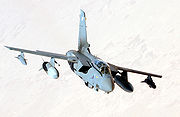 Numerous types of combat air patrols have been employed by US military forces since World War II:
Fighter aircraft
A fighter aircraft is a military aircraft designed primarily for air-to-air combat with other aircraft, as opposed to a bomber, which is designed primarily to attack ground targets...
.
A combat air patrol is an aircraft patrol
Patrol
A patrol is commonly a group of personnel, such as police officers or soldiers, that are assigned to monitor a specific geographic area.- Military :...
provided over an objective area, over the force protected, over the critical area of a combat zone, or over an air defense area, for the purpose of intercepting and destroying hostile aircraft before they reach their target. Combat air patrols apply to both overland and overwater operations, protecting other aircraft, fixed and mobile sites on land, or ship
Ship
Since the end of the age of sail a ship has been any large buoyant marine vessel. Ships are generally distinguished from boats based on size and cargo or passenger capacity. Ships are used on lakes, seas, and rivers for a variety of activities, such as the transport of people or goods, fishing,...
s at sea.
Known by the acronym CAP, it typically entails fighters flying a tactical pattern around or screening a defended target, while looking for incoming attackers. Effective CAP patterns may include aircraft positioned at both high and low altitudes, in order to shorten response times when an attack is detected. Modern CAPs are either GCI
Ground-controlled interception
Ground-controlled interception an air defense tactic whereby one or more radar stations are linked to a command communications centre which guides interceptor aircraft to an airborne target. This tactic was pioneered during World War II by the Royal Air Force with the Luftwaffe to follow closely...
or AWACS-controlled to provide maximum early warning for defensive reaction.
The first CAPs were characteristic of aircraft carrier
Aircraft carrier
An aircraft carrier is a warship designed with a primary mission of deploying and recovering aircraft, acting as a seagoing airbase. Aircraft carriers thus allow a naval force to project air power worldwide without having to depend on local bases for staging aircraft operations...
operations, where CAPs were flown to protect a carrier battle group
Carrier battle group
A carrier battle group consists of an aircraft carrier and its escorts, together composing the group. The first naval task forces built around carriers appeared just prior to and during World War II. The Imperial Japanese Navy was the first to assemble a large number of carriers into a single...
, but the term has become generic to both Air Force and Navy flight operations. Capping operations differ from fighter escorts in that the CAP force is not tied to the group it is protecting, is not limited in altitudes and speeds it flies, and has tactical flexibility to engage a threat. Fighter escorts typically stay with the asset they are supporting and at the speed of the supported group, as a final reactive force against a close threat. When an escort engages, the supported force is left unprotected.
CAP types
- BARCAP: "Barrier Combat Air Patrol", in fleet terms, a mission flown between a carrier battle group and the direction from which it is most likely that an enemy attack will come. Also refers to fighter aircraft placed between a friendly strike force and an area of expected airborne threat, also known as a "MiG screen".
- CAP/Strike: Aircraft with a primary CAP role and a secondary strike role; such aircraft are permitted to jettison strike ordnance and actively pursue any enemy aircraft sighted, and are not restricted to defensive encounters.
- FastCAP: Combat air patrol to protect fighter strike aircraft.
- FORCAP: "Force Combat Air Patrol", a patrol of fighters maintained over the strike force, essentially an escort.
- HAVCAP: "High Asset Value Combat Air Patrol", flown to protect a "high-value asset" such as an AWACS aircraft or aerial refuelingAerial refuelingAerial refueling, also called air refueling, in-flight refueling , air-to-air refueling or tanking, is the process of transferring fuel from one aircraft to another during flight....
aircraft during its specific time on station.
- MiGCAP: Used primarily during the Vietnam WarVietnam WarThe Vietnam War was a Cold War-era military conflict that occurred in Vietnam, Laos, and Cambodia from 1 November 1955 to the fall of Saigon on 30 April 1975. This war followed the First Indochina War and was fought between North Vietnam, supported by its communist allies, and the government of...
, a MiGCAP is directed specifically against MiG aircraft. MiGCAP during Operation LinebackerOperation LinebackerOperation Linebacker was the title of a U.S. Seventh Air Force and U.S. Navy Task Force 77 aerial interdiction campaign conducted against the Democratic Republic of Vietnam from 9 May to 23 October 1972, during the Vietnam War....
became highly organized and threefold:- an ingress MiGCAP of 2-3 flights (8-12 fighters) that preceded the first supporting forces such as chaffChaff (radar countermeasure)Chaff, originally called Window by the British, and Düppel by the Second World War era German Luftwaffe , is a radar countermeasure in which aircraft or other targets spread a cloud of small, thin pieces of aluminium, metallized glass fibre or plastic, which either appears as a cluster of secondary...
bombers or SAMSurface-to-air missileA surface-to-air missile or ground-to-air missile is a missile designed to be launched from the ground to destroy aircraft or other missiles...
suppressors and remained until they departed the hostile zone; - a target area MiGCAP of at least 2 flights that immediately preceded the actual strikers; and
- an egress MiGCAP of 1 or 2 flights that arrived on station at the projected exit point ten minutes prior to the earliest egress time. All egress MiGCAP flights were fully fueled from tankers and relieved the target area CAP.
- an ingress MiGCAP of 2-3 flights (8-12 fighters) that preceded the first supporting forces such as chaff
- RESCAP: "Rescue Combat Air Patrol", a fighter force, often drawn from aircraft already in the area, used to protect personnel on the ground (such as downed pilots) from ground threats, as well as combat search and rescueCombat search and rescueCombat search and rescue are search and rescue operations that are carried out during war that are within or near combat zones.A CSAR mission may be carried out by a task force of helicopters, ground-attack aircraft, tankers and an airborne command post...
aircraft or other rescue forces from both ground and air threats.
- SARCAP: "Search and Rescue Combat Air Patrol", an earlier version of RESCAP.
- Slow CAP: A combat air patrol to protect slower aircraft, such as the EB-66, B-52, or EC-121 during the Vietnam War, replaced by "HAVCAP".
- Strike/CAP: Aircraft with a primary strike role and a secondary air defense role, permitted to jettison strike ordnance and engage enemy aircraft only if directly attacked. Strike/CAP aircraft also have an egress CAP role once strike ordnance has been delivered on target.
- TARCAP: "Target Combat Air Patrol" is flown over or near a strike target in order to protect specialized attack aircraft such as AC-130 gunships from enemy fighters.
Popular culture
- The real-life activity inspired the computer game Combat Air Patrol, a flight simulatorFlight simulatorA flight simulator is a device that artificially re-creates aircraft flight and various aspects of the flight environment. This includes the equations that govern how aircraft fly, how they react to applications of their controls and other aircraft systems, and how they react to the external...
published by Psygnosis in 1995. - In the television shows Battlestar GalacticaBattlestar GalacticaBattlestar Galactica is an American science fiction franchise created by Glen A. Larson. The franchise began with the Battlestar Galactica TV series in 1978, and was followed by a brief sequel TV series in 1980, a line of book adaptations, original novels, comic books, a board game, and video games...
and Battlestar Galactica (re-imagining), skirmisher pilots based aboard the eponymous capital shipCapital shipThe capital ships of a navy are its most important warships; they generally possess the heaviest firepower and armor and are traditionally much larger than other naval vessels...
must maintain a CAP in flight at all times.
Further reading
- Futrell, L. Frank, etal. (1976) United States Air Force in Southeast Asia: Aces and Aerial Victories - 1965-1973, Air University, Headquarters USAF, on-line edition
- Griffith, Paddy (1991). The Ultimate Weaponry. Sidgwick & Jackson.