

Seppuku

Encyclopedia
Japan
Japan is an island nation in East Asia. Located in the Pacific Ocean, it lies to the east of the Sea of Japan, China, North Korea, South Korea and Russia, stretching from the Sea of Okhotsk in the north to the East China Sea and Taiwan in the south...
ese ritual suicide
Suicide
Suicide is the act of intentionally causing one's own death. Suicide is often committed out of despair or attributed to some underlying mental disorder, such as depression, bipolar disorder, schizophrenia, alcoholism, or drug abuse...
by disembowelment
Disembowelment
Disembowelment is the removal of some or all of the organs of the gastrointestinal tract , usually through a horizontal incision made across the abdominal area. Disembowelment may result from an accident, but has also been used as a method of torture and execution...
. Seppuku was originally reserved only for samurai
Samurai
is the term for the military nobility of pre-industrial Japan. According to translator William Scott Wilson: "In Chinese, the character 侍 was originally a verb meaning to wait upon or accompany a person in the upper ranks of society, and this is also true of the original term in Japanese, saburau...
. Part of the samurai bushido
Bushido
, meaning "Way of the Warrior-Knight", is a Japanese word which is used to describe a uniquely Japanese code of conduct and a way of the samurai life, loosely analogous to the concept of chivalry. It originates from the samurai moral code and stresses frugality, loyalty, martial arts mastery, and...
honor code, seppuku was either used voluntarily by samurai to die with honor rather than fall into the hands of their enemies (and likely suffer torture
Torture
Torture is the act of inflicting severe pain as a means of punishment, revenge, forcing information or a confession, or simply as an act of cruelty. Throughout history, torture has often been used as a method of political re-education, interrogation, punishment, and coercion...
), or as a form of capital punishment
Capital punishment
Capital punishment, the death penalty, or execution is the sentence of death upon a person by the state as a punishment for an offence. Crimes that can result in a death penalty are known as capital crimes or capital offences. The term capital originates from the Latin capitalis, literally...
for samurai who had committed serious offenses, or performed for other reasons that had brought shame
Shame society
In cultural anthropology, a shame society is the concept that, in a given society, the primary device for gaining control over children and maintaining social order is the inculcation of shame and the complementary threat of ostracism...
to them. The ceremonial disembowelment, which is usually part of a more elaborate ritual and performed in front of spectators, consists of plunging a short blade, traditionally a tantō
Tanto
A is one of the traditional Japanese swords that were worn by the samurai class of feudal Japan. The tantō dates to the Heian period, when it was mainly used as a weapon but evolved in design over the years to become more ornate...
, into the abdomen and moving the blade from left to right in a slicing motion.
Vocabulary and etymology
Seppuku is also known as harakiri (腹切り, "cutting the belly") and is written with the same kanjiKanji
Kanji are the adopted logographic Chinese characters hanzi that are used in the modern Japanese writing system along with hiragana , katakana , Indo Arabic numerals, and the occasional use of the Latin alphabet...
as seppuku, but in reverse order with an okurigana
Okurigana
are kana suffixes following kanji stems in Japanese written words. They serve two purposes: to inflect adjectives and verbs, and to disambiguate kanji with multiple readings...
. In Japanese, the more formal seppuku, a Chinese on'yomi reading, is typically used in writing, while harakiri, a native kun'yomi reading, is used in speech. Ross notes,
"It is commonly pointed out that hara-kiri is a vulgarism, but this is a misunderstanding. Hara-kiri is a Japanese reading or Kun-yomi of the characters; as it became customary to prefer Chinese readings in official announcements, only the term seppuku was ever used in writing. So hara-kiri is a spoken term and seppuku a written term for the same act."
The practice of committing seppuku at the death of one's master, known as oibara (追腹 or 追い腹, the kun'yomi or Japanese
Japanese language
is a language spoken by over 130 million people in Japan and in Japanese emigrant communities. It is a member of the Japonic language family, which has a number of proposed relationships with other languages, none of which has gained wide acceptance among historical linguists .Japanese is an...
reading) or tsuifuku (追腹, the on'yomi or Chinese
Chinese language
The Chinese language is a language or language family consisting of varieties which are mutually intelligible to varying degrees. Originally the indigenous languages spoken by the Han Chinese in China, it forms one of the branches of Sino-Tibetan family of languages...
reading), follows a similar ritual.
Overview
The first recorded act of seppuku was performed by Minamoto no YorimasaMinamoto no Yorimasa
' was a prominent Japanese poet whose works appeared in various anthologies. He served eight different emperors in his long career, holding posts such as hyōgo no kami...
during the Battle of Uji
Battle of Uji (1180)
The first battle of Uji is famous and important for having opened the Genpei War.In early 1180, Prince Mochihito, the Minamoto Clan's favored claimant to the Imperial Throne, was chased by Taira forces to the Mii-dera, a temple just outside Kyoto....
in the year 1180. Seppuku eventually became a key part of bushido
Bushido
, meaning "Way of the Warrior-Knight", is a Japanese word which is used to describe a uniquely Japanese code of conduct and a way of the samurai life, loosely analogous to the concept of chivalry. It originates from the samurai moral code and stresses frugality, loyalty, martial arts mastery, and...
, the code of the samurai
Samurai
is the term for the military nobility of pre-industrial Japan. According to translator William Scott Wilson: "In Chinese, the character 侍 was originally a verb meaning to wait upon or accompany a person in the upper ranks of society, and this is also true of the original term in Japanese, saburau...
warriors; it was used by warriors to avoid falling into enemy hands, and to attenuate shame and avoid possible torture
Torture
Torture is the act of inflicting severe pain as a means of punishment, revenge, forcing information or a confession, or simply as an act of cruelty. Throughout history, torture has often been used as a method of political re-education, interrogation, punishment, and coercion...
. Samurai could also be ordered by their daimyo
Daimyo
is a generic term referring to the powerful territorial lords in pre-modern Japan who ruled most of the country from their vast, hereditary land holdings...
(feudal
Feudalism
Feudalism was a set of legal and military customs in medieval Europe that flourished between the 9th and 15th centuries, which, broadly defined, was a system for ordering society around relationships derived from the holding of land in exchange for service or labour.Although derived from the...
lords) to carry out seppuku. Later, disgraced warriors were sometimes allowed to carry out seppuku rather than be executed in the normal manner. The most common form of seppuku for men was composed of the cutting of the abdomen, and when the samurai was finished, he stretched out his neck for an assistant to decapitate him. Since the main point of the act was to restore or protect one's honor as a warrior, those who did not belong to the samurai caste were never ordered or expected to carry out seppuku. Samurai generally could carry out the act only with permission.
Sometimes a daimyo
Daimyo
is a generic term referring to the powerful territorial lords in pre-modern Japan who ruled most of the country from their vast, hereditary land holdings...
was called upon to perform seppuku as the basis of a peace agreement. This would weaken the defeated clan so that resistance would effectively cease. Toyotomi Hideyoshi
Toyotomi Hideyoshi
was a daimyo warrior, general and politician of the Sengoku period. He unified the political factions of Japan. He succeeded his former liege lord, Oda Nobunaga, and brought an end to the Sengoku period. The period of his rule is often called the Momoyama period, named after Hideyoshi's castle...
used an enemy's suicide in this way on several occasions, the most dramatic of which effectively ended a dynasty of daimyo. When the Hōjō
Late Hojo clan
The ' was one of the most powerful warrior clans in Japan in the Sengoku period and held domains primarily in the Kantō region.The clan is traditionally reckoned to be started by Ise Shinkurō, who came from a branch of the prestigious Ise clan, a family in the direct employment of the Ashikaga...
were defeated at Odawara
Siege of Odawara (1590)
The third ' occurred in 1590, and was the primary action in Toyotomi Hideyoshi's campaign to eliminate the Hōjō clan as a threat to his power. The months leading up to it saw hasty but major improvements in the defense of the castle, as Hideyoshi's intentions became clear...
in 1590, Hideyoshi insisted on the suicide of the retired daimyo Hōjō Ujimasa
Hojo Ujimasa
was the fourth head of the late Hōjō clan, and daimyo of Odawara.Ujimasa commanded in many battles, consolidating his clan's position, and retired in 1590. His son Hōjō Ujinao became head of the clan and lord of Odawara, but later that year they failed to hold Odawara against the forces of Toyotomi...
, and the exile of his son Ujinao
Hojo Ujinao
Hōjō Ujinao was a Japanese daimyo of the late Sengoku period, and the final head of the Late Hōjō clan. An important figure in the history of Azuchi-Momoyama politics, he lost his entire domain following the siege in 1590...
; with this act of suicide, the most powerful daimyo family in eastern Japan was put to an end.
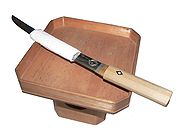
Ritual
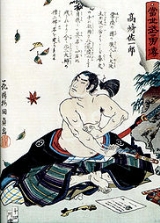
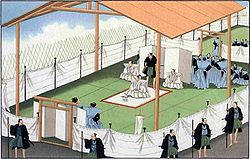
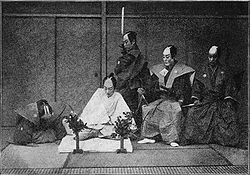
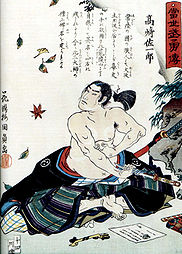
In time, carrying out seppuku came to involve a detailed ritual. This was usually performed in front of spectators if it was a planned seppuku, not one performed on a battlefield. A samurai was bathed, dressed in white robes, and fed his favorite meal. When he had finished, his instrument was placed on his plate. Dressed ceremonially, with his sword placed in front of him and sometimes seated on special cloths, the warrior would prepare for death by writing a death poemDeath poem
A death poem is a poem written near the time of one's own death. It is a tradition for literate people to write one in a number of different cultures, especially in Joseon Korea and Japan.-History:...
.
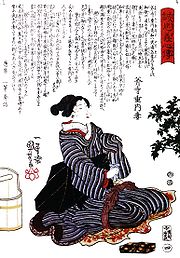
Kaishakunin
A kaishakunin is an appointed second whose duty is to behead one who has committed seppuku, Japanese ritual suicide, at the moment of agony...
, his second) standing by, he would open his kimono
Kimono
The is a Japanese traditional garment worn by men, women and children. The word "kimono", which literally means a "thing to wear" , has come to denote these full-length robes...
(robe), take up his tantō
Tanto
A is one of the traditional Japanese swords that were worn by the samurai class of feudal Japan. The tantō dates to the Heian period, when it was mainly used as a weapon but evolved in design over the years to become more ornate...
(knife) or wakizashi
Wakizashi
The is one of the traditional Japanese swords worn by the samurai class in feudal Japan.-Description:...
(short sword)—which the samurai held by the blade with a portion of cloth wrapped around so that it would not cut his hand and cause him to lose his grip—and plunge it into his abdomen, making a left-to-right cut. The kaishakunin would then perform kaishaku, a cut in which the warrior was decapitated. The maneuver should be done in the manners of dakikubi (lit. "embraced head"), in which way a slight band of flesh is left attaching the head to the body, so that it be hung in front as if embraced. Because of the precision necessary for such a maneuver, the second was a skilled swordsman. The principal and the kaishakunin agreed in advance when the latter was to make his cut. Usually dakikubi would occur as soon as the dagger was plunged into the abdomen. The process became so highly ritualised that as soon as the samurai reached for his blade the kaishakunin would strike. Eventually even the blade became unnecessary and the samurai could reach for something symbolic like a fan and this would trigger the killing stroke from his second. The fan was likely used when the samurai was too old to use the blade, or in situations where it was too dangerous to give him a weapon in such circumstances.
This elaborate ritual evolved after seppuku had ceased being mainly a battlefield or wartime practice and become a para-judicial institution.
The second was usually, but not always, a friend. If a defeated warrior had fought honorably and well, an opponent who wanted to salute his bravery would volunteer to act as his second.
In the Hagakure
Hagakure
Hagakure , or is a practical and spiritual guide for a warrior, drawn from a collection of commentaries by the samurai Yamamoto Tsunetomo, former retainer to Nabeshima Mitsushige, the third ruler of what is now the Saga prefecture in Japan...
, Yamamoto Tsunetomo
Yamamoto Tsunetomo
, also read Yamamoto Jōchō was a samurai of the Saga Domain in Hizen Province under his lord Nabeshima Mitsushige. For thirty years Yamamoto devoted his life to the service of his lord and clan...
wrote:
A specialized form of seppuku in feudal times was known as kanshi (諫死, "remonstration death/death of understanding"), in which a retainer would commit suicide in protest of a lord's decision. The retainer would make one deep, horizontal cut into his stomach, then quickly bandage the wound. After this, the person would then appear before his lord, give a speech in which he announced the protest of the lord's action, then reveal his mortal wound. This is not to be confused with funshi (憤死, indignation death), which is any suicide made to state dissatisfaction or protest. A fictional variation of kanshi was the act of kagebara (陰腹, "shadow stomach") in Japanese theater, in which the protagonist, at the end of the play, would announce to the audience that he had committed an act similar to kanshi, a predetermined slash to the stomach followed by a tight field dressing, and then perish, bringing about a dramatic end.
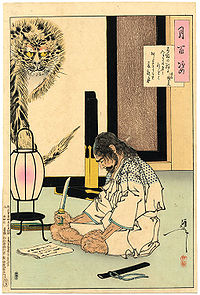
Seppuku as capital punishment
While the voluntary seppuku described above is the best known form, in practice the most common form of seppuku was obligatory seppuku, used as a form of capital punishmentCapital punishment
Capital punishment, the death penalty, or execution is the sentence of death upon a person by the state as a punishment for an offence. Crimes that can result in a death penalty are known as capital crimes or capital offences. The term capital originates from the Latin capitalis, literally...
for disgraced samurai, especially for those who committed a serious offense such as unprovoked murder, robbery, corruption, or treason. The samurai were generally told of their offence in full and given a set time to commit seppuku, usually before sunset on a given day. If the sentenced was uncooperative, it was not unheard of for them to be restrained, or for the actual execution to be carried out by decapitation while retaining only the trappings of seppuku; even the short sword laid out in front of the offender could be replaced with a fan. Unlike voluntary seppuku, seppuku carried out as capital punishment did not necessarily absolve the offender's family of the crime. Depending on the severity of the crime, half or all of the deceased's property could be confiscated, and the family stripped of rank.
European witness
The first recorded time a European saw formal seppuku was the "Sakai IncidentSakai incident
The was the killing of 11 French sailors from the French corvette Dupleix in the port of Sakai near Osaka, Japan in 1868.On March 8, 1868, a skiff sent to Sakai was attacked by samurai of the Tosa clan; 11 sailors and Midshipman Guillou were killed...
" of 1868. On February 15, eleven French sailors of the Dupleix
FS Dupleix (1861)
The Dupleix was a steam and sail corvette of the French Marine Nationale. She was the first French vessel named after the 18th Century Governor of Pondichéry and Gouverneur Général of the French possessions in India marquess Joseph François Dupleix.After her commissioning, the Dupleix was sent to...
entered a Japanese town called Sakai
Sakai, Osaka
is a city in Osaka Prefecture, Japan. It has been one of the largest and most important seaports of Japan since the Medieval era.Following the February 2005 annexation of the town of Mihara, from Minamikawachi District, the city has grown further and is now the fourteenth most populous city in...
without official permission. Their presence caused panic among the residents. Security forces were dispatched to turn the sailors back to their ship, but a fight broke out and the sailors were shot dead. Upon the protest of the French representative, financial compensation was paid and those responsible were sentenced to death. The French captain was present to observe the execution. As each samurai committed ritual disembowelment, the violent act shocked the captain, and he requested a pardon, due to which nine of the samurai were spared. This incident was dramatised in a famous short story, Sakai Jiken, by Mori Ōgai
Mori Ogai
was a Japanese physician, translator, novelist and poet. is considered his major work.- Early life :Mori was born as Mori Rintarō in Tsuwano, Iwami province . His family were hereditary physicians to the daimyō of the Tsuwano Domain...
.
In the 1860s, the British Ambassador to Japan, Algernon Freeman-Mitford (Lord Redesdale) lived within sight of Sengaku-ji
Sengaku-ji
Sengakuji is a Sōtō Zen Buddhist temple located in the Takanawa neighborhood of Minato-ku, near Shinagawa Station, Tokyo, Japan.The graves of Asano Takumi no Kami Naganori and the Forty-seven Ronin are there.-External links:* - in Japanese...
where the Forty-seven Ronin
Forty-seven Ronin
The revenge of the , also known as the Forty-seven Samurai, the Akō vendetta, or the took place in Japan at the start of the 18th century...
are buried. In his book Tales of Old Japan, he describes a man who had come to the graves to kill himself:
Mitford also describes his friend's eyewitness account of a Seppuku:
During the Meiji Restoration
Meiji Restoration
The , also known as the Meiji Ishin, Revolution, Reform or Renewal, was a chain of events that restored imperial rule to Japan in 1868...
, the Tokugawa Shogun's aide committed Seppuku:
In his book Tales of Old Japan, Mitford describes witnessing a hara-kiri:
"As a corollary to the above elaborate statement of the ceremonies proper to be observed at the harakiri, I may here describe an instance of such an execution which I was sent officially to witness. The condemned man was Taki Zenzaburo, an officer of the Prince of BizenBizen Provincewas a province of Japan on the Inland Sea side of Honshū, in what is today the southeastern part of Okayama Prefecture. It was sometimes called , with Bitchu and Bingo Provinces. Bizen borders Mimasaka, Harima, and Bitchū Provinces....
, who gave the order to fire upon the foreign settlement at HyōgoHyogo Prefectureis a prefecture of Japan located in the Kansai region on Honshū island. The capital is Kobe.The prefecture's name was previously alternately spelled as Hiogo.- History :...
in the month of February 1868,—an attack to which I have alluded in the preamble to the story of the Eta Maiden and the HatamotoHatamotoA was a samurai in the direct service of the Tokugawa shogunate of feudal Japan. While all three of the shogunates in Japanese history had official retainers, in the two preceding ones, they were referred to as gokenin. However, in the Edo period, hatamoto were the upper vassals of the Tokugawa...
. Up to that time no foreigner had witnessed such an execution, which was rather looked upon as a traveller's fable.
The ceremony, which was ordered by the MikadoEmperor of JapanThe Emperor of Japan is, according to the 1947 Constitution of Japan, "the symbol of the state and of the unity of the people." He is a ceremonial figurehead under a form of constitutional monarchy and is head of the Japanese Imperial Family with functions as head of state. He is also the highest...
himself, took place at 10:30 at night in the temple of Seifukuji, the headquarters of the SatsumaSatsuma Provincewas an old province of Japan that is now the western half of Kagoshima Prefecture on the island of Kyūshū. Its abbreviation is Sasshū .During the Sengoku Period, Satsuma was a fief of the Shimazu daimyo, who ruled much of southern Kyūshū from their castle at Kagoshima city.In 1871, with the...
troops at Hiogo. A witness was sent from each of the foreign legations. We were seven foreigners in all.
After another profound obeisance, Taki Zenzaburo, in a voice which betrayed just so much emotion and hesitation as might be expected from a man who is making a painful confession, but with no sign of either in his face or manner, spoke as follows:
Bowing once more, the speaker allowed his upper garments to slip down to his girdle, and remained naked to the waist. Carefully, according to custom, he tucked his sleeves under his knees to prevent himself from falling backwards; for a noble Japanese gentleman should die falling forwards. Deliberately, with a steady hand, he took the dirk that lay before him; he looked at it wistfully, almost affectionately; for a moment he seemed to collect his thoughts for the last time, and then stabbing himself deeply below the waist on the left-hand side, he drew the dirk slowly across to the right side, and, turning it in the wound, gave a slight cut upwards. During this sickeningly painful operation he never moved a muscle of his face. When he drew out the dirk, he leaned forward and stretched out his neck; an expression of pain for the first time crossed his face, but he uttered no sound. At that moment the kaishaku, who, still crouching by his side, had been keenly watching his every movement, sprang to his feet, poised his sword for a second in the air; there was a flash, a heavy, ugly thud, a crashing fall; with one blow the head had been severed from the body.
A dead silence followed, broken only by the hideous noise of the blood throbbing out of the inert heap before us, which but a moment before had been a brave and chivalrous man. It was horrible.
The kaishaku made a low bow, wiped his sword with a piece of rice paper which he had ready for the purpose, and retired from the raised floor; and the stained dirk was solemnly borne away, a bloody proof of the execution.
The two representatives of the Mikado then left their places, and, crossing over to where the foreign witnesses sat, called us to witness that the sentence of death upon Taki Zenzaburo had been faithfully carried out. The ceremony being at an end, we left the temple.
The ceremony, to which the place and the hour gave an additional solemnity, was characterized throughout by that extreme dignity and punctiliousness which are the distinctive marks of the proceedings of Japanese gentlemen of rank; and it is important to note this fact, because it carries with it the conviction that the dead man was indeed the officer who had committed the crime, and no substitute. While profoundly impressed by the terrible scene it was impossible at the same time not to be filled with admiration of the firm and manly bearing of the sufferer, and of the nerve with which the kaishaku performed his last duty to his master.
Seppuku in modern Japan
Seppuku as judicial punishment was abolished in 1873, shortly after the Meiji RestorationMeiji Restoration
The , also known as the Meiji Ishin, Revolution, Reform or Renewal, was a chain of events that restored imperial rule to Japan in 1868...
, but voluntary seppuku did not completely die out. Dozens of people are known to have committed seppuku since then, including some military men who committed suicide in 1895 as a protest against the return of a conquered territory to China
China
Chinese civilization may refer to:* China for more general discussion of the country.* Chinese culture* Greater China, the transnational community of ethnic Chinese.* History of China* Sinosphere, the area historically affected by Chinese culture...
; by General Nogi and his wife on the death of Emperor Meiji
Emperor Meiji
The or was the 122nd emperor of Japan according to the traditional order of succession, reigning from 3 February 1867 until his death...
in 1912; and by numerous soldiers and civilians who chose to die rather than surrender at the end of World War II
World War II
World War II, or the Second World War , was a global conflict lasting from 1939 to 1945, involving most of the world's nations—including all of the great powers—eventually forming two opposing military alliances: the Allies and the Axis...
. This behavior had been widely praised by propaganda, which made much of a soldier captured in the Shanghai Incident (1932), who returned to the site of his capture to commit seppuku.
In 1970, famed author Yukio Mishima
Yukio Mishima
was the pen name of , a Japanese author, poet, playwright, actor and film director, also remembered for his ritual suicide by seppuku after a failed coup d'état...
and one of his followers committed public seppuku at the Japan Self-Defense Forces
Japan Self-Defense Forces
The , or JSDF, occasionally referred to as JSF or SDF, are the unified military forces of Japan that were established after the end of the post–World War II Allied occupation of Japan. For most of the post-war period the JSDF was confined to the islands of Japan and not permitted to be deployed...
headquarters after an unsuccessful attempt to incite the armed forces to stage a coup d'état
Coup d'état
A coup d'état state, literally: strike/blow of state)—also known as a coup, putsch, and overthrow—is the sudden, extrajudicial deposition of a government, usually by a small group of the existing state establishment—typically the military—to replace the deposed government with another body; either...
. Mishima committed seppuku in the office of General Kanetoshi Mashita. His second, a 25-year-old named Masakatsu Morita
Masakatsu Morita
was the Tatenokai member who attempted to commit seppuku with Yukio Mishima at the Ichigaya Camp.He was the youngest child of a headmaster. Losing both parents at the age of two, he was cared for by his brother Osamu and educated at a Catholic school...
, tried three times to ritually behead Mishima but failed; his head was finally severed by Hiroyasu Koga
Hiroyasu Koga
Hiroyasu Koga is a former Tatenokai member and kaishakunin responsible for the decapitations of Yukio Mishima and Masakatsu Morita during their seppuku on November 25, 1970...
. Morita then attempted to commit seppuku himself. Although his own cuts were too shallow to be fatal, he gave the signal and he too was beheaded by Koga.
Notable people who performed seppuku
- Minamoto no TametomoMinamoto no Tametomowas a samurai who fought in the Hōgen Rebellion of 1156. He was the son of Minamoto no Tameyoshi, and brother to Yukiie and Yoshitomo....
(1139–1170) - Minamoto no YorimasaMinamoto no Yorimasa' was a prominent Japanese poet whose works appeared in various anthologies. He served eight different emperors in his long career, holding posts such as hyōgo no kami...
(1106–1180) - Minamoto no YoshitsuneMinamoto no Yoshitsunewas a general of the Minamoto clan of Japan in the late Heian and early Kamakura period. Yoshitsune was the ninth son of Minamoto no Yoshitomo, and the third and final son and child that Yoshitomo would father with Tokiwa Gozen. Yoshitsune's older brother Minamoto no Yoritomo founded the Kamakura...
(1159–1189) - Azai NagamasaAzai Nagamasawas a Daimyo during the Sengoku period of Japan. His clan, the Azai, were located in northern Ōmi Province, east of Lake Biwa. He was both the brother-in-law of Oda Nobunaga, starting in 1564, and one of Nobunaga's enemies from 1570-1573. Nagamasa and his clan were utterly destroyed by Oda...
(1545–1573) - Oda NobunagaOda Nobunagawas the initiator of the unification of Japan under the shogunate in the late 16th century, which ruled Japan until the Meiji Restoration in 1868. He was also a major daimyo during the Sengoku period of Japanese history. His opus was continued, completed and finalized by his successors Toyotomi...
(1534–1582) - Takeda KatsuyoriTakeda Katsuyoriwas a Japanese daimyo of the Sengoku Period, who was famed as the head of the Takeda clan and the successor to the legendary warlord Takeda Shingen. He was the son of Shingen by the , the daughter of Suwa Yorishige...
(1546–1582) - Shibata KatsuieShibata Katsuieor was a Japanese military commander during the Sengoku Period who served Oda Nobunaga.-Biography:Katsuie was born in the Shibata family, a branch of the Shiba clan . Note the differences between , , and the .Katsuie was the retainer of Oda Nobukatsu...
(1522–1583) - Hōjō UjimasaHojo Ujimasawas the fourth head of the late Hōjō clan, and daimyo of Odawara.Ujimasa commanded in many battles, consolidating his clan's position, and retired in 1590. His son Hōjō Ujinao became head of the clan and lord of Odawara, but later that year they failed to hold Odawara against the forces of Toyotomi...
(1538–1590) - Sen no RikyūSen no Rikyu, is considered the historical figure with the most profound influence on chanoyu, the Japanese "Way of Tea", particularly the tradition of wabi-cha...
(1522–1591) - Torii MototadaTorii Mototadawas a Japanese samurai of the Sengoku period through late Azuchi-Momoyama Period, who served Tokugawa Ieyasu. Torii died at the siege of Fushimi where his garrison was greatly outnumbered and destroyed by the army of Ishida Mitsunari...
(1539-1600) - Forty-six of the Forty-seven RoninForty-seven RoninThe revenge of the , also known as the Forty-seven Samurai, the Akō vendetta, or the took place in Japan at the start of the 18th century...
(1703) - Watanabe KazanWatanabe Kazanwas a Japanese painter, scholar and statesman member of the samurai class.- Early life :He was born Watanabe Sadayasu in Edo to a poor samurai family, and his artistic talent was developed from an early age. His family served the lord of the Tahara Domain, located in present day Aichi prefecture....
(1793–1841)
- Tanaka Shinbei (1832–1863)
- Takechi HanpeitaTakechi Hanpeita, also known as , was a samurai of the Tosa han during the Bakumatsu period in Japan. As leader of the Tosa Kin no To, which supported the Sonnō Jōi movement, he tried to take control of the Tosa Han and receive the support of Sakamoto Ryōma, but was arrested for the assassination of Yoshida Tōyō...
(1829–1865) - Yamanami KeisukeYamanami Keisukewas a Japanese samurai. He was the General Secretary of the Shinsengumi, a special police force in Kyoto during the late Edo period.-Background:...
(1833–1865) - ByakkotaiByakkotaiThe was a group of around 305 young, teenage, samurai of the Aizu domain, who fought in the Boshin War .-History:Byakkotai was part of Aizu's four-unit military, set up in the domain's drive to finalize its military modernization, in the wake of the Battle of Toba-Fushimi. The other three units...
(group of 16-17 year old warriors of Aizu-han in 1868) - Saigō TakamoriSaigo Takamoriwas one of the most influential samurai in Japanese history, living during the late Edo Period and early Meiji Era. He has been dubbed the last true samurai.-Early life:...
(1828–1877) - Nogi Maresuke (1849–1912)
- Chujiro HayashiChujiro Hayashi, a disciple of Mikao Usui, played a major role in the transmission of Reiki out of Japan and for turning it into a less mystical practice.Hayashi was a naval physician, and employed Reiki to treat his patients. He began studying with Usui in 1925. The following year, he took over Usui's clinic...
(林 忠次郎) (1879–1940) - Korechika Anami (1887–1945)
- Takijirō Ōnishi (1891–1945)
- Yukio MishimaYukio Mishimawas the pen name of , a Japanese author, poet, playwright, actor and film director, also remembered for his ritual suicide by seppuku after a failed coup d'état...
(1925–1970) - Dédé FortinDédé FortinAndré "Dédé" Fortin was the leader and singer of the Québecois band Les Colocs, formed in 1990.-Early life:...
(1962–2000) - Isao InokumaIsao Inokumawas a judoka who competed in the +80 kg and Open divisions.- Biography :Inokuma was born in Yokosuka, Kanagawa, and began judo at age 15. He entered the Tokyo University of Education and won the All-Japan Judo Championships in 1959 at only 21 years of age to become the first student competitor to...
(1938–2001)
See also
- 'Harakiri – the classic Kobayashi film
- Japanese funeralJapanese funeralA Japanese funeral A Japanese funeral A Japanese funeral (葬儀 sōgi or 葬式 sōshiki)includes a wake, the cremation of the deceased, a burial in a family grave, and a periodic memorial service. According to 2007 statistics, 99.81% of deceased Japanese are cremated...
- JigaiJigaiThe word means "suicide" in Japanese. The usual modern word for suicide is . Related words include , and . Jigai refers to suicide by both females and males....
- JunshiJunshi, refers to the medieval Japanese act of vassals committing seppuku upon the death of their lord...
– following the lord in death
- KamikazeKamikazeThe were suicide attacks by military aviators from the Empire of Japan against Allied naval vessels in the closing stages of the Pacific campaign of World War II, designed to destroy as many warships as possible....
- PuputanPuputanPuputan is a Balinese term that refers to a mass ritual suicide in preference to facing the humiliation of surrender. Notable puputans occurred in 1906 and 1908 when the Balinese were being subjugated by the Dutch.- 1906 Badung puputan :...
, Indonesian ritual suicide - Seigō Nakano
- Suicide in JapanSuicide in JapanSuicide in Japan has become a significant problem nationally. Factors in suicide include unemployment , depression, and social pressures. In 2007, the National Police Agency revised the categorization of motives for suicide into a division of 50 reasons with up to three reasons listed for each...
- Shame societyShame societyIn cultural anthropology, a shame society is the concept that, in a given society, the primary device for gaining control over children and maintaining social order is the inculcation of shame and the complementary threat of ostracism...