

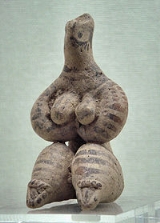
History of Syria

Encyclopedia
The history of Syria
:
culture (PPNA) where agriculture and cattle breeding appeared for the first time in the world. The following Neolithic period (PPNB) is represented by rectangular houses of Mureybet
culture. At the time of the pre-pottery Neolithic people used vessels made of stone, gyps and burnt lime (Vaiselles blanches). Finds of obsidian
tools from Anatolia
are evidences of early trade relations.
Cities of Hamoukar
and Emar
played an important role during the late Neolithic and Bronze Age.
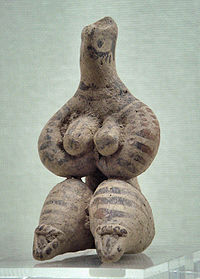 Archaeologists have demonstrated that civilization in Syria was one of the most ancient on earth. Around the excavated city of Ebla
in northern Syria, an Italian mission led by Prof. Paolo Matthiae
discovered in 1975 a great Semitic empire, spread from the Red Sea
north to Turkey
and east to Mesopotamia
from 2500 to 2400 BCE.
Ebla appears to have been founded around 3000 BCE and gradually built its empire through trade with the cities of Sumer
and Akkad
, as well as with peoples to the northwest. Gifts from Pharaoh found during excavations confirm Ebla's contact with Egypt
. Scholars believe the language of Ebla to be among the oldest known written Semitic languages
. The Eblaite civilization was likely conquered by Sargon of Akkad
around 2260 BCE; the city was restored as the nation of the Amorites a few centuries later and flourished through the early second millennium BCE until conquered by the Hittites
.
During the second millennium BCE, Syria was occupied successively by Canaan
ites, Phoenicia
ns, and Arameans as part of the general disruptions associated with the Sea Peoples
; the Phoenicians settled along the coastline of these area as well as in the west (Now Lebanon
& The current Syria
n coast), in the area already known for its cedars. Egyptians
, Sumerians, Assyrians
, Babylonians, and Hittites
variously occupied the strategic ground of Syria during this period, as it was a marchland between their various empires.
after Alexander the Great's conquests (after whose death hegemony of Syria passed from the Antigonids
and subsequently the Seleucids) and from thence to the Romans
and the Byzantines
.
In 83 BC Syria fell under the rule of Tigranes the Great
; the King of Armenia. The Armenians maintained a rule of 13 years over Syria which was finally turned into a Roman Province in 64 BC.
 Syria
Syria
was Roman
(Byzantine) province from 64 BC
to 636
AD.
In the Roman period, the great city of Antioch
(called "the Athens of the east" at that time) was the capital of Syria. It was one of the largest cities in the ancient world, with a total estimated population of 500,000, as well as one of the largest centers of trade and industry. As one of the wealthiest and more populous provinces of the Roman Empire, it is estimated that the population of Roman Syria in the early Roman Empire was only exceeded in the mid-20th century, when it may have been as high as 7-8 million or more, if Palestine and Jordan are included, but not including the eastern section of modern day Syria beyond the Euphrates.
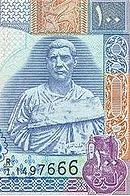
In the 3rd century Syria was home to Elagabalus
, a Roman emperor of the Severan dynasty
who reigned from 218
to 222
. Elagabalus' family held hereditary rights to the priesthood of the sun god El-Gabal, of whom Elagabalus was the high priest at Emesa (modern Homs
) in Syria.
Syria is significant in the history of Christianity
; Paul
was converted on the Road to Damascus and emerged as a significant figure in the first organized Christian Church at Antioch
in ancient Syria, from which he left on many of his missionary journeys.
; from 628 to 637 it was Byzantine, when the province was conquered by the Muslims (after the battle of the Yarmuk in 636. see Battle of Yarmuk). Muawiya I, the first Omayyad caliph, chose Damascus for his residence. Syria formed the central part of the Umayyad
empire. Syria was divided into the following military districts (junds):
During the struggles of the Islamic dynasties for the possession of Syria the country still enjoyed a considerable degree of prosperity. In 750, it came under Abbasid
dominion, losing prominence owing to the move of the Abbasid capital to Baghdad
.
In the late 11th century, Syria was conquered first by the Seljuks and then carved between Turkmen tribes and participants of the first Crusade. In time, the Islamic part of Syria expanded up to the Orontes river and became a center of anti-crusader
activity, especially for Zengi
, Nur ad-Din and his successor and rival, Saladin
. Even so, sections of the coastline of Syria were briefly held by Frankish crusader states. In the 13th century, the first Mongols
arrived, destroying cities and irrigation works. By the end of the 15th century, the discovery of a sea route from Europe to the Far East ended the need for an overland trade route
through Syria.
_dervish,_syrian_peasant,_young_druse_woman,_karvass_(police_officer)_in_damascus.jpg)
Shattered by the Mongols, Syria was part of the Ottoman Empire
from the 16th through 20th centuries, and found itself largely apart from, and ignored by, world affairs. It reached the population it had in late Antiquity only in the 1960s.
After World War I, the Ottoman Empire was dissolved with help from the United Kingdom, France and the Arab nation itself, and in 1922 the League of Nations
split the dominion of the former Syria between two countries: the United Kingdom received Transjordan
and Palestine, and France received what was to become modern-day Syria and Lebanon
.
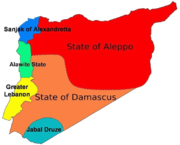
In 1920, an independent Arab Kingdom of Syria
was established under King Faisal
of the Hashemite
family, who later became the King of Iraq
. However, his rule over Syria ended after only a few months, following the clash between his Syrian Arab forces and regular French forces at the Battle of Maysalun
. French troops occupied Syria later that year after the League of Nations
put Syria under French mandate. In 1925, Syrian resistance to French colonial rule broke out in full scale revolt. Despite French attempts to maintain control by encouraging sectarian divisions and isolating urban and rural areas, the revolt spread from the countryside and united Syrian Druze, Sunnis, Shiites, Allawis, and Christians. Once the rebel forces had besieged Damascus, the French military responded with brutal counter-insurgency techniques that prefigured those that would be used later in Algeria and Indo-China. These techniques included house demolitions, collective punishment
s of towns, executions, population transfers, and the use of heavy armor in urban neighborhoods. The revolt was eventually subdued via French aerial bombardment of civilian areas, including Damascus.
Syria and France negotiated a treaty of independence
in September 1936, and Hashim al-Atassi
, who was Prime Minister under King Faisal's brief reign, was the first president to be elected under a new constitution, effectively the first incarnation of the modern republic of Syria. However, France reneged on the treaty and refused to ratify it.
In 1938 the Turkish military went into the Syrian Sanjak of Alexandretta
and expelled most of its Arab and Armenian inhabitants. Before this, Alawi Arabs and Armenians were the majority of Alexandrettas population. The allocation of seats in the provincial assembly was based on the 1938 census held by the French authorities under international supervision: out of 40 seats, 22 were given to the Turks, nine for Alawi
Arabs, five for Armenians, two for Sunni Arabs, and two for Christian Arabs. The assembly was appointed in the summer of 1938 and the French-Turkish treaty settling the status of the Sanjak was signed on July 4, 1938. On September 2, 1938, the assembly proclaimed the Sanjak of Alexandretta as the Republic of Hatay, taking as an excuse that rioting had broken out between Turks and Arabs. The Republic lasted for one year under joint French and Turkish military supervision. The name "Hatay" itself was proposed by Atatürk and the government was under Turkish control. The president Tayfur Sökmen
was a member of Turkish parliament elected in 1935 (representing Antakya
(Greek: Αντιόχεια) and the prime minister Dr. Abdurrahman Melek, was also elected to the Turkish parliament (representing Gaziantep) in 1939 while still holding the prime-ministerial post. In 1939, following a popular referendum, the Republic of Hatay became a Turkish province. For the referendum, Turkey had crossed tens of thousands of Turks into Alexandretta to vote. This referendum has been labeled both "phoney" and "rigged", and that it was a way for the French to let Turks take over the area, hoping that they would turn on Hitler.
With the fall of France in 1940 during World War II, Syria came under the control of the Vichy Government
until the British and Free French occupied the country
in July 1941. Syria proclaimed its independence again in 1941 but it wasn't until January 1, 1944 that it was recognized as an independent republic. On February 26, 1945 Syria declared war on Germany and Japan. Continuing pressure from Syrian nationalist groups and British pressure forced the French to evacuate their troops in April 1946, leaving the country in the hands of a republican government that had been formed during the mandate.
was turned into an Arab Kingdom of Syria
in 1920. Syria came under French Mandate
in 1941, gaining independence in 1946, entering the Arab-Israeli War
in 1948, and remaining in a state of political instability during the 1950s and 1960s.
In a coup
of 1970, Hafez al-Assad
and his Baath Party
took power. Syria was ruled autocratically by Assad during 1970–2000, and after Hafez al-Assad's death in 2000, he was succeeded by his son Bashar al-Assad
.
In the context of the Arab Spring
of 2011, Bashar al-Assad's regime faces the ongoing 2011 Syrian uprising
.
Syria
Syria , officially the Syrian Arab Republic , is a country in Western Asia, bordering Lebanon and the Mediterranean Sea to the West, Turkey to the north, Iraq to the east, Jordan to the south, and Israel to the southwest....
:
- Prehistory and Ancient Near East: see Pre-history of the Southern LevantPre-history of the Southern LevantThe prehistory of the Southern Levant includes the various cultural changes that occurred, as revealed by archaeological evidence, prior to recorded traditions in the area of the Southern Levant, also referred to by a number of other largely overlapping historical designations, including Canaan,...
, Fertile CrescentFertile CrescentThe Fertile Crescent, nicknamed "The Cradle of Civilization" for the fact the first civilizations started there, is a crescent-shaped region containing the comparatively moist and fertile land of otherwise arid and semi-arid Western Asia. The term was first used by University of Chicago...
, EblaEblaEbla Idlib Governorate, Syria) was an ancient city about southwest of Aleppo. It was an important city-state in two periods, first in the late third millennium BC, then again between 1800 and 1650 BC....
, MitanniMitanniMitanni or Hanigalbat was a loosely organized Hurrian-speaking state in northern Syria and south-east Anatolia from ca. 1500 BC–1300 BC... - Antiquity: see Syro-Hittite statesSyro-Hittite statesThe states that are called Neo-Hittite, or more recently Syro-Hittite, were Luwian, Aramaic and Phoenician-speaking political entities of the Iron Age northern Syria and southern Anatolia that arose following the collapse of the Hittite Empire around 1180 BC and lasted until roughly 700 BC...
, Greater SyriaGreater SyriaGreater Syria , also known simply as Syria, is a term that denotes a region in the Near East bordering the Eastern Mediterranean Sea or the Levant....
, Roman Syria - Middle Ages: see Muslim conquest of SyriaMuslim conquest of SyriaThe Muslim conquest of Syria occurred in the first half of the 7th century, and refers to the region known as the Bilad al-Sham, the Levant, or Greater Syria...
, Umayyad Caliphate, Seljuk Empire, County of EdessaCounty of EdessaThe County of Edessa was one of the Crusader states in the 12th century, based around Edessa, a city with an ancient history and an early tradition of Christianity....
, Principality of AntiochPrincipality of AntiochThe Principality of Antioch, including parts of modern-day Turkey and Syria, was one of the crusader states created during the First Crusade.-Foundation:...
, Mongol invasions of Syria, IlkhanateIlkhanateThe Ilkhanate, also spelled Il-khanate , was a Mongol khanate established in Azerbaijan and Persia in the 13th century, considered a part of the Mongol Empire...
, Mamluk Sultanate (Cairo)Mamluk Sultanate (Cairo)The Mamluk Sultanate of Egypt was the final independent Egyptian state prior to the establishment of the Muhammad Ali Dynasty in 1805. It lasted from the overthrow of the Ayyubid Dynasty until the Ottoman conquest of Egypt in 1517. The sultanate's ruling caste was composed of Mamluks, Arabised... - Early Modern era: see Ottoman SyriaOttoman SyriaOttoman Syria is a European reference to the area that during European Renaissance from the late 15th to early 18th century was called the Levant within the early period of the Ottoman Empire, the Orient until the early 19th century, and Greater Syria until 1918...
- Modern era: see French Mandate of SyriaFrench Mandate of SyriaOfficially the French Mandate for Syria and the Lebanon was a League of Nations mandate founded after the First World War and the partitioning of the Ottoman Empire...
, Modern history of SyriaModern history of SyriaOttoman Syria was turned into the short-lived Arab Kingdom of Syria in 1920, which was however soon committed under French Mandate. From 1938 known as a Republic, Syria gained independence in 1946, entering the Arab-Israeli War in 1948, and remaining in a state of political instability during the...
(1946 to present)
Prehistory
Since approximately 10 000 BC Syria was one of centers of NeolithicNeolithic
The Neolithic Age, Era, or Period, or New Stone Age, was a period in the development of human technology, beginning about 9500 BC in some parts of the Middle East, and later in other parts of the world. It is traditionally considered as the last part of the Stone Age...
culture (PPNA) where agriculture and cattle breeding appeared for the first time in the world. The following Neolithic period (PPNB) is represented by rectangular houses of Mureybet
Mureybet
Mureybet is a tell, or ancient settlement mound, located on the west bank of the Euphrates in Ar-Raqqah Governorate, northern Syria. The site was excavated between 1964 and 1974 and has since disappeared under the rising waters of Lake Assad...
culture. At the time of the pre-pottery Neolithic people used vessels made of stone, gyps and burnt lime (Vaiselles blanches). Finds of obsidian
Obsidian
Obsidian is a naturally occurring volcanic glass formed as an extrusive igneous rock.It is produced when felsic lava extruded from a volcano cools rapidly with minimum crystal growth...
tools from Anatolia
Anatolia
Anatolia is a geographic and historical term denoting the westernmost protrusion of Asia, comprising the majority of the Republic of Turkey...
are evidences of early trade relations.
Cities of Hamoukar
Hamoukar
Hamoukar is a large archaeological site located in the Jazira region of northeastern Syria near the Iraqi border and Turkey.-History:...
and Emar
Emar
Emar was an ancient Amorite city on the great bend in the mid-Euphrates in northeastern Syria, now on the shoreline of the man-made Lake Assad. It has been the source of many cuneiform tablets, making it rank with Ugarit, Mari and Ebla among the most important archeological sites of Syria...
played an important role during the late Neolithic and Bronze Age.
Ebla
Ebla Idlib Governorate, Syria) was an ancient city about southwest of Aleppo. It was an important city-state in two periods, first in the late third millennium BC, then again between 1800 and 1650 BC....
in northern Syria, an Italian mission led by Prof. Paolo Matthiae
Paolo Matthiae
Paolo Matthiae is an Italian archaeologist.He was Professor of Archaeology and History of Art of the Ancient Near East in the University of Rome La Sapienza; he has been Director of the Ebla Expedition since 1963—in fact, its discoverer—and has published many articles and books about...
discovered in 1975 a great Semitic empire, spread from the Red Sea
Red Sea
The Red Sea is a seawater inlet of the Indian Ocean, lying between Africa and Asia. The connection to the ocean is in the south through the Bab el Mandeb strait and the Gulf of Aden. In the north, there is the Sinai Peninsula, the Gulf of Aqaba, and the Gulf of Suez...
north to Turkey
Turkey
Turkey , known officially as the Republic of Turkey , is a Eurasian country located in Western Asia and in East Thrace in Southeastern Europe...
and east to Mesopotamia
Mesopotamia
Mesopotamia is a toponym for the area of the Tigris–Euphrates river system, largely corresponding to modern-day Iraq, northeastern Syria, southeastern Turkey and southwestern Iran.Widely considered to be the cradle of civilization, Bronze Age Mesopotamia included Sumer and the...
from 2500 to 2400 BCE.
Ebla appears to have been founded around 3000 BCE and gradually built its empire through trade with the cities of Sumer
Sumer
Sumer was a civilization and historical region in southern Mesopotamia, modern Iraq during the Chalcolithic and Early Bronze Age....
and Akkad
Akkad
The Akkadian Empire was an empire centered in the city of Akkad and its surrounding region in Mesopotamia....
, as well as with peoples to the northwest. Gifts from Pharaoh found during excavations confirm Ebla's contact with Egypt
Ancient Egypt
Ancient Egypt was an ancient civilization of Northeastern Africa, concentrated along the lower reaches of the Nile River in what is now the modern country of Egypt. Egyptian civilization coalesced around 3150 BC with the political unification of Upper and Lower Egypt under the first pharaoh...
. Scholars believe the language of Ebla to be among the oldest known written Semitic languages
Semitic languages
The Semitic languages are a group of related languages whose living representatives are spoken by more than 270 million people across much of the Middle East, North Africa and the Horn of Africa...
. The Eblaite civilization was likely conquered by Sargon of Akkad
Sargon of Akkad
Sargon of Akkad, also known as Sargon the Great "the Great King" , was an Akkadian emperor famous for his conquest of the Sumerian city-states in the 23rd and 22nd centuries BC. The founder of the Dynasty of Akkad, Sargon reigned in the last quarter of the third millennium BC...
around 2260 BCE; the city was restored as the nation of the Amorites a few centuries later and flourished through the early second millennium BCE until conquered by the Hittites
Hittites
The Hittites were a Bronze Age people of Anatolia.They established a kingdom centered at Hattusa in north-central Anatolia c. the 18th century BC. The Hittite empire reached its height c...
.
During the second millennium BCE, Syria was occupied successively by Canaan
Canaan
Canaan is a historical region roughly corresponding to modern-day Israel, Palestine, Lebanon, and the western parts of Jordan...
ites, Phoenicia
Phoenicia
Phoenicia , was an ancient civilization in Canaan which covered most of the western, coastal part of the Fertile Crescent. Several major Phoenician cities were built on the coastline of the Mediterranean. It was an enterprising maritime trading culture that spread across the Mediterranean from 1550...
ns, and Arameans as part of the general disruptions associated with the Sea Peoples
Sea Peoples
The Sea Peoples were a confederacy of seafaring raiders of the second millennium BC who sailed into the eastern Mediterranean, caused political unrest, and attempted to enter or control Egyptian territory during the late 19th dynasty and especially during year 8 of Ramesses III of the 20th Dynasty...
; the Phoenicians settled along the coastline of these area as well as in the west (Now Lebanon
Lebanon
Lebanon , officially the Republic of LebanonRepublic of Lebanon is the most common term used by Lebanese government agencies. The term Lebanese Republic, a literal translation of the official Arabic and French names that is not used in today's world. Arabic is the most common language spoken among...
& The current Syria
Syria
Syria , officially the Syrian Arab Republic , is a country in Western Asia, bordering Lebanon and the Mediterranean Sea to the West, Turkey to the north, Iraq to the east, Jordan to the south, and Israel to the southwest....
n coast), in the area already known for its cedars. Egyptians
Egyptians
Egyptians are nation an ethnic group made up of Mediterranean North Africans, the indigenous people of Egypt.Egyptian identity is closely tied to geography. The population of Egypt is concentrated in the lower Nile Valley, the small strip of cultivable land stretching from the First Cataract to...
, Sumerians, Assyrians
Assyrian people
The Assyrian people are a distinct ethnic group whose origins lie in ancient Mesopotamia...
, Babylonians, and Hittites
Hittites
The Hittites were a Bronze Age people of Anatolia.They established a kingdom centered at Hattusa in north-central Anatolia c. the 18th century BC. The Hittite empire reached its height c...
variously occupied the strategic ground of Syria during this period, as it was a marchland between their various empires.
Ancient history
Eventually the Persians took control of Syria as part of their general control of Southwest Asia; this control transferred to the GreeksGreeks
The Greeks, also known as the Hellenes , are a nation and ethnic group native to Greece, Cyprus and neighboring regions. They also form a significant diaspora, with Greek communities established around the world....
after Alexander the Great's conquests (after whose death hegemony of Syria passed from the Antigonids
Antigonid dynasty
The Antigonid dynasty was a dynasty of Hellenistic kings descended from Alexander the Great's general Antigonus I Monophthalmus .-History:...
and subsequently the Seleucids) and from thence to the Romans
Ancient Rome
Ancient Rome was a thriving civilization that grew on the Italian Peninsula as early as the 8th century BC. Located along the Mediterranean Sea and centered on the city of Rome, it expanded to one of the largest empires in the ancient world....
and the Byzantines
Byzantine Empire
The Byzantine Empire was the Eastern Roman Empire during the periods of Late Antiquity and the Middle Ages, centred on the capital of Constantinople. Known simply as the Roman Empire or Romania to its inhabitants and neighbours, the Empire was the direct continuation of the Ancient Roman State...
.
In 83 BC Syria fell under the rule of Tigranes the Great
Tigranes the Great
Tigranes the Great was emperor of Armenia under whom the country became, for a short time, the strongest state east of the Roman Republic. He was a member of the Artaxiad Royal House...
; the King of Armenia. The Armenians maintained a rule of 13 years over Syria which was finally turned into a Roman Province in 64 BC.
Roman Syria
Syria (Roman province)
Syria was a Roman province, annexed in 64 BC by Pompey, as a consequence of his military presence after pursuing victory in the Third Mithridatic War. It remained under Roman, and subsequently Byzantine, rule for seven centuries, until 637 when it fell to the Islamic conquests.- Principate :The...
was Roman
Roman province
In Ancient Rome, a province was the basic, and, until the Tetrarchy , largest territorial and administrative unit of the empire's territorial possessions outside of Italy...
(Byzantine) province from 64 BC
64 BC
Year 64 BC was a year of the pre-Julian Roman calendar. At the time it was known as the Year of the Consulship of Caesar and Figulus...
to 636
636
Year 636 was a leap year starting on Monday of the Julian calendar. The denomination 636 for this year has been used since the early medieval period, when the Anno Domini calendar era became the prevalent method in Europe for naming years.- Byzantine Empire :* August 20 – Battle of Yarmuk:...
AD.
In the Roman period, the great city of Antioch
Antioch
Antioch on the Orontes was an ancient city on the eastern side of the Orontes River. It is near the modern city of Antakya, Turkey.Founded near the end of the 4th century BC by Seleucus I Nicator, one of Alexander the Great's generals, Antioch eventually rivaled Alexandria as the chief city of the...
(called "the Athens of the east" at that time) was the capital of Syria. It was one of the largest cities in the ancient world, with a total estimated population of 500,000, as well as one of the largest centers of trade and industry. As one of the wealthiest and more populous provinces of the Roman Empire, it is estimated that the population of Roman Syria in the early Roman Empire was only exceeded in the mid-20th century, when it may have been as high as 7-8 million or more, if Palestine and Jordan are included, but not including the eastern section of modern day Syria beyond the Euphrates.
In the 3rd century Syria was home to Elagabalus
Elagabalus
Elagabalus , also known as Heliogabalus, was Roman Emperor from 218 to 222. A member of the Severan Dynasty, he was Syrian on his mother's side, the son of Julia Soaemias and Sextus Varius Marcellus. Early in his youth he served as a priest of the god El-Gabal at his hometown, Emesa...
, a Roman emperor of the Severan dynasty
Severan dynasty
The Severan dynasty was a Roman imperial dynasty, which ruled the Roman Empire between 193 and 235. The dynasty was founded by the Roman general Septimius Severus, who rose to power during the civil war of 193, known as the Year of the Five Emperors....
who reigned from 218
218
Year 218 was a common year starting on Thursday of the Julian calendar. At the time, it was known as the Year of the Consulship of Severus and Adventus...
to 222
222
Year 222 was a common year starting on Tuesday of the Julian calendar. At the time, it was known as the Year of the Consulship of Antoninus and Severus...
. Elagabalus' family held hereditary rights to the priesthood of the sun god El-Gabal, of whom Elagabalus was the high priest at Emesa (modern Homs
Homs
Homs , previously known as Emesa , is a city in western Syria and the capital of the Homs Governorate. It is above sea level and is located north of Damascus...
) in Syria.
Syria is significant in the history of Christianity
History of Christianity
The history of Christianity concerns the Christian religion, its followers and the Church with its various denominations, from the first century to the present. Christianity was founded in the 1st century by the followers of Jesus of Nazareth who they believed to be the Christ or chosen one of God...
; Paul
Paul of Tarsus
Paul the Apostle , also known as Saul of Tarsus, is described in the Christian New Testament as one of the most influential early Christian missionaries, with the writings ascribed to him by the church forming a considerable portion of the New Testament...
was converted on the Road to Damascus and emerged as a significant figure in the first organized Christian Church at Antioch
Antioch
Antioch on the Orontes was an ancient city on the eastern side of the Orontes River. It is near the modern city of Antakya, Turkey.Founded near the end of the 4th century BC by Seleucus I Nicator, one of Alexander the Great's generals, Antioch eventually rivaled Alexandria as the chief city of the...
in ancient Syria, from which he left on many of his missionary journeys.
Umayyad Caliphate
From 616 until 628 Syria was subjugated under the Persian Khosrau IIKhosrau II
250px|thumb|Khosrau II 250px|thumb|Khosrau II 250px|thumb|Khosrau II (Khosrow II, Chosroes II, or Xosrov II in classical sources, sometimes called Parvez, "the Ever Victorious" – (in Persian: خسرو پرویز), was the twenty-second Sassanid King of Persia, reigning from 590 to 628...
; from 628 to 637 it was Byzantine, when the province was conquered by the Muslims (after the battle of the Yarmuk in 636. see Battle of Yarmuk). Muawiya I, the first Omayyad caliph, chose Damascus for his residence. Syria formed the central part of the Umayyad
Umayyad
The Umayyad Caliphate was the second of the four major Arab caliphates established after the death of Muhammad. It was ruled by the Umayyad dynasty, whose name derives from Umayya ibn Abd Shams, the great-grandfather of the first Umayyad caliph. Although the Umayyad family originally came from the...
empire. Syria was divided into the following military districts (junds):
- FilistinJund FilastinJund Filastin was one of several sub-provinces of the Ummayad and Abbasid Caliphate province of Syria, organized soon after the Muslim conquest of Syria in the seventh century. According to al-Biladhuri, the main towns in the district at its capture by the Rashidun Caliphate, were Gaza, Sebastiya,...
(Palestine), consisting of Judaea, Samaria and a portion of the territory east of Jordan; its capital was Ramleh, Jerusalem ranking next. - UrdunnJund al-UrdunnJund al-Urdunn was one of the five districts of Bilad ash-Sham during the period of the Arab Caliphates. It was established under the Rashidun and its capital was Tiberias throughout its rule by the Umayyad and Abbasid caliphates. It encompassed southern Mount Lebanon, the Galilee, the southern...
(Jordan), with capital in Tiberias; roughly speaking, it consisted of the rest of Palestine as far as Tyre. - DamascusJund DimashqJund Dimashq was the largest of several sub-provinces of the Islamic Caliphate province of Bilad al-Sham under the Umayyad and Abbasid dynasties, organized soon after the Muslim conquest of Syria in the seventh century. Its capital and largest city, Damascus , bore the district's name...
, which included Damascus, Baalbek, Tripoli and Beirut. - Hims (Homs)Jund HimsJund Hims was one of the four military districts of the Caliphate province of Syria. Its capital was Homs, from which the district received its name...
, including HamaHamaHama is a city on the banks of the Orontes River in west-central Syria north of Damascus. It is the provincial capital of the Hama Governorate. Hama is the fourth-largest city in Syria—behind Aleppo, Damascus, and Homs—with a population of 696,863...
. - KinnesrinJund QinnasrinJund Qinnasrin was one of five sub-provinces of Syria under the Umayyad and Abbasid Caliphate, organized soon after the Muslim conquest of Syria in the 7th century CE. Initially, its capital was Qinnasrin, but as the city declined in population and wealth, the capital was moved to Aleppo...
, corresponding to northern Syria; the capital at first was Kinnesrin (Qinnasrin) to the south of Aleppo, by which it was afterwards superseded. - The sixth district was the military frontier (Al-'AwasimAl-'AwasimThe al-'awāṣim was the Arabic term used to refer to the Muslim side of the frontier zone between the Byzantine Empire and the Ummayyad and Abbasid Caliphates in Cilicia, northern Syria and northern Mesopotamia...
) bordering upon the Byzantine dominions in Asia Minor.
During the struggles of the Islamic dynasties for the possession of Syria the country still enjoyed a considerable degree of prosperity. In 750, it came under Abbasid
Abbasid
The Abbasid Caliphate or, more simply, the Abbasids , was the third of the Islamic caliphates. It was ruled by the Abbasid dynasty of caliphs, who built their capital in Baghdad after overthrowing the Umayyad caliphate from all but the al-Andalus region....
dominion, losing prominence owing to the move of the Abbasid capital to Baghdad
Baghdad
Baghdad is the capital of Iraq, as well as the coterminous Baghdad Governorate. The population of Baghdad in 2011 is approximately 7,216,040...
.
From the Abbasids to the Ottomans
From 960 to c. 1020 the Byzantine Empire launched a string of successful counter-attacks, capturing Antioch, Tarsus, and Aleppo (twice). Under John Tzimiskes Syria was completely overrun; Damascus itself, the former capital of the Islamic world, was captured, although only for a brief period. The invasion of Seljuk Turks in the latter half of the 11th century put an end to Byzantine Syria. Nonetheless the majority of the population remained Christian, allowing for a significant pool of Turcopoles to be raised in the Crusader armies.In the late 11th century, Syria was conquered first by the Seljuks and then carved between Turkmen tribes and participants of the first Crusade. In time, the Islamic part of Syria expanded up to the Orontes river and became a center of anti-crusader
Crusades
The Crusades were a series of religious wars, blessed by the Pope and the Catholic Church with the main goal of restoring Christian access to the holy places in and near Jerusalem...
activity, especially for Zengi
Zengi
Imad ad-Din Zengi was the atabeg of Mosul, Aleppo, Hama and Edessa and founder of the Zengid dynasty, to which he gave his name.-Early life:...
, Nur ad-Din and his successor and rival, Saladin
Saladin
Ṣalāḥ ad-Dīn Yūsuf ibn Ayyūb , better known in the Western world as Saladin, was an Arabized Kurdish Muslim, who became the first Sultan of Egypt and Syria, and founded the Ayyubid dynasty. He led Muslim and Arab opposition to the Franks and other European Crusaders in the Levant...
. Even so, sections of the coastline of Syria were briefly held by Frankish crusader states. In the 13th century, the first Mongols
Mongols
Mongols ) are a Central-East Asian ethnic group that lives mainly in the countries of Mongolia, China, and Russia. In China, ethnic Mongols can be found mainly in the central north region of China such as Inner Mongolia...
arrived, destroying cities and irrigation works. By the end of the 15th century, the discovery of a sea route from Europe to the Far East ended the need for an overland trade route
Silk Road
The Silk Road or Silk Route refers to a historical network of interlinking trade routes across the Afro-Eurasian landmass that connected East, South, and Western Asia with the Mediterranean and European world, as well as parts of North and East Africa...
through Syria.
Syria under Ottoman rule
Shattered by the Mongols, Syria was part of the Ottoman Empire
Ottoman Empire
The Ottoman EmpireIt was usually referred to as the "Ottoman Empire", the "Turkish Empire", the "Ottoman Caliphate" or more commonly "Turkey" by its contemporaries...
from the 16th through 20th centuries, and found itself largely apart from, and ignored by, world affairs. It reached the population it had in late Antiquity only in the 1960s.
After World War I, the Ottoman Empire was dissolved with help from the United Kingdom, France and the Arab nation itself, and in 1922 the League of Nations
League of Nations
The League of Nations was an intergovernmental organization founded as a result of the Paris Peace Conference that ended the First World War. It was the first permanent international organization whose principal mission was to maintain world peace...
split the dominion of the former Syria between two countries: the United Kingdom received Transjordan
Transjordan
The Emirate of Transjordan was a former Ottoman territory in the Southern Levant that was part of the British Mandate of Palestine...
and Palestine, and France received what was to become modern-day Syria and Lebanon
Lebanon
Lebanon , officially the Republic of LebanonRepublic of Lebanon is the most common term used by Lebanese government agencies. The term Lebanese Republic, a literal translation of the official Arabic and French names that is not used in today's world. Arabic is the most common language spoken among...
.
French Mandate
In 1920, an independent Arab Kingdom of Syria
Arab Kingdom of Syria
The Arab Kingdom of Syria is the first modern Arab state to come into existence, and although it officially lasted less than a year , its existence has had a lasting impact in the Arab world to this day. Throughout its existence it was led by Sharif Hussein bin Ali’s son Faisal bin Hussein...
was established under King Faisal
Faisal I of Iraq
Faisal bin Hussein bin Ali al-Hashemi, was for a short time King of the Arab Kingdom of Syria or Greater Syria in 1920, and was King of the Kingdom of Iraq from 23 August 1921 to 1933...
of the Hashemite
Hashemite
Hashemite is the Latinate version of the , transliteration: Hāšimī, and traditionally refers to those belonging to the Banu Hashim, or "clan of Hashim", a clan within the larger Quraish tribe...
family, who later became the King of Iraq
Iraq
Iraq ; officially the Republic of Iraq is a country in Western Asia spanning most of the northwestern end of the Zagros mountain range, the eastern part of the Syrian Desert and the northern part of the Arabian Desert....
. However, his rule over Syria ended after only a few months, following the clash between his Syrian Arab forces and regular French forces at the Battle of Maysalun
Battle of Maysalun
The Battle of Maysalun , also called The Battle of Maysalun Pass, took place between Syrian and French forces about 12 miles west of Damascus near the town of Maysalun on July 23, 1920.-Background:...
. French troops occupied Syria later that year after the League of Nations
League of Nations
The League of Nations was an intergovernmental organization founded as a result of the Paris Peace Conference that ended the First World War. It was the first permanent international organization whose principal mission was to maintain world peace...
put Syria under French mandate. In 1925, Syrian resistance to French colonial rule broke out in full scale revolt. Despite French attempts to maintain control by encouraging sectarian divisions and isolating urban and rural areas, the revolt spread from the countryside and united Syrian Druze, Sunnis, Shiites, Allawis, and Christians. Once the rebel forces had besieged Damascus, the French military responded with brutal counter-insurgency techniques that prefigured those that would be used later in Algeria and Indo-China. These techniques included house demolitions, collective punishment
Collective punishment
Collective punishment is the punishment of a group of people as a result of the behavior of one or more other individuals or groups. The punished group may often have no direct association with the other individuals or groups, or direct control over their actions...
s of towns, executions, population transfers, and the use of heavy armor in urban neighborhoods. The revolt was eventually subdued via French aerial bombardment of civilian areas, including Damascus.
Syria and France negotiated a treaty of independence
Franco-Syrian Treaty of Independence (1936)
The Franco-Syrian Treaty of Independence was a treaty negotiated between France and Syria to provide for Syrian independence from French authority, which had been imposed under a League of Nations Mandate.- Explanation :...
in September 1936, and Hashim al-Atassi
Hashim al-Atassi
Hashim Bay Khalid al-Atassi was a Syrian nationalist, statesman and its President from 1936 to 1939, 1949 to 1951, and 1954 to 1955.- Background and early career :...
, who was Prime Minister under King Faisal's brief reign, was the first president to be elected under a new constitution, effectively the first incarnation of the modern republic of Syria. However, France reneged on the treaty and refused to ratify it.
In 1938 the Turkish military went into the Syrian Sanjak of Alexandretta
Hatay Province
Hatay Province is a province in southern Turkey, on the Mediterranean coast. It is bordered by Syria to the south and east and the Turkish provinces of Adana and Osmaniye to the north. The province is part of Çukurova, a geographical, economical and cultural region that covers the provinces of...
and expelled most of its Arab and Armenian inhabitants. Before this, Alawi Arabs and Armenians were the majority of Alexandrettas population. The allocation of seats in the provincial assembly was based on the 1938 census held by the French authorities under international supervision: out of 40 seats, 22 were given to the Turks, nine for Alawi
Alawi
The Alawis, also known as Alawites, Nusayris and Ansaris are a prominent mystical and syncretic religious group centred in Syria who are a branch of Shia Islam.-Etymology:...
Arabs, five for Armenians, two for Sunni Arabs, and two for Christian Arabs. The assembly was appointed in the summer of 1938 and the French-Turkish treaty settling the status of the Sanjak was signed on July 4, 1938. On September 2, 1938, the assembly proclaimed the Sanjak of Alexandretta as the Republic of Hatay, taking as an excuse that rioting had broken out between Turks and Arabs. The Republic lasted for one year under joint French and Turkish military supervision. The name "Hatay" itself was proposed by Atatürk and the government was under Turkish control. The president Tayfur Sökmen
Tayfur Sökmen
Tayfur Sökmen was the president of the Republic of Hatay during its existence .-Sources:* Sökmen, Tayfur: , Ankara 1992, ISBN 975-16-0499-0...
was a member of Turkish parliament elected in 1935 (representing Antakya
Antakya
Antakya is the seat of the Hatay Province in southern Turkey, near the border with Syria. The mayor is Lütfü Savaş.Known as Antioch in ancient times, the city has historical significance for Christianity, as it was the place where the followers of Jesus Christ were called Christians for the first...
(Greek: Αντιόχεια) and the prime minister Dr. Abdurrahman Melek, was also elected to the Turkish parliament (representing Gaziantep) in 1939 while still holding the prime-ministerial post. In 1939, following a popular referendum, the Republic of Hatay became a Turkish province. For the referendum, Turkey had crossed tens of thousands of Turks into Alexandretta to vote. This referendum has been labeled both "phoney" and "rigged", and that it was a way for the French to let Turks take over the area, hoping that they would turn on Hitler.
With the fall of France in 1940 during World War II, Syria came under the control of the Vichy Government
Vichy France
Vichy France, Vichy Regime, or Vichy Government, are common terms used to describe the government of France that collaborated with the Axis powers from July 1940 to August 1944. This government succeeded the Third Republic and preceded the Provisional Government of the French Republic...
until the British and Free French occupied the country
Syria-Lebanon campaign
The Syria–Lebanon campaign, also known as Operation Exporter, was the Allied invasion of Vichy French-controlled Syria and Lebanon, in June–July 1941, during World War II. Time Magazine referred to the fighting as a "mixed show" while it was taking place and the campaign remains little known, even...
in July 1941. Syria proclaimed its independence again in 1941 but it wasn't until January 1, 1944 that it was recognized as an independent republic. On February 26, 1945 Syria declared war on Germany and Japan. Continuing pressure from Syrian nationalist groups and British pressure forced the French to evacuate their troops in April 1946, leaving the country in the hands of a republican government that had been formed during the mandate.
Modern history (1946 to present)
Ottoman SyriaOttoman Syria
Ottoman Syria is a European reference to the area that during European Renaissance from the late 15th to early 18th century was called the Levant within the early period of the Ottoman Empire, the Orient until the early 19th century, and Greater Syria until 1918...
was turned into an Arab Kingdom of Syria
Arab Kingdom of Syria
The Arab Kingdom of Syria is the first modern Arab state to come into existence, and although it officially lasted less than a year , its existence has had a lasting impact in the Arab world to this day. Throughout its existence it was led by Sharif Hussein bin Ali’s son Faisal bin Hussein...
in 1920. Syria came under French Mandate
French Mandate of Syria
Officially the French Mandate for Syria and the Lebanon was a League of Nations mandate founded after the First World War and the partitioning of the Ottoman Empire...
in 1941, gaining independence in 1946, entering the Arab-Israeli War
1948 Arab-Israeli War
The 1948 Arab–Israeli War, known to Israelis as the War of Independence or War of Liberation The war commenced after the termination of the British Mandate for Palestine and the creation of an independent Israel at midnight on 14 May 1948 when, following a period of civil war, Arab armies invaded...
in 1948, and remaining in a state of political instability during the 1950s and 1960s.
In a coup
1970 Syrian Corrective Revolution
The 1970 Syrian Corrective Revolution, better known as the Syrian Corrective Movement, was a military-pragmatist faction's takeover within the Ba'ath party regime of Syria on November 13, 1970, bringing Hafez al-Assad to power.-Background:...
of 1970, Hafez al-Assad
Hafez al-Assad
Hafez ibn 'Ali ibn Sulayman al-Assad or more commonly Hafez al-Assad was the President of Syria for three decades. Assad's rule consolidated the power of the central government after decades of coups and counter-coups, such as Operation Wappen in 1957 conducted by the Eisenhower administration and...
and his Baath Party
Baath Party
The Arab Socialist Ba'ath Party was a political party mixing Arab nationalist and Arab socialist interests, opposed to Western imperialism, and calling for the renaissance or resurrection and unification of the Arab world into a single state. Ba'ath is also spelled Ba'th or Baath and means...
took power. Syria was ruled autocratically by Assad during 1970–2000, and after Hafez al-Assad's death in 2000, he was succeeded by his son Bashar al-Assad
Bashar al-Assad
Bashar al-Assad is the President of Syria and Regional Secretary of the Ba'ath Party. His father Hafez al-Assad ruled Syria for 29 years until his death in 2000. Al-Assad was elected in 2000, re-elected in 2007, unopposed each time.- Early Life :...
.
In the context of the Arab Spring
Arab Spring
The Arab Spring , otherwise known as the Arab Awakening, is a revolutionary wave of demonstrations and protests occurring in the Arab world that began on Saturday, 18 December 2010...
of 2011, Bashar al-Assad's regime faces the ongoing 2011 Syrian uprising
2011 Syrian uprising
The 2011 Syrian uprising is an ongoing internal conflict occurring in Syria. Protests started on 26 January 2011, and escalated into an uprising by 15 March 2011...
.
See also
- AbilaAbilene (biblical)Abilene or simply Abila was a plain, a district in Coele-Syria, of which the chief town was Abila Lysaniou...
- Adib ShishakliAdib ShishakliAdib ibn Hasan Shishakli was a Syrian military leader and President of Syria .Born into a notable Syrian-Kurdish family of Hama, Shishakli served with the French Army during the mandate era...
- Bilad al-Sham
- Franco-Syrian Treaty of Independence (1936)Franco-Syrian Treaty of Independence (1936)The Franco-Syrian Treaty of Independence was a treaty negotiated between France and Syria to provide for Syrian independence from French authority, which had been imposed under a League of Nations Mandate.- Explanation :...
- Hashim al-AtassiHashim al-AtassiHashim Bay Khalid al-Atassi was a Syrian nationalist, statesman and its President from 1936 to 1939, 1949 to 1951, and 1954 to 1955.- Background and early career :...
- History of AsiaHistory of AsiaThe history of Asia can be seen as the collective history of several distinct peripheral coastal regions such as, East Asia, South Asia, and the Middle East linked by the interior mass of the Eurasian steppe....
- History of Damascus
- History of the Middle EastHistory of the Middle EastThis article is a general overview of the history of the Middle East. For more detailed information, see articles on the histories of individual countries and regions...
- List of Presidents of Syria
- List of Prime Ministers of Syria
- Munir al-AjlaniMunir al-AjlaniMunir al-Ajlani was a politician, writer, lawyer, and scholar. He made history as the youngest Syrian minister...
- Ottoman SyriaOttoman SyriaOttoman Syria is a European reference to the area that during European Renaissance from the late 15th to early 18th century was called the Levant within the early period of the Ottoman Empire, the Orient until the early 19th century, and Greater Syria until 1918...
- Rulers of DamascusRulers of DamascusThis is a list of rulers of Damascus from ancient times to the present.-Aram Damascus:*Rezon I *Tabrimmon*Ben-Hadad I *Hadadezer *Hazael *Ben-Hadad III...
- Politics of SyriaPolitics of SyriaPolitics in the Syrian Arab Republic takes place in the framework of what is officially a parliamentary republic, but what is considered an authoritarian government where the power is in the hands of the President of Syria, his family, the ruling Ba'ath Party, and the Alawi sect.The two presidents...
- Shukri al-Quwatli
- SyriaSyriaSyria , officially the Syrian Arab Republic , is a country in Western Asia, bordering Lebanon and the Mediterranean Sea to the West, Turkey to the north, Iraq to the east, Jordan to the south, and Israel to the southwest....
- Syrian Social Nationalist PartySyrian Social Nationalist PartyThe Syrian Social Nationalist Party , is a secular nationalist political party in Lebanon and Syria. It advocates the establishment of a Syrian nation state spanning the Fertile Crescent, including present day Syria, Lebanon, Iraq, Jordan, the Palestinian Territories, Israel, Cyprus, Kuwait,...
- Taj al-Din al-HasaniTaj al-Din al-HasaniPresident Taj al-Din al-Hasani was a French-appointed Syrian leader and politician. He was born and raised into a family of Muslim scholars in Damascus...
- Timeline of Syrian historyTimeline of Syrian historyThis is a timeline of Syrian history. To read about the background to these events, see History of Syria.This timeline is incomplete; some important events may be missing. Please help add to it.- Prehistory :-20th century:- 21st century :...
- Usamah ibn MunqidhUsamah ibn MunqidhMajd ad-Dīn Usāma ibn Murshid ibn ʿAlī ibn Munqidh al-Kināni was a medieval Muslim poet, author, faris , and diplomat from the Banu Munqidh dynasty of Shaizar in northern Syria...
- Kitab al-I'tibarKitab al-I'tibarKitab al-I'tibar is the autobiography of Usāmah ibn-Munqidh, an Arab Syrian diplomat and soldier of the 12th century.Usāmah's autobiography is part of the literary genre known as adab which aims at "pleasing, diverting and titilating" its readers, as well as instructing them. Philip K...
Autobiography of Usamah
- Kitab al-I'tibar