
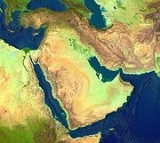
This article is a general overview of the
history of the Middle East. For more detailed information, see articles on the histories of individual countries and regions. For discussion of the issues surrounding the definition of the area see the article on
Middle EastThe Middle East is a region that encompasses Western Asia and Northern Africa. It is often used as a synonym for Near East, in opposition to Far East...
.
Cradle of civilization
The earliest
civilizationCivilization is a sometimes controversial term that has been used in several related ways. Primarily, the term has been used to refer to the material and instrumental side of human cultures that are complex in terms of technology, science, and division of labor. Such civilizations are generally...
s in history were established in the region now known as the Middle East around 3500 BC by the Sumerians, in
MesopotamiaMesopotamia is a toponym for the area of the Tigris–Euphrates river system, largely corresponding to modern-day Iraq, northeastern Syria, southeastern Turkey and southwestern Iran.Widely considered to be the cradle of civilization, Bronze Age Mesopotamia included Sumer and the...
(
IraqIraq ; officially the Republic of Iraq is a country in Western Asia spanning most of the northwestern end of the Zagros mountain range, the eastern part of the Syrian Desert and the northern part of the Arabian Desert....
), widely regarded as the
cradle of civilizationThe cradle of civilization is a term referring to any of the possible locations for the emergence of civilization.It is usually applied to the Ancient Near Eastern Chalcolithic , especially in the Fertile Crescent , but also extended to sites in Armenia, and the Persian Plateau, besides other Asian...
. The
SumerSumer was a civilization and historical region in southern Mesopotamia, modern Iraq during the Chalcolithic and Early Bronze Age....
ians,
AkkadThe Akkadian Empire was an empire centered in the city of Akkad and its surrounding region in Mesopotamia....
ians (later known as
BabyloniaBabylonia was an ancient cultural region in central-southern Mesopotamia , with Babylon as its capital. Babylonia emerged as a major power when Hammurabi Babylonia was an ancient cultural region in central-southern Mesopotamia (present-day Iraq), with Babylon as its capital. Babylonia emerged as...
ns and
AssyriansThe Assyrian people are a distinct ethnic group whose origins lie in ancient Mesopotamia...
) all flourished in this region. Soon after the Sumerian civilization began, the Nile River valley of
ancient EgyptAncient Egypt was an ancient civilization of Northeastern Africa, concentrated along the lower reaches of the Nile River in what is now the modern country of Egypt. Egyptian civilization coalesced around 3150 BC with the political unification of Upper and Lower Egypt under the first pharaoh...
was unified under the
PharaohPharaoh is a title used in many modern discussions of the ancient Egyptian rulers of all periods. The title originates in the term "pr-aa" which means "great house" and describes the royal palace...
s in the 4th millennium BC, and civilization quickly spread through the
Fertile CrescentThe Fertile Crescent, nicknamed "The Cradle of Civilization" for the fact the first civilizations started there, is a crescent-shaped region containing the comparatively moist and fertile land of otherwise arid and semi-arid Western Asia. The term was first used by University of Chicago...
to the west coast of the
Mediterranean SeaThe Mediterranean Sea is a sea connected to the Atlantic Ocean surrounded by the Mediterranean region and almost completely enclosed by land: on the north by Anatolia and Europe, on the south by North Africa, and on the east by the Levant...
and throughout the
LevantThe Levant or ) is the geographic region and culture zone of the "eastern Mediterranean littoral between Anatolia and Egypt" . The Levant includes most of modern Lebanon, Syria, Jordan, Israel, the Palestinian territories, and sometimes parts of Turkey and Iraq, and corresponds roughly to the...
. The Elamites,
HittitesThe Hittites were a Bronze Age people of Anatolia.They established a kingdom centered at Hattusa in north-central Anatolia c. the 18th century BC. The Hittite empire reached its height c...
, Amorites, Phoenicians,
IsraeliteAccording to the Bible the Israelites were a Hebrew-speaking people of the Ancient Near East who inhabited the Land of Canaan during the monarchic period .The word "Israelite" derives from the Biblical Hebrew ישראל...
s and others later built important states in this region.
Assyrian Empires
MesopotamiaMesopotamia is a toponym for the area of the Tigris–Euphrates river system, largely corresponding to modern-day Iraq, northeastern Syria, southeastern Turkey and southwestern Iran.Widely considered to be the cradle of civilization, Bronze Age Mesopotamia included Sumer and the...
was home to several powerful empires which came to rule almost the entire Middle East, particularly the
Assyrian-In antiquity:*ancient Assyria**the Old Assyrian period **the Middle Assyrian period **the Neo-Assyrian period *Either of two provinces of the Persian Empire:**Achaemenid Assyria...
Empires of 1365- 1076 BC and the Neo Assyrian Empire of 911- 605 BC. The Assyrian Empire at its peak was the largest the world had yet seen, and ruled all of what is now modern day Iraq, Syria, Lebanon, Israel, Palestine, Kuwait, Jordan, Egypt, Cyprus and Bahrain, together with large swathes of Iran, Turkey, Armenia, Georgia, Sudan and Arabia.
Iranian Empires
From the early 6th century BC onwards, several Iranian states dominated the region, beginning with the
Medes
and non-Iranian
Neo-Babylonian EmpireThe Neo-Babylonian Empire or Second Babylonian Empire was a period of Mesopotamian history which began in 626 BC and ended in 539 BC. During the preceding three centuries, Babylonia had been ruled by their fellow Akkadian speakers and northern neighbours, Assyria. Throughout that time Babylonia...
, then their successor the
Achaemenid EmpireThe Achaemenid Empire , sometimes known as First Persian Empire and/or Persian Empire, was founded in the 6th century BCE by Cyrus the Great who overthrew the Median confederation...
known as the first Persian Empire, conquered in the late 4th century B.C. by the very short-lived Macedonian Empire of
Alexander the Great, and then successor kingdoms such as
Ptolemaic EgyptEgyptian history can be roughly divided into the following periods:*Prehistoric Egypt*Ancient Egypt**Early Dynastic Period of Egypt: 31st to 27th centuries BC**Old Kingdom of Egypt: 27th to 22nd centuries BC...
and the Seleucid state in Western Asia.
After a century of hiatus the idea of the Persian Empire was revived by the Central Asian Iranian
ParthiansThe Parthian Empire , also known as the Arsacid Empire , was a major Iranian political and cultural power in ancient Persia...
in the 3rd century B.C. and continued by their successors the
SassanidsThe Sassanid Empire , known to its inhabitants as Ērānshahr and Ērān in Middle Persian and resulting in the New Persian terms Iranshahr and Iran , was the last pre-Islamic Persian Empire, ruled by the Sasanian Dynasty from 224 to 651...
from the 3rd century AD. This empire would dominate sizable part of what is now considered the Asian part of the Middle East and continue to influence the rest of the Asiatic and African Middle East region, actually mostly under the Eastern Roman Empire-
Byzantine EmpireThe Byzantine Empire was the Eastern Roman Empire during the periods of Late Antiquity and the Middle Ages, centred on the capital of Constantinople. Known simply as the Roman Empire or Romania to its inhabitants and neighbours, the Empire was the direct continuation of the Ancient Roman State...
rule and influence, until the
ArabArab people, also known as Arabs , are a panethnicity primarily living in the Arab world, which is located in Western Asia and North Africa. They are identified as such on one or more of genealogical, linguistic, or cultural grounds, with tribal affiliations, and intra-tribal relationships playing...
Islamic conquest of PersiaThe Muslim conquest of Persia led to the end of the Sassanid Empire in 644, the fall of Sassanid dynasty in 651 and the eventual decline of the Zoroastrian religion in Persia...
in the mid-7th century C.E. .
Eastern RiteEastern Rite may refer to:* East Syrian Rite, Christian liturgy, also known as the Assyro-Chaldean Rite, Assyrian Rite , or Persian Rite* Maronites, a Christian church based in Lebanon as well have members in Israel, Jordan, Syria and Turkey...
,
Church of the EastThe Church of the East tāʾ d-Maḏnḥāʾ), also known as the Nestorian Church, is a Christian church, part of the Syriac tradition of Eastern Christianity. Originally the church of the Persian Sassanid Empire, it quickly spread widely through Asia...
ChristianityChristianity is a monotheistic religion based on the life and teachings of Jesus as presented in canonical gospels and other New Testament writings...
took hold in Persian ruled Mesopotamia, particularly in
AssyriaAssyria was a Semitic Akkadian kingdom, extant as a nation state from the mid–23rd century BC to 608 BC centred on the Upper Tigris river, in northern Mesopotamia , that came to rule regional empires a number of times through history. It was named for its original capital, the ancient city of Assur...
from the 1st Century AD onwards, and the region became a center of a flourishing Syriac-
Assyrian-In antiquity:*ancient Assyria**the Old Assyrian period **the Middle Assyrian period **the Neo-Assyrian period *Either of two provinces of the Persian Empire:**Achaemenid Assyria...
literary tradition.
Roman Empire
In the 1st century BC, the expanding
Roman RepublicThe Roman Republic was the period of the ancient Roman civilization where the government operated as a republic. It began with the overthrow of the Roman monarchy, traditionally dated around 508 BC, and its replacement by a government headed by two consuls, elected annually by the citizens and...
absorbed the whole Eastern
MediterraneanIn biogeography, the Mediterranean Basin refers to the lands around the Mediterranean Sea that have a Mediterranean climate, with mild, rainy winters and hot, dry summers, which supports characteristic Mediterranean forests, woodlands, and scrub vegetation...
area (which included much of the
Near EastThe Near East is a geographical term that covers different countries for geographers, archeologists, and historians, on the one hand, and for political scientists, economists, and journalists, on the other...
) and under the
Roman EmpireThe Roman Empire was the post-Republican period of the ancient Roman civilization, characterised by an autocratic form of government and large territorial holdings in Europe and around the Mediterranean....
the region was united with most of
EuropeEurope is, by convention, one of the world's seven continents. Comprising the westernmost peninsula of Eurasia, Europe is generally 'divided' from Asia to its east by the watershed divides of the Ural and Caucasus Mountains, the Ural River, the Caspian and Black Seas, and the waterways connecting...
and
North AfricaNorth Africa or Northern Africa is the northernmost region of the African continent, linked by the Sahara to Sub-Saharan Africa. Geopolitically, the United Nations definition of Northern Africa includes eight countries or territories; Algeria, Egypt, Libya, Morocco, South Sudan, Sudan, Tunisia, and...
in a single political and economic unit. Even areas not directly annexed became strongly influenced by the Empire, which became the most powerful political and cultural entity for centuries. Although Latin culture spread across the region, the
GreekGreek is an independent branch of the Indo-European family of languages. Native to the southern Balkans, it has the longest documented history of any Indo-European language, spanning 34 centuries of written records. Its writing system has been the Greek alphabet for the majority of its history;...
culture and language first established in the region by the Macedonian Empire would continue to dominate throughout the Roman period. Cities in the Middle East, especially
AlexandriaAlexandria is the second-largest city of Egypt, with a population of 4.1 million, extending about along the coast of the Mediterranean Sea in the north central part of the country; it is also the largest city lying directly on the Mediterranean coast. It is Egypt's largest seaport, serving...
, became major urban centers for the Empire and the region did became the Empire's "bread basket" as the key agricultural producer.
As the
ChristianA Christian is a person who adheres to Christianity, an Abrahamic, monotheistic religion based on the life and teachings of Jesus of Nazareth as recorded in the Canonical gospels and the letters of the New Testament...
religion spread throughout the Roman and Persian Empires it took root in the Middle East, and cities such as
AlexandriaAlexandria is the second-largest city of Egypt, with a population of 4.1 million, extending about along the coast of the Mediterranean Sea in the north central part of the country; it is also the largest city lying directly on the Mediterranean coast. It is Egypt's largest seaport, serving...
and
EdessaEdessa may refer to:*Edessa, Greece*Edessa, Mesopotamia, now Şanlıurfa, Turkey*County of Edessa, a crusader state*Osroene, an ancient kingdom and province of the Roman Empire...
became important centers of Christian scholarship. By the 5th century, Christianity was the dominant religion in the Middle East with other faiths (gradually including
hereticalHeresy is a controversial or novel change to a system of beliefs, especially a religion, that conflicts with established dogma. It is distinct from apostasy, which is the formal denunciation of one's religion, principles or cause, and blasphemy, which is irreverence toward religion...
Christian sects) being actively repressed. The Middle East's ties to the city of
RomeAncient Rome was a thriving civilization that grew on the Italian Peninsula as early as the 8th century BC. Located along the Mediterranean Sea and centered on the city of Rome, it expanded to one of the largest empires in the ancient world....
would gradually be severed as the Empire split into
EastThe Byzantine Empire was the Eastern Roman Empire during the periods of Late Antiquity and the Middle Ages, centred on the capital of Constantinople. Known simply as the Roman Empire or Romania to its inhabitants and neighbours, the Empire was the direct continuation of the Ancient Roman State...
and
WestThe Western Roman Empire was the western half of the Roman Empire after its division by Diocletian in 285; the other half of the Roman Empire was the Eastern Roman Empire, commonly referred to today as the Byzantine Empire....
with the Middle East becoming tied to the new Roman capital of
ConstantinopleConstantinople was the capital of the Roman, Eastern Roman, Byzantine, Latin, and Ottoman Empires. Throughout most of the Middle Ages, Constantinople was Europe's largest and wealthiest city.-Names:...
. The subsequent fall of Rome and the Western Roman Empire, therefore, had minimal direct impact on the region. The Eastern Roman Empire, today commonly known as the
Byzantine EmpireThe Byzantine Empire was the Eastern Roman Empire during the periods of Late Antiquity and the Middle Ages, centred on the capital of Constantinople. Known simply as the Roman Empire or Romania to its inhabitants and neighbours, the Empire was the direct continuation of the Ancient Roman State...
, ruling from the
BalkansThe Balkans is a geopolitical and cultural region of southeastern Europe...
to the
EuphratesThe Euphrates is the longest and one of the most historically important rivers of Western Asia. Together with the Tigris, it is one of the two defining rivers of Mesopotamia...
, became increasingly defined by and dogmatic about Christianity gradually creating religious rifts between the doctrines dictated by the establishment in Constantinople and believers in many parts of the Middle East. At the time Greek had turned to the 'lingua franca' of the region, although ethnicities such as the Syriacs and the Hebrew continued to exist. Under Byzantine/Greek rule the area of the levant met an era of stability and prosperity.
Islamic Caliphate
From the 7th century, a new power was rising in the Middle East, that of
IslamIslam . The most common are and . : Arabic pronunciation varies regionally. The first vowel ranges from ~~. The second vowel ranges from ~~~...
, whilst the
ByzantineThe Byzantine Empire was the Eastern Roman Empire during the periods of Late Antiquity and the Middle Ages, centred on the capital of Constantinople. Known simply as the Roman Empire or Romania to its inhabitants and neighbours, the Empire was the direct continuation of the Ancient Roman State...
Roman and
SassanidThe Sassanid Empire , known to its inhabitants as Ērānshahr and Ērān in Middle Persian and resulting in the New Persian terms Iranshahr and Iran , was the last pre-Islamic Persian Empire, ruled by the Sasanian Dynasty from 224 to 651...
Persian empires were both weakened by centuries of stalemate warfare during the
Roman-Persian WarsThe Roman–Persian Wars were a series of conflicts between states of the Greco-Roman world and two successive Iranic empires: the Parthian and the Sassanid. Contact between the Parthian Empire and the Roman Republic began in 92 BC; wars began under the late Republic, and continued...
. In a series of rapid
Muslim conquestsMuslim conquests also referred to as the Islamic conquests or Arab conquests, began with the Islamic prophet Muhammad. He established a new unified polity in the Arabian Peninsula which under the subsequent Rashidun and Umayyad Caliphates saw a century of rapid expansion of Muslim power.They...
, the
Arab armiesThe Rashidun Caliphate Army or Rashidun army was the primary military body of the Rashidun Caliphate's armed forces during the Muslim conquests of the 7th century, serving alongside the Rashidun Navy...
, motivated by Islam and led by the
CaliphThe Caliph is the head of state in a Caliphate, and the title for the ruler of the Islamic Ummah, an Islamic community ruled by the Shari'ah. It is a transcribed version of the Arabic word which means "successor" or "representative"...
s and skilled military commanders such as
Khalid ibn al-WalidKhālid ibn al-Walīd also known as Sayf Allāh al-Maslūl , was a companion of the Islamic prophet Muhammad. He is noted for his military tactics and prowess, commanding the forces of Medina and those of his immediate successors of the Rashidun Caliphate; Abu Bakr and Umar...
, swept through most of the Middle East;
reducing Byzantine landsThe Byzantine–Arab Wars were a series of wars between the Arab Caliphates and the East Roman or Byzantine Empire between the 7th and 12th centuries AD. These started during the initial Muslim conquests under the expansionist Rashidun and Umayyad caliphs and continued in the form of an enduring...
by more than half and completely
engulfing the Persian landsThe Muslim conquest of Persia led to the end of the Sassanid Empire in 644, the fall of Sassanid dynasty in 651 and the eventual decline of the Zoroastrian religion in Persia...
. In
AnatoliaAnatolia is a geographic and historical term denoting the westernmost protrusion of Asia, comprising the majority of the Republic of Turkey...
, their
expansion was blockedThe Second Arab Siege of Constantinople was a combined land and sea effort by the Arabs to take the capital city of the Byzantine Empire, Constantinople. The Arab ground forces, led by Maslamah ibn Abd al-Malik, were held off by the massive city walls, decimated by an outbreak of plague and...
by the still capable Byzantines with the help of the
BulgariansThe First Bulgarian Empire was a medieval Bulgarian state founded in the north-eastern Balkans in c. 680 by the Bulgars, uniting with seven South Slavic tribes...
. The Byzantine provinces of
Roman SyriaThe Muslim conquest of Syria occurred in the first half of the 7th century, and refers to the region known as the Bilad al-Sham, the Levant, or Greater Syria...
,
North AfricaThe Umayyad conquest of North Africa continued the century of rapid Arab Muslim expansion following the death of Muhammad in 632 CE. By 640 the Arabs controlled Mesopotamia, had invaded Armenia, and were concluding their conquest of Byzantine Syria. Damascus was the seat of the Umayyad caliphate....
, and Sicily, however, could not mount such a resistance, and the Muslim conquerors swept through those regions. At the far west, they crossed the sea taking
Visigothic HispaniaThe Umayyad conquest of Hispania is the initial Islamic Ummayad Caliphate's conquest, between 711 and 718, of the Christian Visigothic Kingdom of Hispania, centered in the Iberian Peninsula, which was known to them under the Arabic name al-Andalus....
before being
halted in southern FranceThe Battle of Tours , also called the Battle of Poitiers and in Battle of the Court of the Martyrs, was fought in an area between the cities of Poitiers and Tours, located in north-central France, near the village of Moussais-la-Bataille, about northeast of Poitiers...
by the
FranksThe Franks were a confederation of Germanic tribes first attested in the third century AD as living north and east of the Lower Rhine River. From the third to fifth centuries some Franks raided Roman territory while other Franks joined the Roman troops in Gaul. Only the Salian Franks formed a...
. At its greatest extent, the Arab Empire was the first empire to control the entire Middle East, as well 3/4 of the
Mediterranean regionIn biogeography, the Mediterranean Basin refers to the lands around the Mediterranean Sea that have a Mediterranean climate, with mild, rainy winters and hot, dry summers, which supports characteristic Mediterranean forests, woodlands, and scrub vegetation...
, the only other empire besides the Roman Empire to control most of the
Mediterranean SeaThe Mediterranean Sea is a sea connected to the Atlantic Ocean surrounded by the Mediterranean region and almost completely enclosed by land: on the north by Anatolia and Europe, on the south by North Africa, and on the east by the Levant...
. It would be the Arab
CaliphateThe term caliphate, "dominion of a caliph " , refers to the first system of government established in Islam and represented the political unity of the Muslim Ummah...
s of the
Middle AgesThe Middle Ages is a periodization of European history from the 5th century to the 15th century. The Middle Ages follows the fall of the Western Roman Empire in 476 and precedes the Early Modern Era. It is the middle period of a three-period division of Western history: Classic, Medieval and Modern...
that would first unify the entire Middle East as a distinct region and create the dominant
ethnic identityArab people, also known as Arabs , are a panethnicity primarily living in the Arab world, which is located in Western Asia and North Africa. They are identified as such on one or more of genealogical, linguistic, or cultural grounds, with tribal affiliations, and intra-tribal relationships playing...
that persists today. The Seljuk Empire would also later dominate the region.
Much of North Africa became a peripheral area to the main Muslim centres in the Middle East, but Iberia (Al Andalus) and Morocco soon broke from this distant control and founded one of the world's most advanced societies at the time, along with
BaghdadBaghdad is the capital of Iraq, as well as the coterminous Baghdad Governorate. The population of Baghdad in 2011 is approximately 7,216,040...
in the eastern Mediterranean.
Between 831 and 1071, the
Emirate of SicilyThe Emirate of Sicily was an Islamic state on the island of Sicily , which existed from 965 to 1072.-First Arab invasions of Sicily:...
was one of the major centres of Islamic culture in the Mediterranean. After its conquest by the
NormansThe Normans were the people who gave their name to Normandy, a region in northern France. They were descended from Norse Viking conquerors of the territory and the native population of Frankish and Gallo-Roman stock...
the island developed its own distinct culture with the fusion of Arab, Western and Byzantine influences. Palermo remained a leading artistic and commercial centre of the Mediterranean well into the Middle Ages.
Africa was reviving, however, as more organized and centralized states began to form in the later
Middle AgesThe Middle Ages is a periodization of European history from the 5th century to the 15th century. The Middle Ages follows the fall of the Western Roman Empire in 476 and precedes the Early Modern Era. It is the middle period of a three-period division of Western history: Classic, Medieval and Modern...
after the
Renaissance of the 12th centuryThe Renaissance of the 12th century was a period of many changes at the outset of the High Middle Ages. It included social, political and economic transformations, and an intellectual revitalization of Western Europe with strong philosophical and scientific roots...
. Motivated by religion and dreams of conquest, the kings of Europe launched a number of Crusades to try to roll back Muslim power and retake the
holy landThe Holy Land is a term which in Judaism refers to the Kingdom of Israel as defined in the Tanakh. For Jews, the Land's identifiction of being Holy is defined in Judaism by its differentiation from other lands by virtue of the practice of Judaism often possible only in the Land of Israel...
. The Crusades were unsuccessful in this goal, but they were far more effective in weakening the already tottering Byzantine Empire that began to lose increasing amounts of territory to the
Ottoman TurksThe Ottoman Turks were the Turkish-speaking population of the Ottoman Empire who formed the base of the state's military and ruling classes. Reliable information about the early history of Ottoman Turks is scarce, but they take their Turkish name, Osmanlı , from the house of Osman I The Ottoman...
. They also rearranged the balance of power in the Muslim world as Egypt once again emerged as a major power in the eastern Mediterranean.
Turks, Crusaders and Mongols
The dominance of the Arabs came to a sudden end in the mid 11th century with the arrival of the Seljuk Turks, migrating south from the Turkic homelands in
Central AsiaCentral Asia is a core region of the Asian continent from the Caspian Sea in the west, China in the east, Afghanistan in the south, and Russia in the north...
, who conquered Persia, Iraq (capturing Baghdad in 1055), Syria, Palestine, and the
Hejazal-Hejaz, also Hijaz is a region in the west of present-day Saudi Arabia. Defined primarily by its western border on the Red Sea, it extends from Haql on the Gulf of Aqaba to Jizan. Its main city is Jeddah, but it is probably better known for the Islamic holy cities of Mecca and Medina...
. Egypt held out under the
FatimidThe Fatimid Islamic Caliphate or al-Fāṭimiyyūn was a Berber Shia Muslim caliphate first centered in Tunisia and later in Egypt that ruled over varying areas of the Maghreb, Sudan, Sicily, the Levant, and Hijaz from 5 January 909 to 1171.The caliphate was ruled by the Fatimids, who established the...
caliphs until 1169, when it too fell to the Turks.
Despite its massive territorial losses in the 7th century the
ChristianChristianity is a monotheistic religion based on the life and teachings of Jesus as presented in canonical gospels and other New Testament writings...
Byzantine EmpireThe Byzantine Empire was the Eastern Roman Empire during the periods of Late Antiquity and the Middle Ages, centred on the capital of Constantinople. Known simply as the Roman Empire or Romania to its inhabitants and neighbours, the Empire was the direct continuation of the Ancient Roman State...
had continued to be a potent military and economic force in the
MediterraneanThe Mediterranean Sea is a sea connected to the Atlantic Ocean surrounded by the Mediterranean region and almost completely enclosed by land: on the north by Anatolia and Europe, on the south by North Africa, and on the east by the Levant...
preventing Arab expansion into much of Europe. The Seljuks'
defeat of the Byzantine militaryThe Battle of Manzikert , was fought between the Byzantine Empire and Seljuq Turks led by Alp Arslan on August 26, 1071 near Manzikert...
in the 11th century and settling in
AnatoliaAnatolia is a geographic and historical term denoting the westernmost protrusion of Asia, comprising the majority of the Republic of Turkey...
effectively marked the end of Byzantine influence in the region. The Seljuks ruled most of the Middle East region for the next 200 years, but their empire soon broke up into a number of smaller sultanates.
Christian
Western EuropeWestern Europe is a loose term for the collection of countries in the western most region of the European continents, though this definition is context-dependent and carries cultural and political connotations. One definition describes Western Europe as a geographic entity—the region lying in the...
had staged a remarkable economic and demographic recovery in the 11th century since the nadir of its fortunes in the 7th century. The fragmentation of the Middle East allowed joined forces, mainly from England, France and the emerging
Holy Roman EmpireThe Holy Roman Empire was a realm that existed from 962 to 1806 in Central Europe.It was ruled by the Holy Roman Emperor. Its character changed during the Middle Ages and the Early Modern period, when the power of the emperor gradually weakened in favour of the princes...
to enter the region. In 1095,
Pope Urban II Pope Urban II , born Otho de Lagery , was Pope from 12 March 1088 until his death on July 29 1099...
, had responded to pleas from the flagging Byzantine Empire, summoned the European aristocracy to recapture the
Holy LandThe Holy Land is a term which in Judaism refers to the Kingdom of Israel as defined in the Tanakh. For Jews, the Land's identifiction of being Holy is defined in Judaism by its differentiation from other lands by virtue of the practice of Judaism often possible only in the Land of Israel...
for Christianity, and in 1099 the knights of the
First CrusadeThe First Crusade was a military expedition by Western Christianity to regain the Holy Lands taken in the Muslim conquest of the Levant, ultimately resulting in the recapture of Jerusalem...
captured
Jerusalem. They founded the
Kingdom of JerusalemThe Kingdom of Jerusalem was a Catholic kingdom established in the Levant in 1099 after the First Crusade. The kingdom lasted nearly two hundred years, from 1099 until 1291 when the last remaining possession, Acre, was destroyed by the Mamluks, but its history is divided into two distinct periods....
, which survived until 1187, when
SaladinṢalāḥ ad-Dīn Yūsuf ibn Ayyūb , better known in the Western world as Saladin, was an Arabized Kurdish Muslim, who became the first Sultan of Egypt and Syria, and founded the Ayyubid dynasty. He led Muslim and Arab opposition to the Franks and other European Crusaders in the Levant...
retook the city. Smaller crusader fiefdoms survived until 1291.
In the early 13th century, a new wave of invaders, the Mongol armies of the
Mongol EmpireThe Mongol Empire , initially named as Greater Mongol State was a great empire during the 13th and 14th centuries...
, swept through the region,
sacking BaghdadThe Siege of Baghdad, which occurred in 1258, was an invasion, siege and sacking of the city of Baghdad, the capital of the Abbasid Caliphate at the time and the modern-day capital of Iraq, by the Ilkhanate Mongol forces along with other allied troops under Hulagu Khan.The invasion left Baghdad in...
in 1258 and advancing as far south as the border of
EgyptEgypt , officially the Arab Republic of Egypt, Arabic: , is a country mainly in North Africa, with the Sinai Peninsula forming a land bridge in Southwest Asia. Egypt is thus a transcontinental country, and a major power in Africa, the Mediterranean Basin, the Middle East and the Muslim world...
.
MamlukA Mamluk was a soldier of slave origin, who were predominantly Cumans/Kipchaks The "mamluk phenomenon", as David Ayalon dubbed the creation of the specific warrior...
Emir
BaibarsBaibars or Baybars , nicknamed Abu l-Futuh , was a Mamluk Sultan of Egypt. He was one of the commanders of the forces which inflicted a devastating defeat on the Seventh Crusade of King Louis IX of France and he led the vanguard of the Egyptian army at the Battle of Ain Jalut in 1260, which marked...
left
DamascusDamascus , commonly known in Syria as Al Sham , and as the City of Jasmine , is the capital and the second largest city of Syria after Aleppo, both are part of the country's 14 governorates. In addition to being one of the oldest continuously inhabited cities in the world, Damascus is a major...
to
CairoCairo , is the capital of Egypt and the largest city in the Arab world and Africa, and the 16th largest metropolitan area in the world. Nicknamed "The City of a Thousand Minarets" for its preponderance of Islamic architecture, Cairo has long been a centre of the region's political and cultural life...
where he was welcomed by
SultanSultan is a title with several historical meanings. Originally, it was an Arabic language abstract noun meaning "strength", "authority", "rulership", and "dictatorship", derived from the masdar سلطة , meaning "authority" or "power". Later, it came to be used as the title of certain rulers who...
QutuzSaif ad-Din Qutuz, also spelled Kutuz, was the third of the Mamluk Sultans of Egypt in the Turkic line from 1259 until his death in 1260. It was under his leadership that the Mamluks achieved success against the Mongols in the key Battle of Ain Jalut...
. After taking
DamascusDamascus , commonly known in Syria as Al Sham , and as the City of Jasmine , is the capital and the second largest city of Syria after Aleppo, both are part of the country's 14 governorates. In addition to being one of the oldest continuously inhabited cities in the world, Damascus is a major...
, the
IlkhanateThe Ilkhanate, also spelled Il-khanate , was a Mongol khanate established in Azerbaijan and Persia in the 13th century, considered a part of the Mongol Empire...
was established and Hulagu demanded that Sultan
QutuzSaif ad-Din Qutuz, also spelled Kutuz, was the third of the Mamluk Sultans of Egypt in the Turkic line from 1259 until his death in 1260. It was under his leadership that the Mamluks achieved success against the Mongols in the key Battle of Ain Jalut...
surrender
EgyptEgypt , officially the Arab Republic of Egypt, Arabic: , is a country mainly in North Africa, with the Sinai Peninsula forming a land bridge in Southwest Asia. Egypt is thus a transcontinental country, and a major power in Africa, the Mediterranean Basin, the Middle East and the Muslim world...
but Sultan Qutuz had Hulagu's envoys killed and, with the help of
BaibarsBaibars or Baybars , nicknamed Abu l-Futuh , was a Mamluk Sultan of Egypt. He was one of the commanders of the forces which inflicted a devastating defeat on the Seventh Crusade of King Louis IX of France and he led the vanguard of the Egyptian army at the Battle of Ain Jalut in 1260, which marked...
, mobilized his troops. Although Hulagu had to leave for the East when great Khan
MöngkeMongke means "eternal" in Mongolian language and may refer to:-Medieval:* Möngke Khan , Great khan of the Mongol Empire* Yesü Möngke, khan of Chagatai khanate, 1247-1252* Mengu-Timur Mongke (also Mönkh, Monkh, Munkh) means "eternal" in Mongolian language and may refer to:-Medieval:* Möngke Khan...
died in action against the Southern Song, he left his lieutenant, the Christian
KitbuqaKitbuqa Noyan was a Nestorian Christian and a member of the Naiman Turks, a group that was subservient to the Mongol Empire. He was a lieutenant and confidant of the Mongol Ilkhan Hulagu, assisting him in his conquests in the Middle East...
, in charge. Sultan
QutuzSaif ad-Din Qutuz, also spelled Kutuz, was the third of the Mamluk Sultans of Egypt in the Turkic line from 1259 until his death in 1260. It was under his leadership that the Mamluks achieved success against the Mongols in the key Battle of Ain Jalut...
drew the Mongol army into an ambush near the
Orontes RiverThe Orontes or ‘Āṣī is a river of Lebanon, Syria and Turkey.It was anciently the chief river of the Levant, also called Draco, Typhon and Axius...
, routed them at the
Battle of Ain JalutThe Battle of Ain Jalut took place on 3 September 1260 between Mamluks and the Mongols in eastern Galilee, in the Jezreel Valley, not far from Ein Harod....
and captured and executed
KitbuqaKitbuqa Noyan was a Nestorian Christian and a member of the Naiman Turks, a group that was subservient to the Mongol Empire. He was a lieutenant and confidant of the Mongol Ilkhan Hulagu, assisting him in his conquests in the Middle East...
. With this victory
MamlukA Mamluk was a soldier of slave origin, who were predominantly Cumans/Kipchaks The "mamluk phenomenon", as David Ayalon dubbed the creation of the specific warrior...
TurksTurkish people, also known as the "Turks" , are an ethnic group primarily living in Turkey and in the former lands of the Ottoman Empire where Turkish minorities had been established in Bulgaria, Cyprus, Bosnia and Herzegovina, Georgia, Greece, Kosovo, Macedonia, and Romania...
became Sultans of
EgyptEgypt , officially the Arab Republic of Egypt, Arabic: , is a country mainly in North Africa, with the Sinai Peninsula forming a land bridge in Southwest Asia. Egypt is thus a transcontinental country, and a major power in Africa, the Mediterranean Basin, the Middle East and the Muslim world...
and the real power in the Middle East and gaining control of
PalestinePalestine is a conventional name, among others, used to describe the geographic region between the Mediterranean Sea and the Jordan River, and various adjoining lands....
and
SyriaSyria , officially the Syrian Arab Republic , is a country in Western Asia, bordering Lebanon and the Mediterranean Sea to the West, Turkey to the north, Iraq to the east, Jordan to the south, and Israel to the southwest....
, while other Turkish sultans controlled
IraqIraq ; officially the Republic of Iraq is a country in Western Asia spanning most of the northwestern end of the Zagros mountain range, the eastern part of the Syrian Desert and the northern part of the Arabian Desert....
and
AnatoliaAnatolia is a geographic and historical term denoting the westernmost protrusion of Asia, comprising the majority of the Republic of Turkey...
until the arrival of the Ottomans.
The Ottoman era
By the early 15th century, a new power had arisen in western Anatolia, the
OttomanThe Ottoman EmpireIt was usually referred to as the "Ottoman Empire", the "Turkish Empire", the "Ottoman Caliphate" or more commonly "Turkey" by its contemporaries...
emirs, who in 1453 captured the Christian Byzantine capitol of Constantinople and made themselves sultans. The Mameluks held the Ottomans out of the Middle East for a century, but in 1514
Selim the GrimSelim I, Yavuz Sultân Selim Khan, Hâdim-ül Haramain-ish Sharifain , nicknamed Yavuz "the Stern" or "the Steadfast", but often rendered in English as "the Grim" , was the Sultan of the Ottoman Empire from 1512 to...
began the systematic Ottoman conquest of the region. Syria was occupied in 1516 and Egypt in 1517, extinguishing the Mameluk line. The Ottomans united the whole region under one ruler for the first time since the reign of the
AbbasidThe Abbasid Caliphate or, more simply, the Abbasids , was the third of the Islamic caliphates. It was ruled by the Abbasid dynasty of caliphs, who built their capital in Baghdad after overthrowing the Umayyad caliphate from all but the al-Andalus region....
caliphs of the 10th century, and they kept control of it for 400 years.
The Ottomans also conquered
GreeceGreece , officially the Hellenic Republic , and historically Hellas or the Republic of Greece in English, is a country in southeastern Europe....
, the
BalkansThe Balkans is a geopolitical and cultural region of southeastern Europe...
, and most of
HungaryHungary , officially the Republic of Hungary , is a landlocked country in Central Europe. It is situated in the Carpathian Basin and is bordered by Slovakia to the north, Ukraine and Romania to the east, Serbia and Croatia to the south, Slovenia to the southwest and Austria to the west. The...
, setting the new frontier between east and west far to the north of the
DanubeThe Danube is a river in the Central Europe and the Europe's second longest river after the Volga. It is classified as an international waterway....
. But in the west Europe was rapidly expanding, demographically, economically and culturally, with the new wealth of the Americas fuelling a boom that laid the foundations for the growth of
capitalismCapitalism is an economic system that became dominant in the Western world following the demise of feudalism. There is no consensus on the precise definition nor on how the term should be used as a historical category...
and the
industrial revolutionThe Industrial Revolution was a period from the 18th to the 19th century where major changes in agriculture, manufacturing, mining, transportation, and technology had a profound effect on the social, economic and cultural conditions of the times...
. By the 17th century, Europe had overtaken the Muslim world in wealth, population and—most importantly—technology.
By 1700, the Ottomans had been driven out of Hungary and the balance of power along the frontier had shifted decisively in favour of the west. Although some areas of Ottoman Europe, such as
AlbaniaAlbania , officially known as the Republic of Albania , is a country in Southeastern Europe, in the Balkans region. It is bordered by Montenegro to the northwest, Kosovo to the northeast, the Republic of Macedonia to the east and Greece to the south and southeast. It has a coast on the Adriatic Sea...
and
BosniaThe Bosnia Vilayet was an Ottoman vilayet, mostly based on the territory of the present-day state of Bosnia and Herzegovina as well as most of Slavonia, Lika and Dalmatia in present-day Croatia. It bordered Kosovo Vilayet to the south. Before the administrative reform in 1864, it was called the...
, saw many conversions to Islam, the area was never culturally absorbed into the Muslim world. From 1700 to 1918, the Ottomans steadily retreated, and the Middle East fell further and further behind Europe, becoming increasingly inward-looking and defensive. During the 19th century,
GreeceGreece , officially the Hellenic Republic , and historically Hellas or the Republic of Greece in English, is a country in southeastern Europe....
,
SerbiaSerbia , officially the Republic of Serbia , is a landlocked country located at the crossroads of Central and Southeast Europe, covering the southern part of the Carpathian basin and the central part of the Balkans...
,
RomaniaRomania is a country located at the crossroads of Central and Southeastern Europe, on the Lower Danube, within and outside the Carpathian arch, bordering on the Black Sea...
, and
BulgariaBulgaria , officially the Republic of Bulgaria , is a parliamentary democracy within a unitary constitutional republic in Southeast Europe. The country borders Romania to the north, Serbia and Macedonia to the west, Greece and Turkey to the south, as well as the Black Sea to the east...
asserted their independence, and in the
Balkan WarsThe Balkan Wars were two conflicts that took place in the Balkans in south-eastern Europe in 1912 and 1913.By the early 20th century, Montenegro, Bulgaria, Greece and Serbia, the countries of the Balkan League, had achieved their independence from the Ottoman Empire, but large parts of their ethnic...
of 1912–13 the Ottomans were driven out of Europe altogether, except for the city of
ConstantinopleConstantinople was the capital of the Roman, Eastern Roman, Byzantine, Latin, and Ottoman Empires. Throughout most of the Middle Ages, Constantinople was Europe's largest and wealthiest city.-Names:...
and its hinterland.
By the 19th century, the Ottoman Empire was known as the "
sick man of Europe"Sick man of Europe" is a nickname that has been used to describe a European country experiencing a time of economic difficulty and/or impoverishment...
", increasingly under the financial control of the European powers. Domination soon turned to outright conquest. The
FrenchThe French Republic , The French Republic , The French Republic , (commonly known as France , is a unitary semi-presidential republic in Western Europe with several overseas territories and islands located on other continents and in the Indian, Pacific, and Atlantic oceans. Metropolitan France...
annexed
AlgeriaAlgeria , officially the People's Democratic Republic of Algeria , also formally referred to as the Democratic and Popular Republic of Algeria, is a country in the Maghreb region of Northwest Africa with Algiers as its capital.In terms of land area, it is the largest country in Africa and the Arab...
in 1830 and
TunisiaTunisia , officially the Tunisian RepublicThe long name of Tunisia in other languages used in the country is: , is the northernmost country in Africa. It is a Maghreb country and is bordered by Algeria to the west, Libya to the southeast, and the Mediterranean Sea to the north and east. Its area...
in 1878. The
BritishThe United Kingdom of Great Britain and Northern IrelandIn the United Kingdom and Dependencies, other languages have been officially recognised as legitimate autochthonous languages under the European Charter for Regional or Minority Languages...
occupied Egypt in 1882, though it remained under nominal Ottoman sovereignty. The British also established effective control of the
Persian GulfThe Persian Gulf, in Southwest Asia, is an extension of the Indian Ocean located between Iran and the Arabian Peninsula.The Persian Gulf was the focus of the 1980–1988 Iran-Iraq War, in which each side attacked the other's oil tankers...
, and the French extended their influence into
LebanonLebanon , officially the Republic of LebanonRepublic of Lebanon is the most common term used by Lebanese government agencies. The term Lebanese Republic, a literal translation of the official Arabic and French names that is not used in today's world. Arabic is the most common language spoken among...
and Syria. In 1912, the
ItaliansItaly , officially the Italian Republic languages]] under the European Charter for Regional or Minority Languages. In each of these, Italy's official name is as follows:;;;;;;;;), is a unitary parliamentary republic in South-Central Europe. To the north it borders France, Switzerland, Austria and...
seized
LibyaLibya is an African country in the Maghreb region of North Africa bordered by the Mediterranean Sea to the north, Egypt to the east, Sudan to the southeast, Chad and Niger to the south, and Algeria and Tunisia to the west....
and the
Dodecanese islandsThe Dodecanese are a group of 12 larger plus 150 smaller Greek islands in the Aegean Sea, of which 26 are inhabited. Τhis island group generally defines the eastern limit of the Sea of Crete. They belong to the Southern Sporades island group...
, just off the coast of the Ottoman heartland of Anatolia. The Ottomans turned to
GermanyGermany , officially the Federal Republic of Germany , is a federal parliamentary republic in Europe. The country consists of 16 states while the capital and largest city is Berlin. Germany covers an area of 357,021 km2 and has a largely temperate seasonal climate...
to protect them from the western powers, but the result was increasing financial and military dependence on Germany.
In the late 19th and early 20th centuries, Middle Eastern rulers tried to modernize their states to compete more effectively with the European powers. reformist rulers such as Mehemet Ali in Egypt, the Ottoman Sultan
Abdul Hamid IIHis Imperial Majesty, The Sultan Abdülhamid II, Emperor of the Ottomans, Caliph of the Faithful was the 34th sultan of the Ottoman Empire...
and the authors of the 1906 revolution in Persia all sought to import versions of the western model of constitutional government, civil law, secular education and industrial development into their countries. Across the region railways and telegraphs lines were built, schools and universities were opened, and a new class of army officers, lawyers, teachers and administrators emerged, challenging the traditional leadership of Islamic scholars.
Unfortunately, in all these cases the money to pay for the reforms was borrowed from the west, and the crippling debt this entailed led to bankruptcy and even greater western domination, which tended to discredit the reformers. Egypt, for example, fell under British control because the ambitious projects of Muhammad Ali and his successors bankrupted the state. Additionally, the westernisation of the Islamic world created professional armies, led by officers who were both willing and able to seize power for themselves—a problem that has plagued the Middle East ever since. There was also the problem that affects all reforming absolute rulers: they are prepared to consider all reforms except giving up their own power. Abdul Hamid, for example, grew ever more autocratic as he tried to impose reforms on his reluctant empire. Reforming ministers in Persia also tried to impose modernisation on their subjects, provoking sharp resistance.
The most ambitious reformers were the
Young TurksThe Young Turks , from French: Les Jeunes Turcs) were a coalition of various groups favouring reformation of the administration of the Ottoman Empire. The movement was against the absolute monarchy of the Ottoman Sultan and favoured a re-installation of the short-lived Kanûn-ı Esâsî constitution...
(officially called the Committee for Union and Progress), who seized power in the Ottoman Empire in 1908. Led by an ambitious pair of army officers,
Ismail EnverEnver Pasha or Ismail Enver Pasha , title was changed with his military ranks such as Enver Efendi , Enver Bey , Enver Pasha, higher than Mirliva) was an Ottoman military officer and a leader of the Young Turk revolution...
(Enver Pasha) and Ahmed Cemal (Cemal Pasha), and a radical lawyer, Mehmed Talat (Talat Pasha), the Young Turks initially established a constitutional monarchy, but soon became a ruling junta, with Talat as Grand Vizier and Enver as War Minister, which tried to force a radical modernisation program onto the Ottoman Empire.
The plan had several flaws. First it entailed imposing the Turkish language and centralised government on what had hitherto been a multi-lingual and loosely governed empire, which alienated the Arabic-speaking regions of the empire and caused an upsurge in Arab nationalism. Secondly it drove the empire ever deeper into debt. And thirdly, when Enver Bey formed an alliance with
GermanyGermany , officially the Federal Republic of Germany , is a federal parliamentary republic in Europe. The country consists of 16 states while the capital and largest city is Berlin. Germany covers an area of 357,021 km2 and has a largely temperate seasonal climate...
, which he saw as the most advanced military power in Europe, it cost the empire the support of Britain, which had protected the Ottomans against Russian encroachment all through the 19th century.
European domination
In 1914 Enver Bey's alliance with Germany led the Young Turks into the fatal step of joining Germany and
Austria-HungaryAustria-Hungary , more formally known as the Kingdoms and Lands Represented in the Imperial Council and the Lands of the Holy Hungarian Crown of Saint Stephen, was a constitutional monarchic union between the crowns of the Austrian Empire and the Kingdom of Hungary in...
in
World War IWorld War I , which was predominantly called the World War or the Great War from its occurrence until 1939, and the First World War or World War I thereafter, was a major war centred in Europe that began on 28 July 1914 and lasted until 11 November 1918...
, against Britain and France. The British saw the Ottomans as the weak link in the enemy alliance, and concentrated on knocking them out of the war. When a direct assault failed at
GallipoliThe Gallipoli Campaign, also known as the Dardanelles Campaign or the Battle of Gallipoli, took place at the peninsula of Gallipoli in the Ottoman Empire between 25 April 1915 and 9 January 1916, during the First World War...
in 1915, they turned to fomenting revolution in the Ottoman domains, exploiting the awakening force of
ArabArab people, also known as Arabs , are a panethnicity primarily living in the Arab world, which is located in Western Asia and North Africa. They are identified as such on one or more of genealogical, linguistic, or cultural grounds, with tribal affiliations, and intra-tribal relationships playing...
nationalism (and also that of the
ArmeniansArmenian people or Armenians are a nation and ethnic group native to the Armenian Highland.The largest concentration is in Armenia having a nearly-homogeneous population with 97.9% or 3,145,354 being ethnic Armenian....
and
AssyriansThe Assyrian people are a distinct ethnic group whose origins lie in ancient Mesopotamia...
). The Arabs had lived more or less happily under Ottoman rule for 400 years, until the Young Turks had tried to "Turkicise" them and change their traditional system of government. The British found an ally in
Sharif HusseinSayyid Hussein bin Ali, GCB was the Sharif of Mecca, and Emir of Mecca from 1908 until 1917, when he proclaimed himself King of Hejaz, which received international recognition. He initiated the Arab Revolt in 1916 against the increasingly nationalistic Ottoman Empire during the course of the...
, the hereditary ruler of
MeccaMecca is a city in the Hijaz and the capital of Makkah province in Saudi Arabia. The city is located inland from Jeddah in a narrow valley at a height of above sea level...
(and believed by Muslims to be a descendant of the family of the Prophet
MuhammadMuhammad |ligature]] at U+FDF4 ;Arabic pronunciation varies regionally; the first vowel ranges from ~~; the second and the last vowel: ~~~. There are dialects which have no stress. In Egypt, it is pronounced not in religious contexts...
), who led an
Arab RevoltThe Arab Revolt was initiated by the Sherif Hussein bin Ali with the aim of securing independence from the ruling Ottoman Turks and creating a single unified Arab state spanning from Aleppo in Syria to Aden in Yemen.- Background :...
against Ottoman rule, having received a promise of Arab independence in exchange. Armenians and Assyrians, long persecuted
ChristianA Christian is a person who adheres to Christianity, an Abrahamic, monotheistic religion based on the life and teachings of Jesus of Nazareth as recorded in the Canonical gospels and the letters of the New Testament...
minorities were also allied to the British, and rose up in response to Ottoman masssacres of their populations.
But when the Ottoman Empire was defeated by British Empire forces after the
Sinai and Palestine CampaignThe Sinai and Palestine Campaigns took place in the Middle Eastern Theatre of World War I. A series of battles were fought between British Empire, German Empire and Ottoman Empire forces from 26 January 1915 to 31 October 1918, when the Armistice of Mudros was signed between the Ottoman Empire and...
in 1918, the Arab population was met with what it perceived as betrayal by the British. The British and French governments concluded a secret treaty (the
Sykes-Picot AgreementThe Sykes–Picot Agreement of 1916 was a secret agreement between the governments of the United Kingdom and France, with the assent of Imperial Russia, defining their respective spheres of influence and control in Western Asia after the expected downfall of the Ottoman Empire during World War I...
) to partition the Middle East between them and, additionally, the British promised via the
Balfour DeclarationThe Balfour Declaration of 1917 was a letter from the British Foreign Secretary Arthur James Balfour to Baron Rothschild , a leader of the British Jewish community, for transmission to the Zionist Federation of Great Britain and Ireland.The statement was issued through the efforts of Chaim...
the international
ZionistZionism is a Jewish political movement that, in its broadest sense, has supported the self-determination of the Jewish people in a sovereign Jewish national homeland. Since the establishment of the State of Israel, the Zionist movement continues primarily to advocate on behalf of the Jewish state...
movement their support in creating a Jewish homeland in Palestine. Historically known to be the site of the ancient Jewish
Kingdom of IsraelAccording to Biblical tradition, the united Kingdom of Israel was a kingdom that existed in the Land of Israel, a period referred to by scholars as the United Monarchy. Biblical historians date the kingdom from c. 1020 BCE to c...
and successor Jewish nations for 1,200 years between approximately 1100BC-100AD, the region now had a large
ArabArab people, also known as Arabs , are a panethnicity primarily living in the Arab world, which is located in Western Asia and North Africa. They are identified as such on one or more of genealogical, linguistic, or cultural grounds, with tribal affiliations, and intra-tribal relationships playing...
population also from the 7th century AD. When the Ottomans departed, the Arabs proclaimed an independent state in
DamascusDamascus , commonly known in Syria as Al Sham , and as the City of Jasmine , is the capital and the second largest city of Syria after Aleppo, both are part of the country's 14 governorates. In addition to being one of the oldest continuously inhabited cities in the world, Damascus is a major...
, but were too weak, militarily and economically, to resist the European powers for long, and Britain and France soon established control and re-arranged the Middle East to suit themselves.
SyriaSyria , officially the Syrian Arab Republic , is a country in Western Asia, bordering Lebanon and the Mediterranean Sea to the West, Turkey to the north, Iraq to the east, Jordan to the south, and Israel to the southwest....
became a French protectorate thinly disguised as a
League of Nations MandateA League of Nations mandate was a legal status for certain territories transferred from the control of one country to another following World War I, or the legal instruments that contained the internationally agreed-upon terms for administering the territory on behalf of the League...
. The
ChristianA Christian is a person who adheres to Christianity, an Abrahamic, monotheistic religion based on the life and teachings of Jesus of Nazareth as recorded in the Canonical gospels and the letters of the New Testament...
coastal areas were split off to become
LebanonLebanon , officially the Republic of LebanonRepublic of Lebanon is the most common term used by Lebanese government agencies. The term Lebanese Republic, a literal translation of the official Arabic and French names that is not used in today's world. Arabic is the most common language spoken among...
, another French protectorate.
IraqIraq ; officially the Republic of Iraq is a country in Western Asia spanning most of the northwestern end of the Zagros mountain range, the eastern part of the Syrian Desert and the northern part of the Arabian Desert....
and
PalestinePalestine is a conventional name, among others, used to describe the geographic region between the Mediterranean Sea and the Jordan River, and various adjoining lands....
became British mandated territories. Iraq became the "
Kingdom of IraqThe Kingdom of Iraq was the sovereign state of Iraq during and after the British Mandate of Mesopotamia. The League of Nations mandate started in 1920. The kingdom began in August 1921 with the coronation of Faisal bin al-Hussein bin Ali al-Hashemi as King Faisal I...
" and one of Sherif Husayn's sons,
FaisalFaisal bin Hussein bin Ali al-Hashemi, was for a short time King of the Arab Kingdom of Syria or Greater Syria in 1920, and was King of the Kingdom of Iraq from 23 August 1921 to 1933...
, was installed as the King of Iraq. Iraq incorporated large populations of
KurdsThe Kurdish people, or Kurds , are an Iranian people native to the Middle East, mostly inhabiting a region known as Kurdistan, which includes adjacent parts of Iran, Iraq, Syria, and Turkey...
,
AssyriansThe Assyrian people are a distinct ethnic group whose origins lie in ancient Mesopotamia...
and Turcomans, many of whom had been promised independent states of their own. Palestine became the "British Mandate of Palestine" and was split in half. The eastern half of Palestine became the "Emirate of
TransjordanThe Emirate of Transjordan was a former Ottoman territory in the Southern Levant that was part of the British Mandate of Palestine...
" to provide a throne for another of Husayn's sons,
AbdullahAbdullah I bin al-Hussein, King of Jordan [‘Abd Allāh ibn al-Husayn] عبد الله الأول بن الحسين born in Mecca, Second Saudi State, was the second of three sons of Sherif Hussein bin Ali, Sharif and Emir of Mecca and his first wife Abdiyya bint Abdullah...
. The western half of Palestine was placed under direct British administration. The already substantial Jewish population was allowed to increase. Initially this increase was allowed under British protection. Most of the Arabian peninsula fell to another British ally, Ibn Saud. Saud created the Kingdom of
Saudi ArabiaThe Kingdom of Saudi Arabia , commonly known in British English as Saudi Arabia and in Arabic as as-Sa‘ūdiyyah , is the largest state in Western Asia by land area, constituting the bulk of the Arabian Peninsula, and the second-largest in the Arab World...
in 1932.
In 1878, as the result of the
Cyprus ConventionThe Cyprus Convention of 4 June, 1878 was a secret agreement reached between the United Kingdom and the Ottoman Empire which granted control of Cyprus to Great Britain in exchange for their support of the Ottomans during the Congress of Berlin...
, the
United KingdomThe United Kingdom of Great Britain and Ireland was the formal name of the United Kingdom during the period when what is now the Republic of Ireland formed a part of it....
took over the government of
CyprusCyprus , officially the Republic of Cyprus , is a Eurasian island country, member of the European Union, in the Eastern Mediterranean, east of Greece, south of Turkey, west of Syria and north of Egypt. It is the third largest island in the Mediterranean Sea.The earliest known human activity on the...
as a protectorate from the
Ottoman EmpireThe Ottoman EmpireIt was usually referred to as the "Ottoman Empire", the "Turkish Empire", the "Ottoman Caliphate" or more commonly "Turkey" by its contemporaries...
. While the Cypriots at first welcomed
British ruleThe British Empire comprised the dominions, colonies, protectorates, mandates and other territories ruled or administered by the United Kingdom. It originated with the overseas colonies and trading posts established by England in the late 16th and early 17th centuries. At its height, it was the...
, hoping that they would gradually achieve prosperity, democracy and national liberation, they soon became disillusioned. The British imposed heavy taxes to cover the compensation they paid to the Sultan for conceding Cyprus to them. Moreover, the people were not given the right to participate in the administration of the island, since all powers were reserved to the
High CommissionerHigh Commissioner is the title of various high-ranking, special executive positions held by a commission of appointment.The English term is also used to render various equivalent titles in other languages.-Bilateral diplomacy:...
and to
LondonLondon is the capital city of :England and the :United Kingdom, the largest metropolitan area in the United Kingdom, and the largest urban zone in the European Union by most measures. Located on the River Thames, London has been a major settlement for two millennia, its history going back to its...
. In 1931, the Government of Lord Liverpool created the
Six Acts, which established press censorship, the banning of
political partiesPolitical Parties: A Sociological Study of the Oligarchical Tendencies of Modern Democracy is a book by sociologist Robert Michels, published in 1911 , and first introducing the concept of iron law of oligarchy...
(mainly the
communist partyA political party described as a Communist party includes those that advocate the application of the social principles of communism through a communist form of government...
), the dissolution of municipal elections, as well as the out-ruling of trade unions, meetings of more than five individuals, and the tolling of church bells outside
servicesIn Christianity, a church service is a term used to describe a formalized period of communal worship, often but not exclusively occurring on Sunday, or Saturday in the case of those churches practicing seventh-day Sabbatarianism. The church service is the gathering together of Christians to be...
.
Meanwhile, the fall of the Ottomans had allowed Kemal Atatürk to seize power in
TurkeyTurkey , known officially as the Republic of Turkey , is a Eurasian country located in Western Asia and in East Thrace in Southeastern Europe...
and embark on a program of modernisation and secularisation. He abolished the
caliphateThe term caliphate, "dominion of a caliph " , refers to the first system of government established in Islam and represented the political unity of the Muslim Ummah...
, emancipated women, enforced western dress and the use of a new Turkish alphabet based on
Latin alphabetThe Latin alphabet, also called the Roman alphabet, is the most recognized alphabet used in the world today. It evolved from a western variety of the Greek alphabet called the Cumaean alphabet, which was adopted and modified by the Etruscans who ruled early Rome...
in place of
Arabic alphabetThe Arabic alphabet or Arabic abjad is the Arabic script as it is codified for writing the Arabic language. It is written from right to left, in a cursive style, and includes 28 letters. Because letters usually stand for consonants, it is classified as an abjad.-Consonants:The Arabic alphabet has...
, and abolished the jurisdiction of the Islamic courts. In effect, Turkey, having given up rule over the Arab World, now determined to secede from the Middle East and become culturally part of Europe. Ever since, Turkey has insisted that it is a European country and not part of the Middle East.
Another turning point in the history of the Middle East came when
oilPetroleum or crude oil is a naturally occurring, flammable liquid consisting of a complex mixture of hydrocarbons of various molecular weights and other liquid organic compounds, that are found in geologic formations beneath the Earth's surface. Petroleum is recovered mostly through oil drilling...
was discovered, first in Persia in 1908 and later in
Saudi ArabiaThe Kingdom of Saudi Arabia , commonly known in British English as Saudi Arabia and in Arabic as as-Sa‘ūdiyyah , is the largest state in Western Asia by land area, constituting the bulk of the Arabian Peninsula, and the second-largest in the Arab World...
(in 1938) and the other Persian Gulf states, and also in
LibyaLibya is an African country in the Maghreb region of North Africa bordered by the Mediterranean Sea to the north, Egypt to the east, Sudan to the southeast, Chad and Niger to the south, and Algeria and Tunisia to the west....
and
AlgeriaAlgeria , officially the People's Democratic Republic of Algeria , also formally referred to as the Democratic and Popular Republic of Algeria, is a country in the Maghreb region of Northwest Africa with Algiers as its capital.In terms of land area, it is the largest country in Africa and the Arab...
. The Middle East, it turned out, possessed the world's largest easily accessible reserves of crude oil, the most important commodity in the 20th century industrial world. Although western oil companies pumped and exported nearly all of the oil to fuel the rapidly expanding automobile industry and other western industrial developments, the kings and emirs of the oil states became immensely rich, enabling them to consolidate their hold on power and giving them a stake in preserving western hegemony over the region. Oil wealth also had the effect of stultifying whatever movement towards economic, political or social reform might have emerged in the Arab world under the influence of the Kemalist revolution in Turkey.
During the 1920s, 1930s, and 1940s, Syria and Egypt made moves towards independence. In 1919, Saad Zaghloul orchestrated mass demonstrations in Egypt known as the
First RevolutionThe Egyptian Revolution of 1919 was a countrywide revolution against the British occupation of Egypt and Sudan. It was carried out by Egyptians and Sudanese from different walks of life in the wake of the British-ordered exile of revolutionary leader Saad Zaghlul, and other members of the Wafd...
. While Zaghloul would later become Prime Minister, the British repression of the anticolonial riots led to the death of some 800 people. In 1920, Syrian forces were defeated by the French in the
Battle of MaysalunThe Battle of Maysalun , also called The Battle of Maysalun Pass, took place between Syrian and French forces about 12 miles west of Damascus near the town of Maysalun on July 23, 1920.-Background:...
and Iraqi forces were defeated by the British when they
revoltedThe Iraqi Revolt against the British , or the Great Iraqi Revolution of 1920, started in Baghdad in the summer of 1920 with mass demonstrations of both Sunni and Shia, including protests by embittered officers from the old Ottoman army, against the policies of British Acting Civil Commissioner Sir...
. In 1922, the (nominally) independent
Kingdom of EgyptThe Kingdom of Egypt was the first modern Egyptian state, lasting from 1922 to 1953. The Kingdom was created in 1922 when the British government unilaterally ended its protectorate over Egypt, in place since 1914. Sultan Fuad I became the first king of the new state...
was created following the British government's issuance of the
Unilateral Declaration of Egyptian IndependenceThe Unilateral Declaration of Egyptian Independence was issued by the government of the United Kingdom of Great Britain and Ireland on 28 February 1922...
. Although the Kingdom of Egypt was technically "neutral" during
World War IIWorld War II, or the Second World War , was a global conflict lasting from 1939 to 1945, involving most of the world's nations—including all of the great powers—eventually forming two opposing military alliances: the Allies and the Axis...
,
CairoCairo , is the capital of Egypt and the largest city in the Arab world and Africa, and the 16th largest metropolitan area in the world. Nicknamed "The City of a Thousand Minarets" for its preponderance of Islamic architecture, Cairo has long been a centre of the region's political and cultural life...
soon became a major military base for the British forces and the country was occupied. The British were able to do this because of a
1936 treatyThe Anglo-Egyptian Treaty of 1936 was a treaty signed between the United Kingdom and the Kingdom of Egypt; it is officially known as The Treaty of Alliance Between His Majesty, in Respect of the United Kingdom, and His Majesty, the King of Egypt...
by which the
United KingdomThe United Kingdom of Great Britain and Northern IrelandIn the United Kingdom and Dependencies, other languages have been officially recognised as legitimate autochthonous languages under the European Charter for Regional or Minority Languages...
maintained that it had the right to station troops on Egyptian soil to protect the
Suez CanalThe Suez Canal , also known by the nickname "The Highway to India", is an artificial sea-level waterway in Egypt, connecting the Mediterranean Sea and the Red Sea. Opened in November 1869 after 10 years of construction work, it allows water transportation between Europe and Asia without navigation...
. In 1941, the
Rashīd `Alī al-Gaylānī coupThe 1941 Iraqi coup d'état, also known as the Rashid Ali Al-Gaylani coup or the Golden Square coup was a pro-Nazi military coup in Iraq on April 1, 1941 that overthrew the regime of Regent 'Abd al-Ilah and installed Rashid Ali as Prime Minister...
in Iraq led to the British invasion of the country during the
Anglo-Iraqi WarThe Anglo-Iraqi War was the name of the British campaign against the rebel government of Rashid Ali in the Kingdom of Iraq during the Second World War. The war lasted from 2 May to 31 May 1941. The campaign resulted in the re-occupation of Iraq by British armed forces and the return to power of the...
. The British invasion of Iraq was followed by the
Allied invasion of Syria-LebanonThe Syria–Lebanon campaign, also known as Operation Exporter, was the Allied invasion of Vichy French-controlled Syria and Lebanon, in June–July 1941, during World War II. Time Magazine referred to the fighting as a "mixed show" while it was taking place and the campaign remains little known, even...
and the
Anglo-Soviet invasion of IranThe Anglo-Soviet invasion of Iran was the Allied invasion of the Imperial State of Iran during World War II, by British, Commonwealth, and Soviet armed forces. The invasion from August 25 to September 17, 1941, was codenamed Operation Countenance...
.
In Palestine, conflicting forces of Arab nationalism and Zionism created a situation the British could neither resolve nor extricate themselves from. The rise to power of German dictator
Adolf HitlerAdolf Hitler was an Austrian-born German politician and the leader of the National Socialist German Workers Party , commonly referred to as the Nazi Party). He was Chancellor of Germany from 1933 to 1945, and head of state from 1934 to 1945...
in
GermanyGermany , officially the Federal Republic of Germany , is a federal parliamentary republic in Europe. The country consists of 16 states while the capital and largest city is Berlin. Germany covers an area of 357,021 km2 and has a largely temperate seasonal climate...
had created a new urgency in the Zionist quest to immigrate to Palestine and create a
Jewish stateA homeland for the Jewish people was an idea that rose to the fore in the 19th century in the wake of growing anti-Semitism and Jewish assimilation. Jewish emancipation in Europe paved the way for two ideological solutions to the Jewish Question: cultural assimilation, as envisaged by Moses...
there. A Palestinian state was also an attractive alternative for Arab and Persian leaders to British, French, and perceived Jewish colonialism and imperialism under the logic of "
the enemy of my enemy is my friendThe phrase the enemy of my enemy is my friend is a proverb that advances the concept that someone who is the enemy of your enemy is therefore your friend. It further means that because two parties have a common enemy, one can use the other to advance their goals...
" (Lewis, 348–350).
The British, the French, and the Soviets departed many parts of the Middle East during and after
World War IIWorld War II, or the Second World War , was a global conflict lasting from 1939 to 1945, involving most of the world's nations—including all of the great powers—eventually forming two opposing military alliances: the Allies and the Axis...
. Turkey, Saudi Arabia, and the Middle East states on the
Arabian PeninsulaThe Arabian Peninsula is a land mass situated north-east of Africa. Also known as Arabia or the Arabian subcontinent, it is the world's largest peninsula and covers 3,237,500 km2...
generally remained unaffected by World war II. However, after the war, the following Middle states had independence restored or became independent:
- 17 October 1941 – Iran (forces of the United Kingdom
The United Kingdom of Great Britain and Northern IrelandIn the United Kingdom and Dependencies, other languages have been officially recognised as legitimate autochthonous languages under the European Charter for Regional or Minority Languages...
and the Soviet UnionThe Soviet Union , officially the Union of Soviet Socialist Republics , was a constitutionally socialist state that existed in Eurasia between 1922 and 1991....
withdrawn)
- 22 November 1943 – Lebanon
- 1 January 1944 – Syria
- 22 May 1946 – Jordan (British mandate ended)
- 1947 – Iraq (forces of the United Kingdom
The United Kingdom of Great Britain and Northern IrelandIn the United Kingdom and Dependencies, other languages have been officially recognised as legitimate autochthonous languages under the European Charter for Regional or Minority Languages...
withdrawn)
- 1947 – Egypt (forces of the United Kingdom
The United Kingdom of Great Britain and Northern IrelandIn the United Kingdom and Dependencies, other languages have been officially recognised as legitimate autochthonous languages under the European Charter for Regional or Minority Languages...
withdrawn to the Suez CanalThe Suez Canal , also known by the nickname "The Highway to India", is an artificial sea-level waterway in Egypt, connecting the Mediterranean Sea and the Red Sea. Opened in November 1869 after 10 years of construction work, it allows water transportation between Europe and Asia without navigation...
area)
- August 16, 1960 – Cyprus
The struggle between the Arabs and the Jews in Palestine culminated in the 1947
United NationsThe United Nations is an international organization whose stated aims are facilitating cooperation in international law, international security, economic development, social progress, human rights, and achievement of world peace...
plan to partition PalestineThe United Nations Partition Plan for Palestine was created by the United Nations Special Committee on Palestine in 1947 to replace the British Mandate for Palestine with "Independent Arab and Jewish States" and a "Special International Regime for the City of Jerusalem" administered by the United...
. This plan attempted to create an Arab state and a Jewish state in the narrow space between the
Jordan River and the
Mediterranean SeaThe Mediterranean Sea is a sea connected to the Atlantic Ocean surrounded by the Mediterranean region and almost completely enclosed by land: on the north by Anatolia and Europe, on the south by North Africa, and on the east by the Levant...
. While the Jewish leaders accepted it, the Arab leaders rejected this plan.
On 14 May 1948, when the British Mandate expired, the Zionist leadership declared the State of Israel. In the
1948 Arab-Israeli WarThe 1948 Arab–Israeli War, known to Israelis as the War of Independence or War of Liberation The war commenced after the termination of the British Mandate for Palestine and the creation of an independent Israel at midnight on 14 May 1948 when, following a period of civil war, Arab armies invaded...
that immediately followed, the armies of Egypt, Syria, Transjordan, Lebanon, Iraq, and Saudi Arabia intervened and were defeated by Israel. About 800,000 Palestinians fled from areas annexed by Israel and became refugees in neighbouring countries, thus creating the "Palestinian problem," which has bedevilled the region ever since. Approximately two-thirds of 758,000—866,000 of the
Jews expelled or who fled from Arab landsThe Jewish exodus from Arab and Muslim countries was a mass departure, flight and expulsion of Jews, primarily of Sephardi and Mizrahi background, from Arab and Muslim countries, from 1948 until the early 1970s...
after 1948 were absorbed and naturalized by the State of Israel.
On August 16, 1960,
CyprusCyprus , officially the Republic of Cyprus , is a Eurasian island country, member of the European Union, in the Eastern Mediterranean, east of Greece, south of Turkey, west of Syria and north of Egypt. It is the third largest island in the Mediterranean Sea.The earliest known human activity on the...
gained its independence from the
United KingdomThe British Empire comprised the dominions, colonies, protectorates, mandates and other territories ruled or administered by the United Kingdom. It originated with the overseas colonies and trading posts established by England in the late 16th and early 17th centuries. At its height, it was the...
. Archbishop
Makarios IIIMakarios III , born Andreas Christodolou Mouskos , was the archbishop and primate of the autocephalous Cypriot Orthodox Church and the first President of the Republic of Cyprus ....
, a charismatic religious and political leader, was elected the first president of independent Cyprus, and in 1961 it became the 99th member of the
United NationsThe United Nations is an international organization whose stated aims are facilitating cooperation in international law, international security, economic development, social progress, human rights, and achievement of world peace...
.
A zone of conflict
The departure of the European powers from direct control of the region, the establishment of
IsraelThe State of Israel is a parliamentary republic located in the Middle East, along the eastern shore of the Mediterranean Sea...
, and the increasing importance of the oil industry, marked the creation of the modern Middle East. These developments led to a growing presence of the
United StatesThe United States of America is a federal constitutional republic comprising fifty states and a federal district...
in Middle East affairs. The U.S. was the ultimate guarantor of the stability of the region, and from the 1950s the dominant force in the oil industry. When republican revolutions brought radical
anti-WesternAnti-Western sentiment refers to broad opposition or hostility to the people, policies, or governments in the western world. In many cases the United States, Israël and the United Kingdom are the subject of discussion or hostility...
regimes to power in Egypt in 1954, in Syria in 1963, in Iraq in 1968 and in
LibyaLibya is an African country in the Maghreb region of North Africa bordered by the Mediterranean Sea to the north, Egypt to the east, Sudan to the southeast, Chad and Niger to the south, and Algeria and Tunisia to the west....
in 1969, the
Soviet UnionThe Soviet Union , officially the Union of Soviet Socialist Republics , was a constitutionally socialist state that existed in Eurasia between 1922 and 1991....
, seeking to open a new arena of the
Cold WarThe Cold War was the continuing state from roughly 1946 to 1991 of political conflict, military tension, proxy wars, and economic competition between the Communist World—primarily the Soviet Union and its satellite states and allies—and the powers of the Western world, primarily the United States...
in the Middle East, allied itself with Arab rulers such as
Gamal Abdel NasserGamal Abdel Nasser Hussein was the second President of Egypt from 1956 until his death. A colonel in the Egyptian army, Nasser led the Egyptian Revolution of 1952 along with Muhammad Naguib, the first president, which overthrew the monarchy of Egypt and Sudan, and heralded a new period of...
of
EgyptEgypt , officially the Arab Republic of Egypt, Arabic: , is a country mainly in North Africa, with the Sinai Peninsula forming a land bridge in Southwest Asia. Egypt is thus a transcontinental country, and a major power in Africa, the Mediterranean Basin, the Middle East and the Muslim world...
and
Saddam HusseinSaddam Hussein Abd al-Majid al-Tikriti was the fifth President of Iraq, serving in this capacity from 16 July 1979 until 9 April 2003...
of
IraqIraq ; officially the Republic of Iraq is a country in Western Asia spanning most of the northwestern end of the Zagros mountain range, the eastern part of the Syrian Desert and the northern part of the Arabian Desert....
. These regimes gained popular support through their promises to destroy the state of Israel, defeat the U.S. and other "western imperialists," and to bring prosperity to the Arab masses. When they failed to deliver on their promises, they became increasingly despotic.
In response to this challenge to its interests in the region, the U.S. felt obliged to defend its remaining allies, the conservative monarchies of Saudi Arabia, Jordan, Iran and the Persian Gulf emirates, whose methods of rule were almost as unattractive to western eyes as those of the anti-western regimes. Iran in particular became a key U.S. ally, until a revolution led by the Shi'a clergy overthrew the monarchy in 1979 and established a
theocraticTheocracy is a form of organization in which the official policy is to be governed by immediate divine guidance or by officials who are regarded as divinely guided, or simply pursuant to the doctrine of a particular religious sect or religion....
regime that was even more anti-western than the secular regimes in Iraq or Syria. This forced the U.S. into a close alliance with Saudi Arabia. The list of Arab-Israeli wars includes a great number of major wars such as
1948 Arab-Israeli WarThe 1948 Arab–Israeli War, known to Israelis as the War of Independence or War of Liberation The war commenced after the termination of the British Mandate for Palestine and the creation of an independent Israel at midnight on 14 May 1948 when, following a period of civil war, Arab armies invaded...
, 1956 Suez War, 1967 Six Day War, 1970 War of Attrition, 1973 Yom Kippur War,
1982 Lebanon WarThe 1982 Lebanon War , , called Operation Peace for Galilee by Israel, and later known in Israel as the Lebanon War and First Lebanon War, began on 6 June 1982, when the Israel Defense Forces invaded southern Lebanon...
, as well as a number of lesser conflicts.
Between 1963 and 1974, conflict arising between
Greek CypriotsGreek Cypriots are the ethnic Greek population of Cyprus, forming the island's largest ethnolinguistic community at 77% of the population. Greek Cypriots are mostly members of the Church of Cyprus, an autocephalous Greek Orthodox Church within the wider communion of Orthodox Christianity...
and
Turkish CypriotsTurkish Cypriots are the ethnic Turks and members of the Turkish-speaking ethnolinguistic community of the Eastern Mediterranean island of Cyprus. The term is used to refer explicitly to the indigenous Turkish Cypriots, whose Ottoman Turkish forbears colonised the island in 1571...
in
British colonial CyprusThis article covers the modern history of Cyprus, from 1878 to the present.-Cyprus as a Protectorate:In 1878 as a result of the Cyprus Convention, the United Kingdom received as a protectorate, the island of Cyprus from the Ottoman Empire in exchange for United Kingdoms military support to the...
lead to
Cypriot intercommunal violenceCypriot intercommunal violence refers to periods of sectarian conflict between Greek Cypriots and Turkish Cypriots on the island of Cyprus from 1963 to 1974.-Background:...
and the
Turkish invasion of CyprusThe Turkish invasion of Cyprus, launched on 20 July 1974, was a Turkish military invasion in response to a Greek military junta backed coup in Cyprus...
. The ongoing
Cyprus disputeThe Cyprus dispute is the result of the ongoing conflict between the Republic of Cyprus and Turkey, over the Turkish occupied northern part of Cyprus....
has yet to be resolved.
In 1979, Egypt under Nasser's successor,
Anwar SadatMuhammad Anwar al-Sadat was the third President of Egypt, serving from 15 October 1970 until his assassination by fundamentalist army officers on 6 October 1981...
, concluded a peace treaty with Israel, ending the prospects of a united Arab military front. From the 1970s the Palestinians, led by
Yasser ArafatMohammed Yasser Abdel Rahman Abdel Raouf Arafat al-Qudwa al-Husseini , popularly known as Yasser Arafat or by his kunya Abu Ammar , was a Palestinian leader and a Laureate of the Nobel Prize. He was Chairman of the Palestine Liberation Organization , President of the Palestinian National Authority...
's
Palestine Liberation OrganizationThe Palestine Liberation Organization is a political and paramilitary organization which was created in 1964. It is recognized as the "sole legitimate representative of the Palestinian people" by the United Nations and over 100 states with which it holds diplomatic relations, and has enjoyed...
, resorted to a prolonged campaign of violence against Israel and against American, Jewish and western targets generally, as a means of weakening Israeli resolve and undermining western support for Israel. The Palestinians were supported in this, to varying degrees, by the regimes in Syria, Libya, Iran and Iraq. The high point of this campaign came in the 1975 United Nations General Assembly Resolution 3379 condemning Zionism as a form of racism and the reception given to Arafat by the
United Nations General AssemblyFor two articles dealing with membership in the General Assembly, see:* General Assembly members* General Assembly observersThe United Nations General Assembly is one of the five principal organs of the United Nations and the only one in which all member nations have equal representation...
. Resolution 3379 was revoked in 1991 by the United Nations General Assembly Resolution 4686.
The fall of the
Soviet UnionThe Soviet Union , officially the Union of Soviet Socialist Republics , was a constitutionally socialist state that existed in Eurasia between 1922 and 1991....
and the collapse of
communismCommunism is a social, political and economic ideology that aims at the establishment of a classless, moneyless, revolutionary and stateless socialist society structured upon common ownership of the means of production...
in the early 1990s had several consequences for the Middle East. It allowed large numbers of Soviet Jews to emigrate from
RussiaRussia or , officially known as both Russia and the Russian Federation , is a country in northern Eurasia. It is a federal semi-presidential republic, comprising 83 federal subjects...
and
UkraineUkraine is a country in Eastern Europe. It has an area of 603,628 km², making it the second largest contiguous country on the European continent, after Russia...
to Israel, further strengthening the Jewish state. It cut off the easiest source of credit, armaments and diplomatic support to the anti-western Arab regimes, weakening their position. It opened up the prospect of cheap oil from Russia, driving down the price of oil and reducing the west's dependence on oil from the Arab states. It discredited the model of development through authoritarian state socialism, which Egypt (under Nasser), Algeria, Syria and Iraq had followed since the 1960s, leaving these regimes politically and economically stranded. Rulers such as Saddam Hussein in Iraq increasingly turned to Arab nationalism as a substitute for socialism.
This led Iraq into its prolonged war with Iran in the 1980s, and then into its fateful invasion of
KuwaitThe State of Kuwait is a sovereign Arab state situated in the north-east of the Arabian Peninsula in Western Asia. It is bordered by Saudi Arabia to the south at Khafji, and Iraq to the north at Basra. It lies on the north-western shore of the Persian Gulf. The name Kuwait is derived from the...
in 1990. Kuwait had been part of the Ottoman province of
BasraBasra is the capital of Basra Governorate, in southern Iraq near Kuwait and Iran. It had an estimated population of two million as of 2009...
before 1918, and thus in a sense part of Iraq, but Iraq had recognised its independence in the 1960s. The U.S. responded to the invasion by forming a coalition of allies that included Saudi Arabia, Egypt and Syria, gaining approval from the
United NationsThe United Nations is an international organization whose stated aims are facilitating cooperation in international law, international security, economic development, social progress, human rights, and achievement of world peace...
and then evicting Iraq from Kuwait by force in the
Persian Gulf WarThe Persian Gulf War , commonly referred to as simply the Gulf War, was a war waged by a U.N.-authorized coalition force from 34 nations led by the United States, against Iraq in response to Iraq's invasion and annexation of Kuwait.The war is also known under other names, such as the First Gulf...
. President
George H. W. BushGeorge Herbert Walker Bush is an American politician who served as the 41st President of the United States . He had previously served as the 43rd Vice President of the United States , a congressman, an ambassador, and Director of Central Intelligence.Bush was born in Milton, Massachusetts, to...
did not, however, attempt to overthrow Saddam Hussein's regime, something the U.S. later came to regret. The Persian Gulf War and its aftermath brought about a permanent U.S. military presence in the Persian Gulf region, particularly in Saudi Arabia, something that offended many Muslims.
The conflicts continued in 2006 with the so-called 'July War' between Israel and Hezbollah militants. What had been a long-running, localized conflict between Israeli forces and Palestinian militants in the
Gaza Stripthumb|Gaza city skylineThe Gaza Strip lies on the Eastern coast of the Mediterranean Sea. The Strip borders Egypt on the southwest and Israel on the south, east and north. It is about long, and between 6 and 12 kilometres wide, with a total area of...
flared up on July 12, 2006 when
Hezbollah militants captured 2 Israeli soldiers patrolling along the Israeli-Lebanese border. This resulted in what is called the July War in Lebanon, which lasted just over a month, in which more than 1000 Lebanese civilians were killed, around 120 Israeli soldiers and 44 Israeli civilians were killed, both Israel and Lebanon were subjected to constant shelling and air strikes by Hezbollah and Israel, respectively. Air strikes and rocket attacks became commonplace between Israeli forces and the Hezbollah militia as the Israelis attempted to clear a security zone along the Israeli-Lebanese border free of Israeli forces and Hezbollah militants. A recent Report for Congress
http://www.opencrs.com/document/RL33566 argued that indirect involvement of Iran and Syria, in that they allow and help the 'arming, training and financing' of Hezbollah, means that the month-long war was really a direct conflict between Israel and Iran-Syria by proxy.
The contemporary Middle East
By the 1990s, many western commentators (and some Middle Eastern ones) saw the Middle East as not just a
zone of conflict, but also a
zone of backwardness. The rapid spread of political democracy and the development of market economies in
Eastern EuropeEastern Europe is the eastern part of Europe. The term has widely disparate geopolitical, geographical, cultural and socioeconomic readings, which makes it highly context-dependent and even volatile, and there are "almost as many definitions of Eastern Europe as there are scholars of the region"...
,
Latin AmericaLatin America is a region of the Americas where Romance languages – particularly Spanish and Portuguese, and variably French – are primarily spoken. Latin America has an area of approximately 21,069,500 km² , almost 3.9% of the Earth's surface or 14.1% of its land surface area...
,
East AsiaEast Asia or Eastern Asia is a subregion of Asia that can be defined in either geographical or cultural terms...
and parts of Africa passed the Middle East by boats. In the whole region, only Israel, Turkey and to some extent Lebanon and the Palestinian territories were democracies. Other countries had legislative bodies, but these had little power, and in the Persian Gulf states the majority of the population could not vote anyway, as they were guest workers and not citizens. Many Arab commentators counter-claim that, as a direct result of Western foreign policy, an overly strong Israel, double standards of occupation, and destroying a nation that was extremely prosperous in the 1980s under Saddam Hussein by form of sanctions, and interference was removed much progress would come naturally to these nations.
In most Middle Eastern countries, the growth of market economies was inhibited by political restrictions, corruption and cronyism, overspending on arms and prestige projects, and overdependence on oil revenues. Successful economies in the region were those that combined oil wealth with low populations, such as
QatarQatar , also known as the State of Qatar or locally Dawlat Qaṭar, is a sovereign Arab state, located in the Middle East, occupying the small Qatar Peninsula on the northeasterly coast of the much larger Arabian Peninsula. Its sole land border is with Saudi Arabia to the south, with the rest of its...
,
Bahrain' , officially the Kingdom of Bahrain , is a small island state near the western shores of the Persian Gulf. It is ruled by the Al Khalifa royal family. The population in 2010 stood at 1,214,705, including 235,108 non-nationals. Formerly an emirate, Bahrain was declared a kingdom in 2002.Bahrain is...
, and the
United Arab EmiratesThe United Arab Emirates, abbreviated as the UAE, or shortened to "the Emirates", is a state situated in the southeast of the Arabian Peninsula in Western Asia on the Persian Gulf, bordering Oman, and Saudi Arabia, and sharing sea borders with Iraq, Kuwait, Bahrain, Qatar, and Iran.The UAE is a...
. In these states, the ruling emirs allowed some political and social liberalization, but without giving up any of their own power. Lebanon, after a prolonged civil war in the 1980s, also rebuilt a fairly successful economy.
By the end of the 1990s, the Middle East as a whole was falling behind Europe,
IndiaIndia , officially the Republic of India , is a country in South Asia. It is the seventh-largest country by geographical area, the second-most populous country with over 1.2 billion people, and the most populous democracy in the world...
,
ChinaChinese civilization may refer to:* China for more general discussion of the country.* Chinese culture* Greater China, the transnational community of ethnic Chinese.* History of China* Sinosphere, the area historically affected by Chinese culture...
, and other rapidly developing market economies, in terms of production, trade, education, communications and virtually every other criterion of economic and social progress. The assertion that, if oil was subtracted, the total exports of the whole Arab world were less than those of
FinlandFinland , officially the Republic of Finland, is a Nordic country situated in the Fennoscandian region of Northern Europe. It is bordered by Sweden in the west, Norway in the north and Russia in the east, while Estonia lies to its south across the Gulf of Finland.Around 5.4 million people reside...
was frequently quoted. The theories of authors such as
David Pryce-JonesDavid Eugene Henry Pryce-Jones FRSL is a conservative British author and commentator.- Career :He was educated at Eton and read History at Magdalen College, Oxford, where he studied under A.J.P...
, that the Arabs were trapped in a "cycle of backwardness" from which their culture would not allow them to escape, were widely accepted in the west and east.
In the opening years of the 21st century all these factors combined to raise the Middle East conflict to a new height, and to spread its consequences across the globe. The failure of the attempt by
Bill ClintonWilliam Jefferson "Bill" Clinton is an American politician who served as the 42nd President of the United States from 1993 to 2001. Inaugurated at age 46, he was the third-youngest president. He took office at the end of the Cold War, and was the first president of the baby boomer generation...
to broker a peace deal between Israel and the Palestinians at
Camp DavidCamp David is the country retreat of the President of the United States and his guests. It is located in low wooded hills about 60 mi north-northwest of Washington, D.C., on the property of Catoctin Mountain Park in unincorporated Frederick County, Maryland, near Thurmont, at an elevation of...
in 2000 (2000 Camp David Summit) led directly to the election of
Ariel SharonAriel Sharon is an Israeli statesman and retired general, who served as Israel’s 11th Prime Minister. He has been in a permanent vegetative state since suffering a stroke on 4 January 2006....
as Prime Minister of Israel and to the
Al-Aqsa IntifadaThe Second Intifada, also known as the Al-Aqsa Intifada and the Oslo War, was the second Palestinian uprising, a period of intensified Palestinian-Israeli violence, which began in late September 2000...
, characterised by suicide bombing of Israeli civilian targets. This was the first major outbreak of violence since the Oslo Peace Accords of 1993.
At the same time, the failures of most of the Arab regimes and the bankruptcy of secular Arab radicalism led a section of educated Arabs (and other Muslims) to embrace
IslamismIslamism also , lit., "Political Islam" is set of ideologies holding that Islam is not only a religion but also a political system. Islamism is a controversial term, and definitions of it sometimes vary...
, promoted both by the Shi'a clerics of Iran and by the powerful Wahhabist sect of Saudi Arabia. Many of the militant Islamists gained military training while fighting against the forces of the Soviet Union in
AfghanistanAfghanistan , officially the Islamic Republic of Afghanistan, is a landlocked country located in the centre of Asia, forming South Asia, Central Asia and the Middle East. With a population of about 29 million, it has an area of , making it the 42nd most populous and 41st largest nation in the world...
.
One of these was a wealthy Saudi Arabian,
Osama bin LadenOsama bin Mohammed bin Awad bin Laden was the founder of the militant Islamist organization Al-Qaeda, the jihadist organization responsible for the September 11 attacks on the United States and numerous other mass-casualty attacks against civilian and military targets...
. After fighting against the Soviets in Afghanistan, he formed the al-Qaida organization, which was responsible for the 1998 U.S. embassy bombings, the
USS ColeThe second USS Cole is an Arleigh Burke-class Aegis-equipped guided missile destroyer homeported in NS Norfolk, Virginia. The Cole is named in honor of Marine Sergeant Darrell S. Cole, a machine-gunner killed in action on Iwo Jima on 19 February 1945, during World War II...
bombingThe USS Cole Bombing, or the USS Cole Incident, was a suicide attack against the United States Navy destroyer on October 12, 2000 while it was harbored and refueled in the Yemeni port of Aden. Seventeen American sailors were killed, and 39 were injured...
and the
September 11, 2001 attacksThe September 11 attacks The September 11 attacks The September 11 attacks (also referred to as September 11, September 11th or 9/119/11 is pronounced "nine eleven". The slash is not part of the pronunciation...
on the United States. The September 11 attacks led the administration of U.S. President
George W. BushGeorge Walker Bush is an American politician who served as the 43rd President of the United States, from 2001 to 2009. Before that, he was the 46th Governor of Texas, having served from 1995 to 2000....
to launch an invasion of Afghanistan in 2001 to overthrow the Taliban regime, which was harbouring Bin Laden and his organisation. The U.S. and its allies described this operation as part of a global "
War on TerrorismThe War on Terror is a term commonly applied to an international military campaign led by the United States and the United Kingdom with the support of other North Atlantic Treaty Organisation as well as non-NATO countries...
."
During 2002 the administration, led by Defense Secretary
Donald RumsfeldDonald Henry Rumsfeld is an American politician and businessman. Rumsfeld served as the 13th Secretary of Defense from 1975 to 1977 under President Gerald Ford, and as the 21st Secretary of Defense from 2001 to 2006 under President George W. Bush. He is both the youngest and the oldest person to...
, developed a plan to invade Iraq, remove Saddam from power, and turn Iraq into a democratic state with a free-market economy, which, they hoped, would serve as a model for the rest of the Middle East. When the U.S. and its principal allies,
BritainThe United Kingdom of Great Britain and Northern IrelandIn the United Kingdom and Dependencies, other languages have been officially recognised as legitimate autochthonous languages under the European Charter for Regional or Minority Languages...
,
ItalyItaly , officially the Italian Republic languages]] under the European Charter for Regional or Minority Languages. In each of these, Italy's official name is as follows:;;;;;;;;), is a unitary parliamentary republic in South-Central Europe. To the north it borders France, Switzerland, Austria and...
,
SpainSpain , officially the Kingdom of Spain languages]] under the European Charter for Regional or Minority Languages. In each of these, Spain's official name is as follows:;;;;;;), is a country and member state of the European Union located in southwestern Europe on the Iberian Peninsula...
and
AustraliaAustralia , officially the Commonwealth of Australia, is a country in the Southern Hemisphere comprising the mainland of the Australian continent, the island of Tasmania, and numerous smaller islands in the Indian and Pacific Oceans. It is the world's sixth-largest country by total area...
, could not secure
United NationsThe United Nations is an international organization whose stated aims are facilitating cooperation in international law, international security, economic development, social progress, human rights, and achievement of world peace...
approval for the execution of the numerous United Nations resolutions, they launched an invasion of Iraq, overthrowing Saddam with no great difficulty in April 2003.
The advent of a new western army of occupation in a Middle Eastern capital marked a turning point in the history of the region. Despite successful elections (although boycotted by large portions of Iraq's Sunni population) held in January 2005, Iraq has all but disintegrated due to a lack of infrastructure and security. A post-war insurgency has morphed into persistent ethnic violence the American army has been unable to quell. Many of Iraq's intellectual and business elite have fled the country, and total Iraqi refugees already outnumber the Palestinian exodus following the creation of Israel, further destabilizing the region. A responsive surge in US forces in Iraq has recently been largely successful in controlling the insurgency and stabilizing Iraq.
By 2005, also, George W. Bush's
Road map for peaceThe roadmap for peace or "road map" for peace is a plan to resolve the Israeli-Palestinian conflict proposed by a "quartet" of international entities: the United States, the European Union, Russia, and the United Nations. The principles of the plan, originally drafted by U.S. Foreign Service...
between
IsraelThe State of Israel is a parliamentary republic located in the Middle East, along the eastern shore of the Mediterranean Sea...
and the Palestinians has been stalled, although this situation began to change with
Yasser ArafatMohammed Yasser Abdel Rahman Abdel Raouf Arafat al-Qudwa al-Husseini , popularly known as Yasser Arafat or by his kunya Abu Ammar , was a Palestinian leader and a Laureate of the Nobel Prize. He was Chairman of the Palestine Liberation Organization , President of the Palestinian National Authority...
's death in 2004. In response, Israel moved towards a unilateral solution, pushing ahead with the
Israeli West Bank barrierThe Israeli West Bank barrier is a separation barrier being constructed by the State of Israel along and within the West Bank. Upon completion, the barrier’s total length will be approximately...
to protect Israel from Palestinian suicide bombers and proposed unilateral withdrawal from
GazaGaza , also referred to as Gaza City, is a Palestinian city in the Gaza Strip, with a population of about 450,000, making it the largest city in the Palestinian territories.Inhabited since at least the 15th century BC,...
. The barrier if completed would amount to a
de facto annexation of areas of the
West BankThe West Bank ) of the Jordan River is the landlocked geographical eastern part of the Palestinian territories located in Western Asia. To the west, north, and south, the West Bank shares borders with the state of Israel. To the east, across the Jordan River, lies the Hashemite Kingdom of Jordan...
by Israel. In 2006 a new conflict erupted between Israel and
Hezbollah Shi’a militia in southern Lebanon, further setting back any "prospects for peace".
Starting in late 2010 to the present, a
revolutionary waveA revolutionary wave is a series of revolutions occurring in various locations in a similar time period. In many cases, an initial revolution inspires other "affiliate revolutions" with similar aims....
popularly known as the
Arab SpringThe Arab Spring , otherwise known as the Arab Awakening, is a revolutionary wave of demonstrations and protests occurring in the Arab world that began on Saturday, 18 December 2010...
has brought major protests, uprisings, and even revolutions to several Middle Eastern countries and appears to be in the process of significantly changing the social order of the Middle East.
See Also
- History of Asia
The history of Asia can be seen as the collective history of several distinct peripheral coastal regions such as, East Asia, South Asia, and the Middle East linked by the interior mass of the Eurasian steppe....
- History of Bahrain
Bahrain is a island country in the Persian Gulf. Although Bahrain became an independent country in 1971, the history of these islands starts from ancient times...
- History of Egypt
Egyptian history can be roughly divided into the following periods:*Prehistoric Egypt*Ancient Egypt**Early Dynastic Period of Egypt: 31st to 27th centuries BC**Old Kingdom of Egypt: 27th to 22nd centuries BC...
- History of Iran
The history of Iran has been intertwined with the history of a larger historical region, comprising the area from the Danube River in the west to the Indus River and Jaxartes in the east and from the Caucasus, Caspian Sea, and Aral Sea in the north to the Persian Gulf and the Gulf of Oman and Egypt...
- History of Iraq
Iraq, known in Classical Antiquity as Mesopotamia, was home to some of the oldest civilizations in the world, with a cultural history of over 10,000 years. hence its common epithet, the Cradle of Civilization. Mesopotamia, as part of the larger Fertile Crescent, was a significant part of the...
- History of Israel
The State of Israel declared independence on May 14, 1948 after almost two millennia of Jewish dispersal and persecution around the Mediterranean. From the late 19th century the Zionist movement worked towards the goal of recreating a homeland for the Jewish people...
- History of Jordan
The History of Jordan starts with evidence of human activity in Transjordan in the Paleolithic period , continues with the Muslim empires starting in the19th century, the Ottoman Empire in the 16th century, the Great Arab Revolt and the British mandate of Transjordan in the early 20th century, and...
- History of Kuwait
The country of Kuwait has a history which dates to ancient times.-The Greeks:In 3rd century BC, the Ancient Greeks colonized the island, Failaka, on today's Kuwait coast under Alexander and named it "Ikaros". Some believe the name came from an island off the Greek coast, where it is believed that...
- History of Lebanon
This article deals with the history of Lebanon, and the nations previously occupying its territory.-Phoenicia:The coastal plain of Lebanon is the historic home of a string of coastal trading cities of Semitic culture, which the Greeks termed Phoenicia, whose maritime culture flourished there for...
- History of Oman
-Prehistory:Prehistoric migration of Homo Sapiens is likely to have taken place around 100,000 years ago and to have followed the coastlines from Africa along Yemen and the sea shores of Oman. Archaeological sites in Yemen and Oman have yielded a stone tool style that is distinct from the East...
- History of Qatar
Qatar has been inhabited for several millennia. The Al Khalifa family of Bahrain dominated the area from the mid 1850s until 1868 when, at the request of Qatari sheikhs, the British negotiated the termination of the Bahraini claim, except for the payment of tribute. The tribute ended when the...
- History of Saudi Arabia
The modern state of Saudi Arabia was founded in 1932 with the union of the kingdoms of the Hejaz and Nejd. Although the territory within the Kingdom of Saudi Arabia's boundaries is largely arid desert or rocky infertile terrain – home for much of its history to tribal nomadic societies with...
- History of Syria
The history of Syria:*Prehistory and Ancient Near East: see Pre-history of the Southern Levant, Fertile Crescent, Ebla, Mitanni*Antiquity: see Syro-Hittite states, Greater Syria, Roman Syria...
- History of Turkey
The history of the Turks begins with the migration of Oghuz Turks into Anatolia in the context of the larger Turkic expansion, forming the Seljuq Empire in the 11th century. After the Seljuq victory over forces of the Byzantine Empire in 1071 at the Battle of Manzikert, the process was accelerated...
- History of the United Arab Emirates
The United Arab Emirates was formed from the group of tribally organised Arabian Peninsula sheikhdoms along the southern coast of the Persian Gulf and the northwestern coast of the Gulf of Oman.-Advent of Islam:...
- History of Yemen
Yemen is one of the oldest centers of civilization in the Near East. Its relatively fertile land and adequate rainfall in a moister climate helped sustain a stable population, a feature recognized by the ancient Greek geographer Ptolemy, who described Yemen as Eudaimon Arabia meaning "fortunate...
- History of North Africa
North Africa is a relatively thin strip of land between the Sahara desert and the Mediterranean, stretching from Moroccan Atlantic coast to Egypt. The region comprises the modern countries, Morocco, Algeria, Tunisia, Mauritania, Libya and Egypt. The history of the region is a mix of influences...
- Muslim conquests
Muslim conquests also referred to as the Islamic conquests or Arab conquests, began with the Islamic prophet Muhammad. He established a new unified polity in the Arabian Peninsula which under the subsequent Rashidun and Umayyad Caliphates saw a century of rapid expansion of Muslim power.They...
- Ottoman Empire
The Ottoman EmpireIt was usually referred to as the "Ottoman Empire", the "Turkish Empire", the "Ottoman Caliphate" or more commonly "Turkey" by its contemporaries...
- Middle Eastern Empires
The Middle East has been the political center of several empires through history. Many of the earliest known empires originated in the middle east. Middle eastern empires have been instrumental in the spreading of ideas, technology and religions within its territories and to outliers...
- Timeline of Middle Eastern History
This timeline tries to compile dates of important historical events that happened in or that led to the rise of the Middle East. The Middle East is the territory that comprises today's Afghanistan, Egypt, the Persian Gulf states, Iran, Iraq, Israel, Jordan, Lebanon, Oman, Saudi Arabia, Syria,...
- Synoptic table of the principal old world prehistoric cultures
The synoptic table of the principal old world prehistoric cultures gives a rough picture of the relationships between the various principal cultures of prehistory outside the Americas, Antarctica, Australia and Oceania...