

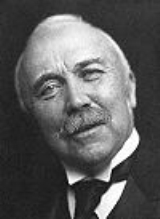
Henry Campbell-Bannerman

Encyclopedia
Sir Henry Campbell-Bannerman GCB (7 September 183622 April 1908) was a British
Liberal Party politician
who served as Prime Minister of the United Kingdom
from 1905 to 1908 and Leader of the Liberal Party
from 1899 to 1908. He also served as Secretary of State for War
twice, in the Cabinets of Gladstone
and Rosebery
. He was the first First Lord of the Treasury
to be officially called "Prime Minister", the term only coming into official usage five days after he took office. He also remains the only person to date to hold the positions of both Prime Minister and Father of the House
at the same time.
Known colloquially as "CB", he was a firm believer in free trade
, Irish Home Rule and the improvement of social conditions. He has been referred to as "Britain's first, and only, radical Prime Minister". Following a general election defeat in 1900
, Campbell-Bannerman went on to lead the Liberal Party
to a landslide victory
over the Conservative Party
at the 1906 general election
, also the last election in which the Liberals gained an overall majority in the House of Commons. The government he subsequently led passed legislation to ensure trade unions could not be liable for damages incurred during strike action, introduced free school meal
s for all children, created the first state pension for all people over 70 and empowered local authorities to purchase agricultural land from private landlords. Campbell-Bannerman resigned as Prime Minister on 3 April 1908 due to ill health and was replaced by his Chancellor
, H. H. Asquith
. He died nineteen days later.
in Glasgow
as Henry Campbell, the second son and youngest of the six children born to Sir James Campbell of Stracathro
(1790–1876) and his wife Janet Bannerman (1799–1873). Sir James Campbell had started work at a young age in the clothing trade in Glasgow, before going into partnership with his brother in 1817 to found J.& W. Campbell & Co., a warehousing, general wholesale and retail drapery business. Sir James was elected as a member of Glasgow Town Council in 1831 and stood as a Conservative
candidate for the Glasgow constituency
in the 1837
and 1841
general elections, before being appointed to serve as the Lord Provost of Glasgow from 1840 to 1843.
Henry's older brother, James
, served as the Conservative Member of Parliament for Glasgow and Aberdeen Universities
from 1880 to 1906. He was opposed to the majority of his younger brother's policies, and chose to stand down in the same election that would bring Campbell-Bannerman to power. In 1871, Henry Campbell became Henry Campbell-Bannerman, the addition of the surname Bannerman being a requirement of the will
of his uncle, Henry Bannerman, from whom he inherited the estate of Hunton Court in Kent
.
Campbell-Bannerman was educated at the High School of Glasgow
(1845–1847), the University of Glasgow
(1851), and Trinity College, Cambridge
(1854–1858), where he achieved a Third-Class Degree
in Classical Tripos
. After graduating, he joined the family firm of J.& W. Campbell & Co., based in Glasgow’s Ingram Street. Campbell was made a partner in the firm in 1860. Following his marriage that year to Sarah Charlotte Bruce
, Henry and his new bride set up residence at 6 Claremont Gardens in the Park district in the West End of Glasgow. The couple never had any children.
Campbell-Bannerman spoke French
, German
and Italian
fluently, and every summer he and his wife spent a couple of months in Europe, usually in France
and at the spa town of Marienbad
in Bohemia
.
candidate in a by-election for the Stirling Burghs
constituency, narrowly losing to fellow Liberal John Ramsay
. However, at the general election in November of that year, Campbell-Bannerman defeated Ramsay and was elected to the House of Commons as the Liberal Member of Parliament for Stirling Burghs, a constituency that he would go on to represent for almost forty years.
Campbell-Bannerman rose quickly through the ministerial ranks, being appointed as Financial Secretary to the War Office
in Gladstone's
first government
in November 1871, serving in this position until 1874. He was appointed to the same position from 1880 to 1882 in Gladstone's second government
, and after serving as Parliamentary and Financial Secretary to the Admiralty between 1882 and 1884, Campbell-Bannerman was promoted to the Cabinet as Chief Secretary for Ireland
in 1884.
In Gladstone's third
and fourth government
s, in 1886 and 1892 to 1894 respectively, as well as Rosebery's government from 1894 to 1895, he served as Secretary of State for War
. During his time in this office, he persuaded the Duke of Cambridge
, the Queen's
cousin, to resign as Commander-in-Chief
of the British Armed Forces
. This earned Campbell-Bannerman a knighthood.
as Leader of the Liberals
in the House of Commons, and Leader of the Opposition
. The Boer War of 1899
split the Liberal Party into Imperialist and Pro-Boer camps, leaving Campbell-Bannerman with a difficult task of holding together the strongly divided party, which was subsequently and unsurprisingly defeated in the "khaki election
" of 1900
. However, the Liberal Party was later able to unify over its opposition to the Education Act 1902
and the Brussels Sugar Convention of 1902, in which Britain and nine other nations attempted to stabilise world sugar prices by setting up a commission to investigate export bounties and decide on penalties. The Conservative Government of Arthur Balfour
had threatened countervailing duties and subsidies of West Indian sugar producers as a negotiating tool. The Convention's intent was to lead to the gradual phasing out of export bounties, and Britain would then forbid the importation of subsidised sugar. In a speech to the Cobden Club
on 28 November 1902, Campbell-Bannerman denounced the Convention as threatening the sovereignty of Britain.
However, it was Joseph Chamberlain
's proposals for Tariff Reform in May 1903 that provided the Liberals with a great and nationally-resonating cause on which to campaign and unify, due to its protectionist nature
. Chamberlain's proposals dominated politics through the rest of 1903 up until the general election of 1906. Campbell-Bannerman, like other Liberals, held an unshakable belief in free trade
. In a speech at Bolton on 15 October 1903 he explained in greater detail the reasoning behind Liberal support for free trade.
In 1903, the Liberal Party's Chief Whip
Herbert Gladstone negotiated a pact with Ramsay MacDonald
of the Labour Representation Committee to withdraw Liberal candidates in order to help LRC candidates in certain seats, in return for LRC withdrawal in other seats to help Liberal candidates. This attempt to undermine and outflank the Conservatives, which would prove to be successful, formed what became known as the "Lib-Lab pact
". Campbell-Bannerman got on well with Labour Leaders, and he said in 1903 "we are keenly in sympathy with the representatives of Labour. We have too few of them in the House of Commons". Despite this comment, and his sympathies with many elements of the Labour movement, he was not a socialist. One biographer has written that "he was deeply and genuinely concerned about the plight of the poor and so had readily adopted the rhetoric of progressivism, but he was not a progressive".
 The Liberals found themselves suddenly returned to power in December 1905 when Arthur Balfour
resigned as Prime Minister, prompting Edward VII
to invite Campbell-Bannerman to form a minority government
as the first Liberal Prime Minister of the 20th century. Balfour had hoped that Campbell-Bannerman would not be able to form a strong government, ushering in a general election that he could win. Campbell-Bannerman also faced problems within his own party, through the so called "Relugas Compact
" between H. H. Asquith
, Sir Edward Grey and Richard Haldane
, who planned to force him into the House of Lords
, weakening him as Prime Minister and effectively allowing Asquith to govern as Leader of the House of Commons
. Campbell-Bannerman saw off both of these issues by immediately dissolving Parliament and calling a general election
, whilst offering the positions of Chancellor of the Exchequer
, Foreign Secretary
and Secretary of State for War
to Asquith, Grey and Haldane respectively, which all three accepted. In his first public speech as Prime Minister on 22 December 1905, Campbell-Bannerman launched the Liberal election campaign, focusing on the traditional Liberal platform of "peace, retrenchment
and reform":
Helped by the Lib-Lab pact that he had had negotiated, the splits in the Conservatives over free trade and the positive election campaign that he fought, the Liberals won by a landslide, gaining 216 seats. The Conservatives saw their number of seats more than halve, and Arthur Balfour, now as Leader of the Opposition, lost his Manchester East
seat to the Liberals. Campbell-Bannerman would be the last ever Liberal to lead his party to an absolute majority in the House of Commons. Now with a majority of 125, Campbell-Bannerman was successfully returned to Downing Street as a considerably-strengthened Prime Minister. The defeat of the Relugas conspirators in the wake of this stunning victory was later referred to as "one of the most delicious comedies in British political history".
Whereas in the past it had never been used formally, Campbell-Bannerman was the first First Lord of the Treasury
to be given official use of the title "Prime Minister", a standard that continues to the present day. In 1907, by virtue of being the Member of Parliament
with the longest continuous service, Campbell-Bannerman achieved the honour of becoming the Father of the House
, the only serving British Prime Minister to do so to date.
introduced by the Campbell-Bannerman Government and beyond were incredibly wide-ranging. As Prime Minister, Campbell-Bannerman shifted the Liberal position from that of a "laissez-faire
" approach, to a more collectivist one. As had happened under his leadership generally, the Liberals in government appeared now to be enacting progressive liberalism, as opposed to traditional, Gladstonian liberalism
which was by now in decline. To that end, the government of Campbell-Bannerman introduced free school meal
s, state pensions, considerably more relaxed laws for trade union
s, moved towards unemployment and sickness pay and moved towards a system of free medical care, albeit for wage owners only. As Prime Minister, Campbell-Bannerman also passed the 1907 Probation Act, which established supervision within the community for young offenders as an alternative to prison, and the Children's Charter, which formed the basis of modern child welfare law, including a clause imposing punishment for those neglecting children. It was also made illegal for children to purchase alcohol
, tobacco
or fireworks, and medical inspections began to be rolled out across the nation. In essence, as Prime Minister, Henry Campbell-Bannerman either directly enacted, or laid the groundwork for later developments, in the "Great Liberal Reforms" of the early 20th Century, which effectively represented the emergence of the welfare state
within the UK. The importance and legacy of these reforms has been recognised by many historians, hence the classification of Campbell-Bannerman by some as "Britain's first and only radical Prime Minister".
with Russia in 1907, brought about principally by the Foreign Secretary, Sir Edward Grey
. In January 1906 Grey sanctioned staff talks between Britain and France's army and navy but without any binding commitment. These included the plan to send one hundred thousand British soldiers to France within two weeks of a Franco-German war. Campbell-Bannerman was not informed of these at first but when Grey told him about them he gave them his blessing. This was the origin of the British Expeditionary Force that would be sent to France in 1914 at the start of the Great War
with Germany. Campbell-Bannerman did not inform the rest of the Cabinet of these staff talks because there was no binding commitment and because he wanted to preserve the unity of the government. The radical members of the Cabinet such as Lord Loreburn, Lord Morley
and Lord Bryce
would have opposed such cooperation with the French.
Campbell-Bannerman visited France in April 1907 and met the Radical Prime Minister
, Georges Clemenceau
. Clemenceau believed that the British would help France in a war with Germany but Campbell-Bannerman told him Britain was in no way committed. He may have been unaware that the staff talks were still ongoing. Not long after this Violet Cecil
met Clemenceau and she wrote down what he had said to her about the meeting:
Campbell-Bannerman's biographer John Wilson has described the meeting as "a clash between two fundamentally different philosophies". The Liberal journalist and friend of Campbell-Bannerman, F. W. Hirst
, claimed that Campbell-Bannerman "had not a ghost of a notion that the French Entente was being converted into a...return to the old balance of power
which had involved Great Britain in so many wars on the Continent. That...Grey and Haldane did not inform the Cabinet is astonishing; that a true-hearted apostle of peace like Sir Henry Campbell-Bannerman should have known of the danger and yet concealed it from his colleagues is incredible, and I am happy to conclude...with an assurance that in the days of his triumph the Liberal leader, having fought a good fight, kept the faith to the end and was in no way responsible for the European tragedy that came to pass six years after his death".
Campbell-Bannerman's government granted the Boer states, the Transvaal and the Orange River Colony, self-government within the British Empire through an Order in Council so as to bypass the House of Lords. This led to the Union of South Africa
in 1910. The first South African Prime Minister, General Louis Botha
, believed that "Campbell-Bannerman's act [in giving self-government back to the Boers] had redressed the balance of the Anglo-Boer War, or had, at any rate, given full power to the South Africans themselves to redress it". The former Boer general, Jan Smuts
, wrote to David Lloyd George
in 1919: "My experience in South Africa has made me a firm believer in political magnanimity, and your and Campbell-Bannerman's great record still remains not only the noblest but also the most successful page in recent British statesmanship". However the Unionist politician Lord Milner
opposed it, saying in August 1907: "People here – not only Liberals – seem delighted, and to think themselves wonderfully fine fellows for having given South Africa back to the Boers. I think it all sheer lunacy".
in 1907, Campbell-Bannerman's health took a turn for the worse. Following a series of heart attacks, the most serious in November 1907, he began to fear that he would not be able to survive to the end of his term. He eventually resigned as Prime Minister
on 3 April 1908, and was succeeded by his Chancellor of the Exchequer
, Herbert Asquith
. Campbell-Bannerman remained both a Member of Parliament and Leader of the Liberal Party
, and continued to live at 10 Downing Street
in the immediate aftermath of his resignation, intending to make other arrangements in the near future. However, his health began to decline at an even quicker pace than before, and he died nineteen days following his resignation on 22 April 1908. His last words were "This is not the end of me". He remains to date the only former Prime Minister to die within 10 Downing Street. Campbell-Bannerman was buried in the churchyard of Meigle Parish Church
, Perthshire
, near Belmont Castle, his home since 1887. A relatively modest stone plaque set in the exterior wall of the church serves as a memorial.
was lowered to half-mast, the blinds were drawn and his portrait was draped in black as a sign of mourning. John Redmond
, the leader of the Irish Nationalist Party, paid tribute to Campbell-Bannerman by saying that "We all feel that Ireland has lost a brave and considerate friend". David Lloyd George
said on hearing of Campbell-Bannerman's death:
In an uncharacteristically emotional speech on 27 April, the day of Campbell-Bannerman's funeral, his successor H. H. Asquith
told the House of Commons:
Robert Smillie
, the trade unionist and Labour MP, said that, after Gladstone, Campbell-Bannerman was the greatest man he had ever met.
George Dangerfield
said Campbell-Bannerman's death "was like the passing of true Liberalism. Sir Henry had believed in Peace, Retrenchment, and Reform, those amiable deities who presided so complacently over large portions of the Victorian era... And now almost the last true worshipper at those large, equivocal altars lay dead". Campbell-Bannerman held firmly to the Liberal principles of Richard Cobden
and William Ewart Gladstone
. It was not until Campbell-Bannerman's departure that the doctrines of New Liberalism
came to be implemented. Friedrich Hayek
said: "Perhaps the government of Sir Henry Campbell-Bannerman... should be regarded as the last Liberal government of the old type, while under his successor, H. H. Asquith, new experiments in social policy were undertaken which were only doubtfully compatible with the older Liberal principles".
There is a blue plaque
outside Campbell-Bannerman's house at 6 Grosvenor Place in London. On 6 December 2008, former leaders of the Liberal Democrats
Charles Kennedy
and Lord Steel
, unveiled a plaque to commemorate Sir Henry at the home in Bath Street, Glasgow. Lord Steel praised his predecessor as Liberal Leader as an "overlooked radical" whose 1906 landslide victory had paved the way for a succession of reforming governments. "He led the way for the longest period of successful radical government ever, which was continued by Herbert Asquith and David Lloyd George," Lord Steel said.
His bronze bust, sculpted by Paul Raphael Montford
, is in Westminster Abbey
.
United Kingdom
The United Kingdom of Great Britain and Northern IrelandIn the United Kingdom and Dependencies, other languages have been officially recognised as legitimate autochthonous languages under the European Charter for Regional or Minority Languages...
Liberal Party politician
Politician
A politician, political leader, or political figure is an individual who is involved in influencing public policy and decision making...
who served as Prime Minister of the United Kingdom
Prime Minister of the United Kingdom
The Prime Minister of the United Kingdom of Great Britain and Northern Ireland is the Head of Her Majesty's Government in the United Kingdom. The Prime Minister and Cabinet are collectively accountable for their policies and actions to the Sovereign, to Parliament, to their political party and...
from 1905 to 1908 and Leader of the Liberal Party
Liberal Party (UK)
The Liberal Party was one of the two major political parties of the United Kingdom during the 19th and early 20th centuries. It was a third party of negligible importance throughout the latter half of the 20th Century, before merging with the Social Democratic Party in 1988 to form the present day...
from 1899 to 1908. He also served as Secretary of State for War
Secretary of State for War
The position of Secretary of State for War, commonly called War Secretary, was a British cabinet-level position, first held by Henry Dundas . In 1801 the post became that of Secretary of State for War and the Colonies. The position was re-instated in 1854...
twice, in the Cabinets of Gladstone
William Ewart Gladstone
William Ewart Gladstone FRS FSS was a British Liberal statesman. In a career lasting over sixty years, he served as Prime Minister four separate times , more than any other person. Gladstone was also Britain's oldest Prime Minister, 84 years old when he resigned for the last time...
and Rosebery
Archibald Primrose, 5th Earl of Rosebery
Archibald Philip Primrose, 5th Earl of Rosebery, KG, PC was a British Liberal statesman and Prime Minister. Between the death of his father, in 1851, and the death of his grandfather, the 4th Earl, in 1868, he was known by the courtesy title of Lord Dalmeny.Rosebery was a Liberal Imperialist who...
. He was the first First Lord of the Treasury
First Lord of the Treasury
The First Lord of the Treasury is the head of the commission exercising the ancient office of Lord High Treasurer in the United Kingdom, and is now always also the Prime Minister...
to be officially called "Prime Minister", the term only coming into official usage five days after he took office. He also remains the only person to date to hold the positions of both Prime Minister and Father of the House
Father of the House
Father of the House is a term that has by tradition been unofficially bestowed on certain members of some national legislatures, most notably the House of Commons in the United Kingdom. In some legislatures the term refers to the oldest member, but in others it refers the longest-serving member.The...
at the same time.
Known colloquially as "CB", he was a firm believer in free trade
Free trade
Under a free trade policy, prices emerge from supply and demand, and are the sole determinant of resource allocation. 'Free' trade differs from other forms of trade policy where the allocation of goods and services among trading countries are determined by price strategies that may differ from...
, Irish Home Rule and the improvement of social conditions. He has been referred to as "Britain's first, and only, radical Prime Minister". Following a general election defeat in 1900
United Kingdom general election, 1900
-Seats summary:-See also:*MPs elected in the United Kingdom general election, 1900*The Parliamentary Franchise in the United Kingdom 1885-1918-External links:***-References:*F. W. S. Craig, British Electoral Facts: 1832-1987**...
, Campbell-Bannerman went on to lead the Liberal Party
Liberal Party (UK)
The Liberal Party was one of the two major political parties of the United Kingdom during the 19th and early 20th centuries. It was a third party of negligible importance throughout the latter half of the 20th Century, before merging with the Social Democratic Party in 1988 to form the present day...
to a landslide victory
Landslide victory
In politics, a landslide victory is the victory of a candidate or political party by an overwhelming margin in an election...
over the Conservative Party
Conservative Party (UK)
The Conservative Party, formally the Conservative and Unionist Party, is a centre-right political party in the United Kingdom that adheres to the philosophies of conservatism and British unionism. It is the largest political party in the UK, and is currently the largest single party in the House...
at the 1906 general election
United Kingdom general election, 1906
-Seats summary:-See also:*MPs elected in the United Kingdom general election, 1906*The Parliamentary Franchise in the United Kingdom 1885-1918-External links:***-References:*F. W. S. Craig, British Electoral Facts: 1832-1987**...
, also the last election in which the Liberals gained an overall majority in the House of Commons. The government he subsequently led passed legislation to ensure trade unions could not be liable for damages incurred during strike action, introduced free school meal
Free school meal
A Free School Meal, provided to a child or young person during a school break, is paid for by Government. For a child to qualify for a Free School Meal, their parent or carer must be receiving particular qualifying benefits as stated by Government...
s for all children, created the first state pension for all people over 70 and empowered local authorities to purchase agricultural land from private landlords. Campbell-Bannerman resigned as Prime Minister on 3 April 1908 due to ill health and was replaced by his Chancellor
Chancellor of the Exchequer
The Chancellor of the Exchequer is the title held by the British Cabinet minister who is responsible for all economic and financial matters. Often simply called the Chancellor, the office-holder controls HM Treasury and plays a role akin to the posts of Minister of Finance or Secretary of the...
, H. H. Asquith
H. H. Asquith
Herbert Henry Asquith, 1st Earl of Oxford and Asquith, KG, PC, KC served as the Liberal Prime Minister of the United Kingdom from 1908 to 1916...
. He died nineteen days later.
Early life and family
Sir Henry Campbell-Bannerman was born on 7 September 1836 at Kelvinside HouseKelvinside
Kelvinside is a district in the Scottish city of Glasgow. It is situated north of the River Clyde and is bounded by Dowanhill, Hyndland and Broomhill to the South with Kelvindale and the River Kelvin to the North...
in Glasgow
Glasgow
Glasgow is the largest city in Scotland and third most populous in the United Kingdom. The city is situated on the River Clyde in the country's west central lowlands...
as Henry Campbell, the second son and youngest of the six children born to Sir James Campbell of Stracathro
Stracathro
Stracathro is a small place in Angus, Scotland,-Location:Stracathro is located 2½ miles southeast of Edzell in NE Angus. It lies to the northeast of Brechin on the A90.-History:...
(1790–1876) and his wife Janet Bannerman (1799–1873). Sir James Campbell had started work at a young age in the clothing trade in Glasgow, before going into partnership with his brother in 1817 to found J.& W. Campbell & Co., a warehousing, general wholesale and retail drapery business. Sir James was elected as a member of Glasgow Town Council in 1831 and stood as a Conservative
Conservative Party (UK)
The Conservative Party, formally the Conservative and Unionist Party, is a centre-right political party in the United Kingdom that adheres to the philosophies of conservatism and British unionism. It is the largest political party in the UK, and is currently the largest single party in the House...
candidate for the Glasgow constituency
Glasgow (UK Parliament constituency)
Glasgow was a burgh constituency of the House of Commons of the Parliament of the United Kingdom from 1832 to 1885. It returned two Member of Parliament until 1868, and then three from 1868 to 1885...
in the 1837
United Kingdom general election, 1837
The 1837 United Kingdom general election saw Robert Peel's Conservatives close further on the position of the Whigs, who won their fourth election of the decade....
and 1841
United Kingdom general election, 1841
-Seats summary:-Whig MPs who lost their seats:*Viscount Morpeth - Chief Secretary for Ireland*Sir George Strickland, Bt*Sir Henry Barron, 1st Baronet-References:*F. W. S. Craig, British Electoral Facts: 1832-1987...
general elections, before being appointed to serve as the Lord Provost of Glasgow from 1840 to 1843.
Henry's older brother, James
James Alexander Campbell (politician)
James Alexander Campbell was a Scottish businessman and Conservative politician.-Biography:Campbell was born in George Square, Glasgow a son of Sir James Campbell of Stracathro and his wife Janet Bannerman of Manchester. His father established the firm J & W Campbell, wholesale merchants and was...
, served as the Conservative Member of Parliament for Glasgow and Aberdeen Universities
Glasgow and Aberdeen Universities (UK Parliament constituency)
Glasgow and Aberdeen Universities, in Scotland, was a university constituency represented in the House of Commons of the Parliament of the United Kingdom from 1868 until 1918...
from 1880 to 1906. He was opposed to the majority of his younger brother's policies, and chose to stand down in the same election that would bring Campbell-Bannerman to power. In 1871, Henry Campbell became Henry Campbell-Bannerman, the addition of the surname Bannerman being a requirement of the will
Will (law)
A will or testament is a legal declaration by which a person, the testator, names one or more persons to manage his/her estate and provides for the transfer of his/her property at death...
of his uncle, Henry Bannerman, from whom he inherited the estate of Hunton Court in Kent
Kent
Kent is a county in southeast England, and is one of the home counties. It borders East Sussex, Surrey and Greater London and has a defined boundary with Essex in the middle of the Thames Estuary. The ceremonial county boundaries of Kent include the shire county of Kent and the unitary borough of...
.
Campbell-Bannerman was educated at the High School of Glasgow
High School of Glasgow
The High School of Glasgow is an independent, co-educational day school in Glasgow, Scotland. Founded as the Choir School of Glasgow Cathedral in around 1124, it is the oldest school in Scotland, and the twelfth oldest in the United Kingdom. It remained part of the Church as the city's grammar...
(1845–1847), the University of Glasgow
University of Glasgow
The University of Glasgow is the fourth-oldest university in the English-speaking world and one of Scotland's four ancient universities. Located in Glasgow, the university was founded in 1451 and is presently one of seventeen British higher education institutions ranked amongst the top 100 of the...
(1851), and Trinity College, Cambridge
Trinity College, Cambridge
Trinity College is a constituent college of the University of Cambridge. Trinity has more members than any other college in Cambridge or Oxford, with around 700 undergraduates, 430 graduates, and over 170 Fellows...
(1854–1858), where he achieved a Third-Class Degree
British undergraduate degree classification
The British undergraduate degree classification system is a grading scheme for undergraduate degrees in the United Kingdom...
in Classical Tripos
Classical Tripos
The Classical Tripos is the taught course in classics at the University of Cambridge, equivalent to Literae Humaniores at Oxford. It is traditionally a three year degree, but for those who have not studied Latin and Greek at school a four year course has been introduced...
. After graduating, he joined the family firm of J.& W. Campbell & Co., based in Glasgow’s Ingram Street. Campbell was made a partner in the firm in 1860. Following his marriage that year to Sarah Charlotte Bruce
Charlotte Campbell-Bannerman
Charlotte, Lady Campbell-Bannerman was the wife of British prime minister Henry Campbell-Bannerman.Sarah Charlotte Bruce was the daughter of Major-General Sir Charles Bruce, KCB, sometime Governor of Portsmouth, and his wife Charlotte, daughter of James Forbes, of Hutton Hall, Essex, and...
, Henry and his new bride set up residence at 6 Claremont Gardens in the Park district in the West End of Glasgow. The couple never had any children.
Campbell-Bannerman spoke French
French language
French is a Romance language spoken as a first language in France, the Romandy region in Switzerland, Wallonia and Brussels in Belgium, Monaco, the regions of Quebec and Acadia in Canada, and by various communities elsewhere. Second-language speakers of French are distributed throughout many parts...
, German
German language
German is a West Germanic language, related to and classified alongside English and Dutch. With an estimated 90 – 98 million native speakers, German is one of the world's major languages and is the most widely-spoken first language in the European Union....
and Italian
Italian language
Italian is a Romance language spoken mainly in Europe: Italy, Switzerland, San Marino, Vatican City, by minorities in Malta, Monaco, Croatia, Slovenia, France, Libya, Eritrea, and Somalia, and by immigrant communities in the Americas and Australia...
fluently, and every summer he and his wife spent a couple of months in Europe, usually in France
France
The French Republic , The French Republic , The French Republic , (commonly known as France , is a unitary semi-presidential republic in Western Europe with several overseas territories and islands located on other continents and in the Indian, Pacific, and Atlantic oceans. Metropolitan France...
and at the spa town of Marienbad
Mariánské Lázne
Mariánské Lázně is a spa town in the Karlovy Vary Region of the Czech Republic. The town, surrounded by green mountains, is a mosaic of parks and noble houses...
in Bohemia
Bohemia
Bohemia is a historical region in central Europe, occupying the western two-thirds of the traditional Czech Lands. It is located in the contemporary Czech Republic with its capital in Prague...
.
Member of Parliament
In April 1868, at the age of thirty-one, Campbell-Bannerman stood as a LiberalLiberal Party (UK)
The Liberal Party was one of the two major political parties of the United Kingdom during the 19th and early 20th centuries. It was a third party of negligible importance throughout the latter half of the 20th Century, before merging with the Social Democratic Party in 1988 to form the present day...
candidate in a by-election for the Stirling Burghs
Stirling Burghs (UK Parliament constituency)
Stirling Burghs was a district of burghs constituency of the House of Commons of the Parliament of the United Kingdom from 1708 to 1918. The constituency comprised the burghs of Stirling in Stirlingshire, Dunfermline, and Inverkeithing in Fife, Queensferry, in Linlithgowshire , and Culross, which...
constituency, narrowly losing to fellow Liberal John Ramsay
John Ramsay (of Kildalton)
John Ramsay was a Scottish merchant and Liberal Party politician.Ramsay was the son of Robert Ramsay of Stirling and his wife Elizabeth Stirling. He was educated at Glasgow University and became a merchant in Glasgow. He was a Deputy Lieutenant and a J.P. for Argyllshire and a J.P. for...
. However, at the general election in November of that year, Campbell-Bannerman defeated Ramsay and was elected to the House of Commons as the Liberal Member of Parliament for Stirling Burghs, a constituency that he would go on to represent for almost forty years.
Campbell-Bannerman rose quickly through the ministerial ranks, being appointed as Financial Secretary to the War Office
Financial Secretary to the War Office
Financial Secretary to the War Office was an office of the British government, the financial secretary of the War Office department.The post was combined with that of Under-Secretary of State for War from 17 April 1947....
in Gladstone's
William Ewart Gladstone
William Ewart Gladstone FRS FSS was a British Liberal statesman. In a career lasting over sixty years, he served as Prime Minister four separate times , more than any other person. Gladstone was also Britain's oldest Prime Minister, 84 years old when he resigned for the last time...
first government
First Gladstone Ministry
-The Cabinet:† The Earl de Grey was created the Marquess of Ripon in 1871. ‡ Henry Austin Bruce was created Baron Aberdare in 1873.Notes...
in November 1871, serving in this position until 1874. He was appointed to the same position from 1880 to 1882 in Gladstone's second government
Second Gladstone Ministry
-The Cabinet:†Created Earl of Selborne in 1882.Notes*William Ewart Gladstone served as both First Lord of the Treasury and Chancellor of the Exchequer between April 1880 and December 1882....
, and after serving as Parliamentary and Financial Secretary to the Admiralty between 1882 and 1884, Campbell-Bannerman was promoted to the Cabinet as Chief Secretary for Ireland
Chief Secretary for Ireland
The Chief Secretary for Ireland was a key political office in the British administration in Ireland. Nominally subordinate to the Lord Lieutenant, from the late 18th century until the end of British rule he was effectively the government minister with responsibility for governing Ireland; usually...
in 1884.
In Gladstone's third
Third Gladstone Ministry
-The Cabinet:ChangesApril, 1886: James Stansfeld succeeds Joseph Chamberlain at the Local Government Board. The Earl of Dalhousie succeeds George Otto Trevelyan as Secretary for Scotland....
and fourth government
Fourth Gladstone Ministry
-The Cabinet:For a more detailed list, including ministers not in the Cabinet, see Liberal Government 1892-1895....
s, in 1886 and 1892 to 1894 respectively, as well as Rosebery's government from 1894 to 1895, he served as Secretary of State for War
Secretary of State for War
The position of Secretary of State for War, commonly called War Secretary, was a British cabinet-level position, first held by Henry Dundas . In 1801 the post became that of Secretary of State for War and the Colonies. The position was re-instated in 1854...
. During his time in this office, he persuaded the Duke of Cambridge
Prince George, Duke of Cambridge
Prince George, Duke of Cambridge was a member of the British Royal Family, a male-line grandson of King George III. The Duke was an army officer and served as commander-in-chief of the British Army from 1856 to 1895...
, the Queen's
Victoria of the United Kingdom
Victoria was the monarch of the United Kingdom of Great Britain and Ireland from 20 June 1837 until her death. From 1 May 1876, she used the additional title of Empress of India....
cousin, to resign as Commander-in-Chief
Commander-in-Chief
A commander-in-chief is the commander of a nation's military forces or significant element of those forces. In the latter case, the force element may be defined as those forces within a particular region or those forces which are associated by function. As a practical term it refers to the military...
of the British Armed Forces
British Armed Forces
The British Armed Forces are the armed forces of the United Kingdom of Great Britain and Northern Ireland.Also known as Her Majesty's Armed Forces and sometimes legally the Armed Forces of the Crown, the British Armed Forces encompasses three professional uniformed services, the Royal Navy, the...
. This earned Campbell-Bannerman a knighthood.
Leader of the Liberal Party
On 6 February 1899 Campbell-Bannerman succeeded Sir William Vernon HarcourtWilliam Vernon Harcourt (politician)
Sir William George Granville Venables Vernon Harcourt was a British lawyer, journalist and Liberal statesman. He served as Member of Parliament for various constituencies and held the offices of Home Secretary and Chancellor of the Exchequer under William Ewart Gladstone before becoming Leader of...
as Leader of the Liberals
Liberal Party (UK)
The Liberal Party was one of the two major political parties of the United Kingdom during the 19th and early 20th centuries. It was a third party of negligible importance throughout the latter half of the 20th Century, before merging with the Social Democratic Party in 1988 to form the present day...
in the House of Commons, and Leader of the Opposition
Leader of the Opposition (UK)
The Leader of Her Majesty's Most Loyal Opposition in the United Kingdom is the politician who leads the Official Opposition in the United Kingdom. There is also a Leader of the Opposition in the House of Lords...
. The Boer War of 1899
Second Boer War
The Second Boer War was fought from 11 October 1899 until 31 May 1902 between the British Empire and the Afrikaans-speaking Dutch settlers of two independent Boer republics, the South African Republic and the Orange Free State...
split the Liberal Party into Imperialist and Pro-Boer camps, leaving Campbell-Bannerman with a difficult task of holding together the strongly divided party, which was subsequently and unsurprisingly defeated in the "khaki election
Khaki Election
In British political history, a khaki election is any national election which is heavily influenced by wartime or postwar sentiment. In the British general election of 1900, the Conservative Party government of Lord Salisbury was returned to office with an increased majority over the Liberal Party...
" of 1900
United Kingdom general election, 1900
-Seats summary:-See also:*MPs elected in the United Kingdom general election, 1900*The Parliamentary Franchise in the United Kingdom 1885-1918-External links:***-References:*F. W. S. Craig, British Electoral Facts: 1832-1987**...
. However, the Liberal Party was later able to unify over its opposition to the Education Act 1902
Education Act 1902
The Education Act 1902 , also known as Balfour's Act, is an Act of the Parliament of the United Kingdom affecting education in England and Wales. At the time of passage of the Act, the Conservative Party was in power...
and the Brussels Sugar Convention of 1902, in which Britain and nine other nations attempted to stabilise world sugar prices by setting up a commission to investigate export bounties and decide on penalties. The Conservative Government of Arthur Balfour
Arthur Balfour
Arthur James Balfour, 1st Earl of Balfour, KG, OM, PC, DL was a British Conservative politician and statesman...
had threatened countervailing duties and subsidies of West Indian sugar producers as a negotiating tool. The Convention's intent was to lead to the gradual phasing out of export bounties, and Britain would then forbid the importation of subsidised sugar. In a speech to the Cobden Club
Cobden Club
The Cobden Club was a political gentlemen's club in London founded in 1866 for believers in Free Trade doctrine, and named in honour of Richard Cobden, who had died the year before....
on 28 November 1902, Campbell-Bannerman denounced the Convention as threatening the sovereignty of Britain.
"It means that we abandon our fiscal independence, together with our free-trade ways; that we subside into the tenth part of a Vehmgericht which is to direct us what sugar is to be countervailed, at what rate per cent. we are to countervail it, how much is to be put on for the bounty, and how much for the tariff being in excess of the convention tariff; and this being the established order of things, the British Chancellor of the Exchequer in his robes obeys the orders that he receives from this foreign convention, in which the Britisher is only one out of ten, and the House of Commons humbly submits to the whole transaction. ("Shame.") Sir, of all the insane schemes ever offered to a free country as a boon this is surely the maddest."
However, it was Joseph Chamberlain
Joseph Chamberlain
Joseph Chamberlain was an influential British politician and statesman. Unlike most major politicians of the time, he was a self-made businessman and had not attended Oxford or Cambridge University....
's proposals for Tariff Reform in May 1903 that provided the Liberals with a great and nationally-resonating cause on which to campaign and unify, due to its protectionist nature
Protectionism
Protectionism is the economic policy of restraining trade between states through methods such as tariffs on imported goods, restrictive quotas, and a variety of other government regulations designed to allow "fair competition" between imports and goods and services produced domestically.This...
. Chamberlain's proposals dominated politics through the rest of 1903 up until the general election of 1906. Campbell-Bannerman, like other Liberals, held an unshakable belief in free trade
Free trade
Under a free trade policy, prices emerge from supply and demand, and are the sole determinant of resource allocation. 'Free' trade differs from other forms of trade policy where the allocation of goods and services among trading countries are determined by price strategies that may differ from...
. In a speech at Bolton on 15 October 1903 he explained in greater detail the reasoning behind Liberal support for free trade.
"We are satisfied that it is right because it gives the freest play to individual energy and initiative and character and the largest liberty both to producer and consumer. We say that trade is injured when it is not allowed to follow its natural course, and when it is either hampered or diverted by artificial obstacles.... We believe in free trade because we believe in the capacity of our countrymen. That at least is why I oppose protection root and branch, veiled and unveiled, one-sided or reciprocal. I oppose it in any form. Besides we have experience of fifty years, during which our prosperity has become the envy of the world."
In 1903, the Liberal Party's Chief Whip
Chief Whip
The Chief Whip is a political office in some legislatures assigned to an elected member whose task is to administer the whipping system that ensures that members of the party attend and vote as the party leadership desires.-The Whips Office:...
Herbert Gladstone negotiated a pact with Ramsay MacDonald
Ramsay MacDonald
James Ramsay MacDonald, PC, FRS was a British politician who was the first ever Labour Prime Minister, leading a minority government for two terms....
of the Labour Representation Committee to withdraw Liberal candidates in order to help LRC candidates in certain seats, in return for LRC withdrawal in other seats to help Liberal candidates. This attempt to undermine and outflank the Conservatives, which would prove to be successful, formed what became known as the "Lib-Lab pact
Lib-Lab pact
In British politics, a Lib-Lab pact is a working arrangement between the Liberal Democrats and the Labour Party.There have been four such arrangements, and one alleged proposal, at the national level...
". Campbell-Bannerman got on well with Labour Leaders, and he said in 1903 "we are keenly in sympathy with the representatives of Labour. We have too few of them in the House of Commons". Despite this comment, and his sympathies with many elements of the Labour movement, he was not a socialist. One biographer has written that "he was deeply and genuinely concerned about the plight of the poor and so had readily adopted the rhetoric of progressivism, but he was not a progressive".
Prime Minister
Arthur Balfour
Arthur James Balfour, 1st Earl of Balfour, KG, OM, PC, DL was a British Conservative politician and statesman...
resigned as Prime Minister, prompting Edward VII
Edward VII of the United Kingdom
Edward VII was King of the United Kingdom and the British Dominions and Emperor of India from 22 January 1901 until his death in 1910...
to invite Campbell-Bannerman to form a minority government
Minority government
A minority government or a minority cabinet is a cabinet of a parliamentary system formed when a political party or coalition of parties does not have a majority of overall seats in the parliament but is sworn into government to break a Hung Parliament election result. It is also known as a...
as the first Liberal Prime Minister of the 20th century. Balfour had hoped that Campbell-Bannerman would not be able to form a strong government, ushering in a general election that he could win. Campbell-Bannerman also faced problems within his own party, through the so called "Relugas Compact
The Relugas Compact
The Relugas Compact was the name given to the political plot hatched between H. H. Asquith, Sir Edward Grey and R B Haldane to remove Sir Henry Campbell-Bannerman from the leadership of the Liberal Party in the House of Commons of the United Kingdom in 1905....
" between H. H. Asquith
H. H. Asquith
Herbert Henry Asquith, 1st Earl of Oxford and Asquith, KG, PC, KC served as the Liberal Prime Minister of the United Kingdom from 1908 to 1916...
, Sir Edward Grey and Richard Haldane
Richard Haldane, 1st Viscount Haldane
Richard Burdon Haldane, 1st Viscount Haldane KT, OM, PC, KC, FRS, FBA, FSA , was an influential British Liberal Imperialist and later Labour politician, lawyer and philosopher. He was Secretary of State for War between 1905 and 1912 during which time the "Haldane Reforms" were implemented...
, who planned to force him into the House of Lords
House of Lords
The House of Lords is the upper house of the Parliament of the United Kingdom. Like the House of Commons, it meets in the Palace of Westminster....
, weakening him as Prime Minister and effectively allowing Asquith to govern as Leader of the House of Commons
Leader of the House of Commons
The Leader of the House of Commons is a member of the Cabinet of the United Kingdom who is responsible for arranging government business in the House of Commons...
. Campbell-Bannerman saw off both of these issues by immediately dissolving Parliament and calling a general election
United Kingdom general election, 1906
-Seats summary:-See also:*MPs elected in the United Kingdom general election, 1906*The Parliamentary Franchise in the United Kingdom 1885-1918-External links:***-References:*F. W. S. Craig, British Electoral Facts: 1832-1987**...
, whilst offering the positions of Chancellor of the Exchequer
Chancellor of the Exchequer
The Chancellor of the Exchequer is the title held by the British Cabinet minister who is responsible for all economic and financial matters. Often simply called the Chancellor, the office-holder controls HM Treasury and plays a role akin to the posts of Minister of Finance or Secretary of the...
, Foreign Secretary
Secretary of State for Foreign and Commonwealth Affairs
The Secretary of State for Foreign and Commonwealth Affairs, commonly referred to as the Foreign Secretary, is a senior member of Her Majesty's Government heading the Foreign and Commonwealth Office and regarded as one of the Great Offices of State...
and Secretary of State for War
Secretary of State for War
The position of Secretary of State for War, commonly called War Secretary, was a British cabinet-level position, first held by Henry Dundas . In 1801 the post became that of Secretary of State for War and the Colonies. The position was re-instated in 1854...
to Asquith, Grey and Haldane respectively, which all three accepted. In his first public speech as Prime Minister on 22 December 1905, Campbell-Bannerman launched the Liberal election campaign, focusing on the traditional Liberal platform of "peace, retrenchment
Retrenchment
Retrenchment is an act of cutting down or reduction, particularly of public expenditure.-Political usage:The word is familiar in this, its most general sense, from the motto of the Gladstonian Liberal party in British politics, "Peace, Retrenchment and Reform."The manifesto for 1906 Liberal...
and reform":
"Expenditure calls for taxes, and taxes are the plaything of the tariff reformer. Militarism, extravagance, protection are weeds which grow in the same field, and if you want to clear the field for honest cultivation you must root them all out. For my own part, I do not believe that we should have been confronted by the spectre of protection if it had not been for the South African war. Depend upon it that in fighting for our open ports and for the cheap food and material upon which the welfare of the people and the prosperity of our commerce depend we are fighting against those powers, privileges, injustices, and monopolies which are unalterably opposed to the triumph of democratic principles."
Helped by the Lib-Lab pact that he had had negotiated, the splits in the Conservatives over free trade and the positive election campaign that he fought, the Liberals won by a landslide, gaining 216 seats. The Conservatives saw their number of seats more than halve, and Arthur Balfour, now as Leader of the Opposition, lost his Manchester East
Manchester East (UK Parliament constituency)
Manchester East was one of six single-member parliamentary constituencies created in 1885 by the division of the existing three-member Parliamentary Borough of Manchester...
seat to the Liberals. Campbell-Bannerman would be the last ever Liberal to lead his party to an absolute majority in the House of Commons. Now with a majority of 125, Campbell-Bannerman was successfully returned to Downing Street as a considerably-strengthened Prime Minister. The defeat of the Relugas conspirators in the wake of this stunning victory was later referred to as "one of the most delicious comedies in British political history".
Whereas in the past it had never been used formally, Campbell-Bannerman was the first First Lord of the Treasury
First Lord of the Treasury
The First Lord of the Treasury is the head of the commission exercising the ancient office of Lord High Treasurer in the United Kingdom, and is now always also the Prime Minister...
to be given official use of the title "Prime Minister", a standard that continues to the present day. In 1907, by virtue of being the Member of Parliament
Member of Parliament
A Member of Parliament is a representative of the voters to a :parliament. In many countries with bicameral parliaments, the term applies specifically to members of the lower house, as upper houses often have a different title, such as senate, and thus also have different titles for its members,...
with the longest continuous service, Campbell-Bannerman achieved the honour of becoming the Father of the House
Father of the House
Father of the House is a term that has by tradition been unofficially bestowed on certain members of some national legislatures, most notably the House of Commons in the United Kingdom. In some legislatures the term refers to the oldest member, but in others it refers the longest-serving member.The...
, the only serving British Prime Minister to do so to date.
Domestic reforms
Though the 1906 election had not seen either of the two main parties make poverty an important issue, the social and liberal reformsLiberal reforms
The Liberal welfare reforms were acts of social legislation passed by the British Liberal Party after the 1906 General Election. It has been argued that this legislation shows the emergence of the modern welfare state in the UK. They shifted their outlook from a laissez-faire system to a more...
introduced by the Campbell-Bannerman Government and beyond were incredibly wide-ranging. As Prime Minister, Campbell-Bannerman shifted the Liberal position from that of a "laissez-faire
Laissez-faire
In economics, laissez-faire describes an environment in which transactions between private parties are free from state intervention, including restrictive regulations, taxes, tariffs and enforced monopolies....
" approach, to a more collectivist one. As had happened under his leadership generally, the Liberals in government appeared now to be enacting progressive liberalism, as opposed to traditional, Gladstonian liberalism
Gladstonian Liberalism
Gladstonian Liberalism is a political doctrine named after the British Victorian Prime Minister and leader of the Liberal Party, William Ewart Gladstone. Gladstonian Liberalism consisted of limited government expenditure and low taxation whilst making sure government had balanced budgets...
which was by now in decline. To that end, the government of Campbell-Bannerman introduced free school meal
Free school meal
A Free School Meal, provided to a child or young person during a school break, is paid for by Government. For a child to qualify for a Free School Meal, their parent or carer must be receiving particular qualifying benefits as stated by Government...
s, state pensions, considerably more relaxed laws for trade union
Trade union
A trade union, trades union or labor union is an organization of workers that have banded together to achieve common goals such as better working conditions. The trade union, through its leadership, bargains with the employer on behalf of union members and negotiates labour contracts with...
s, moved towards unemployment and sickness pay and moved towards a system of free medical care, albeit for wage owners only. As Prime Minister, Campbell-Bannerman also passed the 1907 Probation Act, which established supervision within the community for young offenders as an alternative to prison, and the Children's Charter, which formed the basis of modern child welfare law, including a clause imposing punishment for those neglecting children. It was also made illegal for children to purchase alcohol
Alcohol
In chemistry, an alcohol is an organic compound in which the hydroxy functional group is bound to a carbon atom. In particular, this carbon center should be saturated, having single bonds to three other atoms....
, tobacco
Tobacco
Tobacco is an agricultural product processed from the leaves of plants in the genus Nicotiana. It can be consumed, used as a pesticide and, in the form of nicotine tartrate, used in some medicines...
or fireworks, and medical inspections began to be rolled out across the nation. In essence, as Prime Minister, Henry Campbell-Bannerman either directly enacted, or laid the groundwork for later developments, in the "Great Liberal Reforms" of the early 20th Century, which effectively represented the emergence of the welfare state
Welfare state
A welfare state is a "concept of government in which the state plays a key role in the protection and promotion of the economic and social well-being of its citizens. It is based on the principles of equality of opportunity, equitable distribution of wealth, and public responsibility for those...
within the UK. The importance and legacy of these reforms has been recognised by many historians, hence the classification of Campbell-Bannerman by some as "Britain's first and only radical Prime Minister".
Foreign affairs
Campbell-Bannerman's premiership saw the EntenteAnglo-Russian Entente
Signed on August 31, 1907, in St. Petersburg, Russia, the Anglo-Russian Convention of 1907 brought shaky British-Russian relations to the forefront by solidifying boundaries that identified respective control in Persia, Afghanistan, and Tibet...
with Russia in 1907, brought about principally by the Foreign Secretary, Sir Edward Grey
Edward Grey, 1st Viscount Grey of Fallodon
Edward Grey, 1st Viscount Grey of Fallodon KG, PC, FZL, DL , better known as Sir Edward Grey, Bt, was a British Liberal statesman. He served as Foreign Secretary from 1905 to 1916, the longest continuous tenure of any person in that office...
. In January 1906 Grey sanctioned staff talks between Britain and France's army and navy but without any binding commitment. These included the plan to send one hundred thousand British soldiers to France within two weeks of a Franco-German war. Campbell-Bannerman was not informed of these at first but when Grey told him about them he gave them his blessing. This was the origin of the British Expeditionary Force that would be sent to France in 1914 at the start of the Great War
World War I
World War I , which was predominantly called the World War or the Great War from its occurrence until 1939, and the First World War or World War I thereafter, was a major war centred in Europe that began on 28 July 1914 and lasted until 11 November 1918...
with Germany. Campbell-Bannerman did not inform the rest of the Cabinet of these staff talks because there was no binding commitment and because he wanted to preserve the unity of the government. The radical members of the Cabinet such as Lord Loreburn, Lord Morley
John Morley, 1st Viscount Morley of Blackburn
John Morley, 1st Viscount Morley of Blackburn OM, PC was a British Liberal statesman, writer and newspaper editor. Initially a journalist, he was elected a Member of Parliament in 1883...
and Lord Bryce
James Bryce, 1st Viscount Bryce
James Bryce, 1st Viscount Bryce OM, GCVO, PC, FRS, FBA was a British academic, jurist, historian and Liberal politician.-Background and education:...
would have opposed such cooperation with the French.
Campbell-Bannerman visited France in April 1907 and met the Radical Prime Minister
Prime Minister of France
The Prime Minister of France in the Fifth Republic is the head of government and of the Council of Ministers of France. The head of state is the President of the French Republic...
, Georges Clemenceau
Georges Clemenceau
Georges Benjamin Clemenceau was a French statesman, physician and journalist. He served as the Prime Minister of France from 1906 to 1909, and again from 1917 to 1920. For nearly the final year of World War I he led France, and was one of the major voices behind the Treaty of Versailles at the...
. Clemenceau believed that the British would help France in a war with Germany but Campbell-Bannerman told him Britain was in no way committed. He may have been unaware that the staff talks were still ongoing. Not long after this Violet Cecil
Violet Milner, Viscountess Milner
Lady Violet Georgina Milner, Viscountess Milner was an English Edwardian society Lady and, later, editor of the political monthly, National Review...
met Clemenceau and she wrote down what he had said to her about the meeting:
Clemenceau said...‘I am totally opposed to you – we both recognise a great danger and you are...reducing your army and weakening your navy.’ ‘Ah’ said Bannerman ‘but that is for economy!’...[Clemenceau] then said that he thought the English ought to have some kind of military service, at which Bannerman nearly fainted...‘It comes to this’ said Clemenceau ‘in the event of your supporting us against Germany are you ready to abide by the plans agreed upon between our War Offices and to land 110,000 men on the coast while Italy marches with us in the ranks?’ Then came the crowning touch of the interview. ‘The sentiments of the English people would be totally averse to any troops being landed by England on the continent under any circumstances.’ Clemenceau looks upon this as undoing the whole result of the entente cordiale and says that if that represents the final mind of the British Government, he has done with us.
Campbell-Bannerman's biographer John Wilson has described the meeting as "a clash between two fundamentally different philosophies". The Liberal journalist and friend of Campbell-Bannerman, F. W. Hirst
Francis Wrigley Hirst
Francis Wrigley Hirst was a British journalist, writer and editor of The Economist magazine. He was a Liberal in party terms and a classical liberal in ideology.-Early life:...
, claimed that Campbell-Bannerman "had not a ghost of a notion that the French Entente was being converted into a...return to the old balance of power
Balance of power in international relations
In international relations, a balance of power exists when there is parity or stability between competing forces. The concept describes a state of affairs in the international system and explains the behavior of states in that system...
which had involved Great Britain in so many wars on the Continent. That...Grey and Haldane did not inform the Cabinet is astonishing; that a true-hearted apostle of peace like Sir Henry Campbell-Bannerman should have known of the danger and yet concealed it from his colleagues is incredible, and I am happy to conclude...with an assurance that in the days of his triumph the Liberal leader, having fought a good fight, kept the faith to the end and was in no way responsible for the European tragedy that came to pass six years after his death".
Campbell-Bannerman's government granted the Boer states, the Transvaal and the Orange River Colony, self-government within the British Empire through an Order in Council so as to bypass the House of Lords. This led to the Union of South Africa
Union of South Africa
The Union of South Africa is the historic predecessor to the present-day Republic of South Africa. It came into being on 31 May 1910 with the unification of the previously separate colonies of the Cape, Natal, Transvaal and the Orange Free State...
in 1910. The first South African Prime Minister, General Louis Botha
Louis Botha
Louis Botha was an Afrikaner and first Prime Minister of the Union of South Africa—the forerunner of the modern South African state...
, believed that "Campbell-Bannerman's act [in giving self-government back to the Boers] had redressed the balance of the Anglo-Boer War, or had, at any rate, given full power to the South Africans themselves to redress it". The former Boer general, Jan Smuts
Jan Smuts
Jan Christiaan Smuts, OM, CH, ED, KC, FRS, PC was a prominent South African and British Commonwealth statesman, military leader and philosopher. In addition to holding various cabinet posts, he served as Prime Minister of the Union of South Africa from 1919 until 1924 and from 1939 until 1948...
, wrote to David Lloyd George
David Lloyd George
David Lloyd George, 1st Earl Lloyd-George of Dwyfor OM, PC was a British Liberal politician and statesman...
in 1919: "My experience in South Africa has made me a firm believer in political magnanimity, and your and Campbell-Bannerman's great record still remains not only the noblest but also the most successful page in recent British statesmanship". However the Unionist politician Lord Milner
Alfred Milner, 1st Viscount Milner
Alfred Milner, 1st Viscount Milner KG, GCB, GCMG, PC was a British statesman and colonial administrator who played an influential leadership role in the formulation of foreign and domestic policy between the mid-1890s and early 1920s...
opposed it, saying in August 1907: "People here – not only Liberals – seem delighted, and to think themselves wonderfully fine fellows for having given South Africa back to the Boers. I think it all sheer lunacy".
Retirement and death
Not long after he became Father of the HouseFather of the House
Father of the House is a term that has by tradition been unofficially bestowed on certain members of some national legislatures, most notably the House of Commons in the United Kingdom. In some legislatures the term refers to the oldest member, but in others it refers the longest-serving member.The...
in 1907, Campbell-Bannerman's health took a turn for the worse. Following a series of heart attacks, the most serious in November 1907, he began to fear that he would not be able to survive to the end of his term. He eventually resigned as Prime Minister
Prime Minister of the United Kingdom
The Prime Minister of the United Kingdom of Great Britain and Northern Ireland is the Head of Her Majesty's Government in the United Kingdom. The Prime Minister and Cabinet are collectively accountable for their policies and actions to the Sovereign, to Parliament, to their political party and...
on 3 April 1908, and was succeeded by his Chancellor of the Exchequer
Chancellor of the Exchequer
The Chancellor of the Exchequer is the title held by the British Cabinet minister who is responsible for all economic and financial matters. Often simply called the Chancellor, the office-holder controls HM Treasury and plays a role akin to the posts of Minister of Finance or Secretary of the...
, Herbert Asquith
H. H. Asquith
Herbert Henry Asquith, 1st Earl of Oxford and Asquith, KG, PC, KC served as the Liberal Prime Minister of the United Kingdom from 1908 to 1916...
. Campbell-Bannerman remained both a Member of Parliament and Leader of the Liberal Party
Liberal Party (UK)
The Liberal Party was one of the two major political parties of the United Kingdom during the 19th and early 20th centuries. It was a third party of negligible importance throughout the latter half of the 20th Century, before merging with the Social Democratic Party in 1988 to form the present day...
, and continued to live at 10 Downing Street
10 Downing Street
10 Downing Street, colloquially known in the United Kingdom as "Number 10", is the headquarters of Her Majesty's Government and the official residence and office of the First Lord of the Treasury, who is now always the Prime Minister....
in the immediate aftermath of his resignation, intending to make other arrangements in the near future. However, his health began to decline at an even quicker pace than before, and he died nineteen days following his resignation on 22 April 1908. His last words were "This is not the end of me". He remains to date the only former Prime Minister to die within 10 Downing Street. Campbell-Bannerman was buried in the churchyard of Meigle Parish Church
Meigle
Meigle is a village in Strathmore, Scotland. It lies in the council area of Perth and Kinross in the Coupar Angus and Meigle ward. The nearest town is Forfar in neighbouring Angus. Other smaller settlements nearby are Balkeerie, Kirkinch and Kinloch. Meigle is accessed from the north and south...
, Perthshire
Perthshire
Perthshire, officially the County of Perth , is a registration county in central Scotland. It extends from Strathmore in the east, to the Pass of Drumochter in the north, Rannoch Moor and Ben Lui in the west, and Aberfoyle in the south...
, near Belmont Castle, his home since 1887. A relatively modest stone plaque set in the exterior wall of the church serves as a memorial.
Legacy
On the day of Campbell-Bannerman's death the flag of the National Liberal ClubNational Liberal Club
The National Liberal Club, known to its members as the NLC, is a London gentlemen's club, now also open to women, which was established by William Ewart Gladstone in 1882 for the purpose of providing club facilities for Liberal Party campaigners among the newly-enlarged electorate after the Third...
was lowered to half-mast, the blinds were drawn and his portrait was draped in black as a sign of mourning. John Redmond
John Redmond
John Edward Redmond was an Irish nationalist politician, barrister, MP in the House of Commons of the United Kingdom of Great Britain and Ireland and leader of the Irish Parliamentary Party from 1900 to 1918...
, the leader of the Irish Nationalist Party, paid tribute to Campbell-Bannerman by saying that "We all feel that Ireland has lost a brave and considerate friend". David Lloyd George
David Lloyd George
David Lloyd George, 1st Earl Lloyd-George of Dwyfor OM, PC was a British Liberal politician and statesman...
said on hearing of Campbell-Bannerman's death:
"I think it will be felt by the community as a whole as if they had lost a relative. Certainly those who have been associated with him closely for years will feel a deep sense of personal bereavement. I have never met a great public figure since I have been in politics who so completely won the attachment and affection of the men who came into contact with him. He was not merely admired and respected; he was absolutely loved by us all. I really cannot trust myself to say more. The masses of the people of this country, especially the more unfortunate of them, have lost the best friend they ever had in the high places of the land. His sympathy in all suffering was real, deep, and unaffected. He was truly a great man—a great head and a great heart. He was absolutely the bravest man I ever met in politics. He was entirely free from fear. He was a man of supreme courage. Ireland has certainly lost one of her truest friends, and what is true of Ireland is true of every section of the community of this Empire which has a fight to maintain against powerful foes."
In an uncharacteristically emotional speech on 27 April, the day of Campbell-Bannerman's funeral, his successor H. H. Asquith
H. H. Asquith
Herbert Henry Asquith, 1st Earl of Oxford and Asquith, KG, PC, KC served as the Liberal Prime Minister of the United Kingdom from 1908 to 1916...
told the House of Commons:
"What was the secret of the hold which in these later days he unquestionably had on the admiration and affection of men of all parties and all creeds? ...he was singularly sensitive to human suffering and wrong doing, delicate and even tender in his sympathies, always disposed to despise victories won in any sphere by mere brute force, an almost passionate lover of peace. And yet we have not seen in our time a man of greater courage—courage not of the defiant or aggressive type, but calm, patient, persistent, indomitable...In politics I think he may be fairly described as an idealist in aim, and an optimist by temperament. Great causes appealed to him. He was not ashamed, even on the verge of old age, to see visions and to dream dreams. He had no misgivings as to the future of democracy. He had a single-minded and unquenchable faith in the unceasing progress and the growing unity of mankind...He never put himself forward, yet no one had greater tenacity of purpose. He was the least cynical of mankind, but no one had a keener eye for the humours and ironies of the political situation. He was a strenuous and uncompromising fighter, a strong Party man, but he harboured no resentments, and was generous to a fault in appreciation of the work of others, whether friends or foes. He met both good and evil fortune with the same unclouded brow, the same unruffled temper, the same unshakable confidence in the justice and righteousness of his cause...He has gone to his rest, and to-day in this House, of which he was the senior and the most honoured Member, we may call a truce in the strife of parties, while we remember together our common loss, and pay our united homage to a gracious and cherished memory—
How happy is he born and taught
That serveth not another's will;
Whose armour is his honest thought,
And simple truth his utmost skill;
This man is freed from servile bands
Of hope to rise or fear to fall;
Lord of himself, though not of lands,
And, having nothing, yet hath all.
Robert Smillie
Robert Smillie
Robert Smillie was a trade unionist and Labour Party politician in the United Kingdom.-Biography:Born into the city of Belfast, the second son of John Smillie a Scottish Crofter. Until into his adult years he spelt his name as Smellie; he spelt it like this even on his wedding certificate in 1878...
, the trade unionist and Labour MP, said that, after Gladstone, Campbell-Bannerman was the greatest man he had ever met.
George Dangerfield
George Dangerfield
George Dangerfield was a journalist, historian, and the literary editor of Vanity Fair from 1933 to 1935...
said Campbell-Bannerman's death "was like the passing of true Liberalism. Sir Henry had believed in Peace, Retrenchment, and Reform, those amiable deities who presided so complacently over large portions of the Victorian era... And now almost the last true worshipper at those large, equivocal altars lay dead". Campbell-Bannerman held firmly to the Liberal principles of Richard Cobden
Richard Cobden
Richard Cobden was a British manufacturer and Radical and Liberal statesman, associated with John Bright in the formation of the Anti-Corn Law League as well as with the Cobden-Chevalier Treaty...
and William Ewart Gladstone
William Ewart Gladstone
William Ewart Gladstone FRS FSS was a British Liberal statesman. In a career lasting over sixty years, he served as Prime Minister four separate times , more than any other person. Gladstone was also Britain's oldest Prime Minister, 84 years old when he resigned for the last time...
. It was not until Campbell-Bannerman's departure that the doctrines of New Liberalism
Social liberalism
Social liberalism is the belief that liberalism should include social justice. It differs from classical liberalism in that it believes the legitimate role of the state includes addressing economic and social issues such as unemployment, health care, and education while simultaneously expanding...
came to be implemented. Friedrich Hayek
Friedrich Hayek
Friedrich August Hayek CH , born in Austria-Hungary as Friedrich August von Hayek, was an economist and philosopher best known for his defense of classical liberalism and free-market capitalism against socialist and collectivist thought...
said: "Perhaps the government of Sir Henry Campbell-Bannerman... should be regarded as the last Liberal government of the old type, while under his successor, H. H. Asquith, new experiments in social policy were undertaken which were only doubtfully compatible with the older Liberal principles".
There is a blue plaque
Blue plaque
A blue plaque is a permanent sign installed in a public place to commemorate a link between that location and a famous person or event, serving as a historical marker....
outside Campbell-Bannerman's house at 6 Grosvenor Place in London. On 6 December 2008, former leaders of the Liberal Democrats
Liberal Democrats
The Liberal Democrats are a social liberal political party in the United Kingdom which supports constitutional and electoral reform, progressive taxation, wealth taxation, human rights laws, cultural liberalism, banking reform and civil liberties .The party was formed in 1988 by a merger of the...
Charles Kennedy
Charles Kennedy
Charles Peter Kennedy is a British Liberal Democrat politician, who led the Liberal Democrats from 9 August 1999 until 7 January 2006 and is currently a Member of Parliament for the Ross, Skye and Lochaber constituency....
and Lord Steel
David Steel
David Martin Scott Steel, Baron Steel of Aikwood, KT, KBE, PC is a British Liberal Democrat politician who served as the Leader of the Liberal Party from 1976 until its merger with the Social Democratic Party in 1988 to form the Liberal Democrats...
, unveiled a plaque to commemorate Sir Henry at the home in Bath Street, Glasgow. Lord Steel praised his predecessor as Liberal Leader as an "overlooked radical" whose 1906 landslide victory had paved the way for a succession of reforming governments. "He led the way for the longest period of successful radical government ever, which was continued by Herbert Asquith and David Lloyd George," Lord Steel said.
His bronze bust, sculpted by Paul Raphael Montford
Paul Raphael Montford
Paul Raphael Montford was an English-born sculptor, active in Australia; winner of the gold medal of the Royal Society of British Sculptors in 1934.-Early life:...
, is in Westminster Abbey
Westminster Abbey
The Collegiate Church of St Peter at Westminster, popularly known as Westminster Abbey, is a large, mainly Gothic church, in the City of Westminster, London, United Kingdom, located just to the west of the Palace of Westminster. It is the traditional place of coronation and burial site for English,...
.
Campbell-Bannerman's Government
- Sir Henry Campbell-Bannerman — Prime MinisterPrime ministerA prime minister is the most senior minister of cabinet in the executive branch of government in a parliamentary system. In many systems, the prime minister selects and may dismiss other members of the cabinet, and allocates posts to members within the government. In most systems, the prime...
, First Lord of the TreasuryFirst Lord of the TreasuryThe First Lord of the Treasury is the head of the commission exercising the ancient office of Lord High Treasurer in the United Kingdom, and is now always also the Prime Minister...
and Leader of the House of CommonsLeader of the House of CommonsThe Leader of the House of Commons is a member of the Cabinet of the United Kingdom who is responsible for arranging government business in the House of Commons... - The Lord LoreburnRobert Reid, 1st Earl LoreburnRobert Threshie Reid, 1st Earl Loreburn GCMG, PC, QC was a British lawyer, judge and Liberal politician. He served as Lord Chancellor between 1905 and 1912.-Background and education:...
— Lord ChancellorLord ChancellorThe Lord High Chancellor of Great Britain, or Lord Chancellor, is a senior and important functionary in the government of the United Kingdom. He is the second highest ranking of the Great Officers of State, ranking only after the Lord High Steward. The Lord Chancellor is appointed by the Sovereign... - The Earl of CreweRobert Crewe-Milnes, 1st Marquess of CreweRobert Offley Ashburton Crewe-Milnes, 1st Marquess of Crewe KG, PC , known as The Lord Houghton from 1885 to 1895 and as The Earl of Crewe from 1895 to 1911, was a British statesman and writer....
— Lord President of the CouncilLord President of the CouncilThe Lord President of the Council is the fourth of the Great Officers of State of the United Kingdom, ranking beneath the Lord High Treasurer and above the Lord Privy Seal. The Lord President usually attends each meeting of the Privy Council, presenting business for the monarch's approval... - Lord RiponGeorge Robinson, 1st Marquess of RiponGeorge Frederick Samuel Robinson, 1st Marquess of Ripon KG, GCSI, CIE, PC , known as Viscount Goderich from 1833 to 1859 and as the Earl de Grey and Ripon from 1859 to 1871, was a British politician who served in every Liberal cabinet from 1861 until his death forty-eight years later.-Background...
— Lord Privy SealLord Privy SealThe Lord Privy Seal is the fifth of the Great Officers of State in the United Kingdom, ranking beneath the Lord President of the Council and above the Lord Great Chamberlain. The office is one of the traditional sinecure offices of state...
and Leader of the House of LordsLeader of the House of LordsThe Leader of the House of Lords is a member of the Cabinet of the United Kingdom who is responsible for arranging government business in the House of Lords. The role is always held in combination with a formal Cabinet position, usually one of the sinecure offices of Lord President of the Council,... - H. H. AsquithH. H. AsquithHerbert Henry Asquith, 1st Earl of Oxford and Asquith, KG, PC, KC served as the Liberal Prime Minister of the United Kingdom from 1908 to 1916...
— Chancellor of the ExchequerChancellor of the ExchequerThe Chancellor of the Exchequer is the title held by the British Cabinet minister who is responsible for all economic and financial matters. Often simply called the Chancellor, the office-holder controls HM Treasury and plays a role akin to the posts of Minister of Finance or Secretary of the... - Herbert GladstoneHerbert Gladstone, 1st Viscount GladstoneHerbert John Gladstone, 1st Viscount Gladstone GCB, GCMG, GBE, PC, JP was a British Liberal statesman. The youngest son of William Ewart Gladstone, he was Home Secretary from 1905 to 1910 and Governor-General of the Union of South Africa from 1910 to 1914.-Background and education:Gladstone was...
— Secretary of State for the Home Department - Sir Edward Grey, BtEdward Grey, 1st Viscount Grey of FallodonEdward Grey, 1st Viscount Grey of Fallodon KG, PC, FZL, DL , better known as Sir Edward Grey, Bt, was a British Liberal statesman. He served as Foreign Secretary from 1905 to 1916, the longest continuous tenure of any person in that office...
— Secretary of State for Foreign Affairs - The Earl of ElginVictor Bruce, 9th Earl of ElginVictor Alexander Bruce, 9th Earl of Elgin, 13th Earl of Kincardine, KG, GCSI, GCIE, PC , known as Lord Bruce until 1863, was a British statesman who served as Viceroy of India from 1894 to 1899.-Background and education:...
— Secretary of State for the ColoniesSecretary of State for the ColoniesThe Secretary of State for the Colonies or Colonial Secretary was the British Cabinet minister in charge of managing the United Kingdom's various colonial dependencies.... - Richard HaldaneRichard Haldane, 1st Viscount HaldaneRichard Burdon Haldane, 1st Viscount Haldane KT, OM, PC, KC, FRS, FBA, FSA , was an influential British Liberal Imperialist and later Labour politician, lawyer and philosopher. He was Secretary of State for War between 1905 and 1912 during which time the "Haldane Reforms" were implemented...
— Secretary of State for WarSecretary of State for WarThe position of Secretary of State for War, commonly called War Secretary, was a British cabinet-level position, first held by Henry Dundas . In 1801 the post became that of Secretary of State for War and the Colonies. The position was re-instated in 1854... - John Morley — Secretary of State for IndiaSecretary of State for IndiaThe Secretary of State for India, or India Secretary, was the British Cabinet minister responsible for the government of India and the political head of the India Office...
- The Lord TweedmouthEdward Marjoribanks, 2nd Baron TweedmouthEdward Marjoribanks, 2nd Baron Tweedmouth KT, PC was a British Liberal Party statesman who sat in the House of Commons from 1880 until 1894 when he inherited his peerage and then sat in the House of Lords...
— First Lord of the Admiralty - David Lloyd GeorgeDavid Lloyd GeorgeDavid Lloyd George, 1st Earl Lloyd-George of Dwyfor OM, PC was a British Liberal politician and statesman...
— President of the Board of Trade - Sir Henry FowlerHenry Fowler, 1st Viscount WolverhamptonHenry Hartley Fowler, 1st Viscount Wolverhampton PC , was a British solicitor and Liberal politician who sat in the House of Commons from 1880 until 1908 when he was raised to the peerage...
— Chancellor of the Duchy of LancasterChancellor of the Duchy of LancasterThe Chancellor of the Duchy of Lancaster is, in modern times, a ministerial office in the government of the United Kingdom that includes as part of its duties, the administration of the estates and rents of the Duchy of Lancaster... - Sir John SinclairJohn Sinclair, 1st Baron PentlandJohn Sinclair, 1st Baron Pentland, GCSI, GCIE was a Scottish Liberal Party politician, soldier, peer, administrator and Privy Councillor who served as the Secretary of Scotland from 1905 to 1912 and the Governor of Madras from 1912 to 1919.Baron Pentland was born John Sinclair to Sir John...
— Secretary for Scotland - James BryceJames Bryce, 1st Viscount BryceJames Bryce, 1st Viscount Bryce OM, GCVO, PC, FRS, FBA was a British academic, jurist, historian and Liberal politician.-Background and education:...
— Chief Secretary for IrelandChief Secretary for IrelandThe Chief Secretary for Ireland was a key political office in the British administration in Ireland. Nominally subordinate to the Lord Lieutenant, from the late 18th century until the end of British rule he was effectively the government minister with responsibility for governing Ireland; usually... - John BurnsJohn BurnsJohn Elliot Burns was an English trade unionist and politician of the late 19th and early 20th centuries, particularly associated with London politics. He was a socialist and then a Liberal Member of Parliament and Minister. He was anti-alcohol and a keen sportsman...
— President of the Local Government BoardPresident of the Local Government BoardThe President of the Local Government Board was a ministerial post, frequently a Cabinet position, in the United Kingdom, established in 1871. The Local Government Board itself was established in 1871 and took over supervisory functions from the Board of Trade and the Home Office, including the... - The Earl Carrington — President of the Board of Agriculture
- Augustine BirrellAugustine BirrellAugustine Birrell PC, KC was an English politician, barrister, academic and author. He was Chief Secretary for Ireland from 1907 to 1916, resigning in the immediate aftermath of the Easter Rising.-Early life:...
— President of the Board of Education - Sydney BuxtonSydney Buxton, 1st Earl BuxtonSydney Charles Buxton, 1st Earl Buxton GCMG, PC was a British Liberal politician of the late 19th and early 20th centuries.-Background and education:...
— Postmaster-GeneralUnited Kingdom Postmaster GeneralThe Postmaster General of the United Kingdom is a defunct Cabinet-level ministerial position in HM Government. Aside from maintaining the postal system, the Telegraph Act of 1868 established the Postmaster General's right to exclusively maintain electric telegraphs...
Changes
- January 1907 — Augustine Birrell succeeds Bryce as Irish Secretary. Reginald McKennaReginald McKennaReginald McKenna was a British banker and Liberal politician. He notably served as Home Secretary and Chancellor of the Exchequer during the premiership of H. H. Asquith.-Background and education:...
succeeds Birrell at the Board of Education. - March 1907 — Lewis Harcourt, the First Commissioner of WorksFirst Commissioner of WorksThe First Commissioner of Works and Public Buildings was a position within the government of the United Kingdom of Great Britain and Ireland. It took over some of the functions of the First Commissioner of Woods and Forests in 1851 when the portfolio of Crown holdings was divided into the public...
, enters the Cabinet.
Popular culture
- Campbell-Bannerman was the subject of several parody novels based on Alice in WonderlandAlice's Adventures in WonderlandAlice's Adventures in Wonderland is an 1865 novel written by English author Charles Lutwidge Dodgson under the pseudonym Lewis Carroll. It tells of a girl named Alice who falls down a rabbit hole into a fantasy world populated by peculiar, anthropomorphic creatures...
, such as Caroline LewisEdward Harold BegbieEdward Harold Begbie , also known as Harold Begbie, was an English author and journalist who published nearly 50 books and poems and contributed to periodicals. Besides studies of the Christian religion, he wrote numerous other books, including political satire, comedy, fiction, science fiction,...
's Clara in BlunderlandClara in BlunderlandClara in Blunderland is a novel by Caroline Lewis , written in 1902 and published by William Heinemann of London. It is a political parody of Lewis Carroll's two books, Alice's Adventures in Wonderland and Through the Looking-Glass...
(1902) and Lost in BlunderlandLost in BlunderlandLost in Blunderland: The further adventures of Clara is a novel by Caroline Lewis , written in 1903 and published by William Heinemann of London. It is a political parody of Lewis Carroll's two books, Alice's Adventures in Wonderland and Through the Looking-Glass...
(1903).
Further reading
- Ewen A. Cameron, '‘Maistly Scotch’ Campbell-Bannerman and Liberal Leadership', Journal of Liberal History, Issue 54, Spring 2007.
- Tony Greaves, ‘Sir Henry Campbell-Bannerman’, in Duncan Brack (ed.), Dictionary of Liberal Biography (Politico's, 1998), pp. 69–73.
- J. F. Harris and C. Hazlehurst, ‘Campbell-Bannerman as prime minister’, History, 55 (1970), pp. 360–83.
- Roy Hattersley, Campbell-Bannerman (British Prime Ministers of the 20th century series) (Haus, 2006).
- T. P. O'Connor, Sir Henry Campbell-Bannerman (Hodder & Stoughton, 1908).
- J. A. Spender, The Life of the Right Honourable Sir Henry Campbell-Bannerman GCB (Hodder & Stoughton, 1923).
External links
- Sir Henry Campbell Bannerman biography from the Liberal Democrat History Group
- More about Henry Campbell-Bannerman on the Downing Street website.