
All Topics  
10 Downing Street

 
10 Downing Street

   Email Print
   Bookmark   Link


10 Downing Street


Number 10 Downing Street is the residence and office of the First Lord of the Treasury
First Lord of the Treasury

The First Lord of the Treasury is the head of the Government agency exercising the ancient office of Lord High Treasurer in the United Kingdom, and is usually?but not always?also the Prime Minister of the United Kingdom....
 and Prime Minister of the United Kingdom
Prime Minister of the United Kingdom

The Prime Minister of the United Kingdom of Great Britain and Northern Ireland is the political leader of the United Kingdom and the head of government Her Majesty's Government....
. The headquarters of Her Majesty's Government
Her Majesty's Government

Her Majesty's Government is a term used to refer to the government of the United Kingdom. Apart from the United Kingdom, the phrase has been used by other countries which recognise the British head of state as their own also....
, it is situated on Downing Street
Downing Street

Downing Street is the street in London, England, which for over two hundred years has contained the official residences of two of the most senior British cabinet ministers: the First Lord of the Treasury, an office held by the Prime Minister of the United Kingdom, and the Second Lord of the Treasury, an office held by the Chancellor of the E...
 in the City of Westminster
City of Westminster

The City of Westminster is a London borough of London with City status in the United Kingdom. It is located west of the City of London and north of the River Thames, and forms part of Inner London and the bulk of London's central area....
 in London, England.

Number 10, as it is often known, is perhaps the most famous address in London and one of the most widely recognised houses in the world. The centre of the United Kingdom's government, it is the Prime Minister's home and place of work with offices for secretaries, assistants and advisors.


Discussion
Ask a question about '10 Downing Street'
Start a new discussion about '10 Downing Street'
Answer questions from other users
Full Discussion Forum


Recent Posts


Encyclopedia


Number 10 Downing Street is the residence and office of the First Lord of the Treasury
First Lord of the Treasury

The First Lord of the Treasury is the head of the Government agency exercising the ancient office of Lord High Treasurer in the United Kingdom, and is usually?but not always?also the Prime Minister of the United Kingdom....
 and Prime Minister of the United Kingdom
Prime Minister of the United Kingdom

The Prime Minister of the United Kingdom of Great Britain and Northern Ireland is the political leader of the United Kingdom and the head of government Her Majesty's Government....
. The headquarters of Her Majesty's Government
Her Majesty's Government

Her Majesty's Government is a term used to refer to the government of the United Kingdom. Apart from the United Kingdom, the phrase has been used by other countries which recognise the British head of state as their own also....
, it is situated on Downing Street
Downing Street

Downing Street is the street in London, England, which for over two hundred years has contained the official residences of two of the most senior British cabinet ministers: the First Lord of the Treasury, an office held by the Prime Minister of the United Kingdom, and the Second Lord of the Treasury, an office held by the Chancellor of the E...
 in the City of Westminster
City of Westminster

The City of Westminster is a London borough of London with City status in the United Kingdom. It is located west of the City of London and north of the River Thames, and forms part of Inner London and the bulk of London's central area....
 in London, England.

Number 10, as it is often known, is perhaps the most famous address in London and one of the most widely recognised houses in the world. The centre of the United Kingdom's government, it is the Prime Minister's home and place of work with offices for secretaries, assistants and advisors. There are also conference rooms and dining rooms where the Prime Minister meets and entertains other leaders and foreign dignitaries. The building is near the Palace of Westminster
Palace of Westminster

The Palace of Westminster, also known as the Houses of Parliament or Westminster Palace, in London, is where the two Houses of the Parliament of the United Kingdom meet....
, the Houses of Parliament
Parliament of the United Kingdom

The Parliament of the United Kingdom of Great Britain and Northern Ireland is the supreme legislature in the United Kingdom and British overseas territories....
, and Buckingham Palace
Buckingham Palace

Buckingham Palace is the official London residence of the British monarch. Located in the City of Westminster, the palace is a setting for state occasions and royal entertaining, and a major tourist attraction....
, the official London residence of Queen Elizabeth II
Elizabeth II of the United Kingdom

Elizabeth II is the queen regnant of sixteen independent states known as the Commonwealth realms: Monarchy of the United Kingdom, Monarchy of Canada, Monarchy of Australia, Monarchy of New Zealand, Monarchy of Jamaica, Monarchy of Barbados, the Bahamas, Grenada, Papua New Guinea, the Monarchy of the Solomon Islands, Tuvalu, Saint Lucia, Sain...
.

Number 10 was originally three houses. In 1732, King George II
George II of Great Britain

George II was King of Great Britain and King of Ireland, Duke of Brunswick-L?neburg and Prince-elector#High Offices and Prince-Elector of the Holy Roman Empire from 11 June 1727 until his death....
 offered them to Sir Robert Walpole
Robert Walpole

Robert Walpole, 1st Earl of Orford, Order of the Garter, Order of the Bath, Privy Council of Great Britain , known before 1742 as Sir Robert Walpole, was a Kingdom of Great Britain statesman who is generally regarded as having been the first Prime Minister of the United Kingdom....
 who accepted but only on the condition that they be a gift to the office of First Lord of the Treasury rather than to him personally. Walpole commissioned William Kent
William Kent

William Kent was an eminent England architect, landscape architect and furniture designer of the early 18th century....
 to join them together. It is this larger house that is known today as Number 10 Downing Street.

The arrangement was not an immediate success. Despite its impressive size and convenient location, few early Prime Ministers lived there. Costly to maintain, neglected, and run-down, Number 10 was close to being razed several times.

Nevertheless, Number 10 survived and became linked with many of the great statesmen and events in British history. In 1985, Prime Minister Margaret Thatcher
Margaret Thatcher

Margaret Hilda Thatcher, Baroness Thatcher Order of the Garter, Order of Merit, Her Majesty's Most Honourable Privy Council, Fellow of the Royal Society was Prime Minister of the United Kingdom from 1979 to 1990 and Leader of the Conservative Party of the Conservative Party from 1975 to 1990....
 said Number 10 had become "one of the most precious jewels in the national heritage".

Early history


The original Number 10


Number 10 Downing Street, the modern residence of the First Lord of the Treasury and Prime Minister, was originally three houses: a stately mansion
Mansion

A mansion is a large dwelling house. The word itself derives from the Latin word mansio In the Roman Empire, a mansio was an official stopping place on a Roman road, or via, where cities sprang up, and where the villas of provincial officials came to be placed....
 overlooking St. James's Park
St. James's Park

St. James's Park is a 58 acre park in City of Westminster, central London, the oldest of the Royal Parks of London. The park lies at the southernmost tip of the St....
 called "the house at the back", a modest townhouse
Townhouse

Historically in the United Kingdom, Ireland and in many other countries, a townhouse was a residence of a peer or member of the aristocracy in the capital or major city....
 behind it located at 10 Downing Street and a small cottage next to Number 10. The townhouse, from which the modern building gets its name, was one of several built by Sir George Downing between 1682 and 1684.

Downing, a notorious spy for Oliver Cromwell
Oliver Cromwell

Oliver Cromwell was an English people Military history of the United Kingdom and Politics of England leader best known for his involvement in making England into a republican Commonwealth and for his later role as Lord Protector of England, Scotland, and Ireland....
 and later King Charles II
Charles II of England

Charles II was the Monarchy of Kingdom of England, Kingdom of Scotland, and Kingdom of Ireland.His father Charles I of England Regicide#The regicide of Charles I of England at Palace of Whitehall on 30 January 1649, at the climax of the English Civil War....
, invested shrewdly in properties and acquired considerable wealth. In 1654, he purchased the lease on a parcel of land south of Saint James's Park, adjacent to the house at the back, within walking distance of Parliament. Downing planned to build a row of townhouses designed "for persons of good quality to inhabit in..." The street on which he built these homes now bears his name, and the largest became part of today's Number 10 Downing Street.

Straightforward as this investment seemed, it proved otherwise. There was another claim to the land: the Hampden family had a lease from the Crown that they refused to relinquish. Downing fought this claim, but failed and consequently had to wait thirty years before he could build his houses.

When the Hampden lease expired, Downing received permission to build further west to take advantage of recent real estate developments. The new warrant issued in 1682 reads: "Sir George Downing ... [is authorized] to build new and more houses further westward on the grounds granted him by the patent of 1663/4 Feb. 23. The present grant is by reason that the said Cockpit or the greater part thereof is since demolished; but it is to be subject to the proviso that it be not built any nearer than 14 feet of the wall of the said Park at the West end thereof."

Between 1682 and 1684, Downing built a cul-de-sac of two-storey townhomes complete with coach-houses, stables and views of St. James's Park. How many he built is not clear, most historians say fifteen, others say twenty. Possibly, there were originally fifteen and others were added later. The addresses also changed several times in the coming years; Number 10 was actually "Number 5" for a while; it did not become "10" until 1787.

Downing employed the renowned architect Sir Christopher Wren
Christopher Wren

Sir Christopher Wren was a 17th century England designer, astronomer, geometer, and one of the greatest English architects in history. Wren designed 53 London churches, including St Paul's Cathedral, as well as many secular buildings of note....
 to design his houses. Although large, they were put up quickly and cheaply on soft soil with shallow foundations. The fronts, for example, were facades with lines painted on the surface imitating brick mortar. Prime Minister Winston Churchill
Winston Churchill

Sir Winston Leonard Spencer-Churchill, Order of the Garter, Order of Merit, Order of the Companions of Honour, Territorial Decoration, Fellow of the Royal Society, Her Majesty's Most Honourable Privy Council, Queen's Privy Council for Canada was a Politics of the United Kingdom known chiefly for his leadership of the United King...
 wrote that Number 10 was "shaky and lightly built by the profiteering contractor whose name they bear."

The upper end of the Downing Street cul de sac closed off access to St. James's Park
St. James's Park

St. James's Park is a 58 acre park in City of Westminster, central London, the oldest of the Royal Parks of London. The park lies at the southernmost tip of the St....
, making the street quiet and private. An advertisement in 1720, described it as: "... a pretty open Place, especially at the upper end, where are four or five very large and well-built Houses, fit for Persons of Honour and Quality; each House having a pleasant Prospect into St. James's Park, with a Tarras Walk." The homes had several distinguished residents. The Countess of Yarmouth lived at Number 10 between 1688 and 1689; Lord Lansdowne from 1692 to 1696; and, the Earl of Grantham from 1699 to 1703.

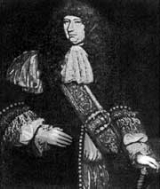
Downing probably never lived in the townhouses he waited thirty years to build. In 1675, he retired to Cambridge where he died a few months after the completion of his street. A portrait of Sir George Downing now hangs in the entrance foyer of the modern Number 10 Downing Street.

History of the "House at the Back" before 1733


the Old Palace of Whitehall By Hendrik Danckerts
"The House at the Back", the largest original part of the First Lord and Prime Minister's residence, was a stately mansion originally constructed around 1530 next to Whitehall Palace, then the primary royal residence. It was one of several buildings that made up the "Cockpit Lodgings", so-called because they were attached to an octagonal structure used as a cock-fighting ring. Early in seventeenth century, it was converted to a concert hall and theatre but kept its old name. After the Glorious Revolution
Glorious Revolution

The Glorious Revolution, also called the Revolution of 1688, was the overthrow of British monarchy James II of England in 1688 by a union of Parliament of England with an invading army led by the Dutch Republic stadtholder William III of England , who as a result ascended the English throne as William III of England....
 in 1688, some of the first Cabinet meetings were secretly held in the Cockpit.

During Tudor times, the house at the back was the home of the Keeper of Whitehall Palace. For many years, it was occupied by Thomas Knevett
Thomas Knyvet, 1st Baron Knyvet

Thomas Knyvet , was the second son of Sir Henry Knyvet of Charlton, Wiltshire, Wiltshire and Anne Pickering, daughter of Sir Christopher Pickering of Killington, Westmoreland....
 (or Knyvet), famous for capturing Guy Fawkes
Guy Fawkes

Guy Fawkes or Guido Fawkes was a member of a group of Roman Catholic restorationists from England that planned the Gunpowder Plot. The plot's aim was to displace Protestant rule by blowing up the Houses of Parliament while King James I of England and the entire Protestant and even most of the Catholic aristocracy and nobility were i...
 in 1605 and foiling his plot to assassinate James I
James I of England

James VI and I was List of monarchs of Scotland as James VI, and List of English monarchs and King of Ireland as James I. He ruled in Kingdom of Scotland as James VI from 24 July 1567, when he was only one year old, succeeding his mother Mary I of Scotland....
. The previous year, Knevett moved into a house next door, approximately where Number 10 is today.

From this time, royalty and government officials usually lived in the house at the back. In 1604, James I's four-year-old son Prince Charles (the future Charles I
Charles I of England

Charles I was List of English monarchs, List of monarchs of Scotland and King of Ireland from 27 March 1625 until his capital punishment on 30 January 1649....
) lived there briefly. The next occupant was eight-year-old Princess Elizabeth
Elizabeth of Bohemia

Elisabeth, Electress Palatine and Queen of Bohemia was the eldest daughter of James I of England, King of England, Scotland and Ireland, and Anne of Denmark....
. Before she moved in, a kitchen and rooms for servants were built, and the property was extended to include the Little Close Tennis Court where Henry VIII
Henry VIII of England

Henry VIII was King of England from 21 April 1509 until his death. He was also Lordship of Ireland and claimant to the Early Modern France. Henry was the second monarch of the House of Tudor, succeeding his father, Henry VII of England....
 played his favourite game. Elizabeth lived there until 1613 when she married Frederick V, Elector Palatine
Frederick V, Elector Palatine

Frederick V was Electoral Palatinate , and, as Frederick I , King of Bohemia . He was the son and heir of Frederick IV, Elector Palatine and of Louise Juliana of Nassau, the daughter of William I of Orange and Charlotte of Bourbon....
 and moved to Hanover
Hanover

Hanover or Hannover#Definitions , on the river Leine, is the capital city of the Federal states of Germany of Lower Saxony , Germany and was once by personal union the family seat of the House of Hanover, in their dignities as the dukes of Brunswick-L?neburg ....
. She was the grandmother of George
George I of Great Britain

George I was List of British Monarchs#House of Hanover and King of Ireland from 1 August 1714 until his death, and ruler of Electorate of Hanover in the Holy Roman Empire from 1698....
, the Elector of Hanover, who became King of England in 1714, and the great-grandmother of King George II
George II of Great Britain

George II was King of Great Britain and King of Ireland, Duke of Brunswick-L?neburg and Prince-elector#High Offices and Prince-Elector of the Holy Roman Empire from 11 June 1727 until his death....
, who offered the house to Walpole in 1732. Thus the house at the back symbolically links the Stuart
House of Stuart

The House of Stuart, also known as the House of Stewart is an important European royal house. Founded by Robert II of Scotland, the Stewarts first became monarchs of the Kingdom of Scotland during the late 14th century....
 and Hanover
House of Hanover

The House of Hanover is a Germanic peoples Royal family dynasty which has ruled the Duchy of Brunswick-L?neburg , the Kingdom of Hanover and the Kingdom of Great Britain and the Kingdom of Ireland....
 royal families.

Oliver Cromwell
Oliver Cromwell

Oliver Cromwell was an English people Military history of the United Kingdom and Politics of England leader best known for his involvement in making England into a republican Commonwealth and for his later role as Lord Protector of England, Scotland, and Ireland....
 lived in the house at the back between 1650 and 1654; his widow, for a year in 1659. George Monck, 1st Duke of Albemarle
George Monck, 1st Duke of Albemarle

George Monck, 1st Duke of Albemarle, Order of the Garter was an England soldier and politician and a key figure in the English Restoration of Charles II of England....
, the general who made possible the Restoration of the monarchy, lived there from 1660 until his death in 1671. Albemarle was First Lord of the Great Treasury Commission of 1667-1672 that transformed royal accounting and allowed the Crown greater control over expenses. These measures laid the foundations for the legal authority of the First Lord of the Treasury. The man thought to be most responsible for developing them was Albemarle's Secretary, Sir George Downing
Sir George Downing, 1st Baronet

Sir George Downing, 1st Baronet was an Anglo-Irish soldier and diplomat, son of Emmanuel Downing, barrister, and of Lucy, sister of Massachusetts Bay Governor John Winthrop....
, the same man who later built Downing Street. Albemarle is the first minister associated with the Treasury to live in what would eventually become the official home of the First Lord of the Treasury and Prime Minister.

In 1671, George Villiers, 2nd Duke of Buckingham
George Villiers, 2nd Duke of Buckingham

George Villiers, 2nd Duke of Buckingham, Knight of the Garter, Privy Council of England, Fellow of the Royal Society , was an England statesman and poet....
, took possession when he became a leading member of the Cabal Ministry. (The "B" in the acronym CABAL refers to Buckingham.) At considerable government expense, Buckingham rebuilt the house. The result was a spacious mansion, lying parallel to Whitehall Palace. From its secluded garden there was a full view of St. James's Park where deer grazed and noble men and women strolled on pathways lined with trees and sculpture.

After Buckingham retired in 1676, Lady Charlotte Fitzroy, Charles II's illegitimate twelve-year-old daughter, moved in when she married the Earl of Lichfield
Earl of Lichfield

Earl of Lichfield is a title that has been created three times in British history. Lord Bernard Stewart, youngest son of Esm? Stewart, 1st Duke of Lennox, was to be created Earl of Lichfield by Charles I of England for his actions at the battles of Battle of Newbury and Battle of Naseby but died before the creation could implemented....
, Master of the Horse
Master of the Horse

The Master of the Horse was a historical position of varying importance in several European nations....
. The Crown authorized extensive rebuilding once again that included widening the garden and adding a storey, giving the house three main floors, plus an attic and basement. The resulting mansion can be seen today as the rear section of Number 10. (See Plan of the Premises Granted to the Earl and Countess of Lichfield in 1677 )

The likely reason that extensive repair was required so soon after Buckingham's renovations is that the house had settled in the swampy ground near the Thames, causing structural damage. Pepys records a high tide when Whitehall was under water and buildings in the area require deep foundations to avoid settling. Like Downing Street, the house at the back rested on a shallow foundation, a design error that would cause problems until 1960 when the modern Number 10 was rebuilt on a foundation set on deep pilings.

The Litchfield family followed James II
James II of England

James II and VII was List of English monarchs, List of Scottish monarchs, and King of Ireland from 6 February 1685. He was the last Roman Catholic Church monarch to reign over the Kingdoms of Kingdom of England, Kingdom of Scotland, and Kingdom of Ireland....
 into exile after the Glorious Revolution
Glorious Revolution

The Glorious Revolution, also called the Revolution of 1688, was the overthrow of British monarchy James II of England in 1688 by a union of Parliament of England with an invading army led by the Dutch Republic stadtholder William III of England , who as a result ascended the English throne as William III of England....
. In 1690, the new monarchs, King William III
William III of England

William III was a Prince of Orange by birth. From 1672 onwards, he governed as List_of_stadtholders_for_the_Low_Countries_provinces William III of Orange over Holland, Zeeland, Utrecht, Guelders, and Overijssel of the Dutch Republic....
 and Queen Mary II
Mary II of England

Mary II reigned as List of English monarchs, List of Scottish monarchs, and King of Ireland from 1689 until her death. Mary, a Protestantism, came to the thrones following the Glorious Revolution, which resulted in the deposition of her Roman Catholic father, James II of England....
, offered the house to Hendrik van Nassau-Ouwerkerk, a Dutch
Netherlands

The Netherlands is a country that is part of the Kingdom of the Netherlands. It is a parliamentary democratic constitutional monarchy. The Netherlands is located in North-West Europe, and bordered by the North Sea to the north and west, Belgium to the south, and Germany to the east....
 general
General

A General officer is an Officer of high military rank. The term or equivalent is used by nearly every country in the world. General can be used as a generic term for all grades of general officer, or it can specifically refer to a single rank that is just called general....
 who had assisted in securing the Crown for the then-Prince of Orange. Nassau, who Anglicized his named to "Overkirk", lived in the house at the back—now called Overkirk House—until his death in 1708.

The house reverted to the Crown when Lady Overkirk died in 1720. The Treasury issued an order "for repairing and fitting it up in the best and most substantial manner" at a cost of £2,522, a very large sum at the time. The work included: "The Back passage into Downing street to be repaired and a new door; a New Necessary House to be made; To take down the Useless passage formerly made for the Maids of Honour to go into Downing Street, when the Queen lived at the Cockpit; To New Cast a great Lead Cistern & pipes and to lay the Water into the house & a new frame for ye Cistern." (See Buildings on the Site of the Cockpit and Number 10 Downing Street c1720 )

Johann Caspar von Bothmar, Count Bothmar, envoy from Hanover and advisor to George I and II, took up residency in 1720. Although Bothmar complained bitterly about "the ruinous Condition of the Premises", he lived there until his death in 1732.

The First Lord's House: 1733–1735


Robertwalpole
When Count Bothmar died, ownership of the house at the back reverted to the Crown. George II took this opportunity to offer it to Sir Robert Walpole, often called the first Prime Minister, as a gift for his services to the nation: stabilizing its finances, keeping it at peace and securing the Hanoverian succession. Coincidentally, the King had obtained the leases on two Downing Street properties, including Number 10, and added these to his proposed gift.

Walpole did not want to accept the gift for himself. Shrewd and wealthy, perhaps he did not want to burden himself by adding to his holdings, or perhaps he knew the houses would be expensive to maintain. At the same time, he probably did not want to offend the King by refusing the gift. Whatever his motivations, Walpole proposed — and the King agreed — that the Crown give the properties to the Office of First Lord of the Treasury. Walpole would live there as the incumbent First Lord, but would vacate it for the next one.

The arrangement made, Walpole set about uniting the properties. Wanting to enlarge the new house, Walpole persuaded Mr Chicken, the tenant of the cottage next door, to move to another house in Downing Street. Mr Chicken's former residence and the house at the back were then incorporated into Number 10.

Walpole commissioned William Kent
William Kent

William Kent was an eminent England architect, landscape architect and furniture designer of the early 18th century....
 to convert them into one building. Kent joined the larger houses by building a two-story structure on part of the space between them, consisting of a long room on the ground floor and several rooms above. The remaining space was converted into an inner courtyard. He then connected the Downing Street houses with a corridor, now called the Treasury Passage.

Having united the structures, Kent gutted them: tearing down walls, ripping up floors, removing staircases, and dismantling fireplaces. Craftsmen created a stone triple staircase with no visible supports in the main section. With an wrought iron balustrade embellished with a scroll design and mahogany handrail, it rises from the garden floor to the first floor. Kent's staircase is the first architectural feature visitors see as they entered Number 10. Black and white photographic portraits of all the Prime Ministers from Walpole to the present decorate the wall going up; there are two of Sir Winston Churchill. (See The Main Stairway c1930 General view showing portraits of the Prime Ministers and Detail of the Wrought Iron Balustrade )

Although Kent left the house at the back with three floors, he surmounted it with a pediment adding height and interest to the structure. To allow Walpole quicker access to Parliament, he closed the north side entrance from St. James's Park, and made the door on Downing Street the main entrance.

The rebuilding took three years. On September 23 1735, the London Daily Post announced that: "Yesterday, the Right Hon. Sir Robert Walpole, with his Lady and Family moved from their House in St James's Square, to his new House adjoining to the Treasury in St James's Park."

Walpole did not enter through the door that is now so famous. That would not be installed until forty years later. However, like Number 10's famous door, Kent's was also modest, belying the spacious elegance beyond. The First Lord's new, albeit temporary, home had sixty rooms, with hardwood and marble floors, crown moulding, elegant pillars and marble mantelpieces; those on the west side with beautiful views of St. James's Park. (See Examples of Mantle Pieces in Number Ten. Mantle piece in the Secretary's Room c1927 and Mantle Piece in the Prime Minister's Bedroom c1927 )

One of the largest rooms was a study for Walpole, measuring forty feet by twenty with enormous windows overlooking St James's Park. The room was and still is magnificent; its impressive size is easily seen in many paintings and photographs. "My Lord's Study" (as Kent labelled it in his drawings) would later be famous as the Cabinet room where Prime Ministers meet with their subordinate ministers. A portrait of Walpole hangs over the fireplace behind the Prime Minister's chair; it is the only picture in the room. (See Modern Cabinet Room:)

The total final cost of conversion is unknown. The original estimate was £8,000, but it probably exceeded £20,000, a very large sum at that time.

Shortly after moving in, Walpole ordered that a portion of the land outside his study to be converted into a terrace and garden. Letters patent issued in April 1736 state that: "... a piece of garden ground situated in his Majesty's park of St. James's, & belonging & adjoining to the house now inhabited by the Right Honorable the Chancellor of His Majesty's Exchequer, hath been lately made & fitted up at the Charge ... of the Crown". The terrace and garden still exist. The terrace, extending across the back of Number 10, provides a full view of St James's Park. The garden, which gives its name to the "garden girls" of the Prime Minister's office, is mostly a large half acre lawn that wraps around Numbers 10, 11, and 12 in an L-shape with a small centrally located flower bed. (See North elevation of Number Ten with steps leading to the garden ) Over the years the terrace and garden have provided a casual background for many group photographs of First Lords together with their Cabinet ministers, staff or guests. Prime Minister Tony Blair, for example, hosted a farewell reception in 2007 for his staff on the terrace.

The same document confirmed that Number 10 Downing Street was: "meant to be annexed & united to the Office of his Majesty's Treasury & to be & to remain for the Use & Habitation of the first Commissioner of his Majesty's Treasury for the time being."

A "vast, awkward house": 1735–1902


Pitt the Younger
Walpole lived in Number 10 for seven years until 1742. He had accepted the house as a gift from the Crown for himself and future First Lords of the Treasury. However, it would be twenty-one years before any of his successors chose to live there. All five First Lords after 1742 preferred their own homes. In fact, this was the pattern for almost 180 years. Of the 31 First Lords from 1735 to 1902, only 16 (including Walpole) lived in Number 10.

Some enjoyed living there. Lord North lived happily in Number 10 with his family for fifteen years from 1767 to 1782. Within its walls, he conducted the war against the American Colonies' rebellion. William Pitt the Younger
William Pitt the Younger

William Pitt, the Younger was a Kingdom of Great Britain politician of the late eighteenth century and early nineteenth century. He became the youngest Prime Minister of the United Kingdom in 1783 at the age of 24....
 made it his home for twenty years—longer than any First Lord before or since—from 1783 to 1801 and from 1804 to 1806. He affectionately referred to Number 10 in a letter to his mother as "My vast, awkward house." While there, Pitt reduced the national debt, formed the Triple Alliance
Triple Alliance

There have been numerous alliances known as the Triple Alliance including:* Aztec Triple Alliance - Tenochtitlan, Texcoco and Tlacopan. Better known as the Aztec Empire....
 against France, and won passage of the Act of Union
Act of Union

Act of Union may be an act that refers to:In the United Kingdom:* Laws in Wales Acts 1535?1542, passed by the Parliament of England, annexing Wales to the Kingdom of England are sometimes known as the "Acts of Union"....
 that created the United Kingdom of Great Britain and Ireland. Fredrick Robinson, Lord Goderich, took a special liking to the house in the late 1820s when he was Chancellor of the Exchequer and later First Lord; he spent state funds lavishly remodeling the interior.

Nevertheless, for seventy years following Pitt's death in 1806, Number 10 was rarely used as the First Lord's residence. Lord Liverpool lived in his home, Fife House, during his ministry from 1812 to 1827. Lord Grey did live in Number 10 during his ministry and conducted his campaign for passage of the Great Reform Act of 1832 while there. But, after Grey resigned, his immediate successors—Melbourne, Peel, Russell, Derby, Aberdeen and Palmerstone—lived elsewhere, as did Gladstone and Disraeli at least during their first ministries. From 1834 to 1877, the building was either vacant or used only for offices and meetings.

Beginning in 1877, first Disraeli and then Gladstone lived in Number 10 and thus revived the idea that it is the First Lord's official residence. Their colorful, sometimes bitter, personal and political rivalry over the issues of their time—Empire vs "Little England", expansion of the franchise, labor reform, and Irish Home Rule—was documented almost daily by the new penny press and photographs. This rivalry associated the office with the house in the public's mind. Indeed, every First Lord since 1877 has lived in Number 10. However, not all were Prime Minister; there was something of a reversion to the earlier pattern until 1902.

One reason many First Lords chose not to make Number 10 their official residence was that most were peers who owned homes superior in size and quality. To them, Number 10 was unimpressive. Instead, they saw their "possession" of the house, albeit temporary, as a perk they could use as a political reward. Most lent it to the Chancellor of the Exchequer, others to lesser officials, and still others to friends or relatives. Henry Pelham, for example, had his own spacious home and had no need for Number 10. In what one historian called a piece of "blatant political corruption", he allowed his son-in-law, Henry Clinton
Henry Clinton

Henry Clinton may refer to:* Henry Clinton who fought during the American Revolutionary War* Henry Clinton , son of General Sir Henry Clinton...
, Earl of Lincoln, to live there from 1745 to 1753 even though Clinton was not involved in politics. Lord Liverpool assigned it to his two Chancellors of the Exchequer, Nicholas Vansittart (1812–1823) and Frederick Robinson
Frederick Robinson

Frederick Robinson is a name shared by several people:* Sir Frederick Philipse Robinson * Frederick John Robinson, 1st Viscount Goderich...
 (1823–1827). A few peers did live in Number 10 out of necessity. The Duke of Wellington, for example, grudgingly lived there for eighteen months between 1828 and 1830 because his own home, Apsley House, was undergoing extensive renovations. He left as soon as it was finished. Even at the end of the nineteenth century, Lord Salisbury, the last peer to be Prime Minister, preferred living in his house on Arlington Street and the Cecil family estate Hatfield House
Hatfield House

Hatfield House is a country house set in a large park, the Great Park, on the eastern side of the town of Hatfield, Hertfordshire, Hertfordshire, England....
. During his last ministry from 1895 to 1902, his nephew, Arthur Balfour
Arthur Balfour

Arthur James Balfour, 1st Earl of Balfour, Order of the Garter, Order of Merit , Privy Council of the United Kingdom was a United Kingdom Conservative Party politician and statesman....
, lived in Number 10.

Another reason many First Lords chose not to live in Number 10 was that it was awkward and hazardous. Prone to sinking because it was built on soft soil and a shallow foundation, floors buckled and the walls and chimneys cracked. The building easily became unsafe and required frequent repairs. In 1766, for example, Lord Charles Townsend
Charles Townsend

Charles Townsend may refer to:*Charlie Townsend , Gloucestershire cricketer*Charles Champlain Townsend , U.S. Representative from Pennsylvania...
, the Chancellor of the Exchequer, pointed out that the house was in a dilapidated condition. His architect's letter to the Treasury read: "... we have caused the House in Downing Street belonging to the Treasury to be surveyed, & find the Walls of the old part of the said House next the street to be much decayed, the Floors & Chimneys much sunk from the level ..." Townsend ordered extensive repairs, but they were still incomplete eight years later. A note from Lord North to the Office of Works, dated September 1774, asks that the work on the front of the house, "which was begun by a Warrant from the Treasury dated August 9, 1766", should be finished. (See Kent's Treasury and No. 10, Downing Street, circa 1754.)

Treasury officials complained that the rickety old building cost too much to maintain; some suggested that it be razed and a new house constructed on the site or elsewhere. In 1782, the Board of Works, reporting on "the dangerous state of the old part of the House", stated that "no time be lost in taking down said building ..." In 1783, the Duke of Portland moved out because it was once again in need of repair. A committee found that the money spent so far was insufficient. This time the Board of Works declared that "the Repairs, Alterations & Additions at the Chancellor of the Exchequer's House will amount to the sum of £5,580, exclusive of the sum for which they already have His Majesty's Warrant. And praying a Warrant for the said sum of £5,580—and also praying an Imprest of that sum to enable them to pay the Workmen." This proved to be a gross underestimate; the final bill was over £11,000. The Morning Herald fumed about the expense: "£500 pounds p.a. preceding the Great Repair, and £11,000 the Great Repair itself! So much has this extraordinary edifice cost the country For one moiety of the sum a much better dwelling might have been purchased!" (See Plan of the Design for Number Ten c1781 )

To make matters worse, the Downing Street neighbourhood declined at the turn of the nineteenth century. Surrounded by rundown buildings, dark alleys, crime and prostitution, it was an unsavoury place. Earlier, the government had taken over the other Downing Street houses: the Colonial Office occupied Number 14 in 1798: the Foreign Office was at Number 16 and the houses on either side; the West India Department was in Number 18 and the Tithe Commissioners, Number 20. But they deteriorated from neglect, became unsafe, and one by one were torn down. By 1857, Downing's townhouses were all gone, except for Number 10, Number 11 (customarily the Chancellor of the Exchequer's residence) and Number 12 (used as offices for Government Whips). Then, in 1879, a fire destroyed the upper floors of Number 12; it was renovated but only as a single storey structure. (See Numbers 10, 11, and 12 Downing Street First Floor Plan and Ground Floor Plan )

Description of rooms and special features in Number 10 Downing Street


Despite its history of chronic deterioration, the expense of maintaining it, and the frequent calls for its demolition, Number 10 survived. Many features added during the 18th and 19th centuries are still present today.

Number 10's famous front door


Most of the modern exterior shape and features of Number 10 were created by Kent when he combined the house at the back with the Downing Street townhouses in 1735. Its outside appearance is basically the same today as it was when he completed his work. The most important exception is the now world famous front door entrance.

Number 10's famous door is the product of the renovations Townsend ordered in 1766; it was probably not completed until 1772. Executed in the Georgian style by the architect Kenton Couse
Kenton Couse

Kenton Couse was an English architect and Office of Works from 1775 to 1782.He was apprenticed to Henry Flitcroft whose patronage obtained him various posts in the Office of Works....
, it is considered a masterpiece of understatement. Unassuming and narrow, it consists of a single white stone step leading to a modest brick front. The small, six-panelled door, made of black oak, is surrounded by cream-coloured casing and adorned above with a semicircular fanlight
Fanlight

A fanlight is a window, semicircular or semi-elliptical in shape, with glazing bars or tracery sets radiating out like an open Fan , It is placed over another window or a doorway....
 window. Painted in white in the centre, between the top and middle sets of panels, is the number "10". Between the two middle panels is a black iron knocker
Door knocker

A door knocker is an item of door furniture that allows people outside a house to alert those inside to their presence. A door knocker has a part fixed to the door, and a part attached to it by a hinge that may be lifted and used to strike a plate fitted to the door, or the door itself, making a noise....
 in the shape of a lion's head; below the knocker is a brass letter box
Letter box

A letter box, letterbox, letter plate, mail slot, or mailbox is a receptacle for receiving incoming mail at a private residence or business....
 with the inscription "First Lord of the Treasury". A black ironwork fence with spiked newel
Newel

A newel is the upright post about which the steps of a circular staircase wind. It is sometimes called a solid newel in distinction from a hollow newel, which is really no newel at all, with the stairs being supported at the walls....
 posts runs along the front of the house and up each side of the step to the door. The fence rises above the step into a double-swirled archway, supporting an iron gas lamp surmounted by a crown. (See The Entrance Door: As seen from the outside )

Beyond the door, Couse installed black and white marble tiles in the entrance hall that are still in use and almost as famous as the door itself. Inside to the left, he added another door leading to Number 11, the Chancellor of the Exchequer's residence. Finally, he added a bow front to the small cottage—formerly Mr. Chicken's house—incorporated into Number 10 in Walpole's time. (See The Entrance Door: As seen from inside showing the black and white marble floor and the door providing access to Number 11 )

The Cabinet Room


In Kent's design for the enlarged Number 10, the Cabinet Room was a simple rectangular space with enormous windows. As part of the renovations begun in 1783, the Cabinet Room was extended, giving the space its modern appearance. Probably not completed until 1796, this alteration was achieved by removing the east wall and rebuilding it several feet inside the adjoining secretaries' room. At the entrance, a screen of two pairs of Corinthian columns was erected (to carry the extra span of the ceiling) supporting a moulded entablature that wraps around the room. The resulting small space, framed by the pillars, serves as an ante-room to the larger area, and adds a sense of power that was not there before. Hendrick Danckerts' painting "The Palace of Whitehall (shown at the beginning of this article) usually hangs in the ante-room. Robert Taylor, the architect who executed this concept, was knighted on its completion. (See Simon Schama's Tour of Downing Street. Pt2: The Cabinet Room See also The Modern Cabinet Room: Two photographs taken by Prime Minister Stanley Baldwin, c1927 View looking toward the screen and View from the Screen )

Although Kent intended the First Lord to use this space as his personal office, it has rarely served that purpose; it has almost always been the Cabinet room. The First Lord has no designated space in Number 10 like the American President's Oval Office in the White House. Each one has chosen for himself one of the adjoining rooms as his private office.

The Great Kitchen


The second part of the renovations begun in 1783 was the creation of a great kitchen (that still exists today) in the basement, probably also under the direction of Robert Taylor
Robert Taylor (architect)

Sir Robert Taylor was a notable England architect of the mid-late 18th century.Born at Woodford, Essex, Taylor followed in his father's footsteps and started working as a stone-mason and sculpture, spending time as a pupil of Sir Henry Cheere....
. Seldom seen by anyone other than staff, the space is two storeys high with a huge arched window and vaulted ceiling. Traditionally, it has always had a chopping block work table in the centre that is long, wide and thick. (See The Kitchen c1930 View showing the table, window and ceiling )

The Pillared Room


The modern Number 10 has three inter-linked State Drawing rooms. The largest is the Pillared Room thought to have been created in 1796 by Taylor. Measuring long by wide, it takes its name from the two pillars at one end. For most state occasions, guests are received in this room before going into the State Dining Room for dinner. Constantly in use for receptions, the Pillared Room is left almost empty with a few chairs around the walls. (See The Pillared Drawing Room c1927 )

The State Dining Room


When Frederick Robinson
Frederick Robinson

Frederick Robinson is a name shared by several people:* Sir Frederick Philipse Robinson * Frederick John Robinson, 1st Viscount Goderich...
 (later Lord Goderich), became Chancellor of the Exchequer in 1823, he decided to leave a personal legacy to the nation. To this end, he employed Sir John Soane, the distinguished architect who had designed the Bank of England
Bank of England

The Bank of England is the central bank of the United Kingdom and is the model on which most modern, large central banks have been based. Since 1946 it has been a Nationalisation institution....
 and many other famous buildings, to build a State Dining Room for Number 10. Begun in 1825 and completed in 1826 at a cost of £2,000, the result is a spacious room with oak panelling and reeded mouldings. Accessed through the first floor, its vaulted, arched ceiling rises up through the next so that it actually occupies two floors. Measuring by , it is the largest room in Number 10; it will comfortably accommodate up to 65 guests at its horseshoe-shaped table. First used on April 4, 1826, Soane was the guest of honour. (See Simon Schama's Tour of Downing Street. Pt 3: The Dining Room See also The State Dining Room c1930: View toward the entrance and View from the entrance )

The Small Dining or Breakfast Room


Above Taylor's vaulted kitchen, between the Pillared Room and the State Dining room, Soane created a Smaller Dining Room (sometimes called the Breakfast Room), which still exists. To build it, Soane removed the chimney from the kitchen to put a door in the room. He then moved the chimney to the east side, running a Y-shaped split flue inside the walls up either side of one of the windows above. Intimate and comfortable with its flat unadorned ceiling, simple mouldings and deep window seats, Prime Ministers have often used this small room for dining with family or for smaller, more personal state occasions. (See the Small Dining or Breakfast Room c1927. The double doors behind the table lead to the Pillared Room. )

"A Precious Jewel": 1902–present


Revival and recognition


When Lord Salisbury retired in 1902, his nephew, Arthur James Balfour, became Prime Minister. It was an easy transition: he was already First Lord of the Treasury and Leader of the House of Commons, and he was already living in Number 10. During his uncle's final years when he was ill or abroad—which was often—Balfour was virtual Prime Minister.

Salisbury was the last Prime Minister who was not First Lord of the Treasury. He was also the last who did not make Number 10 his official home. From 1877 when Disraeli moved into Number 10 the house had been—with the exception of Salisbury—occupied continuously by the Prime Minister. Salisbury reluctantly resided in Number 10 briefly from 1886 to 1887 during his first ministry, but then moved out. He lived at his home on Arlington Street in St. James's and his estate at Hatfield House while Prime Minister from 1887-1892 and 1895-1902.

Balfour revived the custom that Number 10 is the First Lord and Prime Minister's official residence. It has remained the custom since, although there have been times when Prime Ministers have unofficially lived elsewhere. Winston Churchill
Winston Churchill

Sir Winston Leonard Spencer-Churchill, Order of the Garter, Order of Merit, Order of the Companions of Honour, Territorial Decoration, Fellow of the Royal Society, Her Majesty's Most Honourable Privy Council, Queen's Privy Council for Canada was a Politics of the United Kingdom known chiefly for his leadership of the United King...
 for example had a great affection for Number 10, but he grudgingly slept in the bunkered Annex of Number 10 for his safety during World War II. To reassure the people that his government was functioning normally, he insisted on being seen entering and leaving Number 10 occasionally. Harold Wilson
Harold Wilson

James Harold Wilson, Baron Wilson of Rievaulx, Order of the Garter, Order of the British Empire, Fellow of the Royal Society, Her Majesty's Most Honourable Privy Council was one of the most prominent British politicians of the later half of the 20th century....
, during his second ministry from 1974 to 1976, lived in his home on Lord North Street because Lady Wilson wanted "a proper home". Recognising its symbolic importance, he maintained with media complicity, the public illusion of living in Number 10; he worked there every day, holding meetings, and entertaining in the State Dining Room.

Photography and the penny press had by this time already linked Number 10 in the public mind with the Premiership. The introduction of films and television would strengthen this association even more. Pictures of Prime Ministers at the front door with distinguished guests became commonplace. With or without the Prime Minister present, visitors had their picture taken. Suffragettes posed in front of the door when they petitioned Herbert Asquith for women's rights in 1913, a picture that became famous and was circulated around the world. In 1931, Mohandas Gandhi, wearing the traditional homespun dhoti, posed leaving Number 10 after meeting with Ramsey MacDonald to discuss India's independence. This picture, too, became famous especially in India. Illiterate peasants could see their leader had been received in the Prime Minister's home. Couse's elegant, understated door—stark black, framed in cream white with a bold white "10" clearly visible—was the perfect backdrop to record such events. Prime Ministers made historic announcements from the front step. Waving the Anglo-German Agreement of Friendship, Neville Chamberlain
Neville Chamberlain

Arthur Neville Chamberlain was a British Conservative Party politician and Prime Minister of the United Kingdom from 1937 to 1940. Chamberlain is best known for appeasement foreign policy, in particular regarding his signing of the Munich Agreement in 1938, conceding the Sudetenland region of Czechoslovakia to Germany, and for his "containm...
 proclaimed "Peace With Honour" in 1938 from Number 10 after his meeting with Adolf Hitler in Munich. During World War II, Churchill was photographed many times emerging confidently from Number 10 holding up two fingers in the sign for "Victory". The symbol of British government, Number 10 became a gathering place for protestors. Emily Pankhurst and other suffragette leaders stormed Downing Street in 1908; anti-Vietnam War protestors marched there in the 1960s, as did anti-Iraq War protestors in the 2000s. Number 10 became an obligatory stop in every tourist's sightseeing trip to London. Ordinary people, not only British but foreign tourists, posed smiling and laughing in front of its famous door.

Rebuilding Number 10: 1960–1990


By the middle of the 20th century, Number 10 was falling apart again. The deterioration had been obvious for some time. The number of people allowed in the upper floors at one time had been limited for fear the bearing walls would collapse. The staircase had sunk several inches; some steps were buckled and the balustrade was out of alignment. An investigation ordered by Prime Minister Harold Macmillan
Harold Macmillan

Harold Macmillan, 1st Earl of Stockton, Order of Merit, Her Majesty's Most Honourable Privy Council was a British Conservative Party politician and Prime Minister of the United Kingdom from 10 January 1957 to 18 October 1963....
 in 1958 concluded that there was widespread dry rot. The interior wood in the Cabinet Room's double columns was like sawdust. Baseboards, doors, sills and other woodwork were riddled and weakened with disease. After reconstruction had begun, miners dug down into the foundations and found that the huge wooden beams supporting the house had decayed.

There was some discussion of tearing down the building, along with Numbers 11 and 12, and constructing entirely new residences. But that was never really an option. The Prime Minister's home had become an icon of British architecture as cherished as Windsor Castle, Buckingham Palace and the Houses of Parliament. Instead, it was decided that Number 10 (and Numbers 11 and 12) would be rebuilt using as much of the original materials as possible. The interior would be carefully photographed, measured, disassembled, and restored. A modern foundation with deep pilings would be laid. Then the original buildings would be reassembled on top of it, allowing for much needed expansion of the space and modernisation. Any original materials that were beyond repair—such as the pair of double columns in the Cabinet Room—would be replicated in minute detail. This was a formidable undertaking: the three buildings contain over 200 rooms spread out over five floors. The renowned architect Raymond Erith
Raymond Erith

Raymond Erith was an England architect known for his Building restoration and work in a traditional styles. Critic Ian Nairn described his work as "genuinely Georgian architecture, not 'neo'"....
 carried out this painstaking work.

The Times reported that initially the estimated cost for the project was £400,000. After more careful studies were completed, it was concluded that the "total cost was likely to be £1,250,000" and would take two years to complete. In the end, the final cost was close to £3,000,000 and took almost three years due in large part to 14 labour strikes (including a three month work stoppage). There were also unforeseen delays due to archaeological excavations when important artifacts were found dating from Roman, Saxon and mediaeval times when the area was still known as Thorny Island. Macmillan lived in Admiralty House during the reconstruction.

The new foundation was made of steel-reinforced concrete with pilings sunk to . The "new" Number 10 consisted of about 60% new materials; the remaining 40% was either restored or replicas of originals. The garden floor—including the door and entrance foyer, the stairway, the hallway to the Cabinet Room, the Cabinet Room, the garden and terrace, the Small and Large State Rooms and the three reception rooms—was reconstructed exactly as in the old Number 10. The upper floors were modernised and the 3rd floor extended over Numbers 11 and 12 to allow more living space. As many as 40 coats of paint were stripped from the elaborate cornices in the main rooms revealing details unseen for almost 200 years in some cases. When builders examined the exterior façade, they discovered that the black colour visible even in photographs from the mid-nineteenth century was misleading; the bricks were actually yellow. The black appearance was the product of two centuries of pollution. To preserve the 'traditional' look of recent times, the newly cleaned yellow bricks were painted black to resemble their well-known appearance.

Generally, the reconstruction was considered an architectural triumph. Erith, however, was disappointed. He complained openly during the project and afterward that the government had altered his design in many ways to save money. "I am heart broken," he said, "by the result ... the whole project has been a frightful waste of money because it just has not been done properly. The Ministry of Works has insisted on economy after economy. I am bitterly disappointed with what has happened."

Erith's concerns proved justified. Within a few years, extensive dry rot was discovered, especially in the main rooms of Number 10 due to inadequate water-proofing and a broken water pipe. Extensive reconstruction again had to be undertaken to resolve these problems. In the late 1980s, to celebrate Britain's past glory and her renewed status as a world power after the Falklands War, Margaret Thatcher commissioned Quinlan Terry
Quinlan Terry

Quinlan Terry is an England architect. He was educated at Bryanston School and the Architectural Association. He was a pupil of architect Raymond Erith, with whom he formed the partnership Erith & Terry....
, Erith's partner, to redecorate the main rooms. Among other modern details, Terry added ornate Baroque-style central ceiling mouldings and, in the corners, the four national flowers of Britain: rose (England), thistle (Scotland), daffodil (Wales) and shamrock (Ireland).

Security at Number 10 after the 1991 bombing


From the day in 1735 when Walpole entered his newly renovated home, Number 10 had been accessible to the public. There had always been some security but it was minimal: a policeman standing guard at the front door.

Gates had already been installed at both ends of the street during the premiership of Margaret Thatcher
Margaret Thatcher

Margaret Hilda Thatcher, Baroness Thatcher Order of the Garter, Order of Merit, Her Majesty's Most Honourable Privy Council, Fellow of the Royal Society was Prime Minister of the United Kingdom from 1979 to 1990 and Leader of the Conservative Party of the Conservative Party from 1975 to 1990....
 due to terrorist threats. Because of this actual attack, heavier security measures were imposed, if not always visible.

On February 7, 1991, the Provisional IRA used a white van parked in Whitehall
Whitehall

Whitehall is a road in Westminster in London, England. It is the main artery running north from Parliament Square, towards traditional Charing Cross, now at the southern end of Trafalgar Square and marked by the statue of Charles I of England, which is often regarded as the heart of London....
 to launch a mortar shell at Number 10. It exploded in the back garden, blowing in the windows of the Cabinet Room while Prime Minister John Major
John Major

Sir John Major, Order of the Garter, Order of the Companions of Honour, Chartered Institute of Bankers , was Prime Minister of the United Kingdom of the United Kingdom and Leaders of the Conservative and Unionist Party of the Conservative Party during 1990 to 1997....
 was holding a Cabinet meeting. Major moved to Admiralty House
Admiralty House (London)

Admiralty House in London was designed by Sir Robert Taylor and his protege Samuel Pepys Cockerell and opened in 1786. Built at the request of Admiral Lord Howe, First Lord of the Admiralty in 1782-83 for "a few small rooms of my own", it was the official residence of First Lords of the Admiralty until 1964, and has also been home to several...
 while repairs were completed.

A police officer traditionally stands outside the black front door of Number 10—a door which has no keyhole on the outside; it can only be opened from the inside. A second police officer is on permanent duty on the other side of the front door, so there is always someone there to open it for the Prime Minister. A guardhouse stands at the gated entrance accommodating several uniformed heavily armed police. The Metropolitan Police Service's DPG (Diplomatic Protection Group
Diplomatic Protection Group

The Diplomatic Protection Group is a Central Operations branch of London's Metropolitan Police Service. The unit's main purpose is to provide specialist protection for diplomatic residencies in London, such as embassies, high commissions and consular sections....
) provides protection for ministers in London, acting on the Security Service's intelligence.

Number 10's 250th anniversary: 1985


Number 10 became 250 years old in 1985. To celebrate, Prime Minister Margaret Thatcher
Margaret Thatcher

Margaret Hilda Thatcher, Baroness Thatcher Order of the Garter, Order of Merit, Her Majesty's Most Honourable Privy Council, Fellow of the Royal Society was Prime Minister of the United Kingdom from 1979 to 1990 and Leader of the Conservative Party of the Conservative Party from 1975 to 1990....
 hosted a grand dinner at Number 10 in the State Dining Room for her living predecessors—Harold Macmillan
Harold Macmillan

Harold Macmillan, 1st Earl of Stockton, Order of Merit, Her Majesty's Most Honourable Privy Council was a British Conservative Party politician and Prime Minister of the United Kingdom from 10 January 1957 to 18 October 1963....
, Alec Douglas-Home
Alec Douglas-Home

Alexander Frederick Douglas-Home, Baron Home of the Hirsel, Order of the Thistle, Imperial Privy Council , 14th Earl of Home from 1951 to 1963, was a British Conservative Party politician, and served as Prime Minister of the United Kingdom for a year from October 1963 to October 1964 ....
, Harold Wilson
Harold Wilson

James Harold Wilson, Baron Wilson of Rievaulx, Order of the Garter, Order of the British Empire, Fellow of the Royal Society, Her Majesty's Most Honourable Privy Council was one of the most prominent British politicians of the later half of the 20th century....
, Edward Heath
Edward Heath

Sir Edward Richard George Heath, Order of the Garter, Order of the British Empire , often known as Ted Heath, was Prime Minister of the United Kingdom from 1970 to 1974 and leader of the Conservative Party from 1965 to 1975....
, and James Callaghan
James Callaghan

Leonard James Callaghan, Baron Callaghan of Cardiff, Order of the Garter, Her Majesty's Most Honourable Privy Council , was Prime Minister of the United Kingdom from 1976 to 1979 and leader of the Labour Party from 1976 to 1980....
—and Queen Elizabeth II.. Also in attendance were representatives of the families of every 20th century Prime Minister since Asquith, including Olwen Carey Evans (daughter of Lloyd George), Lorna Howard (daughter of Stanley Baldwin), and Clarissa Avon
Clarissa Eden, Countess of Avon

Anne Clarissa Eden, Countess of Avon is the widow of Sir Anthony Eden, 1st Earl of Avon , who was United Kingdom Prime Minister of the United Kingdom from 1955-1957....
 (widow of Anthony Eden
Anthony Eden

Robert Anthony Eden, 1st Earl of Avon, Order of the Garter, Military Cross, Privy Council of the United Kingdom was a British people Conservative Party politician, who was Secretary of State for Foreign and Commonwealth Affairs for three periods between 1935 and 1955, including during World War II....
).

The same year, the Leisure Circle published Christopher Jones
Christopher Jones

Christopher Jones, or Chris Jones, is the name of:* Christopher Jones , English sailor, master of the Mayflower* Christopher Jones , American actor...
' book No. 10 Downing Street, The Story of a House. The foreword is a letter from Thatcher in which she summarises the feelings that she and many other British people have toward Number 10: "How much I wish that the public ... could share with me the feeling of Britain's historic greatness which pervades every nook and cranny of this complicated and meandering old building ... All Prime Ministers are intensely aware that, as tenants and stewards of No. 10 Downing Street, they have in their charge one of the most precious jewels in the nation's heritage."

The Prime Minister's Office


The Prime Minister's office, for which the terms Downing Street and No. 10 are synonymous, lies within 10 Downing Street and is headed by a Chief of Staff and staffed by a mix of career civil servants and special advisers
Special advisers in the United Kingdom

A special adviser, sometimes known as a SpAd or spad, works in a supporting role to the Her Majesty's Government. With media, political or policy expertise, their duty is to assist and advise Minister ....
. It provides the Prime Minister with support and advice on policy, communications with parliament, government departments and public/media relations.

The office was reorganised in 2001 into 3 directories:

  • Policy and government
    Took over the functions of the Private office and policy unit. Prepares advice for the PM and coordinates development and implementation of policy across departments
  • Communication and strategy, contains 3 units:
    • Press office: responsible for relations with the media
    • Strategic communications unit
    • Research and information unit: provides factual information to No. 10
  • Government and political relations: Handles party/public relations


Changes were intended to strengthen the PM's office. However, some commentators have suggested that Blair's reforms have created something similar to a 'Prime Ministers' department.' The reorganisation brought about the fusion of the Prime Minister's Office and the Cabinet Office
Cabinet Office

The Cabinet Office is a United Kingdom government department of the Government of the United Kingdom responsible for supporting the Prime Minister of the United Kingdom and Cabinet of the United Kingdom....
—a number of units within the Cabinet Office
Cabinet Office

The Cabinet Office is a United Kingdom government department of the Government of the United Kingdom responsible for supporting the Prime Minister of the United Kingdom and Cabinet of the United Kingdom....
 are directly responsible to the Prime Minister.

See also


  • Residents of Number 10 Downing Street
    Residents of Number 10 Downing Street

    Number 10 Downing Street is the residence and office of the First Lord of the Treasury and Prime Minister of the United Kingdom. The headquarters of Her Majesty's Government, it is situated on Downing Street in the City of Westminster in London, England....
  • Chequers
    Chequers

    Chequers, or Chequers Court, is a country house near Ellesborough, to the south east of Aylesbury in Buckinghamshire, England, at the foot of the Chiltern Hills....
     – the Prime Minister's official country residence
  • Sybil
    Sybil (cat)

    Sybil is a cat living at 11 Downing Street and 10 Downing Street. Named after Sybil Fawlty, she is the pet of Chancellor of the Exchequer, Alistair Darling....
     – a cat employed as a mouser at 10 Downing Street
  • 24 Sussex Drive
    24 Sussex Drive

    24 Sussex Drive is the official residence of the Prime Minister of Canada., located in New Edinburgh, Ottawa, Ontario. Built between 1866 and 1868 by Joseph Merrill Currier, it has been the home of almost every prime minister since Louis St....
     – the Canadian equivalent
  • The Lodge
    The Lodge

    The Lodge is the official residence of the Prime Minister of Australia in the national capital, Canberra. It is located on Adelaide Avenue, Deakin, Australian Capital Territory....
     – the official residence of the Australian Prime Minister
  • Kirribilli House
    Kirribilli House

    Kirribilli House is the official Sydney residence of the Australian Prime Minister. The house is located at the far eastern end of Kirribilli Avenue in the suburb of Kirribilli....
     – the Australian Prime Minister's official Sydney residence
  • 10 Downing Street Guard Chairs
    10 Downing Street Guard Chairs

    The 10 Downing Street Guard Chairs are two antique chairs. During the early 1800s, No. 10 Downing Street was guarded by two men sitting outside the building in leather chairs made by Thomas Chippendale....
  • 7 Race Course Road
    7 Race Course Road

    7, Race Course Road is the address of the Prime Minister of India's house, the official residence of the Prime Minister of India. The name of the PM House's is Panchavati....
     - The offficial residence of the Prime Minister of India


External links

  • section from the Survey of London
    Survey of London

    The Survey of London is a research project to produce a comprehensive historical and architectural survey of the former County of London. It was founded in 1894 by Charles Robert Ashbee, an Arts and Crafts movement architect and social thinker, and was motivated by a desire to record and preserve London's ancient monuments....
    • Plans of 10, 11 and 12 Downing Street (published 1931): ; ; floors