

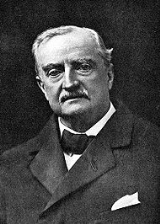
John Redmond

Encyclopedia
John Edward Redmond was an Irish nationalist
politician
, barrister
, MP
in the House of Commons
of the United Kingdom of Great Britain and Ireland
and leader of the Irish Parliamentary Party
from 1900 to 1918. He was a moderate, constitutional and conciliatory politician who attained the twin dominant objectives of his political life, party unity and finally in September 1914 achieving Irish Home Rule under an Act which granted an interim form of self-government to Ireland. Unfortunately for Redmond, implementation of the Act was suspended by the intervention of World War I
, and ultimately made untenable after the Conscription Crisis of 1918.
He was the elder brother of Willie Redmond and father of William Archer Redmond, both of whom were to serve as MPs in his party.
, his grandfather's old family mansion. He was the eldest son of William Archer Redmond, MP by Mary, daughter of General Hoey, the brother of Francis Hoey, heir of the Hoey seat, Dunganstown Castle, County Wicklow
.
For over seven hundred years the Redmonds had been a prominent Catholic gentry family in County Wexford and Wexford
town. They were one of the oldest Hiberno-Norman
families, and had for a long time been known as the Redmonds of 'The Hall', which is now known as Loftus Hall
. His more immediate family were a remarkable political dynasty themselves. Redmond's grand uncle, John Edward Redmond, was a prominent banker and businessman before entering Parliament as a member for Wexford constituency
in 1859; his statue stands in Redmond Square, Wexford town. After his death in 1866, his nephew, William Archer Redmond, this John Redmond's father, was elected to the seat and soon emerged as a prominent supporter of Isaac Butt
's new policy for home rule. John Redmond was the brother of Willie Redmond, MP for Wexford and East Clare
, and the father of William Redmond, whose wife was Bridget Redmond
.
Redmond’s family heritage was more complex than that of most of his nationalist political colleagues. His mother came from a Protestant and unionist family; although she had converted to Catholicism on marriage, she never converted to nationalism. His uncle General John Patrick Redmond, who had inherited the family estate, was created CB
for his role during the Indian mutiny; he disapproved of his nephew’s involvement in agrarian agitation of the 1880s. John Redmond boasted of his family involvement in the 1798 Wexford Rebellion
; a "Miss Redmond" had ridden in support of the rebels, a Father Redmond was hanged by the yeomanry
, as was a maternal ancestor, William Kearney.
in Clongowes Wood College
, he was primarily interested in poetry and literature, played the lead in school theatricals and was regarded as the best speaker in the school's debating society. After finishing at Clongowes, Redmond attended Trinity College, Dublin
in order to study law, but his father's ill health led him to abandon his studies before taking a degree. In 1876 he left to live with his father in London, acting as his assistant in Westminster
, where he developed more fascination for politics than for law. He first came into contact with Michael Davitt
on the occasion of a reception held in London to celebrate the release of the famous Fenian
prisoner. As a clerk in the House of Commons he increasingly identified himself with the fortunes of Charles Stewart Parnell
, one of the founders of the Irish Land League and a noted ‘obstructionist
’ in the Commons.
(from 1882 the Irish Parliamentary Party
) candidate in the by-election to fill the open seat, but was disappointed to learn that Parnell had already promised the next vacancy to his secretary Timothy Healy
. Nevertheless, Redmond supported Healy as the nominee, and when another vacancy arose, this time in New Ross
, he won election unopposed as the Parnellite candidate for the seat. On election (31 January 1881), he rushed to the House of Commons, made his maiden speech next day amid stormy scenes following the arrest of Michael Davitt, then a Land League leader, and was ejected from the Commons all on the same evening. He served as MP for New Ross from 1881 to 1885, for North Wexford
from 1885 to 1891 and finally for Waterford City
from 1891 until his death in 1918.
By the time of Redmond's election, the Land League conflict was by now at a turbulent stage. Early in 1882 he and his brother Willie were sent to Australia on a fund-raising mission which was a success in both political and personal terms; in 1883 he and his brother married into the prosperous Irish-Australian Dalton family and became friends with the famous James Dalton
and whom he spent much of his time with. His marriage was short-lived but happy: his wife Johanna died early in 1889 after bearing him three children. He also travelled in 1884, 1886 and 1904 to America
, where he was to use more extreme language but found his contact with Irish-American extremism daunting. His Australian experience, on the other hand, was to have a strong influence on his political outlook, causing him to embrace an Irish version of Liberal Imperialism and to remain anxious to retain Irish representation and Ireland’s voice at Westminster even after the implementation of home rule. During the debate which followed Gladstone's conversion to Home Rule in 1886, he declared:
In 1899 Redmond married his second wife, Ada Beesley, an English Protestant who, after his death, converted to Catholicism.
, Dublin, being called to the Irish bar in 1887 (and to the English bar a year later), Redmond busied himself with agrarian cases during the Plan of Campaign
. In 1888, following a strong and conceivably intimidatory speech, he received five weeks’ imprisonment with hard labour. A loyal supporter of Parnell, Redmond like Davitt was deeply opposed to the use of physical force and was committed to political change by constitutional means, campaigning constitutionally for Home Rule as an interim form of All-Ireland self-government within the United Kingdom.
When the Irish Parliamentary Party split over Parnell's long-standing family relationship with Katharine O'Shea, the previously separated wife of a fellow MP, whom he later married, Redmond stood by his deposed leader in the dispute. After Parnell's death in 1891, Redmond took over leadership of the Parnellite rump of the split party, the Irish National League
(INL), where he soon demonstrated both his organisational ability and his considerable rhetorical skills. He also raised funds for the Parnell Monument at the northern end of Dublin's O'Connell Street
, choosing the American Augustus Saint Gaudens to sculpt the statue, which was eventually completed in 1911.
The larger anti-Parnellite group formed the Irish National Federation
(INF) under John Dillon
. During this period, he supported the Unionist Irish Secretary Gerald Balfour programme of Constructive Unionism, while assuring the Tory Government that its self-declared policy of "killing Home Rule with kindness" would not achieve its objective. Redmond dropped all interest in agrarian radicalism and, unlike the mainstream nationalists, worked constructively alongside Unionists
, such as Horace Plunkett, in the Recess Committee of 1895 which led to the establishment of a department of agriculture in 1899. He further argued that the land reforms and democratisation of elected local government under the Local Government (Ireland) Act 1898
would in fact stimulate demands for Home Rule rather than dampen them, as was the case.
and his United Irish League
(UIL), the INL and the INF re-united again within the Irish Parliamentary Party, Redmond was elected its chairman (leader), a position he held until his death in 1918—a longer period than any other nationalist leader, except Éamon de Valera
and Daniel O'Connell
. However, Redmond, a Parnellite, was chosen as a compromise due to the personal rivalries between the anti-Parnellite Home Rule leaders. Therefore, he never had as much control over the party as his predecessor, his authority and leadership a balancing act having to contend with such powerful colleagues as John Dillon, William O'Brien, Timothy Healy and Joseph Devlin
. He nevertheless led the Party successfully through the September 1900 general election
.
Then followed William O’Brien’s amicable and conciliatory Land Conference
of 1902 involving leading landlords under Lord Dunraven and tenant representatives O'Brien, Redmond, Timothy Harrington and T. W. Russell for the Ulster tenants. It resulted in the enactment of the unprecedented Wyndham Purchase Land Act of 1903. Redmond first sided with O’Brien's new strategy of "conciliation plus business", but refused O’Brien’s demand to rebuke Dillon for his criticism of the Act, leading to O’Brien’s resignation from the party in November 1903. Again though approving of the 1904 devolution proposals of the Irish Reform Association
, fearing another party split, Redmond quietly endured Dillon’s dictate of distancing from any understanding with the landlord class. However, they made a good team: Redmond, who was a fine speaker and liked the House of Commons, dealt with the British politicians, while Dillon, who disliked London, the Commons and their influence on Irish politicians, stayed in Ireland and kept Redmond in touch with national feelings.
Though government had been dominated by the Conservative Party
for more than a decade, the new century saw much favourable legislation enacted in Ireland’s interest. An electoral swing to the Liberal Party
in the 1906 general election
renewed Redmond’s opportunities for working with government policy. The Liberals, however, did not yet back his party’s demands for full Home Rule, which contributed to a renewal of agrarian radicalism in the ranch wars of 1906-1910. Redmond’s low-key and conciliatory style of leadership gave the impression of weakness but reflected the problem of keeping together a factionalised party. He grew in stature after 1906 and especially after 1910. As far as Redmond was concerned, the Home Rule movement was interested in promoting Irish nationality within the British Empire, but it was also a movement with a visceral antipathy to the English and their colonies.
The second election of December 1910 changed everything to Redmond’s advantage, giving his parliamentary party the balance of power at Westminster
, which marked a high point in his political career. His deal over the budget crisis of 1909 led to the curbing of the power of the House of Lords
, which had previously blocked the budget of the Chancellor of the Exchequer
, David Lloyd George
. With the Lords' veto abolished under the Parliament Act 1911
, Irish Home Rule (which the Lords blocked in 1894) became a reality. Redmond used his leverage to persuade the Liberal government of H. H. Asquith
to introduced the Third Home Rule Bill in April 1912, to grant Ireland national self-government. This could no longer be blocked by the Lords, its enactment merely delayed for two years. Home Rule had reached the pinnacle of its success and Redmond had gone much further than any of his predecessors in shaping British politics to the needs of the Irish.
For all its reservations, the Bill was for Redmond the fulfillment of a lifelong dream. "If I may say so reverently", he told the House of Commons, "I personally thank God that I have lived to see this day". But Asquith missed a magnificent opportunity, by failing to incorporate into the Bill any significant concessions to Ulster Unionists
, who then campaigned relentlessly against it. Nonetheless by 1914 Redmond had become a nationalist hero of Parnellite stature and could have had every expectation of becoming head of a new Irish government in Dublin.
warned in similar vein, that the volatile Northern Ireland situation was left unresolved.
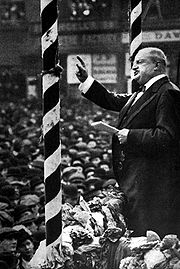 Home rule was vehemently opposed by many Irish Protestants
, the Irish Unionist Party
and Ulster's Orange Order
, who feared domination in an overwhelmingly Catholic state. Unionists also feared economic problems, namely that the predominantly agricultural Ireland would impose tariffs on British goods, leading to restrictions on the importation of industrial produce; the main location of Ireland's industrial development was Ulster
, the north-east of the island, the only part of Ireland dominated by unionists. Most unionist leaders, especially Sir Edward Carson—with whom Redmond always had a good personal relationship, based on shared experiences at Trinity College Dublin and the Irish bar
—threatened the use of force to prevent home rule, helped by their supporters in the British Conservative Party. Redmond misjudged them as merely bluffing. Carson predicted that if any attempt to coerce any part of Ulster were made, "a united Ireland within the lifetime of any one now living would be out of the question".
During negotiations early in 1914, two lines of concessions for the Carsonites were formulated: autonomy for Ulster in the form of 'Home Rule within Home Rule', which Redmond was inclined to, or alternatively the Lloyd George scheme of three years as the time limit for temporary exclusion. Redmond grudgingly acquiesced to this as "the price of peace". From the moment Carson spurned 'temporary' exclusion, the country began a plunge into anarchy. The situation took on an entirely new aspect in late March with the Curragh Mutiny together with the spectre of civil war on the part of the Ulster Covenant
ers, who formed the Ulster Volunteers to oppose Home Rule, forcing Redmond to then in July take over control of their counterpart, the Irish Volunteers
, established in November 1913 to enforce Home Rule.
Asquith conceded to the Lords' demand to have the Home Rule Act 1914, which had passed all stages in the Commons, amended to temporarily exclude the six counties of Northern Ireland
, which for a period would continue to be governed by London, not Dublin, and to later make some special provision for them. A Buckingham Palace Conference
failed to resolve the entangled situation. Strongly opposed to the partition of Ireland
in any form, Redmond and his party reluctantly agreed to what they understood would be a trial exclusion of now six years; under Redmond's aspiration that "Ulster will have to follow", he was belatedly prepared to concede a large measure of autonomy to it to come in.
Redmond's confidence was strong and communicated itself to Ireland. But whatever could be said to shake confidence was said by William O'Brien
and Timothy Healy
, who denounced the Bill as worthless when linked to the plan of even temporary partition and declared that, whatever the Government might say at present, "we had not yet reached the end of their concessions". On the division they and their All-for-Ireland Party
abstained, so that the majority dropped from 85 to 77. Using the Parliament Act, the Lords was deemed to have passed the Act; it received the Royal Assent
in September 1914.
in August 1914 caused the enforcement of Home Rule to be postponed for the duration of the conflict. Judged from the perspective of that time, Redmond had won a form of triumph: he had secured the enactment of Home Rule with the provision that the implementation of the measure would be delayed "not later than the end of the present war", which "would be bloody but short lived". His Unionist opponents were in confusion and dismayed by the enactment of Home Rule and by the absence of any definite provisions for the exclusion of Ulster. In two speeches delivered by Redmond in August and September 1914, deemed as critical turning-points in the Home Rule process, he stated:
Under these circumstances any political bargaining might well have been disastrous to Home Rule. Redmond desperately wanted and needed a rapid enactment of the Home Rule Act, and undoubtedly his words were a means to that end. He called on the country to support the Allied
and British war effort and Britain's commitment under the Triple Entente
; this was a calculated response to the situation principally in the belief that the attained measure of self-government would be granted in full after the war and to be in a stronger position to stave off a final partition of Northern Ireland. His added hope was that the common sacrifice by Irish nationalists and Unionists would bring them closer together, but above all that nationalists could not afford to allow Ulster Unionists to reap the benefit of being the only Irish to support the war effort, when they spontaneously enlisted in their 36th (Ulster) Division.
Speaking at Maryborough, now Port Laoise, on the 16 August, 1914, he addressed a 2,000 strong assembly of Irish Volunteers, some armed, and according to the report in the Irish Times stated, "recently, I took the liberty of saying in the English Parliament that, for the first time in the history of the connection between England and Ireland, it was safe to-day for England to withdraw her armed troops from our country and that the sons of Ireland themselves, North and South, Catholic and Protestant, and whatever the origin of their race might have been – Williamite, Cromwellian, or old Celtic – standing shoulder to shoulder, would defend the good order and peace of Ireland, and defend her shores against any foreign foe. (Cheers.)
I am glad to recognise the response which my words evoked. From every part of Ireland I have received assurances from the Irish Volunteers that they accepted my suggestion, and that they were ready to fulfil the duty that I indicated. (Cheers.) And more than that – perhaps, better and happier than that – I have had evidence from every part of Ireland, from the North as well as from the South, of a desire on the part of men who in the past have been divided from us, to come in at this hour of danger and peril – this hour which may be fraught with the happiest consequences for our country. They are prepared to come in and stand shoulder to shoulder with their Catholic Nationalist countrymen in every quarter of the country.
I say here to you: Welcome these men; they are Irishmen as much as you. (Cheers.) For the first time, perhaps, a real, favourable opportunity has been afforded to them of joining hands with us, and if now the ideal that we all have at heart comes to be realised, the result will be that out of this moment of seeming danger we will win for our country the most inestimable treasure to be obtained, in creating a free and united Ireland – united North and South, Catholic and Protestant. (Cheers.)
I read a couple of days ago in the public Press an account of the departure for the seat of war of one of the most gallant Irish regiments in the world, the Inniskilling Fusiliers; and I read how they were escorted from Enniskillen by the united bodies of the Ulster Volunteers and the National Volunteers. Pray God that may be an omen for the future. You are not drilling and arming to attack any body of your fellow-countrymen. God forbid that should ever take place.
I have in my possession – and it will be possible for me very shortly to distribute them –several thousands of rifles. (Cheers.) In addition to that, I have information to the effect that the Government are about to arm and equip and drill a large number of the Irish Volunteers with the rifles which my colleagues and I will supply. With the rifles which are being supplied from various other quarters, and with the arms from the Government, the day is near when, I believe, every Irish Volunteer will have a rifle in his possession. (Cheers.)"
, who enthusiastically enlisted in Irish regiments of the 10th and 16th (Irish) Divisions of the New British Army
, while a minority of around 9,700 members remained as the original Irish Volunteers. Redmond believed that Imperial Germany's hegemony and military expansion threatened the freedom of Europe and that it was Ireland's duty, having achieved future self-government:
Redmond requested the War Office
to allow the formation of a separate 'Irish Brigade' as had been done for the Ulster Volunteers, but Britain was suspicious of Redmond. His plan was that post-war the 'Irish Brigade' and National Volunteers would provide the basis for an Irish Army, capable of enforcing Home Rule on reluctant Ulster Unionists. Eventually he was granted the gesture of the 16th (Irish) Division which, with the exception of its Irish General Bernhard Hickie
at first had mostly English
officers, unlike the Ulster Division which had its own reserve militia officers, since most of the experienced officers in Ireland had already been posted to the 10th (Irish) Division and most Irish recruits enlisting in the new army lacked the military training to act as officers. Redmond's own son, William Redmond, enlisted, as did his own brother Major Willie Redmond MP, despite being aged over 50 years. They belonged to a group of five Irish MPs who enlisted, the others J. L. Esmonde, Stephen Gwynn, and D. D. Sheehan
as well as former MP Tom Kettle.
Redmond was and is still criticised for having encouraged so many Irish to fight in the Great War. However the Irish historian J. J. Lee wrote:
, which was staged by the remaining Irish Volunteers and the Irish Citizen Army
, led by a number of influential republicans
, under Patrick Pearse
. Pearse, who had in 1913 stood with Redmond on the same platform where the Rising now took place, had at that time praised Redmond’s efforts in achieving Home Rule. Redmond later acknowledged that the Rising was a shattering blow to his life-long policy of constitutional action. It equally helped fuel republican sentiment, particularly when Britain's General Maxwell
, in a highly misguided act, executed the leaders of the Rising, treating them as traitors in wartime. Redmond's plea, and John Dillon's, that the rebels be treated leniently were ignored.
There followed Asquith’s attempt to introduce Home Rule in July 1916, David Lloyd George
, then Minister for Munitions, was then sent to Dublin to offer this to the leaders of the Irish Party, Redmond and Dillon. The scheme revolved around partition, officially a temporary arrangement, as understood by Redmond. Lloyd George however gave the Ulster leader Carson a written guarantee that Ulster would not be forced in. His tactic was to see that neither side would find out before a compromise was implemented. A modified Act of 1914 had been drawn up by the Cabinet on 17 June. The Act had two amendments enforced by Unionists on 19 July – permanent exclusion and a reduction of Ireland’s representation in the Commons. This was informed by Lloyd George on 22 July 1916 to Redmond, who accused the government of treachery. This was decisive to the future fortunes of the Home Rule movement, the Lloyd George debacle of 22 July finished the constitutional party, overthrew Redmond’s power and left him utterly demoralised. It simultaneously discredited the politics of consent and created the space for radical alternatives. Redmond, after 1916 was increasingly eclipsed by ill-health, the rise of Sinn Féin
and the growing dominance of Dillon within the Irish Party.
June 1917 brought a severe personal blow when his brother Willie
died in action on the front at the onset of the Battle of Messines
offensive in Flanders
, his vacant seat in East Clare then won in July by Éamon de Valera
, the most senior surviving commandant of the Easter insurgents. It was one of three by-election gains by Sinn Féin, the small separatist party that had played no part in the Rising, but was wrongly 'blamed' by Britain and the Irish media. It was then taken over by surviving Rising leaders, under de Valera and the IRB
. Just at this time Redmond made a desperate effort to broker a new compromise with Irish unionists, when he accepted Lloyd George's proposal for a national convention to resolve the problem of Home Rule and draft a constitution for Ireland.
of around one hundred delegates sat from July and ended in March 1918. Up until December 1917 Redmond used his influence to have a plan which had been put forward by the Southern Unionist leader Lord Midleton
, accepted. It foresaw All-Ireland Home Rule with partial fiscal autonomy (until after the war, without customs and excise). All sides, icluding most Ulster delegates, wavered towards favouring agreement. Already ailing while attending the Convention, his health permanently affected by an accident in 1912, Redmond also suffered assault on the street in Dublin by a crowd of young Sinn Féin supporters on his way to the Convention, which included C.S. 'Todd' Andrews
. On 15 January, just when he intended to move a motion on his proposal to have the Midleton plan agreed, some nationalists colleagues, the prominent Catholic Bishop O'Donnell and MP Joseph Devlin
expressed doubts. Rather than split the nationalist side he withdrew his motion. A vital chance was lost.
He ended his participation by saying that under the circumstances he felt he could be of no further use to the Convention in the matter. His final word in the Convention was the tragic one – Better for us never to have met than to have met and failed. Late in February the malady from which he was suffering grew worse. He left Dublin for London knowing that a settlement from the Convention was impossible. An operation in March 1918 to remove an intestinal obstruction appeared to progress well at first, but then he suffered heart failure. He died a few hours later at a London nursing home on 6 March 1918. One of the last things he said to the Jesuit Father who was with him to the end, was, Father, I am a broken hearted man. At the Convention, his last move was an adoption of O’Brien’s policy of accommodating Unionist opposition in the North and in the South. It was too late. Had he joined O’Brien ten years before and carried the Irish Party with him, it is possible that Ireland’s destiny would have been settled by evolution.
Condolences and expressions of sympathy were widely expressed. After a funeral service in Westminster Cathedral
his remains were interred, as requested in a manner characteristic of the man, in the family vault at the old Knights' Templars' chapel yard of Saint John's Cemetery, Wexford
town, amongst his own people rather than in the traditional burial place for Irish statesmen and heroes in Glasnevin Cemetery
. The small, neglected cemetery near the town centre is kept locked to the public – his vault, which had been in a dilapidated state, has been only partially restored by Wexford County Council.
of April 1918, Britain, caught in a desperate life or death struggle with Imperial Germany, foolishly attempted to introduce conscription in Ireland linked with implementation of Home Rule. The Irish Nationalists led by Dillon walked out of the House of Commons and returned to Ireland to join in the widespread resistance and protests during the resulting conscription crisis.
The crisis boosted Sinn Féin so that in the December general election
it won the vast majority of seats, leaving the Nationalist Party with only six seats for the 220,837 votes cast (21.7%) (down from 84 seats out of 105 in 1910). The Party simply did not win a fair share of seats because the election was not run under a 'proportional representation' system, but on the 'first past the post' British electoral system. Unionists, on the other hand, won 26 seats for 287,618 (28.3%) of votes, whereas Sinn Féin votes were 476,087 (or 46.9%) for 48 seats, plus 25 uncontested, totalling an impressive 73 seats. In January 1919 a Unilateral Declaration of Independence
by the provisional Sinn Féin First Dáil
proclaimed an Irish Republic
, later abolished in 1921 after the Anglo-Irish War under the terms of the Anglo-Irish Treaty
which agreed on the Partition of Ireland
and established the Irish Free State
with its parliament the Dáil Éireann
(in the Irish Language
), the 'Assembly of Ireland'. The Irish Civil War
followed.
Home Rule was finally implemented in 1921 under the Government of Ireland Act 1920
(Fourth Home Rule Bill) which foresaw two Home Rule Irelands, although only adopted by the six counties forming Northern Ireland
.
(prime minister), John Bruton
, hung a painting of Redmond, whom he regarded as his hero because of his commitment to non-violence, in his office in Ireland's Leinster House
Government Buildings. However, his successor, Bertie Ahern
TD replaced the painting with one of Padraig Pearse.
Redmond's personal vision did not encompass a wholly independent Ireland. He referred to:
He had above all a conciliatory agenda; in his final words in parliament he expressed "a plea for concord between the two races that providence has designed should work as neighbours together”. For him, Home Rule was an interim step for All-Ireland autonomy:
Irish nationalism
Irish nationalism manifests itself in political and social movements and in sentiment inspired by a love for Irish culture, language and history, and as a sense of pride in Ireland and in the Irish people...
politician
Politician
A politician, political leader, or political figure is an individual who is involved in influencing public policy and decision making...
, barrister
Barrister
A barrister is a member of one of the two classes of lawyer found in many common law jurisdictions with split legal professions. Barristers specialise in courtroom advocacy, drafting legal pleadings and giving expert legal opinions...
, MP
Member of Parliament
A Member of Parliament is a representative of the voters to a :parliament. In many countries with bicameral parliaments, the term applies specifically to members of the lower house, as upper houses often have a different title, such as senate, and thus also have different titles for its members,...
in the House of Commons
British House of Commons
The House of Commons is the lower house of the Parliament of the United Kingdom, which also comprises the Sovereign and the House of Lords . Both Commons and Lords meet in the Palace of Westminster. The Commons is a democratically elected body, consisting of 650 members , who are known as Members...
of the United Kingdom of Great Britain and Ireland
United Kingdom of Great Britain and Ireland
The United Kingdom of Great Britain and Ireland was the formal name of the United Kingdom during the period when what is now the Republic of Ireland formed a part of it....
and leader of the Irish Parliamentary Party
Irish Parliamentary Party
The Irish Parliamentary Party was formed in 1882 by Charles Stewart Parnell, the leader of the Nationalist Party, replacing the Home Rule League, as official parliamentary party for Irish nationalist Members of Parliament elected to the House of Commons at...
from 1900 to 1918. He was a moderate, constitutional and conciliatory politician who attained the twin dominant objectives of his political life, party unity and finally in September 1914 achieving Irish Home Rule under an Act which granted an interim form of self-government to Ireland. Unfortunately for Redmond, implementation of the Act was suspended by the intervention of World War I
World War I
World War I , which was predominantly called the World War or the Great War from its occurrence until 1939, and the First World War or World War I thereafter, was a major war centred in Europe that began on 28 July 1914 and lasted until 11 November 1918...
, and ultimately made untenable after the Conscription Crisis of 1918.
He was the elder brother of Willie Redmond and father of William Archer Redmond, both of whom were to serve as MPs in his party.
Family influences and background
John Edward Redmond (the younger) was born at Ballytrent House, Kilrane, County WexfordCounty Wexford
County Wexford is a county in Ireland. It is part of the South-East Region and is also located in the province of Leinster. It is named after the town of Wexford. In pre-Norman times it was part of the Kingdom of Uí Cheinnselaig, whose capital was at Ferns. Wexford County Council is the local...
, his grandfather's old family mansion. He was the eldest son of William Archer Redmond, MP by Mary, daughter of General Hoey, the brother of Francis Hoey, heir of the Hoey seat, Dunganstown Castle, County Wicklow
County Wicklow
County Wicklow is a county in Ireland. It is part of the Mid-East Region and is also located in the province of Leinster. It is named after the town of Wicklow, which derives from the Old Norse name Víkingalág or Wykynlo. Wicklow County Council is the local authority for the county...
.
For over seven hundred years the Redmonds had been a prominent Catholic gentry family in County Wexford and Wexford
Wexford
Wexford is the county town of County Wexford, Ireland. It is situated near the southeastern corner of Ireland, close to Rosslare Europort. The town is connected to Dublin via the M11/N11 National Primary Route, and the national rail network...
town. They were one of the oldest Hiberno-Norman
Hiberno-Norman
The Hiberno-Normans are those Norman lords who settled in Ireland who admitted little if any real fealty to the Anglo-Norman settlers in England, and who soon began to interact and intermarry with the Gaelic nobility of Ireland. The term embraces both their origins as a distinct community with...
families, and had for a long time been known as the Redmonds of 'The Hall', which is now known as Loftus Hall
Loftus Hall
Loftus Hall is a large mansion house on the Hook peninsula, County Wexford, Ireland that is said to have been haunted both by the devil and by the ghost of a young woman....
. His more immediate family were a remarkable political dynasty themselves. Redmond's grand uncle, John Edward Redmond, was a prominent banker and businessman before entering Parliament as a member for Wexford constituency
Wexford Borough (UK Parliament constituency)
Wexford Borough was a United Kingdom Parliament constituency, in Ireland, returning one Member of Parliament . It was an original constituency represented in Parliament when the Union of Great Britain and Ireland took effect on 1 January 1801....
in 1859; his statue stands in Redmond Square, Wexford town. After his death in 1866, his nephew, William Archer Redmond, this John Redmond's father, was elected to the seat and soon emerged as a prominent supporter of Isaac Butt
Isaac Butt
Isaac Butt Q.C. M.P. was an Irish barrister, politician, Member of Parliament , and the founder and first leader of a number of Irish nationalist parties and organisations, including the Irish Metropolitan Conservative Society in 1836, the Home Government Association in 1870 and in 1873 the Home...
's new policy for home rule. John Redmond was the brother of Willie Redmond, MP for Wexford and East Clare
East Clare (UK Parliament constituency)
East Clare was a UK Parliament constituency in Ireland, returning one Member of Parliament 1885–1922.Prior to the United Kingdom general election, 1885 the area was part of the Clare constituency...
, and the father of William Redmond, whose wife was Bridget Redmond
Bridget Redmond
Bridget Mary Redmond was an Irish Cumann na nGaedheal and Fine Gael politician. She was first elected to Dáil Éireann as a Cumann na nGaedheal Teachta Dála for the Waterford constituency at the 1933 general election. Her husband William Redmond represented the same constituency until his death in...
.
Redmond’s family heritage was more complex than that of most of his nationalist political colleagues. His mother came from a Protestant and unionist family; although she had converted to Catholicism on marriage, she never converted to nationalism. His uncle General John Patrick Redmond, who had inherited the family estate, was created CB
Order of the Bath
The Most Honourable Order of the Bath is a British order of chivalry founded by George I on 18 May 1725. The name derives from the elaborate mediæval ceremony for creating a knight, which involved bathing as one of its elements. The knights so created were known as Knights of the Bath...
for his role during the Indian mutiny; he disapproved of his nephew’s involvement in agrarian agitation of the 1880s. John Redmond boasted of his family involvement in the 1798 Wexford Rebellion
Wexford Rebellion
The Wexford Rebellion refers to the outbreak in County Wexford, Ireland in May 1798 of a United Irishmen rebellion against the English domination of Ireland. It was the most successful and most destructive of all the uprisings that occurred throughout Ireland during the Irish Rebellion of 1798,...
; a "Miss Redmond" had ridden in support of the rebels, a Father Redmond was hanged by the yeomanry
Yeomanry
Yeomanry is a designation used by a number of units or sub-units of the British Territorial Army, descended from volunteer cavalry regiments. Today, Yeomanry units may serve in a variety of different military roles.-History:...
, as was a maternal ancestor, William Kearney.
Education and early career
As a student, young John exhibited the seriousness that many would soon come to associate with him. Educated by the JesuitsSociety of Jesus
The Society of Jesus is a Catholic male religious order that follows the teachings of the Catholic Church. The members are called Jesuits, and are also known colloquially as "God's Army" and as "The Company," these being references to founder Ignatius of Loyola's military background and a...
in Clongowes Wood College
Clongowes Wood College
Clongowes Wood College is a voluntary secondary boarding school for boys, located near Clane in County Kildare, Ireland. Founded by the Society of Jesus in 1814, it is one of Ireland's oldest Catholic schools, and featured prominently in James Joyce's semi-autobiographical novel A Portrait of the...
, he was primarily interested in poetry and literature, played the lead in school theatricals and was regarded as the best speaker in the school's debating society. After finishing at Clongowes, Redmond attended Trinity College, Dublin
Trinity College, Dublin
Trinity College, Dublin , formally known as the College of the Holy and Undivided Trinity of Queen Elizabeth near Dublin, was founded in 1592 by letters patent from Queen Elizabeth I as the "mother of a university", Extracts from Letters Patent of Elizabeth I, 1592: "...we...found and...
in order to study law, but his father's ill health led him to abandon his studies before taking a degree. In 1876 he left to live with his father in London, acting as his assistant in Westminster
Westminster
Westminster is an area of central London, within the City of Westminster, England. It lies on the north bank of the River Thames, southwest of the City of London and southwest of Charing Cross...
, where he developed more fascination for politics than for law. He first came into contact with Michael Davitt
Michael Davitt
Michael Davitt was an Irish republican and nationalist agrarian agitator, a social campaigner, labour leader, journalist, Home Rule constitutional politician and Member of Parliament , who founded the Irish National Land League.- Early years :Michael Davitt was born in Straide, County Mayo,...
on the occasion of a reception held in London to celebrate the release of the famous Fenian
Fenian
The Fenians , both the Fenian Brotherhood and Irish Republican Brotherhood , were fraternal organisations dedicated to the establishment of an independent Irish Republic in the 19th and early 20th century. The name "Fenians" was first applied by John O'Mahony to the members of the Irish republican...
prisoner. As a clerk in the House of Commons he increasingly identified himself with the fortunes of Charles Stewart Parnell
Charles Stewart Parnell
Charles Stewart Parnell was an Irish landowner, nationalist political leader, land reform agitator, and the founder and leader of the Irish Parliamentary Party...
, one of the founders of the Irish Land League and a noted ‘obstructionist
Obstructionism
Obstructionism is the practice of deliberately delaying or preventing a process or change, especially in politics.-As workplace aggression:An obstructionist causes problems. Neuman and Baron identify obstructionism as one of the three dimensions that encompass the range of workplace aggression...
’ in the Commons.
Political profession and marriage
Redmond first attended political meetings with Parnell in 1879. Upon his father's death later in 1880, he wrote to Parnell asking for adoption as the Nationalist PartyNationalist Party (Ireland)
The Nationalist Party was a term commonly used to describe a number of parliamentary political parties and constituency organisations supportive of Home Rule for Ireland from 1874 to 1922...
(from 1882 the Irish Parliamentary Party
Irish Parliamentary Party
The Irish Parliamentary Party was formed in 1882 by Charles Stewart Parnell, the leader of the Nationalist Party, replacing the Home Rule League, as official parliamentary party for Irish nationalist Members of Parliament elected to the House of Commons at...
) candidate in the by-election to fill the open seat, but was disappointed to learn that Parnell had already promised the next vacancy to his secretary Timothy Healy
Timothy Michael Healy
Timothy Michael Healy, KC , also known as Tim Healy, was an Irish nationalist politician, journalist, author, barrister and one of the most controversial Irish Members of Parliament in the House of Commons of the United Kingdom of Great Britain and Ireland...
. Nevertheless, Redmond supported Healy as the nominee, and when another vacancy arose, this time in New Ross
New Ross (UK Parliament constituency)
New Ross was a United Kingdom Parliament constituency, in Ireland, returning one Member of Parliament . It was an original constituency represented in Parliament when the Union of Great Britain and Ireland took effect on 1 January 1801.-Boundaries:...
, he won election unopposed as the Parnellite candidate for the seat. On election (31 January 1881), he rushed to the House of Commons, made his maiden speech next day amid stormy scenes following the arrest of Michael Davitt, then a Land League leader, and was ejected from the Commons all on the same evening. He served as MP for New Ross from 1881 to 1885, for North Wexford
North Wexford (UK Parliament constituency)
North Wexford was a United Kingdom Parliament constituency in Ireland, returning one Member of Parliament 1885–1922.Prior to 1885 the area was part of the County Wexford constituency...
from 1885 to 1891 and finally for Waterford City
Waterford City (UK Parliament constituency)
Waterford City was a United Kingdom Parliament constituency, in Ireland.-Boundaries and boundary changes:This constituency was the Parliamentary borough of Waterford in County Waterford.It returned one MP 1801–1832, two MPs 1832–1885 and one 1885–1922...
from 1891 until his death in 1918.
By the time of Redmond's election, the Land League conflict was by now at a turbulent stage. Early in 1882 he and his brother Willie were sent to Australia on a fund-raising mission which was a success in both political and personal terms; in 1883 he and his brother married into the prosperous Irish-Australian Dalton family and became friends with the famous James Dalton
James Dalton (Orange, Australia)
James Dalton was a wealthy merchant and pastoralist that lived during the 19th and 20th centuries in Orange, New South Wales, Australia...
and whom he spent much of his time with. His marriage was short-lived but happy: his wife Johanna died early in 1889 after bearing him three children. He also travelled in 1884, 1886 and 1904 to America
United States
The United States of America is a federal constitutional republic comprising fifty states and a federal district...
, where he was to use more extreme language but found his contact with Irish-American extremism daunting. His Australian experience, on the other hand, was to have a strong influence on his political outlook, causing him to embrace an Irish version of Liberal Imperialism and to remain anxious to retain Irish representation and Ireland’s voice at Westminster even after the implementation of home rule. During the debate which followed Gladstone's conversion to Home Rule in 1886, he declared:
"As a Nationalist, I do not regard as entirely palatable the idea that forever and a day Ireland's voice should be excluded from the councils of an empire which the genius and valour of her sons have done so much to build up and of which she is to remain".
In 1899 Redmond married his second wife, Ada Beesley, an English Protestant who, after his death, converted to Catholicism.
Leader of the Parnellite party
Having belatedly become a barrister by completing his terms at the King's InnsKing's Inns
The Honorable Society of King's Inns , is the institution which controls the entry of barristers-at-law into the justice system of Ireland...
, Dublin, being called to the Irish bar in 1887 (and to the English bar a year later), Redmond busied himself with agrarian cases during the Plan of Campaign
Plan of Campaign
The Plan of Campaign was a stratagem adopted in Ireland between 1886 and 1891, co-ordinated by Irish politicians for the benefit of tenant farmers, against mainly absentee and rack-rent landlords. It was launched to counter agricultural distress caused by the continual depression in prices of dairy...
. In 1888, following a strong and conceivably intimidatory speech, he received five weeks’ imprisonment with hard labour. A loyal supporter of Parnell, Redmond like Davitt was deeply opposed to the use of physical force and was committed to political change by constitutional means, campaigning constitutionally for Home Rule as an interim form of All-Ireland self-government within the United Kingdom.
When the Irish Parliamentary Party split over Parnell's long-standing family relationship with Katharine O'Shea, the previously separated wife of a fellow MP, whom he later married, Redmond stood by his deposed leader in the dispute. After Parnell's death in 1891, Redmond took over leadership of the Parnellite rump of the split party, the Irish National League
National League (Ireland, 1882)
The Irish National League was a nationalist political party in Ireland. It was founded in October 1882 by Charles Stewart Parnell as the successor to the Irish National Land League after this was suppressed...
(INL), where he soon demonstrated both his organisational ability and his considerable rhetorical skills. He also raised funds for the Parnell Monument at the northern end of Dublin's O'Connell Street
O'Connell Street
O'Connell Street is Dublin's main thoroughfare. It measures 49 m in width at its southern end, 46 m at the north, and is 500 m in length...
, choosing the American Augustus Saint Gaudens to sculpt the statue, which was eventually completed in 1911.
The larger anti-Parnellite group formed the Irish National Federation
Irish National Federation
The Irish National Federation was a nationalist political party in Ireland. It was founded in March 1891 by former members of the Irish National League who had left the Irish Parliamentary Party in protest when Charles Stewart Parnell refused to resign the party leadership as a result of his...
(INF) under John Dillon
John Dillon
John Dillon was an Irish land reform agitator from Dublin, an Irish Home Rule activist, a nationalist politician, a Member of Parliament for over 35 years, and the last leader of the Irish Parliamentary Party....
. During this period, he supported the Unionist Irish Secretary Gerald Balfour programme of Constructive Unionism, while assuring the Tory Government that its self-declared policy of "killing Home Rule with kindness" would not achieve its objective. Redmond dropped all interest in agrarian radicalism and, unlike the mainstream nationalists, worked constructively alongside Unionists
Unionism in Ireland
Unionism in Ireland is an ideology that favours the continuation of some form of political union between the islands of Ireland and Great Britain...
, such as Horace Plunkett, in the Recess Committee of 1895 which led to the establishment of a department of agriculture in 1899. He further argued that the land reforms and democratisation of elected local government under the Local Government (Ireland) Act 1898
Local Government (Ireland) Act 1898
The Local Government Act 1898 was an Act of the Parliament of the United Kingdom that established a system of local government in Ireland similar to that already created for England, Wales and Scotland by legislation in 1888 and 1889...
would in fact stimulate demands for Home Rule rather than dampen them, as was the case.
Home Rule and the Liberals
When on 6 February 1900, through the initiative of William O'BrienWilliam O'Brien
William O'Brien was an Irish nationalist, journalist, agrarian agitator, social revolutionary, politician, party leader, newspaper publisher, author and Member of Parliament in the House of Commons of the United Kingdom of Great Britain and Ireland...
and his United Irish League
United Irish League
The United Irish League was a nationalist political party in Ireland, launched 23 January 1898 with the motto "The Land for the People" . Its objective to be achieved through agrarian agitation and land reform, compelling larger grazier farmers to surrender their lands for redistribution amongst...
(UIL), the INL and the INF re-united again within the Irish Parliamentary Party, Redmond was elected its chairman (leader), a position he held until his death in 1918—a longer period than any other nationalist leader, except Éamon de Valera
Éamon de Valera
Éamon de Valera was one of the dominant political figures in twentieth century Ireland, serving as head of government of the Irish Free State and head of government and head of state of Ireland...
and Daniel O'Connell
Daniel O'Connell
Daniel O'Connell Daniel O'Connell Daniel O'Connell (6 August 1775 – 15 May 1847; often referred to as The Liberator, or The Emancipator, was an Irish political leader in the first half of the 19th century...
. However, Redmond, a Parnellite, was chosen as a compromise due to the personal rivalries between the anti-Parnellite Home Rule leaders. Therefore, he never had as much control over the party as his predecessor, his authority and leadership a balancing act having to contend with such powerful colleagues as John Dillon, William O'Brien, Timothy Healy and Joseph Devlin
Joseph Devlin
Joseph Devlin, also known as Joe Devlin, was an Irish journalist and influential nationalist politician...
. He nevertheless led the Party successfully through the September 1900 general election
United Kingdom general election, 1900
-Seats summary:-See also:*MPs elected in the United Kingdom general election, 1900*The Parliamentary Franchise in the United Kingdom 1885-1918-External links:***-References:*F. W. S. Craig, British Electoral Facts: 1832-1987**...
.
Then followed William O’Brien’s amicable and conciliatory Land Conference
Land Conference
The Land Conference was a successful conciliatory negotiation held in the Mansion House in Dublin, Ireland between 20 December 1902 and 4 January 1903. In a short period it produced a unanimously agreed report recommending an amiable solution to the long waged land war between tenant farmers and...
of 1902 involving leading landlords under Lord Dunraven and tenant representatives O'Brien, Redmond, Timothy Harrington and T. W. Russell for the Ulster tenants. It resulted in the enactment of the unprecedented Wyndham Purchase Land Act of 1903. Redmond first sided with O’Brien's new strategy of "conciliation plus business", but refused O’Brien’s demand to rebuke Dillon for his criticism of the Act, leading to O’Brien’s resignation from the party in November 1903. Again though approving of the 1904 devolution proposals of the Irish Reform Association
Irish Reform Association
The Irish Reform Association was an attempt to introduce limited devolved self-government to Ireland by a group of reform oriented Irish unionist land owners who proposed to initially adopt something less than full Home Rule...
, fearing another party split, Redmond quietly endured Dillon’s dictate of distancing from any understanding with the landlord class. However, they made a good team: Redmond, who was a fine speaker and liked the House of Commons, dealt with the British politicians, while Dillon, who disliked London, the Commons and their influence on Irish politicians, stayed in Ireland and kept Redmond in touch with national feelings.
Though government had been dominated by the Conservative Party
Conservative Party (UK)
The Conservative Party, formally the Conservative and Unionist Party, is a centre-right political party in the United Kingdom that adheres to the philosophies of conservatism and British unionism. It is the largest political party in the UK, and is currently the largest single party in the House...
for more than a decade, the new century saw much favourable legislation enacted in Ireland’s interest. An electoral swing to the Liberal Party
Liberal Party (UK)
The Liberal Party was one of the two major political parties of the United Kingdom during the 19th and early 20th centuries. It was a third party of negligible importance throughout the latter half of the 20th Century, before merging with the Social Democratic Party in 1988 to form the present day...
in the 1906 general election
United Kingdom general election, 1906
-Seats summary:-See also:*MPs elected in the United Kingdom general election, 1906*The Parliamentary Franchise in the United Kingdom 1885-1918-External links:***-References:*F. W. S. Craig, British Electoral Facts: 1832-1987**...
renewed Redmond’s opportunities for working with government policy. The Liberals, however, did not yet back his party’s demands for full Home Rule, which contributed to a renewal of agrarian radicalism in the ranch wars of 1906-1910. Redmond’s low-key and conciliatory style of leadership gave the impression of weakness but reflected the problem of keeping together a factionalised party. He grew in stature after 1906 and especially after 1910. As far as Redmond was concerned, the Home Rule movement was interested in promoting Irish nationality within the British Empire, but it was also a movement with a visceral antipathy to the English and their colonies.
The second election of December 1910 changed everything to Redmond’s advantage, giving his parliamentary party the balance of power at Westminster
Palace of Westminster
The Palace of Westminster, also known as the Houses of Parliament or Westminster Palace, is the meeting place of the two houses of the Parliament of the United Kingdom—the House of Lords and the House of Commons...
, which marked a high point in his political career. His deal over the budget crisis of 1909 led to the curbing of the power of the House of Lords
House of Lords
The House of Lords is the upper house of the Parliament of the United Kingdom. Like the House of Commons, it meets in the Palace of Westminster....
, which had previously blocked the budget of the Chancellor of the Exchequer
Chancellor of the Exchequer
The Chancellor of the Exchequer is the title held by the British Cabinet minister who is responsible for all economic and financial matters. Often simply called the Chancellor, the office-holder controls HM Treasury and plays a role akin to the posts of Minister of Finance or Secretary of the...
, David Lloyd George
David Lloyd George
David Lloyd George, 1st Earl Lloyd-George of Dwyfor OM, PC was a British Liberal politician and statesman...
. With the Lords' veto abolished under the Parliament Act 1911
Parliament Act 1911
The Parliament Act 1911 is an Act of the Parliament of the United Kingdom. It is constitutionally important and partly governs the relationship between the House of Commons and the House of Lords which make up the Houses of Parliament. This Act must be construed as one with the Parliament Act 1949...
, Irish Home Rule (which the Lords blocked in 1894) became a reality. Redmond used his leverage to persuade the Liberal government of H. H. Asquith
H. H. Asquith
Herbert Henry Asquith, 1st Earl of Oxford and Asquith, KG, PC, KC served as the Liberal Prime Minister of the United Kingdom from 1908 to 1916...
to introduced the Third Home Rule Bill in April 1912, to grant Ireland national self-government. This could no longer be blocked by the Lords, its enactment merely delayed for two years. Home Rule had reached the pinnacle of its success and Redmond had gone much further than any of his predecessors in shaping British politics to the needs of the Irish.
For all its reservations, the Bill was for Redmond the fulfillment of a lifelong dream. "If I may say so reverently", he told the House of Commons, "I personally thank God that I have lived to see this day". But Asquith missed a magnificent opportunity, by failing to incorporate into the Bill any significant concessions to Ulster Unionists
Ulster Unionist Party
The Ulster Unionist Party – sometimes referred to as the Official Unionist Party or, in a historic sense, simply the Unionist Party – is the more moderate of the two main unionist political parties in Northern Ireland...
, who then campaigned relentlessly against it. Nonetheless by 1914 Redmond had become a nationalist hero of Parnellite stature and could have had every expectation of becoming head of a new Irish government in Dublin.
Home rule enacted
But like most leaders in the nationalist scene, not least his successors in the republican scene, he knew little of Ulster or the intensity of Unionist sentiment against home rule. His successor, John Dillon, claimed that Redmond had removed all the obstacles to Irish unity except those of the Ulster unionists. He had persuaded British public and political opinion of all hues of its merits. William O’Brien and his dissident AFIL PartyAll-for-Ireland League
The All-for-Ireland League , was an Irish, Munster-based political party . Founded by William O'Brien MP, it generated a new national movement to achieve agreement between the different parties concerned on the historically difficult aim of Home Rule for the whole of Ireland...
warned in similar vein, that the volatile Northern Ireland situation was left unresolved.
Church of Ireland
The Church of Ireland is an autonomous province of the Anglican Communion. The church operates in all parts of Ireland and is the second largest religious body on the island after the Roman Catholic Church...
, the Irish Unionist Party
Irish Unionist Party
The Irish Unionist Alliance was a Unionist party founded in Ireland in 1891 to oppose plans for Gladstonian and Parnellite Home Rule for Ireland. The party was led for much of its life by Colonel Edward James Saunderson and later by the William St John Brodrick, Earl of Midleton...
and Ulster's Orange Order
Orange Institution
The Orange Institution is a Protestant fraternal organisation based mainly in Northern Ireland and Scotland, though it has lodges throughout the Commonwealth and United States. The Institution was founded in 1796 near the village of Loughgall in County Armagh, Ireland...
, who feared domination in an overwhelmingly Catholic state. Unionists also feared economic problems, namely that the predominantly agricultural Ireland would impose tariffs on British goods, leading to restrictions on the importation of industrial produce; the main location of Ireland's industrial development was Ulster
Ulster
Ulster is one of the four provinces of Ireland, located in the north of the island. In ancient Ireland, it was one of the fifths ruled by a "king of over-kings" . Following the Norman invasion of Ireland, the ancient kingdoms were shired into a number of counties for administrative and judicial...
, the north-east of the island, the only part of Ireland dominated by unionists. Most unionist leaders, especially Sir Edward Carson—with whom Redmond always had a good personal relationship, based on shared experiences at Trinity College Dublin and the Irish bar
King's Inns
The Honorable Society of King's Inns , is the institution which controls the entry of barristers-at-law into the justice system of Ireland...
—threatened the use of force to prevent home rule, helped by their supporters in the British Conservative Party. Redmond misjudged them as merely bluffing. Carson predicted that if any attempt to coerce any part of Ulster were made, "a united Ireland within the lifetime of any one now living would be out of the question".
During negotiations early in 1914, two lines of concessions for the Carsonites were formulated: autonomy for Ulster in the form of 'Home Rule within Home Rule', which Redmond was inclined to, or alternatively the Lloyd George scheme of three years as the time limit for temporary exclusion. Redmond grudgingly acquiesced to this as "the price of peace". From the moment Carson spurned 'temporary' exclusion, the country began a plunge into anarchy. The situation took on an entirely new aspect in late March with the Curragh Mutiny together with the spectre of civil war on the part of the Ulster Covenant
Ulster Covenant
The Ulster Covenant was signed by just under half a million of men and women from Ulster, on and before September 28, 1912, in protest against the Third Home Rule Bill, introduced by the Government in that same year...
ers, who formed the Ulster Volunteers to oppose Home Rule, forcing Redmond to then in July take over control of their counterpart, the Irish Volunteers
Irish Volunteers
The Irish Volunteers was a military organisation established in 1913 by Irish nationalists. It was ostensibly formed in response to the formation of the Ulster Volunteers in 1912, and its declared primary aim was "to secure and maintain the rights and liberties common to the whole people of Ireland"...
, established in November 1913 to enforce Home Rule.
Asquith conceded to the Lords' demand to have the Home Rule Act 1914, which had passed all stages in the Commons, amended to temporarily exclude the six counties of Northern Ireland
Northern Ireland
Northern Ireland is one of the four countries of the United Kingdom. Situated in the north-east of the island of Ireland, it shares a border with the Republic of Ireland to the south and west...
, which for a period would continue to be governed by London, not Dublin, and to later make some special provision for them. A Buckingham Palace Conference
Buckingham Palace Conference
The Buckingham Palace Conference, sometimes referred to as the Buckingham Palace Conference on Ireland, was a conference called in Buckingham Palace in 1914 by King George V of the United Kingdom to which the leaders of Irish Nationalism and Irish Unionism were invited to discuss plans to introduce...
failed to resolve the entangled situation. Strongly opposed to the partition of Ireland
Partition of Ireland
The partition of Ireland was the division of the island of Ireland into two distinct territories, now Northern Ireland and the Republic of Ireland . Partition occurred when the British Parliament passed the Government of Ireland Act 1920...
in any form, Redmond and his party reluctantly agreed to what they understood would be a trial exclusion of now six years; under Redmond's aspiration that "Ulster will have to follow", he was belatedly prepared to concede a large measure of autonomy to it to come in.
Redmond's confidence was strong and communicated itself to Ireland. But whatever could be said to shake confidence was said by William O'Brien
William O'Brien
William O'Brien was an Irish nationalist, journalist, agrarian agitator, social revolutionary, politician, party leader, newspaper publisher, author and Member of Parliament in the House of Commons of the United Kingdom of Great Britain and Ireland...
and Timothy Healy
Timothy Michael Healy
Timothy Michael Healy, KC , also known as Tim Healy, was an Irish nationalist politician, journalist, author, barrister and one of the most controversial Irish Members of Parliament in the House of Commons of the United Kingdom of Great Britain and Ireland...
, who denounced the Bill as worthless when linked to the plan of even temporary partition and declared that, whatever the Government might say at present, "we had not yet reached the end of their concessions". On the division they and their All-for-Ireland Party
All-for-Ireland League
The All-for-Ireland League , was an Irish, Munster-based political party . Founded by William O'Brien MP, it generated a new national movement to achieve agreement between the different parties concerned on the historically difficult aim of Home Rule for the whole of Ireland...
abstained, so that the majority dropped from 85 to 77. Using the Parliament Act, the Lords was deemed to have passed the Act; it received the Royal Assent
Royal Assent
The granting of royal assent refers to the method by which any constitutional monarch formally approves and promulgates an act of his or her nation's parliament, thus making it a law...
in September 1914.
European conflict intervenes
The outbreak of World War IWorld War I
World War I , which was predominantly called the World War or the Great War from its occurrence until 1939, and the First World War or World War I thereafter, was a major war centred in Europe that began on 28 July 1914 and lasted until 11 November 1918...
in August 1914 caused the enforcement of Home Rule to be postponed for the duration of the conflict. Judged from the perspective of that time, Redmond had won a form of triumph: he had secured the enactment of Home Rule with the provision that the implementation of the measure would be delayed "not later than the end of the present war", which "would be bloody but short lived". His Unionist opponents were in confusion and dismayed by the enactment of Home Rule and by the absence of any definite provisions for the exclusion of Ulster. In two speeches delivered by Redmond in August and September 1914, deemed as critical turning-points in the Home Rule process, he stated:
"armed Nationalist Catholics in the South will be only too glad to join arms with the armed Protestant Ulstermen in the North. Is it too much to hope that out of this situation there may spring a result which will be good, not merely for the Empire, but good for the future welfare and integrity of the Irish nation?"
Under these circumstances any political bargaining might well have been disastrous to Home Rule. Redmond desperately wanted and needed a rapid enactment of the Home Rule Act, and undoubtedly his words were a means to that end. He called on the country to support the Allied
Allies of World War I
The Entente Powers were the countries at war with the Central Powers during World War I. The members of the Triple Entente were the United Kingdom, France, and the Russian Empire; Italy entered the war on their side in 1915...
and British war effort and Britain's commitment under the Triple Entente
Triple Entente
The Triple Entente was the name given to the alliance among Britain, France and Russia after the signing of the Anglo-Russian Entente in 1907....
; this was a calculated response to the situation principally in the belief that the attained measure of self-government would be granted in full after the war and to be in a stronger position to stave off a final partition of Northern Ireland. His added hope was that the common sacrifice by Irish nationalists and Unionists would bring them closer together, but above all that nationalists could not afford to allow Ulster Unionists to reap the benefit of being the only Irish to support the war effort, when they spontaneously enlisted in their 36th (Ulster) Division.
Speaking at Maryborough, now Port Laoise, on the 16 August, 1914, he addressed a 2,000 strong assembly of Irish Volunteers, some armed, and according to the report in the Irish Times stated, "recently, I took the liberty of saying in the English Parliament that, for the first time in the history of the connection between England and Ireland, it was safe to-day for England to withdraw her armed troops from our country and that the sons of Ireland themselves, North and South, Catholic and Protestant, and whatever the origin of their race might have been – Williamite, Cromwellian, or old Celtic – standing shoulder to shoulder, would defend the good order and peace of Ireland, and defend her shores against any foreign foe. (Cheers.)
I am glad to recognise the response which my words evoked. From every part of Ireland I have received assurances from the Irish Volunteers that they accepted my suggestion, and that they were ready to fulfil the duty that I indicated. (Cheers.) And more than that – perhaps, better and happier than that – I have had evidence from every part of Ireland, from the North as well as from the South, of a desire on the part of men who in the past have been divided from us, to come in at this hour of danger and peril – this hour which may be fraught with the happiest consequences for our country. They are prepared to come in and stand shoulder to shoulder with their Catholic Nationalist countrymen in every quarter of the country.
I say here to you: Welcome these men; they are Irishmen as much as you. (Cheers.) For the first time, perhaps, a real, favourable opportunity has been afforded to them of joining hands with us, and if now the ideal that we all have at heart comes to be realised, the result will be that out of this moment of seeming danger we will win for our country the most inestimable treasure to be obtained, in creating a free and united Ireland – united North and South, Catholic and Protestant. (Cheers.)
I read a couple of days ago in the public Press an account of the departure for the seat of war of one of the most gallant Irish regiments in the world, the Inniskilling Fusiliers; and I read how they were escorted from Enniskillen by the united bodies of the Ulster Volunteers and the National Volunteers. Pray God that may be an omen for the future. You are not drilling and arming to attack any body of your fellow-countrymen. God forbid that should ever take place.
I have in my possession – and it will be possible for me very shortly to distribute them –several thousands of rifles. (Cheers.) In addition to that, I have information to the effect that the Government are about to arm and equip and drill a large number of the Irish Volunteers with the rifles which my colleagues and I will supply. With the rifles which are being supplied from various other quarters, and with the arms from the Government, the day is near when, I believe, every Irish Volunteer will have a rifle in his possession. (Cheers.)"
Nationalists split
Redmond's appeal, however, to the Irish Volunteers to also enlist caused them to split; a large majority of 140,000 followed Redmond and formed the National VolunteersNational Volunteers
The National Volunteers was the name taken by the majority of the Irish Volunteers that sided with Irish Parliamentary Party leader John Redmond after the movement split over the question of the Volunteers' role in World War I.-Origins:...
, who enthusiastically enlisted in Irish regiments of the 10th and 16th (Irish) Divisions of the New British Army
Kitchener's Army
The New Army, often referred to as Kitchener's Army or, disparagingly, Kitchener's Mob, was an all-volunteer army formed in the United Kingdom following the outbreak of hostilities in the First World War...
, while a minority of around 9,700 members remained as the original Irish Volunteers. Redmond believed that Imperial Germany's hegemony and military expansion threatened the freedom of Europe and that it was Ireland's duty, having achieved future self-government:
"to the best of her ability to go where ever the firing line extends, in defence of right, of freedom and of religion in this war. It would be a disgrace forever to our country otherwise". (Woodenbridge speech to the Irish Volunteers, 20 September 1914)
Redmond requested the War Office
War Office
The War Office was a department of the British Government, responsible for the administration of the British Army between the 17th century and 1964, when its functions were transferred to the Ministry of Defence...
to allow the formation of a separate 'Irish Brigade' as had been done for the Ulster Volunteers, but Britain was suspicious of Redmond. His plan was that post-war the 'Irish Brigade' and National Volunteers would provide the basis for an Irish Army, capable of enforcing Home Rule on reluctant Ulster Unionists. Eventually he was granted the gesture of the 16th (Irish) Division which, with the exception of its Irish General Bernhard Hickie
William Bernard Hickie
Sir William Bernard Hickie was an Irish born Major General of the British Army and an Irish nationalist politician....
at first had mostly English
England
England is a country that is part of the United Kingdom. It shares land borders with Scotland to the north and Wales to the west; the Irish Sea is to the north west, the Celtic Sea to the south west, with the North Sea to the east and the English Channel to the south separating it from continental...
officers, unlike the Ulster Division which had its own reserve militia officers, since most of the experienced officers in Ireland had already been posted to the 10th (Irish) Division and most Irish recruits enlisting in the new army lacked the military training to act as officers. Redmond's own son, William Redmond, enlisted, as did his own brother Major Willie Redmond MP, despite being aged over 50 years. They belonged to a group of five Irish MPs who enlisted, the others J. L. Esmonde, Stephen Gwynn, and D. D. Sheehan
D. D. Sheehan
Daniel Desmond Sheehan, usually known as D. D. Sheehan was an Irish nationalist, politician, labour leader, journalist, barrister and author...
as well as former MP Tom Kettle.
Redmond was and is still criticised for having encouraged so many Irish to fight in the Great War. However the Irish historian J. J. Lee wrote:
"Redmond could have tactically done nothing other than support the British war campaign; . . . nobody committed to Irish unity could have behaved other than Redmond did at the time. Otherwise, there would be no chance whatever of a united Ireland, in which Redmond passionately believed".He had no idea of the horror and losses the war would cause. Like most people of the time, he thought it would last no longer than a few months.
Easter Rising and aftermath
During 1915 Redmond felt secure in his course and that the path was already partly cleared for independence to be achieved without bloodshed. He was supported by continued by-election successes of the IPP, and felt strong enough to turn down the offer of a cabinet seat, which would have offset Carson’s appointment to the war cabinet but would have been unpopular in Ireland. Even in 1916 he felt supremely confident and optimistic despite timely warnings from Bonar Law of an impending insurrection. Redmond did not expect the 1916 Easter RisingEaster Rising
The Easter Rising was an insurrection staged in Ireland during Easter Week, 1916. The Rising was mounted by Irish republicans with the aims of ending British rule in Ireland and establishing the Irish Republic at a time when the British Empire was heavily engaged in the First World War...
, which was staged by the remaining Irish Volunteers and the Irish Citizen Army
Irish Citizen Army
The Irish Citizen Army , or ICA, was a small group of trained trade union volunteers established in Dublin for the defence of worker’s demonstrations from the police. It was formed by James Larkin and Jack White. Other prominent members included James Connolly, Seán O'Casey, Constance Markievicz,...
, led by a number of influential republicans
Irish Republicanism
Irish republicanism is an ideology based on the belief that all of Ireland should be an independent republic.In 1801, under the Act of Union, the Kingdom of Great Britain and the Kingdom of Ireland merged to form the United Kingdom of Great Britain and Ireland...
, under Patrick Pearse
Patrick Pearse
Patrick Henry Pearse was an Irish teacher, barrister, poet, writer, nationalist and political activist who was one of the leaders of the Easter Rising in 1916...
. Pearse, who had in 1913 stood with Redmond on the same platform where the Rising now took place, had at that time praised Redmond’s efforts in achieving Home Rule. Redmond later acknowledged that the Rising was a shattering blow to his life-long policy of constitutional action. It equally helped fuel republican sentiment, particularly when Britain's General Maxwell
John Maxwell (British Army officer)
General Sir John Grenfell Maxwell GCB, KCMG, CVO, DSO, PC was a British Army officer and colonial governor. He served in the Mahdist War in the Sudan, the Boer War, and in the First World War, but he is best known for his role in the suppression of the 1916 Easter Rising in Ireland and subsequent...
, in a highly misguided act, executed the leaders of the Rising, treating them as traitors in wartime. Redmond's plea, and John Dillon's, that the rebels be treated leniently were ignored.
There followed Asquith’s attempt to introduce Home Rule in July 1916, David Lloyd George
David Lloyd George
David Lloyd George, 1st Earl Lloyd-George of Dwyfor OM, PC was a British Liberal politician and statesman...
, then Minister for Munitions, was then sent to Dublin to offer this to the leaders of the Irish Party, Redmond and Dillon. The scheme revolved around partition, officially a temporary arrangement, as understood by Redmond. Lloyd George however gave the Ulster leader Carson a written guarantee that Ulster would not be forced in. His tactic was to see that neither side would find out before a compromise was implemented. A modified Act of 1914 had been drawn up by the Cabinet on 17 June. The Act had two amendments enforced by Unionists on 19 July – permanent exclusion and a reduction of Ireland’s representation in the Commons. This was informed by Lloyd George on 22 July 1916 to Redmond, who accused the government of treachery. This was decisive to the future fortunes of the Home Rule movement, the Lloyd George debacle of 22 July finished the constitutional party, overthrew Redmond’s power and left him utterly demoralised. It simultaneously discredited the politics of consent and created the space for radical alternatives. Redmond, after 1916 was increasingly eclipsed by ill-health, the rise of Sinn Féin
Sinn Féin
Sinn Féin is a left wing, Irish republican political party in Ireland. The name is Irish for "ourselves" or "we ourselves", although it is frequently mistranslated as "ourselves alone". Originating in the Sinn Féin organisation founded in 1905 by Arthur Griffith, it took its current form in 1970...
and the growing dominance of Dillon within the Irish Party.
June 1917 brought a severe personal blow when his brother Willie
William Hoey Kearney Redmond
William Hoey Kearney Redmond was an Irish nationalist politician. He was a Member of Parliament in the Irish Parliamentary Party for 34 years, a land reform agitator imprisoned three times, a determined advocate of Irish Home Rule, a barrister and a First World War fatality.-Family background:He...
died in action on the front at the onset of the Battle of Messines
Battle of Messines
The Battle of Messines was a battle of the Western front of the First World War. It began on 7 June 1917 when the British Second Army under the command of General Herbert Plumer launched an offensive near the village of Mesen in West Flanders, Belgium...
offensive in Flanders
Flanders
Flanders is the community of the Flemings but also one of the institutions in Belgium, and a geographical region located in parts of present-day Belgium, France and the Netherlands. "Flanders" can also refer to the northern part of Belgium that contains Brussels, Bruges, Ghent and Antwerp...
, his vacant seat in East Clare then won in July by Éamon de Valera
Éamon de Valera
Éamon de Valera was one of the dominant political figures in twentieth century Ireland, serving as head of government of the Irish Free State and head of government and head of state of Ireland...
, the most senior surviving commandant of the Easter insurgents. It was one of three by-election gains by Sinn Féin, the small separatist party that had played no part in the Rising, but was wrongly 'blamed' by Britain and the Irish media. It was then taken over by surviving Rising leaders, under de Valera and the IRB
Irish Republican Brotherhood
The Irish Republican Brotherhood was a secret oath-bound fraternal organisation dedicated to the establishment of an "independent democratic republic" in Ireland during the second half of the 19th century and the start of the 20th century...
. Just at this time Redmond made a desperate effort to broker a new compromise with Irish unionists, when he accepted Lloyd George's proposal for a national convention to resolve the problem of Home Rule and draft a constitution for Ireland.
Defeat and decease
An Irish ConventionIrish Convention
The Irish Convention was an assembly which sat in Dublin, Ireland from July 1917 until March 1918 to address the Irish Question and other constitutional problems relating to an early enactment of self-government for Ireland, to debate its wider future, discuss and come to an understanding on...
of around one hundred delegates sat from July and ended in March 1918. Up until December 1917 Redmond used his influence to have a plan which had been put forward by the Southern Unionist leader Lord Midleton
St John Brodrick, 1st Earl of Midleton
William St John Fremantle Brodrick, 1st Earl of Midleton, KP, PC , known as St John Brodrick until 1907 and as The Viscount Midleton between 1907 and 1920, was a British Conservative Party politician....
, accepted. It foresaw All-Ireland Home Rule with partial fiscal autonomy (until after the war, without customs and excise). All sides, icluding most Ulster delegates, wavered towards favouring agreement. Already ailing while attending the Convention, his health permanently affected by an accident in 1912, Redmond also suffered assault on the street in Dublin by a crowd of young Sinn Féin supporters on his way to the Convention, which included C.S. 'Todd' Andrews
Todd Andrews
Christopher Stephen "Todd" Andrews was an Irish political activist and public servant. He participated in the Irish War of Independence and Civil War as a political and military activist in the Irish Republican movement. Todd Andrews never ran for election and was never a government minister...
. On 15 January, just when he intended to move a motion on his proposal to have the Midleton plan agreed, some nationalists colleagues, the prominent Catholic Bishop O'Donnell and MP Joseph Devlin
Joseph Devlin
Joseph Devlin, also known as Joe Devlin, was an Irish journalist and influential nationalist politician...
expressed doubts. Rather than split the nationalist side he withdrew his motion. A vital chance was lost.
He ended his participation by saying that under the circumstances he felt he could be of no further use to the Convention in the matter. His final word in the Convention was the tragic one – Better for us never to have met than to have met and failed. Late in February the malady from which he was suffering grew worse. He left Dublin for London knowing that a settlement from the Convention was impossible. An operation in March 1918 to remove an intestinal obstruction appeared to progress well at first, but then he suffered heart failure. He died a few hours later at a London nursing home on 6 March 1918. One of the last things he said to the Jesuit Father who was with him to the end, was, Father, I am a broken hearted man. At the Convention, his last move was an adoption of O’Brien’s policy of accommodating Unionist opposition in the North and in the South. It was too late. Had he joined O’Brien ten years before and carried the Irish Party with him, it is possible that Ireland’s destiny would have been settled by evolution.
Condolences and expressions of sympathy were widely expressed. After a funeral service in Westminster Cathedral
Westminster Cathedral
Westminster Cathedral in London is the mother church of the Catholic community in England and Wales and the Metropolitan Church and Cathedral of the Archbishop of Westminster...
his remains were interred, as requested in a manner characteristic of the man, in the family vault at the old Knights' Templars' chapel yard of Saint John's Cemetery, Wexford
Wexford
Wexford is the county town of County Wexford, Ireland. It is situated near the southeastern corner of Ireland, close to Rosslare Europort. The town is connected to Dublin via the M11/N11 National Primary Route, and the national rail network...
town, amongst his own people rather than in the traditional burial place for Irish statesmen and heroes in Glasnevin Cemetery
Glasnevin Cemetery
Glasnevin Cemetery , officially known as Prospect Cemetery, is the largest non-denominational cemetery in Ireland with an estimated 1.5 million burials...
. The small, neglected cemetery near the town centre is kept locked to the public – his vault, which had been in a dilapidated state, has been only partially restored by Wexford County Council.
Party's demise
Redmond was succeeded in the party leadership by John Dillon and spared the experience of further political setbacks when after the German Spring OffensiveSpring Offensive
The 1918 Spring Offensive or Kaiserschlacht , also known as the Ludendorff Offensive, was a series of German attacks along the Western Front during World War I, beginning on 21 March 1918, which marked the deepest advances by either side since 1914...
of April 1918, Britain, caught in a desperate life or death struggle with Imperial Germany, foolishly attempted to introduce conscription in Ireland linked with implementation of Home Rule. The Irish Nationalists led by Dillon walked out of the House of Commons and returned to Ireland to join in the widespread resistance and protests during the resulting conscription crisis.
The crisis boosted Sinn Féin so that in the December general election
Irish (UK) general election, 1918
The Irish general election of 1918 was that part of the 1918 United Kingdom general election that took place in Ireland. It is seen as a key moment in modern Irish history...
it won the vast majority of seats, leaving the Nationalist Party with only six seats for the 220,837 votes cast (21.7%) (down from 84 seats out of 105 in 1910). The Party simply did not win a fair share of seats because the election was not run under a 'proportional representation' system, but on the 'first past the post' British electoral system. Unionists, on the other hand, won 26 seats for 287,618 (28.3%) of votes, whereas Sinn Féin votes were 476,087 (or 46.9%) for 48 seats, plus 25 uncontested, totalling an impressive 73 seats. In January 1919 a Unilateral Declaration of Independence
Declaration of Independence (Ireland)
The Declaration of Independence was a document adopted by Dáil Éireann, the revolutionary parliament of the Irish Republic, at its first meeting in the Mansion House, Dublin, on 21 January 1919. It followed from the Sinn Féin election manifesto of December 1918...
by the provisional Sinn Féin First Dáil
First Dáil
The First Dáil was Dáil Éireann as it convened from 1919–1921. In 1919 candidates who had been elected in the Westminster elections of 1918 refused to recognise the Parliament of the United Kingdom and instead assembled as a unicameral, revolutionary parliament called "Dáil Éireann"...
proclaimed an Irish Republic
Irish Republic
The Irish Republic was a revolutionary state that declared its independence from Great Britain in January 1919. It established a legislature , a government , a court system and a police force...
, later abolished in 1921 after the Anglo-Irish War under the terms of the Anglo-Irish Treaty
Anglo-Irish Treaty
The Anglo-Irish Treaty , officially called the Articles of Agreement for a Treaty Between Great Britain and Ireland, was a treaty between the Government of the United Kingdom of Great Britain and Ireland and representatives of the secessionist Irish Republic that concluded the Irish War of...
which agreed on the Partition of Ireland
Partition of Ireland
The partition of Ireland was the division of the island of Ireland into two distinct territories, now Northern Ireland and the Republic of Ireland . Partition occurred when the British Parliament passed the Government of Ireland Act 1920...
and established the Irish Free State
Irish Free State
The Irish Free State was the state established as a Dominion on 6 December 1922 under the Anglo-Irish Treaty, signed by the British government and Irish representatives exactly twelve months beforehand...
with its parliament the Dáil Éireann
Second Dáil
The Second Dáil was Dáil Éireann as it convened from 16 August 1921 until 8 June 1922. From 1919–1922 Dáil Éireann was the revolutionary parliament of the self-proclaimed Irish Republic. The Second Dáil consisted of members elected in 1921...
(in the Irish Language
Irish language
Irish , also known as Irish Gaelic, is a Goidelic language of the Indo-European language family, originating in Ireland and historically spoken by the Irish people. Irish is now spoken as a first language by a minority of Irish people, as well as being a second language of a larger proportion of...
), the 'Assembly of Ireland'. The Irish Civil War
Irish Civil War
The Irish Civil War was a conflict that accompanied the establishment of the Irish Free State as an entity independent from the United Kingdom within the British Empire....
followed.
Home Rule was finally implemented in 1921 under the Government of Ireland Act 1920
Government of Ireland Act 1920
The Government of Ireland Act 1920 was the Act of the Parliament of the United Kingdom which partitioned Ireland. The Act's long title was "An Act to provide for the better government of Ireland"; it is also known as the Fourth Home Rule Bill or as the Fourth Home Rule Act.The Act was intended...
(Fourth Home Rule Bill) which foresaw two Home Rule Irelands, although only adopted by the six counties forming Northern Ireland
Northern Ireland
Northern Ireland is one of the four countries of the United Kingdom. Situated in the north-east of the island of Ireland, it shares a border with the Republic of Ireland to the south and west...
.
Legacy and personal vision
John Redmond's home town of Wexford remained a strongly Redmondite area for decades afterwards. The seat of Waterford city was one of the few outside Ulster not to be won by Sinn Féin in the 1918 general election. Redmond's son William Redmond represented the City until his death in 1932. A later Irish TaoiseachTaoiseach
The Taoiseach is the head of government or prime minister of Ireland. The Taoiseach is appointed by the President upon the nomination of Dáil Éireann, the lower house of the Oireachtas , and must, in order to remain in office, retain the support of a majority in the Dáil.The current Taoiseach is...
(prime minister), John Bruton
John Bruton
John Gerard Bruton is an Irish politician who served as Taoiseach of Ireland from 1994 to 1997. A minister under two taoisigh, Liam Cosgrave and Garret FitzGerald, Bruton held a number of the top posts in Irish government, including Minister for Finance , and Minister for Industry, Trade,...
, hung a painting of Redmond, whom he regarded as his hero because of his commitment to non-violence, in his office in Ireland's Leinster House
Leinster House
Leinster House is the name of the building housing the Oireachtas, the national parliament of Ireland.Leinster House was originally the ducal palace of the Dukes of Leinster. Since 1922, it is a complex of buildings, of which the former ducal palace is the core, which house Oireachtas Éireann, its...
Government Buildings. However, his successor, Bertie Ahern
Bertie Ahern
Patrick Bartholomew "Bertie" Ahern is a former Irish politician who served as Taoiseach of Ireland from 26 June 1997 to 7 May 2008....
TD replaced the painting with one of Padraig Pearse.
Redmond's personal vision did not encompass a wholly independent Ireland. He referred to:
"that brighter day when the grant of full self-government would reveal to Britain the open secret of making Ireland her friend and helpmate, the brightest jewel in her crown of Empire".
He had above all a conciliatory agenda; in his final words in parliament he expressed "a plea for concord between the two races that providence has designed should work as neighbours together”. For him, Home Rule was an interim step for All-Ireland autonomy:
"His reward was to be repudiated and denounced by a generation which had yet to learn, as they learned three years later when they were forced to accept PartitionPartition of IrelandThe partition of Ireland was the division of the island of Ireland into two distinct territories, now Northern Ireland and the Republic of Ireland . Partition occurred when the British Parliament passed the Government of Ireland Act 1920...
, that true freedom is rarely served by bloodshed and violence, and that in politics compromise is inevitable. Yet it can be said of John Redmond that none of Ireland's sons had ever served her with greater sincerity or nobler purpose".
External links
- John Redmond Ireland's Forgotten Patriot
- John Redmond Portrait Gallery: UCC Multitext Project in Irish History
Further reading
- Gwynn, Stephen: John Redmond's last years, Edward Arnold pub. (1919)
- Gwynn, Denis: The Life of John Redmond (1932)
- Bew, PaulPaul BewPaul Anthony Elliott Bew, Baron Bew of Donegore is a Northern Irish historian. He has worked at Queen's University Belfast since 1979, and is currently Professor of Irish Politics, a position he has held since 1991.-Academic career:...
: John Redmond (1996) - O’Connor Lysaght, D. R.: The Rhetoric of Redmondism History IrelandHistory IrelandHistory Ireland is a magazine about the history of Ireland published every two months. It features articles by a range of writers and book reviews. The focus is on history rather than archaeology.The magazine's editor isTommy Graham....
Magazine (Spring 2003). - Bew, Paul: Redmond, John Edward (1856–1918), Oxford Dictionary of National Biography (2004-5)(2008)