


Islamic philosophy

Encyclopedia
Islamic philosophy is a branch of Islamic studies
. It is the continuous search for Hekma (Wisdom) in the light of Islamic view of life, universe, ethics, society, and so on. Islamic philosophy, understood as a "project of independent philosophical inquiry" began in Baghdad in the middle of the eighth century.
s. [Oliver Leaman, Routledge Encyclopedia of Philosophy]
which the early Muslims inherited as a result of conquests when Alexandria, Syria and Jundishapur
came under Muslim rule, along with pre-Islamic Indian philosophy
and Iranian philosophy
. Many of the early philosophical debates centered around reconciling religion and reason, the latter exemplified by Greek philosophy. One aspect which stands out in Islamic philosophy is that, the philosophy in Islam travels wide but comes back to conform it with the Quran and Sunna.
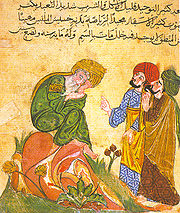 In early Islamic thought, which refers to philosophy during the "Islamic Golden Age
", traditionally dated between the 8th and 12th centuries, two main currents may be distinguished. The first is Kalam
, that mainly dealt with Islamic theological
questions, and the other is Falsafa, that was founded on interpretations of Aristotelianism
and Neoplatonism
. There were attempts by later philosopher-theologians at harmonizing both trends, notably by Ibn Sina (Avicenna)
who founded the school of Avicennism, Ibn Rushd (Averroës)
who founded the school of Averroism
, and others such as Ibn al-Haytham (Alhacen) and Abū Rayhān al-Bīrūnī,
principles through dialectic
. In Arabic
the word literally means "speech".
One of first debates was that between partisan of the Qadar , who affirmed free will
, and the Jabarites (jabar, force, constraint), who believed in fatalism
.
At the second century of the Hijra
, a new movement arose in the theological school of Basra
, Iraq
. A pupil, Wasil ibn Ata
, who was expelled from the school because his answers were contrary to then sunni tradition and became leader of a new school, and systematized the radical opinions of preceding sects, particularly those of the Qadarites and Jabarites. This new school was called Mutazilite (from i'tazala, to separate oneself).
The Mutazilites, compelled to defend their principles against the sunni Islam of their day, looked for support in philosophy
, and are one of the first to pursue a rational theology called Ilm-al-Kalam
(Scholastic theology
); those professing it were called Mutakallamin. This appellation became the common name for all seeking philosophical demonstration in confirmation of religious principles. But subsequent generations were to large extent critical towards the Mutazilite school, especially after formation of the Asharite concepts.
More simply put Kalam means duties of the heart as opposed to (or in conjunction with) fikh duties of the body. Theology verses jurisprudence.
loanword
meaning "philosophy". "Science" is the Latin
word for "philosophy".
(1) Mathematics
(2) Logic
(3) Physics (The object of this science is the study of the bodies which compose the universe: the sky and the stars, and, here below, simple elements such as air, earth, water, fire, and compound bodies animals, plants, and minerals; the reasons of their changes, developments, and intermixture.) also includes medicine.
(4) Metaphysics
(5) Politics
(6) Moral Philosophy (ethics)
From the ninth century onward, owing to Caliph
al-Ma'mun
and his successor, Greek philosophy was introduced among the Arab
s, and the Peripatetic school began to find able representatives among them; such were Al-Kindi
, Al-Farabi
, Ibn Sina (Avicenna)
, and Ibn Rushd (Averroës)
, all of whose fundamental principles were considered as criticized by the Mutakallamin. Another trend, represented by the Brethren of Purity
, used Aristotelian language to expound a fundamentally Neoplatonic
and Neopythagorean
world view.
During the Abbasid caliphate a number of thinkers and scientists, some of them heterodox
Muslims or non-Muslims, played a role in transmitting Greek, Hindu
, and other pre-Islamic knowledge to the Christian
West
. They contributed to making Aristotle
known in Christian Europe
. Three speculative thinkers, al-Farabi
, Ibn Sina (Avicenna)
and al-Kindi
, combined Aristotelianism
and Neoplatonism
with other ideas introduced through Islam.
From Spain
Arabic philosophic literature was translated into Hebrew
and Latin
, contributing to the development of modern European philosophy.
, the set of properties that make matter into a living human body. This seems to imply that the human soul cannot exist apart from the body. Indeed, Aristotle writes, "It is clear that the soul, or at least some parts of it (if it is divisible), cannot be separated from the body. [...] And thus, those have the right idea who think that the soul does not exist without the body." In Aristotelianism, at least one psychological force, the active intellect
, can exist apart from the body. However, according to many interpretations, the active intellect is a superhuman entity emanating from God and enlightening the human mind, not a part of any individual human soul. Thus, Aristotle's theories seem to deny the immortality of the individual human soul.
Wherefore the Mutakallamin had, before anything else, to establish a system of philosophy to demonstrate the creation of matter, and they adopted to that end the theory of atoms as enunciated by Democritus. They taught that atoms possess neither quantity nor extension. Originally atoms were created by God, and are created now as occasion seems to require. Bodies come into existence or die, through the aggregation or the sunderance of these atoms. But this theory did not remove the objections of philosophy to a creation of matter.
For, indeed, if it be supposed that God
commenced His work at a certain definite time by His "will," and for a certain definite object, it must be admitted that He was imperfect before accomplishing His will, or before attaining His object. In order to obviate this difficulty, the Motekallamin extended their theory of the atoms to Time
, and claimed that just as Space
is constituted of atoms and vacuum, Time, likewise, is constituted of small indivisible moments. The creation of the world once established, it was an easy matter for them to demonstrate the existence of a Creator, and that God is unique, omnipotent
, and omniscient
.
(Avempace) and Ibn Rushd (Averroës)
.
Since no idea and no literary or philosophical movement ever germinated on Persian or Arabian soil without leaving its impress on the Jews, the Persian Ghazali found an imitator in the person of Judah ha-Levi. This poet also took upon himself to free his religion from what he saw as the shackles of speculative philosophy, and to this end wrote the "Kuzari," in which he sought to discredit all schools of philosophy alike. He passes severe censure upon the Mutakallamin for seeking to support religion by philosophy. He says, "I consider him to have attained the highest degree of perfection who is convinced of religious truths without having scrutinized them and reasoned over them" ("Kuzari," v.). Then he reduced the chief propositions of the Mutakallamin, to prove the unity of God, to ten in number, describing them at length, and concluding in these terms: "Does the Kalam give us more information concerning God and His attributes than the prophet did?" (Ib. iii. and iv.) Aristotelianism finds no favor in Judah ha-Levi's eyes, for it is no less given to details and criticism; Neoplatonism alone suited him somewhat, owing to its appeal to his poetic temperament.
Ibn Rushd or Ibn Roshd (Averroës)
, the contemporary of Maimonides
, was one of the last of the Islamic Peripatetics. The theories of Ibn Rushd do not differ fundamentally from those of Ibn Bajjah
and Ibn Tufail
, who only follow the teachings of Ibn Sina (Avicenna)
and Al-Farabi
. Like all Islamic Peripatetics, Ibn Rushd admits the hypothesis of the intelligence of the spheres and the hypothesis of universal emanation, through which motion is communicated from place to place to all parts of the universe as far as the supreme world—hypotheses which, in the mind of the Arabic philosophers, did away with the dualism involved in Aristotle's doctrine of pure energy and eternal matter.
But while Al-Farabi
, Ibn Sina (Avicenna)
, and other Persian and Muslim philosophers hurried, so to speak, over subjects that trenched on traditional beliefs, Ibn Rushd delighted in dwelling upon them with full particularity and stress. Thus he says, "Not only is matter eternal, but form is potentially inherent in matter; otherwise, it were a creation ex nihilo" (Munk, "Mélanges," p. 444). According to this theory, therefore, the existence of this world is not only a possibility, as Ibn Sina (Avicenna) declared, but also a necessity.
Islamic philosophy found an audience with the Jews, to whom belongs the honor of having transmitted it to the Christian world. A series of eminent men—such as the Ibn Tibbon
s, Narboni, Gersonides
—joined in translating the Arabic philosophical works into Hebrew and commenting upon them. The works of Ibn Rushd especially became the subject of their study, due in great measure to Maimonides, who, in a letter addressed to his pupil Joseph ben Judah, spoke in the highest terms of Ibn Rushd's commentary.
It should be mentioned that this depiction of intellectual tradition in Islamic Lands is mainly dependent upon what West could understand and received (or was willing to understand) from this long era. In contrast, there are some historians and philosophers who do not agree with this account and describe this era in a completely different way. Their main point of dispute is on the influence of different philosophers on Islamic Philosophy, especially the comparative importance of eastern intellectuals such as Ibn Sina (Avicenna) and of western thinkers such as Ibn Rushd. (For more discussion, refer to the History of Islamic Philosophy by Henry Corbin
.)
(892-942), Emunot ve-Deot
, "The Book of Beliefs and Opinions". In this work Saadia treats the questions that interested the Mutakallamin, such as the creation of matter, the unity of God, the divine attributes, the soul, etc. Saadia criticizes other philosophers severely. For Saadia there was no problem as to creation: God created the world ex nihilo
, just as the Bible
attests; and he contests the theory of the Mutakallamin in reference to atoms, which theory, he declares, is just as contrary to reason and religion as the theory of the philosophers professing the eternity of matter.
To prove the unity of God, Saadia uses the demonstrations of the Mutakallamin. Only the attributes of essence (sifat al-dhatia) can be ascribed to God, but not the attributes of action (sifat-al-fi'aliya). The soul is a substance more delicate even than that of the celestial spheres
. Here Saadia controverts the Mutakallamin, who considered the soul an "accident" arad (compare Guide for the Perplexed
i. 74), and employs the following one of their premises to justify his position: "Only a substance can be the substratum of an accident" (that is, of a non-essential property of things). Saadia argues: "If the soul be an accident only, it can itself have no such accidents as wisdom, joy, love," etc. Saadia was thus in every way a supporter of the Kalam; and if at times he deviated from its doctrines, it was owing to his religious views.
From the ninth century onward, owing to Caliph
al-Ma'mun
and his successor, Greek philosophy was introduced among the Persians
and Arab
s, and the Peripatetic school began to find able representatives among them; such were Al-Kindi
, Farabi, Ibn Sina (Avicenna)
, and Ibn Rushd (Averroës)
, all of whose fundamental principles were considered as criticized by the Mutakallamin. Another trend, represented by the Brethren of Purity
, used Aristotelian language to expound a fundamentally Neoplatonic
and Neopythagorean
world view.
During the Abbasid caliphate a number of thinkers and scientists, some of them heterodox
Muslims or non-Muslims, played a role in transmitting Greek, Hindu
, and other pre-Islamic knowledge to the Christian
West
. They contributed to making Aristotle
known in Christian Europe
. Three speculative thinkers, al-Farabi
, Ibn Sina (Avicenna)
and al-Kindi
, combined Aristotelianism
and Neoplatonism
with other ideas introduced through Islam.
From Spain
Arabic philosophic literature was translated into Hebrew
and Latin
, contributing to the development of modern European philosophy.
effectively marks the end of a particular discipline of Islamic philosophy usually called the Peripatetic Arabic School, and philosophical activity declined significantly in western Islamic countries, namely in Islamic Spain
and North Africa
, though it persisted for much longer in the Eastern countries, in particular Iran
and India
. Contrary to the traditional view, Dimitri Gutas and the Stanford Encyclopedia of Philosophy
consider the period between the 11th and 14th centuries to be the true "Golden Age
" of Arabic and Islamic philosophy, initiated by Al-Ghazali
's successful integration of logic
into the Madrasah
curriculum and the subsequent rise of Avicennism.
Since the political power shift in Western Europe (Spain
and Portugal
) from Muslim to Christian control, the Muslims naturally did not practice philosophy in Western Europe. This also led to some loss of contact between the 'west' and the 'east' of the Islamic world. Muslims in the 'east' continued to do philosophy, as is evident from the works of Ottoman
scholars and especially those living in Muslim kingdoms within the territories of present day Iran and India, such as Shah Waliullah
and Ahmad Sirhindi
. This fact has escaped most pre-modern historians of Islamic (or Arabic) philosophy. In addition, logic has continued to be taught in religious seminaries up to modern times.
After Ibn Rushd, there arose many later schools of Islamic Philosophy. We can mention just a few, such as the those founded by Ibn Arabi
and Mulla Sadra
. These new schools are of particular importance, as they are still active in the Islamic world. The most important among them are:
in the 12th century. This school is a combination of Avicenna
's philosophy and ancient Iranian philosophy
, with many new innovative ideas of Suhrawardi. It is often described as having been influenced by Neoplatonism
.
In logic in Islamic philosophy
, systematic refutations of Greek logic
were written by the Illuminationist school, founded by Shahab al-Din Suhrawardi
(1155-1191), who developed the idea of "decisive necessity
", an important innovation in the history of logic
al philosophical speculation.
is the school of Islamic philosophy founded by Mulla Sadra
in the 17th century. His philosophy and ontology
is considered to be just as important to Islamic philosophy as Martin Heidegger
's philosophy later was to Western philosophy
in the 20th century. Mulla Sadra bought "a new philosophical insight in dealing with the nature of reality
" and created "a major transition from essentialism
to existentialism
" in Islamic philosophy, several centuries before this occurred in Western philosophy.
The idea of "essence precedes existence" is a concept which dates back to Ibn Sina (Avicenna)
and his school of Avicennism as well as Shahab al-Din Suhrawardi
and his Illuminationist philosophy. The opposite idea of "Existence precedes essence
" was thus developed in the works of Averroes
and Mulla Sadra
as a reaction to this idea and is a key foundational concept of existentialism
.
For Mulla Sadra, "existence precedes the essence and is thus principle since something has to exist first and then have an essence." This is primarily the argument that lies at the heart of Mulla Sadra's Transcendent Theosophy
. Sayyid Jalal Ashtiyani later summarized Mulla Sadra's concept as follows:
More careful approaches are needed in terms of thinking about philosophers (and theologians) in Islam in terms of phenomenological methods of investigation in ontology
(or onto-theology), or by way of comparisons that are made with Heidegger's thought and his critique of the history of metaphysics.
's successful integration of logic
into the Madrasah
curriculum in the 11th century led to increased activity in logic, mainly focusing on Avicennian logic.
Ibn Hazm
(994-1064) wrote the Scope of Logic, in which he stressed on the importance of sense
perception
as a source of knowledge. Al-Ghazali
(Algazel) (1058–1111) had an important influence on the use of logic in theology, making use of Avicennian logic in Kalam
.
Fakhr al Din al Razi Amoli
(b. 1149) criticised Aristotle's "first figure
" and developed a form of inductive logic
, foreshadowing the system of inductive logic developed by John Stuart Mill
(1806–1873). Systematic refutations of Greek logic were written by the Illuminationist school, founded by Shahab al-Din Suhrawardi
(1155–1191), who developed the idea of "decisive necessity
", an important innovation in the history of logical philosophical speculation. Another systematic refutation of Greek logic was written by Ibn Taymiyyah (1263–1328), the Ar-Radd 'ala al-Mantiqiyyin (Refutation of Greek Logicians), where he argued against the usefulness, though not the validity, of the syllogism
and in favour of inductive reasoning
.
and the first critiques on historical method
s appeared in the works of the Arab
Ash'ari
polymath Ibn Khaldun
(1332–1406), who is regarded as the father of historiography
, cultural history
, and the philosophy of history
, especially for his historiographical writings in the Muqaddimah
(Latin
ized as Prolegomena) and Kitab al-Ibar (Book of Advice). His Muqaddimah also laid the groundwork for the observation of the role of state
, communication
, propaganda
and systematic bias in history, and he discussed the rise and fall of civilization
s.
Franz Rosenthal
wrote in the History of Muslim Historiography:
polymath Ibn Khaldun
(1332–1406), who was the last major Islamic philosopher from North Africa
. In his Muqaddimah
, he developed the earliest theories on social philosophy, in formulating theories of social cohesion
and social conflict
.
His Muqaddimah was also the introduction to a seven volume analysis of universal history
. He is considered the "father of sociology
", "father of historiography
", and "father of the philosophy of history
", for being the first to discuss the topics of sociology, historiography and the philosophy of history in detail.
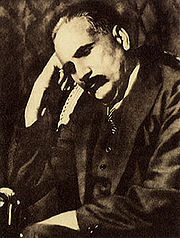 The tradition of Islamic Philosophy is still very much alive today despite the belief in many Western circles that this tradition ceased after the golden ages of Suhrawardi
's Hikmat al-Ishraq (Illumination Philosophy) or, at the latest, Mulla Sadra
's Hikmat-e-Mota'aliye or Transcendent (Exalted) Philosophy. Another unavoidable name is Allama Muhammad Iqbal who reshaped and revitalized Islamic philosophy amongst the Muslims of the Indian sub-continent in the early 20th century http://www.allamaiqbal.com/. Beside his Urdu
and Persian
poetical work, The Reconstruction of Religious Thought in Islam
http://www.allamaiqbal.com/works/prose/english/reconstruction/ is a milestone in the modern political philosophy of Islam.
In contemporary Islamic Lands, the teaching of hikmat or hikmah
has continued and flourished.
, for whom the Hanbali
school of thought is named, rebuked philosophical discussion, once telling proponents of it that he was secure in his religion, but that they were "in doubt, so go to a doubter and argue with him (instead)." Today, Islamic philosophical thought has also been criticized by scholars of the modern Salafi
movement.
There would be many Islamic thinkers who were not as enthusiastic about its potential. But it would be incorrect to assume that they opposed philosophy simply because it was a "foreign science". Oliver Leaman
, an expert on Islamic philosophy, points out that the objections of notable theologians are rarely directed at philosophy itself, but rather at the conclusions the philosophers arrived at. Even al-Ghazali
, who is famous for his critique of the philosophers, was himself an expert in philosophy and logic
. And his criticism was that they arrived at theologically erroneous conclusions. The three most serious of these, in his view, were believing in the co-eternity of the universe with God, denying the bodily resurrection, and asserting that God only has knowledge of abstract universals, not of particular things (but it should be noted that not all philosophers subscribed to these same views).
In recent studies by Muslim contemporary thinkers that aim at 'renewing the impetus of philosophical thinking in Islam', Nader El-Bizri
offers a critical analysis of the conventions of methodology and historiography that dominate the mainstream academic and epistemic approaches in studying 'Islamic philosophy' from 'archival' standpoints, within Oriental and Mediaevalist Studies, which fail to recognize the fact that 'philosophy in Islam' can still be a living intellectual tradition, and that its renewal requires a radical reform in ontology
and epistemology within Islamic thought.
Islamic studies
In a Muslim context, Islamic studies can be an umbrella term for all virtually all of academia, both originally researched and as defined by the Islamization of knowledge...
. It is the continuous search for Hekma (Wisdom) in the light of Islamic view of life, universe, ethics, society, and so on. Islamic philosophy, understood as a "project of independent philosophical inquiry" began in Baghdad in the middle of the eighth century.
Introduction
Islamic philosophy refers to philosophy produced in an Islamic society. It is not necessarily concerned with religious issues, nor exclusively produced by MuslimMuslim
A Muslim, also spelled Moslem, is an adherent of Islam, a monotheistic, Abrahamic religion based on the Quran, which Muslims consider the verbatim word of God as revealed to prophet Muhammad. "Muslim" is the Arabic term for "submitter" .Muslims believe that God is one and incomparable...
s. [Oliver Leaman, Routledge Encyclopedia of Philosophy]
Formative influences
Islamic philosophy as the name implies refers to philosophical activity within the Islamic milieu. The main sources of classical or early Islamic philosophy are the religion of Islam itself (especially ideas derived and interpreted from the Quran), Greek philosophyGreek philosophy
Ancient Greek philosophy arose in the 6th century BCE and continued through the Hellenistic period, at which point Ancient Greece was incorporated in the Roman Empire...
which the early Muslims inherited as a result of conquests when Alexandria, Syria and Jundishapur
Academy of Gundishapur
The Academy of Gondishapur , also Jondishapur , was a renowned academy of learning in the city of Gundeshapur during late antiquity, the intellectual center of the Sassanid empire. It offered training in medicine, philosophy, theology and science. The faculty were versed in the Zoroastrian and...
came under Muslim rule, along with pre-Islamic Indian philosophy
Indian philosophy
India has a rich and diverse philosophical tradition dating back to ancient times. According to Radhakrishnan, the earlier Upanisads constitute "...the earliest philosophical compositions of the world."...
and Iranian philosophy
Iranian philosophy
Iranian philosophy or Persian philosophy can be traced back as far as to Old Iranian philosophical traditions and thoughts which originated in ancient Indo-Iranian roots and were considerably influenced by Zarathustra's teachings...
. Many of the early philosophical debates centered around reconciling religion and reason, the latter exemplified by Greek philosophy. One aspect which stands out in Islamic philosophy is that, the philosophy in Islam travels wide but comes back to conform it with the Quran and Sunna.
Early Islamic philosophy
Islamic Golden Age
During the Islamic Golden Age philosophers, scientists and engineers of the Islamic world contributed enormously to technology and culture, both by preserving earlier traditions and by adding their own inventions and innovations...
", traditionally dated between the 8th and 12th centuries, two main currents may be distinguished. The first is Kalam
Kalam
ʿIlm al-Kalām is the Islamic philosophical discipline of seeking theological principles through dialectic. Kalām in Islamic practice relates to the discipline of seeking theological knowledge through debate and argument. A scholar of kalām is referred to as a mutakallim...
, that mainly dealt with Islamic theological
Islamic theology
Islamic theology is a branch of Islamic studies regarding the beliefs associated with the Islamic faith. Any religious belief system, or creed, can be considered an example of aqidah. However, this term has taken a significant technical usage in Islamic history and theology, denoting those...
questions, and the other is Falsafa, that was founded on interpretations of Aristotelianism
Aristotelianism
Aristotelianism is a tradition of philosophy that takes its defining inspiration from the work of Aristotle. The works of Aristotle were initially defended by the members of the Peripatetic school, and, later on, by the Neoplatonists, who produced many commentaries on Aristotle's writings...
and Neoplatonism
Neoplatonism
Neoplatonism , is the modern term for a school of religious and mystical philosophy that took shape in the 3rd century AD, based on the teachings of Plato and earlier Platonists, with its earliest contributor believed to be Plotinus, and his teacher Ammonius Saccas...
. There were attempts by later philosopher-theologians at harmonizing both trends, notably by Ibn Sina (Avicenna)
Avicenna
Abū ʿAlī al-Ḥusayn ibn ʿAbd Allāh ibn Sīnā , commonly known as Ibn Sīnā or by his Latinized name Avicenna, was a Persian polymath, who wrote almost 450 treatises on a wide range of subjects, of which around 240 have survived...
who founded the school of Avicennism, Ibn Rushd (Averroës)
Averroes
' , better known just as Ibn Rushd , and in European literature as Averroes , was a Muslim polymath; a master of Aristotelian philosophy, Islamic philosophy, Islamic theology, Maliki law and jurisprudence, logic, psychology, politics, Arabic music theory, and the sciences of medicine, astronomy,...
who founded the school of Averroism
Averroism
Averroism is the term applied to either of two philosophical trends among scholastics in the late 13th century: the Arab philosopher Averroës or Ibn Rushd's interpretations of Aristotle and his reconciliation of Aristotelianism with Islamic faith; and the application of these ideas in the Latin...
, and others such as Ibn al-Haytham (Alhacen) and Abū Rayhān al-Bīrūnī,
Kalam
Kalām is the philosophy that seeks Islamic theologicalIslamic theology
Islamic theology is a branch of Islamic studies regarding the beliefs associated with the Islamic faith. Any religious belief system, or creed, can be considered an example of aqidah. However, this term has taken a significant technical usage in Islamic history and theology, denoting those...
principles through dialectic
Dialectic
Dialectic is a method of argument for resolving disagreement that has been central to Indic and European philosophy since antiquity. The word dialectic originated in Ancient Greece, and was made popular by Plato in the Socratic dialogues...
. In Arabic
Arabic language
Arabic is a name applied to the descendants of the Classical Arabic language of the 6th century AD, used most prominently in the Quran, the Islamic Holy Book...
the word literally means "speech".
One of first debates was that between partisan of the Qadar , who affirmed free will
Free will
"To make my own decisions whether I am successful or not due to uncontrollable forces" -Troy MorrisonA pragmatic definition of free willFree will is the ability of agents to make choices free from certain kinds of constraints. The existence of free will and its exact nature and definition have long...
, and the Jabarites (jabar, force, constraint), who believed in fatalism
Fatalism
Fatalism is a philosophical doctrine emphasizing the subjugation of all events or actions to fate.Fatalism generally refers to several of the following ideas:...
.
At the second century of the Hijra
Hijri year
The Hijri year is year numbering system used in the Islamic calendar. It commemorates the Hijra , or emigration of Muhammad and his followers to the city of Medina in 622 CE. In Arabic, AH is symbolized by the letter هـ...
, a new movement arose in the theological school of Basra
Basra
Basra is the capital of Basra Governorate, in southern Iraq near Kuwait and Iran. It had an estimated population of two million as of 2009...
, Iraq
Iraq
Iraq ; officially the Republic of Iraq is a country in Western Asia spanning most of the northwestern end of the Zagros mountain range, the eastern part of the Syrian Desert and the northern part of the Arabian Desert....
. A pupil, Wasil ibn Ata
Wasil ibn Ata
Wasil ibn Ata was an important Muslim theologian and jurist of his time, and by many accounts is considered to be the founder of the Mutazilite school of Islamic thought....
, who was expelled from the school because his answers were contrary to then sunni tradition and became leader of a new school, and systematized the radical opinions of preceding sects, particularly those of the Qadarites and Jabarites. This new school was called Mutazilite (from i'tazala, to separate oneself).
The Mutazilites, compelled to defend their principles against the sunni Islam of their day, looked for support in philosophy
Philosophy
Philosophy is the study of general and fundamental problems, such as those connected with existence, knowledge, values, reason, mind, and language. Philosophy is distinguished from other ways of addressing such problems by its critical, generally systematic approach and its reliance on rational...
, and are one of the first to pursue a rational theology called Ilm-al-Kalam
Kalam
ʿIlm al-Kalām is the Islamic philosophical discipline of seeking theological principles through dialectic. Kalām in Islamic practice relates to the discipline of seeking theological knowledge through debate and argument. A scholar of kalām is referred to as a mutakallim...
(Scholastic theology
Scholasticism
Scholasticism is a method of critical thought which dominated teaching by the academics of medieval universities in Europe from about 1100–1500, and a program of employing that method in articulating and defending orthodoxy in an increasingly pluralistic context...
); those professing it were called Mutakallamin. This appellation became the common name for all seeking philosophical demonstration in confirmation of religious principles. But subsequent generations were to large extent critical towards the Mutazilite school, especially after formation of the Asharite concepts.
More simply put Kalam means duties of the heart as opposed to (or in conjunction with) fikh duties of the body. Theology verses jurisprudence.
Falsafa
Falsafa is a GreekGreek language
Greek is an independent branch of the Indo-European family of languages. Native to the southern Balkans, it has the longest documented history of any Indo-European language, spanning 34 centuries of written records. Its writing system has been the Greek alphabet for the majority of its history;...
loanword
Loanword
A loanword is a word borrowed from a donor language and incorporated into a recipient language. By contrast, a calque or loan translation is a related concept where the meaning or idiom is borrowed rather than the lexical item itself. The word loanword is itself a calque of the German Lehnwort,...
meaning "philosophy". "Science" is the Latin
Latin
Latin is an Italic language originally spoken in Latium and Ancient Rome. It, along with most European languages, is a descendant of the ancient Proto-Indo-European language. Although it is considered a dead language, a number of scholars and members of the Christian clergy speak it fluently, and...
word for "philosophy".
Divisions of the Philosophic Sciences
These sciences, in relation to the aim we have set before us, may be divided into six, sections:(1) Mathematics
(2) Logic
(3) Physics (The object of this science is the study of the bodies which compose the universe: the sky and the stars, and, here below, simple elements such as air, earth, water, fire, and compound bodies animals, plants, and minerals; the reasons of their changes, developments, and intermixture.) also includes medicine.
(4) Metaphysics
(5) Politics
(6) Moral Philosophy (ethics)
From the ninth century onward, owing to Caliph
Caliph
The Caliph is the head of state in a Caliphate, and the title for the ruler of the Islamic Ummah, an Islamic community ruled by the Shari'ah. It is a transcribed version of the Arabic word which means "successor" or "representative"...
al-Ma'mun
Al-Ma'mun
Abū Jaʿfar Abdullāh al-Māʾmūn ibn Harūn was an Abbasid caliph who reigned from 813 until his death in 833...
and his successor, Greek philosophy was introduced among the Arab
Arab
Arab people, also known as Arabs , are a panethnicity primarily living in the Arab world, which is located in Western Asia and North Africa. They are identified as such on one or more of genealogical, linguistic, or cultural grounds, with tribal affiliations, and intra-tribal relationships playing...
s, and the Peripatetic school began to find able representatives among them; such were Al-Kindi
Al-Kindi
' , known as "the Philosopher of the Arabs", was a Muslim Arab philosopher, mathematician, physician, and musician. Al-Kindi was the first of the Muslim peripatetic philosophers, and is unanimously hailed as the "father of Islamic or Arabic philosophy" for his synthesis, adaptation and promotion...
, Al-Farabi
Al-Farabi
' known in the West as Alpharabius , was a scientist and philosopher of the Islamic world...
, Ibn Sina (Avicenna)
Avicenna
Abū ʿAlī al-Ḥusayn ibn ʿAbd Allāh ibn Sīnā , commonly known as Ibn Sīnā or by his Latinized name Avicenna, was a Persian polymath, who wrote almost 450 treatises on a wide range of subjects, of which around 240 have survived...
, and Ibn Rushd (Averroës)
Averroes
' , better known just as Ibn Rushd , and in European literature as Averroes , was a Muslim polymath; a master of Aristotelian philosophy, Islamic philosophy, Islamic theology, Maliki law and jurisprudence, logic, psychology, politics, Arabic music theory, and the sciences of medicine, astronomy,...
, all of whose fundamental principles were considered as criticized by the Mutakallamin. Another trend, represented by the Brethren of Purity
Brethren of Purity
The Brethren of Purity were a secret society of Muslim philosophers in Basra, Iraq, in the 10th century CE....
, used Aristotelian language to expound a fundamentally Neoplatonic
Neoplatonism
Neoplatonism , is the modern term for a school of religious and mystical philosophy that took shape in the 3rd century AD, based on the teachings of Plato and earlier Platonists, with its earliest contributor believed to be Plotinus, and his teacher Ammonius Saccas...
and Neopythagorean
Neopythagoreanism
Neopythagoreanism was a Graeco-Alexandrian school of philosophy, reviving Pythagorean doctrines, which became prominent in the 1st and 2nd centuries CE...
world view.
During the Abbasid caliphate a number of thinkers and scientists, some of them heterodox
Heterodoxy
Heterodoxy is generally defined as "any opinions or doctrines at variance with an official or orthodox position". As an adjective, heterodox is commonly used to describe a subject as "characterized by departure from accepted beliefs or standards"...
Muslims or non-Muslims, played a role in transmitting Greek, Hindu
Hindu
Hindu refers to an identity associated with the philosophical, religious and cultural systems that are indigenous to the Indian subcontinent. As used in the Constitution of India, the word "Hindu" is also attributed to all persons professing any Indian religion...
, and other pre-Islamic knowledge to the Christian
Christian
A Christian is a person who adheres to Christianity, an Abrahamic, monotheistic religion based on the life and teachings of Jesus of Nazareth as recorded in the Canonical gospels and the letters of the New Testament...
West
Western world
The Western world, also known as the West and the Occident , is a term referring to the countries of Western Europe , the countries of the Americas, as well all countries of Northern and Central Europe, Australia and New Zealand...
. They contributed to making Aristotle
Aristotle
Aristotle was a Greek philosopher and polymath, a student of Plato and teacher of Alexander the Great. His writings cover many subjects, including physics, metaphysics, poetry, theater, music, logic, rhetoric, linguistics, politics, government, ethics, biology, and zoology...
known in Christian Europe
Europe
Europe is, by convention, one of the world's seven continents. Comprising the westernmost peninsula of Eurasia, Europe is generally 'divided' from Asia to its east by the watershed divides of the Ural and Caucasus Mountains, the Ural River, the Caspian and Black Seas, and the waterways connecting...
. Three speculative thinkers, al-Farabi
Al-Farabi
' known in the West as Alpharabius , was a scientist and philosopher of the Islamic world...
, Ibn Sina (Avicenna)
Avicenna
Abū ʿAlī al-Ḥusayn ibn ʿAbd Allāh ibn Sīnā , commonly known as Ibn Sīnā or by his Latinized name Avicenna, was a Persian polymath, who wrote almost 450 treatises on a wide range of subjects, of which around 240 have survived...
and al-Kindi
Al-Kindi
' , known as "the Philosopher of the Arabs", was a Muslim Arab philosopher, mathematician, physician, and musician. Al-Kindi was the first of the Muslim peripatetic philosophers, and is unanimously hailed as the "father of Islamic or Arabic philosophy" for his synthesis, adaptation and promotion...
, combined Aristotelianism
Aristotelianism
Aristotelianism is a tradition of philosophy that takes its defining inspiration from the work of Aristotle. The works of Aristotle were initially defended by the members of the Peripatetic school, and, later on, by the Neoplatonists, who produced many commentaries on Aristotle's writings...
and Neoplatonism
Neoplatonism
Neoplatonism , is the modern term for a school of religious and mystical philosophy that took shape in the 3rd century AD, based on the teachings of Plato and earlier Platonists, with its earliest contributor believed to be Plotinus, and his teacher Ammonius Saccas...
with other ideas introduced through Islam.
From Spain
Spain
Spain , officially the Kingdom of Spain languages]] under the European Charter for Regional or Minority Languages. In each of these, Spain's official name is as follows:;;;;;;), is a country and member state of the European Union located in southwestern Europe on the Iberian Peninsula...
Arabic philosophic literature was translated into Hebrew
Hebrew language
Hebrew is a Semitic language of the Afroasiatic language family. Culturally, is it considered by Jews and other religious groups as the language of the Jewish people, though other Jewish languages had originated among diaspora Jews, and the Hebrew language is also used by non-Jewish groups, such...
and Latin
Latin
Latin is an Italic language originally spoken in Latium and Ancient Rome. It, along with most European languages, is a descendant of the ancient Proto-Indo-European language. Although it is considered a dead language, a number of scholars and members of the Christian clergy speak it fluently, and...
, contributing to the development of modern European philosophy.
Some differences between Kalam and Falsafa
Aristotle attempted to demonstrate the unity of God; but from the view which he maintained, that matter was eternal, it followed that God could not be the Creator of the world. According to Aristotelianism, the human soul is simply man's substantial formSubstantial form
A theory of substantial forms asserts that forms organize matter and make it intelligible. Substantial forms are the source of properties, order, unity, identity, and information about objects....
, the set of properties that make matter into a living human body. This seems to imply that the human soul cannot exist apart from the body. Indeed, Aristotle writes, "It is clear that the soul, or at least some parts of it (if it is divisible), cannot be separated from the body. [...] And thus, those have the right idea who think that the soul does not exist without the body." In Aristotelianism, at least one psychological force, the active intellect
Active intellect
The active intellect is a concept in classical and medieval philosophy...
, can exist apart from the body. However, according to many interpretations, the active intellect is a superhuman entity emanating from God and enlightening the human mind, not a part of any individual human soul. Thus, Aristotle's theories seem to deny the immortality of the individual human soul.
Wherefore the Mutakallamin had, before anything else, to establish a system of philosophy to demonstrate the creation of matter, and they adopted to that end the theory of atoms as enunciated by Democritus. They taught that atoms possess neither quantity nor extension. Originally atoms were created by God, and are created now as occasion seems to require. Bodies come into existence or die, through the aggregation or the sunderance of these atoms. But this theory did not remove the objections of philosophy to a creation of matter.
For, indeed, if it be supposed that God
God
God is the English name given to a singular being in theistic and deistic religions who is either the sole deity in monotheism, or a single deity in polytheism....
commenced His work at a certain definite time by His "will," and for a certain definite object, it must be admitted that He was imperfect before accomplishing His will, or before attaining His object. In order to obviate this difficulty, the Motekallamin extended their theory of the atoms to Time
Time
Time is a part of the measuring system used to sequence events, to compare the durations of events and the intervals between them, and to quantify rates of change such as the motions of objects....
, and claimed that just as Space
Space
Space is the boundless, three-dimensional extent in which objects and events occur and have relative position and direction. Physical space is often conceived in three linear dimensions, although modern physicists usually consider it, with time, to be part of a boundless four-dimensional continuum...
is constituted of atoms and vacuum, Time, likewise, is constituted of small indivisible moments. The creation of the world once established, it was an easy matter for them to demonstrate the existence of a Creator, and that God is unique, omnipotent
Omnipotence
Omnipotence is unlimited power. Monotheistic religions generally attribute omnipotence to only the deity of whichever faith is being addressed...
, and omniscient
Omniscience
Omniscience omniscient point-of-view in writing) is the capacity to know everything infinitely, or at least everything that can be known about a character including thoughts, feelings, life and the universe, etc. In Latin, omnis means "all" and sciens means "knowing"...
.
Main protagonists of Falsafa and their critics
The twelfth century saw the apotheosis of pure philosophy and the decline of the Kalam, which latter, being attacked by both the philosophers and the orthodox, perished for lack of champions. This supreme exaltation of philosophy may be attributed, in great measure, to Al-Ghazali (1005–1111) among the Persians, and to Judah ha-Levi (1140) among the Jews. It can be argued that the attacks directed against the philosophers by Ghazali in his work, "Tahafut al-Falasifa" (The Incoherence of the Philosophers), not only produced, by reaction, a current favorable to philosophy, but induced the philosophers themselves to profit by his criticism. They thereafter made their theories clearer and their logic closer. The influence of this reaction brought forth the two greatest philosophers that the Islamic Peripatetic school ever produced, namely, Ibn BajjahIbn Bajjah
Abū-Bakr Muhammad ibn Yahya ibn al-Sāyigh , known as Ibn Bājjah , was an Andalusian polymath: an astronomer, logician, musician, philosopher, physician, physicist, psychologist, botanist, poet and scientist. He was known in the West by his Latinized name, Avempace...
(Avempace) and Ibn Rushd (Averroës)
Averroes
' , better known just as Ibn Rushd , and in European literature as Averroes , was a Muslim polymath; a master of Aristotelian philosophy, Islamic philosophy, Islamic theology, Maliki law and jurisprudence, logic, psychology, politics, Arabic music theory, and the sciences of medicine, astronomy,...
.
Since no idea and no literary or philosophical movement ever germinated on Persian or Arabian soil without leaving its impress on the Jews, the Persian Ghazali found an imitator in the person of Judah ha-Levi. This poet also took upon himself to free his religion from what he saw as the shackles of speculative philosophy, and to this end wrote the "Kuzari," in which he sought to discredit all schools of philosophy alike. He passes severe censure upon the Mutakallamin for seeking to support religion by philosophy. He says, "I consider him to have attained the highest degree of perfection who is convinced of religious truths without having scrutinized them and reasoned over them" ("Kuzari," v.). Then he reduced the chief propositions of the Mutakallamin, to prove the unity of God, to ten in number, describing them at length, and concluding in these terms: "Does the Kalam give us more information concerning God and His attributes than the prophet did?" (Ib. iii. and iv.) Aristotelianism finds no favor in Judah ha-Levi's eyes, for it is no less given to details and criticism; Neoplatonism alone suited him somewhat, owing to its appeal to his poetic temperament.
Ibn Rushd or Ibn Roshd (Averroës)
Averroes
' , better known just as Ibn Rushd , and in European literature as Averroes , was a Muslim polymath; a master of Aristotelian philosophy, Islamic philosophy, Islamic theology, Maliki law and jurisprudence, logic, psychology, politics, Arabic music theory, and the sciences of medicine, astronomy,...
, the contemporary of Maimonides
Maimonides
Moses ben-Maimon, called Maimonides and also known as Mūsā ibn Maymūn in Arabic, or Rambam , was a preeminent medieval Jewish philosopher and one of the greatest Torah scholars and physicians of the Middle Ages...
, was one of the last of the Islamic Peripatetics. The theories of Ibn Rushd do not differ fundamentally from those of Ibn Bajjah
Ibn Bajjah
Abū-Bakr Muhammad ibn Yahya ibn al-Sāyigh , known as Ibn Bājjah , was an Andalusian polymath: an astronomer, logician, musician, philosopher, physician, physicist, psychologist, botanist, poet and scientist. He was known in the West by his Latinized name, Avempace...
and Ibn Tufail
Ibn Tufail
Ibn Tufail was an Andalusian Muslim polymath: an Arabic writer, novelist, Islamic philosopher, Islamic theologian, physician, vizier,...
, who only follow the teachings of Ibn Sina (Avicenna)
Avicenna
Abū ʿAlī al-Ḥusayn ibn ʿAbd Allāh ibn Sīnā , commonly known as Ibn Sīnā or by his Latinized name Avicenna, was a Persian polymath, who wrote almost 450 treatises on a wide range of subjects, of which around 240 have survived...
and Al-Farabi
Al-Farabi
' known in the West as Alpharabius , was a scientist and philosopher of the Islamic world...
. Like all Islamic Peripatetics, Ibn Rushd admits the hypothesis of the intelligence of the spheres and the hypothesis of universal emanation, through which motion is communicated from place to place to all parts of the universe as far as the supreme world—hypotheses which, in the mind of the Arabic philosophers, did away with the dualism involved in Aristotle's doctrine of pure energy and eternal matter.
But while Al-Farabi
Al-Farabi
' known in the West as Alpharabius , was a scientist and philosopher of the Islamic world...
, Ibn Sina (Avicenna)
Avicenna
Abū ʿAlī al-Ḥusayn ibn ʿAbd Allāh ibn Sīnā , commonly known as Ibn Sīnā or by his Latinized name Avicenna, was a Persian polymath, who wrote almost 450 treatises on a wide range of subjects, of which around 240 have survived...
, and other Persian and Muslim philosophers hurried, so to speak, over subjects that trenched on traditional beliefs, Ibn Rushd delighted in dwelling upon them with full particularity and stress. Thus he says, "Not only is matter eternal, but form is potentially inherent in matter; otherwise, it were a creation ex nihilo" (Munk, "Mélanges," p. 444). According to this theory, therefore, the existence of this world is not only a possibility, as Ibn Sina (Avicenna) declared, but also a necessity.
Islamic philosophy found an audience with the Jews, to whom belongs the honor of having transmitted it to the Christian world. A series of eminent men—such as the Ibn Tibbon
Ibn Tibbon
Ibn Tibbon , is a family of Jewish rabbis and translators that lived principally in Provence in the 12th and 13th centuries.- Prominent family members :Prominent members of the family include:...
s, Narboni, Gersonides
Gersonides
Levi ben Gershon, better known by his Latinised name as Gersonides or the abbreviation of first letters as RaLBaG , philosopher, Talmudist, mathematician, astronomer/astrologer. He was born at Bagnols in Languedoc, France...
—joined in translating the Arabic philosophical works into Hebrew and commenting upon them. The works of Ibn Rushd especially became the subject of their study, due in great measure to Maimonides, who, in a letter addressed to his pupil Joseph ben Judah, spoke in the highest terms of Ibn Rushd's commentary.
It should be mentioned that this depiction of intellectual tradition in Islamic Lands is mainly dependent upon what West could understand and received (or was willing to understand) from this long era. In contrast, there are some historians and philosophers who do not agree with this account and describe this era in a completely different way. Their main point of dispute is on the influence of different philosophers on Islamic Philosophy, especially the comparative importance of eastern intellectuals such as Ibn Sina (Avicenna) and of western thinkers such as Ibn Rushd. (For more discussion, refer to the History of Islamic Philosophy by Henry Corbin
Henry Corbin
Henry Corbin was a philosopher, theologian and professor of Islamic Studies at the Sorbonne in Paris, France.Corbin was born in Paris in April 1903. As a boy he revealed the profound sensitivity to music so evident in his work...
.)
Judeo-Islamic philosophies
The oldest Jewish religio-philosophical work preserved in Arabic is that of Saadia GaonSaadia Gaon
Saʻadiah ben Yosef Gaon was a prominent rabbi, Jewish philosopher, and exegete of the Geonic period.The first important rabbinic figure to write extensively in Arabic, he is considered the founder of Judeo-Arabic literature...
(892-942), Emunot ve-Deot
Emunoth ve-Deoth
Emunoth ve-Deoth or Emunoth w'D'oth written by Rabbi Saadia Gaon - originally Kitāb ul-ʾamānāt wal-iʿtiqādāt - was the first systematic presentation and philosophic foundation of the dogmas of Judaism. The work is prefaced by an introduction and has ten chapters; it was completed in 933...
, "The Book of Beliefs and Opinions". In this work Saadia treats the questions that interested the Mutakallamin, such as the creation of matter, the unity of God, the divine attributes, the soul, etc. Saadia criticizes other philosophers severely. For Saadia there was no problem as to creation: God created the world ex nihilo
Ex nihilo
Ex nihilo is a Latin phrase meaning "out of nothing". It often appears in conjunction with the concept of creation, as in creatio ex nihilo, meaning "creation out of nothing"—chiefly in philosophical or theological contexts, but also occurs in other fields.In theology, the common phrase creatio ex...
, just as the Bible
Bible
The Bible refers to any one of the collections of the primary religious texts of Judaism and Christianity. There is no common version of the Bible, as the individual books , their contents and their order vary among denominations...
attests; and he contests the theory of the Mutakallamin in reference to atoms, which theory, he declares, is just as contrary to reason and religion as the theory of the philosophers professing the eternity of matter.
To prove the unity of God, Saadia uses the demonstrations of the Mutakallamin. Only the attributes of essence (sifat al-dhatia) can be ascribed to God, but not the attributes of action (sifat-al-fi'aliya). The soul is a substance more delicate even than that of the celestial spheres
Celestial spheres
The celestial spheres, or celestial orbs, were the fundamental entities of the cosmological models developed by Plato, Eudoxus, Aristotle, Ptolemy, Copernicus and others...
. Here Saadia controverts the Mutakallamin, who considered the soul an "accident" arad (compare Guide for the Perplexed
Guide for the Perplexed
The Guide for the Perplexed is one of the major works of Rabbi Moshe ben Maimon, better known as Maimonides or "the Rambam"...
i. 74), and employs the following one of their premises to justify his position: "Only a substance can be the substratum of an accident" (that is, of a non-essential property of things). Saadia argues: "If the soul be an accident only, it can itself have no such accidents as wisdom, joy, love," etc. Saadia was thus in every way a supporter of the Kalam; and if at times he deviated from its doctrines, it was owing to his religious views.
From the ninth century onward, owing to Caliph
Caliph
The Caliph is the head of state in a Caliphate, and the title for the ruler of the Islamic Ummah, an Islamic community ruled by the Shari'ah. It is a transcribed version of the Arabic word which means "successor" or "representative"...
al-Ma'mun
Al-Ma'mun
Abū Jaʿfar Abdullāh al-Māʾmūn ibn Harūn was an Abbasid caliph who reigned from 813 until his death in 833...
and his successor, Greek philosophy was introduced among the Persians
Persian people
The Persian people are part of the Iranian peoples who speak the modern Persian language and closely akin Iranian dialects and languages. The origin of the ethnic Iranian/Persian peoples are traced to the Ancient Iranian peoples, who were part of the ancient Indo-Iranians and themselves part of...
and Arab
Arab
Arab people, also known as Arabs , are a panethnicity primarily living in the Arab world, which is located in Western Asia and North Africa. They are identified as such on one or more of genealogical, linguistic, or cultural grounds, with tribal affiliations, and intra-tribal relationships playing...
s, and the Peripatetic school began to find able representatives among them; such were Al-Kindi
Al-Kindi
' , known as "the Philosopher of the Arabs", was a Muslim Arab philosopher, mathematician, physician, and musician. Al-Kindi was the first of the Muslim peripatetic philosophers, and is unanimously hailed as the "father of Islamic or Arabic philosophy" for his synthesis, adaptation and promotion...
, Farabi, Ibn Sina (Avicenna)
Avicenna
Abū ʿAlī al-Ḥusayn ibn ʿAbd Allāh ibn Sīnā , commonly known as Ibn Sīnā or by his Latinized name Avicenna, was a Persian polymath, who wrote almost 450 treatises on a wide range of subjects, of which around 240 have survived...
, and Ibn Rushd (Averroës)
Averroes
' , better known just as Ibn Rushd , and in European literature as Averroes , was a Muslim polymath; a master of Aristotelian philosophy, Islamic philosophy, Islamic theology, Maliki law and jurisprudence, logic, psychology, politics, Arabic music theory, and the sciences of medicine, astronomy,...
, all of whose fundamental principles were considered as criticized by the Mutakallamin. Another trend, represented by the Brethren of Purity
Brethren of Purity
The Brethren of Purity were a secret society of Muslim philosophers in Basra, Iraq, in the 10th century CE....
, used Aristotelian language to expound a fundamentally Neoplatonic
Neoplatonism
Neoplatonism , is the modern term for a school of religious and mystical philosophy that took shape in the 3rd century AD, based on the teachings of Plato and earlier Platonists, with its earliest contributor believed to be Plotinus, and his teacher Ammonius Saccas...
and Neopythagorean
Neopythagoreanism
Neopythagoreanism was a Graeco-Alexandrian school of philosophy, reviving Pythagorean doctrines, which became prominent in the 1st and 2nd centuries CE...
world view.
During the Abbasid caliphate a number of thinkers and scientists, some of them heterodox
Heterodoxy
Heterodoxy is generally defined as "any opinions or doctrines at variance with an official or orthodox position". As an adjective, heterodox is commonly used to describe a subject as "characterized by departure from accepted beliefs or standards"...
Muslims or non-Muslims, played a role in transmitting Greek, Hindu
Hindu
Hindu refers to an identity associated with the philosophical, religious and cultural systems that are indigenous to the Indian subcontinent. As used in the Constitution of India, the word "Hindu" is also attributed to all persons professing any Indian religion...
, and other pre-Islamic knowledge to the Christian
Christian
A Christian is a person who adheres to Christianity, an Abrahamic, monotheistic religion based on the life and teachings of Jesus of Nazareth as recorded in the Canonical gospels and the letters of the New Testament...
West
Western world
The Western world, also known as the West and the Occident , is a term referring to the countries of Western Europe , the countries of the Americas, as well all countries of Northern and Central Europe, Australia and New Zealand...
. They contributed to making Aristotle
Aristotle
Aristotle was a Greek philosopher and polymath, a student of Plato and teacher of Alexander the Great. His writings cover many subjects, including physics, metaphysics, poetry, theater, music, logic, rhetoric, linguistics, politics, government, ethics, biology, and zoology...
known in Christian Europe
Europe
Europe is, by convention, one of the world's seven continents. Comprising the westernmost peninsula of Eurasia, Europe is generally 'divided' from Asia to its east by the watershed divides of the Ural and Caucasus Mountains, the Ural River, the Caspian and Black Seas, and the waterways connecting...
. Three speculative thinkers, al-Farabi
Al-Farabi
' known in the West as Alpharabius , was a scientist and philosopher of the Islamic world...
, Ibn Sina (Avicenna)
Avicenna
Abū ʿAlī al-Ḥusayn ibn ʿAbd Allāh ibn Sīnā , commonly known as Ibn Sīnā or by his Latinized name Avicenna, was a Persian polymath, who wrote almost 450 treatises on a wide range of subjects, of which around 240 have survived...
and al-Kindi
Al-Kindi
' , known as "the Philosopher of the Arabs", was a Muslim Arab philosopher, mathematician, physician, and musician. Al-Kindi was the first of the Muslim peripatetic philosophers, and is unanimously hailed as the "father of Islamic or Arabic philosophy" for his synthesis, adaptation and promotion...
, combined Aristotelianism
Aristotelianism
Aristotelianism is a tradition of philosophy that takes its defining inspiration from the work of Aristotle. The works of Aristotle were initially defended by the members of the Peripatetic school, and, later on, by the Neoplatonists, who produced many commentaries on Aristotle's writings...
and Neoplatonism
Neoplatonism
Neoplatonism , is the modern term for a school of religious and mystical philosophy that took shape in the 3rd century AD, based on the teachings of Plato and earlier Platonists, with its earliest contributor believed to be Plotinus, and his teacher Ammonius Saccas...
with other ideas introduced through Islam.
From Spain
Spain
Spain , officially the Kingdom of Spain languages]] under the European Charter for Regional or Minority Languages. In each of these, Spain's official name is as follows:;;;;;;), is a country and member state of the European Union located in southwestern Europe on the Iberian Peninsula...
Arabic philosophic literature was translated into Hebrew
Hebrew language
Hebrew is a Semitic language of the Afroasiatic language family. Culturally, is it considered by Jews and other religious groups as the language of the Jewish people, though other Jewish languages had originated among diaspora Jews, and the Hebrew language is also used by non-Jewish groups, such...
and Latin
Latin
Latin is an Italic language originally spoken in Latium and Ancient Rome. It, along with most European languages, is a descendant of the ancient Proto-Indo-European language. Although it is considered a dead language, a number of scholars and members of the Christian clergy speak it fluently, and...
, contributing to the development of modern European philosophy.
Later Islamic philosophy
The death of Ibn Rushd (Averroës)Averroes
' , better known just as Ibn Rushd , and in European literature as Averroes , was a Muslim polymath; a master of Aristotelian philosophy, Islamic philosophy, Islamic theology, Maliki law and jurisprudence, logic, psychology, politics, Arabic music theory, and the sciences of medicine, astronomy,...
effectively marks the end of a particular discipline of Islamic philosophy usually called the Peripatetic Arabic School, and philosophical activity declined significantly in western Islamic countries, namely in Islamic Spain
Al-Andalus
Al-Andalus was the Arabic name given to a nation and territorial region also commonly referred to as Moorish Iberia. The name describes parts of the Iberian Peninsula and Septimania governed by Muslims , at various times in the period between 711 and 1492, although the territorial boundaries...
and North Africa
North Africa
North Africa or Northern Africa is the northernmost region of the African continent, linked by the Sahara to Sub-Saharan Africa. Geopolitically, the United Nations definition of Northern Africa includes eight countries or territories; Algeria, Egypt, Libya, Morocco, South Sudan, Sudan, Tunisia, and...
, though it persisted for much longer in the Eastern countries, in particular Iran
Iran
Iran , officially the Islamic Republic of Iran , is a country in Southern and Western Asia. The name "Iran" has been in use natively since the Sassanian era and came into use internationally in 1935, before which the country was known to the Western world as Persia...
and India
India
India , officially the Republic of India , is a country in South Asia. It is the seventh-largest country by geographical area, the second-most populous country with over 1.2 billion people, and the most populous democracy in the world...
. Contrary to the traditional view, Dimitri Gutas and the Stanford Encyclopedia of Philosophy
Stanford Encyclopedia of Philosophy
The Stanford Encyclopedia of Philosophy is a freely-accessible online encyclopedia of philosophy maintained by Stanford University. Each entry is written and maintained by an expert in the field, including professors from over 65 academic institutions worldwide...
consider the period between the 11th and 14th centuries to be the true "Golden Age
Golden Age
The term Golden Age comes from Greek mythology and legend and refers to the first in a sequence of four or five Ages of Man, in which the Golden Age is first, followed in sequence, by the Silver, Bronze, and Iron Ages, and then the present, a period of decline...
" of Arabic and Islamic philosophy, initiated by Al-Ghazali
Al-Ghazali
Abu Hāmed Mohammad ibn Mohammad al-Ghazzālī , known as Algazel to the western medieval world, born and died in Tus, in the Khorasan province of Persia was a Persian Muslim theologian, jurist, philosopher, and mystic....
's successful integration of logic
Logic in Islamic philosophy
Logic played an important role in Islamic philosophy .Islamic Logic or mantiq is similar science to what is called Traditional Logic in Western Sciences.- External links :*Routledge Encyclopedia of Philosophy: , Routledge, 1998...
into the Madrasah
Madrasah
Madrasah is the Arabic word for any type of educational institution, whether secular or religious...
curriculum and the subsequent rise of Avicennism.
Since the political power shift in Western Europe (Spain
Spain
Spain , officially the Kingdom of Spain languages]] under the European Charter for Regional or Minority Languages. In each of these, Spain's official name is as follows:;;;;;;), is a country and member state of the European Union located in southwestern Europe on the Iberian Peninsula...
and Portugal
Portugal
Portugal , officially the Portuguese Republic is a country situated in southwestern Europe on the Iberian Peninsula. Portugal is the westernmost country of Europe, and is bordered by the Atlantic Ocean to the West and South and by Spain to the North and East. The Atlantic archipelagos of the...
) from Muslim to Christian control, the Muslims naturally did not practice philosophy in Western Europe. This also led to some loss of contact between the 'west' and the 'east' of the Islamic world. Muslims in the 'east' continued to do philosophy, as is evident from the works of Ottoman
Ottoman Empire
The Ottoman EmpireIt was usually referred to as the "Ottoman Empire", the "Turkish Empire", the "Ottoman Caliphate" or more commonly "Turkey" by its contemporaries...
scholars and especially those living in Muslim kingdoms within the territories of present day Iran and India, such as Shah Waliullah
Shah Waliullah
Shah Waliullah Muhaddith Dehlvi was an Islamic scholar and reformer. He was born during the reign of Aurangzeb. He worked for the revival of Muslim rule and intellectual learning in South Asia, during a time of waning Muslim power...
and Ahmad Sirhindi
Ahmad Sirhindi
Imām Rabbānī Shaykh Ahmad al-Farūqī al-Sirhindī was an Indian Islamic scholar from Punjab, a Hanafi jurist, and a prominent member of the Naqshbandī Sufi order. He is described as Mujaddid Alf Thānī, meaning the "reviver of the second millennium", for his work in rejuvenating Islam and opposing...
. This fact has escaped most pre-modern historians of Islamic (or Arabic) philosophy. In addition, logic has continued to be taught in religious seminaries up to modern times.
After Ibn Rushd, there arose many later schools of Islamic Philosophy. We can mention just a few, such as the those founded by Ibn Arabi
Ibn Arabi
Ibn ʿArabī was an Andalusian Moorish Sufi mystic and philosopher. His full name was Abū 'Abdillāh Muḥammad ibn 'Alī ibn Muḥammad ibn `Arabī .-Biography:...
and Mulla Sadra
Mulla Sadra
Ṣadr ad-Dīn Muḥammad Shīrāzī also called Mulla Sadrā was a Persian Shia Islamic philosopher, theologian and ‘Ālim who led the Iranian cultural renaissance in the 17th century...
. These new schools are of particular importance, as they are still active in the Islamic world. The most important among them are:
- School of Illumination (Hikmat al-Ishraq)
- Transcendent TheosophyTranscendent TheosophyTranscendent theosophy or al-hikmat al-muta’li , the doctrine and philosophy developed by Persian philosopher, Mulla Sadra, is one of two main disciplines of Islamic philosophy that is currently live and active....
(Hikmat Muta'aliah) - Sufi philosophySufi philosophySufi philosophy includes the schools of thought unique to Sufism, a mystical branch within Islam. Sufism and its philosophical traditions may be associated with Sunni Islam or Shia Islam. It has been suggested that Sufi thought emerged from the Middle East in the eighth century, but adherents are...
- Traditionalist SchoolTraditionalist SchoolThe term Traditionalist School is used by Mark Sedgwick and other authors to denote a school of thought, also known as Integral Traditionalism or Perennialism to denote an esoteric movement developed by authors such as French metaphysician René Guénon, German-Swiss...
Illuminationist school
Illuminationist philosophy was a school of Islamic philosophy founded by Shahab al-Din SuhrawardiShahab al-Din Suhrawardi
Other important Muslim mystics carry the name Suhrawardi, particularly Abu 'l-Najib al-Suhrawardi and his paternal nephew Abu Hafs Umar al-Suhrawardi."Shahāb ad-Dīn" Yahya ibn Habash as-Suhrawardī was a Persian...
in the 12th century. This school is a combination of Avicenna
Avicenna
Abū ʿAlī al-Ḥusayn ibn ʿAbd Allāh ibn Sīnā , commonly known as Ibn Sīnā or by his Latinized name Avicenna, was a Persian polymath, who wrote almost 450 treatises on a wide range of subjects, of which around 240 have survived...
's philosophy and ancient Iranian philosophy
Iranian philosophy
Iranian philosophy or Persian philosophy can be traced back as far as to Old Iranian philosophical traditions and thoughts which originated in ancient Indo-Iranian roots and were considerably influenced by Zarathustra's teachings...
, with many new innovative ideas of Suhrawardi. It is often described as having been influenced by Neoplatonism
Neoplatonism
Neoplatonism , is the modern term for a school of religious and mystical philosophy that took shape in the 3rd century AD, based on the teachings of Plato and earlier Platonists, with its earliest contributor believed to be Plotinus, and his teacher Ammonius Saccas...
.
In logic in Islamic philosophy
Logic in Islamic philosophy
Logic played an important role in Islamic philosophy .Islamic Logic or mantiq is similar science to what is called Traditional Logic in Western Sciences.- External links :*Routledge Encyclopedia of Philosophy: , Routledge, 1998...
, systematic refutations of Greek logic
Organon
The Organon is the name given by Aristotle's followers, the Peripatetics, to the standard collection of his six works on logic:* Categories* On Interpretation* Prior Analytics* Posterior Analytics...
were written by the Illuminationist school, founded by Shahab al-Din Suhrawardi
Shahab al-Din Suhrawardi
Other important Muslim mystics carry the name Suhrawardi, particularly Abu 'l-Najib al-Suhrawardi and his paternal nephew Abu Hafs Umar al-Suhrawardi."Shahāb ad-Dīn" Yahya ibn Habash as-Suhrawardī was a Persian...
(1155-1191), who developed the idea of "decisive necessity
Necessity
In U.S. criminal law, necessity may be either a possible justification or an exculpation for breaking the law. Defendants seeking to rely on this defense argue that they should not be held liable for their actions as a crime because their conduct was necessary to prevent some greater harm and when...
", an important innovation in the history of logic
Logic
In philosophy, Logic is the formal systematic study of the principles of valid inference and correct reasoning. Logic is used in most intellectual activities, but is studied primarily in the disciplines of philosophy, mathematics, semantics, and computer science...
al philosophical speculation.
Transcendent school
Transcendent TheosophyTranscendent Theosophy
Transcendent theosophy or al-hikmat al-muta’li , the doctrine and philosophy developed by Persian philosopher, Mulla Sadra, is one of two main disciplines of Islamic philosophy that is currently live and active....
is the school of Islamic philosophy founded by Mulla Sadra
Mulla Sadra
Ṣadr ad-Dīn Muḥammad Shīrāzī also called Mulla Sadrā was a Persian Shia Islamic philosopher, theologian and ‘Ālim who led the Iranian cultural renaissance in the 17th century...
in the 17th century. His philosophy and ontology
Ontology
Ontology is the philosophical study of the nature of being, existence or reality as such, as well as the basic categories of being and their relations...
is considered to be just as important to Islamic philosophy as Martin Heidegger
Martin Heidegger
Martin Heidegger was a German philosopher known for his existential and phenomenological explorations of the "question of Being."...
's philosophy later was to Western philosophy
Western philosophy
Western philosophy is the philosophical thought and work of the Western or Occidental world, as distinct from Eastern or Oriental philosophies and the varieties of indigenous philosophies....
in the 20th century. Mulla Sadra bought "a new philosophical insight in dealing with the nature of reality
Reality
In philosophy, reality is the state of things as they actually exist, rather than as they may appear or might be imagined. In a wider definition, reality includes everything that is and has been, whether or not it is observable or comprehensible...
" and created "a major transition from essentialism
Essentialism
In philosophy, essentialism is the view that, for any specific kind of entity, there is a set of characteristics or properties all of which any entity of that kind must possess. Therefore all things can be precisely defined or described...
to existentialism
Existentialism
Existentialism is a term applied to a school of 19th- and 20th-century philosophers who, despite profound doctrinal differences, shared the belief that philosophical thinking begins with the human subject—not merely the thinking subject, but the acting, feeling, living human individual...
" in Islamic philosophy, several centuries before this occurred in Western philosophy.
The idea of "essence precedes existence" is a concept which dates back to Ibn Sina (Avicenna)
Avicenna
Abū ʿAlī al-Ḥusayn ibn ʿAbd Allāh ibn Sīnā , commonly known as Ibn Sīnā or by his Latinized name Avicenna, was a Persian polymath, who wrote almost 450 treatises on a wide range of subjects, of which around 240 have survived...
and his school of Avicennism as well as Shahab al-Din Suhrawardi
Shahab al-Din Suhrawardi
Other important Muslim mystics carry the name Suhrawardi, particularly Abu 'l-Najib al-Suhrawardi and his paternal nephew Abu Hafs Umar al-Suhrawardi."Shahāb ad-Dīn" Yahya ibn Habash as-Suhrawardī was a Persian...
and his Illuminationist philosophy. The opposite idea of "Existence precedes essence
Existence precedes essence
The proposition that existence precedes essence is a central claim of existentialism, which reverses the traditional philosophical view that the essence or nature of a thing is more fundamental and immutable than its existence...
" was thus developed in the works of Averroes
Averroes
' , better known just as Ibn Rushd , and in European literature as Averroes , was a Muslim polymath; a master of Aristotelian philosophy, Islamic philosophy, Islamic theology, Maliki law and jurisprudence, logic, psychology, politics, Arabic music theory, and the sciences of medicine, astronomy,...
and Mulla Sadra
Mulla Sadra
Ṣadr ad-Dīn Muḥammad Shīrāzī also called Mulla Sadrā was a Persian Shia Islamic philosopher, theologian and ‘Ālim who led the Iranian cultural renaissance in the 17th century...
as a reaction to this idea and is a key foundational concept of existentialism
Existentialism
Existentialism is a term applied to a school of 19th- and 20th-century philosophers who, despite profound doctrinal differences, shared the belief that philosophical thinking begins with the human subject—not merely the thinking subject, but the acting, feeling, living human individual...
.
For Mulla Sadra, "existence precedes the essence and is thus principle since something has to exist first and then have an essence." This is primarily the argument that lies at the heart of Mulla Sadra's Transcendent Theosophy
Transcendent Theosophy
Transcendent theosophy or al-hikmat al-muta’li , the doctrine and philosophy developed by Persian philosopher, Mulla Sadra, is one of two main disciplines of Islamic philosophy that is currently live and active....
. Sayyid Jalal Ashtiyani later summarized Mulla Sadra's concept as follows:
More careful approaches are needed in terms of thinking about philosophers (and theologians) in Islam in terms of phenomenological methods of investigation in ontology
Ontology
Ontology is the philosophical study of the nature of being, existence or reality as such, as well as the basic categories of being and their relations...
(or onto-theology), or by way of comparisons that are made with Heidegger's thought and his critique of the history of metaphysics.
Logic
Al-GhazaliAl-Ghazali
Abu Hāmed Mohammad ibn Mohammad al-Ghazzālī , known as Algazel to the western medieval world, born and died in Tus, in the Khorasan province of Persia was a Persian Muslim theologian, jurist, philosopher, and mystic....
's successful integration of logic
Logic
In philosophy, Logic is the formal systematic study of the principles of valid inference and correct reasoning. Logic is used in most intellectual activities, but is studied primarily in the disciplines of philosophy, mathematics, semantics, and computer science...
into the Madrasah
Madrasah
Madrasah is the Arabic word for any type of educational institution, whether secular or religious...
curriculum in the 11th century led to increased activity in logic, mainly focusing on Avicennian logic.
Ibn Hazm
Ibn Hazm
Abū Muḥammad ʿAlī ibn Aḥmad ibn Saʿīd ibn Ḥazm ) was an Andalusian philosopher, litterateur, psychologist, historian, jurist and theologian born in Córdoba, present-day Spain...
(994-1064) wrote the Scope of Logic, in which he stressed on the importance of sense
Sense
Senses are physiological capacities of organisms that provide inputs for perception. The senses and their operation, classification, and theory are overlapping topics studied by a variety of fields, most notably neuroscience, cognitive psychology , and philosophy of perception...
perception
Perception
Perception is the process of attaining awareness or understanding of the environment by organizing and interpreting sensory information. All perception involves signals in the nervous system, which in turn result from physical stimulation of the sense organs...
as a source of knowledge. Al-Ghazali
Al-Ghazali
Abu Hāmed Mohammad ibn Mohammad al-Ghazzālī , known as Algazel to the western medieval world, born and died in Tus, in the Khorasan province of Persia was a Persian Muslim theologian, jurist, philosopher, and mystic....
(Algazel) (1058–1111) had an important influence on the use of logic in theology, making use of Avicennian logic in Kalam
Kalam
ʿIlm al-Kalām is the Islamic philosophical discipline of seeking theological principles through dialectic. Kalām in Islamic practice relates to the discipline of seeking theological knowledge through debate and argument. A scholar of kalām is referred to as a mutakallim...
.
Fakhr al Din al Razi Amoli
Fakhr al-Din al-Razi
Abu Abdullah Muhammad ibn Umar ibn al-Husayn al-Taymi al-Bakri al-Tabaristani Fakhr al-Din al-Razi , most commonly known as Fakhruddin Razi was a well-known Persian Sunni Muslim theologian and philosopher....
(b. 1149) criticised Aristotle's "first figure
Syllogism
A syllogism is a kind of logical argument in which one proposition is inferred from two or more others of a certain form...
" and developed a form of inductive logic
Inductive reasoning
Inductive reasoning, also known as induction or inductive logic, is a kind of reasoning that constructs or evaluates propositions that are abstractions of observations. It is commonly construed as a form of reasoning that makes generalizations based on individual instances...
, foreshadowing the system of inductive logic developed by John Stuart Mill
John Stuart Mill
John Stuart Mill was a British philosopher, economist and civil servant. An influential contributor to social theory, political theory, and political economy, his conception of liberty justified the freedom of the individual in opposition to unlimited state control. He was a proponent of...
(1806–1873). Systematic refutations of Greek logic were written by the Illuminationist school, founded by Shahab al-Din Suhrawardi
Shahab al-Din Suhrawardi
Other important Muslim mystics carry the name Suhrawardi, particularly Abu 'l-Najib al-Suhrawardi and his paternal nephew Abu Hafs Umar al-Suhrawardi."Shahāb ad-Dīn" Yahya ibn Habash as-Suhrawardī was a Persian...
(1155–1191), who developed the idea of "decisive necessity
Necessity
In U.S. criminal law, necessity may be either a possible justification or an exculpation for breaking the law. Defendants seeking to rely on this defense argue that they should not be held liable for their actions as a crime because their conduct was necessary to prevent some greater harm and when...
", an important innovation in the history of logical philosophical speculation. Another systematic refutation of Greek logic was written by Ibn Taymiyyah (1263–1328), the Ar-Radd 'ala al-Mantiqiyyin (Refutation of Greek Logicians), where he argued against the usefulness, though not the validity, of the syllogism
Syllogism
A syllogism is a kind of logical argument in which one proposition is inferred from two or more others of a certain form...
and in favour of inductive reasoning
Inductive reasoning
Inductive reasoning, also known as induction or inductive logic, is a kind of reasoning that constructs or evaluates propositions that are abstractions of observations. It is commonly construed as a form of reasoning that makes generalizations based on individual instances...
.
Philosophy of history
The first detailed studies on the subject of historiographyHistoriography
Historiography refers either to the study of the history and methodology of history as a discipline, or to a body of historical work on a specialized topic...
and the first critiques on historical method
Historical method
Historical method comprises the techniques and guidelines by which historians use primary sources and other evidence to research and then to write histories in the form of accounts of the past. The question of the nature, and even the possibility, of a sound historical method is raised in the...
s appeared in the works of the Arab
Arab
Arab people, also known as Arabs , are a panethnicity primarily living in the Arab world, which is located in Western Asia and North Africa. They are identified as such on one or more of genealogical, linguistic, or cultural grounds, with tribal affiliations, and intra-tribal relationships playing...
Ash'ari
Ash'ari
The Ashʿari theology is a school of early Muslim speculative theology founded by the theologian Abu al-Hasan al-Ash'ari...
polymath Ibn Khaldun
Ibn Khaldun
Ibn Khaldūn or Ibn Khaldoun was an Arab Tunisian historiographer and historian who is often viewed as one of the forerunners of modern historiography, sociology and economics...
(1332–1406), who is regarded as the father of historiography
Historiography
Historiography refers either to the study of the history and methodology of history as a discipline, or to a body of historical work on a specialized topic...
, cultural history
Cultural history
The term cultural history refers both to an academic discipline and to its subject matter.Cultural history, as a discipline, at least in its common definition since the 1970s, often combines the approaches of anthropology and history to look at popular cultural traditions and cultural...
, and the philosophy of history
Philosophy of history
The term philosophy of history refers to the theoretical aspect of history, in two senses. It is customary to distinguish critical philosophy of history from speculative philosophy of history...
, especially for his historiographical writings in the Muqaddimah
Muqaddimah
The Muqaddimah , also known as the Muqaddimah of Ibn Khaldun or the Prolegomena , is a book written by the Maghrebian Muslim historian Ibn Khaldun in 1377 which records an early view of universal history...
(Latin
Latin
Latin is an Italic language originally spoken in Latium and Ancient Rome. It, along with most European languages, is a descendant of the ancient Proto-Indo-European language. Although it is considered a dead language, a number of scholars and members of the Christian clergy speak it fluently, and...
ized as Prolegomena) and Kitab al-Ibar (Book of Advice). His Muqaddimah also laid the groundwork for the observation of the role of state
Sovereign state
A sovereign state, or simply, state, is a state with a defined territory on which it exercises internal and external sovereignty, a permanent population, a government, and the capacity to enter into relations with other sovereign states. It is also normally understood to be a state which is neither...
, communication
Communication
Communication is the activity of conveying meaningful information. Communication requires a sender, a message, and an intended recipient, although the receiver need not be present or aware of the sender's intent to communicate at the time of communication; thus communication can occur across vast...
, propaganda
Propaganda
Propaganda is a form of communication that is aimed at influencing the attitude of a community toward some cause or position so as to benefit oneself or one's group....
and systematic bias in history, and he discussed the rise and fall of civilization
Civilization
Civilization is a sometimes controversial term that has been used in several related ways. Primarily, the term has been used to refer to the material and instrumental side of human cultures that are complex in terms of technology, science, and division of labor. Such civilizations are generally...
s.
Franz Rosenthal
Franz Rosenthal
Franz Rosenthal was the Louis M. Rabinowitz professor of Semitic languages at Yale from 1956 to 1967 and Sterling Professor Emeritus of Arabic, scholar of Arabic literature and Islam at Yale from 1967 to 1985....
wrote in the History of Muslim Historiography:
Social philosophy
The most famous social philosopher was the Ash'ariAsh'ari
The Ashʿari theology is a school of early Muslim speculative theology founded by the theologian Abu al-Hasan al-Ash'ari...
polymath Ibn Khaldun
Ibn Khaldun
Ibn Khaldūn or Ibn Khaldoun was an Arab Tunisian historiographer and historian who is often viewed as one of the forerunners of modern historiography, sociology and economics...
(1332–1406), who was the last major Islamic philosopher from North Africa
North Africa
North Africa or Northern Africa is the northernmost region of the African continent, linked by the Sahara to Sub-Saharan Africa. Geopolitically, the United Nations definition of Northern Africa includes eight countries or territories; Algeria, Egypt, Libya, Morocco, South Sudan, Sudan, Tunisia, and...
. In his Muqaddimah
Muqaddimah
The Muqaddimah , also known as the Muqaddimah of Ibn Khaldun or the Prolegomena , is a book written by the Maghrebian Muslim historian Ibn Khaldun in 1377 which records an early view of universal history...
, he developed the earliest theories on social philosophy, in formulating theories of social cohesion
Structural cohesion
Structural cohesion is the sociological conception of cohesion in social groups. It is defined as the minimal number of actors in a social network that need to be removed to disconnect at least two actors in the remaining group. It is thus identical to the question of the node connectivity of a...
and social conflict
Social conflict
Social conflict is the struggle for agency or power in society.Social conflict or group conflict occurs when two or more actors oppose each other in social interaction,reciprocally exerting social power in an effort to attain scarce or incompatible goals and prevent the opponent from attaining them...
.
His Muqaddimah was also the introduction to a seven volume analysis of universal history
Universal history
Universal history is basic to the Western tradition of historiography, especially the Abrahamic wellspring of that tradition. Simply stated, universal history is the presentation of the history of humankind as a whole, as a coherent unit.-Ancient authors:...
. He is considered the "father of sociology
Sociology
Sociology is the study of society. It is a social science—a term with which it is sometimes synonymous—which uses various methods of empirical investigation and critical analysis to develop a body of knowledge about human social activity...
", "father of historiography
Historiography
Historiography refers either to the study of the history and methodology of history as a discipline, or to a body of historical work on a specialized topic...
", and "father of the philosophy of history
Philosophy of history
The term philosophy of history refers to the theoretical aspect of history, in two senses. It is customary to distinguish critical philosophy of history from speculative philosophy of history...
", for being the first to discuss the topics of sociology, historiography and the philosophy of history in detail.
Contemporary Islamic philosophy
Shahab al-Din Suhrawardi
Other important Muslim mystics carry the name Suhrawardi, particularly Abu 'l-Najib al-Suhrawardi and his paternal nephew Abu Hafs Umar al-Suhrawardi."Shahāb ad-Dīn" Yahya ibn Habash as-Suhrawardī was a Persian...
's Hikmat al-Ishraq (Illumination Philosophy) or, at the latest, Mulla Sadra
Mulla Sadra
Ṣadr ad-Dīn Muḥammad Shīrāzī also called Mulla Sadrā was a Persian Shia Islamic philosopher, theologian and ‘Ālim who led the Iranian cultural renaissance in the 17th century...
's Hikmat-e-Mota'aliye or Transcendent (Exalted) Philosophy. Another unavoidable name is Allama Muhammad Iqbal who reshaped and revitalized Islamic philosophy amongst the Muslims of the Indian sub-continent in the early 20th century http://www.allamaiqbal.com/. Beside his Urdu
Urdu
Urdu is a register of the Hindustani language that is identified with Muslims in South Asia. It belongs to the Indo-European family. Urdu is the national language and lingua franca of Pakistan. It is also widely spoken in some regions of India, where it is one of the 22 scheduled languages and an...
and Persian
Persian language
Persian is an Iranian language within the Indo-Iranian branch of the Indo-European languages. It is primarily spoken in Iran, Afghanistan, Tajikistan and countries which historically came under Persian influence...
poetical work, The Reconstruction of Religious Thought in Islam
The Reconstruction of Religious Thought in Islam
The Reconstruction of Religious Thought in Islam is a compilation of lectures delivered by Muhammad Iqbal on Islamic philosophy; it was published in 1930. These lectures were delivered by Iqbal in Madras, Hyderabad, and Aligarh...
http://www.allamaiqbal.com/works/prose/english/reconstruction/ is a milestone in the modern political philosophy of Islam.
In contemporary Islamic Lands, the teaching of hikmat or hikmah
Hikmah
Hikmah is an Arabic word meaning wisdom. Hikmah is important to Islamic philosophy.In Islam, Allah is viewed as All-Wise and messengers are given scripture and wisdom . Muslims believe that those who reject faith in God are rejecting wisdom...
has continued and flourished.
- Ayatullah Ruhollah KhomeiniRuhollah KhomeiniGrand Ayatollah Sayyed Ruhollah Musavi Khomeini was an Iranian religious leader and politician, and leader of the 1979 Iranian Revolution which saw the overthrow of Mohammad Reza Pahlavi, the Shah of Iran...
, founder of the Islamic Rebublic of Iran, was a famous teacher of the philosophical school of Hikmat-ul-Mutaliya. Before the victory of the Islamic Revolution, he was one of the few who formally taught philosophy at the Religious Seminary at Qum. - Abdollah Javadi-AmoliAbdollah Javadi-AmoliGrand Ayatollah Abdollah Javadi-Amoli is an Iranian Twelver Shi'a Marja. He is a conservative Iranian politician and one of the prominent Islamic scholars of the Hawza in Qom.-Early life:He was born in 1933 in Amol, north of Iran...
, Grand Ayatollah is an Iranian Twelver Shi'a Marja. He is a conservative Iranian politician and one of the prominent Islamic scholars of the Hawza in Qom.Tasnim (Tafsir) - the Iranian علامه طباطبائى or Allameh TabatabaeiAllameh TabatabaeiAllameh Seyyed Muhammad Husayn Tabatabaei was one of the most prominent thinkers of philosophy and contemporary Shia Islam...
, the author of numerous works including the twenty seven-volume Quranic commentary al-Mizan (الميزان), - Buya HamkaHamkaHaji Abdul Malik Karim Amrullah, known as Hamka was a prominent Indonesian author, ulema and politician. His father, syekh Abdul Karim Amrullah, known as Haji Rasul, led and inspired the reform movement in Sumatra upon his arrival from the holy land Mecca in 1906...
or Haji Abdul Malik Karim Amirullah was a prominent Indonesian author, ulema politician, philosophical thinker, and author of Tafir Al Azhar. He was head of Indonesian mufti council(MUI). He resigned when his fatwa for moslem to do not celebrate Christmas condemned by Suharto regime.Not just as a scholar and a writer in his country, but he was also highly appreciated in Malaysia and SingaporeSingaporeSingapore , officially the Republic of Singapore, is a Southeast Asian city-state off the southern tip of the Malay Peninsula, north of the equator. An island country made up of 63 islands, it is separated from Malaysia by the Straits of Johor to its north and from Indonesia's Riau Islands by the...
. - Murtaza Motahhari, the best student of Allamah Tabatabai, a martyr of the Iran Islamic Revolution; and author of numerous books (an incomplete compilation of his works consists of 25 volumes). He, like his teachers Allama Tabatabai and Ayatullah Khomeini, belong to the philosophical schools of Hikmat-ul-Mutaliya
- Sayyid Abul Ala Maududi, who is credited with creating modern Islamist political thought in the 20th century, was the founder of "Jamaat e Islami" and spent his life in attempting to revive the Islamic Intellectual Tradition.
- DR. Israr Ahmed, ( April 26, 1932 – April 14, 2010) was a Pakistani Islamic theologian[1] followed particularly in South Asia and also among the South Asian diaspora in the Middle East, Western Europe, and North America.[2] Born in Hissar, (today's Haryana) in India, the second son of a government servant, he is the founder of the Tanzeem-e-islami, an off-shoot of the Jamaat-e-Islami.A great Scholar of Islam and Quran.
- Muhammad HamidullahMuhammad HamidullahMuhammad Hamidullah or Muhammad Hameedullah, D. Phil., D. Litt., HI., was a Hyderabadi from Hyderabad State , Muhaddith, Faqih, scholar of Islam and International Law, and foremost a prolific academic author Muhammad Hamidullah or Muhammad Hameedullah, D. Phil., D. Litt., HI., (Urdu: محمد...
(February 9, 1908 - December 17, 2002) belonged to a family of scholars, juristJuristA jurist or jurisconsult is a professional who studies, develops, applies, or otherwise deals with the law. The term is widely used in American English, but in the United Kingdom and many Commonwealth countries it has only historical and specialist usage...
s, writerWriterA writer is a person who produces literature, such as novels, short stories, plays, screenplays, poetry, or other literary art. Skilled writers are able to use language to portray ideas and images....
s and sufis. He was a world-renowned scholar of IslamIslamIslam . The most common are and . : Arabic pronunciation varies regionally. The first vowel ranges from ~~. The second vowel ranges from ~~~...
and International LawInternational lawPublic international law concerns the structure and conduct of sovereign states; analogous entities, such as the Holy See; and intergovernmental organizations. To a lesser degree, international law also may affect multinational corporations and individuals, an impact increasingly evolving beyond...
from IndiaIndiaIndia , officially the Republic of India , is a country in South Asia. It is the seventh-largest country by geographical area, the second-most populous country with over 1.2 billion people, and the most populous democracy in the world...
, who was known for contributions to the research of the history of HadithHadithThe term Hadīth is used to denote a saying or an act or tacit approval or criticism ascribed either validly or invalidly to the Islamic prophet Muhammad....
, translations of the Koran, the advancement of Islamic learningIslamic Golden AgeDuring the Islamic Golden Age philosophers, scientists and engineers of the Islamic world contributed enormously to technology and culture, both by preserving earlier traditions and by adding their own inventions and innovations...
, and to the dissemination of Islamic teachings in the Western worldWestern worldThe Western world, also known as the West and the Occident , is a term referring to the countries of Western Europe , the countries of the Americas, as well all countries of Northern and Central Europe, Australia and New Zealand...
. - Fazlur RahmanFazlur RahmanFazlur Rahman Malik was a well-known scholar of Islam; M. Yahya Birt of the Association of Islam Researchers described him as "probably the most learned of the major Muslim thinkers in the second-half of the twentieth century, in terms of both classical Islam and Western philosophical and...
was professor of Islamic thought at the University of ChicagoUniversity of ChicagoThe University of Chicago is a private research university in Chicago, Illinois, USA. It was founded by the American Baptist Education Society with a donation from oil magnate and philanthropist John D. Rockefeller and incorporated in 1890... - Wahid HasyimWahid HasyimAbdul Wahid Hasyim was the first Minister of Religious Affairs in the government of President Sukarno of Indonesia, a post he held in 1945, and from 1949 to 1952....
first Indonesian minister of religious affairs. Former head of Indonesian Nahdwatul Ulema, and founder of Islamic state universities in Indonesia. His best known idea is reformation of the MadrasahMadrasahMadrasah is the Arabic word for any type of educational institution, whether secular or religious...
curriculum. - Seyyed Hossein NasrSeyyed Hossein NasrSeyyed Hossein Nasr is an Iranian University Professor of Islamic studies at George Washington University, and a prominent Islamic philosopher...
. - Imran Nazar HoseinImran Nazar HoseinImran Nazar Hosein is an International Islamic Philosopher, Scholar and author, specialising in world politics, economy, eschatology , modern socio-economic/political issues and expert on international affairs...
.- Author of Jerusalem in the Quran - Javed Ahmad Ghamidi is a well-known Pakistani Islamic scholar, exegete, and educator. A former member of the Jamaat-e-IslamiJamaat-e-IslamiThis article is about Jamaat-e-Islami Pakistan. For other organizations of similar name see Jamaat-e-Islami The Jamaat-e-Islami , is a Pro-Muslim political party in Pakistan...
, who extended the work of his tutor, Amin Ahsan IslahiAmin Ahsan IslahiAmin Ahsan Islahi was a Pakistani Muslim scholar, famous for his Urdu exegeses of Qur'an, Tadabbur-i-Qur’an—an exegesis that he based on Hamiduddin Farahi's idea of thematic and structural coherence in the Qur'an.-Early life:...
. - In Malaysia, Syed Muhammad Naquib al-AttasSyed Muhammad Naquib al-AttasSyed Muhammad al Naquib bin Ali al-Attas is a prominent contemporary Muslim philosopher and thinker from Malaysia. He is one of the few contemporary scholars who is thoroughly rooted in the traditional Islamic sciences and who is equally competent in theology, philosophy, metaphysics, history, and...
is a prominent metaphysical thinker.; - In Southern/South East Europe the teachings of the skeptic Al-Ibn Theodorakis have found considerable favour.
Criticism
Philosophy as such has not been without criticism amongst Muslims, both contemporary and past. The imam HanbaliHanbali
The Hanbali school is one the schools of Fiqh or religious law within Sunni Islam. The jurisprudence school traces back to Imam Ahmad ibn Hanbal but was institutionalized by his students. Hanbali jurisprudence is considered very strict and conservative, especially regarding questions of dogma...
, for whom the Hanbali
Hanbali
The Hanbali school is one the schools of Fiqh or religious law within Sunni Islam. The jurisprudence school traces back to Imam Ahmad ibn Hanbal but was institutionalized by his students. Hanbali jurisprudence is considered very strict and conservative, especially regarding questions of dogma...
school of thought is named, rebuked philosophical discussion, once telling proponents of it that he was secure in his religion, but that they were "in doubt, so go to a doubter and argue with him (instead)." Today, Islamic philosophical thought has also been criticized by scholars of the modern Salafi
Salafi
A Salafi come from Sunni Islam is a follower of an Islamic movement, Salafiyyah, that is supposed to take the Salaf who lived during the patristic period of early Islam as model examples...
movement.
There would be many Islamic thinkers who were not as enthusiastic about its potential. But it would be incorrect to assume that they opposed philosophy simply because it was a "foreign science". Oliver Leaman
Oliver Leaman
Oliver Leaman is a Professor of Philosophy and Zantker Professor of Judaic Studies. He has been teaching at the University of Kentucky since August 2000, and is particularly interested in Islamic, Jewish and Eastern philosophy.". He has got his Ph.D...
, an expert on Islamic philosophy, points out that the objections of notable theologians are rarely directed at philosophy itself, but rather at the conclusions the philosophers arrived at. Even al-Ghazali
Al-Ghazali
Abu Hāmed Mohammad ibn Mohammad al-Ghazzālī , known as Algazel to the western medieval world, born and died in Tus, in the Khorasan province of Persia was a Persian Muslim theologian, jurist, philosopher, and mystic....
, who is famous for his critique of the philosophers, was himself an expert in philosophy and logic
Logic
In philosophy, Logic is the formal systematic study of the principles of valid inference and correct reasoning. Logic is used in most intellectual activities, but is studied primarily in the disciplines of philosophy, mathematics, semantics, and computer science...
. And his criticism was that they arrived at theologically erroneous conclusions. The three most serious of these, in his view, were believing in the co-eternity of the universe with God, denying the bodily resurrection, and asserting that God only has knowledge of abstract universals, not of particular things (but it should be noted that not all philosophers subscribed to these same views).
In recent studies by Muslim contemporary thinkers that aim at 'renewing the impetus of philosophical thinking in Islam', Nader El-Bizri
Nader El-Bizri
Nader El-Bizri is a Lebanese philosopher, historian of science, and architect living in Britain.-Intellectual Profile:...
offers a critical analysis of the conventions of methodology and historiography that dominate the mainstream academic and epistemic approaches in studying 'Islamic philosophy' from 'archival' standpoints, within Oriental and Mediaevalist Studies, which fail to recognize the fact that 'philosophy in Islam' can still be a living intellectual tradition, and that its renewal requires a radical reform in ontology
Ontology
Ontology is the philosophical study of the nature of being, existence or reality as such, as well as the basic categories of being and their relations...
and epistemology within Islamic thought.
See also
- Early Islamic philosophyEarly Islamic philosophyEarly Islamic philosophy or classical Islamic philosophy is a period of intense philosophical development beginning in the 2nd century AH of the Islamic calendar and lasting until the 6th century AH...
- Contemporary Islamic philosophy
- Islamic ethicsIslamic ethicsIslamic ethics , defined as "good character," historically took shape gradually from the 7th century and was finally established by the 11th century...
- Islamic metaphysics
- List of Islamic studies scholars
- Islamic Golden AgeIslamic Golden AgeDuring the Islamic Golden Age philosophers, scientists and engineers of the Islamic world contributed enormously to technology and culture, both by preserving earlier traditions and by adding their own inventions and innovations...
- Islamic scienceIslamic scienceScience in the medieval Islamic world, also known as Islamic science or Arabic science, is the science developed and practised in the Islamic world during the Islamic Golden Age . During this time, Indian, Iranian and especially Greek knowledge was translated into Arabic...
- Islam and modernityIslam and modernityIslam and modernity is a topic of discussion in contemporary sociology of religion. Neither Islam nor modernity are simple or unified entities. They are abstract quantities which could not be reduced into simple categories. The history of Islam, like that of other religions, is a history of...
External links
- Philosophy in Oxford Islamic Studies Online
- Islamic Ethics and Philosophy Dictionary
- Islamic Philosophy Online
- In the Footsteps of Averroes - The Reformist Islamic Thinker Muhammad Shahrur by Loay Mudhoon
- History of Philosophy in Islam by T. J. De Boer(1903)
- The Study of Islamic Philosophy
- Islamic Philosophy From the Routledge Encyclopedia of Philosophy
- Can the Islamic Intellectual Heritage Be Recovered?
- History of Islamic philosophy by Henry CorbinHenry CorbinHenry Corbin was a philosopher, theologian and professor of Islamic Studies at the Sorbonne in Paris, France.Corbin was born in Paris in April 1903. As a boy he revealed the profound sensitivity to music so evident in his work...
, part one - History of Islamic philosophy by Henry CorbinHenry CorbinHenry Corbin was a philosopher, theologian and professor of Islamic Studies at the Sorbonne in Paris, France.Corbin was born in Paris in April 1903. As a boy he revealed the profound sensitivity to music so evident in his work...
, part two - The Parables of Sophism - Islam Redefined Through Western Philosophy