

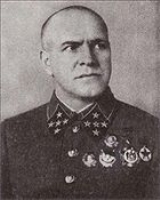
Georgy Zhukov

Encyclopedia
Marshal of the Soviet Union
Georgy Konstantinovich Zhukov , was a Russian
career officer
in the Red Army
who, in the course of World War II
, played a pivotal role in leading the Red Army through much of Eastern Europe
to liberate the Soviet Union
and other nations from the Axis Powers
' occupation and conquer Germany
's capital, Berlin
. He is the most decorated general in the history of the Russian Empire
, the Soviet Union
and the Russian Federation.
family in Strelkovka, Maloyaroslavsky Uyezd, Kaluga Governorate (now merged into the town of Zhukov
in Zhukovsky District
of Kaluga Oblast
in modern-day Russia
), Zhukov was apprenticed to work as a furrier in Moscow
. In 1915 he was conscripted into the army of the Russian Empire
, where he served first in the 106th Reserve Cavalry Regiment, then the 10th Dragoon Novgorod Regiment. During World War I
, Zhukov was awarded the Cross of St. George
twice and promoted to the rank of non-commissioned officer
for his bravery in battle. He joined the Bolshevik Party
after the October Revolution
; his background of poverty became an asset. After recovering from typhus
he fought in the Russian Civil War
from 1918 to 1921, at one time within the 1st Cavalry Army
. He received the Order of the Red Banner
for subduing the Tambov rebellion
in 1921.
By 1923 Zhukov was commander of a regiment and in 1930 of a division. He was a keen proponent of the new theory of armoured warfare and was noted for his detailed planning, tough discipline and strictness, and a "never give up" attitude. He survived Joseph Stalin
's Great Purge
of the Red Army
command in 1937–39.
in an undeclared war that lasted from 1938 to 1939. What began as a routine border skirmish — the Japanese testing the resolve of the Soviets to defend their territory — rapidly escalated into a full-scale war, the Japanese pushing forward with 80,000 troops, 180 tanks and 450 aircraft.
This led to the decisive Battle of Khalkhin Gol
. Zhukov requested major reinforcements, and on 20 August 1939 his "Soviet Offensive" commenced. After an artillery barrage, nearly 500 BT-5 and BT-7
tanks advanced, supported by over 500 fighters and bombers; this was the Soviet Air Force
's first fighter-bomber operation. The offensive first appeared to be a conventional frontal attack; however, two tank brigades were held back and ordered to advance around both flanks, supported by motorised artillery, infantry and tanks. This daring and successful manoeuvre encircled the Japanese 6th Army and captured the enemy's vulnerable supply areas. By 31 August 1939, the Japanese were cleared from the disputed border leaving the Soviets victorious.
The campaign was significant beyond the immediate outcome. Zhukov demonstrated and tested techniques later used against the Germans in the Second World War
. These included the deployment of underwater bridge
s, and improving inexperienced units by adding a few experienced troops. Evaluation of the performance of the BT tanks led to the replacement of fire-prone petrol engines with diesel engine
s, and provided valuable experience for the development of the T-34
medium tank. After the campaign, Nomonhan veterans were transferred to units that had not seen combat, to better spread the benefits of experience.
For his victory, Zhukov was declared a Hero of the Soviet Union
. However, the campaign, and Zhukov's pioneering use of tanks, remained little known outside of the Soviet Union. As a result, the Allies
were surprised by the German Blitzkrieg
during the Battle of France
in 1940. Zhukov considered Nomonhan invaluable preparation for the Second World War.
before a disagreement with Stalin led to him being replaced by Marshal Boris Shaposhnikov
. Fortuitously, this led to a relative non-accountability of Zhukov's military role in the huge territorial losses during the German invasion of the Soviet Union
thus ensuring his presence "in the wings" for Stalingrad. The question of how much he could have done had he held command earlier is still much discussed.
region by the evening of 24.6". Despite numerical superiority, this manoeuvre failed, disorganized Red Army units were destroyed by the Wehrmacht. Zhukov subsequently claimed that he was forced to sign the document by Joseph Stalin
, despite the reservations that he raised. This document was supposedly written by Aleksandr Vasilevsky
.
On 29 July 1941 Zhukov was removed from his post of Chief of the General Staff. In his memoirs he gives his suggested abandoning of Kiev
to avoid an encirclement as a reason for it. On the next day the decision was made official and he was appointed the commander of the Reserve Front. There he oversaw the Yelnya Offensive
.
On 10 September 1941 Zhukov was made the commander of the Leningrad Front
. There he oversaw the defence of the city
.
On 6 October 1941 Zhukov was appointed the representative of Stavka
for the Reserve and Western Fronts. On 10 October 1941 those fronts were merged into the Western Front under Zukov's command. This front then participated in the Battle of Moscow
and several Battles of Rzhev
.
In late August 1942 Zhukov was made Deputy Commander-in-Chief
and sent to the southwestern front to take charge of the defence of Stalingrad. He and Vasilevsky later planned the Stalingrad counteroffensive
. In November Zhukov was sent to coordinate the Western Front and the Kalinin Front
during Operation Mars
.
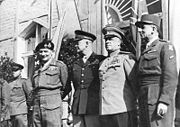 In January 1943 he (together with Kliment Voroshilov
), coordinated the actions of the Leningrad
and Volkhov Front
s and the Baltic Fleet
in Operation Iskra.
Zhukov was a Stavka
coordinator at the Battle of Kursk
in July 1943. According to his memoirs, he played a central role in the planning of the battle and the hugely successful offensive that followed. Commander of the Central Front Konstantin Rokossovsky
, said, however, that the planning and decisions for the Battle of Kursk were made without Zhukov, that he only arrived just before the battle, made no decisions and left soon afterwards, and that Zhukov exaggerated his role.
Following the failure of Marshal Kliment Voroshilov
, he lifted the Siege of Leningrad in January 1944. From 12 February 1944 Zhukov coordinated the actions of the 1st Ukrainian
and 2nd Ukrainian Fronts. On the 1 March 1944 Zhukov was appointed the commander of the 1st Ukrainian Front until early May. During the Soviet offensive Operation Bagration, Zhukov coordinated the 1st Belorussian
and 2nd Belorussian
Fronts, later the 1st Ukrainian Front as well. On 23 August Zhukov was sent to the 3rd Ukrainian Front
to prepare for the advance into Bulgaria
.
On 16 November he became commander of the 1st Belorussian Front which took part in the Vistula–Oder Offensive and the battle for Berlin
. He called on his troops to ”remember our brothers and sisters, our mothers and fathers, our wives and children tortured to death by [the] Germans...We shall exact a brutal revenge for everything.” In a reprise of similar atrocities committed by German soldiers against Russian civilians in the eastward advance into Soviet territory during Operation Barbarossa, the westward march by Soviet forces was marked by brutality towards German civilians, which included looting, burning and rape.
Zhukov was present when German officials signed the Instrument of Surrender
in Berlin.
occupation zone in Germany. As the most prominent Soviet military commander of the Second World War, he inspected the Victory Parade
in Red Square
in Moscow in 1945, mounted on a white stallion. American General Dwight D. Eisenhower
, the supreme Allied commander in the West, was a great admirer of Zhukov; the two toured the Soviet Union together in the immediate aftermath of the victory over Germany.
but also became its Military Governor on 10 June 1945. A war hero and a leader hugely popular with the military, Zhukov constituted a potential threat to Stalin's leadership largely in Stalin's view. As a result, he was replaced by Vasily Sokolovsky
on 10 April 1946. After an unpleasant session of the Main Military Council, at which he was bitterly attacked and accused of being politically unreliable and hostile to the Party Central Committee, he was stripped of his position as Commander-in-Chief of the Soviet Ground Forces
. He was assigned command of the Odessa Military District
, far away from Moscow and lacking strategic significance and attendant massive troop deployment. He arrived there on 13 June 1946. He suffered a heart attack in January 1948 and spent a month in hospital. In February 1948 he was given another secondary posting, the command of the Urals Military District
.
Zhukov also suffered terribly from Lavrentiy Beria
's plots and slanders. In fact, one of the last disasters that Beria caused to the Soviet Union is the plot to topple Zhukov. Two of Zhukov's subordinates, Marshal of the Red Air Force Alexander Alexandrovich Novikov and Lieutenant-General :ru:Konstantin Fyodorovitch Teleghin (Member of the Military Council of 1st Belorussia Army Group) were arrested and tortured in Lefortovo jail at the end of 1945. At the confrontations, G. K. Zhukov unmasked the slander of the Director of the Intelligence Department, F. I. Golikov, about Zhukov's squandering of booty and exaggerating of the Nazi Germany's strength. Some other people accused him of being a Bonapartist
.
In 1946, seven rail carriages with furniture Zhukov was taking to the Soviet Union from Germany were impounded. In 1948, his apartments and house in Moscow were searched and many valuables looted from Germany were found. In this investigation, Lavrentiy Beria even fabricated such unbelievable and unimaginable information such as Zhukov had 17 golden rings, three gemstones, 15 golden necklaces' faces, more than 4,000 meters of cloths, 323 pieces of fur, 44 carpets that were taken from German palaces and 55 paintings and 20 guns.... These incidents were ironically called "the investigation of the cup" by the Soviet military. In respond, G. K. Zhukov answered:
When knowing about the "unfortunates" that happened with G. K. Zhukov, despite not understanding all the problems but Dwight David Eisenhower
expressed his sympathy for his "comrade-in-arms" Zhukov.
After Stalin's death, however, Zhukov returned to favor and became Deputy Defence Minister in 1953. In 1954 Zhukov was a member of the tribunal headed by Konev
, which arrested (and condemned to execution) Lavrenty Beria, who until then had been First Deputy Prime Minister and head of the MVD. When Bulganin
became premier in 1955, he appointed Zhukov as Defence Minister.
following the revolution in October 1956
. Along with the majority of members of the Presidium
, he urged Nikita Khrushchev
to send troops to support the Hungarian authorities and to secure the border with Austria
. Zhukov and most of the Presidium were not, however, eager to see a full-scale intervention in Hungary and Zhukov even recommended the withdrawal of Soviet troops when it seemed that they might have to take extreme measures to suppress the revolution. The mood on the Presidium changed again when Hungary's new Prime Minister, Imre Nagy
, began to talk about Hungarian withdrawal from the Warsaw Pact
. The Soviet leadership pressed ahead ruthlessly to defeat the revolutionaries and install János Kádár
in Nagy's place.
In 1957 Zhukov supported Khrushchev against his conservative enemies, the so-called "Anti-Party Group
" led by Vyacheslav Molotov
. Zhukov's speech to the plenum
of the Central Committee of the Communist Party
was most powerful, directly denouncing the neo-Stalinists
for their complicity in Stalin's crimes, though it also carried the threat of force: the very crime of which he was accusing the others.
In June that year he was made a full member of the Presidium of the Central Committee. He had, however, significant political disagreements with Khrushchev in matters of army policy. Khrushchev scaled down the conventional forces and the navy, while developing the strategic nuclear forces as a primary deterrent force, hence freeing up manpower and resources for the civilian economy.
Zhukov visited Yugoslavia and Albania in October 1957 aboard the Chapayev class cruiser
Kuibyshev, attempting to repair the Tito–Stalin split of 1948. During the voyage, Kuibyshev encountered units of the United States Sixth Fleet, passing honours were rendered.
Zhukov supported the interests of the military and disagreed with Khrushchev's policy. The same issue of Krasnaya Zvezda
(Red Star) that announced Zhukov's return to Moscow also reported that Zhukov had been relieved of his duties. Khrushchev, demonstrating the dominance of the Party over the army, had relieved Zhukov of his ministry and expelled him from the Central Committee. In his memoirs, Khrushchev claimed that he believed that Zhukov was planning a coup against him and that he accused Zhukov of this as grounds for expulsion at the Central Committee meeting.
and Alexei Kosygin restored Zhukov to favour, although not to power. Brezhnev, notorious for his vanity, was said to be angered when, at a gathering to mark the twentieth anniversary of victory in the Second World War, Zhukov was accorded greater acclaim than himself. Brezhnev, a relatively junior political officer in the war, was always concerned with boosting his own importance in the victory.
Zhukov remained a popular figure in the Soviet Union until his death in 1974, although by his own admission he was much better at dealing with military matters than with politics. He was buried with full military honours in the Kremlin Wall Necropolis
.
In 1969, he wrote a book about his life.
Specially, Anthony Beevor in Berlin: the Downfall (published in London, 2002) criticized Zhukov that the Marshal let his subordinates do everything they wanted during two weeks before the Berlin Military Management Committee was actived. However, this point received violently opposition from Doctor Joachim Fest
, a researcher about Berlin and Hitler at the end of World War II. Fest stated that, Beevor totally forgot about the fact that Zhukov was really sensitive about the undiscipline of his subordinates and would strictly punish that undiscipline. Fest also commented that Beevor had scattered wrong information about history. The book also received heavy critics from Grigori Karasin, Russian Ambassador at London.
Some opinions stated that Zhukov is a typical "squander-soldier general" and that he was emotionless about the loss of lives of his forces. However, some scholars strongly rejected this idea and they quoted some of Zhukov's order stored by Russian Minster of Defence and Government of Moskva to prove that Zhukov did care about the soldiers' lives.
However, Zhukov still received many positive comments about him, mostly from his companions in the Soviet Army, from the Russian Army nowadays, and from the Western Allied generals lived contemporarily with him. General of the Army
Dwight D. Eisenhower
stated that because of Zhukov's credits in the war aganist the Nazis, the United Nations owed him much more than any other notable military leaders in the world.
Major General Sir Francis de Guingand, Chief of Staff of Field Marshall Bernard Montgomery described G. K. Zhukov as a friendly and nice person. The US writer John Gunther
, who met Zhukov many times after the World War, said that Zhukov was the most friendly, the nicest and the most honest person, much more than any Russian leaders that Guther had met. John Eisenhower (Dwight D. Eisenhower
's son) claimed that G. K. Zhukov was really ebullient and was a very suitable friend of him.
was a (self awarded) four-time recipient. Zhukov was one of three double recipients of the Order of Victory
. He was also awarded the high honours of many other countries. A partial listing is presented below.
, in memory of the Battle of Halhin Gol. After the dissolution of the Soviet Union
, this monument was one of the very few which did not suffer from the anti-Soviet backlash in the former Communist state
s.
A minor planet
, 2132 Zhukov
, discovered in 1975 by Soviet astronomer Lyudmila Chernykh
, is named in his honor.
In 1995, commemorating Zhukov's 100th birthday, Russia adopted the Order of Zhukov
and the Zhukov Medal.
's poem On the Death of Zhukov ("Na smert' Zhukova", 1974) is regarded by critics as one of the best poems on the war written by an author of the post-Second World War generation. It is a clever stylisation of The Bullfinch, Derzhavin
's elegy on the death of Generalissimo Suvorov in 1800. Brodsky obviously draws a parallel between the careers of these commanders.
Zhukov himself reportedly participated in Beria's arrest at the Kremlin, with one version having him exclaiming "in the name of the Soviet People, you are under arrest, you son of a bitch." The historical accuracy of some accounts is doubted. Nikita Khrushchev's memoirs confirm this story, if not the use of colorful language.
In his book of recollections, Zhukov was critical of the role the Soviet leadership played during the war. The first edition of was published during Brezhnev's reign, only on condition that criticism of Stalin was removed and Zhukov had to add an (invented) episode of a visit to Leonid Brezhnev, politruk at the Southern Front, to consult on military strategy
.
's Red Inferno: 1945. The novel follows his career as Marshal of the Soviet Union in a fictional situation where the Soviet Union attacks America and the remaining Allied nations. Towards the end of the novel an American Boeing B-29 Superfortress drops a nuclear bomb near the city of Paderborn
, Germany, where he has set up his headquarters. The fictional bomb kills both him and his protégé and second in command, Vasily Chuikov
, as well as a large portion of the Soviet military's elite forces.
In the title song from the Swedish band Sabaton
's album Attero Dominatus
they sing about Georgy Zhukov during the Battle of Berlin.
Cigar City Brewing Company in Tampa, Florida
brews a Russian imperial stout named after Zhukov.
Cold War International History Project Bulletin, no. 5 (Woodrow Wilson Center for International Scholars, Washington, DC), Spring, 1995, pp. 22–23, 29–34.
Marshal of the Soviet Union
Marshal of the Soviet Union was the de facto highest military rank of the Soviet Union. ....
Georgy Konstantinovich Zhukov , was a Russian
Russians
The Russian people are an East Slavic ethnic group native to Russia, speaking the Russian language and primarily living in Russia and neighboring countries....
career officer
Officer (armed forces)
An officer is a member of an armed force or uniformed service who holds a position of authority. Commissioned officers derive authority directly from a sovereign power and, as such, hold a commission charging them with the duties and responsibilities of a specific office or position...
in the Red Army
Red Army
The Workers' and Peasants' Red Army started out as the Soviet Union's revolutionary communist combat groups during the Russian Civil War of 1918-1922. It grew into the national army of the Soviet Union. By the 1930s the Red Army was among the largest armies in history.The "Red Army" name refers to...
who, in the course of World War II
World War II
World War II, or the Second World War , was a global conflict lasting from 1939 to 1945, involving most of the world's nations—including all of the great powers—eventually forming two opposing military alliances: the Allies and the Axis...
, played a pivotal role in leading the Red Army through much of Eastern Europe
Eastern Europe
Eastern Europe is the eastern part of Europe. The term has widely disparate geopolitical, geographical, cultural and socioeconomic readings, which makes it highly context-dependent and even volatile, and there are "almost as many definitions of Eastern Europe as there are scholars of the region"...
to liberate the Soviet Union
Soviet Union
The Soviet Union , officially the Union of Soviet Socialist Republics , was a constitutionally socialist state that existed in Eurasia between 1922 and 1991....
and other nations from the Axis Powers
Axis Powers
The Axis powers , also known as the Axis alliance, Axis nations, Axis countries, or just the Axis, was an alignment of great powers during the mid-20th century that fought World War II against the Allies. It began in 1936 with treaties of friendship between Germany and Italy and between Germany and...
' occupation and conquer Germany
Nazi Germany
Nazi Germany , also known as the Third Reich , but officially called German Reich from 1933 to 1943 and Greater German Reich from 26 June 1943 onward, is the name commonly used to refer to the state of Germany from 1933 to 1945, when it was a totalitarian dictatorship ruled by...
's capital, Berlin
Berlin
Berlin is the capital city of Germany and is one of the 16 states of Germany. With a population of 3.45 million people, Berlin is Germany's largest city. It is the second most populous city proper and the seventh most populous urban area in the European Union...
. He is the most decorated general in the history of the Russian Empire
Russian Empire
The Russian Empire was a state that existed from 1721 until the Russian Revolution of 1917. It was the successor to the Tsardom of Russia and the predecessor of the Soviet Union...
, the Soviet Union
Soviet Union
The Soviet Union , officially the Union of Soviet Socialist Republics , was a constitutionally socialist state that existed in Eurasia between 1922 and 1991....
and the Russian Federation.
Career before World War II
Born into a poverty-stricken peasantPeasant
A peasant is an agricultural worker who generally tend to be poor and homeless-Etymology:The word is derived from 15th century French païsant meaning one from the pays, or countryside, ultimately from the Latin pagus, or outlying administrative district.- Position in society :Peasants typically...
family in Strelkovka, Maloyaroslavsky Uyezd, Kaluga Governorate (now merged into the town of Zhukov
Zhukov (town)
Zhukov is a town and the administrative center of Zhukovsky District of Kaluga Oblast, Russia, located on the Ugodka River northwest of Kaluga. Population:...
in Zhukovsky District
Zhukovsky District, Kaluga Oblast
Zhukovsky District is a district in Kaluga Oblast, Russia.Its administrative centre is Zhukov.*District area: 1,360 km²*District's population: 45,600...
of Kaluga Oblast
Kaluga Oblast
Kaluga Oblast is a federal subject of Russia . Its administrative center is the city of Kaluga.-Geography:Kaluga Oblast is located in the central part of the East European Plain. The Smolensk Highland lays in the western and north-western part of the oblast, while the Central Russian Highland -...
in modern-day Russia
Russia
Russia or , officially known as both Russia and the Russian Federation , is a country in northern Eurasia. It is a federal semi-presidential republic, comprising 83 federal subjects...
), Zhukov was apprenticed to work as a furrier in Moscow
Moscow
Moscow is the capital, the most populous city, and the most populous federal subject of Russia. The city is a major political, economic, cultural, scientific, religious, financial, educational, and transportation centre of Russia and the continent...
. In 1915 he was conscripted into the army of the Russian Empire
Russian Empire
The Russian Empire was a state that existed from 1721 until the Russian Revolution of 1917. It was the successor to the Tsardom of Russia and the predecessor of the Soviet Union...
, where he served first in the 106th Reserve Cavalry Regiment, then the 10th Dragoon Novgorod Regiment. During World War I
World War I
World War I , which was predominantly called the World War or the Great War from its occurrence until 1939, and the First World War or World War I thereafter, was a major war centred in Europe that began on 28 July 1914 and lasted until 11 November 1918...
, Zhukov was awarded the Cross of St. George
Cross of St. George
thumb|Original Cross of St. George.Ist and 2nd class were in gold.The Cross of St. George ', or simply the George's Cross, was, until 1913, officially known as the Sign of Distinction of the Military Order of St. George....
twice and promoted to the rank of non-commissioned officer
Non-commissioned officer
A non-commissioned officer , called a sub-officer in some countries, is a military officer who has not been given a commission...
for his bravery in battle. He joined the Bolshevik Party
Communist Party of the Soviet Union
The Communist Party of the Soviet Union was the only legal, ruling political party in the Soviet Union and one of the largest communist organizations in the world...
after the October Revolution
October Revolution
The October Revolution , also known as the Great October Socialist Revolution , Red October, the October Uprising or the Bolshevik Revolution, was a political revolution and a part of the Russian Revolution of 1917...
; his background of poverty became an asset. After recovering from typhus
Typhus
Epidemic typhus is a form of typhus so named because the disease often causes epidemics following wars and natural disasters...
he fought in the Russian Civil War
Russian Civil War
The Russian Civil War was a multi-party war that occurred within the former Russian Empire after the Russian provisional government collapsed to the Soviets, under the domination of the Bolshevik party. Soviet forces first assumed power in Petrograd The Russian Civil War (1917–1923) was a...
from 1918 to 1921, at one time within the 1st Cavalry Army
1st Cavalry Army
The 1st Cavalry Army was the most famous Red Army сavalry formation. It was also known as Budyonny's Cavalry Army or simply as Konarmia ....
. He received the Order of the Red Banner
Order of the Red Banner
The Soviet government of Russia established the Order of the Red Banner , a military decoration, on September 16, 1918 during the Russian Civil War...
for subduing the Tambov rebellion
Tambov Rebellion
The Tambov Rebellion which occurred between 1920 and 1921 was one of the largest and best-organized peasant rebellions challenging the Bolshevik regime during the Russian Civil War. The uprising took place in the territories of the modern Tambov Oblast and part of the Voronezh Oblast, less than...
in 1921.
By 1923 Zhukov was commander of a regiment and in 1930 of a division. He was a keen proponent of the new theory of armoured warfare and was noted for his detailed planning, tough discipline and strictness, and a "never give up" attitude. He survived Joseph Stalin
Joseph Stalin
Joseph Vissarionovich Stalin was the Premier of the Soviet Union from 6 May 1941 to 5 March 1953. He was among the Bolshevik revolutionaries who brought about the October Revolution and had held the position of first General Secretary of the Communist Party of the Soviet Union's Central Committee...
's Great Purge
Great Purge
The Great Purge was a series of campaigns of political repression and persecution in the Soviet Union orchestrated by Joseph Stalin from 1936 to 1938...
of the Red Army
Red Army
The Workers' and Peasants' Red Army started out as the Soviet Union's revolutionary communist combat groups during the Russian Civil War of 1918-1922. It grew into the national army of the Soviet Union. By the 1930s the Red Army was among the largest armies in history.The "Red Army" name refers to...
command in 1937–39.
Nomonhan (Khalkhin Gol)
In 1938 Zhukov was directed to command the First Soviet Mongolian Army Group, and saw action against Japan's Kwantung Army on the border between Mongolia and the Japanese controlled state of ManchukuoManchukuo
Manchukuo or Manshū-koku was a puppet state in Manchuria and eastern Inner Mongolia, governed under a form of constitutional monarchy. The region was the historical homeland of the Manchus, who founded the Qing Empire in China...
in an undeclared war that lasted from 1938 to 1939. What began as a routine border skirmish — the Japanese testing the resolve of the Soviets to defend their territory — rapidly escalated into a full-scale war, the Japanese pushing forward with 80,000 troops, 180 tanks and 450 aircraft.
This led to the decisive Battle of Khalkhin Gol
Battle of Khalkhin Gol
The Battles of Khalkhyn Gol was the decisive engagement of the undeclared Soviet–Japanese Border Wars fought among the Soviet Union, Mongolia and the Empire of Japan in 1939. The conflict was named after the river Khalkhyn Gol, which passes through the battlefield...
. Zhukov requested major reinforcements, and on 20 August 1939 his "Soviet Offensive" commenced. After an artillery barrage, nearly 500 BT-5 and BT-7
BT-7
The BT-7 was the last of the BT tank series of Soviet cavalry tanks that were produced in large numbers between 1935 and 1940. They were lightly armoured, but reasonably well-armed for their time, and had much better mobility than other contemporary tank designs...
tanks advanced, supported by over 500 fighters and bombers; this was the Soviet Air Force
Soviet Air Force
The Soviet Air Force, officially known in Russian as Военно-воздушные силы or Voenno-Vozdushnye Sily and often abbreviated VVS was the official designation of one of the air forces of the Soviet Union. The other was the Soviet Air Defence Forces...
's first fighter-bomber operation. The offensive first appeared to be a conventional frontal attack; however, two tank brigades were held back and ordered to advance around both flanks, supported by motorised artillery, infantry and tanks. This daring and successful manoeuvre encircled the Japanese 6th Army and captured the enemy's vulnerable supply areas. By 31 August 1939, the Japanese were cleared from the disputed border leaving the Soviets victorious.
The campaign was significant beyond the immediate outcome. Zhukov demonstrated and tested techniques later used against the Germans in the Second World War
Eastern Front (World War II)
The Eastern Front of World War II was a theatre of World War II between the European Axis powers and co-belligerent Finland against the Soviet Union, Poland, and some other Allies which encompassed Northern, Southern and Eastern Europe from 22 June 1941 to 9 May 1945...
. These included the deployment of underwater bridge
Underwater bridge
An underwater bridge is a military tactic that was employed during World War II and the Korean War.Underwater bridges are typically constructed of logs, sand and dirt just beneath the surface of the water in a river or similar narrow body of water...
s, and improving inexperienced units by adding a few experienced troops. Evaluation of the performance of the BT tanks led to the replacement of fire-prone petrol engines with diesel engine
Diesel engine
A diesel engine is an internal combustion engine that uses the heat of compression to initiate ignition to burn the fuel, which is injected into the combustion chamber...
s, and provided valuable experience for the development of the T-34
T-34
The T-34 was a Soviet medium tank produced from 1940 to 1958. Although its armour and armament were surpassed by later tanks of the era, it has been often credited as the most effective, efficient and influential design of World War II...
medium tank. After the campaign, Nomonhan veterans were transferred to units that had not seen combat, to better spread the benefits of experience.
For his victory, Zhukov was declared a Hero of the Soviet Union
Hero of the Soviet Union
The title Hero of the Soviet Union was the highest distinction in the Soviet Union, awarded personally or collectively for heroic feats in service to the Soviet state and society.-Overview:...
. However, the campaign, and Zhukov's pioneering use of tanks, remained little known outside of the Soviet Union. As a result, the Allies
Allies of World War II
The Allies of World War II were the countries that opposed the Axis powers during the Second World War . Former Axis states contributing to the Allied victory are not considered Allied states...
were surprised by the German Blitzkrieg
Blitzkrieg
For other uses of the word, see: Blitzkrieg Blitzkrieg is an anglicized word describing all-motorised force concentration of tanks, infantry, artillery, combat engineers and air power, concentrating overwhelming force at high speed to break through enemy lines, and, once the lines are broken,...
during the Battle of France
Battle of France
In the Second World War, the Battle of France was the German invasion of France and the Low Countries, beginning on 10 May 1940, which ended the Phoney War. The battle consisted of two main operations. In the first, Fall Gelb , German armoured units pushed through the Ardennes, to cut off and...
in 1940. Zhukov considered Nomonhan invaluable preparation for the Second World War.
1940
Promoted to full general in 1940, Zhukov was briefly (January–July 1941) chief of the Red Army's General StaffGeneral Staff
A military staff, often referred to as General Staff, Army Staff, Navy Staff or Air Staff within the individual services, is a group of officers and enlisted personnel that provides a bi-directional flow of information between a commanding officer and subordinate military units...
before a disagreement with Stalin led to him being replaced by Marshal Boris Shaposhnikov
Boris Shaposhnikov
Boris Mikhailovitch Shaposhnikov was a Soviet military commander.-Biography:Shaposhnikov was born at Zlatoust, near Chelyabinsk in the Urals. He joined the army of the Russian Empire in 1901 and graduated from the Nicholas General Staff Academy in 1910, reaching the rank of colonel in the...
. Fortuitously, this led to a relative non-accountability of Zhukov's military role in the huge territorial losses during the German invasion of the Soviet Union
Operation Barbarossa
Operation Barbarossa was the code name for Germany's invasion of the Soviet Union during World War II that began on 22 June 1941. Over 4.5 million troops of the Axis powers invaded the USSR along a front., the largest invasion in the history of warfare...
thus ensuring his presence "in the wings" for Stalingrad. The question of how much he could have done had he held command earlier is still much discussed.
World War II
On 22 June 1941 Zhukov signed the "Directive of Peoples' Commissariat of Defence No. 3", which ordered an all-out counteroffensive by Red Army forces: he commanded the troops "to encircle and destroy [the] enemy grouping near Suwałki and to seize the Suwałki region by the evening of 24.6" and "to encircle and destroy the enemy grouping invading in [the] Vladimir-Volynia and Brody direction" and even "to seize the LublinLublin
Lublin is the ninth largest city in Poland. It is the capital of Lublin Voivodeship with a population of 350,392 . Lublin is also the largest Polish city east of the Vistula river...
region by the evening of 24.6". Despite numerical superiority, this manoeuvre failed, disorganized Red Army units were destroyed by the Wehrmacht. Zhukov subsequently claimed that he was forced to sign the document by Joseph Stalin
Joseph Stalin
Joseph Vissarionovich Stalin was the Premier of the Soviet Union from 6 May 1941 to 5 March 1953. He was among the Bolshevik revolutionaries who brought about the October Revolution and had held the position of first General Secretary of the Communist Party of the Soviet Union's Central Committee...
, despite the reservations that he raised. This document was supposedly written by Aleksandr Vasilevsky
Aleksandr Vasilevsky
Aleksandr Mikhaylovich Vasilevsky was a Russian career officer in the Red Army, promoted to Marshal of the Soviet Union in 1943. He was the Chief of the General Staff of the Soviet Armed Forces and Deputy Minister of Defense during World War II, as well as Minister of Defense from 1949 to 1953...
.
On 29 July 1941 Zhukov was removed from his post of Chief of the General Staff. In his memoirs he gives his suggested abandoning of Kiev
Kiev
Kiev or Kyiv is the capital and the largest city of Ukraine, located in the north central part of the country on the Dnieper River. The population as of the 2001 census was 2,611,300. However, higher numbers have been cited in the press....
to avoid an encirclement as a reason for it. On the next day the decision was made official and he was appointed the commander of the Reserve Front. There he oversaw the Yelnya Offensive
Yelnya Offensive
The Soviet Army's Yelnya Offensive operation was part of the Battle of Smolensk during the initial period of the German-Soviet War....
.
On 10 September 1941 Zhukov was made the commander of the Leningrad Front
Leningrad Front
The Leningrad Front was first formed on August 27, 1941, by dividing the Northern Front into the Leningrad Front and Karelian Front, during the German approach on Leningrad .-History:...
. There he oversaw the defence of the city
Siege of Leningrad
The Siege of Leningrad, also known as the Leningrad Blockade was a prolonged military operation resulting from the failure of the German Army Group North to capture Leningrad, now known as Saint Petersburg, in the Eastern Front theatre of World War II. It started on 8 September 1941, when the last...
.
On 6 October 1941 Zhukov was appointed the representative of Stavka
Stavka
Stavka was the term used to refer to a command element of the armed forces from the time of the Kievan Rus′, more formally during the history of Imperial Russia as administrative staff and General Headquarters during late 19th Century Imperial Russian armed forces and those of the Soviet Union...
for the Reserve and Western Fronts. On 10 October 1941 those fronts were merged into the Western Front under Zukov's command. This front then participated in the Battle of Moscow
Battle of Moscow
The Battle of Moscow is the name given by Soviet historians to two periods of strategically significant fighting on a sector of the Eastern Front during World War II. It took place between October 1941 and January 1942. The Soviet defensive effort frustrated Hitler's attack on Moscow, capital of...
and several Battles of Rzhev
Battles of Rzhev
Rzhev Battles is a general term for a series of World War II offensives launched during January 8, 1942—March 31, 1943 by the Soviet Red Army in the general directions of Rzhev, Sychevka and Vyazma against a German salient in the vicinity of Moscow, known as the "Rzhev meat grinder" for...
.
In late August 1942 Zhukov was made Deputy Commander-in-Chief
Commander-in-Chief
A commander-in-chief is the commander of a nation's military forces or significant element of those forces. In the latter case, the force element may be defined as those forces within a particular region or those forces which are associated by function. As a practical term it refers to the military...
and sent to the southwestern front to take charge of the defence of Stalingrad. He and Vasilevsky later planned the Stalingrad counteroffensive
Operation Uranus
Operation Uranus was the codename of the Soviet strategic operation in World War II which led to the encirclement of the German Sixth Army, the Third and Fourth Romanian armies, and portions of the German Fourth Panzer Army. The operation formed part of the ongoing Battle of Stalingrad, and was...
. In November Zhukov was sent to coordinate the Western Front and the Kalinin Front
Kalinin Front
The Kalinin Front was a Front of the Soviet Army during the Second World War. This sense of the term is not identical with the more general usage of military front which indicates a geographic area in wartime, although a Soviet Front may operate within designated boundaries.The Kalinin Front was...
during Operation Mars
Operation Mars
Operation Mars was the codename for the Rzhev offensive operation part of the Rzhev-Vyazma strategic offensive operation launched by Soviet forces against German forces during World War II. It took place between 25 November and 20 December 1942 in a salient in the vicinity of Moscow...
.
Kliment Voroshilov
Kliment Yefremovich Voroshilov , popularly known as Klim Voroshilov was a Soviet military officer, politician, and statesman...
), coordinated the actions of the Leningrad
Leningrad Front
The Leningrad Front was first formed on August 27, 1941, by dividing the Northern Front into the Leningrad Front and Karelian Front, during the German approach on Leningrad .-History:...
and Volkhov Front
Volkhov Front
The Front was reformed on the 9 June 1942 from the Volkhov Operational Group of the Leningrad Front and served until 15 February 1944, participating in the relief of the Siege of Leningrad and taking part in other operations including:-Campaigns:...
s and the Baltic Fleet
Baltic Fleet
The Twice Red Banner Baltic Fleet - is the Russian Navy's presence in the Baltic Sea. In previous historical periods, it has been part of the navy of Imperial Russia and later the Soviet Union. The Fleet gained the 'Twice Red Banner' appellation during the Soviet period, indicating two awards of...
in Operation Iskra.
Zhukov was a Stavka
Stavka
Stavka was the term used to refer to a command element of the armed forces from the time of the Kievan Rus′, more formally during the history of Imperial Russia as administrative staff and General Headquarters during late 19th Century Imperial Russian armed forces and those of the Soviet Union...
coordinator at the Battle of Kursk
Battle of Kursk
The Battle of Kursk took place when German and Soviet forces confronted each other on the Eastern Front during World War II in the vicinity of the city of Kursk, in the Soviet Union in July and August 1943. It remains both the largest series of armored clashes, including the Battle of Prokhorovka,...
in July 1943. According to his memoirs, he played a central role in the planning of the battle and the hugely successful offensive that followed. Commander of the Central Front Konstantin Rokossovsky
Konstantin Rokossovsky
Konstantin Rokossovskiy was a Polish-origin Soviet career officer who was a Marshal of the Soviet Union, as well as Marshal of Poland and Polish Defence Minister, who was famously known for his service in the Eastern Front, where he received high esteem for his outstanding military skill...
, said, however, that the planning and decisions for the Battle of Kursk were made without Zhukov, that he only arrived just before the battle, made no decisions and left soon afterwards, and that Zhukov exaggerated his role.
Following the failure of Marshal Kliment Voroshilov
Kliment Voroshilov
Kliment Yefremovich Voroshilov , popularly known as Klim Voroshilov was a Soviet military officer, politician, and statesman...
, he lifted the Siege of Leningrad in January 1944. From 12 February 1944 Zhukov coordinated the actions of the 1st Ukrainian
1st Ukrainian Front
The 1st Ukrainian Front was a front—a force the size of a Western Army group—of the Soviet Union's Red Army during the Second World War.-Wartime:...
and 2nd Ukrainian Fronts. On the 1 March 1944 Zhukov was appointed the commander of the 1st Ukrainian Front until early May. During the Soviet offensive Operation Bagration, Zhukov coordinated the 1st Belorussian
1st Belorussian Front
The 1st Belorussian Front was a Front of the Soviet Army during World War II...
and 2nd Belorussian
2nd Belorussian Front
The 2nd Belorussian Front was a military formation of Army group size of the Soviet Army during the Second World War...
Fronts, later the 1st Ukrainian Front as well. On 23 August Zhukov was sent to the 3rd Ukrainian Front
3rd Ukrainian Front
3rd Ukrainian Front was a Front of the Red Army during World War II.It was founded on 20 October 1943, on the basis of a Stavka order of October 16, 1943, by renaming the Southwestern Front. It included 1st Guards Army, 8th Guards Army, 6th, 12th, and 46th Armies and 17th Air Army...
to prepare for the advance into Bulgaria
Bulgaria
Bulgaria , officially the Republic of Bulgaria , is a parliamentary democracy within a unitary constitutional republic in Southeast Europe. The country borders Romania to the north, Serbia and Macedonia to the west, Greece and Turkey to the south, as well as the Black Sea to the east...
.
On 16 November he became commander of the 1st Belorussian Front which took part in the Vistula–Oder Offensive and the battle for Berlin
Battle of Berlin
The Battle of Berlin, designated the Berlin Strategic Offensive Operation by the Soviet Union, was the final major offensive of the European Theatre of World War II....
. He called on his troops to ”remember our brothers and sisters, our mothers and fathers, our wives and children tortured to death by [the] Germans...We shall exact a brutal revenge for everything.” In a reprise of similar atrocities committed by German soldiers against Russian civilians in the eastward advance into Soviet territory during Operation Barbarossa, the westward march by Soviet forces was marked by brutality towards German civilians, which included looting, burning and rape.
Zhukov was present when German officials signed the Instrument of Surrender
German Instrument of Surrender, 1945
The German Instrument of Surrender was the legal instrument that established the armistice ending World War II in Europe. It was signed by representatives of the Oberkommando der Wehrmacht and the Allied Expeditionary Force together with the Soviet High Command, French representative signing as...
in Berlin.
Postwar
After the capitulation, Zhukov became the first commander of the SovietSoviet Union
The Soviet Union , officially the Union of Soviet Socialist Republics , was a constitutionally socialist state that existed in Eurasia between 1922 and 1991....
occupation zone in Germany. As the most prominent Soviet military commander of the Second World War, he inspected the Victory Parade
Moscow Victory Parade of 1945
The Moscow Victory Parade of 1945 was a victory parade held by the Soviet army after the defeat of Nazi Germany in the Great Patriotic War. It took place in the Soviet capital of Moscow, mostly centering around a military parade through Red Square...
in Red Square
Red Square
Red Square is a city square in Moscow, Russia. The square separates the Kremlin, the former royal citadel and currently the official residence of the President of Russia, from a historic merchant quarter known as Kitai-gorod...
in Moscow in 1945, mounted on a white stallion. American General Dwight D. Eisenhower
Dwight D. Eisenhower
Dwight David "Ike" Eisenhower was the 34th President of the United States, from 1953 until 1961. He was a five-star general in the United States Army...
, the supreme Allied commander in the West, was a great admirer of Zhukov; the two toured the Soviet Union together in the immediate aftermath of the victory over Germany.
Career after World War II
Zhukov was not only the supreme Military Commander of the Soviet Occupation Zone in GermanyAllied Occupation Zones in Germany
The Allied powers who defeated Nazi Germany in World War II divided the country west of the Oder-Neisse line into four occupation zones for administrative purposes during 1945–49. In the closing weeks of fighting in Europe, US forces had pushed beyond the previously agreed boundaries for the...
but also became its Military Governor on 10 June 1945. A war hero and a leader hugely popular with the military, Zhukov constituted a potential threat to Stalin's leadership largely in Stalin's view. As a result, he was replaced by Vasily Sokolovsky
Vasily Sokolovsky
Vasily Danilovich Sokolovsky was a Soviet military commander.Sokolovsky was born into a peasant family in Kozliki, a small town in the province of Grodno, near Białystok in Poland . He worked as a teacher in a rural school, where he took part in a number of protests and demonstrations against the...
on 10 April 1946. After an unpleasant session of the Main Military Council, at which he was bitterly attacked and accused of being politically unreliable and hostile to the Party Central Committee, he was stripped of his position as Commander-in-Chief of the Soviet Ground Forces
Red Army
The Workers' and Peasants' Red Army started out as the Soviet Union's revolutionary communist combat groups during the Russian Civil War of 1918-1922. It grew into the national army of the Soviet Union. By the 1930s the Red Army was among the largest armies in history.The "Red Army" name refers to...
. He was assigned command of the Odessa Military District
Odessa Military District
The Odessa Military District was a military administrative division of the Imperial Russian military, the Soviet Armed Forces and the Ukrainian Armed Forces and was known under such name from around 1862 to 1998. It was reorganized as part of the Military of Ukraine and the Military of Moldova in...
, far away from Moscow and lacking strategic significance and attendant massive troop deployment. He arrived there on 13 June 1946. He suffered a heart attack in January 1948 and spent a month in hospital. In February 1948 he was given another secondary posting, the command of the Urals Military District
Volga-Urals Military District
The Volga-Ural Military District was a military district of the Russian Ground Forces, formed on 1 September 2001 by the amalgamation of the Volga Military District and the Ural Military District. The headquarters of the Ural Military District, located at Yekaterinburg became the new headquarters...
.
Zhukov also suffered terribly from Lavrentiy Beria
Lavrentiy Beria
Lavrentiy Pavlovich Beria was a Georgian Soviet politician and state security administrator, chief of the Soviet security and secret police apparatus under Joseph Stalin during World War II, and Deputy Premier in the postwar years ....
's plots and slanders. In fact, one of the last disasters that Beria caused to the Soviet Union is the plot to topple Zhukov. Two of Zhukov's subordinates, Marshal of the Red Air Force Alexander Alexandrovich Novikov and Lieutenant-General :ru:Konstantin Fyodorovitch Teleghin (Member of the Military Council of 1st Belorussia Army Group) were arrested and tortured in Lefortovo jail at the end of 1945. At the confrontations, G. K. Zhukov unmasked the slander of the Director of the Intelligence Department, F. I. Golikov, about Zhukov's squandering of booty and exaggerating of the Nazi Germany's strength. Some other people accused him of being a Bonapartist
Bonapartist
In French political history, Bonapartism has two meanings. In a strict sense, this term refers to people who aimed to restore the French Empire under the House of Bonaparte, the Corsican family of Napoleon Bonaparte and his nephew Louis...
.
In 1946, seven rail carriages with furniture Zhukov was taking to the Soviet Union from Germany were impounded. In 1948, his apartments and house in Moscow were searched and many valuables looted from Germany were found. In this investigation, Lavrentiy Beria even fabricated such unbelievable and unimaginable information such as Zhukov had 17 golden rings, three gemstones, 15 golden necklaces' faces, more than 4,000 meters of cloths, 323 pieces of fur, 44 carpets that were taken from German palaces and 55 paintings and 20 guns.... These incidents were ironically called "the investigation of the cup" by the Soviet military. In respond, G. K. Zhukov answered:
When knowing about the "unfortunates" that happened with G. K. Zhukov, despite not understanding all the problems but Dwight David Eisenhower
Dwight D. Eisenhower
Dwight David "Ike" Eisenhower was the 34th President of the United States, from 1953 until 1961. He was a five-star general in the United States Army...
expressed his sympathy for his "comrade-in-arms" Zhukov.
After Stalin's death, however, Zhukov returned to favor and became Deputy Defence Minister in 1953. In 1954 Zhukov was a member of the tribunal headed by Konev
Ivan Konev
Ivan Stepanovich Konev , was a Soviet military commander, who led Red Army forces on the Eastern Front during World War II, retook much of Eastern Europe from occupation by the Axis Powers, and helped in the capture of Germany's capital, Berlin....
, which arrested (and condemned to execution) Lavrenty Beria, who until then had been First Deputy Prime Minister and head of the MVD. When Bulganin
Nikolai Bulganin
Nikolai Alexandrovich Bulganin was a prominent Soviet politician, who served as Minister of Defense and Premier of the Soviet Union . The Bulganin beard is named after him.-Early career:...
became premier in 1955, he appointed Zhukov as Defence Minister.
Minister of Defence
As Soviet defence minister, Zhukov was responsible for the invasion of HungaryHungary
Hungary , officially the Republic of Hungary , is a landlocked country in Central Europe. It is situated in the Carpathian Basin and is bordered by Slovakia to the north, Ukraine and Romania to the east, Serbia and Croatia to the south, Slovenia to the southwest and Austria to the west. The...
following the revolution in October 1956
1956 Hungarian Revolution
The Hungarian Revolution or Uprising of 1956 was a spontaneous nationwide revolt against the government of the People's Republic of Hungary and its Soviet-imposed policies, lasting from 23 October until 10 November 1956....
. Along with the majority of members of the Presidium
Politburo of the Central Committee of the Communist Party of the Soviet Union
The Politburo , known as the Presidium from 1952 to 1966, functioned as the central policymaking and governing body of the Communist Party of the Soviet Union.-Duties and responsibilities:The...
, he urged Nikita Khrushchev
Nikita Khrushchev
Nikita Sergeyevich Khrushchev led the Soviet Union during part of the Cold War. He served as First Secretary of the Communist Party of the Soviet Union from 1953 to 1964, and as Chairman of the Council of Ministers, or Premier, from 1958 to 1964...
to send troops to support the Hungarian authorities and to secure the border with Austria
Austria
Austria , officially the Republic of Austria , is a landlocked country of roughly 8.4 million people in Central Europe. It is bordered by the Czech Republic and Germany to the north, Slovakia and Hungary to the east, Slovenia and Italy to the south, and Switzerland and Liechtenstein to the...
. Zhukov and most of the Presidium were not, however, eager to see a full-scale intervention in Hungary and Zhukov even recommended the withdrawal of Soviet troops when it seemed that they might have to take extreme measures to suppress the revolution. The mood on the Presidium changed again when Hungary's new Prime Minister, Imre Nagy
Imre Nagy
Imre Nagy was a Hungarian communist politician who was appointed Chairman of the Council of Ministers of the People's Republic of Hungary on two occasions...
, began to talk about Hungarian withdrawal from the Warsaw Pact
Warsaw Pact
The Warsaw Treaty Organization of Friendship, Cooperation, and Mutual Assistance , or more commonly referred to as the Warsaw Pact, was a mutual defense treaty subscribed to by eight communist states in Eastern Europe...
. The Soviet leadership pressed ahead ruthlessly to defeat the revolutionaries and install János Kádár
János Kádár
János Kádár was a Hungarian communist leader and the General Secretary of the Hungarian Socialist Workers' Party, presiding over the country from 1956 until his forced retirement in 1988. His thirty-two year term as General Secretary makes Kádár the longest ruler of the People's Republic of Hungary...
in Nagy's place.
In 1957 Zhukov supported Khrushchev against his conservative enemies, the so-called "Anti-Party Group
Anti-Party Group
The Anti-Party Group was a group within the leadership of the Communist Party of the Soviet Union that unsuccessfully attempted to depose Nikita Khrushchev as First Secretary of the Party in May 1957. The group, named by that epithet by Khrushchev, was led by former Premiers Georgy Malenkov and...
" led by Vyacheslav Molotov
Vyacheslav Molotov
Vyacheslav Mikhailovich Molotov was a Soviet politician and diplomat, an Old Bolshevik and a leading figure in the Soviet government from the 1920s, when he rose to power as a protégé of Joseph Stalin, to 1957, when he was dismissed from the Presidium of the Central Committee by Nikita Khrushchev...
. Zhukov's speech to the plenum
Plenum
Plenum may refer to:* Plenum chamber, a chamber intended to contain air, gas, or liquid at positive pressure* Plenism, or Horror vacui...
of the Central Committee of the Communist Party
Central Committee of the Communist Party of the Soviet Union
The Central Committee of the Communist Party of the Soviet Union , abbreviated in Russian as ЦК, "Tse-ka", earlier was also called as the Central Committee of the All-Union Communist Party ...
was most powerful, directly denouncing the neo-Stalinists
Neo-Stalinism
Neo-Stalinism is a political term referring to attempts at rehabilitating the role of Joseph Stalin in history and re-establishing the political course of Stalin, at least partially. The term is also used to designate the modern political regimes in some states, political and social life of which...
for their complicity in Stalin's crimes, though it also carried the threat of force: the very crime of which he was accusing the others.
In June that year he was made a full member of the Presidium of the Central Committee. He had, however, significant political disagreements with Khrushchev in matters of army policy. Khrushchev scaled down the conventional forces and the navy, while developing the strategic nuclear forces as a primary deterrent force, hence freeing up manpower and resources for the civilian economy.
Zhukov visited Yugoslavia and Albania in October 1957 aboard the Chapayev class cruiser
Chapayev class cruiser
The Chapayev class were a group of cruisers built for the Soviet Navy during and after World War II. Seventeen ships were planned but only seven were actually started before the German invasion...
Kuibyshev, attempting to repair the Tito–Stalin split of 1948. During the voyage, Kuibyshev encountered units of the United States Sixth Fleet, passing honours were rendered.
Zhukov supported the interests of the military and disagreed with Khrushchev's policy. The same issue of Krasnaya Zvezda
Krasnaya Zvezda
Krasnaya Zvezda is an official newspaper of Soviet and later Russian Ministry of Defence. It was founded on January 1, 1924. Today its official designation is "Central Organ of the Russian Ministry of Defence."...
(Red Star) that announced Zhukov's return to Moscow also reported that Zhukov had been relieved of his duties. Khrushchev, demonstrating the dominance of the Party over the army, had relieved Zhukov of his ministry and expelled him from the Central Committee. In his memoirs, Khrushchev claimed that he believed that Zhukov was planning a coup against him and that he accused Zhukov of this as grounds for expulsion at the Central Committee meeting.
In retirement
After Khrushchev was deposed in October 1964, the new leadership of Leonid BrezhnevLeonid Brezhnev
Leonid Ilyich Brezhnev – 10 November 1982) was the General Secretary of the Central Committee of the Communist Party of the Soviet Union , presiding over the country from 1964 until his death in 1982. His eighteen-year term as General Secretary was second only to that of Joseph Stalin in...
and Alexei Kosygin restored Zhukov to favour, although not to power. Brezhnev, notorious for his vanity, was said to be angered when, at a gathering to mark the twentieth anniversary of victory in the Second World War, Zhukov was accorded greater acclaim than himself. Brezhnev, a relatively junior political officer in the war, was always concerned with boosting his own importance in the victory.
Zhukov remained a popular figure in the Soviet Union until his death in 1974, although by his own admission he was much better at dealing with military matters than with politics. He was buried with full military honours in the Kremlin Wall Necropolis
Kremlin Wall Necropolis
Burials in the Kremlin Wall Necropolis in Moscow began in November 1917, when 240 pro-Bolshevik victims of the October Revolution were buried in mass graves on Red Square. It is centered on both sides of Lenin's Mausoleum, initially built in wood in 1924 and rebuilt in granite in 1929–1930...
.
In 1969, he wrote a book about his life.
Controversies and opposite comments about Zhukov
Still, there are several opinions that criticized Marshal Zhukov's acts and personality. Even after the Russian Federation honoured Zhukov in 1995, some people still do not acknowledge him. For example, the young historian Konstantin Zaleski believed that in Zhukov's memoirs, the Marshall exaggerated his own role in the Patriotic War. Andrei Mertsalov stated that Zhukov was a rude and wayward person. The marshal also set terribly strict rules toward his subordinates in order to achieve the goals. Others pay attention to Zhukov's "dictatorship." For example Major General P. G. Grigorienko stated that Zhukov always wanted other people to comply with his orders unconditionally. Some notable example for these points is that, on 28 September 1941, Zhukov sent ciphered telegram No. 4976 to commanders of the Leningrad Front and the Baltic Navy, announcing that returned prisoners and families of soldiers captured by the Germans would be shot. This order was published for the first time in 1991 in the Russian magazine Начало (Beginning) No. 3. And in the same month, Zhukov also ordered that any soldiers who arbitrary left their positions would be shot.Specially, Anthony Beevor in Berlin: the Downfall (published in London, 2002) criticized Zhukov that the Marshal let his subordinates do everything they wanted during two weeks before the Berlin Military Management Committee was actived. However, this point received violently opposition from Doctor Joachim Fest
Joachim Fest
Joachim Clemens Fest was a German historian, journalist, critic and editor, best known for his writings and public commentary on Nazi Germany, including an important biography of Adolf Hitler and books about Albert Speer and the German Resistance...
, a researcher about Berlin and Hitler at the end of World War II. Fest stated that, Beevor totally forgot about the fact that Zhukov was really sensitive about the undiscipline of his subordinates and would strictly punish that undiscipline. Fest also commented that Beevor had scattered wrong information about history. The book also received heavy critics from Grigori Karasin, Russian Ambassador at London.
Some opinions stated that Zhukov is a typical "squander-soldier general" and that he was emotionless about the loss of lives of his forces. However, some scholars strongly rejected this idea and they quoted some of Zhukov's order stored by Russian Minster of Defence and Government of Moskva to prove that Zhukov did care about the soldiers' lives.
However, Zhukov still received many positive comments about him, mostly from his companions in the Soviet Army, from the Russian Army nowadays, and from the Western Allied generals lived contemporarily with him. General of the Army
General of the Army
General of the Army is a military rank used in some countries to denote a senior military leader, usually a General in command of a nation's Army. It may also be the title given to a General who commands an Army in the field....
Dwight D. Eisenhower
Dwight D. Eisenhower
Dwight David "Ike" Eisenhower was the 34th President of the United States, from 1953 until 1961. He was a five-star general in the United States Army...
stated that because of Zhukov's credits in the war aganist the Nazis, the United Nations owed him much more than any other notable military leaders in the world.
Major General Sir Francis de Guingand, Chief of Staff of Field Marshall Bernard Montgomery described G. K. Zhukov as a friendly and nice person. The US writer John Gunther
John Gunther
John Gunther was an American journalist and author whose success came primarily in the 1940s and 1950s with a series of popular sociopolitical works known as the "Inside" books...
, who met Zhukov many times after the World War, said that Zhukov was the most friendly, the nicest and the most honest person, much more than any Russian leaders that Guther had met. John Eisenhower (Dwight D. Eisenhower
Dwight D. Eisenhower
Dwight David "Ike" Eisenhower was the 34th President of the United States, from 1953 until 1961. He was a five-star general in the United States Army...
's son) claimed that G. K. Zhukov was really ebullient and was a very suitable friend of him.
Awards
Zhukov was a recipient of numerous decorations. In particular, he was awarded the Hero of the Soviet Union four times ; besides him, only Leonid BrezhnevLeonid Brezhnev
Leonid Ilyich Brezhnev – 10 November 1982) was the General Secretary of the Central Committee of the Communist Party of the Soviet Union , presiding over the country from 1964 until his death in 1982. His eighteen-year term as General Secretary was second only to that of Joseph Stalin in...
was a (self awarded) four-time recipient. Zhukov was one of three double recipients of the Order of Victory
Order of Victory
The Order of Victory was the highest military decoration in the Soviet Union, and one of the rarest orders in the world. The order was awarded only to Generals and Marshals for successfully conducting combat operations involving one or more army groups and resulting in a "successful operation...
. He was also awarded the high honours of many other countries. A partial listing is presented below.
Soviet Orders and Medals
- Order of VictoryOrder of VictoryThe Order of Victory was the highest military decoration in the Soviet Union, and one of the rarest orders in the world. The order was awarded only to Generals and Marshals for successfully conducting combat operations involving one or more army groups and resulting in a "successful operation...
(twice; serial no 1 — 10 April 1944, no 5 — 30 March 1945) - Gold Star of Hero of the Soviet UnionHero of the Soviet UnionThe title Hero of the Soviet Union was the highest distinction in the Soviet Union, awarded personally or collectively for heroic feats in service to the Soviet state and society.-Overview:...
(4 times; 29 August 1939, 29 July 1944, 1 June 1945, 1 December 1956) - Order of LeninOrder of LeninThe Order of Lenin , named after the leader of the Russian October Revolution, was the highest decoration bestowed by the Soviet Union...
(6 times; 16 August 1936, 29 August 1939, 21 February 1945, 1 December 1956, 1 December 1966, 1 December 1971) - Order of the October RevolutionOrder of the October RevolutionThe Order of the October Revolution was instituted on October 31, 1967, in time for the 50th anniversary of the October Revolution. It was awarded to individuals or groups for services furthering communism or the state, or in enhancing the defenses of the Soviet Union, military and civil...
(22 February 1968) - Order of the Red BannerOrder of the Red BannerThe Soviet government of Russia established the Order of the Red Banner , a military decoration, on September 16, 1918 during the Russian Civil War...
(3 times; 31 August 1922, 3 November 1944, 20 June 1949) - Order of SuvorovOrder of SuvorovThe Order of Suvorov is a Soviet award, named after Aleksandr Suvorov , that was established on July 29, 1942 by a decision of the Presidium of Supreme Soviet of the USSR. This decoration was created to award senior army personnel for exceptional leadership in combat operations...
, 1st class (twice; serial no 1 — 28 January 1943, No 39 — 28 July 1943) - Marshal's StarMarshal's StarThe marshal's star is an additional badge of rank worn by marshals of the armed forces of the USSR, and subsequently the Russian Federation. The armed forces of the former USSR and the Russian Federation have two such insignia for higher military ranks, both in the form of a five-pointed star of...
- Honorary weapon - a sword inscribed with golden national emblem of the Soviet Union (22 January 1968)
- Medal "In commemoration of the 100th anniversary of the birth of Vladimir Ilyich Lenin"
- Medal "20 Years of the Workers' and Peasants' Red Army"
- Medal for the Defence of MoscowMedal for the Defence of MoscowThe Medal for the Defence of Moscow was established on May 1, 1944. It was designed to commemorate the deeds of all the soldiers and civilians who had actively fought in the defence of Moscow from the Germans, in the Battle of Moscow....
- Medal for the Defence of LeningradMedal for the Defence of Leningradthumb|200px|right|The Medal for the Defence of LeningradThe Medal for the Defence of Leningrad was established on December 22, 1942, and was awarded to all members of the Soviet Army, Navy, Ministry of Internal Affairs, and civil citizens who took part in the defense of Leningrad during its siege...
- Medal for the Defence of StalingradMedal for the Defence of StalingradThe Medal for the Defence of Stalingrad was established on December 22, 1942. It was designed to commemorate the deeds of all the soldiers and civilians who had actively fought in the defence of Stalingrad from the Germans, in the Battle of Stalingrad, between July 12 and November 19, 1942.The...
- Medal for the Defence of the Caucasus
- Medal for the Capture of Berlin
- Medal For the Victory Over Germany in the Great Patriotic War 1941–1945
- Medal For the Victory Over JapanMedal For the Victory Over JapanThe medal For the Victory Over Japan was a Soviet military decoration, awarded to all the soldiers, officers and partisans who directly participated in the live combat actions against Japan during the Second World War...
- Medal "20 Years of the Soviet Army and Navy"
- Medal "30 Years of the Soviet Army and Navy"
- Medal "40 Years of the Soviet Army and Navy"
- Medal "50 Years Armed Forces of the USSR"
- 800th Anniversary of Moscow Medal800th Anniversary of Moscow MedalThe 800th Anniversary of Moscow Medal was a medal in Russia. It was established by a decree of the Supreme Soviet of the USSR on 20 September 1947 in commemoration of the 800th anniversary of the first Russian reference to Moscow, dating to 1147 when Yuri Dolgorukiy called upon the prince of the...
- 250th Anniversary of Leningrad Medal250th Anniversary of Leningrad MedalThe 250th Anniversary of Leningrad Medal was a medal of the Soviet Union, established by the Decree of the Presidium of the Supreme Soviet of the USSR on 16 May 1957 to commemorate the 250th anniversary of the city of Leningrad...
- Medal "Of Twenty years of Victory in the Second World War 1941–1945"
Foreign awards
- Order of Red Banner of the Republic of Tuva (1939)
- Order of the Red Banner, (Mongolian People's Republic; twice; 1939, 1942)
- Order of the White LionOrder of the White LionThe Order of the White Lion is the highest order of the Czech Republic. It continues a Czechoslovak order of the same name created in 1922 as an award for foreigners....
, 1st class (Czechoslovakia; 1945) - Military Order of the White Lion "For Victory"Military Order of the White LionThe Military Order of the White Lion , also known as the Military Order of the White Lion "For Victory", was an award established on 9 February 1945 to reward military merit, either personal acts of bravery or leadership....
, 1st class (Czechoslovakia; 1945) - Czechoslovak War Cross (1945)
- Cross of GrunwaldCross of GrunwaldOrder Krzyża Grunwaldu 1943-1960, Krzyż Grunwaldu 1960-1992 was a military decoration created in November 1943 by the High Command of Gwardia Ludowa, a World War II Polish resistance movement in Poland organised by the Polish Workers Party...
, 1st class (Poland; 1945) - Grand Cross of the Virtuti MilitariVirtuti MilitariThe Order Wojenny Virtuti Militari is Poland's highest military decoration for heroism and courage in the face of the enemy at war...
(Poland; 1945) - Chief Commander, Legion of MeritLegion of MeritThe Legion of Merit is a military decoration of the United States armed forces that is awarded for exceptionally meritorious conduct in the performance of outstanding services and achievements...
(USA; 1945) - Honorary Knight Grand Cross, Order of the BathOrder of the BathThe Most Honourable Order of the Bath is a British order of chivalry founded by George I on 18 May 1725. The name derives from the elaborate mediæval ceremony for creating a knight, which involved bathing as one of its elements. The knights so created were known as Knights of the Bath...
, (military division) (United Kingdom; 1945) - Grand Cross of the Legion d'HonneurLégion d'honneurThe Legion of Honour, or in full the National Order of the Legion of Honour is a French order established by Napoleon Bonaparte, First Consul of the Consulat which succeeded to the First Republic, on 19 May 1802...
(France; 1945) - Medal "For Warsaw 1939-1945" (Poland, 1946)
- Medal "for Oder, Nisu and the Baltic Region" (Poland; 1946)
- Medal "Sino-Soviet friendship", (China; twice, 1953, 1956)
- Order of FreedomOrder of FreedomOrder of Freedom was the highest military decoration awarded in Yugoslavia, and the second highest Yugoslav state decoration after the Yugoslav Great Star. It was awarded to the commanders of large military units for skillful leadership and for the outstanding courage of the troops...
(SFR Yugoslavia; 1956) - Order of Military MeritOrder of Military MeritOrder of Military Merit may refer to:* Order of Military Merit , National Order "For Military Merit"* Order of Military Merit * German States:** Military Merit Order ** Military Merit Order...
, 1st class (Grand Cross of the officer) (Egypt; 1956) - Garibaldi Medal (Italy, 1956)
- Honorary Italian Partisan (1956)
- Commander's Cross with Star of the Polonia RestitutaPolonia RestitutaThe Order of Polonia Restituta is one of Poland's highest Orders. The Order can be conferred for outstanding achievements in the fields of education, science, sport, culture, art, economics, defense of the country, social work, civil service, or for furthering good relations between countries...
, (Poland; 1968 and Commander's Cross in 1973) - Order of Sukhbaatar (three times; 1968, 1969, 1971) (Mongolian People's Republic)
- Hero of the Mongolian People's Republic (1969)
- Croix de guerreCroix de guerreThe Croix de guerre is a military decoration of France. It was first created in 1915 and consists of a square-cross medal on two crossed swords, hanging from a ribbon with various degree pins. The decoration was awarded during World War I, again in World War II, and in other conflicts...
(France) - Medal "30 year anniversary of the Battle of Khalkhin GolBattle of Khalkhin GolThe Battles of Khalkhyn Gol was the decisive engagement of the undeclared Soviet–Japanese Border Wars fought among the Soviet Union, Mongolia and the Empire of Japan in 1939. The conflict was named after the river Khalkhyn Gol, which passes through the battlefield...
" (Mongolian People's Republic; 1969) - Medal "50 years of the Mongolian People's Republic" (1971)
- Medal "50 years of the Mongolian People's ArmyMongolian People's ArmyThe Mongolian People's Army or Mongolian People's Revolutionary Army was established on 18 March 1921 as a secondary army under Soviet Red Army command during the 1920s and during World War II.-Creation of the army:One of the first actions of the new Mongolian People's Revolutionary Party...
" (1971) - Medal "For Victory over Japan" (Mongolian People's Republic)
- Medal "to the 90th anniversary of the birth of Georgiy Dimitrov"
- Medal "25 years of the Bulgarian People's Army"
Memorials
The very first monument to Georgy Zhukov was erected in MongoliaMongolia
Mongolia is a landlocked country in East and Central Asia. It is bordered by Russia to the north and China to the south, east and west. Although Mongolia does not share a border with Kazakhstan, its western-most point is only from Kazakhstan's eastern tip. Ulan Bator, the capital and largest...
, in memory of the Battle of Halhin Gol. After the dissolution of the Soviet Union
Dissolution of the Soviet Union
The dissolution of the Soviet Union was the disintegration of the federal political structures and central government of the Union of Soviet Socialist Republics , resulting in the independence of all fifteen republics of the Soviet Union between March 11, 1990 and December 25, 1991...
, this monument was one of the very few which did not suffer from the anti-Soviet backlash in the former Communist state
Communist state
A communist state is a state with a form of government characterized by single-party rule or dominant-party rule of a communist party and a professed allegiance to a Leninist or Marxist-Leninist communist ideology as the guiding principle of the state...
s.
A minor planet
Minor planet
An asteroid group or minor-planet group is a population of minor planets that have a share broadly similar orbits. Members are generally unrelated to each other, unlike in an asteroid family, which often results from the break-up of a single asteroid...
, 2132 Zhukov
2132 Zhukov
2132 Zhukov is a main-belt asteroid discovered on October 3, 1975 by L. I. Chernykh at the Crimean Astrophysical Observatory. It is named after Soviet Marshal Georgy Zhukov.- External links :*...
, discovered in 1975 by Soviet astronomer Lyudmila Chernykh
Lyudmila Chernykh
Lyudmila Ivanovna Chernykh is a Russian, Ukrainian and Soviet astronomer.In 1959 she graduated from Irkutsk State Pedagogical University. Between 1959 and 1963 she worked in the 'Time and Frequency Laboratory' of the All-Union Research Institute of Physico-Technical and Radiotechnical Measurements...
, is named in his honor.
In 1995, commemorating Zhukov's 100th birthday, Russia adopted the Order of Zhukov
Order of Zhukov
The Order of Zhukov is military decoration of the Russian Federation. It was established by presidential decree on 9 May 1994. The order is named after Marshal of the Soviet Union Georgy Zhukov...
and the Zhukov Medal.
Recollections
Nobel laureate Joseph BrodskyJoseph Brodsky
Iosif Aleksandrovich Brodsky , was a Russian poet and essayist.In 1964, 23-year-old Brodsky was arrested and charged with the crime of "social parasitism" He was expelled from the Soviet Union in 1972 and settled in America with the help of W. H. Auden and other supporters...
's poem On the Death of Zhukov ("Na smert' Zhukova", 1974) is regarded by critics as one of the best poems on the war written by an author of the post-Second World War generation. It is a clever stylisation of The Bullfinch, Derzhavin
Derzhavin
Derzhavin may refer to:* Gavrila Derzhavin, Russian poet and statesman* 23409 Derzhavin, minor planet...
's elegy on the death of Generalissimo Suvorov in 1800. Brodsky obviously draws a parallel between the careers of these commanders.
Zhukov himself reportedly participated in Beria's arrest at the Kremlin, with one version having him exclaiming "in the name of the Soviet People, you are under arrest, you son of a bitch." The historical accuracy of some accounts is doubted. Nikita Khrushchev's memoirs confirm this story, if not the use of colorful language.
In his book of recollections, Zhukov was critical of the role the Soviet leadership played during the war. The first edition of was published during Brezhnev's reign, only on condition that criticism of Stalin was removed and Zhukov had to add an (invented) episode of a visit to Leonid Brezhnev, politruk at the Southern Front, to consult on military strategy
Military strategy
Military strategy is a set of ideas implemented by military organizations to pursue desired strategic goals. Derived from the Greek strategos, strategy when it appeared in use during the 18th century, was seen in its narrow sense as the "art of the general", 'the art of arrangement' of troops...
.
In popular culture
Zhukov is a character in Robert ConroyRobert Conroy
-Writing career:*His first novel, 1901, deals with a German invasion of Long Island.*His second novel, 1862, is based on what might have happened had the United Kingdom entered into the American Civil War on the side of the Confederacy....
's Red Inferno: 1945. The novel follows his career as Marshal of the Soviet Union in a fictional situation where the Soviet Union attacks America and the remaining Allied nations. Towards the end of the novel an American Boeing B-29 Superfortress drops a nuclear bomb near the city of Paderborn
Paderborn
Paderborn is a city in North Rhine-Westphalia, Germany, capital of the Paderborn district. The name of the city derives from the river Pader, which originates in more than 200 springs near Paderborn Cathedral, where St. Liborius is buried.-History:...
, Germany, where he has set up his headquarters. The fictional bomb kills both him and his protégé and second in command, Vasily Chuikov
Vasily Chuikov
Vasily Ivanovich Chuikov was a Russian lieutenant general in the Red Army during World War II, twice Hero of the Soviet Union , who after the war became a Marshal of the Soviet Union.-Early life and career:Born into a peasant family in the village of Serebryanye Prudy, he joined the Red Army during...
, as well as a large portion of the Soviet military's elite forces.
In the title song from the Swedish band Sabaton
Sabaton (band)
Sabaton is a Grammis-nominated power metal band from Falun, Sweden formed in 1999. The band's main lyrical themes are those of historical wars. This is heard in albums Primo Victoria, Attero Dominatus and Coat of Arms where all of the songs, except final tracks, take inspiration from historical...
's album Attero Dominatus
Attero Dominatus
Attero Dominatus is the third album by Swedish power metal band Sabaton, as well as the first to feature keyboardist Daniel Mÿhr.The Latin name is intended to mean 'Destroy Tyranny' . However it is syntactically incorrect...
they sing about Georgy Zhukov during the Battle of Berlin.
Cigar City Brewing Company in Tampa, Florida
Tampa, Florida
Tampa is a city in the U.S. state of Florida. It serves as the county seat for Hillsborough County. Tampa is located on the west coast of Florida. The population of Tampa in 2010 was 335,709....
brews a Russian imperial stout named after Zhukov.
Primary sources
- Johanna Granville, trans., "Soviet Archival Documents on the Hungarian Revolution, 24 October – 4 November 1956",
Cold War International History Project Bulletin, no. 5 (Woodrow Wilson Center for International Scholars, Washington, DC), Spring, 1995, pp. 22–23, 29–34.
Additional reading
- Granville, Johanna The First Domino: International Decision Making During the Hungarian Crisis of 1956, Texas A & M University Press, 2004. ISBN 1585442984.
- Spahr, William J. Zhukov: The Rise and Fall of a Great Captain. Novato, CA: Presidio Press, 1993 (paperback, ISBN 0-89141-551-3).
External links
- Marshal Zhukov from the Voice of Russia website (in English) Воспоминания и размышления The Memoirs of Georgy Zhukov Zhukov's Awards Shadow of Victory and Take Words Back, books by Viktor SuvorovViktor SuvorovViktor Suvorov is the pen name for Vladimir Bogdanovich Rezun , a former Soviet and now British writer of Russian and Ukrainian descent who writes primarily in Russian, as well as a former Soviet military intelligence spy who defected to the UK...
, highly critical of Zhukov Соколов Б.В. Неизвестный Жуков: портрет без ретуши в зеркале эпохи, Мн.: Родиола-плюс, 2000. (B.V.Sokolov. Unknown Zhukov) Иосиф Бродский. На смерть Жукова (On the Death of Zhukov by Joseph Brodsky), 1974 Georgy Zhukov - Central Intelligence Agency, Office of Current Intelligence. Party–Military Relations in the USSR and the Fall of Marshal Zhukov, 8 June 1959.