


Stavka

Encyclopedia
Stavka was the term used to refer to a command element
of the armed forces
from the time of the Kievan Rus′, more formally during the history of Imperial Russia
as administrative staff and General Headquarters during late 19th Century Imperial Russian armed forces
and those of the Soviet Union
. In western literature it is sometimes incorrectly written STAVKA in uppercase, although the word is not an acronym. The term may be applied to personnel of the military Staff, as well as to military Staff location, its original meaning from the old Russian word ставка — Tent.
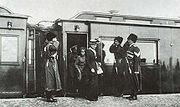 The commander-in-chief of the Russian army
at the beginning of World War I
was Grand Duke
Nicholas Nicholaievitch, a grandson of Tsar
Nicholas I
. Appointed at the last minute in August 1914, he played no part in formulating the military plans in use at the beginning of the war. He was competent, if not brilliant. Nikolai Yanushkevich
was his chief of staff. In the summer of 1915 the Tsar himself took personal command, with Mikhail Alekseyev as his chief of staff.
The Stavka was divided into several departments:
The Stavka was first established in Baranovichi
. In August 1915, after the German advance, the Stavka re-located to Mogilev
.
Stavka of the RKKA
Stavka of the Soviet
Armed Forces
during World War II
, or the headquarters of the "Main Command of the Armed Forces of the Union of SSR" (Stavka Glavnogo Komandovaniya) , was established on June 23, 1941 by the top secret decree signed by Joseph Stalin
in his capacities both as the head of government and as the leader of the Communist Party of the Soviet Union
. According to this decree Stavka was composed of the defence minister Marshal Semyon Timoshenko
(as its president), the head of General Staff Georgy Zhukov
, Stalin
, Vyacheslav Molotov
, Marshal Kliment Voroshilov
, Marshal Semyon Budyonny
and the People's Commissar
(Narkom) of the Navy
Admiral
Nikolai Gerasimovich Kuznetsov
.
The same decree organized at Stavka "the institution of permanent counsellors of Stavka" : Marshal Kulik
, Marshal Shaposhnikov
, Kirill Meretskov
, head of the Air force
Zhigarev, Nikolay Vatutin, head of Air Defence Voronov, Mikoyan
, Kaganovich
, Lavrenty Beria, Voznesensky
, Zhdanov
, Malenkov
, Mekhlis.
Very soon afterwards the deputy defence minister army Meretskov was arrested following the false charges by Beria and Merkulov
. Meretskov was subsequently released from the jail and on the same day at the end of the first week of September 1941 was called for by Stalin.
Stavka of the Main Command was reorganised into the Stavka of the Supreme Command (Stavka Verkhovnogo Komandovaniya)http://ru.wikisource.org/wiki/%D0%9F%D0%BE%D1%81%D1%82%D0%B0%D0%BD%D0%BE%D0%B2%D0%BB%D0%B5%D0%BD%D0%B8%D0%B5_%D0%93%D0%9A%D0%9E_%E2%84%96_83%D1%81%D1%81_%D0%BE%D1%82_10.07.41 on July 10, 1941. On August 8, 1941 it was again reorganised into Stavka of the Supreme Main Command (Stavka Verkhovnogo Glavnokomandovaniya).
On the same day were instituted the commands of Strategic Directions.
Commander-in-Chief
A commander-in-chief is the commander of a nation's military forces or significant element of those forces. In the latter case, the force element may be defined as those forces within a particular region or those forces which are associated by function. As a practical term it refers to the military...
of the armed forces
Armed forces
The armed forces of a country are its government-sponsored defense, fighting forces, and organizations. They exist to further the foreign and domestic policies of their governing body, and to defend that body and the nation it represents from external aggressors. In some countries paramilitary...
from the time of the Kievan Rus′, more formally during the history of Imperial Russia
Military history of Imperial Russia
The Military history of the Russian Empire encompasses the history of armed conflict in which the Empire participated. This history stretches from its creation in 1721 by Peter the Great, until the Russian Revolution , which led to the establishment of the Soviet Union...
as administrative staff and General Headquarters during late 19th Century Imperial Russian armed forces
Imperial Russian Army
The Imperial Russian Army was the land armed force of the Russian Empire, active from around 1721 to the Russian Revolution of 1917. In the early 1850s, the Russian army consisted of around 938,731 regular soldiers and 245,850 irregulars . Until the time of military reform of Dmitry Milyutin in...
and those of the Soviet Union
Military history of the Soviet Union
The military history of the Soviet Union began in the days following the 1917 October Revolution that brought the Bolsheviks to power. The new government formed the Red Army to fight various enemies in the Russian Civil War. The years 1918-1921 saw Red Army's defeats in Polish-Soviet war and...
. In western literature it is sometimes incorrectly written STAVKA in uppercase, although the word is not an acronym. The term may be applied to personnel of the military Staff, as well as to military Staff location, its original meaning from the old Russian word ставка — Tent.
Stavka of the Commander-in-chief during World War I
Military history of Imperial Russia
The Military history of the Russian Empire encompasses the history of armed conflict in which the Empire participated. This history stretches from its creation in 1721 by Peter the Great, until the Russian Revolution , which led to the establishment of the Soviet Union...
at the beginning of World War I
World War I
World War I , which was predominantly called the World War or the Great War from its occurrence until 1939, and the First World War or World War I thereafter, was a major war centred in Europe that began on 28 July 1914 and lasted until 11 November 1918...
was Grand Duke
Grand Duke
The title grand duke is used in Western Europe and particularly in Germanic countries for provincial sovereigns. Grand duke is of a protocolary rank below a king but higher than a sovereign duke. Grand duke is also the usual and established translation of grand prince in languages which do not...
Nicholas Nicholaievitch, a grandson of Tsar
Tsar
Tsar is a title used to designate certain European Slavic monarchs or supreme rulers. As a system of government in the Tsardom of Russia and Russian Empire, it is known as Tsarist autocracy, or Tsarism...
Nicholas I
Nicholas I of Russia
Nicholas I , was the Emperor of Russia from 1825 until 1855, known as one of the most reactionary of the Russian monarchs. On the eve of his death, the Russian Empire reached its historical zenith spanning over 20 million square kilometers...
. Appointed at the last minute in August 1914, he played no part in formulating the military plans in use at the beginning of the war. He was competent, if not brilliant. Nikolai Yanushkevich
Nikolai Yanushkevich
Nikolai Yanushkevich served as Chief of Staff of the General Headquarters of the Imperial Russian Army from March 1914 to September 1915 during World War I.- Life :...
was his chief of staff. In the summer of 1915 the Tsar himself took personal command, with Mikhail Alekseyev as his chief of staff.
The Stavka was divided into several departments:
- Department of General-Quartermaster (Operations department)
- Department of General on Duty (Organisation of troops, supplies, promotions, staff matters)
- Department of military transportations
- Naval department
- Diplomatic chancery (liaison with the Ministry of Foreign Affairs)
The Stavka was first established in Baranovichi
Baranovichi
Baranovichi , is a city in the Brest Province of western Belarus with a population of 173,000. It is a significant railway junction and home to a state university.-Overview:...
. In August 1915, after the German advance, the Stavka re-located to Mogilev
Mogilev
Mogilev is a city in eastern Belarus, about 76 km from the border with Russia's Smolensk Oblast and 105 km from the border with Russia's Bryansk Oblast. It has more than 367,788 inhabitants...
.
Chiefs of Staff
- 19.07.1914—18.08.1915: Lieutenant-General (from 22.10.1914, General of Infantry) Nikolai YanushkevichNikolai YanushkevichNikolai Yanushkevich served as Chief of Staff of the General Headquarters of the Imperial Russian Army from March 1914 to September 1915 during World War I.- Life :...
- 18.09.1915—01.04.1917: General of Infantry (from 1916-Adjutant General) Mikhail Alekseyev
- 10.11.1916—17.02.1917: General of Cavalry Vasily GurkoVasily GurkoVasily Iosifovich Gurko served for a brief period as a Chief-of-Staff of the Imperial Russian Army before being forced out of the country in exile following the October Revolution of 1917.- Biography :Son of the Iosif Gurko...
- 11.03.1917—05.04.1917: General of Infantry Vladislav Klembovsky
- 05.04.1917—31.05.1917: Lieutenant-General Anton Denikin
- 02.06.1917—30.08.1917: Lieutenant-General Alexander LukomskyAlexander LukomskyAlexander Sergeyevich Lukomsky was a Russian military commander, General Staff, Lieutenant-General . He fought for the Imperial Russian Army during the First World War and was one of the organizers of Volunteer army during the Russian Civil War...
- 30.08.1917—09.09.1917: General of Infantry Mikhail Alekseyev
- 10.10.1917—03.11.1917: Lieutenant-General Nikolay DukhoninNikolay DukhoninNikolay Nikolayevich Dukhonin was a Russian general, the last commander-in-chief of the Russian Imperial Army.-Biography:...
- 03.11.1917—07.11.1917: Major General Mikhail DieterichsMikhail DieterichsMikhail Konstantinovich Diterikhs was a general in the Imperial Russian Army and subsequently a key figure in the White movement in Siberia during the Russian Civil War, noted in particular for his monarchist and anti-Semitic views.-Biography:...
- 07.11.1917—02.1918: Major General Mikhail Bonch-BruevichMikhail Bonch-BruevichMikhail Dmitriyevich Bonch-Bruyevich was an Imperial Russian and Soviet military commander, Lieutenant General .From 1892-1895, Bonch-Bruyevich served as an officer with the Lithuanian Guards Regiment, posted at Warsaw.-First World War:...
Stavka of the RKKARed ArmyThe Workers' and Peasants' Red Army started out as the Soviet Union's revolutionary communist combat groups during the Russian Civil War of 1918-1922. It grew into the national army of the Soviet Union. By the 1930s the Red Army was among the largest armies in history.The "Red Army" name refers to...
during World War II
Stavka of the SovietSoviet Union
The Soviet Union , officially the Union of Soviet Socialist Republics , was a constitutionally socialist state that existed in Eurasia between 1922 and 1991....
Armed Forces
Red Army
The Workers' and Peasants' Red Army started out as the Soviet Union's revolutionary communist combat groups during the Russian Civil War of 1918-1922. It grew into the national army of the Soviet Union. By the 1930s the Red Army was among the largest armies in history.The "Red Army" name refers to...
during World War II
World War II
World War II, or the Second World War , was a global conflict lasting from 1939 to 1945, involving most of the world's nations—including all of the great powers—eventually forming two opposing military alliances: the Allies and the Axis...
, or the headquarters of the "Main Command of the Armed Forces of the Union of SSR" (Stavka Glavnogo Komandovaniya) , was established on June 23, 1941 by the top secret decree signed by Joseph Stalin
Joseph Stalin
Joseph Vissarionovich Stalin was the Premier of the Soviet Union from 6 May 1941 to 5 March 1953. He was among the Bolshevik revolutionaries who brought about the October Revolution and had held the position of first General Secretary of the Communist Party of the Soviet Union's Central Committee...
in his capacities both as the head of government and as the leader of the Communist Party of the Soviet Union
Communist Party of the Soviet Union
The Communist Party of the Soviet Union was the only legal, ruling political party in the Soviet Union and one of the largest communist organizations in the world...
. According to this decree Stavka was composed of the defence minister Marshal Semyon Timoshenko
Semyon Timoshenko
Semyon Konstantinovich Timoshenko was a Soviet military commander and senior professional officer of the Red Army at the beginning of the German invasion of the Soviet Union in 1941.-Early life:...
(as its president), the head of General Staff Georgy Zhukov
Georgy Zhukov
Marshal of the Soviet Union Georgy Konstantinovich Zhukov , was a Russian career officer in the Red Army who, in the course of World War II, played a pivotal role in leading the Red Army through much of Eastern Europe to liberate the Soviet Union and other nations from the Axis Powers' occupation...
, Stalin
Joseph Stalin
Joseph Vissarionovich Stalin was the Premier of the Soviet Union from 6 May 1941 to 5 March 1953. He was among the Bolshevik revolutionaries who brought about the October Revolution and had held the position of first General Secretary of the Communist Party of the Soviet Union's Central Committee...
, Vyacheslav Molotov
Vyacheslav Molotov
Vyacheslav Mikhailovich Molotov was a Soviet politician and diplomat, an Old Bolshevik and a leading figure in the Soviet government from the 1920s, when he rose to power as a protégé of Joseph Stalin, to 1957, when he was dismissed from the Presidium of the Central Committee by Nikita Khrushchev...
, Marshal Kliment Voroshilov
Kliment Voroshilov
Kliment Yefremovich Voroshilov , popularly known as Klim Voroshilov was a Soviet military officer, politician, and statesman...
, Marshal Semyon Budyonny
Semyon Budyonny
Semyon Mikhailovich Budyonny , sometimes transliterated as Budennyj, Budyonnyy, Budennii, Budenny, Budyoni, Budyenny, or Budenny, was a Soviet cavalryman, military commander, politician and a close ally of Soviet leader Joseph Stalin.-Early life:...
and the People's Commissar
Commissar
Commissar is the English transliteration of an official title used in Russia from the time of Peter the Great.The title was used during the Provisional Government for regional heads of administration, but it is mostly associated with a number of Cheka and military functions in Bolshevik and Soviet...
(Narkom) of the Navy
Soviet Navy
The Soviet Navy was the naval arm of the Soviet Armed Forces. Often referred to as the Red Fleet, the Soviet Navy would have played an instrumental role in a Warsaw Pact war with NATO, where it would have attempted to prevent naval convoys from bringing reinforcements across the Atlantic Ocean...
Admiral
Admiral
Admiral is the rank, or part of the name of the ranks, of the highest naval officers. It is usually considered a full admiral and above vice admiral and below admiral of the fleet . It is usually abbreviated to "Adm" or "ADM"...
Nikolai Gerasimovich Kuznetsov
Nikolai Gerasimovich Kuznetsov
Nikolay Gerasimovich Kuznetsov was a Soviet naval officer who achieved the rank of Admiral of the Fleet of the Soviet Union and served as People's Commissar of the Navy during The Second World War....
.
The same decree organized at Stavka "the institution of permanent counsellors of Stavka" : Marshal Kulik
Grigory Kulik
Grigory Ivanovich Kulik was a Soviet military commander and was born into a peasant family near Poltava in Ukraine. A soldier in the army of the Russian Empire in World War I, he joined the Bolshevik Party in 1917 and the Red Army in 1918...
, Marshal Shaposhnikov
Boris Shaposhnikov
Boris Mikhailovitch Shaposhnikov was a Soviet military commander.-Biography:Shaposhnikov was born at Zlatoust, near Chelyabinsk in the Urals. He joined the army of the Russian Empire in 1901 and graduated from the Nicholas General Staff Academy in 1910, reaching the rank of colonel in the...
, Kirill Meretskov
Kirill Meretskov
Kirill Afanasievich Meretskov was a Soviet military commander. Having joined the Communist Party in 1917, he served in the Red Army from 1920. During the Winter War, he was responsible for penetrating the Mannerheim Line as commander of the 7th Army...
, head of the Air force
Air force
An air force, also known in some countries as an air army, is in the broadest sense, the national military organization that primarily conducts aerial warfare. More specifically, it is the branch of a nation's armed services that is responsible for aerial warfare as distinct from an army, navy or...
Zhigarev, Nikolay Vatutin, head of Air Defence Voronov, Mikoyan
Anastas Mikoyan
Anastas Ivanovich Mikoyan was an Armenian Old Bolshevik and Soviet statesman during the rules of Vladimir Lenin, Joseph Stalin, Nikita Khrushchev, and Leonid Brezhnev....
, Kaganovich
Lazar Kaganovich
Lazar Moiseyevich Kaganovich was a Soviet politician and administrator and one of the main associates of Joseph Stalin.-Early life:Kaganovich was born in 1893 to Jewish parents in the village of Kabany, Radomyshl uyezd, Kiev Governorate, Russian Empire...
, Lavrenty Beria, Voznesensky
Nikolai Voznesensky
Nikolai Alekseevich Voznesensky was the Soviet economic planner who oversaw the running of Gosplan during the German-Soviet War. A protégé of Andrei Zhdanov, Voznesensky was appointed Deputy Premier in May 1940 at the age of thirty-eight. He was directly involved in the recovery of production...
, Zhdanov
Andrei Zhdanov
Andrei Alexandrovich Zhdanov was a Soviet politician.-Life:Zhdanov enlisted with the Russian Social Democratic Labour Party in 1915 and was promoted through the party ranks, becoming the All-Union Communist Party manager in Leningrad after the assassination of Sergei Kirov in 1934...
, Malenkov
Georgy Malenkov
Georgy Maximilianovich Malenkov was a Soviet politician, Communist Party leader and close collaborator of Joseph Stalin. After Stalin's death, he became Premier of the Soviet Union and was in 1953 briefly considered the most powerful Soviet politician before being overshadowed by Nikita...
, Mekhlis.
Very soon afterwards the deputy defence minister army Meretskov was arrested following the false charges by Beria and Merkulov
Vsevolod Nikolayevich Merkulov
Vsevolod Nikolayevich Merkulov , was the head of NKGB from February to July 1941, and again from April 1943 to March 1946. He was a member of the so-called "Georgian mafia" of Lavrenti Beria, head of the NKVD.In 1913, Merkulov graduated from the Tiflis Gymnasium with the gold medal and became a...
. Meretskov was subsequently released from the jail and on the same day at the end of the first week of September 1941 was called for by Stalin.
Stavka of the Main Command was reorganised into the Stavka of the Supreme Command (Stavka Verkhovnogo Komandovaniya)http://ru.wikisource.org/wiki/%D0%9F%D0%BE%D1%81%D1%82%D0%B0%D0%BD%D0%BE%D0%B2%D0%BB%D0%B5%D0%BD%D0%B8%D0%B5_%D0%93%D0%9A%D0%9E_%E2%84%96_83%D1%81%D1%81_%D0%BE%D1%82_10.07.41 on July 10, 1941. On August 8, 1941 it was again reorganised into Stavka of the Supreme Main Command (Stavka Verkhovnogo Glavnokomandovaniya).
On the same day were instituted the commands of Strategic Directions.