Battle of Khalkhin Gol

Encyclopedia
The Battles of Khalkhyn Gol was the decisive engagement of the undeclared Soviet–Japanese Border Wars fought among the Soviet Union
, Mongolia
and the Empire of Japan
in 1939. The conflict was named after the river Khalkhyn Gol
, which passes through the battlefield. In Japan, the decisive battle of the conflict is known as the after a nearby village
on the border between Mongolia and Manchuria
. The battles resulted in total defeat for the Japanese Sixth Army.
, Japan turned its military interests to Soviet territories that bordered those areas. The first major Soviet-Japanese border incident, the Battle of Lake Khasan
, happened in 1938 in Primorye
. Clashes between Japanese and Soviet forces frequently occurred on the border of Manchuria.
In 1939, Manchuria was a puppet state
of Japan, known as Manchukuo
. The Japanese maintained that the border between Manchukuo and the Mongolian People's Republic was the Khalkhyn Gol
(English "Khalkha River") which flows into Lake Buir. In contrast, the Mongolians and their Soviet
allies maintained that the border ran some 16 kilometres (9.9 mi) east of the river, just east of Nomonhan
village.
The principal occupying army of Manchukuo was the Kwantung Army of Japan, consisting of some of the best Japanese units in 1939. However, the western region of Manchukuo was garrisoned by the newly formed IJA
23rd Infantry Division (23rd ID) at Hailar
, under General Michitarō Komatsubara
and included several Manchukuoan army and border guard units.
Soviet forces consisted of the 57th Special Corps, forward deployed from the Trans-Baikal Military District, responsible for defending the border between Siberia and Manchuria. The Mongolian troops mainly consisted of cavalry brigades and light artillery units, and proved to be effective and agile, but lacked armour and man power in sufficient numbers.
In 1939, the Japanese Cabinet sent instructions to the Kwantung Army to strengthen and fortify Manchukuo's borders with Mongolia and the Soviet Union. Additionally, the Kwantung Army, which had long been stationed in Manchuria far from the Japanese home islands, had become largely autonomous and did not need to seek approval from the Japanese government before acting aggressively against the Soviets.
On 14 May, Lt. Col. Yaozo Azuma led the reconnaissance regiment of 23rd ID, supported by the 64th Infantry Regiment of the same division, under Colonel Takemitsu Yamagata, into the territory and the Mongolians withdrew. However, Soviet and Mongolian troops returned to the disputed region and Azuma's force again moved to evict them. This time things turned out differently, as the Soviet-Mongolian forces surrounded Azuma's force on 28 May and destroyed it. The Azuma force suffered eight officers and 97 men killed and one officer and 33 men wounded, for 63% total casualties. The commander of the Soviet forces and the Far East Front was Comandarm
Grigori Shtern
from May 1938.
Both sides began building up their forces in the area: soon Japan had 30,000 men in the theater. The Soviets dispatched a new Corps
commander, Comcor
Georgy Zhukov
, who arrived on 5 June and brought more motorized and armored forces (I Army Group) to the combat zone. Together with Zhukov arrived Comcor Yakov Smushkevich with his aviation unit.
On 27 June, the Japanese launched an air attack. The IJAF 2nd Air Brigade (2nd AB) struck the Soviet air base at Tamsak-Bulak in Mongolia. The Japanese won this engagement, but the strike had been ordered by the Kwangtung Army without getting permission from Imperial Japanese Army
headquarters in Tokyo. In an effort to prevent the incident from escalating, Tokyo promptly ordered the Japanese Army Air Force to not conduct any more air strikes against Soviet airbases.
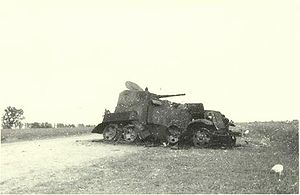 Throughout June, there were continuing reports of Soviet and Mongolian activity on both sides of the river near Nomonhan, and small-scale attacks on isolated Manchukoan units. At the end of the month, the commander of the Japanese 23rd ID, Lt. Gen. Michitarō Komatsubara
, was given permission to "expel the invaders". The Japanese plan was for a two-pronged assault. Three regiments plus part of a fourth, including three from the 23rd ID—the 71st and the 72nd Infantry Regiments, plus a battalion of the 64th Infantry Regiment—and the 26th Infantry Regiment under Colonel Shinichiro Sumi, "borrowed" from the 7th ID, would advance across the Khalkin Gol, destroy Soviet forces on Baintsagan Hill on the west bank, then make a left turn and advance south to the Kawatama Bridge. The second prong of the attack would be the task of the IJA 1st Tank Corps
(1st TC) (Yasuoka Detachment
), consisting of the 3rd and the 4th Tank Regiments, plus a part of the 64th Inf. Regiment, a battalion from the 28th Infantry Regiment, detached from the 7th ID, 24th Engineer Regiment, and a battalion from the 13th Field Artillery Regiment, under overall command of Lieutenant General Yasuoka Masaomi. This force would attack Soviet troops on the east bank of the Khalkhyn Gol and north of the Holsten River. The two Japanese thrusts would meet on the wings.
IJA
Lt. Gen. Yasuoka Masaomi, Cdr, 1st Tank Corps
The northern task force succeeded in crossing the Khalkhyn Gol, driving the Soviets from Baintsagan Hill, and advancing south along the west bank. However, Zhukov, perceiving the threat, launched a counterattack with 450 tanks and armored cars. The Soviet armored force, despite being unsupported by infantry, attacked the Japanese on three sides and nearly encircled them. The Japanese force, further handicapped by having only one pontoon bridge across the river for supplies, was forced to withdraw, recrossing the river on 5 July. Meanwhile, the 1st Tank Corps of the Yasuoka Detachment (the southern task force) attacked on the night of 2 July, moving in the darkness to avoid the Soviet artillery on the high ground of the river's west bank. A pitched battle ensued in which the Yasuoka Detachment lost over half its armor, but still could not break through the Soviet forces on the east bank and reach the Kawatama Bridge. After a Soviet counterattack on 9 July threw the battered, depleted Yasuoka Detachment back, it was dissolved and Yasuoka was relieved.
The two armies continued to spar with each other over the next two weeks along a four km (2.5 miles) front running along the east bank of the Khalkhyn Gol to its junction with the Holsten River. Zhukov, whose army was 748 km (464.8 mi) away from its base of supply, assembled a fleet of 2600 trucks to supply his troops, while the Japanese suffered severe supply problems due to a lack of similar motor transport. On 23 July, the Japanese launched another large-scale assault, sending the 64th and 72nd Infantry Regiments against Soviet forces defending the Kawatama Bridge. Japanese artillery supported the attack with a massive barrage that consumed more than half of their ammunition stores over a period of two days. The attack made some progress but failed to break through Soviet lines and reach the bridge. The Japanese disengaged from the attack on 25 July due to mounting casualties and depleted artillery stores. They had suffered over five thousand casualties to this point but still had 75,000 men and some hundred planes facing the Soviet forces. The battle drifted into stalemate.
tanks), two motorized infantry divisions, and over 550 fighters and bombers. The Mongolians committed two cavalry divisions.
By contrast, at the point of attack the Kwantung Army had only Lieutenant General Michitarō Komatsubara
's 23rd Infantry Division, which with attached forces was equivalent to
two light infantry divisions. Its headquarters had been at Hailar
, over 150 km from the site of the fighting. Japanese intelligence had also failed to detect the scale of the Soviet buildup or the scope of the imminent offensive.
Zhukov decided it was time to break the stalemate. On 20 August 1939, at 0545 hours (5:45AM) Soviet artillery and 557 fighters and bombers attacked Japanese positions, the first fighter/bomber offensive in Soviet Air Force
history. Approximately 50,000 Soviet and Mongolian troops of the 57th Special Corps defended the east bank of the Khalkhyn Gol
. Three infantry divisions and a tank brigade crossed the river, supported by massed artillery and the best planes of the Soviet Air Force. Once the Japanese were pinned down by the attack of Soviet center units, Soviet armored units swept around the flanks and attacked the Japanese in the rear, achieving a classic double envelopment. When the Soviet wings linked up at Nomonhan village on 25 August, the Japanese 23rd ID was trapped. On 26 August, a Japanese counterattack to relieve the 23rd ID failed. On 27 August, the 23rd ID attempted to break out of the encirclement, but also failed. When the surrounded forces refused to surrender, they were again hit with artillery and air attacks. By 31 August, the Japanese forces on the Soviet side of the border were destroyed, leaving remnants of the 23rd ID on the Manchurian side. The Soviet forces had achieved their objective.
The Japanese commander, Komatsubara, refused to accept the outcome of the battle, and prepared a counteroffensive. This was canceled when a cease-fire was signed in Moscow. While Zhukov defeated the Japanese forces from Soviet territory, Stalin had made a deal with Nazi Germany
. After the Soviet success at Nomonhan, Stalin
decided to proceed with the Molotov-Ribbentrop Pact
, which was announced on 24 August. Though World War II
broke out in Europe on 1 September, the Soviet Union had declared its neutrality there. This meant the Soviet Union could concentrate all its forces in the east if needed, and the Japanese position was clearly hopeless.
Stalin had no further ambitions in the east, so the Soviet Union and Japan agreed to a cease-fire on 15 September; it took effect the following day. With no threat of war in the Far East, Stalin proceeded with the Soviet invasion of Poland (1939)
on 17 September.
 Casualty estimates vary widely: Some sources say the Japanese suffered 45,000 or more soldiers killed with Soviet casualties of at least 17,000. The Japanese officially reported 8,440 killed and 8,766 wounded, while the Soviets initially claimed 9,284 total casualties. It is likely that figures published at the time were reduced for propaganda purposes. In recent years, with the opening of the Soviet archives, a more accurate assessment of Soviet casualties has emerged from the work of Grigoriy Krivosheev
, citing 7,974 killed and 15,251 wounded. Similar research into Japanese casualties has yet to take place.
Although this engagement is little-known in the West, it played a important part in the subsequent Japanese conduct of World War II, because it contributed to determine that the two principal Axis Powers
, Germany and Japan, would never geographically link up their areas of control through the Soviet Union. The defeat, together with other factors, lost the support of the Imperial General Staff in Tokyo for the policy of the North Strike Group, favoured by the Army, which wanted to seize Siberia as far as Lake Baikal
for its resources. Among others, these factors include the signing of the Nazi-Soviet non-aggression pact, that deprived the Army of the basis of its war policy against the USSR, and gained the fury of the Emperor with the Army, not so much due to its defeat, but because it initiated such an undeclared war without authorization. Now the South Strike Group, favored by the navy, which wanted to seize the resources of Southeast Asia, especially the petroleum and mineral-rich Dutch East Indies
, started to gain ascendancy. Because the European colonial powers were weak and being defeated in the war with Germany, coupled with their embargoes on Japan (especially of vital oil) in the second half of 1941, the result was the attack on Pearl Harbor, on December 7th of that year. Despite plans being carried out for war against the USSR, the Japanese would never make an offensive movement against the Soviet Union again. In 1941, the two countries signed agreements respecting the borders of Mongolia and Manchukuo and pledging neutrality towards each other. They remained at peace until the Soviet Union
declared war on Japan in August 1945, and attacked IJA forces stationed in Manchuria
, during the final weeks of the war.
It was the first victory for the soon-to-be-famous Soviet general Georgy Zhukov
, earning him the first of his four Hero of the Soviet Union
awards. The other generals Grigoriy Shtern and Yakov Smushkevich, whose roles were no less important and who also earned the Hero title, were forgotten. Zhukov himself was promoted and transferred west to the Kiev district. The battle experience gained by Zhukov was put to good use in December 1941 at the Battle of Moscow
. Zhukov was able to use this experience to launch the first successful Soviet counteroffensive against the German invasion of 1941. Many units of the Siberian and other trans-Ural armies were part of this attack, and the decision to move the divisions from Siberia was aided by the Soviet masterspy Richard Sorge
in Tokyo, who was able to alert the Soviet government that the Japanese were looking south and were unlikely to launch another attack against Siberia in the immediate future. A year after flinging the Germans back from Moscow, Zhukov planned and executed the Red Army's offensive at the Battle of Stalingrad
, using a technique very similar to Khalkhin Gol, in which the Soviet forces held the enemy fixed in the center, built up a mass of force in the area undetected, and launched a pincer attack on the wings to trap the enemy army.
 The Japanese, however, made no major strategic changes. They continued to underestimate their adversaries, deploying piecemeal units instead of mass units, emphasizing the courage and determination of the individual soldier to make up for the lack of firepower, protection, or overwhelming numbers. The problems that faced them at Khalkhin Gol, most importantly their deployment of only two light infantry
divisions, and two tank regiments, would plague them again when the Americans and British recovered from their defeats of late 1941 and early 1942 and turned to the conquest of the Japanese Empire.
At the International Military Tribunal for the Far East
, fourteen Japanese were charged with having "initiated a war of aggression . . . against the Mongolian People's Republic in the area of the Khalkhin-Gol River" and also with having waged a war "in violation of international law" against the USSR. Kenji Doihara
, Hiranuma Kiichirō, and Seishirō Itagaki were convicted on these charges.
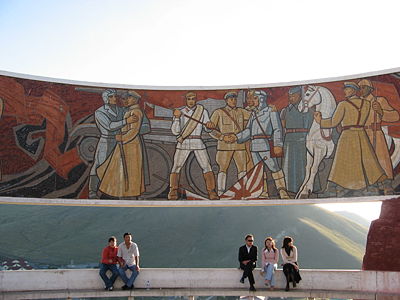
The Mongolian town of Choibalsan, in the Dornod aimag
(province) where the battle was fought, is the location of the "G.K. Zhukov Museum", dedicated to Zhukov and the 1939 battle. Ulaanbaatar, Mongolia also has a "G.K. Zhukov Museum" with information about the battle of Khalkhin Gol.
Soviet Union
The Soviet Union , officially the Union of Soviet Socialist Republics , was a constitutionally socialist state that existed in Eurasia between 1922 and 1991....
, Mongolia
Mongolia
Mongolia is a landlocked country in East and Central Asia. It is bordered by Russia to the north and China to the south, east and west. Although Mongolia does not share a border with Kazakhstan, its western-most point is only from Kazakhstan's eastern tip. Ulan Bator, the capital and largest...
and the Empire of Japan
Empire of Japan
The Empire of Japan is the name of the state of Japan that existed from the Meiji Restoration on 3 January 1868 to the enactment of the post-World War II Constitution of...
in 1939. The conflict was named after the river Khalkhyn Gol
Khalkhyn Gol
Halh River is a river in eastern Mongolia and Inner Mongolia in northern China.The river's source is in the Greater Khingan mountains of Inner Mongolia. By the mouth it splits into two distributaries. The left one feeds the Buir Lake and next via this lake continues as Orchun Gol...
, which passes through the battlefield. In Japan, the decisive battle of the conflict is known as the after a nearby village
Nomonhan
Nomonhan is a small village near the border between Mongolia and Inner Mongolia, China south of the Chinese city of Manzhouli.In the summer of 1939 it was the location of the Nomonhan Incident, as it is termed in Japan, or the Battle of Khalkhin Gol as it is known in Soviet and Mongolian People's...
on the border between Mongolia and Manchuria
Manchukuo
Manchukuo or Manshū-koku was a puppet state in Manchuria and eastern Inner Mongolia, governed under a form of constitutional monarchy. The region was the historical homeland of the Manchus, who founded the Qing Empire in China...
. The battles resulted in total defeat for the Japanese Sixth Army.
Background
After the occupation of ManchuriaManchuria
Manchuria is a historical name given to a large geographic region in northeast Asia. Depending on the definition of its extent, Manchuria usually falls entirely within the People's Republic of China, or is sometimes divided between China and Russia. The region is commonly referred to as Northeast...
, Japan turned its military interests to Soviet territories that bordered those areas. The first major Soviet-Japanese border incident, the Battle of Lake Khasan
Battle of Lake Khasan
The Battle of Lake Khasan and also known as the Changkufeng Incident in China and Japan, was an attempted military incursion of Manchukuo into the territory claimed by the Soviet Union...
, happened in 1938 in Primorye
Primorsky Krai
Primorsky Krai , informally known as Primorye , is a federal subject of Russia . Primorsky means "maritime" in Russian, hence the region is sometimes referred to as Maritime Province or Maritime Territory. Its administrative center is in the city of Vladivostok...
. Clashes between Japanese and Soviet forces frequently occurred on the border of Manchuria.
In 1939, Manchuria was a puppet state
Puppet state
A puppet state is a nominal sovereign of a state who is de facto controlled by a foreign power. The term refers to a government controlled by the government of another country like a puppeteer controls the strings of a marionette...
of Japan, known as Manchukuo
Manchukuo
Manchukuo or Manshū-koku was a puppet state in Manchuria and eastern Inner Mongolia, governed under a form of constitutional monarchy. The region was the historical homeland of the Manchus, who founded the Qing Empire in China...
. The Japanese maintained that the border between Manchukuo and the Mongolian People's Republic was the Khalkhyn Gol
Khalkhyn Gol
Halh River is a river in eastern Mongolia and Inner Mongolia in northern China.The river's source is in the Greater Khingan mountains of Inner Mongolia. By the mouth it splits into two distributaries. The left one feeds the Buir Lake and next via this lake continues as Orchun Gol...
(English "Khalkha River") which flows into Lake Buir. In contrast, the Mongolians and their Soviet
Soviet Union
The Soviet Union , officially the Union of Soviet Socialist Republics , was a constitutionally socialist state that existed in Eurasia between 1922 and 1991....
allies maintained that the border ran some 16 kilometres (9.9 mi) east of the river, just east of Nomonhan
Nomonhan
Nomonhan is a small village near the border between Mongolia and Inner Mongolia, China south of the Chinese city of Manzhouli.In the summer of 1939 it was the location of the Nomonhan Incident, as it is termed in Japan, or the Battle of Khalkhin Gol as it is known in Soviet and Mongolian People's...
village.
The principal occupying army of Manchukuo was the Kwantung Army of Japan, consisting of some of the best Japanese units in 1939. However, the western region of Manchukuo was garrisoned by the newly formed IJA
IJA
IJA can refer to:* Imperial Japanese Army* International Jugglers' Association* International Jousting Association* Instituto Justo Arosemena* The Internet Journal of Anesthesiology* International Judges Association* Empress Ija...
23rd Infantry Division (23rd ID) at Hailar
Hailar
Hailar may refer to:* Hailar River, part of the Russia-China border* Hailar District, district in Inner Mongolia, China...
, under General Michitarō Komatsubara
Michitaro Komatsubara
was a general in the Imperial Japanese Army, during the Nomonhan Incident.-Biography:A native of Yokohama in Kanagawa Prefecture, where his father was a naval engineer, Komatsubara graduated from the 18th class of the Imperial Japanese Army Academy in 1905. He served as a military attaché to Russia...
and included several Manchukuoan army and border guard units.
Soviet forces consisted of the 57th Special Corps, forward deployed from the Trans-Baikal Military District, responsible for defending the border between Siberia and Manchuria. The Mongolian troops mainly consisted of cavalry brigades and light artillery units, and proved to be effective and agile, but lacked armour and man power in sufficient numbers.
In 1939, the Japanese Cabinet sent instructions to the Kwantung Army to strengthen and fortify Manchukuo's borders with Mongolia and the Soviet Union. Additionally, the Kwantung Army, which had long been stationed in Manchuria far from the Japanese home islands, had become largely autonomous and did not need to seek approval from the Japanese government before acting aggressively against the Soviets.
May, June, and July actions
The incident began on 11 May 1939. A Mongolian cavalry unit of some 70–90 men had entered the disputed area in search of grazing for their horses. On that day, Manchukuoan cavalry attacked the Mongolians and drove them back across the Khalkhin Gol. On 13 May, the Mongolian force returned in greater numbers and the Manchukoans were unable to dislodge them.On 14 May, Lt. Col. Yaozo Azuma led the reconnaissance regiment of 23rd ID, supported by the 64th Infantry Regiment of the same division, under Colonel Takemitsu Yamagata, into the territory and the Mongolians withdrew. However, Soviet and Mongolian troops returned to the disputed region and Azuma's force again moved to evict them. This time things turned out differently, as the Soviet-Mongolian forces surrounded Azuma's force on 28 May and destroyed it. The Azuma force suffered eight officers and 97 men killed and one officer and 33 men wounded, for 63% total casualties. The commander of the Soviet forces and the Far East Front was Comandarm
Comandarm
Comandarm was a military rank in the Red Army until the end of the 1930s....
Grigori Shtern
Grigori Shtern
Grigori Mihailovich Shtern 1900, Smila, Kiev Governorate – 28 October 1941) was a Soviet officer in the Red Army and military advisor during the Spanish Civil War. He also served with distinction during the Soviet-Japanese Border Wars and the Winter War....
from May 1938.
Both sides began building up their forces in the area: soon Japan had 30,000 men in the theater. The Soviets dispatched a new Corps
Corps
A corps is either a large formation, or an administrative grouping of troops within an armed force with a common function such as Artillery or Signals representing an arm of service...
commander, Comcor
Comcor
Comcor was a military rank in the Red Army until the end of the 1930s....
Georgy Zhukov
Georgy Zhukov
Marshal of the Soviet Union Georgy Konstantinovich Zhukov , was a Russian career officer in the Red Army who, in the course of World War II, played a pivotal role in leading the Red Army through much of Eastern Europe to liberate the Soviet Union and other nations from the Axis Powers' occupation...
, who arrived on 5 June and brought more motorized and armored forces (I Army Group) to the combat zone. Together with Zhukov arrived Comcor Yakov Smushkevich with his aviation unit.
On 27 June, the Japanese launched an air attack. The IJAF 2nd Air Brigade (2nd AB) struck the Soviet air base at Tamsak-Bulak in Mongolia. The Japanese won this engagement, but the strike had been ordered by the Kwangtung Army without getting permission from Imperial Japanese Army
Imperial Japanese Army
-Foundation:During the Meiji Restoration, the military forces loyal to the Emperor were samurai drawn primarily from the loyalist feudal domains of Satsuma and Chōshū...
headquarters in Tokyo. In an effort to prevent the incident from escalating, Tokyo promptly ordered the Japanese Army Air Force to not conduct any more air strikes against Soviet airbases.
Michitaro Komatsubara
was a general in the Imperial Japanese Army, during the Nomonhan Incident.-Biography:A native of Yokohama in Kanagawa Prefecture, where his father was a naval engineer, Komatsubara graduated from the 18th class of the Imperial Japanese Army Academy in 1905. He served as a military attaché to Russia...
, was given permission to "expel the invaders". The Japanese plan was for a two-pronged assault. Three regiments plus part of a fourth, including three from the 23rd ID—the 71st and the 72nd Infantry Regiments, plus a battalion of the 64th Infantry Regiment—and the 26th Infantry Regiment under Colonel Shinichiro Sumi, "borrowed" from the 7th ID, would advance across the Khalkin Gol, destroy Soviet forces on Baintsagan Hill on the west bank, then make a left turn and advance south to the Kawatama Bridge. The second prong of the attack would be the task of the IJA 1st Tank Corps
Tank Corps
Tank Corps may refer to:* Tank Corps, later Royal Tank Corps, early name of the Royal Tank Regiment* Tank Corps , a type of Red Army formation used up to World War II...
(1st TC) (Yasuoka Detachment
Yasuoka Detachment
Yasuoka Detachment or Yasuoka Task Force, was an armored Japanese Imperial Army unit in 1939. It was commanded by Lt. General Yasuoka Masaomi, composed of 3rd Armored Regiment and 4th Armored Regiment, 64th Infantry Regiment/IJA 23rd Division, 2/28th Infantry Regiment/IJA 7th Division, the 2nd...
), consisting of the 3rd and the 4th Tank Regiments, plus a part of the 64th Inf. Regiment, a battalion from the 28th Infantry Regiment, detached from the 7th ID, 24th Engineer Regiment, and a battalion from the 13th Field Artillery Regiment, under overall command of Lieutenant General Yasuoka Masaomi. This force would attack Soviet troops on the east bank of the Khalkhyn Gol and north of the Holsten River. The two Japanese thrusts would meet on the wings.
IJA
IJA
IJA can refer to:* Imperial Japanese Army* International Jugglers' Association* International Jousting Association* Instituto Justo Arosemena* The Internet Journal of Anesthesiology* International Judges Association* Empress Ija...
Lt. Gen. Yasuoka Masaomi, Cdr, 1st Tank Corps
Tank Corps
Tank Corps may refer to:* Tank Corps, later Royal Tank Corps, early name of the Royal Tank Regiment* Tank Corps , a type of Red Army formation used up to World War II...
- 3rd Tank RegimentRegimentA regiment is a major tactical military unit, composed of variable numbers of batteries, squadrons or battalions, commanded by a colonel or lieutenant colonel...
- Type 89 I-GoType 89 I-GoThe was a medium tank used by the Imperial Japanese Army from 1932 to 1942 in combat operations of the Second Sino-Japanese War, at Khalkhin Gol against the Soviet Union, and in the Second World War. The Type 89B model was the world's first mass produced diesel engine tank...
medium tankMedium tankMedium tank was a classification of tanks; the medium being intermediate in size and weight and armament between heavy tanks and light tanks.The medium tank concept has been eclipsed by the main battle tank.-History:...
s - 26 - Type 97 Chi-HaType 97 Chi-HaThe was a medium tank used by the Imperial Japanese Army during the Second Sino-Japanese War, at Nomonhan against the Soviet Union, and in the Second World War. It was the most widely produced Japanese medium tank of World War II, although the armor protection was considered as average in the 1930s...
medium tanks - 4 - Type 94 tankettes - 7
- Type 97 Te-KeType 97 Te-KeThe was a tankette used by the Imperial Japanese Army in the Second Sino-Japanese War, at Nomonhan against the Soviet Union, and in World War II. It was designed as a fast reconnaissance vehicle, and was a replacement for the earlier Type 94 TK....
tankettes - 4
- Type 89 I-Go
- 4th Tank Regiment
- Type 95 Ha-GoType 95 Ha-GoThe was a light tank used by the Imperial Japanese Army in combat operations of the Second Sino-Japanese War, at Nomonhan against the Soviet Union, and in the Second World War. It proved sufficient against infantry, however, like the American M3 Stuart, it was not designed to fight other tanks...
light tanks - 35 - Type 89 I-GoType 89 I-GoThe was a medium tank used by the Imperial Japanese Army from 1932 to 1942 in combat operations of the Second Sino-Japanese War, at Khalkhin Gol against the Soviet Union, and in the Second World War. The Type 89B model was the world's first mass produced diesel engine tank...
medium tanks - 8 - Type 94 tankettes - 3
- Type 95 Ha-Go
The northern task force succeeded in crossing the Khalkhyn Gol, driving the Soviets from Baintsagan Hill, and advancing south along the west bank. However, Zhukov, perceiving the threat, launched a counterattack with 450 tanks and armored cars. The Soviet armored force, despite being unsupported by infantry, attacked the Japanese on three sides and nearly encircled them. The Japanese force, further handicapped by having only one pontoon bridge across the river for supplies, was forced to withdraw, recrossing the river on 5 July. Meanwhile, the 1st Tank Corps of the Yasuoka Detachment (the southern task force) attacked on the night of 2 July, moving in the darkness to avoid the Soviet artillery on the high ground of the river's west bank. A pitched battle ensued in which the Yasuoka Detachment lost over half its armor, but still could not break through the Soviet forces on the east bank and reach the Kawatama Bridge. After a Soviet counterattack on 9 July threw the battered, depleted Yasuoka Detachment back, it was dissolved and Yasuoka was relieved.
The two armies continued to spar with each other over the next two weeks along a four km (2.5 miles) front running along the east bank of the Khalkhyn Gol to its junction with the Holsten River. Zhukov, whose army was 748 km (464.8 mi) away from its base of supply, assembled a fleet of 2600 trucks to supply his troops, while the Japanese suffered severe supply problems due to a lack of similar motor transport. On 23 July, the Japanese launched another large-scale assault, sending the 64th and 72nd Infantry Regiments against Soviet forces defending the Kawatama Bridge. Japanese artillery supported the attack with a massive barrage that consumed more than half of their ammunition stores over a period of two days. The attack made some progress but failed to break through Soviet lines and reach the bridge. The Japanese disengaged from the attack on 25 July due to mounting casualties and depleted artillery stores. They had suffered over five thousand casualties to this point but still had 75,000 men and some hundred planes facing the Soviet forces. The battle drifted into stalemate.
August: Zhukov's strike
The Japanese regrouped, and planned a third major offensive against the Soviets for 24 August. However, with war apparently imminent in Europe, Zhukov planned a major offensive on 20 August, to clear the Japanese from the Khalkhin Gol region and end the fighting. Zhukov assembled a powerful armored force of three tank brigades (the 4th, 6th and 11th), and two mechanized brigades (the 7th and 8th, which were armored car units with attached infantry support). This force was allocated to the Soviet left and right wings. The entire Soviet force consisted of three rifle divisions, two tank divisions and two more tank brigades (in all, some 498 BT-5 and BT-7BT-7
The BT-7 was the last of the BT tank series of Soviet cavalry tanks that were produced in large numbers between 1935 and 1940. They were lightly armoured, but reasonably well-armed for their time, and had much better mobility than other contemporary tank designs...
tanks), two motorized infantry divisions, and over 550 fighters and bombers. The Mongolians committed two cavalry divisions.
By contrast, at the point of attack the Kwantung Army had only Lieutenant General Michitarō Komatsubara
Michitaro Komatsubara
was a general in the Imperial Japanese Army, during the Nomonhan Incident.-Biography:A native of Yokohama in Kanagawa Prefecture, where his father was a naval engineer, Komatsubara graduated from the 18th class of the Imperial Japanese Army Academy in 1905. He served as a military attaché to Russia...
's 23rd Infantry Division, which with attached forces was equivalent to
two light infantry divisions. Its headquarters had been at Hailar
Hailar
Hailar may refer to:* Hailar River, part of the Russia-China border* Hailar District, district in Inner Mongolia, China...
, over 150 km from the site of the fighting. Japanese intelligence had also failed to detect the scale of the Soviet buildup or the scope of the imminent offensive.
Zhukov decided it was time to break the stalemate. On 20 August 1939, at 0545 hours (5:45AM) Soviet artillery and 557 fighters and bombers attacked Japanese positions, the first fighter/bomber offensive in Soviet Air Force
Soviet Air Force
The Soviet Air Force, officially known in Russian as Военно-воздушные силы or Voenno-Vozdushnye Sily and often abbreviated VVS was the official designation of one of the air forces of the Soviet Union. The other was the Soviet Air Defence Forces...
history. Approximately 50,000 Soviet and Mongolian troops of the 57th Special Corps defended the east bank of the Khalkhyn Gol
Khalkhyn Gol
Halh River is a river in eastern Mongolia and Inner Mongolia in northern China.The river's source is in the Greater Khingan mountains of Inner Mongolia. By the mouth it splits into two distributaries. The left one feeds the Buir Lake and next via this lake continues as Orchun Gol...
. Three infantry divisions and a tank brigade crossed the river, supported by massed artillery and the best planes of the Soviet Air Force. Once the Japanese were pinned down by the attack of Soviet center units, Soviet armored units swept around the flanks and attacked the Japanese in the rear, achieving a classic double envelopment. When the Soviet wings linked up at Nomonhan village on 25 August, the Japanese 23rd ID was trapped. On 26 August, a Japanese counterattack to relieve the 23rd ID failed. On 27 August, the 23rd ID attempted to break out of the encirclement, but also failed. When the surrounded forces refused to surrender, they were again hit with artillery and air attacks. By 31 August, the Japanese forces on the Soviet side of the border were destroyed, leaving remnants of the 23rd ID on the Manchurian side. The Soviet forces had achieved their objective.
The Japanese commander, Komatsubara, refused to accept the outcome of the battle, and prepared a counteroffensive. This was canceled when a cease-fire was signed in Moscow. While Zhukov defeated the Japanese forces from Soviet territory, Stalin had made a deal with Nazi Germany
Nazi Germany
Nazi Germany , also known as the Third Reich , but officially called German Reich from 1933 to 1943 and Greater German Reich from 26 June 1943 onward, is the name commonly used to refer to the state of Germany from 1933 to 1945, when it was a totalitarian dictatorship ruled by...
. After the Soviet success at Nomonhan, Stalin
Joseph Stalin
Joseph Vissarionovich Stalin was the Premier of the Soviet Union from 6 May 1941 to 5 March 1953. He was among the Bolshevik revolutionaries who brought about the October Revolution and had held the position of first General Secretary of the Communist Party of the Soviet Union's Central Committee...
decided to proceed with the Molotov-Ribbentrop Pact
Molotov-Ribbentrop Pact
The Molotov–Ribbentrop Pact, named after the Soviet foreign minister Vyacheslav Molotov and the German foreign minister Joachim von Ribbentrop, was an agreement officially titled the Treaty of Non-Aggression between Germany and the Soviet Union and signed in Moscow in the late hours of 23 August 1939...
, which was announced on 24 August. Though World War II
World War II
World War II, or the Second World War , was a global conflict lasting from 1939 to 1945, involving most of the world's nations—including all of the great powers—eventually forming two opposing military alliances: the Allies and the Axis...
broke out in Europe on 1 September, the Soviet Union had declared its neutrality there. This meant the Soviet Union could concentrate all its forces in the east if needed, and the Japanese position was clearly hopeless.
Stalin had no further ambitions in the east, so the Soviet Union and Japan agreed to a cease-fire on 15 September; it took effect the following day. With no threat of war in the Far East, Stalin proceeded with the Soviet invasion of Poland (1939)
Soviet invasion of Poland (1939)
The 1939 Soviet invasion of Poland was a Soviet military operation that started without a formal declaration of war on 17 September 1939, during the early stages of World War II. Sixteen days after Nazi Germany invaded Poland from the west, the Soviet Union did so from the east...
on 17 September.
Aftermath
Grigoriy Krivosheev
Grigoriy Fedotovich Krivosheyev , is a Russian military historian and a retired Colonel General of the Russian military. He is mostly known in the West via an alternative transliteration of his name Krivosheev, as the editor of a book on Soviet military losses in the 20th century, which was...
, citing 7,974 killed and 15,251 wounded. Similar research into Japanese casualties has yet to take place.
Although this engagement is little-known in the West, it played a important part in the subsequent Japanese conduct of World War II, because it contributed to determine that the two principal Axis Powers
Axis Powers
The Axis powers , also known as the Axis alliance, Axis nations, Axis countries, or just the Axis, was an alignment of great powers during the mid-20th century that fought World War II against the Allies. It began in 1936 with treaties of friendship between Germany and Italy and between Germany and...
, Germany and Japan, would never geographically link up their areas of control through the Soviet Union. The defeat, together with other factors, lost the support of the Imperial General Staff in Tokyo for the policy of the North Strike Group, favoured by the Army, which wanted to seize Siberia as far as Lake Baikal
Lake Baikal
Lake Baikal is the world's oldest at 30 million years old and deepest lake with an average depth of 744.4 metres.Located in the south of the Russian region of Siberia, between Irkutsk Oblast to the northwest and the Buryat Republic to the southeast, it is the most voluminous freshwater lake in the...
for its resources. Among others, these factors include the signing of the Nazi-Soviet non-aggression pact, that deprived the Army of the basis of its war policy against the USSR, and gained the fury of the Emperor with the Army, not so much due to its defeat, but because it initiated such an undeclared war without authorization. Now the South Strike Group, favored by the navy, which wanted to seize the resources of Southeast Asia, especially the petroleum and mineral-rich Dutch East Indies
Dutch East Indies
The Dutch East Indies was a Dutch colony that became modern Indonesia following World War II. It was formed from the nationalised colonies of the Dutch East India Company, which came under the administration of the Netherlands government in 1800....
, started to gain ascendancy. Because the European colonial powers were weak and being defeated in the war with Germany, coupled with their embargoes on Japan (especially of vital oil) in the second half of 1941, the result was the attack on Pearl Harbor, on December 7th of that year. Despite plans being carried out for war against the USSR, the Japanese would never make an offensive movement against the Soviet Union again. In 1941, the two countries signed agreements respecting the borders of Mongolia and Manchukuo and pledging neutrality towards each other. They remained at peace until the Soviet Union
Soviet Union
The Soviet Union , officially the Union of Soviet Socialist Republics , was a constitutionally socialist state that existed in Eurasia between 1922 and 1991....
declared war on Japan in August 1945, and attacked IJA forces stationed in Manchuria
Manchuria
Manchuria is a historical name given to a large geographic region in northeast Asia. Depending on the definition of its extent, Manchuria usually falls entirely within the People's Republic of China, or is sometimes divided between China and Russia. The region is commonly referred to as Northeast...
, during the final weeks of the war.
It was the first victory for the soon-to-be-famous Soviet general Georgy Zhukov
Georgy Zhukov
Marshal of the Soviet Union Georgy Konstantinovich Zhukov , was a Russian career officer in the Red Army who, in the course of World War II, played a pivotal role in leading the Red Army through much of Eastern Europe to liberate the Soviet Union and other nations from the Axis Powers' occupation...
, earning him the first of his four Hero of the Soviet Union
Hero of the Soviet Union
The title Hero of the Soviet Union was the highest distinction in the Soviet Union, awarded personally or collectively for heroic feats in service to the Soviet state and society.-Overview:...
awards. The other generals Grigoriy Shtern and Yakov Smushkevich, whose roles were no less important and who also earned the Hero title, were forgotten. Zhukov himself was promoted and transferred west to the Kiev district. The battle experience gained by Zhukov was put to good use in December 1941 at the Battle of Moscow
Battle of Moscow
The Battle of Moscow is the name given by Soviet historians to two periods of strategically significant fighting on a sector of the Eastern Front during World War II. It took place between October 1941 and January 1942. The Soviet defensive effort frustrated Hitler's attack on Moscow, capital of...
. Zhukov was able to use this experience to launch the first successful Soviet counteroffensive against the German invasion of 1941. Many units of the Siberian and other trans-Ural armies were part of this attack, and the decision to move the divisions from Siberia was aided by the Soviet masterspy Richard Sorge
Richard Sorge
Richard Sorge was a German communist and spy who worked for the Soviet Union. He has gained great fame among espionage enthusiasts for his intelligence gathering during World War II. He worked as a journalist in both Germany and Japan, where he was imprisoned for spying and eventually hanged....
in Tokyo, who was able to alert the Soviet government that the Japanese were looking south and were unlikely to launch another attack against Siberia in the immediate future. A year after flinging the Germans back from Moscow, Zhukov planned and executed the Red Army's offensive at the Battle of Stalingrad
Battle of Stalingrad
The Battle of Stalingrad was a major battle of World War II in which Nazi Germany and its allies fought the Soviet Union for control of the city of Stalingrad in southwestern Russia. The battle took place between 23 August 1942 and 2 February 1943...
, using a technique very similar to Khalkhin Gol, in which the Soviet forces held the enemy fixed in the center, built up a mass of force in the area undetected, and launched a pincer attack on the wings to trap the enemy army.
Light infantry
Traditionally light infantry were soldiers whose job was to provide a skirmishing screen ahead of the main body of infantry, harassing and delaying the enemy advance. Light infantry was distinct from medium, heavy or line infantry. Heavy infantry were dedicated primarily to fighting in tight...
divisions, and two tank regiments, would plague them again when the Americans and British recovered from their defeats of late 1941 and early 1942 and turned to the conquest of the Japanese Empire.
At the International Military Tribunal for the Far East
International Military Tribunal for the Far East
The International Military Tribunal for the Far East , also known as the Tokyo Trials, the Tokyo War Crimes Tribunal, or simply the Tribunal, was convened on April 29, 1946, to try the leaders of the Empire of Japan for three types of crimes: "Class A" crimes were reserved for those who...
, fourteen Japanese were charged with having "initiated a war of aggression . . . against the Mongolian People's Republic in the area of the Khalkhin-Gol River" and also with having waged a war "in violation of international law" against the USSR. Kenji Doihara
Kenji Doihara
was a general in the Imperial Japanese Army in World War II. He was instrumental in the Japanese invasion of Manchuria for which he earned fame taking the nickname 'Lawrence of Manchuria', a reference to the Lawrence of Arabia....
, Hiranuma Kiichirō, and Seishirō Itagaki were convicted on these charges.
The Mongolian town of Choibalsan, in the Dornod aimag
Dornod Province
Dornod is the easternmost of the 21 aimags of Mongolia. Its capital is Choibalsan.- Population :Halh are the ethnic majority of the Dornod aimag, but Buryat ethnic group is 22.8% of population total concentrated in the north-eastern sums of Dashbalbar, Tsagaan-Ovoo, Bayan-Uul, Bayandun and...
(province) where the battle was fought, is the location of the "G.K. Zhukov Museum", dedicated to Zhukov and the 1939 battle. Ulaanbaatar, Mongolia also has a "G.K. Zhukov Museum" with information about the battle of Khalkhin Gol.
External links
- "LIFE" magazine article on combat at Khalkhin Gol, Aug. 7, 1939
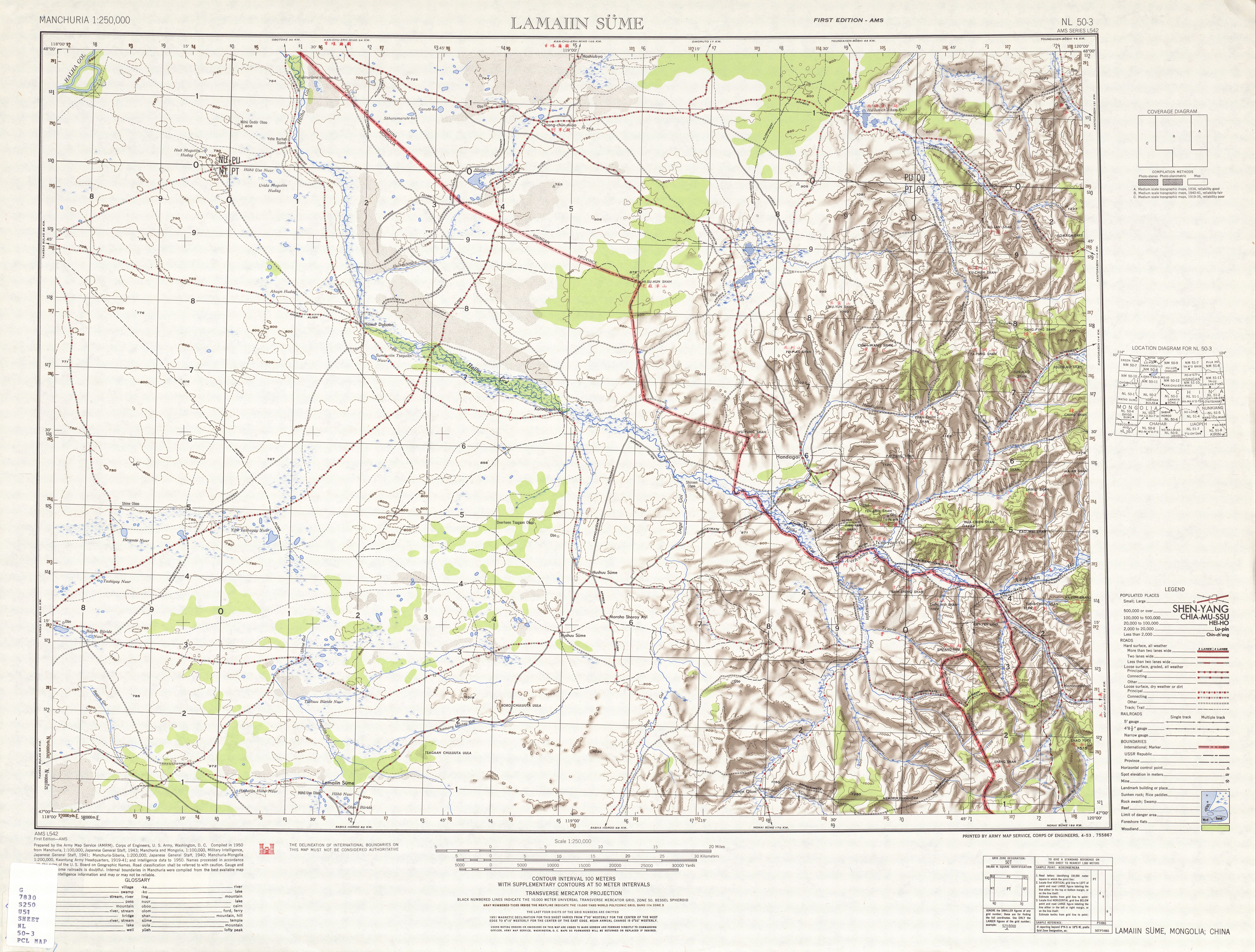
- Topographic Map of the Khalkhin Gol battle area
- Videos of the Nomonhan War Museum
- Warbird Forum – Japan vs. Russia, 1939
- "On the Road to Khalkhin Gol", Part 1 and Part 2, by Henry Sakaida