

1956 Hungarian Revolution

Encyclopedia
The Hungarian Revolution or Uprising of 1956 was a spontaneous nationwide revolt against the government of the People's Republic of Hungary
and its Soviet
-imposed policies, lasting from 23 October until 10 November 1956.
The revolt began as a student demonstration which attracted thousands as it marched through central Budapest
to the Parliament building
. A student delegation entering the radio building
in an attempt to broadcast its demands
was detained. When the delegation's release was demanded by the demonstrators outside, they were fired upon by the State Security Police
(ÁVH) from within the building. The news spread quickly and disorder and violence erupted throughout the capital.
The revolt spread quickly across Hungary
, and the government fell. Thousands organized into militias, battling the State Security Police (ÁVH) and Soviet troops
. Pro-Soviet communists and ÁVH members were often executed or imprisoned, as former prisoners were released and armed. Impromptu councils
wrested municipal control from the ruling Hungarian Working People's Party and demanded political changes. The new government formally disbanded the ÁVH, declared its intention to withdraw from the Warsaw Pact
and pledged to re-establish free elections. By the end of October, fighting had almost stopped and a sense of normality began to return.
After announcing a willingness to negotiate a withdrawal of Soviet forces, the Politburo
changed its mind and moved to crush the revolution. On 4 November, a large Soviet force invaded Budapest and other regions of the country. Hungarian resistance continued until 10 November. Over 2,500 Hungarians and 700 Soviet troops were killed in the conflict, and 200,000 Hungarians fled as refugees. Mass arrests and denunciations continued for months thereafter. By January 1957, the new Soviet-installed government had suppressed all public opposition. These Soviet actions alienated many Western Marxists
, yet strengthened Soviet control over Central Europe.
Public discussion about this revolution was suppressed in Hungary for over 30 years, but since the thaw of the 1980s it has been a subject of intense study and debate. At the inauguration of the Third Hungarian Republic
in 1989, October 23 was declared a national holiday.
, thereby being allied with the fascist forces of Nazi Germany
, Fascist Italy
, Romania
and Bulgaria
. As a part of this, in 1941, the Hungarian military participated
in the occupation of Yugoslavia
and the invasion of the Soviet Union
, joining the Axis powers. The Soviet army was however able to force back the Hungarian and other Axis invaders, and by 1944, Soviet armies themselves were advancing towards Hungary. Fearing invasion, the Hungarian government began armistice negotiations with the Allies, but these were ended when Nazi Germany invaded and occupied
the country and set up their own pro-Axis regime. Both Hungarian and German forces stationed in Hungary were subsequently defeated when the Soviet Union invaded the country in 1945.
occupied Hungary, with the country coming under the Soviet Union's sphere of influence
. At the time, Hungary was a multiparty democracy, and elections in 1945
produced a coalition government
under Prime Minister Zoltán Tildy
. However, the Hungarian Communist Party
, a Marxist-Leninist group who shared the Soviet government's ideological beliefs, constantly wrested small concessions in a process named "salami tactics
", which sliced away the elected government's influence, despite the fact that had only received 17% of the vote.
After the elections of 1945, the portfolio of the Interior Ministry — which oversaw the Hungarian State Security Police
(Államvédelmi Hatóság, later known as the ÁVH) — was forcibly transferred from the Independent Smallholders Party to a nominee of the Communist Party. The ÁVH employed methods of intimidation
, false accusations, imprisonment and torture
, to suppress political opposition. The brief period of multiparty democracy
came to an end when the Communist Party merged with the Social Democratic Party
to become the Hungarian Working People's Party, which stood its candidate list unopposed in 1949. The People's Republic of Hungary
was then declared. By 1949, the Soviets had concluded a mutual assistance treaty
with Hungary which granted the Soviet Union rights to a continued military presence, assuring ultimate political control.
Being revolutionary socialists
, the Hungarian Communist Party set about to replace the capitalist
economy with a socialist
one, and as a part of this undertook radical nationalization
based on the Soviet model. This however produced economic stagnation, lower standards of living and a deep malaise. Writers and journalists were the first to voice open criticism of the government and its policies, publishing critical articles in 1955. By 22 October 1956, Technical University students had resurrected the banned MEFESZ student union
, and staged a demonstration on 23 October which set off a chain of events leading directly to the revolution.
under the severely authoritarian leadership of Mátyás Rákosi
. The Security Police (ÁVH) began a series of purges of more than 7000 dissidents, who were denounced as "Titoists
" or "western agents", and forced to confess in show trials, after which they were relocated to a camp in eastern Hungary.
From 1950 to 1952, the Security Police forcibly relocated thousands of people to obtain property and housing for the Working People's Party members, and to remove the threat of the intellectual and 'bourgeois' class. Thousands were arrested, tortured, tried, and imprisoned in concentration camps, deported to the east
, or were executed, including ÁVH founder László Rajk. In a single year, more than 26,000 people were forcibly relocated from Budapest. As a consequence, jobs and housing were very difficult to obtain. The deportees generally experienced terrible living conditions and were impressed as slave labor on collective farms. Many died as a result of the poor living conditions and malnutrition.
The Rákosi government thoroughly politicized Hungary's educational system to supplant the educated classes with a "toiling intelligentsia". Russian language study and Communist political instruction were made mandatory in schools and universities nationwide. Religious schools were nationalized and church leaders were replaced by those loyal to the government. In 1949 the leader of the Hungarian Catholic Church, Cardinal József Mindszenty, was arrested and sentenced to life imprisonment for treason. Under Rákosi, Hungary's government was among the most repressive in Europe.
The postwar Hungarian economy suffered from multiple challenges. Hungary agreed to pay war reparations
approximating US$300 million, to the Soviet Union, Czechoslovakia, and Yugoslavia, and to support Soviet garrisons. The Hungarian National Bank
in 1946 estimated the cost of reparations as "between 19 and 22 per cent of the annual national income." In 1946, the Hungarian currency
experienced marked depreciation
, resulting in the highest historic rates of hyperinflation
known. Hungary's participation in the Soviet-sponsored COMECON
(Council Of Mutual Economic Assistance), prevented it from trading with the West
or receiving Marshall Plan
aid.
Although national income per capita rose in the first third of the 1950s, the standard of living fell. Huge income deductions to finance industrial investment reduced disposable personal income; mismanagement created chronic shortages in basic foodstuffs resulting in rationing of bread, sugar, flour and meat. Compulsory subscriptions to state bonds further reduced personal income. The net result was that disposable real income of workers and employees in 1952 was only two-thirds of what it had been in 1938, whereas in 1949, the proportion had been 90 per cent. These policies had a cumulative negative effect, and fueled discontent as foreign debt grew and the population experienced shortages of goods.
died, ushering in a period of moderate liberalization during which most European communist parties developed a reform wing. In Hungary, the reformist Imre Nagy
replaced Mátyás Rákosi, "Stalin's Best Hungarian Disciple", as Prime Minister. However, Rákosi remained General Secretary of the Party, and was able to undermine most of Nagy's reforms. By April 1955, he had Nagy discredited and removed from office. After Khrushchev's
"secret speech"
of February 1956, which denounced Stalin and his protégés, Rákosi was deposed as General Secretary of the Party and replaced by Ernő Gerő
on 18 July 1956.
On 14 May 1955, the Soviet Union created the Warsaw Pact
, binding Hungary to the Soviet Union and its satellite state
s in Central and Eastern Europe. Among the principles of this alliance were "respect for the independence and sovereignty of states" and "noninterference in their internal affairs".
In 1955, the Austrian State Treaty
and ensuing declaration of neutrality established Austria as a demilitarized and neutral country. This raised Hungarian hopes of also becoming neutral and in 1955 Nagy had considered "...the possibility of Hungary adopting a neutral status on the Austrian pattern".
In June 1956, a violent uprising by Polish workers
in Poznań
was put down by the government, with scores of protesters killed and wounded. Responding to popular demand, in October 1956, the government appointed the recently rehabilitated
reformist communist Władysław Gomułka as First Secretary of the Polish United Workers' Party
, with a mandate to negotiate trade concessions and troop reductions with the Soviet government. After a few tense days of negotiations, on 19 October the Soviets finally gave in to Gomułka's reformist demands. News of the concessions won by the Poles—known as Polish October
—emboldened many Hungarians to hope for similar concessions for Hungary and these sentiments contributed significantly to the highly charged political climate that prevailed in Hungary in the second half of October 1956.
Within the Cold War
context of the time, by 1956 a fundamental tension had appeared in U.S. policy towards Hungary and the Eastern Bloc
generally. The United States both hoped to encourage East European countries to break away from the bloc through their own efforts, but also wished to avoid a U.S.-Soviet military confrontation, fearing escalation into nuclear war. For these reasons, U.S. policy makers had to consider other means of diminishing Soviet influence in Eastern Europe, short of a rollback
policy. This led to the development of containment
policies such as economic and psychological warfare, covert operations, and, at a later stage, negotiation with the Soviet Union regarding the status of the East-bloc states. In the summer of 1956, relations between Hungary and the U.S. began to improve. At that time, the U.S. responded very favorably to Hungary's overtures about a possible expansion of bilateral trade relations. Hungary's desire for better relations was partly attributable to the country's catastrophic economic situation. Before any results could be achieved, however, the pace of negotiations was slowed by the Hungarian Ministry of Internal Affairs, which feared that better relations with the West might weaken Communist rule in Hungary.
circles, became very popular and attracted thousands of participants. On 6 October 1956, László Rajk
, who had been executed by the Rákosi government, was reburied in a moving ceremony which strengthened the party opposition.
On 16 October 1956, university students in Szeged
snubbed the official communist student union, the DISZ, by re-establishing the MEFESZ (Union of Hungarian University and Academy Students), a democratic student organization, previously banned under the Rákosi dictatorship. Within days, the student bodies of Pécs
, Miskolc
, and Sopron
followed suit. On 22 October, students of the Technical University
compiled a list of sixteen points
containing several national policy demands. After the students heard that the Hungarian Writers’ Union
planned on the following day to express solidarity with pro-reform movements in Poland by laying a wreath at the statue of Polish-born General Bem
, a hero of the Hungarian Revolution of 1848
(1848–49), the students decided to organize a parallel demonstration of sympathy.
 On the afternoon of 23 October 1956, approximately 20,000 protesters convened next to the statue of Józef Bem
- a national hero of Poland and Hungary. Péter Veres
, President of the Writers’ Union, read a manifesto to the crowd, the students read their proclamation, and the crowd then chanted the censored patriotic poem the "National Song
", which refrains: "This we swear, this we swear, that we will no longer be slaves." Someone in the crowd cut out the communist coat of arms from the Hungarian flag, leaving a distinctive hole and others quickly followed suit.
Afterwards, most of the crowd crossed the Danube to join demonstrators outside the Parliament Building. By 6 p.m., the multitude had swollen to more than 200,000 people; the demonstration was spirited, but peaceful.
At 8 p.m., First Secretary Ernő Gerő
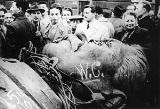
broadcast a speech condemning the writers' and students' demands. Angered by Gerő's hard-line rejection, some demonstrators decided to carry out one of their demands - the removal of Stalin's 30 feet (9.1 m) bronze statue
that was erected in 1951 on the site of a church, which was demolished to make room for the Stalin monument. By 9:30 p.m. the statue was toppled and jubilant crowds celebrated by placing Hungarian flags
in Stalin's boots, which was all that was left of the statue.
At about the same time, a large crowd gathered at the Radio Budapest building, which was heavily guarded by the ÁVH. The flash point was reached as a delegation attempting to broadcast their demands was detained and the crowd grew increasingly unruly as rumors spread that the protesters had been shot. Tear gas was thrown from the upper windows and the ÁVH opened fire on the crowd, killing many. The ÁVH tried to re-supply itself by hiding arms inside an ambulance, but the crowd detected the ruse and intercepted it. Hungarian soldiers sent to relieve the ÁVH hesitated and then, tearing the red stars from their caps, sided with the crowd. Provoked by the ÁVH attack, protesters reacted violently. Police cars were set ablaze, guns were seized from military depots and distributed to the masses and symbols of the communist regime were vandalized.
, Soviet tanks entered Budapest.
By noon on 24 October, Soviet tanks were stationed outside the Parliament building and Soviet soldiers guarded key bridges and crossroads. Armed revolutionaries quickly set up barricades to defend Budapest, and were reported to have already captured some Soviet tanks by mid-morning. That day, Imre Nagy replaced András Hegedüs
as Prime Minister. On the radio, Nagy called for an end to violence and promised to initiate political reforms which had been shelved three years earlier. The population continued to arm itself as sporadic violence erupted. Armed protesters seized the radio building. At the offices of the Communist newspaper Szabad Nép unarmed demonstrators were fired upon by ÁVH guards who were then driven out as armed demonstrators arrived. At this point, the revolutionaries' wrath focused on the ÁVH; Soviet military units were not yet fully engaged, and there were many reports of some Soviet troops showing open sympathy for the demonstrators.
On 25 October, a mass of protesters gathered in front of the Parliament Building. ÁVH units began shooting into the crowd from the rooftops of neighboring buildings. Some Soviet soldiers returned fire on the ÁVH, mistakenly believing that they were the targets of the shooting. Supplied by arms taken from the ÁVH or given by Hungarian soldiers who joined the uprising, some in the crowd started shooting back.
The attacks at the Parliament forced the collapse of the government. Communist First Secretary Ernő Gerő and former Prime Minister András Hegedüs
fled to the Soviet Union; Imre Nagy
became Prime Minister and János Kádár
First Secretary of the Communist Party. Revolutionaries began an aggressive offensive against Soviet troops and the remnants of the ÁVH.
As the Hungarian resistance fought Soviet tanks using Molotov cocktails in the narrow streets of Budapest, revolutionary councils
arose nationwide, assumed local governmental authority, and called for general strikes. Public Communist symbols such as red star
s and Soviet war memorials were removed, and Communist books were burned. Spontaneous revolutionary militias arose, such as the 400-man group loosely led by József Dudás
, which attacked or murdered Soviet sympathizers and ÁVH members. Soviet units fought primarily in Budapest; elsewhere the countryside was largely quiet. One armored division stationed in Budapest, commanded by Pál Maléter
, instead opted to join the insurgents. Soviet commanders often negotiated local cease-fires with the revolutionaries. In some regions, Soviet forces managed to quell revolutionary activity. In Budapest, the Soviets were eventually fought to a stand-still and hostilities began to wane. Hungarian general Béla Király
, freed from a life sentence for political offenses and acting with the support of the Nagy government, sought to restore order by unifying elements of the police, army and insurgent groups into a National Guard. A ceasefire was arranged on 28 October, and by 30 October most Soviet troops had withdrawn from Budapest to garrisons in the Hungarian countryside.
. Many political prisoners were released, most notably Cardinal József Mindszenty. Political parties which were previously banned, such as the Independent Smallholders
and the National Peasants' Party, reappeared to join the coalition.
Local revolutionary councils
formed throughout Hungary, generally without involvement from the preoccupied National Government in Budapest, and assumed various responsibilities of local government from the defunct communist party. By 30 October, these councils had been officially sanctioned by the Hungarian Working People's Party, and the Nagy government asked for their support as "autonomous, democratic local organs formed during the Revolution". Likewise, workers' councils were established at industrial plants and mines, and many unpopular regulations such as production norms were eliminated. The workers' councils strove to manage the enterprise whilst protecting workers' interests, thus establishing a socialist economy free of rigid party control. Local control by the councils was not always bloodless; in Debrecen
, Győr
, Sopron
, Mosonmagyaróvár
and other cities, crowds of demonstrators were fired upon by the ÁVH, with many lives lost. The ÁVH were disarmed, often by force, in many cases assisted by the local police.
(the Politburo) discussed the political upheavals in Poland
and Hungary. A hard-line faction led by Molotov
was pushing for intervention, but Khrushchev and Marshal Zhukov
were initially opposed. A delegation in Budapest reported that the situation was not as dire as had been portrayed. Khrushchev stated that he believed that Party Secretary Ernő Gerő's request for intervention on 23 October indicated that the Hungarian Party still held the confidence of the Hungarian public. In addition, he saw the protests not as an ideological struggle, but as popular discontent over unresolved basic economic and social issues.
After some debate, the Presidium on 30 October decided not to remove the new Hungarian government. Even Marshal Georgy Zhukov
said: "We should withdraw troops from Budapest, and if necessary withdraw from Hungary as a whole. This is a lesson for us in the military-political sphere." They adopted a Declaration of the Government of the USSR on the Principles of Development and Further Strengthening of Friendship and Cooperation between the Soviet Union and other Socialist States, which was issued the next day. This document proclaimed: "The Soviet Government is prepared to enter into the appropriate negotiations with the government of the Hungarian People's Republic and other members of the Warsaw Treaty on the question of the presence of Soviet troops on the territory of Hungary." Thus for a brief moment it looked like there could be a peaceful solution.
On 30 October, armed protestors attacked the ÁVH detachment guarding the Budapest Hungarian Working People's Party headquarters on Köztársaság tér (Republic Square), incited by rumors of prisoners held there, and the earlier shootings of demonstrators by the ÁVH in the city of Mosonmagyaróvár. Over 20 ÁVH officers were killed, some of them lynched by the mob. Hungarian army tanks sent to rescue the party headquarters mistakenly bombarded the building. The head of the Budapest party committee, Imre Mező, was wounded and later died. Scenes from Republic Square were shown on Soviet newsreels a few hours later. Revolutionary leaders in Hungary condemned the incident and appealed for calm, and the mob violence soon died down, but images of the victims were nevertheless used as propaganda
by various Communist organs.
On 31 October the Soviet leaders decided to reverse their decision from the previous day. There is disagreement among historians whether Hungary's declaration to exit the Warsaw Pact caused the second Soviet intervention. Minutes of the 31 October meeting of the Presidium record that the decision to intervene militarily was taken one day before Hungary declared its neutrality and withdrawal from the Warsaw Pact. However, some Russian historians who are not advocates of the Communist era maintain that the Hungarian declaration of neutrality caused the Kremlin to intervene a second time.
Two days earlier, on 30 October, when Soviet Politburo representatives Anastas Mikoyan
and Mikhail Suslov
were in Budapest, Nagy had hinted that neutrality was a long-term objective for Hungary, and that he was hoping to discuss this matter with the leaders in the Kremlin. This information was passed on to Moscow by Mikoyan and Suslov. At that time, Khrushchev was in Stalin's dacha
, considering his options regarding Hungary. One of his speechwriters later said that the declaration of neutrality was an important factor in his subsequent decision to support intervention. In addition, some Hungarian leaders of the revolution as well as students had called for their country's withdrawal from the Warsaw Pact much earlier, and this may have influenced Soviet decision making.
Several other key events alarmed the Presidium and cemented the interventionists' position:
The Presidium decided to break the de facto ceasefire and crush the Hungarian revolution. The plan was to declare a "Provisional Revolutionary Government" under János Kádár, who would appeal for Soviet assistance to restore order. According to witnesses, Kádár was in Moscow in early November, and he was in contact with the Soviet embassy while still a member of the Nagy government. Delegations were sent to other Communist governments in Eastern Europe and China, seeking to avoid a regional conflict, and propaganda
messages prepared for broadcast when the second Soviet intervention had begun. To disguise these intentions, Soviet diplomats were to engage the Nagy government in talks discussing the withdrawal of Soviet forces.
According to some sources, the Chinese leader Mao Zedong
played an important role in Khrushchev's decision to suppress the Hungarian uprising. Chinese Communist Party Deputy Chairman Liu Shaoqi
pressured Khrushchev to send in troops to put down the revolt by force. Although the relations between China and the Soviet Union had deteriorated during the recent years, Mao's words still carried great weight in the Kremlin, and they were frequently in contact during the crisis. Initially Mao opposed a second intervention and this information was passed on to Khrushchev on 30 October, before the Presidium met and decided against intervention. Mao then changed his mind in favor of intervention, but according to William Taubman
it remains unclear when and how Khrushchev learned of this and thus if it influenced his decision on 31 October.
On 1 November to 3 November, Khrushchev left Moscow to meet with his East-European allies and inform them of the decision to intervene. At the first such meeting, he met with Władysław Gomułka in Brest
. Then he had talks with the Romanian, Czechoslovak, and Bulgarian leaders in Bucharest
. Finally Khrushchev flew with Malenkov to Yugoslavia, where they met with Josip Broz Tito
, who was vacationing on his island Brioni
in the Adriatic. The Yugoslavs also persuaded Khrushchev to choose János Kádár
instead of Ferenc Münnich
as the new leader of Hungary.
recommended on 24 October that the United Nations Security Council
convene to discuss the situation in Hungary, little immediate action was taken to introduce a resolution, in part because other world events unfolded the day after the peaceful 'interlude' started, when allied collusion
started the Suez Crisis
. The problem was not that Suez distracted U.S. attention from Hungary, but that it made the condemnation of Soviet actions very difficult. As Vice President Richard Nixon
later explained: "We couldn't on one hand, complain about the Soviets intervening in Hungary and, on the other hand, approve of the British and the French picking that particular time to intervene against [Gamel Abdel] Nasser". Responding to the plea by Nagy at the time of the second massive Soviet intervention on 4 November, the Security Council resolution critical of Soviet actions was vetoed by the Soviet Union; instead resolution 120 was adopted
to pass the matter onto the General Assembly. The General Assembly, by a vote of 50 in favor, 8 against and 15 abstentions, called on the Soviet Union to end its Hungarian intervention, but the newly constituted Kádár government rejected UN observers.
The U.S. President, Dwight Eisenhower, was aware of a detailed study of Hungarian resistance which recommended against U.S. military intervention, and of earlier policy discussions within the National Security Council which focused upon encouraging discontent in Soviet satellite nations only by economic policies and political rhetoric. In a 1998 interview, Hungarian Ambassador Géza Jeszenszky was critical of Western inaction in 1956, citing the influence of the United Nations at that time and giving the example of UN intervention in Korea
from 1950 to 1953.
During the uprising, the Radio Free Europe
(RFE) Hungarian-language programs broadcast news of the political and military situation, as well as appealing to Hungarians to fight the Soviet forces, including tactical advice on resistance methods. After the Soviet suppression of the revolution, RFE was criticized for having misled the Hungarian people that NATO or United Nations would intervene if the citizens continued to resist.
that the Soviet Union would not invade, although Andropov knew otherwise. The Cabinet, with János Kádár in agreement, declared Hungary's neutrality, withdrew from the Warsaw Pact, and requested assistance from the diplomatic corps in Budapest and the UN Secretary-General
to defend Hungary's neutrality. Ambassador Andropov was asked to inform his government that Hungary would begin negotiations on the removal of Soviet forces immediately.
On 3 November, a Hungarian delegation led by the Minister of Defense Pál Maléter
were invited to attend negotiations on Soviet withdrawal at the Soviet Military Command at Tököl
, near Budapest. At around midnight that evening, General Ivan Serov
, Chief of the Soviet Security Police (KGB
) ordered the arrest of the Hungarian delegation, and the next day, the Soviet army again attacked Budapest.
This second Soviet intervention, codenamed "Operation Whirlwind", was launched by Marshal
Ivan Konev
. The five Soviet divisions stationed in Hungary
before 23 October were augmented to a total strength of 17 divisions. The 8th Mechanized Army under command of Lieutenant General Hamazasp Babadzhanian
and the 38th Army under command of Lieutenant General Hadzhi-Umar Mamsurov from the nearby Carpathian Military District
were deployed to Hungary for the operation. Some rank-and-file Soviet soldiers reportedly believed they were being sent to Berlin to fight German fascists. By 9:30 p.m. on 3 November, the Soviet Army had completely encircled Budapest.
At 3:00 a.m. on 4 November, Soviet tanks penetrated Budapest along the Pest
side of the Danube in two thrusts: one up the Soroksári road from the south and the other down the Váci road from the north. Thus before a single shot was fired, the Soviets had effectively split the city in half, controlled all bridgeheads, and were shielded to the rear by the wide Danube river. Armored units crossed into Buda
and at 4:25 a.m. fired the first shots at the army barracks on Budaõrsi road. Soon after, Soviet artillery and tank fire was heard in all districts of Budapest. Operation Whirlwind combined air strikes, artillery, and the coordinated tank-infantry action of 17 divisions.
The Hungarian Army put up sporadic and uncoordinated resistance. Although some very senior officers were openly pro-Soviet, the rank and file soldiers were overwhelmingly loyal to the revolution and either fought against the invasion or deserted. The United Nations reported that there were no recorded incidents of Hungarian Army units fighting on the side of the Soviets.
At 5:20 a.m. on 4 November, Imre Nagy broadcast his final plea to the nation and the world, announcing that Soviet Forces were attacking Budapest and that the Government remained at its post. The radio station, Free Kossuth Rádió
, stopped broadcasting at 8:07 a.m. An emergency Cabinet meeting was held in the Parliament building, but was attended by only three Ministers. As Soviet troops arrived to occupy the building, a negotiated evacuation ensued, leaving Minister of State István Bibó as the last representative of the National Government remaining at post. He wrote For Freedom and Truth
, a stirring proclamation to the nation and the world.
At 6:00 am on 4 November, in the town of Szolnok
, János Kádár
proclaimed the "Hungarian Revolutionary Worker-Peasant Government". His statement declared "We must put an end to the excesses of the counter-revolutionary elements. The hour for action has sounded. We are going to defend the interest of the workers and peasants and the achievements of the people's democracy." Later that evening, Kádár called upon "the faithful fighters of the true cause of socialism" to come out of hiding and take up arms. However, Hungarian support did not materialize; the fighting did not take on the character of an internally divisive civil war, but rather, in the words of a United Nations report, that of "a well-equipped foreign army crushing by overwhelming force a national movement and eliminating the Government."
By 8:00 am organised defence of the city evaporated after the radio station was seized, and many defenders fell back to fortified positions. Hungarian civilians bore the brunt of the fighting, as Soviet troops spared little effort to differentiate military from civilian targets. For this reason, Soviet tanks often crept along main roads firing indiscriminately into buildings. Hungarian resistance was strongest in the industrial areas of Budapest, which were heavily targeted by Soviet artillery and air strikes. The last pocket of resistance
called for ceasefire on 10 November. Over 2,500 Hungarians and 722 Soviet troops had been killed and thousands more were wounded.
published an account 36 hours after the outbreak of violence, which set the tone for all further reports and subsequent Soviet historiography:
The first Soviet report came out 24 hours after the first Western report. Nagy's appeal to the United Nations was not reported. After Nagy was arrested outside of the Yugoslav embassy, his arrest was not reported. Nor did accounts explain how Nagy went from patriot to traitor. The Soviet press reported calm in Budapest while the Western press reported a revolutionary crisis was breaking out. According to the Soviet account, Hungarians never wanted a revolution at all.
In January 1957, representatives of the Soviet Union, Bulgaria, Hungary and Romania met in Budapest to review internal developments in Hungary since the establishment of the Soviet-imposed government. A communiqué on the meeting "unanimously concluded" that Hungarian workers, with the leadership of the Kádár government and support of the Soviet army, defeated attempts "to eliminate the socialist achievements of the Hungarian people".
Soviet, Chinese and other Warsaw Pact governments urged Kádár to proceed with interrogation and trial of former Nagy government ministers, and asked for punitive measures against the"counter-revolutionists". In addition the Kádár government published an extensive series of "white books" (The Counter-Revolutionary Forces in the October Events in Hungary) documenting real incidents of violence against Communist Party and ÁVH members, and the confessions of Nagy supporters. These white books were widely distributed in several languages in most of the socialist countries and, while based in fact, present factual evidence with a colouring and narrative not generally supported by non-Soviet aligned historians.
s from the 1956 Hungarian revolution had been released.
With most of Budapest under Soviet control by 8 November, Kádár became Prime Minister of the "Revolutionary Worker-Peasant Government" and General Secretary of the Hungarian Communist Party
. Few Hungarians rejoined the reorganized Party, its leadership having been purged under the supervision of the Soviet Presidium, led by Georgy Malenkov
and Mikhail Suslov
. Although Party membership declined from 800,000 before the uprising to 100,000 by December 1956, Kádár steadily increased his control over Hungary and neutralized dissenters. The new government attempted to enlist support by espousing popular principles of Hungarian self-determination voiced during the uprising, but Soviet troops remained. After 1956 the Soviet Union severely purged the Hungarian Army and reinstituted political indoctrination in the units that remained. In May 1957, the Soviet Union increased its troop levels in Hungary and by treaty Hungary accepted the Soviet presence on a permanent basis.
The Red Cross and the Austrian Army established refugee camps in Traiskirchen and Graz
. Imre Nagy
along with Georg Lukács
, Géza Losonczy
, and László Rajk's widow, Júlia, took refuge in the Embassy of Yugoslavia as Soviet forces overran Budapest. Despite assurances of safe passage out of Hungary by the Soviets and the Kádár government, Nagy and his group were arrested when attempting to leave the embassy on 22 November and taken to Romania. Losonczy died while on a hunger strike in prison awaiting trial when his jailers "carelessly pushed a feeding tube down his windpipe." The remainder of the group was returned to Budapest in 1958. Nagy was executed, along with Pál Maléter
and Miklós Gimes
, after secret trials in June 1958. Their bodies were placed in unmarked graves in the Municipal Cemetery outside Budapest.
During the November 1956 Soviet assault on Budapest, Cardinal Mindszenty was granted political asylum at the United States embassy, where he lived for the next 15 years, refusing to leave Hungary unless the government reversed his 1949 conviction for treason. Because of poor health and a request from the Vatican
, he finally left the embassy for Austria in September 1971.
espousing a rollback of the domination of Eastern Europe by the USSR, and Soviet promises of the imminent triumph of socialism, national leaders of this period as well as later historians saw the failure of the uprising in Hungary as evidence that the Cold War in Europe had become a stalemate. The Foreign Minister of West Germany recommended that the people of Eastern Europe be discouraged from "taking dramatic action which might have disastrous consequences for themselves." The Secretary-General of NATO
called the Hungarian revolt "the collective suicide of a whole people". In a newspaper interview in 1957, Khrushchev commented "support by United States... is rather in the nature of the support that the rope gives to a hanged man."
In January 1957, United Nations Secretary-General Dag Hammarskjöld
, acting in response to UN General Assembly resolutions requesting investigation and observation of the events in Soviet-occupied Hungary, established the Special Committee on the Problem of Hungary. The Committee, with representatives from Australia, Ceylon (Sri Lanka
), Denmark, Tunisia
and Uruguay
, conducted hearings in New York, Geneva, Rome, Vienna and London. Over five months, 111 refugees were interviewed including ministers, military commanders and other officials of the Nagy government, workers, revolutionary council
members, factory managers and technicians, communists and non-communists, students, writers, teachers, medical personnel and Hungarian soldiers. Documents, newspapers, radio transcripts, photos, film footage and other records from Hungary were also reviewed, as well as written testimony of 200 other Hungarians.
The governments of Hungary and Romania refused the UN officials of the Committee entry, and the government of the Soviet Union did not respond to requests for information. The 268-page Committee Report was presented to the General Assembly in June 1957, documenting the course of the uprising and Soviet intervention, and concluding that "the Kádár government and Soviet occupation were in violation of the human rights of the Hungarian people." A General Assembly resolution was approved, deploring "the repression of the Hungarian people and the Soviet occupation", but no other action was taken.
 Time
Time
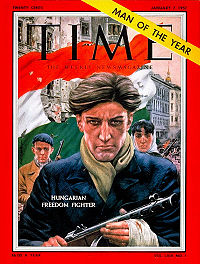
magazine named the Hungarian Freedom Fighter its Man of the Year for 1956. The accompanying Time article comments that this choice could not have been anticipated until the explosive events of the revolution, almost at the end of 1956. The magazine cover and accompanying text displayed an artist's depiction of a Hungarian freedom fighter, and used pseudonyms for the three participants whose stories are the subject of the article.
Hungarian Prime Minister Ferenc Gyurcsány referred to this famous Time Man of the Year cover as "the faces of free Hungary" in a speech to mark the 50th anniversary of the 1956 uprising. Prime Minister Gyurcsány, in a joint appearance with UK Prime Minister Tony Blair
, commented specifically on the TIME cover itself, that "It is an idealised image but the faces of the figures are really the face of the revolutionaries"
At the Melbourne Olympics
in 1956, the Soviet handling of the Hungarian uprising led to a boycott by Spain, the Netherlands and Switzerland. At the Olympic Village, the Hungarian delegation tore down the Communist Hungarian flag and raised the flag of Free Hungary in its place. A confrontation between Soviet and Hungarian teams occurred in the semi-final match
of the water polo
tournament. The match was extremely violent, and was halted in the final minute to quell fighting amongst spectators. This match, now known as the "blood in the water match
", became the subject of several films. The Hungarian team won the game 4–0 and later was awarded the Olympic gold medal.
The events in Hungary produced ideological fractures within the Communist parties of Western Europe. Within the Italian Communist Party
(PCI) a split ensued: most ordinary members and the Party leadership, including Palmiro Togliatti
and Giorgio Napolitano
, regarded the Hungarian insurgents as counter-revolutionaries, as reported in l'Unità
, the official PCI newspaper. However Giuseppe Di Vittorio
, chief of the Communist trade union CGIL, repudiated the leadership position, as did the prominent party members Antonio Giolitti
, Loris Fortuna
and many other influential Communist intellectuals, who later were expelled or left the party. Pietro Nenni
, the national secretary of the Italian Socialist Party
, a close ally of the PCI, opposed the Soviet intervention as well. Napolitano, elected in 2006 as President of the Italian Republic
, wrote in his 2005 political autobiography that he regretted his justification of Soviet action in Hungary, and that at the time he believed in Party unity and the international leadership of Soviet communism.
Within the Communist Party of Great Britain
(CPGB), dissent that began with the repudiation of Stalin by John Saville
and E.P. Thompson, influential historians and members of the Communist Party Historians Group
, culminated in a loss of thousands of party members as events unfolded in Hungary. Peter Fryer
, correspondent for the CPGB newspaper The Daily Worker, reported accurately on the violent suppression of the uprising, but his dispatches were heavily censored; Fryer resigned from the paper upon his return, and was later expelled from the communist party. In France, moderate communists, such as historian Emmanuel Le Roy Ladurie
, resigned, questioning the policy of supporting Soviet actions by the French Communist Party
. The French philosopher and writer Albert Camus
wrote an open letter
, The Blood of the Hungarians, criticizing the West's lack of action. Even Jean-Paul Sartre
, still a determined communist, criticised the Soviets in his article Le Fantôme de Staline, in Situations VII.
 In December, 1991, the preamble of the treaties with the dismembered Soviet Union, under Mikhail Gorbachev
, and Russia, represented by Boris Yeltsin
, apologized officially for the 1956 Soviet actions in Hungary. This apology was repeated by Yeltsin in 1992 during a speech to the Hungarian parliament.
On 13 February 2006, the US State Department commemorated the Fiftieth anniversary of the 1956 Hungarian Revolution. Former US Secretary of State Rice
commented on the contributions made by 1956 Hungarian refugees to the United States and other host countries, as well as the role of Hungary
in providing refuge to East Germans during the 1989 protests against communist rule. US President George W. Bush
also visited Hungary on 22 June 2006, to commemorate the fiftieth anniversary.
On June 16, 1989, the 30th anniversary of his execution, Imre Nagy's body was reburied with full honors. The Republic of Hungary was declared in 1989 on the 33rd anniversary of the Revolution, and 23 October is now a Hungarian national holiday
.
Feature films
Commemorations
People's Republic of Hungary
The People's Republic of Hungary or Hungarian People's Republic was the official state name of Hungary from 1949 to 1989 during its Communist period under the guidance of the Soviet Union. The state remained in existence until 1989 when opposition forces consolidated in forcing the regime to...
and its Soviet
Soviet Union
The Soviet Union , officially the Union of Soviet Socialist Republics , was a constitutionally socialist state that existed in Eurasia between 1922 and 1991....
-imposed policies, lasting from 23 October until 10 November 1956.
The revolt began as a student demonstration which attracted thousands as it marched through central Budapest
Budapest
Budapest is the capital of Hungary. As the largest city of Hungary, it is the country's principal political, cultural, commercial, industrial, and transportation centre. In 2011, Budapest had 1,733,685 inhabitants, down from its 1989 peak of 2,113,645 due to suburbanization. The Budapest Commuter...
to the Parliament building
Hungarian Parliament Building
The Hungarian Parliament Building is the seat of the National Assembly of Hungary, one of Europe's oldest legislative buildings, a notable landmark of Hungary and a popular tourist destination of Budapest. It lies in Lajos Kossuth Square, on the bank of the Danube, in Budapest...
. A student delegation entering the radio building
Hungarian Radio
Magyar Rádió is Hungary's publicly funded radio broadcasting organization. It is also the country's official international broadcasting station...
in an attempt to broadcast its demands
Demands of Hungarian Revolutionaries of 1956
On October 23, 1956, a group of Hungarian students compiled a list of sixteen points containing key national policy demands. Following an anti-Soviet protest march through the Hungarian capital of Budapest, the students attempted to enter the city's main broadcasting station to read their demands...
was detained. When the delegation's release was demanded by the demonstrators outside, they were fired upon by the State Security Police
State Protection Authority
The State Protection Authority was the secret police force of Hungary from 1945 until 1956. It was conceived of as an external appendage of the Soviet Union's secret police forces, but attained an indigenous reputation for brutality during a series of purges beginning in 1948, intensifying in 1949...
(ÁVH) from within the building. The news spread quickly and disorder and violence erupted throughout the capital.
The revolt spread quickly across Hungary
People's Republic of Hungary
The People's Republic of Hungary or Hungarian People's Republic was the official state name of Hungary from 1949 to 1989 during its Communist period under the guidance of the Soviet Union. The state remained in existence until 1989 when opposition forces consolidated in forcing the regime to...
, and the government fell. Thousands organized into militias, battling the State Security Police (ÁVH) and Soviet troops
Soviet Army
The Soviet Army is the name given to the main part of the Armed Forces of the Soviet Union between 1946 and 1992. Previously, it had been known as the Red Army. Informally, Армия referred to all the MOD armed forces, except, in some cases, the Soviet Navy.This article covers the Soviet Ground...
. Pro-Soviet communists and ÁVH members were often executed or imprisoned, as former prisoners were released and armed. Impromptu councils
Workers' council
A workers' council, or revolutionary councils, is the phenomenon where a single place of work or enterprise, such as a factory, school, or farm, is controlled collectively by the workers of that workplace, through the core principle of temporary and instantly revocable delegates.In a system with...
wrested municipal control from the ruling Hungarian Working People's Party and demanded political changes. The new government formally disbanded the ÁVH, declared its intention to withdraw from the Warsaw Pact
Warsaw Pact
The Warsaw Treaty Organization of Friendship, Cooperation, and Mutual Assistance , or more commonly referred to as the Warsaw Pact, was a mutual defense treaty subscribed to by eight communist states in Eastern Europe...
and pledged to re-establish free elections. By the end of October, fighting had almost stopped and a sense of normality began to return.
After announcing a willingness to negotiate a withdrawal of Soviet forces, the Politburo
Politburo of the Central Committee of the Communist Party of the Soviet Union
The Politburo , known as the Presidium from 1952 to 1966, functioned as the central policymaking and governing body of the Communist Party of the Soviet Union.-Duties and responsibilities:The...
changed its mind and moved to crush the revolution. On 4 November, a large Soviet force invaded Budapest and other regions of the country. Hungarian resistance continued until 10 November. Over 2,500 Hungarians and 700 Soviet troops were killed in the conflict, and 200,000 Hungarians fled as refugees. Mass arrests and denunciations continued for months thereafter. By January 1957, the new Soviet-installed government had suppressed all public opposition. These Soviet actions alienated many Western Marxists
Marxism
Marxism is an economic and sociopolitical worldview and method of socioeconomic inquiry that centers upon a materialist interpretation of history, a dialectical view of social change, and an analysis and critique of the development of capitalism. Marxism was pioneered in the early to mid 19th...
, yet strengthened Soviet control over Central Europe.
Public discussion about this revolution was suppressed in Hungary for over 30 years, but since the thaw of the 1980s it has been a subject of intense study and debate. At the inauguration of the Third Hungarian Republic
Third Hungarian Republic
The third Republic of Hungary is an informal term used for the current republic of Hungary, which was proclaimed on October 23, 1989 , ending Hungary's communist era and replacing the former People's Republic of Hungary.The first republic was proclaimed on November 16, 1918 when the...
in 1989, October 23 was declared a national holiday.
Prelude
During World War II, Hungary was a member of the Axis powersAxis Powers
The Axis powers , also known as the Axis alliance, Axis nations, Axis countries, or just the Axis, was an alignment of great powers during the mid-20th century that fought World War II against the Allies. It began in 1936 with treaties of friendship between Germany and Italy and between Germany and...
, thereby being allied with the fascist forces of Nazi Germany
Nazi Germany
Nazi Germany , also known as the Third Reich , but officially called German Reich from 1933 to 1943 and Greater German Reich from 26 June 1943 onward, is the name commonly used to refer to the state of Germany from 1933 to 1945, when it was a totalitarian dictatorship ruled by...
, Fascist Italy
Kingdom of Italy (1861–1946)
The Kingdom of Italy was a state forged in 1861 by the unification of Italy under the influence of the Kingdom of Sardinia, which was its legal predecessor state...
, Romania
Kingdom of Romania
The Kingdom of Romania was the Romanian state based on a form of parliamentary monarchy between 13 March 1881 and 30 December 1947, specified by the first three Constitutions of Romania...
and Bulgaria
Kingdom of Bulgaria
The Kingdom of Bulgaria was established as an independent state when the Principality of Bulgaria, an Ottoman vassal, officially proclaimed itself independent on October 5, 1908 . This move also formalised the annexation of the Ottoman province of Eastern Rumelia, which had been under the control...
. As a part of this, in 1941, the Hungarian military participated
Hungary during World War II
Hungary during World War II was a member of the Axis powers. In the 1930s, the Kingdom of Hungary relied on increased trade with Fascist Italy and Nazi Germany to pull itself out of the Great Depression. By 1938, Hungarian politics and foreign policy had become increasingly pro-Fascist Italian and...
in the occupation of Yugoslavia
Invasion of Yugoslavia
The Invasion of Yugoslavia , also known as the April War , was the Axis Powers' attack on the Kingdom of Yugoslavia which began on 6 April 1941 during World War II...
and the invasion of the Soviet Union
Operation Barbarossa
Operation Barbarossa was the code name for Germany's invasion of the Soviet Union during World War II that began on 22 June 1941. Over 4.5 million troops of the Axis powers invaded the USSR along a front., the largest invasion in the history of warfare...
, joining the Axis powers. The Soviet army was however able to force back the Hungarian and other Axis invaders, and by 1944, Soviet armies themselves were advancing towards Hungary. Fearing invasion, the Hungarian government began armistice negotiations with the Allies, but these were ended when Nazi Germany invaded and occupied
Operation Margarethe
During World War II, the Germans planned two discrete operations using the codename Margarethe.Operation Margarethe I was the occupation of Hungary by German forces on 19 March 1944. The Hungarian government was an ally of Nazi Germany, but had been discussing an armistice with the Allies...
the country and set up their own pro-Axis regime. Both Hungarian and German forces stationed in Hungary were subsequently defeated when the Soviet Union invaded the country in 1945.
Postwar occupation
After World War II, the Soviet ArmySoviet Army
The Soviet Army is the name given to the main part of the Armed Forces of the Soviet Union between 1946 and 1992. Previously, it had been known as the Red Army. Informally, Армия referred to all the MOD armed forces, except, in some cases, the Soviet Navy.This article covers the Soviet Ground...
occupied Hungary, with the country coming under the Soviet Union's sphere of influence
Sphere of influence
In the field of international relations, a sphere of influence is a spatial region or conceptual division over which a state or organization has significant cultural, economic, military or political influence....
. At the time, Hungary was a multiparty democracy, and elections in 1945
Hungarian parliamentary election, 1945
The Hungarian parliamentary election of 1945 was held on 4 November of that year. It came at a turbulent moment in the country's history: World War II had had a devastating impact; the Soviet Union was occupying it, with the Hungarian Communist Party growing in numbers; a land reform that March had...
produced a coalition government
Independent Smallholders, Agrarian Workers and Civic Party
The Independent Smallholders, Agrarian Workers and Civic Party is a political party in Hungary...
under Prime Minister Zoltán Tildy
Zoltán Tildy
Zoltán Tildy , was an influential leader of Hungary, who served as Prime Minister from 1945–1946 and President from 1946-1948 in the post-war period before the seizure of power by Soviet-backed communists....
. However, the Hungarian Communist Party
Hungarian Communist Party
The Communist Party of Hungary , renamed Hungarian Communist Party in 1945, was founded on November 24, 1918, and was in power in Hungary briefly from March to August 1919 under Béla Kun and the Hungarian Soviet Republic. The communist government was overthrown by the Romanian Army and driven...
, a Marxist-Leninist group who shared the Soviet government's ideological beliefs, constantly wrested small concessions in a process named "salami tactics
Salami tactics
Salami tactics, also known as the salami-slice strategy, is a divide and conquer process of threats and alliances used to overcome opposition. With it, an aggressor can influence and eventually dominate a landscape, typically political, piece by piece. In this fashion, the opposition is eliminated...
", which sliced away the elected government's influence, despite the fact that had only received 17% of the vote.
After the elections of 1945, the portfolio of the Interior Ministry — which oversaw the Hungarian State Security Police
State Protection Authority
The State Protection Authority was the secret police force of Hungary from 1945 until 1956. It was conceived of as an external appendage of the Soviet Union's secret police forces, but attained an indigenous reputation for brutality during a series of purges beginning in 1948, intensifying in 1949...
(Államvédelmi Hatóság, later known as the ÁVH) — was forcibly transferred from the Independent Smallholders Party to a nominee of the Communist Party. The ÁVH employed methods of intimidation
Intimidation
Intimidation is intentional behavior "which would cause a person of ordinary sensibilities" fear of injury or harm. It's not necessary to prove that the behavior was so violent as to cause terror or that the victim was actually frightened.Criminal threatening is the crime of intentionally or...
, false accusations, imprisonment and torture
Torture
Torture is the act of inflicting severe pain as a means of punishment, revenge, forcing information or a confession, or simply as an act of cruelty. Throughout history, torture has often been used as a method of political re-education, interrogation, punishment, and coercion...
, to suppress political opposition. The brief period of multiparty democracy
Democracy
Democracy is generally defined as a form of government in which all adult citizens have an equal say in the decisions that affect their lives. Ideally, this includes equal participation in the proposal, development and passage of legislation into law...
came to an end when the Communist Party merged with the Social Democratic Party
Social Democratic Party (Hungary)
The Social Democratic Party often known as the "Historical" Social Democratic Party is a Hungarian political party that emerged following a split within the Hungarian Social Democratic Party in 1989...
to become the Hungarian Working People's Party, which stood its candidate list unopposed in 1949. The People's Republic of Hungary
People's Republic of Hungary
The People's Republic of Hungary or Hungarian People's Republic was the official state name of Hungary from 1949 to 1989 during its Communist period under the guidance of the Soviet Union. The state remained in existence until 1989 when opposition forces consolidated in forcing the regime to...
was then declared. By 1949, the Soviets had concluded a mutual assistance treaty
Comecon
The Council for Mutual Economic Assistance , 1949–1991, was an economic organisation under hegemony of Soviet Union comprising the countries of the Eastern Bloc along with a number of communist states elsewhere in the world...
with Hungary which granted the Soviet Union rights to a continued military presence, assuring ultimate political control.
Being revolutionary socialists
Revolutionary socialism
The term revolutionary socialism refers to Socialist tendencies that advocate the need for fundamental social change through revolution by mass movements of the working class, as a strategy to achieve a socialist society...
, the Hungarian Communist Party set about to replace the capitalist
Capitalism
Capitalism is an economic system that became dominant in the Western world following the demise of feudalism. There is no consensus on the precise definition nor on how the term should be used as a historical category...
economy with a socialist
Socialism
Socialism is an economic system characterized by social ownership of the means of production and cooperative management of the economy; or a political philosophy advocating such a system. "Social ownership" may refer to any one of, or a combination of, the following: cooperative enterprises,...
one, and as a part of this undertook radical nationalization
Nationalization
Nationalisation, also spelled nationalization, is the process of taking an industry or assets into government ownership by a national government or state. Nationalization usually refers to private assets, but may also mean assets owned by lower levels of government, such as municipalities, being...
based on the Soviet model. This however produced economic stagnation, lower standards of living and a deep malaise. Writers and journalists were the first to voice open criticism of the government and its policies, publishing critical articles in 1955. By 22 October 1956, Technical University students had resurrected the banned MEFESZ student union
Students' union
A students' union, student government, student senate, students' association, guild of students or government of student body is a student organization present in many colleges and universities, and has started appearing in some high schools...
, and staged a demonstration on 23 October which set off a chain of events leading directly to the revolution.
Political repression and economic decline
Hungary became a communist statePeople's Republic of Hungary
The People's Republic of Hungary or Hungarian People's Republic was the official state name of Hungary from 1949 to 1989 during its Communist period under the guidance of the Soviet Union. The state remained in existence until 1989 when opposition forces consolidated in forcing the regime to...
under the severely authoritarian leadership of Mátyás Rákosi
Mátyás Rákosi
Mátyás Rákosi was a Hungarian communist politician. He was born as Mátyás Rosenfeld, in present-day Serbia...
. The Security Police (ÁVH) began a series of purges of more than 7000 dissidents, who were denounced as "Titoists
Titoism
Titoism is a variant of Marxism–Leninism named after Josip Broz Tito, leader of the Socialist Federal Republic of Yugoslavia, primarily used to describe the specific socialist system built in Yugoslavia after its refusal of the 1948 Resolution of the Cominform, when the Communist Party of...
" or "western agents", and forced to confess in show trials, after which they were relocated to a camp in eastern Hungary.
From 1950 to 1952, the Security Police forcibly relocated thousands of people to obtain property and housing for the Working People's Party members, and to remove the threat of the intellectual and 'bourgeois' class. Thousands were arrested, tortured, tried, and imprisoned in concentration camps, deported to the east
Population transfer in the Soviet Union
Population transfer in the Soviet Union may be classified into the following broad categories: deportations of "anti-Soviet" categories of population, often classified as "enemies of workers," deportations of entire nationalities, labor force transfer, and organized migrations in opposite...
, or were executed, including ÁVH founder László Rajk. In a single year, more than 26,000 people were forcibly relocated from Budapest. As a consequence, jobs and housing were very difficult to obtain. The deportees generally experienced terrible living conditions and were impressed as slave labor on collective farms. Many died as a result of the poor living conditions and malnutrition.
The Rákosi government thoroughly politicized Hungary's educational system to supplant the educated classes with a "toiling intelligentsia". Russian language study and Communist political instruction were made mandatory in schools and universities nationwide. Religious schools were nationalized and church leaders were replaced by those loyal to the government. In 1949 the leader of the Hungarian Catholic Church, Cardinal József Mindszenty, was arrested and sentenced to life imprisonment for treason. Under Rákosi, Hungary's government was among the most repressive in Europe.
The postwar Hungarian economy suffered from multiple challenges. Hungary agreed to pay war reparations
War reparations
War reparations are payments intended to cover damage or injury during a war. Generally, the term war reparations refers to money or goods changing hands, rather than such property transfers as the annexation of land.- History :...
approximating US$300 million, to the Soviet Union, Czechoslovakia, and Yugoslavia, and to support Soviet garrisons. The Hungarian National Bank
Hungarian National Bank
The Hungarian National Bank is the central bank of Hungary. The principal aim of the bank is to retain price stability. It is also responsible for issuing the national currency, the forint, controlling the cash circulation, setting the Central Bank base rate, publishing official exchange rates...
in 1946 estimated the cost of reparations as "between 19 and 22 per cent of the annual national income." In 1946, the Hungarian currency
Hungarian pengo
The pengő was the currency of Hungary between 1 January 1927, when it replaced the korona, and 31 July 1946, when it was replaced by the forint. The pengő was subdivided into 100 fillér...
experienced marked depreciation
Depreciation
Depreciation refers to two very different but related concepts:# the decrease in value of assets , and# the allocation of the cost of assets to periods in which the assets are used ....
, resulting in the highest historic rates of hyperinflation
Hyperinflation
In economics, hyperinflation is inflation that is very high or out of control. While the real values of the specific economic items generally stay the same in terms of relatively stable foreign currencies, in hyperinflationary conditions the general price level within a specific economy increases...
known. Hungary's participation in the Soviet-sponsored COMECON
Comecon
The Council for Mutual Economic Assistance , 1949–1991, was an economic organisation under hegemony of Soviet Union comprising the countries of the Eastern Bloc along with a number of communist states elsewhere in the world...
(Council Of Mutual Economic Assistance), prevented it from trading with the West
Western world
The Western world, also known as the West and the Occident , is a term referring to the countries of Western Europe , the countries of the Americas, as well all countries of Northern and Central Europe, Australia and New Zealand...
or receiving Marshall Plan
Marshall Plan
The Marshall Plan was the large-scale American program to aid Europe where the United States gave monetary support to help rebuild European economies after the end of World War II in order to combat the spread of Soviet communism. The plan was in operation for four years beginning in April 1948...
aid.
Although national income per capita rose in the first third of the 1950s, the standard of living fell. Huge income deductions to finance industrial investment reduced disposable personal income; mismanagement created chronic shortages in basic foodstuffs resulting in rationing of bread, sugar, flour and meat. Compulsory subscriptions to state bonds further reduced personal income. The net result was that disposable real income of workers and employees in 1952 was only two-thirds of what it had been in 1938, whereas in 1949, the proportion had been 90 per cent. These policies had a cumulative negative effect, and fueled discontent as foreign debt grew and the population experienced shortages of goods.
International events
On 5 March 1953, Joseph StalinJoseph Stalin
Joseph Vissarionovich Stalin was the Premier of the Soviet Union from 6 May 1941 to 5 March 1953. He was among the Bolshevik revolutionaries who brought about the October Revolution and had held the position of first General Secretary of the Communist Party of the Soviet Union's Central Committee...
died, ushering in a period of moderate liberalization during which most European communist parties developed a reform wing. In Hungary, the reformist Imre Nagy
Imre Nagy
Imre Nagy was a Hungarian communist politician who was appointed Chairman of the Council of Ministers of the People's Republic of Hungary on two occasions...
replaced Mátyás Rákosi, "Stalin's Best Hungarian Disciple", as Prime Minister. However, Rákosi remained General Secretary of the Party, and was able to undermine most of Nagy's reforms. By April 1955, he had Nagy discredited and removed from office. After Khrushchev's
Nikita Khrushchev
Nikita Sergeyevich Khrushchev led the Soviet Union during part of the Cold War. He served as First Secretary of the Communist Party of the Soviet Union from 1953 to 1964, and as Chairman of the Council of Ministers, or Premier, from 1958 to 1964...
"secret speech"
On the Personality Cult and its Consequences
On the Personality Cult and its Consequences was a report, critical of Joseph Stalin, made to the Twentieth Party Congress on February 25, 1956 by Soviet leader Nikita Khrushchev. It is more commonly known as the Secret Speech or the Khrushchev Report...
of February 1956, which denounced Stalin and his protégés, Rákosi was deposed as General Secretary of the Party and replaced by Ernő Gerő
Erno Gero
Ernő Gerő was a Hungarian Communist Party leader in the period after World War II and briefly in 1956 the most powerful man in Hungary as first secretary of its ruling communist party.-Life and career:...
on 18 July 1956.
On 14 May 1955, the Soviet Union created the Warsaw Pact
Warsaw Pact
The Warsaw Treaty Organization of Friendship, Cooperation, and Mutual Assistance , or more commonly referred to as the Warsaw Pact, was a mutual defense treaty subscribed to by eight communist states in Eastern Europe...
, binding Hungary to the Soviet Union and its satellite state
Satellite state
A satellite state is a political term that refers to a country that is formally independent, but under heavy political and economic influence or control by another country...
s in Central and Eastern Europe. Among the principles of this alliance were "respect for the independence and sovereignty of states" and "noninterference in their internal affairs".
In 1955, the Austrian State Treaty
Austrian State Treaty
The Austrian State Treaty or Austrian Independence Treaty re-established Austria as a sovereign state. It was signed on May 15, 1955, in Vienna at the Schloss Belvedere among the Allied occupying powers and the Austrian government...
and ensuing declaration of neutrality established Austria as a demilitarized and neutral country. This raised Hungarian hopes of also becoming neutral and in 1955 Nagy had considered "...the possibility of Hungary adopting a neutral status on the Austrian pattern".
In June 1956, a violent uprising by Polish workers
Poznan 1956 protests
The Poznań 1956 protests, also known as Poznań 1956 uprising or Poznań June , were the first of several massive protests of the Polish people against the communist government of the People's Republic of Poland...
in Poznań
Poznan
Poznań is a city on the Warta river in west-central Poland, with a population of 556,022 in June 2009. It is among the oldest cities in Poland, and was one of the most important centres in the early Polish state, whose first rulers were buried at Poznań's cathedral. It is sometimes claimed to be...
was put down by the government, with scores of protesters killed and wounded. Responding to popular demand, in October 1956, the government appointed the recently rehabilitated
Political rehabilitation
Political rehabilitation is the process by which a member of a political organization or government who has fallen into disgrace, is restored to public life. It is usually applied to leaders or other prominent individuals who regain their prominence after a period in which they have no influence or...
reformist communist Władysław Gomułka as First Secretary of the Polish United Workers' Party
Polish United Workers' Party
The Polish United Workers' Party was the Communist party which governed the People's Republic of Poland from 1948 to 1989. Ideologically it was based on the theories of Marxism-Leninism.- The Party's Program and Goals :...
, with a mandate to negotiate trade concessions and troop reductions with the Soviet government. After a few tense days of negotiations, on 19 October the Soviets finally gave in to Gomułka's reformist demands. News of the concessions won by the Poles—known as Polish October
Polish October
Polish October, also known as October 1956, Polish thaw, or Gomułka's thaw, marked a change in the Polish internal political scene in the second half of 1956...
—emboldened many Hungarians to hope for similar concessions for Hungary and these sentiments contributed significantly to the highly charged political climate that prevailed in Hungary in the second half of October 1956.
Within the Cold War
Cold War
The Cold War was the continuing state from roughly 1946 to 1991 of political conflict, military tension, proxy wars, and economic competition between the Communist World—primarily the Soviet Union and its satellite states and allies—and the powers of the Western world, primarily the United States...
context of the time, by 1956 a fundamental tension had appeared in U.S. policy towards Hungary and the Eastern Bloc
Eastern bloc
The term Eastern Bloc or Communist Bloc refers to the former communist states of Eastern and Central Europe, generally the Soviet Union and the countries of the Warsaw Pact...
generally. The United States both hoped to encourage East European countries to break away from the bloc through their own efforts, but also wished to avoid a U.S.-Soviet military confrontation, fearing escalation into nuclear war. For these reasons, U.S. policy makers had to consider other means of diminishing Soviet influence in Eastern Europe, short of a rollback
Rollback
In political science, rollback is the strategy of forcing change in the major policies of a state, usually by replacing its ruling regime. It contrasts with containment, which means preventing the expansion of that state; and with détente, which means a working relationship with that state...
policy. This led to the development of containment
Containment
Containment was a United States policy using military, economic, and diplomatic strategies to stall the spread of communism, enhance America’s security and influence abroad, and prevent a "domino effect". A component of the Cold War, this policy was a response to a series of moves by the Soviet...
policies such as economic and psychological warfare, covert operations, and, at a later stage, negotiation with the Soviet Union regarding the status of the East-bloc states. In the summer of 1956, relations between Hungary and the U.S. began to improve. At that time, the U.S. responded very favorably to Hungary's overtures about a possible expansion of bilateral trade relations. Hungary's desire for better relations was partly attributable to the country's catastrophic economic situation. Before any results could be achieved, however, the pace of negotiations was slowed by the Hungarian Ministry of Internal Affairs, which feared that better relations with the West might weaken Communist rule in Hungary.
Social unrest builds
Rákosi's resignation in July 1956 emboldened students, writers and journalists to be more active and critical in politics. Students and journalists started a series of intellectual forums examining the problems facing Hungary. These forums, called PetőfiSándor Petofi
Sándor Petőfi , was a Hungarian poet and liberal revolutionary. He is considered as Hungary's national poet and he was one of the key figures of the Hungarian Revolution of 1848...
circles, became very popular and attracted thousands of participants. On 6 October 1956, László Rajk
László Rajk
László Rajk was a Hungarian Communist; politician, former Minister of Interior and former Minister of Foreign Affairs...
, who had been executed by the Rákosi government, was reburied in a moving ceremony which strengthened the party opposition.
On 16 October 1956, university students in Szeged
Szeged
' is the third largest city of Hungary, the largest city and regional centre of the Southern Great Plain and the county town of Csongrád county. The University of Szeged is one of the most distinguished universities in Hungary....
snubbed the official communist student union, the DISZ, by re-establishing the MEFESZ (Union of Hungarian University and Academy Students), a democratic student organization, previously banned under the Rákosi dictatorship. Within days, the student bodies of Pécs
Pécs
Pécs is the fifth largest city of Hungary, located on the slopes of the Mecsek mountains in the south-west of the country, close to its border with Croatia. It is the administrative and economical centre of Baranya county...
, Miskolc
Miskolc
Miskolc is a city in northeastern Hungary, mainly with heavy industrial background. With a population close to 170,000 Miskolc is the fourth largest city of Hungary It is also the county capital of Borsod-Abaúj-Zemplén and the regional centre of Northern Hungary.- Geography :Miskolc is located...
, and Sopron
Sopron
In 1910 Sopron had 33,932 inhabitants . Religions: 64.1% Roman Catholic, 27.8% Lutheran, 6.6% Jewish, 1.2% Calvinist, 0.3% other. In 2001 the city had 56,125 inhabitants...
followed suit. On 22 October, students of the Technical University
Budapest University of Technology and Economics
The Budapest University of Technology and Economics , in hungarian abbreviated as BME, English official abbreviation BUTE, is the most significant University of Technology in Hungary and is also one of the oldest Institutes of Technology in the world, having been founded in 1782.-History:BME is...
compiled a list of sixteen points
Demands of Hungarian Revolutionaries of 1956
On October 23, 1956, a group of Hungarian students compiled a list of sixteen points containing key national policy demands. Following an anti-Soviet protest march through the Hungarian capital of Budapest, the students attempted to enter the city's main broadcasting station to read their demands...
containing several national policy demands. After the students heard that the Hungarian Writers’ Union
Hungarian Writers’ Union
The Hungarian Writers Union was founded in 1945 at the end of World War II. Initially the union was intended to be an organizational body through which the interests of writers in Hungary could be represented...
planned on the following day to express solidarity with pro-reform movements in Poland by laying a wreath at the statue of Polish-born General Bem
Józef Bem
Józef Zachariasz Bem was a Polish general, an Ottoman Pasha and a national hero of Poland and Hungary, and a figure intertwined with other European nationalisms...
, a hero of the Hungarian Revolution of 1848
Hungarian Revolution of 1848
The Hungarian Revolution of 1848 was one of many of the European Revolutions of 1848 and closely linked to other revolutions of 1848 in the Habsburg areas...
(1848–49), the students decided to organize a parallel demonstration of sympathy.
First shots
Józef Bem
Józef Zachariasz Bem was a Polish general, an Ottoman Pasha and a national hero of Poland and Hungary, and a figure intertwined with other European nationalisms...
- a national hero of Poland and Hungary. Péter Veres
Péter Veres
Péter Veres was a Hungarian politician and writer, who served as Minister of Defence from 1947 to 1948.-References:*...
, President of the Writers’ Union, read a manifesto to the crowd, the students read their proclamation, and the crowd then chanted the censored patriotic poem the "National Song
Nemzeti dal
The Nemzeti dal , written by Sándor Petőfi, is the poem that is said to have inspired the Hungarian Revolution of 1848. Petőfi read the poem aloud on March 15 in Vörösmarty Square in Budapest to a gathering crowd, which by the end was chanting the refrain as they began to march around the city,...
", which refrains: "This we swear, this we swear, that we will no longer be slaves." Someone in the crowd cut out the communist coat of arms from the Hungarian flag, leaving a distinctive hole and others quickly followed suit.
Afterwards, most of the crowd crossed the Danube to join demonstrators outside the Parliament Building. By 6 p.m., the multitude had swollen to more than 200,000 people; the demonstration was spirited, but peaceful.
At 8 p.m., First Secretary Ernő Gerő
Erno Gero
Ernő Gerő was a Hungarian Communist Party leader in the period after World War II and briefly in 1956 the most powerful man in Hungary as first secretary of its ruling communist party.-Life and career:...
broadcast a speech condemning the writers' and students' demands. Angered by Gerő's hard-line rejection, some demonstrators decided to carry out one of their demands - the removal of Stalin's 30 feet (9.1 m) bronze statue
Stalin Monument in Budapest
The Stalin Monument in Budapest was completed in December 1951 as a gift for Joseph Stalin from the Hungarian People on his seventieth birthday . It was torn down on October 23, 1956 during Hungary's October Revolution.-Monument:...
that was erected in 1951 on the site of a church, which was demolished to make room for the Stalin monument. By 9:30 p.m. the statue was toppled and jubilant crowds celebrated by placing Hungarian flags
Flag of Hungary
The flag of Hungary is a horizontal tricolour of red, white and green. In this exact form, it has been the official flag of Hungary since October 1, 1957.-Origin:...
in Stalin's boots, which was all that was left of the statue.
At about the same time, a large crowd gathered at the Radio Budapest building, which was heavily guarded by the ÁVH. The flash point was reached as a delegation attempting to broadcast their demands was detained and the crowd grew increasingly unruly as rumors spread that the protesters had been shot. Tear gas was thrown from the upper windows and the ÁVH opened fire on the crowd, killing many. The ÁVH tried to re-supply itself by hiding arms inside an ambulance, but the crowd detected the ruse and intercepted it. Hungarian soldiers sent to relieve the ÁVH hesitated and then, tearing the red stars from their caps, sided with the crowd. Provoked by the ÁVH attack, protesters reacted violently. Police cars were set ablaze, guns were seized from military depots and distributed to the masses and symbols of the communist regime were vandalized.
Fighting spreads, government falls
During the night of 23 October, Hungarian Working People's Party Secretary Ernő Gerő requested Soviet military intervention "to suppress a demonstration that was reaching an ever greater and unprecedented scale." The Soviet leadership had formulated contingency plans for intervention in Hungary several months before. By 2 a.m. on 24 October, under orders of the Soviet defence ministerGeorgy Zhukov
Marshal of the Soviet Union Georgy Konstantinovich Zhukov , was a Russian career officer in the Red Army who, in the course of World War II, played a pivotal role in leading the Red Army through much of Eastern Europe to liberate the Soviet Union and other nations from the Axis Powers' occupation...
, Soviet tanks entered Budapest.
By noon on 24 October, Soviet tanks were stationed outside the Parliament building and Soviet soldiers guarded key bridges and crossroads. Armed revolutionaries quickly set up barricades to defend Budapest, and were reported to have already captured some Soviet tanks by mid-morning. That day, Imre Nagy replaced András Hegedüs
András Hegedus
András Hegedüs was a Hungarian Communist politician who served as Chairman of the Council of Ministers from 1955 to 1956. Hegedüs fled to the Soviet Union on 28 October, the fifth day of the Hungarian Revolution of 1956...
as Prime Minister. On the radio, Nagy called for an end to violence and promised to initiate political reforms which had been shelved three years earlier. The population continued to arm itself as sporadic violence erupted. Armed protesters seized the radio building. At the offices of the Communist newspaper Szabad Nép unarmed demonstrators were fired upon by ÁVH guards who were then driven out as armed demonstrators arrived. At this point, the revolutionaries' wrath focused on the ÁVH; Soviet military units were not yet fully engaged, and there were many reports of some Soviet troops showing open sympathy for the demonstrators.
On 25 October, a mass of protesters gathered in front of the Parliament Building. ÁVH units began shooting into the crowd from the rooftops of neighboring buildings. Some Soviet soldiers returned fire on the ÁVH, mistakenly believing that they were the targets of the shooting. Supplied by arms taken from the ÁVH or given by Hungarian soldiers who joined the uprising, some in the crowd started shooting back.
The attacks at the Parliament forced the collapse of the government. Communist First Secretary Ernő Gerő and former Prime Minister András Hegedüs
András Hegedus
András Hegedüs was a Hungarian Communist politician who served as Chairman of the Council of Ministers from 1955 to 1956. Hegedüs fled to the Soviet Union on 28 October, the fifth day of the Hungarian Revolution of 1956...
fled to the Soviet Union; Imre Nagy
Imre Nagy
Imre Nagy was a Hungarian communist politician who was appointed Chairman of the Council of Ministers of the People's Republic of Hungary on two occasions...
became Prime Minister and János Kádár
János Kádár
János Kádár was a Hungarian communist leader and the General Secretary of the Hungarian Socialist Workers' Party, presiding over the country from 1956 until his forced retirement in 1988. His thirty-two year term as General Secretary makes Kádár the longest ruler of the People's Republic of Hungary...
First Secretary of the Communist Party. Revolutionaries began an aggressive offensive against Soviet troops and the remnants of the ÁVH.
As the Hungarian resistance fought Soviet tanks using Molotov cocktails in the narrow streets of Budapest, revolutionary councils
Workers' council
A workers' council, or revolutionary councils, is the phenomenon where a single place of work or enterprise, such as a factory, school, or farm, is controlled collectively by the workers of that workplace, through the core principle of temporary and instantly revocable delegates.In a system with...
arose nationwide, assumed local governmental authority, and called for general strikes. Public Communist symbols such as red star
Red star
A red star, five-pointed and filled, is an important ideological and religious symbol which has been used for various purposes, such as: state emblems, flags, monuments, ornaments, and logos.- Symbol of communism :...
s and Soviet war memorials were removed, and Communist books were burned. Spontaneous revolutionary militias arose, such as the 400-man group loosely led by József Dudás
József Dudás
József Dudás , a Romanian/Hungarian politician and resistance fighter, was born in Marosvásárhely in Austria-Hungary ....
, which attacked or murdered Soviet sympathizers and ÁVH members. Soviet units fought primarily in Budapest; elsewhere the countryside was largely quiet. One armored division stationed in Budapest, commanded by Pál Maléter
Pál Maléter
Pál Maléter was born to Hungarian parents in Eperjes, a city in the northern part of Historical Hungary, today part of Slovakia. He was the military leader of the 1956 Hungarian Revolution....
, instead opted to join the insurgents. Soviet commanders often negotiated local cease-fires with the revolutionaries. In some regions, Soviet forces managed to quell revolutionary activity. In Budapest, the Soviets were eventually fought to a stand-still and hostilities began to wane. Hungarian general Béla Király
Béla Király
Dr. Béla Király was a Hungarian resistance fighter during World War II, as well as a military historian, author, and politician....
, freed from a life sentence for political offenses and acting with the support of the Nagy government, sought to restore order by unifying elements of the police, army and insurgent groups into a National Guard. A ceasefire was arranged on 28 October, and by 30 October most Soviet troops had withdrawn from Budapest to garrisons in the Hungarian countryside.
Interlude
Fighting had virtually ceased between 28 October and 4 November, as many Hungarians believed that Soviet military units were indeed withdrawing from Hungary. There were at least 213 suspected or genuine Hungarian Working People's Party members lynched or executed during this periodThe New Hungarian National Government
The rapid spread of the uprising in the streets of Budapest and the abrupt fall of the Gerő-Hegedüs government left the new national leadership surprised, and at first disorganized. Nagy, a loyal Party reformer described as possessing "only modest political skills", initially appealed to the public for calm and a return to the old order. Yet Nagy, the only remaining Hungarian leader with credibility in both the eyes of the public and the Soviets, "at long last concluded that a popular uprising rather than a counter-revolution was taking place". Calling the ongoing insurgency "a broad democratic mass movement" in a radio address on 27 October, Nagy formed a government which included some non-communist ministers. This new National Government abolished both the ÁVH and the one-party system. Because it held office only ten days, the National Government had little chance to clarify its policies in detail. However, newspaper editorials at the time stressed that Hungary should be a neutral, multiparty social democracySocial democracy
Social democracy is a political ideology of the center-left on the political spectrum. Social democracy is officially a form of evolutionary reformist socialism. It supports class collaboration as the course to achieve socialism...
. Many political prisoners were released, most notably Cardinal József Mindszenty. Political parties which were previously banned, such as the Independent Smallholders
Independent Smallholders, Agrarian Workers and Civic Party
The Independent Smallholders, Agrarian Workers and Civic Party is a political party in Hungary...
and the National Peasants' Party, reappeared to join the coalition.
Local revolutionary councils
Workers' council
A workers' council, or revolutionary councils, is the phenomenon where a single place of work or enterprise, such as a factory, school, or farm, is controlled collectively by the workers of that workplace, through the core principle of temporary and instantly revocable delegates.In a system with...
formed throughout Hungary, generally without involvement from the preoccupied National Government in Budapest, and assumed various responsibilities of local government from the defunct communist party. By 30 October, these councils had been officially sanctioned by the Hungarian Working People's Party, and the Nagy government asked for their support as "autonomous, democratic local organs formed during the Revolution". Likewise, workers' councils were established at industrial plants and mines, and many unpopular regulations such as production norms were eliminated. The workers' councils strove to manage the enterprise whilst protecting workers' interests, thus establishing a socialist economy free of rigid party control. Local control by the councils was not always bloodless; in Debrecen
Debrecen
Debrecen , is the second largest city in Hungary after Budapest. Debrecen is the regional centre of the Northern Great Plain region and the seat of Hajdú-Bihar county.- Name :...
, Győr
Gyor
-Climate:-Main sights:The ancient core of the city is Káptalan Hill at the confluence of three rivers: the Danube, Rába and Rábca. Püspökvár, the residence of Győr’s bishops can be easily recognised by its incomplete tower. Győr’s oldest buildings are the 13th-century dwelling tower and the...
, Sopron
Sopron
In 1910 Sopron had 33,932 inhabitants . Religions: 64.1% Roman Catholic, 27.8% Lutheran, 6.6% Jewish, 1.2% Calvinist, 0.3% other. In 2001 the city had 56,125 inhabitants...
, Mosonmagyaróvár
Mosonmagyaróvár
Mosonmagyaróvár is a city in Győr-Moson-Sopron county in northwestern Hungary. It lies close to both the Austrian and Slovakian borders and has a population of 30,200 ....
and other cities, crowds of demonstrators were fired upon by the ÁVH, with many lives lost. The ÁVH were disarmed, often by force, in many cases assisted by the local police.
Soviet perspective
On 24 October, the Presidium of the Central Committee of the Communist Party of the Soviet UnionPolitburo of the Central Committee of the Communist Party of the Soviet Union
The Politburo , known as the Presidium from 1952 to 1966, functioned as the central policymaking and governing body of the Communist Party of the Soviet Union.-Duties and responsibilities:The...
(the Politburo) discussed the political upheavals in Poland
Polish October
Polish October, also known as October 1956, Polish thaw, or Gomułka's thaw, marked a change in the Polish internal political scene in the second half of 1956...
and Hungary. A hard-line faction led by Molotov
Vyacheslav Molotov
Vyacheslav Mikhailovich Molotov was a Soviet politician and diplomat, an Old Bolshevik and a leading figure in the Soviet government from the 1920s, when he rose to power as a protégé of Joseph Stalin, to 1957, when he was dismissed from the Presidium of the Central Committee by Nikita Khrushchev...
was pushing for intervention, but Khrushchev and Marshal Zhukov
Georgy Zhukov
Marshal of the Soviet Union Georgy Konstantinovich Zhukov , was a Russian career officer in the Red Army who, in the course of World War II, played a pivotal role in leading the Red Army through much of Eastern Europe to liberate the Soviet Union and other nations from the Axis Powers' occupation...
were initially opposed. A delegation in Budapest reported that the situation was not as dire as had been portrayed. Khrushchev stated that he believed that Party Secretary Ernő Gerő's request for intervention on 23 October indicated that the Hungarian Party still held the confidence of the Hungarian public. In addition, he saw the protests not as an ideological struggle, but as popular discontent over unresolved basic economic and social issues.
After some debate, the Presidium on 30 October decided not to remove the new Hungarian government. Even Marshal Georgy Zhukov
Georgy Zhukov
Marshal of the Soviet Union Georgy Konstantinovich Zhukov , was a Russian career officer in the Red Army who, in the course of World War II, played a pivotal role in leading the Red Army through much of Eastern Europe to liberate the Soviet Union and other nations from the Axis Powers' occupation...
said: "We should withdraw troops from Budapest, and if necessary withdraw from Hungary as a whole. This is a lesson for us in the military-political sphere." They adopted a Declaration of the Government of the USSR on the Principles of Development and Further Strengthening of Friendship and Cooperation between the Soviet Union and other Socialist States, which was issued the next day. This document proclaimed: "The Soviet Government is prepared to enter into the appropriate negotiations with the government of the Hungarian People's Republic and other members of the Warsaw Treaty on the question of the presence of Soviet troops on the territory of Hungary." Thus for a brief moment it looked like there could be a peaceful solution.
On 30 October, armed protestors attacked the ÁVH detachment guarding the Budapest Hungarian Working People's Party headquarters on Köztársaság tér (Republic Square), incited by rumors of prisoners held there, and the earlier shootings of demonstrators by the ÁVH in the city of Mosonmagyaróvár. Over 20 ÁVH officers were killed, some of them lynched by the mob. Hungarian army tanks sent to rescue the party headquarters mistakenly bombarded the building. The head of the Budapest party committee, Imre Mező, was wounded and later died. Scenes from Republic Square were shown on Soviet newsreels a few hours later. Revolutionary leaders in Hungary condemned the incident and appealed for calm, and the mob violence soon died down, but images of the victims were nevertheless used as propaganda
Propaganda
Propaganda is a form of communication that is aimed at influencing the attitude of a community toward some cause or position so as to benefit oneself or one's group....
by various Communist organs.
On 31 October the Soviet leaders decided to reverse their decision from the previous day. There is disagreement among historians whether Hungary's declaration to exit the Warsaw Pact caused the second Soviet intervention. Minutes of the 31 October meeting of the Presidium record that the decision to intervene militarily was taken one day before Hungary declared its neutrality and withdrawal from the Warsaw Pact. However, some Russian historians who are not advocates of the Communist era maintain that the Hungarian declaration of neutrality caused the Kremlin to intervene a second time.
Two days earlier, on 30 October, when Soviet Politburo representatives Anastas Mikoyan
Anastas Mikoyan
Anastas Ivanovich Mikoyan was an Armenian Old Bolshevik and Soviet statesman during the rules of Vladimir Lenin, Joseph Stalin, Nikita Khrushchev, and Leonid Brezhnev....
and Mikhail Suslov
Mikhail Suslov
Mikhail Andreyevich Suslov was a Soviet statesman during the Cold War. He served as Second Secretary of the Communist Party of the Soviet Union from 1965, and as unofficial Chief Ideologue of the Party until his death in 1982. Suslov was responsible for party democracy and the separation of power...
were in Budapest, Nagy had hinted that neutrality was a long-term objective for Hungary, and that he was hoping to discuss this matter with the leaders in the Kremlin. This information was passed on to Moscow by Mikoyan and Suslov. At that time, Khrushchev was in Stalin's dacha
Dacha
Dacha is a Russian word for seasonal or year-round second homes often located in the exurbs of Soviet and post-Soviet cities. Cottages or shacks serving as family's main or only home are not considered dachas, although many purpose-built dachas are recently being converted for year-round residence...
, considering his options regarding Hungary. One of his speechwriters later said that the declaration of neutrality was an important factor in his subsequent decision to support intervention. In addition, some Hungarian leaders of the revolution as well as students had called for their country's withdrawal from the Warsaw Pact much earlier, and this may have influenced Soviet decision making.
Several other key events alarmed the Presidium and cemented the interventionists' position:
- Simultaneous movements towards multiparty parliamentary democracy, and a democratic national council of workers, which could "lead towards a capitalist state." Both movements challenged the pre-eminence of the Soviet Communist Party in Eastern Europe and perhaps Soviet hegemonyHegemonyHegemony is an indirect form of imperial dominance in which the hegemon rules sub-ordinate states by the implied means of power rather than direct military force. In Ancient Greece , hegemony denoted the politico–military dominance of a city-state over other city-states...
itself. For the majority of the Presidium, the workers' direct control over their councils without Communist Party leadership was incompatible with their idea of socialism. At the time, these councils were, in the words of Hannah ArendtHannah ArendtHannah Arendt was a German American political theorist. She has often been described as a philosopher, although she refused that label on the grounds that philosophy is concerned with "man in the singular." She described herself instead as a political theorist because her work centers on the fact...
, "the only free and acting soviets (councils)Soviet (council)Soviet was a name used for several Russian political organizations. Examples include the Czar's Council of Ministers, which was called the “Soviet of Ministers”; a workers' local council in late Imperial Russia; and the Supreme Soviet of the Soviet Union....
in existence anywhere in the world". - The Presidium was concerned lest the West might perceive Soviet weakness if it did not deal firmly with Hungary. On 1956-10-29, Israeli, British and French forces invaded EgyptSuez CrisisThe Suez Crisis, also referred to as the Tripartite Aggression, Suez War was an offensive war fought by France, the United Kingdom, and Israel against Egypt beginning on 29 October 1956. Less than a day after Israel invaded Egypt, Britain and France issued a joint ultimatum to Egypt and Israel,...
. Khrushchev reportedly remarked "We should reexamine our assessment and should not withdraw our troops from Hungary and Budapest. We should take the initiative in restoring order in Hungary. If we depart from Hungary, it will give a great boost to the Americans, English, and French—the imperialists. They will perceive it as weakness on our part and will go onto the offensive... To Egypt they will then add Hungary. We have no other choice." - Khrushchev stated that many in the Communist Party would not understand a failure to respond with force in Hungary. De-StalinizationDe-StalinizationDe-Stalinization refers to the process of eliminating the cult of personality, Stalinist political system and the Gulag labour-camp system created by Soviet leader Joseph Stalin. Stalin was succeeded by a collective leadership after his death in March 1953...
had alienated the more conservative elements of the Party, who were alarmed at threats to Soviet influence in Eastern Europe. On 17 June 1953, workers in East BerlinEast BerlinEast Berlin was the name given to the eastern part of Berlin between 1949 and 1990. It consisted of the Soviet sector of Berlin that was established in 1945. The American, British and French sectors became West Berlin, a part strongly associated with West Germany but a free city...
had staged an uprisingUprising of 1953 in East GermanyThe Uprising of 1953 in East Germany started with a strike by East Berlin construction workers on June 16. It turned into a widespread anti-Stalinist uprising against the German Democratic Republic government the next day....
, demanding the resignation of the government of the German Democratic RepublicGerman Democratic RepublicThe German Democratic Republic , informally called East Germany by West Germany and other countries, was a socialist state established in 1949 in the Soviet zone of occupied Germany, including East Berlin of the Allied-occupied capital city...
. This was quickly and violently put down with the help of the Soviet military, with 84 killed and wounded and 700 arrested. In June 1956, in PoznańPoznanPoznań is a city on the Warta river in west-central Poland, with a population of 556,022 in June 2009. It is among the oldest cities in Poland, and was one of the most important centres in the early Polish state, whose first rulers were buried at Poznań's cathedral. It is sometimes claimed to be...
, Poland, an anti-government workers' revoltPoznan 1956 protestsThe Poznań 1956 protests, also known as Poznań 1956 uprising or Poznań June , were the first of several massive protests of the Polish people against the communist government of the People's Republic of Poland...
had been suppressed by the Polish security forces with between 57 and 78 deaths and led to the installation of a less Soviet-controlled governmentPolish OctoberPolish October, also known as October 1956, Polish thaw, or Gomułka's thaw, marked a change in the Polish internal political scene in the second half of 1956...
. Additionally, by late October, unrest was noticed in some regional areas of the Soviet Union: while this unrest was minor, it was intolerable. - Hungarian neutrality and withdrawal from the Warsaw Pact represented a breach in the Soviet defensive buffer zoneBuffer zoneA buffer zone is generally a zonal area that lies between two or more other areas , but depending on the type of buffer zone, the reason for it may be to segregate regions or to conjoin them....
of satellite nations. Soviet fear of invasion from the West made a defensive buffer of allied states in Eastern Europe an essential security objective.
The Presidium decided to break the de facto ceasefire and crush the Hungarian revolution. The plan was to declare a "Provisional Revolutionary Government" under János Kádár, who would appeal for Soviet assistance to restore order. According to witnesses, Kádár was in Moscow in early November, and he was in contact with the Soviet embassy while still a member of the Nagy government. Delegations were sent to other Communist governments in Eastern Europe and China, seeking to avoid a regional conflict, and propaganda
Propaganda
Propaganda is a form of communication that is aimed at influencing the attitude of a community toward some cause or position so as to benefit oneself or one's group....
messages prepared for broadcast when the second Soviet intervention had begun. To disguise these intentions, Soviet diplomats were to engage the Nagy government in talks discussing the withdrawal of Soviet forces.
According to some sources, the Chinese leader Mao Zedong
Mao Zedong
Mao Zedong, also transliterated as Mao Tse-tung , and commonly referred to as Chairman Mao , was a Chinese Communist revolutionary, guerrilla warfare strategist, Marxist political philosopher, and leader of the Chinese Revolution...
played an important role in Khrushchev's decision to suppress the Hungarian uprising. Chinese Communist Party Deputy Chairman Liu Shaoqi
Liu Shaoqi
Liu Shaoqi was a Chinese revolutionary, statesman, and theorist. He was Chairman of the People's Republic of China, China's head of state, from 27 April 1959 to 31 October 1968, during which he implemented policies of economic reconstruction in China...
pressured Khrushchev to send in troops to put down the revolt by force. Although the relations between China and the Soviet Union had deteriorated during the recent years, Mao's words still carried great weight in the Kremlin, and they were frequently in contact during the crisis. Initially Mao opposed a second intervention and this information was passed on to Khrushchev on 30 October, before the Presidium met and decided against intervention. Mao then changed his mind in favor of intervention, but according to William Taubman
William Taubman
William Chase Taubman is an American political scientist. His biography of Nikita Khrushchev won the Pulitzer Prize for biography in 2004 and the National Book Critics Circle Award for Biography in 2003....
it remains unclear when and how Khrushchev learned of this and thus if it influenced his decision on 31 October.
On 1 November to 3 November, Khrushchev left Moscow to meet with his East-European allies and inform them of the decision to intervene. At the first such meeting, he met with Władysław Gomułka in Brest
Brest, Belarus
Brest , formerly also Brest-on-the-Bug and Brest-Litovsk , is a city in Belarus at the border with Poland opposite the city of Terespol, where the Bug River and Mukhavets rivers meet...
. Then he had talks with the Romanian, Czechoslovak, and Bulgarian leaders in Bucharest
Bucharest
Bucharest is the capital municipality, cultural, industrial, and financial centre of Romania. It is the largest city in Romania, located in the southeast of the country, at , and lies on the banks of the Dâmbovița River....
. Finally Khrushchev flew with Malenkov to Yugoslavia, where they met with Josip Broz Tito
Josip Broz Tito
Marshal Josip Broz Tito – 4 May 1980) was a Yugoslav revolutionary and statesman. While his presidency has been criticized as authoritarian, Tito was a popular public figure both in Yugoslavia and abroad, viewed as a unifying symbol for the nations of the Yugoslav federation...
, who was vacationing on his island Brioni
Brijuni
The Brijuni or the Brijuni Islands are a group of fourteen small islands in the Croatian part of the northern Adriatic Sea, separated from the west coast of the Istrian peninsula by the narrow Fažana Strait...
in the Adriatic. The Yugoslavs also persuaded Khrushchev to choose János Kádár
János Kádár
János Kádár was a Hungarian communist leader and the General Secretary of the Hungarian Socialist Workers' Party, presiding over the country from 1956 until his forced retirement in 1988. His thirty-two year term as General Secretary makes Kádár the longest ruler of the People's Republic of Hungary...
instead of Ferenc Münnich
Ferenc Münnich
Ferenc Münnich was a Hungarian Communist politician who served as Chairman of the Council of Ministers of the People's Republic of Hungary from 1958 to 1961....
as the new leader of Hungary.
International reaction
Although the United States Secretary of StateJohn Foster Dulles
John Foster Dulles served as U.S. Secretary of State under President Dwight D. Eisenhower from 1953 to 1959. He was a significant figure in the early Cold War era, advocating an aggressive stance against communism throughout the world...
recommended on 24 October that the United Nations Security Council
United Nations Security Council
The United Nations Security Council is one of the principal organs of the United Nations and is charged with the maintenance of international peace and security. Its powers, outlined in the United Nations Charter, include the establishment of peacekeeping operations, the establishment of...
convene to discuss the situation in Hungary, little immediate action was taken to introduce a resolution, in part because other world events unfolded the day after the peaceful 'interlude' started, when allied collusion
Protocol of Sèvres
The Protocol of Sèvres was a secret agreement reached between the governments of Israel, France and the United Kingdom during discussions held between 22 and 24 October 1956 at Sèvres, France...
started the Suez Crisis
Suez Crisis
The Suez Crisis, also referred to as the Tripartite Aggression, Suez War was an offensive war fought by France, the United Kingdom, and Israel against Egypt beginning on 29 October 1956. Less than a day after Israel invaded Egypt, Britain and France issued a joint ultimatum to Egypt and Israel,...
. The problem was not that Suez distracted U.S. attention from Hungary, but that it made the condemnation of Soviet actions very difficult. As Vice President Richard Nixon
Richard Nixon
Richard Milhous Nixon was the 37th President of the United States, serving from 1969 to 1974. The only president to resign the office, Nixon had previously served as a US representative and senator from California and as the 36th Vice President of the United States from 1953 to 1961 under...
later explained: "We couldn't on one hand, complain about the Soviets intervening in Hungary and, on the other hand, approve of the British and the French picking that particular time to intervene against [Gamel Abdel] Nasser". Responding to the plea by Nagy at the time of the second massive Soviet intervention on 4 November, the Security Council resolution critical of Soviet actions was vetoed by the Soviet Union; instead resolution 120 was adopted
United Nations Security Council Resolution 120
United Nations Security Council Resolution 120, adopted on November 4, 1956, considering the grave situation created by the Union of Soviet Socialist Republics in the suppression of the Hungarian people in asserting their rights, and the lack of unanimity of its permanent members, the Council felt...
to pass the matter onto the General Assembly. The General Assembly, by a vote of 50 in favor, 8 against and 15 abstentions, called on the Soviet Union to end its Hungarian intervention, but the newly constituted Kádár government rejected UN observers.
The U.S. President, Dwight Eisenhower, was aware of a detailed study of Hungarian resistance which recommended against U.S. military intervention, and of earlier policy discussions within the National Security Council which focused upon encouraging discontent in Soviet satellite nations only by economic policies and political rhetoric. In a 1998 interview, Hungarian Ambassador Géza Jeszenszky was critical of Western inaction in 1956, citing the influence of the United Nations at that time and giving the example of UN intervention in Korea
Korean War
The Korean War was a conventional war between South Korea, supported by the United Nations, and North Korea, supported by the People's Republic of China , with military material aid from the Soviet Union...
from 1950 to 1953.
During the uprising, the Radio Free Europe
Radio Free Europe
Radio Free Europe/Radio Liberty is a broadcaster funded by the U.S. Congress that provides news, information, and analysis to countries in Eastern Europe, Central Asia, and the Middle East "where the free flow of information is either banned by government authorities or not fully developed"...
(RFE) Hungarian-language programs broadcast news of the political and military situation, as well as appealing to Hungarians to fight the Soviet forces, including tactical advice on resistance methods. After the Soviet suppression of the revolution, RFE was criticized for having misled the Hungarian people that NATO or United Nations would intervene if the citizens continued to resist.
Soviet intervention of 4 November
On 1 November, Imre Nagy received reports that Soviet forces had entered Hungary from the east and were moving towards Budapest. Nagy sought and received assurances from Soviet ambassador Yuri AndropovYuri Andropov
Yuri Vladimirovich Andropov was a Soviet politician and the General Secretary of the Communist Party of the Soviet Union from 12 November 1982 until his death fifteen months later.-Early life:...
that the Soviet Union would not invade, although Andropov knew otherwise. The Cabinet, with János Kádár in agreement, declared Hungary's neutrality, withdrew from the Warsaw Pact, and requested assistance from the diplomatic corps in Budapest and the UN Secretary-General
Dag Hammarskjöld
Dag Hjalmar Agne Carl Hammarskjöld was a Swedish diplomat, economist, and author. An early Secretary-General of the United Nations, he served from April 1953 until his death in a plane crash in September 1961. He is the only person to have been awarded a posthumous Nobel Peace Prize. Hammarskjöld...
to defend Hungary's neutrality. Ambassador Andropov was asked to inform his government that Hungary would begin negotiations on the removal of Soviet forces immediately.
On 3 November, a Hungarian delegation led by the Minister of Defense Pál Maléter
Pál Maléter
Pál Maléter was born to Hungarian parents in Eperjes, a city in the northern part of Historical Hungary, today part of Slovakia. He was the military leader of the 1956 Hungarian Revolution....
were invited to attend negotiations on Soviet withdrawal at the Soviet Military Command at Tököl
Pest (county)
Ethnic groups :*Magyars - 93.5%*Germans - 1.7%*Roma - 1.2%*Slovaks - 0.8%*Others - 0.5%*Unknown - 2.3%Religions :*Roman Catholic - 53%*Calvinist - 16%*Lutheran - 3.8%*Greek Catholic - 1.2%*Others - 1.3%...
, near Budapest. At around midnight that evening, General Ivan Serov
Ivan Serov
State Security General Ivan Aleksandrovich Serov was a prominent leader of Soviet security and intelligence agencies, head of the KGB between March 1954 and December 1958, as well as head of the GRU between 1958 and 1963. He was Deputy Commissar of the NKVD under Lavrentiy Beria, and was to play a...
, Chief of the Soviet Security Police (KGB
KGB
The KGB was the commonly used acronym for the . It was the national security agency of the Soviet Union from 1954 until 1991, and was the premier internal security, intelligence, and secret police organization during that time.The State Security Agency of the Republic of Belarus currently uses the...
) ordered the arrest of the Hungarian delegation, and the next day, the Soviet army again attacked Budapest.
This second Soviet intervention, codenamed "Operation Whirlwind", was launched by Marshal
Marshal of the Soviet Union
Marshal of the Soviet Union was the de facto highest military rank of the Soviet Union. ....
Ivan Konev
Ivan Konev
Ivan Stepanovich Konev , was a Soviet military commander, who led Red Army forces on the Eastern Front during World War II, retook much of Eastern Europe from occupation by the Axis Powers, and helped in the capture of Germany's capital, Berlin....
. The five Soviet divisions stationed in Hungary
Southern Group of Forces
The Southern Group of Forces was a Soviet Armed Forces formation formed twice following the Second World War, most notably around the time of the Hungarian Revolution of 1956....
before 23 October were augmented to a total strength of 17 divisions. The 8th Mechanized Army under command of Lieutenant General Hamazasp Babadzhanian
Hamazasp Babadzhanian
Hamazasp Khachaturi Babadzhanian was Chief Marshal of the Mechanized Forces of the USSR and Hero of the Soviet Union.-Biography:Babadzhanian was born in the family of an Armenian peasant, in the village of Chardakhlu near Yelizavetpol , then part of the Russian Empire, attending school there...
and the 38th Army under command of Lieutenant General Hadzhi-Umar Mamsurov from the nearby Carpathian Military District
Carpathian Military District
The Carpathian Military District was a military district of the Soviet Armed Forces from 1945 after the conclusion of the Second World War to 1990-91. It became part of the Ukrainian Armed Forces in 1991 and was disbanded by being redesignated the Western Operational Command later in the 1990s.Two...
were deployed to Hungary for the operation. Some rank-and-file Soviet soldiers reportedly believed they were being sent to Berlin to fight German fascists. By 9:30 p.m. on 3 November, the Soviet Army had completely encircled Budapest.
At 3:00 a.m. on 4 November, Soviet tanks penetrated Budapest along the Pest
Pest (city)
Pest is the eastern, mostly flat part of Budapest, Hungary, comprising about two thirds of the city's territory. It is divided from Buda, the other part of Budapest, by the Danube River. Among its most notable parts are the Inner City, including the Hungarian Parliament, Heroes' Square and...
side of the Danube in two thrusts: one up the Soroksári road from the south and the other down the Váci road from the north. Thus before a single shot was fired, the Soviets had effectively split the city in half, controlled all bridgeheads, and were shielded to the rear by the wide Danube river. Armored units crossed into Buda
Buda
For detailed information see: History of Buda CastleBuda is the western part of the Hungarian capital Budapest on the west bank of the Danube. The name Buda takes its name from the name of Bleda the Hun ruler, whose name is also Buda in Hungarian.Buda comprises about one-third of Budapest's...
and at 4:25 a.m. fired the first shots at the army barracks on Budaõrsi road. Soon after, Soviet artillery and tank fire was heard in all districts of Budapest. Operation Whirlwind combined air strikes, artillery, and the coordinated tank-infantry action of 17 divisions.
The Hungarian Army put up sporadic and uncoordinated resistance. Although some very senior officers were openly pro-Soviet, the rank and file soldiers were overwhelmingly loyal to the revolution and either fought against the invasion or deserted. The United Nations reported that there were no recorded incidents of Hungarian Army units fighting on the side of the Soviets.
At 5:20 a.m. on 4 November, Imre Nagy broadcast his final plea to the nation and the world, announcing that Soviet Forces were attacking Budapest and that the Government remained at its post. The radio station, Free Kossuth Rádió
Kossuth Rádió
MR1-Kossuth Rádió , is a major radio station of Hungary and is produced by Magyar Rádió...
, stopped broadcasting at 8:07 a.m. An emergency Cabinet meeting was held in the Parliament building, but was attended by only three Ministers. As Soviet troops arrived to occupy the building, a negotiated evacuation ensued, leaving Minister of State István Bibó as the last representative of the National Government remaining at post. He wrote For Freedom and Truth
For Freedom and Truth
For Freedom and Truth was the last proclamation of the Hungarian National Government written on 4 November 1956 in Budapest, Hungary, just after the Hungarian Revolution of 1956, by Minister of State Bibó István in the parliament building as the author, and the only person and representative of the...
, a stirring proclamation to the nation and the world.
At 6:00 am on 4 November, in the town of Szolnok
Szolnok
Szolnok is the county seat of Jász-Nagykun-Szolnok county in central Hungary. Its location on the banks of the Tisza river, at the heart of the Great Hungarian Plain, has made it an important cultural and economic crossroads for centuries....
, János Kádár
János Kádár
János Kádár was a Hungarian communist leader and the General Secretary of the Hungarian Socialist Workers' Party, presiding over the country from 1956 until his forced retirement in 1988. His thirty-two year term as General Secretary makes Kádár the longest ruler of the People's Republic of Hungary...
proclaimed the "Hungarian Revolutionary Worker-Peasant Government". His statement declared "We must put an end to the excesses of the counter-revolutionary elements. The hour for action has sounded. We are going to defend the interest of the workers and peasants and the achievements of the people's democracy." Later that evening, Kádár called upon "the faithful fighters of the true cause of socialism" to come out of hiding and take up arms. However, Hungarian support did not materialize; the fighting did not take on the character of an internally divisive civil war, but rather, in the words of a United Nations report, that of "a well-equipped foreign army crushing by overwhelming force a national movement and eliminating the Government."
By 8:00 am organised defence of the city evaporated after the radio station was seized, and many defenders fell back to fortified positions. Hungarian civilians bore the brunt of the fighting, as Soviet troops spared little effort to differentiate military from civilian targets. For this reason, Soviet tanks often crept along main roads firing indiscriminately into buildings. Hungarian resistance was strongest in the industrial areas of Budapest, which were heavily targeted by Soviet artillery and air strikes. The last pocket of resistance
Csepel
Csepel is the 21st district and a neighbourhood in Budapest, Hungary. Csepel officially became part of Budapest on 1 January 1950.- Location :...
called for ceasefire on 10 November. Over 2,500 Hungarians and 722 Soviet troops had been killed and thousands more were wounded.
Soviet version of the events
Soviet reports of the events surrounding, during, and after the disturbance were remarkably consistent in their accounts, more so after the Second Soviet intervention cemented support for the Soviet position amongst international Communist Parties. PravdaPravda
Pravda was a leading newspaper of the Soviet Union and an official organ of the Central Committee of the Communist Party between 1912 and 1991....
published an account 36 hours after the outbreak of violence, which set the tone for all further reports and subsequent Soviet historiography:
- On 23 October, the "honest" socialist Hungarians demonstrated against mistakes made by the RákosiMátyás RákosiMátyás Rákosi was a Hungarian communist politician. He was born as Mátyás Rosenfeld, in present-day Serbia...
and GerőErno GeroErnő Gerő was a Hungarian Communist Party leader in the period after World War II and briefly in 1956 the most powerful man in Hungary as first secretary of its ruling communist party.-Life and career:...
governments. - Fascist, Hitlerite, reactionary, counter-revolutionary hooligans financed by the imperialist west took advantage of the unrest to stage a counter-revolution.
- The honest Hungarian people under Nagy appealed to Soviet (Warsaw Pact) forces stationed in Hungary to assist in restoring order.
- The Nagy government was ineffective, allowing itself to be penetrated by counter-revolutionary influences, weakening then disintegrating, as proven by Nagy's culminating denouncement of the Warsaw Pact.
- Hungarian patriots under KádárJános KádárJános Kádár was a Hungarian communist leader and the General Secretary of the Hungarian Socialist Workers' Party, presiding over the country from 1956 until his forced retirement in 1988. His thirty-two year term as General Secretary makes Kádár the longest ruler of the People's Republic of Hungary...
broke with the Nagy government and formed a government of honest Hungarian revolutionary workers and peasants; this genuinely popular government petitioned the Soviet command to help put down the counter-revolution. - Hungarian patriots, with Soviet assistance, smashed the counter-revolution.
The first Soviet report came out 24 hours after the first Western report. Nagy's appeal to the United Nations was not reported. After Nagy was arrested outside of the Yugoslav embassy, his arrest was not reported. Nor did accounts explain how Nagy went from patriot to traitor. The Soviet press reported calm in Budapest while the Western press reported a revolutionary crisis was breaking out. According to the Soviet account, Hungarians never wanted a revolution at all.
In January 1957, representatives of the Soviet Union, Bulgaria, Hungary and Romania met in Budapest to review internal developments in Hungary since the establishment of the Soviet-imposed government. A communiqué on the meeting "unanimously concluded" that Hungarian workers, with the leadership of the Kádár government and support of the Soviet army, defeated attempts "to eliminate the socialist achievements of the Hungarian people".
Soviet, Chinese and other Warsaw Pact governments urged Kádár to proceed with interrogation and trial of former Nagy government ministers, and asked for punitive measures against the"counter-revolutionists". In addition the Kádár government published an extensive series of "white books" (The Counter-Revolutionary Forces in the October Events in Hungary) documenting real incidents of violence against Communist Party and ÁVH members, and the confessions of Nagy supporters. These white books were widely distributed in several languages in most of the socialist countries and, while based in fact, present factual evidence with a colouring and narrative not generally supported by non-Soviet aligned historians.
Hungary
In the immediate aftermath, many thousands of Hungarians were arrested. Eventually, 26,000 of these were brought before the Hungarian courts, 22,000 were sentenced, 13,000 imprisoned, and several hundred executed. Hundreds were also deported to the Soviet Union, many without evidence. Approximately 200,000 fled Hungary as refugees. Former Hungarian Foreign Minister Géza Jeszenszky estimated 350 were executed. Sporadic armed resistance and strikes by workers' councils continued until mid-1957, causing substantial economic disruption. By 1963, most political prisonerPolitical prisoner
According to the Longman Dictionary of Contemporary English, a political prisoner is ‘someone who is in prison because they have opposed or criticized the government of their own country’....
s from the 1956 Hungarian revolution had been released.
With most of Budapest under Soviet control by 8 November, Kádár became Prime Minister of the "Revolutionary Worker-Peasant Government" and General Secretary of the Hungarian Communist Party
Hungarian Communist Party
The Communist Party of Hungary , renamed Hungarian Communist Party in 1945, was founded on November 24, 1918, and was in power in Hungary briefly from March to August 1919 under Béla Kun and the Hungarian Soviet Republic. The communist government was overthrown by the Romanian Army and driven...
. Few Hungarians rejoined the reorganized Party, its leadership having been purged under the supervision of the Soviet Presidium, led by Georgy Malenkov
Georgy Malenkov
Georgy Maximilianovich Malenkov was a Soviet politician, Communist Party leader and close collaborator of Joseph Stalin. After Stalin's death, he became Premier of the Soviet Union and was in 1953 briefly considered the most powerful Soviet politician before being overshadowed by Nikita...
and Mikhail Suslov
Mikhail Suslov
Mikhail Andreyevich Suslov was a Soviet statesman during the Cold War. He served as Second Secretary of the Communist Party of the Soviet Union from 1965, and as unofficial Chief Ideologue of the Party until his death in 1982. Suslov was responsible for party democracy and the separation of power...
. Although Party membership declined from 800,000 before the uprising to 100,000 by December 1956, Kádár steadily increased his control over Hungary and neutralized dissenters. The new government attempted to enlist support by espousing popular principles of Hungarian self-determination voiced during the uprising, but Soviet troops remained. After 1956 the Soviet Union severely purged the Hungarian Army and reinstituted political indoctrination in the units that remained. In May 1957, the Soviet Union increased its troop levels in Hungary and by treaty Hungary accepted the Soviet presence on a permanent basis.
The Red Cross and the Austrian Army established refugee camps in Traiskirchen and Graz
Graz
The more recent population figures do not give the whole picture as only people with principal residence status are counted and people with secondary residence status are not. Most of the people with secondary residence status in Graz are students...
. Imre Nagy
Imre Nagy
Imre Nagy was a Hungarian communist politician who was appointed Chairman of the Council of Ministers of the People's Republic of Hungary on two occasions...
along with Georg Lukács
Georg Lukács
György Lukács was a Hungarian Marxist philosopher and literary critic. He is a founder of the tradition of Western Marxism. He contributed the concept of reification to Marxist philosophy and theory and expanded Karl Marx's theory of class consciousness. Lukács' was also an influential literary...
, Géza Losonczy
Géza Losonczy
Géza Losonczy was a Hungarian journalist and politician. He was associated with the reformist faction of the Hungarian communist party....
, and László Rajk's widow, Júlia, took refuge in the Embassy of Yugoslavia as Soviet forces overran Budapest. Despite assurances of safe passage out of Hungary by the Soviets and the Kádár government, Nagy and his group were arrested when attempting to leave the embassy on 22 November and taken to Romania. Losonczy died while on a hunger strike in prison awaiting trial when his jailers "carelessly pushed a feeding tube down his windpipe." The remainder of the group was returned to Budapest in 1958. Nagy was executed, along with Pál Maléter
Pál Maléter
Pál Maléter was born to Hungarian parents in Eperjes, a city in the northern part of Historical Hungary, today part of Slovakia. He was the military leader of the 1956 Hungarian Revolution....
and Miklós Gimes
Miklós Gimes
Miklós Gimes was a Hungarian journalist and politician, notable for his role in the 1956 Hungarian revolution...
, after secret trials in June 1958. Their bodies were placed in unmarked graves in the Municipal Cemetery outside Budapest.
During the November 1956 Soviet assault on Budapest, Cardinal Mindszenty was granted political asylum at the United States embassy, where he lived for the next 15 years, refusing to leave Hungary unless the government reversed his 1949 conviction for treason. Because of poor health and a request from the Vatican
Holy See
The Holy See is the episcopal jurisdiction of the Catholic Church in Rome, in which its Bishop is commonly known as the Pope. It is the preeminent episcopal see of the Catholic Church, forming the central government of the Church. As such, diplomatically, and in other spheres the Holy See acts and...
, he finally left the embassy for Austria in September 1971.
International
Despite Cold War rhetoric by the WestFree World
The Free World is a Cold War-era term often used to describe states not under the rule of the Soviet Union, its Eastern European allies, China, Vietnam, Cuba, and other communist nations. The term often referred to states such as the United States, Canada, and Western European states such as the...
espousing a rollback of the domination of Eastern Europe by the USSR, and Soviet promises of the imminent triumph of socialism, national leaders of this period as well as later historians saw the failure of the uprising in Hungary as evidence that the Cold War in Europe had become a stalemate. The Foreign Minister of West Germany recommended that the people of Eastern Europe be discouraged from "taking dramatic action which might have disastrous consequences for themselves." The Secretary-General of NATO
Paul-Henri Spaak
Paul Henri Charles Spaak was a Belgian Socialist politician and statesman.-Early life:Paul-Henri Spaak was born on 25 January 1899 in Schaerbeek, Belgium, to a distinguished Belgian family. His grandfather, Paul Janson was an important member of the Liberal Party...
called the Hungarian revolt "the collective suicide of a whole people". In a newspaper interview in 1957, Khrushchev commented "support by United States... is rather in the nature of the support that the rope gives to a hanged man."
In January 1957, United Nations Secretary-General Dag Hammarskjöld
Dag Hammarskjöld
Dag Hjalmar Agne Carl Hammarskjöld was a Swedish diplomat, economist, and author. An early Secretary-General of the United Nations, he served from April 1953 until his death in a plane crash in September 1961. He is the only person to have been awarded a posthumous Nobel Peace Prize. Hammarskjöld...
, acting in response to UN General Assembly resolutions requesting investigation and observation of the events in Soviet-occupied Hungary, established the Special Committee on the Problem of Hungary. The Committee, with representatives from Australia, Ceylon (Sri Lanka
Sri Lanka
Sri Lanka, officially the Democratic Socialist Republic of Sri Lanka is a country off the southern coast of the Indian subcontinent. Known until 1972 as Ceylon , Sri Lanka is an island surrounded by the Indian Ocean, the Gulf of Mannar and the Palk Strait, and lies in the vicinity of India and the...
), Denmark, Tunisia
Tunisia
Tunisia , officially the Tunisian RepublicThe long name of Tunisia in other languages used in the country is: , is the northernmost country in Africa. It is a Maghreb country and is bordered by Algeria to the west, Libya to the southeast, and the Mediterranean Sea to the north and east. Its area...
and Uruguay
Uruguay
Uruguay ,officially the Oriental Republic of Uruguay,sometimes the Eastern Republic of Uruguay; ) is a country in the southeastern part of South America. It is home to some 3.5 million people, of whom 1.8 million live in the capital Montevideo and its metropolitan area...
, conducted hearings in New York, Geneva, Rome, Vienna and London. Over five months, 111 refugees were interviewed including ministers, military commanders and other officials of the Nagy government, workers, revolutionary council
Revolutionary Council
Revolutionary Council may refer to:* Council of Islamic Revolution, a group of clerics and experts who chose by Ayatollah Khomeini in 1979 to manage Islamic revolution of Iran and then legislate for the Interim Government of Iran...
members, factory managers and technicians, communists and non-communists, students, writers, teachers, medical personnel and Hungarian soldiers. Documents, newspapers, radio transcripts, photos, film footage and other records from Hungary were also reviewed, as well as written testimony of 200 other Hungarians.
The governments of Hungary and Romania refused the UN officials of the Committee entry, and the government of the Soviet Union did not respond to requests for information. The 268-page Committee Report was presented to the General Assembly in June 1957, documenting the course of the uprising and Soviet intervention, and concluding that "the Kádár government and Soviet occupation were in violation of the human rights of the Hungarian people." A General Assembly resolution was approved, deploring "the repression of the Hungarian people and the Soviet occupation", but no other action was taken.
Time (magazine)
Time is an American news magazine. A European edition is published from London. Time Europe covers the Middle East, Africa and, since 2003, Latin America. An Asian edition is based in Hong Kong...
magazine named the Hungarian Freedom Fighter its Man of the Year for 1956. The accompanying Time article comments that this choice could not have been anticipated until the explosive events of the revolution, almost at the end of 1956. The magazine cover and accompanying text displayed an artist's depiction of a Hungarian freedom fighter, and used pseudonyms for the three participants whose stories are the subject of the article.
Hungarian Prime Minister Ferenc Gyurcsány referred to this famous Time Man of the Year cover as "the faces of free Hungary" in a speech to mark the 50th anniversary of the 1956 uprising. Prime Minister Gyurcsány, in a joint appearance with UK Prime Minister Tony Blair
Tony Blair
Anthony Charles Lynton Blair is a former British Labour Party politician who served as the Prime Minister of the United Kingdom from 2 May 1997 to 27 June 2007. He was the Member of Parliament for Sedgefield from 1983 to 2007 and Leader of the Labour Party from 1994 to 2007...
, commented specifically on the TIME cover itself, that "It is an idealised image but the faces of the figures are really the face of the revolutionaries"
At the Melbourne Olympics
1956 Summer Olympics
The 1956 Melbourne Summer Olympics, officially known as the Games of the XVI Olympiad, were an international multi-sport event which was held in Melbourne, Australia, in 1956, with the exception of the equestrian events, which could not be held in Australia due to quarantine regulations...
in 1956, the Soviet handling of the Hungarian uprising led to a boycott by Spain, the Netherlands and Switzerland. At the Olympic Village, the Hungarian delegation tore down the Communist Hungarian flag and raised the flag of Free Hungary in its place. A confrontation between Soviet and Hungarian teams occurred in the semi-final match
Water polo at the 1956 Summer Olympics
Ten nations competed in water polo at the 1956 Summer Olympics in Melbourne. The event was open only to men's teams.-Medallists:-Results:For the team rosters see: Water polo at the 1956 Summer Olympics - Men's team squads.-Preliminary round:...
of the water polo
Water polo
Water polo is a team water sport. The playing team consists of six field players and one goalkeeper. The winner of the game is the team that scores more goals. Game play involves swimming, treading water , players passing the ball while being defended by opponents, and scoring by throwing into a...
tournament. The match was extremely violent, and was halted in the final minute to quell fighting amongst spectators. This match, now known as the "blood in the water match
Blood In The Water match
The "Blood in the Water" match was a water polo match between Hungary and the USSR at the 1956 Melbourne Olympics. The match, which took place on December 6, 1956, was against the background of the 1956 Hungarian Revolution and saw Hungary defeat the USSR 4–0...
", became the subject of several films. The Hungarian team won the game 4–0 and later was awarded the Olympic gold medal.
The events in Hungary produced ideological fractures within the Communist parties of Western Europe. Within the Italian Communist Party
Italian Communist Party
The Italian Communist Party was a communist political party in Italy.The PCI was founded as Communist Party of Italy on 21 January 1921 in Livorno, by seceding from the Italian Socialist Party . Amadeo Bordiga and Antonio Gramsci led the split. Outlawed during the Fascist regime, the party played...
(PCI) a split ensued: most ordinary members and the Party leadership, including Palmiro Togliatti
Palmiro Togliatti
Palmiro Togliatti was an Italian politician and leader of the Italian Communist Party from 1927 until his death.-Early life:...
and Giorgio Napolitano
Giorgio Napolitano
Giorgio Napolitano is an Italian politician who has been the 11th President of Italy since 2006. A long-time member of the Italian Communist Party and later the Democrats of the Left, he served as President of the Chamber of Deputies from 1992 to 1994 and as Minister of the Interior from 1996 to...
, regarded the Hungarian insurgents as counter-revolutionaries, as reported in l'Unità
L'Unità
l'Unità is an Italian left-wing newspaper, originally founded as official newspaper of the Italian Communist Party.-History:L'Unità was founded by Antonio Gramsci on 12 February 1924, as the newspaper of workers and peasants, the official newspaper of Italian Communist Party : it was printed in...
, the official PCI newspaper. However Giuseppe Di Vittorio
Giuseppe Di Vittorio
Giuseppe Di Vittorio, also known under the pseudonym Nicoletti , was an Italian syndicalist trade unionist and communist politician, one of the most influential leaders of the labor movement after World War I....
, chief of the Communist trade union CGIL, repudiated the leadership position, as did the prominent party members Antonio Giolitti
Antonio Giolitti
Antonio Giolitti was an Italian politician and cabinet member. He is the grandson of Giovanni Giolitti, well-known liberal statesman of the prefascist period.-Biography:Giolitti was born in Rome....
, Loris Fortuna
Loris Fortuna
Loris Fortuna was an Italian left-wing politician, and former Member of Parliament since 1963.-Biography:...
and many other influential Communist intellectuals, who later were expelled or left the party. Pietro Nenni
Pietro Nenni
Pietro Sandro Nenni was an Italian socialist politician, the national secretary of the Italian Socialist Party and lifetime Senator since 1970. He was a recipient of the Stalin Peace Prize in 1951...
, the national secretary of the Italian Socialist Party
Italian Socialist Party
The Italian Socialist Party was a socialist and later social-democratic political party in Italy founded in Genoa in 1892.Once the dominant leftist party in Italy, it was eclipsed in status by the Italian Communist Party following World War II...
, a close ally of the PCI, opposed the Soviet intervention as well. Napolitano, elected in 2006 as President of the Italian Republic
President of the Italian Republic
The President of the Italian Republic is the head of state of Italy and, as such, is intended to represent national unity and guarantee that Italian politics comply with the Constitution. The president's term of office lasts for seven years....
, wrote in his 2005 political autobiography that he regretted his justification of Soviet action in Hungary, and that at the time he believed in Party unity and the international leadership of Soviet communism.
Within the Communist Party of Great Britain
Communist Party of Great Britain
The Communist Party of Great Britain was the largest communist party in Great Britain, although it never became a mass party like those in France and Italy. It existed from 1920 to 1991.-Formation:...
(CPGB), dissent that began with the repudiation of Stalin by John Saville
John Saville
John Saville was a Greek-British Marxist historian, long associated with Hull University. He was one of the most influential writers on British Labour History in the second half of the twentieth century.- Life and career :...
and E.P. Thompson, influential historians and members of the Communist Party Historians Group
Communist Party Historians Group
A subdivision of the Communist Party of Great Britain , from 1946-1956 the Communist Party Historians Group formed a highly influential cluster of British Marxist historians, who contributed to "history from below." Famous members included such leading lights of 20th-century British history as...
, culminated in a loss of thousands of party members as events unfolded in Hungary. Peter Fryer
Peter Fryer
Peter Fryer was an English Marxist writer and journalist.-Early life:Peter Fryer joined the Young Communist League in 1942 and the Communist Party in 1945. On leaving school in 1943 he became a reporter on the Yorkshire Post, and was dismissed by the paper in 1947 for refusing to leave the...
, correspondent for the CPGB newspaper The Daily Worker, reported accurately on the violent suppression of the uprising, but his dispatches were heavily censored; Fryer resigned from the paper upon his return, and was later expelled from the communist party. In France, moderate communists, such as historian Emmanuel Le Roy Ladurie
Emmanuel Le Roy Ladurie
Emmanuel Le Roy Ladurie is a French historian whose work is mainly focused upon Languedoc in the ancien regime, particularly the history of the peasantry.-Early life and career:...
, resigned, questioning the policy of supporting Soviet actions by the French Communist Party
French Communist Party
The French Communist Party is a political party in France which advocates the principles of communism.Although its electoral support has declined in recent decades, the PCF retains a large membership, behind only that of the Union for a Popular Movement , and considerable influence in French...
. The French philosopher and writer Albert Camus
Albert Camus
Albert Camus was a French author, journalist, and key philosopher of the 20th century. In 1949, Camus founded the Group for International Liaisons within the Revolutionary Union Movement, which was opposed to some tendencies of the Surrealist movement of André Breton.Camus was awarded the 1957...
wrote an open letter
Open letter
An open letter is a letter that is intended to be read by a wide audience, or a letter intended for an individual, but that is nonetheless widely distributed intentionally....
, The Blood of the Hungarians, criticizing the West's lack of action. Even Jean-Paul Sartre
Jean-Paul Sartre
Jean-Paul Charles Aymard Sartre was a French existentialist philosopher, playwright, novelist, screenwriter, political activist, biographer, and literary critic. He was one of the leading figures in 20th century French philosophy, particularly Marxism, and was one of the key figures in literary...
, still a determined communist, criticised the Soviets in his article Le Fantôme de Staline, in Situations VII.
Commemoration
Mikhail Gorbachev
Mikhail Sergeyevich Gorbachev is a former Soviet statesman, having served as General Secretary of the Communist Party of the Soviet Union from 1985 until 1991, and as the last head of state of the USSR, having served from 1988 until its dissolution in 1991...
, and Russia, represented by Boris Yeltsin
Boris Yeltsin
Boris Nikolayevich Yeltsin was the first President of the Russian Federation, serving from 1991 to 1999.Originally a supporter of Mikhail Gorbachev, Yeltsin emerged under the perestroika reforms as one of Gorbachev's most powerful political opponents. On 29 May 1990 he was elected the chairman of...
, apologized officially for the 1956 Soviet actions in Hungary. This apology was repeated by Yeltsin in 1992 during a speech to the Hungarian parliament.
On 13 February 2006, the US State Department commemorated the Fiftieth anniversary of the 1956 Hungarian Revolution. Former US Secretary of State Rice
Condoleezza Rice
Condoleezza Rice is an American political scientist and diplomat. She served as the 66th United States Secretary of State, and was the second person to hold that office in the administration of President George W. Bush...
commented on the contributions made by 1956 Hungarian refugees to the United States and other host countries, as well as the role of Hungary
German reunification
German reunification was the process in 1990 in which the German Democratic Republic joined the Federal Republic of Germany , and when Berlin reunited into a single city, as provided by its then Grundgesetz constitution Article 23. The start of this process is commonly referred by Germans as die...
in providing refuge to East Germans during the 1989 protests against communist rule. US President George W. Bush
George W. Bush
George Walker Bush is an American politician who served as the 43rd President of the United States, from 2001 to 2009. Before that, he was the 46th Governor of Texas, having served from 1995 to 2000....
also visited Hungary on 22 June 2006, to commemorate the fiftieth anniversary.
On June 16, 1989, the 30th anniversary of his execution, Imre Nagy's body was reburied with full honors. The Republic of Hungary was declared in 1989 on the 33rd anniversary of the Revolution, and 23 October is now a Hungarian national holiday
Public holiday
A public holiday, national holiday or legal holiday is a holiday generally established by law and is usually a non-working day during the year....
.
Historiography
György Litván, a widely respected historian of 1956, has identified seven myths surrounding the 1956 revolution that reflect but are incapable of generally characterising the revolution. Litván celebrates the growth of a new and scientific scholarship after 1989 by a younger generation of historians in Hungary and outside of Hungary; however, Litván notes that despite this academic endeavour, recurring popular and scholarly myths place undue emphasis on particular elements of the revolution. One reason Litván identifies for the generation of myths, was the position that the 1956 revolution played in Western cold war politics; both for the Western establishment, and for far left workers and intellectuals. Litván identifies these historiographical errors as undue emphases on: the central role of the workers councils; the importance of the writers; the central importance of young working class urban insurgents; that only Budapest was revolutionary; that the revolution was morally "pure"; that there was unprecedented national unity behind the revolution; and, the myth that 1956 was a counter-revolution. Gyáni describes the historiography of 1956 through a plurality of myths, related to the foundational documents of the Kadarist state removing the capacity for individual memory, and after 1989 to the use of law to restrict the collective right to memory in favour of individual rights to control the representation of individuals in the past. These popular and institutional practices were reflected in both the reformist communist stance of historians following the Imre Nagy Institute, and their post-1989 right wing historian opposition. Gyáni and Litván indicate that the historiography of 1956 is a live political issue in Hungary, and so outside of the scholarly debate multiple conflicting remembrances of 1956 exist.See also
- Kronstadt rebellionKronstadt rebellionThe Kronstadt rebellion was one of many major unsuccessful left-wing uprisings against the Bolsheviks in the aftermath of the Russian Civil War...
- Prague SpringPrague SpringThe Prague Spring was a period of political liberalization in Czechoslovakia during the era of its domination by the Soviet Union after World War II...
- Western betrayalWestern betrayalWestern betrayal, also called Yalta betrayal, refers to a range of critical views concerning the foreign policies of several Western countries between approximately 1919 and 1968 regarding Eastern Europe and Central Europe...
- Children of GloryChildren of Glory-Synopsis:Children of Glory commemorates Hungary's Revolution of 1956 and the Blood in the Water match. Taking place in Budapest and at the Melbourne Olympic Games in October and November of that year, the film takes viewers into the passion and sadness of one of the most dramatic popular revolts...
Further reading
- Granville, Johanna (1999) In the Line of Fire: New Archival Evidence on the Soviet Intervention in Hungary, 1956, Carl Beck Paper, no. 1307 (1999).
- Korda, MichaelMichael KordaMichael Korda is a writer and novelist who was editor-in-Chief of Simon & Schuster in New York City.-Early Years:...
. Journey to a Revolution: A Personal Memoir and History of the Hungarian Revolution of 1956. Harper Perrenial (2006). ISBN 978-0-06-077262-8 - Schmidl, Erwin A. & Ritter, László. (2006) The Hungarian Revolution, 1956; Osprey Elite series #148. ISBN 1-84603-079-X ISBN 978-1-84603-079-6
- United Nations: Report of the Special Committee on the Problem of Hungary, General Assembly, Official Records, Eleventh Session, Supplement No. 18 (A/3592), New York, 1957
- Ürményházi, Attila J.(2006) "The Hungarian Revolution-Uprising, Budapest 1956", National Library of Australia ISBN 0-646-45885-X, Record Id: 40312920
External links
Historical collections- 1956 Hungarian Revolution Collection of the Woodrow Wilson International Center for ScholarsWoodrow Wilson International Center for ScholarsThe Woodrow Wilson International Center for Scholars , located in Washington, D.C., is a United States Presidential Memorial that was established as part of the Smithsonian Institution by an act of Congress in 1968...
, Cold War International History ProjectCold War International History ProjectThe Cold War International History Project is part of the Woodrow Wilson International Center for Scholars. The Project was founded in 1991 with the support of the John D. and Catherine T. MacArthur Foundation and is located in Washington D.C....
(Virtual Archive 2.0), containing documents and other source materials relating to the 1956 Revolution. - Institute of Revolutionary History, Hungary A Hungarian language site providing historical photos and documents, books and reviews, and links to English language sites.
- OSA Digital Archive Videos of the 1956 Hungarian Revolution
- Universal Pictures and Warner Pathé newsreels regarding the revolution
- "On this day 4 November 1956: Soviet troops overrun Hungary" (Accessed 12 October 2006) - BBC reports on the first day of the second Soviet intervention and the fall of the Nagy government.
- Hungary '56 Andy Anderson's pamphlet, written in 1964 and originally published by Solidarity (UK)Solidarity (UK)Solidarity was a small libertarian socialist organisation from 1960 to 1992 in the United Kingdom. It published a magazine of the same name. Solidarity was close to council communism in its prescriptions and was known for its emphasis on workers' self-organisation and for its radical...
, about events of the Hungarian uprising of 1956, focusing on Hungarian demands for economic and political self-management. (AK Press 2002, ISBN 0-934868-01-8)
Feature films
- Freedom's Fury The 2005 documentary film depicting events surrounding the Hungarian-Soviet confrontation in the Olympic water polo tournament, now known as the "blood in the water match". Narrated by Mark Spitz, produced by Lucy Liu and Quentin Tarantino.
- Torn from the flag Documentary film 2007. The significant global effects of the Hungarian revolution of 1956.
Commemorations
- The 1956 Portal A resource for Hungarian-American organizations to highlight and promote their 1956 Hungarian Revolution commemoration activities, including 1956 photos, videos, resources, and events across the US.
- Freedom Fighter 56 Personal stories of survival and escape from participants in the revolution
- 1956 Hungarian Memorial Oral History Project Multicultural Canada oral history collection of revolution refugees in Canada