

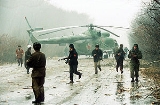
First Chechen War

Encyclopedia
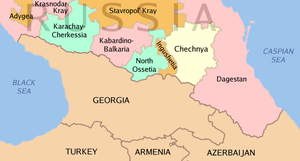
Russia
Russia or , officially known as both Russia and the Russian Federation , is a country in northern Eurasia. It is a federal semi-presidential republic, comprising 83 federal subjects...
and the Chechen Republic of Ichkeria
Chechen Republic of Ichkeria
The Chechen Republic of Ichkeria is the unrecognized secessionist government of Chechnya. The republic was proclaimed in late 1991 by Dzokhar Dudayev, and fought two devastating wars between separatists and the Russian Federation which denounced secession...
, fought from December 1994 to August 1996. After the initial campaign of 1994–1995, culminating in the devastating Battle of Grozny
Battle of Grozny (August 1996)
In the August 1996 Battle of Grozny Chechen rebels conducted a rapid assault on the Chechnya capital Grozny. This led to the final ceasefire in the First Chechen War....
, Russian federal forces attempted to seize control of the mountainous area of Chechnya but were set back by Chechen guerrilla warfare
Guerrilla warfare
Guerrilla warfare is a form of irregular warfare and refers to conflicts in which a small group of combatants including, but not limited to, armed civilians use military tactics, such as ambushes, sabotage, raids, the element of surprise, and extraordinary mobility to harass a larger and...
and raids on the flatlands in spite of Russia's overwhelming manpower, weaponry, and air support
Air Support
Air Support is a 1992 computer game for the Amiga and Atari ST. It is a top-down strategy game, with a first-person mode available for special missions. The game takes place during a retrofuturistic 21st century where all wars are fought in virtual reality. The game was given mostly positive...
. The resulting widespread demoralization
Morale
Morale, also known as esprit de corps when discussing the morale of a group, is an intangible term used to describe the capacity of people to maintain belief in an institution or a goal, or even in oneself and others...
of federal forces, and the almost universal opposition of the Russian public to the conflict, led Boris Yeltsin
Boris Yeltsin
Boris Nikolayevich Yeltsin was the first President of the Russian Federation, serving from 1991 to 1999.Originally a supporter of Mikhail Gorbachev, Yeltsin emerged under the perestroika reforms as one of Gorbachev's most powerful political opponents. On 29 May 1990 he was elected the chairman of...
's government to declare a ceasefire
Ceasefire
A ceasefire is a temporary stoppage of a war in which each side agrees with the other to suspend aggressive actions. Ceasefires may be declared as part of a formal treaty, but they have also been called as part of an informal understanding between opposing forces...
in 1996 and sign a peace treaty
Peace treaty
A peace treaty is an agreement between two or more hostile parties, usually countries or governments, that formally ends a state of war between the parties...
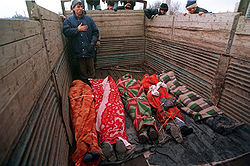
a year later. The official figure for Russian military deaths is 5,500, while most estimates put the number between 3,500 and 7,500, or even as high as 14,000. Although there are no accurate figures for the number of Chechen militants killed, various estimates put the number at about 3,000 to over 15,000 deaths. Various figures estimate the number of civilian deaths at between 30,000 and 100,000 killed and possibly over 200,000 injured, while more than 500,000 people were displaced
Displaced person
A displaced person is a person who has been forced to leave his or her native place, a phenomenon known as forced migration.- Origin of term :...
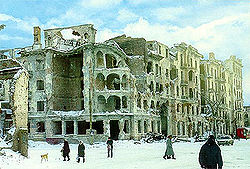
by the conflict, which left cities and villages across the republic in ruins.
Chechnya within Imperial Russia and the Soviet Union
Following long resistance during the 1817−1864 Caucasian WarCaucasian War
The Caucasian War of 1817–1864, also known as the Russian conquest of the Caucasus was an invasion of the Caucasus by the Russian Empire which ended with the annexation of the areas of the North Caucasus to Russia...
, Russia finally defeated Chechnya and annexed it in the 1870s. The Chechens' subsequent attempts at gaining independence after the fall of the Russian Empire
Russian Empire
The Russian Empire was a state that existed from 1721 until the Russian Revolution of 1917. It was the successor to the Tsardom of Russia and the predecessor of the Soviet Union...
failed and in 1922 Chechnya was incorporated into Bolshevist Russia
Russian Soviet Federative Socialist Republic
The Russian Soviet Federative Socialist Republic , commonly referred to as Soviet Russia, Bolshevik Russia, or simply Russia, was the largest, most populous and economically developed republic in the former Soviet Union....
and later into the Soviet Union
Soviet Union
The Soviet Union , officially the Union of Soviet Socialist Republics , was a constitutionally socialist state that existed in Eurasia between 1922 and 1991....
(USSR). In 1936, Soviet leader Joseph Stalin
Joseph Stalin
Joseph Vissarionovich Stalin was the Premier of the Soviet Union from 6 May 1941 to 5 March 1953. He was among the Bolshevik revolutionaries who brought about the October Revolution and had held the position of first General Secretary of the Communist Party of the Soviet Union's Central Committee...
created the Chechen-Ingush Autonomous Soviet Socialist Republic
Chechen-Ingush Autonomous Soviet Socialist Republic
The Chechen–Ingush Autonomous Soviet Socialist Republic, or Chechen–Ingush ASSR ;) was an autonomous republic within the Russian SFSR...
. In 1944, on the orders of NKVD
NKVD
The People's Commissariat for Internal Affairs was the public and secret police organization of the Soviet Union that directly executed the rule of power of the Soviets, including political repression, during the era of Joseph Stalin....
chief Lavrenti Beria, more than 1 million Chechens, the Ingush
Ingush people
The Ingush are a native ethnic group of the North Caucasus, mostly inhabiting the Russian republic of Ingushetia. They refer to themselves as Ghalghai . The Ingush are predominantly Sunni Muslims and speak the Ingush language...
, and several other North Caucasian peoples were deported to Siberia
Siberia
Siberia is an extensive region constituting almost all of Northern Asia. Comprising the central and eastern portion of the Russian Federation, it was part of the Soviet Union from its beginning, as its predecessor states, the Tsardom of Russia and the Russian Empire, conquered it during the 16th...
and Central Asia
Central Asia
Central Asia is a core region of the Asian continent from the Caspian Sea in the west, China in the east, Afghanistan in the south, and Russia in the north...
, officially as punishment for alleged collaboration with the invading German forces; the Chechen-Ingush Republic was abolished. Eventually, Soviet first secretary Nikita Khrushchev
Nikita Khrushchev
Nikita Sergeyevich Khrushchev led the Soviet Union during part of the Cold War. He served as First Secretary of the Communist Party of the Soviet Union from 1953 to 1964, and as Chairman of the Council of Ministers, or Premier, from 1958 to 1964...
granted the Vainakh
Nakh peoples
Nakh peoples are a group of historical and modern ethnic groups speaking Nakh languages and sharing certain cultural traits...
(Chechen and Ingush) peoples permission to return to their homeland and restored their republic in 1957.
The dissolution of the Soviet Union and the Russian Federation Treaty
Russia became an independent nation after the dissolution of the Soviet UnionDissolution of the Soviet Union
The dissolution of the Soviet Union was the disintegration of the federal political structures and central government of the Union of Soviet Socialist Republics , resulting in the independence of all fifteen republics of the Soviet Union between March 11, 1990 and December 25, 1991...
in December 1991. While Russia was widely accepted as the successor state to the USSR, it lost a significant amount of its military and economic power
Economic power
There is no agreed-upon definition of power in economics. At least five definitions of power have been used:*Purchasing power, i.e., the ability of any amount of money to buy goods and services. Those with more assets, or, more correctly, net worth, have more power of this sort...
. While ethnic Russians
Russians
The Russian people are an East Slavic ethnic group native to Russia, speaking the Russian language and primarily living in Russia and neighboring countries....
made up more than 80% of the population of the Russian Soviet Federative Socialist Republic, significant ethnic and religious differences posed a threat of political disintegration
Societal collapse
Societal collapse broadly includes both quite abrupt societal failures typified by collapses , as well as more extended gradual declines of superpowers...
in some regions. In the Soviet period, some of Russia's approximately 100 nationalities
Nationality
Nationality is membership of a nation or sovereign state, usually determined by their citizenship, but sometimes by ethnicity or place of residence, or based on their sense of national identity....
were granted ethnic enclaves that had various formal federal rights attached. Relations of these entities with the federal government
Government of Russia
The Government of the Russian Federation exercises executive power in the Russian Federation. The members of the government are the prime minister , the deputy prime ministers, and the federal ministers...
and demands for autonomy
Autonomy
Autonomy is a concept found in moral, political and bioethical philosophy. Within these contexts, it is the capacity of a rational individual to make an informed, un-coerced decision...
erupted into a major political issue in the early 1990s. Boris Yeltsin
Boris Yeltsin
Boris Nikolayevich Yeltsin was the first President of the Russian Federation, serving from 1991 to 1999.Originally a supporter of Mikhail Gorbachev, Yeltsin emerged under the perestroika reforms as one of Gorbachev's most powerful political opponents. On 29 May 1990 he was elected the chairman of...
incorporated these demands into his 1990 election campaign by claiming that their resolution was a high priority.
There was an urgent need for a law to clearly define the powers of each federal subject. Such a law was passed on March 31, 1992, when Yeltsin and Ruslan Khasbulatov
Ruslan Khasbulatov
Ruslan Imranovich Khasbulatov is a Russian economist and politician of Chechen descent who played a central role in the events leading to the 1993 constitutional crisis in the Russian Federation.-Early life:...
, then chairman of the Russian Supreme Soviet and an ethnic Chechen himself, signed the Federation Treaty bilaterally with 86 out of 88 federal subjects. In almost all cases, demands for greater autonomy or independence were satisfied by concessions of regional autonomy and tax privileges. The treaty outlined three basic types of federal subjects and the powers that were reserved for local and federal government. The only federal subjects that did not sign the treaty were Chechnya and Tatarstan
Tatarstan
The Republic of Tatarstan is a federal subject of Russia located in the Volga Federal District. Its capital is the city of Kazan, which is one of Russia's largest and most prosperous cities. The republic borders with Kirov, Ulyanovsk, Samara, and Orenburg Oblasts, and with the Mari El, Udmurt,...
. Eventually, in the spring of 1994, President Yeltsin signed a special political accord with Mintimer Shaeymiev
Mintimer Shaeymiev
Mintimer Sharipovich Shaimiev was the first President of Tatarstan, a republic within Russia. He is an ethnic Tatar. He became President on June 12, 1991, and was re-elected three times, on March 24, 1996, on March 25, 2001, and on March 25, 2005.Shaeymiev was born in the village of Anyakovo, in...
, the president of Tatarstan, granting many of its demands for greater autonomy for the republic within Russia; thus, Chechnya remained the only federal subject that did not sign the treaty. Neither Yeltsin nor the Chechen government attempted any serious negotiations and the situation deteriorated into a full-scale conflict.
Chechen declaration of independence
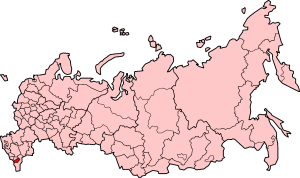
All-National Congress of the Chechen People
The All-National Congress of the Chechen People of the Chechen Republic of Ichkeria came to power on 1 November 1991 under president Dzhokhar Dudayev, a former commander of the Soviet air force base in Tartu, Estonia. Since its formation, the organization advocated sovereignty for Chechnya as a...
(NCChP) party, created by the former Soviet Air Force
Soviet Air Force
The Soviet Air Force, officially known in Russian as Военно-воздушные силы or Voenno-Vozdushnye Sily and often abbreviated VVS was the official designation of one of the air forces of the Soviet Union. The other was the Soviet Air Defence Forces...
general Dzhokhar Dudayev, stormed a session of the Chechen-Ingush ASSR Supreme Soviet with the aim of asserting independence. It caused the death of the head of the Grozny's branch of the Communist Party of the Soviet Union
Communist Party of the Soviet Union
The Communist Party of the Soviet Union was the only legal, ruling political party in the Soviet Union and one of the largest communist organizations in the world...
Vitaly Kutsenko, who was thrown out of a window
Defenestration
Defenestration is the act of throwing someone or something out of a window.The term "defenestration" was coined around the time of an incident in Prague Castle in the year 1618. The word comes from the Latin de- and fenestra...
or fell trying to escape, and effectively dissolved the government of the Chechen-Ingush Autonomous Republic of the Soviet Union
Autonomous republics of the Soviet Union
Autonomous Soviet Socialist Republics of the Soviet Union were administrative units created for certain nations. The ASSRs had a status lower than the union republics of the Soviet Union, but higher than the autonomous oblasts and the autonomous okrugs....
. In the following month, Dudayev won overwhelming popular support (as evidenced by the later presidential elections with high turn out and a clear Dudayev victory) to oust the interim administration supported by central government. He was made president and declared independence from the Soviet Union.
In November 1991, Yeltsin dispatched Internal Troops
Internal Troops
The Internal Troops, full name Internal Troops of the Ministry for Internal Affairs ; alternatively translated as "Interior " is a paramilitary gendarmerie-like force in the now-defunct Soviet Union and its successor countries, particularly, in Russia, Ukraine, Georgia and Azerbaijan...
to Grozny, but they were forced to withdraw when Dudayev's forces surrounded them at the airport. After Chechnya made its initial declaration of sovereignty
Sovereignty
Sovereignty is the quality of having supreme, independent authority over a geographic area, such as a territory. It can be found in a power to rule and make law that rests on a political fact for which no purely legal explanation can be provided...
, the Chechen-Ingush Autonomous Republic split in two in June 1992 amidst the Ingush armed conflict against another Russian republic, North Ossetia. The newly created republic of Ingushetia
Ingushetia
The Republic of Ingushetia is a federal subject of Russia , located in the North Caucasus region with its capital at Magas. In terms of area, the republic is the smallest of Russia's federal subjects except for the two federal cities, Moscow and Saint Petersburg...
then joined the Russian Federation, while Chechnya declared full independence from Moscow
Moscow
Moscow is the capital, the most populous city, and the most populous federal subject of Russia. The city is a major political, economic, cultural, scientific, religious, financial, educational, and transportation centre of Russia and the continent...
in 1993 as the Chechen Republic of Ichkeria
Chechen Republic of Ichkeria
The Chechen Republic of Ichkeria is the unrecognized secessionist government of Chechnya. The republic was proclaimed in late 1991 by Dzokhar Dudayev, and fought two devastating wars between separatists and the Russian Federation which denounced secession...
(ChRI).
Internal conflict in Chechnya and the Grozny-Moscow tensions
From 1991 to 1994 tens of thousands of people of non-Chechen ethnicity left the republicRepublic
A republic is a form of government in which the people, or some significant portion of them, have supreme control over the government and where offices of state are elected or chosen by elected people. In modern times, a common simplified definition of a republic is a government where the head of...
amidst reports of violence and discrimination against the non-Chechen population (mostly Russians, Ukrainians and Armenians). Chechen industry began to fail as a result of many Russian engineers and workers leaving or being expelled from the republic combined with the Soviet era's crippling of the non-Russian/Armenian/Ukrainian populace (Chechens, some Ingush and Nogais, Jews) through Russian-only schooling, heavy discrimination in the public sector of the workforce, and other similar measures (even as late as 1989, Checheno-Ingushetia was ruled by a bureaucracy of ethnic Russians). During the undeclared Chechen civil war
Civil war
A civil war is a war between organized groups within the same nation state or republic, or, less commonly, between two countries created from a formerly-united nation state....
, factions both sympathetic and opposed to Dudayev fought for power, sometimes in pitched battles with the use of heavy weapons. In March 1992, the opposition attempted a coup d'état
Coup d'état
A coup d'état state, literally: strike/blow of state)—also known as a coup, putsch, and overthrow—is the sudden, extrajudicial deposition of a government, usually by a small group of the existing state establishment—typically the military—to replace the deposed government with another body; either...
, but their attempt was crushed by force. A month later, Dudayev introduced direct presidential rule, and in June 1993, dissolved the Chechen parliament to avoid a referendum on a vote of non-confidence. In late October 1992, Russian forces dispatched to the zone of the Ossetian-Ingush conflict were ordered to move to the Chechen border; Dudayev, who perceived this as "an act of aggression against the Chechen Republic", declared a state of emergency
State of emergency
A state of emergency is a governmental declaration that may suspend some normal functions of the executive, legislative and judicial powers, alert citizens to change their normal behaviours, or order government agencies to implement emergency preparedness plans. It can also be used as a rationale...
and threatened general mobilization
Mobilization
Mobilization is the act of assembling and making both troops and supplies ready for war. The word mobilization was first used, in a military context, in order to describe the preparation of the Prussian army during the 1850s and 1860s. Mobilization theories and techniques have continuously changed...
if the Russian troops did not withdraw from the Chechen border. To prevent invasion of Chechnya, he did not provoke the Russian troops.
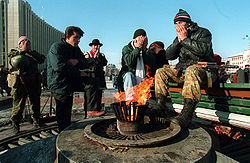
However, the issue of contention was not independence from Russia: even the opposition stated there was no alternative to an international boundary separating Chechnya from Russia. In 1992, Russian newspaper Moscow News made note that, just like the most other seceding republics except for Tatarstan, ethnic Chechens universally supported the establishment of an independent Chechen state. Again, in 1995, during the heat of the First Chechen War, Khalid Delmayev, an anti-Dudayev belonging to an Ichkerian liberal coalition, stated that "Chechnya's statehood may be postponed... but cannot be avoided". Opposition to Dudayev came mainly due to his domestic policy and personality: he once notoriously claimed that Russia intended to destabilize his nation by "artificially creating earthquakes" in Georgia and Armenia. This did not go off well with most Chechens, who came to view him as a national embarrassment at times (if still a patriot at others), but it did not, by any means, dismantle the determination for independence, as most Western commentators note.
Moscow clandestinely supplied separatist forces with financial support, military equipment and mercenaries. Russia also suspended all civilian flights to Grozny while the aviation and border troops set up a military blockade
Blockade
A blockade is an effort to cut off food, supplies, war material or communications from a particular area by force, either in part or totally. A blockade should not be confused with an embargo or sanctions, which are legal barriers to trade, and is distinct from a siege in that a blockade is usually...
of the republic and eventually unmarked Russian aircraft began combat operations over Chechnya. The opposition forces, who were joined by Russian troops, launched a clandestine but badly organized assault on Grozny in mid-October 1994, followed by the second, larger attack
Battle of Grozny (November 1994)
November 1994 Battle of Grozny was a November 26, 1994, failed attempt by the Chechen opposition forces to seize the city of Grozny, the Chechen capital, and overthrow the separatist government of Dzhokhar Dudayev....
on November 26–27, 1994. Despite Russian support, both attempts were unsuccessful. In a major embarrassment for the Kremlin, Dudayev loyalists succeeded in capturing some 20 Russian Army regulars
Regular Army
The Regular Army of the United States was and is the successor to the Continental Army as the country's permanent, professional military establishment. Even in modern times the professional core of the United States Army continues to be called the Regular Army...
and about 50 other Russian citizens who were clandestinely hired by the Russian FSK
FSK (Russia)
The FSK was a state security organization, initially of the USSR, and, after its dissolution, of the Russian Federation. The FSK was the successor organization to the KGB...
state security organization to fight for the Provisional Council forces. On November 29, President Boris Yeltsin issued an ultimatum to all warring factions in Chechnya ordering them to disarm and surrender
Surrender (military)
Surrender is when soldiers, nations or other combatants stop fighting and eventually become prisoners of war, either as individuals or when ordered to by their officers. A white flag is a common symbol of surrender, as is the gesture of raising one's hands empty and open above one's head.When the...
. When the government in Grozny refused, Yeltsin ordered his army to "restore constitution
Constitution
A constitution is a set of fundamental principles or established precedents according to which a state or other organization is governed. These rules together make up, i.e. constitute, what the entity is...
al order" by force.
Since December 1, Russian forces were openly carrying out heavy aerial bombardment
Strategic bombing
Strategic bombing is a military strategy used in a total war with the goal of defeating an enemy nation-state by destroying its economic ability and public will to wage war rather than destroying its land or naval forces...
s of Chechnya. On December 11, 1994, five days after Dudayev and Russian Minister of Defense Gen. Pavel Grachev
Pavel Grachev
Pavel Sergeyevich Grachev , sometimes transliterated as Grachov, is a retired Russian Army General and the former Defence Minister of the Russian Federation; in 1988 he was declared the Hero of the Soviet Union...
of Russia had agreed to "avoid the further use of force", Russian forces entered the republic in order to "establish constitutional order in Chechnya and to preserve the territorial integrity of Russia." Grachev boasted he could topple Dudayev in a couple of hours with a single airborne regiment, and proclaimed that it will be "a bloodless blitzkrieg
Blitzkrieg
For other uses of the word, see: Blitzkrieg Blitzkrieg is an anglicized word describing all-motorised force concentration of tanks, infantry, artillery, combat engineers and air power, concentrating overwhelming force at high speed to break through enemy lines, and, once the lines are broken,...
, that would not last any longer than December 20."
Initial stages
On December 11, 1994, Russian forces launched a three-pronged ground attack towards Grozny. The main attack was temporarily halted by deputy commander of the Russian Ground ForcesRussian Ground Forces
The Russian Ground Forces are the land forces of the Armed Forces of the Russian Federation, formed from parts of the collapsing Soviet Army in 1992. The formation of these forces posed economic challenges after the collapse of the Soviet Union, and required reforms to professionalize the force...
, Gen. Eduard Vorobyov, who then resigned in protest, stating that it is "a crime" to "send the army against its own people." Many in the Russian military and government opposed the war as well. Yeltsin's adviser on nationality affairs, Emil Pain, and Russia's Deputy Minister of Defense Gen. Boris Gromov
Boris Gromov
Boris Vsevolodovich Gromov is a prominent Russian military and political figure. Since 2000, he has been the Governor of Moscow Oblast.-Biography:...
(esteemed commander of the Soviet-Afghan War), also resigned in protest of the invasion ("It will be a bloodbath, another Afghanistan
Afghanistan
Afghanistan , officially the Islamic Republic of Afghanistan, is a landlocked country located in the centre of Asia, forming South Asia, Central Asia and the Middle East. With a population of about 29 million, it has an area of , making it the 42nd most populous and 41st largest nation in the world...
", Gromov said on television), as did Gen. Borys Poliakov. More than 800 professional soldiers and officers refused to take part in the operation; of these, 83 were convicted by military courts and the rest were discharged. Later Gen. Lev Rokhlin
Lev Rokhlin
Lev Yakovlevich Rokhlin was a Lieutenant-General in the Soviet and Russian armies.Rokhlin have reached the top of the Russian military, quickly rose through the ranks during and after the Soviet war in Afghanistan...
also refused to be decorated as a Hero of Russia for his part in the war.
The Chechen Air Force (as well as the republic's civilian aircraft fleet) was completely destroyed in the air strikes of the very first few hours of the war, while around 500 people took advantage of the mid-December amnesty
Amnesty
Amnesty is a legislative or executive act by which a state restores those who may have been guilty of an offense against it to the positions of innocent people, without changing the laws defining the offense. It includes more than pardon, in as much as it obliterates all legal remembrance of the...
declared by Yeltsin for members of Dzhokhar Dudayev's armed groups. Nevertheless, Boris Yeltsin's cabinet's expectations of a quick surgical strike
Surgical strike
A surgical strike is a military attack which results in, was intended to result in, or is claimed to have resulted in only damage to the intended legitimate military target, and no or minimal collateral damage to surrounding structures, vehicles, buildings, etc....
, quickly followed by Chechen capitulation
Capitulation (surrender)
Capitulation , an agreement in time of war for the surrender to a hostile armed force of a particular body of troops, a town or a territory....
and regime change
Regime change
"Regime change" is the replacement of one regime with another. Use of the term dates to at least 1925.Regime change can occur through conquest by a foreign power, revolution, coup d'état or reconstruction following the failure of a state...
, were misguided. Russia found itself in a quagmire practically instantly. The morale
Morale
Morale, also known as esprit de corps when discussing the morale of a group, is an intangible term used to describe the capacity of people to maintain belief in an institution or a goal, or even in oneself and others...
of the Russian troops, poorly prepared and not understanding why and even where they were sent, was low from the beginning. Some Russian units resisted the order to advance, and in some cases, the troops sabotage
Sabotage
Sabotage is a deliberate action aimed at weakening another entity through subversion, obstruction, disruption, or destruction. In a workplace setting, sabotage is the conscious withdrawal of efficiency generally directed at causing some change in workplace conditions. One who engages in sabotage is...
d their own equipment. In Ingushetia, civilian protesters stopped the western column and set 30 military vehicles on fire, while about 70 conscripts deserted
Desertion
In military terminology, desertion is the abandonment of a "duty" or post without permission and is done with the intention of not returning...
their units. Advance of the northern column was halted by the unexpected Chechen resistance
Battle of Dolinskoye
The Battle of Dolinskoye , which took place 25 kilometers northwest of the Chechen capital of Grozny, was the first major ground engagement of the First Chechen War.- Battle :...
at Dolinskoye and the Russian forces suffered the first serious losses. Deeper in Chechnya, a group of 50 Russian paratroopers surrendered to the local militia
Militia
The term militia is commonly used today to refer to a military force composed of ordinary citizens to provide defense, emergency law enforcement, or paramilitary service, in times of emergency without being paid a regular salary or committed to a fixed term of service. It is a polyseme with...
, after being deployed by helicopters behind enemy lines and then abandoned.
Yeltsin ordered the Russian Army to show restraint, but it was neither prepared nor trained for this. Civilian losses quickly mounted, alienating the Chechen population and raising hostility to the Russian forces, even among those who initially supported the attempts to unseat Dudayev. Other problems occurred as Yeltsin sent in freshly trained conscripts from neighboring regions rather than regular soldiers. Highly mobile units of Chechen fighters caused severe losses to Russia's ill-prepared, demoralized troops. The Russian military command then resorted to carpet bombing
Carpet bombing
Carpet bombing is a large aerial bombing done in a progressive manner to inflict damage in every part of a selected area of land. The phrase invokes the image of explosions completely covering an area, in the same way that a carpet covers a floor. Carpet bombing is usually achieved by dropping many...
tactics and indiscriminate barrages of rocket artillery
Rocket artillery
Rocket artillery is a type of artillery equipped with rocket launchers instead of conventional guns or mortars.Types of rocket artillery pieces include multiple rocket launchers.-History:...
, causing enormous casualties among the Chechen and Russian civilian population. On December 29, in a rare instance of a Russian outright victory, the Russian airborne forces seized the military airfield next to Grozny and repelled a Chechen armored counterattack in the battle of Khankala
Battle of Khankala
Battle of Khankala was a failed attempt by the Chechen to counterattack at the strategic position at Khankala from Grozny and Argun using armoured vehicles....
; the next objective was the city itself. With the Russians closing in on the capital, Chechens began to hastily set up defensive fighting position
Defensive fighting position
A defensive fighting position is a type of earthwork constructed in a military context, generally large enough to accommodate at least one person.- Terminology :...
s and group their forces in the city.
Storming of Grozny
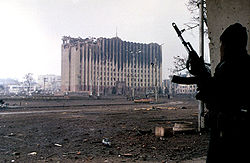
Siege
A siege is a military blockade of a city or fortress with the intent of conquering by attrition or assault. The term derives from sedere, Latin for "to sit". Generally speaking, siege warfare is a form of constant, low intensity conflict characterized by one party holding a strong, static...
d the Chechen capital, thousands of civilians died from a week-long series of air raids
Airstrike
An air strike is an attack on a specific objective by military aircraft during an offensive mission. Air strikes are commonly delivered from aircraft such as fighters, bombers, ground attack aircraft, attack helicopters, and others...
and artillery bombardment in the heaviest bombing campaign in Europe since the destruction of Dresden
Bombing of Dresden in World War II
The Bombing of Dresden was a military bombing by the British Royal Air Force and the United States Army Air Force and as part of the Allied forces between 13 February and 15 February 1945 in the Second World War...
. The initial assault on the New Year's Eve
New Year's Eve
New Year's Eve is observed annually on December 31, the final day of any given year in the Gregorian calendar. In modern societies, New Year's Eve is often celebrated at social gatherings, during which participants dance, eat, consume alcoholic beverages, and watch or light fireworks to mark the...
of 1995 ended in a major Russian defeat, resulting in heavy casualties and at first nearly a complete breakdown of morale in the Russian forces. The disaster claimed lives of an estimated 1,000 to 2,000 Russian soldiers, mostly barely trained and disoriented conscripts; the worst losses were suffered by the 131st 'Maikop' Motor Rifle Brigade, completely destroyed in the fighting near the central railway station. Despite the early Chechen defeat of the New Year assault and many further casualties, Grozny was eventually conquered by Russian forces amidst bitter urban warfare
Urban warfare
Urban warfare is combat conducted in urban areas such as towns and cities. Urban combat is very different from combat in the open at both the operational and tactical level...
. After armored assaults failed, the Russian military set out to pulverize the sealed-off city into submission using air power and artillery, at the same time accusing their enemies of using civilians as human shield
Human shield
Human shield is a military and political term describing the deliberate placement of civilians in or around combat targets to deter an enemy from attacking those targets. It may also refer to the use of civilians to literally shield combatants during attacks, by forcing the civilians to march in...
s by preventing them from leaving the capital as it came under continued bombardment. On January 7, 1995, Russia's Major-General Viktor Vorobyov was killed by mortar
Mortar (weapon)
A mortar is an indirect fire weapon that fires explosive projectiles known as bombs at low velocities, short ranges, and high-arcing ballistic trajectories. It is typically muzzle-loading and has a barrel length less than 15 times its caliber....
fire, becoming the first on a long list of generals to be killed in Chechnya. On January 19, despite heavy casualties, Russian forces seized the ruins of the Chechen presidential palace
Presidential Palace, Grozny
The presidential palace in Grozny was the building in Grozny, capital of Chechnya, which became a world-famous symbol during the early conflict in Chechnya, in which it became the key terrain symbolizing victory. The building was ruined by repeated artillery and air strikes...
, which had been heavily contested for more than three weeks as Chechens finally abandoned their positions in the destroyed downtown area. The battle for the southern part of the city continued until the official end on March 6, 1995.
By the estimates of Yeltsin's human rights adviser Sergey Kovalev, about 27,000 civilians died in the first five weeks of fighting. Russian historian and general Dmitri Volkogonov
Dmitri Volkogonov
Dmitri Antonovich Volkogonov was a Russian historian and officer.-Biography:...
said the Russian military's bombardment of Grozny killed around 35,000 civilians, including 5,000 children, and that the vast majority of those killed were ethnic Russians. While military casualties are not known, the Russian side admitted to having lost nearly 2,000 soldiers killed or missing. The bloodbath of Grozny shocked Russia and the outside world, causing severe criticism of the war. International monitors from the OSCE described the scenes as nothing short of an "unimaginable catastrophe", while former Soviet leader Mikhail Gorbachev
Mikhail Gorbachev
Mikhail Sergeyevich Gorbachev is a former Soviet statesman, having served as General Secretary of the Communist Party of the Soviet Union from 1985 until 1991, and as the last head of state of the USSR, having served from 1988 until its dissolution in 1991...
called the war a "disgraceful, bloody adventure" and German Chancellor Helmut Kohl
Helmut Kohl
Helmut Josef Michael Kohl is a German conservative politician and statesman. He was Chancellor of Germany from 1982 to 1998 and the chairman of the Christian Democratic Union from 1973 to 1998...
called it "sheer madness".
Continued Russian offensive
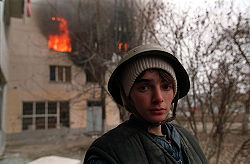
OMON
OMOH is a generic name for the system of special units of militsiya within the Russian and earlier the Soviet MVD...
and other federal forces killed at least 103 civilians
Samashki massacre
The Samashki massacre was an incident which occurred on April 7–8, 1995, in the village of Samashki, at the border between Chechnya and Ingushetia. Numerous villagers died at the hands of Russian paramilitary troops, many of them reportedly drunk or drugged, under the command of Gen. Anatoly Kulikov...
while seizing the border village of Samashki
Samashki
Samashki is a village on the western plains in Achkhoy-Martanovsky District of the Chechen Republic, Russia; since 1992 it is a border village with the Russian Republic of Ingushetia. The pre-war population of Samashki counted about 14,600 people .A railway line from Nazran to Grozny runs through...
on April 7 (several hundred more were detained and beaten or otherwise tortured). In the southern mountains, the Russians launched an offensive along the entire front on April 15, advancing in large columns of 200-300 vehicles. The ChRI forces defended the city of Argun
Argun, Chechen Republic
Argun is a town in the Chechen Republic, Russia, located on the Argun River. Population: 22,000 ....
, moving their military headquarters first to completely surrounded Shali, then shortly after to Serzhen-Yurt as they were forced into the mountains, and finally to Shamil Basayev
Shamil Basayev
Shamil Salmanovich Basayev was a Chechen militant Islamist and a leader of the Chechen rebel movement.Starting as a field commander in the Transcaucasus, Basayev led guerrilla campaigns against the Russian troops for years, as well as launching mass-hostage takings of civilians, with his goal...
's ancestral stronghold of Vedeno
Vedeno
Vedeno is a rural locality in the Chechen Republic, Russia, located some southeast of Grozny. It is the administrative center of Vedensky District. Population: 11,512 ;...
. Chechnya's second-largest city of Gudermes
Gudermes
Gudermes is a town in the Chechen Republic, Russia, located on the Sunzha River east of Grozny. Population: 32,000 .Gudermes had a rural locality status until 1941. Later, it became a railroad junction between Rostov-on-Don, Baku, Astrakhan, and Mozdok. Gudermes is home for oil extraction...
was surrendered without a fight, but the village of Shatoy
Shatoy
Shatoy or Shatoi is a village in the Chechen Republic, Russia. It is the administrative center of Shatoysky District. Population: 1,771 . It is the home village of underground rebel President Doku Umarov. Geographical location: ....
was fought for and defended by the men of Ruslan Gelayev. Eventually, the Chechen command withdrew from the area of Vedeno to the Chechen opposition-aligned village of Dargo, and from there to Benoy
Benoy
Benoy is an international firm of architects, masterplanners, retail auditors, visualisers, interior and graphic designers working from design studios in the United Kingdom, Abu Dhabi, Hong Kong, Shanghai and Singapore...
. According to an estimate cited in a United States Army
United States Army
The United States Army is the main branch of the United States Armed Forces responsible for land-based military operations. It is the largest and oldest established branch of the U.S. military, and is one of seven U.S. uniformed services...
analysis report, between January and June 1995, when the Russian forces conquered most of the republic in the conventional campaign, their losses in Chechnya were approximately 2,800 killed, 10,000 wounded and more than 500 missing or captured. However, some Chechen fighters infiltrated already pacified places hiding in crowds of returning refugees.
As the war continued, separatists resorted to large hostage
Hostage
A hostage is a person or entity which is held by a captor. The original definition meant that this was handed over by one of two belligerent parties to the other or seized as security for the carrying out of an agreement, or as a preventive measure against certain acts of war...
takings, attempting to influence the Russian public and leadership. In June 1995, a group led by the maverick field commander Shamil Basayev took more than 1,500 people hostage in southern Russia in the Budyonnovsk hospital hostage crisis
Budyonnovsk hospital hostage crisis
The Budyonnovsk hospital hostage crisis took place from 14 June to 19 June 1995, when a group of 80 to 200 Chechen terrorists led by Shamil Basayev attacked the southern Russian city of Budyonnovsk , some north of the border with the Russian republic of Chechnya...
; about 120 Russian civilians died before a ceasefire was signed after negotiations between Basayev and the Russian Prime Minister Viktor Chernomyrdin
Viktor Chernomyrdin
Viktor Stepanovich Chernomyrdin was the founder and the first chairman of the Gazprom energy company, the longest serving Prime Minister of Russia and Acting President of Russia for a day in 1996. He was a key figure in Russian politics in the 1990s, and a great contributor to the Russian...
. The raid enforced a temporary stop in Russian military operations, allowing the Chechens the time to regroup during their greatest crisis and prepare for the national militant campaign. The full-scale Russian attack led many of Dudayev's opponents to side with his forces and thousands of volunteers to swell the ranks of mobile militant units. Many others formed local self-defence militia
Militia
The term militia is commonly used today to refer to a military force composed of ordinary citizens to provide defense, emergency law enforcement, or paramilitary service, in times of emergency without being paid a regular salary or committed to a fixed term of service. It is a polyseme with...
units to defend their settlements in the case of the federal offensive action, officially numbering 5,000–6,000 armed men in late 1995. Altogether, the ChRI forces fielded some 10,000–12,000 full-time and reserve fighters at a time, according to the Chechen command. According to the UN report, the Chechen separatist forces included a large number of child soldiers
Military use of children
The military use of children takes three distinct forms: children can take direct part in hostilities , or they can be used in support roles such as porters, spies, messengers, look outs, and sexual slaves; or they can be used for political advantage either as human shields or in...
, some as young as 11 and including females. As the territory controlled by them shrank the separatists increasingly resorted to the classic guerrilla warfare
Guerrilla warfare
Guerrilla warfare is a form of irregular warfare and refers to conflicts in which a small group of combatants including, but not limited to, armed civilians use military tactics, such as ambushes, sabotage, raids, the element of surprise, and extraordinary mobility to harass a larger and...
tactics, such as setting booby trap
Booby trap
A booby trap is a device designed to harm or surprise a person, unknowingly triggered by the presence or actions of the victim. As the word trap implies, they often have some form of bait designed to lure the victim towards it. However, in other cases the device is placed on busy roads or is...
s and mining
Land mine
A land mine is usually a weight-triggered explosive device which is intended to damage a target—either human or inanimate—by means of a blast and/or fragment impact....
roads in the enemy-held territory. The successful use of improvised explosive device
Improvised explosive device
An improvised explosive device , also known as a roadside bomb, is a homemade bomb constructed and deployed in ways other than in conventional military action...
s was particularly noteworthy; they also effectively exploited a combination of mines and ambush
Ambush
An ambush is a long-established military tactic, in which the aggressors take advantage of concealment and the element of surprise to attack an unsuspecting enemy from concealed positions, such as among dense underbrush or behind hilltops...
es.
In the fall of 1995, Gen. Anatoliy Romanov, the federal commander in Chechnya at the time, was critically injured and paralyzed
Paralysis
Paralysis is loss of muscle function for one or more muscles. Paralysis can be accompanied by a loss of feeling in the affected area if there is sensory damage as well as motor. A study conducted by the Christopher & Dana Reeve Foundation, suggests that about 1 in 50 people have been diagnosed...
in a bomb blast in Grozny. Suspicion of responsibility for the attack fell on rogue elements of the Russian military, as the attack destroyed hopes for a permanent ceasefire based on the developing trust between Gen. Romanov and the ChRI Chief of Staff Aslan Maskhadov
Aslan Maskhadov
Aslan Aliyevich Maskhadov was a leader of the Chechen separatist movement and the third President of the Chechen Republic of Ichkeria.He was credited by many with the Chechen victory in the First Chechen War, which allowed for the...
, a former colonel in the Soviet Army; in August, the two went to southern Chechnya in an effort to convince the local commanders to release Russian prisoners. In February 1996, the federal and pro-Russian Chechen forces in Grozny opened fire on the massive pro-independence peace march involving tens of thousands of people, killing a number of demonstrators; the ruins of the presidential palace, the symbol of the Chechen independence, were then demolished two days later.
Human rights and laws of war violations
Human rights organizations accused the federal forces of engaging in indiscriminate and disproportionate use of force whenever encountering resistance, resulting in numerous civilian deaths (for example, according to Human Rights WatchHuman Rights Watch
Human Rights Watch is an international non-governmental organization that conducts research and advocacy on human rights. Its headquarters are in New York City and it has offices in Berlin, Beirut, Brussels, Chicago, Geneva, Johannesburg, London, Los Angeles, Moscow, Paris, San Francisco, Tokyo,...
, Russian artillery and rocket attacks killed at least 267 civilians during the December 1995 separatist raid on Gudermes). The dominant Russian strategy was to use heavy artillery and air strikes throughout the campaign, leading some Western and Chechen sources to call the air strikes deliberate terror bombing on the part of Russia. Ironically, due to the fact that ethnic Chechens in Grozny were able to seek refuge among their respective teips in the surrounding villages of the countryside, a high proportion of initial civilian casualties were inflicted against ethnic Russians who were unable to procure viable escape routes. The villages, however, were also heavily targeted from the first weeks of the conflict (the Russian cluster bomb
Cluster bomb
A cluster munition is a form of air-dropped or ground-launched explosive weapon that releases or ejects smaller sub-munitions. Commonly, this is a cluster bomb that ejects explosive bomblets that are designed to kill enemy personnel and destroy vehicles...
s, for example, killed at least 55 civilians during the January 3, 1995 Shali cluster bomb attack
1995 Shali cluster bomb attack
The 1995 Shali cluster bomb attack is an incident which occurred on January 3, 1995, and in which the Russian jet aircraft repeatedly bombed the Chechen town of Shali with cluster bombs....
). The Russian soldiers often prevented civilians from evacuating from areas of imminent danger and prevented humanitarian organizations from assisting civilians in need. It was widely alleged that Russian troops, especially those belonging to the MVD
Internal Troops
The Internal Troops, full name Internal Troops of the Ministry for Internal Affairs ; alternatively translated as "Interior " is a paramilitary gendarmerie-like force in the now-defunct Soviet Union and its successor countries, particularly, in Russia, Ukraine, Georgia and Azerbaijan...
, committed numerous and in part systematic acts of torture
Torture
Torture is the act of inflicting severe pain as a means of punishment, revenge, forcing information or a confession, or simply as an act of cruelty. Throughout history, torture has often been used as a method of political re-education, interrogation, punishment, and coercion...
and summary execution
Summary execution
A summary execution is a variety of execution in which a person is killed on the spot without trial or after a show trial. Summary executions have been practiced by the police, military, and paramilitary organizations and are associated with guerrilla warfare, counter-insurgency, terrorism, and...
s on separatist sympathizers; they were often linked to zachistka ("cleansing" raids, affecting entire town districts and villages suspected of harboring boyeviki - the separatist fighters). Humanitarian and aid groups chronicled persistent patterns of Russian soldiers killing, raping
Rape
Rape is a type of sexual assault usually involving sexual intercourse, which is initiated by one or more persons against another person without that person's consent. The act may be carried out by physical force, coercion, abuse of authority or with a person who is incapable of valid consent. The...
and looting
Looting
Looting —also referred to as sacking, plundering, despoiling, despoliation, and pillaging—is the indiscriminate taking of goods by force as part of a military or political victory, or during a catastrophe, such as during war, natural disaster, or rioting...
civilians at random, often in disregard of their nationality. Separatist fighters took hostages on a massive scale, kidnapped or killed Chechens considered to be collaborators, and mistreated civilian captives and federal prisoners of war (especially pilots). Both separatist and federal sides of the conflict kidnapped hostages for ransom and used human shields for cover during the fighting and movement of troops (for example, a group of surrounded Russian troops took approximately 500 civilian hostages at Grozny's 9th Municipal Hospital).
The violations by the members of the Russian forces were usually tolerated by their superiors and not punished even when investigated (story of Vladimir Glebov
Vladimir Glebov
Colonel Vladimir Ivanovich Glebov is a Russian military officer who participated in the Soviet war in Afghanistan and the First Chechen War. Vladimir Glebov was mentioned by mass media as "the lieutenant-colonel who was simultaneously recommended to receiving the Hero of the Russian Federation...
serving as an example of such policy). However, television and newspaper accounts widely reported largely uncensored images of the carnage to the Russian public. As a result, the Russian media coverage partially precipitated a loss of public confidence in the government and a steep decline in president Yeltsin's popularity. Chechnya was one of the heaviest burdens on Yeltsin's 1996 presidential election campaign. In addition, the protracted war in Chechnya, especially many reports of extreme violence against civilians, ignited fear and contempt of Russia among other ethnic groups in the federation.
Spread of the war
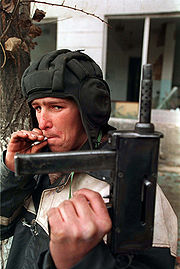
Akhmad Kadyrov
Hajji Akhmad Abdulkhamidovich Kadyrov , also spelled Akhmat, was the Chief Mufti of the Chechen Republic of Ichkeria in the 1990s during and after the First Chechen War...
's declaration that the ChRI was waging a Jihad
Jihad
Jihad , an Islamic term, is a religious duty of Muslims. In Arabic, the word jihād translates as a noun meaning "struggle". Jihad appears 41 times in the Quran and frequently in the idiomatic expression "striving in the way of God ". A person engaged in jihad is called a mujahid; the plural is...
(struggle) against Russia raised the spectre that Jihadis from other regions and even outside Russia would enter the war. By one estimate, up to 5,000 non-Chechens served as foreign volunteers
Foreign volunteers
The armed forces of many nations have, at one time or another, used foreign volunteers who are motivated by political, ideological or other considerations to join a foreign army. These may be formed into units of a given nationality or may be formed into mixed nationality foreign units. Sometimes...
, motivated by religious and/or nationalistic reasons.
Limited fighting occurred in the neighbouring small Russian republic of Ingushetia
Ingushetia
The Republic of Ingushetia is a federal subject of Russia , located in the North Caucasus region with its capital at Magas. In terms of area, the republic is the smallest of Russia's federal subjects except for the two federal cities, Moscow and Saint Petersburg...
, mostly when Russian commanders sent troops over the border in pursuit of Chechen fighters, while as many as 200,000 refugees (from Chechnya and the conflict in North Ossetia) strained Ingushetia's already weak economy. On several occasions, Ingush president Ruslan Aushev
Ruslan Aushev
Ruslan Sultanovich Aushev was the president of Ingushetia from March 1993 to December 2001. He was reportedly the youngest officer in the Soviet army to reach the rank of Lieutenant General. He received the Gold Star of the Hero of the Soviet Union on May 7, 1982...
protested incursions by Russian soldiers and even threatened to sue the Russian Ministry of Defence for damages inflicted, recalling how the federal forces previously assisted in the expulsion
Population transfer
Population transfer is the movement of a large group of people from one region to another by state policy or international authority, most frequently on the basis of ethnicity or religion...
of Ingush population from North Ossetia. Undisciplined Russian soldiers were also reported to be committing murders, rapes, and looting in Ingushetia (in an incident partially witnessed by visiting Russian Duma
Duma
A Duma is any of various representative assemblies in modern Russia and Russian history. The State Duma in the Russian Empire and Russian Federation corresponds to the lower house of the parliament. Simply it is a form of Russian governmental institution, that was formed during the reign of the...
deputies, at least nine Ingush civilians and an ethnic Bashkir
Bashkirs
The Bashkirs are a Turkic people indigenous to Bashkortostan extending on both parts of the Ural mountains, on the place where Europe meets Asia. Groups of Bashkirs also live in the republic of Tatarstan, Perm Krai, Chelyabinsk, Orenburg, Tyumen, Sverdlovsk, Kurgan, Samara and Saratov Oblasts of...
soldier were murdered by apparently drunk Russian soldiers; earlier, drunken Russian soldiers killed another Russian soldier, five Ingush villagers and even the Ingushetia's health minister). Much larger and more deadly hostilities took place in the republic of Dagestan. In particular a border village of Pervomayskoye was completely destroyed by the Russian forces in January 1996 in reaction to the large-scale Chechen hostage taking in Kizlyar
Kizlyar-Pervomayskoye hostage crisis
Rebel fighters led by Raduyev then entered the town itself, where they took 2,000 to 3,400hostages and held them at a local hospital, a nearby high-rise building and a bridge...
in Dagestan (more than 2,000 hostages), bringing strong criticism from this hitherto loyal republic and escalating domestic dissatisfaction. The Don Cossacks
Don Cossacks
Don Cossacks were Cossacks who settled along the middle and lower Don.- Etymology and origins :The Don Cossack Host was a frontier military organization from the end of the 16th until the early 20th century....
of southern Russia, originally sympathetic to the Chechen cause , turned hostile as a result of their Russian-esque culture and language and stronger affinity to Moscow than Grozny (their long history of conflict with indigenous peoples such as the Chechens should also be considered), and the Kuban Cossacks
Kuban Cossacks
Kuban Cossacks or Kubanians are Cossacks who live in the Kuban region of Russia. Most of the Kuban Cossacks are of descendants of two major groups who were re-settled in the Western Northern Caucasus during the Caucasus War in the late 18th century...
started organising themselves against the Chechens, including manning paramilitary roadblocks against infiltration of their territories.
Meanwhile, the war in Chechnya spawned new forms of separatist activities in the Russian Federation. Resistance to the conscription
Conscription
Conscription is the compulsory enlistment of people in some sort of national service, most often military service. Conscription dates back to antiquity and continues in some countries to the present day under various names...
of men from minority ethnic groups to fight in Chechnya was widespread among other republics, many of which passed laws and decrees on the subject. For example, the government of Chuvashia passed a decree providing legal protection to soldiers from the republic who refused to participate in the Chechen war and imposed limits on the use of the federal army in ethnic or regional conflicts within Russia. Some regional and local legislative bodies called for a prohibition on the use of draftees in quelling internal conflicts, while others demanded a total ban on the use of the armed forces in such situations. Russian government officials feared that a move to end the war short of victory would create a cascade of secession attempts by other ethnic minorities.
On March 6, 1996, a Cypriot
Cyprus
Cyprus , officially the Republic of Cyprus , is a Eurasian island country, member of the European Union, in the Eastern Mediterranean, east of Greece, south of Turkey, west of Syria and north of Egypt. It is the third largest island in the Mediterranean Sea.The earliest known human activity on the...
passenger jet was hijacked
Aircraft hijacking
Aircraft hijacking is the unlawful seizure of an aircraft by an individual or a group. In most cases, the pilot is forced to fly according to the orders of the hijackers. Occasionally, however, the hijackers have flown the aircraft themselves, such as the September 11 attacks of 2001...
by Chechen sympathisers while flying toward Germany. On January 9, 1996, a Turkish
Turkey
Turkey , known officially as the Republic of Turkey , is a Eurasian country located in Western Asia and in East Thrace in Southeastern Europe...
passenger ship
Passenger ship
A passenger ship is a ship whose primary function is to carry passengers. The category does not include cargo vessels which have accommodations for limited numbers of passengers, such as the ubiquitous twelve-passenger freighters once common on the seas in which the transport of passengers is...
carrying 200 Russian passengers was taken over by the mostly Turkish gunmen seeking to publicize the Chechen cause. Both of these incidents were resolved through negotiations and the hijackers surrendered without fatalities.
Continued Russian offensive
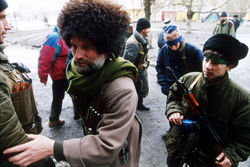
Ibn al-Khattab
Samir Saleh Abdullah Al-Suwailem , more commonly known as Emir Khattab meaning Commander Khattab, or Leader Khattab, and also known as Habib Abdul Rahman, was a Muslim guerilla fighter and financier working with Chechen Mujahideen in the First Chechen War...
destroyed a large Russian armored column in an ambush near Shatoy
Shatoy ambush
The Shatoy ambush was an April 16, 1996, attack by forces of an Arab-born commander Ibn al-Khattab near the town of Shatoy in the southern mountains of Chechnya, during the First Chechen War.-Battle:...
, killing at least 53 soldiers (some 100 according to most estimates); in another one, near Vedeno, at least 28 troops were killed.
As military defeats and growing casualties made the war more and more unpopular in Russia, and as the 1996 presidential elections neared, Yeltsin's government sought a way out of the conflict. Although a Russian guided missile
Guided Missile
Guided Missile is a London based independent record label set up by Paul Kearney in 1994.Guided Missile has always focused on 'the underground', preferring to put out a steady flow of releases and developing the numerous GM events around London and beyond....
attack assassinated the ChRI
President of Ichkeria
This is a list of Presidents of the unrecognised Chechen Republic of Ichkeria, a pro-independence movement that controlled most of Chechnya from 1991 to 1999...
President Dzhokhar Dudayev on April 21, 1996, the separatists persisted. Yeltsin even officially declared "victory" in Grozny on May 28, 1996, after a new temporary ceasefire was signed with the ChRI Acting President
Acting president
An Acting President is a person who temporarily fills the role of an organization's or country's president, either when the real president is unavailable or when the post is vacant .-See also:*Acting *Acting President of Pakistan*Acting President of Malta*Acting President of...
Zelimkhan Yandarbiyev
Zelimkhan Yandarbiyev
Zelimkhan Abdumuslimovich Yandarbiyev was a Chechen writer and a politician, who served as acting president of the breakaway Chechen Republic of Ichkeria between 1996 and 1997...
. While the political leaders were talking about the ceasefires and peace negotiations, military forces continued to conduct combat operations. On August 6, 1996, three days before Yeltsin was to be inaugurated for his second term as president and when most of the Russian Army troops were moved south due to what was planned as their final offensive against remaining mountainous separatist strongholds, the Chechens launched another surprise attack on Grozny.
3rd Battle of Grozny and the Khasav-Yurt Accord
Despite Russian troops in and around Grozny numbering approximately 12,000, more than 1,500 Chechen guerrillas (whose numbers soon swelled) overran the key districts within hours in an operation prepared and led by Maskhadov (who named it Operation Zero option) and Basayev (who called it Operation Jihad). The separatists then laid siegeSiege
A siege is a military blockade of a city or fortress with the intent of conquering by attrition or assault. The term derives from sedere, Latin for "to sit". Generally speaking, siege warfare is a form of constant, low intensity conflict characterized by one party holding a strong, static...
to the Russian posts and bases and the government compound in the city centre, while a number of Chechens deemed to be Russian collaborators were rounded up, detained and, in some cases, executed. At the same time, Russian troops in the cities of Argun and Gudermes were also surrounded in their garrisons. Several attempts by the armored columns to rescue the units trapped in Grozny were repelled with heavy Russian casualties ( the 276th Motorized Regiment of 900 men suffered 50% casualties in a two-day attempt to reach the city centre). Russian military officials said that more than 200 soldiers had been killed and nearly 800 wounded in five days of fighting, and that an unknown number were missing; Chechens put the number of Russian dead at close to 1,000. Thousands of troops were either taken prisoner or surrounded and largely disarmed, their heavy weapons and ammunition commandeered by the separatists.
On August 19, despite the presence of 50,000 to 200,000 Chechen and Russian civilians and thousands of federal servicemen in Grozny, the Russian commander Konstantin Pulikovsky gave an ultimatum for Chechen fighters to leave the city within 48 hours, or else it would be leveled in a massive aerial and artillery bombardment, including by strategic bombers (not used in Chechnya up to this point) and ballistic missiles. This announcement was followed by chaotic scenes of panic
Panic
Panic is a sudden sensation of fear which is so strong as to dominate or prevent reason and logical thinking, replacing it with overwhelming feelings of anxiety and frantic agitation consistent with an animalistic fight-or-flight reaction...
as civilians tried to flee before the army carried out its threat, with parts of the city ablaze and falling shells scattering refugee columns. The bombardment was however soon halted by the ceasefire brokered by Gen. Alexander Lebed, Yeltsin's national security adviser, on August 22. Gen. Lebed called the ultimatum, issued by Gen. Pulikovsky (now replaced), a "bad joke".
During eight hours of subsequent talks, Lebed and Maskhadov drafted and signed the Khasav-Yurt Accord
Khasav-Yurt Accord
Khasavyurt Accord was an agreement that marked the end of the First Chechen War, signed in Khasavyurt in Dagestan on August 30, 1996 between Alexander Lebed and Aslan Maskhadov....
on August 31, 1996. It included: technical aspects of demilitarization, the withdrawal of both sides' forces from Grozny, the creation of joint headquarters to preclude looting in the city, the withdrawal of all federal forces from Chechnya by December 31, 1996, and a stipulation that any agreement on the relations between the Chechen Republic of Ichkeria and the Russian federal government need not be signed until late 2001.
Casualties
According to the General Staff of the Russian Armed ForcesGeneral Staff of the Armed Forces of the Russian Federation
The General Staff of the Armed Forces of the Russian Federation is the military staff of the Armed Forces of the Russian Federation. It is the central organ of the Armed Forces Administration and oversees operational management of the armed forces under the Russian Ministry of Defence.The staff is...
, 3,826 troops were killed, 17,892 were wounded, and 1,906 are missing in action
Missing in action
Missing in action is a casualty Category assigned under the Status of Missing to armed services personnel who are reported missing during active service. They may have been killed, wounded, become a prisoner of war, or deserted. If deceased, neither their remains nor grave can be positively...
. According to NVO
National Virtual Observatory
The US National Virtual Observatory was conceived to allow scientists to access data from multiple astronomical observatories, including ground and space-based facilities, through a single portal. Currently, the National Science Foundation funds the information technology research that created...
, the authoritative Russian independent military weekly, at least 5,362 Russian soldiers died during the war, 52,000 got wounded or sick, and some 3,000 more remained missing by 2005. The estimate of the Committee of Soldiers' Mothers of Russia, however, put the number of the Russian military dead at 14,000, based on information from wounded troops and soldiers' relatives (counting only regular troops, i.e. not the kontraktniki and special service forces). In 2009 the official Russian number of troops still missing from the two wars in Chechnya and presumed dead was some 700, while about 400 remains of the missing servicemen were said to be recovered up to this point.
Anatoly Kulikov
Anatoly Kulikov is a Russian General of the Army, former Interior Minister of Russia .In 1992 Kulikov became Commander of the Interior Troops. Hence he was one of the commanders of pro-government forces during the 1993 Constitutional Crisis in Moscow and the First Chechen War...
claimed that fewer than 20,000 civilians were killed. Sergey Kovalyov's team could offer their conservative, documented estimate of more than 50,000 civilian deaths. Aleksander Lebed asserted that 80,000 to 100,000 had been killed and 240,000 had been injured. The number given by the ChRI authorities was about 100,000 killed. According to Russian newspaper Gazeta
Gazeta
gazeta.ru is a Russian online newspaper covering politics and business. The first issue was published on 28 February 1999. Once controlled by Vladislav Borodulin, the editor-in-chief of the business daily Kommersant, gazeta.ru was sold in 2005 to Sekret Firmy Publishing, a publishing house...
, approximately 35,000 ethnic Russian civilians were killed by Russian forces operating in Chechnya, most of them during the bombardment of Grozny.
The ChRI separatists estimated their combat deaths at about 3,000 (including some 800 in the first three months of the war and said to be mostly killed by mortar fire), although this number is almost certainly too low. Tony Wood, a journalist and author who has written extensively about Chechnya, estimated about 4,000 Chechen combatant losses. It is impossible to know exactly how many Chechen separatists were killed, however, because many fought independently and were not under the control of Dudayev (as such, their deaths were not counted among official Chechen losses). The Russian estimate is much higher; Russia's Federal Forces Command estimated that 15,000 Chechen fighters had been killed by the end of the war.
Prisoners and missing persons
In the Khasav-Yurt Accord, both sides agreed to an "all for all" exchange of prisoners to be carried out at the end of the war. However, despite this commitment, many persons remained forcibly detained. A partial analysis of the list of 1,432 reported missing found that, as of October 30, 1996, at least 139 Chechens were still being forcibly detained by the Russian side; it was entirely unclear how many of these men were alive. As of mid-January 1997, the Chechens still held between 700 and 1,000 Russian soldiers and officers as prisoners of war, according to Human Rights Watch. According to Amnesty InternationalAmnesty International
Amnesty International is an international non-governmental organisation whose stated mission is "to conduct research and generate action to prevent and end grave abuses of human rights, and to demand justice for those whose rights have been violated."Following a publication of Peter Benenson's...
that same month, 1,058 Russian soldiers and officers were being detained by Chechen fighters who were willing to release them in exchange for members of Chechen armed groups. American freelance journalist Andrew Shumack
Andrew Shumack
Andrew Shumack was an American freelance journalist who went missing during the First Chechen War, a month after he'd left St. Petersburg for Chechnya, and is presumed dead....
has been missing from the Chechen capital, Grozny
Grozny
Grozny is the capital city of the Chechen Republic, Russia. The city lies on the Sunzha River. According to the preliminary results of the 2010 Census, the city had a population of 271,596; up from 210,720 recorded in the 2002 Census. but still only about two-thirds of 399,688 recorded in the 1989...
since July 1995 and is presumed dead.
The Moscow peace treaty
Reparation (legal)
In jurisprudence, reparation is replenishment of a previously inflicted loss by the criminal to the victim. Monetary restitution is a common form of reparation...
to Chechens who had been "affected" by the 1994–96 war. In February 1997, Russia also approved an amnesty
Amnesty
Amnesty is a legislative or executive act by which a state restores those who may have been guilty of an offense against it to the positions of innocent people, without changing the laws defining the offense. It includes more than pardon, in as much as it obliterates all legal remembrance of the...
for Russian soldiers and Chechen separatists alike who committed illegal acts in connection with the war in Chechnya between December 1994 and September 1996.
Six months after the Khasav-Yurt Accord, on May 12, 1997, Chechen-elected president Aslan Maskhadov traveled to Moscow where he and Yeltsin signed a formal treaty "on peace and the principles of Russian-Chechen relations" that Maskhadov predicted would demolish "any basis to create ill-feelings between Moscow and Grozny." Maskhadov's optimism, however, proved misplaced. Little more than two years later, some of Maskhadov's former comrades-in-arms, led by radical field commanders Shamil Basayev
Shamil Basayev
Shamil Salmanovich Basayev was a Chechen militant Islamist and a leader of the Chechen rebel movement.Starting as a field commander in the Transcaucasus, Basayev led guerrilla campaigns against the Russian troops for years, as well as launching mass-hostage takings of civilians, with his goal...
and Ibn al-Khattab
Ibn al-Khattab
Samir Saleh Abdullah Al-Suwailem , more commonly known as Emir Khattab meaning Commander Khattab, or Leader Khattab, and also known as Habib Abdul Rahman, was a Muslim guerilla fighter and financier working with Chechen Mujahideen in the First Chechen War...
, launched an invasion of Dagestan in the summer of 1999 – and soon Russia invaded Chechnya again, marking beginning of the Second Chechen War
Second Chechen War
The Second Chechen War, in a later phase better known as the War in the North Caucasus, was launched by the Russian Federation starting 26 August 1999, in response to the Invasion of Dagestan by the Islamic International Peacekeeping Brigade ....
.
Further Reading
- Bennett, Vanora. Crying Wolf. Picador (1998). ISBN 0-330-35170-2
- Goltz, ThomasThomas GoltzThomas Goltz is an American author and journalist best known for his accounts of conflict in the Caucasus region during the 1990s.Goltz was born in Japan, raised in North Dakota and graduated from New York University with an MA in Middle East studies. He has worked in and around Turkey and the...
. "Chechnya Diary: A War Correspondent`s Story of Surviving the War in Chechnya". Thomas Dunne Books / St. Martins Press (2003). ISBN0-312-26874-2 - A Military History of Russia: From Ivan the Terrible to the War in Chechnya Author: David R. Stone (preview available)
- A Small Corner of Hell: Dispatches from Chechnya Author: Anna PolitkovskayaAnna PolitkovskayaAnna Stepanovna Politkovskaya was a Russian journalist, author, and human rights activist known for her opposition to the Chechen conflict and then-President of Russia Vladimir Putin...
(preview available) - Allah's Mountains: The Battle for Chechnya Author: Sebastian SmithSebastian SmithSebastian Smith was a British stage and film actor.-Filmography:* Rescued by Rover * Prehistoric Peeps * The Tramp's Dream * The Blue Carbuncle...
(preview available) - Angel of Grozny Author: Asne SeierstadÅsne SeierstadÅsne Seierstad is a Norwegian freelance journalist and writer, best known for her accounts of everyday life in war zones - most notably Kabul after 2001, Baghdad in 2003 and the ruined Grozny in 2006.-Personal and professional life:...
- Chechnya: Calamity in the Caucasus Author: Carlotta GallCarlotta GallCarlotta Gall is a British journalist who covers Afghanistan, as well as Pakistan for The New York Times.Carlotta Gall is a daughter of the British journalist Sandy Gall and Eleanor Gall. She was educated in England and read Russian and French at Newnham College, Cambridge...
, Thomas De WaalThomas de WaalThomas Patrick Lowndes de Waal , is a British journalist, writer and an expert on the Caucasus. Thomas is the son of Anglican priest Victor de Waal and of writer on religion Esther de Waal, brother of Africa specialist Alex de Waal, John de Waal, barrister and potter and writer Edmund de... - Chechnya: From Nationalism to Jihad Author: James Hughes (preview available)
- Chechnya: From Past To Future Author: Richard SakwaRichard SakwaRichard Sakwa is an expert in the field of Russian and Eastern European communist and post-communist politics. Sakwa is Professor of Russian and European politics at the University of Kent.-Career:...
and others (preview available) - Chechnya: Life in a War-Torn Society Author: Valery TishkovValery TishkovValery Tishkov is an ethnologist.Born in Sverdlovsk, Tishkov attended Moscow State University, where he received a B.A. in 1964. He earned an M.A. in 1969 from Moscow Pedagogical University, and a Ph.D. degree in 1978 from the USSR Academy of Sciences...
(preview available) - Chechnya: The Case for Independence Author: Tony Wood
- Chechnya: Tombstone of Russian Power Author: Anatol LievenAnatol LievenPeter Paul Anatol Lieven is a British author, journalist, and policy analyst. He is presently a Senior Researcher at the New America Foundation, where he focuses on US global strategy and the War on Terrorism, Associated Scholar of the Transnational Crisis Project, Chair of International...
- Landscapes of War: From Sarajevo to Chechnya Author: Juan GoytisoloJuan GoytisoloJuan Goytisolo is a Spanish poet, essayist, and novelist. He currently lives in a voluntary self-exile in Marrakech.-Background:Juan Goytisolo was born to an aristocratic family...
(preview available) - My Jihad Author: Aukai CollinsAukai CollinsAukai Collins, born on February 13, 1974 is also known as "Aqil Collins" is an American of Irish descent who converted to Islam and fought with Islamic Chechen irregulars of the Chechen Republic of Ichkeria...
- Open Wound: Chechnya 1994-2003 Author: Stanley Greene
- Russia Confronts Chechnya: Roots of a Separatist Conflict Author: John B. Dunlop (preview available)
- Russia in Afghanistan and Chechnya Author: Robert M. Cassidy (preview available)
- Russia's Chechen War Author: Tracey C. German (preview available)
- Russia's Restless Frontier: The Chechnya Factor in Post-Soviet Russia Author: Dmitri Trenin, Anatol LievenAnatol LievenPeter Paul Anatol Lieven is a British author, journalist, and policy analyst. He is presently a Senior Researcher at the New America Foundation, where he focuses on US global strategy and the War on Terrorism, Associated Scholar of the Transnational Crisis Project, Chair of International...
(preview available) - Russia's Wars with Chechnya 1994-2003 Author: Michael Orr
- Russian Military Reform, 1992-2002 Author: Anne Aldis, Roger N. McDermott
- The Chechen Wars: Will Russia Go the Way of the Soviet Union? Author: Matthew Evangelista (preview available)
- The Lone Wolf and the Bear: Three Centuries of Chechen Defiance of Russian Rule Author: Moshe Gammer (preview available)
- The Russian Army in a Time of Troubles Author: Pavel K. Baev (preview available)
- The Oath: A Surgeon Under Fire Author: Khassan BaievKhassan BaievDr. Khassan Baiev is a Chechen-American trauma surgeon who upheld the Hippocratic oath to treat thousands of civilians and combatants on both sides of the First and Second Chechen Wars, including Russian soldiers and Chechen fighters....
- The Wolves of Islam: Russia and the Faces of Chechen Terror Author: Paul J. Murphy (preview available)
External links
- YouTube【Don't Ever Forget】Young Russian Conscripts Beheaded by Chechen Terrorists 1999
- Chechen War 1994-96 The World Regional Conflicts Project
- Chechnya Crimes of War Project
- Chechnya Reference Library A collection of analyses and interviews of Chechen commanders conducted by the United States Marine CorpsUnited States Marine CorpsThe United States Marine Corps is a branch of the United States Armed Forces responsible for providing power projection from the sea, using the mobility of the United States Navy to deliver combined-arms task forces rapidly. It is one of seven uniformed services of the United States...
- Chechnya: Two Federal Interventions Conflict Studies Research CentreConflict Studies Research CentreThe Conflict Studies Research Centre, or CSRC, was a component of the Defence Academy of the United Kingdom, based at Shrivenham. It specialised in potential causes of conflict in a wide area ranging from the Baltics to Central Asia....
- Damned and forgotten Documentary by Sergey Govorukhin
- First Chechnya War - 1994-1996 Foreign Military Studies OfficeForeign Military Studies OfficeThe Foreign Military Studies Office, or FMSO, is a research and analysis center for the United States Army that is part of the United States Army Combined Arms Center at Fort Leavenworth. It manages the Joint Reserve Intelligence Center there.-Mission:...
- The Chechen Campaign by Pavel FelgenhauerPavel FelgenhauerPavel E. Felgenhauer is a Russian journalist. He is known for his publications critical of Russia's political and military elite.-Biography:...
- War and Human Rights Memorial human rights groupMemorial (society)Memorial is an international historical and civil rights society that operates in a number of post-Soviet states. It focuses on recording and publicising the Soviet Union's totalitarian past, but also monitors human rights in post-Soviet states....
- Why It All Went So Very Wrong TIMETimeTime is a part of the measuring system used to sequence events, to compare the durations of events and the intervals between them, and to quantify rates of change such as the motions of objects....
- Why the Russian Military Failed in Chechnya U.S. Foreign Studies
- Wounded Bear GlobalSecurity.orgGlobalSecurity.orgGlobalSecurity.org, launched in 2000, is a public policy organization focusing on the fields of defense, space exploration, intelligence, weapons of mass destruction and homeland security...
- Vyacheslav Mironov. I was at that war. Translation available online* http://artofwar.ru/a/abramow_o_b/