

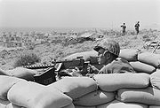
Defensive fighting position

Encyclopedia
Terminology
A DFP is known more commonly within United States ArmyUnited States Army
The United States Army is the main branch of the United States Armed Forces responsible for land-based military operations. It is the largest and oldest established branch of the U.S. military, and is one of seven U.S. uniformed services...
slang as a "foxhole", or the slang term "ranger grave", within United States Marine Corps
United States Marine Corps
The United States Marine Corps is a branch of the United States Armed Forces responsible for providing power projection from the sea, using the mobility of the United States Navy to deliver combined-arms task forces rapidly. It is one of seven uniformed services of the United States...
slang as a "fighting hole", in Australian and New Zealand Army Corps (ANZAC) forces terminology as a "fighting pit", in Australian Army
Australian Army
The Australian Army is Australia's military land force. It is part of the Australian Defence Force along with the Royal Australian Navy and the Royal Australian Air Force. While the Chief of Defence commands the Australian Defence Force , the Army is commanded by the Chief of Army...
terminology
Terminology
Terminology is the study of terms and their use. Terms are words and compound words that in specific contexts are given specific meanings, meanings that may deviate from the meaning the same words have in other contexts and in everyday language. The discipline Terminology studies among other...
as a "Gun-Pit", within the British
United Kingdom
The United Kingdom of Great Britain and Northern IrelandIn the United Kingdom and Dependencies, other languages have been officially recognised as legitimate autochthonous languages under the European Charter for Regional or Minority Languages...
and Canadian
Canada
Canada is a North American country consisting of ten provinces and three territories. Located in the northern part of the continent, it extends from the Atlantic Ocean in the east to the Pacific Ocean in the west, and northward into the Arctic Ocean...
military argot
Argot
An Argot is a secret language used by various groups—including, but not limited to, thieves and other criminals—to prevent outsiders from understanding their conversations. The term argot is also used to refer to the informal specialized vocabulary from a particular field of study, hobby, job,...
as a "slit trench", or simply—but less accurately—as a "trench
Trench warfare
Trench warfare is a form of occupied fighting lines, consisting largely of trenches, in which troops are largely immune to the enemy's small arms fire and are substantially sheltered from artillery...
".
History
Early in World War IIWorld War II
World War II, or the Second World War , was a global conflict lasting from 1939 to 1945, involving most of the world's nations—including all of the great powers—eventually forming two opposing military alliances: the Allies and the Axis...
, during the fighting in North Africa
North African campaign
During the Second World War, the North African Campaign took place in North Africa from 10 June 1940 to 13 May 1943. It included campaigns fought in the Libyan and Egyptian deserts and in Morocco and Algeria and Tunisia .The campaign was fought between the Allies and Axis powers, many of whom had...
, U.S. forces employed the slit trench. This was a very shallow excavation allowing one man to lie horizontally while shielding his body from nearby shell
Shell (projectile)
A shell is a payload-carrying projectile, which, as opposed to shot, contains an explosive or other filling, though modern usage sometimes includes large solid projectiles properly termed shot . Solid shot may contain a pyrotechnic compound if a tracer or spotting charge is used...
bursts and small arms
Small arms
Small arms is a term of art used by armed forces to denote infantry weapons an individual soldier may carry. The description is usually limited to revolvers, pistols, submachine guns, carbines, assault rifles, battle rifles, multiple barrel firearms, sniper rifles, squad automatic weapons, light...
fire. The slit trench soon proved inadequate in this role, as the few inches of dirt above the soldier's body could often be penetrated by bullets or shell fragments. It also exposed the user to assault by enemy tank
Tank
A tank is a tracked, armoured fighting vehicle designed for front-line combat which combines operational mobility, tactical offensive, and defensive capabilities...
s, which could crush the man inside a shallow slit trench by driving into it, then making a simple half-turn.
After the Battle of Kasserine Pass, U.S. troops increasingly adopted the modern foxhole, a vertical, bottle-shaped hole that allowed a soldier to stand and fight with head and shoulders exposed. The foxhole widened near the bottom to allow a soldier to crouch down while under intense artillery
Artillery
Originally applied to any group of infantry primarily armed with projectile weapons, artillery has over time become limited in meaning to refer only to those engines of war that operate by projection of munitions far beyond the range of effect of personal weapons...
fire or tank attack. Foxholes could be enlarged to two-man fighting positions, as well as excavated with firing steps for crew-served weapons or sump
Sump
A sump is a low space that collects any often-undesirable liquids such as water or chemicals. A sump can also be an infiltration basin used to manage surface runoff water and recharge underground aquifers....
s for water drainage or grenade
Grenade
A grenade is a small explosive device that is projected a safe distance away by its user. Soldiers called grenadiers specialize in the use of grenades. The term hand grenade refers any grenade designed to be hand thrown. Grenade Launchers are firearms designed to fire explosive projectile grenades...
disposal
Bomb disposal
Bomb disposal is the process by which hazardous explosive devices are rendered safe. Bomb disposal is an all encompassing term to describe the separate, but interrelated functions in the following fields:*Military:...
.
Tobruk
Hardened fortifications known as "Tobruks" were used by the Germans in North Africa and later in the Atlantic WallAtlantic Wall
The Atlantic Wall was an extensive system of coastal fortifications built by Nazi Germany between 1942 and 1944 along the western coast of Europe as a defense against an anticipated Allied invasion of the mainland continent from Great Britain.-History:On March 23, 1942 Führer Directive Number 40...
fortifications. They were in essence a foxhole made from concrete. They were officially known as Ringstände by the Germans, and "Tobruks" by the Allies, as they had first been encountered there during the fighting in Africa.
Modern defensive fighting positions
Modern militaries publish and distribute elaborate field manuals for the proper construction of DFPs in stages. Each stage develops the fighting position, gradually increasing its effectiveness, while always maintaining functionality. In this way a soldier can improve the position over time, while being able to stop at any time and use the position in a fight.Typically, a DFP is a pit dug deep enough to stand in, with only the head exposed, and a small step at the bottom that allows the soldier to sit down in the hole to avoid fire and tank
Tank
A tank is a tracked, armoured fighting vehicle designed for front-line combat which combines operational mobility, tactical offensive, and defensive capabilities...
treads. Also, there are usually deeper, narrow slits called grenade
Grenade
A grenade is a small explosive device that is projected a safe distance away by its user. Soldiers called grenadiers specialize in the use of grenades. The term hand grenade refers any grenade designed to be hand thrown. Grenade Launchers are firearms designed to fire explosive projectile grenades...
sump
Sump
A sump is a low space that collects any often-undesirable liquids such as water or chemicals. A sump can also be an infiltration basin used to manage surface runoff water and recharge underground aquifers....
s at the bottom to allow a grenade to be kicked in to minimize damage.
Time permitting, DFPs can be enlarged to allow a machine gun
Machine gun
A machine gun is a fully automatic mounted or portable firearm, usually designed to fire rounds in quick succession from an ammunition belt or large-capacity magazine, typically at a rate of several hundred rounds per minute....
crew and ammunition
Ammunition
Ammunition is a generic term derived from the French language la munition which embraced all material used for war , but which in time came to refer specifically to gunpowder and artillery. The collective term for all types of ammunition is munitions...
to be protected, as well as additional overhead cover via timbers.