

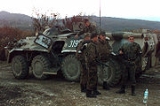
Russian Ground Forces

Encyclopedia
The Russian Ground Forces ' onMouseout='HidePop("30470")' href="/topics/Romanization_of_Russian">tr.
: Suhoputnye voyska Rossiyskoy Federatsii) are the land forces
of the Armed Forces of the Russian Federation
, formed from parts of the collapsing Soviet Army
in 1992. The formation of these forces posed economic challenges after the collapse of the Soviet Union, and required reforms to professionalize the force during the transition. While the Russian Ground Forces in their present form are only about twenty years old, Russian officers trace their antecedents' history through the Imperial Russian Army
era back to the time of Kievan Rus'
.
Since 1992, the Ground Forces have withdrawn many thousands of troops from former Soviet garrisons abroad, while remaining extensively committed to the Chechen Wars, peacekeeping, and other operations in the Soviet successor states
(what is known in Russia as the "near abroad
"). The most recent clash was the 2008 South Ossetia war
with Georgia
n forces.
on land, the security of occupied territories, and the defeat of enemy troops. The Ground Forces must be able to achieve these goals both in nuclear war and non-nuclear war, especially without the use of weapons of mass destruction
. Furthermore, they must be capable of protecting the national interests of Russia within the framework of its international obligations.
The Main Command of the Ground Forces is officially tasked with the following objectives:
as a single military structure for the new Commonwealth of Independent States
. The last Minister of Defence of the Soviet Union, Marshal Yevgeny Shaposhnikov
, was appointed supreme commander of the CIS Armed Forces in December 1991.
Among the numerous treaties signed by the former republics, in order to direct the transition period, was a temporary agreement on general purpose forces, signed in Minsk
on 14 February 1992. However, once it became clear that Ukraine
(and potentially the other republics) was determined to undermine the concept of joint general purpose forces and form their own armed forces, the new Russian government moved to form its own armed forces.
President of the Russian Federation Boris Yeltsin
signed a decree
forming the Russian Ministry of Defence on 7 May 1992, establishing the Russian Ground Forces along with the other parts of the Armed Forces of the Russian Federation
. At that time, the General Staff was in the process of withdrawing tens of thousands of personnel from the Group of Soviet Forces in Germany
, the Northern Group of Forces
in Poland, the Central Group of Forces
in Czechoslovakia, the Southern Group of Forces
in Hungary, and from Mongolia.
Thirty-seven divisions had to be withdrawn from the four groups of forces and the Baltic States, and four military districts—totalling 57 divisions—were handed over to Belarus and Ukraine.
Some idea of the scale of the withdrawal can be gained from the division list. For the dissolving Soviet Ground Forces, the withdrawal from the former Warsaw Pact
states and the Baltic states was an extremely demanding, expensive, and debilitating process.
As the military districts that remained in Russia after the collapse of the Union consisted mostly of the mobilisable cadre
formations, the Russian Ground Forces were, to a large extent, created by relocating the formerly full-strength formations from Eastern Europe to those under-resourced districts. However, the facilities in those districts were inadequate to house the flood of personnel and equipment returning from abroad, and many units "were unloaded from the rail wagons into empty fields."
The need for destruction and transfer of large amounts of weaponry under the Treaty on Conventional Armed Forces in Europe
also necessitated great adjustments.
published a reform plan on 21 July 1992. Later one commentator said it was "hastily" put together by the General Staff "to satisfy the public demand for radical changes."
The General Staff
, from that point, become a bastion of conservatism, causing a build-up of troubles which later became critical. The reform plan advocated a change from an Army-Division-Regiment structure to a Corps-Brigade arrangement. The new structures were to be better capable in a situation with no frontline, and more capable of independent action at all levels. Cutting out a level of command, leaving two out of three higher echelons between the theatre headquarters and the fighting battalions would produce economies, increase flexibility, and simplify command-and-control arrangements.
The expected changeover to the new structure proved to be rare, irregular, and sometimes reversed. The new brigades that appeared were mostly divisions that had broken down until they happened to be at the proposed brigade strengths. New divisions—such as the new 3rd Motor Rifle Division
in the Moscow Military District
, formed on the basis of disbanding tank formations—were formed, rather than new brigades.
Few of the reforms planned in the early 1990s eventuated, for three reasons: Firstly, there was an absence of firm civilian political guidance, with President Yeltsin primarily interested in ensuring that the Armed Forces were controllable and loyal, rather than reformed.
Secondly, declining funding worsened the progress. Finally, there was no firm consensus within the military about what reforms should be implemented. General Pavel Grachev
, the first Russian Minister of Defence (1992–96), broadly advertised reforms, yet wished to preserve the old Soviet-style Army, with large numbers of low-strength formations and continued mass conscription. The General Staff and the armed services tried to preserve Soviet era doctrines, deployments, weapons, and missions in the absence of solid new guidance.
A British military expert, Michael Orr, claims that the hierarchy had great difficulty fully understanding the changed situation, due to their education. As graduates of Soviet military academies
, they received great operational and staff training, but in political terms they had learned an ideology, rather than a wide understanding of international affairs. Thus, the generals—focused on NATO expanding to the east—could not adapt themselves and the Armed Forces to the new opportunities and challenges they faced.
The military leadership were unsure of both the rightness of Yeltsin's cause and the reliability of their forces, and had to be convinced at length by Yeltsin to attack the Parliament.
When the attack was finally mounted, forces from five different divisions around Moscow were used, and the personnel involved were mostly officers and senior non-commissioned officers. There were also indications that some formations deployed into Moscow only under protest. However, once Parliament had been stormed, the parliamentary leaders arrested, and temporary censorship imposed, Yeltsin succeeded in retaining power.
The continuation of Chechen independence was seen as reducing Moscow's authority; Chechnya became perceived as a haven for criminals, and a hard-line group within the Kremlin began advocating war. A Security Council meeting was held 29 November 1994, where Yeltsin ordered the Chechens to disarm, or else Moscow would restore order. Defense Minister Pavel Grachev
assured Yeltsin that he would "take Grozny with one airborne assault regiment in two hours."
The operation began on 11 December 1994, and by 31 December, Russian forces were entering Grozny
, the Chechen capital. The 131st Motor Rifle Brigade was ordered to make a swift push for the centre of the city, but was then virtually destroyed in Chechen ambushes. After finally seizing Grozny amid fierce resistance, Russian troops moved on to other Chechen strongholds. When Chechen militants took hostages in the Budyonnovsk hospital hostage crisis
in Stavropol Kray in June 1995, peace looked possible for a time, but the fighting continued. Following this incident, the separatists were referred to as insurgents or terrorists within Russia.
Dzhokar Dudayev was assassinated in April 1996, and that summer, a Chechen attack retook Groznyy. Alexander Lebed, then Secretary of the Security Council, began talks with the Chechen rebel leader Aslan Maskhadov
in August 1996 and signed an agreement on 22/23 August; by the end of that month, the fighting ended.
The formal ceasefire was signed in the Dagestan
i town of Khasavyurt
on 31 August 1996, stipulating that a formal agreement on relations between the Chechen Republic of Ichkeria and the Russian federal government need not be signed until late 2001.
Writing some years later, Dmitri Trenin and Aleksei Malashenko described the Russian military's performance in Chechniya as "grossly deficient at all levels, from commander-in-chief to the drafted private."
The Ground Forces' performance in the First Chechen War has been assessed by a British academic as "appallingly bad".
Writing six years later, Michael Orr said "one of the root causes of the Russian failure in 1994–96 was their inability to raise and deploy a properly-trained military force."
, followed quickly in early September by a series of four terrorist bombings across Russia. This prompted Russian military action against the alleged Chechen culprits.
In the first Chechen war, the Russians primarily put to waste to an area with artillery and airstrikes before advancing the land forces. Improvements were made in the Ground Forces between 1996 and 1999; when the Second Chechen War started, instead of hastily-assembled "composite regiments" dispatched with little or no training, whose members had never seen service together, formations were brought up to strength with replacements, put through preparatory training, and then dispatched. Combat performance improved accordingly, and large-scale opposition was crippled.
Most of the prominent past Chechen separatist leaders had died or been killed, including former president
Aslan Maskhadov
and leading warlord
and terrorist attack mastermind Shamil Basayev
. However, small-scale conflict continued to drag on; as of November 2007, it had spread across other parts of the Russian Caucasus.
It was a divisive struggle, with at least one senior military officer dismissed for being unresponsive to government commands: General Colonel Gennady Troshev
was dismissed in 2002 for refusing to move from command of the North Caucasus Military District
to command of the less important Siberian Military District.
The Second Chechen War was officially declared ended on 16 April 2009.
arrived as Minister of Defence in 1997, he initiated what were seen as real reforms under very difficult conditions.
The number of military educational establishments, virtually unchanged since 1991, was reduced, and the amalgamation of the Siberian and Trans-Baikal Military Districts was ordered. A larger number of army divisions were given "constant readiness" status, which was supposed to bring them up to 80 percent manning and 100 percent equipment holdings. Sergeyev announced in August 1998 that there would be six divisions and four brigades on 24-hour alert by the end of that year. Three levels of forces were announced; constant readiness, low-level, and strategic reserves.
However, personnel quality—even in these favored units—continued to be a problem. Lack of fuel for training and a shortage of well-trained junior officers hampered combat effectiveness. However, concentrating on the interests of his old service, the Strategic Rocket Forces
, Sergeyev directed the disbanding of the Ground Forces headquarters itself in December 1997. The disbandment was a "military nonsense", in Orr's words, "justifiable only in terms of internal politics within the Ministry of Defence". The Ground Forces' prestige declined as a result, as the headquarters disbandment implied—at least in theory—that the Ground Forces no longer ranked equally with the Air Force and Navy.
, more funds were committed, the Ground Forces Headquarters was reestablished, and some progress on professionalisation occurred. Plans called for reducing mandatory service to 18 months in 2007, and to one year by 2008 but a mixed Ground Force, of both contract soldiers and conscripts, would remain. (As of 2009, the length of conscript service was 12 months.)
Funding increases began in 1999; after some recovery in the Russian economy and the associated rose in income, especially from oil, "Russia's officially reported defence spending [rose] in nominal terms at least, for the first time since the formation of the Russian Federation".
The budget rose from 141 billion rubles in 2000 to 219 billion rubles in 2001.
Much of this funding has been spent on personnel—there have been several pay rises, starting with a 20-percent rise authorised in 2001; the current professionalisation programme, including 26,000 extra sergeant
s, was expected to cost at least 31 billion roubles ($1.1 billion USD).
Increased funding has been spread across the whole budget, with personnel spending being matched by greater procurement and research and development
funding.
However, in 2004, Alexander Goltz said that, given the insistence of the hierarchy on trying to force contract soldiers into the old conscript pattern, there is little hope of a fundamental strengthening of the Ground Forces. He further elaborated that they are expected to remain, to some extent, a military liability and "Russia's most urgent social problem" for some time to come.
Goltz summed up by saying: "All of this means that the Russian armed forces are not ready to defend the country and that, at the same time, they are also dangerous for Russia. Top military personnel demonstrate neither the will nor the ability to effect fundamental changes."
More money is arriving both for personnel and equipment; Russian Prime Minister Vladimir Putin
said in June 2008 that monetary allowances for servicemen in permanent-readiness units will be raised significantly.
Enlisted pay will rise to 65,000 rubles (US$2,750) per month, and the pay of officers on combat duty in rapid response units will rise to 100,000–150,000 rubles (US$4,230–$6,355) per month. However, while the move to one year conscript service will disrupt dedovshchina
, it is unlikely that bullying will disappear altogether without significant societal change.
Other assessments from the same source point out that the Russian Armed Forces faced major disruption in 2008, as demographic change hindered plans to reduce the term of conscription from two years to one.
As a result of these factors and continuing corruption, the additional funding may not have led to a large improvement in the Russian Army's effectiveness.
However, this will affect units of continuous readiness only. It is intended to create 39 to 40 such brigades by 1 January 2016, including 39 all-arms brigades, 21 artillery and MRL brigades, 7 brigades of army air defence forces, 12 communication brigades, and two brigades of electronic warfare. In addition, one division stationed in the Far East will remain, and there will be an additional 17 separate regiments. The reform has increasingly received criticism from independent military experts in Russia, and has been called "unprecedented".
In the course of the reorganization it is planned to replace current 4-chain command structure (military district
- field army
- division
- regiment
) with a 3-chain structure: strategic command - operational command - brigade. Brigades are supposed to be used as mobile permanent-readiness units capable of fighting independently with the support of highly mobile task forces or together with other brigades under joint command.
In a statement on Sept. 24 2009, Chief commander of land forces, Vladimir Boldyrev said half of the Russian land forces were reformed by June 1, that 85 brigades of constant combat preparedness had already been created. Among them are the combined-arms brigade, missile brigades, assault brigades and electronic warfare brigade.s
This can be compared to an estimated 670,000, with 210,000 conscripts, in 1995–96. These numbers should be treated with caution, however, due to the difficulty for those outside Russia to make accurate assessments, and confusion even within the General Staff on the numbers of conscripts within the force.
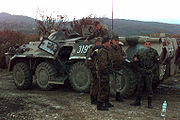 The Ground Forces began their existence in 1992, inheriting the Soviet military manpower system practically unchanged, though it was in a state of rapid decay. The Soviet Ground Forces
were traditionally manned through terms of conscription, which had been reduced in 1967 from three to two years. This system was administered through the thousands of military commissariats ( [voyenkomat]) located throughout the Soviet Union. Between January and May of each year, every young Soviet male citizen was required to report to the local voyenkomat for assessment for military service, following a summons based on lists from every school and employer in the area.
The voyenkomat worked to quotas sent out by a department of the General Staff, listing how many young men were required by each service and branch of the Armed Forces.
(Since the fall of the Soviet Union, draft evasion has skyrocketed; officials regularly bemoan the ten or so percent that actually appear when summoned.) The new conscripts were then picked up by an officer from their future unit and usually sent by train across the country. On arrival, they would begin the Young Soldiers' course, and become part of the system of senior rule, known as dedovshchina
, literally "rule by the grandfathers." There were only a very small number of professional non-commissioned officers (NCOs), as most NCOs were conscripts sent on short courses
to prepare them for section commanders' and platoon sergeants' positions. These conscript NCOs were supplemented by praporshchik
warrant officers, positions created in the 1960s to support the increased variety of skills required for modern weapons.
The Soviet Army's officer-to-soldier ratio was extremely top-heavy, partially in order to compensate for the relatively low education level of the military manpower base and the absence of professional NCOs. Following World War II and the great expansion of officer education, officers became the product of four-to-five-year higher military colleges. As in most armies, newly commissioned officers usually become platoon leaders, having to accept responsibility for the soldiers' welfare and training (with the exceptions noted above). Young officers in Soviet Army units were worked round the clock, normally receiving only three days off per month. Annual vacations were under threat if deficiencies emerged within the unit, and the pressure created enormous stress. Toward the end of the Soviet Union, this led to a decline in morale amongst young officers.
In the early 2000s, many junior officers did not wish to serve—in 2002, more than half the officers who left the forces did so early. Their morale was low, among other reasons, because their postings were entirely in the hands of their immediate superiors and the personnel department. "Without having to account for their actions, they can choose to promote or not promote him, to send him to Moscow or to some godforsaken post on the Chinese border."
There is little available information on the current status of women
, who are not conscripted, in the Ground Forces. According to the BBC
, there were 90,000 women in the Russian Army in 2002, though estimates on numbers of women across the entire Russian armed forces in 2000 ranged from 115,000 to 160,000.
Women serve in support roles, most commonly in the fields of nursing, communications, and engineering. Some officers' wives have become contract service personnel.
, then Minister of Defence, proposed that—in addition to the numerous enlisted contract soldiers—all sergeants should become professional, which would raise the number of professional soldiers and non-commissioned officers in the Armed Forces overall to approximately 140,000 in 2008. The current programme allows for an extra 26,000 posts for fully professional sergeants.
The CIA
reported in the World Factbook that 30 percent of Russian army personnel were contract servicemen at the end of 2005, and that as of May 2006, 178,000 contract servicemen were serving in the Ground Forces and the Navy. Planning calls for volunteer servicemen to compose 70 percent of armed forces by 2010, with the remaining servicemen consisting of conscripts. At the end of 2005, the Ground Forces had 40 all-volunteer constant readiness units, with another 20 constant readiness units to be formed in 2006. These CIA figures can be set against IISS data, which reports that at the end of 2004, the number of contracts being signed in the Moscow Military District
was only 17 percent of the target figure; in the North Caucasus
, 45 percent; and in the Volga-Ural, 25 percent.
Whatever the number of contract soldiers, commentators such as Alexander Goltz are pessimistic that many more combat ready units will result, as senior officers "see no difference between professional NCOs, ... versus conscripts who have been drilled in training schools for less than six months. Such sergeants will have neither the knowledge nor the experience that can help them win authority [in] the barracks." Defence Minister Sergey Ivanov underlined the in-barracks discipline situation, even after years of attempted professionalisation, when releasing the official injury figures for 2002. 531 men had died on duty as a result of accidents and crimes, and 20,000 had been wounded (the numbers apparently not including suicides). According to Ivanov, "the accident rate is not falling". Two of every seven conscripts will become addicted to drugs and alcohol while serving their terms, and a further one in twenty will suffer homosexual rape, according to 2005 reports.
Part of the reason is the feeling between contract servicemen, conscripts, and officers.
Generals directing the withdrawals from Eastern Europe diverted arms, equipment, and foreign monies intended to build housing in Russia for the withdrawn troops. Several years later, the former commander in Germany, General Matvei Burlakov, and the Defence Minister, Pavel Grachev
, had their involvement exposed. They were also accused of ordering the murder of reporter Dmitry Kholodov
, who had been investigating the scandals. In December 1996, Defence Minister Igor Rodionov
ordered the dismissal of the Commander of the Ground Forces, General Vladimir Semyonov
, for activities incompatible with his position — reportedly his wife's business activities.
A 1995 study by the U.S. Foreign Military Studies Office
went as far as to say that the Armed Forces were "an institution increasingly defined by the high levels of military criminality and corruption embedded within it at every level." The FMSO noted that crime levels had always grown with social turbulence, such as the trauma Russia was passing through. The author identified four major types among the raft of criminality prevalent within the forces—weapons trafficking and the arms trade; business and commercial ventures; military crime beyond Russia's borders; and contract murder. Weapons disappearances began during the dissolution of the Union and has continued. Within units "rations are sold while soldiers grow hungry ... [while] fuel, spare parts, and equipment can be bought." Meanwhile voyemkomats take bribes to arrange avoidance of service, or a more comfortable posting.
Beyond the Russian frontier, drugs were smuggled across the Tajik
border—supposedly being patrolled by Russian guards—by military aircraft, and a Russian senior officer, General Major Alexander Perelyakin, had been dismissed from his post with the United Nations peacekeeping force in Bosnia-Hercegovina (UNPROFOR), following continued complaints of smuggling, profiteering, and corruption. In terms of contract killings, beyond the Kholodov case, there have been widespread rumours that GRU Spetsnaz
personnel have been moonlighting as mafiya hitmen.
Reports such as these continue. Some of the more egregious examples have included a constant-readiness motor rifle regiment's tanks running out of fuel on the firing ranges, due to the diversion of their fuel supplies to local businesses. Visiting the 20th Army in April 2002, Sergey Ivanov said the volume of theft was "simply impermissible".
Some degree of change is under way. Abuse of personnel, sending soldiers to work outside units—a long standing tradition which could see conscripts doing things ranging from being large scale manpower supply for commercial businesses to being officers' families' servants—is now banned by Sergei Ivanov's Order 428 of October 2005. What is more, the order is being enforced, with several prosecutions recorded. President Putin also demanded a halt to dishonest use of military property in November 2005: "We must completely eliminate the use of the Armed Forces' material base for any commercial objectives."
The spectrum of dishonest activity has included, in the past, exporting aircraft as scrap metal; but the point at which officers are prosecuted has shifted, and investigations over trading in travel warrants and junior officers' routine thieving of soldiers' meals are beginning to be reported. However, British military analysts comment that "there should be little doubt that the overall impact of theft and fraud is much greater than that which is actually detected". Chief Military Prosecutor Sergey Fridinskiy said in March 2007 that there was "no systematic work in the Armed Forces to prevent embezzlement".
One of the latest corruption scandals occurred at the elite Lipetsk pilot training center
, where the deputy commander, the chief of staff and other officers allegedly extorted 3 million rubles of premium pay from other officers since the beginning of 2010. The Tambov military garrison prosecutor confirmed that charges have been lodged against those involved. The affair came to light after a junior officer wrote about the extortion in his personal blog. Sergey Fridinskiy, the Main Military Prosecutor acknowledged that extortion in the distribution of supplementary pay in army units is common, and that "criminal cases on the facts of extortion are being investigated in practically every district and fleet.”
 The President of Russia is the Supreme Commander-in-chief of the armed forces. The Main Command (Glavkomat) of the Ground Forces, based in Moscow
, directs activities. This body was disbanded in 1997, but reformed by President Putin in 2001 by appointing Colonel General
Nikolai Kormiltsev
as the commander-in-chief
of the ground forces and also as a deputy minister of defense. Kormiltsev handed over command to Colonel General
(later General of the Army) Alexey Maslov
in 2004, and in a realignment of responsibilities, the Ground Forces Commander-in-Chief lost his position as a deputy minister of defence. Like Kormiltsev, while serving as Ground Forces Commander-in-Chief Maslov has been promoted to General of the Army.
As of January 2010, the Commander of the Russian Ground Forces is General of the Army Alexander Postnikov
.
The Main Command of the Ground Forces consists of the Main Staff of the Ground Troops, and departments for Peacekeeping Forces, Armaments of the Ground Troops, Rear Services of the Ground Troops, Cadres of the Ground Troops (personnel), Indoctrination Work, and Military Education. There were also a number of directorates which used to be commanded by the Ground Forces Commander-in-Chief in his capacity as a deputy defence minister. They included Radiation, Chemical, and Biological Defence Troops of the Armed Forces, Engineer Troops of the Armed Forces, and Troop Air Defence, as well as several others. Their exact command status is now unknown.
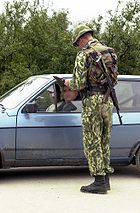 The Motorised Rifle Troops, the most numerous branch of service, constitutes the nucleus of Ground Forces' battle formations. They are equipped with powerful armament for destruction of ground-based and aerial targets, missile complexes, tanks, artillery and mortars, anti-tank guided missiles, antiaircraft missile systems and installations, and means of reconnaissance and control. It is estimated that there are currently 19 motor rifle divisions, and the Navy now has several motor rifle formations under its command in the Ground and Coastal Defence Forces of the Baltic Fleet
, the Northeastern Group of Troops and Forces on the Kamchatka Peninsula
and other areas of the extreme northeast. Also present are a large number of mobilisation divisions and brigades, known as "Bases for Storage of Weapons and Equipment", that in peacetime only have enough personnel assigned to guard the site and maintain the weapons.
The Tank Troops are the main impact force of the Ground Forces and a powerful means of armed struggle, intended for the accomplishment of the most important combat tasks. As of 2007, there were three tank divisions in the force: the 4th and 10th within the Moscow Military District
, and 5th Guards "Don" in the Siberian MD.
The 2nd Tank Division
in the Siberian Military District and the 21st Tank Division in the Far Eastern MD were disbanded.
The Artillery and Rocket Forces provide the Ground Forces' main firepower. The Ground Forces currently include 5 to 6 static defence machine-gun/artillery divisions and seemingly now one division of field artillery—the 34th Guards in the Moscow MD
. The previous 12th in the Siberian MD, and the 15th in the Far Eastern MD, seem to have disbanded.
The Air Defense Troops (PVO) are one of the basic weapons for the destruction of enemy air forces. They consist of surface-to-air missile
s, anti-aircraft artillery and radio-technical units and subdivisions.
Army Aviation, while intended for the direct support of the Ground Forces, is under the control of the Air Forces (VVS)
since 2003. However, by 2015 the Army Aviation will have been transferred back to the Ground Forces and 18 new aviation brigades will be added. Of the around 1,000 new helicopters that have been ordered under the State Armament Programmes, 900 will be for the Army Aviation.
s, the ground forces now consist of armies subordinate to the four new military districts: (Western
, Southern
, Central
, and Eastern
Military Districts). The new districts have the role of 'operational strategic commands,' which command the Ground Forces as well as the Naval Forces and part of the Air and Air Defence Forces within their areas of responsibility.
Each major formation is bolded, and directs the non-bolded major subordinate formations.
It is not entirely clear to which superior(s) the four operational-strategic commands will report to from 1 December 2010, as they command formations from multiple services (Air Force
, Ground Forces & Navy). A current detailed list of the subordinate units of the four military districts can be found in the respective articles. During 2009 all 23 remaining divisions were reorganised into four tank brigades, 35 motor-rifle brigades, one prikritiya brigade formed from a machinegun-light artillery division, and three airborne-assault brigades (pre-existing). Almost all are now designated otdelnaya (separate), with only several brigades retaining the guards honorific title.
 The Ground Forces retain a very large quantity of vehicles and equipment. There is also likely to be a great deal of older equipment in state military storage, a practice continued from the Soviet Union.
However, following the collapse of the USSR, the newly independent republics became host to most of the formations with modern equipment, whereas Russia was left with lower-category units, usually with older equipment. As financial stringency began to bite harder, the amount of new equipment fell as well, and by 1998, only ten tanks and about 30 BMP infantry fighting vehicles were being purchased each year.
Funding for new equipment has greatly risen in recent years, and the Russian defence industry continues to develop new weapons systems for the Ground Forces.
However, for the Ground Forces, while overall funding has dramatically increased, this does not guarantee that large numbers of new systems will enter service. In the case of vehicles, as the references show, examination of the actual number of vehicles planned to be bought yearly (about 200 MBTs and IFVs/APCs) means that for a force of about thirty divisions, each with about 300–400 MBTs and IFVs, it might take around 30 years to re-equip all formations.
Jane's World Armies
notes that the Soviet/Russian military tradition has never placed much importance on the survivability of individual soldiers, and thus eschews protective equipment such as flak jackets and helmets as being too heavy and uncomfortable, though promises to improve this state of affairs have been made.
, with some minor changes. The principal difference from the usual Western style is some variation in generals' rank titles—in at least one case, Colonel General
, derived from German usage. Most of the rank names were borrowed from existing German
/Prussia
n, French
, English
, Dutch
, and Polish
ranks upon the formation of Russian regular army
in the late 17th century, and have lasted with few changes of title through the Soviet period.
Romanization of Russian
Romanization of the Russian alphabet is the process of transliterating the Russian language from the Cyrillic alphabet into the Latin alphabet...
: Suhoputnye voyska Rossiyskoy Federatsii) are the land forces
Army
An army An army An army (from Latin arma "arms, weapons" via Old French armée, "armed" (feminine), in the broadest sense, is the land-based military of a nation or state. It may also include other branches of the military such as the air force via means of aviation corps...
of the Armed Forces of the Russian Federation
Armed Forces of the Russian Federation
The Armed Forces of the Russian Federation are the military services of Russia, established after the break-up of the Soviet Union. On 7 May 1992 Boris Yeltsin signed a decree establishing the Russian Ministry of Defence and placing all Soviet Armed Forces troops on the territory of the RSFSR...
, formed from parts of the collapsing Soviet Army
Soviet Army
The Soviet Army is the name given to the main part of the Armed Forces of the Soviet Union between 1946 and 1992. Previously, it had been known as the Red Army. Informally, Армия referred to all the MOD armed forces, except, in some cases, the Soviet Navy.This article covers the Soviet Ground...
in 1992. The formation of these forces posed economic challenges after the collapse of the Soviet Union, and required reforms to professionalize the force during the transition. While the Russian Ground Forces in their present form are only about twenty years old, Russian officers trace their antecedents' history through the Imperial Russian Army
Imperial Russian Army
The Imperial Russian Army was the land armed force of the Russian Empire, active from around 1721 to the Russian Revolution of 1917. In the early 1850s, the Russian army consisted of around 938,731 regular soldiers and 245,850 irregulars . Until the time of military reform of Dmitry Milyutin in...
era back to the time of Kievan Rus'
Kievan Rus'
Kievan Rus was a medieval polity in Eastern Europe, from the late 9th to the mid 13th century, when it disintegrated under the pressure of the Mongol invasion of 1237–1240....
.
Since 1992, the Ground Forces have withdrawn many thousands of troops from former Soviet garrisons abroad, while remaining extensively committed to the Chechen Wars, peacekeeping, and other operations in the Soviet successor states
Post-Soviet states
The post-Soviet states, also commonly known as the Former Soviet Union or former Soviet republics, are the 15 independent states that split off from the Union of Soviet Socialist Republics in its dissolution in December 1991...
(what is known in Russia as the "near abroad
Near abroad
In political language of Russia and some other post-Soviet states, the near abroad refers to the newly independent republics which emerged after the dissolution of the Soviet Union, and sometimes other nearby countries such as Finland and Mongolia....
"). The most recent clash was the 2008 South Ossetia war
2008 South Ossetia war
The 2008 South Ossetia War or Russo-Georgian War was an armed conflict in August 2008 between Georgia on one side, and Russia and separatist governments of South Ossetia and Abkhazia on the other....
with Georgia
Georgia (country)
Georgia is a sovereign state in the Caucasus region of Eurasia. Located at the crossroads of Western Asia and Eastern Europe, it is bounded to the west by the Black Sea, to the north by Russia, to the southwest by Turkey, to the south by Armenia, and to the southeast by Azerbaijan. The capital of...
n forces.
Mission
The primary responsibilities of the Ground Forces are the protection of the state borders, combatCombat
Combat, or fighting, is a purposeful violent conflict meant to establish dominance over the opposition, or to terminate the opposition forever, or drive the opposition away from a location where it is not wanted or needed....
on land, the security of occupied territories, and the defeat of enemy troops. The Ground Forces must be able to achieve these goals both in nuclear war and non-nuclear war, especially without the use of weapons of mass destruction
Weapons of mass destruction
A weapon of mass destruction is a weapon that can kill and bring significant harm to a large number of humans and/or cause great damage to man-made structures , natural structures , or the biosphere in general...
. Furthermore, they must be capable of protecting the national interests of Russia within the framework of its international obligations.
The Main Command of the Ground Forces is officially tasked with the following objectives:
- The training of troops for combat, on the basis of tasks determined by the Armed Forces' General StaffGeneral Staff of the Armed Forces of the Russian FederationThe General Staff of the Armed Forces of the Russian Federation is the military staff of the Armed Forces of the Russian Federation. It is the central organ of the Armed Forces Administration and oversees operational management of the armed forces under the Russian Ministry of Defence.The staff is...
. - The improvement of troops' structure and composition, and the optimization of their numbers, including for special troopsSpetsnazSpetsnaz, Specnaz tr: Voyska specialnogo naznacheniya; ) is an umbrella term for any special forces in Russian, literally "force of special purpose"...
. - The development of military theory and practice.
- The development and introduction of training field manuals, manuals, and methodology.
- The improvement of operational and combat training of the Ground Forces.
History
As the Soviet Union dissolved, efforts were made to keep the Soviet Armed ForcesSoviet Armed Forces
The Soviet Armed Forces, also called the Armed Forces of the Union of Soviet Socialist Republics and Armed Forces of the Soviet Union refers to the armed forces of the Russian SFSR , and Soviet Union from their beginnings in the...
as a single military structure for the new Commonwealth of Independent States
Commonwealth of Independent States
The Commonwealth of Independent States is a regional organization whose participating countries are former Soviet Republics, formed during the breakup of the Soviet Union....
. The last Minister of Defence of the Soviet Union, Marshal Yevgeny Shaposhnikov
Yevgeny Shaposhnikov
Yevgeny Ivanovich Shaposhnikov is a Russian military leader and business figure, Marshal of Aviation .Shaposhnikov was born on a farm near Aksay in Rostov Oblast Russia...
, was appointed supreme commander of the CIS Armed Forces in December 1991.
Among the numerous treaties signed by the former republics, in order to direct the transition period, was a temporary agreement on general purpose forces, signed in Minsk
Minsk
- Ecological situation :The ecological situation is monitored by Republican Center of Radioactive and Environmental Control .During 2003–2008 the overall weight of contaminants increased from 186,000 to 247,400 tons. The change of gas as industrial fuel to mazut for financial reasons has worsened...
on 14 February 1992. However, once it became clear that Ukraine
Ukraine
Ukraine is a country in Eastern Europe. It has an area of 603,628 km², making it the second largest contiguous country on the European continent, after Russia...
(and potentially the other republics) was determined to undermine the concept of joint general purpose forces and form their own armed forces, the new Russian government moved to form its own armed forces.
President of the Russian Federation Boris Yeltsin
Boris Yeltsin
Boris Nikolayevich Yeltsin was the first President of the Russian Federation, serving from 1991 to 1999.Originally a supporter of Mikhail Gorbachev, Yeltsin emerged under the perestroika reforms as one of Gorbachev's most powerful political opponents. On 29 May 1990 he was elected the chairman of...
signed a decree
Decree
A decree is a rule of law issued by a head of state , according to certain procedures . It has the force of law...
forming the Russian Ministry of Defence on 7 May 1992, establishing the Russian Ground Forces along with the other parts of the Armed Forces of the Russian Federation
Armed Forces of the Russian Federation
The Armed Forces of the Russian Federation are the military services of Russia, established after the break-up of the Soviet Union. On 7 May 1992 Boris Yeltsin signed a decree establishing the Russian Ministry of Defence and placing all Soviet Armed Forces troops on the territory of the RSFSR...
. At that time, the General Staff was in the process of withdrawing tens of thousands of personnel from the Group of Soviet Forces in Germany
Group of Soviet Forces in Germany
The Group of Soviet Forces in Germany , also known as the Group of Soviet Occupation Forces in Germany and the Western Group of Forces were the troops of the Soviet Army in East Germany....
, the Northern Group of Forces
Northern Group of Forces
The Northern Group of Forces was the military formation of the Soviet Army stationed in Poland from the end of Second World War in 1945 until 1993 when they were withdrawn in the aftermath of the fall of Soviet Union...
in Poland, the Central Group of Forces
Central Group of Forces
The Central Group of Forces was a Soviet military formation used to control Soviet troops in Central Europe on two occasions: in Austria and Hungary from 1945-55 and troops stationed in Czechoslovakia after the Prague Spring of 1968....
in Czechoslovakia, the Southern Group of Forces
Southern Group of Forces
The Southern Group of Forces was a Soviet Armed Forces formation formed twice following the Second World War, most notably around the time of the Hungarian Revolution of 1956....
in Hungary, and from Mongolia.
Thirty-seven divisions had to be withdrawn from the four groups of forces and the Baltic States, and four military districts—totalling 57 divisions—were handed over to Belarus and Ukraine.
Some idea of the scale of the withdrawal can be gained from the division list. For the dissolving Soviet Ground Forces, the withdrawal from the former Warsaw Pact
Warsaw Pact
The Warsaw Treaty Organization of Friendship, Cooperation, and Mutual Assistance , or more commonly referred to as the Warsaw Pact, was a mutual defense treaty subscribed to by eight communist states in Eastern Europe...
states and the Baltic states was an extremely demanding, expensive, and debilitating process.
As the military districts that remained in Russia after the collapse of the Union consisted mostly of the mobilisable cadre
En cadre
En cadre or cadre is a French expression originally denoting either the complement of commissioned officers of a regiment or the permanent skeleton establishment of a unit, around which the unit could be built if needed...
formations, the Russian Ground Forces were, to a large extent, created by relocating the formerly full-strength formations from Eastern Europe to those under-resourced districts. However, the facilities in those districts were inadequate to house the flood of personnel and equipment returning from abroad, and many units "were unloaded from the rail wagons into empty fields."
The need for destruction and transfer of large amounts of weaponry under the Treaty on Conventional Armed Forces in Europe
Treaty on Conventional Armed Forces in Europe
The original Treaty on Conventional Armed Forces in Europe was negotiated and concluded during the last years of the Cold War and established comprehensive limits on key categories of conventional military equipment in Europe and mandated the destruction of excess weaponry...
also necessitated great adjustments.
Post-Soviet reform plans
The Ministry of Defence newspaper Krasnaya ZvezdaKrasnaya Zvezda
Krasnaya Zvezda is an official newspaper of Soviet and later Russian Ministry of Defence. It was founded on January 1, 1924. Today its official designation is "Central Organ of the Russian Ministry of Defence."...
published a reform plan on 21 July 1992. Later one commentator said it was "hastily" put together by the General Staff "to satisfy the public demand for radical changes."
The General Staff
General Staff of the Armed Forces of the Russian Federation
The General Staff of the Armed Forces of the Russian Federation is the military staff of the Armed Forces of the Russian Federation. It is the central organ of the Armed Forces Administration and oversees operational management of the armed forces under the Russian Ministry of Defence.The staff is...
, from that point, become a bastion of conservatism, causing a build-up of troubles which later became critical. The reform plan advocated a change from an Army-Division-Regiment structure to a Corps-Brigade arrangement. The new structures were to be better capable in a situation with no frontline, and more capable of independent action at all levels. Cutting out a level of command, leaving two out of three higher echelons between the theatre headquarters and the fighting battalions would produce economies, increase flexibility, and simplify command-and-control arrangements.
The expected changeover to the new structure proved to be rare, irregular, and sometimes reversed. The new brigades that appeared were mostly divisions that had broken down until they happened to be at the proposed brigade strengths. New divisions—such as the new 3rd Motor Rifle Division
3rd Motor Rifle Division
The Soviet Army's 3rd Rifle Division was an infantry division active from 1921 to 1946 and from 1955 to 1956. It was formed 5 June 1921 in the Ukraine Military District. It appears that Order No. № 724/284 created the division from the 3rd and 46th Separate Rifle Brigades. At the beginning of...
in the Moscow Military District
Moscow Military District
The Moscow Military District was a military district of the Soviet Armed Forces and the Armed Forces of the Russian Federation. In 2010 it was merged with the Leningrad Military District, the Northern Fleet and the Baltic Fleet to form the new Western Military District.-History:In the beginning of...
, formed on the basis of disbanding tank formations—were formed, rather than new brigades.
Few of the reforms planned in the early 1990s eventuated, for three reasons: Firstly, there was an absence of firm civilian political guidance, with President Yeltsin primarily interested in ensuring that the Armed Forces were controllable and loyal, rather than reformed.
Secondly, declining funding worsened the progress. Finally, there was no firm consensus within the military about what reforms should be implemented. General Pavel Grachev
Pavel Grachev
Pavel Sergeyevich Grachev , sometimes transliterated as Grachov, is a retired Russian Army General and the former Defence Minister of the Russian Federation; in 1988 he was declared the Hero of the Soviet Union...
, the first Russian Minister of Defence (1992–96), broadly advertised reforms, yet wished to preserve the old Soviet-style Army, with large numbers of low-strength formations and continued mass conscription. The General Staff and the armed services tried to preserve Soviet era doctrines, deployments, weapons, and missions in the absence of solid new guidance.
A British military expert, Michael Orr, claims that the hierarchy had great difficulty fully understanding the changed situation, due to their education. As graduates of Soviet military academies
Soviet military academies
There were/are a number of military academies in the Soviet Union/Russia of different specialties.Unlike Western military academies such as West Point, Soviet, now Russian, military and police institutions referred to as "academy" are post-graduate professional military schools for experienced...
, they received great operational and staff training, but in political terms they had learned an ideology, rather than a wide understanding of international affairs. Thus, the generals—focused on NATO expanding to the east—could not adapt themselves and the Armed Forces to the new opportunities and challenges they faced.
Internal crisis of 1993
The Ground Forces reluctantly became involved in the Russian constitutional crisis of 1993 after President Yeltsin issued an unconstitutional decree dissolving the Parliament, following the Parliament's resistance to Yeltsin's consolidation of power and his neo-liberal reforms. A group of deputies, including Vice President Alexander Rutskoi, barricaded themselves inside the Parliament building. While giving public support to the President, the Armed Forces, led by General Grachev, tried to remain neutral, following the wishes of the officer corps.The military leadership were unsure of both the rightness of Yeltsin's cause and the reliability of their forces, and had to be convinced at length by Yeltsin to attack the Parliament.
When the attack was finally mounted, forces from five different divisions around Moscow were used, and the personnel involved were mostly officers and senior non-commissioned officers. There were also indications that some formations deployed into Moscow only under protest. However, once Parliament had been stormed, the parliamentary leaders arrested, and temporary censorship imposed, Yeltsin succeeded in retaining power.
First Chechen War
The Chechen people had never willingly accepted Russian rule. With the dissolution of the Soviet Union, the Chechens declared independence in November 1991, under the leadership of a former Air Forces officer, General Dzhokar Dudayev.The continuation of Chechen independence was seen as reducing Moscow's authority; Chechnya became perceived as a haven for criminals, and a hard-line group within the Kremlin began advocating war. A Security Council meeting was held 29 November 1994, where Yeltsin ordered the Chechens to disarm, or else Moscow would restore order. Defense Minister Pavel Grachev
Pavel Grachev
Pavel Sergeyevich Grachev , sometimes transliterated as Grachov, is a retired Russian Army General and the former Defence Minister of the Russian Federation; in 1988 he was declared the Hero of the Soviet Union...
assured Yeltsin that he would "take Grozny with one airborne assault regiment in two hours."
The operation began on 11 December 1994, and by 31 December, Russian forces were entering Grozny
Grozny
Grozny is the capital city of the Chechen Republic, Russia. The city lies on the Sunzha River. According to the preliminary results of the 2010 Census, the city had a population of 271,596; up from 210,720 recorded in the 2002 Census. but still only about two-thirds of 399,688 recorded in the 1989...
, the Chechen capital. The 131st Motor Rifle Brigade was ordered to make a swift push for the centre of the city, but was then virtually destroyed in Chechen ambushes. After finally seizing Grozny amid fierce resistance, Russian troops moved on to other Chechen strongholds. When Chechen militants took hostages in the Budyonnovsk hospital hostage crisis
Budyonnovsk hospital hostage crisis
The Budyonnovsk hospital hostage crisis took place from 14 June to 19 June 1995, when a group of 80 to 200 Chechen terrorists led by Shamil Basayev attacked the southern Russian city of Budyonnovsk , some north of the border with the Russian republic of Chechnya...
in Stavropol Kray in June 1995, peace looked possible for a time, but the fighting continued. Following this incident, the separatists were referred to as insurgents or terrorists within Russia.
Dzhokar Dudayev was assassinated in April 1996, and that summer, a Chechen attack retook Groznyy. Alexander Lebed, then Secretary of the Security Council, began talks with the Chechen rebel leader Aslan Maskhadov
Aslan Maskhadov
Aslan Aliyevich Maskhadov was a leader of the Chechen separatist movement and the third President of the Chechen Republic of Ichkeria.He was credited by many with the Chechen victory in the First Chechen War, which allowed for the...
in August 1996 and signed an agreement on 22/23 August; by the end of that month, the fighting ended.
The formal ceasefire was signed in the Dagestan
Dagestan
The Republic of Dagestan is a federal subject of Russia, located in the North Caucasus region. Its capital and the largest city is Makhachkala, located at the center of Dagestan on the Caspian Sea...
i town of Khasavyurt
Khasavyurt
Khasavyurt is a city in the Republic of Dagestan, Russia. Population: It was founded in 1846 and granted town status in 1931. The main local industries are food processing, brick making and garment making....
on 31 August 1996, stipulating that a formal agreement on relations between the Chechen Republic of Ichkeria and the Russian federal government need not be signed until late 2001.
Writing some years later, Dmitri Trenin and Aleksei Malashenko described the Russian military's performance in Chechniya as "grossly deficient at all levels, from commander-in-chief to the drafted private."
The Ground Forces' performance in the First Chechen War has been assessed by a British academic as "appallingly bad".
Writing six years later, Michael Orr said "one of the root causes of the Russian failure in 1994–96 was their inability to raise and deploy a properly-trained military force."
Second Chechen War
The Second Chechen War began in August 1999 after Chechen militias invaded neighboring DagestanDagestan
The Republic of Dagestan is a federal subject of Russia, located in the North Caucasus region. Its capital and the largest city is Makhachkala, located at the center of Dagestan on the Caspian Sea...
, followed quickly in early September by a series of four terrorist bombings across Russia. This prompted Russian military action against the alleged Chechen culprits.
In the first Chechen war, the Russians primarily put to waste to an area with artillery and airstrikes before advancing the land forces. Improvements were made in the Ground Forces between 1996 and 1999; when the Second Chechen War started, instead of hastily-assembled "composite regiments" dispatched with little or no training, whose members had never seen service together, formations were brought up to strength with replacements, put through preparatory training, and then dispatched. Combat performance improved accordingly, and large-scale opposition was crippled.
Most of the prominent past Chechen separatist leaders had died or been killed, including former president
President
A president is a leader of an organization, company, trade union, university, or country.Etymologically, a president is one who presides, who sits in leadership...
Aslan Maskhadov
Aslan Maskhadov
Aslan Aliyevich Maskhadov was a leader of the Chechen separatist movement and the third President of the Chechen Republic of Ichkeria.He was credited by many with the Chechen victory in the First Chechen War, which allowed for the...
and leading warlord
Warlord
A warlord is a person with power who has both military and civil control over a subnational area due to armed forces loyal to the warlord and not to a central authority. The term can also mean one who espouses the ideal that war is necessary, and has the means and authority to engage in war...
and terrorist attack mastermind Shamil Basayev
Shamil Basayev
Shamil Salmanovich Basayev was a Chechen militant Islamist and a leader of the Chechen rebel movement.Starting as a field commander in the Transcaucasus, Basayev led guerrilla campaigns against the Russian troops for years, as well as launching mass-hostage takings of civilians, with his goal...
. However, small-scale conflict continued to drag on; as of November 2007, it had spread across other parts of the Russian Caucasus.
It was a divisive struggle, with at least one senior military officer dismissed for being unresponsive to government commands: General Colonel Gennady Troshev
Gennady Troshev
Gennady Nikolayevich Troshev was a Russian Colonel General in the Russian military and formerly the commander of the North Caucasus Military District, including Chechnya, during the Second Chechen War...
was dismissed in 2002 for refusing to move from command of the North Caucasus Military District
North Caucasus Military District
The North Caucasus Military District was a military district of the Russian Ground Forces, which became in 2010 the Southern Military District and lately also includes the Black Sea Fleet and Caspian Flotilla....
to command of the less important Siberian Military District.
The Second Chechen War was officially declared ended on 16 April 2009.
Reforms under Sergeyev
When Igor SergeyevIgor Sergeyev
Igor Dmitriyevich Sergeyev was the Defense Minister of the Russian Federation from 22 May 1997 until 28 March 2001...
arrived as Minister of Defence in 1997, he initiated what were seen as real reforms under very difficult conditions.
The number of military educational establishments, virtually unchanged since 1991, was reduced, and the amalgamation of the Siberian and Trans-Baikal Military Districts was ordered. A larger number of army divisions were given "constant readiness" status, which was supposed to bring them up to 80 percent manning and 100 percent equipment holdings. Sergeyev announced in August 1998 that there would be six divisions and four brigades on 24-hour alert by the end of that year. Three levels of forces were announced; constant readiness, low-level, and strategic reserves.
However, personnel quality—even in these favored units—continued to be a problem. Lack of fuel for training and a shortage of well-trained junior officers hampered combat effectiveness. However, concentrating on the interests of his old service, the Strategic Rocket Forces
Strategic Rocket Forces
The Strategic Missile Troops or Strategic Rocket Forces of the Russian Federation or RVSN RF , transliteration: Raketnye voyska strategicheskogo naznacheniya Rossiyskoy Federatsii, literally Missile Troops of Strategic Designation of the Russian Federation) are a military branch of the Russian...
, Sergeyev directed the disbanding of the Ground Forces headquarters itself in December 1997. The disbandment was a "military nonsense", in Orr's words, "justifiable only in terms of internal politics within the Ministry of Defence". The Ground Forces' prestige declined as a result, as the headquarters disbandment implied—at least in theory—that the Ground Forces no longer ranked equally with the Air Force and Navy.
Reforms under Putin
Under President Vladimir PutinVladimir Putin
Vladimir Vladimirovich Putin served as the second President of the Russian Federation and is the current Prime Minister of Russia, as well as chairman of United Russia and Chairman of the Council of Ministers of the Union of Russia and Belarus. He became acting President on 31 December 1999, when...
, more funds were committed, the Ground Forces Headquarters was reestablished, and some progress on professionalisation occurred. Plans called for reducing mandatory service to 18 months in 2007, and to one year by 2008 but a mixed Ground Force, of both contract soldiers and conscripts, would remain. (As of 2009, the length of conscript service was 12 months.)
Funding increases began in 1999; after some recovery in the Russian economy and the associated rose in income, especially from oil, "Russia's officially reported defence spending [rose] in nominal terms at least, for the first time since the formation of the Russian Federation".
The budget rose from 141 billion rubles in 2000 to 219 billion rubles in 2001.
Much of this funding has been spent on personnel—there have been several pay rises, starting with a 20-percent rise authorised in 2001; the current professionalisation programme, including 26,000 extra sergeant
Sergeant
Sergeant is a rank used in some form by most militaries, police forces, and other uniformed organizations around the world. Its origins are the Latin serviens, "one who serves", through the French term Sergent....
s, was expected to cost at least 31 billion roubles ($1.1 billion USD).
Increased funding has been spread across the whole budget, with personnel spending being matched by greater procurement and research and development
Research and development
The phrase research and development , according to the Organization for Economic Co-operation and Development, refers to "creative work undertaken on a systematic basis in order to increase the stock of knowledge, including knowledge of man, culture and society, and the use of this stock of...
funding.
However, in 2004, Alexander Goltz said that, given the insistence of the hierarchy on trying to force contract soldiers into the old conscript pattern, there is little hope of a fundamental strengthening of the Ground Forces. He further elaborated that they are expected to remain, to some extent, a military liability and "Russia's most urgent social problem" for some time to come.
Goltz summed up by saying: "All of this means that the Russian armed forces are not ready to defend the country and that, at the same time, they are also dangerous for Russia. Top military personnel demonstrate neither the will nor the ability to effect fundamental changes."
More money is arriving both for personnel and equipment; Russian Prime Minister Vladimir Putin
Vladimir Putin
Vladimir Vladimirovich Putin served as the second President of the Russian Federation and is the current Prime Minister of Russia, as well as chairman of United Russia and Chairman of the Council of Ministers of the Union of Russia and Belarus. He became acting President on 31 December 1999, when...
said in June 2008 that monetary allowances for servicemen in permanent-readiness units will be raised significantly.
Enlisted pay will rise to 65,000 rubles (US$2,750) per month, and the pay of officers on combat duty in rapid response units will rise to 100,000–150,000 rubles (US$4,230–$6,355) per month. However, while the move to one year conscript service will disrupt dedovshchina
Dedovshchina
Dedovshchina is the name given to the informal system of subjection of new junior conscripts, formerly to the Soviet Armed Forces and today to the Russian armed forces, Interior Ministry, and FSB border guards, as well as the military forces of certain former Soviet Republics, to brutalization...
, it is unlikely that bullying will disappear altogether without significant societal change.
Other assessments from the same source point out that the Russian Armed Forces faced major disruption in 2008, as demographic change hindered plans to reduce the term of conscription from two years to one.
As a result of these factors and continuing corruption, the additional funding may not have led to a large improvement in the Russian Army's effectiveness.
Serdukov reforms
A major reorganisation of the force began in 2007 by the Minister for Defence Anatoliy Serdukov, with the aim of converting all divisions into brigades, and cutting surplus officers and establishments.However, this will affect units of continuous readiness only. It is intended to create 39 to 40 such brigades by 1 January 2016, including 39 all-arms brigades, 21 artillery and MRL brigades, 7 brigades of army air defence forces, 12 communication brigades, and two brigades of electronic warfare. In addition, one division stationed in the Far East will remain, and there will be an additional 17 separate regiments. The reform has increasingly received criticism from independent military experts in Russia, and has been called "unprecedented".
In the course of the reorganization it is planned to replace current 4-chain command structure (military district
Military district
Military districts are formations of a state's armed forces which are responsible for a certain area of territory. They are often more responsible for administrative than operational matters, and in countries with conscript forces, often handle parts of the conscription cycle.Navies have also used...
- field army
Field army
A Field Army, or Area Army, usually referred to simply as an Army, is a term used by many national military forces for a military formation superior to a corps and beneath an army group....
- division
Division (military)
A division is a large military unit or formation usually consisting of between 10,000 and 20,000 soldiers. In most armies, a division is composed of several regiments or brigades, and in turn several divisions typically make up a corps...
- regiment
Regiment
A regiment is a major tactical military unit, composed of variable numbers of batteries, squadrons or battalions, commanded by a colonel or lieutenant colonel...
) with a 3-chain structure: strategic command - operational command - brigade. Brigades are supposed to be used as mobile permanent-readiness units capable of fighting independently with the support of highly mobile task forces or together with other brigades under joint command.
In a statement on Sept. 24 2009, Chief commander of land forces, Vladimir Boldyrev said half of the Russian land forces were reformed by June 1, that 85 brigades of constant combat preparedness had already been created. Among them are the combined-arms brigade, missile brigades, assault brigades and electronic warfare brigade.s
Personnel
The Ground Forces included an estimated total of 395,000 persons, including an estimated 190,000 conscripts and 35,000 personnel of the Airborne Forces (VDV) in 2006.This can be compared to an estimated 670,000, with 210,000 conscripts, in 1995–96. These numbers should be treated with caution, however, due to the difficulty for those outside Russia to make accurate assessments, and confusion even within the General Staff on the numbers of conscripts within the force.
Red Army
The Workers' and Peasants' Red Army started out as the Soviet Union's revolutionary communist combat groups during the Russian Civil War of 1918-1922. It grew into the national army of the Soviet Union. By the 1930s the Red Army was among the largest armies in history.The "Red Army" name refers to...
were traditionally manned through terms of conscription, which had been reduced in 1967 from three to two years. This system was administered through the thousands of military commissariats ( [voyenkomat]) located throughout the Soviet Union. Between January and May of each year, every young Soviet male citizen was required to report to the local voyenkomat for assessment for military service, following a summons based on lists from every school and employer in the area.
The voyenkomat worked to quotas sent out by a department of the General Staff, listing how many young men were required by each service and branch of the Armed Forces.
(Since the fall of the Soviet Union, draft evasion has skyrocketed; officials regularly bemoan the ten or so percent that actually appear when summoned.) The new conscripts were then picked up by an officer from their future unit and usually sent by train across the country. On arrival, they would begin the Young Soldiers' course, and become part of the system of senior rule, known as dedovshchina
Dedovshchina
Dedovshchina is the name given to the informal system of subjection of new junior conscripts, formerly to the Soviet Armed Forces and today to the Russian armed forces, Interior Ministry, and FSB border guards, as well as the military forces of certain former Soviet Republics, to brutalization...
, literally "rule by the grandfathers." There were only a very small number of professional non-commissioned officers (NCOs), as most NCOs were conscripts sent on short courses
to prepare them for section commanders' and platoon sergeants' positions. These conscript NCOs were supplemented by praporshchik
Praporshchik
Praporshchik is a rank in the Russian military.-Imperial Russia:Praporshchik was originally a name of a junior commissioned officer rank in the military of the Russian Empire equivalent to ensign...
warrant officers, positions created in the 1960s to support the increased variety of skills required for modern weapons.
The Soviet Army's officer-to-soldier ratio was extremely top-heavy, partially in order to compensate for the relatively low education level of the military manpower base and the absence of professional NCOs. Following World War II and the great expansion of officer education, officers became the product of four-to-five-year higher military colleges. As in most armies, newly commissioned officers usually become platoon leaders, having to accept responsibility for the soldiers' welfare and training (with the exceptions noted above). Young officers in Soviet Army units were worked round the clock, normally receiving only three days off per month. Annual vacations were under threat if deficiencies emerged within the unit, and the pressure created enormous stress. Toward the end of the Soviet Union, this led to a decline in morale amongst young officers.
In the early 2000s, many junior officers did not wish to serve—in 2002, more than half the officers who left the forces did so early. Their morale was low, among other reasons, because their postings were entirely in the hands of their immediate superiors and the personnel department. "Without having to account for their actions, they can choose to promote or not promote him, to send him to Moscow or to some godforsaken post on the Chinese border."
There is little available information on the current status of women
Women in the Russian and Soviet military
Women in the Russian and Soviet military, as in other nations, have played an important role in their country's military history, in particular during the Great Patriotic War. Despite performing various duties in the armies throughout Russian history, it was in the 20th century that women began to...
, who are not conscripted, in the Ground Forces. According to the BBC
BBC
The British Broadcasting Corporation is a British public service broadcaster. Its headquarters is at Broadcasting House in the City of Westminster, London. It is the largest broadcaster in the world, with about 23,000 staff...
, there were 90,000 women in the Russian Army in 2002, though estimates on numbers of women across the entire Russian armed forces in 2000 ranged from 115,000 to 160,000.
Women serve in support roles, most commonly in the fields of nursing, communications, and engineering. Some officers' wives have become contract service personnel.
Kontraktniki
From small beginnings in the early 1990s, employment of contract soldiers (Kontraktniki) has grown greatly within the Ground Forces, though many have been of poor quality (wives of officers with no other prospective employment, for example). In December 2005, Sergei IvanovSergei Ivanov
Sergei Borisovich Ivanov is a Russian senior official and statesman. He was Minister of Defence from March 2001 to February 2007, Deputy Prime Minister from November 2005 to February 2007, and the First Deputy Prime Minister from February 2007 to May 2008...
, then Minister of Defence, proposed that—in addition to the numerous enlisted contract soldiers—all sergeants should become professional, which would raise the number of professional soldiers and non-commissioned officers in the Armed Forces overall to approximately 140,000 in 2008. The current programme allows for an extra 26,000 posts for fully professional sergeants.
The CIA
Central Intelligence Agency
The Central Intelligence Agency is a civilian intelligence agency of the United States government. It is an executive agency and reports directly to the Director of National Intelligence, responsible for providing national security intelligence assessment to senior United States policymakers...
reported in the World Factbook that 30 percent of Russian army personnel were contract servicemen at the end of 2005, and that as of May 2006, 178,000 contract servicemen were serving in the Ground Forces and the Navy. Planning calls for volunteer servicemen to compose 70 percent of armed forces by 2010, with the remaining servicemen consisting of conscripts. At the end of 2005, the Ground Forces had 40 all-volunteer constant readiness units, with another 20 constant readiness units to be formed in 2006. These CIA figures can be set against IISS data, which reports that at the end of 2004, the number of contracts being signed in the Moscow Military District
Moscow Military District
The Moscow Military District was a military district of the Soviet Armed Forces and the Armed Forces of the Russian Federation. In 2010 it was merged with the Leningrad Military District, the Northern Fleet and the Baltic Fleet to form the new Western Military District.-History:In the beginning of...
was only 17 percent of the target figure; in the North Caucasus
North Caucasus Military District
The North Caucasus Military District was a military district of the Russian Ground Forces, which became in 2010 the Southern Military District and lately also includes the Black Sea Fleet and Caspian Flotilla....
, 45 percent; and in the Volga-Ural, 25 percent.
Whatever the number of contract soldiers, commentators such as Alexander Goltz are pessimistic that many more combat ready units will result, as senior officers "see no difference between professional NCOs, ... versus conscripts who have been drilled in training schools for less than six months. Such sergeants will have neither the knowledge nor the experience that can help them win authority [in] the barracks." Defence Minister Sergey Ivanov underlined the in-barracks discipline situation, even after years of attempted professionalisation, when releasing the official injury figures for 2002. 531 men had died on duty as a result of accidents and crimes, and 20,000 had been wounded (the numbers apparently not including suicides). According to Ivanov, "the accident rate is not falling". Two of every seven conscripts will become addicted to drugs and alcohol while serving their terms, and a further one in twenty will suffer homosexual rape, according to 2005 reports.
Part of the reason is the feeling between contract servicemen, conscripts, and officers.
Crime and corruption in the ground forces
The new Russian Ground Forces inherited an increasing crime problem from their Soviet predecessors. As draft resistance grew in the last years of the Soviet Union, the authorities tried to compensate by enlisting men with criminal records and who spoke little or no Russian. Crime rates soared, with the military procurator in Moscow in September 1990 reporting a 40-percent increase in crime over the previous six months, including a 41-percent rise in serious bodily injuries. Disappearances of weapons rose to rampant levels, especially in Eastern Europe and the Caucasus.Generals directing the withdrawals from Eastern Europe diverted arms, equipment, and foreign monies intended to build housing in Russia for the withdrawn troops. Several years later, the former commander in Germany, General Matvei Burlakov, and the Defence Minister, Pavel Grachev
Pavel Grachev
Pavel Sergeyevich Grachev , sometimes transliterated as Grachov, is a retired Russian Army General and the former Defence Minister of the Russian Federation; in 1988 he was declared the Hero of the Soviet Union...
, had their involvement exposed. They were also accused of ordering the murder of reporter Dmitry Kholodov
Dmitry Kholodov
Dmitry Yuryevich Kholodov was educated as a physicist and began his working life, alongside his parents, at the defence industry institute in Klimovsk in the Moscow Region. Faced by limited career prospects he turned to journalism, first working for the local radio. In 1992 he became a reporter...
, who had been investigating the scandals. In December 1996, Defence Minister Igor Rodionov
Igor Rodionov
Igor Nikolayevich Rodionov is a Russian general and Duma deputy. He is best known as a hardline politician, and for his service heading the Defence Ministry of the Russian Federation....
ordered the dismissal of the Commander of the Ground Forces, General Vladimir Semyonov
Vladimir Magomedovich Semyonov
Vladimir Magomedovich Semyonov is a Russian colonel-general and the first president of the Karachay-Cherkess Republic ....
, for activities incompatible with his position — reportedly his wife's business activities.
A 1995 study by the U.S. Foreign Military Studies Office
Foreign Military Studies Office
The Foreign Military Studies Office, or FMSO, is a research and analysis center for the United States Army that is part of the United States Army Combined Arms Center at Fort Leavenworth. It manages the Joint Reserve Intelligence Center there.-Mission:...
went as far as to say that the Armed Forces were "an institution increasingly defined by the high levels of military criminality and corruption embedded within it at every level." The FMSO noted that crime levels had always grown with social turbulence, such as the trauma Russia was passing through. The author identified four major types among the raft of criminality prevalent within the forces—weapons trafficking and the arms trade; business and commercial ventures; military crime beyond Russia's borders; and contract murder. Weapons disappearances began during the dissolution of the Union and has continued. Within units "rations are sold while soldiers grow hungry ... [while] fuel, spare parts, and equipment can be bought." Meanwhile voyemkomats take bribes to arrange avoidance of service, or a more comfortable posting.
Beyond the Russian frontier, drugs were smuggled across the Tajik
Tajikistan
Tajikistan , officially the Republic of Tajikistan , is a mountainous landlocked country in Central Asia. Afghanistan borders it to the south, Uzbekistan to the west, Kyrgyzstan to the north, and China to the east....
border—supposedly being patrolled by Russian guards—by military aircraft, and a Russian senior officer, General Major Alexander Perelyakin, had been dismissed from his post with the United Nations peacekeeping force in Bosnia-Hercegovina (UNPROFOR), following continued complaints of smuggling, profiteering, and corruption. In terms of contract killings, beyond the Kholodov case, there have been widespread rumours that GRU Spetsnaz
Spetsnaz
Spetsnaz, Specnaz tr: Voyska specialnogo naznacheniya; ) is an umbrella term for any special forces in Russian, literally "force of special purpose"...
personnel have been moonlighting as mafiya hitmen.
Reports such as these continue. Some of the more egregious examples have included a constant-readiness motor rifle regiment's tanks running out of fuel on the firing ranges, due to the diversion of their fuel supplies to local businesses. Visiting the 20th Army in April 2002, Sergey Ivanov said the volume of theft was "simply impermissible".
Some degree of change is under way. Abuse of personnel, sending soldiers to work outside units—a long standing tradition which could see conscripts doing things ranging from being large scale manpower supply for commercial businesses to being officers' families' servants—is now banned by Sergei Ivanov's Order 428 of October 2005. What is more, the order is being enforced, with several prosecutions recorded. President Putin also demanded a halt to dishonest use of military property in November 2005: "We must completely eliminate the use of the Armed Forces' material base for any commercial objectives."
The spectrum of dishonest activity has included, in the past, exporting aircraft as scrap metal; but the point at which officers are prosecuted has shifted, and investigations over trading in travel warrants and junior officers' routine thieving of soldiers' meals are beginning to be reported. However, British military analysts comment that "there should be little doubt that the overall impact of theft and fraud is much greater than that which is actually detected". Chief Military Prosecutor Sergey Fridinskiy said in March 2007 that there was "no systematic work in the Armed Forces to prevent embezzlement".
One of the latest corruption scandals occurred at the elite Lipetsk pilot training center
Lipetsk Air Base
Lipetsk Air Base is an air base in Lipetsk Oblast, Russia located 12 km northwest of Lipetsk. It is the combat training center of Soviet Air Force, analogous to the U.S. Air Force's Nellis Air Force Base...
, where the deputy commander, the chief of staff and other officers allegedly extorted 3 million rubles of premium pay from other officers since the beginning of 2010. The Tambov military garrison prosecutor confirmed that charges have been lodged against those involved. The affair came to light after a junior officer wrote about the extortion in his personal blog. Sergey Fridinskiy, the Main Military Prosecutor acknowledged that extortion in the distribution of supplementary pay in army units is common, and that "criminal cases on the facts of extortion are being investigated in practically every district and fleet.”
Organisation
Moscow
Moscow is the capital, the most populous city, and the most populous federal subject of Russia. The city is a major political, economic, cultural, scientific, religious, financial, educational, and transportation centre of Russia and the continent...
, directs activities. This body was disbanded in 1997, but reformed by President Putin in 2001 by appointing Colonel General
Colonel General
Colonel General is a senior rank of General. North Korea and Russia are two countries which have used the rank extensively throughout their histories...
Nikolai Kormiltsev
Nikolai Kormiltsev
Nikolai Kormiltsev was Commander-in-Chief of the Russian Ground Forces from 2001 to 2004, before being replaced by Alexey Maslov....
as the commander-in-chief
Commander-in-Chief
A commander-in-chief is the commander of a nation's military forces or significant element of those forces. In the latter case, the force element may be defined as those forces within a particular region or those forces which are associated by function. As a practical term it refers to the military...
of the ground forces and also as a deputy minister of defense. Kormiltsev handed over command to Colonel General
Colonel General
Colonel General is a senior rank of General. North Korea and Russia are two countries which have used the rank extensively throughout their histories...
(later General of the Army) Alexey Maslov
Alexey Maslov
General of the Army Alexey Fyodorovich Maslov is the former Commander-in-Chief of the Russian Ground Forces. He is a graduate of the Tank Troops Military Academy and in the Military Academy of the General Staff of the Russian Armed Forces....
in 2004, and in a realignment of responsibilities, the Ground Forces Commander-in-Chief lost his position as a deputy minister of defence. Like Kormiltsev, while serving as Ground Forces Commander-in-Chief Maslov has been promoted to General of the Army.
As of January 2010, the Commander of the Russian Ground Forces is General of the Army Alexander Postnikov
Alexander Postnikov
Alexander Nikolaevich Postnikov-Streltsov is the current commanding officer of the Russian Ground Forces. He currently holds the rank of Colonel General.Он был командующим войсками Siberian Military District с 2007 года...
.
The Main Command of the Ground Forces consists of the Main Staff of the Ground Troops, and departments for Peacekeeping Forces, Armaments of the Ground Troops, Rear Services of the Ground Troops, Cadres of the Ground Troops (personnel), Indoctrination Work, and Military Education. There were also a number of directorates which used to be commanded by the Ground Forces Commander-in-Chief in his capacity as a deputy defence minister. They included Radiation, Chemical, and Biological Defence Troops of the Armed Forces, Engineer Troops of the Armed Forces, and Troop Air Defence, as well as several others. Their exact command status is now unknown.
Structure
The branches of service include motorized rifles, tanks, artillery and rocket forces, troop air defense, special corps (reconnaissance, signals, radioelectronic warfare, engineering, radiation, chemical and biological protection, technical support, automobile, and the protection of the rear), military units, and logistical establishments.Baltic Fleet
The Twice Red Banner Baltic Fleet - is the Russian Navy's presence in the Baltic Sea. In previous historical periods, it has been part of the navy of Imperial Russia and later the Soviet Union. The Fleet gained the 'Twice Red Banner' appellation during the Soviet period, indicating two awards of...
, the Northeastern Group of Troops and Forces on the Kamchatka Peninsula
Kamchatka Peninsula
The Kamchatka Peninsula is a peninsula in the Russian Far East, with an area of . It lies between the Pacific Ocean to the east and the Sea of Okhotsk to the west...
and other areas of the extreme northeast. Also present are a large number of mobilisation divisions and brigades, known as "Bases for Storage of Weapons and Equipment", that in peacetime only have enough personnel assigned to guard the site and maintain the weapons.
The Tank Troops are the main impact force of the Ground Forces and a powerful means of armed struggle, intended for the accomplishment of the most important combat tasks. As of 2007, there were three tank divisions in the force: the 4th and 10th within the Moscow Military District
Moscow Military District
The Moscow Military District was a military district of the Soviet Armed Forces and the Armed Forces of the Russian Federation. In 2010 it was merged with the Leningrad Military District, the Northern Fleet and the Baltic Fleet to form the new Western Military District.-History:In the beginning of...
, and 5th Guards "Don" in the Siberian MD.
The 2nd Tank Division
2nd Guards Tank Corps
The 2nd Tatsinskaya Guards Tank Corps was a Red Army armoured formation that saw service during World War II on the Eastern Front. After the war it continued to serve with Soviet occupation forces in Central Europe. It was originally the 24th Tank Corps...
in the Siberian Military District and the 21st Tank Division in the Far Eastern MD were disbanded.
The Artillery and Rocket Forces provide the Ground Forces' main firepower. The Ground Forces currently include 5 to 6 static defence machine-gun/artillery divisions and seemingly now one division of field artillery—the 34th Guards in the Moscow MD
Moscow Military District
The Moscow Military District was a military district of the Soviet Armed Forces and the Armed Forces of the Russian Federation. In 2010 it was merged with the Leningrad Military District, the Northern Fleet and the Baltic Fleet to form the new Western Military District.-History:In the beginning of...
. The previous 12th in the Siberian MD, and the 15th in the Far Eastern MD, seem to have disbanded.
The Air Defense Troops (PVO) are one of the basic weapons for the destruction of enemy air forces. They consist of surface-to-air missile
Surface-to-air missile
A surface-to-air missile or ground-to-air missile is a missile designed to be launched from the ground to destroy aircraft or other missiles...
s, anti-aircraft artillery and radio-technical units and subdivisions.
Army Aviation, while intended for the direct support of the Ground Forces, is under the control of the Air Forces (VVS)
Russian Air Force
The Russian Air Force is the air force of Russian Military. It is currently under the command of Colonel General Aleksandr Zelin. The Russian Navy has its own air arm, the Russian Naval Aviation, which is the former Soviet Aviatsiya Voyenno Morskogo Flota , or AV-MF).The Air Force was formed from...
since 2003. However, by 2015 the Army Aviation will have been transferred back to the Ground Forces and 18 new aviation brigades will be added. Of the around 1,000 new helicopters that have been ordered under the State Armament Programmes, 900 will be for the Army Aviation.
Dispositions since 2010
As a result of the 2008 Russian military reform2008 Russian military reform
Significant reforms of the Armed Forces of the Russian Federation were announced in October 2008 under Defence Minister Anatoliy Serdyukov, and major structural reorganisation began in 2009...
s, the ground forces now consist of armies subordinate to the four new military districts: (Western
Western Military District
Western Military District is one of the four operational strategic commands of the Armed Forces of the Russian Federation. The district was formed in Presidential Decree № 1144 signed on September 20, 2010...
, Southern
Southern Military District
The Southern Military District is one of the four operational strategic commands of the Armed Forces of the Russian Federation. The district was formed in accordance with Presidential Decree № 1144 signed on September 20, 2010...
, Central
Central Military District
The Central Military District is one of Russia's Military Districts. The district was formed in Presidential Decree № 1144 signed on September 20, 2010. The district includes the territories of the former Siberian Military District...
, and Eastern
Eastern Military District
The Eastern Military District is one of the four operational strategic commands of the Armed Forces of the Russian Federation. The district was formed in Presidential Decree № 1144 signed on September 20, 2010...
Military Districts). The new districts have the role of 'operational strategic commands,' which command the Ground Forces as well as the Naval Forces and part of the Air and Air Defence Forces within their areas of responsibility.
Each major formation is bolded, and directs the non-bolded major subordinate formations.
It is not entirely clear to which superior(s) the four operational-strategic commands will report to from 1 December 2010, as they command formations from multiple services (Air Force
Russian Air Force
The Russian Air Force is the air force of Russian Military. It is currently under the command of Colonel General Aleksandr Zelin. The Russian Navy has its own air arm, the Russian Naval Aviation, which is the former Soviet Aviatsiya Voyenno Morskogo Flota , or AV-MF).The Air Force was formed from...
, Ground Forces & Navy). A current detailed list of the subordinate units of the four military districts can be found in the respective articles. During 2009 all 23 remaining divisions were reorganised into four tank brigades, 35 motor-rifle brigades, one prikritiya brigade formed from a machinegun-light artillery division, and three airborne-assault brigades (pre-existing). Almost all are now designated otdelnaya (separate), with only several brigades retaining the guards honorific title.
| Formation | Headquarters Location |
|---|---|
| Western Military District Western Military District Western Military District is one of the four operational strategic commands of the Armed Forces of the Russian Federation. The district was formed in Presidential Decree № 1144 signed on September 20, 2010... (Colonel General Arkady Bakhin Arkady Bakhin Arkady V. Bakhin is a military officer of the Russian Federation with the rank of Colonel-General. He was born May 8, 1956 in Kaunas, Lithuanian SSR.... ) |
HQ Saint Petersburg Saint Petersburg Saint Petersburg is a city and a federal subject of Russia located on the Neva River at the head of the Gulf of Finland on the Baltic Sea... |
| * 6th Army 6th Army (Soviet Union) The 6th Army was a field army of the Soviet Red Army formed four times during World War II and active with the Russian Ground Forces up until 1998... |
Agalatovo |
| * 20th Army | Voronezh Voronezh Voronezh is a city in southwestern Russia, the administrative center of Voronezh Oblast. It is located on both sides of the Voronezh River, away from where it flows into the Don. It is an operating center of the Southeastern Railway , as well as the center of the Don Highway... |
| Southern Military District Southern Military District The Southern Military District is one of the four operational strategic commands of the Armed Forces of the Russian Federation. The district was formed in accordance with Presidential Decree № 1144 signed on September 20, 2010... (Lieutenant General Alexander Galkin) |
HQ Rostov-na-Donu |
| * 49th Army | Stavropol Stavropol -International relations:-Twin towns/sister cities:Stavropol is twinned with: Des Moines, United States Béziers, France Pazardzhik, Bulgaria-External links:* **... |
| * 58th Army 58th Army (Russia) The 58th Army is a field army; first of the Soviet Union's Red Army and subsequently of the Russian Ground Forces.... |
Vladikavkaz Vladikavkaz -Notable structures:In Vladikavkaz, there is a guyed TV mast, tall, built in 1961, which has six crossbars with gangways in two levels running from the mast structure to the guys.-Twin towns/sister cities:... |
| Central Military District Central Military District The Central Military District is one of Russia's Military Districts. The district was formed in Presidential Decree № 1144 signed on September 20, 2010. The district includes the territories of the former Siberian Military District... (Lieutenant General Vladimir Chirkin) |
HQ Yekaterinburg Yekaterinburg Yekaterinburg is a major city in the central part of Russia, the administrative center of Sverdlovsk Oblast. Situated on the eastern side of the Ural mountain range, it is the main industrial and cultural center of the Urals Federal District with a population of 1,350,136 , making it Russia's... |
| * 2nd Army 2nd Guards Tank Army (Soviet Union) The Second Tank Army of the Red Army was formed in January - February, 1943 on the basis of the 3rd Reserve Army of the Bryansk Front.Originally the Army comprised 11th and 16th Tank Corps, 60th, 112th and 194th Rifle Divisions, the 11th Guards Separate tank brigade, 115th Rifle Brigade, the 28th... |
Samara Samara, Russia Samara , is the sixth largest city in Russia. It is situated in the southeastern part of European Russia at the confluence of the Volga and Samara Rivers. Samara is the administrative center of Samara Oblast. Population: . The metropolitan area of Samara-Tolyatti-Syzran within Samara Oblast... |
| * 41st Army | Novosibirsk Novosibirsk Novosibirsk is the third-largest city in Russia, after Moscow and Saint Petersburg, and the largest city of Siberia, with a population of 1,473,737 . It is the administrative center of Novosibirsk Oblast as well as of the Siberian Federal District... |
| Eastern Military District Eastern Military District The Eastern Military District is one of the four operational strategic commands of the Armed Forces of the Russian Federation. The district was formed in Presidential Decree № 1144 signed on September 20, 2010... (Admiral Konstantin Sidenko) |
HQ Khabarovsk Khabarovsk Khabarovsk is the largest city and the administrative center of Khabarovsk Krai, Russia. It is located some from the Chinese border. It is the second largest city in the Russian Far East, after Vladivostok. The city became the administrative center of the Far Eastern Federal District of Russia... |
| * 5th Army | Ussuriysk Ussuriysk Ussuriysk is a city in Primorsky Krai, Russia, located in the fertile valley of the Razdolnaya River, north of Vladivostok and about from both the Chinese border and the Pacific Ocean. Population: -Medieval history:... |
| * 29th Army 29th Army (Soviet Union) The Soviet Red Army's 29th Army was a field army of the Red Army and later the Russian Ground Forces.- History :It was first formed in July 1941 in the Moscow Military District on the basis of 30th Rifle Corps. The 245th, 252nd, 254th and 256th Rifle Divisions, and a number of smaller units made up... |
Chita, Zabaykalsky Krai |
| * 35th Army 35th Army (Soviet Union) The 35th Red Banner Army is a field army of the Russian Ground Forces.The 35th Army was originally formed within the Soviet Red Army in July 1941 on the basis of 18th Rifle Corps, and joined the Far Eastern Front. Within Far Eastern Front it comprised 35th, 66th, 78th Rifle Divisions, the 109th... |
Belogorsk, Amur Oblast Belogorsk, Amur Oblast Belogorsk is a town in Amur Oblast, Russia, located on the Tom River, a tributary of the Zeya. Population: 67,400 ; 53,000 ; 34,000 .-History:... |
| * 36th Army | Ulan Ude |
Equipment
However, following the collapse of the USSR, the newly independent republics became host to most of the formations with modern equipment, whereas Russia was left with lower-category units, usually with older equipment. As financial stringency began to bite harder, the amount of new equipment fell as well, and by 1998, only ten tanks and about 30 BMP infantry fighting vehicles were being purchased each year.
Funding for new equipment has greatly risen in recent years, and the Russian defence industry continues to develop new weapons systems for the Ground Forces.
However, for the Ground Forces, while overall funding has dramatically increased, this does not guarantee that large numbers of new systems will enter service. In the case of vehicles, as the references show, examination of the actual number of vehicles planned to be bought yearly (about 200 MBTs and IFVs/APCs) means that for a force of about thirty divisions, each with about 300–400 MBTs and IFVs, it might take around 30 years to re-equip all formations.
Jane's World Armies
Jane's Information Group
Jane's Information Group is a publishing company specializing in transportation and military topics.-History:It was founded by Fred T...
notes that the Soviet/Russian military tradition has never placed much importance on the survivability of individual soldiers, and thus eschews protective equipment such as flak jackets and helmets as being too heavy and uncomfortable, though promises to improve this state of affairs have been made.
Equipment summary
The following figures are from two different sources. Main equipment numbers are from the IISS's Military Balance 2006, and these broadly agree with the latest 2008 edition of the Military Balance. Figures in parentheses marked "active" are from http://warfare.ru.| Equipment | Numbers |
|---|---|
| Main Battle Tanks | 22,800+ (~6,500 active) |
| Light Tanks | 150 PT-76; None |
| Armoured Infantry Fighting Vehicles | 15,000+ (~6,000 active) |
| Armoured Personnel Carriers | 9,900+ (~6,400 active) |
| Towed Artillery | 12,765 (~7,550 active) |
| Self Propelled Artillery | 6,000 (~3,500 active) |
| Multiple Rocket Launchers | about 4,500 (~900 active) |
| Mortars | 6,600 (~2,600 active) |
| Self-Propelled Surface to Air Missile Surface-to-air missile A surface-to-air missile or ground-to-air missile is a missile designed to be launched from the ground to destroy aircraft or other missiles... s |
about 2,500 |
Ranks and insignia
The newly re-emergent Russia retained most of the ranks of the Soviet ArmySoviet Army
The Soviet Army is the name given to the main part of the Armed Forces of the Soviet Union between 1946 and 1992. Previously, it had been known as the Red Army. Informally, Армия referred to all the MOD armed forces, except, in some cases, the Soviet Navy.This article covers the Soviet Ground...
, with some minor changes. The principal difference from the usual Western style is some variation in generals' rank titles—in at least one case, Colonel General
Colonel General
Colonel General is a senior rank of General. North Korea and Russia are two countries which have used the rank extensively throughout their histories...
, derived from German usage. Most of the rank names were borrowed from existing German
Germany
Germany , officially the Federal Republic of Germany , is a federal parliamentary republic in Europe. The country consists of 16 states while the capital and largest city is Berlin. Germany covers an area of 357,021 km2 and has a largely temperate seasonal climate...
/Prussia
Prussia
Prussia was a German kingdom and historic state originating out of the Duchy of Prussia and the Margraviate of Brandenburg. For centuries, the House of Hohenzollern ruled Prussia, successfully expanding its size by way of an unusually well-organized and effective army. Prussia shaped the history...
n, French
France
The French Republic , The French Republic , The French Republic , (commonly known as France , is a unitary semi-presidential republic in Western Europe with several overseas territories and islands located on other continents and in the Indian, Pacific, and Atlantic oceans. Metropolitan France...
, English
England
England is a country that is part of the United Kingdom. It shares land borders with Scotland to the north and Wales to the west; the Irish Sea is to the north west, the Celtic Sea to the south west, with the North Sea to the east and the English Channel to the south separating it from continental...
, Dutch
Netherlands
The Netherlands is a constituent country of the Kingdom of the Netherlands, located mainly in North-West Europe and with several islands in the Caribbean. Mainland Netherlands borders the North Sea to the north and west, Belgium to the south, and Germany to the east, and shares maritime borders...
, and Polish
Poland
Poland , officially the Republic of Poland , is a country in Central Europe bordered by Germany to the west; the Czech Republic and Slovakia to the south; Ukraine, Belarus and Lithuania to the east; and the Baltic Sea and Kaliningrad Oblast, a Russian exclave, to the north...
ranks upon the formation of Russian regular army
Regular army
A regular army consists of the permanent force of a country's army that is maintained under arms during peacetime.Countries that use the term include:*Australian Army*British Army*Canadian Forces, specifically "Regular Force"*Egyptian army*Indian Army...
in the late 17th century, and have lasted with few changes of title through the Soviet period.