
All Topics  
Karl Jaspers

 
Karl Jaspers

   Email Print
   Bookmark   Link


Karl Jaspers


Karl Theodor Jaspers (February 23, 1883 – February 26, 1969) was a German
Germany

Germany , officially the Federal Republic of Germany , is a country in Central Europe. It is bordered to the north by the North Sea, Denmark, and the Baltic Sea; to the east by Poland and the Czech Republic; to the south by Austria and Switzerland; and to the west by France, Luxembourg, Belgium, and the Netherlands....
 psychiatrist
Psychiatrist

A psychiatrist is a physician who specializes in psychiatry and is certified in treating mental disorders. All psychiatrists are trained in diagnostic evaluation and in psychotherapy....
 and philosopher who had a strong influence on modern theology
Theology

Theology is the study of the existence or attributes of a deity or gods, or more generally the study of religion or spirituality. It is sometimes contrasted with religious studies: theology is understood as the study of religion from an internal perspective , and religious studies as the study of religion from an external perspective....
, psychiatry
Psychiatry

Psychiatry is a Medicine Specialty devoted to the Treatment of mental disorders, Biomedical research and Prevention of mental disorder. The term was first coined by the German physician Johann Christian Reil in 1808....
 and philosophy
Philosophy

Philosophy is the study of general problems concerning matters such as existence, knowledge, truth, beauty, justice, validity, mind, and language....
. Trained in and practiced psychiatry, Jaspers later turned to philosophical inquiry and attempted to discover an innovative philosophical system. He was often viewed as a major exponent of existentialism
Existentialism

Existentialism is a term that has been applied to the work of a number of nineteenth and twentieth century philosophers who, despite profound doctrinal differences, took the human subject — not merely the thinking subject, but the acting, feeling, living human individual and his or her conditions of existence — as a starting point...
 in Germany
Germany

Germany , officially the Federal Republic of Germany , is a country in Central Europe. It is bordered to the north by the North Sea, Denmark, and the Baltic Sea; to the east by Poland and the Czech Republic; to the south by Austria and Switzerland; and to the west by France, Luxembourg, Belgium, and the Netherlands....
, though he did not accept this label.

ers was born in Oldenburg
Oldenburg

||-||-||-||}Oldenburg is an Independent City in Lower Saxony, Germany. It is situated in the western part of the state between the cities of Bremen and Groningen , at the Hunte river....
 in 1883 to a mother from a local farming community, and a jurist father.


Discussion
Ask a question about 'Karl Jaspers'
Start a new discussion about 'Karl Jaspers'
Answer questions from other users
Full Discussion Forum


Quotations


Man is always something more than what he knows of himself. He is not what he is simply once and for all, but is a process... As published in Existentialism from Dostoyevsky to Sartre (1956) edited by Walter Kaufman.


Encyclopedia


Karl Theodor Jaspers (February 23, 1883 – February 26, 1969) was a German
Germany

Germany , officially the Federal Republic of Germany , is a country in Central Europe. It is bordered to the north by the North Sea, Denmark, and the Baltic Sea; to the east by Poland and the Czech Republic; to the south by Austria and Switzerland; and to the west by France, Luxembourg, Belgium, and the Netherlands....
 psychiatrist
Psychiatrist

A psychiatrist is a physician who specializes in psychiatry and is certified in treating mental disorders. All psychiatrists are trained in diagnostic evaluation and in psychotherapy....
 and philosopher who had a strong influence on modern theology
Theology

Theology is the study of the existence or attributes of a deity or gods, or more generally the study of religion or spirituality. It is sometimes contrasted with religious studies: theology is understood as the study of religion from an internal perspective , and religious studies as the study of religion from an external perspective....
, psychiatry
Psychiatry

Psychiatry is a Medicine Specialty devoted to the Treatment of mental disorders, Biomedical research and Prevention of mental disorder. The term was first coined by the German physician Johann Christian Reil in 1808....
 and philosophy
Philosophy

Philosophy is the study of general problems concerning matters such as existence, knowledge, truth, beauty, justice, validity, mind, and language....
. Trained in and practiced psychiatry, Jaspers later turned to philosophical inquiry and attempted to discover an innovative philosophical system. He was often viewed as a major exponent of existentialism
Existentialism

Existentialism is a term that has been applied to the work of a number of nineteenth and twentieth century philosophers who, despite profound doctrinal differences, took the human subject — not merely the thinking subject, but the acting, feeling, living human individual and his or her conditions of existence — as a starting point...
 in Germany
Germany

Germany , officially the Federal Republic of Germany , is a country in Central Europe. It is bordered to the north by the North Sea, Denmark, and the Baltic Sea; to the east by Poland and the Czech Republic; to the south by Austria and Switzerland; and to the west by France, Luxembourg, Belgium, and the Netherlands....
, though he did not accept this label.

Biography

Jaspers was born in Oldenburg
Oldenburg

||-||-||-||}Oldenburg is an Independent City in Lower Saxony, Germany. It is situated in the western part of the state between the cities of Bremen and Groningen , at the Hunte river....
 in 1883 to a mother from a local farming community, and a jurist father. He showed an early interest in philosophy
Philosophy

Philosophy is the study of general problems concerning matters such as existence, knowledge, truth, beauty, justice, validity, mind, and language....
, but his father's experience with the legal system undoubtedly influenced his decision to study law at university. It soon became clear that Jaspers did not particularly enjoy law, and he switched to studying medicine
Medicine

Medicine is the art and science of healing. It encompasses a range of health care practices evolved to maintain and restore health by the prevention and treatment of illness....
 in 1902.

Jaspers graduated from medical school in 1909 and began work at a psychiatric hospital
Psychiatric hospital

A psychiatric hospital is a hospital specializing in the treatment of serious mental illness, usually for relatively long-term inpatients.Two rules usually govern whether someone should be placed in a psychiatric hospital: if someone is an immediate threat to harm themselves, or to harm other people....
 in Heidelberg
Heidelberg

Heidelberg is a city in Baden-W?rttemberg, Germany. As of 2006, over 140,000 people live within the city's area. The town of Heidelberg is an administrative district of its own....
 where Emil Kraepelin
Emil Kraepelin

Emil Kraepelin was a Germany psychiatrist. The Encyclopedia of Psychology by H. J. Eysenck identifies him as the founder of contemporary scientific psychiatry, as well as of psychopharmacology and psychiatric genetics....
 had worked some years earlier. Jaspers became dissatisfied with the way the medical community of the time approached the study of mental illness
Mental illness

A mental disorder or mental illness is a psychological or behavioral pattern that occurs in an individual and is thought to cause distress or disability that is not expected as part of normal development or culture....
 and set himself the task of improving the psychiatric approach. In 1913 Jaspers gained a temporary post as a psychology
Psychology

Psychology is an academic and applied science discipline involving the science study of human mental functions and behavior. Occasionally it also relies on symbolic hermeneutics and critical theory, although these traditions are less pronounced than in other social sciences such as sociology....
 teacher at Heidelberg University. The post later became permanent, and Jaspers never returned to clinical practice.

At the age of 40 Jaspers turned from psychology to philosophy
Philosophy

Philosophy is the study of general problems concerning matters such as existence, knowledge, truth, beauty, justice, validity, mind, and language....
, expanding on themes he had developed in his psychiatric works. He became a renowned philosopher, well respected in Germany and Europe
Europe

Europe is, conventionally, one of the world's seven continents. Comprising the westernmost peninsula of Eurasia, Europe is generally divided from Asia to its east by the water divide of the Ural Mountains, the Ural , the Caspian Sea, and by the Caucasus Mountains to the southeast....
.

Afer the Nazi seizure of power
Machtergreifung

Machtergreifung is a German language word meaning "seizure of power". It is normally used specifically to refer to the Nazism takeover of power in Weimar Germany on January 30 1933....
 in 1933, Jaspers was considered to have a "Jewish taint" (jüdische Versippung, in the jargon of the time) due to his Jewish wife, and was forced to retire from teaching in 1937. In 1938 he fell under a publication ban as well. Many of his long-time friends stood by him, however, and he was able to continue his studies and research without being totally isolated. But he and his wife were under constant threat of removal to a concentration camp
Nazi concentration camps

Nazi Germany under Adolf Hitler maintained concentration camps throughout the territories it controlled. The first Nazism concentration camps were greatly expanded in Germany after the Reichstag fire in 1933, and were intended to hold political prisoners and opponents of the regime....
 until March 30, 1945, when Heidelberg was liberated by American troops.

In 1948 Jaspers moved to the University of Basel
University of Basel

The University of Basel is located at Basel, Switzerland....
 in Switzerland
Switzerland

Switzerland is a landlocked Swiss Alps country of roughly 7.7 million people in Western Europe with an area of 41,285 km?. Switzerland is a federal republic consisting of 26 states called Cantons of Switzerland....
. He remained prominent in the philosophical community until his death in Basel
Basel

Basel is Switzerland's third most populous city . With 731,000 inhabitants in the tri-national metropolitan area , Basel is Switzerland's third-largest urban area....
 in 1969.

Contributions to psychiatry

Jaspers' dissatisfaction with the popular understanding of mental illness led him to question both the diagnostic criteria and the methods of clinical psychiatry. He published a revolutionary paper in 1910 in which he addressed the problem of whether paranoia
Paranoia

Paranoia is a thought process characterized by excessive anxiety or fear, often to the point of irrationality and delusion. Paranoid thinking typically includes persecutory beliefs concerning a perceived threat towards oneself....
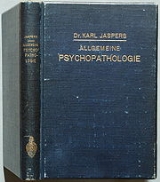
 was an aspect of personality or the result of biological changes. Whilst not broaching new ideas, this article introduced a new method of study. Jaspers studied several patients in detail, giving biographical information on the people concerned as well as providing notes on how the patients themselves felt about their symptoms. This has become known as the biographical method and now forms the mainstay of modern psychiatric practice. Jaspers set about writing his views on mental illness in a book which he published in 1913 as General Psychopathology. The two volumes which make up this work have become a classic in the psychiatric literature and many modern diagnostic criteria stem from ideas contained within them. Of particular importance, Jaspers believed that psychiatrists should diagnose symptoms (particularly of psychosis
Psychosis

Psychosis , with adjective psychotic, literally means abnormal condition of the mind, and is a generic psychiatry term for a mental state often described as involving a "loss of contact with reality"....
) by their form rather than by their content. For example, in diagnosing a hallucination
Hallucination

A hallucination, in the broadest sense, is a perception in the absence of a stimulus . In a stricter sense, hallucinations are defined as perceptions in a conscious and awake state in the absence of external stimuli which have qualities of real perception, in that they are vivid, substantial, and located in external objective space....
, the fact that a person experiences visual phenomena when no sensory stimuli account for it (form) assumes more importance than what the patient sees (content).

Jaspers felt that psychiatrists could also diagnose delusion
Delusion

A delusion is commonly defined as a fixed false belief and is used in everyday language to describe a belief that is either false, fanciful or derived from deception....
s in the same way. He argued that clinicians should not consider a belief delusional based on the content of the belief, but only based on the way in which a patient holds such a belief (see delusion
Delusion

A delusion is commonly defined as a fixed false belief and is used in everyday language to describe a belief that is either false, fanciful or derived from deception....
 for further discussion). Jaspers also distinguished between primary and secondary delusions. He defined primary delusions as autochthonous meaning arising without apparent cause, appearing incomprehensible in terms of normal mental processes. (This is a distinctly different use of the term autochthonous than its usual medical or sociological meaning of indigenous.) Secondary delusions, on the other hand, he classified as influenced by the person's background, current situation or mental state.

Jaspers considered primary delusions as ultimately 'un-understandable,' as he believed no coherent reasoning process existed behind their formation. This view has caused some controversy, and the likes of R. D. Laing and Richard Bentall
Richard Bentall

Richard Bentall holds a Chair in Experimental Clinical psychology at the University of Manchester, United Kingdom. Born in Sheffield, he attended the University College of North Wales, Bangor, Wales as an undergraduate before taking a Doctor of Philosophy in experimental psychology at the same institution....
 (1999, p.133-135) have criticised it, stressing that taking this stance can lead therapists into the complacency of assuming that because they do not understand a patient, the patient is deluded and further investigation on the part of the therapist will have no effect. Huub Engels (2009) argues that schizophrenic speech disorder may be understandable as Emil Kraepelin
Emil Kraepelin

Emil Kraepelin was a Germany psychiatrist. The Encyclopedia of Psychology by H. J. Eysenck identifies him as the founder of contemporary scientific psychiatry, as well as of psychopharmacology and psychiatric genetics....
's dream speech
Dream speech

In 1906 the famous German psychiatrist Emil Kraepelin published a monograph entitled ?ber Sprachst?rungen im Traume . In his psychiatry textbook Kraepelin used the short cut Traumsprache to denote language disturbances occurring in dreams....
 is understandable.

Contributions to Philosophy and Theology

Most commentators associate Jaspers with the philosophy of existentialism
Existentialism

Existentialism is a term that has been applied to the work of a number of nineteenth and twentieth century philosophers who, despite profound doctrinal differences, took the human subject — not merely the thinking subject, but the acting, feeling, living human individual and his or her conditions of existence — as a starting point...
, in part because he draws largely upon the existentialist roots of Nietzsche
Friedrich Nietzsche

Friedrich Wilhelm Nietzsche was a 19th century philosophy Germans philosophy and classical philology. He wrote critical texts on religion, morality, contemporary culture, philosophy, and science, using a distinctive German language style and displaying a fondness for metaphor and aphorism....
 and Kierkegaard
Søren Kierkegaard

S?ren Aabye Kierkegaard was a prolific 19th century Denmark philosopher and theologian. Kierkegaard strongly criticised both the Hegelianism of his time, and what he saw as the empty ceremony of the Church of Denmark....
, and in part because the theme of individual freedom permeates his work.

In Philosophy (3 vols, 1932), Jaspers gave his view of the history of philosophy and introduced his major themes. Beginning with modern science and empiricism, Jaspers points out that as we question reality, we confront borders that an empirical (or scientific) method simply cannot transcend. At this point, the individual faces a choice: sink into despair and resignation, or take a leap of faith
Leap of faith

A leap of faith, in its most commonly used meaning, is the act of believing in something without, or in spite of, available empirical evidence. It is an act commonly associated with religious belief as many religions consider faith to be an essential element of piety....
 toward what Jaspers calls Transcendence. In making this leap, individuals confront their own limitless freedom, which Jaspers calls Existenz, and can finally experience authentic existence.

Transcendence (paired with the term The Encompassing in later works) is, for Jaspers, that which exists beyond the world of time and space. Jaspers' formulation of Transcendence as ultimate non-objectivity (or no-thing-ness) has led many philosophers to argue that ultimately, Jaspers became a monist, though Jaspers himself continually stressed the necessity of recognizing the validity of the concepts both of subjectivity and of objectivity.

Although he rejected explicit religious doctrines, including the notion of a personal God, Jaspers influenced contemporary theology through his philosophy of transcendence and the limits of human experience. Mystic Christian
Christian

A Christian is a person who adheres to Christianity, a Monotheism#Christian view religion centered on the life and teachings of Jesus and interpreted by Christians to have been prophesied in the Hebrew Bible/Old Testament....
 traditions influenced Jaspers himself tremendously, particularly those of Meister Eckhart
Meister Eckhart

Meister Eckhart Dominican order , is the most common formula used to refer to Eckhart von Hochheim, a Germany theology, philosopher and German mysticism, born near Erfurt, in Thuringia....
 and of Nicholas of Cusa
Nicholas of Cusa

Nicholas of Kues was a Roman Catholic cardinal from Germany , a Philosophy, jurist, Mathematics, and an Astronomy. He is widely considered as one of the greatest geniuses and polymaths of the 15th century....
. He also took an active interest in Eastern philosophies, particularly Buddhism
Buddhism

Buddhism is a family of beliefs and practices considered by most to be a religionand is based on the teachings attributed to Siddhartha Gautama, commonly known as "The Buddha" , who was born in what is today Nepal....
, and developed the theory of an Axial Age
Axial Age

Germany philosopher Karl Jaspers coined the term the axial age to describe the period from 8th century BC to 2nd century BC, during which, according to Jaspers, similarly revolutionary thinking appeared in China, India and the Occident....
, a period of substantial philosophical and religious development. Jaspers also entered public debates with Rudolf Bultmann
Rudolf Bultmann

Rudolf Karl Bultmann was a Germany theology of Lutheran background, who was for three decades professor of New Testament studies at the University of Marburg....
, wherein Jaspers roundly criticized Bultmann's "demythologizing" of Christianity.

Jaspers also wrote extensively on the threat to human freedom posed by modern science and modern economic and political institutions. During World War II, he had to abandon his teaching post because his wife was Jewish. After the war he resumed his teaching position, and in his work The Question of German Guilt he unabashedly examined the culpability of Germany as a whole in the atrocities of Hitler's Third Reich.

Jaspers's major works, lengthy and detailed, can seem daunting in their complexity. His last great attempt at a systematic philosophy of Existenz — Von Der Wahrheit (On Truth) — has not yet appeared in English. However, he also wrote accessible and entertaining shorter works, most notably Philosophy is for Everyman.

Commentators often compare Jaspers' philosophy to that of his contemporary, Martin Heidegger
Martin Heidegger

Martin Heidegger was an influential Germany Philosophy. His best known book, Being and Time, is generally considered to be one of the most important philosophical works of the 20th century....
. Indeed, both sought to explore the meaning of being (Sein
Sein

Sein can mean:* ?le de Sein, an island of Bretagne* ?le-de-Sein, a commune of Bretagne* Raz de Sein, a stretch of water in Bretagne...
) and existence (Dasein
Dasein

Dasein is a German language word famously used by Martin Heidegger in his magnum opus Being and Time. The word Dasein was used by several philosophers before Heidegger, with the meaning of "existence" or "presence"....
). While the two did maintain a brief friendship, their relationship deteriorated - due in part to Heidegger's affiliation with the Nazi
Nazism

Nazism, officially National Socialism , refers to the ideology and practices of the National Socialist German Workers? Party under Adolf Hitler, and the policies adopted by the dictatorial government of Nazi Germany from 1933 to 1945....
 party, but also due to the (probably over-emphasized) philosophical differences between the two.

The two major proponents of phenomenological hermeneutics
Hermeneutics

Hermeneutics is the study of interpretation theory. Traditional hermeneutics - which includes Biblical hermeneutics - refers to the study of the interpretation of written texts, especially texts in the areas of literature, religion and law....
, Paul Ricoeur
Paul Ricoeur

Paul Ric?ur was a French people Philosophy best known for combining Phenomenology description with Hermeneutics interpretation. As such, he is connected to two other major hermeneutic phenomenologists, Martin Heidegger and Hans-Georg Gadamer....
 (a student of Jaspers) and Hans-Georg Gadamer
Hans-Georg Gadamer

Hans-Georg Gadamer was a Germany philosopher of the continental philosophy, best known for his 1960 magnum opus, Truth and Method ....
 (Jaspers's successor at Heidelberg) both display Jaspers's influence in their works.

Other important work appeared in Philosophy and Existence (1938). For Jaspers, the term "existence" (Existenz) designates the indefinable experience of freedom and possibility; an experience which constitutes the authentic being of individuals who become aware of "the encompassing" by confronting suffering, conflict, guilt, chance, and death.

Political views


Jaspers valued humanism
Humanism

Humanism is a broad category of ethics that affirm the dignity and worth of all people, based on the ability to determine right and wrong by appealing to universal human qualities, particularly rationalism, without resorting to the supernatural or alleged divine authority from religious texts....
 and the continuity of integral cultural tradition in political spheres. He strongly opposed totalitarian despotism and warned about the increasing tendency towards technocracy, or a regime that put humans merely as instruments of science or ideological goal. He was also skeptical of majoritarian
Majoritarian

A majoritarian electoral system is one which is based on a "winner take all" principle. This is in contrast to the proportional representation family of electoral systems, which split the mandates in rough proportion with votes gained by each party....
 democracy. Thus, he supported a form of governance with guaranteed individual freedom and limited government
Limited government

Limited government is a government outline where any more than minimal governmental intervention in personal liberties and the economy is not usually allowed by law, usually in a written Constitution....
 yet rooted in authentic tradition and guided by an intellectual elite.

Jaspers' influences

Jaspers held Kierkegaard and Nietzsche to be two of the most important figures in post-Kantian philosophy. In his compilation, The Great Philosophers, he wrote:
I approach the presentation of Kierkegaard with some trepidation. Next to Nietzsche, or rather, prior to Nietzsche, I consider him to be the most important thinker of our post-Kantian age. With Goethe and Hegel, an epoch had reached its conclusion, and our prevalent way of thinking - that is, the positivistic, natural-scientific one - cannot really be considered as philosophy.
Jaspers also questions whether the two philosophers could be taught. For Kierkegaard, at least, Jaspers felt that Kierkegaard's whole method of indirect communication precludes any attempts to properly expound his thought into any sort of systematic teaching. Though Jaspers was certainly indebted to Kierkegaard and Nietzsche, he also owes much to more traditional philosophers, especially Kant and Plato. Walter Kaufmann argues in "From Shakespeare to Existentialism" that, though Jaspers was certainly indebted to Kierkegaard and Nietzsche, he was closest to Kant's philosophy.
Jaspers is too often seen as the heir of Nietzsche and Kierkegaard to whom he is in many ways less close than to Kant...the Kantian antinomies and Kant's concern with the realm of decision, freedom, and faith have become exemplary for Jaspers. And even as Kant "had to do away with knowledge to make room for faith," Jaspers values Nietzsche in large measure because he thinks that Nietzsche did away with knowledge, thus making room for Jaspers' philosophic faith"...
This is supported by Jaspers' essay "On My Philosophy" (link below),
"While I was still at school Spinoza was the first. Kant then became the philosopher for me and has remained so...Nietzsche gained importance for me only late as the magnificent revelation of nihilism and the task of overcoming it."


Books

  • Philosophy of Existence
    Philosophy of Existence

    Philosophy of Existence is a book by German psychiatrist and philosopher Karl Jaspers. It is both a discussion on the history of philosophy and an exposition of Jaspers' own philosophical system, which is often viewed as a form of existentialism....
     - ISBN 0-8122-1010-7
  • Reason and Existenz - ISBN 0-87462-611-0
  • Way to Wisdom - ISBN 0-300-00134-7
  • Philosophy Is for Everman
  • Man in the Modern Age


Translations


Further reading

  • Bentall, Richard (1999). Why There Will Never Be a Convincing Theory of Schizophrenia. In S. Rose (ed). From brains to consciousness? Essays on the new sciences of mind. London: Penguin Books. Bentall criticises Jaspers' un-understandable-concept in a section (p.133-135) entitled: There is meaning in madness, or why Jaspers was (mostly) wrong.
  • Engels, Huub (2009). Emil Kraepelins Traumsprache: erklären und verstehen. In Dietrich von Engelhardt und Horst-Jürgen Gerigk (ed.). Karl Jaspers im Schnittpunkt von Zeitgeschichte, Psychopathologie, Literatur und Film. p.331-43. ISBN 978-3-86809-018-5 Heidelberg: Mattes Verlag.


External links

  • Jaspers, K., 1941.
  • The Stanford Encyclopedia of Philosophy: -- by Chris Thornhill.
  • ed. by Claudio Fiorillo in