

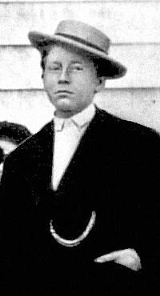
Knut Hamsun

Encyclopedia
Knut Hamsun was a Norwegian author
, who was awarded the Nobel Prize in Literature
in 1920. He was praised by King Haakon VII of Norway
as Norway's soul.
Hamsun's work spans more than 70 years and shows variation with regard to the subject, perspective and environment. He published more than 20 novels, a collection of poetry, some short stories and plays, a travelogue
, and some essays.
The young Hamsun objected to realism
and naturalism
. He argued that the main object of modern literature should be the intricacies of the human mind, that writers should describe the "whisper of blood, and the pleading of bone marrow". Hamsun is considered the "leader of the Neo-Romantic
revolt at the turn of the century", with works such as Hunger
(1890), Mysteries
(1892), Pan
(1894), and Victoria
(1898). His later works—in particular his "Nordland
novels"—were influenced by the Norwegian new realism
, portraying everyday life in rural Norway and often employing local dialect, irony, and humour. The epic work Growth of the Soil
(1917) earned him the Nobel Prize.
Hamsun is considered to be "one of the most influential and innovative literary stylists of the past hundred years" (ca. 1890–1990). He pioneered psychological literature with techniques of stream of consciousness and interior monologue
, and influenced authors such as Thomas Mann
, Franz Kafka
, Maxim Gorky
, Stefan Zweig
, Henry Miller
, Hermann Hesse
, and Ernest Hemingway
. Isaac Bashevis Singer
called Hamsun "the father of the modern school of literature in his every aspect—his subjectiveness, his fragmentariness, his use of flashbacks, his lyricism. The whole modern school of fiction in the twentieth century stems from Hamsun". Ernest Hemingway stated that "Hamsun taught me to write".
On August 4, 2009, the Knut Hamsun Centre
was opened in Hamarøy
. Since 1916, several of Hamsun's works have been adapted into motion pictures.
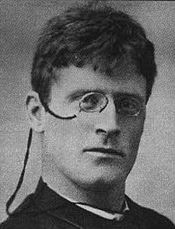
, Norway in Gudbrandsdal
. He was the fourth son (of seven children) of Peder Pedersen and Tora Olsdatter. When he was three, the family moved to Hamsund, Hamarøy
in Nordland
. They were poor and an uncle had invited them to farm his land for him.
At age nine, Knut was separated from his family and lived with his uncle Hans Olsen, who needed help with the post office he ran. Olsen used to beat and starve his nephew, and Hamsun later stated that his chronic nervous difficulties were due to the way his uncle treated him.
In 1874, he finally escaped back to Lom, Norway
. In the next five years, he would pick up any job just for the sake of the money. That included being a store clerk, peddler, shoemaker's apprentice, an assistant to a sheriff, and an elementary school teacher.
At 17, he became an apprentice to a ropemaker, and at about the same time he started to write. He spent several years in America, traveling and working at various jobs, and published his impressions under the title Fra det moderne Amerikas Aandsliv (1889).
In his second novel Bjørger (1878), he attempted to imitate Bjørnstjerne Bjørnson
's writing style of the Icelandic saga narrative. The melodramatic story follows a poet Bjørger and his love for Laura. This book was published under the pseudonym Knud Pedersen Hamsund. This book later served as the basis for Victoria: En Kærligheds Historie (1898; translated as Victoria: A Love Story, 1923).
, Norway. His ashes are buried in the garden of his home at Nørholm
.
described him "as a descendant of Fyodor Dostoyevsky and Friedrich Nietzsche
". Arthur Koestler
was a fan of his love stories. H. G. Wells
praised Markens Grøde (1917) for which Hamsun was awarded the Nobel Prize in Literature
. Isaac Bashevis Singer
was a fan of modern subjectivism, use of flashbacks, his use of fragmentation, and his lyricism And Charles Bukowski called him the greatest writer to have ever lived.
. The semiautobiographical work described a young writer's descent into near madness as a result of hunger and poverty in the Norwegian capital of Kristiania (modern name Oslo
). To many, the novel presages the writings of Franz Kafka
and other twentieth-century novelists with its internal monologue
and bizarre logic.
A theme to which Hamsun often returned is that of the perpetual wanderer, an itinerant stranger (often the narrator) who shows up and insinuates himself into the life of small rural communities. This wanderer theme is central to the novels Mysteries
, Pan
, Under the Autumn Star, The Last Joy, Vagabonds, and others.
Hamsun’s prose often contains rapturous depictions of the natural world, with intimate reflections on the Norwegian woodlands and coastline. For this reason, he has been linked with the spiritual movement known as pantheism
. Hamsun saw mankind and nature united in a strong, sometimes mystical bond. This connection between the characters and their natural environment is exemplified in the novels Pan, A Wanderer Plays on Muted Strings, and the epic Growth of the Soil
, "his monumental work" credited with securing him the Nobel Prize in literature
in 1920
.
A fifteen-volume edition of his complete works was published in 1954. In 2009, to mark the 150-year anniversary of his birth, a new 27-volume edition of his complete works was published, including short stories, poetry, plays, and articles not included in the 1954 edition. For this new edition, all of Hamsun's works underwent slight linguistic modifications in order to make them more accessible to contemporary Norwegian readers. Fresh English translations of two of his major works, Growth of the Soil and Pan, were published in 1998.
Hamsun’s works remain popular. In 2009, a Norwegian biographer stated, "We can’t help loving him, though we have hated him all these years ... That’s our Hamsun trauma. He’s a ghost that won’t stay in the grave."
, Henrik Ibsen
, and Sigrid Undset
, Hamsun formed a quartet of Scandinavian authors who became internationally known for their works. Hamsun pioneered psychological literature with techniques of stream of consciousness and interior monologue
, as found in material by James Joyce
, Marcel Proust
, and Virginia Woolf
.
(b. 1881) in 1909 and she was his companion until the end of his life. With Marie Hamsun he had four children, the sons Tore and Arild and the daughters Elinor and Cecilia.
Marie wrote about her life with Hamsun in two memoir
s. She was a promising actress when she met Hamsun but ended her career and traveled with him to Hamarøy. They bought a farm, the idea being "to earn their living as farmers, with his writing providing some additional income".
After a few years, they decided to move south, to Larvik
. In 1918, the couple bought Nørholm
, an old and somewhat dilapidated manor house between Lillesand
and Grimstad
. The main residence was restored and redecorated. Here Hamsun could occupy himself with writing undisturbed, although he often travelled to write in other cities and places (preferably in spartan housing).
Following the Second Boer War
, he adopted increasingly conservative views. He also came to be known as a prominent advocate of Germany and German culture, as well as a rhetorical opponent of British imperialism
and the Soviet Union
. During both the First
and the Second World War, he publicly expressed his sympathy for Germany.
His sympathies were heavily influenced by the impact of the Boer War
, seen by Hamsun as British oppression of a small people, as well as by his dislike of the English and distaste for the USA. During the 1930s, most of the Norwegian right-wing newspapers and political parties were sympathetic to various degrees to fascist regimes in Europe, and Hamsun came to be a prominent advocate of such views. During WWII, he continued to express his support for Germany, and his public statements led to controversy, in particular in the immediate aftermath of the war. When WWII started, he was over 80 years old, almost deaf and his main source of information was the conservative newspaper Aftenposten
, which had been sympathetic to Fascist Italy and Nazi Germany from the beginning. He suffered two intracranial hemorrhage
s during the war.
Hamsun wrote several newspaper articles in the course of the war, famously stating in 1940 that "the Germans are fighting for us, and now are crushing England's tyranny over us and all neutrals". In 1943, he sent Germany’s minister of propaganda
Joseph Goebbels
his Nobel Prize
medal as a gift. His biographer Thorkild Hansen
interpreted this as part of the strategy to get an audience with Hitler. Hamsun was eventually invited to meet with Hitler; during the meeting, he complained about the German civilian administrator in Norway, Josef Terboven
, and ask that imprisoned Norwegian citizens be released, enraging Hitler. Otto Dietrich
describes the meeting in his memoirs as the only time that another person was able to get a word in edgewise with Hitler. He attributes the cause to Hamsun's deafness. Regardless, Dietrich notes that it took Hitler three days to get over his anger. Hamsun also on other occasions helped Norwegians who had been imprisoned for resistance activities and try to influence German policies in Norway.
Nevertheless, a week after Hitler
's death, Hamsun wrote a eulogy for Hitler
, saying “He was a warrior, a warrior for mankind, and a prophet of the gospel of justice for all nations.” Following the end of the war, angry crowds burned his books in public in major Norwegian cities and Hamsun was confined for several months in a psychiatric hospital.
Hamsun was forced to undergo a psychiatric examination, which concluded that he had "permanently impaired mental faculties", and on that basis the charges of treason were dropped. Instead, a civil liability case was raised against him, and in 1948 he had to pay a ruinous sum to the Norwegian government of 325,000 kroner
for his alleged membership in Nasjonal Samling and for the moral support he gave to the Germans, but was cleared of any direct Nazi affiliation. Whether he was a member of Nasjonal Samling or not and whether his mental abilities were impaired is a much debated issue even today. Hamsun stated he was never a member of any political party. He wrote his last book Paa giengrodde Stier (On Overgrown Paths
) in 1949, a book many take as evidence of his functioning mental capabilities. In it, he harshly criticizes the psychiatrists and the judges, and in his own words proves that he is not mentally ill.
The Danish author Thorkild Hansen
investigated the trial and wrote the book The Hamsun Trial (1978), which created a storm in Norway. Among other things Hansen stated: "If you want to meet idiots, go to Norway," as he felt that such treatment of the old Nobel Prize-winning author was outrageous. In 1996
the Swedish director Jan Troell based the movie Hamsun on Hansen's book. In Hamsun, the Swedish actor Max von Sydow
plays Knut Hamsun; his wife, Marie, is played by the Danish actress Ghita Nørby
.
The book Mysteries
was the basis of a 1978 film of the same name (by the Dutch film company Sigma Pictures), directed by Paul de Lussanet, starring Sylvia Kristel
, Rutger Hauer, Andrea Ferreol
and Rita Tushingham
.
Landstrykere (Wayfarers) is a Norwegian film from 1990 directed by Ola Solum.
The Telegraphist
is a Norwegian movie from 1993 directed by Erik Gustavson. It is based on the novel "Mothwise" (of which the American title is "Dreamers").
Pan
has been the basis of four films between 1922 and 1995. The latest adaptation, the Danish film of the same name
, was directed by Henning Carlsen
, who also directed the Danish, Norwegian and Swedish coproduction of the 1966 film Sult
from Hamsun's novel of the same name
.
A biopic entitled Hamsun
was released in 1996, directed by Jan Troell, starring Max von Sydow
as Hamsun.
Works
Other
Norwegian literature
Norwegian literature is literature composed in Norway or by Norwegian people. The history of Norwegian literature starts with the pagan Eddaic poems and skaldic verse of the 9th and 10th centuries with poets such as Bragi Boddason and Eyvindr Skáldaspillir...
, who was awarded the Nobel Prize in Literature
Nobel Prize in Literature
Since 1901, the Nobel Prize in Literature has been awarded annually to an author from any country who has, in the words from the will of Alfred Nobel, produced "in the field of literature the most outstanding work in an ideal direction"...
in 1920. He was praised by King Haakon VII of Norway
Haakon VII of Norway
Haakon VII , known as Prince Carl of Denmark until 1905, was the first king of Norway after the 1905 dissolution of the personal union with Sweden. He was a member of the House of Schleswig-Holstein-Sonderburg-Glücksburg...
as Norway's soul.
Hamsun's work spans more than 70 years and shows variation with regard to the subject, perspective and environment. He published more than 20 novels, a collection of poetry, some short stories and plays, a travelogue
Travel literature
Travel literature is travel writing of literary value. Travel literature typically records the experiences of an author touring a place for the pleasure of travel. An individual work is sometimes called a travelogue or itinerary. Travel literature may be cross-cultural or transnational in focus, or...
, and some essays.
The young Hamsun objected to realism
Realism
Realism, Realist or Realistic are terms that describe any manifestation of philosophical realism, the belief that reality exists independently of observers, whether in philosophy itself or in the applied arts and sciences. In this broad sense it is frequently contrasted with Idealism.Realism in the...
and naturalism
Naturalism (literature)
Naturalism was a literary movement taking place from the 1880s to 1940s that used detailed realism to suggest that social conditions, heredity, and environment had inescapable force in shaping human character...
. He argued that the main object of modern literature should be the intricacies of the human mind, that writers should describe the "whisper of blood, and the pleading of bone marrow". Hamsun is considered the "leader of the Neo-Romantic
Neo-romanticism
The term neo-romanticism is used to cover a variety of movements in music, painting and architecture. It has been used with reference to very late 19th century and early 20th century composers such as Gustav Mahler particularly by Carl Dahlhaus who uses it as synonymous with late Romanticism...
revolt at the turn of the century", with works such as Hunger
Hunger (novel)
Hunger is a novel by the Norwegian author Knut Hamsun and was published in its final form in 1890. Parts of it had been published anonymously in the Danish magazine Ny Jord in 1888. The novel has been hailed as the literary opening of the 20th century and an outstanding example of modern,...
(1890), Mysteries
Mysteries (novel)
Mysteries is a novel by Norwegian author Knut Hamsun.-Plot introduction:In this intensely psychological Modernist novel, the community of a small Norwegian coastal town is "[shaken]" by the arrival of eccentric stranger Johan Nagel...
(1892), Pan
Pan (novel)
Pan is a 1894 novel by the Norwegian author Knut Hamsun. Written while he lived in Paris, France, and in Kristiansand, Norway, Hamsun was directly influenced by the works of Fyodor Dostoevsky...
(1894), and Victoria
Victoria (novel)
Victoria is a novel by Knut Hamsun.A miller's son, Johannes, falls in love with the daughter of a wealthy landowner, Victoria.The novel follows them through adolescence, as Johannes struggles with the social hierarchy and becomes a successful author, and Victoria is forced into marrying Otto, a...
(1898). His later works—in particular his "Nordland
Nordland
is a county in Norway in the North Norway region, bordering Troms in the north, Nord-Trøndelag in the south, Norrbottens län in Sweden to the east, Västerbottens län to the southeast, and the Atlantic Ocean to the west. The county was formerly known as Nordlandene amt. The county administration is...
novels"—were influenced by the Norwegian new realism
Norwegian new realism
The Norwegian new realism was a literary movement that dominated Norwegian literature in the first half of the 20th century. Prominent examples include Knut Hamsun's later work, Sigrid Undset, Johan Falkberget, and Olaf Bull. Both Knut Hamsun and Sigrid Undset were awarded the Nobel Prize in...
, portraying everyday life in rural Norway and often employing local dialect, irony, and humour. The epic work Growth of the Soil
Growth of the Soil
The Growth of the Soil is the novel by Norwegian writer Knut Hamsun which won him the Nobel Prize in Literature in 1920.-Theme:...
(1917) earned him the Nobel Prize.
Hamsun is considered to be "one of the most influential and innovative literary stylists of the past hundred years" (ca. 1890–1990). He pioneered psychological literature with techniques of stream of consciousness and interior monologue
Monologue
In theatre, a monologue is a speech presented by a single character, most often to express their thoughts aloud, though sometimes also to directly address another character or the audience. Monologues are common across the range of dramatic media...
, and influenced authors such as Thomas Mann
Thomas Mann
Thomas Mann was a German novelist, short story writer, social critic, philanthropist, essayist, and 1929 Nobel Prize laureate, known for his series of highly symbolic and ironic epic novels and novellas, noted for their insight into the psychology of the artist and the intellectual...
, Franz Kafka
Franz Kafka
Franz Kafka was a culturally influential German-language author of short stories and novels. Contemporary critics and academics, including Vladimir Nabokov, regard Kafka as one of the best writers of the 20th century...
, Maxim Gorky
Maxim Gorky
Alexei Maximovich Peshkov , primarily known as Maxim Gorky , was a Russian and Soviet author, a founder of the Socialist Realism literary method and a political activist.-Early years:...
, Stefan Zweig
Stefan Zweig
Stefan Zweig was an Austrian novelist, playwright, journalist and biographer. At the height of his literary career, in the 1920s and 1930s, he was one of the most famous writers in the world.- Biography :...
, Henry Miller
Henry Miller
Henry Valentine Miller was an American novelist and painter. He was known for breaking with existing literary forms and developing a new sort of 'novel' that is a mixture of novel, autobiography, social criticism, philosophical reflection, surrealist free association, and mysticism, one that is...
, Hermann Hesse
Hermann Hesse
Hermann Hesse was a German-Swiss poet, novelist, and painter. In 1946, he received the Nobel Prize in Literature...
, and Ernest Hemingway
Ernest Hemingway
Ernest Miller Hemingway was an American author and journalist. His economic and understated style had a strong influence on 20th-century fiction, while his life of adventure and his public image influenced later generations. Hemingway produced most of his work between the mid-1920s and the...
. Isaac Bashevis Singer
Isaac Bashevis Singer
Isaac Bashevis Singer – July 24, 1991) was a Polish Jewish American author noted for his short stories. He was one of the leading figures in the Yiddish literary movement, and received the Nobel Prize in Literature in 1978...
called Hamsun "the father of the modern school of literature in his every aspect—his subjectiveness, his fragmentariness, his use of flashbacks, his lyricism. The whole modern school of fiction in the twentieth century stems from Hamsun". Ernest Hemingway stated that "Hamsun taught me to write".
On August 4, 2009, the Knut Hamsun Centre
Knut Hamsun Centre
The Knut Hamsun Centre is a museum and educational centre in Hamarøy in Northern Norway dedicated to the life and work of the writer Knut Hamsun....
was opened in Hamarøy
Hamarøy
Hamarøy is a municipality in Nordland county, Norway. It is part of the Salten traditional region. The administrative centre of the municipality is the village of Oppeid...
. Since 1916, several of Hamsun's works have been adapted into motion pictures.
Biography
Early life
Knut Hamsun was born as Knud Pedersen in LomLom
Lom as an ethnic group:* Lom people, a Gypsy group, mainly in the CaucasusLom as a placename:* Lom, Norway, a municipality in Norway** Lom prisoner of war camp, a Norwegian prisoner of war camp in the above-mentioned location....
, Norway in Gudbrandsdal
Gudbrandsdal
The Gudbrandsdalen is a valley and traditional district in the Norwegian county of Oppland. The valley is oriented in a north-westerly direction from Lillehammer at Mjøsa, extending 230 km toward Romsdal...
. He was the fourth son (of seven children) of Peder Pedersen and Tora Olsdatter. When he was three, the family moved to Hamsund, Hamarøy
Hamarøy
Hamarøy is a municipality in Nordland county, Norway. It is part of the Salten traditional region. The administrative centre of the municipality is the village of Oppeid...
in Nordland
Nordland
is a county in Norway in the North Norway region, bordering Troms in the north, Nord-Trøndelag in the south, Norrbottens län in Sweden to the east, Västerbottens län to the southeast, and the Atlantic Ocean to the west. The county was formerly known as Nordlandene amt. The county administration is...
. They were poor and an uncle had invited them to farm his land for him.
At age nine, Knut was separated from his family and lived with his uncle Hans Olsen, who needed help with the post office he ran. Olsen used to beat and starve his nephew, and Hamsun later stated that his chronic nervous difficulties were due to the way his uncle treated him.
In 1874, he finally escaped back to Lom, Norway
Lom, Norway
Lom is a municipality in Oppland county, Norway. It is part of the traditional region of Gudbrandsdal. The administrative centre of the municipality is the village of Fossbergom....
. In the next five years, he would pick up any job just for the sake of the money. That included being a store clerk, peddler, shoemaker's apprentice, an assistant to a sheriff, and an elementary school teacher.
At 17, he became an apprentice to a ropemaker, and at about the same time he started to write. He spent several years in America, traveling and working at various jobs, and published his impressions under the title Fra det moderne Amerikas Aandsliv (1889).
Literary career
Working all those odd jobs paid off, and he published his first book about it: Den Gaadefulde: En Kjærlighedshistorie fra Nordland (The Enigmatic Man: A Love Story from Northern Norway, 1877).In his second novel Bjørger (1878), he attempted to imitate Bjørnstjerne Bjørnson
Bjørnstjerne Bjørnson
Bjørnstjerne Martinius Bjørnson was a Norwegian writer and the 1903 Nobel Prize in Literature laureate. Bjørnson is considered as one of The Four Greats Norwegian writers; the others being Henrik Ibsen, Jonas Lie, and Alexander Kielland...
's writing style of the Icelandic saga narrative. The melodramatic story follows a poet Bjørger and his love for Laura. This book was published under the pseudonym Knud Pedersen Hamsund. This book later served as the basis for Victoria: En Kærligheds Historie (1898; translated as Victoria: A Love Story, 1923).
Death
Knut Hamsun died on February 19, 1952, aged 92, in GrimstadGrimstad
is a town and municipality in Aust-Agder county, Norway. It belongs to the geographical region of Sørlandet. The administrative center of the municipality is the town of Grimstad. Other notable places in Grimstad include Eide, Fevik, Fjære, Landvik, Prestegårdskogen, Reddal, and Roresanden.It is...
, Norway. His ashes are buried in the garden of his home at Nørholm
Nørholm
Nørholm, also called Nørholmen, is a manor house and agricultural property in Grimstad, in Aust-Agder county, Norway. The estate is most associated with its ownership by Nobel Prize winning author Knut Hamsun. -History:...
.
Legacy
Thomas MannThomas Mann
Thomas Mann was a German novelist, short story writer, social critic, philanthropist, essayist, and 1929 Nobel Prize laureate, known for his series of highly symbolic and ironic epic novels and novellas, noted for their insight into the psychology of the artist and the intellectual...
described him "as a descendant of Fyodor Dostoyevsky and Friedrich Nietzsche
Friedrich Nietzsche
Friedrich Wilhelm Nietzsche was a 19th-century German philosopher, poet, composer and classical philologist...
". Arthur Koestler
Arthur Koestler
Arthur Koestler CBE was a Hungarian author and journalist. Koestler was born in Budapest and, apart from his early school years, was educated in Austria...
was a fan of his love stories. H. G. Wells
H. G. Wells
Herbert George Wells was an English author, now best known for his work in the science fiction genre. He was also a prolific writer in many other genres, including contemporary novels, history, politics and social commentary, even writing text books and rules for war games...
praised Markens Grøde (1917) for which Hamsun was awarded the Nobel Prize in Literature
Nobel Prize in Literature
Since 1901, the Nobel Prize in Literature has been awarded annually to an author from any country who has, in the words from the will of Alfred Nobel, produced "in the field of literature the most outstanding work in an ideal direction"...
. Isaac Bashevis Singer
Isaac Bashevis Singer
Isaac Bashevis Singer – July 24, 1991) was a Polish Jewish American author noted for his short stories. He was one of the leading figures in the Yiddish literary movement, and received the Nobel Prize in Literature in 1978...
was a fan of modern subjectivism, use of flashbacks, his use of fragmentation, and his lyricism And Charles Bukowski called him the greatest writer to have ever lived.
Work
Hamsun first received wide acclaim with his 1890 novel Hunger (Sult)Hunger (novel)
Hunger is a novel by the Norwegian author Knut Hamsun and was published in its final form in 1890. Parts of it had been published anonymously in the Danish magazine Ny Jord in 1888. The novel has been hailed as the literary opening of the 20th century and an outstanding example of modern,...
. The semiautobiographical work described a young writer's descent into near madness as a result of hunger and poverty in the Norwegian capital of Kristiania (modern name Oslo
Oslo
Oslo is a municipality, as well as the capital and most populous city in Norway. As a municipality , it was established on 1 January 1838. Founded around 1048 by King Harald III of Norway, the city was largely destroyed by fire in 1624. The city was moved under the reign of Denmark–Norway's King...
). To many, the novel presages the writings of Franz Kafka
Franz Kafka
Franz Kafka was a culturally influential German-language author of short stories and novels. Contemporary critics and academics, including Vladimir Nabokov, regard Kafka as one of the best writers of the 20th century...
and other twentieth-century novelists with its internal monologue
Internal monologue
Internal monologue, also known as inner voice, internal speech, or verbal stream of consciousness is thinking in words. It also refers to the semi-constant internal monologue one has with oneself at a conscious or semi-conscious level....
and bizarre logic.
A theme to which Hamsun often returned is that of the perpetual wanderer, an itinerant stranger (often the narrator) who shows up and insinuates himself into the life of small rural communities. This wanderer theme is central to the novels Mysteries
Mysteries (novel)
Mysteries is a novel by Norwegian author Knut Hamsun.-Plot introduction:In this intensely psychological Modernist novel, the community of a small Norwegian coastal town is "[shaken]" by the arrival of eccentric stranger Johan Nagel...
, Pan
Pan (novel)
Pan is a 1894 novel by the Norwegian author Knut Hamsun. Written while he lived in Paris, France, and in Kristiansand, Norway, Hamsun was directly influenced by the works of Fyodor Dostoevsky...
, Under the Autumn Star, The Last Joy, Vagabonds, and others.
Hamsun’s prose often contains rapturous depictions of the natural world, with intimate reflections on the Norwegian woodlands and coastline. For this reason, he has been linked with the spiritual movement known as pantheism
Pantheism
Pantheism is the view that the Universe and God are identical. Pantheists thus do not believe in a personal, anthropomorphic or creator god. The word derives from the Greek meaning "all" and the Greek meaning "God". As such, Pantheism denotes the idea that "God" is best seen as a process of...
. Hamsun saw mankind and nature united in a strong, sometimes mystical bond. This connection between the characters and their natural environment is exemplified in the novels Pan, A Wanderer Plays on Muted Strings, and the epic Growth of the Soil
Growth of the Soil
The Growth of the Soil is the novel by Norwegian writer Knut Hamsun which won him the Nobel Prize in Literature in 1920.-Theme:...
, "his monumental work" credited with securing him the Nobel Prize in literature
Nobel Prize in Literature
Since 1901, the Nobel Prize in Literature has been awarded annually to an author from any country who has, in the words from the will of Alfred Nobel, produced "in the field of literature the most outstanding work in an ideal direction"...
in 1920
1920 in literature
The year 1920 in literature involved some significant events and new books.-Events:*Agatha Christie publishes her first novel, The Mysterious Affair at Styles, introducing the long-running character detective, Hercule Poirot....
.
A fifteen-volume edition of his complete works was published in 1954. In 2009, to mark the 150-year anniversary of his birth, a new 27-volume edition of his complete works was published, including short stories, poetry, plays, and articles not included in the 1954 edition. For this new edition, all of Hamsun's works underwent slight linguistic modifications in order to make them more accessible to contemporary Norwegian readers. Fresh English translations of two of his major works, Growth of the Soil and Pan, were published in 1998.
Hamsun’s works remain popular. In 2009, a Norwegian biographer stated, "We can’t help loving him, though we have hated him all these years ... That’s our Hamsun trauma. He’s a ghost that won’t stay in the grave."
Writing techniques
Along with August StrindbergAugust Strindberg
Johan August Strindberg was a Swedish playwright, novelist, poet, essayist and painter. A prolific writer who often drew directly on his personal experience, Strindberg's career spanned four decades, during which time he wrote over 60 plays and more than 30 works of fiction, autobiography,...
, Henrik Ibsen
Henrik Ibsen
Henrik Ibsen was a major 19th-century Norwegian playwright, theatre director, and poet. He is often referred to as "the father of prose drama" and is one of the founders of Modernism in the theatre...
, and Sigrid Undset
Sigrid Undset
Sigrid Undset was a Norwegian novelist who was awarded the Nobel Prize for Literature in 1928.-Biography:Undset was born in Kalundborg, Denmark, but her family moved to Norway when she was two years old. In 1924, she converted to Catholicism and became a lay Dominican...
, Hamsun formed a quartet of Scandinavian authors who became internationally known for their works. Hamsun pioneered psychological literature with techniques of stream of consciousness and interior monologue
Monologue
In theatre, a monologue is a speech presented by a single character, most often to express their thoughts aloud, though sometimes also to directly address another character or the audience. Monologues are common across the range of dramatic media...
, as found in material by James Joyce
James Joyce
James Augustine Aloysius Joyce was an Irish novelist and poet, considered to be one of the most influential writers in the modernist avant-garde of the early 20th century...
, Marcel Proust
Marcel Proust
Valentin Louis Georges Eugène Marcel Proust was a French novelist, critic, and essayist best known for his monumental À la recherche du temps perdu...
, and Virginia Woolf
Virginia Woolf
Adeline Virginia Woolf was an English author, essayist, publisher, and writer of short stories, regarded as one of the foremost modernist literary figures of the twentieth century....
.
Personal life
In 1898, Hamsun married Bergljot Göpfert (née Bech), who bore him the daughter Victoria, but the marriage ended in 1906. Hamsun then married Marie AndersenMarie Hamsun
Marie Hamsun was a Norwegian actress and writer. Marie Andersen was born in Elverum, Hedmark, Norway. She was the eldest child in an affluent family. In 1897 the family moved to Christiania, where his father was involved in the property trade for twenty years until he bought the farm in Åneby in...
(b. 1881) in 1909 and she was his companion until the end of his life. With Marie Hamsun he had four children, the sons Tore and Arild and the daughters Elinor and Cecilia.
Marie wrote about her life with Hamsun in two memoir
Memoir
A memoir , is a literary genre, forming a subclass of autobiography – although the terms 'memoir' and 'autobiography' are almost interchangeable. Memoir is autobiographical writing, but not all autobiographical writing follows the criteria for memoir set out below...
s. She was a promising actress when she met Hamsun but ended her career and traveled with him to Hamarøy. They bought a farm, the idea being "to earn their living as farmers, with his writing providing some additional income".
After a few years, they decided to move south, to Larvik
Larvik
is a city and municipality in Vestfold county, Norway. The administrative centre of the municipality is the city of Larvik. Larvik kommune - has about 41 364 inhabitants and covers 530 km2....
. In 1918, the couple bought Nørholm
Nørholm
Nørholm, also called Nørholmen, is a manor house and agricultural property in Grimstad, in Aust-Agder county, Norway. The estate is most associated with its ownership by Nobel Prize winning author Knut Hamsun. -History:...
, an old and somewhat dilapidated manor house between Lillesand
Lillesand
is a town and municipality in Aust-Agder county, Norway. It is part of the traditional district of Sørlandet. The administrative center of the municipality is the town of Lillesand.-General information:...
and Grimstad
Grimstad
is a town and municipality in Aust-Agder county, Norway. It belongs to the geographical region of Sørlandet. The administrative center of the municipality is the town of Grimstad. Other notable places in Grimstad include Eide, Fevik, Fjære, Landvik, Prestegårdskogen, Reddal, and Roresanden.It is...
. The main residence was restored and redecorated. Here Hamsun could occupy himself with writing undisturbed, although he often travelled to write in other cities and places (preferably in spartan housing).
Political sympathies
In younger years, Hamsun had anarchist leanings of an anti-egalitarian, racially conscious bent. In The Cultural Life of America (1889), he expressed his fear of miscegenation: "The Negros are and will remain Negros, a nascent human form from the tropics, rudimentary organs on the body of white society. Instead of founding an intellectual elite, America has established a mulatto studfarm."Following the Second Boer War
Second Boer War
The Second Boer War was fought from 11 October 1899 until 31 May 1902 between the British Empire and the Afrikaans-speaking Dutch settlers of two independent Boer republics, the South African Republic and the Orange Free State...
, he adopted increasingly conservative views. He also came to be known as a prominent advocate of Germany and German culture, as well as a rhetorical opponent of British imperialism
Imperialism
Imperialism, as defined by Dictionary of Human Geography, is "the creation and/or maintenance of an unequal economic, cultural, and territorial relationships, usually between states and often in the form of an empire, based on domination and subordination." The imperialism of the last 500 years,...
and the Soviet Union
Soviet Union
The Soviet Union , officially the Union of Soviet Socialist Republics , was a constitutionally socialist state that existed in Eurasia between 1922 and 1991....
. During both the First
World War I
World War I , which was predominantly called the World War or the Great War from its occurrence until 1939, and the First World War or World War I thereafter, was a major war centred in Europe that began on 28 July 1914 and lasted until 11 November 1918...
and the Second World War, he publicly expressed his sympathy for Germany.
His sympathies were heavily influenced by the impact of the Boer War
Second Boer War
The Second Boer War was fought from 11 October 1899 until 31 May 1902 between the British Empire and the Afrikaans-speaking Dutch settlers of two independent Boer republics, the South African Republic and the Orange Free State...
, seen by Hamsun as British oppression of a small people, as well as by his dislike of the English and distaste for the USA. During the 1930s, most of the Norwegian right-wing newspapers and political parties were sympathetic to various degrees to fascist regimes in Europe, and Hamsun came to be a prominent advocate of such views. During WWII, he continued to express his support for Germany, and his public statements led to controversy, in particular in the immediate aftermath of the war. When WWII started, he was over 80 years old, almost deaf and his main source of information was the conservative newspaper Aftenposten
Aftenposten
Aftenposten is Norway's largest newspaper. It retook this position in 2010, taking it from the tabloid Verdens Gang which had been the largest newspaper for several decades. It is based in Oslo. The morning edition, which is distributed across all of Norway, had a circulation of 250,179 in 2007...
, which had been sympathetic to Fascist Italy and Nazi Germany from the beginning. He suffered two intracranial hemorrhage
Intracranial hemorrhage
An intracranial hemorrhage is a hemorrhage, or bleeding, within the skull.-Causes:Intracranial bleeding occurs when a blood vessel within the skull is ruptured or leaks. It can result from physical trauma or nontraumatic causes such as a ruptured aneurysm...
s during the war.
Hamsun wrote several newspaper articles in the course of the war, famously stating in 1940 that "the Germans are fighting for us, and now are crushing England's tyranny over us and all neutrals". In 1943, he sent Germany’s minister of propaganda
Propaganda
Propaganda is a form of communication that is aimed at influencing the attitude of a community toward some cause or position so as to benefit oneself or one's group....
Joseph Goebbels
Joseph Goebbels
Paul Joseph Goebbels was a German politician and Reich Minister of Propaganda in Nazi Germany from 1933 to 1945. As one of Adolf Hitler's closest associates and most devout followers, he was known for his zealous oratory and anti-Semitism...
his Nobel Prize
Nobel Prize
The Nobel Prizes are annual international awards bestowed by Scandinavian committees in recognition of cultural and scientific advances. The will of the Swedish chemist Alfred Nobel, the inventor of dynamite, established the prizes in 1895...
medal as a gift. His biographer Thorkild Hansen
Thorkild Hansen
Thorkild Hansen was a Danish novelist known for his Slave Trilogy. He also did works concerning Knut Hamsun and travel writing...
interpreted this as part of the strategy to get an audience with Hitler. Hamsun was eventually invited to meet with Hitler; during the meeting, he complained about the German civilian administrator in Norway, Josef Terboven
Josef Terboven
Josef Antonius Heinrich Terboven was a Nazi leader, best known as the Reichskommissar during the German occupation of Norway.-Early life:...
, and ask that imprisoned Norwegian citizens be released, enraging Hitler. Otto Dietrich
Otto Dietrich
Dr. Otto Dietrich was an SS-Obergruppenführer, the Third Reich's Press Chief, and a confidant of Adolf Hitler.-Biography:...
describes the meeting in his memoirs as the only time that another person was able to get a word in edgewise with Hitler. He attributes the cause to Hamsun's deafness. Regardless, Dietrich notes that it took Hitler three days to get over his anger. Hamsun also on other occasions helped Norwegians who had been imprisoned for resistance activities and try to influence German policies in Norway.
Nevertheless, a week after Hitler
Adolf Hitler
Adolf Hitler was an Austrian-born German politician and the leader of the National Socialist German Workers Party , commonly referred to as the Nazi Party). He was Chancellor of Germany from 1933 to 1945, and head of state from 1934 to 1945...
's death, Hamsun wrote a eulogy for Hitler
Knut Hamsun's obituary of Adolf Hitler
In 1945 at the age of 86, the Nobel laureate novelist Knut Hamsun wrote an obituary of Adolf Hitler in the newspaper Aftenposten. Hamsun's eulogy to Hitler served as the collaborationist newspaper's feature article on Hitler's death....
, saying “He was a warrior, a warrior for mankind, and a prophet of the gospel of justice for all nations.” Following the end of the war, angry crowds burned his books in public in major Norwegian cities and Hamsun was confined for several months in a psychiatric hospital.
Hamsun was forced to undergo a psychiatric examination, which concluded that he had "permanently impaired mental faculties", and on that basis the charges of treason were dropped. Instead, a civil liability case was raised against him, and in 1948 he had to pay a ruinous sum to the Norwegian government of 325,000 kroner
Norwegian krone
The krone is the currency of Norway and its dependent territories. The plural form is kroner . It is subdivided into 100 øre. The ISO 4217 code is NOK, although the common local abbreviation is kr. The name translates into English as "crown"...
for his alleged membership in Nasjonal Samling and for the moral support he gave to the Germans, but was cleared of any direct Nazi affiliation. Whether he was a member of Nasjonal Samling or not and whether his mental abilities were impaired is a much debated issue even today. Hamsun stated he was never a member of any political party. He wrote his last book Paa giengrodde Stier (On Overgrown Paths
On Overgrown Paths
On Overgrown Paths is the last literary work by Norwegian author Knut Hamsun, and is seen as the author's attempt at proving his soundness of mind after his sanity was called into question...
) in 1949, a book many take as evidence of his functioning mental capabilities. In it, he harshly criticizes the psychiatrists and the judges, and in his own words proves that he is not mentally ill.
The Danish author Thorkild Hansen
Thorkild Hansen
Thorkild Hansen was a Danish novelist known for his Slave Trilogy. He also did works concerning Knut Hamsun and travel writing...
investigated the trial and wrote the book The Hamsun Trial (1978), which created a storm in Norway. Among other things Hansen stated: "If you want to meet idiots, go to Norway," as he felt that such treatment of the old Nobel Prize-winning author was outrageous. In 1996
1996 in film
Major releases this year included Scream, Independence Day, Fargo, Trainspotting, The English Patient, Twister, Mars Attacks!, Jerry Maguire and a version of Evita starring Madonna.-Events:...
the Swedish director Jan Troell based the movie Hamsun on Hansen's book. In Hamsun, the Swedish actor Max von Sydow
Max von Sydow
Max von Sydow is a Swedish actor. He has also held French citizenship since 2002. He has starred in many films and had supporting roles in dozens more...
plays Knut Hamsun; his wife, Marie, is played by the Danish actress Ghita Nørby
Ghita Nørby
Ghita Nørby is a popular Danish actress with 117 film credits to her name from 1956-2005, making her one of the most active Danish actresses ever. She was born in Copenhagen, Denmark to opera singer Einar Nørby...
.
Films
Hamsun's works have been the basis of 25 films and television mini-series adaptations, starting in 1916.The book Mysteries
Mysteries (novel)
Mysteries is a novel by Norwegian author Knut Hamsun.-Plot introduction:In this intensely psychological Modernist novel, the community of a small Norwegian coastal town is "[shaken]" by the arrival of eccentric stranger Johan Nagel...
was the basis of a 1978 film of the same name (by the Dutch film company Sigma Pictures), directed by Paul de Lussanet, starring Sylvia Kristel
Sylvia Kristel
Sylvia Kristel is a Dutch actress, model and singer. Her most famous role is in the French film Emmanuelle.- Early life :...
, Rutger Hauer, Andrea Ferreol
Andréa Ferréol
Andréa Ferréol is a French actress, officer of the Ordre national du Mérite .Her debut is in the 1973 film La Grande bouffe, which made a big scandal at the Cannes Film Festival....
and Rita Tushingham
Rita Tushingham
-Career:Born in Liverpool, Tushingham began her career as a stage actress at the Liverpool Playhouse. Her screen debut was in A Taste of Honey...
.
Landstrykere (Wayfarers) is a Norwegian film from 1990 directed by Ola Solum.
The Telegraphist
The Telegraphist
The Telegraphist is a 1993 Norwegian film directed by Erik Gustavson. It is based on the novel "The Dreamers" by Knut Hamsun. It stars Bjørn Floberg and Marie Richardson, as well as Kjersti Holmen, who won an Amanda for her role...
is a Norwegian movie from 1993 directed by Erik Gustavson. It is based on the novel "Mothwise" (of which the American title is "Dreamers").
Pan
Pan (novel)
Pan is a 1894 novel by the Norwegian author Knut Hamsun. Written while he lived in Paris, France, and in Kristiansand, Norway, Hamsun was directly influenced by the works of Fyodor Dostoevsky...
has been the basis of four films between 1922 and 1995. The latest adaptation, the Danish film of the same name
Pan (1995 film)
Pan is a 1995 Danish/Norwegian/German film directed by Henning Carlsen, based on Knut Hamsun's 1894 novel of the same name. It is the fourth and most recent film adaptation of the novel—the novel was previously adapted into motion pictures in 1922, 1937, and 1960.-Cast:*Sofie Gråbøl as Edvarda...
, was directed by Henning Carlsen
Henning Carlsen
Henning Carlsen is a Danish film director, screenwriter, and producer most noted for his documentaries and his contributions to the style of Cinéma vérité. Carlsen's 1966 social-realistic drama Hunger was nominated for the Palme D'Or and won the Bodil Award for Best Danish Film...
, who also directed the Danish, Norwegian and Swedish coproduction of the 1966 film Sult
Hunger (1966 film)
Hunger , is a 1966 black-and-white drama film directed by Denmark's Henning Carlsen, starring Swedish actor Per Oscarsson, and based upon the novel Hunger by Norwegian Nobel Prize-winning author Knut Hamsun...
from Hamsun's novel of the same name
Hunger (novel)
Hunger is a novel by the Norwegian author Knut Hamsun and was published in its final form in 1890. Parts of it had been published anonymously in the Danish magazine Ny Jord in 1888. The novel has been hailed as the literary opening of the 20th century and an outstanding example of modern,...
.
A biopic entitled Hamsun
Hamsun (film)
Hamsun is a 1996 Danish-Swedish-Norwegian-German drama directed by Jan Troell, about the later life of the Norwegian author Knut Hamsun , who together with his wife Marie Hamsun , went from being national saints to national traitors after supporting Nazi Germany during their occupation of Norway...
was released in 1996, directed by Jan Troell, starring Max von Sydow
Max von Sydow
Max von Sydow is a Swedish actor. He has also held French citizenship since 2002. He has starred in many films and had supporting roles in dozens more...
as Hamsun.
Further reading
- Ferguson, Robert. 1987. Enigma: The Life of Knut Hamsun. Farrar, Straus and Giroux.
- Haugan, JørgenJørgen HauganJørgen Haugan is a Norwegian author and lecturer. He was written a number of books, principally biographies of noted Scandinavian writers....
. 2004. The Fall of the Sun God. Knut Hamsun - a Literary Biography Oslo: Aschehoug. - Humpal, Martin. 1999. The Roots of Modernist Narrative: Knut Hamsun's Novels Hunger, Mysteries and Pan. International Specialized Book Services.
- Kolloen, Ingar Sletten. 2009. Knut Hamsun: Dreamer and Dissident . Yale University Press. ISBN 978-0-300-12356-2
- Larsen, Hanna Astrup. 1922. Knut Hamsun Alfred A. Knopf.
- Shaer, Matthew. 2009. Tackling Knut Hamsun. Review of Sletten, Dreamer and dissenter and Žagar, The dark side of literary brilliance. In Los Angeles Times, 25 October 2009.
- D'Urance, Michel. 2007. Hamsun. Editions Pardès, Paris, 128 p.
External links
Biographical- National Library of Norway Commemoration Page
- Biography, from the Norwegian Ministry of Foreign AffairsNorwegian Ministry of Foreign AffairsThe Royal Norwegian Ministry of Foreign Affairs is the foreign ministry of the Kingdom of Norway...
- Hamsun bibliography 1879–2009 : literature on Knut Hamsun (National Library of Norway)
- Knut Hamsun, at Nobel Prize website
- Biography and bibliography, at Books and Writers
- "Knut Hamsun: Dreamer and Dissenter", bio and review at The New Republic, September 2010
- Knut Hamsun Online, fan-supported website
Works
- Works by or about Knut Hamsun at Internet ArchiveInternet ArchiveThe Internet Archive is a non-profit digital library with the stated mission of "universal access to all knowledge". It offers permanent storage and access to collections of digitized materials, including websites, music, moving images, and nearly 3 million public domain books. The Internet Archive...
(scanned books original editions color illustrated) (plain text and HTML) - Audio works by Knut Hamsun, at Internet ArchiveInternet ArchiveThe Internet Archive is a non-profit digital library with the stated mission of "universal access to all knowledge". It offers permanent storage and access to collections of digitized materials, including websites, music, moving images, and nearly 3 million public domain books. The Internet Archive...
(includes LibriVoxLibriVoxLibriVox is an online digital library of free public domain audiobooks, read by volunteers and is probably, since 2007, the world's most prolific audiobook publisher...
)
Other
- Wood, James, Addicted to Unpredictability, an essay. Retrieved 8 October 2006.
- Chelsea on the Edge: The Adventures of an American TheaterChelsea on the Edge: The Adventures of an American TheaterChelsea on the Edge: The Adventures of an American Theater is a book by Davi Napoleon about the onstage triumphs and the offstage turmoil at the Chelsea Theater Center of Brooklyn...
, Davi NapoleonDavi NapoleonDavi Napoleon, aka Davida Skurnick is an American theater historian and critic. She is a theater columnist for The Faster Times, an online newspaper, and a regular contributor to Live Design, a monthly magazine about entertainment design and designers...
. Includes discussion of Ice Age, a controversial production in which Hamson is the protagnist. Iowa State University Press. ISBN-0-8138-1713-7, 1991.