


Yellow

Encyclopedia
Yellow (ˈ) is the color
evoked by light that stimulates both the L and M (long and medium wavelength) cone cell
s of the retina
about equally, with no significant stimulation of the S (short-wavelength) cone cells. Light with a wavelength of 570–590 nm
is yellow, as is light with a suitable mixture of red
and green
. Yellow's traditional RYB
complementary color
is purple
, violet
, or indigo
, while its colorimetrically defined complementary color in both RGB
and CMYK
color spaces is blue
.
, the oldest known use of this word in English is from The Epinal Glossary in the year 700.
In the English language
, yellow has traditionally been associated with jaundice
and cowardice
. Yellow is associated with the word "caution" and is the second light on stop lights. The color is associated with aging as well, for both people and objects (e.g. "yellowed" paper). Ethnographically, the term "yellow" has been used as a slang term for both Asians ("yellow peril
") and, in the early 20th century, light-skinned African-Americans (High yellow
).
"Yellow" ("giallo
"), in Italy
, refers to crime stories, both fictional and real. This association began in about 1930, when the first series of crime novels published in Italy had yellow covers. The term "yellow movie" (黃色電影) can refer to films of pornographic nature in Chinese culture, and is analogous to the English "blue movie
". Lastly, it is associated with sensational journalistic practices, or yellow journalism
, and resistance to militant trade unions.
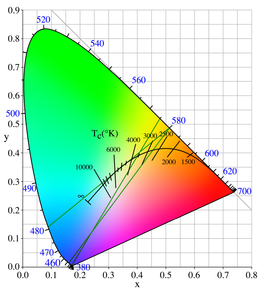 Hunt defines that "two colors are complementary when it is possible to reproduce the tristimulus values of a specified achromatic stimulus by an additive mixture of these two stimuli." That is, when two colored lights can be mixed to match a specified white (achromatic, non-colored) light, the colors of those two lights are complementary
. This definition, however, does not constrain what version of white
will be specified. In the nineteenth century, the scientists Grassmann and Helmholtz did experiments in which they concluded that finding a good complement for spectral yellow was difficult, but that the result was indigo
, that is, a wavelength that today's color scientists would call violet
. Helmholtz says "Yellow and indigo blue" are complements. Grassman reconstructs Newton's category boundaries in terms of wavelengths and says "This indigo therefore falls within the limits of color between which, according to Helmholtz, the complementary colors of yellow lie." Newton's own color circle has yellow directly opposite the boundary between indigo and violet. These results, that the complement of yellow is a wavelength shorter than 450 nm, are derivable from the modern CIE 1931 system of colorimetry if it is assumed that the yellow is about 580 nm or shorter wavelength, and the specified white is the color of a blackbody radiator of temperature 2800 K
or lower (that is, the white of an ordinary incandescent light bulb). More typically, with a daylight-colored or around 5000 to 6000 K white, the complement of yellow will be in the blue wavelength range, which is the standard modern answer for the complement of yellow.
s of spectral classes F and G, such as our sun
Sol, have color temperature
s that make them look "yellowish". The first astronomer to classify stars according to their color was F. G. W. Struve
in 1827. One of his classifications was flavae, or yellow, and this roughly corresponded to stars in the modern spectral range F5 to K0. The Strömgren photometric system
for stellar classification includes a 'y' or yellow filter that is centered at a wavelength of 550 nm and has a bandwidth of 20–30 nm.
; yellow is a secondary color in an additive RGB space.
The measured light spectrum
from yellow pixels on a typical computer display is complex, and very unlike the reflectance spectrum of a yellow object such as a banana.
Process yellow (also known as pigment yellow, printer's yellow or canary yellow) is one of the three colors typically used as subtractive primary color
s, along with magenta
and cyan
. The CMYK
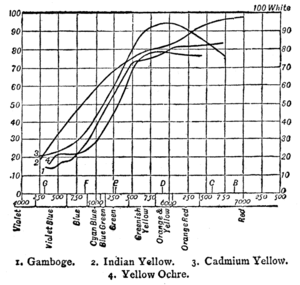
system for color printing is based on using four inks, one of which is a yellow color. This is in itself a standard color, and a fairly narrow range of yellow inks or pigments are used. Process yellow is based on a colorant that reflects the preponderance of red and green light, and absorbs most blue light, as in the reflectance spectra shown in the figure on the lower right.
Because of the characteristics of paint pigments and use of different color wheel
s, painters
traditionally regard the complement of yellow as the color indigo
or blue-violet.
Process yellow is not an RGB color, and there is no fixed conversion from CMYK primaries to RGB. Different formulations are used for printer's ink, so there can be variations in the printed color that is pure yellow ink.
The first recorded use of canary yellow as a color name in English was in 1789.
s emitting in the yellow part of the spectrum are much less common than most other colors. They are also much more expensive than comparable lasers because the difference in energy levels between the metastable and the ground state required for laser action is difficult to create for yellow photons. In commercial products diode pumped solid state (DPSS) technology is employed to create the yellow light. An infrared laser diode at 808 nm is used to pump a crystal of neodymium-doped yttrium vanadium oxide (Nd:YVO4) or neodymium-doped yttrium aluminium garnet (Nd:YAG) and induces it to emit at two frequencies (281.76 THz & 223.39 THz: 1064 nm and 1342 nm wavelengths) simultaneously. This deeper infrared light is then passed through another crystal containing potassium, titanium and phosphorus (KTP), whose non-linear properties generate light at a frequency that is the sum of the two incident beams (505.15 THz); in this case corresponding to the wavelength of 593.5 nm ("yellow"). This wavelength is also available, though even more rarely, from a Helium-neon laser
. However, this not a true yellow, as it exceeds 590 nm. A variant of this same DPSS technology using slightly different starting frequencies was made available in 2010, producing a wavelength of 589 nm, which is considered a true yellow color. The use of yellow lasers at 589nm and 594nm have recently become more widespread thanks to the field of Optogenetics
.


Color
Color or colour is the visual perceptual property corresponding in humans to the categories called red, green, blue and others. Color derives from the spectrum of light interacting in the eye with the spectral sensitivities of the light receptors...
evoked by light that stimulates both the L and M (long and medium wavelength) cone cell
Cone cell
Cone cells, or cones, are photoreceptor cells in the retina of the eye that are responsible for color vision; they function best in relatively bright light, as opposed to rod cells that work better in dim light. If the retina is exposed to an intense visual stimulus, a negative afterimage will be...
s of the retina
Retina
The vertebrate retina is a light-sensitive tissue lining the inner surface of the eye. The optics of the eye create an image of the visual world on the retina, which serves much the same function as the film in a camera. Light striking the retina initiates a cascade of chemical and electrical...
about equally, with no significant stimulation of the S (short-wavelength) cone cells. Light with a wavelength of 570–590 nm
Nanometre
A nanometre is a unit of length in the metric system, equal to one billionth of a metre. The name combines the SI prefix nano- with the parent unit name metre .The nanometre is often used to express dimensions on the atomic scale: the diameter...
is yellow, as is light with a suitable mixture of red
Red
Red is any of a number of similar colors evoked by light consisting predominantly of the longest wavelengths of light discernible by the human eye, in the wavelength range of roughly 630–740 nm. Longer wavelengths than this are called infrared , and cannot be seen by the naked eye...
and green
Green
Green is a color, the perception of which is evoked by light having a spectrum dominated by energy with a wavelength of roughly 520–570 nanometres. In the subtractive color system, it is not a primary color, but is created out of a mixture of yellow and blue, or yellow and cyan; it is considered...
. Yellow's traditional RYB
RYB color model
RYB is a historical set of colors used in subtractive color mixing, and is one commonly used set of primary colors...
complementary color
Complementary color
Complementary colors are pairs of colors that are of “opposite” hue in some color model. The exact hue “complementary” to a given hue depends on the model in question, and perceptually uniform, additive, and subtractive color models, for example, have differing complements for any given color.-...
is purple
Purple
Purple is a range of hues of color occurring between red and blue, and is classified as a secondary color as the colors are required to create the shade....
, violet
Violet (color)
As the name of a color, violet is synonymous with a bluish purple, when the word "purple" is used in the common English language sense of any color between blue and red, not including either blue or red...
, or indigo
Indigo
Indigo is a color named after the purple dye derived from the plant Indigofera tinctoria and related species. The color is placed on the electromagnetic spectrum between about 420 and 450 nm in wavelength, placing it between blue and violet...
, while its colorimetrically defined complementary color in both RGB
RGB color model
The RGB color model is an additive color model in which red, green, and blue light is added together in various ways to reproduce a broad array of colors...
and CMYK
CMYK color model
The CMYK color model is a subtractive color model, used in color printing, and is also used to describe the printing process itself. CMYK refers to the four inks used in some color printing: cyan, magenta, yellow, and key...
color spaces is blue
Blue
Blue is a colour, the perception of which is evoked by light having a spectrum dominated by energy with a wavelength of roughly 440–490 nm. It is considered one of the additive primary colours. On the HSV Colour Wheel, the complement of blue is yellow; that is, a colour corresponding to an equal...
.
Etymology and definitions
The word "yellow" comes from the Old English geolu, or geolwe which derived from the Proto-Germanic word gelwaz. According to the Oxford English DictionaryOxford English Dictionary
The Oxford English Dictionary , published by the Oxford University Press, is the self-styled premier dictionary of the English language. Two fully bound print editions of the OED have been published under its current name, in 1928 and 1989. The first edition was published in twelve volumes , and...
, the oldest known use of this word in English is from The Epinal Glossary in the year 700.
In the English language
English language
English is a West Germanic language that arose in the Anglo-Saxon kingdoms of England and spread into what was to become south-east Scotland under the influence of the Anglian medieval kingdom of Northumbria...
, yellow has traditionally been associated with jaundice
Jaundice
Jaundice is a yellowish pigmentation of the skin, the conjunctival membranes over the sclerae , and other mucous membranes caused by hyperbilirubinemia . This hyperbilirubinemia subsequently causes increased levels of bilirubin in the extracellular fluid...
and cowardice
Cowardice
Cowardice is the perceived failure to demonstrate sufficient mental robustness and courage in the face of a challenge. Under many military codes of justice, cowardice in the face of combat is a crime punishable by death...
. Yellow is associated with the word "caution" and is the second light on stop lights. The color is associated with aging as well, for both people and objects (e.g. "yellowed" paper). Ethnographically, the term "yellow" has been used as a slang term for both Asians ("yellow peril
Yellow Peril
Yellow Peril was a colour metaphor for race that originated in the late nineteenth century with immigration of Chinese laborers to various Western countries, notably the United States, and later associated with the Japanese during the mid 20th century, due to Japanese military expansion.The term...
") and, in the early 20th century, light-skinned African-Americans (High yellow
High yellow
High yellow, occasionally simply yellow , is a term for very light-skinned persons of Black descent. It is a reference to the golden yellow skin tone of some mixed-race people...
).
"Yellow" ("giallo
Giallo
Giallo is an Italian 20th century genre of literature and film, which in Italian indicates crime fiction and mystery. In the English language it refers to a genre similar to the French fantastique genre and includes elements of horror fiction and eroticism...
"), in Italy
Italy
Italy , officially the Italian Republic languages]] under the European Charter for Regional or Minority Languages. In each of these, Italy's official name is as follows:;;;;;;;;), is a unitary parliamentary republic in South-Central Europe. To the north it borders France, Switzerland, Austria and...
, refers to crime stories, both fictional and real. This association began in about 1930, when the first series of crime novels published in Italy had yellow covers. The term "yellow movie" (黃色電影) can refer to films of pornographic nature in Chinese culture, and is analogous to the English "blue movie
Blue movie
Blue movie may refer to:* Pornographic film* Blue film, amateur underground pornography in India* Blue Movie, a film by Andy Warhol* Blue Movie , a film by Wim Verstappen* Blue Movie , a novel by Terry Southern...
". Lastly, it is associated with sensational journalistic practices, or yellow journalism
Yellow journalism
Yellow journalism or the yellow press is a type of journalism that presents little or no legitimate well-researched news and instead uses eye-catching headlines to sell more newspapers. Techniques may include exaggerations of news events, scandal-mongering, or sensationalism...
, and resistance to militant trade unions.
Colorimetry
Complementary color
Complementary colors are pairs of colors that are of “opposite” hue in some color model. The exact hue “complementary” to a given hue depends on the model in question, and perceptually uniform, additive, and subtractive color models, for example, have differing complements for any given color.-...
. This definition, however, does not constrain what version of white
White
White is a color, the perception of which is evoked by light that stimulates all three types of color sensitive cone cells in the human eye in nearly equal amounts and with high brightness compared to the surroundings. A white visual stimulation will be void of hue and grayness.White light can be...
will be specified. In the nineteenth century, the scientists Grassmann and Helmholtz did experiments in which they concluded that finding a good complement for spectral yellow was difficult, but that the result was indigo
Indigo
Indigo is a color named after the purple dye derived from the plant Indigofera tinctoria and related species. The color is placed on the electromagnetic spectrum between about 420 and 450 nm in wavelength, placing it between blue and violet...
, that is, a wavelength that today's color scientists would call violet
Violet (color)
As the name of a color, violet is synonymous with a bluish purple, when the word "purple" is used in the common English language sense of any color between blue and red, not including either blue or red...
. Helmholtz says "Yellow and indigo blue" are complements. Grassman reconstructs Newton's category boundaries in terms of wavelengths and says "This indigo therefore falls within the limits of color between which, according to Helmholtz, the complementary colors of yellow lie." Newton's own color circle has yellow directly opposite the boundary between indigo and violet. These results, that the complement of yellow is a wavelength shorter than 450 nm, are derivable from the modern CIE 1931 system of colorimetry if it is assumed that the yellow is about 580 nm or shorter wavelength, and the specified white is the color of a blackbody radiator of temperature 2800 K
Kelvin
The kelvin is a unit of measurement for temperature. It is one of the seven base units in the International System of Units and is assigned the unit symbol K. The Kelvin scale is an absolute, thermodynamic temperature scale using as its null point absolute zero, the temperature at which all...
or lower (that is, the white of an ordinary incandescent light bulb). More typically, with a daylight-colored or around 5000 to 6000 K white, the complement of yellow will be in the blue wavelength range, which is the standard modern answer for the complement of yellow.
Astronomy
StarStar
A star is a massive, luminous sphere of plasma held together by gravity. At the end of its lifetime, a star can also contain a proportion of degenerate matter. The nearest star to Earth is the Sun, which is the source of most of the energy on Earth...
s of spectral classes F and G, such as our sun
Sun
The Sun is the star at the center of the Solar System. It is almost perfectly spherical and consists of hot plasma interwoven with magnetic fields...
Sol, have color temperature
Color temperature
Color temperature is a characteristic of visible light that has important applications in lighting, photography, videography, publishing, manufacturing, astrophysics, and other fields. The color temperature of a light source is the temperature of an ideal black-body radiator that radiates light of...
s that make them look "yellowish". The first astronomer to classify stars according to their color was F. G. W. Struve
Friedrich Georg Wilhelm von Struve
Friedrich Georg Wilhelm von Struve was a Danish-Baltic German astronomer from a famous dynasty.-Life:...
in 1827. One of his classifications was flavae, or yellow, and this roughly corresponded to stars in the modern spectral range F5 to K0. The Strömgren photometric system
Strömgren photometric system
Strömgren photometric system is four-colour medium-band photometric system for stellar classification. It was pioneered by the Danish astronomer Bengt Strömgren in 1956 and extended by his colleague the American astronomer David L...
for stellar classification includes a 'y' or yellow filter that is centered at a wavelength of 550 nm and has a bandwidth of 20–30 nm.
Pigments
- CarotenoidCarotenoidCarotenoids are tetraterpenoid organic pigments that are naturally occurring in the chloroplasts and chromoplasts of plants and some other photosynthetic organisms like algae, some bacteria, and some types of fungus. Carotenoids can be synthesized fats and other basic organic metabolic building...
s are organic pigmentPigmentA pigment is a material that changes the color of reflected or transmitted light as the result of wavelength-selective absorption. This physical process differs from fluorescence, phosphorescence, and other forms of luminescence, in which a material emits light.Many materials selectively absorb...
s which give many biological objects, including egg yolkEgg yolkAn egg yolk is a part of an egg which feeds the developing embryo. The egg yolk is suspended in the egg white by one or two spiral bands of tissue called the chalazae...
s, autumn leaves and yellow flowers, their color. - Yellow pan traps are used to capture insects, many of which are attracted to shades of yellow.
Birds
- Yellow-breasted ChatYellow-breasted ChatThe Yellow-breasted Chat is a large songbird, formerly considered the most atypical member of the New World warbler family, though the long-standing suspicion is that it does not actually belong there. Its placement is not definitely resolved. It is the only member of the genus Icteria...
s (Icteria virens) are large foragingForaging- Definitions and significance of foraging behavior :Foraging is the act of searching for and exploiting food resources. It affects an animal's fitness because it plays an important role in an animal's ability to survive and reproduce...
songbirdSongbirdA songbird is a bird belonging to the suborder Passeri of the perching birds . Another name that is sometimes seen as scientific or vernacular name is Oscines, from Latin oscen, "a songbird"...
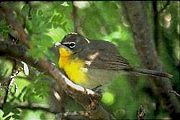
found in southern parts of Canada, the United States, Mexico, and Central America. They are olive with a white bellie and a yellow throat and breast, with a long tail, a thick heavy bill, a large white eye ring, and dark legs. - The YellowhammerYellowhammerThe Yellowhammer, Emberiza citrinella, is a passerine bird in the bunting family Emberizidae. It is common in all sorts of open areas with some scrub or trees and form small flocks in winter....
(Emberiza citrinella) is a passerinePasserineA passerine is a bird of the order Passeriformes, which includes more than half of all bird species. Sometimes known as perching birds or, less accurately, as songbirds, the passerines form one of the most diverse terrestrial vertebrate orders: with over 5,000 identified species, it has roughly...
in the buntingBunting (bird)Buntings are a group of Eurasian and African passerine birds of the family Emberizidae.They are seed-eating birds with stubby, conical bills, and are the Old World equivalents of the species known in North America as sparrows...
family EmberizidaeEmberizidaeThe Emberizidae are a large family of passerine birds. They are seed-eating birds with a distinctively shaped bill.In Europe, most species are called buntings. In North America, most of the species in this family are known as sparrows, but these birds are not closely related to the sparrows, the...
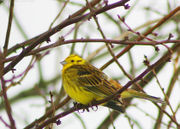
. It breeds across Europe and much of Asia. Most yellowhammers are resident, but some far northern birds migrate south in winter. It is common in all sorts of open areas with some scrub or trees. They are large with a thick seed-eater's bill. The males have a bright yellow head, yellow underparts, and a heavily streaked brown back. Females are much duller and more streaked below. - The Yellow-shafted Flicker (Colaptes auratus) is a large woodpeckerWoodpeckerWoodpeckers are near passerine birds of the order Piciformes. They are one subfamily in the family Picidae, which also includes the piculets and wrynecks. They are found worldwide and include about 180 species....
of eastern North America. It is a subspecies of the Northern Flicker. They have yellow shafts on their wing and tail feathers. - The Yellow WarblerYellow WarblerDendroica petechia is a New World warbler species or superspecies; the subspecies group around D. aestiva is increasingly treated as good species Dendroica aestiva again. The name for the entire cryptic species complex is Mangrove Warbler, and another group of subspecies is known as Golden Warbler...
(Dendroica petechia) is a species of Warbler living in most of North AmericaNorth AmericaNorth America is a continent wholly within the Northern Hemisphere and almost wholly within the Western Hemisphere. It is also considered a northern subcontinent of the Americas...
who is completely yellow other than a few red streaks on the breast and head in males. - The Domestic CanaryDomestic CanaryThe Domestic Canary, often simply known as the canary, is a domesticated form of the wild Canary, a small songbird in the finch family originating from the Macaronesian Islands ....
(Serinus Canaria) is the domesticated form of the Wild Canary, a small songbird. The color canary yellow is named after the Domestic Canary, which can be selectively bred to be yellow.
Fish
- Yellowtail is the common name for dozens of different fishFishFish are a paraphyletic group of organisms that consist of all gill-bearing aquatic vertebrate animals that lack limbs with digits. Included in this definition are the living hagfish, lampreys, and cartilaginous and bony fish, as well as various extinct related groups...
species that have yellow tails or a yellow body. - Yellowfin tunaYellowfin tunaThe yellowfin tuna is a species of tuna found in pelagic waters of tropical and subtropical oceans worldwide.Yellowfin is often marketed as ahi, from its Hawaiian name ahi although the name ahi in Hawaiian also refers to the closely related bigeye tuna. The species name, albacares can lead to...
(Thunnus albacares) is a species of tuna, having bright yellow anal and second dorsal finDorsal finA dorsal fin is a fin located on the backs of various unrelated marine and freshwater vertebrates, including most fishes, marine mammals , and the ichthyosaurs...
s. Found in tropical and subtropical seas and weighing up to 200 kg (440.9 lb), it is caught as a replacement for the depleted stocks of bluefin tuna.
Insects
- A yellow-fever mosquitoAedesAedes is a genus of mosquito originally found in tropical and subtropical zones, but now found on all continents excluding Antarctica. Some species have been spread by human activity. Aedes albopictus, a most invasive species was recently spread to the New World, including the U.S., by the used...
is a mosquito in the AedesAedesAedes is a genus of mosquito originally found in tropical and subtropical zones, but now found on all continents excluding Antarctica. Some species have been spread by human activity. Aedes albopictus, a most invasive species was recently spread to the New World, including the U.S., by the used...
genusGenusIn biology, a genus is a low-level taxonomic rank used in the biological classification of living and fossil organisms, which is an example of definition by genus and differentia...
, so named because they transmit dengue feverDengue feverDengue fever , also known as breakbone fever, is an infectious tropical disease caused by the dengue virus. Symptoms include fever, headache, muscle and joint pains, and a characteristic skin rash that is similar to measles...
and yellow feverYellow feverYellow fever is an acute viral hemorrhagic disease. The virus is a 40 to 50 nm enveloped RNA virus with positive sense of the Flaviviridae family....
, the mosquito-born viruses.
- YellowjacketYellowjacketYellowjacket is the common name in North America for predatory wasps of the genera Vespula and Dolichovespula. Members of these genera are known simply as "wasps" in other English-speaking countries...
s are black-and-yellow waspWaspThe term wasp is typically defined as any insect of the order Hymenoptera and suborder Apocrita that is neither a bee nor an ant. Almost every pest insect species has at least one wasp species that preys upon it or parasitizes it, making wasps critically important in natural control of their...
s of the genus Vespula or Dolichovespula (though some can be black-and-white, the most notable of these being the bald-faced hornetBald-faced hornetDolichovespula maculata is a North American insect commonly called the bald-faced hornet...
, Dolichovespula maculata). They can be identified by their distinctive black-and-yellow color, small size (slightly larger than a beeBeeBees are flying insects closely related to wasps and ants, and are known for their role in pollination and for producing honey and beeswax. Bees are a monophyletic lineage within the superfamily Apoidea, presently classified by the unranked taxon name Anthophila...
), and entirely black antennaeAntenna (biology)Antennae in biology have historically been paired appendages used for sensing in arthropods. More recently, the term has also been applied to cilium structures present in most cell types of eukaryotes....
.
Trees
- The yellow birchYellow BirchBetula alleghaniensis , is a species of birch native to eastern North America, from Newfoundland to Nova Scotia, New Brunswick, southern Quebec and Ontario, and the southeast corner of Manitoba in Canada, west to Minnesota, and south in the Appalachian Mountains to northern Georgia.It is a...
(Betula alleghaniensis) is a birchBirchBirch is a tree or shrub of the genus Betula , in the family Betulaceae, closely related to the beech/oak family, Fagaceae. The Betula genus contains 30–60 known taxa...
species native to eastern North America, from Nova ScotiaNova ScotiaNova Scotia is one of Canada's three Maritime provinces and is the most populous province in Atlantic Canada. The name of the province is Latin for "New Scotland," but "Nova Scotia" is the recognized, English-language name of the province. The provincial capital is Halifax. Nova Scotia is the...
, New BrunswickNew BrunswickNew Brunswick is one of Canada's three Maritime provinces and is the only province in the federation that is constitutionally bilingual . The provincial capital is Fredericton and Saint John is the most populous city. Greater Moncton is the largest Census Metropolitan Area...
, and southern QuebecQuebecQuebec or is a province in east-central Canada. It is the only Canadian province with a predominantly French-speaking population and the only one whose sole official language is French at the provincial level....
west to MinnesotaMinnesotaMinnesota is a U.S. state located in the Midwestern United States. The twelfth largest state of the U.S., it is the twenty-first most populous, with 5.3 million residents. Minnesota was carved out of the eastern half of the Minnesota Territory and admitted to the Union as the thirty-second state...
, and south in the Appalachian MountainsAppalachian MountainsThe Appalachian Mountains #Whether the stressed vowel is or ,#Whether the "ch" is pronounced as a fricative or an affricate , and#Whether the final vowel is the monophthong or the diphthong .), often called the Appalachians, are a system of mountains in eastern North America. The Appalachians...
to northern GeorgiaGeorgia (U.S. state)Georgia is a state located in the southeastern United States. It was established in 1732, the last of the original Thirteen Colonies. The state is named after King George II of Great Britain. Georgia was the fourth state to ratify the United States Constitution, on January 2, 1788...
. They are medium-sized deciduousDeciduousDeciduous means "falling off at maturity" or "tending to fall off", and is typically used in reference to trees or shrubs that lose their leaves seasonally, and to the shedding of other plant structures such as petals after flowering or fruit when ripe...
trees and can reaching about 20 m tall, trunks up to 80 cm in diameter. The bark is smooth and yellow-bronze and the wood is extensively used for flooringFlooringFlooring is the general term for a permanent covering of a floor, or for the work of installing such a floor covering. Floor covering is a term to generically describe any finish material applied over a floor structure to provide a walking surface...
, cabinetry, and toothpicks. - The Thorny yellowwood is an Australian rainforest tree which has deep yellow wood.
- Yellow poplarLiriodendronLiriodendron is a genus of two species of characteristically large deciduous trees in the magnolia family .These trees are widely known by the common name tulip tree or tuliptree for their large flowers superficially resembling tulips, but are closely related to magnolias rather than lilies, the...
is a common name for LiriodendronLiriodendronLiriodendron is a genus of two species of characteristically large deciduous trees in the magnolia family .These trees are widely known by the common name tulip tree or tuliptree for their large flowers superficially resembling tulips, but are closely related to magnolias rather than lilies, the...
, the tuliptree. The common name is inaccurate as this genusGenusIn biology, a genus is a low-level taxonomic rank used in the biological classification of living and fossil organisms, which is an example of definition by genus and differentia...
is not related to poplarPoplarPopulus is a genus of 25–35 species of deciduous flowering plants in the family Salicaceae, native to most of the Northern Hemisphere. English names variously applied to different species include poplar , aspen, and cottonwood....
s.
Other plants
- RapeseedRapeseedRapeseed , also known as rape, oilseed rape, rapa, rappi, rapaseed is a bright yellow flowering member of the family Brassicaceae...
(Brassica napus), also known as rape or oilseed rape, is a bright yellow flowering member of the family Brassicaceae (mustard or cabbage family). - GoldenrodGoldenrodSolidago, commonly called goldenrods, is a genus of about 100 species of flowering plants in the family Asteraceae. Most are herbaceous perennial species found in the meadows and pastures, along roads, ditches and waste areas in North America. There are also a few species native to Mexico, South...
is a yellow flowering plant in the Family AsteraceaeAsteraceaeThe Asteraceae or Compositae , is an exceedingly large and widespread family of vascular plants. The group has more than 22,750 currently accepted species, spread across 1620 genera and 12 subfamilies...
.
Electric yellow vs. process yellow
The color box at right shows the most intense yellow representable in 8-bit RGB color modelRGB color model
The RGB color model is an additive color model in which red, green, and blue light is added together in various ways to reproduce a broad array of colors...
; yellow is a secondary color in an additive RGB space.
The measured light spectrum
Spectrum
A spectrum is a condition that is not limited to a specific set of values but can vary infinitely within a continuum. The word saw its first scientific use within the field of optics to describe the rainbow of colors in visible light when separated using a prism; it has since been applied by...
from yellow pixels on a typical computer display is complex, and very unlike the reflectance spectrum of a yellow object such as a banana.
Process yellow (also known as pigment yellow, printer's yellow or canary yellow) is one of the three colors typically used as subtractive primary color
Primary color
Primary colors are sets of colors that can be combined to make a useful range of colors. For human applications, three primary colors are usually used, since human color vision is trichromatic....
s, along with magenta
Magenta
Magenta is a color evoked by light stronger in blue and red wavelengths than in yellowish-green wavelengths . In light experiments, magenta can be produced by removing the lime-green wavelengths from white light...
and cyan
Cyan
Cyan from , transliterated: kýanos, meaning "dark blue substance") may be used as the name of any of a number of colors in the blue/green range of the spectrum. In reference to the visible spectrum cyan is used to refer to the color obtained by mixing equal amounts of green and blue light or the...
. The CMYK
CMYK color model
The CMYK color model is a subtractive color model, used in color printing, and is also used to describe the printing process itself. CMYK refers to the four inks used in some color printing: cyan, magenta, yellow, and key...
system for color printing is based on using four inks, one of which is a yellow color. This is in itself a standard color, and a fairly narrow range of yellow inks or pigments are used. Process yellow is based on a colorant that reflects the preponderance of red and green light, and absorbs most blue light, as in the reflectance spectra shown in the figure on the lower right.
Because of the characteristics of paint pigments and use of different color wheel
Color wheel
A color wheel or color circle is an abstract illustrative organization of color hues around a circle that shows relationships between primary colors, secondary colors, complementary colors, etc....
s, painters
Painting
Painting is the practice of applying paint, pigment, color or other medium to a surface . The application of the medium is commonly applied to the base with a brush but other objects can be used. In art, the term painting describes both the act and the result of the action. However, painting is...
traditionally regard the complement of yellow as the color indigo
Indigo
Indigo is a color named after the purple dye derived from the plant Indigofera tinctoria and related species. The color is placed on the electromagnetic spectrum between about 420 and 450 nm in wavelength, placing it between blue and violet...
or blue-violet.
Process yellow is not an RGB color, and there is no fixed conversion from CMYK primaries to RGB. Different formulations are used for printer's ink, so there can be variations in the printed color that is pure yellow ink.
The first recorded use of canary yellow as a color name in English was in 1789.
Lasers
LaserLaser
A laser is a device that emits light through a process of optical amplification based on the stimulated emission of photons. The term "laser" originated as an acronym for Light Amplification by Stimulated Emission of Radiation...
s emitting in the yellow part of the spectrum are much less common than most other colors. They are also much more expensive than comparable lasers because the difference in energy levels between the metastable and the ground state required for laser action is difficult to create for yellow photons. In commercial products diode pumped solid state (DPSS) technology is employed to create the yellow light. An infrared laser diode at 808 nm is used to pump a crystal of neodymium-doped yttrium vanadium oxide (Nd:YVO4) or neodymium-doped yttrium aluminium garnet (Nd:YAG) and induces it to emit at two frequencies (281.76 THz & 223.39 THz: 1064 nm and 1342 nm wavelengths) simultaneously. This deeper infrared light is then passed through another crystal containing potassium, titanium and phosphorus (KTP), whose non-linear properties generate light at a frequency that is the sum of the two incident beams (505.15 THz); in this case corresponding to the wavelength of 593.5 nm ("yellow"). This wavelength is also available, though even more rarely, from a Helium-neon laser
Helium-neon laser
A helium–neon laser or HeNe laser, is a type of gas laser whose gain medium consists of a mixture of helium and neon inside of a small bore capillary tube, usually excited by a DC electrical discharge.- History of HeNe laser development:...
. However, this not a true yellow, as it exceeds 590 nm. A variant of this same DPSS technology using slightly different starting frequencies was made available in 2010, producing a wavelength of 589 nm, which is considered a true yellow color. The use of yellow lasers at 589nm and 594nm have recently become more widespread thanks to the field of Optogenetics
Optogenetics
Optogenetics is the combination of genetic and optical methods to control specific events in targeted cells of living tissue, even within freely moving mammals and other animals, with the temporal precision needed to keep pace with functioning intact biological systems.In 2010, optogenetics was...
.
Minerals and chemistry
- YellowcakeYellowcakeYellowcake is a kind of uranium concentrate powder obtained from leach solutions, in an intermediate step in the processing of uranium ores. Yellowcake concentrates are prepared by various extraction and refining methods, depending on the types of ores...
(also known as urania and uranic oxide) is concentrated uranium oxideUranium oxideUranium oxide is an oxide of the element uranium.The metal uranium forms several oxides:* Uranium dioxide or uranium oxide * Uranium trioxide or uranium oxide...
, obtained through the milling of uranium ore. Yellowcake is used in the preparation of fuel for nuclear reactorNuclear reactorA nuclear reactor is a device to initiate and control a sustained nuclear chain reaction. Most commonly they are used for generating electricity and for the propulsion of ships. Usually heat from nuclear fission is passed to a working fluid , which runs through turbines that power either ship's...
s and in uranium enrichment, one of the essential steps for creating nuclear weaponNuclear weaponA nuclear weapon is an explosive device that derives its destructive force from nuclear reactions, either fission or a combination of fission and fusion. Both reactions release vast quantities of energy from relatively small amounts of matter. The first fission bomb test released the same amount...
s.
- Titan yellowTitan yellowTitan yellow is a compound with formula Na2C28H19S4O6. It is a triazene dye used as a stain and fluorescent indicator in microscopy. It is also used as a reagent for the detection of magnesium. As an acid-base indicator, it changes color from yellow to red between pH 12 and pH 13....
(also known as clayton yellow), chemical formula has been used to determine magnesiumMagnesiumMagnesium is a chemical element with the symbol Mg, atomic number 12, and common oxidation number +2. It is an alkaline earth metal and the eighth most abundant element in the Earth's crust and ninth in the known universe as a whole...
in serumSerous fluidIn physiology, the term serous fluid is used for various bodily fluids that are typically pale yellow and transparent, and of a benign nature, that fill the inside of body cavities. Serous fluid originates from serous glands, with secretions enriched with proteins and water. Serous fluid may also...
and urineUrineUrine is a typically sterile liquid by-product of the body that is secreted by the kidneys through a process called urination and excreted through the urethra. Cellular metabolism generates numerous by-products, many rich in nitrogen, that require elimination from the bloodstream...
, but the method is prone to interference, making the ammonium phosphateAmmonium phosphateAmmonium phosphate is the salt of ammonia and phosphoric acid. It has the formula 3PO4 and consists of ammonium cations and phosphate anion. It is obtained as a crystalline powder upon mixing concentrated solutions of ammonia and phosphoric acid, or on the addition of excess of ammonia to the...
method superior when analysing blood cells, food or fecal material. - Methyl yellowMethyl yellowMethyl yellow, or C.I. 11020, is a chemical compound which may be used as a pH indicator.In aqueous solution at low pH, methyl yellow appears red...
(p-Dimethylaminoazobenzene) is a pH indicatorPH indicatorA pH indicator is a halochromic chemical compound that is added in small amounts to a solution so that the pH of the solution can be determined visually. Hence a pH indicator is a chemical detector for hydronium ions or hydrogen ions in the Arrhenius model. Normally, the indicator causes the...
used to determine acidity. It changes from yellow at pH=4.0 to red at pH=2.9. - Yellow fireworksFireworksFireworks are a class of explosive pyrotechnic devices used for aesthetic and entertainment purposes. The most common use of a firework is as part of a fireworks display. A fireworks event is a display of the effects produced by firework devices...
are produced by adding sodiumSodiumSodium is a chemical element with the symbol Na and atomic number 11. It is a soft, silvery-white, highly reactive metal and is a member of the alkali metals; its only stable isotope is 23Na. It is an abundant element that exists in numerous minerals, most commonly as sodium chloride...
compounds to the firework mixture. Sodium has a strong emission at 589.3 nm (D-line), a very slightly orange-tinted yellow. - Amongst the elementChemical elementA chemical element is a pure chemical substance consisting of one type of atom distinguished by its atomic number, which is the number of protons in its nucleus. Familiar examples of elements include carbon, oxygen, aluminum, iron, copper, gold, mercury, and lead.As of November 2011, 118 elements...
s, sulfurSulfurSulfur or sulphur is the chemical element with atomic number 16. In the periodic table it is represented by the symbol S. It is an abundant, multivalent non-metal. Under normal conditions, sulfur atoms form cyclic octatomic molecules with chemical formula S8. Elemental sulfur is a bright yellow...
and goldGoldGold is a chemical element with the symbol Au and an atomic number of 79. Gold is a dense, soft, shiny, malleable and ductile metal. Pure gold has a bright yellow color and luster traditionally considered attractive, which it maintains without oxidizing in air or water. Chemically, gold is a...
are most obviously yellow. PhosphorusPhosphorusPhosphorus is the chemical element that has the symbol P and atomic number 15. A multivalent nonmetal of the nitrogen group, phosphorus as a mineral is almost always present in its maximally oxidized state, as inorganic phosphate rocks...
, arsenicArsenicArsenic is a chemical element with the symbol As, atomic number 33 and relative atomic mass 74.92. Arsenic occurs in many minerals, usually in conjunction with sulfur and metals, and also as a pure elemental crystal. It was first documented by Albertus Magnus in 1250.Arsenic is a metalloid...
and antimonyAntimonyAntimony is a toxic chemical element with the symbol Sb and an atomic number of 51. A lustrous grey metalloid, it is found in nature mainly as the sulfide mineral stibnite...
have allotropes which are yellow or whitish-yellow; fluorineFluorineFluorine is the chemical element with atomic number 9, represented by the symbol F. It is the lightest element of the halogen column of the periodic table and has a single stable isotope, fluorine-19. At standard pressure and temperature, fluorine is a pale yellow gas composed of diatomic...
and chlorineChlorineChlorine is the chemical element with atomic number 17 and symbol Cl. It is the second lightest halogen, found in the periodic table in group 17. The element forms diatomic molecules under standard conditions, called dichlorine...
are pale yellowish gases.
Pigments
- Yellow ochre (also known as Mars yellow, Pigment yellow 42, 43), hydrated ferric oxide , is a naturally occurring pigmentPigmentA pigment is a material that changes the color of reflected or transmitted light as the result of wavelength-selective absorption. This physical process differs from fluorescence, phosphorescence, and other forms of luminescence, in which a material emits light.Many materials selectively absorb...
found in clays in many parts of the world. It is non-toxic and has been used in painting since prehistoric times. - Indian yellowIndian YellowIndian yellow, also called euxanthin or euxanthine, is a xanthonoid. It is transparent yellow pigment used in oil paint. Chemically it is a magnesium euxanthate, the magnesium salt of euxanthic acid. It is a clear, deep and luminescent yellow pigment...
is a transparent, fluorescent pigment used in oil paintings and watercolors. Originally magnesium euxanthate, it was claimed to have been produced from the urine of Indian cows fed only on mango leaves. It has now been replaced by synthetic Indian yellow hue. - Naples YellowNaples YellowNaples yellow, also called antimony yellow, can range from a somewhat muted, or earthy, reddish yellow pigment to a bright light yellow, and is the chemical compound lead antimonate. Its chemical composition is Pb2/Pb32. It is also known as jaune d'antimoine. It is one of the oldest synthetic...
(lead antimonate yellow) is one of the oldest synthetic pigments, derived from the mineral bindheimite and used extensively up to the 20th century. It is toxic and nowadays is replaced in paint by a mixture of modern pigments. - Cadmium YellowCadmium pigmentsCadmium pigments are a class of pigments that have cadmium as one of the chemical components. They are highly toxic and can produce cadmium poisoning. Most of cadmium produced worldwide is used in the production of nickel-cadmium batteries, but about half the remaining consumption, which is about...
(cadmium sulfideCadmium sulfideCadmium sulfide is the inorganic compound with the formula CdS. Cadmium sulfide is a yellow solid. It occurs in nature with two different crystal structures as the rare minerals greenockite and hawleyite, but is more prevalent as an impurity substituent in the similarly structured zinc ores...
, CdS) has been used in artists' paints since the mid-19th century. Because of its toxicity, it may nowadays be replaced by azo pigments. - Chrome YellowChrome yellowChrome Yellow is a natural yellow pigment made of lead chromate . It was first extracted from the mineral crocoite by the French chemist Louis Vauquelin in 1809...
(lead chromate), derived from the mineral crocoiteCrocoiteCrocoite is a mineral consisting of lead chromate, PbCrO4, and crystallizing in the monoclinic crystal system. It is sometimes used as a paint, being identical in composition with the artificial product chrome yellow. It was discovered at Berezovsky deposit near Ekaterinburg in the Urals in 1766;...
, was used by artists in the earlier part of the 19th century, but has been largely replaced by other yellow pigments because of the toxicity of lead. - Titanium YellowTitanium yellowTitanium yellow, also nickel antimony titanium yellow, nickel antimony titanium yellow rutile, CI Pigment Yellow 53, or C.I. 77788, is a yellow pigment with the chemical composition of NiO.Sb2O5.20TiO2. Its CAS number is . It is a complex inorganic compound. Its melting point lies above 1000 °C,...
(nickel antimony titanium yellow rutile) is created by adding small amounts of the oxides of nickel and antimony to titanium dioxide and heating. It is used to produce yellow paints with good white coverage and has the LBNL paint code "Y10". - GambogeGambogeGamboge is a partially transparent dark mustard yellow pigment.Other forms and spellings are: cambodia, cambogium, camboge, cambugium, gambaugium, gambogia, gambozia, gamboidea, gambogium, gumbouge, gambouge, gamboge, gambooge, gambugia...
is an orange-brown resinResinResin in the most specific use of the term is a hydrocarbon secretion of many plants, particularly coniferous trees. Resins are valued for their chemical properties and associated uses, such as the production of varnishes, adhesives, and food glazing agents; as an important source of raw materials...
, derived from trees of the genus GarciniaGarciniaGarcinia is a plant genus of the family Clusiaceae native to Asia, Australia, tropical and southern Africa, and Polynesia. The number of species is highly disputed, with various sources recognizing between 50 and about 300 taxa as specifically valid...
, which becomes yellow when powdered. It was used as a watercolor pigment in the far eastFar EastThe Far East is an English term mostly describing East Asia and Southeast Asia, with South Asia sometimes also included for economic and cultural reasons.The term came into use in European geopolitical discourse in the 19th century,...
from the 8th century - the name "gamboge" is derived from "CambodiaCambodiaCambodia , officially known as the Kingdom of Cambodia, is a country located in the southern portion of the Indochina Peninsula in Southeast Asia...
" - and has been used in Europe since the 17th century. - OrpimentOrpimentOrpiment, As2S3, is a common monoclinic arsenic sulfide mineral. It has a Mohs hardness of 1.5 to 2 and a specific gravity of 3.46. It melts at 300 °C to 325 °C...
, also called King's Yellow or Chinese Yellow is arsenic trisulfideArsenic trisulfideArsenic trisulfide is the inorganic compound with the formula As2S3. This bright yellow solid is a well known mineral orpiment , has been used as a pigment, and has played a role in the analysis of arsenic compounds. This chalcogenide material is a group V/VI, intrinsic p-type semiconductor and...
and was used as a paint pigment until the 19th century when, because of its high toxicity and reaction with lead-based pigments, it was generally replaced by Cadmium Yellow. - AzoAzo compoundAzo compounds are compounds bearing the functional group R-N=N-R', in which R and R' can be either aryl or alkyl. IUPAC defines azo compounds as: "Derivatives of diazene , HN=NH, wherein both hydrogens are substituted by hydrocarbyl groups, e.g. PhN=NPh azobenzene or diphenyldiazene." The more...
-dye based pigment (a brightly colored transparent or semitransparent dye with a white pigment) is used as the colorant in most modern paints requiring either a highly saturated yellow or simplicity of color mixing. The most common is the monoazo arylide yellowArylide YellowArylide yellow, also known as Monoazo yellow is a pigment used primarily in artistic oil paints and watercolors. The pigment is considered a semi-transparent, bright, pale yellow....
family, first marketed as Hansa YellowHansa yellowHansa Yellow is a synthetic Arylide Yellow pigment used in inks, oil paint, acrylic paint and other applications. Hansa yellows were first made in Germany just before World War I and are ASTM II lightfast and semitransparent....
.
Cultural associations
- The ancient MayaMaya civilizationThe Maya is a Mesoamerican civilization, noted for the only known fully developed written language of the pre-Columbian Americas, as well as for its art, architecture, and mathematical and astronomical systems. Initially established during the Pre-Classic period The Maya is a Mesoamerican...
associated the color yellow with the direction South. The Maya glyph for "yellow" (k'an) also means "precious" or "ripe". - The color is traditionally associated with the Malay Rulers of Malaysia.
- The word yellow can be used as an adjective meaning cowardly.
- The color was also used to represent the Manchus in the new flag of China :Five Races Under One UnionFive Races Under One UnionFive races under one union was one of the major principles upon which the Republic of China was originally founded in 1911 at the time of the Xinhai Revolution.-Description:...
, and also under the flag of ManchukuoManchukuoManchukuo or Manshū-koku was a puppet state in Manchuria and eastern Inner Mongolia, governed under a form of constitutional monarchy. The region was the historical homeland of the Manchus, who founded the Qing Empire in China...
.
History
- The legendary first emperor of China was known as the Yellow EmperorYellow EmperorThe Yellow Emperor or Huangdi1 is a legendary Chinese sovereign and culture hero, included among the Three Sovereigns and Five Emperors. Tradition holds that he reigned from 2697–2597 or 2696–2598 BC...
or Huangdi (ChineseTraditional Chinese characterTraditional Chinese characters refers to Chinese characters in any character set which does not contain newly created characters or character substitutions performed after 1946. It most commonly refers to characters in the standardized character sets of Taiwan, of Hong Kong, or in the Kangxi...
: 黃帝, Simplified Chinese: 黄帝). Members of the imperial family of China at that time were the only ones allowed to display the color yellow in buildings and garments. - The Yellow Turbans were a Daoist sect that staged an extensive rebellionRebellionRebellion, uprising or insurrection, is a refusal of obedience or order. It may, therefore, be seen as encompassing a range of behaviors aimed at destroying or replacing an established authority such as a government or a head of state...
during the Han DynastyHan DynastyThe Han Dynasty was the second imperial dynasty of China, preceded by the Qin Dynasty and succeeded by the Three Kingdoms . It was founded by the rebel leader Liu Bang, known posthumously as Emperor Gaozu of Han. It was briefly interrupted by the Xin Dynasty of the former regent Wang Mang...
.
Journalism
- "Yellow journalismYellow journalismYellow journalism or the yellow press is a type of journalism that presents little or no legitimate well-researched news and instead uses eye-catching headlines to sell more newspapers. Techniques may include exaggerations of news events, scandal-mongering, or sensationalism...
" is a term that refers to sensationalistSensationalismSensationalism is a type of editorial bias in mass media in which events and topics in news stories and pieces are over-hyped to increase viewership or readership numbers...
journalismJournalismJournalism is the practice of investigation and reporting of events, issues and trends to a broad audience in a timely fashion. Though there are many variations of journalism, the ideal is to inform the intended audience. Along with covering organizations and institutions such as government and...
that distorts, exaggerates, or exploits news to maximize profit. The term came from Joseph PulitzerJoseph PulitzerJoseph Pulitzer April 10, 1847 – October 29, 1911), born Politzer József, was a Hungarian-American newspaper publisher of the St. Louis Post Dispatch and the New York World. Pulitzer introduced the techniques of "new journalism" to the newspapers he acquired in the 1880s and became a leading...
's New York WorldNew York WorldThe New York World was a newspaper published in New York City from 1860 until 1931. The paper played a major role in the history of American newspapers...
and William Randolph HearstWilliam Randolph HearstWilliam Randolph Hearst was an American business magnate and leading newspaper publisher. Hearst entered the publishing business in 1887, after taking control of The San Francisco Examiner from his father...
's New York Journal AmericanNew York Journal AmericanThe New York Journal American was a newspaper published from 1937 to 1966. The Journal American was the product of a merger between two New York newspapers owned by William Randolph Hearst: The New York American , a morning paper, and the New York Evening Journal, an afternoon paper...
, who engaged in sensational reporting during the late 19th and early 20th century, most famously during the Spanish-American WarSpanish-American WarThe Spanish–American War was a conflict in 1898 between Spain and the United States, effectively the result of American intervention in the ongoing Cuban War of Independence...
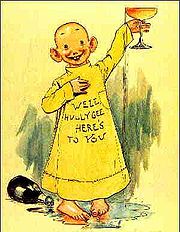
. The term was derived from the color comic stripComic stripA comic strip is a sequence of drawings arranged in interrelated panels to display brief humor or form a narrative, often serialized, with text in balloons and captions....
The Yellow KidThe Yellow KidThe Yellow Kid emerged as the lead character in Hogan's Alley, drawn by Richard F. Outcault, which became one of the first Sunday supplement comic strips in an American newspaper, although its graphical layout had already been thoroughly established in political and other, purely-for-entertainment...
, which appeared in both papers.
Music
- The BeatlesThe BeatlesThe Beatles were an English rock band, active throughout the 1960s and one of the most commercially successful and critically acclaimed acts in the history of popular music. Formed in Liverpool, by 1962 the group consisted of John Lennon , Paul McCartney , George Harrison and Ringo Starr...
1966 album RevolverRevolver (album)Revolver is the seventh studio album by the English rock group The Beatles, released on 5 August 1966 on the Parlophone label and produced by George Martin. Many of the tracks on Revolver are marked by an electric guitar-rock sound, in contrast with their previous LP, the folk rock inspired Rubber...
features the #1 hit, "Yellow SubmarineYellow Submarine (song)"Yellow Submarine" is a 1966 song by The Beatles, written by Paul McCartney , with lead vocals by Ringo Starr. It was included on the Revolver album and issued as a single, coupled with "Eleanor Rigby". The single went to number 1 on every major British chart, remained at number 1 for four weeks...
". Subsequently United ArtistsUnited ArtistsUnited Artists Corporation is an American film studio. The original studio of that name was founded in 1919 by D. W. Griffith, Charles Chaplin, Mary Pickford and Douglas Fairbanks....
released an animated film in 1968 called "Yellow Submarine", based on the music of the Beatles. - The March 1967 album by DonovanDonovanDonovan Donovan Donovan (born Donovan Philips Leitch (born 10 May 1946) is a Scottish singer-songwriter and guitarist. Emerging from the British folk scene, he developed an eclectic and distinctive style that blended folk, jazz, pop, psychedelia, and world music...
called Mellow YellowMellow Yellow (album)Mellow Yellow is the fourth album from Scottish singer-songwriter Donovan. It was released in the United States in March 1967 Mellow Yellow is the fourth album from Scottish singer-songwriter Donovan. It was released in the United States in March 1967 Mellow Yellow is the fourth album from...
was very popular among the hippieHippieThe hippie subculture was originally a youth movement that arose in the United States during the mid-1960s and spread to other countries around the world. The etymology of the term 'hippie' is from hipster, and was initially used to describe beatniks who had moved into San Francisco's...
s. The featured song on the album, "Mellow YellowMellow Yellow"Mellow Yellow" is a song and single release by Donovan. It reached #2 on the Billboard charts in the U.S. in 1966 and #8 in the UK in early 1967....
", popularized during the Spring of 1967 a widely believed hoaxHoaxA hoax is a deliberately fabricated falsehood made to masquerade as truth. It is distinguishable from errors in observation or judgment, or rumors, urban legends, pseudosciences or April Fools' Day events that are passed along in good faith by believers or as jokes.-Definition:The British...
that it was possible to get high by smoking scrapings from the inside of bananaBananaBanana is the common name for herbaceous plants of the genus Musa and for the fruit they produce. Bananas come in a variety of sizes and colors when ripe, including yellow, purple, and red....
peels, although this rumor was actually started in 1966 by a different musicianMusicianA musician is an artist who plays a musical instrument. It may or may not be the person's profession. Musicians can be classified by their roles in performing music and writing music.Also....* A person who makes music a profession....
popular among the hippies, Country Joe McDonaldCountry Joe McDonaldCountry Joe McDonald is an American musician who was the lead singer of the 1960s psychedelic rock group Country Joe and the Fish.-Personal life:...
. - ColdplayColdplayColdplay are a British alternative rock band formed in 1996 by lead vocalist Chris Martin and lead guitarist Jonny Buckland at University College London. After they formed Pectoralz, Guy Berryman joined the group as a bassist and they changed their name to Starfish. Will Champion joined as a...
achieved worldwide fame with their 2000 single "YellowYellow (song)"Yellow" is a song by English alternative rock band Coldplay. The band wrote the song and co-produced it with British record producer Ken Nelson for their debut album, Parachutes...
".
Politics
- Yellow was also the color of the New PartyNew Party (Republic of China)The New Party, formerly the Chinese New Party , is a centre-right conservative political party in the Republic of China , and part of the pan-blue coalition....
in the Republic of ChinaRepublic of ChinaThe Republic of China , commonly known as Taiwan , is a unitary sovereign state located in East Asia. Originally based in mainland China, the Republic of China currently governs the island of Taiwan , which forms over 99% of its current territory, as well as Penghu, Kinmen, Matsu and other minor...
(TaiwanTaiwanTaiwan , also known, especially in the past, as Formosa , is the largest island of the same-named island group of East Asia in the western Pacific Ocean and located off the southeastern coast of mainland China. The island forms over 99% of the current territory of the Republic of China following...
), which supports Chinese reunificationChinese reunificationChinese reunification refers to the bringing together of all of the territories controlled by the People's Republic of China and the Republic of China under a single political entity...
. - In ThailandThailandThailand , officially the Kingdom of Thailand , formerly known as Siam , is a country located at the centre of the Indochina peninsula and Southeast Asia. It is bordered to the north by Burma and Laos, to the east by Laos and Cambodia, to the south by the Gulf of Thailand and Malaysia, and to the...
, People's Alliance for DemocracyPeople's Alliance for DemocracyThe People's Alliance for Democracy also called the National Liberation Alliance - กลุ่มพันธมิตรกู้ชาติ, Thai Patriots Network or the Yellow Shirts - เสื้อเหลือง - was originally a coalition of protesters against Thaksin Shinawatra, the former Prime Minister of Thailand. Its leaders include...
(PAD) also known as Yellow Shirts. - In the United States, a yellow dog DemocratYellow dog DemocratYellow Dog Democrats was a political term applied to voters in the Southern United States who voted solely for Democratic candidates, with the term commencing in the late 19th century. Due to Republican president Abraham Lincoln's leading the Union against the Confederacy, these voters would...
was a Southern voter who consistently voted for Democratic candidates in the late 19th and early 20th centuries because of lingering resentment against the Republicans dating back to the Civil WarAmerican Civil WarThe American Civil War was a civil war fought in the United States of America. In response to the election of Abraham Lincoln as President of the United States, 11 southern slave states declared their secession from the United States and formed the Confederate States of America ; the other 25...
and Reconstruction period. Today the term refers to a hard-core Democrat, supposedly referring to a person who would vote for a "yellow dog" before voting for a Republican. - In the United States yellow is also associated with the Libertarian PartyLibertarian Party (United States)The Libertarian Party is the third largest and fastest growing political party in the United States. The political platform of the Libertarian Party reflects its brand of libertarianism, favoring minimally regulated, laissez-faire markets, strong civil liberties, minimally regulated migration...
, to contrast with the Green PartyGreen Party (United States)The Green Party of the United States is a nationally recognized political party which officially formed in 1991. It is a voluntary association of state green parties. Prior to national formation, many state affiliates had already formed and were recognized by other state parties...
(green), Democratic PartyDemocratic Party (United States)The Democratic Party is one of two major contemporary political parties in the United States, along with the Republican Party. The party's socially liberal and progressive platform is largely considered center-left in the U.S. political spectrum. The party has the lengthiest record of continuous...
(blue) and Republican PartyRepublican Party (United States)The Republican Party is one of the two major contemporary political parties in the United States, along with the Democratic Party. Founded by anti-slavery expansion activists in 1854, it is often called the GOP . The party's platform generally reflects American conservatism in the U.S...
(red). - In the United Kingdom, yellow is associated with the Liberal DemocratsLiberal DemocratsThe Liberal Democrats are a social liberal political party in the United Kingdom which supports constitutional and electoral reform, progressive taxation, wealth taxation, human rights laws, cultural liberalism, banking reform and civil liberties .The party was formed in 1988 by a merger of the...
. - In the United KingdomUnited KingdomThe United Kingdom of Great Britain and Northern IrelandIn the United Kingdom and Dependencies, other languages have been officially recognised as legitimate autochthonous languages under the European Charter for Regional or Minority Languages...
, The Monster Raving Loony Party (OMRLP) has made use of yellow, along with black, as its primary party colors. - During the People Power Revolution of 1986, yellow was the dominant theme, the color being associated with former Philippine PresidentPresident of the PhilippinesThe President of the Philippines is the head of state and head of government of the Philippines. The president leads the executive branch of the Philippine government and is the commander-in-chief of the Armed Forces of the Philippines...
Corazon AquinoCorazon AquinoMaria Corazon Sumulong Cojuangco-Aquino was the 11th President of the Philippines and the first woman to hold that office in Philippine history. She is best remembered for leading the 1986 People Power Revolution, which toppled Ferdinand Marcos and restored democracy in the Philippines...
. It is now a symbol of both support for her as well as in commemoration of the popular revolt. - In Europe, many liberalLiberalismLiberalism is the belief in the importance of liberty and equal rights. Liberals espouse a wide array of views depending on their understanding of these principles, but generally, liberals support ideas such as constitutionalism, liberal democracy, free and fair elections, human rights,...
parties are symbolised by the color yellow, including the Free Democratic PartyFree Democratic Party (Germany)The Free Democratic Party , abbreviated to FDP, is a centre-right classical liberal political party in Germany. It is led by Philipp Rösler and currently serves as the junior coalition partner to the Union in the German federal government...
(Germany), Liberal ForumLiberal ForumThe Liberal Forum is a small classical liberal party in Austria. The party is currently led by Angelika Mlinar, and is a member of the Liberal International and the European Liberal Democrat and Reform Party.-Founding:...
(Austria), Estonian Reform PartyEstonian Reform PartyThe Estonian Reform Party is a centre-right, free market liberal party in Estonia. It is led by Estonian Prime Minister Andrus Ansip, and has 33 members in the 101-member Riigikogu, making it the largest party in the legislature...
, National Liberal PartyNational Liberal Party (Romania)The National Liberal Party , abbreviated to PNL, is a centre-right liberal party in Romania. It is the third-largest party in the Romanian Parliament, with 53 seats in the Chamber of Deputies and 22 in the Senate: behind the centre-right Democratic Liberal Party and the centre-left Social...
(Romania) and Liberal and Centre UnionLiberal and Centre UnionThe Liberal and Centre Union , abbreviated to LiCS, is a centre-right, liberal and conservative liberal political party in Lithuania. The party has thirteen seats in the Seimas, making it the fourth-largest party in the legislature....
(Lithuania). The pan-European Alliance of Liberals and Democrats for EuropeGroup of the Alliance of Liberals and Democrats for EuropeThe Group of the Alliance of Liberals and Democrats for Europe is the current liberal/centrist political group of the European Parliament...
and European Liberal Democrat and Reform PartyEuropean Liberal Democrat and Reform PartyThe European Liberal Democrat and Reform Party is a European political party mainly active in the European Union, composed of 56 national-level liberal and liberal-democratic parties from across Europe...
also use the color yellow. - A group of NGOs by the name of Bersih (Coalition for Clean and Fair Elections) had used the color yellow to symbolize their fight against corruption in election in Malaysia. The giant rally was organized on the 9th of July 2011.
Religion and metaphysics
- The ChristianChristianA Christian is a person who adheres to Christianity, an Abrahamic, monotheistic religion based on the life and teachings of Jesus of Nazareth as recorded in the Canonical gospels and the letters of the New Testament...
holiday of EasterEasterEaster is the central feast in the Christian liturgical year. According to the Canonical gospels, Jesus rose from the dead on the third day after his crucifixion. His resurrection is celebrated on Easter Day or Easter Sunday...
is represented by the colors yellow and lavenderLavenderThe lavenders are a genus of 39 species of flowering plants in the mint family, Lamiaceae. An Old World genus, distributed from Macaronesia across Africa, the Mediterranean, South-West Asia, Arabia, Western Iran and South-East India...
because the crocusCrocusCrocus is a genus in the iris family comprising about 80 species of perennials growing from corms. Many are cultivated for their flowers appearing in autumn, winter, or spring...
flower, which is yellow and lavender, blooms in Europe in the spring. - In the metaphysicsMetaphysicsMetaphysics is a branch of philosophy concerned with explaining the fundamental nature of being and the world, although the term is not easily defined. Traditionally, metaphysics attempts to answer two basic questions in the broadest possible terms:...
of the New AgeNew AgeThe New Age movement is a Western spiritual movement that developed in the second half of the 20th century. Its central precepts have been described as "drawing on both Eastern and Western spiritual and metaphysical traditions and then infusing them with influences from self-help and motivational...
Prophetess, Alice A. Bailey, in her system called the Seven RaysSeven RaysThe seven rays is an occult concept that has appeared in several religions and esoteric philosophies, since at least the 6th century BCE, of the Aryan peoples in both Western culture and in India...
which classifies humanHumanHumans are the only living species in the Homo genus...
s into seven different metaphysical psychological typesPsychological TypesPsychological Types is the title of the sixth volume in the Princeton / Bollingen edition of the Collected Works of Carl Jung. The original German language edition, "Psychologische Typen", was first published by Rascher Verlag, Zurich in 1921....
, the fourth ray of harmony through conflict is represented by the color yellow. People who have this metaphysical psychological type are said to be on the Yellow Ray. " - In HinduismHinduismHinduism is the predominant and indigenous religious tradition of the Indian Subcontinent. Hinduism is known to its followers as , amongst many other expressions...
, yellow is used to symbolically represent the third, solar plexus chakraChakraChakra is a concept originating in Hindu texts, featured in tantric and yogic traditions of Hinduism and Buddhism. Its name derives from the Sanskrit word for "wheel" or "turning" .Chakra is a concept referring to wheel-like vortices...
(ManipuraManipuraManipura , called "city of jewels", is the third primary chakra according to Hindu tradition.-Location:Manipura is located at the spine directly behind either the navel or the solar plexus, depending on the system, while its kshetram or superficial activation point is located directly on the navel...
). - PsychicPsychicA psychic is a person who professes an ability to perceive information hidden from the normal senses through extrasensory perception , or is said by others to have such abilities. It is also used to describe theatrical performers who use techniques such as prestidigitation, cold reading, and hot...
s who claim to be able to observe the auraAura (paranormal)In parapsychology and many forms of spiritual practice, an aura is a field of subtle, luminous radiation surrounding a person or object . The depiction of such an aura often connotes a person of particular power or holiness. Sometimes, however, it is said that all living things and all objects...
with their third eyeThird eyeThe third eye is a mystical and esoteric concept referring in part to the ajna chakra in certain spiritual traditions. It is also spoken of as the gate that leads within to inner realms and spaces of higher consciousness...
report that someone with a yellow aura is typically someone who is in an occupation requiring intellectualIntellectualAn intellectual is a person who uses intelligence and critical or analytical reasoning in either a professional or a personal capacity.- Terminology and endeavours :"Intellectual" can denote four types of persons:...
acumen, such as a scientistScientistA scientist in a broad sense is one engaging in a systematic activity to acquire knowledge. In a more restricted sense, a scientist is an individual who uses the scientific method. The person may be an expert in one or more areas of science. This article focuses on the more restricted use of the word...
.
Sports
- In Association footballFootball (soccer)Association football, more commonly known as football or soccer, is a sport played between two teams of eleven players with a spherical ball...
(soccer), the referee shows a yellow card to indicate that a player has been officially cautioned because they have committed a foul or have wasted time. - In American FootballAmerican footballAmerican football is a sport played between two teams of eleven with the objective of scoring points by advancing the ball into the opposing team's end zone. Known in the United States simply as football, it may also be referred to informally as gridiron football. The ball can be advanced by...
, a yellow flag is thrown onto the field by a referee to indicate a penalty. - Originally in Rugby LeagueRugby leagueRugby league football, usually called rugby league, is a full contact sport played by two teams of thirteen players on a rectangular grass field. One of the two codes of rugby football, it originated in England in 1895 by a split from Rugby Football Union over paying players...
and then later, also in Rugby UnionRugby unionRugby union, often simply referred to as rugby, is a full contact team sport which originated in England in the early 19th century. One of the two codes of rugby football, it is based on running with the ball in hand...
, the referee shows a yellow cardPenalty cardA penalty card is used in many sports as a means of warning, reprimanding or penalising a player, coach or team official. Penalty cards are most commonly used by referees or umpires to indicate that a player has committed an offense. The referee will hold the card above his or her head while...
to indicate that a player has been sent to the sin bin. - In auto racingAuto racingAuto racing is a motorsport involving the racing of cars for competition. It is one of the world's most watched televised sports.-The beginning of racing:...
, a yellow flagFlagA flag is a piece of fabric with a distinctive design that is usually rectangular and used as a symbol, as a signaling device, or decoration. The term flag is also used to refer to the graphic design employed by a flag, or to its depiction in another medium.The first flags were used to assist...
signals caution. Cars are not allowed to pass one another under a yellow flag. - In cycle racingRoad bicycle racingRoad bicycle racing is a bicycle racing sport held on roads, using racing bicycles. The term "road racing" is usually applied to events where competing riders start simultaneously with the winner being the first to the line at the end of the course .Historically, the most...
, the yellow jerseyYellow jerseyThe general classification in the Tour de France is the most important classification, the one by which the winner of the Tour de France is determined. Since 1919, the leader of the general classification wears the yellow jersey .-History:...
- or maillot jaune - is awarded to the leader in a stage race. The tradition was begun in the Tour de FranceTour de FranceThe Tour de France is an annual bicycle race held in France and nearby countries. First staged in 1903, the race covers more than and lasts three weeks. As the best known and most prestigious of cycling's three "Grand Tours", the Tour de France attracts riders and teams from around the world. The...
where the sponsoring L'Auto newspaperNewspaperA newspaper is a scheduled publication containing news of current events, informative articles, diverse features and advertising. It usually is printed on relatively inexpensive, low-grade paper such as newsprint. By 2007, there were 6580 daily newspapers in the world selling 395 million copies a...
(later L'ÉquipeL'ÉquipeL'Équipe is a French nationwide daily newspaper devoted to sports, owned by Éditions Philippe Amaury. The paper is noted for coverage of football , rugby, motorsports and cycling...
) was printed on distinctive yellow newsprintNewsprintNewsprint is a low-cost, non-archival paper most commonly used to print newspapers, and other publications and advertising material. It usually has an off-white cast and distinctive feel. It is designed for use in printing presses that employ a long web of paper rather than individual sheets of...
.
Transportation
- In some countries, taxicabTaxicabA taxicab, also taxi or cab, is a type of vehicle for hire with a driver, used by a single passenger or small group of passengers, often for a non-shared ride. A taxicab conveys passengers between locations of their choice...
s are commonly yellow. This practice began in Chicago, where taxi entrepreneur John D. HertzJohn D. HertzJohn Daniel Hertz, Sr. was an American businessman, thoroughbred racehorse owner, and philanthropist.-Biography:...
painted his taxis yellow based on a University of ChicagoUniversity of ChicagoThe University of Chicago is a private research university in Chicago, Illinois, USA. It was founded by the American Baptist Education Society with a donation from oil magnate and philanthropist John D. Rockefeller and incorporated in 1890...
study alleging that yellow is the color most easily seen at a distance. - In Canada and the United States, school busSchool busA school bus is a type of bus designed and manufactured for student transport: carrying children and teenagers to and from school and school events...
es are almost uniformly painted a yellow color (often referred to as "school bus yellowSchool bus yellowSchool bus yellow is a color which was especially formulated for use on School buses in North America in 1939. The color is now officially known in Canada and the U.S. as National School Bus Glossy Yellow and was originally called National School Bus Chrome. The pigment used for this color was, for...
") for purposes of visibility and safety, and British busBusA bus is a road vehicle designed to carry passengers. Buses can have a capacity as high as 300 passengers. The most common type of bus is the single-decker bus, with larger loads carried by double-decker buses and articulated buses, and smaller loads carried by midibuses and minibuses; coaches are...
operators such as FirstGroup plcFirstGroup plcFirstGroup plc is a public transport company, registered in Scotland at its headquarters in Aberdeen, operating in the United Kingdom, Ireland, Denmark, Sweden, Canada and the United States...
are attempting to introduce the concept there. - "CaterpillarCaterpillar Inc.Caterpillar Inc. , also known as "CAT", designs, manufactures, markets and sells machinery and engines and sells financial products and insurance to customers via a worldwide dealer network. Caterpillar is the world's largest manufacturer of construction and mining equipment, diesel and natural gas...
yellow" and "high-visibility yellow" are used for highway construction equipment. - In the rules of the road, yellow (called "amber" in Britain) is a traffic lightTraffic lightTraffic lights, which may also be known as stoplights, traffic lamps, traffic signals, signal lights, robots or semaphore, are signalling devices positioned at road intersections, pedestrian crossings and other locations to control competing flows of traffic...
signal warning that the period in which passage is permitted is coming to an end. It is intermediate between green (go) and red (stop). In railway signaling, yellow is often the color for warning, slow down, such as with distant signalsRailway signalA signal is a mechanical or electrical device erected beside a railway line to pass information relating to the state of the line ahead to train/engine drivers. The driver interprets the signal's indication and acts accordingly...
. - Yellow warning signs, especially with black wording, borders, or alternating stripes, are used in many countries around the world to indicate caution, both as road signs and for other uses such as "caution, slippery floor". In United KingdomUnited KingdomThe United Kingdom of Great Britain and Northern IrelandIn the United Kingdom and Dependencies, other languages have been officially recognised as legitimate autochthonous languages under the European Charter for Regional or Minority Languages...
, yellow is used for the front of trains to increase their visibility. - Several light railLight railLight rail or light rail transit is a form of urban rail public transportation that generally has a lower capacity and lower speed than heavy rail and metro systems, but higher capacity and higher speed than traditional street-running tram systems...
and rapid transitRapid transitA rapid transit, underground, subway, elevated railway, metro or metropolitan railway system is an electric passenger railway in an urban area with a high capacity and frequency, and grade separation from other traffic. Rapid transit systems are typically located either in underground tunnels or on...
lines on various public transportation have a Yellow LineYellow LineYellow line or Yellow Line may refer to:* Single yellow line, road marking* Double-yellow line, road marking*In the 1st & Ten graphics system, a depiction of the first down line on television broadcasts of football games...
.
Vexillology
- In International maritime signal flagsInternational maritime signal flagsThe system of international maritime signal flags is one system of flag signals representing individual letters of the alphabet in signals to or from ships...
a yellow flag denotes the letter "Q". It also means a shipShipSince the end of the age of sail a ship has been any large buoyant marine vessel. Ships are generally distinguished from boats based on size and cargo or passenger capacity. Ships are used on lakes, seas, and rivers for a variety of activities, such as the transport of people or goods, fishing,...
asserts that it does not need to be quarantined. - In heraldry, yellow is often used to represent the tinctureTinctureA tincture is an alcoholic extract or solution of a non-volatile substance . To qualify as a tincture, the alcoholic extract is to have an ethanol percentage of at least 40-60%...
OrOr (heraldry)In heraldry, Or is the tincture of gold and, together with argent , belongs to the class of light tinctures called "metals". In engravings and line drawings, it may be represented using a field of evenly spaced dots...
.
See also
- List of colors
- RYB color modelRYB color modelRYB is a historical set of colors used in subtractive color mixing, and is one commonly used set of primary colors...
- Sodium vapor lampSodium vapor lampA sodium vapor lamp is a gas discharge lamp that uses sodium in an excited state to produce light. There are two varieties of such lamps: low pressure and high pressure...
- Variations of yellowVariations of yellowDisplayed at right is the web color lemon chiffonLemon chiffon is a color that is reminiscent of the color of lemon chiffon cake.-Yellow :...