

Pink

Encyclopedia
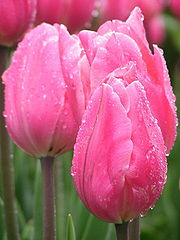
Pink is a mixture of red and white. Commonly used for Valentine's Day and Easter, pink is sometimes referred to as "the color of love." The use of the word for the color known today as pink was first recorded in the late 17th century.
Although pink is roughly considered just as a tint
of red
, in fact most variations of pink
lie between red, white and magenta
colors. This means that the pink's hue
is somewhat between red and magenta.
Roseus is a Latin
word meaning "rosy
" or "pink." Lucretius
used the word to describe the dawn
in his epic poem
On the Nature of Things
(De Rerum Natura). The word is also used in the binomial names
of several species
, such as the Rosy Starling
(Sturnus roseus) and Catharanthus roseus
. In most Indo-European languages
, the color pink is called rosa. In Persian
, it is called "Souraty", meaning "Color of the face", and in Arabic, it is called "وردي".
, flowering plant
s in the genus Dianthus
. The name derives from the frilled edge of the flowers—the verb
"to pink" dates from the 14th century and means "to decorate with a perforated or punched pattern" (possibly from German "pinken" = to peck). As noted and referenced above, the word “pink” was first used as a noun to refer to the color known today as pink in the 17th century. The verb sense of the word “pink” continues to be used today in the name of the hand tool known as pinking shears
.
bice
" amongst the green
s (p. 38), and specifies several admixtures of greenish colors made with pink—e.g. "Grasse-green is made of Pink and Bice, it is shadowed with Indigo
and Pink ... French-green of Pink and Indico [shadowed with] Indico" (pp. 38–40). In William Salmon
's Polygraphice (1673), "Pink yellow" is mentioned amongst the chief yellow
pigments (p. 96), and the reader is instructed to mix it with either Saffron
or Ceruse
for "sad" or "light" shades thereof, respectively (p. 98).
University of Maryland Professor Jo B. Paoletti, author of forthcoming book Pink and Blue: Telling the Girls From the Boys in America considers this was common usage in France orphanages during the XVIII century , but this was not the case everywhere. In the United States there was no established rule: There are theories indicating an origin of this costume in the XXth century. Zucker and Bradly say that it began in the 1920s and other authors suggest the 1910s. An article in the trade publication Earnshaw's Infants' Department in June 1918 said: "The generally accepted rule is pink for the boys, and blue for the girls. The reason is that pink, being a more decided and stronger color, is more suitable for the boy, while blue, which is more delicate and dainty, is prettier for the girl." From then until the 1940s, pink was considered appropriate for boys because being related to red it was the more masculine and decided color, while blue was considered appropriate for girls because it was the more delicate and dainty color, or related to the Virgin Mary. Since the 1940s, the societal norm was inverted; pink became considered appropriate for girls and blue
appropriate for boys, a practice that has continued into the 21st century.
Although pink is roughly considered just as a tint
Tints and shades
In color theory, a tint is the mixture of a color with white, which increases lightness, and a shade is the mixture of a color with black, which reduces lightness...
of red
Red
Red is any of a number of similar colors evoked by light consisting predominantly of the longest wavelengths of light discernible by the human eye, in the wavelength range of roughly 630–740 nm. Longer wavelengths than this are called infrared , and cannot be seen by the naked eye...
, in fact most variations of pink
Variations of pink
This article is about notable tints and shades of the color pink. These various colors are shown below.-Pink:At right is displayed web color pink.This color is identical to the color Tamarisk, the color of the flowers of the Tamarisk plant....
lie between red, white and magenta
Magenta
Magenta is a color evoked by light stronger in blue and red wavelengths than in yellowish-green wavelengths . In light experiments, magenta can be produced by removing the lime-green wavelengths from white light...
colors. This means that the pink's hue
Hue
Hue is one of the main properties of a color, defined technically , as "the degree to which a stimulus can be describedas similar to or different from stimuli that are described as red, green, blue, and yellow,"...
is somewhat between red and magenta.
Roseus is a Latin
Latin
Latin is an Italic language originally spoken in Latium and Ancient Rome. It, along with most European languages, is a descendant of the ancient Proto-Indo-European language. Although it is considered a dead language, a number of scholars and members of the Christian clergy speak it fluently, and...
word meaning "rosy
Rose (color)
Rose is the color halfway between red and magenta on the HSV color wheel, also known as the RGB color wheel, on which it is at hue angle of 330 degrees.Rose is one of the tertiary colors on the HSV color wheel...
" or "pink." Lucretius
Lucretius
Titus Lucretius Carus was a Roman poet and philosopher. His only known work is an epic philosophical poem laying out the beliefs of Epicureanism, De rerum natura, translated into English as On the Nature of Things or "On the Nature of the Universe".Virtually no details have come down concerning...
used the word to describe the dawn
Dawn
Dawn is the time that marks the beginning of the twilight before sunrise. It is recognized by the presence of weak sunlight, while the sun itself is still below the horizon...
in his epic poem
Epic poetry
An epic is a lengthy narrative poem, ordinarily concerning a serious subject containing details of heroic deeds and events significant to a culture or nation. Oral poetry may qualify as an epic, and Albert Lord and Milman Parry have argued that classical epics were fundamentally an oral poetic form...
On the Nature of Things
On the Nature of Things
De rerum natura is a 1st century BC didactic poem by the Roman poet and philosopher Lucretius with the goal of explaining Epicurean philosophy to a Roman audience. The poem, written in some 7,400 dactylic hexameters, is divided into six untitled books, and explores Epicurean physics through richly...
(De Rerum Natura). The word is also used in the binomial names
Binomial nomenclature
Binomial nomenclature is a formal system of naming species of living things by giving each a name composed of two parts, both of which use Latin grammatical forms, although they can be based on words from other languages...
of several species
Species
In biology, a species is one of the basic units of biological classification and a taxonomic rank. A species is often defined as a group of organisms capable of interbreeding and producing fertile offspring. While in many cases this definition is adequate, more precise or differing measures are...
, such as the Rosy Starling
Rosy Starling
The Rosy Starling or Rose-coloured Starling is a passerine bird in the starling family Sturnidae. It is sometimes given its own, monotypic genus Pastor...
(Sturnus roseus) and Catharanthus roseus
Catharanthus roseus
Catharanthus roseus is a species of Catharanthus native and endemic to Madagascar. Synonyms include Vinca rosea , Ammocallis rosea, and Lochnera rosea; other English names occasionally used include Cape Periwinkle, Rose Periwinkle, Rosy Periwinkle, and "Old-maid".In the wild, it is an endangered...
. In most Indo-European languages
Indo-European languages
The Indo-European languages are a family of several hundred related languages and dialects, including most major current languages of Europe, the Iranian plateau, and South Asia and also historically predominant in Anatolia...
, the color pink is called rosa. In Persian
Persian language
Persian is an Iranian language within the Indo-Iranian branch of the Indo-European languages. It is primarily spoken in Iran, Afghanistan, Tajikistan and countries which historically came under Persian influence...
, it is called "Souraty", meaning "Color of the face", and in Arabic, it is called "وردي".
Etymology
The color pink is named after the flowers called pinksDianthus
Dianthus is a genus of about 300 species of flowering plants in the family Caryophyllaceae, native mainly to Europe and Asia, with a few species extending south to north Africa, and one species in arctic North America. Common names include carnation , pink and sweet William Dianthus is a genus of...
, flowering plant
Flowering plant
The flowering plants , also known as Angiospermae or Magnoliophyta, are the most diverse group of land plants. Angiosperms are seed-producing plants like the gymnosperms and can be distinguished from the gymnosperms by a series of synapomorphies...
s in the genus Dianthus
Dianthus
Dianthus is a genus of about 300 species of flowering plants in the family Caryophyllaceae, native mainly to Europe and Asia, with a few species extending south to north Africa, and one species in arctic North America. Common names include carnation , pink and sweet William Dianthus is a genus of...
. The name derives from the frilled edge of the flowers—the verb
Verb
A verb, from the Latin verbum meaning word, is a word that in syntax conveys an action , or a state of being . In the usual description of English, the basic form, with or without the particle to, is the infinitive...
"to pink" dates from the 14th century and means "to decorate with a perforated or punched pattern" (possibly from German "pinken" = to peck). As noted and referenced above, the word “pink” was first used as a noun to refer to the color known today as pink in the 17th century. The verb sense of the word “pink” continues to be used today in the name of the hand tool known as pinking shears
Pinking shears
Pinking shears are scissors, the blades of which are sawtoothed instead of straight. They leave a zigzag pattern instead of a straight edge.Pinking shears have a utilitarian function for cutting woven cloth. Cloth edges that are unfinished will easily fray, the weave becoming undone and threads...
.
Pinke
In the 17th century, the word pink or pinke was also used to describe a yellowish pigment, which was mixed with blue colors to yield greenish colors. Thomas Jenner's A Book of Drawing, Limning, Washing (1652) categorizes "Pink & blewBlue
Blue is a colour, the perception of which is evoked by light having a spectrum dominated by energy with a wavelength of roughly 440–490 nm. It is considered one of the additive primary colours. On the HSV Colour Wheel, the complement of blue is yellow; that is, a colour corresponding to an equal...
bice
Bice
Bice, from the French bis, a word of doubtful origin, originally meaning dark-coloured, was a term applied in English to particular green or blue pigments. In French the terms vert bis and azur bis mean dark green and dark blue respectively...
" amongst the green
Green
Green is a color, the perception of which is evoked by light having a spectrum dominated by energy with a wavelength of roughly 520–570 nanometres. In the subtractive color system, it is not a primary color, but is created out of a mixture of yellow and blue, or yellow and cyan; it is considered...
s (p. 38), and specifies several admixtures of greenish colors made with pink—e.g. "Grasse-green is made of Pink and Bice, it is shadowed with Indigo
Indigo
Indigo is a color named after the purple dye derived from the plant Indigofera tinctoria and related species. The color is placed on the electromagnetic spectrum between about 420 and 450 nm in wavelength, placing it between blue and violet...
and Pink ... French-green of Pink and Indico [shadowed with] Indico" (pp. 38–40). In William Salmon
William Salmon
William Salmon , advertising himself as "Professor of Physick", was a writer of medical texts that savor to the modern eye of quackery. His Medicina Practica, with the Claris Alcymiae, reveals its scope in its subtitle:...
's Polygraphice (1673), "Pink yellow" is mentioned amongst the chief yellow
Yellow
Yellow is the color evoked by light that stimulates both the L and M cone cells of the retina about equally, with no significant stimulation of the S cone cells. Light with a wavelength of 570–590 nm is yellow, as is light with a suitable mixture of red and green...
pigments (p. 96), and the reader is instructed to mix it with either Saffron
Saffron (color)
Saffron is a color that is a tone of golden yellow resembling the color of the tip of the saffron crocus thread, from which the spice saffron is derived.The first recorded use of saffron as a color name in English was in 1200...
or Ceruse
Venetian ceruse
Venetian Ceruse, also known as Spirits of Saturn, was a 16th century cosmetic used as a skin whitener. It was in great demand and considered the best available at that time. The product contained a pigment composed of white lead, which was understood to cause lead poisoning that would eventually...
for "sad" or "light" shades thereof, respectively (p. 98).
In gender
- The use of pink as distinctive of girls can be dated back at least to 1868, in Louisa Mae Alcott's Little WomenLittle WomenLittle Women is a novel by American author Louisa May Alcott . The book was written and set in the Alcott family home, Orchard House, in Concord, Massachusetts. It was published in two volumes in 1868 and 1869...
, when after being shown boy and girl twins, Laurie asks:
University of Maryland Professor Jo B. Paoletti, author of forthcoming book Pink and Blue: Telling the Girls From the Boys in America considers this was common usage in France orphanages during the XVIII century , but this was not the case everywhere. In the United States there was no established rule: There are theories indicating an origin of this costume in the XXth century. Zucker and Bradly say that it began in the 1920s and other authors suggest the 1910s. An article in the trade publication Earnshaw's Infants' Department in June 1918 said: "The generally accepted rule is pink for the boys, and blue for the girls. The reason is that pink, being a more decided and stronger color, is more suitable for the boy, while blue, which is more delicate and dainty, is prettier for the girl." From then until the 1940s, pink was considered appropriate for boys because being related to red it was the more masculine and decided color, while blue was considered appropriate for girls because it was the more delicate and dainty color, or related to the Virgin Mary. Since the 1940s, the societal norm was inverted; pink became considered appropriate for girls and blue
Baby blue
Baby blue is a tint of blue, one of the pastel colors.The first recorded use of baby blue as a color name in English was in 1892.-Bubbles:Bubbles is a pale tint of baby blue....
appropriate for boys, a practice that has continued into the 21st century.
- Some feminists have sought to 'reclaim' the color pink. For example, the Swedish feminist party Feminist InitiativeFeminist Initiative (Sweden)Feminist Initiative is a feminist political party in Sweden. The party was formed in 2005 and announced on 9 September 2005 that it would put up candidates for the 2006 parliamentary elections in Sweden...
and the American activist women's group Code Pink: Women for PeaceCode PinkCode Pink: Women for Peace is an anti-war group that is mainly composed of women. It has regional offices in Los Angeles, San Francisco, New York City, and Washington, D.C., and many more chapters in the U.S. as well as several in other countries...
use pink as their color.
- The pink ribbonPink ribbonThe pink ribbon is an international symbol of breast cancer awareness. Pink ribbons, and the color pink in general, identify the wearer or promoter with the breast cancer brand and express moral support for women with breast cancer....
is the international symbol of breast cancerBreast cancerBreast cancer is cancer originating from breast tissue, most commonly from the inner lining of milk ducts or the lobules that supply the ducts with milk. Cancers originating from ducts are known as ductal carcinomas; those originating from lobules are known as lobular carcinomas...
awareness. Pink was chosen partially because it is so strongly associated with femininity.
- It has been suggested that females prefer pink because of a preference for reddish things like ripe fruits and healthy faces, but the associated study has been criticized as "bad science".
- The phrase "pink-collar workerPink-collar workerThe term, 'pink-collar worker' is in reference to a blue-collar worker, or a white-collar worker. A 'pink-collar worker' performs work said to be stereotypical women's work and are typically in the service industry.- Occupations :...
" refers, in the West, to persons working in fields or jobs conventionally regarded as "women's workWomen's workWomen's work or woman's work is a term used particularly in the West to indicate work that is believed to be exclusively the domain of women and associates particular tasks with the female gender. It is particularly used with regards to work that a mother or wife will perform within a family and...
".
In sexuality
- Whereas Jewish peoplePeoplePeople is a plurality of human beings or other beings possessing enough qualities constituting personhood. It has two usages:* as the plural of person or a group of people People is a plurality of human beings or other beings possessing enough qualities constituting personhood. It has two usages:*...
were forced to wear a yellow star of DavidNazi concentration camp badgesNazi concentration camp badges, primarily triangles, were part of the system of identification in Nazi camps. They were used in the concentration camps in the Nazi-occupied countries to identify the reason the prisoners had been placed there. The triangles were made of fabric and were sewn on...
under Nazi rule, and Roma people were forced to wear a black triangle, men imprisoned on accusations of homosexualityHomosexualityHomosexuality is romantic or sexual attraction or behavior between members of the same sex or gender. As a sexual orientation, homosexuality refers to "an enduring pattern of or disposition to experience sexual, affectional, or romantic attractions" primarily or exclusively to people of the same...
or same-sex sexual activity were forced to wear a pink trianglePink triangleThe pink triangle was one of the Nazi concentration camp badges, used to identify male prisoners who were sent there because of their homosexuality. Every prisoner had to wear a downward-pointing triangle on his or her jacket, the colour of which was to categorise him or her by "kind"...
. Nowadays, a pink triangle (sometimes pointing up, contrary to Nazi usage) is often worn with pride. - A DutchNetherlandsThe Netherlands is a constituent country of the Kingdom of the Netherlands, located mainly in North-West Europe and with several islands in the Caribbean. Mainland Netherlands borders the North Sea to the north and west, Belgium to the south, and Germany to the east, and shares maritime borders...
newsgroup about homosexuality is called nl.roze (roze being the Dutch word for pink), while in Britain, Pink NewsPink NewsPink News is a United Kingdom-based online gay newspaper.The paper version, The Pink News, officially launched at the Law Society on 28 June 2006 by Francis Maude, Chairman of the Conservative Party, Meg Munn, Minister for Equality, Simon Hughes, President of the Liberal Democrats and Meg Hillier,...
is a leading gay newspaper and online news service. There is a magazine called Pink for the lesbian, gay, bisexual and transsexual (LGBT) community which has different editions for various metropolitan areaMetropolitan areaThe term metropolitan area refers to a region consisting of a densely populated urban core and its less-populated surrounding territories, sharing industry, infrastructure, and housing. A metropolitan area usually encompasses multiple jurisdictions and municipalities: neighborhoods, townships,...
s. In France Pink TVPink TVPink TV is Europe's second gay satellite channel , started in France on 25 October 2004, it costs €9 per month, and is mostly funded by TF1 and Canal Plus, terrestrial channels in France. It is now possible to access Pink TV via satellite, cable and DSL providers. Highlights include Queer as Folk,...
is an LGBT cable channel. - In business, the pink pound or pink dollar refers to the spending power of the LGBT community. Advertising agenciesAdvertisingAdvertising is a form of communication used to persuade an audience to take some action with respect to products, ideas, or services. Most commonly, the desired result is to drive consumer behavior with respect to a commercial offering, although political and ideological advertising is also common...
sometimes call the gay market the pink economy. - Though long discontinued, the now mainstream gay-oriented magazine The AdvocateThe AdvocateThe Advocate is an American LGBT-interest magazine, printed monthly and available by subscription. The Advocate brand also includes a web site. Both magazine and web site have an editorial focus on news, politics, opinion, and arts and entertainment of interest to LGBT people...
for many years of its early history featured a sometimes sizable section of personal ads and mostly sexually-oriented ads printed on pink paper and referred to as "the pink pages." As the gay rights movement gained increased mainstream momentum and public acceptance, and as the magazine itself became less underground and was distributed more widely on newsstands in "middle America," the publishers made the section more easily removable for those who preferred not to view/keep it with the main body of the magazine, and The Advocate eventually ceased to include the "pink pages" at all.
Reptiles
- The pink iguana is an iguanaIguanaIguana is a herbivorous genus of lizard native to tropical areas of Central America and the Caribbean. The genus was first described in 1768 by Austrian naturalist Josephus Nicolaus Laurenti in his book Specimen Medicum, Exhibens Synopsin Reptilium Emendatam cum Experimentis circa Venena...
that was first identified in 1986 and first recognized as a distinct speciesSpeciesIn biology, a species is one of the basic units of biological classification and a taxonomic rank. A species is often defined as a group of organisms capable of interbreeding and producing fertile offspring. While in many cases this definition is adequate, more precise or differing measures are...
in 2009.
Mammals
- Many pigPigA pig is any of the animals in the genus Sus, within the Suidae family of even-toed ungulates. Pigs include the domestic pig, its ancestor the wild boar, and several other wild relatives...
s are colored pink. - The so-called "white elephantWhite elephant (pachyderm)A white elephant is a rare kind of elephant, but not a distinct species. Although often depicted as snow white, their skin is normally a soft reddish-brown, turning a light pink when wet. They have fair eyelashes and toenails....
" is revered in several countries in Southeast AsiaSoutheast AsiaSoutheast Asia, South-East Asia, South East Asia or Southeastern Asia is a subregion of Asia, consisting of the countries that are geographically south of China, east of India, west of New Guinea and north of Australia. The region lies on the intersection of geological plates, with heavy seismic...
and is naturally pink. - The Pink DolphinPink dolphinPink dolphin is the common name of two different species of dolphins:* The Chinese white dolphin of the Pearl River Delta that live in and around Hong Kong...
is a freshwater river dolphinRiver dolphinRiver dolphins are the four living species of dolphin that reside in freshwater rivers and estuaries. River dolphins inhabit areas of Asia and South America. They are classed in the Platanistoidea superfamily of cetaceans. Three species live in fresh water rivers. The fourth species, the La Plata...
endemic to the OrinocoOrinocoThe Orinoco is one of the longest rivers in South America at . Its drainage basin, sometimes called the Orinoquia, covers , with 76.3% of it in Venezuela and the remainder in Colombia...
, AmazonAmazon RiverThe Amazon of South America is the second longest river in the world and by far the largest by waterflow with an average discharge greater than the next seven largest rivers combined...
and Araguaia/Tocantins RiverTocantins RiverThe Tocantins is a river in Brazil, the central fluvial artery of the country. In the Tupi language, its name means "toucan's beak" . It runs from south to north for about 2,640 km. It is not really a branch of the Amazon River, although usually so considered, since its waters flow into the...
systems of BrazilBrazilBrazil , officially the Federative Republic of Brazil , is the largest country in South America. It is the world's fifth largest country, both by geographical area and by population with over 192 million people...
, BoliviaBoliviaBolivia officially known as Plurinational State of Bolivia , is a landlocked country in central South America. It is the poorest country in South America...
, PeruPeruPeru , officially the Republic of Peru , is a country in western South America. It is bordered on the north by Ecuador and Colombia, on the east by Brazil, on the southeast by Bolivia, on the south by Chile, and on the west by the Pacific Ocean....
, EcuadorEcuadorEcuador , officially the Republic of Ecuador is a representative democratic republic in South America, bordered by Colombia on the north, Peru on the east and south, and by the Pacific Ocean to the west. It is one of only two countries in South America, along with Chile, that do not have a border...
, ColombiaColombiaColombia, officially the Republic of Colombia , is a unitary constitutional republic comprising thirty-two departments. The country is located in northwestern South America, bordered to the east by Venezuela and Brazil; to the south by Ecuador and Peru; to the north by the Caribbean Sea; to the...
and VenezuelaVenezuelaVenezuela , officially called the Bolivarian Republic of Venezuela , is a tropical country on the northern coast of South America. It borders Colombia to the west, Guyana to the east, and Brazil to the south...
. It is an endangered speciesEndangered speciesAn endangered species is a population of organisms which is at risk of becoming extinct because it is either few in numbers, or threatened by changing environmental or predation parameters...
and has a brain 40% larger than a human's.
In art
- In 1973, Sheila Levrant de BrettevilleSheila Levrant de BrettevilleSheila Levrant de Bretteville is a graphic designer, artist and educator whose work reflects her belief in the importance of feminist principles and user participation in graphic design...
created "Pink," a broadside meant to explore the notions of gender as associated with the color pink, for an American Institute of Graphic Arts exhibition about color. This was the only entry about the color pink. Various women including many in the Feminist Studio Workshop at the Woman's BuildingWoman's BuildingThe Woman's Building was an non-profit arts and education center located in Los Angeles, California, in the United States. The Woman's Building focused on feminist art and served as a venue for the women's movement and was spearheaded by artist Judy Chicago, graphic designer Sheila Levrant de...
submitted entries exploring their association with the color. De Bretteville arranged the squares of paper to form a “quilt” from which posters were printed and disseminated throughout Los Angeles. She was often called "Pinky" as a result. - In 1993, artist Gioia Fonda created a conceptual piece in the form of a week long holiday called pink week. The intention of pink week is to liberate the color pink from all dogma and simply celebrate the color pink as a color.
- Bubblegum Pink is an installation by the artist duo Bigert & Bergstrom which "confronted [the viewer] with three different mental climates" involving large amounts of pink. This mirrors the use of the color in American prisons to calm aggressive prisoners. It features a pink cell and a carpet worn by repetitive pacing.
- Christo and Jeanne-ClaudeChristo and Jeanne-ClaudeChristo and Jeanne-Claude were a married couple who created environmental works of art...
's Surrounded Islands wrapped wooded islands in Miami's Biscayne BayBiscayne BayBiscayne Bay is a lagoon that is approximately 35 miles long and up to 8 miles wide located on the Atlantic coast of South Florida, United States. It is usually divided for purposes of discussion and analysis into three parts: North Bay, Central Bay, and South Bay. Its area is...
with 6500000 square feet (603,869.8 m²) of bright pink fabric. Thomas von Taschitzki has said that "the monochrome pink wrappings"..."form a counterpoint to the small green wooded islands." - Many of Franz West's aluminiumAluminiumAluminium or aluminum is a silvery white member of the boron group of chemical elements. It has the symbol Al, and its atomic number is 13. It is not soluble in water under normal circumstances....
sculptures were often painted a bright pink, for example Sexualitatssymbol (Symbol of Sexuality). West has said that the pink was intended as an "outcry to nature".
In human culture
- In the FrenchFranceThe French Republic , The French Republic , The French Republic , (commonly known as France , is a unitary semi-presidential republic in Western Europe with several overseas territories and islands located on other continents and in the Indian, Pacific, and Atlantic oceans. Metropolitan France...
academic dress systemAcademic dressAcademic dress or academical dress is a traditional form of clothing for academic settings, primarily tertiary education, worn mainly by those that have been admitted to a university degree or hold a status that entitles them to assume them...
, the five traditional fields of study (Arts, Science, Medicine, Law and Divinity) are each symbolized by a distinctive color, which appears in the academic dressAcademic dressAcademic dress or academical dress is a traditional form of clothing for academic settings, primarily tertiary education, worn mainly by those that have been admitted to a university degree or hold a status that entitles them to assume them...
of the people who graduated in this field. Redcurrant, an extremely red shade of pink, is the distinctive color for Medicine (and other health-related fields) :fr:Groseille (couleur).
- In Ireland, Support group for Irish Pink Adoptions defines a pink family as a relatively neutral umbrella term for the single gay men, single lesbians, or same-gender couples who intend to adopt, are in the process of adopting, or have adopted. It also covers adults born/raised in such families. The group welcome the input of other people touched by adoption, especially people who were adopted as children and are now adults.
- Seeing pink elephantsSeeing pink elephants"Seeing pink elephants" is a euphemism for drunken hallucination, caused by alcoholic hallucinosis or delirium tremens. The first recorded use of the term is by Jack London in 1913, who describes one kind of alcoholic, in the autobiographical John Barleycorn, as "the man whom we all know, stupid,...
is a euphemismEuphemismA euphemism is the substitution of a mild, inoffensive, relatively uncontroversial phrase for another more frank expression that might offend or otherwise suggest something unpleasant to the audience...
for hallucinationHallucinationA hallucination, in the broadest sense of the word, is a perception in the absence of a stimulus. In a stricter sense, hallucinations are defined as perceptions in a conscious and awake state in the absence of external stimuli which have qualities of real perception, in that they are vivid,...
s caused by delirium tremensDelirium tremensDelirium tremens is an acute episode of delirium that is usually caused by withdrawal from alcohol, first described in 1813...
. The concept was used in the Disney's animated film DumboDumboDumbo is a 1941 American animated film produced by Walt Disney and released on October 23, 1941, by RKO Radio Pictures.The fourth film in the Walt Disney Animated Classics series, Dumbo is based upon the storyline written by Helen Aberson and illustrated by Harold Pearl for the prototype of a...
when the title character accidentally becomes drunk and sees a parade of pink elephants. - A pink lady is an alcoholic beverage made with ginGinGin is a spirit which derives its predominant flavour from juniper berries . Although several different styles of gin have existed since its origins, it is broadly differentiated into two basic legal categories...
and grenadine syrup and may include other ingredients. A pink squirrel is made of white creme de cacao, creme de noyaux and cream. - In the 19th and early 20th century, pink was the traditional color used in cartographyCartographyCartography is the study and practice of making maps. Combining science, aesthetics, and technique, cartography builds on the premise that reality can be modeled in ways that communicate spatial information effectively.The fundamental problems of traditional cartography are to:*Set the map's...
to represent the British EmpireBritish EmpireThe British Empire comprised the dominions, colonies, protectorates, mandates and other territories ruled or administered by the United Kingdom. It originated with the overseas colonies and trading posts established by England in the late 16th and early 17th centuries. At its height, it was the...
. - Mary KayMary KayMary Kay, Inc. is a privately held company that sells skin care and cosmetics products. Mary Kay World Headquarters is located in Addison, Texas, United States, a Dallas suburb. Mary Kay Ash founded Mary Kay Inc. on Friday, September 13, 1963...
in 1968, Mary Kay Ash, purchased the first Pink Cadillac, which eventually became the trademark of her company. - Pink MoneyPink moneyPink money describes the purchasing power of the gay community, often especially with respect to political donations. With the rise of the gay rights movement, pink money has gone from being a fringe or marginalized market to a thriving industry in many parts of the Western world such as the...
refers to the financial power of the LGBTLGBTLGBT is an initialism that collectively refers to "lesbian, gay, bisexual, and transgender" people. In use since the 1990s, the term "LGBT" is an adaptation of the initialism "LGB", which itself started replacing the phrase "gay community" beginning in the mid-to-late 1980s, which many within the...
community. - When one gets laid off or fired from one's jobJob (role)A job is a regular activity performed in exchange for payment. A person usually begins a job by becoming an employee, volunteering, or starting a business. The duration of a job may range from an hour to a lifetime . If a person is trained for a certain type of job, they may have a profession...
, in the United StatesUnited StatesThe United States of America is a federal constitutional republic comprising fifty states and a federal district...
, it is called getting a pink slip. - The Pink PantherThe Pink Panther (character)The Pink Panther is the main and title character in the opening and closing credit sequences of every film in The Pink Panther series except for A Shot in the Dark and Inspector Clouseau. His popularity spawned a series of theatrical shorts, merchandise, a comic book, and television cartoons...
is a popular cartoonCartoonA cartoon is a form of two-dimensional illustrated visual art. While the specific definition has changed over time, modern usage refers to a typically non-realistic or semi-realistic drawing or painting intended for satire, caricature, or humor, or to the artistic style of such works...
character. - In Power RangersPower RangersPower Rangers is a long-running American entertainment and merchandising franchise built around a live action children's television series featuring teams of costumed heroes...
and their Japanese origins Super SentaiSuper SentaiThe is the name given to the long-running Japanese superhero team genre of shows produced by Toei Co., Ltd., Toei Agency and Bandai, and aired by TV Asahi...
the Pink Rangers are always female and there was never a male Pink Ranger on the show. The first Pink Ranger, Kimberly HartKimberly HartKimberly Ann Hart is a fictional character in the Power Rangers universe. She was played by actress Amy Jo Johnson during the first three seasons of the show, plus on the two feature films of the franchise. Kimberly is best remembered as the first Pink Ranger from the first entry of the franchise...
, became an icon during the first season of the show. - In The Powerpuff GirlsThe Powerpuff GirlsThe Powerpuff Girls is an American animated television series created by animator Craig McCracken and produced by Hanna-Barbera for Cartoon Network...
, the leader of the team Blossom wears a pink dress that matches her pink eyes. - Pink Cadillac was a 1989 movie starring Clint Eastwood.
- The color pink is often used to represent women or young girls. (See discussion above in section on Pink in gender and sexuality.).
- JaipurJaipurJaipur , also popularly known as the Pink City, is the capital and largest city of the Indian state of Rajasthan. Founded on 18 November 1727 by Maharaja Sawai Jai Singh II, the ruler of Amber, the city today has a population of more than 3.1 million....
is known as the Pink City for its many colored buildings. - In the pink is an English idiomatic expression for in good condition or in good healthHealthHealth is the level of functional or metabolic efficiency of a living being. In humans, it is the general condition of a person's mind, body and spirit, usually meaning to be free from illness, injury or pain...
. - Pink is the official color for Breast CancerBreast cancerBreast cancer is cancer originating from breast tissue, most commonly from the inner lining of milk ducts or the lobules that supply the ducts with milk. Cancers originating from ducts are known as ductal carcinomas; those originating from lobules are known as lobular carcinomas...
awareness. - In SpanishSpanish languageSpanish , also known as Castilian , is a Romance language in the Ibero-Romance group that evolved from several languages and dialects in central-northern Iberia around the 9th century and gradually spread with the expansion of the Kingdom of Castile into central and southern Iberia during the...
and ItalianItalian languageItalian is a Romance language spoken mainly in Europe: Italy, Switzerland, San Marino, Vatican City, by minorities in Malta, Monaco, Croatia, Slovenia, France, Libya, Eritrea, and Somalia, and by immigrant communities in the Americas and Australia...
, a "pink novel" (novela rosa in Spanish, romanzo rosa in Italian) is a sentimentalSentimentalitySentimentality originally indicated the reliance on feelings as a guide to truth, but current usage defines it as an appeal to shallow, uncomplicated emotions at the expense of reason....
novel marketed to women. - In Nazi GermanyNazi GermanyNazi Germany , also known as the Third Reich , but officially called German Reich from 1933 to 1943 and Greater German Reich from 26 June 1943 onward, is the name commonly used to refer to the state of Germany from 1933 to 1945, when it was a totalitarian dictatorship ruled by...
, in the WehrmachtWehrmachtThe Wehrmacht – from , to defend and , the might/power) were the unified armed forces of Nazi Germany from 1935 to 1945. It consisted of the Heer , the Kriegsmarine and the Luftwaffe .-Origin and use of the term:...
, the panzer divisionPanzer DivisionA panzer division was an armored division in the army and air force branches of the Wehrmacht as well as the Waffen-SS of Nazi Germany during World War II....
s used pink military flags. - PinkPink (singer)Alecia Beth Moore , better known by her stage name Pink , is an American singer-songwriter, musician and actress....
is an AmericanUnited StatesThe United States of America is a federal constitutional republic comprising fifty states and a federal district...
singer-songwriter whose real name is Alecia Moore. - "PinkPink (song)"Pink" is a song by American hard rock band Aerosmith. It was written by Steven Tyler and professional songwriters Richie Supa and Glen Ballard...
" is a song by AerosmithAerosmithAerosmith is an American rock band, sometimes referred to as "The Bad Boys from Boston" and "America's Greatest Rock and Roll Band". Their style, which is rooted in blues-based hard rock, has come to also incorporate elements of pop, heavy metal, and rhythm and blues, and has inspired many...
. - Pink, being a 'watered-down' red, is sometimes used in a derogatory way to describe a person with mild communistCommunismCommunism is a social, political and economic ideology that aims at the establishment of a classless, moneyless, revolutionary and stateless socialist society structured upon common ownership of the means of production...
or socialistSocialismSocialism is an economic system characterized by social ownership of the means of production and cooperative management of the economy; or a political philosophy advocating such a system. "Social ownership" may refer to any one of, or a combination of, the following: cooperative enterprises,...
beliefs (see PinkoPinkoPinko is a term for a person regarded as being sympathetic to communism, though not necessarily a Communist Party member.The term has its origins in the notion that pink is a lighter shade of red, the color associated with communism...
).
- The Pink HouseCasa RosadaLa Casa Rosada is the official seat of the executive branch of the government of Argentina, and of the offices of the President. The President normally lives at the Quinta de Olivos, a compound in Olivos, Buenos Aires Province. Its characteristic color is pink, and is considered one of the most...
is the official seat of the executive branch of the government of ArgentinaArgentinaArgentina , officially the Argentine Republic , is the second largest country in South America by land area, after Brazil. It is constituted as a federation of 23 provinces and an autonomous city, Buenos Aires...
. - Code PinkCode PinkCode Pink: Women for Peace is an anti-war group that is mainly composed of women. It has regional offices in Los Angeles, San Francisco, New York City, and Washington, D.C., and many more chapters in the U.S. as well as several in other countries...
is an anti-warAnti-warAn anti-war movement is a social movement, usually in opposition to a particular nation's decision to start or carry on an armed conflict, unconditional of a maybe-existing just cause. The term can also refer to pacifism, which is the opposition to all use of military force during conflicts. Many...
organization co-founded in 2002 by anti-corporateCorporationA corporation is created under the laws of a state as a separate legal entity that has privileges and liabilities that are distinct from those of its members. There are many different forms of corporations, most of which are used to conduct business. Early corporations were established by charter...
globalizationGlobalizationGlobalization refers to the increasingly global relationships of culture, people and economic activity. Most often, it refers to economics: the global distribution of the production of goods and services, through reduction of barriers to international trade such as tariffs, export fees, and import...
activist Medea BenjaminMedea BenjaminMedea Benjamin is an American political activist, best known for co-founding Code Pink and, along with her husband, activist and author Kevin Danaher, fair trade advocacy group Global Exchange...
of the NGO Global ExchangeGlobal ExchangeGlobal Exchange is an advocacy group and non-governmental organization , based in San Francisco, California, United States. The group's mission is to promote human rights and social, economic, and environmental justice around the world.-History:...
in San Francisco. - The term pink revolution may be used to refer to the overthrow of President Askar AkayevAskar AkayevAskar Akayevich Akayev served as the President of Kyrgyzstan from 1990 until his overthrow in the March 2005 Tulip Revolution....
and his government in the Central Asian republic of KyrgyzstanKyrgyzstanKyrgyzstan , officially the Kyrgyz Republic is one of the world's six independent Turkic states . Located in Central Asia, landlocked and mountainous, Kyrgyzstan is bordered by Kazakhstan to the north, Uzbekistan to the west, Tajikistan to the southwest and China to the east...
after the parliamentary electionsKyrgyz parliamentary elections, 2005The 2005 Kyrgyz parliamentary elections were held 27 February 2005 with run-offs held on 13 March 2005. Over 400 candidates ran for the new 75-member unicameral legislative assembly. According to media reports, only six seats were won by the opposition, although most candidates were officially...
of February 27 and of March 13, 2005, although it is more commonly called the tulip revolutionTulip RevolutionThe Tulip Revolution or First Kyrgyz Revolution refers to the overthrow of President Askar Akayev and his government in the Central Asian republic of Kyrgyzstan after the parliamentary elections of February 27 and of March 13, 2005...
. - In CatholicismCatholicismCatholicism is a broad term for the body of the Catholic faith, its theologies and doctrines, its liturgical, ethical, spiritual, and behavioral characteristics, as well as a religious people as a whole....
, pink (called roseRose (color)Rose is the color halfway between red and magenta on the HSV color wheel, also known as the RGB color wheel, on which it is at hue angle of 330 degrees.Rose is one of the tertiary colors on the HSV color wheel...
by the Catholic Church) symbolizes joy and happiness. It is used for the Third Sunday of AdventAdventAdvent is a season observed in many Western Christian churches, a time of expectant waiting and preparation for the celebration of the Nativity of Jesus at Christmas. It is the beginning of the Western liturgical year and commences on Advent Sunday, called Levavi...
and the Fourth Sunday of LentLentIn the Christian tradition, Lent is the period of the liturgical year from Ash Wednesday to Easter. The traditional purpose of Lent is the preparation of the believer – through prayer, repentance, almsgiving and self-denial – for the annual commemoration during Holy Week of the Death and...
(see Laetare SundayLaetare SundayLaetare Sunday , so called from the incipit of the Introit at Mass, "Laetare Jerusalem" , is a name often used to denote the fourth Sunday of the season of Lent in the Christian liturgical calendar...
) to mark the halfway point in these seasons of penance. For this reason, one of the candles in an Advent wreathAdvent wreathThe Advent wreath, or Advent crown, is a Christian tradition that symbolizes the passage of the four weeks of Advent in the liturgical calendar of the Western church...
may be pink, rather than purple. However, in some Protestant denominations, the pink candle is sometimes lit on the Fourth Sunday of AdventAdventAdvent is a season observed in many Western Christian churches, a time of expectant waiting and preparation for the celebration of the Nativity of Jesus at Christmas. It is the beginning of the Western liturgical year and commences on Advent Sunday, called Levavi...
, sometimes known as the Sunday of Love. - The Invisible Pink UnicornInvisible Pink UnicornThe Invisible Pink Unicorn is the goddess of a parody religion used to satirize theistic beliefs, taking the form of a unicorn that is paradoxically both invisible and pink...
is the goddessGoddessA goddess is a female deity. In some cultures goddesses are associated with Earth, motherhood, love, and the household. In other cultures, goddesses also rule over war, death, and destruction as well as healing....
of a parody religionParody religionA parody religion or mock religion is a parody of a religion, sect or cult. A parody religion can be a parody of several religions, sects, gurus and cults at the same time. Or, it can be a parody of no particular religion, instead parodying the concept of religious belief...
, a rhetoricRhetoricRhetoric is the art of discourse, an art that aims to improve the facility of speakers or writers who attempt to inform, persuade, or motivate particular audiences in specific situations. As a subject of formal study and a productive civic practice, rhetoric has played a central role in the Western...
al tool intended to satirizeSatireSatire is primarily a literary genre or form, although in practice it can also be found in the graphic and performing arts. In satire, vices, follies, abuses, and shortcomings are held up to ridicule, ideally with the intent of shaming individuals, and society itself, into improvement...
the contradictory properties often attributed to deitiesDeityA deity is a recognized preternatural or supernatural immortal being, who may be thought of as holy, divine, or sacred, held in high regard, and respected by believers....
. - Pink noisePink noisePink noise or 1/ƒ noise is a signal or process with a frequency spectrum such that the power spectral density is inversely proportional to the frequency. In pink noise, each octave carries an equal amount of noise power...
, also known as 1/f noise, is a signal or process with a frequency spectrum such that the power spectral density is proportional to the reciprocal of the frequency. - The leader in the Giro d'ItaliaGiro d'ItaliaThe Giro d'Italia , also simply known as The Giro, is a long distance road bicycle racing stage race for professional cyclists held over three weeks in May/early June in and around Italy. The Giro is one of the three Grand Tours , and is part of the UCI World Ranking calendar...
cycle raceRoad bicycle racingRoad bicycle racing is a bicycle racing sport held on roads, using racing bicycles. The term "road racing" is usually applied to events where competing riders start simultaneously with the winner being the first to the line at the end of the course .Historically, the most...
wears a pink jersey (maglia rosa); this reflects the distinctive pink-colored newsprint of the sponsoring ItalianItalyItaly , officially the Italian Republic languages]] under the European Charter for Regional or Minority Languages. In each of these, Italy's official name is as follows:;;;;;;;;), is a unitary parliamentary republic in South-Central Europe. To the north it borders France, Switzerland, Austria and...
La Gazzetta dello SportLa Gazzetta dello SportLa Gazzetta dello Sport is an Italian newspaper dedicated to coverage of various sports. It was first published on April 3, 1896, allowing it to cover the first modern Olympic Games held in Athens...
newspaperNewspaperA newspaper is a scheduled publication containing news of current events, informative articles, diverse features and advertising. It usually is printed on relatively inexpensive, low-grade paper such as newsprint. By 2007, there were 6580 daily newspapers in the world selling 395 million copies a...
.
- The Pink 'Un is or was the name of twoThe Pink'unThe Pink'un was a weekly, paid-for newspaper and website, that focused on Norwich City football club and also non-league football in Norfolk, England...
differentThe Sporting TimesThe Sporting Times was a weekly British newspaper devoted chiefly to sport, and in particular to horse racing...
English newspapers focused on sporting news. - The Financial TimesFinancial TimesThe Financial Times is an international business newspaper. It is a morning daily newspaper published in London and printed in 24 cities around the world. Its primary rival is the Wall Street Journal, published in New York City....
is often referred to as the Pink Sheet or Pink 'Un.
See also
- Fuchsia (color)Fuchsia (color)Fuchsia is a vivid reddish or pinkish purple color named after the flower of the fuchsia plant, itself named after the German scientist Leonhart Fuchs...
Fuchsia Pink - List of colors
- Pink Panther
- Rose (color)Rose (color)Rose is the color halfway between red and magenta on the HSV color wheel, also known as the RGB color wheel, on which it is at hue angle of 330 degrees.Rose is one of the tertiary colors on the HSV color wheel...
- RoséRoséA rosé is a type of wine that has some of the color typical of a red wine, but only enough to turn it pink. The pink color can range from a pale orange to a vivid near-purple, depending on the grapes and wine making techniques.- Production techniques :There are three major ways to produce rosé...
, a wine whose color is neither red nor white - Variations of pinkVariations of pinkThis article is about notable tints and shades of the color pink. These various colors are shown below.-Pink:At right is displayed web color pink.This color is identical to the color Tamarisk, the color of the flowers of the Tamarisk plant....