


Color wheel

Encyclopedia
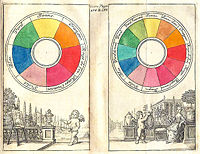
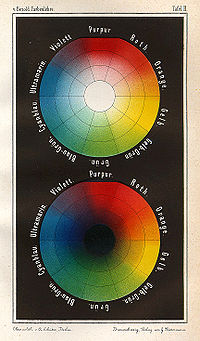
Color
Color or colour is the visual perceptual property corresponding in humans to the categories called red, green, blue and others. Color derives from the spectrum of light interacting in the eye with the spectral sensitivities of the light receptors...
hue
Hue
Hue is one of the main properties of a color, defined technically , as "the degree to which a stimulus can be describedas similar to or different from stimuli that are described as red, green, blue, and yellow,"...
s around a circle that shows relationships between primary color
Primary color
Primary colors are sets of colors that can be combined to make a useful range of colors. For human applications, three primary colors are usually used, since human color vision is trichromatic....
s, secondary color
Secondary color
A secondary color is a color made by mixing two primary colors in a given color space. Examples include the following:-Light : red + green = yellowgreen + blue = cyan blue +...
s, complementary color
Complementary color
Complementary colors are pairs of colors that are of “opposite” hue in some color model. The exact hue “complementary” to a given hue depends on the model in question, and perceptually uniform, additive, and subtractive color models, for example, have differing complements for any given color.-...
s, etc.
Some sources use the terms color wheel and color circle interchangeably; however, one term or the other may be more prevalent in certain fields or certain versions as mentioned above. For instance, some reserve the term color wheel for mechanical rotating devices, such as color tops or filter wheels. Others classify various color wheels as color disc, color chart, and color scale varieties.
As an illustrative model, artists typically use red
Red
Red is any of a number of similar colors evoked by light consisting predominantly of the longest wavelengths of light discernible by the human eye, in the wavelength range of roughly 630–740 nm. Longer wavelengths than this are called infrared , and cannot be seen by the naked eye...
, yellow
Yellow
Yellow is the color evoked by light that stimulates both the L and M cone cells of the retina about equally, with no significant stimulation of the S cone cells. Light with a wavelength of 570–590 nm is yellow, as is light with a suitable mixture of red and green...
, and blue
Blue
Blue is a colour, the perception of which is evoked by light having a spectrum dominated by energy with a wavelength of roughly 440–490 nm. It is considered one of the additive primary colours. On the HSV Colour Wheel, the complement of blue is yellow; that is, a colour corresponding to an equal...
primaries (RYB color model
RYB color model
RYB is a historical set of colors used in subtractive color mixing, and is one commonly used set of primary colors...
) arranged at three equally spaced points around their color wheel. Printers and others who use modern subtractive color methods and terminology use magenta
Magenta
Magenta is a color evoked by light stronger in blue and red wavelengths than in yellowish-green wavelengths . In light experiments, magenta can be produced by removing the lime-green wavelengths from white light...
, yellow
Yellow
Yellow is the color evoked by light that stimulates both the L and M cone cells of the retina about equally, with no significant stimulation of the S cone cells. Light with a wavelength of 570–590 nm is yellow, as is light with a suitable mixture of red and green...
, and cyan
Cyan
Cyan from , transliterated: kýanos, meaning "dark blue substance") may be used as the name of any of a number of colors in the blue/green range of the spectrum. In reference to the visible spectrum cyan is used to refer to the color obtained by mixing equal amounts of green and blue light or the...
as subtractive primaries. Intermediate and interior points of color wheels and circles represent color mixtures. In a paint or subtractive color wheel, the "center of gravity" is usually (but not always) black, representing all colors of light being absorbed; in a color circle, on the other hand, the center is white or gray, indicating a mixture of different wavelengths of light (all wavelengths, or two complementary colors, for example).
The arrangement of colors around the color circle is often considered to be in correspondence with the wavelength
Wavelength
In physics, the wavelength of a sinusoidal wave is the spatial period of the wave—the distance over which the wave's shape repeats.It is usually determined by considering the distance between consecutive corresponding points of the same phase, such as crests, troughs, or zero crossings, and is a...
s of light
Light
Light or visible light is electromagnetic radiation that is visible to the human eye, and is responsible for the sense of sight. Visible light has wavelength in a range from about 380 nanometres to about 740 nm, with a frequency range of about 405 THz to 790 THz...
, as opposed to hues, in accord with the original color circle of Isaac Newton
Isaac Newton
Sir Isaac Newton PRS was an English physicist, mathematician, astronomer, natural philosopher, alchemist, and theologian, who has been "considered by many to be the greatest and most influential scientist who ever lived."...
. Modern color circles include the purple
Purple
Purple is a range of hues of color occurring between red and blue, and is classified as a secondary color as the colors are required to create the shade....
s, however, between red and violet. Color scientists and psychologists often use the additive primaries, red
Red
Red is any of a number of similar colors evoked by light consisting predominantly of the longest wavelengths of light discernible by the human eye, in the wavelength range of roughly 630–740 nm. Longer wavelengths than this are called infrared , and cannot be seen by the naked eye...
, green
Green
Green is a color, the perception of which is evoked by light having a spectrum dominated by energy with a wavelength of roughly 520–570 nanometres. In the subtractive color system, it is not a primary color, but is created out of a mixture of yellow and blue, or yellow and cyan; it is considered...
and blue
Blue
Blue is a colour, the perception of which is evoked by light having a spectrum dominated by energy with a wavelength of roughly 440–490 nm. It is considered one of the additive primary colours. On the HSV Colour Wheel, the complement of blue is yellow; that is, a colour corresponding to an equal...
; and often refer to their arrangement around a circle as a color circle as opposed to a color wheel.
Colors of the color wheel
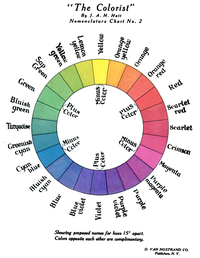
Primary color
Primary colors are sets of colors that can be combined to make a useful range of colors. For human applications, three primary colors are usually used, since human color vision is trichromatic....
s. The corresponding secondary color
Secondary color
A secondary color is a color made by mixing two primary colors in a given color space. Examples include the following:-Light : red + green = yellowgreen + blue = cyan blue +...
s are green, orange, and violet. The tertiary color
Tertiary color
A tertiary color is a color made by mixing one primary color with one secondary color, in a given color space such as RGB or RYB.Unlike primary and secondary colors, these are not represented by one firmly established name each, but the following examples include some typical names.Brown and grey...
s are red–orange, red–violet, yellow–orange, yellow–green, blue–violet and blue–green.
A color wheel based on RGB (red, green, blue) or RGV (red, green, violet) additive primaries has cyan, magenta, and yellow secondaries (cyan
Cyan
Cyan from , transliterated: kýanos, meaning "dark blue substance") may be used as the name of any of a number of colors in the blue/green range of the spectrum. In reference to the visible spectrum cyan is used to refer to the color obtained by mixing equal amounts of green and blue light or the...
was previously known as cyan blue). Alternatively, the same arrangement of colors around a circle can be described as based on cyan, magenta, and yellow subtractive primaries, with red, green, and blue (or violet) being secondaries.
Most color wheels are based on three primary color
Primary color
Primary colors are sets of colors that can be combined to make a useful range of colors. For human applications, three primary colors are usually used, since human color vision is trichromatic....
s, three secondary color
Secondary color
A secondary color is a color made by mixing two primary colors in a given color space. Examples include the following:-Light : red + green = yellowgreen + blue = cyan blue +...
s, and the six intermediates formed by mixing a primary with a secondary, known as tertiary colors, for a total of 12 main divisions; some add more intermediates, for 24 named colors. Other color wheels, however, are based on the four opponent
Opponent process
The color opponent process is a color theory that states that the human visual system interprets information about color by processing signals from cones and rods in an antagonistic manner...
colors, and may have four or eight main colors.
Goethe's Theory of Colours
Theory of Colours
Theory of Colours is a work by Johann Wolfgang von Goethe about the poet's views on the nature of colours and how these are perceived by man, published in 1810...
provided the first systematic study of the physiological effects of color (1810). His observations on the effect of opposed colors led him to a symmetric arrangement of his color wheel, "for the colours diametrically opposed to each other… are those that reciprocally evoke each other in the eye." (Goethe, Theory of Colours, 1810 ). In this, he anticipated Ewald Hering
Ewald Hering
Karl Ewald Konstantin Hering was a German physiologist who did much research into color vision and spatial perception...
's opponent color theory
Opponent process
The color opponent process is a color theory that states that the human visual system interprets information about color by processing signals from cones and rods in an antagonistic manner...
(1872).
The color circle and color vision
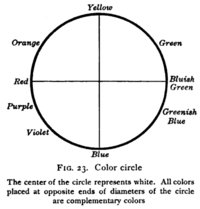
Red
Red is any of a number of similar colors evoked by light consisting predominantly of the longest wavelengths of light discernible by the human eye, in the wavelength range of roughly 630–740 nm. Longer wavelengths than this are called infrared , and cannot be seen by the naked eye...
at one end of the spectrum and violet
Violet (color)
As the name of a color, violet is synonymous with a bluish purple, when the word "purple" is used in the common English language sense of any color between blue and red, not including either blue or red...
at the other. A wedge-shaped gap represents colors that have no unique spectral frequency. These extra-spectral colors, the purple
Purple
Purple is a range of hues of color occurring between red and blue, and is classified as a secondary color as the colors are required to create the shade....
s, form from additive mixture of colors from the ends of the spectrum.
In normal human vision, wavelengths of between about 400 nm and 700 nm are represented by this incomplete circle, with the longer wavelengths equating to the red end of the spectrum. Complements are located directly opposite each other on this wheel. These complements are not identical to those in pigment mixing (such as are used in paint), but when lights are additively mixed in the correct proportions appear as a neutral grey or white.
The color circle is used for, among other purposes, illustrating additive color
Additive color
An additive color model involves light emitted directly from a source or illuminant of some sort. The additive reproduction process usually uses red, green and blue light to produce the other colors. Combining one of these additive primary colors with another in equal amounts produces the...
mixture. Combining two colored lights from different parts of the spectrum may produce a third color that appears like a light from another part of the spectrum, even though dissimilar wavelengths are involved. This type of color matching is known as metameric
Metamerism (color)
In colorimetry, metamerism is the matching of apparent color of objects with different spectral power distributions. Colors that match this way are called metamers....
matching. Thus a combination of green and red light might produce a color close to yellow in apparent hue. The newly formed color lies between the two original colors on the color circle, but they are usually represented as being joined by a straight line on the circle, the location of the new color closer to the (white) centre of the circle indicating that the resulting hue is less saturated (i.e., paler) than either of the two source colors. The combination of any two colors in this way are always less saturated than the two pure spectral colors individually.
Objects may be viewed under a variety of different lighting conditions. The human visual system is able to adapt to these differences by chromatic adaptation
Chromatic adaptation
Chromatic adaptation is one aspect of vision that may fool someone into observing a color-based optical illusion, such as the same color illusion.An object may be viewed under various conditions. For example, it may be illuminated by sunlight, the light of a fire, or a harsh electric light...
. This aspect of the visual system is relatively easy to mislead, and optical illusions relating to color are therefore a common phenomenon. The color circle is a useful tool for examining these illusions.
Arranging spectral colors in a circle to predict admixture of light stems from work by Sir Isaac Newton
Isaac Newton
Sir Isaac Newton PRS was an English physicist, mathematician, astronomer, natural philosopher, alchemist, and theologian, who has been "considered by many to be the greatest and most influential scientist who ever lived."...
. The psychophysical theory behind the color circle dates to the early color triangle
Color triangle
A color triangle is an arrangement of colors within a triangle, based on the additive combination of three primary colors at its corners.An additive color space defined by three primary colors has a chromaticity gamut that is a color triangle, when the amounts of the primaries are constrained to be...
of Thomas Young
Thomas Young (scientist)
Thomas Young was an English polymath. He is famous for having partly deciphered Egyptian hieroglyphics before Jean-François Champollion eventually expanded on his work...
, whose work was later extended by James Clerk Maxwell
James Clerk Maxwell
James Clerk Maxwell of Glenlair was a Scottish physicist and mathematician. His most prominent achievement was formulating classical electromagnetic theory. This united all previously unrelated observations, experiments and equations of electricity, magnetism and optics into a consistent theory...
and Hermann von Helmholtz
Hermann von Helmholtz
Hermann Ludwig Ferdinand von Helmholtz was a German physician and physicist who made significant contributions to several widely varied areas of modern science...
. Young postulated that the eye contains receptors that respond to three different primary sensations, or spectra of light. As Maxwell showed, all hues, but not all colors, can be created from three primary color
Primary color
Primary colors are sets of colors that can be combined to make a useful range of colors. For human applications, three primary colors are usually used, since human color vision is trichromatic....
s such as red, green, and blue, if they are mixed in the right proportions. The Young–Helmholtz theory is still seen as the most effective in modeling human color vision, though the color vision system is far more complex than differences in the retina alone, with different cells in the lateral geniculate nucleus
Lateral geniculate nucleus
The lateral geniculate nucleus is the primary relay center for visual information received from the retina of the eye. The LGN is found inside the thalamus of the brain....
also responding in opponent
Opponent process
The color opponent process is a color theory that states that the human visual system interprets information about color by processing signals from cones and rods in an antagonistic manner...
fashion to complementary color
Complementary color
Complementary colors are pairs of colors that are of “opposite” hue in some color model. The exact hue “complementary” to a given hue depends on the model in question, and perceptually uniform, additive, and subtractive color models, for example, have differing complements for any given color.-...
s, and further color coding occurs in the visual cortex.
Color wheels and paint color mixing
There is no straight-line relationship between colors mixed in pigment, which vary from medium to medium. With a psychophysical color circle, however, the resulting hue of any mixture of two colored light sources can be determined simply by the relative brightness and wavelength of the two lights. A similar calculation cannot be performed with two paints. As such, a painter's color wheel is indicative rather than predictive, being used to compare existing colors rather than calculate exact colors of mixtures. Because of differences relating to the medium, different color wheels can be created according to the type of paint or other medium used, and many artists make their own individual color wheels. These often contain only blocks of color rather than the gradation between tones that is characteristic of the color circle.Color wheel software
A number of interactive color wheel applications are available both on the Internet and as desktop applications. These programs are used by artists and designers for picking colors for a design.HSV color wheel
The HSL and HSV color spaces are simple geometric transformations of the RGBRGB color space
An RGB color space is any additive color space based on the RGB color model. A particular RGB color space is defined by the three chromaticities of the red, green, and blue additive primaries, and can produce any chromaticity that is the triangle defined by those primary colors...
cube into cylindrical form. The outer top circle of the HSV cylinder – or the outer middle circle of the HSL cylinder – can be thought of as a color wheel. There is no authoritative way of labeling the colors in such a color wheel, but the six colors which fall at corners of the RGB cube are given names in the X11 color list
X11 color names
In computing, on the X Window System, X11 color names are represented in a simple text file, which maps certain strings to RGB color values. It is shipped with every X11 installation, hence the name, and is usually located in <X11root>/lib/X11/rgb.txt.It is not known who originally compiled...
, and are named keywords in HTML.
Color schemes
Color schemes are logical combinations of colors on the color wheel.In color theory
Color theory
In the visual arts, color theory is a body of practical guidance to color mixing and the visual impacts of specific color combinations. Although color theory principles first appeared in the writings of Leone Battista Alberti and the notebooks of Leonardo da Vinci , a tradition of "colory theory"...
, a color scheme
Color scheme
In color theory, a color scheme is the choice of colors used in design for a range of media. For example, the use of a white background with black text is an example of a basic and commonly default color scheme in web design....
is the choice of colors used in design for a range of media. For example, the use of a white background with black text is an example of a common default color scheme in web design.
Color schemes are used to create style and appeal. Colors that create an aesthetic feeling together commonly appear together in color schemes. A basic color scheme uses two colors that look appealing together. More advanced color schemes involve several colors in combination, usually based around a single color—for example, text with such colors as red, yellow, orange and light blue arranged together on a black background in a magazine article.
Color schemes can also contain different shades of a single color; for example, a color scheme that mixes different shades of green, ranging from very light (almost white) to very dark.
Gallery
See also
- Color theoryColor theoryIn the visual arts, color theory is a body of practical guidance to color mixing and the visual impacts of specific color combinations. Although color theory principles first appeared in the writings of Leone Battista Alberti and the notebooks of Leonardo da Vinci , a tradition of "colory theory"...
- Visual perceptionVisual perceptionVisual perception is the ability to interpret information and surroundings from the effects of visible light reaching the eye. The resulting perception is also known as eyesight, sight, or vision...
- PsychophysicsPsychophysicsPsychophysics quantitatively investigates the relationship between physical stimuli and the sensations and perceptions they effect. Psychophysics has been described as "the scientific study of the relation between stimulus and sensation" or, more completely, as "the analysis of perceptual...
- Color solidColor solidA color solid is the three-dimensional representation of a color model, an analog of the two-dimensional color wheel. The added spatial dimension allows a color solid to depict an added dimension of color variation...
External links
- David Briggs (2007). Hue in The Dimensions of Colour