

Gamut

Encyclopedia
Computer graphics
Computer graphics are graphics created using computers and, more generally, the representation and manipulation of image data by a computer with help from specialized software and hardware....
and photography
Photography
Photography is the art, science and practice of creating durable images by recording light or other electromagnetic radiation, either electronically by means of an image sensor or chemically by means of a light-sensitive material such as photographic film...
, the gamut, or color gamut (icon), is a certain complete subset of color
Color
Color or colour is the visual perceptual property corresponding in humans to the categories called red, green, blue and others. Color derives from the spectrum of light interacting in the eye with the spectral sensitivities of the light receptors...
s. The most common usage refers to the subset of colors which can be accurately represented in a given circumstance, such as within a given color space
Color space
A color model is an abstract mathematical model describing the way colors can be represented as tuples of numbers, typically as three or four values or color components...
or by a certain output device
Output device
An output device is any piece of computer hardware equipment used to communicate the results of data processing carried out by an information processing system to the outside world....
. Another sense, less frequently used but not less correct, refers to the complete set of colors found within an image at a given time. In this context, digitizing a photograph, converting a digitized image to a different color space, or outputting it to a given medium using a certain output device generally alters its gamut, in the sense that some of the colors in the original are lost in the process.
Introduction
The term gamut was adopted from the field of music, where it means the set of pitches of which musical melodies are composed; Shakespeare's use of the term in The Taming of the ShrewThe Taming of the Shrew
The Taming of the Shrew is a comedy by William Shakespeare, believed to have been written between 1590 and 1591.The play begins with a framing device, often referred to as the Induction, in which a mischievous nobleman tricks a drunken tinker named Sly into believing he is actually a nobleman himself...
is sometimes attributed to the author/musician Thomas Morley
Thomas Morley
Thomas Morley was an English composer, theorist, editor and organist of the Renaissance, and the foremost member of the English Madrigal School. He was the most famous composer of secular music in Elizabethan England and an organist at St Paul's Cathedral...
. In the 1850s, the term was applied to a range of colors or hue, for example by Thomas De Quincey
Thomas de Quincey
Thomas Penson de Quincey was an English esssayist, best known for his Confessions of an English Opium-Eater .-Child and student:...
, who wrote "Porphyry
Porphyry (geology)
Porphyry is a variety of igneous rock consisting of large-grained crystals, such as feldspar or quartz, dispersed in a fine-grained feldspathic matrix or groundmass. The larger crystals are called phenocrysts...
, I have heard, runs through as large a gamut of hues as marble."
In color theory
Color theory
In the visual arts, color theory is a body of practical guidance to color mixing and the visual impacts of specific color combinations. Although color theory principles first appeared in the writings of Leone Battista Alberti and the notebooks of Leonardo da Vinci , a tradition of "colory theory"...
, the gamut of a device or process is that portion of the color space
Color space
A color model is an abstract mathematical model describing the way colors can be represented as tuples of numbers, typically as three or four values or color components...
that can be represented, or reproduced. Generally, the color gamut is specified in the hue
Hue
Hue is one of the main properties of a color, defined technically , as "the degree to which a stimulus can be describedas similar to or different from stimuli that are described as red, green, blue, and yellow,"...
–saturation
Saturation (color theory)
In colorimetry and color theory, colorfulness, chroma, and saturation are related but distinct concepts referring to the perceived intensity of a specific color. Colorfulness is the degree of difference between a color and gray. Chroma is the colorfulness relative to the brightness of another color...
plane, as a system can usually produce colors over a wide intensity
Intensity (disambiguation)
-In colloquial use:*Strength *Amplitude*Level *Magnitude -Physics:*Intensity , power per unit area *Field strength of electric, magnetic, or electromagnetic fields...
range within its color gamut; for a subtractive color system (such as used in printing
Printing
Printing is a process for reproducing text and image, typically with ink on paper using a printing press. It is often carried out as a large-scale industrial process, and is an essential part of publishing and transaction printing....
), the range of intensity available in the system is for the most part meaningless without considering system-specific properties (such as the illumination
Optics
Optics is the branch of physics which involves the behavior and properties of light, including its interactions with matter and the construction of instruments that use or detect it. Optics usually describes the behavior of visible, ultraviolet, and infrared light...
of the ink).
When certain colors cannot be expressed within a particular color model, those colors are said to be out of gamut. For example, while pure red
Red
Red is any of a number of similar colors evoked by light consisting predominantly of the longest wavelengths of light discernible by the human eye, in the wavelength range of roughly 630–740 nm. Longer wavelengths than this are called infrared , and cannot be seen by the naked eye...
can be expressed in the RGB color space, it cannot be expressed in the CMYK color space; pure red is out of gamut in the CMYK color space.
A device that is able to reproduce the entire visible color space is an unrealized goal within the engineering
Engineering
Engineering is the discipline, art, skill and profession of acquiring and applying scientific, mathematical, economic, social, and practical knowledge, in order to design and build structures, machines, devices, systems, materials and processes that safely realize improvements to the lives of...
of color displays
Display device
A display device is an output device for presentation of information in visual or tactile form...
and printing processes. While modern techniques allow increasingly good approximations, the complexity of these systems often makes them impractical.
While processing a digital image, the most convenient color model used is the RGB model. Printing the image requires transforming the image from the original RGB color space to the printer's CMYK color space. During this process, the colors from the RGB which are out of gamut must be somehow converted to approximate values within the CMYK space gamut. Simply trimming only the colors which are out of gamut to the closest colors in the destination space would burn
Burned (image)
An image is said to be burned when its original gamut considerably exceeds the target gamut, or when the result of processing considerably exceeds the image's gamut, resulting in clipping...
the image. There are several algorithms approximating this transformation, but none of them can be truly perfect, since those colors are simply out of the target device's capabilities. This is why identifying the colors in an image which are out of gamut in the target color space as soon as possible during processing is critical for the quality of the final product.
Representation of gamuts
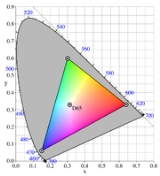
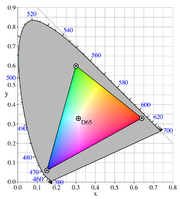
Gamuts are commonly represented as areas in the CIE 1931 chromaticity diagram as shown at right, with the curved edge representing the monochromatic (single-wavelength) or spectral colorSpectral color
A spectral color is a color that is evoked by a single wavelength of light in the visible spectrum, or by a relatively narrow band of wavelengths...
s.
The accessible gamut depends on the brightness; a full gamut must therefore be represented in 3D space, as below:
 |
 |
The pictures at left show the gamuts of RGB color space (top), such as on computer monitors, and of reflective colors in nature (bottom). The cone drawn in grey corresponds roughly to the CIE diagram at right, with the added dimension of brightness.
The axes in these diagrams are the responses of the short-wavelength (S), middle-wavelength (M), and long-wavelength (L) cones in the human eye
Human eye
The human eye is an organ which reacts to light for several purposes. As a conscious sense organ, the eye allows vision. Rod and cone cells in the retina allow conscious light perception and vision including color differentiation and the perception of depth...
. The other letters indicate black (Blk), red (R), green (G), blue (B), cyan (C), magenta (M), yellow (Y), and white colors (W). (Note: These pictures are not exactly to scale.)
The top left diagram shows that the shape of the RGB gamut is a triangle between red, green, and blue at lower luminosities; a triangle between cyan, magenta, and yellow at higher luminosities, and a single white point at maximum luminosity. The exact positions of the apexes depends on the emission spectra of the phosphor
Phosphor
A phosphor, most generally, is a substance that exhibits the phenomenon of luminescence. Somewhat confusingly, this includes both phosphorescent materials, which show a slow decay in brightness , and fluorescent materials, where the emission decay takes place over tens of nanoseconds...
s in the computer monitor, and on the ratio between the maximum luminosities of the three phosphors (i.e., the color balance).
The gamut of the CMYK color space is, ideally, approximately the same as that for RGB, with slightly different apexes, depending on both the exact properties of the dyes and the light source. In practice, due to the way raster-printed colors interact with each other and the paper and due to their non-ideal absorption spectra, the gamut is smaller and has rounded corners.
The gamut of reflective colors in nature has a similar, though more rounded, shape. An object that reflects only a narrow band of wavelengths will have a color close to the edge of the CIE diagram, but it will have a very low luminosity at the same time. At higher luminosities, the accessible area in the CIE diagram becomes smaller and smaller, up to a single point of white, where all wavelengths are reflected exactly 100 per cent; the exact coordinates of white are, of course, determined by the color of the light source.
Surfaces
The idea of optimal colors was introduced by the Baltic German Chemist Wilhelm Ostwald
Wilhelm Ostwald
Friedrich Wilhelm Ostwald was a Baltic German chemist. He received the Nobel Prize in Chemistry in 1909 for his work on catalysis, chemical equilibria and reaction velocities...
. Erwin Schrödinger
Erwin Schrödinger
Erwin Rudolf Josef Alexander Schrödinger was an Austrian physicist and theoretical biologist who was one of the fathers of quantum mechanics, and is famed for a number of important contributions to physics, especially the Schrödinger equation, for which he received the Nobel Prize in Physics in 1933...
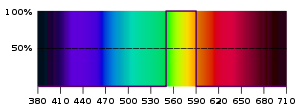
showed in his 1919 article Theorie der Pigmente von größter Leuchtkraft (Theory of Pigments with Highest Luminosity) that the most-saturated colors that can be created with a given total reflectivity are generated by surfaces having either zero or full reflectance at any given wavelength, and the reflectivity spectrum must have at most two transitions between zero and full. Thus two types of "optimal color" spectra are possible: Either the transition goes from zero at both ends of the spectrum to one in the middle, as shown in the image at right, or it goes from one at the ends to zero in the middle. The first type produces colors that are similar to the spectral colors and follow roughly the horseshoe-shaped portion of the CIE xy chromaticity diagram, but are generally less saturated. The second type produces colors that are similar to (but generally less saturated than) the colors on the straight line in the CIE xy chromaticity diagram, leading to magenta-like colors. Schrödinger's work was further developed by David MacAdam
David MacAdam
Dr. David Lewis MacAdam was an American physicist and color scientist who made important contributions to color science and technology in the fields of colorimetry, color discrimination, color photography and television, and color order.-Education:MacAdam grew up in Philadelphia, attended Lehigh...
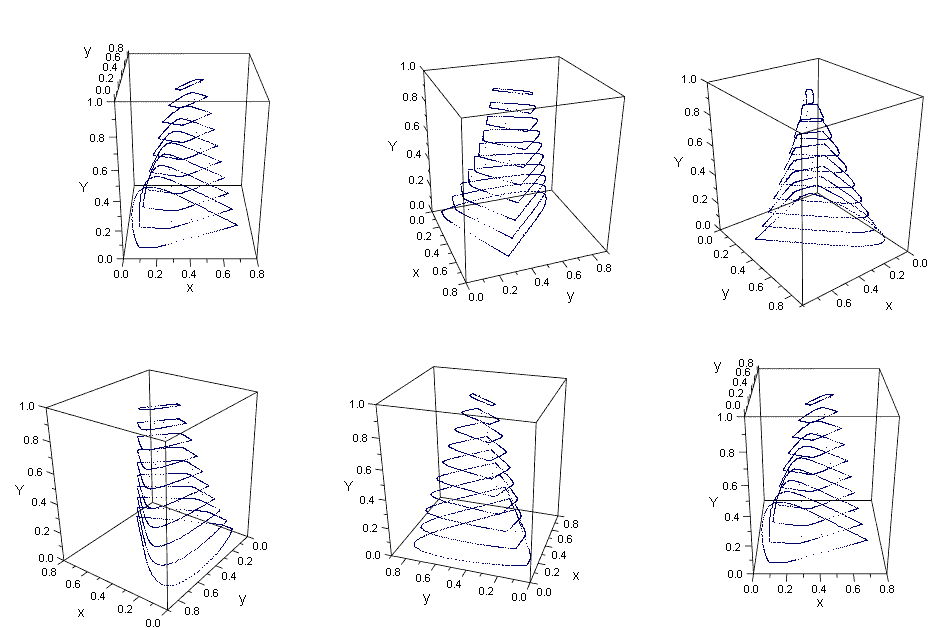
and Siegfried Rösch. MacAdam was the first person to calculate precise coordinates of selected points on the boundary of the optimal color solid in the CIE 1931 color space for lightness levels from Y = 10 to 95 in steps of 10 units. This enabled him to draw the optimal color solid at an acceptable degree of precision. Because of his achievement the boundary of the optimal color solid is called the MacAdam limit. On modern computers it is possible to calculate an optimal color solid with great precision in seconds or minutes. The MacAdam limit, on which the most saturated (or "optimal") colors reside, shows that colors that are near monochromatic colors can only be achieved at very low luminance levels, except for yellows, because a mixture of the wavelengths from the long straight-line portion of the spectral locus between green and red will combine to make a color very close to a monochromatic yellow.
Light sources
Light sources used as primaries in an additive color reproduction system need to be bright, so they are generally not close to monochromatic. That is, the color gamut of most variable-color light sources can be understood as a result of difficulties producing pure monochromatic (single wavelengthWavelength
In physics, the wavelength of a sinusoidal wave is the spatial period of the wave—the distance over which the wave's shape repeats.It is usually determined by considering the distance between consecutive corresponding points of the same phase, such as crests, troughs, or zero crossings, and is a...
) light. The best technological source of monochromatic light is the laser
Laser
A laser is a device that emits light through a process of optical amplification based on the stimulated emission of photons. The term "laser" originated as an acronym for Light Amplification by Stimulated Emission of Radiation...
, which can be rather expensive and impractical for many systems. However, as optoelectronic technology matures, single-longitudinal-mode diode lasers are becoming less expensive, and several applications can already profit from this.
Systems that use additive color processes usually have a color gamut which is roughly a convex polygon
Convex polygon
In geometry, a polygon can be either convex or concave .- Convex polygons :A convex polygon is a simple polygon whose interior is a convex set...
in the hue-saturation plane. The vertices of the polygon are the most saturated colors the system can produce. In subtractive color systems, the color gamut is more often an irregular region.
Comparison of various systems
Following is a list of representative color systems more or less ordered from large to small color gamut:- Laser video projectorLaser video projectorA laser video projector is a video projector that modulates a laser beam in order to project a raster-based image. The systems work either by scanning the entire picture a dot at a time and modulating the laser directly at high frequency, much like the electron beams in a CRT, or by optically...
uses 3 lasers to produce the broadest gamut available in practical display equipment today, derived from the fact that lasers produce truly monochromatic primaries. The systems work either by scanning the entire picture a dot at a time and modulating the laser directly at high frequency, much like the electron beams in a CRTCathode ray tubeThe cathode ray tube is a vacuum tube containing an electron gun and a fluorescent screen used to view images. It has a means to accelerate and deflect the electron beam onto the fluorescent screen to create the images. The image may represent electrical waveforms , pictures , radar targets and...
, or by optically spreading and then modulating the laser and scanning a line at a time, the line itself being modulated in much the same way as in a DLP projector. Lasers can also be used as a light source for a DLP projector. More than 3 lasers can be combined to increase the gamut range, a technique sometimes used in holographyHolographyHolography is a technique that allows the light scattered from an object to be recorded and later reconstructed so that when an imaging system is placed in the reconstructed beam, an image of the object will be seen even when the object is no longer present...
. - Digital Light Processing or DLP technology is a trademarked technology from Texas Instruments. The DLP chip contains a rectangular array of up to 2 million hinge-mounted microscopic mirrors. Each of the micromirrors measures less than one-fifth the width of a human hair. A DLP chip's micromirror tilt either toward the light source in a DLP projection system (ON) or away from it (OFF). This creates a light or dark pixel on the projection surface.
- Photographic filmPhotographic filmPhotographic film is a sheet of plastic coated with an emulsion containing light-sensitive silver halide salts with variable crystal sizes that determine the sensitivity, contrast and resolution of the film...
can reproduce a larger color gamut than typical television, computer, or home videoHome videoHome video is a blanket term used for pre-recorded media that is either sold or rented/hired for home cinema entertainment. The term originates from the VHS/Betamax era but has carried over into current optical disc formats like DVD and Blu-ray Disc and, to a lesser extent, into methods of digital...
systems. - CRTCathode ray tubeThe cathode ray tube is a vacuum tube containing an electron gun and a fluorescent screen used to view images. It has a means to accelerate and deflect the electron beam onto the fluorescent screen to create the images. The image may represent electrical waveforms , pictures , radar targets and...
and similar video displays have a roughly triangular color gamut which covers a significant portion of the visible color space. In CRTs, the limitations are due to the phosphors in the screen which produce red, green, and blue light. - Liquid crystal displayLiquid crystal displayA liquid crystal display is a flat panel display, electronic visual display, or video display that uses the light modulating properties of liquid crystals . LCs do not emit light directly....
(LCD) screens filter the light emitted by a backlightBacklightA backlight is a form of illumination used in liquid crystal displays . As LCDs do not produce light themselves , they need illumination to produce a visible image...
. The gamut of an LCD screen is therefore limited to the emitted spectrum of the backlight. Typical LCD screens use cold-cathode fluorescent bulbs (CCFLs) for backlights. LCD Screens with certain LEDLight-emitting diodeA light-emitting diode is a semiconductor light source. LEDs are used as indicator lamps in many devices and are increasingly used for other lighting...
or wide-gamut CCFL backlights yield a more comprehensive gamut than CRTs. - TelevisionTelevisionTelevision is a telecommunication medium for transmitting and receiving moving images that can be monochrome or colored, with accompanying sound...
uses a CRT display (usually), but does not take full advantage of its color display properties, due to the limitations of broadcastingBroadcastingBroadcasting is the distribution of audio and video content to a dispersed audience via any audio visual medium. Receiving parties may include the general public or a relatively large subset of thereof...
. HDTVHigh-definition televisionHigh-definition television is video that has resolution substantially higher than that of traditional television systems . HDTV has one or two million pixels per frame, roughly five times that of SD...
is far better, but still somewhat less than, for example, computer displays using the same display technology. - PaintPaintPaint is any liquid, liquefiable, or mastic composition which after application to a substrate in a thin layer is converted to an opaque solid film. One may also consider the digital mimicry thereof...
mixing, both artistic and for commercial applications, achieves a reasonably large color gamut by starting with a larger palette than the red, green, and blue of CRTs or cyan, magenta, and yellow of printing. Paint may reproduce some highly saturated colors that cannot be reproduced well by CRTs (particularly violet), but overall the color gamut is smaller. - PrintingPrintingPrinting is a process for reproducing text and image, typically with ink on paper using a printing press. It is often carried out as a large-scale industrial process, and is an essential part of publishing and transaction printing....
typically uses the CMYK color space (cyan, magenta, yellow, and black). Very few printing processes do not include black; however, those processes (with the exception of dye-sublimation printerDye-sublimation printerA dye-sublimation printer is a computer printer which employs a printing process that uses heat to transfer dye onto medium materials such as a plastic card, paper, or fabric. The sublimation name is applied because the dye transitions between the solid and gas states without going through a...
s) are poor at representing low saturation, low intensity colors. Efforts have been made to expand the gamut of the printing process by adding inks of non-primary colors; these are typically orange and green (see HexachromeHexachromeHexachrome was a six-color printing process designed by Pantone Inc. In addition to custom CMYK inks, Hexachrome added orange and green inks to expand the color gamut, for better color reproduction. It was therefore also known as a CMYKOG process....
) or light cyan and light magenta (see CcMmYK color modelCcMmYK color modelCcMmYK, sometimes referred to as CMYKLcLm, is a six color printing process used in some inkjet printers optimized for photo printing. It extends the customary four color CMYK process, which stands for Cyan, Magenta, Yellow and Key , by adding light cyan and light magenta...
). Spot colorSpot colorIn offset printing, a spot color is any color generated by an ink that is printed using a single run.The widely spread offset-printing process is composed of four spot colors: Cyan, Magenta, Yellow, and Key commonly referred to as CMYK...
inks of a very specific color are also sometimes used. - A monochromeMonochromeMonochrome describes paintings, drawings, design, or photographs in one color or shades of one color. A monochromatic object or image has colors in shades of limited colors or hues. Images using only shades of grey are called grayscale or black-and-white...
display's color gamut is a one-dimensional curve in color space.
External links
- Using the Chromaticity Diagram for Color Gamut Evaluation by Bruce Lindbloom.
- Color Gamut Mapping book by Jan Morovic.
- Quantifying Color Gamut by William D. Kappele
- Stanford University CS 178 interactive Flash demo explaining color gamut mapping.