


San shou

Encyclopedia
Sanshou or Sanda or an "unsanctioned fight" is a Chinese
hand-to-hand
self-defense
system and combat sport
. Sanshou is a martial art which was originally developed by the Chinese military based upon the intense study and practices of traditional Kung Fu and modern combat fighting techniques; it combines full-contact kickboxing
, which include punches
and kicks, wrestling
, takedowns, throws
, sweeps
, kick catches, and in some competitions, even elbow
and knee strikes.
Not seen as a style itself, rather it is considered as just one of the two components of Chinese martial arts
training and is often taught alongside with taolu (forms) training. However, as part of the development of sport wushu by the Chinese government
, a standard curriculum for sanshou was developed. It is to this standard curriculum that the term "Sanshou" is usually applied.
This curriculum was developed with reference to traditional Chinese martial arts. This general Sanshou curriculum varies in its different forms, as the Chinese government developed a version for civilians for self-defense and as a sport.
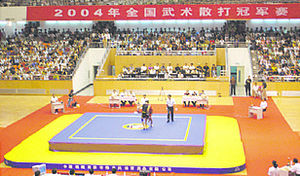 The generalized modern curriculum practiced in modern wushu schools is composed of different traditional martial arts fighting styles from China, but mainly based on scientific efficiency. Sanshou is composed of Chinese martial arts applications including most aspects of combat including striking and grappling, however when Sanshou was developed as a sport, restrictions were made for safety reasons as well as to promote it as a non-violent sport. Examples of such restrictions included no blows delivered to the back of the head, spine or groin and the discontinuation of the combat when any of the fighters fall to the ground. However many schools, whether traditional or modern, practice it as an all round martial arts system with no restrictions, only adapting their training in relation to competition rules prior to the event. Sanshou tournaments are one of the two disciplines recognized by the International Wushu Federation
.
Sanshou's competitive history involved barehanded or lei tai fights in which no rules existed. However, even sanshou as a competitive event developed in the military as these bouts were commonly held between the soldiers to test and practice barehanded martial skills, ability and techniques. Rules were developed and the use of protective gloves etc. was adopted. It was originally used by the Kuomintang
at the first modern military academy in Whampoa in the 1920s. Later it was also adopted as a method by the People's Liberation Army
of China.
One can see Sanshou as a synthesis of traditional Chinese fighting techniques into a more amorphous system and is commonly taught alongside traditional Chinese styles which Sanshou techniques, theory and training methods are derived from. The emphasis of Sanshou is on realistic fighting ability.
, and Liu Hailong
who is known as "The Conqueror of Muay Thai" as he has beaten many of the top Muay Thai fighters. Some Sanshou fighters well-known in the United States
include the IKF
and former Strikeforce
middleweight champion, Cung Le
, as well as Jason Yee, Rudi Ott, Marvin Perry
, and Max Chen. Other Sanshou based fighters who have entered MMA include Cung Le
, KJ Noons, James Fanshier, Patrick Barry
, Anthony Johnson
UFC
fighter Zhang Tie Quan
,
Muslim Salihov, the European and world champion from Russia
beat 4 top Chinese fighters from different weight categories, including the Chinese champion from the 90 kg category and became the first non-Chinese to claim the "King of Sanda" title.
-like takedowns and sweeps. & Na (Seizing), which includes jointlocks, strangulation and other submissions.
China
Chinese civilization may refer to:* China for more general discussion of the country.* Chinese culture* Greater China, the transnational community of ethnic Chinese.* History of China* Sinosphere, the area historically affected by Chinese culture...
hand-to-hand
Hand to hand combat
Hand-to-hand combat is a lethal or nonlethal physical confrontation between two or more persons at very short range that does not involve the use of firearms or other distance weapons...
self-defense
Self-defense
Self-defense, self-defence or private defense is a countermeasure that involves defending oneself, one's property or the well-being of another from physical harm. The use of the right of self-defense as a legal justification for the use of force in times of danger is available in many...
system and combat sport
Combat sport
A Combat sport, also known as a Fighting sport, is a competitive contact sport where two combatants fight against each other using certain rules of engagement , typically with the aim of simulating parts of real hand to hand combat...
. Sanshou is a martial art which was originally developed by the Chinese military based upon the intense study and practices of traditional Kung Fu and modern combat fighting techniques; it combines full-contact kickboxing
Kickboxing
Kickboxing refers to a group of martial arts and stand-up combat sports based on kicking and punching, historically developed from karate, Muay Thai and western boxing....
, which include punches
Punch (strike)
A punch is a striking blow with the fist. It is the most commonly used attack in hand to hand combat. It is used in some martial arts and combat sports, most notably boxing where it is the only type of technique allowed...
and kicks, wrestling
Wrestling
Wrestling is a form of grappling type techniques such as clinch fighting, throws and takedowns, joint locks, pins and other grappling holds. A wrestling bout is a physical competition, between two competitors or sparring partners, who attempt to gain and maintain a superior position...
, takedowns, throws
Throw (grappling)
A throw is a martial arts term for a grappling technique that involves off-balancing or lifting an opponent, and tossing them to the ground in Japanese martial arts referred to as nage-waza, 投げ技, "throwing technique"...
, sweeps
Sweep (martial arts)
A sweep is the name used for two categories of martial arts techniques. From standing, sweeps are throws or takedowns that primarily use the legs to attack an opponent's legs...
, kick catches, and in some competitions, even elbow
Elbow (strike)
An elbow strike is a strike with the point of the elbow, the part of the forearm nearest to the elbow, or the part of the upper arm nearest to the elbow...
and knee strikes.
Not seen as a style itself, rather it is considered as just one of the two components of Chinese martial arts
Chinese martial arts
Chinese martial arts, also referred to by the Mandarin Chinese term wushu and popularly as kung fu , are a number of fighting styles that have developed over the centuries in China. These fighting styles are often classified according to common traits, identified as "families" , "sects" or...
training and is often taught alongside with taolu (forms) training. However, as part of the development of sport wushu by the Chinese government
Government of the People's Republic of China
All power within the government of the People's Republic of China is divided among three bodies: the People's Republic of China, State Council, and the People's Liberation Army . This article is concerned with the formal structure of the state, its departments and their responsibilities...
, a standard curriculum for sanshou was developed. It is to this standard curriculum that the term "Sanshou" is usually applied.
This curriculum was developed with reference to traditional Chinese martial arts. This general Sanshou curriculum varies in its different forms, as the Chinese government developed a version for civilians for self-defense and as a sport.
Curriculum
International Wushu Federation
The International Wushu Federation is an international sport organization established on October 3, 1990 in Beijing, China during the 11th Asian summer Games to promote competitive Wushu...
.
Sanshou's competitive history involved barehanded or lei tai fights in which no rules existed. However, even sanshou as a competitive event developed in the military as these bouts were commonly held between the soldiers to test and practice barehanded martial skills, ability and techniques. Rules were developed and the use of protective gloves etc. was adopted. It was originally used by the Kuomintang
Kuomintang
The Kuomintang of China , sometimes romanized as Guomindang via the Pinyin transcription system or GMD for short, and translated as the Chinese Nationalist Party is a founding and ruling political party of the Republic of China . Its guiding ideology is the Three Principles of the People, espoused...
at the first modern military academy in Whampoa in the 1920s. Later it was also adopted as a method by the People's Liberation Army
People's Liberation Army
The People's Liberation Army is the unified military organization of all land, sea, strategic missile and air forces of the People's Republic of China. The PLA was established on August 1, 1927 — celebrated annually as "PLA Day" — as the military arm of the Communist Party of China...
of China.
One can see Sanshou as a synthesis of traditional Chinese fighting techniques into a more amorphous system and is commonly taught alongside traditional Chinese styles which Sanshou techniques, theory and training methods are derived from. The emphasis of Sanshou is on realistic fighting ability.
Sport
Yùndòng Sanda (Mandarin Chinese, Sport Free Fighting): A modern fighting method, sport, and applicable component of Wushu / Kung Fu influenced by traditional Chinese Boxing, of which takedowns & throws are legal in competition, as well as all other sorts of striking (use of arms & legs). Chinese wrestling methods called Shuai Jiao and other Chinese grappling techniques such as Chin Na. It has all the combat aspects of wushu. Sanda appears much like Kickboxing or Muay Thai, but includes many more grappling techniques. Sanda fighting competitions are often held alongside taolu or form competitions. Sanda represents the modern development of Lei Tai contests, but with rules in place to reduce the chance of serious injury. Many Chinese martial art schools teach or work within the rule sets of Sanda, working to incorporate the movements, characteristics, and theory of their style. Chinese martial artists also compete in non-Chinese or mixed combat sports, including Boxing, Kickboxing and Mixed Martial Arts. Sanda is practiced in tournaments and is normally held alongside taolu events in wushu competition. For safety reasons, some techniques from the self-defense form such as elbow strikes, chokes, and joint locks, are not allowed during tournaments. Competitors can win by knockout or points which are earned by landing strikes to the body or head, throwing an opponent, or when competition is held on a raised lei tai platform, pushing them off the platform. Fighters are only allowed to clinch for a few seconds. If the clinch is not broken by the fighters, and if neither succeeds in throwing his opponent within the time limit, the referee will break the clinch. In the U.S., competitions are held either in boxing rings or on the raised lei tai platform. Amateur fighters wear protective gear. "Amateur Sanda" allows kicks, punches, knees (not to the head), and throws. A competition held in China, called the "King of Sanda", is held in a ring similar to a boxing ring in design but larger in dimension. As professionals, they wear no protective gear except for gloves, cup, and mouthpiece, and "Professional Sanda" allows knee strikes (including to the head) as well as kicking, punching and throwing. Some Sanda fighters have participated in fighting tournaments such as K-1 and Shoot Boxing. They have had some degree of success, especially in Shoot boxing competitions, which is more similar to Sanda. Due to the rules of Kickboxing competition, Sanda fighters are subjected to more limitations than usual. Also notable competitors in China's mainstream Mixed Martial Arts competition, Art of War Fighting Championship are dominantly of wushu background. Sanda has been featured in many style-versus-style competitions. Muay Thai is frequently pitted against Sanda as is Karate, Kickboxing, & Tae Kwon Do. Although it is less common, some Sanda practitioners have also fought in the publicly viewed American Mixed Martial Arts competitions.Notable competitors
Some well-known Chinese Sanshou fighters include Yuan Yubao, Bao Li GaoBao Li Gao
Bao Li Gao , also known as "Son of the Grassland" and "Muay Thai Killer," is a Chinese San Shou fighter and mixed martial artist born in the Inner Mongolia Province...
, and Liu Hailong
Liu Hailong
Liu Hailong is a Chinese Sanshou kickboxer. Liu's rise to fame came in 2000 in the inaugural King of Sanda tournament. Liu not only won his weight class, but went on to win a grueling one-night open weight round robin tournament against much bigger fighters as well, giving him the title Sanda...
who is known as "The Conqueror of Muay Thai" as he has beaten many of the top Muay Thai fighters. Some Sanshou fighters well-known in the United States
United States
The United States of America is a federal constitutional republic comprising fifty states and a federal district...
include the IKF
International Kickboxing Federation
The International Kickboxing Federation is a kickboxing sanctioning body. The IKF World Headquarters in the USA oversees IKF World Operations with the rest of the IKF World Team.-Styles:...
and former Strikeforce
Strikeforce
Strikeforce is a U.S.-based mixed martial arts and kickboxing organization based in San Jose, California. It is headed by CEO Scott Coker and owned by Zuffa, LLC...
middleweight champion, Cung Le
Cung Le
Cung Le is a Vietnamese-American Sanshou kickboxer, mixed martial artist, and actor from Saigon, Vietnam currently competing in the UFC. He is the former IKF Light Heavyweight San Shou World Champion and has a professional San Shou record of 16-0 before moving to mixed martial arts...
, as well as Jason Yee, Rudi Ott, Marvin Perry
Marvin Perry
Marvin Perry is a Trinidadian and Tobagonian former kickboxer.Perry started training in Karate at the age of 13. He then trained for about two years before coming to the United States and beginning training in Kung Fu...
, and Max Chen. Other Sanshou based fighters who have entered MMA include Cung Le
Cung Le
Cung Le is a Vietnamese-American Sanshou kickboxer, mixed martial artist, and actor from Saigon, Vietnam currently competing in the UFC. He is the former IKF Light Heavyweight San Shou World Champion and has a professional San Shou record of 16-0 before moving to mixed martial arts...
, KJ Noons, James Fanshier, Patrick Barry
Patrick Barry
Patrick Barry , was a pioneer horticulturist, owner of the then largest nursery in the United States, and noted author on the subject of horticulture....
, Anthony Johnson
Anthony Johnson
Anthony Johnson is the name of:* Anthony Johnson , American film actor* Anthony Johnson , a freedman of African descent in early Virginia* Anthony Johnson , NFL running back...
UFC
Ultimate Fighting Championship
The Ultimate Fighting Championship is the largest mixed martial arts promotion company in the world that hosts most of the top-ranked fighters in the sport...
fighter Zhang Tie Quan
Zhang Tie Quan
Zhang Tiequan, or Zhang Tie Quan , often anglicised to Tiequan Zhang, is a Chinese mixed martial artist, who fights as a featherweight. He has spent most of his career fighting in the Art of War Fighting Championship in his native China, but in 2010, he joined World Extreme Cagefighting in the...
,
Muslim Salihov, the European and world champion from Russia
Russia
Russia or , officially known as both Russia and the Russian Federation , is a country in northern Eurasia. It is a federal semi-presidential republic, comprising 83 federal subjects...
beat 4 top Chinese fighters from different weight categories, including the Chinese champion from the 90 kg category and became the first non-Chinese to claim the "King of Sanda" title.
Military Use
Jùnshì Sanda (Mandarin Chinese, Military Free Fighting): A system of unarmed combat that was designed by Chinese Elite Forces based upon their intense study of traditional martial arts such as Kung Fu, Shuai Jiao, Chin Na and modern hand-to-hand fighting and combat philosophy to develop a realistic system of unarmed fighting for the Chinese military. Jùnshì Sanda employs all parts of the body as anatomical weapons to attack and counter with, by using what the Chinese consider to be the four basic martial arts techniques: Da (Upper-Body Striking); Using fists, open hands, fingers, elbows, shoulders, forearms and the head. Ti (Lower-Body Striking); Including kicks, knees and stomping. Shuai (Throws), using Wrestling and JudoJudo
is a modern martial art and combat sport created in Japan in 1882 by Jigoro Kano. Its most prominent feature is its competitive element, where the object is to either throw or takedown one's opponent to the ground, immobilize or otherwise subdue one's opponent with a grappling maneuver, or force an...
-like takedowns and sweeps. & Na (Seizing), which includes jointlocks, strangulation and other submissions.
External links
- International Kickboxing Federation official website - Sanshou Competition Rules
- IKF, International Kickboxing Federation official website
- Sanshou.com
- Florida Sanshou & Muay Thai (FSMT) - U.S. Website dedicated to providing information about the sports of Sanshou (China) and Muay Thai (Thailand)
- Sanda Video Instructions from China
- United States Kickboxing Association
- SanDa-MMA.com
- A Brief History of Sanshou, American Wu Shu Society
- Niteroi Shaolin Kung Fu Association