

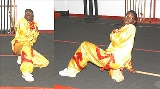
Monkey Kung Fu

Encyclopedia
Monkey Kung Fu, or Monkey Fist (猴拳), is a Chinese martial art
which utilizes ape
or monkey
-like movements as part of its technique.
There are a number of independently developed systems of monkey kung fu. Examples includes Xingzhemen (行者門) named after the protagonist Sun Wukong
of the popular Ming dynasty novel Journey to the West
, Nanhouquan (南猴拳) or Southern Monkey Fist originating from the Southern Shaolin Temple as well as the more well known Da Sheng Pi Gua Men 大聖劈掛門 style of Hong Kong.
(1911) by a fighter named Kou Si (Kau Sei) from a small village in Northern China
. Legend states that while serving a sentence in prison, he observed a group of monkeys from his cell. As he studied their movements and mannerisms, he found that they combined well with his own Di Tang style. While exact circumstances of Kou Si's inspiration remain legend, upon his release he developed his new style of fighting and dubbed it 'Da Sheng Men' (Great Sage Style) in honor of the Monkey King Sun Wukong
in the Buddhist tale Journey to the West
.
or semi-squatting position and are normally accompanied by very swift and 'jerky' head movements as the practitioner nervously looks around. The monkey staff, or hou gun (猴棍), is one of this style's specialty weapons. Monkey boxing is an imitative technique and so execution of the movements and facial expressions must be so convincing that it looks exactly like a monkey and not simply like a human imitating a monkey hence the very high degree of difficulty associated with this technique.
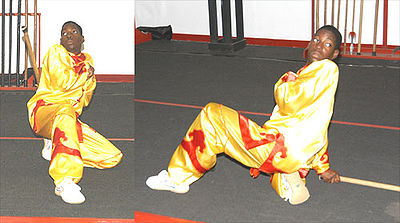 The favorite weapon for Monkey Boxing is the staff or stick and standing beside it, the upper end of the staff is normally eye height for the practitioner. There are also other weapons favored by Monkey Boxers (e.g. the broadsword, straight sword, spear, and the iron ring). Monkey forms are not normally performed fast paced from start to finish as in other techniques, instead the practitioner will execute a very swift series of movements then stop to 'play' (which means to fidget or scratch and it usually involves nervously looking around, picking imaginary fruits or insects from off the legs, arms, ears or head and even the groin area then very quickly eating them or scooping water from an imaginary pond or stream then drinking it). In the lost monkey technique, there is a lot of running, nervously looking around, rolling, kicking and punching to the groin area of the opponent. Running is done in a semi-squatting position and a clenched fist is not used; instead the fingers are loosely held in a semi-closed fist sometimes referred to as the monkey claw. With the exception of the Tall Monkey technique, all monkey forms tend to be executed from the squatting and stooping positions. When well executed, monkey forms are comical and entertaining, so tend to attract the most attention at martial arts tournaments.
Chinese martial arts
Chinese martial arts, also referred to by the Mandarin Chinese term wushu and popularly as kung fu , are a number of fighting styles that have developed over the centuries in China. These fighting styles are often classified according to common traits, identified as "families" , "sects" or...
which utilizes ape
Ape
Apes are Old World anthropoid mammals, more specifically a clade of tailless catarrhine primates, belonging to the biological superfamily Hominoidea. The apes are native to Africa and South-east Asia, although in relatively recent times humans have spread all over the world...
or monkey
Monkey
A monkey is a primate, either an Old World monkey or a New World monkey. There are about 260 known living species of monkey. Many are arboreal, although there are species that live primarily on the ground, such as baboons. Monkeys are generally considered to be intelligent. Unlike apes, monkeys...
-like movements as part of its technique.
There are a number of independently developed systems of monkey kung fu. Examples includes Xingzhemen (行者門) named after the protagonist Sun Wukong
Sun Wukong
Sun Wukong , also known as the Monkey King is a main character in the classical Chinese epic novel Journey to the West . In the novel, he is a monkey born from a stone who acquires supernatural powers through Taoist practices...
of the popular Ming dynasty novel Journey to the West
Journey to the West
Journey to the West is one of the Four Great Classical Novels of Chinese literature. It was written by Wu Cheng'en in the 16th century. In English-speaking countries, the tale is also often known simply as Monkey. This was one title used for a popular, abridged translation by Arthur Waley...
, Nanhouquan (南猴拳) or Southern Monkey Fist originating from the Southern Shaolin Temple as well as the more well known Da Sheng Pi Gua Men 大聖劈掛門 style of Hong Kong.
Hou Quan
The Hou Quan style from the Emei region, taught by the famous "Monkey King" Xiao Yingpeng and others, was also used as the basis for the modern wushu variant of monkey style (and monkey staff) that is often seen in demonstrations and competitions today. Each independent style has its own unique approach to the expression of how to incorporate a monkey's movements into fighting.Da Sheng Men
Da Sheng Men, or "Great Sage" Kung Fu, was developed near the end of the Qing dynastyQing Dynasty
The Qing Dynasty was the last dynasty of China, ruling from 1644 to 1912 with a brief, abortive restoration in 1917. It was preceded by the Ming Dynasty and followed by the Republic of China....
(1911) by a fighter named Kou Si (Kau Sei) from a small village in Northern China
Northern and southern China
Northern China and southern China are two approximate regions within China. The exact boundary between these two regions has never been precisely defined...
. Legend states that while serving a sentence in prison, he observed a group of monkeys from his cell. As he studied their movements and mannerisms, he found that they combined well with his own Di Tang style. While exact circumstances of Kou Si's inspiration remain legend, upon his release he developed his new style of fighting and dubbed it 'Da Sheng Men' (Great Sage Style) in honor of the Monkey King Sun Wukong
Sun Wukong
Sun Wukong , also known as the Monkey King is a main character in the classical Chinese epic novel Journey to the West . In the novel, he is a monkey born from a stone who acquires supernatural powers through Taoist practices...
in the Buddhist tale Journey to the West
Journey to the West
Journey to the West is one of the Four Great Classical Novels of Chinese literature. It was written by Wu Cheng'en in the 16th century. In English-speaking countries, the tale is also often known simply as Monkey. This was one title used for a popular, abridged translation by Arthur Waley...
.
Da Sheng Pi Gua
Da Sheng Pi Gua Kung Fu 大聖劈掛門 was developed by Kou Si's student Geng De Hai who started learning Pi Gua kung fu from his father Kan Wing Kwai from as early as 8 years of age. Gan Wing Gwai was a master of Pi Gua kung fu and after his death, Kou Si decided to train Geng De Hai in Da Sheng Kung Fu. After mastering Da Sheng Kung Fu and combining it with Pi Gua Kung Fu, out of respect for Kou Si's friendship, in naming the new technique Geng De Hai placed Da Sheng at the beginning followed by Pi Gua hence the name Da Sheng Pi Gua Kung Fu.Hou Quan
Traditional hou quan as taught in Mainland China includes running on all fours (i.e. the hands and feet), various difficult acrobatic movements such as flipping sideways in the air, front flips, back flips, back handsprings, hand stands, walking on the hands, forward lunges/dives, backward lunges, spinning on the butt, spinning on the back and many kicks and strikes. Most of the attacks are aimed at the knees, groin area, throat or eyes of the opponent and hand strikes are normally either open handed slaps or clawing with a semi-closed fist called the monkey claw. A wide array of facial monkey expressions are also practiced, inclusive of happiness, anger, fear, fright, confusion and bewilderment etc. Except for very brief periods, most movements inclusive of running are executed from either a squattingSquatting position
Squatting is a posture where the weight of the body is on the feet but the knees are bent either fully or partially . In contrast, sitting, involves taking the weight of the body, at least in part, on the buttocks against the ground or a horizontal object such as a chair seat...
or semi-squatting position and are normally accompanied by very swift and 'jerky' head movements as the practitioner nervously looks around. The monkey staff, or hou gun (猴棍), is one of this style's specialty weapons. Monkey boxing is an imitative technique and so execution of the movements and facial expressions must be so convincing that it looks exactly like a monkey and not simply like a human imitating a monkey hence the very high degree of difficulty associated with this technique.
Da Sheng
There are five variations of monkey kung fu developed as part of the Da Sheng Men system, and still utilized in the later Da Sheng Pi Gua system (although the Crafty monkey variation described below may have been absorbed into the Lost monkey curriculum in Da Shing Pi Gua and Bei Shaolin among others, hence there are only five variations listed, in these systems):- Drunken MonkeyDrunken MonkeyDrunken Monkey Form or Drunken Monkey Pole Form of Kung Fu is a Korean martial art, and one of the variations of the Monkey Style.This style is different from Zui Quan , as the practitioner is imitating gestures of an intoxicated monkey, rather than a human fighter.Drunken Monkey does not begin...
uses a lot of throat, eye and groin strikes as well as tumbling and falling techniques. It incorporates a lot of false steps to give the appearance it is defenseless and uses a lot of off balance strikes. The practitioner waddles, takes very faltering steps and sometimes fall to the ground and lies prone while waiting for the opponent to approach at which time a devastating attack is launched at the knees or groin areas of the opponent. In drunken monkey you use more internal energy than any other. It is one of the more difficult of the monkey styles to master and also extremely effective against a standard, attack-oriented enemy. Countering this style involves shifting your body around often to ensure that the Drunken Monkey user impacts more solid, tougher areas of your body. - Stone Monkey is a "physical" style. The practitioner trains up his body to exchange blows with the opponent - Stone Monkey uses a kind of Iron body method. It will leave an area exposed on its body for an opponent to attack, so it can attack a more vital spot on the body. It is important not to attack reflexively at open spots, and try to hammer away at their weak spots until they give in.
- Lost Monkey feigns a lot. Practitioners of Lost Monkey give the appearance of being lost and confused to deceive the opponent into underestimating his abilities, and he retaliates when it is least expected. The hands and footwork change and flow from each other at will. All monkeys are sociable animals and so they live in troupes or family groups. They are also very territorial by nature and so when they wander into the territory of another troupe there is normally a fight possibly resulting in death to the trespassers. This technique incorporates the fear, nervousness and mischief of a monkey who has wandered into a neighboring territory, in that it attempts to pick and eat as many fruits and insects as quickly as is possible while nervously looking around before scurrying back to its own home range.
- Standing Monkey or Tall Monkey is a relatively conventional monkey that likes to keep an upright position and avoid tumbling around. This style is more suited for tall people. Tall monkey likes to climb body limbs to make attacks at pressure points. It is a long range style.
- Wooden Monkey mimics a serious, angry monkey that attacks and defends with ferocity. The attitude of this monkey is more serious, and its movements are noticeably less light than the other monkeys. Wood monkey likes to grapple and bring its opponent to the ground.
Additional information
Movies and Television Programs
The following films showcase Monkey Kung Fu either throughout the movie or in television programs or in major scenes:- Hou quan kou si, English title Monkey's Fist, (1974)http://www.imdb.com/title/tt0198546/ features real-life Monkey Kung Fu specialist Chan Sau Chung.
- Tie ma liu, English title Iron Monkey, (1977)http://www.imdb.com/title/tt0076822/ starring Chen Kuan Tai.
- In the movie KnockaboutKnockabout (film)Knockabout is a 1979 Hong Kong martial arts comedy film directed by Sammo Hung and starring Hung and Yuen Biao.-Plot:...
, (1979) the lead protagonist Yipao used monkey-fist technique (which he learned from a cop pretending to be a beggar) against The Fox, which happens to be his former master and the one who killed his friend Taipao. - Feng hou, English title Mad Monkey Kung-Fu, (1979)http://imdb.com/title/tt0079147/, although the technique displayed in this movie is really the 'monkey' variation of the Lau Family Hung Gar system and not genuine Da Sheng Pi Gua Kung Fu.
- Chu long ma liu, English title Monkey's Fist Floating Snake, (1979)http://www.imdb.com/title/tt0078969/
- Zui hou nu, English title Lady Iron Monkey, (1979)http://www.imdb.com/title/tt0182724/ starring Fung Ling Kam.
- Liu he qian shou, English title Return of the Scorpion, (1979)http://www.imdb.com/title/tt0079478/ features 7 Kung Fu masters, one (i.e. Chan Sau Chung) is a practitioner of Monkey Kung Fu. In the first fight scene, Chan Sau Chung does a few movements of the Drunken Monkey technique in that he take a few faltering steps (i.e. Monkey Staggering Steps) then he lies prone and waits for his opponent to approach at which time he does a massive wheel kick and immediately launches an attack at his opponents groin (i.e. angry monkey steals the peaches).
- Jackie ChanJackie ChanJackie Chan, SBS, MBE is a Hong Kong actor, action choreographer, comedian, director, producer, martial artist, screenwriter, entrepreneur, singer and stunt performer. In his movies, he is known for his acrobatic fighting style, comic timing, use of improvised weapons, and innovative stunts...
's Drunken Master IIDrunken Master IIDrunken Master II is a 1994 Hong Kong kung fu action film directed by Lau Kar-Leung and Jackie Chan, who stars as Chinese folk hero, Wong Fei Hung. It was Chan's first traditional style martial arts film since The Young Master...
(1994) (AKA Legend of Drunken Master (2000) (U.S.United StatesThe United States of America is a federal constitutional republic comprising fifty states and a federal district...
)) features drunken monkey-type styles in one fight scene. Wong Fei HungWong Fei HungWong Fei-hung was a Chinese martial artist, a traditional Chinese medicine physician, acupuncturist and revolutionary who became a folk hero and the subject of numerous television series and films. He was considered an expert in the Hung Gar style of Chinese martial arts. Wong is visibly the most...
takes a form he calls "monkey drinks master's wine" which bears resemblances and has a similar name to the Drunken Monkey forms "The Monkey King Stealing Wine", "The Monkey King Drinking Wine" and "The Monkey King Becoming Drunk." Although it should be noted that the Chinese language version does NOT make a monkey reference - the original language references the Immortal, Hsiang Chung Li, one of the 8 Drunken Gods holding his giant wine pot. Other references to monkey in the English version "Monkey kicking" and so forth was changed simply for Western audiences as the original reference again is to one of the famous 8 Immortals, Li Tie Kuai, the crippled beggar known for his devastating kicks in the Shao-Lin Kung-Fu forms. - Chui ma lau, English title Drunken Monkey, uses the Monkey fist variant Drunken MonkeyDrunken MonkeyDrunken Monkey Form or Drunken Monkey Pole Form of Kung Fu is a Korean martial art, and one of the variations of the Monkey Style.This style is different from Zui Quan , as the practitioner is imitating gestures of an intoxicated monkey, rather than a human fighter.Drunken Monkey does not begin...
, (2002)http://www.imdb.com/title/tt0367602/ although the technique displayed in this movie is really the 'monkey' variation of the Lau Family Hung Gar system and not genuine Tai Shing Pak Kwar Kung Fu. - In the film "Extreme Fighter," Monkey Kung Fu master Michael Matsuda co-stars in the role of the "monkey man."
- In the film BloodsportBloodsport (film)Bloodsport is a 1988 American martial arts film directed by Newt Arnold and starring Jean-Claude Van Damme, Donald Gibb and Leah Ayres. The film is based on the claimed adventures of Frank Dux, and was followed by three sequels Bloodsport II: The Next Kumite , Bloodsport III and Bloodsport 4: The...
a Monkey Kung Fu user participates in a underground fighting tournament. - In Star Wars Episode I: The Phantom MenaceStar Wars Episode I: The Phantom MenaceStar Wars Episode I: The Phantom Menace is a 1999 American epic space opera film written and directed by George Lucas. It is the fourth film to be released in the Star Wars saga, as the first of a three-part prequel to the original Star Wars trilogy, as well as the first film in the saga in terms...
, Ray Park can be seen using an adapted form of Monkey Kung Fu as Sith Lord Darth MaulDarth MaulDarth Maul is a fictional character in the science fiction saga Star Wars. He is one of the main antagonists of Star Wars Episode I: The Phantom Menace, portrayed by martial artist Ray Park and voiced by Peter Serafinowicz....
. - In Kung Fu PandaKung Fu PandaKung Fu Panda is a 2008 American computer-animated action comedy film produced by DreamWorks Animation and distributed by Paramount Pictures...
there was a monkey master that attacked obviously with the monkey style of kung fu. He was voiced by Jackie Chan - In The Forbidden Kingdom Jackie ChanJackie ChanJackie Chan, SBS, MBE is a Hong Kong actor, action choreographer, comedian, director, producer, martial artist, screenwriter, entrepreneur, singer and stunt performer. In his movies, he is known for his acrobatic fighting style, comic timing, use of improvised weapons, and innovative stunts...
used the Drunken Monkey style since he had to drink wine all the time to be immortal, but of course he would still be drunk. - In the Disney cartoon Kim PossibleKim PossibleKim Possible is an American animated television series about a teenage crime fighter who has the task of dealing with worldwide, family, and school issues every day. The show is action-oriented, but also has a light-hearted atmosphere and often lampoons the conventions and clichés of the...
, Kim's sidekick, Ron Stoppable, is embued with the abilities of Monkey Kung Fu master by four ancient statues. Also on the show, Montgomery Fiske (a.k.a. Monkey Fist), a villain with surgically-altered hands and feet, is a master of Da Sheng Pi Gua. - In the movie The QuestThe Quest (film)The Quest is a 1996 American martial arts action film written and directed by Jean-Claude Van Damme. The film starred Van Damme, Roger Moore, Janet Gunn, and James Remar. The film is Van Damme's directorial debut. The plot revolves around an international martial arts tournament, with a storyline...
, the representative from China uses an obvious monkey style for his second match.