

Hong Kong action cinema

Encyclopedia
Hong Kong action cinema is the principal source of the Hong Kong film industry
's global fame. It combines elements from the action film
, as codified by Hollywood
, with Chinese storytelling and aesthetic traditions, to create a culturally distinctive form that nevertheless has a wide transcultural appeal. In recent years, the flow has reversed somewhat, with American and European action films being heavily influenced by Hong Kong
genre conventions.
The first Hong Kong
action films favoured the wuxia
style, emphasizing mysticism and swordplay, but this trend was politically suppressed in the 1930s and replaced by styles in which films depicted more down-to-earth unarmed kung fu, often featuring folk hero Wong Fei Hung
. Post-war cultural upheavals led to a second wave of wuxia films with highly acrobatic violence, followed by the emergence of the grittier kung fu films for which the Shaw Brothers studio became best known. The 1970s
saw the rise and sudden death of international superstar Bruce Lee
. He was succeeded in the 1980s
by Jackie Chan
—who popularised the use of comedy, dangerous stunt
s, and modern urban settings in action films—and Jet Li
, whose authentic wushu
skills appealed to both eastern and western audiences. The innovative work of directors and producers like Tsui Hark
and John Woo
introduced further variety (for example, gunplay
, triads and the supernatural). An exodus by many leading figures to Hollywood in the 1990s
coincided with a downturn in the industry.
 The signature contribution to action cinema from the Chinese-speaking world is the martial arts film
, the most famous of which were developed in Hong Kong. The genre emerged first in Chinese popular literature
. The early 20th century saw an explosion of what were called wuxia
novels (often translated as "martial chivalry"), generally published in serialized form in newspapers. These were tales of heroic, sword-wielding warriors, often featuring mystical or fantasy
elements. This genre was quickly seized on by early Chinese film
s, particularly in the movie capital of the time, Shanghai
. Starting in the 1920s, wuxia titles, often adapted from novels (for example, 1928's The Burning of the Red Lotus Monastery and its eighteen sequels) were hugely popular and the genre dominated Chinese film for several years.
The boom came to an end in the 1930s, caused by official opposition from cultural and political elites, especially the Kuomintang
government, who saw it as promoting superstition and violent anarchy. Wuxia filmmaking was picked up in Hong Kong, at the time a British
colony with a highly liberal economy and culture and a developing film industry. The first martial arts film in Cantonese
, the dominant Chinese spoken language of Hong Kong, was The Adorned Pavilion (1938).
 By the late 1940s, upheavals in mainland China
—the Second Sino-Japanese War
, the Chinese Civil War
, and the victory of the Communist Party of China
—had shifted the centre of Chinese language
filmmaking to Hong Kong. The industry continued the wuxia tradition in Cantonese B movie
s and serials, although the more prestigious Mandarin-language cinema generally ignored the genre. Animation and special effects drawn directly on the film by hand were used to simulate the flying abilities and other preternatural
powers of characters; later titles in the cycle included The Six-Fingered Lord of the Lute (1965) and Sacred Fire, Heroic Wind (1966).
A countertradition to the wuxia films emerged in the kung fu movies that were also produced at this time. These movies emphasized more "authentic", down-to-earth and unarmed combat over the swordplay and mysticism of wuxia. The most famous exemplar was real-life martial artist Kwan Tak Hing
; he became an avuncular hero figure to at least a couple of generations of Hong Kongers by playing historical folk hero Wong Fei Hung
in a series of roughly one hundred movies, from The True Story of Wong Fei Hung (1949) through to Wong Fei Hung Bravely Crushing the Fire Formation (1970). A number of enduring elements were introduced or solidified by these films: the still-popular character of "Master Wong"; the influence of Chinese opera
with its stylized martial arts and acrobatics
; and the concept of martial arts heroes as exponents of Confucian
ethics.
, inaugurated a new generation of wuxia films, starting with Xu Zenghong's Temple of the Red Lotus (1965), a remake of the 1928 classic. These Mandarin productions were more lavish and in colour; their style was less fantastical and more intense, with stronger and more acrobatic violence. They were influenced by imported samurai movies from Japan
and by the wave of "New School" wuxia novels by authors like Jin Yong and Liang Yusheng
that started in the 1950s.
The New School wuxia wave marked the move of male-oriented action films to the centre of Hong Kong cinema, which had long been dominated by female stars and genres aimed at female audiences, such as romances
and musicals
. Even so, during the 1960s female action stars like Cheng Pei Pei and Connie Chan Po-chu
were prominent alongside male stars, such as former swimming champion Jimmy Wang Yu
, and they continued an old tradition of female warriors in wuxia storytelling. The signature directors of the period were Chang Cheh
with One-Armed Swordsman
(1967) and Golden Swallow
(1968) and King Hu
with Come Drink with Me
(1966). Hu soon left Shaw Brothers to pursue his own vision of wuxia with independent productions in Taiwan
, such as the enormously successful Dragon Inn (1967, aka Dragon Gate Inn). Chang stayed on and remained the Shaws' prolific star director into the early 1980s.
-speaking) iteration of the kung fu movie, which came to dominate through the decade and into the early 1980s. Seriously trained martial artists
such as Ti Lung
and Gordon Liu
became some of the top stars as increasing proportions of running times were devoted to combat setpieces. Chinese Boxer (1970), starring and directed by Jimmy Wang Yu, is widely credited with launching the kung fu boom. But remaining at the vanguard, at least initially, were Shaw Brothers and director Chang Cheh. Chang's Vengeance
(1970) was another of the first trendsetters and his dozens of contributions included The Boxer from Shantung (1972), Five Deadly Venoms
(1978) and Crippled Avengers
(1979). Kung fu cinema was particularly influenced by Chang's concern with his vision of masculine values and male friendship; the female warrior figures who had been prominent in late 1960s wuxia work were sidelined, with prominent exceptions such as the popular Angela Mao
.
Chang's only competitor as the genre’s most influential filmmaker was his long-time action choreographer, Lau Kar Leung (aka Liu Chia Liang in Mandarin). Lau began directing his own movies for the Shaw brothers in 1975 with The Spiritual Boxer, a progenitor of the kung fu comedy. In subsequent titles like Executioners from Shaolin (1977), The 36th Chamber of Shaolin
(1978), and Legendary Weapons of China
(1982), Lau emphasized the traditions and philosophy of the martial arts and strove to give onscreen fighting greater authenticity and ever greater speed and intricacy.
The kung fu boom was partly fueled by enormous international popularity, and not just in East Asia. In the West, kung fu imports, dubbed
and often recut and retitled, shown as "B" films in urban theaters and on television, made Hong Kong film widely noticed, although not widely respected, for the first time. African-Americans particularly embraced the genre (as exemplified by the popular hip-hop group, the Wu-Tang Clan
) perhaps as an almost unprecedented source of adventure stories with non-white heroes, who furthermore often displayed a strong streak of racial and/or nationalistic pride.
The popularity of these movies in North America would continue into the 1980s when ninja movies were introduced. In popular culture, the films of this era were colloquially known as Kung Fu Theater or Black Belt Theater, names that many independent stations used for their weekly airing slot.
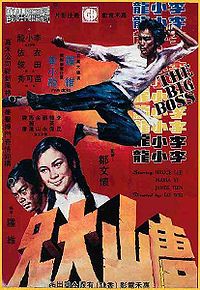 No single figure was more responsible for this international profile than Bruce Lee
, an American-born, Hong Kong-raised martial artist and actor. Lee completed just four movies before his death at the age of 32: The Big Boss
(1971), Fist of Fury
and Way of the Dragon
(both 1972), and Enter the Dragon
(1973). But in this very brief career he became cinema's first global Chinese
superstar. Eastern film historian Patrick Macias
ascribes his success to "(bringing) the warrior spirit of old into the present day... developing his own fighting style... and possessing superhuman charisma". His first three movies broke local box office records and were successful in much of the world. The English-language Enter the Dragon, the first-ever US-Hong Kong co-production, grossed about US$200 million worldwide, making it the most internationally successful film from that region up to then. Furthermore, his decision at the outset to work for young, upstart studio Golden Harvest
, rather than accept the Shaws' notoriously tightfisted standard contract, was a factor in Golden Harvest's meteoric rise and Shaw's eventual decline.
Following Lee's untimely death, a cottage industry of faux Lee movies
emerged, featuring either performers who adopted similar screen names (Bruce Li, Bruce Lai, etc.), or outtake footage of Lee, or some combination of both. The fad did little to engender mainstream respect in the West for the relatively new phenomenon of martial arts cinema. But despite such posthumous treatment, Lee continues to cast a long shadow over Hong Kong film.
. Like many kung fu performers of the day, Chan came out of training in Peking opera and started in film as a stuntman
, notably in some of Lee's vehicles. He was groomed for a while by The Big Boss and Fist of Fury director Lo Wei
as another Lee clone, in several movies including New Fist of Fury
(1976), with little success. But in 1978, Chan teamed up with action choreographer Yuen Woo Ping on Yuen's directorial debut, Snake in the Eagle's Shadow
. The resulting blend of physical comedy and kung fu action provided Chan with his first hit and the rudiments of what would become his signature style. Chan's follow-up movie with Yuen, Drunken Master
(also 1978), and his directorial debut, The Fearless Hyena (1979), were also giant hits and cemented his popularity.
 Although these films were not the first kung fu comedies, they launched a vogue that helped reinvigorate the waning kung fu genre. Especially notable in this regard were two of Chan's childhood Peking Opera School
classmates, Sammo Hung
and Yuen Biao
, who also made careers of this specialty, sometimes co-starring with Chan. Hung, noted for the seeming paradox of his overweight physique and physical agility, also made a name for himself as a director and action choreographer from early on, with titles like Enter the Fat Dragon
(1978).
summer blockbusters from America.
 In 1982, Jackie Chan
began experimenting with elaborate stunt
action sequences in Dragon Lord
, which featured a pyramid fight scene that holds the record for the most take
s required for a single scene, with 2900 takes, and the final fight scene where he performs various stunts, including one where he does a back flip off a loft
and falls to the lower ground. By 1983, Chan branched out into action films which, though they still used martial arts, were less limited in scope, setting and plot. His first film in this vein, Project A
, saw the official formation of the Jackie Chan Stunt Team
and added elaborate, dangerous stunts to the fights and typical slapstick humor (at one point, Chan falls from the top of a clock tower through a series of fabric canopies). The new formula helped Project A gross over HK$19 million.
Chan continued to take the approach - and the budgets - to new heights in hits like Police Story (1985). Here was Chan dangling from a speeding bus, sliding down a pole covered with exploding light bulb
s, and destroying large parts of a shopping centre and a hillside shantytown. The 1988 sequel called for explosions on a scale similar to many Hollywood movies and seriously injured leading lady Maggie Cheung
- an occupational risk Chan had already grown used to. Thus Jackie Chan created the template for the contemporary urban action-comedy of the 1980s, combining cops, kung fu and all the bodybreaking potential of the modern city with its glass, metal and speeding vehicles.
, the production company established in 1980 by comedians Raymond Wong, Karl Maka
and Dean Shek
. With movies like the spy spoof Aces Go Places
(1982) and its sequels, Cinema City helped make modern special effects, James Bond
-type gadgets and big vehicular stunts part of the industry vernacular. Director/producer Tsui Hark
had a hand in shaping the Cinema City style while employed there from 1981–1983 but went on to make an even bigger impact after leaving. In such movies as Zu Warriors from the Magic Mountain
(1983) and A Chinese Ghost Story
(1987, directed by Ching Siu-tung
), he kept pushing back the boundaries of Hong Kong special effects. He led the way in replacing the rough and ready camera style of 1970s kung fu with glossier and more sophisticated visuals and ever more furious editing.
's epoch-making heroic bloodshed
movie A Better Tomorrow
(1986). Woo's saga of cops and the triads (Chinese gangsters) combined fancifully choreographed (and extremely violent) gunplay with heightened emotional melodrama, sometimes resembling a modern-dress version of 1970s kung fu films by Woo's mentor Chang Cheh
. The formula broke another all-time box office record. It also jump-started the faltering career of co-star Chow Yun-fat
, who overnight became one of the colony's most popular idols and Woo's favorite leading man.
For the remainder of the 1980s and into the early 1990s, a deluge of films by Woo and others explored similar territory, often with a similar visual style and thematic bent. They were usually marked by an emphasis on the fraternal bonds of duty and affection among the criminal protagonists. The most notable other auteur of these themes was Ringo Lam
, who offered a less romanticized take in such films as City on Fire
, Prison on Fire
(both 1987), and Full Contact
(1992), all starring Chow Yun-Fat. The genre and its creators were accused in some quarters of cravenly glorifying real-life triads, whose involvement in the film business was notorious.
novels, which featured flying warriors in mid-air combat. Performers were trussed up on ultrathin wires to allow them to conduct gravity-defying action sequences, a technique known by Western fans, sometimes disparagingly, as wire fu.
As so often, Tsui Hark led the way. He produced Swordsman
(1990), which reestablished the wuxia novels of Jin Yong as favorite big-screen sources (television adaptations had long been ubiquitous). He directed Once Upon a Time in China
(1991), which resurrected oft-filmed folk hero Wong Fei Hung
. Both films were followed by sequels and a raft of imitations, often starring Mainland wushu
champion Jet Li
, who had become the biggest new superstar with his portrayal of Wong. He went on to receive a special award for a mainland China
person at the 1995 Taipei Golden Horse Film Festival. The other signature star of the subgenre was Taiwanese-born actress Brigitte Lin
. She made an unlikely specialty of androgynous woman-warrior types, such as the villainous, sex-changing eunuch
in The Swordsman 2 (1992), epitomizing martial arts fantasy's often-noted fascination with gender instability.
, but reawakened Western interest. Building on the reduced but enduring kung fu movie subculture, Jackie Chan and films like Tsui Hark's Peking Opera Blues
(1986) were already building a cult following when Woo's The Killer (1989) had a limited but successful release in the U.S. and opened the floodgates. In the '90s, Westerners with an eye on "alternative" culture became common sights in Chinatown
video shops and theaters, and gradually the films became more available in the mainstream video market and even occasionally in mainstream theaters. Western critics and film scholars also began to take Hong Kong action cinema seriously and made many key figures and films part of their canon of world cinema.
From here, Hong Kong came to define a new vocabulary for worldwide action cinema, with the aid of a new generation of North American filmmakers. Quentin Tarantino
's Reservoir Dogs
(1992) drew inspiration from City on Fire
and his two-part Kill Bill
(2003–04) was in large part a martial arts homage, borrowing Yuen Woo-Ping as fight choreographer and actor. Robert Rodriguez
's Desperado
(1995) and its 2003 sequel Once Upon a Time in Mexico
aped Woo's visual mannerisms. The Wachowski brothers' The Matrix
trilogy (1999–2003) of science-fiction-action blockbusters borrowed from Woo and wire fu movies and also employed Yuen behind the scenes. Martin Scorsese
's The Departed
(2006) was a remake of the Infernal Affairs
trilogy (2002–2003) by Andrew Lau
and Alan Mak
.
John Woo
left for Hollywood after his 1992 film Hard Boiled
. His 1997 film Face/Off
was the breakthrough that established his unique style in Hollywood. This effort was immensely popular with both critics and public alike (it grossed over US$240 million worldwide). Mission: Impossible II
(2000) grossed over US$560 million worldwide. Since these two films, Woo has struggled to revisit his successes of the 1980s and early 1990s.
After over fifteen years of success in Hong Kong cinema and a couple of attempts to crack the U.S. market, Jackie Chan
's 1995 film Rumble in the Bronx
finally brought him recognition in the U.S. Since then, he has made several highly successful films for U.S. studios including Rush Hour (1998), Shanghai Noon
(2000), and their respective sequels. Between his films for U.S. studios, he still makes films for Hong Kong studios, sometimes in English (Mr. Nice Guy
and Who Am I?), often set in western countries like Australia or the Netherlands
, and sometimes in Cantonese (2004's New Police Story
and 2006's Rob-B-Hood
). Because of his enormous U.S. popularity, these films are usually released in the U.S., a rarity for Hong Kong films, and generally attract respectable audience numbers.
Jet Li
has reduced his Hong Kong output since 1998's Hitman concentrating on Hollywood instead. After a minor role in Lethal Weapon 4
(1998), he has gone on to star in several Hollywood films which have performed respectably and made a name for him with American audiences. So far, he has returned to Chinese cinema for only two films: Hero
(2002) and Fearless
(2006). He claimed Fearless would be his last traditional kung fu film. Chow Yun-fat
has also moved to Hollywood. After his 1995 film Peace Hotel, he has made a handful of films in Hollywood which have not seen as much success as Jet Li's: these include The Replacement Killers
(1998), The Corruptor
(1999), Anna and the King
(1999) and Bulletproof Monk
(2003). He returned to China for 2000's Crouching Tiger, Hidden Dragon
.
 The Hong Kong film industry has been in a severe slump since the mid-1990s. The number of local films produced, and their box office takings, are dramatically reduced; American imports now dominate in a way they had not for decades, or perhaps ever. This crisis and increased contact with Western cinema have probably been the biggest recent influences on Hong Kong action cinema.
Luring local and regional youth audiences away from Hollywood is a constant concern. Action movies are now generally headlined by babyfaced Cantonese pop music
idols, such as Ekin Cheng
and Nicholas Tse
, enhanced with wires and digital effects - a trend also driven by the waning of a previous generation of martial arts-trained stars. The late 1990s witnessed a fad for Cantopop stars in high-tech, more American-styled action pictures such as Downtown Torpedoes (1997), Gen-X Cops
and Purple Storm
(both 1999).
Andrew Lau
's wuxia comic-book adaptation The Storm Riders
(1998) earned a record-breaking gross and ushered in an era of computer-generated imagery
, previously little used in Hong Kong film. Tsui Hark
's lavish CGI-enhanced efforts Time and Tide
(2000) and The Legend of Zu
(2001), however, were surprisingly unsuccessful. Comedy megastar and director Stephen Chow
used digital effects to push his typical affectionate parody of martial arts conventions to cartoonish levels in Shaolin Soccer
(2001) and Kung Fu Hustle
(2004), each of which also set a new box office record.
Striking a different note were a series of crime films more restrained and actor-driven than the earlier, John Woo-inspired examples. The Milkyway Image production company was at the vanguard with examples like Patrick Yau
's Expect the Unexpected
(1998), Johnnie To
's The Mission
(1999) and Running Out of Time (1999). Andrew Lau and Alan Mak
's blockbuster Infernal Affairs
trilogy (2002–2003) has set off a mini-trend of brooding police thrillers.
Collaboration with other industries, particularly that of Mainland China
, is another increasingly common survival and recovery strategy. Hong Kong stars and other personnel have been involved in international wuxia successes like Crouching Tiger, Hidden Dragon
(Taiwan, 2000) and Hero
(China, 2002).
Cinema of Hong Kong
The cinema of Hong Kong is one of the three major threads in the history of Chinese language cinema, alongside the cinema of China, and the cinema of Taiwan...
's global fame. It combines elements from the action film
Action film
Action film is a film genre where one or more heroes is thrust into a series of challenges that require physical feats, extended fights and frenetic chases...
, as codified by Hollywood
Cinema of the United States
The cinema of the United States, also known as Hollywood, has had a profound effect on cinema across the world since the early 20th century. Its history is sometimes separated into four main periods: the silent film era, classical Hollywood cinema, New Hollywood, and the contemporary period...
, with Chinese storytelling and aesthetic traditions, to create a culturally distinctive form that nevertheless has a wide transcultural appeal. In recent years, the flow has reversed somewhat, with American and European action films being heavily influenced by Hong Kong
Culture of Hong Kong
The culture of Hong Kong can best be described as a foundation that began with China, and became more influenced by British colonialism. Despite the 1997 transfer of sovereignty to the People's Republic of China, Hong Kong continues to hold an identity of its own.-People in the culture:Most Hong...
genre conventions.
The first Hong Kong
Hong Kong
Hong Kong is one of two Special Administrative Regions of the People's Republic of China , the other being Macau. A city-state situated on China's south coast and enclosed by the Pearl River Delta and South China Sea, it is renowned for its expansive skyline and deep natural harbour...
action films favoured the wuxia
Wuxia
Wuxia is a broad genre of Chinese fiction concerning the adventures of martial artists. Although wuxia is traditionally a form of literature, its popularity has caused it to spread to diverse art forms like Chinese opera, manhua , films, television series, and video games...
style, emphasizing mysticism and swordplay, but this trend was politically suppressed in the 1930s and replaced by styles in which films depicted more down-to-earth unarmed kung fu, often featuring folk hero Wong Fei Hung
Wong Fei Hung
Wong Fei-hung was a Chinese martial artist, a traditional Chinese medicine physician, acupuncturist and revolutionary who became a folk hero and the subject of numerous television series and films. He was considered an expert in the Hung Gar style of Chinese martial arts. Wong is visibly the most...
. Post-war cultural upheavals led to a second wave of wuxia films with highly acrobatic violence, followed by the emergence of the grittier kung fu films for which the Shaw Brothers studio became best known. The 1970s
1970s in Hong Kong
1970s in Hong Kong underwent many changes that shaped its future. Economically, it reinvented itself from a manufacturing base into a financial centre. The market also began leaning toward corporations and franchises.-Background:...
saw the rise and sudden death of international superstar Bruce Lee
Bruce Lee
Bruce Lee was a Chinese American, Hong Kong actor, martial arts instructor, philosopher, film director, film producer, screenwriter, and founder of the Jeet Kune Do martial arts movement...
. He was succeeded in the 1980s
1980s in Hong Kong
1980s in Hong Kong marks a period when the territory was known for its wealth and trademark lifestyle. Hong Kong would be recognised internationally for its politics, entertainment and skyrocketing real estate prices.-Background:...
by Jackie Chan
Jackie Chan
Jackie Chan, SBS, MBE is a Hong Kong actor, action choreographer, comedian, director, producer, martial artist, screenwriter, entrepreneur, singer and stunt performer. In his movies, he is known for his acrobatic fighting style, comic timing, use of improvised weapons, and innovative stunts...
—who popularised the use of comedy, dangerous stunt
Stunt
A stunt is an unusual and difficult physical feat, or any act requiring a special skill, performed for artistic purposes in TV, theatre, or cinema...
s, and modern urban settings in action films—and Jet Li
Jet Li
The fame gained by his sports winnings led to a career as a martial arts film star, beginning in mainland China and then continuing into Hong Kong. Li acquired his screen name in 1982 in the Philippines when a publicity company thought his real name was too hard to pronounce...
, whose authentic wushu
Chinese martial arts
Chinese martial arts, also referred to by the Mandarin Chinese term wushu and popularly as kung fu , are a number of fighting styles that have developed over the centuries in China. These fighting styles are often classified according to common traits, identified as "families" , "sects" or...
skills appealed to both eastern and western audiences. The innovative work of directors and producers like Tsui Hark
Tsui Hark
Tsui Hark , born Tsui Man-kong, is a Hong Kong New Wave film director and producer. He is viewed as a major figure in the Golden Age of Hong Kong cinema .-Early life:...
and John Woo
John Woo
John Woo Yu-Sen SBS is a Hong Kong-based film director and producer. Recognized for his stylised films of highly choreographed action sequences, Mexican standoffs, and use of slow-motion, Woo has directed several notable Hong Kong action films, among them, A Better Tomorrow, The Killer, Hard...
introduced further variety (for example, gunplay
Gun fu
Gun fu, a portmanteau of gun and kung fu, is the style of sophisticated close-quarters gunplay seen in Hong Kong action cinema and in Western films influenced by it. It often resembles a martial arts battle played out with firearms instead of traditional weapons...
, triads and the supernatural). An exodus by many leading figures to Hollywood in the 1990s
1990s in Hong Kong
The 1990s in Hong Kong marked a transitional period and the last decade of Colonial Hong Kong.-Background:The 1984 Sino-British Joint Declaration paved the way for a series of changes that would facilitate the transfer of sovereignty from the United Kingdom to the People's Republic of China . In...
coincided with a downturn in the industry.
Early martial arts films
Martial arts film
Martial arts film is a film genre. A sub-genre of the action film, martial arts films contain numerous fights between characters, usually as the films' primary appeal and entertainment value, and often as a method of storytelling and character expression and development. Martial arts are frequently...
, the most famous of which were developed in Hong Kong. The genre emerged first in Chinese popular literature
Chinese literature
Chinese literature extends thousands of years, from the earliest recorded dynastic court archives to the mature fictional novels that arose during the Ming Dynasty to entertain the masses of literate Chinese...
. The early 20th century saw an explosion of what were called wuxia
Wuxia
Wuxia is a broad genre of Chinese fiction concerning the adventures of martial artists. Although wuxia is traditionally a form of literature, its popularity has caused it to spread to diverse art forms like Chinese opera, manhua , films, television series, and video games...
novels (often translated as "martial chivalry"), generally published in serialized form in newspapers. These were tales of heroic, sword-wielding warriors, often featuring mystical or fantasy
Fantasy
Fantasy is a genre of fiction that commonly uses magic and other supernatural phenomena as a primary element of plot, theme, or setting. Many works within the genre take place in imaginary worlds where magic is common...
elements. This genre was quickly seized on by early Chinese film
Cinema of China
The Chinese-language cinema has three distinct historical threads: Cinema of Hong Kong, Cinema of China, and Cinema of Taiwan. Since 1949 the cinema of mainland China has operated under restrictions imposed by the Communist Party of China's State Administration of Radio, Film, and Television and...
s, particularly in the movie capital of the time, Shanghai
Shanghai
Shanghai is the largest city by population in China and the largest city proper in the world. It is one of the four province-level municipalities in the People's Republic of China, with a total population of over 23 million as of 2010...
. Starting in the 1920s, wuxia titles, often adapted from novels (for example, 1928's The Burning of the Red Lotus Monastery and its eighteen sequels) were hugely popular and the genre dominated Chinese film for several years.
The boom came to an end in the 1930s, caused by official opposition from cultural and political elites, especially the Kuomintang
Kuomintang
The Kuomintang of China , sometimes romanized as Guomindang via the Pinyin transcription system or GMD for short, and translated as the Chinese Nationalist Party is a founding and ruling political party of the Republic of China . Its guiding ideology is the Three Principles of the People, espoused...
government, who saw it as promoting superstition and violent anarchy. Wuxia filmmaking was picked up in Hong Kong, at the time a British
British Empire
The British Empire comprised the dominions, colonies, protectorates, mandates and other territories ruled or administered by the United Kingdom. It originated with the overseas colonies and trading posts established by England in the late 16th and early 17th centuries. At its height, it was the...
colony with a highly liberal economy and culture and a developing film industry. The first martial arts film in Cantonese
Standard Cantonese
Cantonese, or Standard Cantonese, is a language that originated in the vicinity of Canton in southern China, and is often regarded as the prestige dialect of Yue Chinese....
, the dominant Chinese spoken language of Hong Kong, was The Adorned Pavilion (1938).
Postwar martial arts cinema
Mainland China
Mainland China, the Chinese mainland or simply the mainland, is a geopolitical term that refers to the area under the jurisdiction of the People's Republic of China . According to the Taipei-based Mainland Affairs Council, the term excludes the PRC Special Administrative Regions of Hong Kong and...
—the Second Sino-Japanese War
Second Sino-Japanese War
The Second Sino-Japanese War was a military conflict fought primarily between the Republic of China and the Empire of Japan. From 1937 to 1941, China fought Japan with some economic help from Germany , the Soviet Union and the United States...
, the Chinese Civil War
Chinese Civil War
The Chinese Civil War was a civil war fought between the Kuomintang , the governing party of the Republic of China, and the Communist Party of China , for the control of China which eventually led to China's division into two Chinas, Republic of China and People's Republic of...
, and the victory of the Communist Party of China
Communist Party of China
The Communist Party of China , also known as the Chinese Communist Party , is the founding and ruling political party of the People's Republic of China...
—had shifted the centre of Chinese language
Chinese language
The Chinese language is a language or language family consisting of varieties which are mutually intelligible to varying degrees. Originally the indigenous languages spoken by the Han Chinese in China, it forms one of the branches of Sino-Tibetan family of languages...
filmmaking to Hong Kong. The industry continued the wuxia tradition in Cantonese B movie
B movie
A B movie is a low-budget commercial motion picture that is not definitively an arthouse or pornographic film. In its original usage, during the Golden Age of Hollywood, the term more precisely identified a film intended for distribution as the less-publicized, bottom half of a double feature....
s and serials, although the more prestigious Mandarin-language cinema generally ignored the genre. Animation and special effects drawn directly on the film by hand were used to simulate the flying abilities and other preternatural
Preternatural
The preternatural or praeternatural is that which appears outside or beyond the natural. In contrast to the supernatural, preternatural phenomena are presumed to have rational explanations that are, as of yet, unknown....
powers of characters; later titles in the cycle included The Six-Fingered Lord of the Lute (1965) and Sacred Fire, Heroic Wind (1966).
A countertradition to the wuxia films emerged in the kung fu movies that were also produced at this time. These movies emphasized more "authentic", down-to-earth and unarmed combat over the swordplay and mysticism of wuxia. The most famous exemplar was real-life martial artist Kwan Tak Hing
Kwan Tak Hing
Kwan Tak-hing, MBE was a Hong Kong actor who played the role of martial artist folk hero Wong Fei-hung in at least 77 films, between the 1940s and the 1980s. No-one else in cinema history has portrayed the same person as many times. In total he made over 130 films. He was elected to be the...
; he became an avuncular hero figure to at least a couple of generations of Hong Kongers by playing historical folk hero Wong Fei Hung
Wong Fei Hung
Wong Fei-hung was a Chinese martial artist, a traditional Chinese medicine physician, acupuncturist and revolutionary who became a folk hero and the subject of numerous television series and films. He was considered an expert in the Hung Gar style of Chinese martial arts. Wong is visibly the most...
in a series of roughly one hundred movies, from The True Story of Wong Fei Hung (1949) through to Wong Fei Hung Bravely Crushing the Fire Formation (1970). A number of enduring elements were introduced or solidified by these films: the still-popular character of "Master Wong"; the influence of Chinese opera
Chinese opera
Chinese opera is a popular form of drama and musical theatre in China with roots going back as far as the third century CE...
with its stylized martial arts and acrobatics
Acrobatics
Acrobatics is the performance of extraordinary feats of balance, agility and motor coordination. It can be found in many of the performing arts, as well as many sports...
; and the concept of martial arts heroes as exponents of Confucian
Confucianism
Confucianism is a Chinese ethical and philosophical system developed from the teachings of the Chinese philosopher Confucius . Confucianism originated as an "ethical-sociopolitical teaching" during the Spring and Autumn Period, but later developed metaphysical and cosmological elements in the Han...
ethics.
"New School" wuxia
In the second half of the 1960s, the era's biggest studio, Shaw BrothersShaw Brothers Studio
The Shaw Brothers Studio , owned by Shaw Brothers Ltd., was the foremost and the largest movie production company of Hong Kong movies.From their distribution base in Singapore where they founded parent company Shaw Organization in 1924, and as a strategic development of their movie distribution...
, inaugurated a new generation of wuxia films, starting with Xu Zenghong's Temple of the Red Lotus (1965), a remake of the 1928 classic. These Mandarin productions were more lavish and in colour; their style was less fantastical and more intense, with stronger and more acrobatic violence. They were influenced by imported samurai movies from Japan
Cinema of Japan
The has a history that spans more than 100 years. Japan has one of the oldest and largest film industries in the world – as of 2009 the fourth largest by number of feature films produced. Movies have been produced in Japan since 1897, when the first foreign cameramen arrived...
and by the wave of "New School" wuxia novels by authors like Jin Yong and Liang Yusheng
Liang Yusheng
Chen Wentong , better known by his pen name Liang Yusheng , is a Chinese writer of wuxia novels.He is credited as the pioneer of the "new school" wuxia genre in the 20th century, as well as one of the three most esteemed wuxia writers in the second half of the 20th century .-Biography:Chen was...
that started in the 1950s.
The New School wuxia wave marked the move of male-oriented action films to the centre of Hong Kong cinema, which had long been dominated by female stars and genres aimed at female audiences, such as romances
Romance film
Romance films are love stories that focus on passion, emotion, and the affectionate involvement of the main characters and the journey that their love takes through courtship or marriage. Romance films make the love story or the search for love the main plot focus...
and musicals
Musical film
The musical film is a film genre in which songs sung by the characters are interwoven into the narrative, sometimes accompanied by dancing. The songs usually advance the plot or develop the film's characters, though in some cases they serve merely as breaks in the storyline, often as elaborate...
. Even so, during the 1960s female action stars like Cheng Pei Pei and Connie Chan Po-chu
Connie Chan Po-chu
Connie Chan Po-chu was born in 1946 to impoverished parents, one of at least nine siblings, in Guangdong, China. To increase their children's chances of survival, Chan's birth parents gave away some of their youngest to other families. As a result, Chan was adopted by Chan Fei-nung and his wife,...
were prominent alongside male stars, such as former swimming champion Jimmy Wang Yu
Jimmy Wang Yu
Jimmy Wang Yu is a Chinese actor, director, producer, and screenwriter. He shot to fame with the Shaw Brothers Studio's martial arts film, The One-Armed Swordsman, in 1967...
, and they continued an old tradition of female warriors in wuxia storytelling. The signature directors of the period were Chang Cheh
Chang Cheh
Chang Cheh was Shaw Brothers Studio's best known and most prolific film director, with such films as the Five Venoms, the Brave Archer , the The One-Armed Swordsman, and other classics of wuxia and kung fu film.-Career:Referred to as "The Godfather of Hong Kong cinema", Chang Cheh directed over 100...
with One-Armed Swordsman
One-Armed Swordsman
One-Armed Swordsman is a 1967 Hong Kong wuxia film produced by the Shaw Brothers Studio. Directed by Chang Cheh, it was the first of the new style of wuxia films emphasizing male anti-heroes, violent swordplay and heavy bloodletting...
(1967) and Golden Swallow
Golden Swallow
Golden Swallow may refer to:* Golden Swallow * The Golden Swallow, a Hero of Chinese folkloreIn film* Golden Swallow, a 1949 film by Shaw Productions* Golden Swallow , a 1968 film by Shaw Brothers...
(1968) and King Hu
King Hu
King Hu was a Hong Kong- and Taiwan-based Chinese film director whose Wuxia films brought Chinese cinema to new technical and artistic heights. His films Come Drink with Me , Dragon Gate Inn and A Touch of Zen inaugurated a new generation of wuxia films in the late 1960s...
with Come Drink with Me
Come Drink with Me
Come Drink with Me is a 1966 Hong Kong wuxia film directed by King Hu. Set during the Ming Dynasty, it stars Cheng Pei-pei and Yueh Hua as warriors with Chan Hung-lit as the villain, and features action choreography by Han Ying-chieh. It is widely considered one of the best Hong Kong films ever made...
(1966). Hu soon left Shaw Brothers to pursue his own vision of wuxia with independent productions in Taiwan
Cinema of Taiwan
The history of Chinese-language cinema has three separate threads of development: Cinema of Hong Kong, Cinema of Mainland China and Cinema of Taiwan . Taiwanese cinema grew up outside of the Hong Kong mainstream and the censorship of the People's Republic of China.Taiwanese cinema is deeply rooted...
, such as the enormously successful Dragon Inn (1967, aka Dragon Gate Inn). Chang stayed on and remained the Shaws' prolific star director into the early 1980s.
The 1970s kung fu wave
The early 1970s saw wuxia giving way to a new, grittier and more graphic (and MandarinStandard Mandarin
Standard Chinese or Modern Standard Chinese, also known as Mandarin or Putonghua, is the official language of the People's Republic of China and Republic of China , and is one of the four official languages of Singapore....
-speaking) iteration of the kung fu movie, which came to dominate through the decade and into the early 1980s. Seriously trained martial artists
Martial arts
Martial arts are extensive systems of codified practices and traditions of combat, practiced for a variety of reasons, including self-defense, competition, physical health and fitness, as well as mental and spiritual development....
such as Ti Lung
Ti Lung
Tommy Tam Fu-Wing, also known as Ti Lung , or Dik Lung, is a Hong Kong actor.-Background:He studied Wing Chun under the martial arts master Chu Wan. In 1969, Ti was found by the Shaw Brothers and cast in Return of the One-Armed Swordsman opposite Jimmy Wang Yu, a role which would launch his career...
and Gordon Liu
Gordon Liu
Gordon Liu is a Chinese martial arts film actor. He became famous for playing the lead in The 36th Chamber of Shaolin and its sequels...
became some of the top stars as increasing proportions of running times were devoted to combat setpieces. Chinese Boxer (1970), starring and directed by Jimmy Wang Yu, is widely credited with launching the kung fu boom. But remaining at the vanguard, at least initially, were Shaw Brothers and director Chang Cheh. Chang's Vengeance
Vengeance (1970 film)
Vengeance is a 1970 kung fu film directed by Chang Cheh, and starring David Chiang and Ti Lung. The film is set in 1920 Peking, and centers on a revenge plight of Chiang...
(1970) was another of the first trendsetters and his dozens of contributions included The Boxer from Shantung (1972), Five Deadly Venoms
Five Deadly Venoms
Five Venoms aka Five Deadly Venoms is a cult 1978 Hong Kong martial arts film directed by Chang Cheh, starring the Venom Mob, and produced by the Shaw Brothers Studio, about five kung-fu fighters with unique animal styles: The Centipede, The Snake, The Scorpion, The Lizard and The Toad...
(1978) and Crippled Avengers
Crippled Avengers
Crippled Avengers is a 1978 Shaw Brothers kung fu film directed by Chang Cheh and starring four members of the Venom Mob. It has been released in North America as Mortal Combat and Return of the 5 Deadly Venoms....
(1979). Kung fu cinema was particularly influenced by Chang's concern with his vision of masculine values and male friendship; the female warrior figures who had been prominent in late 1960s wuxia work were sidelined, with prominent exceptions such as the popular Angela Mao
Angela Mao
Angela Mao is a martial arts film actress best known for the string of kung fu films in which she starred during the 1970s. She is also known as Mao Ying, Angela Mao Ying, and Mao Fu Ying...
.
Chang's only competitor as the genre’s most influential filmmaker was his long-time action choreographer, Lau Kar Leung (aka Liu Chia Liang in Mandarin). Lau began directing his own movies for the Shaw brothers in 1975 with The Spiritual Boxer, a progenitor of the kung fu comedy. In subsequent titles like Executioners from Shaolin (1977), The 36th Chamber of Shaolin
The 36th Chamber of Shaolin
The 36th Chamber of Shaolin , also known as The Master Killer and Shaolin Master Killer, is a 1978 Shaw Brothers kung fu film directed by Liu Chia-liang and starring Gordon Liu....
(1978), and Legendary Weapons of China
Legendary Weapons of China
Legendary Weapons of China is a 1982 martial arts fantasy film directed by Lau Kar-Leung. It takes place during the late Qing Dynasty when Empress Dowager Cixi dispatches her agents to various factions of the Boxer Rebellion in order find supernatural martial artists that are invulnerable to...
(1982), Lau emphasized the traditions and philosophy of the martial arts and strove to give onscreen fighting greater authenticity and ever greater speed and intricacy.
The kung fu boom was partly fueled by enormous international popularity, and not just in East Asia. In the West, kung fu imports, dubbed
Dubbing (filmmaking)
Dubbing is the post-production process of recording and replacing voices on a motion picture or television soundtrack subsequent to the original shooting. The term most commonly refers to the substitution of the voices of the actors shown on the screen by those of different performers, who may be...
and often recut and retitled, shown as "B" films in urban theaters and on television, made Hong Kong film widely noticed, although not widely respected, for the first time. African-Americans particularly embraced the genre (as exemplified by the popular hip-hop group, the Wu-Tang Clan
Wu-Tang Clan
The Wu-Tang Clan is a hip-hop group from Staten Island that consists of RZA, GZA, Method Man, Raekwon, Ghostface Killah, Inspectah Deck, U-God, Masta Killa, and the late Ol' Dirty Bastard. They are frequently joined by fellow childhood friend Cappadonna, a quasi member of the group...
) perhaps as an almost unprecedented source of adventure stories with non-white heroes, who furthermore often displayed a strong streak of racial and/or nationalistic pride.
The popularity of these movies in North America would continue into the 1980s when ninja movies were introduced. In popular culture, the films of this era were colloquially known as Kung Fu Theater or Black Belt Theater, names that many independent stations used for their weekly airing slot.
Bruce Lee
Bruce Lee
Bruce Lee was a Chinese American, Hong Kong actor, martial arts instructor, philosopher, film director, film producer, screenwriter, and founder of the Jeet Kune Do martial arts movement...
, an American-born, Hong Kong-raised martial artist and actor. Lee completed just four movies before his death at the age of 32: The Big Boss
The Big Boss
The Big Boss, previously known by its U.S. title Fists Of Fury is a 1971 Hong Kong martial arts action crime thriller film. The Big Boss was Bruce Lee's first major film. It was written to star James Tien; however, Lee's strong performance relegated Tien, already a star in Hong Kong, to second...
(1971), Fist of Fury
Fist of Fury
Fist of Fury, formerly known as The Chinese Connection and The Iron Hand in the United States, is a 1972 Hong Kong martial arts film directed by Lo Wei. It starred Bruce Lee in his second major film after The Big Boss...
and Way of the Dragon
Way of the Dragon
The Way of the Dragon is a 1972 Hong Kong martial arts film written, produced, directed by and starring Bruce Lee.- Plot :Tang Lung is sent from Hong Kong to Rome to help his friend's niece Chen Ching Hua, and family friends, whose restaurant is being targeted by the local Mafia, which has been...
(both 1972), and Enter the Dragon
Enter the Dragon
Enter the Dragon is a 1973 Hong Kong martial arts co-production with Golden Harvest and Warner Bros. studios, directed by Robert Clouse; starring Bruce Lee, Jim Kelly and John Saxon. This is Bruce Lee's final film appearance before his death on July 20, 1973...
(1973). But in this very brief career he became cinema's first global Chinese
Han Chinese
Han Chinese are an ethnic group native to China and are the largest single ethnic group in the world.Han Chinese constitute about 92% of the population of the People's Republic of China , 98% of the population of the Republic of China , 78% of the population of Singapore, and about 20% of the...
superstar. Eastern film historian Patrick Macias
Patrick Macias
Patrick Macias is an author and co-author of several titles on pop culture fandom, specifically relating to Japanese culture and otaku culture in America...
ascribes his success to "(bringing) the warrior spirit of old into the present day... developing his own fighting style... and possessing superhuman charisma". His first three movies broke local box office records and were successful in much of the world. The English-language Enter the Dragon, the first-ever US-Hong Kong co-production, grossed about US$200 million worldwide, making it the most internationally successful film from that region up to then. Furthermore, his decision at the outset to work for young, upstart studio Golden Harvest
Golden Harvest
Golden Harvest is a film production, distribution, and exhibition company based in Hong Kong. It played a major role in becoming the first Chinese film company to successfully enter the western market for an extended period of time, especially with the films of Bruce Lee and Jackie Chan...
, rather than accept the Shaws' notoriously tightfisted standard contract, was a factor in Golden Harvest's meteoric rise and Shaw's eventual decline.
Following Lee's untimely death, a cottage industry of faux Lee movies
Bruceploitation
Bruceploitation is a cultural phenomenon mostly seen in the 1970s after the 1973 death of martial artist and actor Bruce Lee. Movie makers in mainland China, Hong Kong and Taiwan hired a great number of Bruce Lee look-alike actors to star in many cheap knock-off martial arts movies to cash in on...
emerged, featuring either performers who adopted similar screen names (Bruce Li, Bruce Lai, etc.), or outtake footage of Lee, or some combination of both. The fad did little to engender mainstream respect in the West for the relatively new phenomenon of martial arts cinema. But despite such posthumous treatment, Lee continues to cast a long shadow over Hong Kong film.
Jackie Chan and the kung fu comedy
The only Chinese performer who has ever rivalled Bruce Lee's global fame is Jackie ChanJackie Chan
Jackie Chan, SBS, MBE is a Hong Kong actor, action choreographer, comedian, director, producer, martial artist, screenwriter, entrepreneur, singer and stunt performer. In his movies, he is known for his acrobatic fighting style, comic timing, use of improvised weapons, and innovative stunts...
. Like many kung fu performers of the day, Chan came out of training in Peking opera and started in film as a stuntman
Stunt double
A stunt double is a type of body double, specifically a skilled replacement used for dangerous film or video sequences, in movies and television , and for other sophisticated stunts...
, notably in some of Lee's vehicles. He was groomed for a while by The Big Boss and Fist of Fury director Lo Wei
Lo Wei
Lo Wei was a famous Hong Kong film director and film actor best known for launching the martial arts film careers of both Bruce Lee, in The Big Boss and Fist of Fury, and Jackie Chan, in New Fist of Fury....
as another Lee clone, in several movies including New Fist of Fury
New Fist of Fury
New Fist of Fury is a 1976 Hong Kong martial arts film directed by Lo Wei and starring Jackie Chan. It is the first of several films that Lo directed Chan in, and the first using Chan's stage name Sing Lung...
(1976), with little success. But in 1978, Chan teamed up with action choreographer Yuen Woo Ping on Yuen's directorial debut, Snake in the Eagle's Shadow
Snake in the Eagle's Shadow
Snake in the Eagle's Shadow is a 1978 Hong Kong martial arts action film directed by Yuen Woo-ping his directorial debut, who has since gained international stardom as the action choreographer for films such as Iron Monkey, Fist of Legend, Crouching Tiger, Hidden Dragon, The Matrix series, Kill...
. The resulting blend of physical comedy and kung fu action provided Chan with his first hit and the rudiments of what would become his signature style. Chan's follow-up movie with Yuen, Drunken Master
Drunken Master
Drunken Master, also known as Drunk Monkey In The Tiger's Eye, is a 1978 Hong Kong martial arts comedy film directed by Yuen Woo-ping, and starring Jackie Chan, Yuen Siu-tien, and Hwang Jang Lee...
(also 1978), and his directorial debut, The Fearless Hyena (1979), were also giant hits and cemented his popularity.
Peking Opera School
The Peking Opera Schools were boarding schools located throughout Mainland China, Hong Kong, Macau and Taiwan, specialising in teaching Peking opera...
classmates, Sammo Hung
Sammo Hung
Sammo Hung is a Hong Kong actor, martial artist, film producer and director, known for his work in many martial arts films and Hong Kong action cinema...
and Yuen Biao
Yuen Biao
Yuen Biao is a Hong Kong actor, martial artist. He specialises in acrobatics and Chinese martial arts and has worked on over 80 films as actor, stuntman and action choreographer...
, who also made careers of this specialty, sometimes co-starring with Chan. Hung, noted for the seeming paradox of his overweight physique and physical agility, also made a name for himself as a director and action choreographer from early on, with titles like Enter the Fat Dragon
Enter the Fat Dragon
Enter the Fat Dragon is a 1978 Hong Kong action film directed by and starring Sammo Hung...
(1978).
Reinventing action cinema
Chan's clowning may have helped extend the life of the kung fu wave for several years. Nevertheless, he became a star towards the end of the boom, and would soon help move the colony towards a new type of action. In the 1980s, he and many colleagues would forge a slicker, more spectacular Hong Kong pop cinema that would successfully compete with the post-Star WarsStar Wars
Star Wars is an American epic space opera film series created by George Lucas. The first film in the series was originally released on May 25, 1977, under the title Star Wars, by 20th Century Fox, and became a worldwide pop culture phenomenon, followed by two sequels, released at three-year...
summer blockbusters from America.
Jackie Chan and the modern martial arts film
Jackie Chan
Jackie Chan, SBS, MBE is a Hong Kong actor, action choreographer, comedian, director, producer, martial artist, screenwriter, entrepreneur, singer and stunt performer. In his movies, he is known for his acrobatic fighting style, comic timing, use of improvised weapons, and innovative stunts...
began experimenting with elaborate stunt
Stunt
A stunt is an unusual and difficult physical feat, or any act requiring a special skill, performed for artistic purposes in TV, theatre, or cinema...
action sequences in Dragon Lord
Dragon Lord
Dragon Lord is a 1982 Hong Kong martial arts film directed by and starring Jackie Chan. It was originally supposed to be a sequel to The Young Master and even had the name Young Master in Love until it was changed to Dragon Lord...
, which featured a pyramid fight scene that holds the record for the most take
Take
A take is a single continuous recorded performance. The term is used in film and music to denote and track the stages of production.-Film:In cinematography, a take refers to each filmed "version" of a particular shot or "setup"...
s required for a single scene, with 2900 takes, and the final fight scene where he performs various stunts, including one where he does a back flip off a loft
Loft
A loft can be an upper story or attic in a building, directly under the roof. Alternatively, a loft apartment refers to large adaptable open space, often converted for residential use from some other use, often light industrial...
and falls to the lower ground. By 1983, Chan branched out into action films which, though they still used martial arts, were less limited in scope, setting and plot. His first film in this vein, Project A
Project A
Project A is a 1983 Hong Kong martial arts action comedy film written and directed by Jackie Chan, and starring Chan, Sammo Hung and Yuen Biao....
, saw the official formation of the Jackie Chan Stunt Team
Jackie Chan Stunt Team
The Jackie Chan Stunt Team , also known as Jackie Chan's Stuntmen Association is a group of stuntmen and martial artists who work alongside Jackie Chan.-History:...
and added elaborate, dangerous stunts to the fights and typical slapstick humor (at one point, Chan falls from the top of a clock tower through a series of fabric canopies). The new formula helped Project A gross over HK$19 million.
Chan continued to take the approach - and the budgets - to new heights in hits like Police Story (1985). Here was Chan dangling from a speeding bus, sliding down a pole covered with exploding light bulb
Exploding light bulb
An exploding light bulb is a tungsten halogen or high-intensity discharge lamp, which ruptures explosively. Because these lamps operate with high pressure inside a high-temperature envelope, explosion can result in small pieces of hot glass ejected at high speed.- Causes of bulb explosion :If the...
s, and destroying large parts of a shopping centre and a hillside shantytown. The 1988 sequel called for explosions on a scale similar to many Hollywood movies and seriously injured leading lady Maggie Cheung
Maggie Cheung
Maggie Cheung Man yuk is a Chinese actress from Hong Kong. Raised in England and Hong Kong, she has over 70 films to her credit since starting her career in 1983...
- an occupational risk Chan had already grown used to. Thus Jackie Chan created the template for the contemporary urban action-comedy of the 1980s, combining cops, kung fu and all the bodybreaking potential of the modern city with its glass, metal and speeding vehicles.
Tsui Hark and Cinema City
Chan's move towards larger-scale action films was paralleled by work coming out of Cinema CityCinema City
Cinema City can mean:* Cinema City & Films Co. - the production company established in 1980 by actors Raymond Wong, Karl Maka and Dean Shek. See Hong Kong action cinema....
, the production company established in 1980 by comedians Raymond Wong, Karl Maka
Karl Maka
Karl Maka is a popular Hong Kong producer, director, actor and presenter. He was born on 29 February 1944 in Taishan, China. One of his popular movie is the Aces Go Places film series which he acted alongside Sam Hui....
and Dean Shek
Dean Shek
Dean Shek aka Dean Shek Tien is a veteran Hong Kong feature film actor and film producer with over 92 films acting credits to his name...
. With movies like the spy spoof Aces Go Places
Aces Go Places
Aces Go Places, , also known in the United States as Diamondfinger or Mad Mission 1, is a 1982 Hong Kong action/comedy film directed by Eric Tsang, and starring Sam Hui and Karl Maka.-Plot:...
(1982) and its sequels, Cinema City helped make modern special effects, James Bond
James Bond
James Bond, code name 007, is a fictional character created in 1953 by writer Ian Fleming, who featured him in twelve novels and two short story collections. There have been a six other authors who wrote authorised Bond novels or novelizations after Fleming's death in 1964: Kingsley Amis,...
-type gadgets and big vehicular stunts part of the industry vernacular. Director/producer Tsui Hark
Tsui Hark
Tsui Hark , born Tsui Man-kong, is a Hong Kong New Wave film director and producer. He is viewed as a major figure in the Golden Age of Hong Kong cinema .-Early life:...
had a hand in shaping the Cinema City style while employed there from 1981–1983 but went on to make an even bigger impact after leaving. In such movies as Zu Warriors from the Magic Mountain
Zu Warriors from the Magic Mountain
Zu Warriors from the Magic Mountain is a 1983 Hong Kong supernatural fantasy film directed by Tsui Hark, who attempts to combine Hong Kong action cinema with Western special effects technology...
(1983) and A Chinese Ghost Story
A Chinese Ghost Story
A Chinese Ghost Story is a 1987 Hong Kong romantic comedy horror film starring Leslie Cheung, Joey Wong, and Wu Ma, directed by Ching Siu-tung, and produced by Tsui Hark...
(1987, directed by Ching Siu-tung
Ching Siu-tung
Ching Siu-tung , also known as Tony Ching, is a Hong Kong action choreographer, actor, film director and producer, who has directed over 20 films, including the critically acclaimed supernatural fantasy A Chinese Ghost Story .-Career:...
), he kept pushing back the boundaries of Hong Kong special effects. He led the way in replacing the rough and ready camera style of 1970s kung fu with glossier and more sophisticated visuals and ever more furious editing.
John Woo and the triad films
As a producer, Tsui Hark facilitated the creation of John WooJohn Woo
John Woo Yu-Sen SBS is a Hong Kong-based film director and producer. Recognized for his stylised films of highly choreographed action sequences, Mexican standoffs, and use of slow-motion, Woo has directed several notable Hong Kong action films, among them, A Better Tomorrow, The Killer, Hard...
's epoch-making heroic bloodshed
Heroic bloodshed
Heroic Bloodshed is a genre of Hong Kong action cinema revolving around stylized action sequences and dramatic themes such as brotherhood, duty, honour, redemption and violence. The term heroic bloodshed was coined by editor Rick Baker in the magazine Eastern Heroes in the late 1980s, specifically...
movie A Better Tomorrow
A Better Tomorrow
A Better Tomorrow is a 1986 Hong Kong action film which had a profound influence on the Hong Kong film-making industry, and later on an international scale.Directed by John Woo, it stars Chow Yun-fat, Ti Lung and Leslie Cheung...
(1986). Woo's saga of cops and the triads (Chinese gangsters) combined fancifully choreographed (and extremely violent) gunplay with heightened emotional melodrama, sometimes resembling a modern-dress version of 1970s kung fu films by Woo's mentor Chang Cheh
Chang Cheh
Chang Cheh was Shaw Brothers Studio's best known and most prolific film director, with such films as the Five Venoms, the Brave Archer , the The One-Armed Swordsman, and other classics of wuxia and kung fu film.-Career:Referred to as "The Godfather of Hong Kong cinema", Chang Cheh directed over 100...
. The formula broke another all-time box office record. It also jump-started the faltering career of co-star Chow Yun-fat
Chow Yun-Fat
Chow Yun-fat, SBS is an actor from Hong Kong. He is best known in Asia for his collaboration with filmmaker John Woo in heroic bloodshed genre films A Better Tomorrow, The Killer, and Hard Boiled; and to the West for his role as Li Mu-bai in Crouching Tiger, Hidden Dragon...
, who overnight became one of the colony's most popular idols and Woo's favorite leading man.
For the remainder of the 1980s and into the early 1990s, a deluge of films by Woo and others explored similar territory, often with a similar visual style and thematic bent. They were usually marked by an emphasis on the fraternal bonds of duty and affection among the criminal protagonists. The most notable other auteur of these themes was Ringo Lam
Ringo Lam
Ringo Lam Ling-Tung , born in 1955 is a Hong Kong film director, producer and scriptwriter.He is known for gritty, dark and realistic action thrillers. He was born in Hong Kong and studied film at York University film school in Toronto...
, who offered a less romanticized take in such films as City on Fire
City on Fire (1987 film)
City on Fire is a gritty and stylish 1987 Hong Kong action crime drama film produced and directed by Ringo Lam, and starring Chow Yun-fat, Danny Lee and Sun Yueh...
, Prison on Fire
Prison on Fire
Prison on Fire is a 1987 Hong Kong action film directed by Ringo Lam and starring Chow Yun-fat. The film was followed by a sequel, Prison on Fire II, in 1991.-Plot:...
(both 1987), and Full Contact
Full Contact
Full Contact is a 1992 Hong Kong action film produced and directed by Ringo Lam. The film stars Chow Yun-fat, Simon Yam, Anthony Wong, and Ann Bridgewater. It was based upon Donald Westlake's novel The Hunter, with Chow Yun-Fat's character, Gou Fei, analogous to the novel's main character,...
(1992), all starring Chow Yun-Fat. The genre and its creators were accused in some quarters of cravenly glorifying real-life triads, whose involvement in the film business was notorious.
The wire-work wave
As the triad films petered out in the early 1990s, period martial arts returned as the favored action genre. But this was a new martial arts cinema that took full advantage of technical strides as well the higher budgets that came with Hong Kong's dominance of the region's screens. These lavish productions were often adapted from the more fantastical wuxiaWuxia
Wuxia is a broad genre of Chinese fiction concerning the adventures of martial artists. Although wuxia is traditionally a form of literature, its popularity has caused it to spread to diverse art forms like Chinese opera, manhua , films, television series, and video games...
novels, which featured flying warriors in mid-air combat. Performers were trussed up on ultrathin wires to allow them to conduct gravity-defying action sequences, a technique known by Western fans, sometimes disparagingly, as wire fu.
As so often, Tsui Hark led the way. He produced Swordsman
The Swordsman
The Swordsman or Swordsman is a 1990 Hong Kong wuxia film. King Hu was credited as the director but he allegedly left the project midway, and the film was completed by a team led by producer Tsui Hark. The film is adapted from Louis Cha's novel The Smiling, Proud Wanderer...
(1990), which reestablished the wuxia novels of Jin Yong as favorite big-screen sources (television adaptations had long been ubiquitous). He directed Once Upon a Time in China
Once Upon a Time in China
Once Upon a Time in China is a Hong Kong martial arts action/adventure film franchise directed, written, and produced by Tsui Hark. The stories are based on the life of the legendary kung fu master, Traditional Chinese medicine practitioner, and Chinese folk hero, Wong Fei Hung...
(1991), which resurrected oft-filmed folk hero Wong Fei Hung
Wong Fei Hung
Wong Fei-hung was a Chinese martial artist, a traditional Chinese medicine physician, acupuncturist and revolutionary who became a folk hero and the subject of numerous television series and films. He was considered an expert in the Hung Gar style of Chinese martial arts. Wong is visibly the most...
. Both films were followed by sequels and a raft of imitations, often starring Mainland wushu
Wushu (sport)
The sport of wushu is both an exhibition and a full-contact sport derived from traditional Chinese martial arts. It was created in the People's Republic of China after 1949, in an attempt to nationalize the practice of traditional Chinese martial arts...
champion Jet Li
Jet Li
The fame gained by his sports winnings led to a career as a martial arts film star, beginning in mainland China and then continuing into Hong Kong. Li acquired his screen name in 1982 in the Philippines when a publicity company thought his real name was too hard to pronounce...
, who had become the biggest new superstar with his portrayal of Wong. He went on to receive a special award for a mainland China
Mainland China
Mainland China, the Chinese mainland or simply the mainland, is a geopolitical term that refers to the area under the jurisdiction of the People's Republic of China . According to the Taipei-based Mainland Affairs Council, the term excludes the PRC Special Administrative Regions of Hong Kong and...
person at the 1995 Taipei Golden Horse Film Festival. The other signature star of the subgenre was Taiwanese-born actress Brigitte Lin
Brigitte Lin
Brigitte Lin or Brigitte Lin Ching Hsia is a Taiwanese actress. She was a popular actress, regarded as an icon of Chinese cinema, who acted in both Taiwanese and Hong Kong movies...
. She made an unlikely specialty of androgynous woman-warrior types, such as the villainous, sex-changing eunuch
Eunuch
A eunuch is a person born male most commonly castrated, typically early enough in his life for this change to have major hormonal consequences...
in The Swordsman 2 (1992), epitomizing martial arts fantasy's often-noted fascination with gender instability.
Influence in the West
All of these developments not only made Hong Kong the dominant cinema in East AsiaEast Asia
East Asia or Eastern Asia is a subregion of Asia that can be defined in either geographical or cultural terms...
, but reawakened Western interest. Building on the reduced but enduring kung fu movie subculture, Jackie Chan and films like Tsui Hark's Peking Opera Blues
Peking Opera Blues
Peking Opera Blues is a 1986 Hong Kong film directed by Tsui Hark. The movie combines comedy, Hong Kong action, and serious drama with scenes involving Peking Opera...
(1986) were already building a cult following when Woo's The Killer (1989) had a limited but successful release in the U.S. and opened the floodgates. In the '90s, Westerners with an eye on "alternative" culture became common sights in Chinatown
Chinatown
A Chinatown is an ethnic enclave of overseas Chinese people, although it is often generalized to include various Southeast Asian people. Chinatowns exist throughout the world, including East Asia, Southeast Asia, the Americas, Australasia, and Europe. Binondo's Chinatown located in Manila,...
video shops and theaters, and gradually the films became more available in the mainstream video market and even occasionally in mainstream theaters. Western critics and film scholars also began to take Hong Kong action cinema seriously and made many key figures and films part of their canon of world cinema.
From here, Hong Kong came to define a new vocabulary for worldwide action cinema, with the aid of a new generation of North American filmmakers. Quentin Tarantino
Quentin Tarantino
Quentin Jerome Tarantino is an American film director, screenwriter, producer, cinematographer and actor. In the early 1990s, he began his career as an independent filmmaker with films employing nonlinear storylines and the aestheticization of violence...
's Reservoir Dogs
Reservoir Dogs
Reservoir Dogs is an American crime film marking debut of director and writer Quentin Tarantino. It depicts the events before and after a botched diamond heist, but not the heist itself. Reservoir Dogs stars an ensemble cast: Harvey Keitel, Steve Buscemi, Tim Roth, Michael Madsen, Chris Penn, and...
(1992) drew inspiration from City on Fire
City on Fire (1987 film)
City on Fire is a gritty and stylish 1987 Hong Kong action crime drama film produced and directed by Ringo Lam, and starring Chow Yun-fat, Danny Lee and Sun Yueh...
and his two-part Kill Bill
Kill Bill
Kill Bill Volume 1 is a 2003 action thriller film written and directed by Quentin Tarantino. It is the first of two volumes that were theatrically released several months apart, the second volume being Kill Bill Volume 2....
(2003–04) was in large part a martial arts homage, borrowing Yuen Woo-Ping as fight choreographer and actor. Robert Rodriguez
Robert Rodriguez
Robert Anthony Rodríguez is an American film director, screenwriter, producer, cinematographer, editor and musician. He shoots and produces many of his films in his native Texas and Mexico. He has directed such films as Desperado, From Dusk till Dawn, The Faculty, Spy Kids, Sin City, Planet...
's Desperado
Desperado (film)
Desperado is a 1995 action thriller film written and directed by Robert Rodriguez. The film stars Antonio Banderas as the former mariachi who seeks revenge on the drug lord who killed his lover....
(1995) and its 2003 sequel Once Upon a Time in Mexico
Once Upon a Time in Mexico
Once Upon a Time in Mexico is a 2003 action film written, edited and directed by Robert Rodriguez. It is the final film in the "Mariachi Trilogy", which also includes El Mariachi and Desperado. Antonio Banderas reprises his role as El Mariachi...
aped Woo's visual mannerisms. The Wachowski brothers' The Matrix
The Matrix
The Matrix is a 1999 science fiction-action film written and directed by Larry and Andy Wachowski, starring Keanu Reeves, Laurence Fishburne, Carrie-Anne Moss, Joe Pantoliano, and Hugo Weaving...
trilogy (1999–2003) of science-fiction-action blockbusters borrowed from Woo and wire fu movies and also employed Yuen behind the scenes. Martin Scorsese
Martin Scorsese
Martin Charles Scorsese is an American film director, screenwriter, producer, actor, and film historian. In 1990 he founded The Film Foundation, a nonprofit organization dedicated to film preservation, and in 2007 he founded the World Cinema Foundation...
's The Departed
The Departed
The Departed is a 2006 American crime thriller film, fashioned as a remake of the 2002 Hong Kong film Infernal Affairs. The film was directed by Martin Scorsese and written by William Monahan...
(2006) was a remake of the Infernal Affairs
Infernal Affairs
Infernal Affairs is a 2002 Hong Kong crime-thriller film directed by Andrew Lau and Alan Mak. It tells the story of a police officer who infiltrates the triads, and a police officer secretly working for the same gang. The Chinese title means "the non-stop path", a reference to Avici, the lowest...
trilogy (2002–2003) by Andrew Lau
Andrew Lau
Andrew Lau Wai-Keung is a Hong Kong cinematographer and filmmaker. Lau began his career in the 1980s and 1990s, serving as a cinematographer to filmmakers such as Ringo Lam, Wong Jing and Wong Kar-wai. In the 1990s, Lau decided to have more creative freedom as a cinematographer by becoming a film...
and Alan Mak
Alan Mak
Alan Mak Siu-Fai , born on 1 January 1968 in Hong Kong, is a writer, director, actor and producer.-Biography:In 1986, Mak studied at the School of Drama in the Hong Kong Academy for Performance Arts. Upon graduation in 1990, he started his movie career....
.
Exit of many leading figures
Due to the new-found international awareness of Hong Kong films during the 1980s and early 1990s and a downturn in the industry as the 1990s progressed, many of the leading lights of Hong Kong cinema left for Hollywood, which offered budgets and pay which could not be equalled by Hong Kong production companies.John Woo
John Woo
John Woo Yu-Sen SBS is a Hong Kong-based film director and producer. Recognized for his stylised films of highly choreographed action sequences, Mexican standoffs, and use of slow-motion, Woo has directed several notable Hong Kong action films, among them, A Better Tomorrow, The Killer, Hard...
left for Hollywood after his 1992 film Hard Boiled
Hard Boiled
Hard Boiled is a 1992 Hong Kong action film directed by John Woo. The film stars Chow Yun-fat as Inspector "Tequila" Yuen, Tony Leung Chiu-Wai as Tony, an undercover cop, and Anthony Wong as Johnny Wong, a leader of criminal triads. The film features Tequila, whose partner is killed in a tea...
. His 1997 film Face/Off
Face/Off
Face/Off is a 1997 action thriller film directed by John Woo, starring John Travolta and Nicolas Cage. The two both play an FBI agent and a terrorist, sworn enemies who assume the physical appearance of one another....
was the breakthrough that established his unique style in Hollywood. This effort was immensely popular with both critics and public alike (it grossed over US$240 million worldwide). Mission: Impossible II
Mission: Impossible II
Mission: Impossible II is a 2000 action film directed by John Woo, and starring Tom Cruise, who also served as the film's producer...
(2000) grossed over US$560 million worldwide. Since these two films, Woo has struggled to revisit his successes of the 1980s and early 1990s.
After over fifteen years of success in Hong Kong cinema and a couple of attempts to crack the U.S. market, Jackie Chan
Jackie Chan
Jackie Chan, SBS, MBE is a Hong Kong actor, action choreographer, comedian, director, producer, martial artist, screenwriter, entrepreneur, singer and stunt performer. In his movies, he is known for his acrobatic fighting style, comic timing, use of improvised weapons, and innovative stunts...
's 1995 film Rumble in the Bronx
Rumble in the Bronx
Rumble in the Bronx is a 1995 Hong Kong martial arts action comedy film starring Jackie Chan and Anita Mui. Released in the US in 1995, Rumble in the Bronx had a successful theater run, and brought Chan into the American mainstream...
finally brought him recognition in the U.S. Since then, he has made several highly successful films for U.S. studios including Rush Hour (1998), Shanghai Noon
Shanghai Noon
Shanghai Noon is a 2000 American martial arts action comedy western film starring Jackie Chan and Owen Wilson. The film, marking the directorial debut of Tom Dey, was written by Alfred Gough and Miles Millar....
(2000), and their respective sequels. Between his films for U.S. studios, he still makes films for Hong Kong studios, sometimes in English (Mr. Nice Guy
Mr. Nice Guy (1997 film)
Mr Nice Guy is a 1997 Hong Kong martial arts action crime comedy film directed by Sammo Hung and starring Jackie Chan. It also stars Richard Norton as the villain, with whom Chan had worked in 1993 film City Hunter and Chan and Hung had worked in Twinkle, Twinkle Lucky Stars. Hung makes a cameo as...
and Who Am I?), often set in western countries like Australia or the Netherlands
Netherlands
The Netherlands is a constituent country of the Kingdom of the Netherlands, located mainly in North-West Europe and with several islands in the Caribbean. Mainland Netherlands borders the North Sea to the north and west, Belgium to the south, and Germany to the east, and shares maritime borders...
, and sometimes in Cantonese (2004's New Police Story
New Police Story
New Police Story is a 2004 Hong Kong action film starring Jackie Chan and directed by Benny Chan.The film is a reboot of the Police Story series. New Police Story relies much more on drama and heavy action than its predecessors.-Plot:...
and 2006's Rob-B-Hood
Rob-B-Hood
Rob-B-Hood is a 2006 action comedy film directed by Benny Chan, and starring Jackie Chan, Louis Koo and Michael Hui. It was produced with a budget of HK$130 million and filmed between December 2005 and January 2006...
). Because of his enormous U.S. popularity, these films are usually released in the U.S., a rarity for Hong Kong films, and generally attract respectable audience numbers.
Jet Li
Jet Li
The fame gained by his sports winnings led to a career as a martial arts film star, beginning in mainland China and then continuing into Hong Kong. Li acquired his screen name in 1982 in the Philippines when a publicity company thought his real name was too hard to pronounce...
has reduced his Hong Kong output since 1998's Hitman concentrating on Hollywood instead. After a minor role in Lethal Weapon 4
Lethal Weapon 4
Lethal Weapon 4 is a 1998 American action film directed by Richard Donner, starring Mel Gibson, Danny Glover, Joe Pesci, Rene Russo, Chris Rock and Jet Li. It is the third sequel in the Lethal Weapon series of films. -Plot:...
(1998), he has gone on to star in several Hollywood films which have performed respectably and made a name for him with American audiences. So far, he has returned to Chinese cinema for only two films: Hero
Hero (2002 film)
Hero is a 2002 wuxia film directed by Zhang Yimou. Starring Jet Li as the nameless protagonist, the film is based on the story of Jing Ke's assassination attempt on the King of Qin in 227 BC....
(2002) and Fearless
Fearless (2006 film)
Fearless, known in Chinese as Huo Yuanjia and Jet Li's Fearless in the United Kingdom and the United States, is a 2006 film directed by Ronny Yu and starring Jet Li...
(2006). He claimed Fearless would be his last traditional kung fu film. Chow Yun-fat
Chow Yun-Fat
Chow Yun-fat, SBS is an actor from Hong Kong. He is best known in Asia for his collaboration with filmmaker John Woo in heroic bloodshed genre films A Better Tomorrow, The Killer, and Hard Boiled; and to the West for his role as Li Mu-bai in Crouching Tiger, Hidden Dragon...
has also moved to Hollywood. After his 1995 film Peace Hotel, he has made a handful of films in Hollywood which have not seen as much success as Jet Li's: these include The Replacement Killers
The Replacement Killers
The Replacement Killers is a 1998 American action film, directed by Antoine Fuqua in his directorial debut. It stars Chow Yun-fat and Mira Sorvino...
(1998), The Corruptor
The Corruptor
The Corruptor is a 1999 American action thriller film directed by James Foley, and starring Chow Yun-fat and Mark Wahlberg.-Plot:NYPD Lieutenant Nick Chen is one of New York City's police officers and is head of the Asian Gang Unit...
(1999), Anna and the King
Anna and the King
Anna and the King is a 1999 biographical drama film loosely based on Anna and the King of Siam, the story of Anna Leonowens, who was an English schoolteacher in Siam, now Thailand, in the 19th century...
(1999) and Bulletproof Monk
Bulletproof Monk
Bulletproof Monk is a 2003 action film starring Chow Yun-fat, Seann William Scott and Jaime King. The film was directed by Paul Hunter. It is loosely based on the comic book by Michael Avon Oeming....
(2003). He returned to China for 2000's Crouching Tiger, Hidden Dragon
Crouching Tiger, Hidden Dragon
Crouching Tiger, Hidden Dragon is a 2000 wuxia film. An American-Chinese-Hong Kong-Taiwanese co-production, the film was directed by Ang Lee and featured an international cast of ethnic Chinese actors, including Chow Yun-Fat, Michelle Yeoh, Zhang Ziyi, and Chang Chen...
.
Recent trends
Luring local and regional youth audiences away from Hollywood is a constant concern. Action movies are now generally headlined by babyfaced Cantonese pop music
Cantopop
Cantopop is a colloquialism for "Cantonese popular music". It is sometimes referred to as HK-pop, short for "Hong Kong popular music". It is categorized as a subgenre of Chinese popular music within C-pop...
idols, such as Ekin Cheng
Ekin Cheng
Ekin Cheng is a Hong Kong actor and Cantopop singer. Early in his career he used the name Dior as a first name. He has also been referred to as Noodle Cheng, after a popular noodle product with a similar name...
and Nicholas Tse
Nicholas Tse
Nicholas Tse is a Hong Kong singer-songwriter, actor and musician, and son of actor Patrick Tse. He is a member of the Emperor Entertainment Group...
, enhanced with wires and digital effects - a trend also driven by the waning of a previous generation of martial arts-trained stars. The late 1990s witnessed a fad for Cantopop stars in high-tech, more American-styled action pictures such as Downtown Torpedoes (1997), Gen-X Cops
Gen-X Cops
Gen-X Cops is a 1999 Hong Kong action/crime film directed by Benny Chan, starring Nicholas Tse, Stephen Fung and Sam Lee.-Synopsis:Jet fuel is stolen by weapons smugglers. The fuel is reacquired by the Hong Kong police but then once again stolen by a yakuza boss named Akatora who is trying to sell...
and Purple Storm
Purple Storm (film)
Purple Storm is a 1999 Hong Kong science-fiction thriller directed by Teddy Chan was released on 25 October, 1999 and was officially released since on 25 November 1999...
(both 1999).
Andrew Lau
Andrew Lau
Andrew Lau Wai-Keung is a Hong Kong cinematographer and filmmaker. Lau began his career in the 1980s and 1990s, serving as a cinematographer to filmmakers such as Ringo Lam, Wong Jing and Wong Kar-wai. In the 1990s, Lau decided to have more creative freedom as a cinematographer by becoming a film...
's wuxia comic-book adaptation The Storm Riders
The Storm Riders
The Storm Riders is a 1998 Hong Kong film based on the manhua series Fung Wan by artist Ma Wing-shing. Directed by Andrew Lau, it starred Ekin Cheng as Wind and Aaron Kwok as Cloud. The plot involves two children, Whispering Wind and Striding Cloud, who become powerful warriors under the evil Lord...
(1998) earned a record-breaking gross and ushered in an era of computer-generated imagery
Computer-generated imagery
Computer-generated imagery is the application of the field of computer graphics or, more specifically, 3D computer graphics to special effects in art, video games, films, television programs, commercials, simulators and simulation generally, and printed media...
, previously little used in Hong Kong film. Tsui Hark
Tsui Hark
Tsui Hark , born Tsui Man-kong, is a Hong Kong New Wave film director and producer. He is viewed as a major figure in the Golden Age of Hong Kong cinema .-Early life:...
's lavish CGI-enhanced efforts Time and Tide
Time and Tide (2000 film)
Time and Tide is a 2000 Hong Kong action film directed by Tsui Hark. The film is set in Hong Kong where a young man becomes a bodyguard and befriends a mercenary determined to begin life a new with the woman he just married...
(2000) and The Legend of Zu
The Legend of Zu
The Legend of Zu, also known as Zu Warriors in the United States, is a 2001 Hong Kong film produced and directed by Tsui Hark. The film starred Ekin Cheng, Louis Koo, Cecilia Cheung, Patrick Tam, Zhang Ziyi and Sammo Hung...
(2001), however, were surprisingly unsuccessful. Comedy megastar and director Stephen Chow
Stephen Chow
Stephen Chow Sing-Chi is a Hong Kong actor, comedian, screenwriter, film director and producer.- Professional career :Stephen Chow began as a temporary actor for TVB. He entered TVB in early 1980s, and was trained there, although he had few opportunities to appear in films. Chow graduated from...
used digital effects to push his typical affectionate parody of martial arts conventions to cartoonish levels in Shaolin Soccer
Shaolin Soccer
Shaolin Soccer is a 2001 Hong Kong comedy film co-written, directed by and starring Stephen Chow. A former Shaolin monk reunites his five brothers, years after their master's death, to apply their superhuman martial arts skills to play soccer and bring Shaolin kung fu to the masses.In 2008 a...
(2001) and Kung Fu Hustle
Kung Fu Hustle
Kung Fu Hustle is a 2004 action comedy film directed and produced by, and starring Stephen Chow. The other film producers were Chui Po-chu and Jeffrey Lau, while the screenplay was written by Huo Xin, Chan Man-keung, and Tsang Kan-cheung...
(2004), each of which also set a new box office record.
Striking a different note were a series of crime films more restrained and actor-driven than the earlier, John Woo-inspired examples. The Milkyway Image production company was at the vanguard with examples like Patrick Yau
Patrick Yau
Patrick Yau Tat-Chi is a Hong Kong film director and assistant director best known for making independent films for Milkyway Image, the production company owned by Johnnie To and Wai Ka-Fai.-Career:...
's Expect the Unexpected
Expect the Unexpected (film)
-Cast and roles:* Simon Yam - Ken* Sean Lau - Sam* Yoyo Mung - Mandy* Ruby Wong - Macy* Lam Suet - Collins* Lester Chit-Man Chan - Head of Security Carrier Robbers* Joe Cheng - Heavy-armed Robber in Apartment* Benz Hui - Ben* Kar Sin Pak - Isabella...
(1998), Johnnie To
Johnnie To
Johnnie To Kei-Fung, born 22 April 1955, is a Hong Kong film director and producer. Popular in his native Hong Kong, To has also found acclaim overseas...
's The Mission
The Mission (1999 film)
The Mission is a 1999 Hong Kong action film produced and directed Johnnie To, and starring Anthony Wong, Francis Ng, Jackie Lui, Lam Suet, and Simon Yam.-Plot:...
(1999) and Running Out of Time (1999). Andrew Lau and Alan Mak
Alan Mak
Alan Mak Siu-Fai , born on 1 January 1968 in Hong Kong, is a writer, director, actor and producer.-Biography:In 1986, Mak studied at the School of Drama in the Hong Kong Academy for Performance Arts. Upon graduation in 1990, he started his movie career....
's blockbuster Infernal Affairs
Infernal Affairs
Infernal Affairs is a 2002 Hong Kong crime-thriller film directed by Andrew Lau and Alan Mak. It tells the story of a police officer who infiltrates the triads, and a police officer secretly working for the same gang. The Chinese title means "the non-stop path", a reference to Avici, the lowest...
trilogy (2002–2003) has set off a mini-trend of brooding police thrillers.
Collaboration with other industries, particularly that of Mainland China
Cinema of China
The Chinese-language cinema has three distinct historical threads: Cinema of Hong Kong, Cinema of China, and Cinema of Taiwan. Since 1949 the cinema of mainland China has operated under restrictions imposed by the Communist Party of China's State Administration of Radio, Film, and Television and...
, is another increasingly common survival and recovery strategy. Hong Kong stars and other personnel have been involved in international wuxia successes like Crouching Tiger, Hidden Dragon
Crouching Tiger, Hidden Dragon
Crouching Tiger, Hidden Dragon is a 2000 wuxia film. An American-Chinese-Hong Kong-Taiwanese co-production, the film was directed by Ang Lee and featured an international cast of ethnic Chinese actors, including Chow Yun-Fat, Michelle Yeoh, Zhang Ziyi, and Chang Chen...
(Taiwan, 2000) and Hero
Hero (2002 film)
Hero is a 2002 wuxia film directed by Zhang Yimou. Starring Jet Li as the nameless protagonist, the film is based on the story of Jing Ke's assassination attempt on the King of Qin in 227 BC....
(China, 2002).
External links
- The Rise and Fall of the House of Shaw - Essay charting the history of Shaw Brothers Studios.