
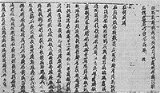
Encyclopedia
The Art of War is a
Chinese military treatise written during the 6th century BC by
Sun Tzu. Composed of 13 chapters, each of which is devoted to one aspect of
warfare, it has long been praised as the definitive work on
military strategies and tactics of its time.
The Art of War is one of the oldest and most famous studies of strategy and has had a huge influence on both
military planning and beyond. First translated into a European language in 1782 by French
Jesuit Jean Joseph Marie Amiot, it had been credited with influencing
Napoleon, the German
General Staff, and even the planning of
Operation Desert Storm. Leaders as diverse as
Mao Zedong,
Vo Nguyen Giap, and
General Douglas MacArthur have claimed to have drawn inspiration from the work.
Since the late 20th century,
The Art of War has also been applied, with much success, to
business and managerial strategies.
History
Based on the content, the book was finished between Zhuan Zhu's assassination of King Liao of Wu and
Wu Zixu's recommendation to King Helü of Wu in
China.
It was believed by some that the long-lost
Sun Bin Bing Fa, or
Sun Bin's The Art of War cited in the Book of Han, was actually Sun Tzu's
The Art of War, but in April 1972, archaeologists discovered a tomb in Linyi County,
Shandong Province, that contained several fragments of important scrolls buried during the
Han Dynasty. Among the scrolls were a copy of the Sun Bin Bing Fa and a copy of Sun Tzu's
The Art of War, thus removing any doubt.
The 13 chapters
Chapter titles from Lionel Giles' 1910 translation- I. Laying Plans
- II. Waging War
- III. Attack by Stratagem
- IV. Tactical Dispositions
- V. Energy
- VI. Weak Points and Strong
- VII. Maneuvering
- VIII. Variation in Tactics
- IX. The Army On The March
- X. Terrain
- XI. The Nine Situations
- XII. The Attack By Fire
- XIII. The Use of Spies
Chapter titles from CHOW-HOU WEE's 2003 translation- I. Detail Assessment and Planning
- II. Waging War
- III. Strategic Attack
- IV. Disposition of the Army
- V. Forces
- VI. Weaknesses and Strengths
- VII. Military Manoeuvres
- VIII. Variations and Adaptability
- IX. Movement and Development of Troops
- X. Terrain
- XI. The Nine Battlegrounds
- XII. Attacking with Fire
- XIII. Intelligence and Espionage
Annotations
Before the bamboo scroll version was discovered by archaeologists in April 1972, the most cited version of
The Art of War was the Annotation of Sun Tzu's Strategies by
Cao Cao, the founder of Cao Wei Kingdom. In the preface, he wrote that previous annotations were not focused on the essential ideas. Other annotations cited in official history books include Shen You 's
Sun Tzu's Military Strategy,
Jia Xu's
Copy of Sun Tzu's Military Strategy,
Cao Cao and Wang Ling 's
Sun Tzu's Military Strategy.
The
Book of Sui documented seven books named after Sun Tzu. An annotation by Du Mu also includes
Cao Cao's annotation. Li Jing's The Art of War is said to be a revision of Sun Tzu's strategies. Annotations by
Cao Cao, Du Mu and Li Quan were translated into
Tangut language before 1040 AD.
After the
movable type printer was invented, The Art of War was published as a military text book, known as
Seven Military Classics with six other strategy books. A book named
Ten Schools of The Art of War Annotations was published before 1161 AD.
As a required reading military textbook since the
Song Dynasty, Seven Military Classics has many annotations. More than 30 differently annotated versions of this book exist today.
Vernacular Chinese became increasingly popular in the late 1920s. Annotations in Vernacular Chinese began to appear after this time. Some of these works were translated from other languages, such as Japanese.
Quotations
Verses from the book occur in modern daily
Chinese idioms and phrases, such as the last verse of Chapter 3:
- ??:????,????;??????,????;???,???,????
- So it is said that if you know your enemies and know yourself, you will not be imperiled in a hundred battles; if you do not know your enemies but do know yourself, you will win one and lose one; if you do not know your enemies nor yourself, you will be imperiled in every single battle.
This has been more tersely interpreted and condensed into the modern proverb:
- ????, ????
- If you know both yourself and your enemy, you will come out of one hundred battles with one hundred victories.
Similar verses have also been borrowed -- in a manner construing skillfulness as victory "without fighting" -- for example:
- ????,?????;???????,?????
- One hundred victories in one hundred battles is not the most skillful. Seizing the enemy without fighting is the most skillful.
Military applications
In many
East Asian countries,
The Art of War was part of the syllabus for potential candidates of military service examinations. Various translations are available and were used by some
European military institutions, for instance, in
Germany before
World War I. In the
United States Marine Corps, it is reportedly required reading for intelligence personnel and recommended for all Marines.
During Sengoku Jidai in
Japan, a
Samurai named
Takeda Shingen is said to have become almost invincible in all battles without relying on
guns, because he studied
The Art of War. The book even gave him the inspiration for his famous battle standard "Furinkazan" , meaning fast as wind, silent as forest, ferocious as fire and immovable as mountain. Some say that had Shingen not died from illness, he would have become the
Shogun of Japan.
During the
Vietnam War, some
Vietcong officers studied
The Art of War , and reportedly could recite entire passages from memory.
Applicability outside the military
Since at least the 1980's,
The Art of War has been applied to fields well outside the military one. Much of the text is about how to fight wars without actually having to do battle: it gives tips on how to outsmart one's opponent so that physical battle is not necessary. As such, it has found application as a training guide for many competitive endeavors that do not involve actual combat.
Most notably the book has gained popularity in corporate life; there have been a variety of business books written that apply its lessons to "office politics" and corporate strategy. Many
Japanese companies make the book required reading for their key executives. The book is also popular among Western business management, who have turned to it for inspiration and advice on how to succeed in competitive business situations.
It has also crept its way into sport:
Australian
cricket coach
John Buchanan handed out excerpts from the book to his players before a match against
England in 2001, and the book is allegedly a favorite of
University of South Carolina football head coach Steve Spurrier
Former Brazilian
football coach, and current coach of the Portuguese national football team
Luiz Felipe Scolari uses the book to plot his
football strategy. In the 2002 FIFA World Cup he gave each of his players copies of the book. In the recent 2006 FIFA World Cup in Germany he used the book to plan his team's win against England.
It has found use in
political campaigning as well; Republican election strategist
Lee Atwater claimed he travelled everywhere with the book.
Some have also interpreted
The Art of War as providing methods for developing social strategies, such as developing social relationships, maintaining romantic relationships, and seduction. The book stresses subtlety and always making it appear like one is trying to achieve something other than one's actual intention.
The use of individual quotations from the book as a source of
fortune cookie-like proverbs and not seeing the general coherence of the text has been criticized by many scholars of
Chinese history.
Related material
Sun Tzu is attributed with having a grandson Sun Bin who wrote another treatise on military strategy often called "The Lost Art of War" or "The Art of Warfare". Sun Bin or Sun Pin as he is sometimes called is also known as Sun Tzu II. The following are some published texts in this area:
-
- , in Chinese and English
- Translation by Sonshi with many readers' interpretations
- Free Microsoft Reader version for download
-
- on how the appearance of the book in movies influenced the number of books sold
- Free mp3 downloads Narrated by Michael Scott of
- - discussion on Sun Tzu's Art of War and its strategy