
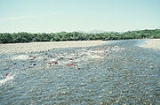
Fishery
A fishery is an organized effort by humans to catch
fish or other aquatic species, an activity known as
fishing. Generally, a fishery exists for the purpose of providing human
food, although other aims are possible , or obtaining
ornamental fish or fish products such as fish oil. Industrial fisheries are fisheries where the catch is not intended for direct human consumption .
Regardless of purpose, however, the term fishery generally refers to a fishing effort centered on either a particular ecoregion or a particular species or type of fish or aquatic animal, and usually fisheries are differentiated by both criteria.
Encyclopedia
A
fishery is an organized effort by humans to catch
fish or other aquatic species, an activity known as
fishing. Generally, a fishery exists for the purpose of providing human
food, although other aims are possible , or obtaining
ornamental fish or fish products such as fish oil. Industrial fisheries are fisheries where the catch is not intended for direct human consumption .
Regardless of purpose, however, the term fishery generally refers to a fishing effort centered on either a particular ecoregion or a particular species or type of fish or aquatic animal, and usually fisheries are differentiated by both criteria. Examples would be the
salmon fishery of
Alaska, the
cod fishery off the
Lofoten islands or the
tuna fishery of the
Eastern Pacific. Most fisheries are
marine, rather than
freshwater; most marine fisheries are based near the
coast. This is not only because harvesting from relatively shallow waters is easier than in the open ocean, but also because fish are much more abundant near the
coastal shelf, due to coastal upwelling and the abundance of
nutrients available there.
Fisheries historically
Fisheries have been important parts of human life and food production throughout history. Fish acts as one main food in people's everyday life as well as food security of the nation. Fisheries have become a part of human cultures and mythologies, providing a community identity and a subject for artists throughout the ages. Partially, this is because fisheries are irretrievably wrapped up in humanity’s perpetual fascination with the sea, and partially, because they have been a major source of food and income for many communities throughout the ages.
One of the world’s longest lasting trade histories is the
trade of dry cod from the
Lofoten area to the southern parts of
Europe,
Italy,
Spain and
Portugal. The trade in cod started during the
viking period or before, has been going on for more than 1000 years and is still important.
In India, the
Pandyas, a classical Dravidian
Tamil kingdom, were known for the pearl fishery as early as the 1st century BC. Their seaport Tuticorin was known for deep sea
pearl fishing. The
paravas, a Tamil caste centred in Tuticorin, developed a rich community because of their pearl trade, navigation knowledge and fisheries.
Fisheries in the present day
Today, fisheries are estimated to provide 16% of the world population's
protein, and that figure is considerably elevated in some
developing nations and in regions that depend heavily on the sea. Fisheries are a huge global business and provide income for millions of people. Fisheries have been and continue to be culturally important for many communities as well.
According to the
Food and Agriculture Organization of the
United Nations, total world capture fisheries production in 2000 was 86 million tons . The top producing countries were, in order, the
People's Republic of China ,
Peru,
Japan, the
United States,
Chile,
Indonesia,
Russia,
India,
Thailand,
Norway and
Iceland. Those countries accounted for more than half of the world's production; China alone accounted for a third of the world's production. Of that production, over 90% was marine and less than 10% was inland.
There are large and important fisheries worldwide for various species of fish,
mollusks and
crustaceans. However, a very small number of species support the majority of the world’s fisheries. Some of these species are
herring,
cod,
anchovy,
tuna,
flounder, mullet,
squid,
shrimp,
salmon,
crab,
lobster,
oyster and
scallops. All except these last four provided a worldwide catch of well over a
million tonnes in 1999, with
herring and
sardines together providing a catch of over 22 million metric tons in 1999. Many other species as well are fished in smaller numbers, both locally and globally.
Methods
Fishing methods vary according to the region, the species being fished for, and the amount of income and technology available to the fisher. A fishery can consist of one man with a small
boat hand-casting nets, to a huge fleet of trawlers processing tons of fish per day. Some common commercial techniques today are
trawling,
seining, driftnetting, handlining, longlining, gillnetting, and diving.
Fisheries and communities
For some communities, both currently and historically, fisheries provide not only a source of food and work but also a
community and
cultural identity.
This shows up in
art,
literature, and traditions. These communities are generally those that have been historically dependent on fishing as a source of income and food.
Fisheries science
Fisheries science is the academic discipline of managing and understanding fisheries. It draws on the disciplines of
biology,
ecology,
oceanography,
economics and management to attempt to provide an integrated picture of fisheries. It is typically taught in a
university setting, and can be the focus of an undergraduate, master's or Ph.D. program. It is in universities worldwide, usually organised as multidisciplinary programs involving parts of traditional university disciplines. In some cases new disciplines have emerged, as in the case of bioeconomics. A few universities also offer fully integrated programs in fisheries science.
See also: International Council for the Exploration of the Sea
Important issues and topics in fisheries
Considering the importance of fisheries, and that they depend on a natural resource, it is no surprise that there are many pressing environmental issues surrounding them. These can be classed into issues that involve the availability of fish to be caught, such as
overfishing,
sustainable fisheries, and fisheries management; and issues surrounding the impact of fishing on the environment, such as by-catch. These fishery conservation issues are generally considered part of marine conservation, and many of these issues are addressed in fisheries science programs. They are also, however, controversial. There is an apparent and growing disparity between the availability of fish to be caught and humanity’s desire to catch them, a problem that is exacerbated by the rapidly growing
world population. As with some other environmental issues, often the people engaged in the activity of fishing – the fishers – and the
scientists who study
fisheries science, who are often acting as fishery managers, are in conflict with each other, as the dictates of economics mean that fishers have to keep fishing for their livelihood, but the dictates of sustainable science mean that some fisheries must close or reduce to protect the health of the population of the fish themselves. It is starting to be realized, however, that these two camps must work together to ensure fishery health through the 21st century and beyond.
The cover story of the May 15, 2003 issue of the science journal
Nature – with Dr. Ransom Myers, an internationally prominent fisheries biologist as the lead author – was devoted to a summary of the scientific information. The story asserted that, as compared with 1950 levels, only a remnant of all large ocean-fish stocks are currently left in the seas.
For further information
The literature on fisheries—both scientific and popular—is vast. The literature is subdivided into dozens of topics, from fishing gear design, to the impact of fish biology and oceanography on fisheries, to how to most effectively manage fisheries. Some good places to start are the websites of fisheries science departments and the catalogs of university libraries. Some well known
journals about fisheries are
Fisheries,
Fisheries Oceanography,
Fishery Bulletin, and
The Canadian Journal of Aquatic and Fishery Sciences. In addition, many countries have their own regional journals.
References
- Castro, P. and M. Huber. . Marine Biology. 4th ed. Boston: McGraw Hill.
- Myers, Ransom and Boris Worm. . "Rapid worldwide depletion of predatory fish communities," Nature, Vol 423. London: Nature Publishing.
- FAO Fisheries Department. . The State of World Fisheries and Aquaculture. Rome: Food and Agriculture Organization of the United Nations.
See also
...
[i]
...
External links
Nations Unies...
: Oceans and Coastal Areas