

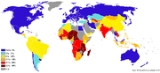
Poverty threshold

Encyclopedia
The poverty threshold, or poverty line, is the minimum level of income
deemed necessary to achieve an adequate standard of living
in a given country. In practice, like the definition of poverty
, the official or common understanding of the poverty line is significantly higher in developed countries than in developing countries.
The common international poverty line has in the past been roughly $1 a day. In 2008, the World Bank
came out with a revised figure of $1.25 at 2005 purchasing-power parity (PPP).
Determining the poverty line is usually done by finding the total cost of all the essential resources that an average human adult consumes in one year. The largest of these expenses is typically the rent
required to live in an apartment, so historically, economists have paid particular attention to the real estate market and housing prices as a strong poverty line affector.
Individual factors are often used to account for various circumstances, such as whether one is a parent, elderly, a child, married, etc. The poverty threshold may be adjusted each year.
The poverty threshold is useful as an economic tool with which to measure such people and consider socioeconomic reforms such as welfare and unemployment insurance to reduce poverty.
). The intuition behind an absolute measure is that mere survival takes essentially the same amount of resources across the world and that everybody should be subject to the same standards if meaningful comparisons of policies and progress are to be made. Notice that if everyone's real income in an economy increases, and the income distribution
does not change, absolute poverty will decline.
Measuring poverty by an absolute threshold has the advantage of applying the same standard across different locations and time periods, making comparisons easier. On the other hand, it suffers from the disadvantage that any absolute poverty threshold is to some extent arbitrary; the amount of wealth required for survival is not the same in all places and time periods. For example, a person living in far northern Scandinavia requires a source of heat during colder months, while a person living on a tropical island does not.
This type of measure is often contrasted with measures of relative poverty (see below), which classify individuals or families as "poor" not by comparing them to a fixed cutoff point, but by comparing them to others in the population under study.
The term absolute poverty is also sometimes used as a synonym for extreme poverty
. Absolute poverty is the absence of enough resources (such as money) to secure basic life necessities.
According to a UN declaration that resulted from the World Summit on Social Development in Copenhagen in 1995, absolute poverty is "a condition characterised by severe deprivation of basic human needs, including food, safe drinking water, sanitation facilities, health, shelter, education and information. It depends not only on income but also on access to services."
David Gordon's paper, "Indicators of Poverty & Hunger", for the United Nations, further defines absolute poverty as the absence of any two of the following eight basic needs:
For example, a person who lives in a home with a mud floor is considered severely deprived of shelter. A person who never attended school and cannot read is considered severely deprived of education. A person who has no newspaper, radio, television, or telephone is considered severely deprived of information. All people who meet any two of these conditions — for example, they live in homes with mud floors and cannot read — are considered to be living in absolute poverty.
A measure of relative poverty defines "poverty" as being below some relative poverty threshold. For example, the statement that "households with an accumulated income less than 60% of the median equivalized household disposable income are living in poverty" uses a relative measure to define poverty. In this system, if everyone's real income in an economy increases, but the income distribution
stays the same, then the rate of relative poverty will also stay the same.
Relative poverty measurements can sometimes produce odd results, especially in small populations. For example, if the median
household in a wealthy neighborhood earns US$1 million each year, then a family that earns US$100,000 would be considered poor on the relative poverty scale, even though such a family could meet all of its basic needs and much more. At the other end of the scale, if the median household in a very poor neighborhood earned only 50% of what it needs to buy food, then a person who earned the median income would not be considered poor on a relative poverty scale, even though the person is clearly poor on an absolute poverty scale.
Measures of relative poverty are almost the same as measuring income inequality: If a society gets a more equal income distribution, relative poverty will fall. Following this, some argue that the term relative poverty is itself misleading and that income inequality should be used instead. They point out that if society changed in a way that hurt high earners more than low ones, then relative poverty would decrease, but every citizen of the society would be worse off. Likewise in the reverse direction: it is possible to reduce absolute poverty while increasing relative poverty.
The term relative poverty can also be used in a different sense to mean "moderate poverty" –- for example, a standard of living or level of income that is high enough to satisfy basic needs (like water
, food
, clothing
, shelter, and basic health care
), but still significantly lower than that of the majority of the population under consideration.
publishes a basic needs
poverty measure for Canada
. According to the Fraser Institute, "the basic-needs approach is partly absolute (the list [of necessities] is limited to items required for long-term physical well-being) and partly relative, reflecting the standards that apply in the individual's own society at the present time." The Fraser Institute's list of necessities for living creditably in Canada includes not only food
, shelter, clothing
, and health care
, but also personal care
, furniture
, transportation, communication
, laundry
, and home insurance
. It is criticized for not including any entertainment items like cable television
, daily newspapers, and tickets to movies or sporting events.
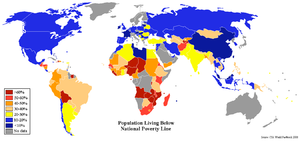 National estimates are based on population-weighted subgroup estimates from household surveys. Definitions of the poverty line may vary considerably among nations. For example, rich nations generally employ more generous standards of poverty than poor nations. Thus, the numbers are not comparable among countries.
In 2009, in the United States of America, the poverty threshold for a single person under 65 was US$11,161; the threshold for a family group of four, including two children, was US$21,756. According to the U.S. Census Bureau data released Tuesday September 13th, 2011, the nation's poverty rate rose to 15.1% in 2010.
In the UK, "more than five million people – over a fifth (23 percent) of all employees – were paid less than £6.67 an hour in April 2006. This is based on a low pay rate of 60 percent of full-time median earnings, equivalent to a little over £12,000 a year for a 35-hour working week. In April 2006, a 35-hour week would have earned someone £9,191 a year – before tax or National Insurance".
India's official poverty level, on the other hand, is split according to rural vs. urban thresholds. For urban dwellers, the poverty line is defined as living on less than 538.60 rupees (approximately USD $12) per month, whereas for rural dwellers, it is defined as living on less than 356.35 rupees per month (approximately USD $7.50). By this measure, only 27.5% of Indians live in poverty, whereas by the World Bank standard of $1.25 per day, 42% of Indians live in poverty – this is the third highest rate in South Asia
after Bangladesh
and Bhutan
.
In the year 2011 there was a crossfire between National Advisory Council of India (NAC) & Planning Commission of India. The row was sparked when Planning Commission informed the Supreme Court that for an average Indian urban dweller, Rs.32 per day is adequate to carry out his/her living and that those who earn more than Rs.32 ($ 2 in terms of PPP) in Urban areas & Rs.25 ($ 1.56 in terms of PPP) in Rural areas shall not be considered as poor anymore. Former NAC member Jean Dreze said the health expenditure estimated by the Tendulkar panel was “barely enough to buy an aspirin”. Food rights activist Colin Gonsalves described the definition as “shocking”. The per capita expenditure of Rs 32 per day in cities won’t be sufficient even for food. He also quoted saying that “A person cannot feed himself properly with this money. Where from he will spend on clothing, health and other things?”.
.
A poverty threshold relies on a quantitative
, or purely numbers-based, measure of income. If other human development-indicators like health and education are used, they must be quantified, which is not a simple (if even achievable) task.
the son to pay the rent, then that money does not count as income to the son. If a church or non-profit organization gives food to an elderly person, the value of the food is not counted as income to the elderly person. Rea Hederman, a senior policy analyst in the Center for Data Analysis at the Heritage Foundation
, said
Studies measuring the difference between income before and after taxes and government transfers, however, have found that without these programs poverty would be roughly 30% to 40% higher than the official poverty line indicates, despite many of their benefits not being counted as income.
Income
Income is the consumption and savings opportunity gained by an entity within a specified time frame, which is generally expressed in monetary terms. However, for households and individuals, "income is the sum of all the wages, salaries, profits, interests payments, rents and other forms of earnings...
deemed necessary to achieve an adequate standard of living
Standard of living
Standard of living is generally measured by standards such as real income per person and poverty rate. Other measures such as access and quality of health care, income growth inequality and educational standards are also used. Examples are access to certain goods , or measures of health such as...
in a given country. In practice, like the definition of poverty
Poverty
Poverty is the lack of a certain amount of material possessions or money. Absolute poverty or destitution is inability to afford basic human needs, which commonly includes clean and fresh water, nutrition, health care, education, clothing and shelter. About 1.7 billion people are estimated to live...
, the official or common understanding of the poverty line is significantly higher in developed countries than in developing countries.
The common international poverty line has in the past been roughly $1 a day. In 2008, the World Bank
World Bank
The World Bank is an international financial institution that provides loans to developing countries for capital programmes.The World Bank's official goal is the reduction of poverty...
came out with a revised figure of $1.25 at 2005 purchasing-power parity (PPP).
Determining the poverty line is usually done by finding the total cost of all the essential resources that an average human adult consumes in one year. The largest of these expenses is typically the rent
Renting
Renting is an agreement where a payment is made for the temporary use of a good, service or property owned by another. A gross lease is when the tenant pays a flat rental amount and the landlord pays for all property charges regularly incurred by the ownership from landowners...
required to live in an apartment, so historically, economists have paid particular attention to the real estate market and housing prices as a strong poverty line affector.
Individual factors are often used to account for various circumstances, such as whether one is a parent, elderly, a child, married, etc. The poverty threshold may be adjusted each year.
The poverty threshold is useful as an economic tool with which to measure such people and consider socioeconomic reforms such as welfare and unemployment insurance to reduce poverty.
Absolute poverty
A measure of absolute poverty quantifies the number of people below a fixed real poverty threshold. It is a level of poverty as defined in terms of the minimal requirements necessary to afford minimal standards of food, clothing, health care and shelter. (See definition from Glossary of Sociology.) For the measure to be absolute, the line must be the same in different countries, cultures, and technological levels. Such an absolute measure should look only at the individual's power to consume and it should be independent of any changes in income distribution. Such a measure is possible only when all consumed goods and services are counted and when PPP-exchange rates are used (see purchasing power parityPurchasing power parity
In economics, purchasing power parity is a condition between countries where an amount of money has the same purchasing power in different countries. The prices of the goods between the countries would only reflect the exchange rates...
). The intuition behind an absolute measure is that mere survival takes essentially the same amount of resources across the world and that everybody should be subject to the same standards if meaningful comparisons of policies and progress are to be made. Notice that if everyone's real income in an economy increases, and the income distribution
Income distribution
In economics, income distribution is how a nation’s total economy is distributed amongst its population.Income distribution has always been a central concern of economic theory and economic policy...
does not change, absolute poverty will decline.
Measuring poverty by an absolute threshold has the advantage of applying the same standard across different locations and time periods, making comparisons easier. On the other hand, it suffers from the disadvantage that any absolute poverty threshold is to some extent arbitrary; the amount of wealth required for survival is not the same in all places and time periods. For example, a person living in far northern Scandinavia requires a source of heat during colder months, while a person living on a tropical island does not.
This type of measure is often contrasted with measures of relative poverty (see below), which classify individuals or families as "poor" not by comparing them to a fixed cutoff point, but by comparing them to others in the population under study.
The term absolute poverty is also sometimes used as a synonym for extreme poverty
Extreme poverty
Extreme poverty, as defined in 1996 by Joseph Wresinski, the founder of ATD Fourth World, is:"The lack of basic security connotes the absence of one or more factors enabling individuals and families to assume basic responsibilities and to enjoy fundamental rights. The situation may become...
. Absolute poverty is the absence of enough resources (such as money) to secure basic life necessities.
According to a UN declaration that resulted from the World Summit on Social Development in Copenhagen in 1995, absolute poverty is "a condition characterised by severe deprivation of basic human needs, including food, safe drinking water, sanitation facilities, health, shelter, education and information. It depends not only on income but also on access to services."
David Gordon's paper, "Indicators of Poverty & Hunger", for the United Nations, further defines absolute poverty as the absence of any two of the following eight basic needs:
- Food: Body Mass IndexBody mass indexThe body mass index , or Quetelet index, is a heuristic proxy for human body fat based on an individual's weight and height. BMI does not actually measure the percentage of body fat. It was invented between 1830 and 1850 by the Belgian polymath Adolphe Quetelet during the course of developing...
must be above 16. - Safe drinking water: Water must not come from solely rivers and ponds, and must be available nearby (less than 15 minutes' walk each way).
- Sanitation facilities: Toilets or latrineLatrineA latrine is a communal facility containing one or more commonly many toilets which may be simple pit toilets or in the case of the United States Armed Forces any toilet including modern flush toilets...
s must be accessible in or near the home. - Health: Treatment must be received for serious illnesses and pregnancy.
- Shelter: Homes must have fewer than four people living in each room. Floors must not be made of dirt, mud, or clay.
- Education: Everyone must attend school or otherwise learn to read.
- Information: Everyone must have access to newspapers, radios, televisions, computers, or telephones at home.
- Access to services: This item is undefined by Gordon, but normally is used to indicate the complete panoply of education, health, legal, social, and financial (creditCredit (finance)Credit is the trust which allows one party to provide resources to another party where that second party does not reimburse the first party immediately , but instead arranges either to repay or return those resources at a later date. The resources provided may be financial Credit is the trust...
) services.
For example, a person who lives in a home with a mud floor is considered severely deprived of shelter. A person who never attended school and cannot read is considered severely deprived of education. A person who has no newspaper, radio, television, or telephone is considered severely deprived of information. All people who meet any two of these conditions — for example, they live in homes with mud floors and cannot read — are considered to be living in absolute poverty.
Relative poverty
A measure of relative poverty defines "poverty" as being below some relative poverty threshold. For example, the statement that "households with an accumulated income less than 60% of the median equivalized household disposable income are living in poverty" uses a relative measure to define poverty. In this system, if everyone's real income in an economy increases, but the income distribution
Income distribution
In economics, income distribution is how a nation’s total economy is distributed amongst its population.Income distribution has always been a central concern of economic theory and economic policy...
stays the same, then the rate of relative poverty will also stay the same.
Relative poverty measurements can sometimes produce odd results, especially in small populations. For example, if the median
Median
In probability theory and statistics, a median is described as the numerical value separating the higher half of a sample, a population, or a probability distribution, from the lower half. The median of a finite list of numbers can be found by arranging all the observations from lowest value to...
household in a wealthy neighborhood earns US$1 million each year, then a family that earns US$100,000 would be considered poor on the relative poverty scale, even though such a family could meet all of its basic needs and much more. At the other end of the scale, if the median household in a very poor neighborhood earned only 50% of what it needs to buy food, then a person who earned the median income would not be considered poor on a relative poverty scale, even though the person is clearly poor on an absolute poverty scale.
Measures of relative poverty are almost the same as measuring income inequality: If a society gets a more equal income distribution, relative poverty will fall. Following this, some argue that the term relative poverty is itself misleading and that income inequality should be used instead. They point out that if society changed in a way that hurt high earners more than low ones, then relative poverty would decrease, but every citizen of the society would be worse off. Likewise in the reverse direction: it is possible to reduce absolute poverty while increasing relative poverty.
The term relative poverty can also be used in a different sense to mean "moderate poverty" –- for example, a standard of living or level of income that is high enough to satisfy basic needs (like water
Water
Water is a chemical substance with the chemical formula H2O. A water molecule contains one oxygen and two hydrogen atoms connected by covalent bonds. Water is a liquid at ambient conditions, but it often co-exists on Earth with its solid state, ice, and gaseous state . Water also exists in a...
, food
Food
Food is any substance consumed to provide nutritional support for the body. It is usually of plant or animal origin, and contains essential nutrients, such as carbohydrates, fats, proteins, vitamins, or minerals...
, clothing
Clothing
Clothing refers to any covering for the human body that is worn. The wearing of clothing is exclusively a human characteristic and is a feature of nearly all human societies...
, shelter, and basic health care
Health care
Health care is the diagnosis, treatment, and prevention of disease, illness, injury, and other physical and mental impairments in humans. Health care is delivered by practitioners in medicine, chiropractic, dentistry, nursing, pharmacy, allied health, and other care providers...
), but still significantly lower than that of the majority of the population under consideration.
Basic needs
Some measurements combine certain aspects of absolute and relative measures. For example, the Fraser InstituteFraser Institute
The Fraser Institute is a Canadian think tank. It has been described as politically conservative and right-wing libertarian and espouses free market principles...
publishes a basic needs
Basic needs
The basic needs approach is one of the major approaches to the measurement of absolute poverty. It attempts to define the absolute minimum resources necessary for long-term physical well-being, usually in terms of consumption goods. The poverty line is then defined as the amount of income...
poverty measure for Canada
Canada
Canada is a North American country consisting of ten provinces and three territories. Located in the northern part of the continent, it extends from the Atlantic Ocean in the east to the Pacific Ocean in the west, and northward into the Arctic Ocean...
. According to the Fraser Institute, "the basic-needs approach is partly absolute (the list [of necessities] is limited to items required for long-term physical well-being) and partly relative, reflecting the standards that apply in the individual's own society at the present time." The Fraser Institute's list of necessities for living creditably in Canada includes not only food
Food
Food is any substance consumed to provide nutritional support for the body. It is usually of plant or animal origin, and contains essential nutrients, such as carbohydrates, fats, proteins, vitamins, or minerals...
, shelter, clothing
Clothing
Clothing refers to any covering for the human body that is worn. The wearing of clothing is exclusively a human characteristic and is a feature of nearly all human societies...
, and health care
Health care
Health care is the diagnosis, treatment, and prevention of disease, illness, injury, and other physical and mental impairments in humans. Health care is delivered by practitioners in medicine, chiropractic, dentistry, nursing, pharmacy, allied health, and other care providers...
, but also personal care
Hygiene
Hygiene refers to the set of practices perceived by a community to be associated with the preservation of health and healthy living. While in modern medical sciences there is a set of standards of hygiene recommended for different situations, what is considered hygienic or not can vary between...
, furniture
Furniture
Furniture is the mass noun for the movable objects intended to support various human activities such as seating and sleeping in beds, to hold objects at a convenient height for work using horizontal surfaces above the ground, or to store things...
, transportation, communication
Communication
Communication is the activity of conveying meaningful information. Communication requires a sender, a message, and an intended recipient, although the receiver need not be present or aware of the sender's intent to communicate at the time of communication; thus communication can occur across vast...
, laundry
Laundry
Laundry is a noun that refers to the act of washing clothing and linens, the place where that washing is done, and/or that which needs to be, is being, or has been laundered...
, and home insurance
Home insurance
Home insurance, also commonly called hazard insurance or homeowner's insurance , is the type of property insurance that covers private homes...
. It is criticized for not including any entertainment items like cable television
Cable television
Cable television is a system of providing television programs to consumers via radio frequency signals transmitted to televisions through coaxial cables or digital light pulses through fixed optical fibers located on the subscriber's property, much like the over-the-air method used in traditional...
, daily newspapers, and tickets to movies or sporting events.
National poverty lines
In 2009, in the United States of America, the poverty threshold for a single person under 65 was US$11,161; the threshold for a family group of four, including two children, was US$21,756. According to the U.S. Census Bureau data released Tuesday September 13th, 2011, the nation's poverty rate rose to 15.1% in 2010.
In the UK, "more than five million people – over a fifth (23 percent) of all employees – were paid less than £6.67 an hour in April 2006. This is based on a low pay rate of 60 percent of full-time median earnings, equivalent to a little over £12,000 a year for a 35-hour working week. In April 2006, a 35-hour week would have earned someone £9,191 a year – before tax or National Insurance".
India's official poverty level, on the other hand, is split according to rural vs. urban thresholds. For urban dwellers, the poverty line is defined as living on less than 538.60 rupees (approximately USD $12) per month, whereas for rural dwellers, it is defined as living on less than 356.35 rupees per month (approximately USD $7.50). By this measure, only 27.5% of Indians live in poverty, whereas by the World Bank standard of $1.25 per day, 42% of Indians live in poverty – this is the third highest rate in South Asia
South Asia
South Asia, also known as Southern Asia, is the southern region of the Asian continent, which comprises the sub-Himalayan countries and, for some authorities , also includes the adjoining countries to the west and the east...
after Bangladesh
Bangladesh
Bangladesh , officially the People's Republic of Bangladesh is a sovereign state located in South Asia. It is bordered by India on all sides except for a small border with Burma to the far southeast and by the Bay of Bengal to the south...
and Bhutan
Bhutan
Bhutan , officially the Kingdom of Bhutan, is a landlocked state in South Asia, located at the eastern end of the Himalayas and bordered to the south, east and west by the Republic of India and to the north by the People's Republic of China...
.
In the year 2011 there was a crossfire between National Advisory Council of India (NAC) & Planning Commission of India. The row was sparked when Planning Commission informed the Supreme Court that for an average Indian urban dweller, Rs.32 per day is adequate to carry out his/her living and that those who earn more than Rs.32 ($ 2 in terms of PPP) in Urban areas & Rs.25 ($ 1.56 in terms of PPP) in Rural areas shall not be considered as poor anymore. Former NAC member Jean Dreze said the health expenditure estimated by the Tendulkar panel was “barely enough to buy an aspirin”. Food rights activist Colin Gonsalves described the definition as “shocking”. The per capita expenditure of Rs 32 per day in cities won’t be sufficient even for food. He also quoted saying that “A person cannot feed himself properly with this money. Where from he will spend on clothing, health and other things?”.
Criticisms
Using a poverty threshold is problematic because having an income marginally above it is not substantially different from having an income marginally below it: the negative effects of poverty tend to be continuous rather than discrete, and the same low income affects different people in different ways. To overcome this problem, poverty indices are sometimes used instead; see income inequality metricsIncome inequality metrics
The concept of inequality is distinct from that of poverty and fairness. Income inequality metrics or income distribution metrics are used by social scientists to measure the distribution of income, and economic inequality among the participants in a particular economy, such as that of a specific...
.
A poverty threshold relies on a quantitative
Numerical data
Numerical data is data measured or identified on a numerical scale. Numerical data can be analyzed using statistical methods, and results can be displayed using tables, charts, histograms and graphs. For example, a researcher will ask a questions to a participant that include words how often, how...
, or purely numbers-based, measure of income. If other human development-indicators like health and education are used, they must be quantified, which is not a simple (if even achievable) task.
Overstating poverty
In-kind gifts, whether from public or private sources, are not counted when calculating a poverty threshold. For example, if a parent pays the rent on an apartment for an adult son directly to the apartment owner, instead of giving the money toMITULAthe son to pay the rent, then that money does not count as income to the son. If a church or non-profit organization gives food to an elderly person, the value of the food is not counted as income to the elderly person. Rea Hederman, a senior policy analyst in the Center for Data Analysis at the Heritage Foundation
Heritage Foundation
The Heritage Foundation is a conservative American think tank based in Washington, D.C. Heritage's stated mission is to "formulate and promote conservative public policies based on the principles of free enterprise, limited government, individual freedom, traditional American values, and a strong...
, said
The official poverty measure counts only monetary income. It considers antipoverty programs such as food stamps, housing assistanceSection 8 (housing)Section 8 of the United States Housing Act of 1937 , as repeatedly amended, authorizes the payment of rental housing assistance to private landlords on behalf of approximately 3.1 million low-income households...
, the Earned Income Tax CreditEarned income tax creditThe United States federal earned income tax credit or earned income credit is a refundable tax credit primarily for individuals and families who have low to moderate earned income. Greater tax credit is given to those who also have qualifying children...
, MedicaidMedicaidMedicaid is the United States health program for certain people and families with low incomes and resources. It is a means-tested program that is jointly funded by the state and federal governments, and is managed by the states. People served by Medicaid are U.S. citizens or legal permanent...
and school lunches, among others, "in-kind benefits" – and hence not income. So, despite everything these programs do to relieve poverty, they aren't counted as income when Washington measures the poverty rate.
Studies measuring the difference between income before and after taxes and government transfers, however, have found that without these programs poverty would be roughly 30% to 40% higher than the official poverty line indicates, despite many of their benefits not being counted as income.
See also
- Asset povertyAsset PovertyAsset poverty is an economic and social condition that is more persistent and prevalent than income poverty. It can be defined as a household’s inability to access wealth resources that are sufficient enough to provide for basic needs for a period of three months. Basic needs refer to the minimum...
- Income deficitIncome deficitThe Income Deficit is the difference between a single person or family's income and its poverty threshold or poverty line, when the former is exceeded by the latter. Data on the income deficits of various members of a population allow for the construction of one type of measurement of income...
- Measuring povertyMeasuring povertyAlthough the most severe poverty is in the developing world, there is evidence of poverty in every region. In developed countries, this condition results in wandering homeless people and poor suburbs and ghettos. Poverty may be seen as the collective condition of poor people, or of poor groups, and...
- List of countries by percentage of population living in poverty
- Social issues in BrazilSocial issues in BrazilBrazil ranks 49.3 in the Gini coefficient index, with the richest 10% of Brazilians receiving 42.7% of the nation's income, while the poorest 10% receive less than 1.2%.-Poverty:...
- Poverty in ChinaPoverty in ChinaPoverty in People's Republic of China refers to the state of relative or absolute material deprivation that affects hundreds of millions of Chinese citizens, particularly those living in rural areas....
- Poverty in IndiaPoverty in IndiaPoverty is widespread in India, with the nation estimated to have a third of the world's poor. According to a 2005 World Bank estimate, 41.6% of the total Indian population falls below the international poverty line of 1.25 a day...
- Poverty in the United KingdomPoverty in the United KingdomThe United Kingdom is a developed country with comparatively large income differences. As such, those at the lower end of the income distribution have a relatively low standard of living. However, the severe privations of those in the developing world are scarcely to be seen due to the more...
- Poverty in the United StatesPoverty in the United StatesPoverty is defined as the state of one who lacks a usual or socially acceptable amount of money or material possessions. According to the U.S. Census Bureau data released Tuesday September 13th, 2011, the nation's poverty rate rose to 15.1% in 2010, up from 14.3% in 2009 and to its highest level...
Further reading
- Alan Gillie, "The Origin of the Poverty Line", Economic History Review, XLIX/4 (1996), 726
External links
- History of the U.S. Poverty Line by Tom Gentle, Oregon State University.
- United States Department of Health and Human Services Poverty Guidelines, Research, and Measurement
- 2007 United States Department of Health and Human Services Poverty Guidelines
- Debraj RayDebraj RayDebraj Ray graduated with a BA in Economics from the University of Calcutta in 1977.Ray is presently , and Professor of Economics at New York University. He is Co-Editor of the American Economic Review....
1998, Development Economics, Princeton University Press, ISBN 0-691-01706-9. - World Summit for Social Development Agreements, United Nations
- The "elimination" of poverty, Takis Fotopoulos, The International Journal of Inclusive Democracy, vol.4, no.1, (January 2008).