

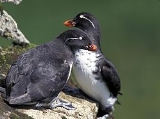
Auk

Encyclopedia
An auk is a bird of the family Alcidae in the order Charadriiformes
. Auks are superficially similar to penguin
s due to their black-and-white colours, their upright posture and some of their habits. Nevertheless they are not closely related to penguins, but rather are believed to be an example of moderate convergent evolution
.
Unlike penguins, modern auks can fly (except for the recently extinct Great Auk
). They are good swimmers and divers, but their walking appears clumsy. Due to their short wings, auks have to flap their wings very quickly in order to fly. Extant auks range in size from the Least Auklet
, at 85 g (3 oz) and 15 cm (6 in), to the Thick-billed Murre, at 1 kg (2¼ lb) and 45 cm (18 in).
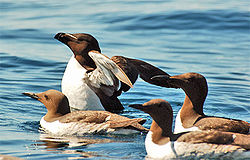
Auks live on the open sea and only go ashore for breeding, although some species, like the Common Guillemot, spend a great part of the year defending their nesting spot from others.
Several species have different names in Europe and North America. The guillemots of Europe are murres in North America, if they occur in both continents, and the Little Auk becomes the Dovekie.
Some species, such as the Uria
guillemots, nest in large colonies
on cliff edges; others, like the Cepphus
guillemots, breed in small groups on rocky coasts; and the puffin
s, auklets and some murrelets nest in burrows. All species except the Brachyramphus
murrelets are colonial
.
s; both groups are wing
-propelled pursuit divers. In the region where auks live, their only seabird competition is the cormorant
s (which dive powered by their strong feet); in areas where the two groups feed on the same prey, the auks tend to feed further offshore.
Although not to the extent of penguins, auks have largely sacrificed flight, and also mobility on land, in exchange for swimming ability; their wings are a compromise between the best possible design for diving and the bare minimum needed for flying. This varies by subfamily, the Uria guillemots (including the Razorbill
) and murrelets being the most efficient under the water, whereas the puffins and auklets are better adapted for flying and walking. This reflects the type of prey taken: strong-swimming murres hunt faster schooling fish, whereas auklets take slower moving krill. Time depth recorders on auks have shown that they can dive as deep as 100 m in the case of Uria guillemots, 40 m for the Cepphus guillemots and 30 m for the auklets.
. However, genetic analyses have demonstrated that these peculiarities are the product of strong natural selection instead: as opposed to, for example, plover
s (a much older charadriiform lineage), auks radically changed from a wading shorebird
to a diving seabird lifestyle. Thus, today, the auks are no longer separated in their own suborder ("Alcae"), but are considered part of the Lari
suborder which otherwise contains gulls and similar birds. Judging from genetic data, their closest living relatives appear to be the skua
s, with these two lineages separating about 30 million years ago
(mya). Alternatively, auks may have split off far earlier from the rest of the Lari and undergone strong morphological, but slow genetic evolution, which would require a very high evolutionary pressure
, coupled with a long lifespan and slow reproduction.
The earliest unequivocal fossil
s of auks are from the late Eocene
, some 35 mya. The genus
Miocepphus, (from the iocene, 15 mya) is the earliest known from good specimens. Two very fragmentary fossils are often assigned to the Alcidae, although this may not be correct: Hydrotherikornis (late Eocene
) and Petralca (Late Oligocene
). Most extant genera are known to exist since the Late Miocene or Early Pliocene
(c. 5 mya). Miocene fossils have been found in both California
and Maryland
, but the greater diversity of fossils and tribes in the Pacific leads most scientists to conclude that it was there they first evolved, and it is in the Miocene Pacific that the first fossils of extant genera
are found. Early movement between the Pacific and the Atlantic probably happened to the south (since there was no northern opening to the Atlantic), later movements across the Arctic Ocean. The flightless subfamily Mancallinae
, which was apparently restricted to the Pacific coast of southern North America and became extinct in the Early Pleistocene
, is sometimes includes in the family Alcidae under some definitions.
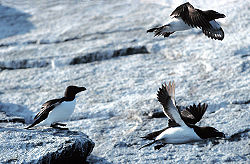 The extant auks (subfamily Alcinae) are broken up into 2 main groups: the usually high-billed puffins (tribe Fraterculini) and auklets (tribe Aethiini), as opposed to the more slender-billed murres and true auks (tribe Alcini), and the murrelets and guillemots (tribes Brachyramphini and Cepphini). The tribal arrangement was originally based on analyses of morphology and ecology
. mtDNA
cytochrome b
sequence and allozyme
studies confirm these findings except that the Synthliboramphus murrelets should be split into a distinct tribe, as they appear more closely related to the Alcini - in any case, assumption of a closer relationship between the former and the true guillemots was only weakly supported by earlier studies.
Compared to other families of seabirds, there are no genera with many species
(such as the 47 Larus
gull
s). This is probably a product of the rather small geographic range of the family (the most limited of any seabird family), and the periods of glacial
advance and retreat that have kept the populations on the move in a narrow band of subarctic ocean.
Today, as in the past, the auks are restricted to cooler northern waters. Their ability to spread further south is restricted as their prey hunting method, pursuit diving, becomes less efficient in warmer waters. The speed at which small fish (which along with krill
are the auk's principal food items) can swim doubles as the temperature increases from 5°C to 15°C, with no corresponding increase in speed for the bird. The southernmost auks, in California and Mexico, can survive there because of cold upwelling
s. The current paucity of auks in the Atlantic (6 species), compared to the Pacific (19-20 species) is considered to be because of extinctions to the Atlantic auks; the fossil record shows there were many more species in the Atlantic during the Pliocene
. Auks also tend to be restricted to continental shelf waters and breed on few oceanic islands.
Hydotherikornis oregonus (Described by Miller in 1931), the oldest purported alcid from the Eocene of California, is actually a petrel (as reviewed by Chandler in 1990) and is reassigned to the tubenoses (Procellariiformes). A 2003 paper entitled "The Earliest North American Record of Auk (Aves: Alcidae) From the Late Eocene of Central Georgia" by Robert M. Chandler and Dennis Parmley of Georgia College and State University reports a Late Eocene, wing-propelled diving, auk from the Priabonain Stage of the Late Eocene. These sediments have been dated through Chandronian NALMA {North American Land Mammal Age}, at an estimate of 34.5 to 35.5 million years on the Eocene time scale for fossil bearing sediments of the Clinchfield Formation, Gordon, Wilkinson County, Georgia. Furthermore, the sediments containing this unabraided portion of a left humerus (43.7mm long) are tropical or sub-tropical as evidenced by a wealth of warm water shark teeth, palaeophied snake vertebrae and turtles.
) Family Alcidae (crown group
)
Subfamily Alcinae
Subfamily Fraterculinae
Biodiversity
of auks seems to have been markedly higher during the Pliocene
. See the genus accounts for prehistoric species.
Charadriiformes
Charadriiformes is a diverse order of small to medium-large birds. It includes about 350 species and has members in all parts of the world. Most Charadriiformes live near water and eat invertebrates or other small animals; however, some are pelagic , some occupy deserts and a few are found in thick...
. Auks are superficially similar to penguin
Penguin
Penguins are a group of aquatic, flightless birds living almost exclusively in the southern hemisphere, especially in Antarctica. Highly adapted for life in the water, penguins have countershaded dark and white plumage, and their wings have become flippers...
s due to their black-and-white colours, their upright posture and some of their habits. Nevertheless they are not closely related to penguins, but rather are believed to be an example of moderate convergent evolution
Convergent evolution
Convergent evolution describes the acquisition of the same biological trait in unrelated lineages.The wing is a classic example of convergent evolution in action. Although their last common ancestor did not have wings, both birds and bats do, and are capable of powered flight. The wings are...
.
Unlike penguins, modern auks can fly (except for the recently extinct Great Auk
Great Auk
The Great Auk, Pinguinus impennis, formerly of the genus Alca, was a large, flightless alcid that became extinct in the mid-19th century. It was the only modern species in the genus Pinguinus, a group of birds that formerly included one other species of flightless giant auk from the Atlantic Ocean...
). They are good swimmers and divers, but their walking appears clumsy. Due to their short wings, auks have to flap their wings very quickly in order to fly. Extant auks range in size from the Least Auklet
Least Auklet
The Least Auklet, Aethia pusilla, is a seabird and the smallest species of auk. It is the most abundant seabird in North America, and one of the most abundant in the world, with a population of around nine million birds. They breed on the islands of Alaska and Siberia, and spend the winter close to...
, at 85 g (3 oz) and 15 cm (6 in), to the Thick-billed Murre, at 1 kg (2¼ lb) and 45 cm (18 in).
Auks live on the open sea and only go ashore for breeding, although some species, like the Common Guillemot, spend a great part of the year defending their nesting spot from others.
Several species have different names in Europe and North America. The guillemots of Europe are murres in North America, if they occur in both continents, and the Little Auk becomes the Dovekie.
Some species, such as the Uria
Uria
Uria is a genus of seabirds in the auk family known in Britain as guillemots, in most of North America as murres, and in Newfoundland and Labrador as turr. These are medium-sized birds with mainly brown or black plumage in the breeding season...
guillemots, nest in large colonies
Bird colony
A bird colony is a large congregation of individuals of one or more species of bird that nest or roost in close proximity at a particular location. Many kinds of birds are known to congregate in groups of varying size; a congregation of nesting birds is called a breeding colony...
on cliff edges; others, like the Cepphus
Cepphus
Cepphus is a genus of seabirds in the auk family also referred to as true guillemots or, in North America, simply as guillemots. These are medium-sized birds with mainly black plumage in the breeding season, thin dark bills and red legs and feet. Two species have white wing patches, the third has...
guillemots, breed in small groups on rocky coasts; and the puffin
Puffin
Puffins are any of three small species of auk in the bird genus Fratercula with a brightly coloured beak during the breeding season. These are pelagic seabirds that feed primarily by diving in the water. They breed in large colonies on coastal cliffs or offshore islands, nesting in crevices among...
s, auklets and some murrelets nest in burrows. All species except the Brachyramphus
Brachyramphus
Brachyramphus is a small genus of seabirds from the North Pacific. It consists of three species:* Marbled Murrelet, Brachyramphus marmoratus* Long-billed Murrelet Brachyramphus perdix* Kittlitz's Murrelet, Brachyramphus brevirostris...
murrelets are colonial
Bird colony
A bird colony is a large congregation of individuals of one or more species of bird that nest or roost in close proximity at a particular location. Many kinds of birds are known to congregate in groups of varying size; a congregation of nesting birds is called a breeding colony...
.
Feeding and ecology
The feeding behaviour of auks is often compared to that of penguinPenguin
Penguins are a group of aquatic, flightless birds living almost exclusively in the southern hemisphere, especially in Antarctica. Highly adapted for life in the water, penguins have countershaded dark and white plumage, and their wings have become flippers...
s; both groups are wing
Wing
A wing is an appendage with a surface that produces lift for flight or propulsion through the atmosphere, or through another gaseous or liquid fluid...
-propelled pursuit divers. In the region where auks live, their only seabird competition is the cormorant
Cormorant
The bird family Phalacrocoracidae is represented by some 40 species of cormorants and shags. Several different classifications of the family have been proposed recently, and the number of genera is disputed.- Names :...
s (which dive powered by their strong feet); in areas where the two groups feed on the same prey, the auks tend to feed further offshore.
Although not to the extent of penguins, auks have largely sacrificed flight, and also mobility on land, in exchange for swimming ability; their wings are a compromise between the best possible design for diving and the bare minimum needed for flying. This varies by subfamily, the Uria guillemots (including the Razorbill
Razorbill
The Razorbill is colonial seabird that will only come to land in order to breed. It is the largest living member of the Auk family. This agile bird will choose only one partner for life and females will lay one egg per year. Razorbills will nest along coastal cliffs in enclosed or slightly exposed...
) and murrelets being the most efficient under the water, whereas the puffins and auklets are better adapted for flying and walking. This reflects the type of prey taken: strong-swimming murres hunt faster schooling fish, whereas auklets take slower moving krill. Time depth recorders on auks have shown that they can dive as deep as 100 m in the case of Uria guillemots, 40 m for the Cepphus guillemots and 30 m for the auklets.
Evolution and distribution
Traditionally, the auks were believed to be one of the earliest distinct charadriiform lineages due to their characteristic morphologyMorphology (biology)
In biology, morphology is a branch of bioscience dealing with the study of the form and structure of organisms and their specific structural features....
. However, genetic analyses have demonstrated that these peculiarities are the product of strong natural selection instead: as opposed to, for example, plover
Plover
Plovers are a widely distributed group of wading birds belonging to the subfamily Charadriinae. There are about 40 species in the subfamily, most of them called "plover" or "dotterel". The closely related lapwing subfamily, Vanellinae, comprises another 20-odd species.Plovers are found throughout...
s (a much older charadriiform lineage), auks radically changed from a wading shorebird
Wader
Waders, called shorebirds in North America , are members of the order Charadriiformes, excluding the more marine web-footed seabird groups. The latter are the skuas , gulls , terns , skimmers , and auks...
to a diving seabird lifestyle. Thus, today, the auks are no longer separated in their own suborder ("Alcae"), but are considered part of the Lari
Lari
The suborder Lari is the part of the order Charadriiformes which includes the gulls, terns, skuas and skimmers, with the waders and snipes making up the rest of the order. Following recent research, the auks are now placed into the Lari too; the Glareolidae might constitute a distinct suborder...
suborder which otherwise contains gulls and similar birds. Judging from genetic data, their closest living relatives appear to be the skua
Skua
The skuas are a group of seabirds with about seven species forming the family Stercorariidae and the genus Stercorarius. The three smaller skuas are called jaegers in North America....
s, with these two lineages separating about 30 million years ago
Year
A year is the orbital period of the Earth moving around the Sun. For an observer on Earth, this corresponds to the period it takes the Sun to complete one course throughout the zodiac along the ecliptic....
(mya). Alternatively, auks may have split off far earlier from the rest of the Lari and undergone strong morphological, but slow genetic evolution, which would require a very high evolutionary pressure
Evolutionary pressure
Any cause that reduces reproductive success in a proportion of a population, potentially exerts evolutionary pressure or selection pressure. With sufficient pressure, inherited traits that mitigate its effects - even if they would be deleterious in other circumstances - can become widely spread...
, coupled with a long lifespan and slow reproduction.
The earliest unequivocal fossil
Fossil
Fossils are the preserved remains or traces of animals , plants, and other organisms from the remote past...
s of auks are from the late Eocene
Eocene
The Eocene Epoch, lasting from about 56 to 34 million years ago , is a major division of the geologic timescale and the second epoch of the Paleogene Period in the Cenozoic Era. The Eocene spans the time from the end of the Palaeocene Epoch to the beginning of the Oligocene Epoch. The start of the...
, some 35 mya. The genus
Genus
In biology, a genus is a low-level taxonomic rank used in the biological classification of living and fossil organisms, which is an example of definition by genus and differentia...
Miocepphus, (from the iocene, 15 mya) is the earliest known from good specimens. Two very fragmentary fossils are often assigned to the Alcidae, although this may not be correct: Hydrotherikornis (late Eocene
Eocene
The Eocene Epoch, lasting from about 56 to 34 million years ago , is a major division of the geologic timescale and the second epoch of the Paleogene Period in the Cenozoic Era. The Eocene spans the time from the end of the Palaeocene Epoch to the beginning of the Oligocene Epoch. The start of the...
) and Petralca (Late Oligocene
Oligocene
The Oligocene is a geologic epoch of the Paleogene Period and extends from about 34 million to 23 million years before the present . As with other older geologic periods, the rock beds that define the period are well identified but the exact dates of the start and end of the period are slightly...
). Most extant genera are known to exist since the Late Miocene or Early Pliocene
Pliocene
The Pliocene Epoch is the period in the geologic timescale that extends from 5.332 million to 2.588 million years before present. It is the second and youngest epoch of the Neogene Period in the Cenozoic Era. The Pliocene follows the Miocene Epoch and is followed by the Pleistocene Epoch...
(c. 5 mya). Miocene fossils have been found in both California
California
California is a state located on the West Coast of the United States. It is by far the most populous U.S. state, and the third-largest by land area...
and Maryland
Maryland
Maryland is a U.S. state located in the Mid Atlantic region of the United States, bordering Virginia, West Virginia, and the District of Columbia to its south and west; Pennsylvania to its north; and Delaware to its east...
, but the greater diversity of fossils and tribes in the Pacific leads most scientists to conclude that it was there they first evolved, and it is in the Miocene Pacific that the first fossils of extant genera
Genus
In biology, a genus is a low-level taxonomic rank used in the biological classification of living and fossil organisms, which is an example of definition by genus and differentia...
are found. Early movement between the Pacific and the Atlantic probably happened to the south (since there was no northern opening to the Atlantic), later movements across the Arctic Ocean. The flightless subfamily Mancallinae
Mancallinae
The Mancallinae were a sub-family of prehistoric flightless auk relatives that lived on the Pacific coast of today's California and Mexico from the late Miocene epoch to the early Pleistocene...
, which was apparently restricted to the Pacific coast of southern North America and became extinct in the Early Pleistocene
Pleistocene
The Pleistocene is the epoch from 2,588,000 to 11,700 years BP that spans the world's recent period of repeated glaciations. The name pleistocene is derived from the Greek and ....
, is sometimes includes in the family Alcidae under some definitions.
Ecology
Ecology is the scientific study of the relations that living organisms have with respect to each other and their natural environment. Variables of interest to ecologists include the composition, distribution, amount , number, and changing states of organisms within and among ecosystems...
. mtDNA
Mitochondrial DNA
Mitochondrial DNA is the DNA located in organelles called mitochondria, structures within eukaryotic cells that convert the chemical energy from food into a form that cells can use, adenosine triphosphate...
cytochrome b
Cytochrome b
Cytochrome b/b6 is the main subunit of transmembrane cytochrome bc1 and b6f complexes. In addition, it commonly refers to a region of mtDNA used for population genetics and phylogenetics.- Function :...
sequence and allozyme
Allozyme
Variant forms of an enzyme that are coded by different alleles at the same locus are called allozymes. These are opposed to isozymes, which are enzymes that perform the same function, but which are coded by genes located at different loci....
studies confirm these findings except that the Synthliboramphus murrelets should be split into a distinct tribe, as they appear more closely related to the Alcini - in any case, assumption of a closer relationship between the former and the true guillemots was only weakly supported by earlier studies.
Compared to other families of seabirds, there are no genera with many species
Species
In biology, a species is one of the basic units of biological classification and a taxonomic rank. A species is often defined as a group of organisms capable of interbreeding and producing fertile offspring. While in many cases this definition is adequate, more precise or differing measures are...
(such as the 47 Larus
Larus
Larus is a large genus of gulls with worldwide distribution . Many of its species are abundant and well-known birds in their ranges...
gull
Gull
Gulls are birds in the family Laridae. They are most closely related to the terns and only distantly related to auks, skimmers, and more distantly to the waders...
s). This is probably a product of the rather small geographic range of the family (the most limited of any seabird family), and the periods of glacial
Glacier
A glacier is a large persistent body of ice that forms where the accumulation of snow exceeds its ablation over many years, often centuries. At least 0.1 km² in area and 50 m thick, but often much larger, a glacier slowly deforms and flows due to stresses induced by its weight...
advance and retreat that have kept the populations on the move in a narrow band of subarctic ocean.
Today, as in the past, the auks are restricted to cooler northern waters. Their ability to spread further south is restricted as their prey hunting method, pursuit diving, becomes less efficient in warmer waters. The speed at which small fish (which along with krill
Krill
Krill is the common name given to the order Euphausiacea of shrimp-like marine crustaceans. Also known as euphausiids, these small invertebrates are found in all oceans of the world...
are the auk's principal food items) can swim doubles as the temperature increases from 5°C to 15°C, with no corresponding increase in speed for the bird. The southernmost auks, in California and Mexico, can survive there because of cold upwelling
Upwelling
Upwelling is an oceanographic phenomenon that involves wind-driven motion of dense, cooler, and usually nutrient-rich water towards the ocean surface, replacing the warmer, usually nutrient-depleted surface water. The increased availability in upwelling regions results in high levels of primary...
s. The current paucity of auks in the Atlantic (6 species), compared to the Pacific (19-20 species) is considered to be because of extinctions to the Atlantic auks; the fossil record shows there were many more species in the Atlantic during the Pliocene
Pliocene
The Pliocene Epoch is the period in the geologic timescale that extends from 5.332 million to 2.588 million years before present. It is the second and youngest epoch of the Neogene Period in the Cenozoic Era. The Pliocene follows the Miocene Epoch and is followed by the Pleistocene Epoch...
. Auks also tend to be restricted to continental shelf waters and breed on few oceanic islands.
Hydotherikornis oregonus (Described by Miller in 1931), the oldest purported alcid from the Eocene of California, is actually a petrel (as reviewed by Chandler in 1990) and is reassigned to the tubenoses (Procellariiformes). A 2003 paper entitled "The Earliest North American Record of Auk (Aves: Alcidae) From the Late Eocene of Central Georgia" by Robert M. Chandler and Dennis Parmley of Georgia College and State University reports a Late Eocene, wing-propelled diving, auk from the Priabonain Stage of the Late Eocene. These sediments have been dated through Chandronian NALMA {North American Land Mammal Age}, at an estimate of 34.5 to 35.5 million years on the Eocene time scale for fossil bearing sediments of the Clinchfield Formation, Gordon, Wilkinson County, Georgia. Furthermore, the sediments containing this unabraided portion of a left humerus (43.7mm long) are tropical or sub-tropical as evidenced by a wealth of warm water shark teeth, palaeophied snake vertebrae and turtles.
Systematics
Family Alcidae (=Pan-AlcidaePan-Alcidae
Pan-Alcidae is a clade of charadriiform birds containing the auks and their extinct relatives. It was named in 2011 by N.A. Smith, who defined it as all descendants of the common ancestor of the group Mancallinae and crown group auks ....
)
- Basal and incertae sedisIncertae sedis, is a term used to define a taxonomic group where its broader relationships are unknown or undefined. Uncertainty at specific taxonomic levels is attributed by , , and similar terms.-Examples:*The fossil plant Paradinandra suecica could not be assigned to any...
FossilFossils are the preserved remains or traces of animals , plants, and other organisms from the remote past...
: Late Miocene of Orange County, USA) - Hydrotherikornis (fossilFossilFossils are the preserved remains or traces of animals , plants, and other organisms from the remote past...
: Late Eocene of Oregon, USA) – disputed - "Mancalla" diegensis (fossilFossilFossils are the preserved remains or traces of animals , plants, and other organisms from the remote past...
: Middle Pliocene of California, USA) - "Mancalla" milleri (fossilFossilFossils are the preserved remains or traces of animals , plants, and other organisms from the remote past...
) - "Mancalla" emlongi (fossilFossilFossils are the preserved remains or traces of animals , plants, and other organisms from the remote past...
) - Pseudocepphus (fossilFossilFossils are the preserved remains or traces of animals , plants, and other organisms from the remote past...
: Middle - Late Miocene) – basal Alcinae? - Subfamily Petralcinae (fossilFossilFossils are the preserved remains or traces of animals , plants, and other organisms from the remote past...
) – disputed- Petralca (Early ?- Late Oligocene of Austria)
- Subfamily MancallinaeMancallinaeThe Mancallinae were a sub-family of prehistoric flightless auk relatives that lived on the Pacific coast of today's California and Mexico from the late Miocene epoch to the early Pleistocene...
(fossilFossilFossils are the preserved remains or traces of animals , plants, and other organisms from the remote past...
)
- Praemancalla (Late Miocene - Early Pliocene of Orange County, USA)
- Mancalla (Late Miocene - Early Pleistocene of W North America)
- Miomancalla
Crown group
A crown group is a group consisting of living representatives, their ancestors back to the most recent common ancestor of that group, and all of that ancestor's descendants. The name was given by Willi Hennig, the formulator of phylogenetic systematics, as a way of classifying living organisms...
)
- Miocepphus (fossilFossilFossils are the preserved remains or traces of animals , plants, and other organisms from the remote past...
: Middle Miocene of CE USA)
- Tribe Alcini – typical auks and murres
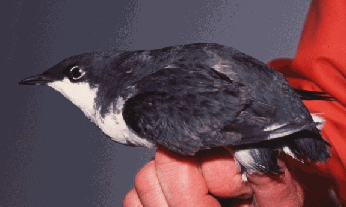
- UriaUriaUria is a genus of seabirds in the auk family known in Britain as guillemots, in most of North America as murres, and in Newfoundland and Labrador as turr. These are medium-sized birds with mainly brown or black plumage in the breeding season...
- Common Guillemot or Common Murre, Uria aalge
- Brunnich's GuillemotBrünnich's GuillemotThe Thick-billed Murre or Brünnich's Guillemot is a bird in the auk family . This bird is named after the Danish zoologist Morten Thrane Brünnich...
or Thick-billed Murre, Uria lomvia
- Little AukLittle AukThe Little Auk, or Dovekie , is a small auk, the only member of the genus Alle. It breeds on islands in the high Arctic. There are two subspecies: A. a. alle breeds in Greenland, Iceland, Novaya Zemlya and Spitsbergen, and A. a...
or Dovekie, Alle alle - Great AukGreat AukThe Great Auk, Pinguinus impennis, formerly of the genus Alca, was a large, flightless alcid that became extinct in the mid-19th century. It was the only modern species in the genus Pinguinus, a group of birds that formerly included one other species of flightless giant auk from the Atlantic Ocean...
, Pinguinus impennis (extinctExtinctionIn biology and ecology, extinction is the end of an organism or of a group of organisms , normally a species. The moment of extinction is generally considered to be the death of the last individual of the species, although the capacity to breed and recover may have been lost before this point...
, c.1844) - RazorbillRazorbillThe Razorbill is colonial seabird that will only come to land in order to breed. It is the largest living member of the Auk family. This agile bird will choose only one partner for life and females will lay one egg per year. Razorbills will nest along coastal cliffs in enclosed or slightly exposed...
, Alca torda
- Uria
- Tribe Synthliboramphini – synthliboramphine murrelets
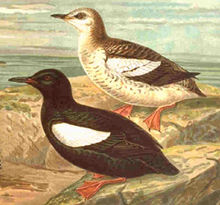
- SynthliboramphusSynthliboramphusSynthliboramphus is a small genus of seabirds in the auk family from the North Pacific. It consists of four species:* Xantus's Murrelet, Synthliboramphus hypoleucus* Craveri's Murrelet, Synthliboramphus craveri...
- Xantus's MurreletXantus's MurreletXantus's Murrelet is a small seabird found in the California Current system in the Pacific Ocean. This auk breeds on islands off California and Mexico...
, Synthliboramphus hypoleucus – sometimes separated in Endomychura - Craveri's MurreletCraveri's MurreletCraveri’s Murrelet is a small seabird which breeds on offshore islands in both the Pacific Ocean and the Gulf of California off the Baja peninsula of Mexico. It also wanders fairly regularly as far as central California in the USA, primarily during post-breeding dispersal...
, Synthliboramphus craveri – sometimes separated in Endomychura - Ancient MurreletAncient MurreletThe Ancient Murrelet, Synthliboramphus antiquus, is a bird in the auk family. It breeds from the Yellow Sea , through the Russian Pacific coast and the Aleutian Islands to the Haida Gwaii archipelago of British Columbia, where about half of the world population breeds.These birds breed in colonies,...
, Synthliboramphus antiquus
- Xantus's Murrelet
- Japanese MurreletJapanese MurreletThe Japanese Murrelet, Synthliboramphus wumizusume also known as Crested Murrelet is a small bird that inhabits rocky islets and reefs in the warm waters of Japan, Russia and South Korea...
, Synthliboramphus wumizusume
- Synthliboramphus
- Tribe Cepphini – true guillemots
- CepphusCepphusCepphus is a genus of seabirds in the auk family also referred to as true guillemots or, in North America, simply as guillemots. These are medium-sized birds with mainly black plumage in the breeding season, thin dark bills and red legs and feet. Two species have white wing patches, the third has...
- Black GuillemotBlack GuillemotThe Black Guillemot or Tystie is a medium-sized alcid.Adult birds have black bodies with a white wing patch, a thin dark bill, and red legs and feet. They show white wing linings in flight. In winter, the upperparts are pale grey and the underparts are white. The wings remain black with the large...
or Tystie, Cepphus grylle - Pigeon GuillemotPigeon GuillemotThe Pigeon Guillemot is a medium-sized alcid endemic to the Pacific. They closely resemble the other members of the genus Cepphus, particularly the Black Guillemot, which is slightly smaller....
, Cepphus columba- Kurile Guillemot, Cepphus (columba) snowi
- Spectacled GuillemotSpectacled GuillemotThe Spectacled, or Sooty Guillemot, Cepphus carbo, is a seabird in the auk family.-Description:This species is about 38 cm long, with red legs, black bill and a blackish iris....
, Cepphus carbo
- Black Guillemot
- Cepphus
- Tribe Brachyramphini – brachyramphine murrelets
- BrachyramphusBrachyramphusBrachyramphus is a small genus of seabirds from the North Pacific. It consists of three species:* Marbled Murrelet, Brachyramphus marmoratus* Long-billed Murrelet Brachyramphus perdix* Kittlitz's Murrelet, Brachyramphus brevirostris...
- Marbled MurreletMarbled MurreletThe Marbled Murrelet is a small seabird from the North Pacific. It is a member of the auk family. It nests in old-growth forests or on the ground at higher latitudes where trees cannot grow...
, Brachyramphus marmoratus - Long-billed MurreletLong-billed MurreletThe Long-billed Murrelet is a small seabird from the North Pacific. It is an unusual member of the auk family, often nesting far inland in old growth forests...
Brachyramphus perdix - Kittlitz's MurreletKittlitz's MurreletThe Kittlitz's Murrelet, is a small alcid found in the waters off Alaska and Eastern Siberia. This critically endangered species is, like the closely related Marbled Murrelet, unusual for seabirds in not being colonial, nesting instead in isolated locations on mountain tops, where the nests were...
, Brachyramphus brevirostris
- Marbled Murrelet
- Brachyramphus
- Tribe Aethiini – auklets
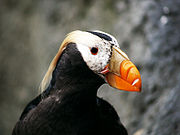
- Ptychoramphus
- Cassin's AukletCassin's AukletThe Cassin’s Auklet is a small, chunky seabird that ranges widely in the North Pacific. It nests in small burrows and because of its presence on well studied islands in British Columbia and off California it is one of the better known auks...
, Ptychoramphus aleuticus
- Cassin's Auklet
- AethiaAethiaAethia is a genus of four small auklets endemic to the North Pacific Ocean, Bering Sea and Sea of Okhotsk and among some of North America's most abundant seabirds. The relationships between the four true auklets remains unclear...
- Parakeet AukletParakeet AukletThe Parakeet Auklet is a small seabird of the North Pacific. It used to be placed on its own in the genus Cyclorrhynchus but recent morphological and genetic evidence suggest it should be placed in the genus Aethia. It is associated with the boreal waters of Alaska and Kamchatka and Siberia...
, Aethia psittacula - Crested AukletCrested AukletThe Crested Auklet is a small seabird of the family Alcidae which nests in huge colonies in the Bering Sea and Sea of Okhotsk. They often breed in mixed-species colonies with Least Auklets, their smaller congener.The Crested Auklet can measure in length, in wingspan and weigh...
, Aethia cristatella - Whiskered AukletWhiskered AukletThe Whiskered Auklet, Aethia pygmaea, is a small seabird of the auk family. It has a more restricted range than other members of its genus, Aethia, living only around the Aleutian Islands and on some islands off Siberia , and breeding on these islands. It is one of the smallest alcids, only the...
, Aethia pygmaea - Least AukletLeast AukletThe Least Auklet, Aethia pusilla, is a seabird and the smallest species of auk. It is the most abundant seabird in North America, and one of the most abundant in the world, with a population of around nine million birds. They breed on the islands of Alaska and Siberia, and spend the winter close to...
, Aethia pusilla
- Parakeet Auklet
- Ptychoramphus
- Tribe Fraterculini – puffins
- Rhinoceros AukletRhinoceros AukletThe Rhinoceros Auklet is a seabird and a close relative of the puffins. It is the only living species of the genus Cerorhinca. Given its close relationship with the puffins, the common name Rhinoceros Puffin has been proposed for the species.It ranges widely across the North Pacific, feeding on...
, Cerorhinca monocerata - FraterculaPuffinPuffins are any of three small species of auk in the bird genus Fratercula with a brightly coloured beak during the breeding season. These are pelagic seabirds that feed primarily by diving in the water. They breed in large colonies on coastal cliffs or offshore islands, nesting in crevices among...
- Atlantic PuffinAtlantic PuffinThe Atlantic Puffin is a seabird species in the auk family. It is a pelagic bird that feeds primarily by diving for fish, but also eats other sea creatures, such as squid and crustaceans. Its most obvious characteristic during the breeding season is its brightly coloured bill...
, Fratercula arctica - Horned PuffinHorned PuffinThe Horned Puffin is an auk, similar in appearance to the Atlantic Puffin; this bird's bill is yellow at the base and red at the tip. It is a pelagic seabird that feeds primarily by diving for fish. It nests in colonies, often with other auks.The yellow bill plate grows before the breeding...
, Fratercula corniculata - Tufted PuffinTufted PuffinThe Tufted Puffin also known as Crested Puffin, is a relatively abundant medium-sized pelagic seabird in the auk family found throughout the North Pacific Ocean....
, Fratercula cirrhata
- Atlantic Puffin
- Rhinoceros Auklet
Biodiversity
Biodiversity
Biodiversity is the degree of variation of life forms within a given ecosystem, biome, or an entire planet. Biodiversity is a measure of the health of ecosystems. Biodiversity is in part a function of climate. In terrestrial habitats, tropical regions are typically rich whereas polar regions...
of auks seems to have been markedly higher during the Pliocene
Pliocene
The Pliocene Epoch is the period in the geologic timescale that extends from 5.332 million to 2.588 million years before present. It is the second and youngest epoch of the Neogene Period in the Cenozoic Era. The Pliocene follows the Miocene Epoch and is followed by the Pleistocene Epoch...
. See the genus accounts for prehistoric species.