

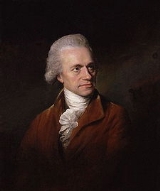
William Herschel

Encyclopedia
Sir Frederick William Herschel, KH
, FRS, German: Friedrich Wilhelm Herschel (15 November 1738 – 25 August 1822) was a German-born British astronomer
, technical expert, and composer. Born in Hanover
, Wilhelm first followed his father into the Military Band of Hanover, but emigrated to Britain at age 19. Herschel became most famous for the discovery of Uranus
in addition to two of its major moons, Titania
and Oberon
. He also discovered two moons of Saturn
and infrared radiation
. Finally, Herschel is less known for the twenty-four symphonies that he composed.
and is a man very much respected in the Berkshire town. He died in Slough
and was also buried there. A new Bus Station was built in the centre of Slough
in 2011 and the design was inspired by the infrared experiment of Sir William Herschel. He was buried under the tower of St Laurences Church, Upton, Slough. The Shopping centre in the town, 'The Observatory', also comes in memory of him.
, Electorate of Hanover
one of ten children of Isaak and Anna Ilse, née Moritzen, Herschel. His father was of Jewish descent and an oboist
in the Hannover Military Band. In 1755 the Hannoverian Guards regiment, in whose band Wilhelm and his brother Jakob were engaged as oboists, was ordered to England. At the time the crowns of Great Britain and Hannover
were united under George II
. As the threat of war with France loomed, the Hannoverian Guard was recalled from England to defend Hannover. After the Hannoverian guard was defeated at the Battle of Hastenbeck
, Herschel's father Isaak sent his two sons to seek refuge in England in late 1757. Although his older brother Jakob had received his dismissal from the Hannoverian Guard, Wilhelm was accused of desertion, (for which he was pardoned by George III in 1782). Wilhelm, nineteen years old at this time, was a quick student of the English language. In England he went by the English rendition of his name, Frederick William Herschel.
He played the cello and harpsichord
in addition to the oboe
and later the organ
. He composed numerous musical works, including 24 symphonies and many concertos, as well as some church music. Apart from a few oboe concertos, his music is largely forgotten today.
Herschel moved to Sunderland in 1761 when Charles Avison
immediately engaged him as first violin and soloist for his Newcastle orchestra, where he played for one season. In ‘Sunderland in the County of Durham 20 April 1761’ he wrote his symphony no. 8 in C minor. He was head of the Durham Militia band 1760–61 and visited the home of Sir Ralph Milbanke at Halnaby Hall in 1760, where he wrote two symphonies, as well as giving performances himself.
After Newcastle he moved to Leeds and Halifax
where he was the first organist at St John the Baptist church. He became organist of the Octagon Chapel, Bath
, a fashionable chapel in a well-known spa, in which town he was also Director of Public Concerts. He was appointed as the organist in 1766 and gave his introductory concert on 1 January 1767. As the organ was still incomplete he showed off his versatility by performing his own compositions including a violin concerto
, an oboe concerto
and a harpsichord
sonata
. The organ was completed in October 1767. His sister Caroline
came to England in 1772 and lived with him there in New King Street. His brothers Dietrich, Alexander and Jakob (1734–1792) also appeared as musicians of Bath. In 1780, Herschel was appointed director of the Bath orchestra, with his sister often appearing as soprano soloist.
and lenses
. His interest in astronomy
grew stronger after he made the acquaintance of the English Astronomer Royal
Nevil Maskelyne
. He started building his own reflecting telescope
s and would spend up to 16 hours a day grinding and polishing the speculum metal
primary mirror
s. He "began to look at the planets and the stars" in May, 1773 and on 1 March 1774 began an astronomical journal by noting his observations of Saturn's rings and the Great Orion Nebula (M 42).
shifts in their separation, for the distance of stars from the Earth (a method first suggested by Galileo Galilei
). From the back garden of his house in New King Street, Bath and using a 6.2 inches (157.5 mm), 7 feet (2.1 m) (f/13) Newtonian telescope
"with a most capital speculum" of his own manufacture, Herschel began a systematic search for these stars among "every star in the Heavens" in October, 1779 and continued listing discoveries through 1792. He soon discovered many more binary and multiple stars than expected, and compiled them with careful measurements of their relative positions in two catalogues presented to the Royal Society
, London in 1782 (269 double or multiple systems) and 1784 (434 systems). A third catalogue of discoveries made after 1783 was published in 1821 (145 systems). In 1797 Herschel measured many of the systems again, and discovered changes in their relative positions that could not be attributed to the parallax caused by the Earth's orbit. He waited until 1802 (in Catalogue of 500 new Nebulae, nebulous Stars, planetary Nebulae, and Clusters of Stars; with Remarks on the Construction of the Heavens) to announce the hypothesis that the two stars might be "binary sidereal systems" orbiting under mutual gravitational attraction, a hypothesis he confirmed in 1803 in his Account of the Changes that have happened, during the last Twenty-five Years, in the relative Situation of Double-stars; with an Investigation of the Cause to which they are owing. In all, Herschel discovered over 800 confirmed double or multiple star systems, almost all of them physical rather than virtual pairs. His theoretical and observational work provided the foundation for modern binary star astronomy; new catalogues adding to his work were not published until after 1820 by Friedrich Wilhelm Struve, James South and John Herschel
.
computed the orbit and found it to be probably planetary. Herschel determined in agreement that it must be a planet beyond the orbit of Saturn. He called the new planet the 'Georgian star' (Georgium sidus) after King George III, which also brought him favour; the name didn't stick, however. In France, where reference to the British king was to be avoided if possible, the planet was known as 'Herschel' until the name 'Uranus' was universally adopted. The same year, Herschel was awarded the Copley Medal
and elected a Fellow of the Royal Society
. In 1782, he was appointed "The King’s Astronomer" (not to be confused with the Astronomer Royal
). He and his sister subsequently moved to Datchet
(then in Buckinghamshire
but now in Berkshire
) on 1 August 1782. He continued his work as a telescope maker and achieved an international reputation for their manufacture, profitably selling over 60 completed reflectors to British and Continental astronomers.
e. (At that time, nebula was the generic term for any visually extended or diffuse astronomical object, including galaxies beyond the Milky Way, until galaxies were confirmed as extragalactic systems by Edwin Hubble
in 1924.) Herschel published his discoveries as three catalogues: Catalogue of One Thousand New Nebulae and Clusters of Stars (1786), Catalogue of a Second Thousand New Nebulae and Clusters of Stars (1789) and the previously cited Catalogue of 500 New Nebulae ... (1802). He arranged his discoveries under eight "classes": (I) bright nebulae, (II) faint nebulae, (III) very faint nebulae, (IV) planetary nebulae, (V) very large nebulae, (VI) very compressed and rich clusters of stars, (VII) compressed clusters of small and large [faint and bright] stars, and (VIII) coarsely scattered clusters of stars. Herschel's discoveries were supplemented by those of Caroline Herschel (11 objects) and his son John Herschel (1754 objects) and published by him as General Catalogue of Nebulae and Clusters in 1864. This catalogue was later edited by John Dreyer, supplemented with discoveries by many other 19th century astronomers, and published in 1888 as the New General Catalogue (abbreviated NGC) of over 6200 deep sky objects. The NGC numbering is still the most commonly used identifying label for these celestial landmarks.
a telescope, and she began to make astronomical discoveries in her own right, particularly comet
s. She discovered eight comets, eleven nebulae and, at her brother's suggestion, updated and corrected Flamsteed's work detailing the position of stars. This was published as the British Catalogue of Stars. She was honoured by the Royal Astronomical Society
for this work. Caroline also continued to serve as his assistant, often taking notes while he observed at the telescope.
In June 1785, owing to damp conditions, he and Caroline moved to Clay Hall in Old Windsor
. In 1786, the Herschels moved to a new residence on Windsor Road in Slough
. He lived the rest of his life in this residence, which came to be known as Observatory House
. It is no longer standing.
On 7 May 1788, he married the widow Mary Pitt (née Baldwin) at St Laurence's Church
, Upton in Slough
. His sister Caroline then moved to separate lodgings, but continued to work as his assistant.

During the course of his career, he constructed more than four hundred telescopes. The largest and most famous of these was a reflecting telescope
with a 49+1/2 in primary mirror
and a 40-foot (12 m) focal length
. Because of the poor reflectivity of the speculum mirrors of that day, Herschel eliminated the small diagonal mirror of a standard newtonian reflector from his design and tilted his primary mirror so he could view the formed image directly. This design has come to be called the Herschelian telescope. On 28 August 1789, his first night of observation using this instrument, he discovered a new moon of Saturn
. A second moon followed within the first month of observation. The "40-foot telescope" proved very cumbersome, however, and most of his observations were done with a smaller 18.5 inches (47 cm) 20 feet (6.1 m) reflector. Herschel discovered that unfilled telescope apertures can be used to obtain high angular resolution, something which became the essential basis for interferometric imaging in astronomy (in particular Aperture Masking Interferometry
and hypertelescopes).
In his later career, Herschel discovered two moons of Saturn, Mimas
and Enceladus
; as well as two moons of Uranus, Titania
and Oberon
. He did not give these moons their names; they were named by his son John
in 1847 and 1852, respectively, well after his death.
Recently, some evidence has been cited by Dr. Stuart Eves that Herschel might have discovered rings around Uranus.
Herschel measured the axial tilt
of the planet Mars
and discovered that the martian ice caps, first observed by Giovanni Domenico Cassini
(1666) and Christiaan Huygens (1672), changed size with the planet's seasons.
From studying the proper motion
of stars, he was the first to realise that the solar system
is moving
through space
, and he determined the approximate direction of that movement. He also studied the structure of the Milky Way
and concluded that it was in the shape of a disk
.
He also coined the word "asteroid
", meaning star-like (from the Greek
asteroeides, aster "star" + -eidos "form, shape"), in 1802 (shortly after Olbers discovered the second minor planet
, 2 Pallas
, in late March of the same year), to describe the star-like appearance of the small moons of the giant planets
and of the minor planets; the planets all show discs, by comparison. However, it was not until the 1850s that 'asteroid' became a standard term for describing certain minor planets.
As part of his attempts to determine if there was a link between solar activity
and the terrestrial climate, Herschel also collected records of the price of wheat, as direct meteorological measurements were not available for a sufficient period. He theorised that the price of wheat would be linked
to the harvest and hence to the weather over the year. This attempt was unsuccessful due to the lack of previous solar observations against which to compare the wheat prices, but similar techniques were used later with success.
Despite his numerous important scientific discoveries, Herschel was not averse to wild speculation. In particular, he believed every planet was inhabited, even the Sun
: he believed that the Sun had a cool, solid surface protected from its hot atmosphere
by an opaque layer of cloud, and that a race of beings adapted to their strange environment lived there and had enormous heads. He believed the creatures' heads must be exceptionally large because his calculations showed that under those conditions a normal sized head would effectively explode. The original belief of life-forms inhabiting the Sun came from the sight and movement of sunspots on the surface of the Sun.
by passing it through a prism and holding a thermometer
just beyond the red end of the visible spectrum
. This thermometer was meant to be a control to measure the ambient air temperature in the room. He was shocked when it showed a higher temperature than the visible spectrum
. Further experimentation led to Herschel's conclusion that there must be an invisible
form of light beyond the visible spectrum
.
to establish that coral
had the characteristic thin cell walls of an animal, instead of it being a plant, as many believed.
, born at Observatory House on 7 March 1792. In 1816, William was made a Knight of the Royal Guelphic Order
by the Prince Regent
entitling him to the prefix 'Sir'. He helped to found the Astronomical Society of London in 1820, which in 1831 received a royal charter and became the Royal Astronomical Society
. In 1813, he was elected a foreign member of the Royal Swedish Academy of Sciences
.
On 25 August 1822, Herschel died at Observatory House, Windsor Road, Slough, and is buried at nearby St Laurence's Church, Upton. His son John Herschel
also became a famous astronomer. One of William's brothers, Alexander Herschel, moved permanently to England, near Caroline and John. His sister Caroline returned to Hanover
, Germany after the death of her brother. She died on 9 January 1848.
His house at 19 New King Street in Bath, Somerset where he made many telescope
s and first observed Uranus, is now home to the Herschel Museum of Astronomy.

Royal Guelphic Order
The Royal Guelphic Order, sometimes also referred to as the Hanoverian Guelphic Order, is a Hanoverian order of chivalry instituted on 28 April 1815 by the Prince Regent . It has not been conferred by the British Crown since the death of King William IV in 1837, when the personal union of the...
, FRS, German: Friedrich Wilhelm Herschel (15 November 1738 – 25 August 1822) was a German-born British astronomer
Astronomer
An astronomer is a scientist who studies celestial bodies such as planets, stars and galaxies.Historically, astronomy was more concerned with the classification and description of phenomena in the sky, while astrophysics attempted to explain these phenomena and the differences between them using...
, technical expert, and composer. Born in Hanover
Hanover
Hanover or Hannover, on the river Leine, is the capital of the federal state of Lower Saxony , Germany and was once by personal union the family seat of the Hanoverian Kings of Great Britain, under their title as the dukes of Brunswick-Lüneburg...
, Wilhelm first followed his father into the Military Band of Hanover, but emigrated to Britain at age 19. Herschel became most famous for the discovery of Uranus
Uranus
Uranus is the seventh planet from the Sun. It has the third-largest planetary radius and fourth-largest planetary mass in the Solar System. It is named after the ancient Greek deity of the sky Uranus , the father of Cronus and grandfather of Zeus...
in addition to two of its major moons, Titania
Titania (moon)
Titania is the largest of the moons of Uranus and the eighth largest moon in the Solar System at a diameter of 1578 km. Discovered by William Herschel in 1787, Titania is named after the queen of the fairies in Shakespeare's A Midsummer Night's Dream...
and Oberon
Oberon (moon)
Oberon , also designated ', is the outermost major moon of the planet Uranus. It is the second largest and second most massive of the Uranian moons, and the ninth most massive moon in the Solar System. Discovered by William Herschel in 1787, Oberon is named after the mythical king of the fairies...
. He also discovered two moons of Saturn
Saturn
Saturn is the sixth planet from the Sun and the second largest planet in the Solar System, after Jupiter. Saturn is named after the Roman god Saturn, equated to the Greek Cronus , the Babylonian Ninurta and the Hindu Shani. Saturn's astronomical symbol represents the Roman god's sickle.Saturn,...
and infrared radiation
Infrared
Infrared light is electromagnetic radiation with a wavelength longer than that of visible light, measured from the nominal edge of visible red light at 0.74 micrometres , and extending conventionally to 300 µm...
. Finally, Herschel is less known for the twenty-four symphonies that he composed.
Memorial
Sir William Herschel lived most of his life in SloughSlough
Slough is a borough and unitary authority within the ceremonial county of Royal Berkshire, England. The town straddles the A4 Bath Road and the Great Western Main Line, west of central London...
and is a man very much respected in the Berkshire town. He died in Slough
Slough
Slough is a borough and unitary authority within the ceremonial county of Royal Berkshire, England. The town straddles the A4 Bath Road and the Great Western Main Line, west of central London...
and was also buried there. A new Bus Station was built in the centre of Slough
Slough
Slough is a borough and unitary authority within the ceremonial county of Royal Berkshire, England. The town straddles the A4 Bath Road and the Great Western Main Line, west of central London...
in 2011 and the design was inspired by the infrared experiment of Sir William Herschel. He was buried under the tower of St Laurences Church, Upton, Slough. The Shopping centre in the town, 'The Observatory', also comes in memory of him.
Early life and musical activities
Herschel was born in HanoverHanover
Hanover or Hannover, on the river Leine, is the capital of the federal state of Lower Saxony , Germany and was once by personal union the family seat of the Hanoverian Kings of Great Britain, under their title as the dukes of Brunswick-Lüneburg...
, Electorate of Hanover
Electorate of Hanover
The Electorate of Brunswick-Lüneburg was the ninth Electorate of the Holy Roman Empire of the German Nation...
one of ten children of Isaak and Anna Ilse, née Moritzen, Herschel. His father was of Jewish descent and an oboist
Oboist
An oboist is a musician who plays the oboe or any oboe family instrument, including the cor anglais, oboe d'amore, shawm and oboe musette....
in the Hannover Military Band. In 1755 the Hannoverian Guards regiment, in whose band Wilhelm and his brother Jakob were engaged as oboists, was ordered to England. At the time the crowns of Great Britain and Hannover
House of Hanover
The House of Hanover is a deposed German royal dynasty which has ruled the Duchy of Brunswick-Lüneburg , the Kingdom of Hanover, the Kingdom of Great Britain, the Kingdom of Ireland and the United Kingdom of Great Britain and Ireland...
were united under George II
George II of Great Britain
George II was King of Great Britain and Ireland, Duke of Brunswick-Lüneburg and Archtreasurer and Prince-elector of the Holy Roman Empire from 11 June 1727 until his death.George was the last British monarch born outside Great Britain. He was born and brought up in Northern Germany...
. As the threat of war with France loomed, the Hannoverian Guard was recalled from England to defend Hannover. After the Hannoverian guard was defeated at the Battle of Hastenbeck
Battle of Hastenbeck
The Battle of Hastenbeck was fought as part of the Invasion of Hanover during the Seven Year's War between the allied forces of Hanover, Hesse-Kassel and Brunswick and the French...
, Herschel's father Isaak sent his two sons to seek refuge in England in late 1757. Although his older brother Jakob had received his dismissal from the Hannoverian Guard, Wilhelm was accused of desertion, (for which he was pardoned by George III in 1782). Wilhelm, nineteen years old at this time, was a quick student of the English language. In England he went by the English rendition of his name, Frederick William Herschel.
He played the cello and harpsichord
Harpsichord
A harpsichord is a musical instrument played by means of a keyboard. It produces sound by plucking a string when a key is pressed.In the narrow sense, "harpsichord" designates only the large wing-shaped instruments in which the strings are perpendicular to the keyboard...
in addition to the oboe
Oboe
The oboe is a double reed musical instrument of the woodwind family. In English, prior to 1770, the instrument was called "hautbois" , "hoboy", or "French hoboy". The spelling "oboe" was adopted into English ca...
and later the organ
Organ (music)
The organ , is a keyboard instrument of one or more divisions, each played with its own keyboard operated either with the hands or with the feet. The organ is a relatively old musical instrument in the Western musical tradition, dating from the time of Ctesibius of Alexandria who is credited with...
. He composed numerous musical works, including 24 symphonies and many concertos, as well as some church music. Apart from a few oboe concertos, his music is largely forgotten today.
Herschel moved to Sunderland in 1761 when Charles Avison
Charles Avison
Charles Avison – 10 May 1770) was an English composer during the Baroque and Classical periods. He was a church organist at St John The Baptist Church in Newcastle and at St. Nicholas's Church...
immediately engaged him as first violin and soloist for his Newcastle orchestra, where he played for one season. In ‘Sunderland in the County of Durham 20 April 1761’ he wrote his symphony no. 8 in C minor. He was head of the Durham Militia band 1760–61 and visited the home of Sir Ralph Milbanke at Halnaby Hall in 1760, where he wrote two symphonies, as well as giving performances himself.
After Newcastle he moved to Leeds and Halifax
Halifax, West Yorkshire
Halifax is a minster town, within the Metropolitan Borough of Calderdale in West Yorkshire, England. It has an urban area population of 82,056 in the 2001 Census. It is well-known as a centre of England's woollen manufacture from the 15th century onward, originally dealing through the Halifax Piece...
where he was the first organist at St John the Baptist church. He became organist of the Octagon Chapel, Bath
Octagon Chapel, Bath
The Octagon Chapel in Milsom Street, Bath, Somerset, England was built in 1767 and has been designated as a Grade I listed building.- History :...
, a fashionable chapel in a well-known spa, in which town he was also Director of Public Concerts. He was appointed as the organist in 1766 and gave his introductory concert on 1 January 1767. As the organ was still incomplete he showed off his versatility by performing his own compositions including a violin concerto
Violin concerto
A violin concerto is a concerto for solo violin and instrumental ensemble, customarily orchestra. Such works have been written since the Baroque period, when the solo concerto form was first developed, up through the present day...
, an oboe concerto
Oboe concerto
A number of concertos have been written for the oboe, both as a solo instrument as well as in conjunction with other solo instrument, and accompanied by string orchestra, chamber orchestra, full orchestra, band, or similar large ensemble.These include concertos by the following...
and a harpsichord
Harpsichord
A harpsichord is a musical instrument played by means of a keyboard. It produces sound by plucking a string when a key is pressed.In the narrow sense, "harpsichord" designates only the large wing-shaped instruments in which the strings are perpendicular to the keyboard...
sonata
Sonata
Sonata , in music, literally means a piece played as opposed to a cantata , a piece sung. The term, being vague, naturally evolved through the history of music, designating a variety of forms prior to the Classical era...
. The organ was completed in October 1767. His sister Caroline
Caroline Herschel
Caroline Lucretia Herschel was a German-British astronomer, the sister of astronomer Sir Friedrich Wilhelm Herschel with whom she worked throughout both of their careers. Her most significant contribution to astronomy was the discovery of several comets and in particular the periodic comet...
came to England in 1772 and lived with him there in New King Street. His brothers Dietrich, Alexander and Jakob (1734–1792) also appeared as musicians of Bath. In 1780, Herschel was appointed director of the Bath orchestra, with his sister often appearing as soprano soloist.
Astronomy
Herschel's music led him to an interest in mathematicsMathematics
Mathematics is the study of quantity, space, structure, and change. Mathematicians seek out patterns and formulate new conjectures. Mathematicians resolve the truth or falsity of conjectures by mathematical proofs, which are arguments sufficient to convince other mathematicians of their validity...
and lenses
Lens (optics)
A lens is an optical device with perfect or approximate axial symmetry which transmits and refracts light, converging or diverging the beam. A simple lens consists of a single optical element...
. His interest in astronomy
Astronomy
Astronomy is a natural science that deals with the study of celestial objects and phenomena that originate outside the atmosphere of Earth...
grew stronger after he made the acquaintance of the English Astronomer Royal
Astronomer Royal
Astronomer Royal is a senior post in the Royal Household of the Sovereign of the United Kingdom. There are two officers, the senior being the Astronomer Royal dating from 22 June 1675; the second is the Astronomer Royal for Scotland dating from 1834....
Nevil Maskelyne
Nevil Maskelyne
The Reverend Dr Nevil Maskelyne FRS was the fifth English Astronomer Royal. He held the office from 1765 to 1811.-Biography:...
. He started building his own reflecting telescope
Reflecting telescope
A reflecting telescope is an optical telescope which uses a single or combination of curved mirrors that reflect light and form an image. The reflecting telescope was invented in the 17th century as an alternative to the refracting telescope which, at that time, was a design that suffered from...
s and would spend up to 16 hours a day grinding and polishing the speculum metal
Speculum metal
Speculum metal is a mixture of around two-thirds copper and one-third tin making a white brittle alloy that can be polished to make a highly reflective surface. It is used primarily to make different kinds of mirrors including early reflecting telescope optical mirrors...
primary mirror
Primary mirror
A primary mirror is the principal light-gathering surface of a reflecting telescope.-Description:The primary mirror of a reflecting telescope is a spherical or parabolic shaped disks of polished reflective metal , or in later telescopes, glass or other material coated with a reflective layer...
s. He "began to look at the planets and the stars" in May, 1773 and on 1 March 1774 began an astronomical journal by noting his observations of Saturn's rings and the Great Orion Nebula (M 42).
Double Stars
Herschel's early observational work soon focused on the search for visually very close pairs of stars. Astronomers of the era expected that changes over time in the apparent separation and relative location of these stars would provide evidence both for the proper motion of stars and, by means of parallaxParallax
Parallax is a displacement or difference in the apparent position of an object viewed along two different lines of sight, and is measured by the angle or semi-angle of inclination between those two lines. The term is derived from the Greek παράλλαξις , meaning "alteration"...
shifts in their separation, for the distance of stars from the Earth (a method first suggested by Galileo Galilei
Galileo Galilei
Galileo Galilei , was an Italian physicist, mathematician, astronomer, and philosopher who played a major role in the Scientific Revolution. His achievements include improvements to the telescope and consequent astronomical observations and support for Copernicanism...
). From the back garden of his house in New King Street, Bath and using a 6.2 inches (157.5 mm), 7 feet (2.1 m) (f/13) Newtonian telescope
Newtonian telescope
The Newtonian telescope is a type of reflecting telescope invented by the British scientist Sir Isaac Newton , using a concave primary mirror and a flat diagonal secondary mirror. Newton’s first reflecting telescope was completed in 1668 and is the earliest known functional reflecting telescope...
"with a most capital speculum" of his own manufacture, Herschel began a systematic search for these stars among "every star in the Heavens" in October, 1779 and continued listing discoveries through 1792. He soon discovered many more binary and multiple stars than expected, and compiled them with careful measurements of their relative positions in two catalogues presented to the Royal Society
Royal Society
The Royal Society of London for Improving Natural Knowledge, known simply as the Royal Society, is a learned society for science, and is possibly the oldest such society in existence. Founded in November 1660, it was granted a Royal Charter by King Charles II as the "Royal Society of London"...
, London in 1782 (269 double or multiple systems) and 1784 (434 systems). A third catalogue of discoveries made after 1783 was published in 1821 (145 systems). In 1797 Herschel measured many of the systems again, and discovered changes in their relative positions that could not be attributed to the parallax caused by the Earth's orbit. He waited until 1802 (in Catalogue of 500 new Nebulae, nebulous Stars, planetary Nebulae, and Clusters of Stars; with Remarks on the Construction of the Heavens) to announce the hypothesis that the two stars might be "binary sidereal systems" orbiting under mutual gravitational attraction, a hypothesis he confirmed in 1803 in his Account of the Changes that have happened, during the last Twenty-five Years, in the relative Situation of Double-stars; with an Investigation of the Cause to which they are owing. In all, Herschel discovered over 800 confirmed double or multiple star systems, almost all of them physical rather than virtual pairs. His theoretical and observational work provided the foundation for modern binary star astronomy; new catalogues adding to his work were not published until after 1820 by Friedrich Wilhelm Struve, James South and John Herschel
John Herschel
Sir John Frederick William Herschel, 1st Baronet KH, FRS ,was an English mathematician, astronomer, chemist, and experimental photographer/inventor, who in some years also did valuable botanical work...
.
Uranus
In March, 1781, during his search for double stars, Herschel noticed an object appearing as a nonstellar disk. Herschel originally thought it was a comet or a star. He made many more observations of it, and afterwards Russian Academician Anders LexellAnders Johan Lexell
Anders Johan Lexell was a Swedish-born Russian astronomer, mathematician, and physicist who spent most of his life in Russia where he is known as Andrei Ivanovich Leksel .Lexell made important discoveries in polygonometry and celestial mechanics; the latter led to a comet named in...
computed the orbit and found it to be probably planetary. Herschel determined in agreement that it must be a planet beyond the orbit of Saturn. He called the new planet the 'Georgian star' (Georgium sidus) after King George III, which also brought him favour; the name didn't stick, however. In France, where reference to the British king was to be avoided if possible, the planet was known as 'Herschel' until the name 'Uranus' was universally adopted. The same year, Herschel was awarded the Copley Medal
Copley Medal
The Copley Medal is an award given by the Royal Society of London for "outstanding achievements in research in any branch of science, and alternates between the physical sciences and the biological sciences"...
and elected a Fellow of the Royal Society
Royal Society
The Royal Society of London for Improving Natural Knowledge, known simply as the Royal Society, is a learned society for science, and is possibly the oldest such society in existence. Founded in November 1660, it was granted a Royal Charter by King Charles II as the "Royal Society of London"...
. In 1782, he was appointed "The King’s Astronomer" (not to be confused with the Astronomer Royal
Astronomer Royal
Astronomer Royal is a senior post in the Royal Household of the Sovereign of the United Kingdom. There are two officers, the senior being the Astronomer Royal dating from 22 June 1675; the second is the Astronomer Royal for Scotland dating from 1834....
). He and his sister subsequently moved to Datchet
Datchet
Datchet is an English Thameside village and civil parish situated in the unitary authority of Windsor and Maidenhead in the county of Berkshire. It was transferred to Berkshire from Buckinghamshire in 1974....
(then in Buckinghamshire
Buckinghamshire
Buckinghamshire is a ceremonial and non-metropolitan home county in South East England. The county town is Aylesbury, the largest town in the ceremonial county is Milton Keynes and largest town in the non-metropolitan county is High Wycombe....
but now in Berkshire
Berkshire
Berkshire is a historic county in the South of England. It is also often referred to as the Royal County of Berkshire because of the presence of the royal residence of Windsor Castle in the county; this usage, which dates to the 19th century at least, was recognised by the Queen in 1957, and...
) on 1 August 1782. He continued his work as a telescope maker and achieved an international reputation for their manufacture, profitably selling over 60 completed reflectors to British and Continental astronomers.
Deep Sky Surveys
From 1782 to 1802, and most intensively from 1783 to 1790, Herschel conducted systematic surveys in search of "deep sky" or nonstellar objects with two 20 feet (609.6 cm), 12 inch and 18.7 inch telescopes (in combination with his favoured 6 inch aperture instrument). Excluding duplicated and "lost" entries, Herschel ultimately discovered over 2400 objects defined by him as nebulaNebula
A nebula is an interstellar cloud of dust, hydrogen gas, helium gas and other ionized gases...
e. (At that time, nebula was the generic term for any visually extended or diffuse astronomical object, including galaxies beyond the Milky Way, until galaxies were confirmed as extragalactic systems by Edwin Hubble
Edwin Hubble
Edwin Powell Hubble was an American astronomer who profoundly changed the understanding of the universe by confirming the existence of galaxies other than the Milky Way - our own galaxy...
in 1924.) Herschel published his discoveries as three catalogues: Catalogue of One Thousand New Nebulae and Clusters of Stars (1786), Catalogue of a Second Thousand New Nebulae and Clusters of Stars (1789) and the previously cited Catalogue of 500 New Nebulae ... (1802). He arranged his discoveries under eight "classes": (I) bright nebulae, (II) faint nebulae, (III) very faint nebulae, (IV) planetary nebulae, (V) very large nebulae, (VI) very compressed and rich clusters of stars, (VII) compressed clusters of small and large [faint and bright] stars, and (VIII) coarsely scattered clusters of stars. Herschel's discoveries were supplemented by those of Caroline Herschel (11 objects) and his son John Herschel (1754 objects) and published by him as General Catalogue of Nebulae and Clusters in 1864. This catalogue was later edited by John Dreyer, supplemented with discoveries by many other 19th century astronomers, and published in 1888 as the New General Catalogue (abbreviated NGC) of over 6200 deep sky objects. The NGC numbering is still the most commonly used identifying label for these celestial landmarks.
Work with his sister Caroline
In 1783 he gave CarolineCaroline Herschel
Caroline Lucretia Herschel was a German-British astronomer, the sister of astronomer Sir Friedrich Wilhelm Herschel with whom she worked throughout both of their careers. Her most significant contribution to astronomy was the discovery of several comets and in particular the periodic comet...
a telescope, and she began to make astronomical discoveries in her own right, particularly comet
Comet
A comet is an icy small Solar System body that, when close enough to the Sun, displays a visible coma and sometimes also a tail. These phenomena are both due to the effects of solar radiation and the solar wind upon the nucleus of the comet...
s. She discovered eight comets, eleven nebulae and, at her brother's suggestion, updated and corrected Flamsteed's work detailing the position of stars. This was published as the British Catalogue of Stars. She was honoured by the Royal Astronomical Society
Royal Astronomical Society
The Royal Astronomical Society is a learned society that began as the Astronomical Society of London in 1820 to support astronomical research . It became the Royal Astronomical Society in 1831 on receiving its Royal Charter from William IV...
for this work. Caroline also continued to serve as his assistant, often taking notes while he observed at the telescope.
In June 1785, owing to damp conditions, he and Caroline moved to Clay Hall in Old Windsor
Windsor, Berkshire
Windsor is an affluent suburban town and unparished area in the Royal Borough of Windsor and Maidenhead in Berkshire, England. It is widely known as the site of Windsor Castle, one of the official residences of the British Royal Family....
. In 1786, the Herschels moved to a new residence on Windsor Road in Slough
Slough
Slough is a borough and unitary authority within the ceremonial county of Royal Berkshire, England. The town straddles the A4 Bath Road and the Great Western Main Line, west of central London...
. He lived the rest of his life in this residence, which came to be known as Observatory House
Observatory House
Observatory House was an observatory in Slough, England. It was built, run and used by the astronomer William Herschel, and his sister Caroline. The famous '40-foot telescope' - at that time the largest in the world - was housed there in the late 18th century and early 19th century.The main house...
. It is no longer standing.
On 7 May 1788, he married the widow Mary Pitt (née Baldwin) at St Laurence's Church
St Laurence's Church, Slough
Saint Laurence's Church is one of three churches in the modern parish of Upton-cum-Chalvey, and is the oldest building in the borough of Slough, in Berkshire, England....
, Upton in Slough
Upton, Slough
Upton is a suburb of Slough in Berkshire, England. Until the local government reforms of 1974 it was in Buckinghamshire. It was one of the villages that developed into the town.-History:...
. His sister Caroline then moved to separate lodgings, but continued to work as his assistant.
Herschel's telescopes
During the course of his career, he constructed more than four hundred telescopes. The largest and most famous of these was a reflecting telescope
Reflecting telescope
A reflecting telescope is an optical telescope which uses a single or combination of curved mirrors that reflect light and form an image. The reflecting telescope was invented in the 17th century as an alternative to the refracting telescope which, at that time, was a design that suffered from...
with a 49+1/2 in primary mirror
Primary mirror
A primary mirror is the principal light-gathering surface of a reflecting telescope.-Description:The primary mirror of a reflecting telescope is a spherical or parabolic shaped disks of polished reflective metal , or in later telescopes, glass or other material coated with a reflective layer...
and a 40-foot (12 m) focal length
Focal length
The focal length of an optical system is a measure of how strongly the system converges or diverges light. For an optical system in air, it is the distance over which initially collimated rays are brought to a focus...
. Because of the poor reflectivity of the speculum mirrors of that day, Herschel eliminated the small diagonal mirror of a standard newtonian reflector from his design and tilted his primary mirror so he could view the formed image directly. This design has come to be called the Herschelian telescope. On 28 August 1789, his first night of observation using this instrument, he discovered a new moon of Saturn
Saturn
Saturn is the sixth planet from the Sun and the second largest planet in the Solar System, after Jupiter. Saturn is named after the Roman god Saturn, equated to the Greek Cronus , the Babylonian Ninurta and the Hindu Shani. Saturn's astronomical symbol represents the Roman god's sickle.Saturn,...
. A second moon followed within the first month of observation. The "40-foot telescope" proved very cumbersome, however, and most of his observations were done with a smaller 18.5 inches (47 cm) 20 feet (6.1 m) reflector. Herschel discovered that unfilled telescope apertures can be used to obtain high angular resolution, something which became the essential basis for interferometric imaging in astronomy (in particular Aperture Masking Interferometry
Aperture masking interferometry
Aperture Masking Interferometry is a form of speckle interferometry, allowing diffraction limited imaging from ground-based telescopes. This technique allows ground based telescopes to reach the maximum possible resolution, allowing ground-based telescopes with large diameters to produce far...
and hypertelescopes).
Further discoveries
| Uranus Uranus Uranus is the seventh planet from the Sun. It has the third-largest planetary radius and fourth-largest planetary mass in the Solar System. It is named after the ancient Greek deity of the sky Uranus , the father of Cronus and grandfather of Zeus... |
13 March 1781 |
| Oberon Oberon (moon) Oberon , also designated ', is the outermost major moon of the planet Uranus. It is the second largest and second most massive of the Uranian moons, and the ninth most massive moon in the Solar System. Discovered by William Herschel in 1787, Oberon is named after the mythical king of the fairies... |
11 January 1787 |
| Titania Titania (moon) Titania is the largest of the moons of Uranus and the eighth largest moon in the Solar System at a diameter of 1578 km. Discovered by William Herschel in 1787, Titania is named after the queen of the fairies in Shakespeare's A Midsummer Night's Dream... |
11 January 1787 |
| Enceladus Enceladus (moon) Enceladus is the sixth-largest of the moons of Saturn. It was discovered in 1789 by William Herschel. Until the two Voyager spacecraft passed near it in the early 1980s very little was known about this small moon besides the identification of water ice on its surface... |
28 August 1789 |
| Mimas Mimas (moon) Mimas is a moon of Saturn which was discovered in 1789 by William Herschel. It is named after Mimas, a son of Gaia in Greek mythology, and is also designated Saturn I.... |
17 September 1789 |
In his later career, Herschel discovered two moons of Saturn, Mimas
Mimas (moon)
Mimas is a moon of Saturn which was discovered in 1789 by William Herschel. It is named after Mimas, a son of Gaia in Greek mythology, and is also designated Saturn I....
and Enceladus
Enceladus (moon)
Enceladus is the sixth-largest of the moons of Saturn. It was discovered in 1789 by William Herschel. Until the two Voyager spacecraft passed near it in the early 1980s very little was known about this small moon besides the identification of water ice on its surface...
; as well as two moons of Uranus, Titania
Titania (moon)
Titania is the largest of the moons of Uranus and the eighth largest moon in the Solar System at a diameter of 1578 km. Discovered by William Herschel in 1787, Titania is named after the queen of the fairies in Shakespeare's A Midsummer Night's Dream...
and Oberon
Oberon (moon)
Oberon , also designated ', is the outermost major moon of the planet Uranus. It is the second largest and second most massive of the Uranian moons, and the ninth most massive moon in the Solar System. Discovered by William Herschel in 1787, Oberon is named after the mythical king of the fairies...
. He did not give these moons their names; they were named by his son John
John Herschel
Sir John Frederick William Herschel, 1st Baronet KH, FRS ,was an English mathematician, astronomer, chemist, and experimental photographer/inventor, who in some years also did valuable botanical work...
in 1847 and 1852, respectively, well after his death.
Recently, some evidence has been cited by Dr. Stuart Eves that Herschel might have discovered rings around Uranus.
Herschel measured the axial tilt
Axial tilt
In astronomy, axial tilt is the angle between an object's rotational axis, and a line perpendicular to its orbital plane...
of the planet Mars
Mars
Mars is the fourth planet from the Sun in the Solar System. The planet is named after the Roman god of war, Mars. It is often described as the "Red Planet", as the iron oxide prevalent on its surface gives it a reddish appearance...
and discovered that the martian ice caps, first observed by Giovanni Domenico Cassini
Giovanni Domenico Cassini
This article is about the Italian-born astronomer. For his French-born great-grandson, see Jean-Dominique Cassini.Giovanni Domenico Cassini was an Italian/French mathematician, astronomer, engineer, and astrologer...
(1666) and Christiaan Huygens (1672), changed size with the planet's seasons.
From studying the proper motion
Proper motion
The proper motion of a star is its angular change in position over time as seen from the center of mass of the solar system. It is measured in seconds of arc per year, arcsec/yr, where 3600 arcseconds equal one degree. This contrasts with radial velocity, which is the time rate of change in...
of stars, he was the first to realise that the solar system
Solar System
The Solar System consists of the Sun and the astronomical objects gravitationally bound in orbit around it, all of which formed from the collapse of a giant molecular cloud approximately 4.6 billion years ago. The vast majority of the system's mass is in the Sun...
is moving
Stellar kinematics
Stellar kinematics is the study of the movement of stars without needing to understand how they acquired their motion. This differs from stellar dynamics, which takes into account gravitational effects...
through space
Space
Space is the boundless, three-dimensional extent in which objects and events occur and have relative position and direction. Physical space is often conceived in three linear dimensions, although modern physicists usually consider it, with time, to be part of a boundless four-dimensional continuum...
, and he determined the approximate direction of that movement. He also studied the structure of the Milky Way
Milky Way
The Milky Way is the galaxy that contains the Solar System. This name derives from its appearance as a dim un-resolved "milky" glowing band arching across the night sky...
and concluded that it was in the shape of a disk
Spiral galaxy
A spiral galaxy is a certain kind of galaxy originally described by Edwin Hubble in his 1936 work The Realm of the Nebulae and, as such, forms part of the Hubble sequence. Spiral galaxies consist of a flat, rotating disk containing stars, gas and dust, and a central concentration of stars known as...
.
He also coined the word "asteroid
Asteroid
Asteroids are a class of small Solar System bodies in orbit around the Sun. They have also been called planetoids, especially the larger ones...
", meaning star-like (from the Greek
Greek language
Greek is an independent branch of the Indo-European family of languages. Native to the southern Balkans, it has the longest documented history of any Indo-European language, spanning 34 centuries of written records. Its writing system has been the Greek alphabet for the majority of its history;...
asteroeides, aster "star" + -eidos "form, shape"), in 1802 (shortly after Olbers discovered the second minor planet
Minor planet
An asteroid group or minor-planet group is a population of minor planets that have a share broadly similar orbits. Members are generally unrelated to each other, unlike in an asteroid family, which often results from the break-up of a single asteroid...
, 2 Pallas
2 Pallas
Pallas, formally designated 2 Pallas, is the second asteroid to have been discovered , and one of the largest. It is estimated to constitute 7% of the mass of the asteroid belt, and its diameter of 530–565 km is comparable to, or slightly larger than, that of 4 Vesta. It is however 20%...
, in late March of the same year), to describe the star-like appearance of the small moons of the giant planets
Gas giant
A gas giant is a large planet that is not primarily composed of rock or other solid matter. There are four gas giants in the Solar System: Jupiter, Saturn, Uranus, and Neptune...
and of the minor planets; the planets all show discs, by comparison. However, it was not until the 1850s that 'asteroid' became a standard term for describing certain minor planets.
As part of his attempts to determine if there was a link between solar activity
Solar variation
Solar variation is the change in the amount of radiation emitted by the Sun and in its spectral distribution over years to millennia. These variations have periodic components, the main one being the approximately 11-year solar cycle . The changes also have aperiodic fluctuations...
and the terrestrial climate, Herschel also collected records of the price of wheat, as direct meteorological measurements were not available for a sufficient period. He theorised that the price of wheat would be linked
Causality
Causality is the relationship between an event and a second event , where the second event is understood as a consequence of the first....
to the harvest and hence to the weather over the year. This attempt was unsuccessful due to the lack of previous solar observations against which to compare the wheat prices, but similar techniques were used later with success.
Despite his numerous important scientific discoveries, Herschel was not averse to wild speculation. In particular, he believed every planet was inhabited, even the Sun
Sun
The Sun is the star at the center of the Solar System. It is almost perfectly spherical and consists of hot plasma interwoven with magnetic fields...
: he believed that the Sun had a cool, solid surface protected from its hot atmosphere
Atmosphere
An atmosphere is a layer of gases that may surround a material body of sufficient mass, and that is held in place by the gravity of the body. An atmosphere may be retained for a longer duration, if the gravity is high and the atmosphere's temperature is low...
by an opaque layer of cloud, and that a race of beings adapted to their strange environment lived there and had enormous heads. He believed the creatures' heads must be exceptionally large because his calculations showed that under those conditions a normal sized head would effectively explode. The original belief of life-forms inhabiting the Sun came from the sight and movement of sunspots on the surface of the Sun.
Discovery of infrared radiation in sunlight
On 11 February 1800, Herschel was testing filters for the sun so he could observe sun spots. When using a red filter he found there was a lot of heat produced. Herschel discovered infrared radiation in sunlightSunlight
Sunlight, in the broad sense, is the total frequency spectrum of electromagnetic radiation given off by the Sun. On Earth, sunlight is filtered through the Earth's atmosphere, and solar radiation is obvious as daylight when the Sun is above the horizon.When the direct solar radiation is not blocked...
by passing it through a prism and holding a thermometer
Thermometer
Developed during the 16th and 17th centuries, a thermometer is a device that measures temperature or temperature gradient using a variety of different principles. A thermometer has two important elements: the temperature sensor Developed during the 16th and 17th centuries, a thermometer (from the...
just beyond the red end of the visible spectrum
Visible spectrum
The visible spectrum is the portion of the electromagnetic spectrum that is visible to the human eye. Electromagnetic radiation in this range of wavelengths is called visible light or simply light. A typical human eye will respond to wavelengths from about 390 to 750 nm. In terms of...
. This thermometer was meant to be a control to measure the ambient air temperature in the room. He was shocked when it showed a higher temperature than the visible spectrum
Visible spectrum
The visible spectrum is the portion of the electromagnetic spectrum that is visible to the human eye. Electromagnetic radiation in this range of wavelengths is called visible light or simply light. A typical human eye will respond to wavelengths from about 390 to 750 nm. In terms of...
. Further experimentation led to Herschel's conclusion that there must be an invisible
Visual perception
Visual perception is the ability to interpret information and surroundings from the effects of visible light reaching the eye. The resulting perception is also known as eyesight, sight, or vision...
form of light beyond the visible spectrum
Visible spectrum
The visible spectrum is the portion of the electromagnetic spectrum that is visible to the human eye. Electromagnetic radiation in this range of wavelengths is called visible light or simply light. A typical human eye will respond to wavelengths from about 390 to 750 nm. In terms of...
.
Biology
Herschel used a microscopeMicroscope
A microscope is an instrument used to see objects that are too small for the naked eye. The science of investigating small objects using such an instrument is called microscopy...
to establish that coral
Coral
Corals are marine animals in class Anthozoa of phylum Cnidaria typically living in compact colonies of many identical individual "polyps". The group includes the important reef builders that inhabit tropical oceans and secrete calcium carbonate to form a hard skeleton.A coral "head" is a colony of...
had the characteristic thin cell walls of an animal, instead of it being a plant, as many believed.
Family and death
William Herschel and Mary had one child, JohnJohn Herschel
Sir John Frederick William Herschel, 1st Baronet KH, FRS ,was an English mathematician, astronomer, chemist, and experimental photographer/inventor, who in some years also did valuable botanical work...
, born at Observatory House on 7 March 1792. In 1816, William was made a Knight of the Royal Guelphic Order
Royal Guelphic Order
The Royal Guelphic Order, sometimes also referred to as the Hanoverian Guelphic Order, is a Hanoverian order of chivalry instituted on 28 April 1815 by the Prince Regent . It has not been conferred by the British Crown since the death of King William IV in 1837, when the personal union of the...
by the Prince Regent
George IV of the United Kingdom
George IV was the King of the United Kingdom of Great Britain and Ireland and also of Hanover from the death of his father, George III, on 29 January 1820 until his own death ten years later...
entitling him to the prefix 'Sir'. He helped to found the Astronomical Society of London in 1820, which in 1831 received a royal charter and became the Royal Astronomical Society
Royal Astronomical Society
The Royal Astronomical Society is a learned society that began as the Astronomical Society of London in 1820 to support astronomical research . It became the Royal Astronomical Society in 1831 on receiving its Royal Charter from William IV...
. In 1813, he was elected a foreign member of the Royal Swedish Academy of Sciences
Royal Swedish Academy of Sciences
The Royal Swedish Academy of Sciences or Kungliga Vetenskapsakademien is one of the Royal Academies of Sweden. The Academy is an independent, non-governmental scientific organization which acts to promote the sciences, primarily the natural sciences and mathematics.The Academy was founded on 2...
.
On 25 August 1822, Herschel died at Observatory House, Windsor Road, Slough, and is buried at nearby St Laurence's Church, Upton. His son John Herschel
John Herschel
Sir John Frederick William Herschel, 1st Baronet KH, FRS ,was an English mathematician, astronomer, chemist, and experimental photographer/inventor, who in some years also did valuable botanical work...
also became a famous astronomer. One of William's brothers, Alexander Herschel, moved permanently to England, near Caroline and John. His sister Caroline returned to Hanover
Hanover
Hanover or Hannover, on the river Leine, is the capital of the federal state of Lower Saxony , Germany and was once by personal union the family seat of the Hanoverian Kings of Great Britain, under their title as the dukes of Brunswick-Lüneburg...
, Germany after the death of her brother. She died on 9 January 1848.
His house at 19 New King Street in Bath, Somerset where he made many telescope
Telescope
A telescope is an instrument that aids in the observation of remote objects by collecting electromagnetic radiation . The first known practical telescopes were invented in the Netherlands at the beginning of the 1600s , using glass lenses...
s and first observed Uranus, is now home to the Herschel Museum of Astronomy.
Named after Herschel
- The symbol for planet Uranus (
 ) features Herschel's surname capital letter.
 - Mu CepheiMu CepheiMu Cephei , also known as Herschel's Garnet Star, is a red supergiant star in the constellation Cepheus. It is one of the largest and most luminous stars known in the Milky Way...
, two of the largest known stars in the universe, is also known as Herschel's Garnet Star - HerschelHerschel (lunar crater)Herschel is a lunar impact crater located just to the north of the walled plain Ptolemaeus. Just to the north is the flooded crater Spörer, and due east lies the disintegrated crater Gyldén...
, a crater on the MoonMoonThe Moon is Earth's only known natural satellite,There are a number of near-Earth asteroids including 3753 Cruithne that are co-orbital with Earth: their orbits bring them close to Earth for periods of time but then alter in the long term . These are quasi-satellites and not true moons. For more... - HerschelHerschel (Martian crater)Herschel is a large crater on Mars. It is named after the eighteenth century astronomer William Herschel.Herschel is 300 kilometers wide, so large that it is properly considered an impact basin. It is located in the cratered highlands of the Martian southern hemisphere, at 14.5°S, 230°W...
, a large impact basinImpact craterIn the broadest sense, the term impact crater can be applied to any depression, natural or manmade, resulting from the high velocity impact of a projectile with a larger body...
on MarsMarsMars is the fourth planet from the Sun in the Solar System. The planet is named after the Roman god of war, Mars. It is often described as the "Red Planet", as the iron oxide prevalent on its surface gives it a reddish appearance... - The enormous crater Herschel on SaturnSaturnSaturn is the sixth planet from the Sun and the second largest planet in the Solar System, after Jupiter. Saturn is named after the Roman god Saturn, equated to the Greek Cronus , the Babylonian Ninurta and the Hindu Shani. Saturn's astronomical symbol represents the Roman god's sickle.Saturn,...
's moon MimasMimas (moon)Mimas is a moon of Saturn which was discovered in 1789 by William Herschel. It is named after Mimas, a son of Gaia in Greek mythology, and is also designated Saturn I.... - 2000 Herschel2000 Herschel2000 Herschel is an asteroid discovered on July 29, 1960 by Joachim Schubart. It is named in honour of the English astronomer of German origin Friedrich Wilhelm Herschel who discovered Uranus....
, an asteroid - The William Herschel TelescopeWilliam Herschel TelescopeThe William Herschel Telescope is a optical/near-infrared reflecting telescope located at the Observatorio del Roque de los Muchachos on the island of La Palma in the Canary Islands, Spain. The telescope, which is named after William Herschel, is part of the Isaac Newton Group of Telescopes...
on La PalmaLa PalmaLa Palma is the most north-westerly of the Canary Islands. La Palma has an area of 706 km2 making it the fifth largest of the seven main Canary Islands... - The Herschel Space ObservatoryHerschel Space ObservatoryThe Herschel Space Observatory is a European Space Agency space observatory sensitive to the far infrared and submillimetre wavebands. It is the largest space telescope ever launched, carrying a single mirror of in diameter....
, successfully launched by the European Space Agency on 14 May 2009. It is the largest space telescope of its kind - Herschel Grammar SchoolHerschel Grammar SchoolHerschel Grammar School is a selective co-educational grammar foundation school and Technology College in Slough, Berkshire. The current headteacher is Mrs Joanne Rockall...
, Slough - Rue Herschel, a street in the 6th Arrondissement of Paris.
- The Herschel Building at City of Bath CollegeCity of Bath CollegeCity of Bath College is a Further Education college in the centre of Bath, Somerset, England.-History:The college was formed in 1892 under the combined names of Bath City Science, Art, and Technical Schools...
, Bath - The Herschel building at Newcastle University, Newcastle, United Kingdom
- Herschel Museum of Astronomy
- Herschelschule, Hanover, Germany, a grammar school
- Herschel, SaskatchewanHerschel, Saskatchewan-External links:*******-Footnotes:...
, Canada is a small, rural village that is home to the Ancient Echoes Interpretative Centre - The Herschel Observatory, from the school Universitas in Santos, Brazil.
- The lunar crater C. HerschelC. Herschel (crater)C. Herschel is a small lunar crater that lies on the western part of Mare Imbrium. It is a circular, bowl-shaped formation that has not undergone significant erosion. The interior floor has the same low albedo as the surrounding lunar mare. To the south-southwest is the similar crater Heis....
, the asteroid 281 Lucretia281 Lucretia281 Lucretia is an asteroid belonging to the Flora family in the Main Belt.It was discovered by Johann Palisa on October 31, 1888 in Vienna. It is named for the middle name of Caroline Herschel, one of the first female astronomers.-References:...
, and the comet 35P/Herschel-Rigollet35P/Herschel-Rigollet35P/Herschel–Rigollet is a periodic comet discovered by Caroline Herschel on 1788-12-21.-1789 apparition:Caroline Herschel first observed the comet on 21 December 1788 and it was observed later that night by her brother William Herschel who described it as looking like a bright nebula and about...
are named after his sister Caroline HerschelCaroline HerschelCaroline Lucretia Herschel was a German-British astronomer, the sister of astronomer Sir Friedrich Wilhelm Herschel with whom she worked throughout both of their careers. Her most significant contribution to astronomy was the discovery of several comets and in particular the periodic comet...
. - A public house in Slough is named after him and is quite close to the site of Observatory House. Herschel Arms, 22 Park Street, Slough, Berkshire SL1 1PS
- Herschel Astronomical Society who operate the Herschel Memorial Observatory based in Eton, Berkshire.
- Herschel Park, Slough.
- New Slough Bus Station shape was inspired by his infrared experiement of Sir William Herschel. The Bus Station was built in 2011.
See also
- List of astronomical instrument makers
- List of largest optical telescopes historically
- German inventors and discoverersGerman inventors and discoverersThis is a list of German inventors and discoverers. The following list comprises people from Germany or German-speaking Europe, also of people of predominantly German heritage, in alphabetical order of the surname. The main section includes existing articles, indicated by blue links, and possibly...
External links
- William Herschel's Deep Sky Catalog
- The William Herschel Double Star Catalogs Restored
- Full text of The Story of the Herschels (1886) from Project GutenbergProject GutenbergProject Gutenberg is a volunteer effort to digitize and archive cultural works, to "encourage the creation and distribution of eBooks". Founded in 1971 by Michael S. Hart, it is the oldest digital library. Most of the items in its collection are the full texts of public domain books...
- Portraits of William Herschel at the National Portrait Gallery (United Kingdom)
- Herschel Museum of Astronomy located in his Bath home
- William Herschel Society
- The Oboe Concertos of Sir William Herschel, Wilbert Davis Jerome ed. ISBN 0871692252
- A notebook of Herschel's, dated from 1759 is available in the digital collections of the Linda Hall Library.