


Newtonian telescope

Encyclopedia
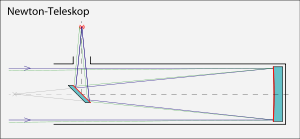
Reflecting telescope
A reflecting telescope is an optical telescope which uses a single or combination of curved mirrors that reflect light and form an image. The reflecting telescope was invented in the 17th century as an alternative to the refracting telescope which, at that time, was a design that suffered from...
invented by the British scientist Sir Isaac Newton (1642–1727), using a concave primary mirror
Primary mirror
A primary mirror is the principal light-gathering surface of a reflecting telescope.-Description:The primary mirror of a reflecting telescope is a spherical or parabolic shaped disks of polished reflective metal , or in later telescopes, glass or other material coated with a reflective layer...
and a flat diagonal secondary mirror. Newton’s first reflecting telescope
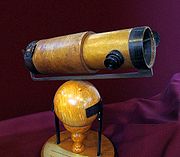
Newton's Reflector
The first reflecting telescope built by Sir Isaac Newton in 1668 is a landmark in the history of telescopes, being the first known successful reflecting telescope. It was the prototype for a design that later came to be called a newtonian telescope....
was completed in 1668 and is the earliest known functional reflecting telescope. The Newtonian telescope's simple design makes them very popular with amateur telescope makers.
History
Newton’s idea for a reflecting telescope was not a new one. Galileo GalileiGalileo Galilei
Galileo Galilei , was an Italian physicist, mathematician, astronomer, and philosopher who played a major role in the Scientific Revolution. His achievements include improvements to the telescope and consequent astronomical observations and support for Copernicanism...
and Giovanni Francesco Sagredo
Giovanni Francesco Sagredo
Giovanni Francesco Sagredo was a Venetian mathematician and close friend of Galileo, who wrote:Many years ago I was often to be found in the marvelous city of Venice, in discussions with Signore Giovanni Francesco Sagredo, a man of noble extraction and trenchant wit. He was also a friend and...
had discussed using a mirror as the image forming objective
Objective (optics)
In an optical instrument, the objective is the optical element that gathers light from the object being observed and focuses the light rays to produce a real image. Objectives can be single lenses or mirrors, or combinations of several optical elements. They are used in microscopes, telescopes,...
soon after the invention of the refracting telescope, and others, such as Niccolò Zucchi
Niccolo Zucchi
Niccolò Zucchi was an Italian Jesuit, astronomer, and physicist.As an astronomer he may have been the first to see the belts on the planet Jupiter , and reported spots on Mars in 1640....
, claimed to have experimented with the idea as far back as 1616. Newton may even have read James Gregory's
James Gregory (astronomer and mathematician)
James Gregory FRS was a Scottish mathematician and astronomer. He described an early practical design for the reflecting telescope – the Gregorian telescope – and made advances in trigonometry, discovering infinite series representations for several trigonometric functions.- Biography :The...
1663 book Optica Promota which described reflecting telescope designs using parabolic mirrors
Parabola
In mathematics, the parabola is a conic section, the intersection of a right circular conical surface and a plane parallel to a generating straight line of that surface...
(a telescope Gregory had been trying unsuccessfully to build).
White Light
White Light may refer to:*Light with the color white*White Light , a 1980 novel by Rudy Rucke*White Light , 1971 album*White Light , 2010 album...
is composed of a spectrum
Spectrum
A spectrum is a condition that is not limited to a specific set of values but can vary infinitely within a continuum. The word saw its first scientific use within the field of optics to describe the rainbow of colors in visible light when separated using a prism; it has since been applied by...
of colors. Color distortion (chromatic aberration
Chromatic aberration
In optics, chromatic aberration is a type of distortion in which there is a failure of a lens to focus all colors to the same convergence point. It occurs because lenses have a different refractive index for different wavelengths of light...
) was the primary fault of refracting telescope
Refracting telescope
A refracting or refractor telescope is a type of optical telescope that uses a lens as its objective to form an image . The refracting telescope design was originally used in spy glasses and astronomical telescopes but is also used for long focus camera lenses...
s of Newton's day, and there were many theories as to what caused it. During the mid 1660s with his work on the theory of colour, Newton came to the conclusion that this defect was caused by the lens of the refracting telescope behaving the same as prisms
Prism (optics)
In optics, a prism is a transparent optical element with flat, polished surfaces that refract light. The exact angles between the surfaces depend on the application. The traditional geometrical shape is that of a triangular prism with a triangular base and rectangular sides, and in colloquial use...
he was experimenting with, breaking white light into a rainbow of colors around bright astronomical object
Astronomical object
Astronomical objects or celestial objects are naturally occurring physical entities, associations or structures that current science has demonstrated to exist in the observable universe. The term astronomical object is sometimes used interchangeably with astronomical body...
s. If this was true, then chromatic aberration could be eliminated by building a telescope that did not use a lens – a reflecting telescope.
In late 1668 Isaac Newton built his first reflecting telescope
Newton's Reflector
The first reflecting telescope built by Sir Isaac Newton in 1668 is a landmark in the history of telescopes, being the first known successful reflecting telescope. It was the prototype for a design that later came to be called a newtonian telescope....
. He chose an alloy
Alloy
An alloy is a mixture or metallic solid solution composed of two or more elements. Complete solid solution alloys give single solid phase microstructure, while partial solutions give two or more phases that may or may not be homogeneous in distribution, depending on thermal history...
(speculum metal
Speculum metal
Speculum metal is a mixture of around two-thirds copper and one-third tin making a white brittle alloy that can be polished to make a highly reflective surface. It is used primarily to make different kinds of mirrors including early reflecting telescope optical mirrors...
) of tin
Tin
Tin is a chemical element with the symbol Sn and atomic number 50. It is a main group metal in group 14 of the periodic table. Tin shows chemical similarity to both neighboring group 14 elements, germanium and lead and has two possible oxidation states, +2 and the slightly more stable +4...
and copper
Copper
Copper is a chemical element with the symbol Cu and atomic number 29. It is a ductile metal with very high thermal and electrical conductivity. Pure copper is soft and malleable; an exposed surface has a reddish-orange tarnish...
as the most suitable material for his objective
Objective (optics)
In an optical instrument, the objective is the optical element that gathers light from the object being observed and focuses the light rays to produce a real image. Objectives can be single lenses or mirrors, or combinations of several optical elements. They are used in microscopes, telescopes,...
mirror. He later devised means for shaping and grinding the mirror and may have been the first to use a pitch lap to polish the optical surface. He chose a spherical shape for his mirror instead of a parabola to simplify construction; even though it would introduce spherical aberration
Spherical aberration
thumb|right|Spherical aberration. A perfect lens focuses all incoming rays to a point on the [[Optical axis|optic axis]]. A real lens with spherical surfaces suffers from spherical aberration: it focuses rays more tightly if they enter it far from the optic axis than if they enter closer to the...
, it would still correct chromatic aberration. He added to his reflector what is the hallmark of the design of a Newtonian telescope, namely a secondary diagonally mounted mirror near the primary mirror's focus to reflect the image at a 90° angle to an eyepiece
Eyepiece
An eyepiece, or ocular lens, is a type of lens that is attached to a variety of optical devices such as telescopes and microscopes. It is so named because it is usually the lens that is closest to the eye when someone looks through the device. The objective lens or mirror collects light and brings...
mounted on the side of the telescope. This unique addition allowed the image to be viewed with minimal obstruction of the objective mirror. He also made the tube, mount
Telescope mount
A telescope mount is a mechanical structure which supports a telescope. Telescope mounts are designed to support the mass of the telescope and allow for accurate pointing of the instrument...
, and fittings. Newton's first version had a primary mirror diameter of 1.3 inches and a focal ratio of f/5. He found that the telescope did work without color distortion and that he could see the four Galilean moons
Galilean moons
The Galilean moons are the four moons of Jupiter discovered by Galileo Galilei in January 1610. They are the largest of the many moons of Jupiter and derive their names from the lovers of Zeus: Io, Europa, Ganymede and Callisto. Ganymede, Europa and Io participate in a 1:2:4 orbital resonance...
of Jupiter
Jupiter
Jupiter is the fifth planet from the Sun and the largest planet within the Solar System. It is a gas giant with mass one-thousandth that of the Sun but is two and a half times the mass of all the other planets in our Solar System combined. Jupiter is classified as a gas giant along with Saturn,...
and the crescent phase of the planet Venus
Phases of Venus
The phases of the planet Venus are the different variations of lighting seen on the planet's surface, similar to lunar phases. The first recorded observations of them were telescopic observations by Galileo Galilei in 1610...
with it. Newton's friend Isaac Barrow
Isaac Barrow
Isaac Barrow was an English Christian theologian, and mathematician who is generally given credit for his early role in the development of infinitesimal calculus; in particular, for the discovery of the fundamental theorem of calculus. His work centered on the properties of the tangent; Barrow was...
showed a second telescope to a small group from the Royal Society of London at the end of 1671. They were so impressed with it that they demonstrated it to Charles II
Charles II of England
Charles II was monarch of the three kingdoms of England, Scotland, and Ireland.Charles II's father, King Charles I, was executed at Whitehall on 30 January 1649, at the climax of the English Civil War...
in January of 1672. Newton was admitted as a fellow of the society in the same year.
Like Gregory before him, Newton found it hard to construct an effective reflector. It was difficult to grind the speculum metal to a regular curvature. The surface also tarnish
Tarnish
Tarnish is a thin layer of corrosion that forms over copper, brass, silver, aluminum, and other similar metals as their outermost layer undergoes a chemical reaction. Tarnish does not always result from the sole effects of oxygen in the air. For example, silver needs hydrogen sulfide to tarnish; it...
ed rapidly; the consequent low reflectivity of the mirror and also its small size meant that the view through the telescope was very dim compared to contemporary refractors. Because of these difficulties in construction, the Newtonian reflecting telescope was initially not widely adopted. It wasn't until 50 years later in 1721 that John Hadley
John Hadley
John Hadley was an English mathematician, inventor of the octant, a precursor to the sextant, around 1730.He was born in Bloomsbury, London, to Katherine FitzJames and George Hadley....
showed a much-improved model to the Royal Society. Hadley had solved many of the problems of making a parabolic
Paraboloid
In mathematics, a paraboloid is a quadric surface of special kind. There are two kinds of paraboloids: elliptic and hyperbolic. The elliptic paraboloid is shaped like an oval cup and can have a maximum or minimum point....
mirror. His Newtonian with a mirror diameter of 6 inches (~15 cm) compared favorably with the large aerial refracting telescopes
Aerial telescope
An aerial telescope is a type of very-long-focal-length refracting telescope built in the second half of the 17th century that did not use a tube. Instead, the objective was mounted on a pole, tree, tower, building or other structure on a swivel ball-joint. The observer stood on the ground and held...
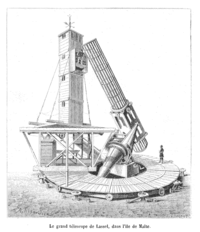
of the day. The size of reflecting telescopes would subsequently grow rapidly, with designs doubling in primary mirror diameter about every 50 years.
Advantages of the Newtonian design
- They are free of chromatic aberrationChromatic aberrationIn optics, chromatic aberration is a type of distortion in which there is a failure of a lens to focus all colors to the same convergence point. It occurs because lenses have a different refractive index for different wavelengths of light...
found in refracting telescopes. - Newtonian telescopes are usually less expensive for any given objective diameter (or apertureApertureIn optics, an aperture is a hole or an opening through which light travels. More specifically, the aperture of an optical system is the opening that determines the cone angle of a bundle of rays that come to a focus in the image plane. The aperture determines how collimated the admitted rays are,...
) than comparable quality telescopes of other types. - Since there is only one surface that needs to be ground and polished into a complex shape, overall fabrication is far simpler than other telescope designs (GregoriansGregorian telescopeThe Gregorian telescope is a type of reflecting telescope designed by Scottish mathematician and astronomer James Gregory in the 17th century, and first built in 1673 by Robert Hooke...
, cassegrainsCassegrain reflectorThe Cassegrain reflector is a combination of a primary concave mirror and a secondary convex mirror, often used in optical telescopes and radio antennas....
, and early refractors had two surfaces that need "figuringFiguringFiguring is the process of final polishing of an optical surface to remove imperfections or modify the surface curvature to achieve the shape required for a given application.-Types of figuring:...
". Later achromaticAchromatic lensAn achromatic lens or achromat is a lens that is designed to limit the effects of chromatic and spherical aberration. Achromatic lenses are corrected to bring two wavelengths into focus in the same plane....
refractor objectives had four surfaces that have to be figured). - A short focal ratio can be more easily obtained, leading to wider field of view.
- The eyepiece is located at the top end of the telescope. Combined with short f-ratios this can allow for a much more compact mounting system, reducing cost and adding to portability.
Disadvantages of the Newtonian design
- Newtonians, like other reflecting telescope designs using parabolic mirrors, suffer from comaComa (optics)In optics , the coma in an optical system refers to aberration inherent to certain optical designs or due to imperfection in the lens or other components which results in off-axis point sources such as stars appearing distorted, appearing to have a tail like a comet...
, an off-axis aberration which causes imagery to flare inward and towards the optical axis (stars towards edge of the field of view take on a "comet-like" shape). This flare is zero on-axis, and is linearLinearIn mathematics, a linear map or function f is a function which satisfies the following two properties:* Additivity : f = f + f...
with increasing field angle and inversely proportional to the square of the mirror focal ratio (the mirror focal lengthFocal lengthThe focal length of an optical system is a measure of how strongly the system converges or diverges light. For an optical system in air, it is the distance over which initially collimated rays are brought to a focus...
divided by the mirror diameter). The formula for third order tangential coma is 3θ / 16F², where θ is the angle off axis to the image in radians and F is the focal ratio. Newtonians with a focal ratio of f/6 or lower (f/5 for example) are considered to have increasingly serious coma for visual or photographic use. Newtonians having a focal ratio of less than f/4 have considerable coma but are the most compact systems, and can still yield beautiful wide-field, low-power imagery. Commercial lenses are also available for Newtonian telescopes that correct for coma from low focal ratio primary mirrors and restore image sharpness over the field.
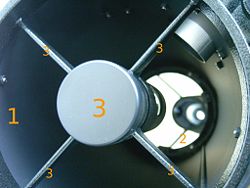
- Newtonians have a central obstruction due to the secondary mirror in the light path. This obstruction and also the diffraction spikeDiffraction spikeDiffraction spikes are lines radiating from bright light sources in reflecting telescope images. They are artifacts caused by light diffracting around the support vanes of the secondary mirror...
s caused by the support structure (called the spider) of the secondary mirror reduce contrast. Visually, these effects can be reduced by using a two or three-legged curved spider. This reduces the diffraction sidelobe intensities by a factor of about four and helps to improve image contrast, with the potential penalty that circular spiders are more prone to wind-induced vibration. Although a four-legged spider causes less diffraction than a three-legged curved spider, the three-legged curved spider often gives a more aesthetically pleasing view.
- For portable Newtonians collimation can be a problem. The primary and secondary can get out of alignment from the shocks associated with transportation and handling. This means the telescope may need to be re-aligned (collimated) every time it is set up. Other designs such as refractors and catadioptrics (specifically Maksutov cassegrainsMaksutov telescopeThe Maksutov is a catadioptric telescope design that combines a spherical mirror with a weakly negative meniscus lens in a design that takes advantage of all the surfaces being nearly "spherically symmetrical". The negative lens is usually full diameter and placed at the entrance pupil of the...
) have fixed collimation.
- The focal plane is at an asymmetrical point and at the top of the optical tube assembly. For visual observing, most notably on equatorial telescope mountsEquatorial mountAn equatorial mount is a mount for instruments that follows the rotation of the sky by having one rotational axis parallel to the Earth's axis of rotation. This type of mount is used for astronomical telescopes and cameras...
, tube orientation can put the eyepieceEyepieceAn eyepiece, or ocular lens, is a type of lens that is attached to a variety of optical devices such as telescopes and microscopes. It is so named because it is usually the lens that is closest to the eye when someone looks through the device. The objective lens or mirror collects light and brings...
in a very poor viewing position, and larger telescopes require ladderLadderA ladder is a vertical or inclined set of rungs or steps. There are two types: rigid ladders that can be leaned against a vertical surface such as a wall, and rope ladders that are hung from the top. The vertical members of a rigid ladder are called stringers or stiles . Rigid ladders are usually...
s or support structures to access it. Some designs provide mechanisms for rotating the eyepiece mount or the entire tube assembly to a better position. For research telescopes, counterbalancing very heavy instruments mounted at this focus has to be taken into consideration.
See also
- List of telescope types
- Schmidt-Newton telescopeSchmidt-Newton telescopeA Schmidt–Newton telescope is a catadioptric telescope that combines elements from both the Schmidt camera and the Newtonian reflector. In this telescope design a spherical primary mirror is combined with a Schmidt corrector plate, making system that has less spherical aberration than a reflecting...