


Proper motion

Encyclopedia
The proper motion of a star
is its angular change in position over time as seen from the center of mass of the solar system
. It is measured in seconds of arc per year, arcsec/yr, where 3600 arcseconds equal one degree
. This contrasts with radial velocity
, which is the time rate of change in distance toward or away from the viewer, usually measured by Doppler shift of received radiation. The proper motion is not entirely "proper" (that is, intrinsic to the star) because it includes a component due to the motion of the solar system itself. Due to the finite speed of light, the true velocities of distant stars are not observable, the observed proper motion reflects the motion of a star at the time the light was emitted.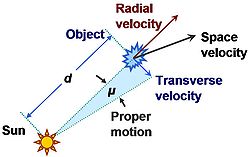
s over historical time. Ursa Major
, for example, looks nearly the same now as it did hundreds of years ago. However, precise long-term observations show that the constellations change shape, albeit very slowly, and that each star has an independent motion
.
This motion is caused by the true movement of the stars relative to the Sun
and solar system
through space. The Sun travels in a nearly circular orbit (the solar circle) about the center of the Milky Way
at a speed of about 220 km/s at a radius of 8 ± 0.65 kpc
from the center, which can be taken as the rate of rotation of the Milky Way itself at this radius.
The proper motion is measured by two quantities: the position angle
and the proper motion itself. The first quantity indicates the direction of the proper motion on the celestial sphere
(with 0 degrees meaning the motion is due north, 90 degrees meaning the motion is due east, and so on), and the second quantity gives the motion's magnitude, in seconds of arc
per year.
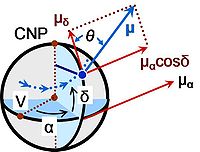 Proper motion may also be given by the angular changes per year in the right ascension
(μα) and declination
(μδ). On the celestial sphere
, positions are located by latitude and longitude. The coordinate δ corresponds to latitude. The coordinate α corresponds to longitude measured from the vernal equinox V, the point on the sky where the Sun crosses the celestial equator on near March 21.
The components of proper motion by convention are arrived at as follows. Suppose in a year an object moves from coordinates (α, δ) to coordinates (α1, δ1), with angles measured in seconds of arc. Then the changes of angle in seconds of arc per year are:
|style="text-align: right;"|
|-
|style="text-align: right;"|
|}
The magnitude of the proper motion μ is given by vector addition of its components:
|style="text-align: right;"|
|
|-
|}
where δ is the declination. The factor in cos δ accounts for the fact that the radius from the axis of the sphere to its surface varies as cos δ, becoming, for example, zero at the pole. Thus, the component of velocity parallel to the equator corresponding to a given angular change in α is smaller the further north the object's location. The change μα , which must be multiplied by cos δ to become a component of the proper motion, is sometimes called the "proper motion in right ascension", and μδ the "proper motion in declination".
The position angle θ is related to these components by:
|-
|style="text-align: right;"|
|
|-
|style="text-align: right;"|
|
|}
 Barnard's star
has the largest proper motion of all stars, moving at 10.3 seconds of arc per year. Large proper motion is usually a strong indication that a star is relatively close to the Sun. This is indeed the case for Barnard's Star which, at a distance of about 6 light-year
s, is, after the Sun and the Alpha Centauri
system, the nearest known star to Earth (yet, being a red dwarf
, too faint to see without a telescope
or powerful binoculars, with an apparent magnitude
of 9.54).
In 1992, Rho Aquilae
became the first star to have its name invalidated by moving to a neighbouring constellation - it is now a star of the
constellation Delphinus
. This will next happen to Gamma Caeli
,
which is due to become a star of the constellation Columba
in the year 2400.
A proper motion of 1 arcsec per year at a distance of 1 light-year corresponds to a relative transverse speed of 1.45 km/s. For Barnard's star this works out to 90 km/s; including the radial velocity of 111 km/s (which is at right angles to the transverse velocity) gives a true motion of 142 km/s. True or absolute motion is more difficult to measure than the proper motion, as the true transverse velocity involves the product of the proper motion times the distance; that is, true velocity measurements depend on distance measurements, which are difficult in general. Currently, the nearby star with the largest true velocity (relative to the Sun) is Wolf 424
which moves at 555 km/s (or 1/540 of the speed of light).
is one source of such images. In the past, searches for high proper motion objects were undertaken using blink comparator
s to examine the images by eye, but modern efforts use techniques such as image differencing
to automatically search through digitized image data. Because the selection bias
es of the resulting high proper motion samples are well-understood and well-quantified, it is possible to use them to construct an unbiased census of the nearby stellar population — how many stars exist of each true brightness, for example. Studies of this kind show that the local population of stars consists largely of intrinsically faint, inconspicuous stars such as red dwarf
s.
Measurement of the proper motions of a large sample of stars in a distant stellar system, like a globular cluster, can be used to compute the cluster's total mass via the Leonard-Merritt mass estimator
. Coupled with measurements of the stars' radial velocities, proper motions can be used to compute the distance to the cluster.
Stellar proper motions have been used to infer the presence of a super-massive black hole at the center of the Milky Way. This black hole is suspected to be Sgr A*, with a mass of 2.6 × 10⁶ M☉, where M☉ is a solar mass
.
Proper motions of the galaxies in the Local Group
are discussed in detail in Röser. In 2005, the first measurement was made of the proper motion of the Triangulum Galaxy
M-33, the third largest and only ordinary spiral galaxy in the Local Group, located 860 ± 28 kpcs beyond the Milky Way. Although the Andromeda Galaxy
is known to move, and an Andromeda-Milky Way collision
is predicted in about 5 – 10 billion years, the proper motion of the Andromeda galaxy, about 786 kpc distant, is still an uncertain matter, with an upper bound on its transverse velocity of ≈ 100 km/s. Proper motion of the NGC 4258 (M106) galaxy
in the M106 group of galaxies was used in 1999 to find an accurate distance to this object. Measurements were made of the radial motion of objects in that galaxy moving directly toward and away from us, and assuming this same motion to apply to objects with only a proper motion, the observed proper motion predicts a distance to the galaxy of 7.2 ± 0.5 Mpc.
, Arcturus and Aldebaran
were over half a degree away from the positions charted by the ancient Greek astronomer Hipparchus
roughly 1850 years earlier.
The term "proper motion" derives from the historical use of "proper" to mean "belonging to" (cf, propre in French), so there is no such thing as "improper motion" in astronomy.
catalog.(see List of stars in the Hipparcos Catalogue) It does not include stars such as Teegarden's star
which are too faint for that catalog. A more complete list of stellar objects can be made by doing a Criteria query at http://simbad.u-strasbg.fr/simbad/ .
Star
A star is a massive, luminous sphere of plasma held together by gravity. At the end of its lifetime, a star can also contain a proportion of degenerate matter. The nearest star to Earth is the Sun, which is the source of most of the energy on Earth...
is its angular change in position over time as seen from the center of mass of the solar system
Center of mass
In physics, the center of mass or barycenter of a system is the average location of all of its mass. In the case of a rigid body, the position of the center of mass is fixed in relation to the body...
. It is measured in seconds of arc per year, arcsec/yr, where 3600 arcseconds equal one degree
Degree (angle)
A degree , usually denoted by ° , is a measurement of plane angle, representing 1⁄360 of a full rotation; one degree is equivalent to π/180 radians...
. This contrasts with radial velocity
Radial velocity
Radial velocity is the velocity of an object in the direction of the line of sight . In astronomy, radial velocity most commonly refers to the spectroscopic radial velocity...
, which is the time rate of change in distance toward or away from the viewer, usually measured by Doppler shift of received radiation. The proper motion is not entirely "proper" (that is, intrinsic to the star) because it includes a component due to the motion of the solar system itself. Due to the finite speed of light, the true velocities of distant stars are not observable, the observed proper motion reflects the motion of a star at the time the light was emitted.
Introduction
Over the course of centuries, stars appear to maintain nearly fixed positions with respect to each other, so that they form the same constellationConstellation
In modern astronomy, a constellation is an internationally defined area of the celestial sphere. These areas are grouped around asterisms, patterns formed by prominent stars within apparent proximity to one another on Earth's night sky....
s over historical time. Ursa Major
Ursa Major
Ursa Major , also known as the Great Bear, is a constellation visible throughout the year in most of the northern hemisphere. It can best be seen in April...
, for example, looks nearly the same now as it did hundreds of years ago. However, precise long-term observations show that the constellations change shape, albeit very slowly, and that each star has an independent motion
Motion (physics)
In physics, motion is a change in position of an object with respect to time. Change in action is the result of an unbalanced force. Motion is typically described in terms of velocity, acceleration, displacement and time . An object's velocity cannot change unless it is acted upon by a force, as...
.
This motion is caused by the true movement of the stars relative to the Sun
Sun
The Sun is the star at the center of the Solar System. It is almost perfectly spherical and consists of hot plasma interwoven with magnetic fields...
and solar system
Solar System
The Solar System consists of the Sun and the astronomical objects gravitationally bound in orbit around it, all of which formed from the collapse of a giant molecular cloud approximately 4.6 billion years ago. The vast majority of the system's mass is in the Sun...
through space. The Sun travels in a nearly circular orbit (the solar circle) about the center of the Milky Way
Milky Way
The Milky Way is the galaxy that contains the Solar System. This name derives from its appearance as a dim un-resolved "milky" glowing band arching across the night sky...
at a speed of about 220 km/s at a radius of 8 ± 0.65 kpc
Parsec
The parsec is a unit of length used in astronomy. It is about 3.26 light-years, or just under 31 trillion kilometres ....
from the center, which can be taken as the rate of rotation of the Milky Way itself at this radius.
The proper motion is measured by two quantities: the position angle
Position angle
Position angle, usually abbreviated PA, is a measurement derived from observing visual binary stars. It is defined as the angular offset in degrees of the secondary star to the primary, relative to the north celestial pole....
and the proper motion itself. The first quantity indicates the direction of the proper motion on the celestial sphere
Celestial sphere
In astronomy and navigation, the celestial sphere is an imaginary sphere of arbitrarily large radius, concentric with the Earth and rotating upon the same axis. All objects in the sky can be thought of as projected upon the celestial sphere. Projected upward from Earth's equator and poles are the...
(with 0 degrees meaning the motion is due north, 90 degrees meaning the motion is due east, and so on), and the second quantity gives the motion's magnitude, in seconds of arc
Minute of arc
A minute of arc, arcminute, or minute of angle , is a unit of angular measurement equal to one sixtieth of one degree. In turn, a second of arc or arcsecond is one sixtieth of one minute of arc....
per year.
Right ascension
Right ascension is the astronomical term for one of the two coordinates of a point on the celestial sphere when using the equatorial coordinate system. The other coordinate is the declination.-Explanation:...
(μα) and declination
Declination
In astronomy, declination is one of the two coordinates of the equatorial coordinate system, the other being either right ascension or hour angle. Declination in astronomy is comparable to geographic latitude, but projected onto the celestial sphere. Declination is measured in degrees north and...
(μδ). On the celestial sphere
Celestial sphere
In astronomy and navigation, the celestial sphere is an imaginary sphere of arbitrarily large radius, concentric with the Earth and rotating upon the same axis. All objects in the sky can be thought of as projected upon the celestial sphere. Projected upward from Earth's equator and poles are the...
, positions are located by latitude and longitude. The coordinate δ corresponds to latitude. The coordinate α corresponds to longitude measured from the vernal equinox V, the point on the sky where the Sun crosses the celestial equator on near March 21.
The components of proper motion by convention are arrived at as follows. Suppose in a year an object moves from coordinates (α, δ) to coordinates (α1, δ1), with angles measured in seconds of arc. Then the changes of angle in seconds of arc per year are:
|style="text-align: right;"|
|-
|style="text-align: right;"|
|}
The magnitude of the proper motion μ is given by vector addition of its components:
|style="text-align: right;"|
|
|-
|}
where δ is the declination. The factor in cos δ accounts for the fact that the radius from the axis of the sphere to its surface varies as cos δ, becoming, for example, zero at the pole. Thus, the component of velocity parallel to the equator corresponding to a given angular change in α is smaller the further north the object's location. The change μα , which must be multiplied by cos δ to become a component of the proper motion, is sometimes called the "proper motion in right ascension", and μδ the "proper motion in declination".
The position angle θ is related to these components by:
|-
|style="text-align: right;"|
|
|-
|style="text-align: right;"|
|
|}
Barnard's star
Barnard's Star, also known occasionally as Barnard's "Runaway" Star, is a very low-mass red dwarf star approximately six light-years away from Earth in the constellation of Ophiuchus . In 1916, the American astronomer E.E...
has the largest proper motion of all stars, moving at 10.3 seconds of arc per year. Large proper motion is usually a strong indication that a star is relatively close to the Sun. This is indeed the case for Barnard's Star which, at a distance of about 6 light-year
Light-year
A light-year, also light year or lightyear is a unit of length, equal to just under 10 trillion kilometres...
s, is, after the Sun and the Alpha Centauri
Alpha Centauri
Alpha Centauri is the brightest star in the southern constellation of Centaurus...
system, the nearest known star to Earth (yet, being a red dwarf
Red dwarf
According to the Hertzsprung-Russell diagram, a red dwarf star is a small and relatively cool star, of the main sequence, either late K or M spectral type....
, too faint to see without a telescope
Telescope
A telescope is an instrument that aids in the observation of remote objects by collecting electromagnetic radiation . The first known practical telescopes were invented in the Netherlands at the beginning of the 1600s , using glass lenses...
or powerful binoculars, with an apparent magnitude
Apparent magnitude
The apparent magnitude of a celestial body is a measure of its brightness as seen by an observer on Earth, adjusted to the value it would have in the absence of the atmosphere...
of 9.54).
In 1992, Rho Aquilae
Rho Aquilae
Rho Aquilae is a star in the constellation Delphinus – it moved across the border from Aquila into Delphinus in 1992. It has the traditional name Tso Ke, from the Mandarin 左旗 zuǒqí meaning "the left flag"....
became the first star to have its name invalidated by moving to a neighbouring constellation - it is now a star of the
constellation Delphinus
Delphinus
Delphinus is a constellation in the northern sky, close to the celestial equator. Its name is Latin for dolphin. Delphinus was one of the 48 constellations listed by the 2nd century astronomer Ptolemy, and it remains among the 88 modern constellations recognized by the International Astronomical...
. This will next happen to Gamma Caeli
Gamma Caeli
The Bayer designation Gamma Caeli is shared by two star systems, in the constellation Caelum:* γ1 Caeli* γ2 CaeliThey are separated by 0.22° on the sky....
,
which is due to become a star of the constellation Columba
Columba (constellation)
Columba is a small, faint constellation created in the late sixteenth century. Its name is Latin for dove. It is located just south of Canis Major and Lepus.-History:...
in the year 2400.
A proper motion of 1 arcsec per year at a distance of 1 light-year corresponds to a relative transverse speed of 1.45 km/s. For Barnard's star this works out to 90 km/s; including the radial velocity of 111 km/s (which is at right angles to the transverse velocity) gives a true motion of 142 km/s. True or absolute motion is more difficult to measure than the proper motion, as the true transverse velocity involves the product of the proper motion times the distance; that is, true velocity measurements depend on distance measurements, which are difficult in general. Currently, the nearby star with the largest true velocity (relative to the Sun) is Wolf 424
Wolf 424
Wolf 424 is a binary star system comprising two red dwarf stars at a distance of approximately 14.2 light years from the Sun. It is located in the constellation Virgo, between the stars ε Virginis and δ Virginis....
which moves at 555 km/s (or 1/540 of the speed of light).
Usefulness in astronomy
Stars with large proper motions tend to be nearby; most stars are far enough away that their proper motions are very small, on the order of a few thousandths of an arcsecond per year. It is possible to construct nearly complete samples of high proper motion stars by comparing photographic sky survey images taken many years apart. The Palomar Sky SurveyNational Geographic Society - Palomar Observatory Sky Survey
The National Geographic Society – Palomar Observatory Sky Survey is a major photographic survey of the night sky that was completed at Palomar Observatory in 1958.-Observations:...
is one source of such images. In the past, searches for high proper motion objects were undertaken using blink comparator
Blink comparator
A blink comparator was a viewing apparatus used by astronomers to find differences between two photographs of the night sky shot using optical telescopes such as astrographs. It permitted rapidly switching from viewing one photograph to viewing the other, "blinking" back and forth between the two...
s to examine the images by eye, but modern efforts use techniques such as image differencing
Image differencing
Image differencing is an image processing technique used to determine changes between images. The difference between two images is calculated by finding the difference between each pixel in each image, and generating an image based on the result...
to automatically search through digitized image data. Because the selection bias
Selection bias
Selection bias is a statistical bias in which there is an error in choosing the individuals or groups to take part in a scientific study. It is sometimes referred to as the selection effect. The term "selection bias" most often refers to the distortion of a statistical analysis, resulting from the...
es of the resulting high proper motion samples are well-understood and well-quantified, it is possible to use them to construct an unbiased census of the nearby stellar population — how many stars exist of each true brightness, for example. Studies of this kind show that the local population of stars consists largely of intrinsically faint, inconspicuous stars such as red dwarf
Red dwarf
According to the Hertzsprung-Russell diagram, a red dwarf star is a small and relatively cool star, of the main sequence, either late K or M spectral type....
s.
Measurement of the proper motions of a large sample of stars in a distant stellar system, like a globular cluster, can be used to compute the cluster's total mass via the Leonard-Merritt mass estimator
Leonard-Merritt mass estimator
The Leonard–Merritt mass estimator is a formula for estimating the mass of a spherical stellar system using the apparent positions and proper motions of its component stars. The distance to the stellar system must also be known....
. Coupled with measurements of the stars' radial velocities, proper motions can be used to compute the distance to the cluster.
Stellar proper motions have been used to infer the presence of a super-massive black hole at the center of the Milky Way. This black hole is suspected to be Sgr A*, with a mass of 2.6 × 10⁶ M☉, where M☉ is a solar mass
Solar mass
The solar mass , , is a standard unit of mass in astronomy, used to indicate the masses of other stars and galaxies...
.
Proper motions of the galaxies in the Local Group
Local Group
The Local Group is the group of galaxies that includes Earth's galaxy, the Milky Way. The group comprises more than 30 galaxies , with its gravitational center located somewhere between the Milky Way and the Andromeda Galaxy...
are discussed in detail in Röser. In 2005, the first measurement was made of the proper motion of the Triangulum Galaxy
Triangulum Galaxy
The Triangulum Galaxy is a spiral galaxy approximately 3 million light years from Earth in the constellation Triangulum. It is catalogued as Messier 33 or NGC 598, and is sometimes informally referred to as the Pinwheel Galaxy, a nickname it shares with Messier 101...
M-33, the third largest and only ordinary spiral galaxy in the Local Group, located 860 ± 28 kpcs beyond the Milky Way. Although the Andromeda Galaxy
Andromeda Galaxy
The Andromeda Galaxy is a spiral galaxy approximately 2.5 million light-years from Earth in the constellation Andromeda. It is also known as Messier 31, M31, or NGC 224, and is often referred to as the Great Andromeda Nebula in older texts. Andromeda is the nearest spiral galaxy to the...
is known to move, and an Andromeda-Milky Way collision
Andromeda-Milky Way collision
The collision seen from a hypothetical extragalactic planet. The galaxies will be at this relative angleThe Andromeda–Milky Way collision is a predicted galaxy collision that could possibly take place in approximately 3 to 5 billion years' time between the two largest galaxies in the Local...
is predicted in about 5 – 10 billion years, the proper motion of the Andromeda galaxy, about 786 kpc distant, is still an uncertain matter, with an upper bound on its transverse velocity of ≈ 100 km/s. Proper motion of the NGC 4258 (M106) galaxy
Messier 106
Messier 106 is a spiral galaxy in the constellation Canes Venatici. It was discovered by Pierre Méchain in 1781. M106 is at a distance of about 22 to 25 million light-years away from Earth...
in the M106 group of galaxies was used in 1999 to find an accurate distance to this object. Measurements were made of the radial motion of objects in that galaxy moving directly toward and away from us, and assuming this same motion to apply to objects with only a proper motion, the observed proper motion predicts a distance to the galaxy of 7.2 ± 0.5 Mpc.
History
Proper motion was suspected by early astronomers (according to Macrobius, AD 400) but proof was provided in 1718 by Edmund Halley, who noticed that SiriusSirius
Sirius is the brightest star in the night sky. With a visual apparent magnitude of −1.46, it is almost twice as bright as Canopus, the next brightest star. The name "Sirius" is derived from the Ancient Greek: Seirios . The star has the Bayer designation Alpha Canis Majoris...
, Arcturus and Aldebaran
Aldebaran
Aldebaran is a red giant star located about 65 light years away in the zodiac constellation of Taurus. With an average apparent magnitude of 0.87 it is the brightest star in the constellation and is one of the brightest stars in the nighttime sky...
were over half a degree away from the positions charted by the ancient Greek astronomer Hipparchus
Hipparchus
Hipparchus, the common Latinization of the Greek Hipparkhos, can mean:* Hipparchus, the ancient Greek astronomer** Hipparchic cycle, an astronomical cycle he created** Hipparchus , a lunar crater named in his honour...
roughly 1850 years earlier.
The term "proper motion" derives from the historical use of "proper" to mean "belonging to" (cf, propre in French), so there is no such thing as "improper motion" in astronomy.
Stars with high proper motion
The following are the stars with highest proper motion from the HipparcosHipparcos
Hipparcos was a scientific mission of the European Space Agency , launched in 1989 and operated between 1989 and 1993. It was the first space experiment devoted to precision astrometry, the accurate measurement of the positions of celestial objects on the sky...
catalog.(see List of stars in the Hipparcos Catalogue) It does not include stars such as Teegarden's star
Teegarden's star
Teegarden's Star, also known as SO J025300.5+165258, is an M-type red dwarf star or brown dwarf in the constellation Aries, located about 12 light years from the Solar System. Despite its proximity to Earth it is a dim magnitude 15 and can only be seen through large telescopes. This star was found...
which are too faint for that catalog. A more complete list of stellar objects can be made by doing a Criteria query at http://simbad.u-strasbg.fr/simbad/ .
| # | Star | Proper motion | Radial velocity (km/s) |
Parallax (mas) |
|
|---|---|---|---|---|---|
| μα · cos δ (mas/yr) |
μδ (mas/yr) |
||||
| 1 | Barnard's star Barnard's star Barnard's Star, also known occasionally as Barnard's "Runaway" Star, is a very low-mass red dwarf star approximately six light-years away from Earth in the constellation of Ophiuchus . In 1916, the American astronomer E.E... |
-798.71 | 10337.77 | -106.8 | 549.30 |
| 2 | Kapteyn's star Kapteyn's Star Kapteyn's Star is a class M1 red dwarf star about 13 light years from Earth in the southern constellation of Pictor. With a magnitude of nearly 9 it is visible through binoculars or a telescope.-History:... |
6500.34 | -5723.17 | +245.5 | 255.12 |
| 3 | Groombridge 1830 Groombridge 1830 Groombridge 1830 is a star in the constellation Ursa Major.-Description:It is a yellowish class G8 subdwarf catalogued by Stephen Groombridge with the Groombridge Transit Circle between 1806 and the 1830s and published posthumously in his star catalog, Catalogue of Circumpolar Stars... |
4003.69 | -5814.64 | -98.0 | 109.22 |
| 4 | Lacaille 9352 Lacaille 9352 Lacaille 9352 is a red dwarf star approximately 3.29 pc or 10.74 light years from Earth's Solar System. This star has the fourth highest known proper motion, moving a total of 6.9 arcseconds per year... |
6766.63 | 1327.99 | +9.7 | 303.89 |
| 5 | Gliese 1 (CD -37 15492) (GJ 1) | 5633.95 | -2336.69 | +23.6 | 229.32 |
| 6 | HIP 67593 HIP 67593 HIP 67593 is a large proper motion star that coincidentally shares a sky position with an "optical" companion, HIP 67594, which is 40 parsecs more distant from the sun.... |
2282.15 | 5369.33 | — | 76.20 |
| 7 | 61 Cygni 61 Cygni 61 Cygni,Not to be confused with 16 Cygni, a more distant system containing two G-type stars harboring the gas giant planet 16 Cygni Bb. sometimes called Bessel's Star or Piazzi's Flying Star, is a binary star system in the constellation Cygnus... A & B |
4133.05 | 3201.78 | -64.3 | 287.18 |
| 8 | Lalande 21185 Lalande 21185 Lalande 21185 is a red dwarf star in the constellation of Ursa Major. Although relatively close by, it is only magnitude 7 in visible light and thus is too dim to see with the unaided eye... |
-580.46 | -4769.95 | -85.0 | 392.52 |
| 9 | Epsilon Indi Epsilon Indi Epsilon Indi is a K-type main-sequence star approximately 12 light-years away in the constellation of Indus. Two brown dwarfs, found in 2003, orbit the star.- Observation :... |
3961.41 | -2538.33 | -40.4 | 275.79 |
Software
There are a number of software products that allow a person to view the proper motion of stars over differing time scales. Two free ones are:- Moovastar - Freeware - Windows, Fairly Basic. You can choose a region of the sky, set the limiting magnitude and set a time sequence (time step, number of steps, and step interval). The program will simulate the motion of the stars. There's a clear help function included.
- HippLiner - Freeware - Windows, Moderately sophisticated, with some pretty displays. Still under development, needs some more navigation and configuration features.
See also
- Solar apexSolar apexThe solar apex is the direction that the Sun travels with respect to the Local Standard of Rest. In lay terms, it's the "target" within the Milky Way that the Sun appears to be "chasing" as it orbits the galaxy...
- Leonard-Merritt mass estimatorLeonard-Merritt mass estimatorThe Leonard–Merritt mass estimator is a formula for estimating the mass of a spherical stellar system using the apparent positions and proper motions of its component stars. The distance to the stellar system must also be known....
- Very Long Baseline InterferometryVery Long Baseline InterferometryVery Long Baseline Interferometry is a type of astronomical interferometry used in radio astronomy. It allows observations of an object that are made simultaneously by many telescopes to be combined, emulating a telescope with a size equal to the maximum separation between the telescopes.Data...
- Galaxy rotation curveGalaxy rotation curveThe rotation curve of a galaxy can be represented by a graph that plots the orbital velocity of the stars or gas in the galaxy on the y-axis against the distance from the center of the galaxy on the x-axis....
- Celestial coordinates
- Milky WayMilky WayThe Milky Way is the galaxy that contains the Solar System. This name derives from its appearance as a dim un-resolved "milky" glowing band arching across the night sky...