


Reflecting telescope

Encyclopedia
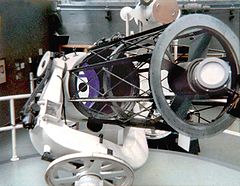
Optical telescope
An optical telescope is a telescope which is used to gather and focus light mainly from the visible part of the electromagnetic spectrum for directly viewing a magnified image for making a photograph, or collecting data through electronic image sensors....
which uses a single or combination of curved mirror
Curved mirror
A curved mirror is a mirror with a curved reflective surface, which may be either convex or concave . Most curved mirrors have surfaces that are shaped like part of a sphere, but other shapes are sometimes used in optical devices...
s that reflect light
Light
Light or visible light is electromagnetic radiation that is visible to the human eye, and is responsible for the sense of sight. Visible light has wavelength in a range from about 380 nanometres to about 740 nm, with a frequency range of about 405 THz to 790 THz...
and form an image
Image
An image is an artifact, for example a two-dimensional picture, that has a similar appearance to some subject—usually a physical object or a person.-Characteristics:...
. The reflecting telescope was invented in the 17th century as an alternative to the refracting telescope
Refracting telescope
A refracting or refractor telescope is a type of optical telescope that uses a lens as its objective to form an image . The refracting telescope design was originally used in spy glasses and astronomical telescopes but is also used for long focus camera lenses...
which, at that time, was a design that suffered from severe chromatic aberration
Chromatic aberration
In optics, chromatic aberration is a type of distortion in which there is a failure of a lens to focus all colors to the same convergence point. It occurs because lenses have a different refractive index for different wavelengths of light...
. Although reflecting telescopes produce other types of optical aberrations, it is a design that allows for very large diameter objectives
Objective (optics)
In an optical instrument, the objective is the optical element that gathers light from the object being observed and focuses the light rays to produce a real image. Objectives can be single lenses or mirrors, or combinations of several optical elements. They are used in microscopes, telescopes,...
. Almost all of the major telescopes used in astronomy
Astronomy
Astronomy is a natural science that deals with the study of celestial objects and phenomena that originate outside the atmosphere of Earth...
research are reflectors. Reflecting telescopes come in many design variations and may employ extra optical elements to improve image quality or place the image in a mechanically advantageous position. Since reflecting telescopes use mirror
Mirror
A mirror is an object that reflects light or sound in a way that preserves much of its original quality prior to its contact with the mirror. Some mirrors also filter out some wavelengths, while preserving other wavelengths in the reflection...
s, the design is sometimes referred to as a "catoptric
Catoptrics
Catoptrics deals with the phenomena of reflected light and image-forming optical systems using mirrors. From the Greek κατοπτρικός ....
" telescope.
History
The idea that curved mirrors behave like lenses dates back at least to Alhazen's 11th century treatise on optics, works that had been widely disseminated in Latin translations in early modern EuropeEarly modern Europe
Early modern Europe is the term used by historians to refer to a period in the history of Europe which spanned the centuries between the end of the Middle Ages and the beginning of the Industrial Revolution, roughly the late 15th century to the late 18th century...
. Soon after the invention of the refracting telescope
Refracting telescope
A refracting or refractor telescope is a type of optical telescope that uses a lens as its objective to form an image . The refracting telescope design was originally used in spy glasses and astronomical telescopes but is also used for long focus camera lenses...
, Galileo, Giovanni Francesco Sagredo
Giovanni Francesco Sagredo
Giovanni Francesco Sagredo was a Venetian mathematician and close friend of Galileo, who wrote:Many years ago I was often to be found in the marvelous city of Venice, in discussions with Signore Giovanni Francesco Sagredo, a man of noble extraction and trenchant wit. He was also a friend and...
, and others, spurred on by their knowledge of the principles of curved mirrors, discussed the idea of building a telescope using a mirror as the image forming objective. There were reports that the Bolognese
Bologna
Bologna is the capital city of Emilia-Romagna, in the Po Valley of Northern Italy. The city lies between the Po River and the Apennine Mountains, more specifically, between the Reno River and the Savena River. Bologna is a lively and cosmopolitan Italian college city, with spectacular history,...
Cesare Caravaggi had constructed one around 1626 and the Italian professor Niccolò Zucchi
Niccolo Zucchi
Niccolò Zucchi was an Italian Jesuit, astronomer, and physicist.As an astronomer he may have been the first to see the belts on the planet Jupiter , and reported spots on Mars in 1640....
, in a later work, wrote that he had experimented with a concave bronze mirror in 1616, but said it did not produce a satisfactory image. The potential advantages of using parabolic mirrors
Parabolic reflector
A parabolic reflector is a reflective device used to collect or project energy such as light, sound, or radio waves. Its shape is that of a circular paraboloid, that is, the surface generated by a parabola revolving around its axis...
, primarily reduction of spherical aberration
Spherical aberration
thumb|right|Spherical aberration. A perfect lens focuses all incoming rays to a point on the [[Optical axis|optic axis]]. A real lens with spherical surfaces suffers from spherical aberration: it focuses rays more tightly if they enter it far from the optic axis than if they enter closer to the...
with no chromatic aberration
Chromatic aberration
In optics, chromatic aberration is a type of distortion in which there is a failure of a lens to focus all colors to the same convergence point. It occurs because lenses have a different refractive index for different wavelengths of light...
, led to many proposed designs for reflecting telescopes the most notable being James Gregory
James Gregory (astronomer and mathematician)
James Gregory FRS was a Scottish mathematician and astronomer. He described an early practical design for the reflecting telescope – the Gregorian telescope – and made advances in trigonometry, discovering infinite series representations for several trigonometric functions.- Biography :The...
’s 1663 published ideas for what came to be called the Gregorian telescope
Gregorian telescope
The Gregorian telescope is a type of reflecting telescope designed by Scottish mathematician and astronomer James Gregory in the 17th century, and first built in 1673 by Robert Hooke...
, but no working models were built until 1673 by Robert Hooke
Robert Hooke
Robert Hooke FRS was an English natural philosopher, architect and polymath.His adult life comprised three distinct periods: as a scientific inquirer lacking money; achieving great wealth and standing through his reputation for hard work and scrupulous honesty following the great fire of 1666, but...
.
Isaac Newton
Isaac Newton
Sir Isaac Newton PRS was an English physicist, mathematician, astronomer, natural philosopher, alchemist, and theologian, who has been "considered by many to be the greatest and most influential scientist who ever lived."...
has been generally credited with building the first reflecting telescope
Newton's Reflector
The first reflecting telescope built by Sir Isaac Newton in 1668 is a landmark in the history of telescopes, being the first known successful reflecting telescope. It was the prototype for a design that later came to be called a newtonian telescope....
in 1668. It used a spherically ground metal primary mirror
Primary mirror
A primary mirror is the principal light-gathering surface of a reflecting telescope.-Description:The primary mirror of a reflecting telescope is a spherical or parabolic shaped disks of polished reflective metal , or in later telescopes, glass or other material coated with a reflective layer...
and a small diagonal mirror in an optical configuration that has come to be known as the Newtonian telescope
Newtonian telescope
The Newtonian telescope is a type of reflecting telescope invented by the British scientist Sir Isaac Newton , using a concave primary mirror and a flat diagonal secondary mirror. Newton’s first reflecting telescope was completed in 1668 and is the earliest known functional reflecting telescope...
.
Despite the theoretical advantages of the reflector design, the difficulty of construction and the poor performance of the speculum metal
Speculum metal
Speculum metal is a mixture of around two-thirds copper and one-third tin making a white brittle alloy that can be polished to make a highly reflective surface. It is used primarily to make different kinds of mirrors including early reflecting telescope optical mirrors...
mirrors being used at the time meant it took over 100 years for them to become popular. Many of the advances in reflecting telescopes included the perfection of parabolic mirror
Parabolic reflector
A parabolic reflector is a reflective device used to collect or project energy such as light, sound, or radio waves. Its shape is that of a circular paraboloid, that is, the surface generated by a parabola revolving around its axis...
fabrication in the 18th century, silver coated glass mirrors in the 19th century, long-lasting aluminum coatings in the 20th century, segmented mirror
Segmented mirror
A segmented mirror is an array of smaller mirrors designed to act as segments of a single large curved mirror. The segments can be either spherical or asymmetric . They are used as objectives for large reflecting telescopes...
s to allow larger diameters, and active optics
Active optics
Active optics is a technology used with reflecting telescopes developed in the 1980s, which actively shapes a telescope's mirrors to prevent deformation due to external influences such as wind, temperature, mechanical stress...
to compensate for gravitational deformation. A mid-20th century innovation was catadioptric telescopes such as the Schmidt camera
Schmidt camera
A Schmidt camera, also referred to as the Schmidt telescope, is a catadioptric astrophotographic telescope designed to provide wide fields of view with limited aberrations. Other similar designs are the Wright Camera and Lurie-Houghton telescope....
, which use both a lens (corrector plate) and mirror as primary optical elements, mainly used for wide-field imaging without spherical aberration.
The late 20th century has seen the development of adaptive optics
Adaptive optics
Adaptive optics is a technology used to improve the performance of optical systems by reducing the effect of wavefront distortions. It is used in astronomical telescopes and laser communication systems to remove the effects of atmospheric distortion, and in retinal imaging systems to reduce the...
and lucky imaging
Lucky imaging
Lucky imaging is one form of speckle imaging used for astronomical photography. Speckle imaging techniques use a high-speed camera with exposure times short enough so that the changes in the Earth's atmosphere during the exposure are minimal.With lucky imaging, those optimum exposures least...
to overcome the problems of seeing
Astronomical seeing
Astronomical seeing refers to the blurring and twinkling of astronomical objects such as stars caused by turbulent mixing in the Earth's atmosphere varying the optical refractive index...
, and reflecting telescopes are ubiquitous on space telescopes and many types of spacecraft
Spacecraft
A spacecraft or spaceship is a craft or machine designed for spaceflight. Spacecraft are used for a variety of purposes, including communications, earth observation, meteorology, navigation, planetary exploration and transportation of humans and cargo....
imaging devices.
Technical considerations
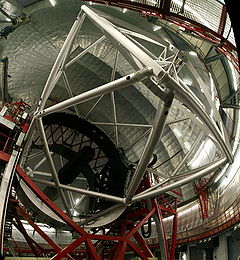
Primary mirror
A primary mirror is the principal light-gathering surface of a reflecting telescope.-Description:The primary mirror of a reflecting telescope is a spherical or parabolic shaped disks of polished reflective metal , or in later telescopes, glass or other material coated with a reflective layer...
is the reflector telescope's basic optical element that creates an image at the focal plane. The distance from the mirror to the focal plane is called the focal length
Focal length
The focal length of an optical system is a measure of how strongly the system converges or diverges light. For an optical system in air, it is the distance over which initially collimated rays are brought to a focus...
. Film or a digital sensor may be located here to record the image, or a secondary mirror
Secondary mirror
A secondary mirror is the second deflecting or focusing mirror element in a reflecting telescope. Light gathered by the primary mirror is directed towards a focal point typically past the location of the secondary. Secondary mirrors in the form of an optically flat diagonal mirror are used to...
may be added near the focus to modify the optical characteristics and/or redirect the light to film, digital sensors, or an eyepiece
Eyepiece
An eyepiece, or ocular lens, is a type of lens that is attached to a variety of optical devices such as telescopes and microscopes. It is so named because it is usually the lens that is closest to the eye when someone looks through the device. The objective lens or mirror collects light and brings...
for visual observation.
The primary mirror in most modern telescopes is composed of a solid glass cylinder
Cylinder (geometry)
A cylinder is one of the most basic curvilinear geometric shapes, the surface formed by the points at a fixed distance from a given line segment, the axis of the cylinder. The solid enclosed by this surface and by two planes perpendicular to the axis is also called a cylinder...
whose front surface has been ground to a spherical or parabolic shape. A thin layer of aluminum is vacuum deposited
Vacuum deposition
Vacuum deposition is a family of processes used to deposit layers atom-by-atom or molecule-by-molecule at sub-atmospheric pressure on a solid surface. The layers may be as thin as one atom to millimeters thick . There may be multiple layers of different materials...
onto the mirror, forming a highly reflective first surface mirror.
Optical errors
Reflecting telescopes, just like any other optical system, do not produce "perfect" images. The need to image objects at distances up to infinity, view them at different wavelengths of light, along with the requirement to have some way to view the image the primary mirror produces, means there is always some compromise in a reflecting telescope's optical design.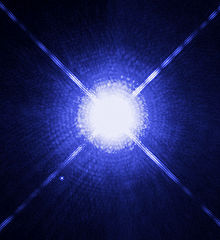
Secondary mirror
A secondary mirror is the second deflecting or focusing mirror element in a reflecting telescope. Light gathered by the primary mirror is directed towards a focal point typically past the location of the secondary. Secondary mirrors in the form of an optically flat diagonal mirror are used to...
, film holder, or detector near that focal point partially obstructing the light from reaching the primary mirror. Not only does this cause some reduction in the amount of light the system collects, it also causes a loss in contrast in the image due to diffraction
Diffraction
Diffraction refers to various phenomena which occur when a wave encounters an obstacle. Italian scientist Francesco Maria Grimaldi coined the word "diffraction" and was the first to record accurate observations of the phenomenon in 1665...
effects of the obstruction as well as diffraction spike
Diffraction spike
Diffraction spikes are lines radiating from bright light sources in reflecting telescope images. They are artifacts caused by light diffracting around the support vanes of the secondary mirror...
s caused by most secondary support structures.
The use of mirrors avoids chromatic aberration
Chromatic aberration
In optics, chromatic aberration is a type of distortion in which there is a failure of a lens to focus all colors to the same convergence point. It occurs because lenses have a different refractive index for different wavelengths of light...
but they produce other types of aberrations
Aberration in optical systems
Aberrations are departures of the performance of an optical system from the predictions of paraxial optics. Aberration leads to blurring of the image produced by an image-forming optical system. It occurs when light from one point of an object after transmission through the system does not converge...
. A simple spherical mirror cannot bring light from a distant object to a common focus since the reflection of light rays striking the mirror near its edge do not converge with those that reflect from nearer the center of the mirror, a defect called spherical aberration
Spherical aberration
thumb|right|Spherical aberration. A perfect lens focuses all incoming rays to a point on the [[Optical axis|optic axis]]. A real lens with spherical surfaces suffers from spherical aberration: it focuses rays more tightly if they enter it far from the optic axis than if they enter closer to the...
. To avoid this problem most reflecting telescopes use parabolic shaped mirrors
Parabolic reflector
A parabolic reflector is a reflective device used to collect or project energy such as light, sound, or radio waves. Its shape is that of a circular paraboloid, that is, the surface generated by a parabola revolving around its axis...
, a shape that can focus all the light to a common focus. Parabolic mirrors work well with objects near the center of the image they produce, (light traveling parallel to the mirror's optical axis
Optical axis
An optical axis is a line along which there is some degree of rotational symmetry in an optical system such as a camera lens or microscope.The optical axis is an imaginary line that defines the path along which light propagates through the system...
), but towards the edge of that same field of view they suffer from off axis aberrations:
- ComaComa (optics)In optics , the coma in an optical system refers to aberration inherent to certain optical designs or due to imperfection in the lens or other components which results in off-axis point sources such as stars appearing distorted, appearing to have a tail like a comet...
- an aberration where point sources (stars) at the center of the image are focused to a point but typically appears as "comet-like" radial smudges that get worse towards the edges of the image. - Field curvature - The best image plane is in general curved, which may not correspond to the detector's shape and leads to a focus error across the field. It is sometimes corrected by a field flattening lens.
- AstigmatismAstigmatismAn optical system with astigmatism is one where rays that propagate in two perpendicular planes have different foci. If an optical system with astigmatism is used to form an image of a cross, the vertical and horizontal lines will be in sharp focus at two different distances...
- an azimuthal variation of focus around the aperture causing point source images off-axis to appear elliptical. Astigmatism is not usually a problem in a narrow field of viewField of viewThe field of view is the extent of the observable world that is seen at any given moment....
, but in a wide field image it gets rapidly worse and varies quadratically with field angle. - Distortion - Distortion does not affect image quality (sharpness) but does affect object shapes. It is sometimes corrected by image processing.
There are reflecting telescope designs that use modified mirror surfaces (such as the Ritchey–Chrétien telescope) or some form of correcting lens (such as catadioptric telescopes) that correct some of these aberrations.
Use in astronomical research
Nearly all large research-grade astronomical telescopes are reflectors. There are several reasons for this:- In a lensLens (optics)A lens is an optical device with perfect or approximate axial symmetry which transmits and refracts light, converging or diverging the beam. A simple lens consists of a single optical element...
the entire volume of material has to be free of imperfection and inhomogeneities, whereas in a mirror, only one surface has to be perfectly polished. - Light of different wavelengthWavelengthIn physics, the wavelength of a sinusoidal wave is the spatial period of the wave—the distance over which the wave's shape repeats.It is usually determined by considering the distance between consecutive corresponding points of the same phase, such as crests, troughs, or zero crossings, and is a...
s travels through a medium other than vacuumVacuumIn everyday usage, vacuum is a volume of space that is essentially empty of matter, such that its gaseous pressure is much less than atmospheric pressure. The word comes from the Latin term for "empty". A perfect vacuum would be one with no particles in it at all, which is impossible to achieve in...
at different speeds. This causes chromatic aberrationChromatic aberrationIn optics, chromatic aberration is a type of distortion in which there is a failure of a lens to focus all colors to the same convergence point. It occurs because lenses have a different refractive index for different wavelengths of light...
in uncorrected lenses and creating an aberration-free large lens is a costly process. A mirror can eliminate this problem entirely. - Reflectors work in a wider spectrum of light since certain wavelengths are absorbed when passing through glass elements like those found in a refractor or catadioptric.
- There are structural problems involved in manufacturing and manipulating large-aperture lenses. Since a lens can only be held in place by its edge, the center of a large lens will sag due to gravity, distorting the image it produces. The largest practical lens size in a refracting telescope is around 1 meter. In contrast, a mirror can be supported by the whole side opposite its reflecting face, allowing for reflecting telescope designs that can overcome gravitational sag. The largest reflector designs currently exceed 10 meters in diameter.
Gregorian
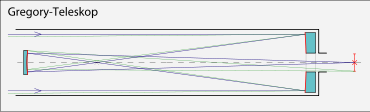
Gregorian telescope
The Gregorian telescope is a type of reflecting telescope designed by Scottish mathematician and astronomer James Gregory in the 17th century, and first built in 1673 by Robert Hooke...
, described by James Gregory in his 1663 book Optica Promota, employs a concave secondary mirror that reflects the image back through a hole in the primary mirror. This produces an upright image, useful for terrestrial observations. Some small spotting scope
Spotting scope
A spotting scope is a small portable telescope with added optics to present an erect image, optimized for the observation of terrestrial objects...
s are still built this way. There are several large modern telescopes that use a Gregorian configuration such as the Vatican Advanced Technology Telescope
Vatican Advanced Technology Telescope
The Vatican Advanced Technology Telescope, aka the VATT, is a 1.8 meter Gregorian telescope observing in the optical and infrared. It is part of the Mount Graham International Observatory. It is situated on Mount Graham in southeast Arizona, and it achieved 'first light', the first starlight to...
, the Magellan telescopes
Magellan telescopes
The Magellan Telescopes are a pair of 6.5 m diameter optical telescopes located at Las Campanas Observatory in Chile. The two telescopes are named after the astronomer Walter Baade and the philanthropist Landon T...
, the Large Binocular Telescope
Large Binocular Telescope
Large Binocular Telescope is an optical telescope for astronomy located on Mount Graham in the Pinaleno Mountains of southeastern Arizona, and is a part of the Mount Graham International Observatory...
, and the Giant Magellan Telescope
Giant Magellan Telescope
The Giant Magellan Telescope is a ground-based extremely large telescope planned for completion in 2018. It will consist of seven diameter primary segments, with the resolving power of a primary mirror and collecting area equivalent to one...
.
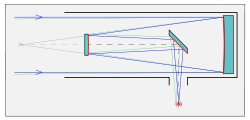
Newtonian
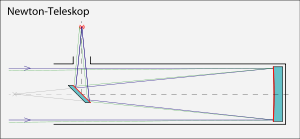
Newtonian telescope
The Newtonian telescope is a type of reflecting telescope invented by the British scientist Sir Isaac Newton , using a concave primary mirror and a flat diagonal secondary mirror. Newton’s first reflecting telescope was completed in 1668 and is the earliest known functional reflecting telescope...
was the first successful reflecting telescope, completed by Isaac Newton
Isaac Newton
Sir Isaac Newton PRS was an English physicist, mathematician, astronomer, natural philosopher, alchemist, and theologian, who has been "considered by many to be the greatest and most influential scientist who ever lived."...
in 1668. It usually has a paraboloid primary mirror but at focal ratio
F-number
In optics, the f-number of an optical system expresses the diameter of the entrance pupil in terms of the focal length of the lens; in simpler terms, the f-number is the focal length divided by the "effective" aperture diameter...
s of f/8 or longer a spherical primary mirror can be sufficient for high visual resolution. A flat secondary mirror reflects the light to a focal plane at the side of the top of the telescope tube. It is one of the simplest and least expensive designs for a given size of primary, and is popular with amateur telescope makers
Amateur telescope making
Amateur telescope making is the activity of building telescopes as a hobby, as opposed to being a paid professional. Amateur telescope makers build their instruments for personal enjoyment of a technical challenge, as a way to obtain an inexpensive or personally customized telescope, or as a...
as a home-build project.
The Cassegrain design and its variations
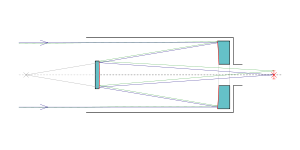
The Cassegrain telescope (sometimes called the "Classic Cassegrain") was first published in an 1672 design attributed to Laurent Cassegrain
Laurent Cassegrain
Laurent Cassegrain was a Catholic priest who is notable as the probable inventor of the Cassegrain reflector, a folded two mirror reflecting telescope design.-Biography:...
. It has a parabolic primary mirror, and a hyperbolic secondary mirror that reflects the light back down through a hole in the primary. Folding and diverging effect of the secondary creates a telescope with a long focal length while having a short tube length.
Ritchey–Chrétien
The Ritchey–Chrétien telescope, invented by George Willis RitcheyGeorge Willis Ritchey
George Willis Ritchey was an American optician and telescope maker and astronomer born at Tuppers Plains, Ohio....
and Henri Chrétien
Henri Chrétien
Henri Jacques Chrétien was a French astronomer and an inventor.Born in Paris, France, his most famous invention is the anamorphic widescreen process, that resulted in the CinemaScope, and the co-invention of the Ritchey-Chrétien telescope , which was anadvanced type of astronomical telescope, now...
in the early 1910s, is a specialized Cassegrain reflector which has two hyperbolic mirrors (instead of a parabolic primary). It is free of coma
Coma (optics)
In optics , the coma in an optical system refers to aberration inherent to certain optical designs or due to imperfection in the lens or other components which results in off-axis point sources such as stars appearing distorted, appearing to have a tail like a comet...
and spherical aberration at a nearly flat focal plane if the primary and secondary curvature are properly figured
Figuring
Figuring is the process of final polishing of an optical surface to remove imperfections or modify the surface curvature to achieve the shape required for a given application.-Types of figuring:...
, making it well suited for wide field and photographic observations. Almost every professional reflector telescope in the world is of the Ritchey–Chrétien design.
Dall–Kirkham
The Dall–Kirkham Cassegrain telescope's design was created by Horace Dall in 1928 and took on the name in an article published in Scientific AmericanScientific American
Scientific American is a popular science magazine. It is notable for its long history of presenting science monthly to an educated but not necessarily scientific public, through its careful attention to the clarity of its text as well as the quality of its specially commissioned color graphics...
in 1930 following discussion between amateur astronomer Allan Kirkham and Albert G. Ingalls, the magazine editor at the time. It uses a concave elliptical
Ellipse
In geometry, an ellipse is a plane curve that results from the intersection of a cone by a plane in a way that produces a closed curve. Circles are special cases of ellipses, obtained when the cutting plane is orthogonal to the cone's axis...
primary mirror and a convex spherical secondary. While this system is easier to grind than a classic Cassegrain or Ritchey–Chrétien system, it does not correct for off-axis coma and field curvature so the image degrades quickly off-axis. Because this is less noticeable at longer focal ratios, Dall–Kirkhams are seldom faster than f/15.
Off-axis designs
There are several designs that try to avoid obstructing the incoming light by eliminating the secondary or moving any secondary element off the primary mirror's optical axisOptical axis
An optical axis is a line along which there is some degree of rotational symmetry in an optical system such as a camera lens or microscope.The optical axis is an imaginary line that defines the path along which light propagates through the system...
, commonly called off-axis optical system
Off-axis optical system
An off-axis optical system is an optical system in which the optical axis of the aperture is not coincident with the mechanical center of the aperture. An optical system in which the optical axis of the aperture is not coincident with the mechanical center of the aperture...
s.
Herschelian

William Herschel
Sir Frederick William Herschel, KH, FRS, German: Friedrich Wilhelm Herschel was a German-born British astronomer, technical expert, and composer. Born in Hanover, Wilhelm first followed his father into the Military Band of Hanover, but emigrated to Britain at age 19...
, who used this design to build very large telescopes including a 49.5 inch (126 cm) diameter telescope in 1789. In the Herschelian reflector the primary mirror is tilted so the observer's head does not block the incoming light. Although this introduces geometrical aberrations, Herschel employed this design to avoid the use of a newtonian secondary mirror since the speculum metal
Speculum metal
Speculum metal is a mixture of around two-thirds copper and one-third tin making a white brittle alloy that can be polished to make a highly reflective surface. It is used primarily to make different kinds of mirrors including early reflecting telescope optical mirrors...
mirrors of that time tarnish
Tarnish
Tarnish is a thin layer of corrosion that forms over copper, brass, silver, aluminum, and other similar metals as their outermost layer undergoes a chemical reaction. Tarnish does not always result from the sole effects of oxygen in the air. For example, silver needs hydrogen sulfide to tarnish; it...
ed quickly and could only achieve 60% reflectivity.
Schiefspiegler
A variant of the Cassegrain, the Schiefspiegler telescope ("skewed" or "oblique reflector"), which uses tilted mirrors to avoid the secondary mirror casting a shadow on the primary. However, while eliminating diffraction patterns this leads to an increase in coma and astigmatism. These defects become manageable at large focal ratios — most Schiefspieglers use f/15 or longer, which tends to restrict useful observation to the moon and planets.A number of variations are common, with varying numbers of mirrors of different types. The Kutter style uses a single concave primary and a convex secondary. One variation of a multi-schiefspiegler uses a concave primary, convex secondary and a parabolic tertiary. One of the interesting aspects of some Schiefspieglers is that one of the mirrors can be involved in the light path twice — each light path reflects along a different meridional path.
Yolo
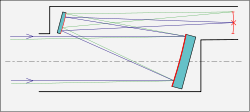
Toroidal reflector
A toroidal mirror is a form of parabolic reflector which has a different focal distance depending on the angle of the mirror. The curvature is actually that of an elliptic paraboloid with a \ne b. If the shape were that of a toroid, the mirror would exhibit spherical aberration.Toroidal mirrors...
s. The Yolo design eliminates coma, but leaves significant astigmatism, which is reduced by deformation of the secondary mirror by some form of warping harness, or alternatively, polishing a toroidal figure into the secondary.
Liquid mirror telescopes
One design of telescope uses a rotating mirror consisting of a liquid metal in a tray which is spun at constant speed. As the tray spins the liquid forms a parabolic surface, of essentially arbitrary size. This allows for very big telescope mirrors (over 6 metres), but unfortunately it cannot be steered, as it always points vertically.Prime focus
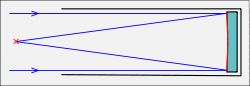
Focus (optics)
In geometrical optics, a focus, also called an image point, is the point where light rays originating from a point on the object converge. Although the focus is conceptually a point, physically the focus has a spatial extent, called the blur circle. This non-ideal focusing may be caused by...
of the primary mirror
Primary mirror
A primary mirror is the principal light-gathering surface of a reflecting telescope.-Description:The primary mirror of a reflecting telescope is a spherical or parabolic shaped disks of polished reflective metal , or in later telescopes, glass or other material coated with a reflective layer...
. At the focal point is some type of structure for holding a film plate or electronic detector. In the past, in very large telescopes, an observer would sit inside the telescope in an "observing cage" to directly view the image or operate a camera. Nowadays CCD
Charge-coupled device
A charge-coupled device is a device for the movement of electrical charge, usually from within the device to an area where the charge can be manipulated, for example conversion into a digital value. This is achieved by "shifting" the signals between stages within the device one at a time...
cameras allow for remote operation of the telescope from almost anywhere in the world. The space available at prime focus is severely limited by the need to avoid obstructing the incoming light.
Radio telescope
Radio telescope
A radio telescope is a form of directional radio antenna used in radio astronomy. The same types of antennas are also used in tracking and collecting data from satellites and space probes...
s often have a prime focus design. The mirror is replaced by a metal surface for reflecting radio wave
Radio Wave
Radio Wave may refer to:*Radio frequency*Radio Wave 96.5, a radio station in Blackpool, UK...
s, and the observer is an antenna.
Nasmyth and coudé focus
Nasmyth
The Nasmyth design is similar to the Cassegrain except no hole is drilled in the primary mirror; instead, a third mirror reflects the light to the side.Coudé
Adding further optics to a Nasmyth-style telescope to deliver the light (usually through the declinationDeclination
In astronomy, declination is one of the two coordinates of the equatorial coordinate system, the other being either right ascension or hour angle. Declination in astronomy is comparable to geographic latitude, but projected onto the celestial sphere. Declination is measured in degrees north and...
axis) to a fixed focus point that does not move as the telescope is reoriented gives a coudé focus (from the French word for elbow). This design has often been used on large observatory telescopes, as it allows heavy observation equipment, such as spectrograph
Spectrograph
A spectrograph is an instrument that separates an incoming wave into a frequency spectrum. There are several kinds of machines referred to as spectrographs, depending on the precise nature of the waves...
s, to be more easily used.
The coudé focus was widely used in large telescopes built in most of the Twentieth Century, since limits on optical design and fabrication required high-resolution spectrographs in particular to have large collimating mirrors (ideally with the same diameter as the telescope's primary mirror) and very long focal lengths. Such instruments could not withstand being moved, and adding mirrors to the light path to divert the light to a fixed position to such an instrument housed on or below the observing floor (and usually built as an unmoving integral part of the observatory building) was the only option. The 1.5m Hale Telescope, Hooker Telescope, 200 inch Hale Telescope
Hale telescope
The Hale Telescope is a , 3.3 reflecting telescope at the Palomar Observatory in California, named after astronomer George Ellery Hale. With funding from the Rockefeller Foundation, he orchestrated the planning, design, and construction of the observatory, but did not live to see its commissioning...
, Shane Telescope, and Harlan J. Smith Telescope
Harlan J. Smith Telescope
The Harlan J. Smith Telescope is a 2.7m telescope located at the McDonald Observatory, in Texas, in the United States. This telescope is one of several research telescopes that are part of the University of Texas at Austin observatory perched atop Mount Locke in the Davis Mountains of west Texas...
all were built with coudé foci instrumentation. The development of echelle
Echelle grating
An echelle grating is a type of diffraction grating which is characterised by a relatively low groove density but is optimized for high diffraction orders. Echelle gratings are, like other types of diffraction grating, used in spectrometers and similar instruments, such as HARPS, and numerous...
spectrometers allowed high-resolution spectroscopy with a much more compact instrument, one which can sometimes be successfully mounted on the Cassegrain focus. However, since inexpensive and adequately stable computer-controlled alt-az telescope mounts were developed in the 1980s, the Nasmyth design has supplanted the coudé focus for large telescopes.
See also
- Catadioptric telescopes
- Honeycomb mirrorHoneycomb mirrorA honeycomb mirror is a large mirror usually used as the primary mirror in astronomical reflecting telescopes whose face is supported by a ribbed structure that resembles a honeycomb. The design provides sufficient rigidity for ultra-high precision optics while reducing the weight of the mirror...
- List of largest optical reflecting telescopes
- List of largest optical telescopes historically
- List of telescope types
- Mirror support cellMirror support cellIn astronomy the mirror support cell - more commonly mirror cell - is the component of a reflecting telescope which supports the mirror in place to hold optical alignment, allow collimation adjustment, and protect it from falling out...
- PLate OPtimizerPLate OPtimizerPLate OPtimizer, or PLOP is a CAD program used by amateur telescope makers to design primary mirror support cells for reflecting telescopes. It was developed by telescope maker David Lewis, first described in 1999, and used to simplify calculations needed in the design of mirror support cells...
- Refracting telescopeRefracting telescopeA refracting or refractor telescope is a type of optical telescope that uses a lens as its objective to form an image . The refracting telescope design was originally used in spy glasses and astronomical telescopes but is also used for long focus camera lenses...