


Lens (optics)

Encyclopedia
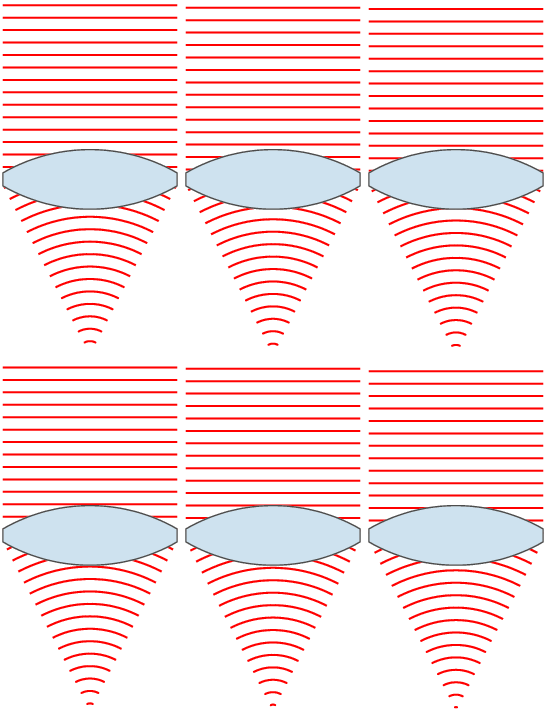
Optics
Optics is the branch of physics which involves the behavior and properties of light, including its interactions with matter and the construction of instruments that use or detect it. Optics usually describes the behavior of visible, ultraviolet, and infrared light...
device with perfect or approximate axial symmetry
Axial symmetry
Axial symmetry is symmetry around an axis; an object is axially symmetric if its appearance is unchanged if rotated around an axis . For example, a baseball bat or a tea saucer looks the same if it is rotated by any angle about the line passing lengthwise through its center, so it is axially...
which transmits
Transmittance
In optics and spectroscopy, transmittance is the fraction of incident light at a specified wavelength that passes through a sample. A related term is absorptance, or absorption factor, which is the fraction of radiation absorbed by a sample at a specified wavelength...
and refracts
Refraction
Refraction is the change in direction of a wave due to a change in its speed. It is essentially a surface phenomenon . The phenomenon is mainly in governance to the law of conservation of energy. The proper explanation would be that due to change of medium, the phase velocity of the wave is changed...
light
Light
Light or visible light is electromagnetic radiation that is visible to the human eye, and is responsible for the sense of sight. Visible light has wavelength in a range from about 380 nanometres to about 740 nm, with a frequency range of about 405 THz to 790 THz...
, converging or diverging the beam
Light beam
A light beam or beam of light is a narrow projection of light energy radiating from a source into a beam. Sunlight is a natural example of a light beam when filtered through various mediums...
. A simple lens
Simple lens
In optics, a simple lens or singlet lens is a lens consisting of a single simple element. Typical examples include a magnifying glass or a lens in a pair of simple reading glasses....
consists of a single optical element. A compound lens is an array of simple lenses (elements) with a common axis; the use of multiple elements allows more optical aberrations to be corrected than is possible with a single element. Lenses are typically made of glass
Glass
Glass is an amorphous solid material. Glasses are typically brittle and optically transparent.The most familiar type of glass, used for centuries in windows and drinking vessels, is soda-lime glass, composed of about 75% silica plus Na2O, CaO, and several minor additives...
or transparent plastic
Plastic
A plastic material is any of a wide range of synthetic or semi-synthetic organic solids used in the manufacture of industrial products. Plastics are typically polymers of high molecular mass, and may contain other substances to improve performance and/or reduce production costs...
. Elements which refract electromagnetic radiation
Electromagnetic radiation
Electromagnetic radiation is a form of energy that exhibits wave-like behavior as it travels through space...
outside the visual spectrum are also called lenses: for instance, a microwave
Microwave
Microwaves, a subset of radio waves, have wavelengths ranging from as long as one meter to as short as one millimeter, or equivalently, with frequencies between 300 MHz and 300 GHz. This broad definition includes both UHF and EHF , and various sources use different boundaries...
lens can be made from paraffin wax.
The variant spelling lense is sometimes seen. While it is listed as an alternative spelling in some dictionaries, most mainstream dictionaries do not list it as acceptable.
History

Lentil
The lentil is an edible pulse. It is a bushy annual plant of the legume family, grown for its lens-shaped seeds...
, because a double-convex lens is lentil-shaped. The genus of the lentil plant is Lens
Lens (genus)
The genus Lens of the legume family Fabaceae contains four species of small, erect or climbing herbs with pinnate leaves and small inconspicuous white flowers and small flattened pods...
, and the most commonly eaten species is Lens culinaris. The lentil plant also gives its name to a geometric figure
Lens (geometry)
In geometry, a lens is a biconvex shape comprising two circular arcs, joined at their endpoints. If the arcs have equal radii, it is called a symmetric lens.A concave-convex shape is called a lune...
.
The oldest lens artifact is the Nimrud lens
Nimrud lens
The Nimrud lens is a 3000 year old piece of rock crystal, which was unearthed by Austen Henry Layard at the Assyrian palace of Nimrud, in modern-day Iraq. It may have been used as a magnifying glass, or as a burning-glass to start fires by concentrating sunlight. Assyrian craftsmen made intricate...
, which is over three thousand years old, dating back to ancient Assyria
Assyria
Assyria was a Semitic Akkadian kingdom, extant as a nation state from the mid–23rd century BC to 608 BC centred on the Upper Tigris river, in northern Mesopotamia , that came to rule regional empires a number of times through history. It was named for its original capital, the ancient city of Assur...
. David Brewster
David Brewster
Sir David Brewster KH PRSE FRS FSA FSSA MICE was a Scottish physicist, mathematician, astronomer, inventor, writer and university principal.-Early life:...
proposed that it may have been used as a magnifying glass
Magnifying glass
A magnifying glass is a convex lens that is used to produce a magnified image of an object. The lens is usually mounted in a frame with a handle ....
, or as a burning-glass
Burning-glass
A burning glass or burning lens is a large convex lens that can concentrate the sun's rays onto a small area, heating up the area and thus resulting in ignition of the exposed surface. Burning mirrors achieve a similar effect by using reflecting surfaces to focus the light...
to start fires by concentrating sunlight. Assyrian craftsmen made intricate engravings, and could have used such a lens in their work. Another early reference to magnification
Magnification
Magnification is the process of enlarging something only in appearance, not in physical size. This enlargement is quantified by a calculated number also called "magnification"...
dates back to ancient Egypt
Ancient Egypt
Ancient Egypt was an ancient civilization of Northeastern Africa, concentrated along the lower reaches of the Nile River in what is now the modern country of Egypt. Egyptian civilization coalesced around 3150 BC with the political unification of Upper and Lower Egypt under the first pharaoh...
ian hieroglyphs
Egyptian hieroglyphs
Egyptian hieroglyphs were a formal writing system used by the ancient Egyptians that combined logographic and alphabetic elements. Egyptians used cursive hieroglyphs for religious literature on papyrus and wood...
in the 8th century BC, which depict "simple glass meniscal lenses".
The earliest written records of lenses date to Ancient Greece, with Aristophanes
Aristophanes
Aristophanes , son of Philippus, of the deme Cydathenaus, was a comic playwright of ancient Athens. Eleven of his forty plays survive virtually complete...
' play The Clouds
The Clouds
The Clouds is a comedy written by the celebrated playwright Aristophanes lampooning intellectual fashions in classical Athens. It was originally produced at the City Dionysia in 423 BC and it was not well received, coming last of the three plays competing at the festival that year. It was revised...
(424 BC) mentioning a burning-glass (a biconvex lens used to focus
Focus (optics)
In geometrical optics, a focus, also called an image point, is the point where light rays originating from a point on the object converge. Although the focus is conceptually a point, physically the focus has a spatial extent, called the blur circle. This non-ideal focusing may be caused by...
the sun
Sun
The Sun is the star at the center of the Solar System. It is almost perfectly spherical and consists of hot plasma interwoven with magnetic fields...
's rays to produce fire). Some scholars argue that the archeological evidence indicates that there was widespread use of lenses in antiquity, spanning several millennia. Such lenses were used by artisans for fine work, and for authenticating seal impressions. The writings of Pliny the Elder
Pliny the Elder
Gaius Plinius Secundus , better known as Pliny the Elder, was a Roman author, naturalist, and natural philosopher, as well as naval and army commander of the early Roman Empire, and personal friend of the emperor Vespasian...
(23–79) show that burning-glasses were known to the Roman Empire
Roman Empire
The Roman Empire was the post-Republican period of the ancient Roman civilization, characterised by an autocratic form of government and large territorial holdings in Europe and around the Mediterranean....
, and mentions what is arguably the earliest written reference to a corrective lens
Corrective lens
A corrective lens is a lens worn in front of the eye, mainly used to treat myopia, hyperopia, astigmatism, and presbyopia. Glasses or "spectacles" are worn on the face a short distance in front of the eye. Contact lenses are worn directly on the surface of the eye...
: Nero
Nero
Nero , was Roman Emperor from 54 to 68, and the last in the Julio-Claudian dynasty. Nero was adopted by his great-uncle Claudius to become his heir and successor, and succeeded to the throne in 54 following Claudius' death....
was said to watch the gladiatorial games
Gladiator
A gladiator was an armed combatant who entertained audiences in the Roman Republic and Roman Empire in violent confrontations with other gladiators, wild animals, and condemned criminals. Some gladiators were volunteers who risked their legal and social standing and their lives by appearing in the...
using an emerald
Emerald
Emerald is a variety of the mineral beryl colored green by trace amounts of chromium and sometimes vanadium. Beryl has a hardness of 7.5–8 on the 10 point Mohs scale of mineral hardness...
(presumably concave to correct for myopia
Myopia
Myopia , "shortsightedness" ) is a refractive defect of the eye in which collimated light produces image focus in front of the retina under conditions of accommodation. In simpler terms, myopia is a condition of the eye where the light that comes in does not directly focus on the retina but in...
, though the reference is vague). Both Pliny and Seneca the Younger
Seneca the Younger
Lucius Annaeus Seneca was a Roman Stoic philosopher, statesman, dramatist, and in one work humorist, of the Silver Age of Latin literature. He was tutor and later advisor to emperor Nero...
(3 BC–65) described the magnifying effect of a glass globe filled with water
Water
Water is a chemical substance with the chemical formula H2O. A water molecule contains one oxygen and two hydrogen atoms connected by covalent bonds. Water is a liquid at ambient conditions, but it often co-exists on Earth with its solid state, ice, and gaseous state . Water also exists in a...
.
In the 10th century, Ibn Sahl
Ibn Sahl
This article is about the physicist. For the physician, see Ali ibn Sahl Rabban al-Tabari. For the poet, see Ibn Sahl of Sevilla.Ibn Sahl was a Muslim Persian mathematician, physicist and optics engineer of the Islamic Golden Age associated with the Abbasid court of Baghdad...
used what is now known as Snell's law
Snell's law
In optics and physics, Snell's law is a formula used to describe the relationship between the angles of incidence and refraction, when referring to light or other waves passing through a boundary between two different isotropic media, such as water and glass...
to calculate the shape of lenses.
Excavations at the Viking
Viking
The term Viking is customarily used to refer to the Norse explorers, warriors, merchants, and pirates who raided, traded, explored and settled in wide areas of Europe, Asia and the North Atlantic islands from the late 8th to the mid-11th century.These Norsemen used their famed longships to...
harbour town of Fröjel, Gotland
Gotland
Gotland is a county, province, municipality and diocese of Sweden; it is Sweden's largest island and the largest island in the Baltic Sea. At 3,140 square kilometers in area, the region makes up less than one percent of Sweden's total land area...
, Sweden
Sweden
Sweden , officially the Kingdom of Sweden , is a Nordic country on the Scandinavian Peninsula in Northern Europe. Sweden borders with Norway and Finland and is connected to Denmark by a bridge-tunnel across the Öresund....
discovered in 1999 the rock crystal Visby lenses
Visby lenses
The Visby lenses are a collection of lens-shaped manufactured objects made of rock crystal found in several Viking graves on the island of Gotland, Sweden, dating from the 11th or 12th century...
, produced by turning on pole lathes at Fröjel in the 11th to 12th century, with an imaging quality comparable to that of 1950s aspheric lens
Aspheric lens
An aspheric lens or asphere is a lens whose surface profiles are not portions of a sphere or cylinder. In photography, a lens assembly that includes an aspheric element is often called an aspherical lens....
es. The Viking lenses were capable of concentrating enough sunlight to ignite fires.
Lenses came into widespread use in Europe with the invention of reading stone
Reading stone
A reading stone was an approximately hemispherical lens that was placed on top of text to magnify the letters so that people with presbyopia could read it more easily. Reading stones were among the earliest common uses of lenses....
s in the 11th century and the invention of spectacles, probably in Italy
Italy
Italy , officially the Italian Republic languages]] under the European Charter for Regional or Minority Languages. In each of these, Italy's official name is as follows:;;;;;;;;), is a unitary parliamentary republic in South-Central Europe. To the north it borders France, Switzerland, Austria and...
in the 1280s. Scholars have noted that spectacles were invented not long after the translation of Ibn al-Haytham's Book of Optics
Book of Optics
The Book of Optics ; ; Latin: De Aspectibus or Opticae Thesaurus: Alhazeni Arabis; Italian: Deli Aspecti) is a seven-volume treatise on optics and other fields of study composed by the medieval Muslim scholar Alhazen .-See also:* Science in medieval Islam...
into Latin, but it is not clear what role, if any, the optical theory of the time played in the discovery. Nicholas of Cusa
Nicholas of Cusa
Nicholas of Kues , also referred to as Nicolaus Cusanus and Nicholas of Cusa, was a cardinal of the Catholic Church from Germany , a philosopher, theologian, jurist, mathematician, and an astronomer. He is widely considered one of the great geniuses and polymaths of the 15th century...
is believed to have been the first to discover the benefits of concave lenses for the treatment of myopia
Myopia
Myopia , "shortsightedness" ) is a refractive defect of the eye in which collimated light produces image focus in front of the retina under conditions of accommodation. In simpler terms, myopia is a condition of the eye where the light that comes in does not directly focus on the retina but in...
in 1451.
The Abbe sine condition
Abbe sine condition
The Abbe sine condition is a condition that must be fulfilled by a lens or other optical system in order for it to produce sharp images of off-axis as well as on-axis objects...
, due to Ernst Abbe (1860s), is a condition that must be fulfilled by a lens or other optical system in order for it to produce sharp images of off-axis as well as on-axis objects. It revolutionized the design of optical instruments such as microscopes, and helped to establish the Carl Zeiss
Carl Zeiss
Carl Zeiss was a German maker of optical instruments commonly known for the company he founded, Carl Zeiss Jena . Zeiss made contributions to lens manufacturing that have aided the modern production of lenses...
company as a leading supplier of optical instruments.
Construction of simple lenses
Most lenses are spherical lenses: their two surfaces are parts of the surfaces of spheres, with the lens axis ideally perpendicular to both surfaces. Each surface can be convex (bulging outwards from the lens), concave (depressed into the lens), or planar (flat). The line joining the centres of the spheres making up the lens surfaces is called the axis of the lens. Typically the lens axis passes through the physical centre of the lens, because of the way they are manufactured. Lenses may be cut or ground after manufacturing to give them a different shape or size. The lens axis may then not pass through the physical centre of the lens.Toric
Toric lens
A toric lens is a lens with two different powers in two orientations perpendicular to each other. One of the lens surfaces is shaped like a "cap" from a torus , while the other one usually is spherical...
or sphero-cylindrical lenses have surfaces with two different radii of curvature in two orthogonal planes. They have a different focal power in different meridians. This is a form of deliberate astigmatism
Astigmatism
An optical system with astigmatism is one where rays that propagate in two perpendicular planes have different foci. If an optical system with astigmatism is used to form an image of a cross, the vertical and horizontal lines will be in sharp focus at two different distances...
.
More complex are aspheric lens
Aspheric lens
An aspheric lens or asphere is a lens whose surface profiles are not portions of a sphere or cylinder. In photography, a lens assembly that includes an aspheric element is often called an aspherical lens....
es. These are lenses where one or both surfaces have a shape that is neither spherical nor cylindrical. Such lenses can produce images with much less aberration than standard simple lenses.
Types of simple lenses
Lenses are classified by the curvature of the two optical surfaces. A lens is biconvex (or double convex, or just convex) if both surfaces are convex. If both surfaces have the same radius of curvature, the lens is equiconvex. A lens with two concave surfaces is biconcave (or just concave). If one of the surfaces is flat, the lens is plano-convex or plano-concave depending on the curvature of the other surface. A lens with one convex and one concave side is convex-concave or meniscus. It is this type of lens that is most commonly used in corrective lenses.
If the lens is biconvex or plano-convex, a collimated
Collimated light
Collimated light is light whose rays are parallel, and therefore will spread slowly as it propagates. The word is related to "collinear" and implies light that does not disperse with distance , or that will disperse minimally...
beam of light travelling parallel to the lens axis and passing through the lens will be converged (or focused) to a spot on the axis, at a certain distance behind the lens (known as the focal length
Focal length
The focal length of an optical system is a measure of how strongly the system converges or diverges light. For an optical system in air, it is the distance over which initially collimated rays are brought to a focus...
). In this case, the lens is called a positive or converging lens.
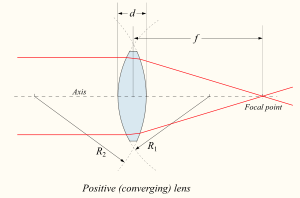 |
If the lens is biconcave or plano-concave, a collimated beam of light passing through the lens is diverged (spread); the lens is thus called a negative or diverging lens. The beam after passing through the lens appears to be emanating from a particular point on the axis in front of the lens; the distance from this point to the lens is also known as the focal length, although it is negative with respect to the focal length of a converging lens.
Convex-concave (meniscus) lenses can be either positive or negative, depending on the relative curvatures of the two surfaces. A negative meniscus lens has a steeper concave surface and will be thinner at the centre than at the periphery. Conversely, a positive meniscus lens has a steeper convex surface and will be thicker at the centre than at the periphery. An ideal thin lens
Thin lens
[Image:Lens1.svg|thumb|A lens can be considered a thin lens if d [Image:Lens1.svg|thumb|A lens can be considered a thin lens if d [Image:Lens1.svg|thumb|A lens can be considered a thin lens if d...
with two surfaces of equal curvature would have zero optical power
Optical power
Optical power is the degree to which a lens, mirror, or other optical system converges or diverges light. It is equal to the reciprocal of the focal length of the device. The dioptre is the most common unit of measurement of optical power...
, meaning that it would neither converge nor diverge light. All real lenses have a nonzero thickness, however, which affects the optical power. To obtain exactly zero optical power, a meniscus lens must have slightly unequal curvatures to account for the effect of the lens' thickness.
Lensmaker's equation
The focal length of a lens in air can be calculated from the lensmaker's equation:
where
 is the focal length of the lens,
 is the refractive index
Refractive index
In optics the refractive index or index of refraction of a substance or medium is a measure of the speed of light in that medium. It is expressed as a ratio of the speed of light in vacuum relative to that in the considered medium....
of the lens material,
 is the radius of curvature of the lens surface closest to the light source,
 is the radius of curvature of the lens surface farthest from the light source, and
 is the thickness of the lens (the distance along the lens axis between the two surface vertices).
Sign convention of lens radii R1 and R2
The signs of the lens' radii of curvature indicate whether the corresponding surfaces are convex or concave. The sign conventionSign convention
In physics, a sign convention is a choice of the physical significance of signs for a set of quantities, in a case where the choice of sign is arbitrary. "Arbitrary" here means that the same physical system can be correctly described using different choices for the signs, as long as one set of...
used to represent this varies, but in this article if R1 is positive the first surface is convex, and if R1 is negative the surface is concave. The signs are reversed for the back surface of the lens: if R2 is positive the surface is concave, and if R2 is negative the surface is convex. If either radius is infinite
Infinity
Infinity is a concept in many fields, most predominantly mathematics and physics, that refers to a quantity without bound or end. People have developed various ideas throughout history about the nature of infinity...
, the corresponding surface is flat. With this convention the signs are determined by the shapes of the lens surfaces, and are independent of the direction in which light travels through the lens.
Thin lens equation
If d is small compared to R1 and R2, then the thin lensThin lens
[Image:Lens1.svg|thumb|A lens can be considered a thin lens if d [Image:Lens1.svg|thumb|A lens can be considered a thin lens if d [Image:Lens1.svg|thumb|A lens can be considered a thin lens if d...
approximation can be made. For a lens in air, f is then given by

The focal length f is positive for converging lenses, and negative for diverging lenses. The reciprocal
Multiplicative inverse
In mathematics, a multiplicative inverse or reciprocal for a number x, denoted by 1/x or x−1, is a number which when multiplied by x yields the multiplicative identity, 1. The multiplicative inverse of a fraction a/b is b/a. For the multiplicative inverse of a real number, divide 1 by the...
of the focal length, 1/f, is the optical power
Optical power
Optical power is the degree to which a lens, mirror, or other optical system converges or diverges light. It is equal to the reciprocal of the focal length of the device. The dioptre is the most common unit of measurement of optical power...
of the lens. If the focal length is in metres, this gives the optical power in dioptre
Dioptre
A dioptre, or diopter, is a unit of measurement of the optical power of a lens or curved mirror, which is equal to the reciprocal of the focal length measured in metres . It is thus a unit of reciprocal length. For example, a 3-dioptre lens brings parallel rays of light to focus at metre...
s (inverse metres).
Lenses have the same focal length when light travels from the back to the front as when light goes from the front to the back, although other properties of the lens, such as the aberrations
Aberration in optical systems
Aberrations are departures of the performance of an optical system from the predictions of paraxial optics. Aberration leads to blurring of the image produced by an image-forming optical system. It occurs when light from one point of an object after transmission through the system does not converge...
are not necessarily the same in both directions.
Imaging properties
As mentioned above, a positive or converging lens in air will focus a collimated beam travelling along the lens axis to a spot (known as the focal pointFocus (optics)
In geometrical optics, a focus, also called an image point, is the point where light rays originating from a point on the object converge. Although the focus is conceptually a point, physically the focus has a spatial extent, called the blur circle. This non-ideal focusing may be caused by...
) at a distance f from the lens. Conversely, a point source
Point source
A point source is a localised, relatively small source of something.Point source may also refer to:*Point source , a localised source of pollution**Point source water pollution, water pollution with a localized source...
of light placed at the focal point will be converted into a collimated beam by the lens. These two cases are examples of image
Image
An image is an artifact, for example a two-dimensional picture, that has a similar appearance to some subject—usually a physical object or a person.-Characteristics:...
formation in lenses. In the former case, an object at an infinite distance (as represented by a collimated beam of waves) is focused to an image at the focal point of the lens. In the latter, an object at the focal length distance from the lens is imaged at infinity. The plane perpendicular to the lens axis situated at a distance f from the lens is called the focal plane.
If the distances from the object to the lens and from the lens to the image are S1 and S2 respectively, for a lens of negligible thickness, in air, the distances are related by the thin lens formula
 .
.This can also be put into the "Newtonian" form:

where
 and
and  .
.What this means is that, if an object is placed at a distance S1 along the axis in front of a positive lens of focal length f, a screen placed at a distance S2 behind the lens will have a sharp image of the object projected onto it, as long as S1 > f (if the lens-to-screen distance S2 is varied slightly, the image will become less sharp). This is the principle behind photography
Photography
Photography is the art, science and practice of creating durable images by recording light or other electromagnetic radiation, either electronically by means of an image sensor or chemically by means of a light-sensitive material such as photographic film...
and the human eye
Human eye
The human eye is an organ which reacts to light for several purposes. As a conscious sense organ, the eye allows vision. Rod and cone cells in the retina allow conscious light perception and vision including color differentiation and the perception of depth...
. The image in this case is known as a real image
Real image
In optics, a real image is a representation of an object in which the perceived location is actually a point of convergence of the rays of light that make up the image. If a screen is placed in the plane of a real image the image will generally become visible on the screen...
.
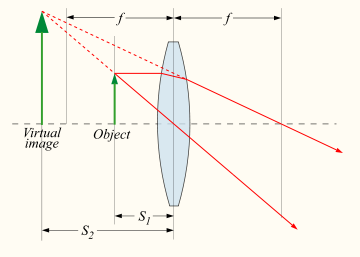
Note that if S1 < f, S2 becomes negative, the image is apparently positioned on the same side of the lens as the object. Although this kind of image, known as a virtual image
Virtual image
In optics, a virtual image is an image in which the outgoing rays from a point on the object always diverge. It will appear to converge in or behind the optical device . A simple example is a flat mirror where the image of oneself is perceived at twice the distance from oneself to the mirror...
, cannot be projected on a screen, an observer looking through the lens will see the image in its apparent calculated position. A magnifying glass
Magnifying glass
A magnifying glass is a convex lens that is used to produce a magnified image of an object. The lens is usually mounted in a frame with a handle ....
creates this kind of image.
The magnification
Magnification
Magnification is the process of enlarging something only in appearance, not in physical size. This enlargement is quantified by a calculated number also called "magnification"...
of the lens is given by:
 ,
,where M is the magnification factor; if |M|>1, the image is larger than the object.
Notice the sign convention here shows that, if M is negative, as it is for real images, the image is upside-down with respect to the object. For virtual images, M is positive and the image is upright.
In the special case that S1 = ∞, then S2 = f and M = −f / ∞ = 0. This corresponds to a collimated beam being focused to a single spot at the focal point. The size of the image in this case is not actually zero, since diffraction
Diffraction
Diffraction refers to various phenomena which occur when a wave encounters an obstacle. Italian scientist Francesco Maria Grimaldi coined the word "diffraction" and was the first to record accurate observations of the phenomenon in 1665...
effects place a lower limit on the size of the image (see Rayleigh criterion).
The formulas above may also be used for negative (diverging) lens by using a negative focal length (f), but for these lenses only virtual images can be formed.
For the case of lenses that are not thin, or for more complicated multi-lens optical systems, the same formulas can be used, but S1 and S2 are interpreted differently. If the system is in air or vacuum
Vacuum
In everyday usage, vacuum is a volume of space that is essentially empty of matter, such that its gaseous pressure is much less than atmospheric pressure. The word comes from the Latin term for "empty". A perfect vacuum would be one with no particles in it at all, which is impossible to achieve in...
, S1 and S2 are measured from the front and rear principal planes of the system, respectively. Imaging in media with an index of refraction greater than 1 is more complicated, and is beyond the scope of this article.
Aberrations
Lenses do not form perfect images, and there is always some degree of distortion or aberration introduced by the lens which causes the image to be an imperfect replica of the object. Careful design of the lens system for a particular application ensures that the aberration is minimized. There are several different types of aberration which can affect image quality.Spherical aberration
Spherical aberrationSpherical aberration
thumb|right|Spherical aberration. A perfect lens focuses all incoming rays to a point on the [[Optical axis|optic axis]]. A real lens with spherical surfaces suffers from spherical aberration: it focuses rays more tightly if they enter it far from the optic axis than if they enter closer to the...
occurs because spherical surfaces are not the ideal shape with which to make a lens, but they are by far the simplest shape to which glass can be ground and polished and so are often used. Spherical aberration causes beams parallel to, but distant from, the lens axis to be focused in a slightly different place than beams close to the axis. This manifests itself as a blurring of the image. Lenses in which closer-to-ideal, non-spherical surfaces are used are called aspheric lenses. These were formerly complex to make and often extremely expensive, but advances in technology have greatly reduced the manufacturing cost for such lenses. Spherical aberration can be minimised by careful choice of the curvature of the surfaces for a particular application: for instance, a plano-convex lens which is used to focus a collimated beam produces a sharper focal spot when used with the convex side towards the beam source.
Coma
Another type of aberration is comaComa (optics)
In optics , the coma in an optical system refers to aberration inherent to certain optical designs or due to imperfection in the lens or other components which results in off-axis point sources such as stars appearing distorted, appearing to have a tail like a comet...
, which derives its name from the comet
Comet
A comet is an icy small Solar System body that, when close enough to the Sun, displays a visible coma and sometimes also a tail. These phenomena are both due to the effects of solar radiation and the solar wind upon the nucleus of the comet...
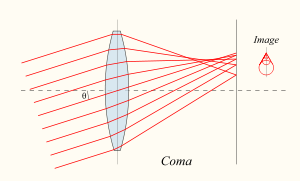
-like appearance of the aberrated image. Coma occurs when an object off the optical axis of the lens is imaged, where rays pass through the lens at an angle to the axis θ. Rays which pass through the centre of the lens of focal length f are focused at a point with distance f tan θ from the axis. Rays passing through the outer margins of the lens are focused at different points, either further from the axis (positive coma) or closer to the axis (negative coma). In general, a bundle of parallel rays passing through the lens at a fixed distance from the centre of the lens are focused to a ring-shaped image in the focal plane, known as a comatic circle. The sum of all these circles results in a V-shaped or comet-like flare. As with spherical aberration, coma can be minimised (and in some cases eliminated) by choosing the curvature of the two lens surfaces to match the application. Lenses in which both spherical aberration and coma are minimised are called bestform lenses.
Chromatic aberration
Chromatic aberrationChromatic aberration
In optics, chromatic aberration is a type of distortion in which there is a failure of a lens to focus all colors to the same convergence point. It occurs because lenses have a different refractive index for different wavelengths of light...
is caused by the dispersion
Dispersion (optics)
In optics, dispersion is the phenomenon in which the phase velocity of a wave depends on its frequency, or alternatively when the group velocity depends on the frequency.Media having such a property are termed dispersive media...
of the lens material—the variation of its refractive index
Refractive index
In optics the refractive index or index of refraction of a substance or medium is a measure of the speed of light in that medium. It is expressed as a ratio of the speed of light in vacuum relative to that in the considered medium....
, n, with the wavelength of light. Since, from the formulae above, f is dependent upon n, it follows that different wavelengths of light will be focused to different positions. Chromatic aberration of a lens is seen as fringes of colour around the image. It can be minimised by using an achromatic doublet
Achromatic lens
An achromatic lens or achromat is a lens that is designed to limit the effects of chromatic and spherical aberration. Achromatic lenses are corrected to bring two wavelengths into focus in the same plane....
(or achromat) in which two materials with differing dispersion are bonded together to form a single lens. This reduces the amount of chromatic aberration over a certain range of wavelengths, though it does not produce perfect correction. The use of achromats was an important step in the development of the optical microscope. An apochromat
Apochromat
An apochromat, or apochromatic lens , is a photographic or other lens that has better correction of chromatic and spherical aberration than the much more common achromat lenses.-Explanation:...
is a lens or lens system which has even better correction of chromatic aberration, combined with improved correction of spherical aberration. Apochromats are much more expensive than achromats.
Different lens materials may also be used to minimise chromatic aberration, such as specialised coatings or lenses made from the crystal fluorite
Fluorite
Fluorite is a halide mineral composed of calcium fluoride, CaF2. It is an isometric mineral with a cubic habit, though octahedral and more complex isometric forms are not uncommon...
. This naturally occurring substance has the highest known Abbe number
Abbe number
In physics and optics, the Abbe number, also known as the V-number or constringence of a transparent material, is a measure of the material's dispersion in relation to the refractive index...
, indicating that the material has low dispersion.

Other types of aberration
Other kinds of aberration include field curvature, barrelBarrel distortion
In geometric optics and cathode ray tube displays, distortion is a deviation from rectilinear projection, a projection in which straight lines in a scene remain straight in an image...
and pincushion distortion, and astigmatism
Astigmatism
An optical system with astigmatism is one where rays that propagate in two perpendicular planes have different foci. If an optical system with astigmatism is used to form an image of a cross, the vertical and horizontal lines will be in sharp focus at two different distances...
.
Aperture diffraction
Even if a lens is designed to minimize or eliminate the aberrations described above, the image quality is still limited by the diffractionDiffraction
Diffraction refers to various phenomena which occur when a wave encounters an obstacle. Italian scientist Francesco Maria Grimaldi coined the word "diffraction" and was the first to record accurate observations of the phenomenon in 1665...
of light passing through the lens' finite aperture
Aperture
In optics, an aperture is a hole or an opening through which light travels. More specifically, the aperture of an optical system is the opening that determines the cone angle of a bundle of rays that come to a focus in the image plane. The aperture determines how collimated the admitted rays are,...
. A diffraction-limited
Diffraction-limited
The resolution of an optical imaging system — a microscope, telescope, or camera — can be limited by factors such as imperfections in the lenses or misalignment. However, there is a fundamental maximum to the resolution of any optical system which is due to diffraction...
lens is one in which aberrations have been reduced to the point where the image quality is primarily limited by diffraction under the design conditions.
Compound lenses
Simple lenses are subject to the optical aberrations discussed above. In many cases these aberrations can be compensated for to a great extent by using a combination of simple lenses with complementary aberrations. A compound lens is a collection of simple lenses of different shapes and made of materials of different refractive indices, arranged one after the other with a common axis.The simplest case is where lenses are placed in contact: if the lenses of focal lengths f1 and f2 are "thin
Thin lens
[Image:Lens1.svg|thumb|A lens can be considered a thin lens if d [Image:Lens1.svg|thumb|A lens can be considered a thin lens if d [Image:Lens1.svg|thumb|A lens can be considered a thin lens if d...
", the combined focal length f of the lenses is given by

Since 1/f is the power of a lens, it can be seen that the powers of thin lenses in contact are additive.
If two thin lenses are separated in air by some distance d (where d is smaller than the focal length of the first lens), the focal length for the combined system is given by

The distance from the second lens to the focal point of the combined lenses is called the back focal length (BFL).

As d tends to zero, the value of the BFL tends to the value of f given for thin lenses in contact.
If the separation distance is equal to the sum of the focal lengths (d = f1+f2), the combined focal length and BFL are infinite. This corresponds to a pair of lenses that transform a parallel (collimated) beam into another collimated beam. This type of system is called an afocal system
Afocal system
In optics an afocal system is an optical system that produces no net convergence or divergence of the beam, i.e. has an infinite effective focal length. This type of system can be created with a pair of optical elements where the distance between the elements is equal to the sum of each element's...
, since it produces no net convergence or divergence of the beam. Two lenses at this separation form the simplest type of optical telescope
Optical telescope
An optical telescope is a telescope which is used to gather and focus light mainly from the visible part of the electromagnetic spectrum for directly viewing a magnified image for making a photograph, or collecting data through electronic image sensors....
. Although the system does not alter the divergence of a collimated beam, it does alter the width of the beam. The magnification of such a telescope is given by

which is the ratio of the input beam width to the output beam width. Note the sign convention: a telescope with two convex lenses (f1 > 0, f2 > 0) produces a negative magnification, indicating an inverted image. A convex plus a concave lens (f1 > 0 > f2) produces a positive magnification and the image is upright.
Uses of lenses
A single convex lens mounted in a frame with a handle or stand is a magnifying glassMagnifying glass
A magnifying glass is a convex lens that is used to produce a magnified image of an object. The lens is usually mounted in a frame with a handle ....
.
Lenses are used as prosthetics for the correction of visual impairment
Visual impairment
Visual impairment is vision loss to such a degree as to qualify as an additional support need through a significant limitation of visual capability resulting from either disease, trauma, or congenital or degenerative conditions that cannot be corrected by conventional means, such as refractive...
s such as myopia
Myopia
Myopia , "shortsightedness" ) is a refractive defect of the eye in which collimated light produces image focus in front of the retina under conditions of accommodation. In simpler terms, myopia is a condition of the eye where the light that comes in does not directly focus on the retina but in...
, hyperopia
Hyperopia
Hyperopia, also known as farsightedness, longsightedness or hypermetropia, is a defect of vision caused by an imperfection in the eye , causing difficulty focusing on near objects, and in extreme cases causing a sufferer to be unable to focus on objects at any distance...
, presbyopia
Presbyopia
Presbyopia is a condition where the eye exhibits a progressively diminished ability to focus on near objects with age. Presbyopia’s exact mechanisms are not known with certainty; the research evidence most strongly supports a loss of elasticity of the crystalline lens, although changes in the...
, and astigmatism
Astigmatism
An optical system with astigmatism is one where rays that propagate in two perpendicular planes have different foci. If an optical system with astigmatism is used to form an image of a cross, the vertical and horizontal lines will be in sharp focus at two different distances...
. (See corrective lens
Corrective lens
A corrective lens is a lens worn in front of the eye, mainly used to treat myopia, hyperopia, astigmatism, and presbyopia. Glasses or "spectacles" are worn on the face a short distance in front of the eye. Contact lenses are worn directly on the surface of the eye...
, contact lens
Contact lens
A contact lens, or simply contact, is a lens placed on the eye. They are considered medical devices and can be worn to correct vision, for cosmetic or therapeutic reasons. In 2004, it was estimated that 125 million people use contact lenses worldwide, including 28 to 38 million in the United...
, eyeglasses.) Most lenses used for other purposes have strict axial symmetry
Axial symmetry
Axial symmetry is symmetry around an axis; an object is axially symmetric if its appearance is unchanged if rotated around an axis . For example, a baseball bat or a tea saucer looks the same if it is rotated by any angle about the line passing lengthwise through its center, so it is axially...
; eyeglass lenses are only approximately symmetric. They are usually shaped to fit in a roughly oval, not circular, frame; the optical centers are placed over the eyeballs; their curvature may not be axially symmetric to correct for astigmatism
Astigmatism
An optical system with astigmatism is one where rays that propagate in two perpendicular planes have different foci. If an optical system with astigmatism is used to form an image of a cross, the vertical and horizontal lines will be in sharp focus at two different distances...
. Sunglasses'
Sunglasses
Sunglasses or sun glasses are a form of protective eyewear designed primarily to prevent bright sunlight and high-energy visible light from damaging or discomforting the eyes. They can sometimes also function as a visual aid, as variously termed spectacles or glasses exist, featuring lenses that...
lenses are designed to attenuate light; sunglass lenses that also correct visual impairments can be custom made.
Other uses are in imaging systems such as monocular
Monocular
A monocular is a modified refracting telescope used to magnify the images of distant objects by passing light through a series of lenses and sometimes prisms; the use of prisms results in a lightweight telescope. Volume and weight are less than half those of binoculars of similar optical...
s, binoculars
Binoculars
Binoculars, field glasses or binocular telescopes are a pair of identical or mirror-symmetrical telescopes mounted side-by-side and aligned to point accurately in the same direction, allowing the viewer to use both eyes when viewing distant objects...
, telescope
Optical telescope
An optical telescope is a telescope which is used to gather and focus light mainly from the visible part of the electromagnetic spectrum for directly viewing a magnified image for making a photograph, or collecting data through electronic image sensors....
s, microscope
Microscope
A microscope is an instrument used to see objects that are too small for the naked eye. The science of investigating small objects using such an instrument is called microscopy...
s, camera
Camera
A camera is a device that records and stores images. These images may be still photographs or moving images such as videos or movies. The term camera comes from the camera obscura , an early mechanism for projecting images...
s and projector
Movie projector
A movie projector is an opto-mechanical device for displaying moving pictures by projecting them on a projection screen. Most of the optical and mechanical elements, except for the illumination and sound devices, are present in movie cameras.-Physiology:...
s. Some of these instruments produce a virtual image
Virtual image
In optics, a virtual image is an image in which the outgoing rays from a point on the object always diverge. It will appear to converge in or behind the optical device . A simple example is a flat mirror where the image of oneself is perceived at twice the distance from oneself to the mirror...
when applied to the human eye; others produce a real image
Real image
In optics, a real image is a representation of an object in which the perceived location is actually a point of convergence of the rays of light that make up the image. If a screen is placed in the plane of a real image the image will generally become visible on the screen...
which can be captured on photographic film
Photographic film
Photographic film is a sheet of plastic coated with an emulsion containing light-sensitive silver halide salts with variable crystal sizes that determine the sensitivity, contrast and resolution of the film...
or an optical sensor, or can be viewed on a screen. In these devices lenses are sometimes paired up with curved mirror
Curved mirror
A curved mirror is a mirror with a curved reflective surface, which may be either convex or concave . Most curved mirrors have surfaces that are shaped like part of a sphere, but other shapes are sometimes used in optical devices...
s to make a catadioptric system where the lenses spherical aberration corrects the opposite aberration in the mirror (such as Schmidt
Schmidt corrector plate
A Schmidt corrector plate is an aspheric lens which is designed to correct the spherical aberration in the spherical primary mirror it is combined with. It was invented by Bernhard Schmidt in 1931, although it may have been independently invented by Finnish astronomer Yrjö Väisälä in 1924...
and meniscus
Meniscus corrector
A meniscus corrector is a negative meniscus lens that is used to correct spherical aberration in image-forming optical systems such as catadioptric telescopes...
correctors).
Convex lenses produce an image of an object at infinity at their focus; if the sun
Sun
The Sun is the star at the center of the Solar System. It is almost perfectly spherical and consists of hot plasma interwoven with magnetic fields...
is imaged, much of the visible and infrared light incident on the lens is concentrated into the small image. A large lens will create enough intensity to burn a flammable object at the focal point. Since ignition can be achieved even with a poorly made lens, lenses have been used as burning-glass
Burning-glass
A burning glass or burning lens is a large convex lens that can concentrate the sun's rays onto a small area, heating up the area and thus resulting in ignition of the exposed surface. Burning mirrors achieve a similar effect by using reflecting surfaces to focus the light...
es for at least 2400 years. A modern application is the use of relatively large lenses to concentrate solar energy on relatively small photovoltaic cells, harvesting more energy without the need to use larger, more expensive, cells.
Radio astronomy
Radio astronomy
Radio astronomy is a subfield of astronomy that studies celestial objects at radio frequencies. The initial detection of radio waves from an astronomical object was made in the 1930s, when Karl Jansky observed radiation coming from the Milky Way. Subsequent observations have identified a number of...
and radar
Radar
Radar is an object-detection system which uses radio waves to determine the range, altitude, direction, or speed of objects. It can be used to detect aircraft, ships, spacecraft, guided missiles, motor vehicles, weather formations, and terrain. The radar dish or antenna transmits pulses of radio...
systems often use dielectric lenses, commonly called a lens antenna to refract electromagnetic radiation
Electromagnetic radiation
Electromagnetic radiation is a form of energy that exhibits wave-like behavior as it travels through space...
into a collector antenna.
Lenses can become scratched and abraded. Abrasion resistant
Abrasion (mechanical)
Abrasion is the process of scuffing, scratching, wearing down, marring, or rubbing away. It can be intentionally imposed in a controlled process using an abrasive...
coatings are available to help control this.
See also
- Aberration in optical systemsAberration in optical systemsAberrations are departures of the performance of an optical system from the predictions of paraxial optics. Aberration leads to blurring of the image produced by an image-forming optical system. It occurs when light from one point of an object after transmission through the system does not converge...
- Anti-fogAnti-fogAnti-fog agents, also known as anti-fogging agents and treatments, are chemicals which prevent the condensation of water in the form of small droplets on a surface which resemble fog...
ging treatment of optical surfaces - AxiconAxiconAn axicon is a specialized type of lens which has a conical surface. An axicon images a point source into a line along the optic axis, or transforms a laser beam into a ring. It can be used to turn a Gaussian beam into an approximation to a Bessel beam, with greatly reduced diffraction....
- Back focal plane
- BokehBokehIn photography, bokeh is the blur, or the aesthetic quality of the blur, in out-of-focus areas of an image, or "the way the lens renders out-of-focus points of light."...
- Cardinal point (optics)Cardinal point (optics)In Gaussian optics, the cardinal points consist of three pairs of points located on the optical axis of an ideal, rotationally symmetric, focal, optical system...
- Corrective lensCorrective lensA corrective lens is a lens worn in front of the eye, mainly used to treat myopia, hyperopia, astigmatism, and presbyopia. Glasses or "spectacles" are worn on the face a short distance in front of the eye. Contact lenses are worn directly on the surface of the eye...
- Cylindrical lensCylindrical lensA cylindrical lens is a lens which focuses light which passes through on to a line instead of on to a point, as a spherical lens would. The curved face or faces of a cylindrical lens are sections of a cylinder, and focus the image passing through it onto a line parallel to the intersection of the...
- EyepieceEyepieceAn eyepiece, or ocular lens, is a type of lens that is attached to a variety of optical devices such as telescopes and microscopes. It is so named because it is usually the lens that is closest to the eye when someone looks through the device. The objective lens or mirror collects light and brings...
- F-numberF-numberIn optics, the f-number of an optical system expresses the diameter of the entrance pupil in terms of the focal length of the lens; in simpler terms, the f-number is the focal length divided by the "effective" aperture diameter...
- Fresnel lensFresnel lensA Fresnel lens is a type of lens originally developed by French physicist Augustin-Jean Fresnel for lighthouses.The design allows the construction of lenses of large aperture and short focal length without the mass and volume of material that would be required by a lens of conventional design...
- Gradient index lens
- Gravitational lensGravitational lensA gravitational lens refers to a distribution of matter between a distant source and an observer, that is capable of bending the light from the source, as it travels towards the observer...
- History of lensmaking
- Lens (anatomy)Lens (anatomy)The crystalline lens is a transparent, biconvex structure in the eye that, along with the cornea, helps to refract light to be focused on the retina. The lens, by changing shape, functions to change the focal distance of the eye so that it can focus on objects at various distances, thus allowing a...
- List of lens designs
- MicroscopeMicroscopeA microscope is an instrument used to see objects that are too small for the naked eye. The science of investigating small objects using such an instrument is called microscopy...
- MicrolensMicrolensA microlens is a small lens, generally with a diameter less than a millimetre and often as small as 10 micrometres . The small sizes of the lenses means that a simple design can give good optical quality but sometimes unwanted effects arise due to optical diffraction at the small features...
- Numerical apertureNumerical apertureIn optics, the numerical aperture of an optical system is a dimensionless number that characterizes the range of angles over which the system can accept or emit light. By incorporating index of refraction in its definition, NA has the property that it is constant for a beam as it goes from one...
- Optical coatingOptical coatingAn optical coating is one or more thin layers of material deposited on an optical component such as a lens or mirror, which alters the way in which the optic reflects and transmits light. One type of optical coating is an antireflection coating, which reduces unwanted reflections from surfaces, and...
s - Optical lens designOptical lens designOptical lens design refers to the calculation of lens construction parameters that will meet a set of performance requirements and constraints, including cost and schedule limitations....
- Optical lenticular
- Photochromic lens
- Photographic lensPhotographic lensA camera lens is an optical lens or assembly of lenses used in conjunction with a camera body and mechanism to make images of objects either on photographic film or on other media capable of storing an image chemically or electronically.While in principle a simple convex lens will suffice, in...
- Prime lensPrime lensIn film and photography, a prime lens is either a photographic lens whose focal length is fixed, as opposed to a zoom lens, or it is the primary lens in a combination lens system....
- Prism (optics)Prism (optics)In optics, a prism is a transparent optical element with flat, polished surfaces that refract light. The exact angles between the surfaces depend on the application. The traditional geometrical shape is that of a triangular prism with a triangular base and rectangular sides, and in colloquial use...
- Ray tracingRay tracing (physics)In physics, ray tracing is a method for calculating the path of waves or particles through a system with regions of varying propagation velocity, absorption characteristics, and reflecting surfaces. Under these circumstances, wavefronts may bend, change direction, or reflect off surfaces,...
- Sunglass lens
- SuperlensSuperlensA superlens, super lens or perfect lens is a lens which uses metamaterials to go beyond the diffraction limit. The diffraction limit is an inherent limitation in conventional optical devices or lenses. In 2000, a type of lens was proposed, consisting of a metamaterial that compensates for wave...
- TelescopeTelescopeA telescope is an instrument that aids in the observation of remote objects by collecting electromagnetic radiation . The first known practical telescopes were invented in the Netherlands at the beginning of the 1600s , using glass lenses...
- Zoom lensZoom lensA zoom lens is a mechanical assembly of lens elements for which the focal length can be varied, as opposed to a fixed focal length lens...
External links
- Applied photographic optics Book
- Book- The properties of optical glass
- Handbook of Ceramics, Glasses, and Diamonds
- Optical glass construction
- History of Optics (audio mp3) by Simon Schaffer, Professor in History and Philosophy of Science at the University of CambridgeUniversity of CambridgeThe University of Cambridge is a public research university located in Cambridge, United Kingdom. It is the second-oldest university in both the United Kingdom and the English-speaking world , and the seventh-oldest globally...
, Jim Bennett, Director of the Museum of the History of Science at the University of OxfordUniversity of OxfordThe University of Oxford is a university located in Oxford, United Kingdom. It is the second-oldest surviving university in the world and the oldest in the English-speaking world. Although its exact date of foundation is unclear, there is evidence of teaching as far back as 1096...
and Emily Winterburn, Curator of Astronomy at the National Maritime MuseumNational Maritime MuseumThe National Maritime Museum in Greenwich, England is the leading maritime museum of the United Kingdom and may be the largest museum of its kind in the world. The historic buildings forming part of the Maritime Greenwich World Heritage Site, it also incorporates the Royal Observatory, Greenwich,...
(recorded by the BBCBBCThe British Broadcasting Corporation is a British public service broadcaster. Its headquarters is at Broadcasting House in the City of Westminster, London. It is the largest broadcaster in the world, with about 23,000 staff...
). - a chapter from an online textbook on refraction and lenses
- Thin Spherical Lenses on Project PHYSNET.
- Lens article at digitalartform.com
- Article on Ancient Egyptian lenses
- picture of the Ninive rock crystal lens
- Do Sensors “Outresolve” Lenses?; on lens and sensor resolution interaction.
- Fundamental optics
- FDTD Animation of Electromagnetic Propagation through Convex Lens (on- and off-axis)