
All Topics  
Nebula

 
Nebula

   Email Print
   Bookmark   Link


Nebula


A nebula (from Latin
Latin

Latin is an Italic language, historically spoken in Latium and Ancient Rome. Through the Military history of the Roman Empire, Latin spread throughout the Mediterranean and a large part of Europe....
: "cloud" ; pl.


Discussion
Ask a question about 'Nebula'
Start a new discussion about 'Nebula'
Answer questions from other users
Full Discussion Forum


Encyclopedia


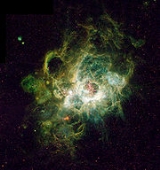
Triangulum
Eagle Nebula Pillars
A nebula (from Latin
Latin

Latin is an Italic language, historically spoken in Latium and Ancient Rome. Through the Military history of the Roman Empire, Latin spread throughout the Mediterranean and a large part of Europe....
: "cloud" ; pl. nebulae or nebulę, with ligature
Ę

? is a grapheme formed from the letters a and e. Originally a ligature representing a Latin diphthong, it has been promoted to the full status of a letter in the alphabets of many languages....
 or nebulas) is an interstellar cloud
Interstellar cloud

Interstellar cloud is the generic name given to an accumulation of gas, plasma and cosmic dust in milky way and other galaxy. Put differently, an interstellar cloud is a denser-than-average region of the interstellar medium....
 of dust
Cosmic dust

Cosmic dust is a type of dust composed of particles in space which are a few molecules to 0.1 mm in size. Cosmic dust can be further distinguished by its astronomical location; for example: intergalactic dust, interstellar dust , interplanetary dust and circumplanetary dust ....
, hydrogen
Hydrogen

Hydrogen is the chemical element with atomic number 1. It is represented by the chemical symbol H. At standard temperature and pressure, hydrogen is a colorless, odorless, nonmetallic, tasteless, highly combustion and explosive Diatomic molecule gas with the molecular formula H2....
 gas and plasma
Plasma (physics)

In physics and chemistry, plasma is a partially ionized gas, in which a certain proportion of electrons are free rather than being bound to an atom or molecule....
. Originally nebula was a general name for any extended astronomical
Astronomy

Astronomy is the science of Astronomical object and Phenomenon that originate outside the Earth's atmosphere . It is concerned with the evolution, physics, chemistry, meteorology, and motion of celestial objects, as well as the physical cosmology....
 object
Astronomical object

s are significant entity, associations or structures which current science has confirmed to exist in outer space. This does not necessarily mean that more current science will not disprove their existence....
, including galaxies
Galaxy

A galaxy is a massive, gravitation system that consists of stars and stellar remnants, an interstellar medium of gas and cosmic dust, and an important but poorly-understood component tentatively dubbed dark matter....
 beyond the Milky Way
Milky Way

The Milky Way, sometimes called simply the Galaxy, is the galaxy in which the Solar System is located. It is a barred spiral galaxy that is part of the Local Group of galaxies....
 (some examples of the older usage survive; for example, the Andromeda Galaxy
Andromeda Galaxy

The Andromeda Galaxy is a spiral galaxy approximately 2.5 million light-years away in the constellation Andromeda . It is the nearest spiral galaxy to our own, the Milky Way Galaxy....
 was referred to as the Andromeda
Andromeda (mythology)

Andromeda was a woman from Greek mythology who, as divine punishment for her mother's bragging, was chained to a rock as a sacrifice to a sea monster....
 Nebula
before galaxies were discovered by Edwin Hubble
Edwin Hubble

Edwin Powell Hubble was an United States Astronomy. He profoundly changed astronomers' understanding of the nature of the universe by demonstrating the existence of other galaxies besides the Milky Way....
). Nebulae often form star-forming regions, such as in the Eagle Nebula
Eagle Nebula

The Eagle Nebula is a young open cluster of stars in the constellation Serpens, discovered by Jean-Philippe de Cheseaux in 1745-46. Its name derives from its shape which is reminiscent of an eagle....
. This nebula is depicted in one of NASA
NASA

The National Aeronautics and Space Administration is an agency of the Federal government of the United States, responsible for the nation's public list of space agencies....
's most famous images, the "Pillars of Creation
Eagle Nebula

The Eagle Nebula is a young open cluster of stars in the constellation Serpens, discovered by Jean-Philippe de Cheseaux in 1745-46. Its name derives from its shape which is reminiscent of an eagle....
". In these regions the formations of gas, dust and other materials 'clump' together to form larger masses, which attract further matter, and eventually will become big enough to form stars. The remaining materials are then believed to form planet
Planet

A planet , as 2006 definition of planet by the International Astronomical Union , is a celestial body orbiting a star or Stellar evolution#Stellar remnants that is massive enough to be rounded by its own gravity, is not massive enough to cause thermonuclear fusion, and has cleared the neighbourhood of planetesimals....
s, and other planetary system
Planetary system

A planetary system consists of the various non-stellar objects orbiting a star such as planets, natural satellites, asteroids, meteoroids, comets, and cosmic dust....
 objects.

Formation

Ngc2024 2mass
Many nebulae form the gravitational collapse of gas in the interstellar medium
Interstellar medium

In astronomy, the interstellar medium is the gas and cosmic dust that pervade interstellar space: the matter that exists between the stars within a galaxy....
 or ISM. As the material collapses under its own weight, massive stars may form in the center, and their ultraviolet radiation ion
Ion

An ion is an atom or molecule which has lost or gained one or more electrons, giving it a positive or negative electrical charge. According to the Bohr_model this will be from or in the outer shield 'n'....
ises the surrounding gas, which creates plasma (the 4th state of matter), making it visible at optical wavelength
Wavelength

In physics, wavelength is the distance between repeating units of a propagating wave of a given frequency. It is commonly designated by the Greek language letter lambda ....
s. An example of this type of nebula is the Rosette Nebula
Rosette Nebula

The Rosette Nebula is a large, circular H II region located near one end of a giant molecular cloud in the Monoceros region of the Milky Way. The open cluster NGC 2244 is closely associated with the nebulosity, the stars of the cluster having been formed from the nebula's matter....
 or the Pelican Nebula
Pelican Nebula

The Pelican Nebula is an H II region associated with the North America Nebula in the constellation Cygnus . The emission nebula resembles a pelican in shape, hence the name....
. The size of these nebulae, known as HII regions, varies depending on the size of the original cloud of gas, and the number of stars formed can vary too. As the sites of star formation, the formed stars are sometimes known as a young, loose cluster.

Some nebulae are formed as the result of supernova
Supernova

A supernova is a Astronomy#Stellar astronomy explosion. Supernovae are extremely luminous and cause a burst of radiation that often briefly outshines an entire galaxy, before fading from view over several weeks or months....
 explosions, the death throes of massive, short-lived stars. The material thrown off from the supernova
Supernova

A supernova is a Astronomy#Stellar astronomy explosion. Supernovae are extremely luminous and cause a burst of radiation that often briefly outshines an entire galaxy, before fading from view over several weeks or months....
 explosion is ionized by the supernova remnant. One of the best examples of this is the Crab Nebula
Crab Nebula

The Crab Nebula  is a supernova remnant and pulsar wind nebula in the constellation of Taurus . The nebula was first observed by John Bevis, and corresponds to a bright supernova recorded by Chinese astronomy and Islamic astronomy astronomers SN 1054....
, in Taurus
Taurus (constellation)

Taurus is one of the constellations of the zodiac. Its name is Latin for cattle, and its symbol is , a stylized bull's head. Taurus is a large and prominent constellation in the northern hemisphere's winter sky, between Aries to the west and Gemini to the east; to the north lie Perseus and Auriga , to the southeast Orion , to the south E...
. It is the result of a recorded supernova, SN 1054
SN 1054

SN 1054 was a supernova that was widely seen on Earth in the year 1054. It was recorded by Chinese astronomy, Japanese, and Islamic astronomy as being bright enough to see in daylight for 23 days and was visible in the night sky for 653 days. The progenitor star was located in the Milky Way galaxy at a distance of 6,300 light years and...
, in the year 1054 and at the centre of the nebula is a neutron star
Neutron star

A neutron star is a type of compact star that can result from the gravitational collapse of a massive star during a Type II supernova, Type Ib and Ic supernovae supernova event....
, created during the explosion.

Other nebulae may form as planetary nebulae. This is the final stage of a low-mass star's life, like Earth
Earth

Earth is the third planet from the Sun. Earth is the largest of the terrestrial planets in the Solar System in diameter, mass and density. It is also referred to as the World and Wiktionary:Terra.Note that by International Astronomical Union convention, the term "Terra" is used for naming extensive land masses, rather...
's Sun
Sun

The Sun , a G V star, is the star at the center of the Solar System. The Earth and other matter orbit the Sun, which by itself accounts for about 98.6% of the Solar System's mass....
. Star
Star

A star is a massive, luminous ball of Plasma that is held together by its own gravity. The nearest star to Earth is the Sun, which is the source of most of the energy on Earth....
s with a mass
Mass

In physical science, mass refers to the degree of acceleration a body acquires when subject to a force: bodies with greater mass are accelerated less by the same force....
 up to 8-10 solar masses evolve into red giant
Red giant

A red giant is a luminous giant star of low or intermediate mass that is in a late phase of stellar evolution. The outer atmosphere is inflated and tenuous, making the radius immense and the surface temperature low, somewhere from 5,000 K and lower....
s and slowly lose their outer layers during pulsations in their atmospheres. When a star has lost a sufficient amount of material, its temperature increases and the ultraviolet radiation it emits is capable of ion
Ion

An ion is an atom or molecule which has lost or gained one or more electrons, giving it a positive or negative electrical charge. According to the Bohr_model this will be from or in the outer shield 'n'....
izing the surrounding nebula that it has thrown off.

Diffuse nebulae

Omega Nebula
Pleiades Large
Most nebulae can be described as diffuse nebulae, which means that they are extended and contain no well-defined boundaries. In visible light these nebulae may be divided into emission nebula
Emission nebula

An emission nebula is a cloud of ionized gas emitting light of various colors. The most common source for ionization are high-energy photons emitted from a nearby hot star....
e and reflection nebula
Reflection nebula

In Astronomy, reflection nebulae are interstellar cloud of dust which are simply reflecting the light of a nearby star or stars. The energy from the nearby star, or stars, is insufficient to ionize the gas of the nebula to create an emission nebula, but is enough to give sufficient scattering to make the dust visible....
e, a categorization that depends on how the light we see is created. Emission nebulae contain ion
Ion

An ion is an atom or molecule which has lost or gained one or more electrons, giving it a positive or negative electrical charge. According to the Bohr_model this will be from or in the outer shield 'n'....
ized gas (mostly ionized hydrogen
Hydrogen

Hydrogen is the chemical element with atomic number 1. It is represented by the chemical symbol H. At standard temperature and pressure, hydrogen is a colorless, odorless, nonmetallic, tasteless, highly combustion and explosive Diatomic molecule gas with the molecular formula H2....
) that produces spectral line
Spectral line

A spectral line is a dark or bright line in an otherwise uniform and continuous optical spectrum, resulting from an excess or deficiency of photons in a narrow frequency range, compared with the nearby frequencies....
 emission. These emission nebulae are often called HII regions; the term "HII" is used in professional astronomy to refer to ionized hydrogen. In contrast to emission nebulae, reflection nebulae do not produce significant amounts of visible light by themselves but instead reflect light from nearby stars.
Horsehead Hubble
Dark nebulae are similar to diffuse nebulae, but they are not seen by their emitted or reflected light. Instead, they are seen as dark clouds in front of more distant stars or in front of emission nebulae.

Although these nebulae appear different at optical wavelengths, they all appear to be bright sources of emission at infrared
Infrared

Infrared radiation is electromagnetic radiation whose wavelength is longer than that of visible light , but shorter than that of terahertz radiation and microwaves ....
 wavelengths. This emission comes primarily from the dust
Cosmic dust

Cosmic dust is a type of dust composed of particles in space which are a few molecules to 0.1 mm in size. Cosmic dust can be further distinguished by its astronomical location; for example: intergalactic dust, interstellar dust , interplanetary dust and circumplanetary dust ....
 within the nebulae.

Specific types of nebulae

While diffuse nebulae have poorly-defined boundaries, a few nebulae may actually be described as discrete objects with identifiable boundaries.

Planetary nebulae

Ngc6543
Planetary nebula
Planetary nebula

A planetary nebula is an emission nebula consisting of a glowing shell of gas and Plasma formed by certain types of stars when they die. The name originated in the 18th century because of their similarity in appearance to gas giants when viewed through small optical telescopes, and is unrelated to the planets of the solar system....
e are nebulae that form from the gaseous shells that are ejected from low-mass asymptotic giant branch stars when they transform into white dwarf
White dwarf

A white dwarf, also called a degenerate dwarf, is a small star composed mostly of electron-degenerate matter. Because a white dwarf's mass is comparable to that of the Sun and its volume is comparable to that of the Earth, it is very density....
s. These nebulae are emission nebulae with spectral emission that is similar to the emission nebulae found in star formation
Star formation

Star formation is the process by which dense parts of molecular clouds collapse into a ball of Plasma to form a star. As a branch of astronomy star formation includes the study of the interstellar medium and giant molecular clouds as precursors to the star formation process and the study of young stellar objects and planet formation as its i...
 regions. Technically, they are a type of HII region because the majority of hydrogen
Hydrogen

Hydrogen is the chemical element with atomic number 1. It is represented by the chemical symbol H. At standard temperature and pressure, hydrogen is a colorless, odorless, nonmetallic, tasteless, highly combustion and explosive Diatomic molecule gas with the molecular formula H2....
 will be ionised. However, planetary nebulae are denser and more compact than the emission nebulae in star formation regions. Planetary nebulae are so called because the first astronomers
Astronomy

Astronomy is the science of Astronomical object and Phenomenon that originate outside the Earth's atmosphere . It is concerned with the evolution, physics, chemistry, meteorology, and motion of celestial objects, as well as the physical cosmology....
 who observed these objects thought that the nebulae resembled the disks of planets, although they are not at all related to planets.
Protoplanetary nebula
Pia04533
A protoplanetary nebula
Protoplanetary nebula

A protoplanetary nebula or preplanetary nebula is an astronomical object which is at the short-lived episode during a star's rapid stellar evolution between the late asymptotic giant branch phase and the subsequent planetary nebula phase....
 (PPN) is an astronomical object which is at the short-lived episode during a star's rapid stellar evolution
Stellar evolution

Stellar evolution is the process by which a star undergoes a sequence of radical changes during its lifetime. Depending on the mass of the star, this lifetime ranges from only few millions of years to trillions of years , considerably more than the age of the universe....
 between the late asymptotic giant branch
Asymptotic Giant Branch

The asymptotic giant branch is the region of the Hertzsprung-Russell diagram populated by evolving low to medium-mass stars. This is a period of stellar evolution undertaken by all low to intermediate mass stars late in their life....
 (LAGB) phase and the subsequent planetary nebula (PN) phase. A PPN emits strong infrared radiation, and is a kind of reflection nebula. The exact point when a PPN becomes a planetary nebula (PN) is defined by the temperature of the central star.

Supernova remnants

Crab Nebula
A supernova
Supernova

A supernova is a Astronomy#Stellar astronomy explosion. Supernovae are extremely luminous and cause a burst of radiation that often briefly outshines an entire galaxy, before fading from view over several weeks or months....
 occurs when a high-mass star reaches the end of its life. When nuclear fusion
Nuclear fusion

In nuclear physics and nuclear chemistry, nuclear fusion is the process by which multiple like-charged atomic nuclei join together to form a heavier nucleus....
 ceases in the core of the star, the star collapses inward on itself. The gas falling inward either rebounds or gets so strongly heated that it expands outwards from the core, thus causing the star to explode. The expanding shell of gas form a supernova remnant
Supernova remnant

A supernova remnant is the structure resulting from the gigantic explosion of a star in a supernova. The supernova remnant is bounded by an expanding shock wave, and consists of ejected material expanding from the explosion, and the interstellar material it sweeps up and shocks along the way....
, a special type of diffuse nebula. Although much of the optical and X-ray
X-ray

X-radiation is a form of electromagnetic radiation. X-rays have a wavelength in the range of 10 to 0.01 nanometers, corresponding to frequency in the range 30 Hertz to 30 Hertz and energies in the range 120 Electron volt to 120 keV....
 emission from supernova remnants originates from ionized gas, a substantial amount of the radio
Radio

Radio is the transmission of signals, by modulation of electromagnetic radiation with frequency below those of visible light.Electromagnetic radiation radio propagation by means of oscillating electromagnetic fields that pass through the air and the vacuum of space....
 emission is a form of non-thermal emission called synchrotron emission. This emission originates from high-velocity electrons oscillating within magnetic field
Magnetic field

A magnetism field is a vector field which can exert a magnetic force on moving electric charges and on magnetic dipoles . When placed in a magnetic field, magnetic dipoles tend to align their axes parallel to the magnetic field....
s.

Notable named nebulae

  • Ant Nebula
  • Barnard's Loop
    Barnard's Loop

    Barnard's Loop is an emission nebula nebula in the constellation of Orion . It is part of a giant molecular cloud which also contains the bright Horsehead Nebula and Orion Nebula nebulae....
  • Boomerang Nebula
    Boomerang Nebula

    The Boomerang Nebula is a protoplanetary nebula located 5,000 light-years away from Earth in the Centaurus. The nebula is measured at , the coldest place known in the universe....
  • Cat's Eye Nebula
    Cat's Eye Nebula

    The Cat's Eye Nebula is a planetary nebula in the constellation of Draco . Structurally, it is one of the most complex nebulae known, with high-resolution Hubble Space Telescope observations revealing remarkable structures such as knots, jets and sinewy arc-like features....
  • Crab Nebula
    Crab Nebula

    The Crab Nebula  is a supernova remnant and pulsar wind nebula in the constellation of Taurus . The nebula was first observed by John Bevis, and corresponds to a bright supernova recorded by Chinese astronomy and Islamic astronomy astronomers SN 1054....
  • Eagle Nebula
    Eagle Nebula

    The Eagle Nebula is a young open cluster of stars in the constellation Serpens, discovered by Jean-Philippe de Cheseaux in 1745-46. Its name derives from its shape which is reminiscent of an eagle....
  • Eta Carinae Nebula
    Eta Carinae Nebula

    The Carina Nebula is a large bright nebula that surrounds several open clusters of stars. Eta Carinae and HD 93129A, two of the most massive and luminous stars in our Milky Way galaxy, are among them....
  • Hourglass Nebula
    Hourglass Nebula

    The Engraved Hourglass Nebula is a young planetary nebula situated in the southern constellation Musca about 8,000 light-years away from Earth....
  • Horsehead Nebula
    Horsehead Nebula

    The Horsehead Nebula is a dark nebula in the Orion constellation. The nebula is located just below Alnitak, the star furthest left on Orion's Belt, and is part of the much larger Orion Molecular Cloud Complex....
  • Orion Nebula
    Orion Nebula

    The Orion Nebula is a diffuse nebula situated south of Orion 's Belt. It is one of the brightest nebulae, and is visible to the naked eye in the night sky....
  • Red Square Nebula
    Red Square Nebula

    The Red Square Nebula is a celestial object located in the area of the sky occupied by star MWC 922. The first images of this bipolar nebula, taken using the Palomar Observatory Hale telescope in California, were released in April 2007....
  • Ring Nebula
    Ring Nebula

    The famously named "Ring Nebula" is located in the northern constellation of Lyra, and also catalogued as Messier 57, M57 or NGC 6720....
  • Rosette Nebula
    Rosette Nebula

    The Rosette Nebula is a large, circular H II region located near one end of a giant molecular cloud in the Monoceros region of the Milky Way. The open cluster NGC 2244 is closely associated with the nebulosity, the stars of the cluster having been formed from the nebula's matter....
  • Tarantula Nebula
    Tarantula Nebula

    The Tarantula Nebula is an H II region in the Large Magellanic Cloud. It was originally thought to be a star, but in 1751 Nicolas Louis de Lacaille recognized its nebular nature....


See also

  • H I region
    H I region

    An H I region is an interstellar cloud composed of neutral atomic hydrogen . These regions are non-luminous, save for emission of the hydrogen line spectral line....
  • H II region
    H II region

    An H II region is a cloud of glowing gas and Plasma , sometimes several hundred light-years across, in which star formation is taking place....
  • List of diffuse nebulae
    List of diffuse nebulae

    This lists:* Diffuse nebula* Emission nebula* Reflection nebula...
  • Magellanic Clouds
    Magellanic Clouds

    The two Magellanic Clouds are irregular galaxy dwarf galaxy Galaxy morphological classification, which are members of our Local Group of galaxies....
  • Messier object
    Messier object

    The Messier objects are a set of astronomical objects first listed by France astronomy Charles Messier in his "Catalogue des N?buleuses et des Amas d'?toiles" included in the Connaissance des Temps for 1774 ....
  • Orion Molecular Cloud Complex
    Orion Molecular Cloud Complex

    The Orion Molecular Cloud Complex refers to a large nebula located in the constellation of Orion . The cloud itself is between 1,500 and 1,600 light-years away and is hundreds of light-years across....
  • Timeline of the interstellar medium and intergalactic medium


Further reading

  • Lightner, G. Samuel. "Nebulae: Fuzzy Patches in Space." FusedWed.pppl.gov/CPEP 18 December 2000.


---. "Nebulae." FusedWed.pppl.gov/CPEP

--- 17 November 2005

---. "Reflection Nebulae." FusedWed.pppl.gov/CPEP 18 December 2000

---. "Emission Nebulae." FusedWed.pppl.gov/CPEP 18 December 2000

---. "Planetary Nebulae." FusedWed.pppl.gov/CPEP 18 December 2000

---. "Supernova Remnants." FusedWed.pppl.gov/CPEP 18 December 2000

External links