

Procession

Encyclopedia
A procession is an organized body of people advancing in a formal or ceremonial manner.
.jpg) Edo Period
Edo Period
documenters enjoyed drawing the processions of pleasure district beauties, such as Courtesan Parading With Attendants by Suzuki Harunobu
. Similar parading courtesans feature in Cherry Blossom in the Evening on the Nakanomachi in Yoshiwara by Utagawa Hiroshige and True Scenery of the Gay Quarter of Minatozakimachi Shinminato by Utagawa Sadahide. The Lord Mayor's Show
in London
has long featured displays by the city's official trade guilds. Parades were at one time important advertisement when a traveling circus
arrived in a new town. Today, many parades in the United States are sponsored by department stores, such as Macy's
, which expect the public spectacle to lure shoppers to the store.
was one such example, documented by Jean-Léon Gérôme
in 1864. The signing of surrender by Japanese diplomats and soldiers aboard an American battle ship at the end of World War II
involved a strictly codified procession on and off the ship. Processions play an important role in coronations, such as that of Elizabeth II of the United Kingdom
in 1953, the Shah
of Iran
in 1967, Otumfuo Osei Tutu II of the Ashanti in 1999, and Norodom Sihamoni
of Cambodia
in 2004.
, and modern reviewing of the troops by generals and heads of state. Return From Vienna, a painting by Jozef Brandt
, shows war booty taken from the Turks being escorted into eastern Europe
by soldiers.
and the United States of America.
once staged elaborate barge
processions to bless the waters Venice's tightly controlled maritime economy existed on. Symbolic processions were an important tool in the non-violent protest of Gandhi. Marches on Washington include formal processions. Gay Pride
parades also started with this basis in New York City
.
, or processions that begin and end funeral
s, graduation
s, and wedding
s.
processions. Some biblical examples were the processions with the Ark of Covenant and the procession of Jesus on a donkey into Jerusalem.
, and Roman triumphal reliefs, such as those of the arch of Titus
.
and the Phallic processions
, and later formed an essential part of the celebration of the great religious festivals (e.g. the processions of the Thesmophoria
, and that of the Great Dionysia), and of the mysteries (e.g. the great procession from Athens to Eleusis, in connection with the Eleusinia).
Of the Roman processions, the most prominent was that of the Triumph
, which had its origin in the return of the victorious army headed by the general, who proceeded in great pomp from the Campus to the Capitol to offer sacrifice, accompanied by the army, captives, spoils, the chief magistrate, priests bearing the images of the gods, amidst strewing of flowers, burning of incense and the like (Ovid
, Trist. iv. 2, 3 and 6). Connected with the triumph was the pompa circensis
, or solemn procession that preceded the games in the circus. It first came into use at the Ludi Romani
, when the games were preceded by a great procession from the Capitol to the Circus. The praetor
or consul
who appeared in the ponipa circensis wore the robes of a triumphing general (see Mommsen, Staatsrec/zt I. 397 for the connection of the triumph with the ludi
). Thus, when it became customary for the consul to celebrate games at the opening of the consular year, he came, under the empire, to appear in triumphal robes in the processus consularis, or procession of the consul to the Capitol to sacrifice to Jupiter.
, the consular processions in Constantinople
retained their religious character, now proceeding to Hagia Sophia
, where prayers and offerings were made; but in Rome, where Christianity was not so widely spread among the upper classes, at first the tendency was to convert the procession into a purely civil function, omitting the pagan rites and prayers, without substituting Christian ones Only after Theodosius did the processions become a religious event, repeat with icons, crosses, and banners. There were other local processions connected with the primitive worship of the country people, which remained unchanged, but they were eventually overshadowed by the popular piety of the Church. Such were those of the Ambarvalia
, Robigalia
, which were essentially rustic festivals, lustration
s of the fields, consisting in a procession round the spot to be purified, leading the sacrificial victims with prayers, hymns, and ceremonies to protect the young crops from evil influence.
Tertullian
(2nd century) uses processio and procedere in the sense of to go out, appear in public, and, as applied to a church function, processio was first used in the same way as collecta, i.e. for the assembly of the people in a church. In this sense it appears to be used by Pope Leo I
, while in the version by Dionysius Exiguus
of the 17th canon of the Council of Laodicaea ouv&~eoi, is translated by processionibus.
For the processions that formed part of the ritual of the Eucharist, those of the introit, the gospel and the oblation, the earliest records date from the 6th century and even later, but they evidently were established at a much earlier date. As to public processions, these seem to have come into rapid vogue after the recognition of Christianity as the religion of the empire. Those at Jerusalem would seem to have been long established when described by the authoress of the Peregrinatio Silviae towards the end of the 4th century.
Very early were the processions accompanied by hymns and prayers, known as litaniae, rogationes or supplicationes. It is to such a procession that reference appears to be made in a letter of St Basil, which would thus be the first recorded mention of a public Christian procession. The first mention for the Western Church occurs in St Ambrose. In both these cases the litanies are stated to have been long in use. There is also mention of a procession accompanied by hymns, organized at Constantinople by St John Chrysostom (c. 390-400) in opposition to a procession of Arians
, in Sozomen
. In times of calamity litanies were held, in which the people walked in robes of penitence, fasting, barefooted, and, in later times, frequently dressed in black (litaniae nigrae). The cross was carried at the head of the procession and often the gospel and the relics of the saint were carried. Gregory of Tours
gives numerous instances of such litanies in time of calamity; thus he describes a procession of the clergy and people round the city, in which relics of St Remigius were carried and litanies chanted in order to avert the plague. So, too, Gregory the Great writes to the Sicilian bishops to hold processions to prevent a threatened invasion of Sicily. A famous instance of these penitential litanies is the litania septiformis ordered by Gregory the Great in the year 590, when Rome had been inundated and pestilence had followe
In this litany seven processions, of clergy, laymen, monks, nuns, matrons, the poor, and children respectively, starting from seven different churches, proceeding to hear mass at St. Maria Maggiore. This litany has often been confused with the litania major, introduced at Rome in 598 (vide supra) , but is quite distinct from it. Funeral processions, accompanied with singing and the carrying of lighted tapers, were very early customary (see ceremonial use of lights
), and akin to these, also very early, were the processions connected with the translation of the relics of martyrs from their original burying place to the church where they were to be enshrined. From the time of the emperor Constantine I these processions were of great magnificence.
Some liturgists maintain that the early Church in its processions followed Old Testament precedents, quoting such cases as the procession of the ark
round the walls of Jericho, the procession of David with the ark, the processions of thanksgiving on the return from captivity, &c. The liturgy of the early Church as Duchesne shows was influenced by that of the Jewish synagogue, but the theory that the Church's processions were directly related to the Old Testament ritual is of late origin.
Festivals involving processions were adopted by the Christian Church from the pagan calendar of Rome. The litaniae majores et minores, which are stated by Hermann Usener
to have been first instituted by Pope Liberius
(352-366). It is generally acknowledged that they are the equivalent of the Christian Church of the Roman lustrations of the crops in spring, the Ambarvalia
, &c. The litania major, or great procession on St Mark's day (April 25) is shown to coincide both in date and ritual with the Roman Robigalia
, which took place ad. vii. Kal. Mai., and consisted in a procession leaving Rome by the Flaminian gate, and proceeding by way of the Milvian bridge to a sanctuary at the 5th milestone of the Via Claudia, where the flamen quirinalis sacrificed a dog and a sheep to avert blight (robigo) from the crops. The litania major followed the same route as far as the Milvian bridge, when it turned off and returned to St Peter's, where mass was celebrated. This was already established as an annual festival by 598, as is shown by a document of Gregory the Great that inculcates the duty of celebrating litaniam, quae major ab omnibus appellatur. The litaniae minores or rogations, held on the three days preceding Ascension Day, were first introduced into Gaul by Bishop Mamertus of Vienne (c. 470), and made binding for all Gaul by the First Council of Orleans
(511). The litaniae minores were also adopted for these three days in Rome by Pope Leo III
(c. 800).
A description of the institution and character of the Ascensiontide rogations is given by Sidonius Apollinaris
. The solemnity of these, he says, was first established by Mamertus. Hitherto they had been erratic, lukewarm, and poorly attended (vagae, tepentes, infrequentesque). Those he instituted were characterized by fasting, prayers, psalms, and tears. In the Ambrosian rite the rogations take place after Ascension, and in the Spanish on the Thursday to Saturday after Whitsuntide, and in November (Synod of Girona, 517).
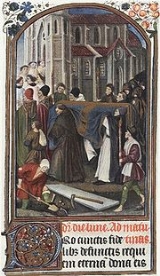
. The most important and characteristic of these still have a place in the ritual of the Catholic Church, as well as those of the Church of England
and the Eastern Orthodox churches.
There are also processions of honor, for instance to meet a royal personage, or the bishop on his first entry into his diocese (Pontif. Tom. iii.). Those taking part in processions are to walk bare-headed (weather permitting), two and two, in decent costume, and with reverent mien; clergy and laity, men and women, are to walk separately. The cross is carried at the head of the procession, and banners embroidered with sacred pictures in places where this is customary; these banners must not be of military or triangular shape. Violet
is the color prescribed for processions, except on the Feast of Corpus Christi, or on a day when some other color is prescribed. The officiating priest wears a cope
, or at least a surplice
with a violet stole, the other priests and clergy wear surplices.
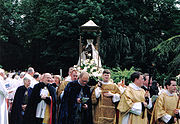
Where the host is carried in procession it is covered always by a canopy, and accompanied by lights. At the litaniae majores and minores and other penitential processions, joyful hymns are not allowed, but the litanies are sung, and, if the length of the procession requires, the penitential and gradual psalms. As to the discipline regarding processions the bishop, according to the Council of Trent
(Sess. 25 de reg. cap. 6), appoints and regulates processions and public prayers outside the churches.
The observance or variation of the discipline belongs to the Congregation of Rites; in pontifical processions, which are regulated by the masters of the ceremonies (magistri ceremoniarum pontificalium), these points are decided by the chief cardinal deacon. As to processions within the churches, some difference of opinion having arisen as to the regulating authority, the Congregation of Rites has decided that the bishop must ask, though not necessarily follow, the advice of the chapter in their regulation.
.jpg)
abolished in all Protestant countries those processions associated with the doctrine of transubstantiation
(Corpus Christi); the Sacrament of the Lord's Supper, according to the 28th Article of Religion of the Church of England was not by Christs ordinance reserved, carried about, lifted up, or worshipped. It also abolished those associated with the cult of the Blessed Virgin and the saints. The stern simplicity of Calvinism
, indeed, would not tolerate religious processions of any kind, and from the Reformed Churches they vanished altogether. The more conservative temper of the Anglican and Lutheran communions, however, suffered the retention of such processions as did not conflict with the reformed doctrines, though even in these Churches they met with opposition and tended after a while to fall into disuse.
Kirchenordnung of 1553, a funeral procession was prescribed, the bier being followed by the congregation singing hymns; the Brandenburg Kirchenordnung (1540) directed a cross-bearer to precede the procession and lighted candles to be carried, and this was prescribed also by the Waldeck Kirchenordnung of 1556. At present funeral processions survive in general only in the country districts; the processional cross or crucifix is still carried. In some provinces also the Lutheran Church has retained the ancient rogation processions in the week before Whitsuntide and, in some cases, in the month of May or on special occasions (e.g. days of humiliation, Busstage), processions about the fields to ask a blessing on the crops. On these occasions the ancient litanies are still used.
In a narrower sense of going forth, proceeding, the term is used in the technical language of theology
in the phrase Procession of the Holy Ghost, expressing the relation of the Third Person in the Triune Godhead to the Father and the Son.
. Some examples include:
Procession elements
Many elements may be used to make a procession more significant than just "people walking in the same direction":- A special mode of transport, such as a ceremonial bargeBargeA barge is a flat-bottomed boat, built mainly for river and canal transport of heavy goods. Some barges are not self-propelled and need to be towed by tugboats or pushed by towboats...
, elephant howdahHowdahA howdah, or houdah, also known as hathi howdah, is a carriage which is positioned on the back of an elephant, or occasionally some other animal, used most often in the past to carry wealthy people or for use in hunting or warfare...
, horse drawn carriageCarriageA carriage is a wheeled vehicle for people, usually horse-drawn; litters and sedan chairs are excluded, since they are wheelless vehicles. The carriage is especially designed for private passenger use and for comfort or elegance, though some are also used to transport goods. It may be light,...
, or a palanquinLitter (vehicle)The litter is a class of wheelless vehicles, a type of human-powered transport, for the transport of persons. Examples of litter vehicles include lectica , jiao [较] , sedan chairs , palanquin , Woh , gama...
carried on the shoulders of others. Cleopatra's arrival to seduce Mark AnthonyMark AnthonyMark Anthony may refer to:Persons* Mark Antony , statesman and general in Ancient Rome* Marc Anthony , singer/songwriter and former husband of Jennifer Lopez* Mark Anthony , Canadian DJ and music producer...
on a perfumed barge has taken on legendary proportion. African kings sometimes ride in palanquins carved to look like luxury cars or other status symbolStatus symbolA status symbol is a perceived visible, external denotation of one's social position and perceived indicator of economic or social status. Many luxury goods are often considered status symbols...
s, while Muslim brides travel in camel howdahs as shown in Bride Arriving in a Village, Biskra, AlgeriaAlgeriaAlgeria , officially the People's Democratic Republic of Algeria , also formally referred to as the Democratic and Popular Republic of Algeria, is a country in the Maghreb region of Northwest Africa with Algiers as its capital.In terms of land area, it is the largest country in Africa and the Arab...
by Philippe Pavy. The PopePopeThe Pope is the Bishop of Rome, a position that makes him the leader of the worldwide Catholic Church . In the Catholic Church, the Pope is regarded as the successor of Saint Peter, the Apostle...
has traditionally been carried in a special sedan chair known as the sedia gestatoriaSedia gestatoriaThe sedia gestatoria is a portable throne on which Popes were carried until 1978. It consists of a richly adorned, silk-covered armchair, fastened on a suppedaneum, on each side of which are two gilded rings; through these rings pass the long rods with which twelve footmen , in red uniforms, carry...
. In humbler terms, a mayorMayorIn many countries, a Mayor is the highest ranking officer in the municipal government of a town or a large urban city....
, grand marshalGrand MarshalGrand Marshal is a ceremonial, military, or political office of very high rank. The term has its origins with the word "Marshal" with the first usage of the term "Grand Marshal" as a ceremonial title for certain religious orders...
, or fair "queen" of a local parade will often ride in the town's fanciest automobileAutomobileAn automobile, autocar, motor car or car is a wheeled motor vehicle used for transporting passengers, which also carries its own engine or motor...
. - Music, including everything from the choirChoirA choir, chorale or chorus is a musical ensemble of singers. Choral music, in turn, is the music written specifically for such an ensemble to perform.A body of singers who perform together as a group is called a choir or chorus...
of a church procession to the marching bandMarching bandMarching band is a physical activity in which a group of instrumental musicians generally perform outdoors and incorporate some type of marching with their musical performance. Instrumentation typically includes brass, woodwinds, and percussion instruments...
of a military procession. Criers may march before the procession, yelling to clear the way for it. Some high school homecomingHomecomingHomecoming is the tradition of welcoming back alumni of a school. It most commonly refers to a tradition in many universities, colleges and high schools in North America...
parades include trucks filled with people who do nothing but make as much noise as possible. - Order of precedence- even without showy display, a group of people walking forward may be said to form a procession if their order and placement clearly visualize a hierarchy or symbiotic relationship. For instance, one's nearness to the king or others of high rank had important political connotations when the royal family walked to or from chapel services at the palace of VersaillesVersaillesVersailles , a city renowned for its château, the Palace of Versailles, was the de facto capital of the kingdom of France for over a century, from 1682 to 1789. It is now a wealthy suburb of Paris and remains an important administrative and judicial centre...
. Similarly, precedence came into play when the grandest Edwardian parties progressed from the sitting room to the dining room, and the stylized movement and hierarchy of marching military units clearly sets up a formal procession. - Bearers of bannerBannerA banner is a flag or other piece of cloth bearing a symbol, logo, slogan or other message. Banner-making is an ancient craft.The word derives from late Latin bandum, a cloth out of which a flag is made...
s, fans, iconIconAn icon is a religious work of art, most commonly a painting, from Eastern Christianity and in certain Eastern Catholic churches...
s, treasure, or other eye-catching items, or leading exotic animals. This was a very important part of Roman triumphRoman triumphThe Roman triumph was a civil ceremony and religious rite of ancient Rome, held to publicly celebrate and sanctify the military achievement of an army commander who had won great military successes, or originally and traditionally, one who had successfully completed a foreign war. In Republican...
s, as booty gave the Roman populace visual proof of the warrior's success. The most elaborate evolution of this is the spectacular floatFloat (parade)A float is a decorated platform, either built on a vehicle or towed behind one, which is a component of many festive parades, such as those of Mardi Gras in New Orleans, the Carnival of Viareggio, the Maltese Carnival, the Macy's Thanksgiving Day Parade, the Key West Fantasy Fest parade, the...
s of CarnivalCarnivalCarnaval is a festive season which occurs immediately before Lent; the main events are usually during February. Carnaval typically involves a public celebration or parade combining some elements of a circus, mask and public street party...
paradeParadeA parade is a procession of people, usually organized along a street, often in costume, and often accompanied by marching bands, floats or sometimes large balloons. Parades are held for a wide range of reasons, but are usually celebrations of some kind...
s. A simpler example is the ring bearer at a wedding. - Scent, provided by flower bearers or censers of incenseIncenseIncense is composed of aromatic biotic materials, which release fragrant smoke when burned. The term "incense" refers to the substance itself, rather than to the odor that it produces. It is used in religious ceremonies, ritual purification, aromatherapy, meditation, for creating a mood, and for...
.
- Skilled performers, such as acrobats or dancers
- Special costume. Traditionally, the costumes of acolyteAcolyteIn many Christian denominations, an acolyte is anyone who performs ceremonial duties such as lighting altar candles. In other Christian Churches, the term is more specifically used for one who wishes to attain clergyhood.-Etymology:...
s, footmen, ceremonial guards, or slaves help show off the wealth of the person staging a procession. An ornate example was the embroidered trainTrainA train is a connected series of vehicles for rail transport that move along a track to transport cargo or passengers from one place to another place. The track usually consists of two rails, but might also be a monorail or maglev guideway.Propulsion for the train is provided by a separate...
of George IV of the United KingdomGeorge IV of the United KingdomGeorge IV was the King of the United Kingdom of Great Britain and Ireland and also of Hanover from the death of his father, George III, on 29 January 1820 until his own death ten years later...
, carried at his coronation by nine lords in waiting with their own matching silken clothes, capes, ruffs, and plumed hats. Other examples include the Swiss GuardSwiss GuardSwiss Guards or Schweizergarde is the name given to the Swiss soldiers who have served as bodyguards, ceremonial guards, and palace guards at foreign European courts since the late 15th century. They have had a high reputation for discipline, as well as loyalty to their employers...
and high vestments of the Pope. The formal, matching clothes of bridesmaids and groomsmen are in the same tradition, although sometimes purchased at the attendant's expense rather than by the people honored in the ceremony. In egalitarian times and places, whoever has taken the time and money to put together something impressive may appear in a parade; such costumes are of course the focal point of HalloweenHalloweenHallowe'en , also known as Halloween or All Hallows' Eve, is a yearly holiday observed around the world on October 31, the night before All Saints' Day...
parades such as that staged in Greenwich VillageGreenwich VillageGreenwich Village, , , , .in New York often simply called "the Village", is a largely residential neighborhood on the west side of Lower Manhattan in New York City. A large majority of the district is home to upper middle class families...
, New York. Finally, processions may be staged simply to show off the costumes as one part of a larger event, such as at fashion pageants, military reenactments, pop concerts, or Renaissance Festivals. - Special lighting. Candlelight vigilCandlelight vigilA candlelight vigil is an outdoor assembly of people carrying candles, held after sunset. Such events are typically held either to protest the suffering of some marginalized group of people, or in memory of lives lost to some disease, disaster, massacre or other tragedy. In the latter case, the...
s for the deceased or to show political solidarity often include a candlelit procession. FireworksFireworksFireworks are a class of explosive pyrotechnic devices used for aesthetic and entertainment purposes. The most common use of a firework is as part of a fireworks display. A fireworks event is a display of the effects produced by firework devices...
illuminate such diverse events as coronations, parades, and Thai royal barge processions. - Spectacle, such as an aircraft flyoverFlypastFlypast is a term used in the United Kingdom, the Commonwealth, and other countries to denote ceremonial or honorific flights by groups of aircraft and, rarely, by a single aircraft...
, or the confetti of New York ticker tape parades - The dispensing of gifts, at one time often food or money. Today, most people are familiar with the dispensing of beads at Mardi GrasMardi GrasThe terms "Mardi Gras" , "Mardi Gras season", and "Carnival season", in English, refer to events of the Carnival celebrations, beginning on or after Epiphany and culminating on the day before Ash Wednesday...
and the throwing of candy at local fair parades.
Advertisement
Edo period
The , or , is a division of Japanese history which was ruled by the shoguns of the Tokugawa family, running from 1603 to 1868. The political entity of this period was the Tokugawa shogunate....
documenters enjoyed drawing the processions of pleasure district beauties, such as Courtesan Parading With Attendants by Suzuki Harunobu
Suzuki Harunobu
was a Japanese woodblock print artist, one of the most famous in the Ukiyo-e style. He was an innovator, the first to produce full-color prints in 1765, rendering obsolete the former modes of two- and three-color prints. Harunobu used many special techniques, and depicted a wide variety of...
. Similar parading courtesans feature in Cherry Blossom in the Evening on the Nakanomachi in Yoshiwara by Utagawa Hiroshige and True Scenery of the Gay Quarter of Minatozakimachi Shinminato by Utagawa Sadahide. The Lord Mayor's Show
Lord Mayor's Show
The Lord Mayor's Show is one of the longest established and best known annual events in London which dates back to 1535. The Lord Mayor in question is that of the City of London, the historic centre of London that is now the metropolis's financial district, informally known as the Square Mile...
in London
London
London is the capital city of :England and the :United Kingdom, the largest metropolitan area in the United Kingdom, and the largest urban zone in the European Union by most measures. Located on the River Thames, London has been a major settlement for two millennia, its history going back to its...
has long featured displays by the city's official trade guilds. Parades were at one time important advertisement when a traveling circus
Circus
A circus is commonly a travelling company of performers that may include clowns, acrobats, trained animals, trapeze acts, musicians, hoopers, tightrope walkers, jugglers, unicyclists and other stunt-oriented artists...
arrived in a new town. Today, many parades in the United States are sponsored by department stores, such as Macy's
Macy's
Macy's is a U.S. chain of mid-to-high range department stores. In addition to its flagship Herald Square location in New York City, the company operates over 800 stores in the United States...
, which expect the public spectacle to lure shoppers to the store.
Change in government
The Reception of the Ambassadors From Siam at the Château de FontainebleauChâteau de Fontainebleau
The Palace of Fontainebleau, located 55 kilometres from the centre of Paris, is one of the largest French royal châteaux. The palace as it is today is the work of many French monarchs, building on an early 16th century structure of Francis I. The building is arranged around a series of courtyards...
was one such example, documented by Jean-Léon Gérôme
Jean-Léon Gérôme
Jean-Léon Gérôme was a French painter and sculptor in the style now known as Academicism. The range of his oeuvre included historical painting, Greek mythology, Orientalism, portraits and other subjects, bringing the Academic painting tradition to an artistic climax.-Life:Jean-Léon Gérôme was born...
in 1864. The signing of surrender by Japanese diplomats and soldiers aboard an American battle ship at the end of World War II
World War II
World War II, or the Second World War , was a global conflict lasting from 1939 to 1945, involving most of the world's nations—including all of the great powers—eventually forming two opposing military alliances: the Allies and the Axis...
involved a strictly codified procession on and off the ship. Processions play an important role in coronations, such as that of Elizabeth II of the United Kingdom
Elizabeth II of the United Kingdom
Elizabeth II is the constitutional monarch of 16 sovereign states known as the Commonwealth realms: the United Kingdom, Canada, Australia, New Zealand, Jamaica, Barbados, the Bahamas, Grenada, Papua New Guinea, the Solomon Islands, Tuvalu, Saint Lucia, Saint Vincent and the Grenadines, Belize,...
in 1953, the Shah
Shah
Shāh is the title of the ruler of certain Southwest Asian and Central Asian countries, especially Persia , and derives from the Persian word shah, meaning "king".-History:...
of Iran
Iran
Iran , officially the Islamic Republic of Iran , is a country in Southern and Western Asia. The name "Iran" has been in use natively since the Sassanian era and came into use internationally in 1935, before which the country was known to the Western world as Persia...
in 1967, Otumfuo Osei Tutu II of the Ashanti in 1999, and Norodom Sihamoni
Norodom Sihamoni
Norodom Sihamoni is the current reigning King of Cambodia. He is the eldest son of Norodom Sihanouk and Norodom Monineath Sihanouk. Previously Cambodia's ambassador to UNESCO, he was named by a nine-member throne council to become the next king after his father Norodom Sihanouk abdicated in 2004...
of Cambodia
Cambodia
Cambodia , officially known as the Kingdom of Cambodia, is a country located in the southern portion of the Indochina Peninsula in Southeast Asia...
in 2004.
Display of power
Such as ancient Roman triumphs, the durbar processions of IndiaIndia
India , officially the Republic of India , is a country in South Asia. It is the seventh-largest country by geographical area, the second-most populous country with over 1.2 billion people, and the most populous democracy in the world...
, and modern reviewing of the troops by generals and heads of state. Return From Vienna, a painting by Jozef Brandt
Józef Brandt
Józef Brandt was a Polish painter, best known for his paintings of battles.Brandt studied in Warsaw in the school of J.N. Leszczynski and at the Noblemen's Institute. In 1858 he left for Paris to study at the Ecole centrale Paris but was persuaded by Juliusz Kossak to abandon engineering in favor...
, shows war booty taken from the Turks being escorted into eastern Europe
Europe
Europe is, by convention, one of the world's seven continents. Comprising the westernmost peninsula of Eurasia, Europe is generally 'divided' from Asia to its east by the watershed divides of the Ural and Caucasus Mountains, the Ural River, the Caspian and Black Seas, and the waterways connecting...
by soldiers.
Entertainment
Parades arranged purely for fun, such as those of community organizations and friendly societies, so popular in Great BritainGreat Britain
Great Britain or Britain is an island situated to the northwest of Continental Europe. It is the ninth largest island in the world, and the largest European island, as well as the largest of the British Isles...
and the United States of America.
Political solidarity
Religious ceremonies have since prehistory employed the procession of holy objects to inspire solidarity of belief. The doges of VeniceVenice
Venice is a city in northern Italy which is renowned for the beauty of its setting, its architecture and its artworks. It is the capital of the Veneto region...
once staged elaborate barge
Barge
A barge is a flat-bottomed boat, built mainly for river and canal transport of heavy goods. Some barges are not self-propelled and need to be towed by tugboats or pushed by towboats...
processions to bless the waters Venice's tightly controlled maritime economy existed on. Symbolic processions were an important tool in the non-violent protest of Gandhi. Marches on Washington include formal processions. Gay Pride
Gay pride
LGBT pride or gay pride is the concept that lesbian, gay, bisexual, and transgender people should be proud of their sexual orientation and gender identity...
parades also started with this basis in New York City
New York City
New York is the most populous city in the United States and the center of the New York Metropolitan Area, one of the most populous metropolitan areas in the world. New York exerts a significant impact upon global commerce, finance, media, art, fashion, research, technology, education, and...
.
Events
Processions used to mark the beginning or end of an event, such as parades at the beginning of county fairs or at the Olympic GamesOlympic Games
The Olympic Games is a major international event featuring summer and winter sports, in which thousands of athletes participate in a variety of competitions. The Olympic Games have come to be regarded as the world’s foremost sports competition where more than 200 nations participate...
, or processions that begin and end funeral
Funeral
A funeral is a ceremony for celebrating, sanctifying, or remembering the life of a person who has died. Funerary customs comprise the complex of beliefs and practices used by a culture to remember the dead, from interment itself, to various monuments, prayers, and rituals undertaken in their honor...
s, graduation
Graduation
Graduation is the action of receiving or conferring an academic degree or the ceremony that is sometimes associated, where students become Graduates. Before the graduation, candidates are referred to as Graduands. The date of graduation is often called degree day. The graduation itself is also...
s, and wedding
Wedding
A wedding is the ceremony in which two people are united in marriage or a similar institution. Wedding traditions and customs vary greatly between cultures, ethnic groups, religions, countries, and social classes...
s.
Religious processions
Processions are found in almost every form of religious worship, such as Holy WeekHoly Week
Holy Week in Christianity is the last week of Lent and the week before Easter...
processions. Some biblical examples were the processions with the Ark of Covenant and the procession of Jesus on a donkey into Jerusalem.
History
Processions have in all peoples and at all times been a natural form of public celebration, as forming an orderly and impressive ceremony. Religious and triumphal processions are abundantly illustrated by ancient monuments, e.g. the religious processions of Egypt, those illustrated by the rock-carvings of Boghaz-Keui, the many representations of processions in Greek art, culminating in the great Panathenaic procession of the Parthenon FriezeParthenon Frieze
The Parthenon frieze is the low relief, pentelic marble sculpture created to adorn the upper part of the Parthenon’s naos. It was sculpted between ca. 443 and 438 BC, most likely under the direction of Pheidias. Of the of the original frieze, survives—some 80 percent...
, and Roman triumphal reliefs, such as those of the arch of Titus
Arch of Titus
The Arch of Titus is a 1st-century honorific arch located on the Via Sacra, Rome, just to the south-east of the Roman Forum. It was constructed in c.82 AD by the Roman Emperor Domitian shortly after the death of his older brother Titus to commemorate Titus' victories, including the Siege of...
.
Greco-Roman practice
Processions played a prominent part in the great festivals of Greece, where they were always religious in character. The games were either opened or accompanied by more or less elaborate processions and sacrifices, while processions from the earliest times formed part of the worship of the old nature gods, as those connected with the cult of DionysusCult of Dionysus
The Cult of Dionysus is strongly associated with satyrs, centaurs, and sileni, and its characteristic symbols are the bull, the serpent, the ivy, and the wine. The Dionysia and Lenaia festivals in Athens were dedicated to Dionysus, as well as the Phallic processions...
and the Phallic processions
Phallic processions
Phallic processions, or Penis Parade, called phallika in ancient Greece, were a common feature of Dionysiac celebrations; they were processions that advanced to a cult center, and were characterized by obscenities and verbal abuse. The display of a fetishized phallus was a common feature...
, and later formed an essential part of the celebration of the great religious festivals (e.g. the processions of the Thesmophoria
Thesmophoria
Thesmophoria was a festival held in Greek cities, in honor of the goddesses Demeter and her daughter Persephone. The name derives from thesmoi, or laws by which men must work the land. The Thesmophoria were the most widespread festivals and the main expression of the cult of Demeter, aside from the...
, and that of the Great Dionysia), and of the mysteries (e.g. the great procession from Athens to Eleusis, in connection with the Eleusinia).
Of the Roman processions, the most prominent was that of the Triumph
Roman triumph
The Roman triumph was a civil ceremony and religious rite of ancient Rome, held to publicly celebrate and sanctify the military achievement of an army commander who had won great military successes, or originally and traditionally, one who had successfully completed a foreign war. In Republican...
, which had its origin in the return of the victorious army headed by the general, who proceeded in great pomp from the Campus to the Capitol to offer sacrifice, accompanied by the army, captives, spoils, the chief magistrate, priests bearing the images of the gods, amidst strewing of flowers, burning of incense and the like (Ovid
Ovid
Publius Ovidius Naso , known as Ovid in the English-speaking world, was a Roman poet who is best known as the author of the three major collections of erotic poetry: Heroides, Amores, and Ars Amatoria...
, Trist. iv. 2, 3 and 6). Connected with the triumph was the pompa circensis
Pompa circensis
In ancient Rome, the pompa circensis was the procession that preceded the official games held in the circus as part of religious festivals and other occasions.-Description:...
, or solemn procession that preceded the games in the circus. It first came into use at the Ludi Romani
Ludi Romani
The Ludi Romani were a religious festival in ancient Rome. They were held annually starting in 366 BC from September 12 to September 14, later extended to September 5 to September 19. In the last 1st century BC, an extra day was added in honor of the deified Julius Caesar on 4 September...
, when the games were preceded by a great procession from the Capitol to the Circus. The praetor
Praetor
Praetor was a title granted by the government of Ancient Rome to men acting in one of two official capacities: the commander of an army, usually in the field, or the named commander before mustering the army; and an elected magistratus assigned varied duties...
or consul
Consul
Consul was the highest elected office of the Roman Republic and an appointive office under the Empire. The title was also used in other city states and also revived in modern states, notably in the First French Republic...
who appeared in the ponipa circensis wore the robes of a triumphing general (see Mommsen, Staatsrec/zt I. 397 for the connection of the triumph with the ludi
Ludi
Ludi were public games held for the benefit and entertainment of the Roman people . Ludi were held in conjunction with, or sometimes as the major feature of, Roman religious festivals, and were also presented as part of the cult of state.The earliest ludi were horse races in the circus...
). Thus, when it became customary for the consul to celebrate games at the opening of the consular year, he came, under the empire, to appear in triumphal robes in the processus consularis, or procession of the consul to the Capitol to sacrifice to Jupiter.
Christian practice
After the ascendency of Christianity in the Roman EmpireRoman Empire
The Roman Empire was the post-Republican period of the ancient Roman civilization, characterised by an autocratic form of government and large territorial holdings in Europe and around the Mediterranean....
, the consular processions in Constantinople
Constantinople
Constantinople was the capital of the Roman, Eastern Roman, Byzantine, Latin, and Ottoman Empires. Throughout most of the Middle Ages, Constantinople was Europe's largest and wealthiest city.-Names:...
retained their religious character, now proceeding to Hagia Sophia
Hagia Sophia
Hagia Sophia is a former Orthodox patriarchal basilica, later a mosque, and now a museum in Istanbul, Turkey...
, where prayers and offerings were made; but in Rome, where Christianity was not so widely spread among the upper classes, at first the tendency was to convert the procession into a purely civil function, omitting the pagan rites and prayers, without substituting Christian ones Only after Theodosius did the processions become a religious event, repeat with icons, crosses, and banners. There were other local processions connected with the primitive worship of the country people, which remained unchanged, but they were eventually overshadowed by the popular piety of the Church. Such were those of the Ambarvalia
Ambarvalia
Ambarvalia was a Roman agricultural fertility riteheld at the end of May in honor of Ceres.At these festivals they sacrificed a bull, a sow, and a sheep, which, before the sacrifice, were led in procession thrice around the fields; whence the feast is supposed to have taken its name, ambio, I go...
, Robigalia
Robigalia
In ancient Roman religion, the Robigalia was a festival held April 25. Its main ritual was a dog sacrifice to protect grain fields from disease. Games in the form of "major and minor" races were held...
, which were essentially rustic festivals, lustration
Lustration
Lustration is the government process regulating the participation of former communists, especially informants of the communist secret police, in the successor political appointee positions or in civil service positions in the period after the fall of the various European Communist states in 1989 –...
s of the fields, consisting in a procession round the spot to be purified, leading the sacrificial victims with prayers, hymns, and ceremonies to protect the young crops from evil influence.
Tertullian
Tertullian
Quintus Septimius Florens Tertullianus, anglicised as Tertullian , was a prolific early Christian author from Carthage in the Roman province of Africa. He is the first Christian author to produce an extensive corpus of Latin Christian literature. He also was a notable early Christian apologist and...
(2nd century) uses processio and procedere in the sense of to go out, appear in public, and, as applied to a church function, processio was first used in the same way as collecta, i.e. for the assembly of the people in a church. In this sense it appears to be used by Pope Leo I
Pope Leo I
Pope Leo I was pope from September 29, 440 to his death.He was an Italian aristocrat, and is the first pope of the Catholic Church to have been called "the Great". He is perhaps best known for having met Attila the Hun in 452, persuading him to turn back from his invasion of Italy...
, while in the version by Dionysius Exiguus
Dionysius Exiguus
Dionysius Exiguus was a 6th-century monk born in Scythia Minor, modern Dobruja shared by Romania and Bulgaria. He was a member of the Scythian monks community concentrated in Tomis, the major city of Scythia Minor...
of the 17th canon of the Council of Laodicaea ouv&~eoi, is translated by processionibus.
For the processions that formed part of the ritual of the Eucharist, those of the introit, the gospel and the oblation, the earliest records date from the 6th century and even later, but they evidently were established at a much earlier date. As to public processions, these seem to have come into rapid vogue after the recognition of Christianity as the religion of the empire. Those at Jerusalem would seem to have been long established when described by the authoress of the Peregrinatio Silviae towards the end of the 4th century.
Very early were the processions accompanied by hymns and prayers, known as litaniae, rogationes or supplicationes. It is to such a procession that reference appears to be made in a letter of St Basil, which would thus be the first recorded mention of a public Christian procession. The first mention for the Western Church occurs in St Ambrose. In both these cases the litanies are stated to have been long in use. There is also mention of a procession accompanied by hymns, organized at Constantinople by St John Chrysostom (c. 390-400) in opposition to a procession of Arians
Arianism
Arianism is the theological teaching attributed to Arius , a Christian presbyter from Alexandria, Egypt, concerning the relationship of the entities of the Trinity and the precise nature of the Son of God as being a subordinate entity to God the Father...
, in Sozomen
Sozomen
Salminius Hermias Sozomenus was a historian of the Christian church.-Family and Home:He was born around 400 in Bethelia, a small town near Gaza, into a wealthy Christian family of Palestine....
. In times of calamity litanies were held, in which the people walked in robes of penitence, fasting, barefooted, and, in later times, frequently dressed in black (litaniae nigrae). The cross was carried at the head of the procession and often the gospel and the relics of the saint were carried. Gregory of Tours
Gregory of Tours
Saint Gregory of Tours was a Gallo-Roman historian and Bishop of Tours, which made him a leading prelate of Gaul. He was born Georgius Florentius, later adding the name Gregorius in honour of his maternal great-grandfather...
gives numerous instances of such litanies in time of calamity; thus he describes a procession of the clergy and people round the city, in which relics of St Remigius were carried and litanies chanted in order to avert the plague. So, too, Gregory the Great writes to the Sicilian bishops to hold processions to prevent a threatened invasion of Sicily. A famous instance of these penitential litanies is the litania septiformis ordered by Gregory the Great in the year 590, when Rome had been inundated and pestilence had followe
In this litany seven processions, of clergy, laymen, monks, nuns, matrons, the poor, and children respectively, starting from seven different churches, proceeding to hear mass at St. Maria Maggiore. This litany has often been confused with the litania major, introduced at Rome in 598 (vide supra) , but is quite distinct from it. Funeral processions, accompanied with singing and the carrying of lighted tapers, were very early customary (see ceremonial use of lights
Ceremonial use of lights
The ceremonial use of lights is found in the practice of many religions. Candles are extremely common and other forms of light, whether fire or other, are also used.-Overview:...
), and akin to these, also very early, were the processions connected with the translation of the relics of martyrs from their original burying place to the church where they were to be enshrined. From the time of the emperor Constantine I these processions were of great magnificence.
Some liturgists maintain that the early Church in its processions followed Old Testament precedents, quoting such cases as the procession of the ark
Ark of the Covenant
The Ark of the Covenant , also known as the Ark of the Testimony, is a chest described in Book of Exodus as solely containing the Tablets of Stone on which the Ten Commandments were inscribed...
round the walls of Jericho, the procession of David with the ark, the processions of thanksgiving on the return from captivity, &c. The liturgy of the early Church as Duchesne shows was influenced by that of the Jewish synagogue, but the theory that the Church's processions were directly related to the Old Testament ritual is of late origin.
Festivals involving processions were adopted by the Christian Church from the pagan calendar of Rome. The litaniae majores et minores, which are stated by Hermann Usener
Hermann Usener
Hermann Karl Usener was a German scholar in the fields of philology and comparative religion.-Life:...
to have been first instituted by Pope Liberius
Pope Liberius
Pope Liberius, pope from May 17, 352, to September 24, 366, was consecrated according to the Catalogus Liberianus on May 22, as the successor of Pope Julius I. He was regarded as a saint in the early Church, but his name was later removed from the Roman Martyrology, however, he is once again...
(352-366). It is generally acknowledged that they are the equivalent of the Christian Church of the Roman lustrations of the crops in spring, the Ambarvalia
Ambarvalia
Ambarvalia was a Roman agricultural fertility riteheld at the end of May in honor of Ceres.At these festivals they sacrificed a bull, a sow, and a sheep, which, before the sacrifice, were led in procession thrice around the fields; whence the feast is supposed to have taken its name, ambio, I go...
, &c. The litania major, or great procession on St Mark's day (April 25) is shown to coincide both in date and ritual with the Roman Robigalia
Robigalia
In ancient Roman religion, the Robigalia was a festival held April 25. Its main ritual was a dog sacrifice to protect grain fields from disease. Games in the form of "major and minor" races were held...
, which took place ad. vii. Kal. Mai., and consisted in a procession leaving Rome by the Flaminian gate, and proceeding by way of the Milvian bridge to a sanctuary at the 5th milestone of the Via Claudia, where the flamen quirinalis sacrificed a dog and a sheep to avert blight (robigo) from the crops. The litania major followed the same route as far as the Milvian bridge, when it turned off and returned to St Peter's, where mass was celebrated. This was already established as an annual festival by 598, as is shown by a document of Gregory the Great that inculcates the duty of celebrating litaniam, quae major ab omnibus appellatur. The litaniae minores or rogations, held on the three days preceding Ascension Day, were first introduced into Gaul by Bishop Mamertus of Vienne (c. 470), and made binding for all Gaul by the First Council of Orleans
First Council of Orléans
The First Council of Orléans was convoked by Clovis I in 511. Shortly before his death, Clovis called a synod of Gallic bishops to meet at Orléans to reform the church and create a strong link between the crown and the Catholic episcopate. 33 bishops assisted and passed thirty-one decrees on the...
(511). The litaniae minores were also adopted for these three days in Rome by Pope Leo III
Pope Leo III
Pope Saint Leo III was Pope from 795 to his death in 816. Protected by Charlemagne from his enemies in Rome, he subsequently strengthened Charlemagne's position by crowning him as Roman Emperor....
(c. 800).
A description of the institution and character of the Ascensiontide rogations is given by Sidonius Apollinaris
Sidonius Apollinaris
Gaius Sollius Apollinaris Sidonius or Saint Sidonius Apollinaris was a poet, diplomat, and bishop. Sidonius is "the single most important surviving author from fifth-century Gaul" according to Eric Goldberg...
. The solemnity of these, he says, was first established by Mamertus. Hitherto they had been erratic, lukewarm, and poorly attended (vagae, tepentes, infrequentesque). Those he instituted were characterized by fasting, prayers, psalms, and tears. In the Ambrosian rite the rogations take place after Ascension, and in the Spanish on the Thursday to Saturday after Whitsuntide, and in November (Synod of Girona, 517).
Specific denominations
It is impossible to describe in detail the vast development of processions during the Middle AgesMiddle Ages
The Middle Ages is a periodization of European history from the 5th century to the 15th century. The Middle Ages follows the fall of the Western Roman Empire in 476 and precedes the Early Modern Era. It is the middle period of a three-period division of Western history: Classic, Medieval and Modern...
. The most important and characteristic of these still have a place in the ritual of the Catholic Church, as well as those of the Church of England
Church of England
The Church of England is the officially established Christian church in England and the Mother Church of the worldwide Anglican Communion. The church considers itself within the tradition of Western Christianity and dates its formal establishment principally to the mission to England by St...
and the Eastern Orthodox churches.
Roman Catholics
For Roman Catholics, the rules governing them are laid down in the Rituale Romanum (Tit. ix.), and they are classified in the following way:- Processiones generales, in which the whole body of the clergy takes part.
- Processiones ordinariae, on yearly festivals, such as the feast of the Purification of the Virgin (Candlemas), the procession on Palm SundayPalm SundayPalm Sunday is a Christian moveable feast that falls on the Sunday before Easter. The feast commemorates Jesus' triumphal entry into Jerusalem, an event mentioned in all four Canonical Gospels. ....
or Holy WeekHoly WeekHoly Week in Christianity is the last week of Lent and the week before Easter...
, the Litaniae Majores and Minores, the feast of Corpus ChristiCorpus Christi (feast)Corpus Christi is a Latin Rite solemnity, now designated the solemnity of The Most Holy Body and Blood of Christ . It is also celebrated in some Anglican, Lutheran and Old Catholic Churches. Like Trinity Sunday and the Solemnity of Christ the King, it does not commemorate a particular event in...
, and on other days, according to the custom of the churches. - Processiones extraordinariae, or processions ordered on special occasions, e.g. to pray for rain or fine weather, in time of storm, famine, plague, war, or, in quacunque tribulatione, processions of thanksgiving, translation of relics, the dedication of a church or a cemetery.
There are also processions of honor, for instance to meet a royal personage, or the bishop on his first entry into his diocese (Pontif. Tom. iii.). Those taking part in processions are to walk bare-headed (weather permitting), two and two, in decent costume, and with reverent mien; clergy and laity, men and women, are to walk separately. The cross is carried at the head of the procession, and banners embroidered with sacred pictures in places where this is customary; these banners must not be of military or triangular shape. Violet
Violet (color)
As the name of a color, violet is synonymous with a bluish purple, when the word "purple" is used in the common English language sense of any color between blue and red, not including either blue or red...
is the color prescribed for processions, except on the Feast of Corpus Christi, or on a day when some other color is prescribed. The officiating priest wears a cope
Cope
The cope is a liturgical vestment, a very long mantle or cloak, open in front and fastened at the breast with a band or clasp. It may be of any liturgical colour....
, or at least a surplice
Surplice
A surplice is a liturgical vestment of the Western Christian Church...
with a violet stole, the other priests and clergy wear surplices.
Where the host is carried in procession it is covered always by a canopy, and accompanied by lights. At the litaniae majores and minores and other penitential processions, joyful hymns are not allowed, but the litanies are sung, and, if the length of the procession requires, the penitential and gradual psalms. As to the discipline regarding processions the bishop, according to the Council of Trent
Council of Trent
The Council of Trent was the 16th-century Ecumenical Council of the Roman Catholic Church. It is considered to be one of the Church's most important councils. It convened in Trent between December 13, 1545, and December 4, 1563 in twenty-five sessions for three periods...
(Sess. 25 de reg. cap. 6), appoints and regulates processions and public prayers outside the churches.
The observance or variation of the discipline belongs to the Congregation of Rites; in pontifical processions, which are regulated by the masters of the ceremonies (magistri ceremoniarum pontificalium), these points are decided by the chief cardinal deacon. As to processions within the churches, some difference of opinion having arisen as to the regulating authority, the Congregation of Rites has decided that the bishop must ask, though not necessarily follow, the advice of the chapter in their regulation.
Reformed churches
The ReformationProtestant Reformation
The Protestant Reformation was a 16th-century split within Western Christianity initiated by Martin Luther, John Calvin and other early Protestants. The efforts of the self-described "reformers", who objected to the doctrines, rituals and ecclesiastical structure of the Roman Catholic Church, led...
abolished in all Protestant countries those processions associated with the doctrine of transubstantiation
Transubstantiation
In Roman Catholic theology, transubstantiation means the change, in the Eucharist, of the substance of wheat bread and grape wine into the substance of the Body and Blood, respectively, of Jesus, while all that is accessible to the senses remains as before.The Eastern Orthodox...
(Corpus Christi); the Sacrament of the Lord's Supper, according to the 28th Article of Religion of the Church of England was not by Christs ordinance reserved, carried about, lifted up, or worshipped. It also abolished those associated with the cult of the Blessed Virgin and the saints. The stern simplicity of Calvinism
Calvinism
Calvinism is a Protestant theological system and an approach to the Christian life...
, indeed, would not tolerate religious processions of any kind, and from the Reformed Churches they vanished altogether. The more conservative temper of the Anglican and Lutheran communions, however, suffered the retention of such processions as did not conflict with the reformed doctrines, though even in these Churches they met with opposition and tended after a while to fall into disuse.
Lutheran practice
The Lutheran practice has varied at different times and in different countries. Thus, according to the WürttembergWürttemberg
Württemberg , formerly known as Wirtemberg or Wurtemberg, is an area and a former state in southwestern Germany, including parts of the regions Swabia and Franconia....
Kirchenordnung of 1553, a funeral procession was prescribed, the bier being followed by the congregation singing hymns; the Brandenburg Kirchenordnung (1540) directed a cross-bearer to precede the procession and lighted candles to be carried, and this was prescribed also by the Waldeck Kirchenordnung of 1556. At present funeral processions survive in general only in the country districts; the processional cross or crucifix is still carried. In some provinces also the Lutheran Church has retained the ancient rogation processions in the week before Whitsuntide and, in some cases, in the month of May or on special occasions (e.g. days of humiliation, Busstage), processions about the fields to ask a blessing on the crops. On these occasions the ancient litanies are still used.
In a narrower sense of going forth, proceeding, the term is used in the technical language of theology
Theology
Theology is the systematic and rational study of religion and its influences and of the nature of religious truths, or the learned profession acquired by completing specialized training in religious studies, usually at a university or school of divinity or seminary.-Definition:Augustine of Hippo...
in the phrase Procession of the Holy Ghost, expressing the relation of the Third Person in the Triune Godhead to the Father and the Son.
Processions in art
The wealth of display associated with processions makes them a rich subject for literary and visual artArt
Art is the product or process of deliberately arranging items in a way that influences and affects one or more of the senses, emotions, and intellect....
. Some examples include:
- Processions were popular subjects for the RomanticRomanticismRomanticism was an artistic, literary and intellectual movement that originated in the second half of the 18th century in Europe, and gained strength in reaction to the Industrial Revolution...
painters of the late 19th and early 20th centuries. Fantastical Ludwig II of BavariaLudwig II of BavariaLudwig II was King of Bavaria from 1864 until shortly before his death. He is sometimes called the Swan King and der Märchenkönig, the Fairy tale King...
was the subject of Sleigh Ride by Wenig. Spring, a painting by Sir Lawrence Alma Tadema, displays a romanticized Roman procession, while his Finding of Moses shows an heiress of the Pharaoh proceeding to the palace with her entourage. The exotic Queen of Sheba's Visit to King Solomon by Edward PoynterEdward PoynterSir Edward John Poynter, 1st Baronet, PRA was an English painter, designer, and draughtsman who served as President of the Royal Academy.-Life:...
touches on a longstanding convention of elaborate processions from "the East". Walter CraneWalter CraneWalter Crane was an English artist and book illustrator. He is considered to be the most prolific and influential children’s book creator of his generation and, along with Randolph Caldecott and Kate Greenaway, one of the strongest contributors to the child's nursery motif that the genre of...
depicted Beauty being escorted by wigged monkeys in his 1874 Beauty and the Beast. - the opera AidaAidaAida sometimes spelled Aïda, is an opera in four acts by Giuseppe Verdi to an Italian libretto by Antonio Ghislanzoni, based on a scenario written by French Egyptologist Auguste Mariette...
is known for its triumphal procession. The first staging included a live elephant on stage. - the processions of Tarkhaans and Tarkheenas are emblematic of Tashbaan's wealth and glamour in the book The Horse and His BoyThe Horse and His BoyThe Horse and His Boy is a novel by C. S. Lewis. It was published in 1954, making it the fifth of seven books published in Lewis' series The Chronicles of Narnia. The books in this series are sometimes ordered chronologically in relation to the events in the books as opposed to the dates of their...
by C. S. LewisC. S. LewisClive Staples Lewis , commonly referred to as C. S. Lewis and known to his friends and family as "Jack", was a novelist, academic, medievalist, literary critic, essayist, lay theologian and Christian apologist from Belfast, Ireland...
In film
- the Nazi entourage in Raiders of the Lost ArkRaiders of the Lost ArkRaiders of the Lost Ark is a 1981 American action-adventure film directed by Steven Spielberg, produced by George Lucas, and starring Harrison Ford. It is the first film in the Indiana Jones franchise...
, upon arriving at their island base, begin an elaborate trek to the centre of the island, with soldiers holding aloft National Socialist standards. The procession is somewhat ostentatious given the climate, prompting the black-dressed Gestapo agent to remove his hat and wipe the sweat from his brow. - a spectacular procession introduces Prince Akeem's appointed bride in the film Coming to AmericaComing to AmericaComing to America is a 1988 comedy film directed by John Landis. The screenplay was written by David Sheffield and Barry W. Blaustein, from a story by Eddie Murphy, who also stars in the film. Murphy plays an African prince, who heads to the United States in hopes of finding a woman he can marry...
- a utopian parade is depicted by James GurneyJames GurneyJames Gurney is an artist and author best known for his illustrated book series Dinotopia, which is presented in the form of a 19th century explorer’s journal from an island utopia cohabited by humans and dinosaurs...
in his Dinosaur Parade - elaborate Chinese weddingWeddingA wedding is the ceremony in which two people are united in marriage or a similar institution. Wedding traditions and customs vary greatly between cultures, ethnic groups, religions, countries, and social classes...
processions feature in the films Crouching Tiger, Hidden DragonCrouching Tiger, Hidden DragonCrouching Tiger, Hidden Dragon is a 2000 wuxia film. An American-Chinese-Hong Kong-Taiwanese co-production, the film was directed by Ang Lee and featured an international cast of ethnic Chinese actors, including Chow Yun-Fat, Michelle Yeoh, Zhang Ziyi, and Chang Chen...
and The Last EmperorThe Last EmperorThe Last Emperor is a 1987 biopic about the life of Puyi, the last Emperor of China, whose autobiography was the basis for the screenplay written by Mark Peploe and Bernardo Bertolucci. Independently produced by Jeremy Thomas, it was directed by Bertolucci and released in 1987 by Columbia Pictures... - in the film Pillow Book, the heroine compares her wedding procession with the procession of a Heian PeriodHeian periodThe is the last division of classical Japanese history, running from 794 to 1185. The period is named after the capital city of Heian-kyō, or modern Kyōto. It is the period in Japanese history when Buddhism, Taoism and other Chinese influences were at their height...
empress. In another film by the same director, Peter GreenawayPeter GreenawayPeter Greenaway, CBE is a British film director. His films are noted for the distinct influence of Renaissance and Baroque painting, and Flemish painting in particular...
, the act of ProsperoProsperoProspero is the protagonist in The Tempest, a play by William Shakespeare.- The Tempest :Prospero is the rightful Duke of Milan, who was put to sea on "a rotten carcass of a butt [boat]" to die by his usurping brother, Antonio, twelve years before the play begins. Prospero and Miranda survived,...
simply walking through his house becomes a lush, visual procession because of the house's wealth of literary and visual symbolism. - Processions appear in several Star WarsStar WarsStar Wars is an American epic space opera film series created by George Lucas. The first film in the series was originally released on May 25, 1977, under the title Star Wars, by 20th Century Fox, and became a worldwide pop culture phenomenon, followed by two sequels, released at three-year...
films, including award ceremonies at the end of Phantom Menace and New HopeStar Wars Episode IV: A New HopeStar Wars Episode IV: A New Hope, originally released as Star Wars, is a 1977 American epic space opera film, written and directed by George Lucas. It is the first of six films released in the Star Wars saga: two subsequent films complete the original trilogy, while a prequel trilogy completes the...
, a funeral procession at the end of Revenge of the Sith, and a military procession during Return of the Jedi - the Buddha discovers deathDeathDeath is the permanent termination of the biological functions that sustain a living organism. Phenomena which commonly bring about death include old age, predation, malnutrition, disease, and accidents or trauma resulting in terminal injury....
, old age, and povertyPovertyPoverty is the lack of a certain amount of material possessions or money. Absolute poverty or destitution is inability to afford basic human needs, which commonly includes clean and fresh water, nutrition, health care, education, clothing and shelter. About 1.7 billion people are estimated to live...
while watching an elaborate procession in the film Little BuddhaLittle BuddhaLittle Buddha is a 1994 feature film by Italian director Bernardo Bertolucci, starring Bridget Fonda and Keanu Reeves. Made by Bertolucci's regular partner, British producer Jeremy Thomas, it marked the team's return to the East after The Last Emperor.... - the film Jefferson in ParisJefferson in ParisJefferson in Paris is a 1995 Franco-American historical drama film directed by James Ivory . The screenplay by Ruth Prawer Jhabvala is a semi-fictional account of Thomas Jefferson's tenure as the Ambassador of the United States to France prior to his Presidency, and his alleged relationships with...
includes a scene during which Thomas JeffersonThomas JeffersonThomas Jefferson was the principal author of the United States Declaration of Independence and the Statute of Virginia for Religious Freedom , the third President of the United States and founder of the University of Virginia...
and his daughter watch one of the daily processions that make up the royal ritual at Versailles - the funeral procession of Elizabeth I of EnglandElizabeth I of EnglandElizabeth I was queen regnant of England and Ireland from 17 November 1558 until her death. Sometimes called The Virgin Queen, Gloriana, or Good Queen Bess, Elizabeth was the fifth and last monarch of the Tudor dynasty...
is portrayed in the film OrlandoOrlando (film)Orlando is a 1992 film based on Virginia Woolf's novel Orlando: A Biography, starring Tilda Swinton as Orlando, Billy Zane as Marmaduke Bonthrop Shelmerdine, and Quentin Crisp as Queen Elizabeth. It was directed by Sally Potter.... - the god RaRaRa is the ancient Egyptian sun god. By the Fifth Dynasty he had become a major deity in ancient Egyptian religion, identified primarily with the mid-day sun...
appears in a formal procession shortly before being overthrown in the film StargateStargateStargate is a adventure military science fiction franchise, initially conceived by Roland Emmerich and Dean Devlin. The first film in the franchise was simply titled Stargate. It was originally released on October 28, 1994, by Metro-Goldwyn-Mayer and Carolco, and became a hit, grossing nearly... - the procession of Audrey HepburnAudrey HepburnAudrey Hepburn was a British actress and humanitarian. Although modest about her acting ability, Hepburn remains one of the world's most famous actresses of all time, remembered as a film and fashion icon of the twentieth century...
as an Italian princessPrincessPrincess is the feminine form of prince . Most often, the term has been used for the consort of a prince, or his daughters....
set up the dilemma of her characterFictional characterA character is the representation of a person in a narrative work of art . Derived from the ancient Greek word kharaktêr , the earliest use in English, in this sense, dates from the Restoration, although it became widely used after its appearance in Tom Jones in 1749. From this, the sense of...
at the beginning of the film Roman Holiday - the procession of Prince Ali in the DisneyWalt Disney PicturesWalt Disney Pictures is an American film studio owned by The Walt Disney Company. Walt Disney Pictures and Television, a subsidiary of the Walt Disney Studios and the main production company for live-action feature films within the Walt Disney Motion Pictures Group, based at the Walt Disney...
film AladdinAladdinAladdin is a Middle Eastern folk tale. It is one of the tales in The Book of One Thousand and One Nights , and one of the most famous, although it was actually added to the collection by Antoine Galland ....
allows the hero to show off his newfound prestige - the procession of the wicked SkeksisSkeksisThe Skeksis are a fictional species which act as the main antagonists in the 1982 fantasy film The Dark Crystal, its companion book The World of The Dark Crystal and the TokyoPop prequel Legends of the Dark Crystal. The word "Skeksis" serves as both singular and plural form for this species, with...
into their regeneration chamber, and the following procession of their spiritual counterparts, the Mystics, marks the climax of the film Dark Crystal - the triumphal procession of Helen and ParisParisParis is the capital and largest city in France, situated on the river Seine, in northern France, at the heart of the Île-de-France region...
into TroyTroyTroy was a city, both factual and legendary, located in northwest Anatolia in what is now Turkey, southeast of the Dardanelles and beside Mount Ida...
begins the 2004 film of the same name