


Mosan art

Encyclopedia
Meuse River
The Maas or Meuse is a major European river, rising in France and flowing through Belgium and the Netherlands before draining into the North Sea...
in present-day Belgium
Belgium
Belgium , officially the Kingdom of Belgium, is a federal state in Western Europe. It is a founding member of the European Union and hosts the EU's headquarters, and those of several other major international organisations such as NATO.Belgium is also a member of, or affiliated to, many...
, the Netherlands
Netherlands
The Netherlands is a constituent country of the Kingdom of the Netherlands, located mainly in North-West Europe and with several islands in the Caribbean. Mainland Netherlands borders the North Sea to the north and west, Belgium to the south, and Germany to the east, and shares maritime borders...
, and Germany
Germany
Germany , officially the Federal Republic of Germany , is a federal parliamentary republic in Europe. The country consists of 16 states while the capital and largest city is Berlin. Germany covers an area of 357,021 km2 and has a largely temperate seasonal climate...
. Although the term applies to art from this region from all periods, it generally refers to Romanesque art
Romanesque art
Romanesque art refers to the art of Western Europe from approximately 1000 AD to the rise of the Gothic style in the 13th century, or later, depending on region. The preceding period is increasingly known as the Pre-Romanesque...
, with Mosan Romanesque architecture
Romanesque architecture
Romanesque architecture is an architectural style of Medieval Europe characterised by semi-circular arches. There is no consensus for the beginning date of the Romanesque architecture, with proposals ranging from the 6th to the 10th century. It developed in the 12th century into the Gothic style,...
, stone carving
Stone carving
Stone carving is an ancient activity where pieces of rough natural stone are shaped by the controlled removal of stone. Owing to the permanence of the material, evidence can be found that even the earliest societies indulged in some form of stone work....
, metalwork, enamelling
Vitreous enamel
Vitreous enamel, also porcelain enamel in U.S. English, is a material made by fusing powdered glass to a substrate by firing, usually between 750 and 850 °C...
and manuscript illumination
Illuminated manuscript
An illuminated manuscript is a manuscript in which the text is supplemented by the addition of decoration, such as decorated initials, borders and miniature illustrations...
reaching a high level of development during the 11th, 12th and 13th century.
Development of Mosan art and geographical spread
The Meuse valley lay in the heart of the Carolingian EmpireCarolingian Empire
Carolingian Empire is a historiographical term which has been used to refer to the realm of the Franks under the Carolingian dynasty in the Early Middle Ages. This dynasty is seen as the founders of France and Germany, and its beginning date is based on the crowning of Charlemagne, or Charles the...
and therefore the style draws largely from the heritage of the Carolingian art
Carolingian art
Carolingian art comes from the Frankish Empire in the period of roughly 120 years from about AD 780 to 900 — during the reign of Charlemagne and his immediate heirs — popularly known as the Carolingian Renaissance. The art was produced by and for the court circle and a group of...
tradition. Thus, Mosan art contains strong classical elements, which separates it from the international Romanesque style seen elsewhere during the period, for example in France (see http://www.musee-moyenage.fr/ang/pages/page_id18376_u1l2.htm), Germany (see http://www.musee-moyenage.fr/ang/pages/page_id18362_u1l2.htm), England and Italy. However, it shares with mainstream Romanesque art elements such as the treatment of space. Although the iconography
Iconography
Iconography is the branch of art history which studies the identification, description, and the interpretation of the content of images. The word iconography literally means "image writing", and comes from the Greek "image" and "to write". A secondary meaning is the painting of icons in the...
of 11th and 12th century Meuse valley art largely draws on Biblical
Bible
The Bible refers to any one of the collections of the primary religious texts of Judaism and Christianity. There is no common version of the Bible, as the individual books , their contents and their order vary among denominations...
inspiration, some of the elaborately carved capitals in the two main churches in Maastricht
Maastricht
Maastricht is situated on both sides of the Meuse river in the south-eastern part of the Netherlands, on the Belgian border and near the German border...
depict scenes from many aspects of daily life, as well as images from an intriguing world of fantasy.
The Mosan region was formed largely by the boundary of the Bishopric of Liège
Bishopric of Liège
The Bishopric of Liège or Prince-Bishopric of Liège was a state of the Holy Roman Empire in the Low Countries in present Belgium. It acquired its status as a prince-bishopric between 980 and 985 when Bishop Notger, who had been the bishop of Liege since 972, acquired the status of Prince-Bishop...
, which had strong political links to the Holy Roman Empire
Holy Roman Empire
The Holy Roman Empire was a realm that existed from 962 to 1806 in Central Europe.It was ruled by the Holy Roman Emperor. Its character changed during the Middle Ages and the Early Modern period, when the power of the emperor gradually weakened in favour of the princes...
, and ecclesiastical links to the archbishopric of Cologne. The region's main artistic centres were the cities of Liège
Liège
Liège is a major city and municipality of Belgium located in the province of Liège, of which it is the economic capital, in Wallonia, the French-speaking region of Belgium....
, Huy
Huy
Huy is a municipality of Belgium. It lies in the country's Walloon Region and Province of Liege. Huy lies along the river Meuse, at the mouth of the small river Hoyoux. It is in the sillon industriel, the former industrial backbone of Wallonia, home to about two-thirds of the Walloon population...
, Dinant
Dinant
Dinant is a Walloon city and municipality located on the River Meuse in the Belgian province of Namur, Belgium. The Dinant municipality includes the old communes of Anseremme, Bouvignes-sur-Meuse, Dréhance, Falmagne, Falmignoul, Foy-Notre-Dame, Furfooz, Lisogne, Sorinnes, and Thynes.-Origins to...
, Namur
Namur (city)
Namur is a city and municipality in Wallonia, in southern Belgium. It is both the capital of the province of Namur and of Wallonia....
, Tongeren, Maastricht
Maastricht
Maastricht is situated on both sides of the Meuse river in the south-eastern part of the Netherlands, on the Belgian border and near the German border...
, Roermond
Roermond
Roermond is a city, a municipality, and a diocese in the southeastern part of the Netherlands.The city of Roermond is a historically important town, on the lower Roer at the east bank of the Meuse river. It received city rights in 1231...
and Aachen
Aachen
Aachen has historically been a spa town in North Rhine-Westphalia, Germany. Aachen was a favoured residence of Charlemagne, and the place of coronation of the Kings of Germany. Geographically, Aachen is the westernmost town of Germany, located along its borders with Belgium and the Netherlands, ...
, as well as a number of important monasteries (Sint-Truiden
Sint-Truiden
Sint-Truiden is a city and municipality located in the province of Limburg, Flemish Region, Belgium, near the towns of Hasselt and Tongeren. The municipality includes the old communes of Aalst, Brustem, Duras, Engelmanshoven, Gelinden, Gorsem, Groot-Gelmen, Halmaal, Kerkom-bij-Sint-Truiden,...
, Aldeneik
Church of Saint Anne, Aldeneik
The Sint-Annakerk is a Romanesque, partly Gothic, Roman Catholic church in Aldeneik, Belgium. The church was begun in the 12th century and consists of a 3-aisle basilica in Mosan style without transepts. Originally, the church was part of the Aldeneik monastery...
, Herkenrode
Herkenrode Abbey
Herkenrode Abbey was a former monastery of Cistercian nuns located in Kuringen, part of the municipality of Hasselt, which lies in the province of Limburg, Belgium....
, Averbode
Averbode Abbey
Averbode Abbey is a Premonstratensian monastery situated near Diest , in the Archdiocese of Mechelen-Brussels in Belgium.-1134-1800:Averbode Abbey was founded about 1134-1135 by Count Arnold II of Loon...
, Munsterbilzen
Munsterbilzen Abbey
Munsterbilzen Abbey was an abbey of Benedictine nuns in Munsterbilzen, Limburg, Belgium, founded in around 670 by Saint Landrada. It was plundered by Vikings in 881 but restored. From the 9th century it was dedicated to Saint Amor....
, Susteren
Susteren Abbey
Susteren Abbey is a former Benedictine abbey at Susteren near Roermond, Limburg, Netherlands founded in the 8th century. The former abbey church is now St. Amelberga's Basilica.-History:...
, Sint Odiliënberg, Rolduc
Rolduc
Rolduc is the name of a medieval abbey in Kerkrade, the Netherlands, which is now a Roman Catholic seminary and an affiliated conferencing center.-History:...
, Burtscheid
Burtscheid Abbey
Burtscheid Abbey was a house of the Benedictine Order, after 1220 a Cistercian nunnery, located at Burtscheid, near Aachen, North Rhine-Westphalia, in Germany....
, Kornelimünster
Kornelimünster Abbey
Kornelimünster Abbey is a Benedictine monastery in Kornelimünster, since 1972 a part of Aachen , in North Rhine-Westphalia in Germany.- First foundation :...
, Stavelot
Stavelot
Stavelot is a Walloon municipality located in the Belgian province of Liège. On January 1, 2006, Stavelot had a total population of 6,671. The total area is 85.07 km² which gives a population density of 78 inhabitants per km².-History:...
, Nivelles
Collegiate Church of Saint Gertrude
The Collegiate Church of Saint Gertrude is a historical building in Nivelles, Wallonia, Belgium consecrated in 1046 by Wazon, bishop of Liège in the presence of emperor Henry III...
, Aulne
Aulne Abbey
Aulne Abbey was a Cistercian monastery between Thuin and Landelies on the Sambre in the Bishopric of Liège in Belgium.-History:Originally it was a Benedictine monastery, founded by Saint Landelinus about 637. Before 974 the Benedictines were replaced by secular clerics leading a common life, who,...
, Floreffe
Floreffe Abbey
Floreffe Abbey is a former Premonstratensian monastery, the second of the order to be founded, situated on the Sambre at Floreffe, about 11 km southwest of Namur, Belgium.-History:...
, Flône
Flône Abbey
The Abbey of Flône, Belgium, is located on the banks of the Meuse River at Flône , in the province of Liège . It was founded in 1075....
, Celles
Celles, Houyet
Celles is a village in the municipality of Houyet in the province of Namur, Belgium.It is a member of the heritage group Les Plus Beaux Villages de Wallonie ....
, Gembloux and Lobbes
Lobbes Abbey
Lobbes Abbey was a Benedictine monastery in Lobbes in Hainaut, Belgium. The abbey played an important role in the religious, political and religious life of the Prince-Bishopric of Liège, especially around the year 1000.-Foundation:...
). Mosan art at its peak had a strong influence on bordering regions, notably on Rhineland
Rhineland
Historically, the Rhinelands refers to a loosely-defined region embracing the land on either bank of the River Rhine in central Europe....
art (Cologne
Cologne
Cologne is Germany's fourth-largest city , and is the largest city both in the Germany Federal State of North Rhine-Westphalia and within the Rhine-Ruhr Metropolitan Area, one of the major European metropolitan areas with more than ten million inhabitants.Cologne is located on both sides of the...
, Bonn
Bonn
Bonn is the 19th largest city in Germany. Located in the Cologne/Bonn Region, about 25 kilometres south of Cologne on the river Rhine in the State of North Rhine-Westphalia, it was the capital of West Germany from 1949 to 1990 and the official seat of government of united Germany from 1990 to 1999....
).
Highlights of Mosan art
Mosan Romanesque art has been described by art historians as the first golden age of Netherlandish art (before early Netherlandish paintingEarly Netherlandish painting
Early Netherlandish painting refers to the work of artists active in the Low Countries during the 15th- and early 16th-century Northern renaissance, especially in the flourishing Burgundian cities of Bruges and Ghent...
and Dutch Golden Age painting
Dutch Golden Age painting
Dutch Golden Age painting is the painting of the Dutch Golden Age, a period in Dutch history generally spanning the 17th century, during and after the later part of the Eighty Years War for Dutch independence. The new Dutch Republic was the most prosperous nation in Europe, and led European trade,...
). Usually the term Mosan art does not include Medieval literature
Medieval literature
Medieval literature is a broad subject, encompassing essentially all written works available in Europe and beyond during the Middle Ages . The literature of this time was composed of religious writings as well as secular works...
although Heinrich von Veldeke
Heinrich von Veldeke
Hendrik van Veldeke is the first writer in the Low Countries that we know by name who wrote in a European language other than Latin. He was born in Veldeke, a hamlet on the territory of Spalbeek, which has been a community of Hasselt, Limburg, Belgium, since 1977...
is considered the first poet writing in Middle Dutch
Middle Dutch
Middle Dutch is a collective name for a number of closely related West Germanic dialects which were spoken and written between 1150 and 1500...
(as well as in Middle High German
Middle High German
Middle High German , abbreviated MHG , is the term used for the period in the history of the German language between 1050 and 1350. It is preceded by Old High German and followed by Early New High German...
).
Architecture
Mosan architecture is a distinctive branch in Romanesque architectureRomanesque architecture
Romanesque architecture is an architectural style of Medieval Europe characterised by semi-circular arches. There is no consensus for the beginning date of the Romanesque architecture, with proposals ranging from the 6th to the 10th century. It developed in the 12th century into the Gothic style,...
that produced imposing churches in Liège and Maastricht, as well as powerful monasteries in rural areas. The fully developed Mosan style of the 12th century is a comprise between the older Meuse valley traditions and foreign influences, mainly coming from the Rhineland
Rhineland
Historically, the Rhinelands refers to a loosely-defined region embracing the land on either bank of the River Rhine in central Europe....
and Italy
Italy
Italy , officially the Italian Republic languages]] under the European Charter for Regional or Minority Languages. In each of these, Italy's official name is as follows:;;;;;;;;), is a unitary parliamentary republic in South-Central Europe. To the north it borders France, Switzerland, Austria and...
. An outstanding factor in Mosan architecture is the closed west front (westwerk). Unfortunately, some of the main churches, such as the Stavelot and Sint-Truiden abbeys, and Liège cathedral, were destroyed and nothing remains of them.
- Former collegiate church St BartholomewSt Bartholomew's Church, LiègeFounded outside the city walls, the Roman Catholic Collegial Church of Saint Bartholemew in Liège, Belgium, was built in coal sandstone, from the late 11th century to the late 12th century , and underwent, like most religious buildings, modifications through the centuries...
, LiègeLiègeLiège is a major city and municipality of Belgium located in the province of Liège, of which it is the economic capital, in Wallonia, the French-speaking region of Belgium.... - Former collegiate church St Denis, Liège
- Former collegiate church St John, Liège
- Former collegiate church of Our Lady, HuyHuyHuy is a municipality of Belgium. It lies in the country's Walloon Region and Province of Liege. Huy lies along the river Meuse, at the mouth of the small river Hoyoux. It is in the sillon industriel, the former industrial backbone of Wallonia, home to about two-thirds of the Walloon population...
- Former collegiate church Saint George and Saint Ode, AmayAmayAmay is a Belgian municipality located in the Walloon province of Liège. On January 1, 2006, Amay had a total population of 13,144. The total area is 27.61 km² which gives a population density of approximately 476 inhabitants per km²...
- Former collegiate church Saint Étienne, WahaWahaWaha is a Belgian village located in the Province of Luxembourg in Wallonia. In 1977 the village merged with Aye, Hargimon, Humain, Marche-en-Famenne, Marloie, On, Champlon and Roy to form the municipality of Marche-en-Famenne.- Etymology :...
- Former collegiate church of Fosses-la-VilleFosses-la-VilleFosses-la-Ville is a Walloon municipality located in the Belgian province of Namur. On January 1, 2006 Fosses-la-Ville had a total population of 9,311...
- Former abbey church of Saint GertrudeCollegiate Church of Saint GertrudeThe Collegiate Church of Saint Gertrude is a historical building in Nivelles, Wallonia, Belgium consecrated in 1046 by Wazon, bishop of Liège in the presence of emperor Henry III...
, NivellesNivellesNivelles is a Walloon city and municipality located in the Belgian province of Walloon Brabant. The Nivelles municipality includes the old communes of Baulers, Bornival, Thines, and Monstreux.... - Former abbey church of Saint UrsmerLobbes AbbeyLobbes Abbey was a Benedictine monastery in Lobbes in Hainaut, Belgium. The abbey played an important role in the religious, political and religious life of the Prince-Bishopric of Liège, especially around the year 1000.-Foundation:...
, LobbesLobbesLobbes is a Walloon municipality located in the Belgian province of Hainaut. On January 1, 2006, Lobbes had a total population of 5,499. The total area is 32.08 km² which gives a population density of 171 inhabitants per km².... - Former abbey church of CellesCelles, HouyetCelles is a village in the municipality of Houyet in the province of Namur, Belgium.It is a member of the heritage group Les Plus Beaux Villages de Wallonie ....
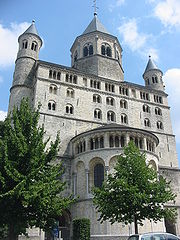
- Basilica of Saint ServatiusBasilica of Saint ServatiusThe Roman catholic Basilica of Saint Servatius, situated in Maastricht at the Vrijthof square, is a mainly Romanesque church dedicated to Saint Servatius.- History :...
, MaastrichtMaastrichtMaastricht is situated on both sides of the Meuse river in the south-eastern part of the Netherlands, on the Belgian border and near the German border... - Basilica of Our LadyBasilica of Our Lady (Maastricht)The Roman catholic Basilica of Our Lady is a Romanesque basilica in Maastricht, The Netherlands, dedicated to Our Lady of the Assumption. The church is often referred to as the Star of the Sea, after the church's main devotion, Our Lady, Star of the Sea...
, Maastricht - Former abbey churchChurch of Saint Anne, AldeneikThe Sint-Annakerk is a Romanesque, partly Gothic, Roman Catholic church in Aldeneik, Belgium. The church was begun in the 12th century and consists of a 3-aisle basilica in Mosan style without transepts. Originally, the church was part of the Aldeneik monastery...
, AldeneikAldeneikAldeneik, founded in 730, is a suburb of the Belgian town of Maaseik. It lies on the banks of the Meuse River, close to the border with the Netherlands, close to where the Bosbeek runs off it. According to legend it sprung up around a monastery set up by the Frankish sisters Herlindis and Relindis,... - Former abbey church, RolducRolducRolduc is the name of a medieval abbey in Kerkrade, the Netherlands, which is now a Roman Catholic seminary and an affiliated conferencing center.-History:...
- Former abbey churchSusteren AbbeySusteren Abbey is a former Benedictine abbey at Susteren near Roermond, Limburg, Netherlands founded in the 8th century. The former abbey church is now St. Amelberga's Basilica.-History:...
, SusterenSusterenSusteren is a city in the Dutch province of Limburg. It is located in the municipality of Echt-Susteren, about 7 km northwest of Sittard. It was a separate municipality until 2003, when it was merged with Echt. Susteren received town privileges in 1276.... - Former abbey church, Sint Odiliënberg
Stone carving
Mosan stone carving reached a peak in the 12th century in Maastricht, Liège and Nivelles. Maastricht 'metsen' (stone carvers) worked on capitalsCapital (architecture)
In architecture the capital forms the topmost member of a column . It mediates between the column and the load thrusting down upon it, broadening the area of the column's supporting surface...
and relief
Relief
Relief is a sculptural technique. The term relief is from the Latin verb levo, to raise. To create a sculpture in relief is thus to give the impression that the sculpted material has been raised above the background plane...
s as far afield as Utrecht
Utrecht (city)
Utrecht city and municipality is the capital and most populous city of the Dutch province of Utrecht. It is located in the eastern corner of the Randstad conurbation, and is the fourth largest city of the Netherlands with a population of 312,634 on 1 Jan 2011.Utrecht's ancient city centre features...
, Bonn
Bonn
Bonn is the 19th largest city in Germany. Located in the Cologne/Bonn Region, about 25 kilometres south of Cologne on the river Rhine in the State of North Rhine-Westphalia, it was the capital of West Germany from 1949 to 1990 and the official seat of government of united Germany from 1990 to 1999....
and Eisenach
Eisenach
Eisenach is a city in Thuringia, Germany. It is situated between the northern foothills of the Thuringian Forest and the Hainich National Park. Its population in 2006 was 43,626.-History:...
.
- Carved capitals in western galleries of Basilica of Saint ServatiusBasilica of Saint ServatiusThe Roman catholic Basilica of Saint Servatius, situated in Maastricht at the Vrijthof square, is a mainly Romanesque church dedicated to Saint Servatius.- History :...
, Maastricht (12th c.) - Carved capitals in East choir of Basilica of Our LadyBasilica of Our Lady (Maastricht)The Roman catholic Basilica of Our Lady is a Romanesque basilica in Maastricht, The Netherlands, dedicated to Our Lady of the Assumption. The church is often referred to as the Star of the Sea, after the church's main devotion, Our Lady, Star of the Sea...
, Maastricht (12th c.) - Carved capitals in crypt of abbey church of RolducRolducRolduc is the name of a medieval abbey in Kerkrade, the Netherlands, which is now a Roman Catholic seminary and an affiliated conferencing center.-History:...
(12th c.) - Vierge de Dom Rupert (12th c.), Curtius MuseumCurtius MuseumThe Curtius Museum is a museum of archaeology and decorative arts, located on the bank of the Meuse River in Liège, classified as a Major Heritage of Wallonia...
, Liège - Pierre Boudon relief (12th c.), Curtius MuseumCurtius MuseumThe Curtius Museum is a museum of archaeology and decorative arts, located on the bank of the Meuse River in Liège, classified as a Major Heritage of Wallonia...
, Liège - Samson Portal, Collegiate Church of Saint GertrudeCollegiate Church of Saint GertrudeThe Collegiate Church of Saint Gertrude is a historical building in Nivelles, Wallonia, Belgium consecrated in 1046 by Wazon, bishop of Liège in the presence of emperor Henry III...
, NivellesNivellesNivelles is a Walloon city and municipality located in the Belgian province of Walloon Brabant. The Nivelles municipality includes the old communes of Baulers, Bornival, Thines, and Monstreux.... - Baptismal font, Furnaux (NamurNamur (province)Namur is a province of Wallonia, one of the three regions of Belgium. It borders on the Walloon provinces of Hainaut, Walloon Brabant, Liège and Luxembourg in Belgium, and on France. Its capital is the city of Namur...
) - Oath on the Relics relief (12th c.), Basilica of Our Lady, Maastricht
- Majestas Domini tympanumTympanum (architecture)In architecture, a tympanum is the semi-circular or triangular decorative wall surface over an entrance, bounded by a lintel and arch. It often contains sculpture or other imagery or ornaments. Most architectural styles include this element....
(12th c.), Basilica of Saint Servatius, Maastricht - Double relief choir screen (12th c.), Basilica of Saint Servatius, Maastricht
- Four-part relief in Saint Peter's ChurchPieterskerk, UtrechtThe Pieterskerk is one of the oldest Roman Catholic churches in the Dutch city of Utrecht, dedicated to Peter the Apostle. Its construction began in 1039 and it was inaugurated on 1 May 1048 by Bernold, Bishop of Utrecht...
, UtrechtUtrecht (city)Utrecht city and municipality is the capital and most populous city of the Dutch province of Utrecht. It is located in the eastern corner of the Randstad conurbation, and is the fourth largest city of the Netherlands with a population of 312,634 on 1 Jan 2011.Utrecht's ancient city centre features...
Metal work
Metalwork has traditionally been considered the high art of the 12th century Meuse region, culminating in the work of Nicholas of VerdunNicholas of Verdun
Nicholas of Verdun was a French artist, one of the most famous goldsmiths and enamellists of the Middle Ages, a major figure in Romanesque art, and the leading figure of Mosan art in his day...
, which is of exceptionally high quality. The Shrine of the Three Kings at Cologne Cathedral
Shrine of the Three Kings at Cologne Cathedral
The Shrine of the Three Kings is a reliquary said to contain the bones of the Biblical Magi, also known as the Three Kings or the Three Wise Men. The shrine is a large gilded and decorated triple sarcophagus placed above and behind the high altar of Cologne Cathedral...
, the Anno Shrine in Siegburg
Siegburg
--122.148.78.228 05:06, 14 November 2011 Siegburg is a city in the district of Rhein-Sieg-Kreis, in North Rhine-Westphalia, Germany...
and the Shrine of Our Lady in Tournai
Tournai
Tournai is a Walloon city and municipality of Belgium located 85 kilometres southwest of Brussels, on the river Scheldt, in the province of Hainaut....
are among the best examples of his work.
- Baptismal font at St Bartholomew's Church, Liège (early 12th c.) by Renier de HuyRenier de HuyRenier de Huy was a 12th century metalworker and sculptor to whom is attributed a major masterpiece of Mosan art, the baptismal font at St Bartholomew's Church, Liège in Liege, Belgium of 1107–18...
- Shrine of Saint ServatiusSaint ServatiusSaint Servatius was bishop of Tongeren—Roman Atuatuca Tungrorum the capital of the Tungri—one of the earliest dioceses in the Low Countries. Later in his life he fled to Maastricht, Roman Mosae Trajectum, where he became the first bishop of this city...
(±1165) in MaastrichtMaastrichtMaastricht is situated on both sides of the Meuse river in the south-eastern part of the Netherlands, on the Belgian border and near the German border... - Shrine of Saint Hadelin (1170, partly 11th c.) in ViséViséVisé is a Walloon municipality and city of Belgium, where it is located on the river Meuse, in the province of Liège.The municipality consists of the former municipalities of Visé, Lanaye, Lixhe, Richelle, Argenteau and Cheratte....
- Shrine of Saint Remacle in StavelotStavelotStavelot is a Walloon municipality located in the Belgian province of Liège. On January 1, 2006, Stavelot had a total population of 6,671. The total area is 85.07 km² which gives a population density of 78 inhabitants per km².-History:...
- Shrines of Saint DomitianDomitian of HuyDomitian of Huy was a Gaulish bishop of the sixth century who is noted for both his generosity and writings against heresy. He is venerated as a saint in the Roman Catholic Church.-Life:...
and Saint Mangold (by Godefroid de Huy, ±1172-1189) in HuyHuyHuy is a municipality of Belgium. It lies in the country's Walloon Region and Province of Liege. Huy lies along the river Meuse, at the mouth of the small river Hoyoux. It is in the sillon industriel, the former industrial backbone of Wallonia, home to about two-thirds of the Walloon population... - Shrine of Our Lady (1205) at Tournai CathedralTournai CathedralThe Cathedral of Our Lady is Roman Catholic church, see of the Diocese of Tournai in Tournai, Belgium. It has been classified both as a Wallonia's major heritage since 1936 and as a World Heritage Site since 2000.-History:...
by Nicholas of VerdunNicholas of VerdunNicholas of Verdun was a French artist, one of the most famous goldsmiths and enamellists of the Middle Ages, a major figure in Romanesque art, and the leading figure of Mosan art in his day... - Shrine of the Three Kings at Cologne CathedralShrine of the Three Kings at Cologne CathedralThe Shrine of the Three Kings is a reliquary said to contain the bones of the Biblical Magi, also known as the Three Kings or the Three Wise Men. The shrine is a large gilded and decorated triple sarcophagus placed above and behind the high altar of Cologne Cathedral...
(1180) by Nicholas of Verdun - Shrines of CharlemagneCharlemagneCharlemagne was King of the Franks from 768 and Emperor of the Romans from 800 to his death in 814. He expanded the Frankish kingdom into an empire that incorporated much of Western and Central Europe. During his reign, he conquered Italy and was crowned by Pope Leo III on 25 December 800...
('Karlsschrein', 1215) and MaryMary (mother of Jesus)Mary , commonly referred to as "Saint Mary", "Mother Mary", the "Virgin Mary", the "Blessed Virgin Mary", or "Mary, Mother of God", was a Jewish woman of Nazareth in Galilee...
('Marienschrein', 1238), Aachen CathedralAachen CathedralAachen Cathedral, frequently referred to as the "Imperial Cathedral" , is a Roman Catholic church in Aachen, Germany. The church is the oldest cathedral in northern Europe and was known as the "Royal Church of St. Mary at Aachen" during the Middle Ages... - BarbarossaFrederick I, Holy Roman EmperorFrederick I Barbarossa was a German Holy Roman Emperor. He was elected King of Germany at Frankfurt on 4 March 1152 and crowned in Aachen on 9 March, crowned King of Italy in Pavia in 1155, and finally crowned Roman Emperor by Pope Adrian IV, on 18 June 1155, and two years later in 1157 the term...
Chandelier (1170), Aachen Cathedral - Retable of the Pentecost (1160–1170, Cluny Museum, ParisParisParis is the capital and largest city in France, situated on the river Seine, in northern France, at the heart of the Île-de-France region...
– http://www.musee-moyenage.fr/ang/pages/page_id18375_u1l2.htm) - Stavelot TriptychStavelot TriptychThe Stavelot Triptych is a medieval reliquary and portable altar in gold and enamel intended to protect, honor and display pieces of the True Cross. Created by Mosan artists—"Mosan" signifies the valley of the Meuse river—around 1156 at Stavelot Abbey in present-day Belgium...
. Morgan LibraryMorgan LibraryThe Morgan Library & Museum is a museum and research library in New York City, USA. It was founded to house the private library of J. P. Morgan in 1906, which included, besides the manuscripts and printed books, some of them in rare bindings, his collection of prints and drawings...
, New York CityNew York CityNew York is the most populous city in the United States and the center of the New York Metropolitan Area, one of the most populous metropolitan areas in the world. New York exerts a significant impact upon global commerce, finance, media, art, fashion, research, technology, education, and... - Reliquary of St. Maurus, now in Bečov nad TeplouBecov nad TeplouBečov nad Teplou is a town in the Czech Republic....
- Stavelot altar base. Royal Museums of Art and HistoryRoyal Museums of Art and HistoryThe Royal Museums of Art and History is a group of museums in Brussels, Belgium...
, BrusselsBrusselsBrussels , officially the Brussels Region or Brussels-Capital Region , is the capital of Belgium and the de facto capital of the European Union... - Reliquary with head of pope AlexanderPope Alexander IPope Saint Alexander I was Bishop of Rome from about 106 to 115. The Holy See's Annuario Pontificio identifies him as a Roman who reigned from 108 or 109 to 116 or 119...
. Royal Museums of Art and HistoryRoyal Museums of Art and HistoryThe Royal Museums of Art and History is a group of museums in Brussels, Belgium...
, BrusselsBrusselsBrussels , officially the Brussels Region or Brussels-Capital Region , is the capital of Belgium and the de facto capital of the European Union... - The foot of the so-called Cross of Saint Bertin. Museum of Saint-OmerSaint-OmerSaint-Omer , a commune and sub-prefecture of the Pas-de-Calais department west-northwest of Lille on the railway to Calais. The town is named after Saint Audomar, who brought Christianity to the area....
Painting, illumination and other works of art
Very little has come to us from what must have been an impressive body of Mosan muralMural
A mural is any piece of artwork painted or applied directly on a wall, ceiling or other large permanent surface. A particularly distinguishing characteristic of mural painting is that the architectural elements of the given space are harmoniously incorporated into the picture.-History:Murals of...
s. Wolfram von Eschenbach
Wolfram von Eschenbach
Wolfram von Eschenbach was a German knight and poet, regarded as one of the greatest epic poets of his time. As a Minnesinger, he also wrote lyric poetry.-Life:...
, in his Parzival
Parzival
Parzival is a major medieval German romance by the poet Wolfram von Eschenbach, in the Middle High German language. The poem, commonly dated to the first quarter of the 13th century, is itself largely based on Chrétien de Troyes’s Perceval, the Story of the Grail and mainly centers on the Arthurian...
expressed his high regard for Maastricht (and Cologne) painters (Parzival, 158, 13-16). Book illumination
Illuminated manuscript
An illuminated manuscript is a manuscript in which the text is supplemented by the addition of decoration, such as decorated initials, borders and miniature illustrations...
, like the rest of the arts, was at its zenith in the second half of the 12th century. The principal centres were the abbey of Saint Laurent in Liège and the abbeys of Stavelot and Lobbes. Another highly developed art was vitreous enamel
Vitreous enamel
Vitreous enamel, also porcelain enamel in U.S. English, is a material made by fusing powdered glass to a substrate by firing, usually between 750 and 850 °C...
ing.
- Mural of the choir vault (heavily restored). Basilica of Saint Servatius, Maastricht
- FloreffeFloreffeFloreffe is a Walloon municipality located in the Belgian province of Namur. On 1 January 2006 the municipality had 7,405 inhabitants. The total area is 38.89 km², giving a population density of 190 inhabitants per km²....
Bible (12th c.). British MuseumBritish MuseumThe British Museum is a museum of human history and culture in London. Its collections, which number more than seven million objects, are amongst the largest and most comprehensive in the world and originate from all continents, illustrating and documenting the story of human culture from its...
, LondonLondonLondon is the capital city of :England and the :United Kingdom, the largest metropolitan area in the United Kingdom, and the largest urban zone in the European Union by most measures. Located on the River Thames, London has been a major settlement for two millennia, its history going back to its... - Stavelot BibleStavelot BibleThe Stavelot Bible is a Romanesque illuminated manuscript bible in two volumes datable to 1093-1097. It was produced for, but not necessarily in, the Benedictine monastery of Stavelot, in the Principality of Stavelot-Malmedy of modern Belgium, and required four years to complete...
(11th c.). British Museum, London - Evangeliary of AverbodeAverbode AbbeyAverbode Abbey is a Premonstratensian monastery situated near Diest , in the Archdiocese of Mechelen-Brussels in Belgium.-1134-1800:Averbode Abbey was founded about 1134-1135 by Count Arnold II of Loon...
(12th c.). University Library, Liège - Manuscripts from the abbey of Sint-TruidenSint-TruidenSint-Truiden is a city and municipality located in the province of Limburg, Flemish Region, Belgium, near the towns of Hasselt and Tongeren. The municipality includes the old communes of Aalst, Brustem, Duras, Engelmanshoven, Gelinden, Gorsem, Groot-Gelmen, Halmaal, Kerkom-bij-Sint-Truiden,...
- Evangeliary of NotgerNotker of LiègeNotker of Liège was a Benedictine monk, bishop and first prince-bishop of the Bishopric of Liège with a capital Liège/Lüttich, ....
(10-12th c.)