

The School of Athens

Encyclopedia
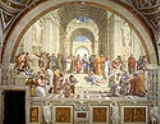
The School of Athens, or in Italian
, is one of the most famous painting
s by the Italian Renaissance
artist Raphael
. It was painted between 1510
and 1511
as a part of Raphael's commission to decorate with fresco
es the rooms now known as the , in the Apostolic Palace
in the Vatican
. The was the first of the rooms to be decorated, and The School of Athens the second painting to be finished there, after , on the opposite wall. The picture has long been seen as "Raphael's masterpiece
and the perfect embodiment of the classical spirit of the High Renaissance
."
containing a majestic female figure seated in the clouds, with putti
bearing the phrases: “Seek Knowledge of Causes”, “Divine Inspiration”, “Knowledge of Things Divine” (Disputa), “To Each What Is Due”. Accordingly, the figures on the walls below exemplify Philosophy, Poetry (including Music), Theology, and Law. The traditional title is not Raphael's, and the subject of the “School” is actually "Philosophy", or at least ancient Greek philosophy, and its overhead tondo-label, “Causarum Cognitio” tells us what kind, as it appears to echo Aristotle
’s emphasis on wisdom as knowing why, hence knowing the causes, in Metaphysics
Book I and Physics
Book II. Indeed, Aristotle appears to be the central figure in the scene below. However all the philosophers depicted sought to understand through knowledge of first causes. Many lived before Plato
and Aristotle, and hardly a third were Athenians. The architecture contains Roman elements, but the general semi-circular setting having Plato and Aristotle at its centre might be alluding to Pythagoras
' circumpunct.
Commentators have suggested that nearly every great Greek philosopher can be found within the painting, but determining which are depicted is difficult, since Raphael made no designations outside possible likenesses, and no contemporary documents explain the painting. Compounding the problem, Raphael had to invent a system of iconography
to allude to various figures for whom there were no traditional visual types. For example, while the Socrates
figure is immediately recognizable from Classical busts, the alleged Epicurus
is far removed from the standard type for that philosopher. Aside from the identities of the figures depicted, many aspects of the fresco have been variously interpreted, but few such interpretations are generally accepted among scholars. The popular idea that the rhetorical gestures of Plato and Aristotle are kinds of pointing (to the heavens, and down to earth) is a likely reading. However Plato’s Timaeus
– which is the book Raphael places in his hand – was a sophisticated treatment of space, time and change, including the Earth, which guided mathematical sciences for over a millennium. Aristotle, with his four elements theory, held that all change on Earth was owing to the motions of the heavens. In the painting Aristotle carries his Ethics
, which he denied could be reduced to a mathematical science.
It is not established how much the young Raphael knew of ancient philosophy, what guidance he might have had from people such as Bramante
, or whether a detailed program was dictated by his sponsor, Pope Julius II. Finally, according to Vasari, the scene includes Raphael himself, the Duke of Mantua, Zoroaster and some Evangelists.
However, as Heinrich Wölfflin
observed, "it is quite wrong to attempt interpretations of the 'School of Athens' as an esoteric treatise ... The all-important thing was the artistic motive which expressed a physical or spiritual state, and the name of the person was a matter of indifference" in Raphael's time. What is evident is Raphael's artistry in orchestrating a beautiful space, continuous with that of viewers in the Stanza, in which a great variety of human figures, each one expressing "mental states by physical actions", interact, and are grouped in a "polyphony" unlike anything in earlier art, in the ongoing dialogue of Philosophy.
or Aristotle
, are incontrovertible. Beyond that, identifications of Raphael's figures, even among scholars, have always been conjectural. To complicate matters, beginning from Vasari's efforts, some have received multiple identifications, not only as ancients but also as figures contemporary with Raphael.
Luitpold Dussler counts among those who can be identified with some certainty: Plato, Aristoteles, Socrates, Pythagoras, Euclid, Ptolemy, Zoroaster, Raphael, Sodoma and Diogenes. Other identifications he holds to be "more or less speculative".
A more comprehensive list of proposed identifications is given below:
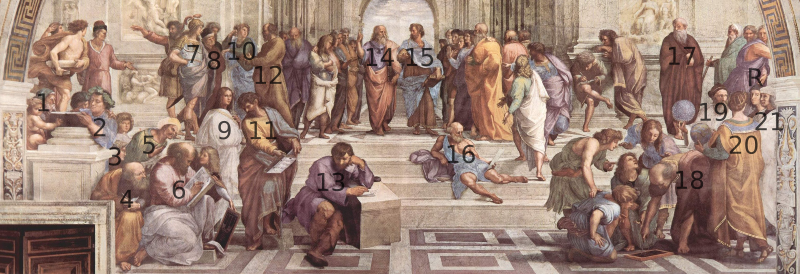 1: Zeno of Citium
2: Epicurus
3: (Federico II of Mantua?)
4: Boethius or Anaximander
or Empedocles
?
5: Averroes
6: Pythagoras
7: Alcibiades
or Alexander the Great?
8: Antisthenes
or Xenophon
?
9: unknown (Francesco Maria della Rovere?)
10: Aeschines or Xenophon
?
11: Parmenides
?
12: Socrates
13: Heraclitus
(Michelangelo
)
14: Plato
(Leonardo da Vinci
)
15: Aristotle
16: Diogenes
17: Plotinus
(Donatello
?)
18: Euclid
or Archimedes
with students (Bramante
?)
19: Zoroaster
20: Ptolemy
?
R: Apelles
(Raphael
)
21: Protogenes
(Il Sodoma
, Perugino, or Timoteo Viti
)
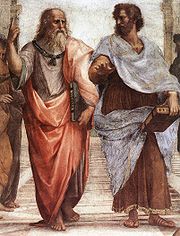 In the center of the fresco, at its architecture's central vanishing point
, are the two undisputed main subjects: Plato
on the left and Aristotle
, his student, on the right. Both figures hold modern (of the time), bound copies of their books in their left hands, while gesturing with their right. Plato holds Timaeus
, Aristotle his Nicomachean Ethics
. Plato is depicted as old, grey, wise-looking, and bare-foot. By contrast Aristotle, slightly ahead of him, is in mature manhood, handsome, well-shod and dressed with gold, and the youth about them seem to look his way. In addition, these two central figures gesture along different dimensions: Plato vertically, upward along the picture-plane, into the beautiful vault above; Aristotle on the horizontal plane at right-angles to the picture-plane (hence in strong foreshortening), initiating a powerful flow of space toward viewers. It is popularly thought that their gestures indicate central aspects of their philosophies, for Plato
, his Theory of Forms
, and for Aristotle, his empiricist
views, with an emphasis on concrete particular
s. However Plato's Timaeus was, even in the Renaissance, a very influential treatise on the cosmos, whereas Aristotle insisted that the purpose of ethics is "practical" rather than "theoretical" or "speculative": not knowledge for its own sake, as he considered cosmology to be.
philosophy
and Christian theology
(see Christianity and Paganism
and Christian philosophy
). The architecture of the building was inspired by the work of Bramante
, who, according to Vasari
, helped Raphael with the architecture in the picture. Some have suggested that the building itself was intended to be an advance view of St. Peter's Basilica
.
There are two sculptures in the background. The one on the left is the god Apollo
, god of light, archery and music, holding a lyre
. The sculpture on the right is Athena
, goddess of wisdom
, in her Roman guise as Minerva
.
The main arch, above the characters, shows arabesque swastikas as a decoration pattern.
in Frankfurt
, a study for the group around "Pythagoras" in the lower left of the painting is preserved in the Albertina
in Vienna
. Several drawings, showing the two men talking while walking up the steps on the right and the Medusa
on Athena's shield, the statue of Athena and three other statues, a study for the combat-scene in the relief below Apollo and "Euclid" teaching his pupils are in the Ashmolean Museum
in Oxford
.
The cartoon
for the painting is in the Ambrosiana in Milan
.
has a rectangular version over 4 metres by 8 metres in size, painted on canvas, dated 1755 by Anton Raphael Mengs
on display in the eastern Cast Court.
Modern reproductions of the fresco abound. For example, a full-size one can be seen in the auditorium of Old Cabell Hall at the University of Virginia
. Produced in 1900 by George W. Breck to replace an older reproduction that was destroyed in a fire in 1895, it is four inches off scale from the original, because the Vatican would not allow identical reproductions of its art works.
Other reproductions include: by Neide, in Königsberg Cathedral
, Kaliningrad
, in the University of North Carolina at Asheville
's Highsmith University Student Union, and a recent one in the seminar room at Baylor University
's Brooks College.
The two figures at the left of Plotinus were used as part of the cover art of both Use Your Illusion I
and II
albums of Guns N' Roses
.
Italian language
Italian is a Romance language spoken mainly in Europe: Italy, Switzerland, San Marino, Vatican City, by minorities in Malta, Monaco, Croatia, Slovenia, France, Libya, Eritrea, and Somalia, and by immigrant communities in the Americas and Australia...
, is one of the most famous painting
Painting
Painting is the practice of applying paint, pigment, color or other medium to a surface . The application of the medium is commonly applied to the base with a brush but other objects can be used. In art, the term painting describes both the act and the result of the action. However, painting is...
s by the Italian Renaissance
Italian Renaissance
The Italian Renaissance began the opening phase of the Renaissance, a period of great cultural change and achievement in Europe that spanned the period from the end of the 13th century to about 1600, marking the transition between Medieval and Early Modern Europe...
artist Raphael
Raphael
Raffaello Sanzio da Urbino , better known simply as Raphael, was an Italian painter and architect of the High Renaissance. His work is admired for its clarity of form and ease of composition and for its visual achievement of the Neoplatonic ideal of human grandeur...
. It was painted between 1510
1510 in art
-Works:* Sandro Botticelli completes painting of Adoration of the Christ Child as a tondo , oil on panel.-Births:* Orazio Alfani – Italian painter of the Renaissance...
and 1511
1511 in art
-Events:-Painting:* Matthias Grünewald – The Small Crucifixion* Titian – The Miracle of the Speaking Babe* Raphael – The School of Athens-Births:* Bartolomeo Ammanati, architect and sculptor...
as a part of Raphael's commission to decorate with fresco
Fresco
Fresco is any of several related mural painting types, executed on plaster on walls or ceilings. The word fresco comes from the Greek word affresca which derives from the Latin word for "fresh". Frescoes first developed in the ancient world and continued to be popular through the Renaissance...
es the rooms now known as the , in the Apostolic Palace
Apostolic Palace
The Apostolic Palace is the official residence of the Pope, which is located in Vatican City. It is also known as the Sacred Palace, the Papal Palace and the Palace of the Vatican...
in the Vatican
Vatican City
Vatican City , or Vatican City State, in Italian officially Stato della Città del Vaticano , which translates literally as State of the City of the Vatican, is a landlocked sovereign city-state whose territory consists of a walled enclave within the city of Rome, Italy. It has an area of...
. The was the first of the rooms to be decorated, and The School of Athens the second painting to be finished there, after , on the opposite wall. The picture has long been seen as "Raphael's masterpiece
Masterpiece
Masterpiece in modern usage refers to a creation that has been given much critical praise, especially one that is considered the greatest work of a person's career or to a work of outstanding creativity, skill or workmanship....
and the perfect embodiment of the classical spirit of the High Renaissance
High Renaissance
The expression High Renaissance, in art history, is a periodizing convention used to denote the apogee of the visual arts in the Italian Renaissance...
."
Program, subject, figure identifications, interpretations
The "School of Athens" is one of a group of four main frescoes on the walls of the Stanza (those on either side centrally interrupted by windows) that depict distinct branches of knowledge. Each theme is identified above by a separate tondoTondo (art)
A tondo is a Renaissance term for a circular work of art, either a painting or a sculpture. The word derives from the Italian rotondo, "round." The term is usually not used in English for small round paintings, but only those over about 60 cm in diameter, thus excluding many round portrait...
containing a majestic female figure seated in the clouds, with putti
Putto
A putto is a figure of an infant often depicted as a young male. Putti are defined as chubby, winged or wingless, male child figure in nude. Putti are distinct from cherubim, but some English-speakers confuse them with each other, except that in the plural, "the Cherubim" refers to the biblical...
bearing the phrases: “Seek Knowledge of Causes”, “Divine Inspiration”, “Knowledge of Things Divine” (Disputa), “To Each What Is Due”. Accordingly, the figures on the walls below exemplify Philosophy, Poetry (including Music), Theology, and Law. The traditional title is not Raphael's, and the subject of the “School” is actually "Philosophy", or at least ancient Greek philosophy, and its overhead tondo-label, “Causarum Cognitio” tells us what kind, as it appears to echo Aristotle
Aristotle
Aristotle was a Greek philosopher and polymath, a student of Plato and teacher of Alexander the Great. His writings cover many subjects, including physics, metaphysics, poetry, theater, music, logic, rhetoric, linguistics, politics, government, ethics, biology, and zoology...
’s emphasis on wisdom as knowing why, hence knowing the causes, in Metaphysics
Metaphysics (Aristotle)
Metaphysics is one of the principal works of Aristotle and the first major work of the branch of philosophy with the same name. The principal subject is "being qua being", or being understood as being. It examines what can be asserted about anything that exists just because of its existence and...
Book I and Physics
Physics (Aristotle)
The Physics of Aristotle is one of the foundational books of Western science and philosophy...
Book II. Indeed, Aristotle appears to be the central figure in the scene below. However all the philosophers depicted sought to understand through knowledge of first causes. Many lived before Plato
Plato
Plato , was a Classical Greek philosopher, mathematician, student of Socrates, writer of philosophical dialogues, and founder of the Academy in Athens, the first institution of higher learning in the Western world. Along with his mentor, Socrates, and his student, Aristotle, Plato helped to lay the...
and Aristotle, and hardly a third were Athenians. The architecture contains Roman elements, but the general semi-circular setting having Plato and Aristotle at its centre might be alluding to Pythagoras
Pythagoras
Pythagoras of Samos was an Ionian Greek philosopher, mathematician, and founder of the religious movement called Pythagoreanism. Most of the information about Pythagoras was written down centuries after he lived, so very little reliable information is known about him...
' circumpunct.
Commentators have suggested that nearly every great Greek philosopher can be found within the painting, but determining which are depicted is difficult, since Raphael made no designations outside possible likenesses, and no contemporary documents explain the painting. Compounding the problem, Raphael had to invent a system of iconography
Iconography
Iconography is the branch of art history which studies the identification, description, and the interpretation of the content of images. The word iconography literally means "image writing", and comes from the Greek "image" and "to write". A secondary meaning is the painting of icons in the...
to allude to various figures for whom there were no traditional visual types. For example, while the Socrates
Socrates
Socrates was a classical Greek Athenian philosopher. Credited as one of the founders of Western philosophy, he is an enigmatic figure known chiefly through the accounts of later classical writers, especially the writings of his students Plato and Xenophon, and the plays of his contemporary ...
figure is immediately recognizable from Classical busts, the alleged Epicurus
Epicurus
Epicurus was an ancient Greek philosopher and the founder of the school of philosophy called Epicureanism.Only a few fragments and letters remain of Epicurus's 300 written works...
is far removed from the standard type for that philosopher. Aside from the identities of the figures depicted, many aspects of the fresco have been variously interpreted, but few such interpretations are generally accepted among scholars. The popular idea that the rhetorical gestures of Plato and Aristotle are kinds of pointing (to the heavens, and down to earth) is a likely reading. However Plato’s Timaeus
Timaeus (dialogue)
Timaeus is one of Plato's dialogues, mostly in the form of a long monologue given by the title character, written circa 360 BC. The work puts forward speculation on the nature of the physical world and human beings. It is followed by the dialogue Critias.Speakers of the dialogue are Socrates,...
– which is the book Raphael places in his hand – was a sophisticated treatment of space, time and change, including the Earth, which guided mathematical sciences for over a millennium. Aristotle, with his four elements theory, held that all change on Earth was owing to the motions of the heavens. In the painting Aristotle carries his Ethics
Nicomachean Ethics
The Nicomachean Ethics is the name normally given to Aristotle's best known work on ethics. The English version of the title derives from Greek Ἠθικὰ Νικομάχεια, transliterated Ethika Nikomacheia, which is sometimes also given in the genitive form as Ἠθικῶν Νικομαχείων, Ethikōn Nikomacheiōn...
, which he denied could be reduced to a mathematical science.
It is not established how much the young Raphael knew of ancient philosophy, what guidance he might have had from people such as Bramante
Donato Bramante
Donato Bramante was an Italian architect, who introduced the Early Renaissance style to Milan and the High Renaissance style to Rome, where his most famous design was St...
, or whether a detailed program was dictated by his sponsor, Pope Julius II. Finally, according to Vasari, the scene includes Raphael himself, the Duke of Mantua, Zoroaster and some Evangelists.
However, as Heinrich Wölfflin
Heinrich Wölfflin
Heinrich Wölfflin was a famous Swiss art critic, whose objective classifying principles were influential in the development of formal analysis in the history of art during the 20th century. He taught at Basel, Berlin and Munich in the generation that raised German art history to pre-eminence...
observed, "it is quite wrong to attempt interpretations of the 'School of Athens' as an esoteric treatise ... The all-important thing was the artistic motive which expressed a physical or spiritual state, and the name of the person was a matter of indifference" in Raphael's time. What is evident is Raphael's artistry in orchestrating a beautiful space, continuous with that of viewers in the Stanza, in which a great variety of human figures, each one expressing "mental states by physical actions", interact, and are grouped in a "polyphony" unlike anything in earlier art, in the ongoing dialogue of Philosophy.
Figures
The identities of some of the philosophers in the picture, such as PlatoPlato
Plato , was a Classical Greek philosopher, mathematician, student of Socrates, writer of philosophical dialogues, and founder of the Academy in Athens, the first institution of higher learning in the Western world. Along with his mentor, Socrates, and his student, Aristotle, Plato helped to lay the...
or Aristotle
Aristotle
Aristotle was a Greek philosopher and polymath, a student of Plato and teacher of Alexander the Great. His writings cover many subjects, including physics, metaphysics, poetry, theater, music, logic, rhetoric, linguistics, politics, government, ethics, biology, and zoology...
, are incontrovertible. Beyond that, identifications of Raphael's figures, even among scholars, have always been conjectural. To complicate matters, beginning from Vasari's efforts, some have received multiple identifications, not only as ancients but also as figures contemporary with Raphael.
Luitpold Dussler counts among those who can be identified with some certainty: Plato, Aristoteles, Socrates, Pythagoras, Euclid, Ptolemy, Zoroaster, Raphael, Sodoma and Diogenes. Other identifications he holds to be "more or less speculative".
A more comprehensive list of proposed identifications is given below:
Zeno of Citium
Zeno of Citium was a Greek philosopher from Citium . Zeno was the founder of the Stoic school of philosophy, which he taught in Athens from about 300 BC. Based on the moral ideas of the Cynics, Stoicism laid great emphasis on goodness and peace of mind gained from living a life of virtue in...
2: Epicurus
Epicurus
Epicurus was an ancient Greek philosopher and the founder of the school of philosophy called Epicureanism.Only a few fragments and letters remain of Epicurus's 300 written works...
3: (Federico II of Mantua?)
4: Boethius or Anaximander
Anaximander
Anaximander was a pre-Socratic Greek philosopher who lived in Miletus, a city of Ionia; Milet in modern Turkey. He belonged to the Milesian school and learned the teachings of his master Thales...
or Empedocles
Empedocles
Empedocles was a Greek pre-Socratic philosopher and a citizen of Agrigentum, a Greek city in Sicily. Empedocles' philosophy is best known for being the originator of the cosmogenic theory of the four Classical elements...
?
5: Averroes
Averroes
' , better known just as Ibn Rushd , and in European literature as Averroes , was a Muslim polymath; a master of Aristotelian philosophy, Islamic philosophy, Islamic theology, Maliki law and jurisprudence, logic, psychology, politics, Arabic music theory, and the sciences of medicine, astronomy,...
6: Pythagoras
Pythagoras
Pythagoras of Samos was an Ionian Greek philosopher, mathematician, and founder of the religious movement called Pythagoreanism. Most of the information about Pythagoras was written down centuries after he lived, so very little reliable information is known about him...
7: Alcibiades
Alcibiades
Alcibiades, son of Clinias, from the deme of Scambonidae , was a prominent Athenian statesman, orator, and general. He was the last famous member of his mother's aristocratic family, the Alcmaeonidae, which fell from prominence after the Peloponnesian War...
or Alexander the Great?
8: Antisthenes
Antisthenes
Antisthenes was a Greek philosopher and a pupil of Socrates. Antisthenes first learned rhetoric under Gorgias before becoming an ardent disciple of Socrates. He adopted and developed the ethical side of Socrates' teachings, advocating an ascetic life lived in accordance with virtue. Later writers...
or Xenophon
Xenophon
Xenophon , son of Gryllus, of the deme Erchia of Athens, also known as Xenophon of Athens, was a Greek historian, soldier, mercenary, philosopher and a contemporary and admirer of Socrates...
?
9: unknown (Francesco Maria della Rovere?)
10: Aeschines or Xenophon
Xenophon
Xenophon , son of Gryllus, of the deme Erchia of Athens, also known as Xenophon of Athens, was a Greek historian, soldier, mercenary, philosopher and a contemporary and admirer of Socrates...
?
11: Parmenides
Parmenides
Parmenides of Elea was an ancient Greek philosopher born in Elea, a Greek city on the southern coast of Italy. He was the founder of the Eleatic school of philosophy. The single known work of Parmenides is a poem, On Nature, which has survived only in fragmentary form. In this poem, Parmenides...
?
12: Socrates
Socrates
Socrates was a classical Greek Athenian philosopher. Credited as one of the founders of Western philosophy, he is an enigmatic figure known chiefly through the accounts of later classical writers, especially the writings of his students Plato and Xenophon, and the plays of his contemporary ...
13: Heraclitus
Heraclitus
Heraclitus of Ephesus was a pre-Socratic Greek philosopher, a native of the Greek city Ephesus, Ionia, on the coast of Asia Minor. He was of distinguished parentage. Little is known about his early life and education, but he regarded himself as self-taught and a pioneer of wisdom...
(Michelangelo
Michelangelo
Michelangelo di Lodovico Buonarroti Simoni , commonly known as Michelangelo, was an Italian Renaissance painter, sculptor, architect, poet, and engineer who exerted an unparalleled influence on the development of Western art...
)
14: Plato
Plato
Plato , was a Classical Greek philosopher, mathematician, student of Socrates, writer of philosophical dialogues, and founder of the Academy in Athens, the first institution of higher learning in the Western world. Along with his mentor, Socrates, and his student, Aristotle, Plato helped to lay the...
(Leonardo da Vinci
Leonardo da Vinci
Leonardo di ser Piero da Vinci was an Italian Renaissance polymath: painter, sculptor, architect, musician, scientist, mathematician, engineer, inventor, anatomist, geologist, cartographer, botanist and writer whose genius, perhaps more than that of any other figure, epitomized the Renaissance...
)
15: Aristotle
Aristotle
Aristotle was a Greek philosopher and polymath, a student of Plato and teacher of Alexander the Great. His writings cover many subjects, including physics, metaphysics, poetry, theater, music, logic, rhetoric, linguistics, politics, government, ethics, biology, and zoology...
16: Diogenes
Diogenes of Sinope
Diogenes the Cynic was a Greek philosopher and one of the founders of Cynic philosophy. Also known as Diogenes of Sinope , he was born in Sinope , an Ionian colony on the Black Sea , in 412 or 404 BCE and died at Corinth in 323 BCE.Diogenes of Sinope was a controversial figure...
17: Plotinus
Plotinus
Plotinus was a major philosopher of the ancient world. In his system of theory there are the three principles: the One, the Intellect, and the Soul. His teacher was Ammonius Saccas and he is of the Platonic tradition...
(Donatello
Donatello
Donato di Niccolò di Betto Bardi , also known as Donatello, was an early Renaissance Italian artist and sculptor from Florence...
?)
18: Euclid
Euclid
Euclid , fl. 300 BC, also known as Euclid of Alexandria, was a Greek mathematician, often referred to as the "Father of Geometry". He was active in Alexandria during the reign of Ptolemy I...
or Archimedes
Archimedes
Archimedes of Syracuse was a Greek mathematician, physicist, engineer, inventor, and astronomer. Although few details of his life are known, he is regarded as one of the leading scientists in classical antiquity. Among his advances in physics are the foundations of hydrostatics, statics and an...
with students (Bramante
Donato Bramante
Donato Bramante was an Italian architect, who introduced the Early Renaissance style to Milan and the High Renaissance style to Rome, where his most famous design was St...
?)
19: Zoroaster
Zoroaster
Zoroaster , also known as Zarathustra , was a prophet and the founder of Zoroastrianism who was either born in North Western or Eastern Iran. He is credited with the authorship of the Yasna Haptanghaiti as well as the Gathas, hymns which are at the liturgical core of Zoroastrianism...
20: Ptolemy
Ptolemy
Claudius Ptolemy , was a Roman citizen of Egypt who wrote in Greek. He was a mathematician, astronomer, geographer, astrologer, and poet of a single epigram in the Greek Anthology. He lived in Egypt under Roman rule, and is believed to have been born in the town of Ptolemais Hermiou in the...
?
R: Apelles
Apelles
Apelles of Kos was a renowned painter of ancient Greece. Pliny the Elder, to whom we owe much of our knowledge of this artist rated him superior to preceding and subsequent artists...
(Raphael
Raphael
Raffaello Sanzio da Urbino , better known simply as Raphael, was an Italian painter and architect of the High Renaissance. His work is admired for its clarity of form and ease of composition and for its visual achievement of the Neoplatonic ideal of human grandeur...
)
21: Protogenes
Protogenes
Protogenes was an ancient Greek painter, a contemporary rival of Apelles. As with the other famous ancient Greek painters, none of his work has survived, and it is known only from literary references and descriptions....
(Il Sodoma
Il Sodoma
Il Sodoma was the name given to the Italian Renaissance painter Giovanni Antonio Bazzi. Il Sodoma painted in a manner that superimposed the High Renaissance style of early 16th-century Rome onto the traditions of the provincial Sienese school; he spent the bulk of his professional life in Siena,...
, Perugino, or Timoteo Viti
Timoteo Viti
Timoteo Viti , sometimes called Timoteo della Viti or Timoteo da Urbino, was an Italian Renaissance painter, who was closely associated with Raphael, who was fourteen years his junior.-Career:...
)
Central figures (14 and 15)
Vanishing point
A vanishing point is a point in a perspective drawing to which parallel lines not parallel to the image plane appear to converge. The number and placement of the vanishing points determines which perspective technique is being used...
, are the two undisputed main subjects: Plato
Plato
Plato , was a Classical Greek philosopher, mathematician, student of Socrates, writer of philosophical dialogues, and founder of the Academy in Athens, the first institution of higher learning in the Western world. Along with his mentor, Socrates, and his student, Aristotle, Plato helped to lay the...
on the left and Aristotle
Aristotle
Aristotle was a Greek philosopher and polymath, a student of Plato and teacher of Alexander the Great. His writings cover many subjects, including physics, metaphysics, poetry, theater, music, logic, rhetoric, linguistics, politics, government, ethics, biology, and zoology...
, his student, on the right. Both figures hold modern (of the time), bound copies of their books in their left hands, while gesturing with their right. Plato holds Timaeus
Timaeus (dialogue)
Timaeus is one of Plato's dialogues, mostly in the form of a long monologue given by the title character, written circa 360 BC. The work puts forward speculation on the nature of the physical world and human beings. It is followed by the dialogue Critias.Speakers of the dialogue are Socrates,...
, Aristotle his Nicomachean Ethics
Nicomachean Ethics
The Nicomachean Ethics is the name normally given to Aristotle's best known work on ethics. The English version of the title derives from Greek Ἠθικὰ Νικομάχεια, transliterated Ethika Nikomacheia, which is sometimes also given in the genitive form as Ἠθικῶν Νικομαχείων, Ethikōn Nikomacheiōn...
. Plato is depicted as old, grey, wise-looking, and bare-foot. By contrast Aristotle, slightly ahead of him, is in mature manhood, handsome, well-shod and dressed with gold, and the youth about them seem to look his way. In addition, these two central figures gesture along different dimensions: Plato vertically, upward along the picture-plane, into the beautiful vault above; Aristotle on the horizontal plane at right-angles to the picture-plane (hence in strong foreshortening), initiating a powerful flow of space toward viewers. It is popularly thought that their gestures indicate central aspects of their philosophies, for Plato
Plato
Plato , was a Classical Greek philosopher, mathematician, student of Socrates, writer of philosophical dialogues, and founder of the Academy in Athens, the first institution of higher learning in the Western world. Along with his mentor, Socrates, and his student, Aristotle, Plato helped to lay the...
, his Theory of Forms
Theory of Forms
Plato's theory of Forms or theory of Ideas asserts that non-material abstract forms , and not the material world of change known to us through sensation, possess the highest and most fundamental kind of reality. When used in this sense, the word form is often capitalized...
, and for Aristotle, his empiricist
Empiricism
Empiricism is a theory of knowledge that asserts that knowledge comes only or primarily via sensory experience. One of several views of epistemology, the study of human knowledge, along with rationalism, idealism and historicism, empiricism emphasizes the role of experience and evidence,...
views, with an emphasis on concrete particular
Particular
In philosophy, particulars are concrete entities existing in space and time as opposed to abstractions. There are, however, theories of abstract particulars or tropes. For example, Socrates is a particular...
s. However Plato's Timaeus was, even in the Renaissance, a very influential treatise on the cosmos, whereas Aristotle insisted that the purpose of ethics is "practical" rather than "theoretical" or "speculative": not knowledge for its own sake, as he considered cosmology to be.
Setting
The building is in the shape of a Greek cross, which some have suggested was intended to show a harmony between paganPaganism
Paganism is a blanket term, typically used to refer to non-Abrahamic, indigenous polytheistic religious traditions....
philosophy
Philosophy
Philosophy is the study of general and fundamental problems, such as those connected with existence, knowledge, values, reason, mind, and language. Philosophy is distinguished from other ways of addressing such problems by its critical, generally systematic approach and its reliance on rational...
and Christian theology
Christian theology
- Divisions of Christian theology :There are many methods of categorizing different approaches to Christian theology. For a historical analysis, see the main article on the History of Christian theology.- Sub-disciplines :...
(see Christianity and Paganism
Christianity and Paganism
Early Christianity developed in an era of the Roman Empire during which many religions were practiced, that are, due to the lack of a better term, labeled paganism."Paganism", in spite of its etymological meaning of "rural", has a number of distinct meanings...
and Christian philosophy
Christian philosophy
Christian philosophy may refer to any development in philosophy that is characterised by coming from a Christian tradition.- Origins of Christian philosophy :...
). The architecture of the building was inspired by the work of Bramante
Donato Bramante
Donato Bramante was an Italian architect, who introduced the Early Renaissance style to Milan and the High Renaissance style to Rome, where his most famous design was St...
, who, according to Vasari
Giorgio Vasari
Giorgio Vasari was an Italian painter, writer, historian, and architect, who is famous today for his biographies of Italian artists, considered the ideological foundation of art-historical writing.-Biography:...
, helped Raphael with the architecture in the picture. Some have suggested that the building itself was intended to be an advance view of St. Peter's Basilica
St. Peter's Basilica
The Papal Basilica of Saint Peter , officially known in Italian as ' and commonly known as Saint Peter's Basilica, is a Late Renaissance church located within the Vatican City. Saint Peter's Basilica has the largest interior of any Christian church in the world...
.
There are two sculptures in the background. The one on the left is the god Apollo
Apollo
Apollo is one of the most important and complex of the Olympian deities in Greek and Roman mythology...
, god of light, archery and music, holding a lyre
Lyre
The lyre is a stringed musical instrument known for its use in Greek classical antiquity and later. The word comes from the Greek "λύρα" and the earliest reference to the word is the Mycenaean Greek ru-ra-ta-e, meaning "lyrists", written in Linear B syllabic script...
. The sculpture on the right is Athena
Athena
In Greek mythology, Athena, Athenê, or Athene , also referred to as Pallas Athena/Athene , is the goddess of wisdom, courage, inspiration, civilization, warfare, strength, strategy, the arts, crafts, justice, and skill. Minerva, Athena's Roman incarnation, embodies similar attributes. Athena is...
, goddess of wisdom
Wisdom
Wisdom is a deep understanding and realization of people, things, events or situations, resulting in the ability to apply perceptions, judgements and actions in keeping with this understanding. It often requires control of one's emotional reactions so that universal principles, reason and...
, in her Roman guise as Minerva
Minerva
Minerva was the Roman goddess whom Romans from the 2nd century BC onwards equated with the Greek goddess Athena. She was the virgin goddess of poetry, medicine, wisdom, commerce, weaving, crafts, magic...
.
The main arch, above the characters, shows arabesque swastikas as a decoration pattern.
Drawings, cartoon
A number of drawings made by Raphael as studies for the School of Athens are extant. A study for the Diogenes is in the StädelStädel
The Städel, officially the Städelsches Kunstinstitut und Städtische Galerie, is an art museum in Frankfurt am Main, with one of the most important collections in Germany....
in Frankfurt
Frankfurt
Frankfurt am Main , commonly known simply as Frankfurt, is the largest city in the German state of Hesse and the fifth-largest city in Germany, with a 2010 population of 688,249. The urban area had an estimated population of 2,300,000 in 2010...
, a study for the group around "Pythagoras" in the lower left of the painting is preserved in the Albertina
Albertina
The Albertina is a museum in Vienna, Austria, containing the world's best collection of old master prints and drawings.Albertina, a feminine adjectival form of Albert , may also refer to:...
in Vienna
Vienna
Vienna is the capital and largest city of the Republic of Austria and one of the nine states of Austria. Vienna is Austria's primary city, with a population of about 1.723 million , and is by far the largest city in Austria, as well as its cultural, economic, and political centre...
. Several drawings, showing the two men talking while walking up the steps on the right and the Medusa
Medusa
In Greek mythology Medusa , " guardian, protectress") was a Gorgon, a chthonic monster, and a daughter of Phorcys and Ceto. The author Hyginus, interposes a generation and gives Medusa another chthonic pair as parents. Gazing directly upon her would turn onlookers to stone...
on Athena's shield, the statue of Athena and three other statues, a study for the combat-scene in the relief below Apollo and "Euclid" teaching his pupils are in the Ashmolean Museum
Ashmolean Museum
The Ashmolean Museum on Beaumont Street, Oxford, England, is the world's first university museum...
in Oxford
Oxford
The city of Oxford is the county town of Oxfordshire, England. The city, made prominent by its medieval university, has a population of just under 165,000, with 153,900 living within the district boundary. It lies about 50 miles north-west of London. The rivers Cherwell and Thames run through...
.
The cartoon
Cartoon
A cartoon is a form of two-dimensional illustrated visual art. While the specific definition has changed over time, modern usage refers to a typically non-realistic or semi-realistic drawing or painting intended for satire, caricature, or humor, or to the artistic style of such works...
for the painting is in the Ambrosiana in Milan
Milan
Milan is the second-largest city in Italy and the capital city of the region of Lombardy and of the province of Milan. The city proper has a population of about 1.3 million, while its urban area, roughly coinciding with its administrative province and the bordering Province of Monza and Brianza ,...
.
Reproductions
The Victoria and Albert MuseumVictoria and Albert Museum
The Victoria and Albert Museum , set in the Brompton district of The Royal Borough of Kensington and Chelsea, London, England, is the world's largest museum of decorative arts and design, housing a permanent collection of over 4.5 million objects...
has a rectangular version over 4 metres by 8 metres in size, painted on canvas, dated 1755 by Anton Raphael Mengs
Anton Raphael Mengs
Anton Raphael Mengs was a German painter, active in Rome, Madrid and Saxony, who became one of the precursors to Neoclassical painting.- Biography :Mengs was born in 1728 at Ústí nad Labem in Bohemia...
on display in the eastern Cast Court.
Modern reproductions of the fresco abound. For example, a full-size one can be seen in the auditorium of Old Cabell Hall at the University of Virginia
University of Virginia
The University of Virginia is a public research university located in Charlottesville, Virginia, United States, founded by Thomas Jefferson...
. Produced in 1900 by George W. Breck to replace an older reproduction that was destroyed in a fire in 1895, it is four inches off scale from the original, because the Vatican would not allow identical reproductions of its art works.
Other reproductions include: by Neide, in Königsberg Cathedral
Königsberg Cathedral
Königsberg Cathedral is a Brick Gothic style building in Kaliningrad on an island in the Pregel . The island was called Kneiphof in German times.-14th Century to World War II:...
, Kaliningrad
Kaliningrad
Kaliningrad is a seaport and the administrative center of Kaliningrad Oblast, the Russian exclave between Poland and Lithuania on the Baltic Sea...
, in the University of North Carolina at Asheville
University of North Carolina at Asheville
The University of North Carolina at Asheville is a co-educational, four year, public liberal arts university. The university is also known as UNC Asheville. Located in Asheville, Buncombe County, North Carolina, UNCA is the only designated liberal arts institution in the University of North...
's Highsmith University Student Union, and a recent one in the seminar room at Baylor University
Baylor University
Baylor University is a private, Christian university located in Waco, Texas. Founded in 1845, Baylor is accredited by the Southern Association of Colleges and Schools.-History:...
's Brooks College.
The two figures at the left of Plotinus were used as part of the cover art of both Use Your Illusion I
Use Your Illusion I
Use Your Illusion I is the third studio album by the American rock band Guns N' Roses. It was the first of two albums released in conjunction with the Use Your Illusion Tour, the other being Use Your Illusion II. The two are thus sometimes considered a double album. In fact, in the original vinyl...
and II
Use Your Illusion II
Use Your Illusion II is the fourth studio album by the American rock band Guns N' Roses. It was one of two albums released in conjunction with the Use Your Illusion Tour, and as a result the two albums are sometimes considered a double album...
albums of Guns N' Roses
Guns N' Roses
Guns N' Roses is an American hard rock band, formed in Hollywood, Los Angeles, California, in 1985. The band has released six studio albums, three EPs, and one live album...
.
External links
- The School of Athens, Masterpieces of Western Art, Department of Art History and Archaeology, Columbia UniversityColumbia UniversityColumbia University in the City of New York is a private, Ivy League university in Manhattan, New York City. Columbia is the oldest institution of higher learning in the state of New York, the fifth oldest in the United States, and one of the country's nine Colonial Colleges founded before the...
- The School of Athens at the Web Gallery of Art
- The School of Athens (interactive map)
- The School of Athens — original cartoon at the Ambrosiana Gallery, Milan
- The School of Athens reproduction at UNC Asheville
- BBC Radio 4 discussion about the significance of this picture in the programme "In Our Time" with Melvyn Bragg.