

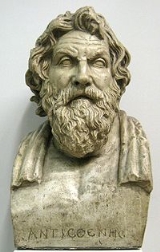
Antisthenes

Encyclopedia
Antisthenes was a Greek philosopher and a pupil of Socrates
. Antisthenes first learned rhetoric
under Gorgias
before becoming an ardent disciple of Socrates
. He adopted and developed the ethical side of Socrates' teachings, advocating an ascetic life lived in accordance with virtue
. Later writers regarded him as the founder of Cynic philosophy.
. In his youth he fought at Tanagra
(426 BCE), and was a disciple first of Gorgias
, and then of Socrates
, at whose death he was present. He never forgave his master's persecutors, and is even said to have been instrumental in procuring their punishment. He survived the Battle of Leuctra
(371 BCE), as he is reported to have compared the victory of the Thebans to a set of schoolboys beating their master. Although one source tells us that he died at the age of 70, he was apparently still alive in 366 BCE, and he must have been nearer to 80 years old when he died at Athens, c. 365 BCE. He is said to have lectured at the Cynosarges
, a gymnasium for the use of Athenians born of foreign mothers, near the temple of Hercules. Diogenes Laërtius
says that his works filled ten volumes, but of these, only fragments remain. His favourite style seems to have been dialogues, some of them being vehement attacks on his contemporaries, as on Alcibiades
in the second of his two works entitled Cyrus, on Gorgias
in his Archelaus and on Plato
in his Satho. His style was pure and elegant, and Theopompus
even said that Plato stole from him many of his thoughts. However, Cicero
, after reading some works by Antisthenes, called him "a man more intelligent than learned" . He possessed considerable powers of wit and sarcasm, and was fond of playing upon words; saying, for instance, that he would rather fall among crows (korakes) than flatterers (kolakes), for the one devour the dead, but the other the living. Two declamations have survived, named Ajax and Odysseus, which are purely rhetorical.
, not pleasure
, is the end of existence. Everything that the wise person does, Antisthenes said, conforms to perfect virtue, and pleasure is not only unnecessary, but a positive evil. He is reported to have held pain and even ill-repute to be blessings, and said that "I'd rather be mad than feel pleasure." It is, however, probable that he did not consider all pleasure worthless, but only that which results from the gratification of sensual or artificial desires, for we find him praising the pleasures which spring "from out of one's soul," and the enjoyments of a wisely chosen friendship. The supreme good he placed in a life lived according to virtue
, – virtue consisting in action, which when obtained is never lost, and exempts the wise person from error. It is closely connected with reason, but to enable it to develop itself in action, and to be sufficient for happiness, it requires the aid of Socratic strength .
(the Physicus) contained a theory of the nature of the gods, in which he argued that there were many gods believed in by the people, but only one natural God
. He also said that God resembles nothing on earth, and therefore could not be understood from any representation.
, Antisthenes was troubled by the problem of universals
. As a proper nominalist, he held that definition and predication are either false or tautological
, since we can only say that every individual is what it is, and can give no more than a description of its qualities, e. g. that silver is like tin in colour. Thus he disbelieved the Platonic system of Ideas. "A horse," said Antisthenes, "I can see, but horsehood I cannot see." Definition is merely a circuitous method of stating an identity: "a tree is a vegetable growth" is logically no more than "a tree is a tree."
, writing a generation later refers several times to Antisthenes and his followers "the Antistheneans," but makes no reference to Cynicism. There are many later tales about the infamous Cynic Diogenes of Sinope
dogging Antisthenes' footsteps and becoming his faithful hound, but it is no means certain that the two men ever met. Some scholars, drawing on the discovery of defaced coins from Sinope
dating from the period 350-340 BCE, believe that Diogenes only moved to Athens after the death of Antisthenes, and it has been argued that the stories linking Antisthenes to Diogenes were invented by the Stoics in a later period in order to provide a succession linking Socrates to Zeno
, via Antisthenes, Diogenes, and Crates
. These tales were important to the Stoics for establishing a chain of teaching that ran from Socrates to Zeno. Others argue that the evidence from the coins is weak, and thus Diogenes could have moved to Athens well before 340 BCE. It is also possible that Diogenes visited Athens and Antisthenes before his exile, and returned to Sinope.
Antisthenes certainly adopted a rigorous ascetic lifestyle, and he developed many of the principles of Cynic philosophy which became an inspiration for Diogenes and later Cynics. It was said that he had laid the foundations of the city which they afterwards built.
Socrates
Socrates was a classical Greek Athenian philosopher. Credited as one of the founders of Western philosophy, he is an enigmatic figure known chiefly through the accounts of later classical writers, especially the writings of his students Plato and Xenophon, and the plays of his contemporary ...
. Antisthenes first learned rhetoric
Rhetoric
Rhetoric is the art of discourse, an art that aims to improve the facility of speakers or writers who attempt to inform, persuade, or motivate particular audiences in specific situations. As a subject of formal study and a productive civic practice, rhetoric has played a central role in the Western...
under Gorgias
Gorgias
Gorgias ,Greek sophist, pre-socratic philosopher and rhetorician, was a native of Leontini in Sicily. Along with Protagoras, he forms the first generation of Sophists. Several doxographers report that he was a pupil of Empedocles, although he would only have been a few years younger...
before becoming an ardent disciple of Socrates
Socrates
Socrates was a classical Greek Athenian philosopher. Credited as one of the founders of Western philosophy, he is an enigmatic figure known chiefly through the accounts of later classical writers, especially the writings of his students Plato and Xenophon, and the plays of his contemporary ...
. He adopted and developed the ethical side of Socrates' teachings, advocating an ascetic life lived in accordance with virtue
Virtue
Virtue is moral excellence. A virtue is a positive trait or quality subjectively deemed to be morally excellent and thus is valued as a foundation of principle and good moral being....
. Later writers regarded him as the founder of Cynic philosophy.
Life
Antisthenes was born c. 445 BCE and was the son of Antisthenes, an Athenian. His mother was a ThracianThracians
The ancient Thracians were a group of Indo-European tribes inhabiting areas including Thrace in Southeastern Europe. They spoke the Thracian language – a scarcely attested branch of the Indo-European language family...
. In his youth he fought at Tanagra
Battle of Tanagra (426 BC)
There was an earlier battle at Tanagra during the Peloponnesian War; see Battle of Tanagra .The Battle of Tanagra was a battle in the Peloponnesian War in 426 BC between Athens and Tanagra &Thebes,...
(426 BCE), and was a disciple first of Gorgias
Gorgias
Gorgias ,Greek sophist, pre-socratic philosopher and rhetorician, was a native of Leontini in Sicily. Along with Protagoras, he forms the first generation of Sophists. Several doxographers report that he was a pupil of Empedocles, although he would only have been a few years younger...
, and then of Socrates
Socrates
Socrates was a classical Greek Athenian philosopher. Credited as one of the founders of Western philosophy, he is an enigmatic figure known chiefly through the accounts of later classical writers, especially the writings of his students Plato and Xenophon, and the plays of his contemporary ...
, at whose death he was present. He never forgave his master's persecutors, and is even said to have been instrumental in procuring their punishment. He survived the Battle of Leuctra
Battle of Leuctra
The Battle of Leuctra was a battle fought on July 6, 371 BC, between the Boeotians led by Thebans and the Spartans along with their allies amidst the post-Corinthian War conflict. The battle took place in the neighbourhood of Leuctra, a village in Boeotia in the territory of Thespiae...
(371 BCE), as he is reported to have compared the victory of the Thebans to a set of schoolboys beating their master. Although one source tells us that he died at the age of 70, he was apparently still alive in 366 BCE, and he must have been nearer to 80 years old when he died at Athens, c. 365 BCE. He is said to have lectured at the Cynosarges
Cynosarges
Cynosarges was a public gymnasium located just outside the walls of Ancient Athens on the southern bank of the Ilissos river.Its name derives from Cynos-argos and means white or swift dog...
, a gymnasium for the use of Athenians born of foreign mothers, near the temple of Hercules. Diogenes Laërtius
Diogenes Laertius
Diogenes Laertius was a biographer of the Greek philosophers. Nothing is known about his life, but his surviving Lives and Opinions of Eminent Philosophers is one of the principal surviving sources for the history of Greek philosophy.-Life:Nothing is definitively known about his life...
says that his works filled ten volumes, but of these, only fragments remain. His favourite style seems to have been dialogues, some of them being vehement attacks on his contemporaries, as on Alcibiades
Alcibiades
Alcibiades, son of Clinias, from the deme of Scambonidae , was a prominent Athenian statesman, orator, and general. He was the last famous member of his mother's aristocratic family, the Alcmaeonidae, which fell from prominence after the Peloponnesian War...
in the second of his two works entitled Cyrus, on Gorgias
Gorgias
Gorgias ,Greek sophist, pre-socratic philosopher and rhetorician, was a native of Leontini in Sicily. Along with Protagoras, he forms the first generation of Sophists. Several doxographers report that he was a pupil of Empedocles, although he would only have been a few years younger...
in his Archelaus and on Plato
Plato
Plato , was a Classical Greek philosopher, mathematician, student of Socrates, writer of philosophical dialogues, and founder of the Academy in Athens, the first institution of higher learning in the Western world. Along with his mentor, Socrates, and his student, Aristotle, Plato helped to lay the...
in his Satho. His style was pure and elegant, and Theopompus
Theopompus
Theopompus was a Greek historian and rhetorician- Biography :Theopompus was born on Chios. In early youth he seems to have spent some time at Athens, along with his father, who had been exiled on account of his Laconian sympathies...
even said that Plato stole from him many of his thoughts. However, Cicero
Cicero
Marcus Tullius Cicero , was a Roman philosopher, statesman, lawyer, political theorist, and Roman constitutionalist. He came from a wealthy municipal family of the equestrian order, and is widely considered one of Rome's greatest orators and prose stylists.He introduced the Romans to the chief...
, after reading some works by Antisthenes, called him "a man more intelligent than learned" . He possessed considerable powers of wit and sarcasm, and was fond of playing upon words; saying, for instance, that he would rather fall among crows (korakes) than flatterers (kolakes), for the one devour the dead, but the other the living. Two declamations have survived, named Ajax and Odysseus, which are purely rhetorical.
Philosophy
Ethics
Antisthenes was a pupil of Socrates, from whom he imbibed the fundamental ethical precept that virtueVirtue
Virtue is moral excellence. A virtue is a positive trait or quality subjectively deemed to be morally excellent and thus is valued as a foundation of principle and good moral being....
, not pleasure
Pleasure
Pleasure describes the broad class of mental states that humans and other animals experience as positive, enjoyable, or worth seeking. It includes more specific mental states such as happiness, entertainment, enjoyment, ecstasy, and euphoria...
, is the end of existence. Everything that the wise person does, Antisthenes said, conforms to perfect virtue, and pleasure is not only unnecessary, but a positive evil. He is reported to have held pain and even ill-repute to be blessings, and said that "I'd rather be mad than feel pleasure." It is, however, probable that he did not consider all pleasure worthless, but only that which results from the gratification of sensual or artificial desires, for we find him praising the pleasures which spring "from out of one's soul," and the enjoyments of a wisely chosen friendship. The supreme good he placed in a life lived according to virtue
Virtue
Virtue is moral excellence. A virtue is a positive trait or quality subjectively deemed to be morally excellent and thus is valued as a foundation of principle and good moral being....
, – virtue consisting in action, which when obtained is never lost, and exempts the wise person from error. It is closely connected with reason, but to enable it to develop itself in action, and to be sufficient for happiness, it requires the aid of Socratic strength .
Physics
His work on Natural PhilosophyNatural philosophy
Natural philosophy or the philosophy of nature , is a term applied to the study of nature and the physical universe that was dominant before the development of modern science...
(the Physicus) contained a theory of the nature of the gods, in which he argued that there were many gods believed in by the people, but only one natural God
God
God is the English name given to a singular being in theistic and deistic religions who is either the sole deity in monotheism, or a single deity in polytheism....
. He also said that God resembles nothing on earth, and therefore could not be understood from any representation.
Logic
In logicLogic
In philosophy, Logic is the formal systematic study of the principles of valid inference and correct reasoning. Logic is used in most intellectual activities, but is studied primarily in the disciplines of philosophy, mathematics, semantics, and computer science...
, Antisthenes was troubled by the problem of universals
Problem of universals
The problem of universals is an ancient problem in metaphysics about whether universals exist. Universals are general or abstract qualities, characteristics, properties, kinds or relations, such as being male/female, solid/liquid/gas or a certain colour, that can be predicated of individuals or...
. As a proper nominalist, he held that definition and predication are either false or tautological
Tautology (logic)
In logic, a tautology is a formula which is true in every possible interpretation. Philosopher Ludwig Wittgenstein first applied the term to redundancies of propositional logic in 1921; it had been used earlier to refer to rhetorical tautologies, and continues to be used in that alternate sense...
, since we can only say that every individual is what it is, and can give no more than a description of its qualities, e. g. that silver is like tin in colour. Thus he disbelieved the Platonic system of Ideas. "A horse," said Antisthenes, "I can see, but horsehood I cannot see." Definition is merely a circuitous method of stating an identity: "a tree is a vegetable growth" is logically no more than "a tree is a tree."
Antisthenes and the Cynics
In later times, Antisthenes came to be seen as the founder of the Cynics, but it is by no means certain that he would have recognized the term. AristotleAristotle
Aristotle was a Greek philosopher and polymath, a student of Plato and teacher of Alexander the Great. His writings cover many subjects, including physics, metaphysics, poetry, theater, music, logic, rhetoric, linguistics, politics, government, ethics, biology, and zoology...
, writing a generation later refers several times to Antisthenes and his followers "the Antistheneans," but makes no reference to Cynicism. There are many later tales about the infamous Cynic Diogenes of Sinope
Diogenes of Sinope
Diogenes the Cynic was a Greek philosopher and one of the founders of Cynic philosophy. Also known as Diogenes of Sinope , he was born in Sinope , an Ionian colony on the Black Sea , in 412 or 404 BCE and died at Corinth in 323 BCE.Diogenes of Sinope was a controversial figure...
dogging Antisthenes' footsteps and becoming his faithful hound, but it is no means certain that the two men ever met. Some scholars, drawing on the discovery of defaced coins from Sinope
Sinop, Turkey
Sinop is a city with a population of 36,734 on İnce Burun , by its Cape Sinop which is situated on the most northern edge of the Turkish side of Black Sea coast, in the ancient region of Paphlagonia, in modern-day northern Turkey, historically known as Sinope...
dating from the period 350-340 BCE, believe that Diogenes only moved to Athens after the death of Antisthenes, and it has been argued that the stories linking Antisthenes to Diogenes were invented by the Stoics in a later period in order to provide a succession linking Socrates to Zeno
Zeno of Citium
Zeno of Citium was a Greek philosopher from Citium . Zeno was the founder of the Stoic school of philosophy, which he taught in Athens from about 300 BC. Based on the moral ideas of the Cynics, Stoicism laid great emphasis on goodness and peace of mind gained from living a life of virtue in...
, via Antisthenes, Diogenes, and Crates
Crates of Thebes
Crates of Thebes, was a Cynic philosopher. Crates gave away his money to live a life of poverty on the streets of Athens. He married Hipparchia of Maroneia who lived in the same manner that he did. Respected by the people of Athens, he is remembered for being the teacher of Zeno of Citium, the...
. These tales were important to the Stoics for establishing a chain of teaching that ran from Socrates to Zeno. Others argue that the evidence from the coins is weak, and thus Diogenes could have moved to Athens well before 340 BCE. It is also possible that Diogenes visited Athens and Antisthenes before his exile, and returned to Sinope.
Antisthenes certainly adopted a rigorous ascetic lifestyle, and he developed many of the principles of Cynic philosophy which became an inspiration for Diogenes and later Cynics. It was said that he had laid the foundations of the city which they afterwards built.
External links
- XenophonXenophonXenophon , son of Gryllus, of the deme Erchia of Athens, also known as Xenophon of Athens, was a Greek historian, soldier, mercenary, philosopher and a contemporary and admirer of Socrates...
, Symposium, Book IV