
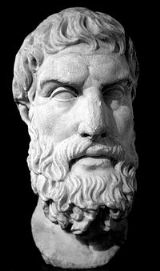
Epicurus was an
ancient Greek philosopherAncient Greek philosophy arose in the 6th century BCE and continued through the Hellenistic period, at which point Ancient Greece was incorporated in the Roman Empire...
and the founder of the school of philosophy called
EpicureanismEpicureanism is a system of philosophy based upon the teachings of Epicurus, founded around 307 BC. Epicurus was an atomic materialist, following in the steps of Democritus. His materialism led him to a general attack on superstition and divine intervention. Following Aristippus—about whom...
.
Only a few fragments and letters remain of Epicurus's 300 written works. Much of what is known about Epicurean philosophy derives from later followers and commentators.
For Epicurus, the purpose of philosophy was to attain the happy, tranquil life, characterized by
ataraxiaAtaraxia is a Greek term used by Pyrrho and Epicurus for a lucid state, characterized by freedom from worry or any other preoccupation.For the Epicureans, ataraxia was synonymous with the only true happiness possible for a person...
—peace and freedom from fear—and
aponiaAponia means the absence of pain, and was regarded by the Epicureans to be the height of bodily pleasure.As with the other Hellenistic schools of philosophy, the Epicureans believed that the goal of human life is happiness...
—the absence of pain—and by living a self-sufficient life surrounded by friends.
He taught that pleasure and pain are the measures of what is good and evil, that death is the end of the body and the soul and should therefore not be feared, that the gods do not reward or punish humans, that the universe is infinite and eternal, and that events in the world are ultimately based on the motions and interactions of
atomsAtomism is a natural philosophy that developed in several ancient traditions. The atomists theorized that the natural world consists of two fundamental parts: indivisible atoms and empty void.According to Aristotle, atoms are indestructible and immutable and there are an infinite variety of shapes...
moving in empty space.
Biography
His parents, Neocles and Chaerestrate, both Athenian-born, and his father a citizen, had emigrated to the Athenian settlement on the
AegeanThe Aegean Sea[p] is an elongated embayment of the Mediterranean Sea located between the southern Balkan and Anatolian peninsulas, i.e., between the mainlands of Greece and Turkey. In the north, it is connected to the Marmara Sea and Black Sea by the Dardanelles and Bosporus...
island of
SamosSamos is a Greek island in the eastern Aegean Sea, south of Chios, north of Patmos and the Dodecanese, and off the coast of Asia Minor, from which it is separated by the -wide Mycale Strait. It is also a separate regional unit of the North Aegean region, and the only municipality of the regional...
about ten years before Epicurus's birth in February 341 BCE. As a boy, he studied philosophy for four years under the
PlatonistPlatonism is the philosophy of Plato or the name of other philosophical systems considered closely derived from it. In a narrower sense the term might indicate the doctrine of Platonic realism...
teacher Pamphilus. At the age of 18, he went to
AthensAthens , is the capital and largest city of Greece. Athens dominates the Attica region and is one of the world's oldest cities, as its recorded history spans around 3,400 years. Classical Athens was a powerful city-state...
for his two-year term of military service. The playwright
MenanderMenander , Greek dramatist, the best-known representative of Athenian New Comedy, was the son of well-to-do parents; his father Diopeithes is identified by some with the Athenian general and governor of the Thracian Chersonese known from the speech of Demosthenes De Chersoneso...
served in the same age-class of the
ephebesEphebos , also anglicised as ephebe or archaically ephebus , is a Greek word for an adolescent age group or a social status reserved for that age in Antiquity....
as Epicurus.
After the death of
Alexander the Great,
PerdiccasPerdiccas was one of Alexander the Great's generals. After Alexander's death in 323 BC he became regent of all Alexander's empire.Arrian tells us he was son of Orontes, a descendant of the independent princes of the Macedonian province of Orestis...
expelled the Athenian settlers on Samos to Colophon, on the coast of what is now Turkey. After the completion of his military service, Epicurus joined his family there. He studied under
NausiphanesNausiphanes , a native of Teos, was attached to the philosophy of Democritus, and was a pupil of Pyrrho. He had a large number of pupils, and was particularly famous as a rhetorician. Epicurus was at one time one of his hearers, but was unsatisfied with him, and apparently abused him in his writings...
, who followed the teachings of
DemocritusDemocritus was an Ancient Greek philosopher born in Abdera, Thrace, Greece. He was an influential pre-Socratic philosopher and pupil of Leucippus, who formulated an atomic theory for the cosmos....
. In 311/310 BCE Epicurus taught in
MytileneMytilene is a town and a former municipality on the island of Lesbos, North Aegean, Greece. Since the 2011 local government reform it is part of the municipality Lesbos, of which it is a municipal unit. It is the capital of the island of Lesbos. Mytilene, whose name is pre-Greek, is built on the...
but caused strife and was forced to leave. He then founded a school in
LampsacusLampsacus was an ancient Greek city strategically located on the eastern side of the Hellespont in the northern Troad. An inhabitant of Lampsacus was called a Lampsacene. The name has been transmitted in the nearby modern town of Lapseki.-Ancient history:...
before returning to Athens in 306 BCE. There he founded The Garden, a school named for the garden he owned about halfway between the
StoaThe Stoa Poikile or Painted Porch, originally called the Porch of Peisianax , was erected during the 5th century BC and was located on the north side of the Ancient Agora of Athens. The Stoa was the location from which Zeno of Citium taught Stoicism...
and the
AcademyThe Academy was founded by Plato in ca. 387 BC in Athens. Aristotle studied there for twenty years before founding his own school, the Lyceum. The Academy persisted throughout the Hellenistic period as a skeptical school, until coming to an end after the death of Philo of Larissa in 83 BC...
that served as the school's meeting place.
Even though many of his teachings were heavily influenced by earlier thinkers, especially by
DemocritusDemocritus was an Ancient Greek philosopher born in Abdera, Thrace, Greece. He was an influential pre-Socratic philosopher and pupil of Leucippus, who formulated an atomic theory for the cosmos....
, he differed in a significant way with Democritus on determinism. Epicurus would often deny this influence, denounce other philosophers as confused, and claim to be "self-taught".
Epicurus never married and had no known children. He suffered from
kidney stoneA kidney stone, also known as a renal calculus is a solid concretion or crystal aggregation formed in the kidneys from dietary minerals in the urine...
s, to which he finally succumbed in 270 BCE at the age of 72, and despite the prolonged pain involved, he wrote to
IdomeneusIdomeneus of Lampsacus was a friend and disciple of Epicurus. We have no details of his life, except that he married Batis of Lampsacus, the sister of Metrodorus, and he was a court dignitary at Lampsacus around 306-301 BC...
:
I have written this letter to you on a happy day to me, which is also the last day of my life. For I have been attacked by a painful inability to urinate, and also dysentery, so violent that nothing can be added to the violence of my sufferings. But the cheerfulness of my mind, which comes from the recollection of all my philosophical contemplation, counterbalances all these afflictions. And I beg you to take care of the children of Metrodorus, in a manner worthy of the devotion shown by the young man to me, and to philosophy.
The school
Epicurus' school, which was based in the garden of his house and thus called "The Garden", had a small but devoted following in his lifetime. The primary members were
HermarchusHermarchus or Hermarch , sometimes incorrectly written Hermachus , was an Epicurean philosopher. He was the disciple and successor of Epicurus as head of the school. None of his writings survive. He wrote works directed against Plato, Aristotle, and Empedocles. A fragment from his Against...
, the financier
IdomeneusIdomeneus of Lampsacus was a friend and disciple of Epicurus. We have no details of his life, except that he married Batis of Lampsacus, the sister of Metrodorus, and he was a court dignitary at Lampsacus around 306-301 BC...
,
LeonteusLeonteus of Lampsacus, was a pupil of Epicurus early in the 3rd century BCE. He was the husband of Themista, who also attended Epicurus' school. Such was the esteem in which they held Epicurus that they named their son after him....
and his wife
ThemistaThemista of Lampsacus, the wife of Leonteus, was a student of Epicurus, early in the 3rd century BCE. Epicurus' school was unusual in the 3rd century, in that it allowed women to attend, and we also hear of Leontion attending Epicurus' school around the same time...
, the
satiristSatire is primarily a literary genre or form, although in practice it can also be found in the graphic and performing arts. In satire, vices, follies, abuses, and shortcomings are held up to ridicule, ideally with the intent of shaming individuals, and society itself, into improvement...
ColotesColotes of Lampsacus was a pupil of Epicurus, and one of the most famous of his disciples. He wrote a work to prove That it is impossible even to live according to the doctrines of the other philosophers . It was dedicated to king Ptolemy Philopator...
, the mathematician
Polyaenus of LampsacusPolyaenus of Lampsacus , also spelled Polyenus, son of Athenodorus, was an ancient Greek mathematician and a friend of Epicurus. His friendship with Epicurus started after the latter's escape from Mytilene in 307 or 306 BC when he opened a philosophical school at Lampsacus associating himself with...
, Leontion, and Metrodorus of Lampsacus, the most famous popularizer of Epicureanism. His school was the first of the ancient Greek philosophical schools to admit women as a rule rather than an exception. The original school was based in Epicurus's home and garden. An inscription on the gate to The Garden is recorded by
SenecaLucius Annaeus Seneca was a Roman Stoic philosopher, statesman, dramatist, and in one work humorist, of the Silver Age of Latin literature. He was tutor and later advisor to emperor Nero...
in epistle XXI of
Epistulae morales ad LuciliumThe Epistulae morales ad Lucilium is a bundle of 124 letters which were written by Seneca the Younger at the end of his life. These letters all start with the phrase "Seneca Lucilio suo salutem" and end with the word "Vale" . In these letters, Seneca gives Lucilius tips on how to become a more...
:
Stranger, here you will do well to tarry; here our highest good is pleasure.
Epicurus emphasized friendship as an important ingredient of happiness, and the school resembled in many ways a community of friends living together. However, he also instituted a hierarchical system of levels among his followers, and had them swear an oath on his core tenets.
Prefiguring science and ethics
Epicurus is a key figure in the development of
scienceScience is a systematic enterprise that builds and organizes knowledge in the form of testable explanations and predictions about the universe...
and the
scientific methodScientific method refers to a body of techniques for investigating phenomena, acquiring new knowledge, or correcting and integrating previous knowledge. To be termed scientific, a method of inquiry must be based on gathering empirical and measurable evidence subject to specific principles of...
because of his insistence that nothing should be believed, except that which was tested through direct observation and logical deduction. Many of his ideas about nature and physics presaged important scientific concepts of our time. He was a key figure in the
Axial AgeGerman philosopher Karl Jaspers coined the term the axial age or axial period to describe the period from 800 to 200 BC, during which, according to Jaspers, similar revolutionary thinking appeared in India, China and the Occident...
, the period from 800 BCE to 200 BCE, during which similarly revolutionary thinking appeared in China, India, Iran, the Near East, and Ancient Greece. His statement of the
Ethic of ReciprocityThe Golden Rule or ethic of reciprocity is a maxim, ethical code, or moralitythat essentially states either of the following:* : One should treat others as one would like others to treat oneself....
as the foundation of ethics is the earliest in Ancient Greece, and he differs from the formulation of
utilitarianismUtilitarianism is an ethical theory holding that the proper course of action is the one that maximizes the overall "happiness", by whatever means necessary. It is thus a form of consequentialism, meaning that the moral worth of an action is determined only by its resulting outcome, and that one can...
by
Jeremy BenthamJeremy Bentham was an English jurist, philosopher, and legal and social reformer. He became a leading theorist in Anglo-American philosophy of law, and a political radical whose ideas influenced the development of welfarism...
and
John Stuart MillJohn Stuart Mill was a British philosopher, economist and civil servant. An influential contributor to social theory, political theory, and political economy, his conception of liberty justified the freedom of the individual in opposition to unlimited state control. He was a proponent of...
by emphasizing the minimization of harm to oneself and others as the way to maximize happiness.
Epicurus's teachings represented a departure from the other major Greek thinkers of his period, and before, but was nevertheless founded on many of the same principles as
DemocritusDemocritus was an Ancient Greek philosopher born in Abdera, Thrace, Greece. He was an influential pre-Socratic philosopher and pupil of Leucippus, who formulated an atomic theory for the cosmos....
. Like Democritus, he was an atomist, believing that the fundamental constituents of the world were indivisible little bits of matter (
atomThe atom is a basic unit of matter that consists of a dense central nucleus surrounded by a cloud of negatively charged electrons. The atomic nucleus contains a mix of positively charged protons and electrically neutral neutrons...
s, Greek
atomos, indivisible) flying through
empty spaceOuter space is the void that exists between celestial bodies, including the Earth. It is not completely empty, but consists of a hard vacuum containing a low density of particles: predominantly a plasma of hydrogen and helium, as well as electromagnetic radiation, magnetic fields, and neutrinos....
(
kenos). Everything that occurs is the result of the atoms colliding, rebounding, and becoming entangled with one another, with no purpose or plan behind their motions. (Compare this with the modern study of
particle physicsParticle physics is a branch of physics that studies the existence and interactions of particles that are the constituents of what is usually referred to as matter or radiation. In current understanding, particles are excitations of quantum fields and interact following their dynamics...
.) His theory differs from the earlier atomism of Democritus because he admits that atoms do not always follow straight lines but their direction of motion may occasionally exhibit a 'swerve' (
clinamen). This allowed him to avoid the
determinismDeterminism is the general philosophical thesis that states that for everything that happens there are conditions such that, given them, nothing else could happen. There are many versions of this thesis. Each of them rests upon various alleged connections, and interdependencies of things and...
implicit in the earlier atomism and to affirm
free will"To make my own decisions whether I am successful or not due to uncontrollable forces" -Troy MorrisonA pragmatic definition of free willFree will is the ability of agents to make choices free from certain kinds of constraints. The existence of free will and its exact nature and definition have long...
. (Compare this with the modern theory of quantum physics, which postulates a non-deterministic random motion of fundamental particles.)
He regularly admitted women and slaves into his school and was one of the first Greeks to break from the god-fearing and god-worshiping tradition common at the time, even while affirming that religious activities are useful as a way to contemplate the gods and to use them as an example of the pleasant life. Epicurus participated in the activities of traditional Greek religion, but taught that one should avoid holding false opinions about the gods. The gods are immortal and blessed and men who ascribe any additional qualities that are alien to immortality and blessedness are, according to Epicurus, impious. The gods do not punish the bad and reward the good as the common man believes. The opinion of the crowd is, Epicurus claims, that the gods "send great evils to the wicked and great blessings to the righteous who model themselves after the gods," when in reality Epicurus believes the gods do not concern themselves at all with human beings.
It is not the man who denies the gods worshipped by the multitude, who is impious, but he who affirms of the gods what the multitude believes about them.
Pleasure as absence of suffering
Epicurus' philosophy is based on the theory that all good and bad derive from the sensations of pleasure and pain. What is good is what is pleasurable, and what is bad is what is painful. Pleasure and pain were ultimately, for Epicurus, the basis for the moral distinction between good and bad. If pain is chosen over pleasure in some cases it is only because it leads to a greater pleasure. Although Epicurus has been commonly misunderstood to advocate the rampant pursuit of pleasure, what he was really after was the absence of pain (both physical and mental, i.e.,
sufferingSuffering, or pain in a broad sense, is an individual's basic affective experience of unpleasantness and aversion associated with harm or threat of harm. Suffering may be qualified as physical or mental. It may come in all degrees of intensity, from mild to intolerable. Factors of duration and...
) - a state of satiation and tranquility that was free of the fear of death and the retribution of the gods. When we do not suffer pain, we are no longer in need of pleasure, and we enter a state of 'perfect mental peace' (
ataraxiaAtaraxia is a Greek term used by Pyrrho and Epicurus for a lucid state, characterized by freedom from worry or any other preoccupation.For the Epicureans, ataraxia was synonymous with the only true happiness possible for a person...
).
Epicurus' teachings were introduced into medical philosophy and practice by the Epicurean doctor
Asclepiades of BithyniaAsclepiades was a Greek physician born at Prusa in Bithynia in Asia Minor and flourished at Rome, where he established Greek medicine near the end of the 2nd century BCE. He attempted to build a new theory of disease, based on the flow of atoms through pores in the body...
, who was the first physician who introduced Greek medicine in Rome. Asclepiades introduced the friendly, sympathetic, pleasing and painless treatment of patients. He advocated humane treatment of mental disorders, had insane persons freed from confinement and treated them with natural therapy, such as diet and massages. His teachings are surprisingly modern, therefore Asclepiades is considered to be a pioneer physician in psychotherapy, physical therapy and molecular medicine.
Epicurus explicitly warned against overindulgence because it often leads to pain. For instance, Epicurus warned against pursuing love too ardently. He defended friendships as ramparts for pleasure and denied them any inherent worth. He also believed (
contra Aristotle) that death was not to be feared. When a man dies, he does not feel the pain of death because he no longer is and he therefore feels nothing. Therefore, as Epicurus famously said, "death is nothing to us." When we exist death is not, and when death exists we are not. All sensation and consciousness ends with death and therefore in death there is neither pleasure nor pain. The fear of death arises from the belief that in death there is awareness.
From this doctrine arose the Epicurean epitaph:
Non fui, fui, non sum, non curo (I was not; I was; I am not; I do not care) – which is inscribed on the gravestones of his followers and seen on many ancient gravestones of the
Roman EmpireThe Roman Empire was the post-Republican period of the ancient Roman civilization, characterised by an autocratic form of government and large territorial holdings in Europe and around the Mediterranean....
. This quote is often used today at
humanistHumanism is an approach in study, philosophy, world view or practice that focuses on human values and concerns. In philosophy and social science, humanism is a perspective which affirms some notion of human nature, and is contrasted with anti-humanism....
funerals.
The "Epicurean paradox" is a version of the
problem of evilIn the philosophy of religion, the problem of evil is the question of how to explain evil if there exists a deity that is omnibenevolent, omnipotent, and omniscient . Some philosophers have claimed that the existences of such a god and of evil are logically incompatible or unlikely...
. It is a
trilemmaA trilemma is a difficult choice from three options, each of which is unacceptable or unfavourable.There are two logically equivalent ways in which to express a trilemma: it can be expressed as a choice among three unfavourable options, one of which must be chosen, or as a choice among three...
argument (God is omnipotent, God is good, but Evil exists); or more commonly seen as this quote:
“Is God willing to prevent evil, but not able?
Then he is not omnipotent.
Is he able, but not willing?
Then he is malevolent.
Is he both able and willing?
Then whence cometh evil?
Is he neither able nor willing?
Then why call him God?”
This argument was a type favoured by the ancient Greek
skepticsPhilosophical skepticism is both a philosophical school of thought and a method that crosses disciplines and cultures. Many skeptics critically examine the meaning systems of their times, and this examination often results in a position of ambiguity or doubt...
, and may have been wrongly attributed to Epicurus by Lactantius, who, from his
ChristianA Christian is a person who adheres to Christianity, an Abrahamic, monotheistic religion based on the life and teachings of Jesus of Nazareth as recorded in the Canonical gospels and the letters of the New Testament...
perspective, regarded Epicurus as an atheist. It has been suggested that it may actually be the work of an early
skepticPhilosophical skepticism is both a philosophical school of thought and a method that crosses disciplines and cultures. Many skeptics critically examine the meaning systems of their times, and this examination often results in a position of ambiguity or doubt...
writer, possibly
CarneadesCarneades was an Academic skeptic born in Cyrene. By the year 159 BC, he had started to refute all previous dogmatic doctrines, especially Stoicism, and even the Epicureans whom previous skeptics had spared. As head of the Academy, he was one of three philosophers sent to Rome in 155 BC where his...
. According to Reinhold F. Glei, it is settled that the argument of theodicy is from an academic source which is not only not epicurean, but even anti-epicurean. The earliest extant version of this
trilemma appears in the writings of the skeptic
Sextus EmpiricusSextus Empiricus , was a physician and philosopher, and has been variously reported to have lived in Alexandria, Rome, or Athens. His philosophical work is the most complete surviving account of ancient Greek and Roman skepticism....
.
Epicurus didn’t deny the existence of gods. Instead, he stated that what gods there may be do not concern themselves with us, and thus would not seek to punish us either in this or any other life.
Epicurus emphasized the senses in his
epistemology, and his Principle of Multiple Explanations ("if several theories are consistent with the observed data, retain them all") is an early contribution to the
philosophy of scienceThe philosophy of science is concerned with the assumptions, foundations, methods and implications of science. It is also concerned with the use and merit of science and sometimes overlaps metaphysics and epistemology by exploring whether scientific results are actually a study of truth...
.
There are also some things for which it is not enough to state a single cause, but several, of which one, however, is the case. Just as if you were to see the lifeless corpse of a man lying far away, it would be fitting to list all the causes of death in order to make sure that the single cause of this death may be stated. For you would not be able to establish conclusively that he died by the sword or of cold or of illness or perhaps by poison, but we know that there is something of this kind that happened to him.
In contrast to the Stoics, Epicureans showed little interest in participating in the politics of the day, since doing so leads to trouble. He instead advocated seclusion. His garden can be compared to present-day
communeA commune is an intentional community of people living together, sharing common interests, property, possessions, resources, and, in some communes, work and income. In addition to the communal economy, consensus decision-making, non-hierarchical structures and ecological living have become...
s. This principle is epitomized by the phrase
lathe biōsas .
PlutarchPlutarch then named, on his becoming a Roman citizen, Lucius Mestrius Plutarchus , c. 46 – 120 AD, was a Greek historian, biographer, essayist, and Middle Platonist known primarily for his Parallel Lives and Moralia...
elaborated in his essay
Is the Saying "Live in Obscurity" Right? ( -
An recte dictum sit latenter esse vivendum) 1128c; Flavius Philostratus
Vita Apollonii 8.28.12, meaning "live in obscurity", "get through life without drawing attention to yourself", i. e. live without pursuing glory or wealth or power, but anonymously, enjoying little things like food, the company of friends, etc.
As an ethical guideline, Epicurus emphasized minimizing harm and maximizing happiness of oneself and others:
It is impossible to live a pleasant life without living wisely and well and justly (agreeing "neither to harm nor be harmed"),
and it is impossible to live wisely and well and justly without living a pleasant life.
Legacy
Elements of Epicurean philosophy have resonated and resurfaced in various diverse thinkers and movements throughout Western intellectual history.
The atomic poems (such as 'All Things are Governed by Atoms') and natural philosophy of
Margaret CavendishMargaret Cavendish, Duchess of Newcastle-upon-Tyne was an English aristocrat, a prolific writer, and a scientist. Born Margaret Lucas, she was the youngest sister of prominent royalists Sir John Lucas and Sir Charles Lucas...
were influenced by Epicurus.
His emphasis on minimizing harm and maximizing happiness in his formulation of the
Ethic of ReciprocityThe Golden Rule or ethic of reciprocity is a maxim, ethical code, or moralitythat essentially states either of the following:* : One should treat others as one would like others to treat oneself....
was later picked up by the democratic thinkers of the
French RevolutionThe French Revolution , sometimes distinguished as the 'Great French Revolution' , was a period of radical social and political upheaval in France and Europe. The absolute monarchy that had ruled France for centuries collapsed in three years...
, and others, like
John LockeJohn Locke FRS , widely known as the Father of Liberalism, was an English philosopher and physician regarded as one of the most influential of Enlightenment thinkers. Considered one of the first of the British empiricists, following the tradition of Francis Bacon, he is equally important to social...
, who wrote that people had a right to "life, liberty, and property." To Locke, one's own body was part of their property, and thus one's right to property would theoretically guarantee safety for their persons, as well as their possessions.
This triad, as well as the
egalitarianismEgalitarianism is a trend of thought that favors equality of some sort among moral agents, whether persons or animals. Emphasis is placed upon the fact that equality contains the idea of equity of quality...
of Epicurus, was carried forward into the American freedom movement and Declaration of Independence, by the
American founding fatherThe Founding Fathers of the United States of America were political leaders and statesmen who participated in the American Revolution by signing the United States Declaration of Independence, taking part in the American Revolutionary War, establishing the United States Constitution, or by some...
,
Thomas JeffersonThomas Jefferson was the principal author of the United States Declaration of Independence and the Statute of Virginia for Religious Freedom , the third President of the United States and founder of the University of Virginia...
, as "all men are created equal" and endowed with certain "inalienable rights such as life, liberty, and the pursuit of happiness." Jefferson considered himself an Epicurean.
http://www.csun.edu/~hcfll004/jefflet.html
In
An Enquiry Concerning Human UnderstandingAn Enquiry Concerning Human Understanding is a book by the Scottish empiricist philosopher David Hume, published in 1748. It was a revision of an earlier effort, Hume's A Treatise of Human Nature, published anonymously in London in 1739–40...
,
David HumeDavid Hume was a Scottish philosopher, historian, economist, and essayist, known especially for his philosophical empiricism and skepticism. He was one of the most important figures in the history of Western philosophy and the Scottish Enlightenment...
uses Epicurus as a character for explaining the impossibility of our knowing God to be any greater or better than his creation proves him to be.
Karl MarxKarl Heinrich Marx was a German philosopher, economist, sociologist, historian, journalist, and revolutionary socialist. His ideas played a significant role in the development of social science and the socialist political movement...
's doctoral thesis was on "The Difference Between the
DemocriteanDemocritus was an Ancient Greek philosopher born in Abdera, Thrace, Greece. He was an influential pre-Socratic philosopher and pupil of Leucippus, who formulated an atomic theory for the cosmos....
and Epicurean Philosophy of Nature."
http://www.marxists.org/archive/marx/works/1841/dr-theses/index.htm
Epicurus was first to assert human freedom as coming from a fundamental
indeterminismIndeterminism is the concept that events are not caused, or not caused deterministically by prior events. It is the opposite of determinism and related to chance...
in the motion of atoms. This has led some philosophers to think that for Epicurus
free will"To make my own decisions whether I am successful or not due to uncontrollable forces" -Troy MorrisonA pragmatic definition of free willFree will is the ability of agents to make choices free from certain kinds of constraints. The existence of free will and its exact nature and definition have long...
was
caused directly by chance. In his "On the Nature of Things,"
LucretiusTitus Lucretius Carus was a Roman poet and philosopher. His only known work is an epic philosophical poem laying out the beliefs of Epicureanism, De rerum natura, translated into English as On the Nature of Things or "On the Nature of the Universe".Virtually no details have come down concerning...
appears to suggest this in the best-known passage on Epicurus's position. But in his Letter to Menoeceus, Epicurus follows
AristotleAristotle was a Greek philosopher and polymath, a student of Plato and teacher of Alexander the Great. His writings cover many subjects, including physics, metaphysics, poetry, theater, music, logic, rhetoric, linguistics, politics, government, ethics, biology, and zoology...
and clearly identifies
three possible causes - "some things happen of necessity, others by chance, others through our own agency." Aristotle said some things "depend on us" (
eph hemin). Epicurus agreed, and said it is to these last things that
praisePraise is the act of making positive statements about a person, object or idea, either in public or privately. Praise is typically, but not exclusively, earned relative to achievement and accomplishment...
and
blameBlame is the act of censuring, holding responsible, making negative statements about an individual or group that their action or actions are socially or morally irresponsible, the opposite of praise. When someone is morally responsible for doing something wrong their action is blameworthy...
naturally attach. For Epicurus, the
chanceRandomness has somewhat differing meanings as used in various fields. It also has common meanings which are connected to the notion of predictability of events....
"swerve" (or
clinamenClinamen is the Latin name Lucretius gave to the unpredictable swerve of atoms, in order to defend the atomistic doctrine of Epicurus.According to Lucretius, the unpredictable swerve occurs "at no fixed place or time":...
) of the atoms simply defeated
determinismDeterminism is the general philosophical thesis that states that for everything that happens there are conditions such that, given them, nothing else could happen. There are many versions of this thesis. Each of them rests upon various alleged connections, and interdependencies of things and...
to leave room for autonomous agency.
Epicurus was also a significant source of inspiration and interest for both
Arthur SchopenhauerArthur Schopenhauer was a German philosopher known for his pessimism and philosophical clarity. At age 25, he published his doctoral dissertation, On the Fourfold Root of the Principle of Sufficient Reason, which examined the four separate manifestations of reason in the phenomenal...
, having particular influence on the famous pessimist's views on suffering and death, as well as one of Schopenhauer's successors:
Friedrich NietzscheFriedrich Wilhelm Nietzsche was a 19th-century German philosopher, poet, composer and classical philologist...
. Nietzsche cites his affinities to Epicurus in a number of his works, including
The Gay ScienceThe Gay Science is a book written by Friedrich Nietzsche, first published in 1882 and followed by a second edition, which was published after the completion of Thus Spoke Zarathustra and Beyond Good and Evil, in 1887. This substantial expansion includes a fifth book and an appendix of songs...
,
Beyond Good and EvilBeyond Good and Evil is a book by the philosopher Friedrich Nietzsche, first published in 1886.It takes up and expands on the ideas of his previous work, Thus Spoke Zarathustra, but approached from a more critical, polemical direction....
, and his private letters to Peter Gast. Nietzsche was attracted to, among other things, Epicurus's ability to maintain a cheerful philosophical outlook in the face of painful physical ailments. Nietzsche also suffered from a number of sicknesses during his lifetime. However, he thought that Epicurus's conception of happiness as freedom from anxiety was too passive and negative.
Works
The only surviving complete works by Epicurus are three letters, which are to be found in book X of Diogenes Laertius's
Lives of Eminent Philosophers, and two groups of quotes: the
Principal Doctrines, reported as well in Diogenes's book X, and the
Vatican Sayings, preserved in a manuscript from the
Vatican LibraryThe Vatican Library is the library of the Holy See, currently located in Vatican City. It is one of the oldest libraries in the world and contains one of the most significant collections of historical texts. Formally established in 1475, though in fact much older, it has 75,000 codices from...
.
Numerous fragments of his thirty-seven volume treatise
On NatureOn Nature is the name of a philosophical treatise written by Epicurus. It was a thirty-seven volume work. Numerous fragments have been found among the charred papyrus fragments at the Villa of the Papyri at Herculaneum ....
have been found among the charred papyrus fragments at the
Villa of the PapyriThe Villa of the Papyri is a private house in the ancient Roman city of Herculaneum . Situated north-west of the township, the residence sits halfway up the slope of the volcano Vesuvius without other buildings to obstruct the view. The villa suburbana was owned by Julius Caesar's father-in-law,...
at
HerculaneumHerculaneum was an ancient Roman town destroyed by volcanic pyroclastic flows in AD 79, located in the territory of the current commune of Ercolano, in the Italian region of Campania in the shadow of Mt...
. In addition, other Epicurean writings found at Herculaneum contain important quotations from his other works. Moreover, numerous fragments and testimonies are found throughout ancient Greek and Roman literature, a collection of which can be found in
UsenerHermann Karl Usener was a German scholar in the fields of philology and comparative religion.-Life:...
's
EpicureaEpicurea is a collection of texts, fragments and testimonies by Epicurus composed by Hermann Usener in 1887.- External links :* at Internet Archive* at...
.
Hero cult
According to Diskin Clay, Epicurus himself established a custom of celebrating his birthday annually with common meals, befitting his stature as hero ctistes (or founding hero) of the Garden. He ordained in his will annual memorial feasts for himself on the same date (10th of
Gamelion monthThe Attic calendar is a hellenic calendar that was in use in ancient Attica, the ancestral territory of the Athenian polis. This article focuses on the 5th and 4th centuries BC, the classical period that produced some of the most significant works of ancient Greek literature. Because of the...
). Epicurean communities continued this tradition, referring to Epicurus as their "savior" (
soterSoter derives from the Greek epithet , meaning a saviour, a deliverer; initial capitalised ; fully capitalised ; feminine Soteira...
) and celebrating him as hero. Lucretius apotheosized Epicurus as the main character of his epic poem De rerum natura. The hero cult of Epicurus may have operated as a Garden variety civic religion. However, clear evidence of an Epicurean hero cult, as well as the cult itself, seems buried by the weight of posthumous philosophical interpretation. Epicurus' cheerful demeanor, as he continued to work despite dying from a painful stone blockage of his urinary tract lasting a fortnight, according to his successor
HermarchusHermarchus or Hermarch , sometimes incorrectly written Hermachus , was an Epicurean philosopher. He was the disciple and successor of Epicurus as head of the school. None of his writings survive. He wrote works directed against Plato, Aristotle, and Empedocles. A fragment from his Against...
and reported by his biographer
Diogenes LaertiusDiogenes Laertius was a biographer of the Greek philosophers. Nothing is known about his life, but his surviving Lives and Opinions of Eminent Philosophers is one of the principal surviving sources for the history of Greek philosophy.-Life:Nothing is definitively known about his life...
, further enhanced his status among his followers.
In literature and popular media
In Canto X Circle 6 ("Where the heretics lie") of
DanteDurante degli Alighieri, mononymously referred to as Dante , was an Italian poet, prose writer, literary theorist, moral philosopher, and political thinker. He is best known for the monumental epic poem La commedia, later named La divina commedia ...
's
InfernoInferno is the first part of Dante Alighieri's 14th-century epic poem Divine Comedy. It is followed by Purgatorio and Paradiso. It is an allegory telling of the journey of Dante through what is largely the medieval concept of Hell, guided by the Roman poet Virgil. In the poem, Hell is depicted as...
, Epicurus and his followers are criticized for supporting a materialistic ideal when they are mentioned to have been condemned to the Circle of Heresy.
Epicurus the SageEpicurus the Sage was the name of a 2-issue limited series written by William Messner-Loebs, with art by Sam Kieth. Each issue was bound in a graphic novel format, and was 48 pages long, without advertisements...
is a two-part comic book by
William Messner-LoebsWilliam Messner-Loebs is an American comic book writer and artist from Michigan, also known as Bill Loebs and Bill Messner-Loebs...
and
Sam KiethSam Kieth is a New York Times best-selling American comic book writer and illustrator, best known as the creator of The Maxx and Zero Girl.-Comics career:...
portraying Epicurus as "the only sane philosopher" by anachronistically bringing him together with many other well-known Greek philosophers. It was republished as graphic novel by the Wildstorm branch of
DC ComicsDC Comics, Inc. is one of the largest and most successful companies operating in the market for American comic books and related media. It is the publishing unit of DC Entertainment a company of Warner Bros. Entertainment, which itself is owned by Time Warner...
.
Further reading
- Bailey C. (1928). The Greek Atomists and Epicurus, Oxford: Clarendon Press.
- Oates, Whitney J. (1940). The Stoic and Epicurean philosophers, The Complete Extant Writings of Epicurus, Epictetus, Lucretius and Marcus Aurelius. New York: Modern Library.
External links
- Epicurus.info - Epicurean Philosophy Online: features classical e-texts & photos of Epicurean artifacts.
- Epicurus.net - Epicurus and Epicurean Philosophy
- Epicurus & Lucretius - Small article by "P. Dionysius Mus"
- The Difference Between the Democritean and Epicurean Philosophy of Nature - Karl Marx
Karl Heinrich Marx was a German philosopher, economist, sociologist, historian, journalist, and revolutionary socialist. His ideas played a significant role in the development of social science and the socialist political movement...
’s doctoral thesis.
- "Epicurus on Happiness" - A documentary on the philosophy of Epicurus, first 11:25 of below, Greek subtitles.
- Epicurus's Guide to Happiness - 24 minute documentary, Alain de Botton
Alain de Botton is a Swiss writer, television presenter, and entrepreneur, resident in the UK.His books and television programs discuss various contemporary subjects and themes in a philosophical style, emphasizing philosophy's relevance to everyday life. In August 2008, he was a founding member...
, UK Channel 4Channel 4 is a British public-service television broadcaster which began working on 2 November 1982. Although largely commercially self-funded, it is ultimately publicly owned; originally a subsidiary of the Independent Broadcasting Authority , the station is now owned and operated by the Channel...
, no subtitles.
- Epicurus on Free Will
- Principal Doctrines
- Vatican Sayings
- The Garden of Epicurus - useful summary of the teachings of Epicurus
- Philosophy of Happiness (PDF)
- Letters
- Portrait
- http://www.digitalsculpture.org/epicurus/index.html Discussion, bibliography, 3D models of the lost portrait