

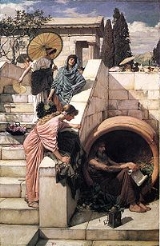
Diogenes of Sinope

Encyclopedia
Diogenes the Cynic was a Greek
philosopher and one of the founders of Cynic philosophy. Also known as Diogenes of Sinope , he was born in Sinope
(modern-day Sinop, Turkey
), an Ionian colony on the Black Sea , in 412
or 404 BCE and died at Corinth
in 323 BCE.
Diogenes of Sinope was a controversial figure. His father minted coins for a living and when Diogenes took to "defacement of the currency", he was kicked out of the city. After being exiled, he moved to Athen
s to debunk cultural conventions. Diogenes modelled himself on the example of Hercules
. He believed that virtue
was better revealed in action than in theory. He used his lifestyle and behaviour to criticise the social values and institutions of what he saw as a corrupt society. He declared himself a cosmopolitan
. There are many tales about him dogging Antisthenes
' footsteps and becoming his faithful hound, but it is by no means certain that the two men ever met. Diogenes made a virtue of poverty. He begged for a living and slept in a tub
in the marketplace. He became notorious for his philosophical stunts such as carrying a lamp in the daytime, claiming to be looking for an honest man. He publicly mocked Alexander and lived. He embarrassed Plato
, disputed his interpretation of Socrates
and sabotaged his lectures.
After being captured by pirates and sold into slavery, Diogenes eventually settled in Corinth
. There he passed his philosophy of Cynicism to Crates
, who taught it to Zeno of Citium
, who fashioned it into the school of Stoicism
, one of the most enduring schools of Greek philosophy. None of Diogenes’ many writings have survived, but details of his life come in the form of anecdotes (chreia
), especially from Diogenes Laërtius
, in his book Lives and Opinions of Eminent Philosophers
. All we have is a number of anecdotes concerning his life and sayings attributed to him in a number of scattered classical sources, none of them definitive.
on the south coast of the Black Sea
, either in 412 BCE or 404 BCE. Nothing is known about his early life except that his father Hicesias was a banker. It seems likely that Diogenes was also enrolled into the banking business aiding his father. At some point (the exact date is unknown) Hicesias and Diogenes became embroiled in a scandal involving the adulteration or defacement
of the currency, and Diogenes was exiled from the city. This aspect of the story seems to be corroborated by archaeology: large numbers of defaced coins (smashed with a large chisel stamp) have been discovered at Sinope dating from the middle of the 4th century BCE, and other coins of the time bear the name of Hicesias as the official who minted them. The reasons for the defacement of the coinage are unclear, although Sinope was being disputed between pro-Persian
and pro-Greek
factions in the 4th century, and there may have been political rather than financial motives behind the act.
 According to one story, Diogenes went to the Oracle at Delphi
to ask for its advice, and was told that he should "deface the currency.” Diogenes decided that the oracle meant that he should deface the political currency rather than actual coins. He traveled to Athens
and made it his life's goal to challenge established customs and values. He argued that instead of being troubled about the true nature of evil, people merely rely on customary interpretations. This distinction between nature ("physis
") and custom ("nomos
") is a favorite theme of ancient Greek philosophy, and one that Plato takes up in The Republic, in the legend of the Ring of Gyges
.
Diogenes arrived in Athens with a slave named Manes who abandoned him shortly thereafter. With characteristic humour, Diogenes dismissed his ill fortune by saying, "If Manes can live without Diogenes, why not Diogenes without Manes?" Diogenes would mock such a relation of extreme dependency. He found the figure of a master who could do nothing for himself contemptibly helpless. He was attracted by the ascetic
teaching of Antisthenes
, a student of Socrates, who (according to Plato
) had been present at his death. When Diogenes asked Antisthenes to mentor him, Antisthenes ignored him and reportedly "eventually beat him off with his staff". Diogenes responds, "Strike, for you will find no wood hard enough to keep me away from you, so long as I think you've something to say." Diogenes became Antisthenes' pupil, despite the brutality with which he was initially received. Whether the two ever really met is still uncertain, but he surpassed his master both in reputation and in the austerity of his life. He considered his avoidance of earthly pleasures a contrast to and commentary on contemporary Athenian behaviors. This attitude was grounded in a disdain for what he regarded as the folly, pretense, vanity, self-deception, and artificiality of human conduct.
 The stories told of Diogenes illustrate the logical consistency of his character. He inured himself to the weather by living in a tub belonging to the temple of Cybele
. He destroyed the single wooden bowl he possessed on seeing a peasant boy drink from the hollow of his hands. It was contrary to Athenian customs to eat within the marketplace, and still he would eat, for, as he explained when rebuked, it was during the time he was in the marketplace that he felt hungry. He used to stroll about in full daylight with a lamp
; when asked what he was doing, he would answer, "I am just looking for an honest man." Diogenes looked for a human being but reputedly found nothing but rascals and scoundrels.
When Plato gave Socrates' definition of man as "featherless bipeds" and was much praised for the definition, Diogenes plucked a chicken
and brought it into Plato's Academy
, saying, "Behold! I've brought you a man." After this incident, "with broad flat nails
" was added to Plato's definition.
, Diogenes was captured by pirates while on voyage to Aegina
and sold as a slave
in Crete
to a Corinth
ian named Xeniades
. Being asked his trade, he replied that he knew no trade but that of governing men, and that he wished to be sold to a man who needed a master. As tutor to Xeniades' two sons, it is said that he lived in Corinth for the rest of his life, which he devoted to preaching the doctrines of virtuous self-control. There are many stories about what actually happened to after his time in with Xeniades' two sons. There are stories stating he was set free after he became "a cherished member of the household", while one says he was set free almost immediately, and still another states that "he grew old and died at Xeniades’ house in Corinth." He is even said to have lectured to large audiences at the Isthmian Games
.
Although most of the stories about him living in a tub are located in Athens, there are some accounts of him living in a tub near the Craneum gymnasium in Corinth:
.jpg)
It was in Corinth that a meeting between Alexander the Great and Diogenes is supposed to have taken place. The accounts of Plutarch and Diogenes Laërtius recount that they exchanged only a few words: while Diogenes was relaxing in the sunlight in the morning, Alexander, thrilled to meet the famous philosopher, asked if there was any favour he might do for him. Diogenes replied, "Yes, stand out of my sunlight". Alexander then declared, "If I were not Alexander, then I should wish to be Diogenes." In another account of the conversation, Alexander found the philosopher looking attentively at a pile of human bones. Diogenes explained, "I am searching for the bones of your father but cannot distinguish them from those of a slave."
.
and Crates of Thebes
, Diogenes is considered one of the founders of Cynicism. The ideas of Diogenes, like those of most other Cynics, must be arrived at indirectly. No writings of Diogenes survived even though he is reported to have authored over ten books, a volume of letters and seven tragedies. Cynic ideas are inseparable from Cynic practice; therefore what we know about Diogenes is contained in anecdotes concerning his life and sayings attributed to him in a number of scattered classical sources.
Diogenes maintained that all the artificial growths of society were incompatible with happiness and that morality implies a return to the simplicity of nature. So great was his austerity and simplicity that the Stoic
s would later claim him to be a wise man or "sophos". In his words, "Humans have complicated every simple gift of the gods." Although Socrates
had previously identified himself as belonging to the world, rather than a city, Diogenes is credited with the first known use of the word "cosmopolitan
". When he was asked where he came from, he replied, "I am a citizen of the world (cosmopolites)". This was a radical claim in a world where a man's identity was intimately tied to his citizenship in a particular city state. An exile and an outcast, a man with no social identity, Diogenes made a mark on his contemporaries.
Diogenes had nothing but disdain for Plato
and his abstract philosophy. Diogenes viewed Antisthenes
as the true heir to Socrates
, and shared his love of virtue
and indifference to wealth
, together with a disdain for general opinion. Diogenes shared Socrates' belief that he could function as doctor to men's souls and improve them morally, while at the same time holding contempt for their obtuseness. Plato once described Diogenes as "a Socrates gone mad."
, masturbated in public, and pointed at people with his middle finger
.
From "Life of Diogenes": "Someone took him [Diogenes] into a magnificent house and warned him not to spit, whereupon, having cleared his throat, he spat into the man's face, being unable, he said, to find a meaner receptacle."
The term "Cynic" itself derives from the Greek
word κυνικός, kynikos, "dog-like" and that from κύων, kyôn, "dog
" (genitive: kynos). One explanation offered in ancient times for why the Cynics were called dogs was because Antisthenes
taught in the Cynosarges
gymnasium at Athens
. The word Cynosarges means the place of the white dog. Later Cynics also sought to turn the word to their advantage, as a later commentator explained:
As noted (see Death), Diogenes' association with dogs was memorialized by the Corinthians, who erected to his memory a pillar on which rested a dog of Parian marble
.
(English language publication in 1987). In his Critique of Cynical Reason, Diogenes is used as an example of Sloterdijk’s idea of the “kynical” — in which personal degradation is used for purposes of community comment or censure. Calling the practice of this tactic “kynismos,” Sloterdijk explains that the kynical actor actually embodies the message he/she is trying to convey. The goal here is typically a false regression that mocks authority — especially authority that the kynical actor considers corrupt, suspect, or unworthy.
There is another discussion of Diogenes and the Cynics in Michel Foucault
's book Fearless Speech. Here Foucault discusses Diogenes' antics in relation to the speaking of truth (parrhesia
) in the ancient world.
, the Louvre
, and the Capitol
. The interview between Diogenes and Alexander is represented in an ancient marble bas-relief found in the Villa Albani.
Among artists who have painted the famous encounter of Diogenes with Alexander there are works by de Crayer
, de Vos
, Assereto
, Langetti
, Sevin, Sebastiano Ricci
, Gandolfi
, Wink, Abildgaard
, Monsiau
, Martin
, and Daumier
. The famous story of Diogenes searching for an "honest man" has been depicted by Jordaens
, van Everdingen
, van der Werff
, Pannini
, and Corinth
. Others who have painted him with his famous lantern include de Ribera, Castiglione
, Petrini
, Gérôme
, Bastien-Lepage
, and Waterhouse
. The scene in which Diogenes discards his cup has been painted by Poussin
, Rosa
, and Martin
; and the story of Diogenes begging from a statue has been depicted by Restout
. In Raphael
's fresco The School of Athens
, a lone reclining figure in the foreground represents Diogenes.
Diogenes has also been the subject of sculptures, with famous bas-relief images by Puget
and Pajou
.
's story "Ward No. 6"; William Blake
's The Marriage of Heaven and Hell
; François Rabelais
' Gargantua and Pantagruel
; Goethe
's poem Genialisch Treiben; as well as in the first sentence of Søren Kierkegaard
's novelistic treatise Repetition
. In Cervantes
' short story "The Man of Glass" ("El licenciado Vidriera
"), part of the Novelas Ejemplares
collection, the (anti-)hero unaccountably begins to channel Diogenes in a string of tart chreia
i once he becomes convinced that he is made of glass. Diogenes gives his own life and opinions in Christoph Martin Wieland
's novel Socrates Mainomenos (1770; English translation Socrates Out of His Senses, 1771). Diogenes is the primary model for the philosopher Didactylos in Terry Pratchett
's Small Gods
. He is mimicked by a beggar-spy in Jacqueline Carey
's Kushiel's Scion
and paid tribute to with a costume in a party by the main character in its sequel, Kushiel's Justice
. The character Lucy Snowe in Charlotte Bronte
's novel Villette
is given the nickname Diogenes. Diogenes also features in Part Four of Elizabeth Smart
's By Grand Central Station I Sat Down and Wept
. He is a figure in Seamus Heaney
's The Haw Lantern
. In Christopher Moore
's Lamb: The Gospel According to Biff, Christ's Childhood Pal
, one of Jesus
' apostles is a devotee of Diogenes, complete with his own pack of dogs which he refers to as his own disciples. His story opens the first chapter of Dolly Freed's 1978 book Possum Living.
The dog that Paul Dombey befriends in Charles Dickens
' Dombey and Son
is called Diogenes.
Alexander's meeting with Diogenes is portrayed in Valerio Manfredi's Alexander: The Ends of the Earth.
The many allusions to dogs in Shakespeare’s Timon of Athens
are references to the school of Cynicism that could be interpreted as suggesting a parallel between the misanthropic hermit, Timon
, and Diogenes; but Shakespeare would have had access to Michel de Montaigne
’s essay, "Of Democritus and Heraclitus", which emphasised their differences: Timon actively wishes men ill and shuns them as dangerous, whereas Diogenes esteems them so little that contact with them could not disturb him "Timonism" is in fact often contrasted with "Cynicism": "Cynics saw what people could be and were angered by what they had become; Timonists felt humans were hopelessly stupid & uncaring by nature and so saw no hope for change."
The philosopher's name was adopted by the fictional Diogenes Club
, an organization that Sherlock Holmes
' brother Mycroft Holmes
belongs to in the story "The Greek Interpreter" by Sir Arthur Conan Doyle. It is called such as its members are educated, yet untalkative and have a dislike of socialising, much like the philosopher himself. The group is the focus of a number of Holmes pastiche
s by Kim Newman
.
Ancient Greece
Ancient Greece is a civilization belonging to a period of Greek history that lasted from the Archaic period of the 8th to 6th centuries BC to the end of antiquity. Immediately following this period was the beginning of the Early Middle Ages and the Byzantine era. Included in Ancient Greece is the...
philosopher and one of the founders of Cynic philosophy. Also known as Diogenes of Sinope , he was born in Sinope
Sinop, Turkey
Sinop is a city with a population of 36,734 on İnce Burun , by its Cape Sinop which is situated on the most northern edge of the Turkish side of Black Sea coast, in the ancient region of Paphlagonia, in modern-day northern Turkey, historically known as Sinope...
(modern-day Sinop, Turkey
Turkey
Turkey , known officially as the Republic of Turkey , is a Eurasian country located in Western Asia and in East Thrace in Southeastern Europe...
), an Ionian colony on the Black Sea , in 412
412 BC
Year 412 BC was a year of the pre-Julian Roman calendar. At the time, it was known as the Year of the Consulship of Ambustus and Pacilus...
or 404 BCE and died at Corinth
Corinth
Corinth is a city and former municipality in Corinthia, Peloponnese, Greece. Since the 2011 local government reform it is part of the municipality Corinth, of which it is the seat and a municipal unit...
in 323 BCE.
Diogenes of Sinope was a controversial figure. His father minted coins for a living and when Diogenes took to "defacement of the currency", he was kicked out of the city. After being exiled, he moved to Athen
Athen
Athen may refer to:* Athens, capital of Greece - Athen in German, Norwegian, and Danish* SS Athen , German merchant ship lost off Portland Bill in the English Channel in 1906, and now a dive site....
s to debunk cultural conventions. Diogenes modelled himself on the example of Hercules
Hercules
Hercules is the Roman name for Greek demigod Heracles, son of Zeus , and the mortal Alcmene...
. He believed that virtue
Virtue
Virtue is moral excellence. A virtue is a positive trait or quality subjectively deemed to be morally excellent and thus is valued as a foundation of principle and good moral being....
was better revealed in action than in theory. He used his lifestyle and behaviour to criticise the social values and institutions of what he saw as a corrupt society. He declared himself a cosmopolitan
Cosmopolitanism
Cosmopolitanism is the ideology that all human ethnic groups belong to a single community based on a shared morality. This is contrasted with communitarian and particularistic theories, especially the ideas of patriotism and nationalism...
. There are many tales about him dogging Antisthenes
Antisthenes
Antisthenes was a Greek philosopher and a pupil of Socrates. Antisthenes first learned rhetoric under Gorgias before becoming an ardent disciple of Socrates. He adopted and developed the ethical side of Socrates' teachings, advocating an ascetic life lived in accordance with virtue. Later writers...
' footsteps and becoming his faithful hound, but it is by no means certain that the two men ever met. Diogenes made a virtue of poverty. He begged for a living and slept in a tub
Pithos
Pithos originally referred in ancient Greek to a large storage jar of a characteristic shape. The word was at one point used by western classical archaeologists to mean the jars uncovered by excavation in Crete and Greece, it has now been taken into the American English language as a general word...
in the marketplace. He became notorious for his philosophical stunts such as carrying a lamp in the daytime, claiming to be looking for an honest man. He publicly mocked Alexander and lived. He embarrassed Plato
Plato
Plato , was a Classical Greek philosopher, mathematician, student of Socrates, writer of philosophical dialogues, and founder of the Academy in Athens, the first institution of higher learning in the Western world. Along with his mentor, Socrates, and his student, Aristotle, Plato helped to lay the...
, disputed his interpretation of Socrates
Socrates
Socrates was a classical Greek Athenian philosopher. Credited as one of the founders of Western philosophy, he is an enigmatic figure known chiefly through the accounts of later classical writers, especially the writings of his students Plato and Xenophon, and the plays of his contemporary ...
and sabotaged his lectures.
After being captured by pirates and sold into slavery, Diogenes eventually settled in Corinth
Corinth
Corinth is a city and former municipality in Corinthia, Peloponnese, Greece. Since the 2011 local government reform it is part of the municipality Corinth, of which it is the seat and a municipal unit...
. There he passed his philosophy of Cynicism to Crates
Crates of Thebes
Crates of Thebes, was a Cynic philosopher. Crates gave away his money to live a life of poverty on the streets of Athens. He married Hipparchia of Maroneia who lived in the same manner that he did. Respected by the people of Athens, he is remembered for being the teacher of Zeno of Citium, the...
, who taught it to Zeno of Citium
Zeno of Citium
Zeno of Citium was a Greek philosopher from Citium . Zeno was the founder of the Stoic school of philosophy, which he taught in Athens from about 300 BC. Based on the moral ideas of the Cynics, Stoicism laid great emphasis on goodness and peace of mind gained from living a life of virtue in...
, who fashioned it into the school of Stoicism
Stoicism
Stoicism is a school of Hellenistic philosophy founded in Athens by Zeno of Citium in the early . The Stoics taught that destructive emotions resulted from errors in judgment, and that a sage, or person of "moral and intellectual perfection," would not suffer such emotions.Stoics were concerned...
, one of the most enduring schools of Greek philosophy. None of Diogenes’ many writings have survived, but details of his life come in the form of anecdotes (chreia
Chreia
The chreia was, in antiquity and the Byzantine Empire, both a genre of literature and one of the progymnasmata.-Definition:...
), especially from Diogenes Laërtius
Diogenes Laertius
Diogenes Laertius was a biographer of the Greek philosophers. Nothing is known about his life, but his surviving Lives and Opinions of Eminent Philosophers is one of the principal surviving sources for the history of Greek philosophy.-Life:Nothing is definitively known about his life...
, in his book Lives and Opinions of Eminent Philosophers
Lives and Opinions of Eminent Philosophers
Lives and Opinions of Eminent Philosophers is a biography of the Greek philosophers by Diogenes Laërtius, written in Greek, perhaps in the first half of the third century AD.-Overview:...
. All we have is a number of anecdotes concerning his life and sayings attributed to him in a number of scattered classical sources, none of them definitive.
Life
Diogenes was born in the Greek colony of SinopeSinop, Turkey
Sinop is a city with a population of 36,734 on İnce Burun , by its Cape Sinop which is situated on the most northern edge of the Turkish side of Black Sea coast, in the ancient region of Paphlagonia, in modern-day northern Turkey, historically known as Sinope...
on the south coast of the Black Sea
Black Sea
The Black Sea is bounded by Europe, Anatolia and the Caucasus and is ultimately connected to the Atlantic Ocean via the Mediterranean and the Aegean seas and various straits. The Bosphorus strait connects it to the Sea of Marmara, and the strait of the Dardanelles connects that sea to the Aegean...
, either in 412 BCE or 404 BCE. Nothing is known about his early life except that his father Hicesias was a banker. It seems likely that Diogenes was also enrolled into the banking business aiding his father. At some point (the exact date is unknown) Hicesias and Diogenes became embroiled in a scandal involving the adulteration or defacement
Defacement (vandalism)
In common usage, to deface something refers to marking or removing the part of an object designed to hold the viewers' attention. Example acts of defacement could include scoring a book cover with a blade, splashing paint over a painting in a gallery, or smashing the nose of a sculpted bust...
of the currency, and Diogenes was exiled from the city. This aspect of the story seems to be corroborated by archaeology: large numbers of defaced coins (smashed with a large chisel stamp) have been discovered at Sinope dating from the middle of the 4th century BCE, and other coins of the time bear the name of Hicesias as the official who minted them. The reasons for the defacement of the coinage are unclear, although Sinope was being disputed between pro-Persian
Achaemenid Empire
The Achaemenid Empire , sometimes known as First Persian Empire and/or Persian Empire, was founded in the 6th century BCE by Cyrus the Great who overthrew the Median confederation...
and pro-Greek
Classical Greece
Classical Greece was a 200 year period in Greek culture lasting from the 5th through 4th centuries BC. This classical period had a powerful influence on the Roman Empire and greatly influenced the foundation of Western civilizations. Much of modern Western politics, artistic thought, such as...
factions in the 4th century, and there may have been political rather than financial motives behind the act.
In Athens
Pythia
The Pythia , commonly known as the Oracle of Delphi, was the priestess at the Temple of Apollo at Delphi, located on the slopes of Mount Parnassus. The Pythia was widely credited for her prophecies inspired by Apollo. The Delphic oracle was established in the 8th century BC...
to ask for its advice, and was told that he should "deface the currency.” Diogenes decided that the oracle meant that he should deface the political currency rather than actual coins. He traveled to Athens
Athens
Athens , is the capital and largest city of Greece. Athens dominates the Attica region and is one of the world's oldest cities, as its recorded history spans around 3,400 years. Classical Athens was a powerful city-state...
and made it his life's goal to challenge established customs and values. He argued that instead of being troubled about the true nature of evil, people merely rely on customary interpretations. This distinction between nature ("physis
Physis
Physis is a Greek theological, philosophical, and scientific term usually translated into English as "nature."In The Odyssey, Homer uses the word once , referring to the intrinsic way of growth of a particular species of plant. In the pre-Socratic philosophers it developed a complex of other...
") and custom ("nomos
Nomos
Nomos or Nomoi may refer to:* Nome , a subdivisions of Ancient Egypt* Nome , the administrative division immediately below the peripheries of Greece * law...
") is a favorite theme of ancient Greek philosophy, and one that Plato takes up in The Republic, in the legend of the Ring of Gyges
Ring of Gyges
The Ring of Gyges is a mythical magical artifact mentioned by the philosopher Plato in book 2 of his Republic . It granted its owner the power to become invisible at will...
.
Diogenes arrived in Athens with a slave named Manes who abandoned him shortly thereafter. With characteristic humour, Diogenes dismissed his ill fortune by saying, "If Manes can live without Diogenes, why not Diogenes without Manes?" Diogenes would mock such a relation of extreme dependency. He found the figure of a master who could do nothing for himself contemptibly helpless. He was attracted by the ascetic
Asceticism
Asceticism describes a lifestyle characterized by abstinence from various sorts of worldly pleasures often with the aim of pursuing religious and spiritual goals...
teaching of Antisthenes
Antisthenes
Antisthenes was a Greek philosopher and a pupil of Socrates. Antisthenes first learned rhetoric under Gorgias before becoming an ardent disciple of Socrates. He adopted and developed the ethical side of Socrates' teachings, advocating an ascetic life lived in accordance with virtue. Later writers...
, a student of Socrates, who (according to Plato
Plato
Plato , was a Classical Greek philosopher, mathematician, student of Socrates, writer of philosophical dialogues, and founder of the Academy in Athens, the first institution of higher learning in the Western world. Along with his mentor, Socrates, and his student, Aristotle, Plato helped to lay the...
) had been present at his death. When Diogenes asked Antisthenes to mentor him, Antisthenes ignored him and reportedly "eventually beat him off with his staff". Diogenes responds, "Strike, for you will find no wood hard enough to keep me away from you, so long as I think you've something to say." Diogenes became Antisthenes' pupil, despite the brutality with which he was initially received. Whether the two ever really met is still uncertain, but he surpassed his master both in reputation and in the austerity of his life. He considered his avoidance of earthly pleasures a contrast to and commentary on contemporary Athenian behaviors. This attitude was grounded in a disdain for what he regarded as the folly, pretense, vanity, self-deception, and artificiality of human conduct.
Cybele
Cybele , was a Phrygian form of the Earth Mother or Great Mother. As with Greek Gaia , her Minoan equivalent Rhea and some aspects of Demeter, Cybele embodies the fertile Earth...
. He destroyed the single wooden bowl he possessed on seeing a peasant boy drink from the hollow of his hands. It was contrary to Athenian customs to eat within the marketplace, and still he would eat, for, as he explained when rebuked, it was during the time he was in the marketplace that he felt hungry. He used to stroll about in full daylight with a lamp
Oil lamp
An oil lamp is an object used to produce light continuously for a period of time using an oil-based fuel source. The use of oil lamps began thousands of years ago and is continued to this day....
; when asked what he was doing, he would answer, "I am just looking for an honest man." Diogenes looked for a human being but reputedly found nothing but rascals and scoundrels.
When Plato gave Socrates' definition of man as "featherless bipeds" and was much praised for the definition, Diogenes plucked a chicken
Chicken
The chicken is a domesticated fowl, a subspecies of the Red Junglefowl. As one of the most common and widespread domestic animals, and with a population of more than 24 billion in 2003, there are more chickens in the world than any other species of bird...
and brought it into Plato's Academy
Platonic Academy
The Academy was founded by Plato in ca. 387 BC in Athens. Aristotle studied there for twenty years before founding his own school, the Lyceum. The Academy persisted throughout the Hellenistic period as a skeptical school, until coming to an end after the death of Philo of Larissa in 83 BC...
, saying, "Behold! I've brought you a man." After this incident, "with broad flat nails
Nail (anatomy)
A nail is a horn-like envelope covering the dorsal aspect of the terminal phalanges of fingers and toes in humans, most non-human primates, and a few other mammals. Nails are similar to claws, which are found on numerous other animals....
" was added to Plato's definition.
In Corinth
According to a story which seems to have originated with Menippus of GadaraMenippus
Menippus of Gadara, was a Cynic and satirist. His works, which are all lost, were an important influence on Varro and Lucian. The Menippean satire genre is named after him.-Life:...
, Diogenes was captured by pirates while on voyage to Aegina
Aegina
Aegina is one of the Saronic Islands of Greece in the Saronic Gulf, from Athens. Tradition derives the name from Aegina, the mother of Aeacus, who was born in and ruled the island. During ancient times, Aegina was a rival to Athens, the great sea power of the era.-Municipality:The municipality...
and sold as a slave
Slavery
Slavery is a system under which people are treated as property to be bought and sold, and are forced to work. Slaves can be held against their will from the time of their capture, purchase or birth, and deprived of the right to leave, to refuse to work, or to demand compensation...
in Crete
Crete
Crete is the largest and most populous of the Greek islands, the fifth largest island in the Mediterranean Sea, and one of the thirteen administrative regions of Greece. It forms a significant part of the economy and cultural heritage of Greece while retaining its own local cultural traits...
to a Corinth
Corinth
Corinth is a city and former municipality in Corinthia, Peloponnese, Greece. Since the 2011 local government reform it is part of the municipality Corinth, of which it is the seat and a municipal unit...
ian named Xeniades
Xeniades
Xeniades was the name of two people from Corinth who lived in the time of Ancient Greece:#A Greek philosopher from Corinth who lived in the time of Democritus, c. 400 BC...
. Being asked his trade, he replied that he knew no trade but that of governing men, and that he wished to be sold to a man who needed a master. As tutor to Xeniades' two sons, it is said that he lived in Corinth for the rest of his life, which he devoted to preaching the doctrines of virtuous self-control. There are many stories about what actually happened to after his time in with Xeniades' two sons. There are stories stating he was set free after he became "a cherished member of the household", while one says he was set free almost immediately, and still another states that "he grew old and died at Xeniades’ house in Corinth." He is even said to have lectured to large audiences at the Isthmian Games
Isthmian Games
The Isthmian Games or Isthmia were one of the Panhellenic Games of Ancient Greece, and were named after the isthmus of Corinth, where they were held...
.
Although most of the stories about him living in a tub are located in Athens, there are some accounts of him living in a tub near the Craneum gymnasium in Corinth:
A report that PhilipPhilip II of MacedonPhilip II of Macedon "friend" + ἵππος "horse" — transliterated ; 382 – 336 BC), was a king of Macedon from 359 BC until his assassination in 336 BC. He was the father of Alexander the Great and Philip III.-Biography:...
was marching on the town had thrown all Corinth into a bustle; one was furbishing his arms, another wheeling stones, a third patching the wall, a fourth strengthening a battlement, every one making himself useful somehow or other. Diogenes having nothing to do – of course no one thought of giving him a job – was moved by the sight to gather up his philosopher's cloak and begin rolling his tub energetically up and down the Craneum; an acquaintance asked for, and got, the explanation: "I do not want to be thought the only idler in such a busy multitude; I am rolling my tub to be like the rest."
Diogenes and Alexander
It was in Corinth that a meeting between Alexander the Great and Diogenes is supposed to have taken place. The accounts of Plutarch and Diogenes Laërtius recount that they exchanged only a few words: while Diogenes was relaxing in the sunlight in the morning, Alexander, thrilled to meet the famous philosopher, asked if there was any favour he might do for him. Diogenes replied, "Yes, stand out of my sunlight". Alexander then declared, "If I were not Alexander, then I should wish to be Diogenes." In another account of the conversation, Alexander found the philosopher looking attentively at a pile of human bones. Diogenes explained, "I am searching for the bones of your father but cannot distinguish them from those of a slave."
Death
There are conflicting accounts of Diogenes' death. He is alleged variously to have held his breath; to have become ill from eating raw octopus; or to have suffered an infected dog bite. When asked how he wished to be buried, he left instructions to be thrown outside the city wall so wild animals could feast on his body. When asked if he minded this, he said, "Not at all, as long as you provide me with a stick to chase the creatures away!" When asked how he could use the stick since he would lack awareness, he replied "If I lack awareness, then why should I care what happens to me when I am dead?" At the end, Diogenes made fun of people's excessive concern with the "proper" treatment of the dead. The Corinthians erected to his memory a pillar on which rested a dog of Parian marbleParian marble
Parian marble is a fine-grained semitranslucent pure-white and entirely flawless marble quarried during the classical era on the Greek island of Paros in the Aegean Sea.It was highly prized by ancient Greeks for making sculptures...
.
Cynicism
Along with AntisthenesAntisthenes
Antisthenes was a Greek philosopher and a pupil of Socrates. Antisthenes first learned rhetoric under Gorgias before becoming an ardent disciple of Socrates. He adopted and developed the ethical side of Socrates' teachings, advocating an ascetic life lived in accordance with virtue. Later writers...
and Crates of Thebes
Crates of Thebes
Crates of Thebes, was a Cynic philosopher. Crates gave away his money to live a life of poverty on the streets of Athens. He married Hipparchia of Maroneia who lived in the same manner that he did. Respected by the people of Athens, he is remembered for being the teacher of Zeno of Citium, the...
, Diogenes is considered one of the founders of Cynicism. The ideas of Diogenes, like those of most other Cynics, must be arrived at indirectly. No writings of Diogenes survived even though he is reported to have authored over ten books, a volume of letters and seven tragedies. Cynic ideas are inseparable from Cynic practice; therefore what we know about Diogenes is contained in anecdotes concerning his life and sayings attributed to him in a number of scattered classical sources.
Diogenes maintained that all the artificial growths of society were incompatible with happiness and that morality implies a return to the simplicity of nature. So great was his austerity and simplicity that the Stoic
STOIC
STOIC was a variant of Forth.It started out at the MIT and Harvard Biomedical Engineering Centre in Boston, and was written in the mid 1970s by Jonathan Sachs...
s would later claim him to be a wise man or "sophos". In his words, "Humans have complicated every simple gift of the gods." Although Socrates
Socrates
Socrates was a classical Greek Athenian philosopher. Credited as one of the founders of Western philosophy, he is an enigmatic figure known chiefly through the accounts of later classical writers, especially the writings of his students Plato and Xenophon, and the plays of his contemporary ...
had previously identified himself as belonging to the world, rather than a city, Diogenes is credited with the first known use of the word "cosmopolitan
Cosmopolitanism
Cosmopolitanism is the ideology that all human ethnic groups belong to a single community based on a shared morality. This is contrasted with communitarian and particularistic theories, especially the ideas of patriotism and nationalism...
". When he was asked where he came from, he replied, "I am a citizen of the world (cosmopolites)". This was a radical claim in a world where a man's identity was intimately tied to his citizenship in a particular city state. An exile and an outcast, a man with no social identity, Diogenes made a mark on his contemporaries.
Diogenes had nothing but disdain for Plato
Plato
Plato , was a Classical Greek philosopher, mathematician, student of Socrates, writer of philosophical dialogues, and founder of the Academy in Athens, the first institution of higher learning in the Western world. Along with his mentor, Socrates, and his student, Aristotle, Plato helped to lay the...
and his abstract philosophy. Diogenes viewed Antisthenes
Antisthenes
Antisthenes was a Greek philosopher and a pupil of Socrates. Antisthenes first learned rhetoric under Gorgias before becoming an ardent disciple of Socrates. He adopted and developed the ethical side of Socrates' teachings, advocating an ascetic life lived in accordance with virtue. Later writers...
as the true heir to Socrates
Socrates
Socrates was a classical Greek Athenian philosopher. Credited as one of the founders of Western philosophy, he is an enigmatic figure known chiefly through the accounts of later classical writers, especially the writings of his students Plato and Xenophon, and the plays of his contemporary ...
, and shared his love of virtue
Virtue
Virtue is moral excellence. A virtue is a positive trait or quality subjectively deemed to be morally excellent and thus is valued as a foundation of principle and good moral being....
and indifference to wealth
Wealth
Wealth is the abundance of valuable resources or material possessions. The word wealth is derived from the old English wela, which is from an Indo-European word stem...
, together with a disdain for general opinion. Diogenes shared Socrates' belief that he could function as doctor to men's souls and improve them morally, while at the same time holding contempt for their obtuseness. Plato once described Diogenes as "a Socrates gone mad."
Obscenity
Diogenes taught by living example. He tried to demonstrate that wisdom and happiness belong to the man who is independent of society and that civilisation is regressive. He scorned not only family and political social organization, but property rights and reputation. He even rejected normal ideas about human decency. Diogenes is said to have eaten in the marketplace, urinated on some people who insulted him, defecated in the theatreTheatre of Ancient Greece
The theatre of Ancient Greece, or ancient Greek drama, is a theatrical culture that flourished in ancient Greece between c. 550 and c. 220 BC. The city-state of Athens, which became a significant cultural, political and military power during this period, was its centre, where it was...
, masturbated in public, and pointed at people with his middle finger
Finger (gesture)
In Western culture, the finger , also known as the middle finger, is an obscene hand gesture, often meaning the phrases "fuck off" , "fuck you" or "up yours"...
.
From "Life of Diogenes": "Someone took him [Diogenes] into a magnificent house and warned him not to spit, whereupon, having cleared his throat, he spat into the man's face, being unable, he said, to find a meaner receptacle."
Diogenes the Dog
Many anecdotes of Diogenes refer to his dog-like behavior, and his praise of a dog's virtues. It is not known whether Diogenes was insulted with the epithet "doggish" and made a virtue of it, or whether he first took up the dog theme himself. Diogenes believed human beings live artificially and hypocritically and would do well to study the dog. Besides performing natural bodily functions in public with ease, a dog will eat anything, and make no fuss about where to sleep. Dogs live in the present without anxiety, and have no use for the pretensions of abstract philosophy. In addition to these virtues, dogs are thought to know instinctively who is friend and who is foe. Unlike human beings who either dupe others or are duped, dogs will give an honest bark at the truth. Diogenes stated that "other dogs bite their enemies, I bite my friends to save them."The term "Cynic" itself derives from the Greek
Ancient Greek
Ancient Greek is the stage of the Greek language in the periods spanning the times c. 9th–6th centuries BC, , c. 5th–4th centuries BC , and the c. 3rd century BC – 6th century AD of ancient Greece and the ancient world; being predated in the 2nd millennium BC by Mycenaean Greek...
word κυνικός, kynikos, "dog-like" and that from κύων, kyôn, "dog
Dog
The domestic dog is a domesticated form of the gray wolf, a member of the Canidae family of the order Carnivora. The term is used for both feral and pet varieties. The dog may have been the first animal to be domesticated, and has been the most widely kept working, hunting, and companion animal in...
" (genitive: kynos). One explanation offered in ancient times for why the Cynics were called dogs was because Antisthenes
Antisthenes
Antisthenes was a Greek philosopher and a pupil of Socrates. Antisthenes first learned rhetoric under Gorgias before becoming an ardent disciple of Socrates. He adopted and developed the ethical side of Socrates' teachings, advocating an ascetic life lived in accordance with virtue. Later writers...
taught in the Cynosarges
Cynosarges
Cynosarges was a public gymnasium located just outside the walls of Ancient Athens on the southern bank of the Ilissos river.Its name derives from Cynos-argos and means white or swift dog...
gymnasium at Athens
Athens
Athens , is the capital and largest city of Greece. Athens dominates the Attica region and is one of the world's oldest cities, as its recorded history spans around 3,400 years. Classical Athens was a powerful city-state...
. The word Cynosarges means the place of the white dog. Later Cynics also sought to turn the word to their advantage, as a later commentator explained:
There are four reasons why the Cynics are so named. First because of the indifference of their way of life, for they make a cult of indifference and, like dogs, eat and make love in public, go barefoot, and sleep in tubs and at crossroads. The second reason is that the dog is a shameless animal, and they make a cult of shamelessness, not as being beneath modesty, but as superior to it. The third reason is that the dog is a good guard, and they guard the tenets of their philosophy. The fourth reason is that the dog is a discriminating animal which can distinguish between its friends and enemies. So do they recognize as friends those who are suited to philosophy, and receive them kindly, while those unfitted they drive away, like dogs, by barking at them.
As noted (see Death), Diogenes' association with dogs was memorialized by the Corinthians, who erected to his memory a pillar on which rested a dog of Parian marble
Parian marble
Parian marble is a fine-grained semitranslucent pure-white and entirely flawless marble quarried during the classical era on the Greek island of Paros in the Aegean Sea.It was highly prized by ancient Greeks for making sculptures...
.
Contemporary theory
Diogenes is discussed in a 1983 book by German philosopher Peter SloterdijkPeter Sloterdijk
Peter Sloterdijk is a German philosopher, television host, cultural scientist and essayist. He is a professor of philosophy and media theory at the University of Art and Design Karlsruhe. He currently co-hosts the German show Im Glashaus: Das Philosophische Quartett.-Biography:Sloterdijk's father...
(English language publication in 1987). In his Critique of Cynical Reason, Diogenes is used as an example of Sloterdijk’s idea of the “kynical” — in which personal degradation is used for purposes of community comment or censure. Calling the practice of this tactic “kynismos,” Sloterdijk explains that the kynical actor actually embodies the message he/she is trying to convey. The goal here is typically a false regression that mocks authority — especially authority that the kynical actor considers corrupt, suspect, or unworthy.
There is another discussion of Diogenes and the Cynics in Michel Foucault
Michel Foucault
Michel Foucault , born Paul-Michel Foucault , was a French philosopher, social theorist and historian of ideas...
's book Fearless Speech. Here Foucault discusses Diogenes' antics in relation to the speaking of truth (parrhesia
Parrhesia
In rhetoric, parrhesia is a figure of speech described as: to speak candidly or to ask forgiveness for so speaking. The term is borrowed from the Greek παρρησία meaning literally "to speak everything" and by extension "to speak freely," "to speak boldly," or "boldness." It implies not only...
) in the ancient world.
Diogenes syndrome
Diogenes' name has been applied to a behavioural disorder characterised by involuntary self-neglect and hoarding. The disorder afflicts the elderly and has no relation to Diogenes' deliberate Herculean rejection of material comfort.Art
Both in ancient and in modern times, Diogenes' personality has appealed strongly to sculptors and to painters. Ancient busts exist in the museums of the VaticanVatican City
Vatican City , or Vatican City State, in Italian officially Stato della Città del Vaticano , which translates literally as State of the City of the Vatican, is a landlocked sovereign city-state whose territory consists of a walled enclave within the city of Rome, Italy. It has an area of...
, the Louvre
Louvre
The Musée du Louvre – in English, the Louvre Museum or simply the Louvre – is one of the world's largest museums, the most visited art museum in the world and a historic monument. A central landmark of Paris, it is located on the Right Bank of the Seine in the 1st arrondissement...
, and the Capitol
Capitoline Museums
The Capitoline Museums are a group of art and archeological museums in Piazza del Campidoglio, on top of the Capitoline Hill in Rome, Italy. The museums are contained in three palazzi surrounding a central trapezoidal piazza in a plan conceived by Michelangelo Buonarroti in 1536 and executed over...
. The interview between Diogenes and Alexander is represented in an ancient marble bas-relief found in the Villa Albani.
Among artists who have painted the famous encounter of Diogenes with Alexander there are works by de Crayer
Caspar de Crayer
Gaspar de Crayer , sometimes called Gaspard or Caspar de Crayer was a Flemish painter.Crayer was born in Antwerp. He learned the art of painting from Michael Coxcie. He matriculated in the Guild of St Luke at Brussels in 1607, resided in the capital of Brabant till after 1660, and finally settled...
, de Vos
Cornelis de Vos
right|thumb|Cornelis de Vos, Family portrait, 1631, 165 x 235 cm, Oil on canvas, [[Royal Museum of Fine Arts, Antwerp]]Cornelis de Vos , was a Flemish Baroque painter best known for his portraiture....
, Assereto
Gioacchino Assereto
Gioacchino Assereto was an Italian painter of the early Baroque period, active in Genoa.He initially apprenticed with Luciano Borzone and later Giovanni Andrea Ansaldo. He painted two vault frescoes in the church of Santissima Annunziata del Vastato: David and Abimelech and Santi Giovanni and...
, Langetti
Giovan Battista Langetti
Giovanni Battista Langetti , also known as Giambattista Langetti, was an Italian late-Baroque painter. He was active in his native Genoa, then Rome, and finally for the longest period in Venice....
, Sevin, Sebastiano Ricci
Sebastiano Ricci
Sebastiano Ricci was an Italian painter of the late Baroque school of Venice. About the same age as Piazzetta, and an elder contemporary of Tiepolo, he represents a late version of the vigorous and luminous Cortonesque style of grand manner fresco painting.-Early years:He was born in Belluno, son...
, Gandolfi
Gaetano Gandolfi
Gaetano Gandolfi was an Italian painter of the late Baroque and early Neoclassic period, active in Bologna.Gaetano was born in San Matteo della Decima, near Bologna, to a family of artists. Ubaldo Gandolfi was his brother, Mauro Gandolfi was his son, and Democrito Gandolfi was his grandson...
, Wink, Abildgaard
Nikolaj Abraham Abildgaard
Nikolaj Abraham Abildgaard , Danish artist, was born in Copenhagen, the son of Søren Abildgaard, an antiquarian draughtsman of repute, and Anne Margrethe Bastholm.- Training as an artist :...
, Monsiau
Nicolas-André Monsiau
Nicolas-André Monsiau was a French history painter and a refined draughtsman who turned to book illustration to supplement his income when the French Revolution disrupted patronage...
, Martin
John Martin (painter)
John Martin was an English Romantic painter, engraver and illustrator.-Biography:Martin was born in July 1789, in a one-room family cottage, at Haydon Bridge, near Hexham in Northumberland, the 4th son of Fenwick Martin, a one time fencing master...
, and Daumier
Honoré Daumier
Honoré Daumier was a French printmaker, caricaturist, painter, and sculptor, whose many works offer commentary on social and political life in France in the 19th century....
. The famous story of Diogenes searching for an "honest man" has been depicted by Jordaens
Jacob Jordaens
Jacob Jordaens was one of three Flemish Baroque painters, along with Peter Paul Rubens and Anthony van Dyck, to bring prestige to the Antwerp school of painting. Unlike those contemporaries he never traveled abroad to study Italian painting, and his career is marked by an indifference to their...
, van Everdingen
Caesar van Everdingen
Cesar Pietersz, or Cesar Boetius van Everdingen , older brother of Allart van Everdingen and Jan van Everdingen, was a Dutch Golden Age portrait and history painter.-Biography:...
, van der Werff
Adriaen van der Werff
Adriaen van der Werff was an accomplished Dutch painter of portraits and erotic, devotional and mythological scenes. His brother, Pieter van der Werff , was his principal pupil and assistant.-Life:...
, Pannini
Giovanni Paolo Pannini
Giovanni Paolo Panini or Pannini was a painter and architect, who worked in Rome and is mainly known as one of the vedutisti ....
, and Corinth
Lovis Corinth
Lovis Corinth was a German painter and printmaker whose mature work realized a synthesis of impressionism and expressionism....
. Others who have painted him with his famous lantern include de Ribera, Castiglione
Giovanni Benedetto Castiglione
Giovanni Benedetto Castiglione was an Italian Baroque artist, painter, printmaker and draftsman, of the Genoese school. He is best known now for his elaborate engravings, and as the inventor of the printmaking technique of monotyping. He was known as Il Grechetto in Italy and in France as Le...
, Petrini
Giuseppe Antonio Petrini
Giuseppe Antonio Petrini was a painter of the late-Baroque, active mainly in Lugano, present-day Switzerland.While born in Carona in Canton Ticino and died in Lugano, both in Switzerland, Petrini belongs to the Northern Italian or Lombard heritage of baroque painting. He possibly apprenticed with...
, Gérôme
Jean-Léon Gérôme
Jean-Léon Gérôme was a French painter and sculptor in the style now known as Academicism. The range of his oeuvre included historical painting, Greek mythology, Orientalism, portraits and other subjects, bringing the Academic painting tradition to an artistic climax.-Life:Jean-Léon Gérôme was born...
, Bastien-Lepage
Jules Bastien-Lepage
Jules Bastien-Lepage , was a French naturalist painter, a style related to the Realist movement.-Life and work:...
, and Waterhouse
John William Waterhouse
John William Waterhouse was an English painter known for working in the Pre-Raphaelite style. He worked several decades after the breakup of the Pre-Raphaelite Brotherhood, which had seen its heydey in the mid-nineteenth century, leading him to have gained the moniker of "the modern Pre-Raphaelite"...
. The scene in which Diogenes discards his cup has been painted by Poussin
Nicolas Poussin
Nicolas Poussin was a French painter in the classical style. His work predominantly features clarity, logic, and order, and favors line over color. His work serves as an alternative to the dominant Baroque style of the 17th century...
, Rosa
Salvator Rosa
Salvator Rosa was an Italian Baroque painter, poet and printmaker, active in Naples, Rome and Florence. As a painter, he is best known as an "unorthodox and extravagant" and a "perpetual rebel" proto-Romantic.-Early life:...
, and Martin
John Martin (painter)
John Martin was an English Romantic painter, engraver and illustrator.-Biography:Martin was born in July 1789, in a one-room family cottage, at Haydon Bridge, near Hexham in Northumberland, the 4th son of Fenwick Martin, a one time fencing master...
; and the story of Diogenes begging from a statue has been depicted by Restout
Jean-Bernard Restout
Jean-Bernard Restout was a French painter.-Life:A son of Jean II Restout and like him a member of the Académie de Rouen, he won the Prix de Rome in 1758 and was aggregated to the Académie royale on his return from Italy in 1765, then received into it in 1769. However, he refused to conform to its...
. In Raphael
Raphael
Raffaello Sanzio da Urbino , better known simply as Raphael, was an Italian painter and architect of the High Renaissance. His work is admired for its clarity of form and ease of composition and for its visual achievement of the Neoplatonic ideal of human grandeur...
's fresco The School of Athens
The School of Athens
The School of Athens, or in Italian, is one of the most famous paintings by the Italian Renaissance artist Raphael. It was painted between 1510 and 1511 as a part of Raphael's commission to decorate with frescoes the rooms now known as the , in the Apostolic Palace in the Vatican...
, a lone reclining figure in the foreground represents Diogenes.
Diogenes has also been the subject of sculptures, with famous bas-relief images by Puget
Pierre Paul Puget
Pierre Paul Puget was a French painter, sculptor, architect and engineer.-Biography:Puget was born in Marseille. At the age of fourteen he carved the ornaments of the galleys built in the shipyards of his native city, and at sixteen the decoration and construction of a ship were entrusted to him...
and Pajou
Augustin Pajou
Augustin Pajou was a French sculptor, born in Paris. At eighteen he won the Prix de Rome, and at thirty exhibited his Pluton tenant Cerbère enchaîné .-Selected works:...
.
Literature
Diogenes is referred to in Anton ChekhovAnton Chekhov
Anton Pavlovich Chekhov was a Russian physician, dramatist and author who is considered to be among the greatest writers of short stories in history. His career as a dramatist produced four classics and his best short stories are held in high esteem by writers and critics...
's story "Ward No. 6"; William Blake
William Blake
William Blake was an English poet, painter, and printmaker. Largely unrecognised during his lifetime, Blake is now considered a seminal figure in the history of both the poetry and visual arts of the Romantic Age...
's The Marriage of Heaven and Hell
The Marriage of Heaven and Hell
The Marriage of Heaven and Hell is a book by the English poet and printmaker William Blake. It is a series of texts written in imitation of biblical prophecy but expressing Blake's own intensely personal Romantic and revolutionary beliefs. Like his other books, it was published as printed sheets...
; François Rabelais
François Rabelais
François Rabelais was a major French Renaissance writer, doctor, Renaissance humanist, monk and Greek scholar. He has historically been regarded as a writer of fantasy, satire, the grotesque, bawdy jokes and songs...
' Gargantua and Pantagruel
Gargantua and Pantagruel
The Life of Gargantua and of Pantagruel is a connected series of five novels written in the 16th century by François Rabelais. It is the story of two giants, a father and his son and their adventures, written in an amusing, extravagant, satirical vein...
; Goethe
Johann Wolfgang von Goethe
Johann Wolfgang von Goethe was a German writer, pictorial artist, biologist, theoretical physicist, and polymath. He is considered the supreme genius of modern German literature. His works span the fields of poetry, drama, prose, philosophy, and science. His Faust has been called the greatest long...
's poem Genialisch Treiben; as well as in the first sentence of Søren Kierkegaard
Søren Kierkegaard
Søren Aabye Kierkegaard was a Danish Christian philosopher, theologian and religious author. He was a critic of idealist intellectuals and philosophers of his time, such as Georg Wilhelm Friedrich Hegel, Friedrich Wilhelm Joseph Schelling and Karl Wilhelm Friedrich Schlegel...
's novelistic treatise Repetition
Repetition (Kierkegaard)
Kierkegaard said "Seneca has said that when a person has reached his thirtieth year he ought to know his constitution so well that he can be his own physician; I likewise believe that when a person has reached a certain age he ought to be able to be his own pastor...
. In Cervantes
Miguel de Cervantes
Miguel de Cervantes Saavedra was a Spanish novelist, poet, and playwright. His magnum opus, Don Quixote, considered the first modern novel, is a classic of Western literature, and is regarded amongst the best works of fiction ever written...
' short story "The Man of Glass" ("El licenciado Vidriera
El licenciado Vidriera
El licenciado Vidriera is a short story written by Miguel de Cervantes and included in his Novelas ejemplares, first published in 1613.-Plot summary :...
"), part of the Novelas Ejemplares
Novelas ejemplares
The Exemplary Novels are a series of short stories by Miguel de Cervantes. Written between 1590 and 1612, the collection was published in Madrid in 1613 by Juan de la Cuesta, and received well in the wake of the first part of Don Quixote. These are twelve short novels that follow the model...
collection, the (anti-)hero unaccountably begins to channel Diogenes in a string of tart chreia
Chreia
The chreia was, in antiquity and the Byzantine Empire, both a genre of literature and one of the progymnasmata.-Definition:...
i once he becomes convinced that he is made of glass. Diogenes gives his own life and opinions in Christoph Martin Wieland
Christoph Martin Wieland
Christoph Martin Wieland was a German poet and writer.- Biography :He was born at Oberholzheim , which then belonged to the Free Imperial City of Biberach an der Riss in the south-east of the modern-day state of Baden-Württemberg...
's novel Socrates Mainomenos (1770; English translation Socrates Out of His Senses, 1771). Diogenes is the primary model for the philosopher Didactylos in Terry Pratchett
Terry Pratchett
Sir Terence David John "Terry" Pratchett, OBE is an English novelist, known for his frequently comical work in the fantasy genre. He is best known for his popular and long-running Discworld series of comic fantasy novels...
's Small Gods
Small Gods
Small Gods is the thirteenth of Terry Pratchett's Discworld novels, published in 1992. It tells the origin of the god Om, and his relations with his prophet, the reformer Brutha...
. He is mimicked by a beggar-spy in Jacqueline Carey
Jacqueline Carey
Jacqueline Carey is an author and novelist, primarily of fantasy fiction.-Life:She attended Lake Forest College, receiving B.A.'s in psychology and English literature. During college, she spent 6 months working in a bookstore in London as part of a work exchange program. While there, she decided...
's Kushiel's Scion
Kushiel's Scion
Kushiel's Scion is the 2006 novel by Jacqueline Carey, following on from the Kushiel's Legacy trilogy...
and paid tribute to with a costume in a party by the main character in its sequel, Kushiel's Justice
Kushiel's Justice
Kushiel's Justice is a novel by Jacqueline Carey. It is the sequel to Kushiel's Scion. Kushiel's Scion is itself the sequel to the Kushiel's Legacy Trilogy...
. The character Lucy Snowe in Charlotte Bronte
Charlotte Brontë
Charlotte Brontë was an English novelist and poet, the eldest of the three Brontë sisters who survived into adulthood, whose novels are English literature standards...
's novel Villette
Villette
-Places:Villette or La Villette is the name or part of the name of several places in Europe:-France:*Villette, in the Meurthe-et-Moselle département*Villette, in the Yvelines département*Villette-d'Anthon, in the Isère département...
is given the nickname Diogenes. Diogenes also features in Part Four of Elizabeth Smart
Elizabeth Smart (author)
Elizabeth Smart was a Canadian poet and novelist. Her book, By Grand Central Station I Sat Down and Wept, detailed her romance with the poet George Barker...
's By Grand Central Station I Sat Down and Wept
By Grand Central Station I Sat Down and Wept
By Grand Central Station I Sat Down and Wept is a novel of prose poetry written by the Canadian author Elizabeth Smart and published in 1945. It is widely considered to be a classic of the genre....
. He is a figure in Seamus Heaney
Seamus Heaney
Seamus Heaney is an Irish poet, writer and lecturer. He lives in Dublin. Heaney has received the Nobel Prize in Literature , the Golden Wreath of Poetry , T. S. Eliot Prize and two Whitbread prizes...
's The Haw Lantern
The Haw Lantern
The Haw Lantern is a collection of poems written by Irish Nobel laureate Seamus Heaney. It has a theme of loss and deals with the death of his mother, who died in 1984.Here is an interpretation of some of the poems featured in the collection:...
. In Christopher Moore
Christopher Moore
Christopher Moore is an American writer of comic fantasy. He grew up in Mansfield, Ohio, and attended Ohio State University and Brooks Institute of Photography in Santa Barbara, California....
's Lamb: The Gospel According to Biff, Christ's Childhood Pal
Lamb: The Gospel According to Biff, Christ's Childhood Pal
Lamb: The Gospel According to Biff, Christ's Childhood Pal is the sixth novel by absurdist author Christopher Moore, published in 2002. In this work the author seeks to fill in the "lost" years of Jesus through the point of view of Jesus' childhood pal, "Levi bar Alphaeus who is called Biff".The...
, one of Jesus
Jesus
Jesus of Nazareth , commonly referred to as Jesus Christ or simply as Jesus or Christ, is the central figure of Christianity...
' apostles is a devotee of Diogenes, complete with his own pack of dogs which he refers to as his own disciples. His story opens the first chapter of Dolly Freed's 1978 book Possum Living.
The dog that Paul Dombey befriends in Charles Dickens
Charles Dickens
Charles John Huffam Dickens was an English novelist, generally considered the greatest of the Victorian period. Dickens enjoyed a wider popularity and fame than had any previous author during his lifetime, and he remains popular, having been responsible for some of English literature's most iconic...
' Dombey and Son
Dombey and Son
Dombey and Son is a novel by the Victorian author Charles Dickens. It was first published in monthly parts between October 1846 and April 1848 with the full title Dealings with the Firm of Dombey and Son: Wholesale, Retail and for Exportation...
is called Diogenes.
Alexander's meeting with Diogenes is portrayed in Valerio Manfredi's Alexander: The Ends of the Earth.
The many allusions to dogs in Shakespeare’s Timon of Athens
Timon of Athens
The Life of Timon of Athens is a play by William Shakespeare about the fortunes of an Athenian named Timon , generally regarded as one of his most obscure and difficult works...
are references to the school of Cynicism that could be interpreted as suggesting a parallel between the misanthropic hermit, Timon
Timon
Timon is a genus of wall lizards of the family Lacertidae.-Species:*Timon lepidus*Timon pater*Timon princeps*Timon tangitanus...
, and Diogenes; but Shakespeare would have had access to Michel de Montaigne
Michel de Montaigne
Lord Michel Eyquem de Montaigne , February 28, 1533 – September 13, 1592, was one of the most influential writers of the French Renaissance, known for popularising the essay as a literary genre and is popularly thought of as the father of Modern Skepticism...
’s essay, "Of Democritus and Heraclitus", which emphasised their differences: Timon actively wishes men ill and shuns them as dangerous, whereas Diogenes esteems them so little that contact with them could not disturb him "Timonism" is in fact often contrasted with "Cynicism": "Cynics saw what people could be and were angered by what they had become; Timonists felt humans were hopelessly stupid & uncaring by nature and so saw no hope for change."
The philosopher's name was adopted by the fictional Diogenes Club
The Diogenes Club
The Diogenes Club is a fictional gentleman's club created by Sir Arthur Conan Doyle and featured in several Sherlock Holmes stories, most notably "The Greek Interpreter"...
, an organization that Sherlock Holmes
Sherlock Holmes
Sherlock Holmes is a fictional detective created by Scottish author and physician Sir Arthur Conan Doyle. The fantastic London-based "consulting detective", Holmes is famous for his astute logical reasoning, his ability to take almost any disguise, and his use of forensic science skills to solve...
' brother Mycroft Holmes
Mycroft Holmes
Mycroft Holmes is a fictional character in the stories written by Arthur Conan Doyle. He is the elder brother of the famous detective Sherlock Holmes.- Profile :...
belongs to in the story "The Greek Interpreter" by Sir Arthur Conan Doyle. It is called such as its members are educated, yet untalkative and have a dislike of socialising, much like the philosopher himself. The group is the focus of a number of Holmes pastiche
Pastiche
A pastiche is a literary or other artistic genre or technique that is a "hodge-podge" or imitation. The word is also a linguistic term used to describe an early stage in the development of a pidgin language.-Hodge-podge:...
s by Kim Newman
Kim Newman
Kim Newman is an English journalist, film critic, and fiction writer. Recurring interests visible in his work include film history and horror fiction—both of which he attributes to seeing Tod Browning's Dracula at the age of eleven—and alternate fictional versions of history...
.