

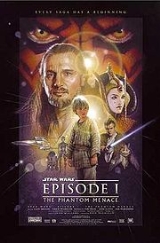
Star Wars Episode I: The Phantom Menace

Encyclopedia
Star Wars Episode I: The Phantom Menace is a 1999 American epic
space opera
film written and directed by George Lucas
. It is the fourth film to be released in the Star Wars
saga, as the first of a three-part prequel
to the original Star Wars trilogy, as well as the first film in the saga in terms of story chronology. The Phantom Menace was also Lucas' first product as a film director
after 22 years, and only his fourth overall. The film follows the Jedi Master
Qui-Gon Jinn
and his apprentice
Obi-Wan Kenobi
, who escort and protect Queen Amidala
in traveling from the planet Naboo
to the planet Coruscant
in the hope of finding a peaceful end to a large-scale interplanetary
trade dispute. The film also features a young Anakin Skywalker
before he became a Jedi, introduced as a young slave boy who seems to be unusually strong with nascent powers of The Force
, and must contend with the mysterious return of the Sith
.
Lucas began production
of this motion picture after he had concluded that the science of movie special effect
s had advanced to the level of what he wanted for his fourth film in the Saga. Its filming took place during 1997 at various locations including Leavesden Film Studios
and the Tunisia
n desert
. Its special effects included extensive use of computer-generated imagery
(CGI), with some of its characters and its settings being completely computerized and not existing at all in the real world.
The Phantom Menace premiered in theaters on May 19, 1999, sixteen years after the 1983 premiere of the previous film in the saga, Return of the Jedi
. The film's premiere was accompanied by extensive media coverage and great anticipation. Despite mixed reviews by critics, who tended to praise the visuals and action sequences but criticize the writing, characterization and acting, it grossed $924.3 million worldwide, making it the Star Wars film with the highest gross-income (unadjusted for inflation), the 18th highest gross-income film of all time, and the highest-income film of 1999. It is also the seventh highest-income film of all time at the American box office. A 3D re-release has been confirmed, with an approximate release date of February 10, 2012.
is in a period of decline. In response to a taxation on trade routes, the Trade Federation
organizes a blockade of battleships around the planet of Naboo
. Supreme Chancellor Finis Valorum (Terrence Stamp) dispatches two Jedi
, Qui-Gon Jinn
(Liam Neeson
) and his Jedi apprentice Obi-Wan Kenobi
(Ewan McGregor
) to negotiate with Trade Federation Viceroy Nute Gunray
(Silas Carson
), in hopes of resolving the issue. However, Darth Sidious
orders the army to kill the Jedi and invade Naboo with an army of battle droids. The two Jedi escape the attempt on their lives by stowing aboard landing craft and escaping to Naboo. There, Qui-Gon saves Gungan outcast Jar Jar Binks
(Ahmed Best
) from being crushed by a Federation tank. Indebted to the Jedi, Jar Jar leads them to the underwater Gungan city of Otoh Gunga; there, the Jedi unsuccessfully attempt to persuade the Gungans to help the people of Naboo, though they are able to obtain a transport to reach the Capital city of Theed on the surface.
Queen Amidala
(Natalie Portman
) is captured by the Federation army, but is rescued by the Jedi. The Queen escapes Naboo with the Jedi on her personal starship, which is damaged on its way through the blockade surrounding the planet, forcing them to land on Tatooine
, a nearby desert planet, for repairs. Qui-Gon ventures into the settlement of Mos Espa with Jar Jar and the astromech droid R2-D2
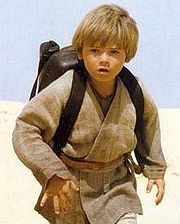
to a junk shop to purchase a new hyperdrive generator. The queen allows Padmé, supposedly a handmaid, to journey along with them. There, they meet a slave child named Anakin Skywalker
(Jake Lloyd
), an interesting pilot and engineer who has created his own protocol droid, C-3PO
. After spending time with Anakin, Qui-Gon senses a strong presence of the Force
within the boy, and suspects he may be the "Chosen One" of Jedi prophecy who will bring balance to the Force. Qui-Gon makes a bet with Anakin's owner, Watto
(Andy Secombe
), to enter him in a podracing tournament; if Anakin wins, he will be freed. Anakin manages to win the race and joins the group to be trained as a Jedi, but he is forced to leave his mother Shmi (Pernilla August
) behind, as Qui-Gon was unable to arrange for her release. They are attacked by Darth Sidious' apprentice, Darth Maul
(Ray Park
), who was dispatched to capture the Queen.
Having escaped the attack, the Jedi escort the Queen to the Republic capital planet of Coruscant
so she can plead her people's case to Chancellor Valorum. Qui-Gon offers the Jedi Council
to train Anakin as a Jedi, but is rejected. Meanwhile, Senator Palpatine
of Naboo convinces the Queen to a motion of no confidence
in Valorum in attempt to vote for a stronger Chancellor who will help end the conflict. She pushes such a vote, but grows frustrated with the lack of action by the Galactic Senate, ultimately deciding to return to Naboo with the Jedi.
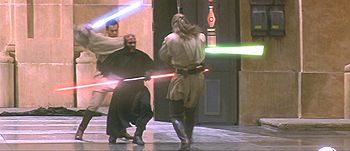 Back on Naboo, Padmé reveals herself to be Queen Amidala, the other "Queen" having been a decoy. Padmé convinces the Gungans to form an alliance against the Trade Federation. While Jar Jar leads his people in a battle against the droid army and the Queen comes in to capture Gunray in Theed, Anakin pilots a vacant starfighter and joins the fight against the Federation droid control ship in space, and—using the Force—destroys the ship, deactivating the droid army. Meanwhile, Obi-Wan and Qui-Gon encounter Darth Maul once more and engage him in a lightsaber duel. Maul mortally wounds Qui-Gon, but is killed by Obi-Wan; Qui-Gon's dying request is for Obi-Wan to train Anakin. Palpatine is elected as the new Supreme Chancellor, the Federation Viceroy is sent to stand trial for his crimes, Obi-Wan is bestowed the rank of Jedi Knight, and the Jedi Council accepts Anakin to become Obi-Wan's apprentice. At a festive ceremony, Padmé presents a gift of appreciation and friendship to the Gungans.
, George Lucas reportedly realized that the story he had written was too vast in scope to be covered in one stand-alone film, and thus, the original film was meant to be the introduction to a much wider story arc that could be covered by sequels if the first film turned out to be successful. The original movie eventually evolved, from being the first movie in the sequence, to a film actually belonging to the second trilogy in the saga. By the time of the third draft Lucas had negotiated a contract that gave him rights to make two sequels. He had also by that point developed a fairly elaborate back-story
to aid his writing process. While writing the first sequel, The Empire Strikes Back
, Lucas considered different directions in which to take the story. He turned the villain Darth Vader
into the father of hero Luke Skywalker
, and developed a backstory depicting Vader as having once been Jedi Knight Anakin Skywalker, a powerful warrior who was swayed to the dark side of the Force
. With this new backstory in place, Lucas decided that the series would be a trilogy, renaming the film from "Episode II" to "Episode V". By the time of the final film of the trilogy, Star Wars Episode VI: Return of the Jedi
, Vader became a tragic character and was ultimately redeemed. However, Lucas stated that he was "burned out" and would take a break from the series.
After losing much of his fortune in a divorce settlement in 1987, George Lucas had no desire to return to Star Wars, and had unofficially canceled his Sequel Trilogy by the time of Return of the Jedi. But since Lucas had developed most of the backstory, the idea of prequels continued to fascinate him. In the early 1990s, Star Wars saw a resurgence in popularity in the wake of Dark Horse
's comic line and Timothy Zahn
's trilogy of novels. Seeing that there was still a large audience for his idea of a prequel trilogy, and with the explosion of CGI
technology, George Lucas considered returning to directing. By 1993 it was announced, in Variety
among other sources, that he would be making the prequels. He began outlining the story, now indicating that Anakin Skywalker would be the main protagonist rather than Obi-Wan Kenobi
, and that the series would be a tragic one examining Anakin's turn to the dark side. Lucas also began to change how the prequels would exist relative to the originals, from a "filling-in" of history, backstory, existing parallel or tangential to the originals, to the beginning of one long story that started with Anakin's childhood and ended with his death. This was the final step towards turning the franchise into a "saga".
George Lucas began writing the new Star Wars trilogy on November 1, 1994. The screenplay for Star Wars was adapted from Lucas' 15-page outline that was written in 1976. The early outline was originally designed to help Lucas track the character backstories and what events had taken place before the original trilogy. While the working title
for the film was The Beginning, Lucas later revealed the true title to be The Phantom Menace; a reference to Palpatine hiding his true identity as an evil Sith Lord behind the facade of a well-intentioned public servant.
and his design team started a two-year process of reviewing thousands of designs for the film. Stunt
coordinator Nick Gillard was recruited to create a new Jedi fighting style for the prequel trilogy. Gillard likened the lightsaber
battles to a chess
game "with every move being a check." Because of their short-range weapons, Gillard theorized that the Jedi would have had to develop a fighting style that merged every swordfighting style, such as kendo
and other kenjutsu
styles, with other swinging techniques, such as tennis swings and tree-chopping
. While training Liam Neeson and Ewan McGregor, Gillard would write a sequence to be an estimated 60 seconds long, meant to be among five to six sequences per fight. Lucas later referred to Jedi as being "negotiators", rather than high-casualty soldiers. The preference of hand-to-hand combat was intended to give a more spiritual and intellectual role to the Jedi. Lucas also decided to make elaborate costumes, considering that the society was more sophisticated than the one depicted in the original trilogy. Designer Trisha Biggar and her team created over one thousand costumes, with inspiration from various cultures around the globe.
Filming began on June 26, 1997 and ended on September 30 of that year, primarily taking place at Leavesden Film Studios in England, with additional location shooting in the Tunisia
n desert
for the Tatooine scenes and the Italian Caserta Palace for the Theed City Naboo Palace interior. The city of Mos Espa was built in the desert outside Tozeur
. On the night following the third day of shooting in Tozeur, an unexpected sandstorm destroyed many sets and props. With a quick rescheduling to allow for repairs, production was able to leave Tunisia on the exact day originally planned.
The Phantom Menace would be the final Star Wars
film to be shot on 35mm film. All future films would be shot using Sony
CineAlta
high-definition video cameras.
s in the film industry were achieved by the use of miniature models, matte
paintings, and on-set visual effects, although other films had made extensive use of computer-generated imagery
(CGI). Visual effects supervisor John Knoll previewed 3,500 storyboard
s for the film, with Lucas accompanying him to explain what factors of the shots would be practical and what would be created through visual effects. Knoll later recounted that on hearing the explanations of the storyboards, he was unaware of any way to accomplish what he had seen. The result was to mix original techniques with the newest digital techniques to make it difficult for the viewer to guess which technique was being used. New computer software was written by Knoll and his visual effects team to create certain shots in the film. Another goal was to create computer-generated characters that could act seamlessly with live-action actors. While filming scenes with CGI characters, Lucas would block
the characters using their corresponding voice actor on-set. The voice actors were then removed and the live-action actors would perform the same scene alone. A CGI character would later be added into the shot, completing the conversation. Lucas also used CGI to correct the physical presence of actors in certain scenes. About 1,950 of the shots have special effects, with the scene where toxic gas is released on the Jedi being the only sequence without any digital alteration.
Having confronted problems with the props used to depict R2-D2
before, Lucas allowed two companies, Industrial Light & Magic (ILM) and the production's British special effects department, to create their own versions for the robot. Nine R2-D2 models were created; one was for actor Kenny Baker
to be dropped into; seven were built by ILM, and featured two wheelchair motors capable of pushing 440 pounds (198 kilograms) of weight, enabling it to run and being mostly used in stage sets; and the British studio produced a "pneumatic" R2 that was able to shift from two to three legs, and was mostly used in Tunisia, because that R2's motor drive system allowed it to drive over sand.
To research for the podrace vehicles, the visual effects crew went to a jet junkyard outside Phoenix
, and scavenged four Boeing 747
engines. Life-sized replicas of the engines were built, and sent to Tunisia to provide reference in the film. Besides Jake Lloyd inside a hydraulic-controlled cockpit, the entire podracing scene is computer-generated, including the scenario, which the effects crew tried to design to be as "out of this world" as possible.
of The Phantom Menace was composed and conducted by John Williams
. He started working in the score in October 1998, and began recording the music with the London Voices and London Symphony Orchestra
at Abbey Road Studios
on February 10, 1999. Williams decided to use more electronic instruments such as synthesizer
s to enhance the sound, and more choral pieces to "capture the magical, mystical force that a regular orchestra might not have been able to provide" and reflect the different atmosphere, "more mysterious and mystical and less military" than the original trilogy. One of the most notable tracks is "Duel of the Fates
", that even received its own music video
, which uses the chorus introduced to give a religious, temple-like feel to the epic lightsaber duel. While composing Anakin's theme, Williams tried to both reflect the innocence of his childhood, and foreshadow his transformation into Darth Vader by putting slight suggestions of "The Imperial March
" into the melody.
The soundtrack for the film was released by Sony Classical Records
on May 4, 1999. This album featured the score restructured by the composer as a listening experience, it is therefore not in film order and omits many notable cues from the film due to space restrictions of a compact disc. A two-disc "Ultimate Edition" was released on November 14, 2000. The set features almost the entire score as it is heard in the film, including all of the edits and loops that were made for the sound mix.
and Universal Studios
, with the releases of The Love Letter and Notting Hill
respectively. The Love Letter resulted in a box-office flop, whereas Notting Hill fared rather well and followed The Phantom Menace closely in second place. Challenger, Gray & Christmas
of Chicago, a work-issues consulting firm, estimated that 2.2 million full-time employees did not appear for work to attend the film, resulting in $293 million in lost productivity. According to The Wall Street Journal
, so many workers announced plans to view premiere screenings that many companies shut down on the opening day. Queue area
s formed outside cinema theaters over a month in advance of ticket sales.
More theater lines appeared when it was announced that cinemas were not allowed to sell tickets in advance until two weeks into the release. This was done out of fear that family theater-goers would be either unable to receive tickets or forced to pay higher prices. Tickets were instead to be sold on a traditional first-come-first-served basis. However, after meetings with the National Association of Theatre Owners
, Lucasfilm agreed to allow advance ticket sales on May 12, 1999, provided that there be a twelve-ticket limit per customer. As a result, however, some advance tickets were sold by scalpers
as high as $100 apiece, which a distribution chief called "horrible", stating it was exactly what they wanted to avoid. Daily Variety
reported that theater owners received strict instructions from Lucasfilm that the film could only play in the cinema's largest auditorium for the first 8–12 weeks; no honor passes were allowed for the first eight weeks, and they were obligated to send their payments to distributor 20th Century Fox within seven days.
Despite worries about whether the film would be finished in time, two weeks before its theatrical release Lucasfilm pushed the release date up from May 21, 1999 to May 19, 1999. At the ShoWest Convention, Lucas stated that the change was to give the fans a "head start" by allowing them to view it over the week and allowing families the chance to view it on the weekends. Foreshadowing his future conversion to digital cinematography
, Lucas stated that the film would be released on four digital projectors on June 18, 1999. Eleven charity premiere
s were staged across the United States on May 16, 1999; receipts from the Los Angeles
event were donated to the Elizabeth Glaser Pediatric AIDS Foundation
with corporate packages available for $5,000–$25,000. Other charity premieres included the Dallas premiere for Children's Medical Center
, the Aubrey Fund for Pediatric Cancer Research at the Sloan-Kettering Hospital
in New York, the Big Brother/Sister Association
of the Philadelphia
premiere, and the Children's National Medical Center
in Washington D.C. A statement said that tickets were sold at $500 apiece and that certain sections were set aside for disadvantaged children.
spent $20 million in The Phantom Menaces advertising campaign. The company also made licensing deals for promotion with Hasbro
, Lego
, Tricon Global Restaurants
and PepsiCo
. Lucasfilm also helped the Star Wars fan club to organize a special event, Star Wars Celebration
, which was held in Denver, Colorado
between April 30 and May 2, 1999.
The teaser trailer
was pre-released on selected screens accompanying A Bug's Life
on November 17, 1998, and there were even reports that people were paying full admission at theaters just to see the trailer. A bootlegged version
of the preview was leaked on the internet the same day, and the trailer was released the following morning on the film's official website, with the servers becoming gridlocked soon after. The theatrical trailer caused even more notable media hype, because it not only premiered in theaters, but screened at the ShoWest Convention
in Las Vegas
, and was aired on Entertainment Tonight
and Access Hollywood
.
The teaser poster, featuring Anakin with his shadow forming Darth Vader's silhouette, was released on November 10, 1998. After Lucas opted for a drawn theatrical poster, Drew Struzan
, the artist responsible for the Special Edition posters, was commissioned to illustrate, and the poster was unveiled on March 11, 1999. Lucasfilm dictated that, contractually, Struzan's illustration was the only art the foreign distributors could use, and other than the text, it could not be modified in any way.
Many tie-in adaptations were released, such as a LucasArts
video game for the PlayStation
and PC, a pinball machine
by Williams, a four-part comic book
adaptation by Dark Horse Comics
, and a junior novelization
by Scholastic.
The official novelization
of the film was written by Terry Brooks
, who met with Lucas before writing the book and received his approval and guidance, including information about impending developments in the following two installments of the series. Brooks also wrote three chapters of unique material.
on April 4, 2000, in two different versions, a standard pan and scan
and a Collector's Edition widescreen
. In its first two days of availability, the regular version sold 4.5 million copies and the limited edition, 500,000. Later it became the first Star Wars film to be officially released on DVD
, on October 16, 2001. The DVD version of the film had certain scenes and other elements edited and inserted by George Lucas, making it slightly different from its theatrical release while retaining an identical plot. Among the special features are seven deleted scenes completed specifically for the DVD, a commentary track featuring among others Lucas and producer Rick McCallum
, and a number of documentaries, including a full-length documentary entitled "The Beginning: Making Episode I". The Phantom Menace became the fastest selling DVD ever in the US, with 2.2 million copies sold in its first week after release. The DVD version was re-released in a prequel trilogy box set on November 4, 2008. A Laserdisc
version of The Phantom Menace was also released in Japan, several months before it was available on DVD in the US. The Star Wars films were released on Blu-ray Disc
on September 16, 2011 in three different editions.
. The films will re-release in internal-saga order beginning with The Phantom Menace, which is scheduled to be released on February 10, 2012. The teaser poster was released on the internet on October 17, 2011.
with an average rating of 5.9/10, making it the lowest rated Star Wars film of the original and prequel trilogy. Some aspects of the scripting were criticized, especially the character of Jar Jar Binks
, who was regarded by many members of the older fan community as purely a merchandising
opportunity rather than a serious character in the film. Kenneth Turan of the Los Angeles Times
described Binks as "a major miscue, a comic-relief character who's frankly not funny." He also criticized the American media for using fan opinions from the Internet
as a reliable source for their news stories, although the Binks character was widely derided by fans and critics alike. In 2002, with the release of Star Wars Episode II: Attack of the Clones
, Ewan McGregor said that in retrospect The Phantom Menace slightly lacked some of the "humor and color" of the forthcoming prequels. He felt as a result of bearing the weight of setting up the entire saga, it seemed "kind of flat." One critic observed that, "Perhaps the absolute creative freedom director George Lucas enjoyed while dreaming up the flick's 'comic' relief—with no studio execs and not many an independently minded actor involved—is a path to the dark side."
However, despite the negative criticisms leveled at the film, many others praised The Phantom Menace. Roger Ebert
gave it three and a half out of four stars, calling it "an astonishing achievement in imaginative filmmaking," and stating that "Lucas tells a good story." Ebert also commented that it was perfectly fine for the characters being a bit less compelling, seeing that they were just being introduced, and hypothetically entreating filmmakers to "give me transparent underwater cities and vast hollow senatorial spheres any day." Owen Gleiberman of Entertainment Weekly
complimented Liam Neeson's performance and the action scenes, and Susan Wloszczyna of USA Today
thought the movie did "plenty right," including the characters of Darth Maul and Watto. David Cornelius of efilmcritic.com remarked that the better moments of the film "don't merely balance out the weaker ones — they topple them." Colin Kennedy of Empire
said that despite problems with pacing and writing "there is still much pleasure to be had watching our full-blown Jedi guides in action", praising the visuals and Liam Neeson's performance, and considering the duel between Darth Maul and the Jedi "the saga's very best lightsaber battle".
Nevertheless, The Phantom Menace was rated by Entertainment Weekly
as one of "The 25 Worst Sequels Ever Made". Similarly, Comcast
ranked the film as the worst movie sequel of all time. James Berardinelli
would later note, "The Phantom Menace was probably the most overhyped motion picture of the last decade (if not longer), and its reputation suffered as a result of its inability to satisfy unreasonable expectations." William Arnold, of the Seattle Post-Intelligencer
, agreed that the massive hype of the film caused much of the negative reaction, saying "it built expectations that can't possibly be matched and scuttled (the) element of storytelling surprise." However, he also felt that the film was "well made and entertaining" and believed it was much better than similar box office fare released around that year, such as The Mummy
and The Matrix
.
The introduction of midi-chlorians (microscopic organisms that allow communication with the Force) in the film has been controversial among fans. Those against it have seen it as a concept that negates the spiritual quality of the Force. Film historian Daniel Dinello notes, "Anathema to Star Wars fanatics who thought they reduced the Force to a kind of viral
infection, midi-chlorians provide a biological interface, the link between physical bodies and spiritual energy." Religion expert John D. Caputo
adds, "In the 'Gospel according to Lucas' a world is conjured up in which the intractable oppositions that have tormented religious thinkers for centuries are reconciled. ... The gifts that the Jedi masters enjoy have a perfectly plausible scientific basis, even if its ways are mysterious: their bodily cell
s have a heavier than usual concentration of 'midi-chlorians.'"
After the release of the film, there was controversy over whether several alien characters reflected racial stereotypes
, notably: the oafish, slow-witted Jar Jar Binks had long droopy ears reminiscent of dreadlocks
and spoke with what many perceived as a Caribbean
patois
(particularly Jamaican Creole
); the greedy and corrupt Neimoidians of the Trade Federation spoke with East Asia
n accents; and the unprincipled desert trader Watto has been interpreted as a Fagin
-esque Jewish stereotype. Lucas has categorically denied all of these implications; however, animator Rob Coleman admitted that he viewed footage of Alec Guinness
as Fagin in Oliver Twist
to inspire his animators in creating Watto. Jar Jar Binks was described by one critic as "Servile and cowardly...a black minstrel
-ish stereotype on par with Stepin Fetchit
." Michael Eric Dyson, professor of African-American studies at Georgetown University
, observed that the entire Gungan people seem oddly suggestive of a primitive Africa
n tribe: "The leader of Jar Jar's tribe is a fat, bumbling buffoon with a rumbling voice, and he seems to be a caricature of a stereotypical African tribal chieftain."
records in its debut. It broke The Lost World: Jurassic Park
s records for the largest single-day gross with more than $28 million in the opening day (surpassed in 2001 by Harry Potter and the Sorcerer's Stone), and fastest to $100 million gross in five days (surpassed in 2002 by Spider-Man
). It also became the fastest movie to reach the $200 million and $300 million mark, surpassing Independence Day
and Titanic
respectively. The Phantom Menace was 1999's most successful film, earning more than $431 million in North America
and $493 million elsewhere. The worldwide total of $924 million makes it the seventeenth highest grossing film of all time, as well as the most financially successful Star Wars film in the saga when not adjusted for inflation of ticket prices. International grosses which exceeded $10 million included Australia ($25.9 million), Brazil ($10.4 million), France and Algeria ($43 million), Germany ($53.9 million), Italy ($12.9 million), Japan ($109.9 million), Mexico ($12 million), Spain ($25 million), and the United Kingdom and Ireland ($81.9 million).
: Best Sound Effects
, Best Visual Effects
, and Best Sound (Gary Rydstrom
, Tom Johnson
, Shawn Murphy
and John Midgley
), losing all three to The Matrix
. In contrast, the film received several Golden Raspberry
, or Razzie, nominations. These included Worst Picture, Worst Director, Worst Screenplay, Worst Supporting Actor (Jake Lloyd as Anakin), Worst Supporting Actress (Sofia Coppola
as Saché), Worst Screen Couple (Jake Lloyd and Natalie Portman), and won the Worst Supporting Actor category with Jar Jar Binks actor Ahmed Best
. The film won Saturn Awards for Best Costumes and Best Special Effects
, the MTV Movie Award for Best Action Scene, and a Young Artist Award
for Jake Lloyd's performance. It was also nominated for, among others, the BAFTAs
in Visual Effects
and Sound
, and the Grammy Award
for Best Soundtrack
. Empire
ranked The Phantom Menace 449th in a 2008 list of the 500 greatest movies of all time.
 The Jedi practice Zen
-like mind training and martial arts
, as did the ancient Japanese
Samurai
warriors. The name "Qui-Gon" adapts the term Qigong
, which refers to a Chinese
discipline involving meditation
and the cultivation of an unseen force "Chi
" or "Qi
" for healing, health and combat. The words ki (Japanese
) and Ch'i (Chinese
) are translations of the India
n term "Prana
", referring to the energy thought to flow through all living things from the source of all chi (or power) which is "The Way" or "The Tao
" in Chinese philosophy. In Taoist philosophy, The Way is understood to have two sides, yin and yang
. Unlike Chinese philosophy, where yin and yang are not moral qualities, the ancient Persian philosophy of Zurvanism
taught that the dualism of dark and light forces are locked in eternal battle while at the same time being two sides (or evolutes) of the same "Force", the force of time itself (Zurvan): the prime mover. These elements derive primarily from Eastern and Iran
ian religions and myths.
There are many Christian
and Biblical
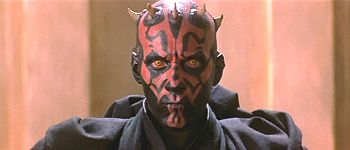
references in the film, such as the appearance of Darth Maul, whose design draws heavily from traditional depictions of the Christian Devil, complete with red skin and horns. The Star Wars film cycle features a similar religious narrative involving Anakin Skywalker, the "chosen one" conceived of a virgin birth, who is tempted to join the Sith. His fall from grace seemingly prevents him from fulfilling his destiny as the "chosen one"—the individual prophesied to bring balance to the Force. The inspiration behind the story of the "virgin birth" parallels a concept developed by Joseph Campbell
and his work on The Hero with a Thousand Faces
, the same work that heavily influenced Lucas in his writing of the original Star Wars trilogy's outline.
Japanese film such as Akira Kurosawa
's The Hidden Fortress
was a source of inspiration for Star Wars Episode IV: A New Hope
, and scholars point out that The Phantom Menace was likewise influenced by Japan
ese culture. Film historians Geoff King and Tanya Krzywinska assert, "The costume and make-up designs ... favour a mixture of the gothic
and the oriental
over anything very futuristic. The gothic is most strongly apparent in Darth Maul's demon
ic horns and the red and black make-up mask that borrows from the facial designs found in depictions of Japanese demons." King and Krzywinska note that "Qui-Gon's pony tail and Obi-Wan's position of apprentice further encourage a reading in terms of the Samurai
tradition." Finally, "Amidala, in keeping with her status and character, has a number of highly formal outfits ... to go with hair sculpted into a curve that frames make-up of a Japanese cast."
The design of the spaceship of Queen Amidala's ship is based on the actual US strategic reconnaissance airplane Lockheed SR-71 Blackbird.
Epic film
An epic is a genre of film that emphasizes human drama on a grand scale. Epics are more ambitious in scope than other film genres, and their ambitious nature helps to differentiate them from similar genres such as the period piece or adventure film...
space opera
Space opera
Space opera is a subgenre of science fiction that emphasizes romantic, often melodramatic adventure, set mainly or entirely in outer space, generally involving conflict between opponents possessing advanced technologies and abilities. The term has no relation to music and it is analogous to "soap...
film written and directed by George Lucas
George Lucas
George Walton Lucas, Jr. is an American film producer, screenwriter, and director, and entrepreneur. He is the founder, chairman and chief executive of Lucasfilm. He is best known as the creator of the space opera franchise Star Wars and the archaeologist-adventurer character Indiana Jones...
. It is the fourth film to be released in the Star Wars
Star Wars
Star Wars is an American epic space opera film series created by George Lucas. The first film in the series was originally released on May 25, 1977, under the title Star Wars, by 20th Century Fox, and became a worldwide pop culture phenomenon, followed by two sequels, released at three-year...
saga, as the first of a three-part prequel
Prequel
A prequel is a work that supplements a previously completed one, and has an earlier time setting.The widely recognized term was a 20th-century neologism, and a portmanteau from pre- and sequel...
to the original Star Wars trilogy, as well as the first film in the saga in terms of story chronology. The Phantom Menace was also Lucas' first product as a film director
Film director
A film director is a person who directs the actors and film crew in filmmaking. They control a film's artistic and dramatic nathan roach, while guiding the technical crew and actors.-Responsibilities:...
after 22 years, and only his fourth overall. The film follows the Jedi Master
Jedi
The Jedi are characters in the Star Wars universe and the series's main protagonists. The Jedi use a power called the Force and weapons called lightsabers, which emit a controlled energy flow in the shape of a sword, in order to serve and protect the Republic and the galaxy at large from conflict...
Qui-Gon Jinn
Qui-Gon Jinn
Qui-Gon Jinn is a fictional character in the Star Wars universe, and a main protagonist of the 1999 film Star Wars Episode I: The Phantom Menace, portrayed by Liam Neeson. He also appears in the Star Wars Expanded Universe of comic books, video games, and novels...
and his apprentice
Apprenticeship
Apprenticeship is a system of training a new generation of practitioners of a skill. Apprentices or protégés build their careers from apprenticeships...
Obi-Wan Kenobi
Obi-Wan Kenobi
Obi-Wan Kenobi is a fictional character in the Star Wars universe. He is one of several primary characters in the Star Wars series. Along with Darth Vader, R2-D2, and C-3PO, he is one of the few major characters to appear in all six Star Wars films...
, who escort and protect Queen Amidala
Padmé Amidala
Padmé Amidala is a fictional character in the Star Wars science fiction franchise. She first appeared on film in the 1999 feature film, Star Wars Episode I: The Phantom Menace, as the young queen of the planet Naboo. In subsequent prequel trilogy films, Padmé represents Naboo in the Galactic Senate...
in traveling from the planet Naboo
Naboo
Naboo is a fictitious planet in the fictional Star Wars universe with a mostly green terrain and which is the homeworld of two societies: the Gungans who dwell in underwater cities and the humans who live in colonies on the surface...
to the planet Coruscant
Coruscant
Coruscant is a planet in the fictional Star Wars universe. It first appeared onscreen in the 1997 Special Edition of Star Wars Episode VI: Return of the Jedi, but was first mentioned in Timothy Zahn's 1991 novel Heir to the Empire...
in the hope of finding a peaceful end to a large-scale interplanetary
Planet
A planet is a celestial body orbiting a star or stellar remnant that is massive enough to be rounded by its own gravity, is not massive enough to cause thermonuclear fusion, and has cleared its neighbouring region of planetesimals.The term planet is ancient, with ties to history, science,...
trade dispute. The film also features a young Anakin Skywalker
Darth Vader
Darth Vader is a central character in the Star Wars saga, appearing as one of the main antagonists in the original trilogy and as the main protagonist in the prequel trilogy....
before he became a Jedi, introduced as a young slave boy who seems to be unusually strong with nascent powers of The Force
Force (Star Wars)
The Force is a binding, metaphysical and ubiquitous power in the fictional universe of the Star Wars galaxy created by George Lucas. Mentioned in the first film in the series, it is integral to all subsequent incarnations of Star Wars, including the expanded universe of comic books, novels, and...
, and must contend with the mysterious return of the Sith
Sith
-Sith:The Sith is a name applied to certain characters in the Star Wars universe. In the films they are the central antagonists. They are capable of using the dark side of the Force.-The Invention of the Sith:...
.
Lucas began production
Film producer
A film producer oversees and delivers a film project to all relevant parties while preserving the integrity, voice and vision of the film. They will also often take on some financial risk by using their own money, especially during the pre-production period, before a film is fully financed.The...
of this motion picture after he had concluded that the science of movie special effect
Special effect
The illusions used in the film, television, theatre, or entertainment industries to simulate the imagined events in a story are traditionally called special effects ....
s had advanced to the level of what he wanted for his fourth film in the Saga. Its filming took place during 1997 at various locations including Leavesden Film Studios
Leavesden Film Studios
Warner Bros. Studios, Leavesden , is a film and media complex owned by Warner Bros.. The studios and backlot sit on the site of the former Rolls-Royce factory at Leavesden Aerodrome, which was an important centre of aircraft production during World War II...
and the Tunisia
Tunisia
Tunisia , officially the Tunisian RepublicThe long name of Tunisia in other languages used in the country is: , is the northernmost country in Africa. It is a Maghreb country and is bordered by Algeria to the west, Libya to the southeast, and the Mediterranean Sea to the north and east. Its area...
n desert
Desert
A desert is a landscape or region that receives an extremely low amount of precipitation, less than enough to support growth of most plants. Most deserts have an average annual precipitation of less than...
. Its special effects included extensive use of computer-generated imagery
Computer-generated imagery
Computer-generated imagery is the application of the field of computer graphics or, more specifically, 3D computer graphics to special effects in art, video games, films, television programs, commercials, simulators and simulation generally, and printed media...
(CGI), with some of its characters and its settings being completely computerized and not existing at all in the real world.
The Phantom Menace premiered in theaters on May 19, 1999, sixteen years after the 1983 premiere of the previous film in the saga, Return of the Jedi
Star Wars Episode VI: Return of the Jedi
Star Wars Episode VI: Return of the Jedi is a 1983 American epic space opera film directed by Richard Marquand and written by George Lucas and Lawrence Kasdan. It is the third film released in the Star Wars saga, and the sixth in terms of the series' internal chronology...
. The film's premiere was accompanied by extensive media coverage and great anticipation. Despite mixed reviews by critics, who tended to praise the visuals and action sequences but criticize the writing, characterization and acting, it grossed $924.3 million worldwide, making it the Star Wars film with the highest gross-income (unadjusted for inflation), the 18th highest gross-income film of all time, and the highest-income film of 1999. It is also the seventh highest-income film of all time at the American box office. A 3D re-release has been confirmed, with an approximate release date of February 10, 2012.
Plot
The Galactic RepublicGalactic Republic (Star Wars)
The Galactic Republic is the name of the interplanetary State used in the fictional Star Wars universe prior to the establishment of the Galactic Empire. The form of this government, created by the Senate, was introduced in the Prequel Trilogy. By the time of the original Star Wars trilogy, it is...
is in a period of decline. In response to a taxation on trade routes, the Trade Federation
Trade Federation
The Trade Federation is a fictional organization in the Star Wars universe at the time of the Galactic Republic. It appears in the franchise's three prequel movies and the Star Wars Expanded Universe...
organizes a blockade of battleships around the planet of Naboo
Naboo
Naboo is a fictitious planet in the fictional Star Wars universe with a mostly green terrain and which is the homeworld of two societies: the Gungans who dwell in underwater cities and the humans who live in colonies on the surface...
. Supreme Chancellor Finis Valorum (Terrence Stamp) dispatches two Jedi
Jedi
The Jedi are characters in the Star Wars universe and the series's main protagonists. The Jedi use a power called the Force and weapons called lightsabers, which emit a controlled energy flow in the shape of a sword, in order to serve and protect the Republic and the galaxy at large from conflict...
, Qui-Gon Jinn
Qui-Gon Jinn
Qui-Gon Jinn is a fictional character in the Star Wars universe, and a main protagonist of the 1999 film Star Wars Episode I: The Phantom Menace, portrayed by Liam Neeson. He also appears in the Star Wars Expanded Universe of comic books, video games, and novels...
(Liam Neeson
Liam Neeson
Liam John Neeson, OBE is an Irish actor who has been nominated for an Oscar, a BAFTA and three Golden Globe Awards.He has starred in a number of notable roles including Oskar Schindler in Schindler's List, Michael Collins in Michael Collins, Peyton Westlake in Darkman, Jean Valjean in Les...
) and his Jedi apprentice Obi-Wan Kenobi
Obi-Wan Kenobi
Obi-Wan Kenobi is a fictional character in the Star Wars universe. He is one of several primary characters in the Star Wars series. Along with Darth Vader, R2-D2, and C-3PO, he is one of the few major characters to appear in all six Star Wars films...
(Ewan McGregor
Ewan McGregor
Ewan Gordon McGregor is a Scottish actor. He has had success in mainstream, indie, and art house films. McGregor is perhaps best known for his roles as heroin addict Mark Renton in the drama Trainspotting , young Jedi Obi-Wan Kenobi in the Star Wars prequel trilogy , and poet Christian in the...
) to negotiate with Trade Federation Viceroy Nute Gunray
Nute Gunray
Nute Gunray is a fictional character and supporting villain from the Star Wars universe, played by Silas Carson in the films. Besides Palpatine , he is the only villain to appear in all three episodes of the prequel trilogy....
(Silas Carson
Silas Carson
Silas Carson is an English actor, mostly known for playing Jedi Master Ki-Adi-Mundi and Viceroy Nute Gunray in all three of the Star Wars prequels and providing the voice of the Ood in Doctor Who....
), in hopes of resolving the issue. However, Darth Sidious
Palpatine
Palpatine is a fictional character and the main antagonist of the Star Wars saga, portrayed by Ian McDiarmid in the feature films.Palpatine first appeared as the unnamed Emperor of the Galactic Empire in the 1980 film Star Wars Episode V: The Empire Strikes Back...
orders the army to kill the Jedi and invade Naboo with an army of battle droids. The two Jedi escape the attempt on their lives by stowing aboard landing craft and escaping to Naboo. There, Qui-Gon saves Gungan outcast Jar Jar Binks
Jar Jar Binks
Jar Jar Binks is a fictional character from the Star Wars Saga , and the television series Star Wars: The Clone Wars. His primary role was to provide comic relief, but many reacted negatively to his character...
(Ahmed Best
Ahmed Best
Ahmed Best is an American voice actor and musician. He has won the Annie Award for Best Voice Acting in an Animated Television Production. He rose to prominence in the 2000s for providing the voice of Jar Jar Binks in the Star Wars franchise. He later turned to television, where he played Jar Jar...
) from being crushed by a Federation tank. Indebted to the Jedi, Jar Jar leads them to the underwater Gungan city of Otoh Gunga; there, the Jedi unsuccessfully attempt to persuade the Gungans to help the people of Naboo, though they are able to obtain a transport to reach the Capital city of Theed on the surface.
Queen Amidala
Padmé Amidala
Padmé Amidala is a fictional character in the Star Wars science fiction franchise. She first appeared on film in the 1999 feature film, Star Wars Episode I: The Phantom Menace, as the young queen of the planet Naboo. In subsequent prequel trilogy films, Padmé represents Naboo in the Galactic Senate...
(Natalie Portman
Natalie Portman
Natalie Hershlag , better known by her stage name Natalie Portman, is an actress with dual American and Israeli citizenship. Her first role was as an orphan taken in by a hitman in the 1994 French action film Léon, but major success came when she was cast as Padmé Amidala in the Star Wars prequel...
) is captured by the Federation army, but is rescued by the Jedi. The Queen escapes Naboo with the Jedi on her personal starship, which is damaged on its way through the blockade surrounding the planet, forcing them to land on Tatooine
Tatooine
Tatooine is a fictional planet and setting for many key scenes in the Star Wars saga, appearing in every Star Wars film except The Empire Strikes Back, although it is mentioned at the end of the movie...
, a nearby desert planet, for repairs. Qui-Gon ventures into the settlement of Mos Espa with Jar Jar and the astromech droid R2-D2
R2-D2
R2-D2 , is a character in the Star Wars universe. An astromech droid, R2-D2 is a major character throughout all six Star Wars films. Along with his droid companion C-3PO, he joins or supports Anakin Skywalker, Luke Skywalker, Princess Leia, and Obi-Wan Kenobi in various points in the saga...
to a junk shop to purchase a new hyperdrive generator. The queen allows Padmé, supposedly a handmaid, to journey along with them. There, they meet a slave child named Anakin Skywalker
Darth Vader
Darth Vader is a central character in the Star Wars saga, appearing as one of the main antagonists in the original trilogy and as the main protagonist in the prequel trilogy....
(Jake Lloyd
Jake Lloyd
Jake Lloyd is a former American actor , who gained worldwide fame when he was chosen by George Lucas to play the young Anakin Skywalker in Star Wars Episode I: The Phantom Menace, the first film in the Star Wars prequel trilogy and currently resides in Chicago. He reprised this role in five...
), an interesting pilot and engineer who has created his own protocol droid, C-3PO
C-3PO
C-3PO is a robot character from the Star Wars universe who appears in both the original Star Wars films and the prequel trilogy. He is also a major character in the television show Droids, and appears frequently in the series' "Expanded Universe" of novels, comic books, and video games...
. After spending time with Anakin, Qui-Gon senses a strong presence of the Force
Force (Star Wars)
The Force is a binding, metaphysical and ubiquitous power in the fictional universe of the Star Wars galaxy created by George Lucas. Mentioned in the first film in the series, it is integral to all subsequent incarnations of Star Wars, including the expanded universe of comic books, novels, and...
within the boy, and suspects he may be the "Chosen One" of Jedi prophecy who will bring balance to the Force. Qui-Gon makes a bet with Anakin's owner, Watto
Watto
Watto is a fictional character in the Star Wars universe, featured in the films The Phantom Menace and Attack of the Clones. He is computer-generated and played by voice actor Andy Secombe. He is a mean-tempered, greedy Toydarian, and owner of a second-hand goods store in Mos Espa on the planet...
(Andy Secombe
Andy Secombe
Andrew Secombe , better known as Andy Secombe, is a Welsh actor, voice actor, and author.He played Rover the Dog in the Channel 4 children's series Chips Comic....
), to enter him in a podracing tournament; if Anakin wins, he will be freed. Anakin manages to win the race and joins the group to be trained as a Jedi, but he is forced to leave his mother Shmi (Pernilla August
Pernilla August
Pernilla August is a Swedish actress, director and script-writer. Being one of Sweden's leading actresses and a long time collaborator with director Ingmar Bergman, she won the Best Actress Award at the 1992 Cannes Film Festival for her role in his The Best Intentions...
) behind, as Qui-Gon was unable to arrange for her release. They are attacked by Darth Sidious' apprentice, Darth Maul
Darth Maul
Darth Maul is a fictional character in the science fiction saga Star Wars. He is one of the main antagonists of Star Wars Episode I: The Phantom Menace, portrayed by martial artist Ray Park and voiced by Peter Serafinowicz....
(Ray Park
Ray Park
Raymond Park is a Scottish actor, stuntman and martial artist, best known for his playing the physical part of Darth Maul in Star Wars Episode I: The Phantom Menace, Toad in X-Men, Snake-Eyes in G.I. Joe: The Rise of Cobra, and Edgar on Heroes.-Early life:Park was born in Glasgow, Scotland...
), who was dispatched to capture the Queen.
Having escaped the attack, the Jedi escort the Queen to the Republic capital planet of Coruscant
Coruscant
Coruscant is a planet in the fictional Star Wars universe. It first appeared onscreen in the 1997 Special Edition of Star Wars Episode VI: Return of the Jedi, but was first mentioned in Timothy Zahn's 1991 novel Heir to the Empire...
so she can plead her people's case to Chancellor Valorum. Qui-Gon offers the Jedi Council
Jedi Council
The Jedi High Council is a fictional institution from the Star Wars film series. The Jedi Council are the strongest members of the Jedi Order, and are elected to lead the Jedi.-History:...
to train Anakin as a Jedi, but is rejected. Meanwhile, Senator Palpatine
Palpatine
Palpatine is a fictional character and the main antagonist of the Star Wars saga, portrayed by Ian McDiarmid in the feature films.Palpatine first appeared as the unnamed Emperor of the Galactic Empire in the 1980 film Star Wars Episode V: The Empire Strikes Back...
of Naboo convinces the Queen to a motion of no confidence
Motion of no confidence
A motion of no confidence is a parliamentary motion whose passing would demonstrate to the head of state that the elected parliament no longer has confidence in the appointed government.-Overview:Typically, when a parliament passes a vote of no...
in Valorum in attempt to vote for a stronger Chancellor who will help end the conflict. She pushes such a vote, but grows frustrated with the lack of action by the Galactic Senate, ultimately deciding to return to Naboo with the Jedi.
Cast
- Liam NeesonLiam NeesonLiam John Neeson, OBE is an Irish actor who has been nominated for an Oscar, a BAFTA and three Golden Globe Awards.He has starred in a number of notable roles including Oskar Schindler in Schindler's List, Michael Collins in Michael Collins, Peyton Westlake in Darkman, Jean Valjean in Les...
as Qui-Gon JinnQui-Gon JinnQui-Gon Jinn is a fictional character in the Star Wars universe, and a main protagonist of the 1999 film Star Wars Episode I: The Phantom Menace, portrayed by Liam Neeson. He also appears in the Star Wars Expanded Universe of comic books, video games, and novels...
: A Jedi MasterJediThe Jedi are characters in the Star Wars universe and the series's main protagonists. The Jedi use a power called the Force and weapons called lightsabers, which emit a controlled energy flow in the shape of a sword, in order to serve and protect the Republic and the galaxy at large from conflict...
and mentor to Obi-Wan. When he discovers Anakin, he insists that the boy be trained as a Jedi, despite the protests of the council. Lucas originally envisioned an American actor in the role, but cast Neeson, who is Irish, because he considered Neeson to have great skills and presence, describing him as a "master actor, who the other actors will look up to, who has got the qualities of strength that the character demands." - Ewan McGregorEwan McGregorEwan Gordon McGregor is a Scottish actor. He has had success in mainstream, indie, and art house films. McGregor is perhaps best known for his roles as heroin addict Mark Renton in the drama Trainspotting , young Jedi Obi-Wan Kenobi in the Star Wars prequel trilogy , and poet Christian in the...
as Obi-Wan KenobiObi-Wan KenobiObi-Wan Kenobi is a fictional character in the Star Wars universe. He is one of several primary characters in the Star Wars series. Along with Darth Vader, R2-D2, and C-3PO, he is one of the few major characters to appear in all six Star Wars films...
: Qui-Gon's young Jedi Padawan apprentice. He holds Qui-Gon in high regard, but questions his motives at times. McGregor prepared for the role by watching Alec GuinnessAlec GuinnessSir Alec Guinness, CH, CBE was an English actor. He was featured in several of the Ealing Comedies, including Kind Hearts and Coronets in which he played eight different characters. He later won the Academy Award for Best Actor for his role as Colonel Nicholson in The Bridge on the River Kwai...
, who portrayed the elderly Obi-Wan, in both the original Star Wars trilogy and Guinness' early work. - Natalie PortmanNatalie PortmanNatalie Hershlag , better known by her stage name Natalie Portman, is an actress with dual American and Israeli citizenship. Her first role was as an orphan taken in by a hitman in the 1994 French action film Léon, but major success came when she was cast as Padmé Amidala in the Star Wars prequel...
as Queen Padmé AmidalaPadmé AmidalaPadmé Amidala is a fictional character in the Star Wars science fiction franchise. She first appeared on film in the 1999 feature film, Star Wars Episode I: The Phantom Menace, as the young queen of the planet Naboo. In subsequent prequel trilogy films, Padmé represents Naboo in the Galactic Senate...
: The young queen of Naboo at 14 years of age, Amidala hopes to protect her planet from a blockade brought on by the Trade Federation. Over 200 actresses were auditioned for the role, with production notes stating that "The role required a young woman who could be believable as the ruler of that planet, but at the same time be vulnerable and open." Portman was chosen specially for her performances in The ProfessionalLéon (film)Léon is a 1994 French thriller film written and directed by Luc Besson...
(1994) and Beautiful Girls (1996), which impressed Lucas. He stated, "I was looking for someone who was young, strong, along the lines of Leia [and] Natalie embodied all those traits and more." The actress was unfamiliar with Star Wars prior to being cast, but was enthused over being cast as the Queen of Naboo, a character she expected to become a role model: "It was wonderful playing a young queen with so much power. I think it will be good for young women to see a strong woman of action who is also smart and a leader." - Jake LloydJake LloydJake Lloyd is a former American actor , who gained worldwide fame when he was chosen by George Lucas to play the young Anakin Skywalker in Star Wars Episode I: The Phantom Menace, the first film in the Star Wars prequel trilogy and currently resides in Chicago. He reprised this role in five...
as Anakin SkywalkerDarth VaderDarth Vader is a central character in the Star Wars saga, appearing as one of the main antagonists in the original trilogy and as the main protagonist in the prequel trilogy....
: A nine-year-old slave boy from Tatooine. He is discovered to have the highest known count of midichlorians, a sign of strength in the Force. More than 3,000 young actors auditioned for the role throughout North AmericaNorth AmericaNorth America is a continent wholly within the Northern Hemisphere and almost wholly within the Western Hemisphere. It is also considered a northern subcontinent of the Americas...
and the United KingdomUnited KingdomThe United Kingdom of Great Britain and Northern IrelandIn the United Kingdom and Dependencies, other languages have been officially recognised as legitimate autochthonous languages under the European Charter for Regional or Minority Languages...
. They included child actors Michael AngaranoMichael Angarano- Early life :Angarano was born in Brooklyn, New York, the son of Doreen and Michael P. Angarano. He is of Italian descent. His family owns and operates three successful dance studios; two in New York and one in California called Reflections in Dance. His mother is the owner and director of all...
, Erik von DettenErik von DettenErik Thomas von Detten is an American actor. He is known for his roles in Escape to Witch Mountain, Toy Story, Brink!, The Princess Diaries, and So Weird.-Personal life:Von Detten was born in San Diego, California...
, Justin BerfieldJustin BerfieldJustin Tyler Berfield is an American actor, writer and producer, best known for his portrayal as Malcolm's 2nd-oldest brother, Reese, in Malcolm in the Middle...
, and Haley Joel OsmentHaley Joel OsmentHaley Joel Osment is an American actor. After a series of roles in television and film during the 1990s, including a small part in Forrest Gump playing Tom Hanks' title character’s son, Osment rose to fame with his performance as Cole Sear in M...
. The field narrowed to three actors, all of whom were interviewed by Lucas and then screen-testedScreen testA screen test is a method of determining the suitability of an actor or actress for performing on film and/or in a particular role. The performer is generally given a scene, or selected lines and actions, and instructed to perform in front of a camera to see if they are suitable...
with Natalie Portman. - Ian McDiarmidIan McDiarmidIan McDiarmid is a Scottish theatre actor and director, who has also made sporadic appearances on film and television.McDiarmid has had a successful career in theatre; he has been cast in many plays, while occasionally directing others and although he has appeared mostly in theatrical productions,...
as Palpatine/Darth SidiousPalpatinePalpatine is a fictional character and the main antagonist of the Star Wars saga, portrayed by Ian McDiarmid in the feature films.Palpatine first appeared as the unnamed Emperor of the Galactic Empire in the 1980 film Star Wars Episode V: The Empire Strikes Back...
: The Senator of Naboo, who is eventually elected Chancellor of the Republic. McDiarmid was surprised when Lucas approached him 16 years after Return of the Jedi to reprise the role of Palpatine, because he had assumed that a younger actor would play the part in the prequel films. - Ahmed BestAhmed BestAhmed Best is an American voice actor and musician. He has won the Annie Award for Best Voice Acting in an Animated Television Production. He rose to prominence in the 2000s for providing the voice of Jar Jar Binks in the Star Wars franchise. He later turned to television, where he played Jar Jar...
as the voice of Jar Jar BinksJar Jar BinksJar Jar Binks is a fictional character from the Star Wars Saga , and the television series Star Wars: The Clone Wars. His primary role was to provide comic relief, but many reacted negatively to his character...
: A clumsy Gungan, exiled from his home but taken in by Qui-Gon and Obi-Wan. He accompanies them throughout the film. Best was hired after Gurland saw him on a StompStomp (dance troupe)Stomp is a percussion group that uses the body and ordinary objects to create a physical theatre performance.-History and performances:...
performance in San Francisco, and originally was just going to provide motion capturing, but after offering to also voice the character, was accepted. He wandered in the set in a foam-and-latex suit and headpiece to provide reference for the actors, with his filmed performance later replaced by the computer-generated character. Best frequently improvised movements to make Jar Jar as clumsy and comedic as possible. - Pernilla AugustPernilla AugustPernilla August is a Swedish actress, director and script-writer. Being one of Sweden's leading actresses and a long time collaborator with director Ingmar Bergman, she won the Best Actress Award at the 1992 Cannes Film Festival for her role in his The Best Intentions...
as Shmi Skywalker: Anakin's mother. She is concerned for her son's future, and lets him leave with the Jedi. August, a veteran of Swedish cinema, was chosen after auditioning with Liam Neeson, although she was afraid of not being chosen due to her accent. - Ray ParkRay ParkRaymond Park is a Scottish actor, stuntman and martial artist, best known for his playing the physical part of Darth Maul in Star Wars Episode I: The Phantom Menace, Toad in X-Men, Snake-Eyes in G.I. Joe: The Rise of Cobra, and Edgar on Heroes.-Early life:Park was born in Glasgow, Scotland...
as Darth MaulDarth MaulDarth Maul is a fictional character in the science fiction saga Star Wars. He is one of the main antagonists of Star Wars Episode I: The Phantom Menace, portrayed by martial artist Ray Park and voiced by Peter Serafinowicz....
: A young Zabrak Sith apprentice to Darth Sidious who uses a double-bladed lightsaber. A martial artsMartial artsMartial arts are extensive systems of codified practices and traditions of combat, practiced for a variety of reasons, including self-defense, competition, physical health and fitness, as well as mental and spiritual development....
champion with experience in gymnastics and swordfighting, Park was originally only a member of the stunt crew, and stunt coordinator Nick Gillard filmed Park to demonstrate how he envisioned the lightsaber battles. Lucas and McCallum were so impressed with the test tape that they gave Park the role of Maul. But his voice was considered "too squeaky", leading him to be dubbed over. He was voiced by Peter SerafinowiczPeter SerafinowiczPeter Szymon Serafinowicz is an English actor, comedian, writer, composer, voice artist and occasional director.-Early life:Serafinowicz was born in Liverpool, England. He attended Our Lady of the Assumption Roman Catholic Primary School and St Francis Xavier Secondary School...
. - Anthony DanielsAnthony DanielsAnthony Daniels is an English actor. He is best known for his role as the droid C-3PO in the Star Wars series of films made between 1977 and 2005.-Early life:...
voices C-3POC-3POC-3PO is a robot character from the Star Wars universe who appears in both the original Star Wars films and the prequel trilogy. He is also a major character in the television show Droids, and appears frequently in the series' "Expanded Universe" of novels, comic books, and video games...
: A protocol droid built by Anakin, he lacks a metal covering in this film, which R2-D2 refers to as being "naked". A puppeteer—dressed in a color close to the one seen in the background, similar to the JapanJapanJapan is an island nation in East Asia. Located in the Pacific Ocean, it lies to the east of the Sea of Japan, China, North Korea, South Korea and Russia, stretching from the Sea of Okhotsk in the north to the East China Sea and Taiwan in the south...
ese puppet theater BunrakuBunraku, also known as Ningyō jōruri , is a form of traditional Japanese puppet theater, founded in Osaka in 1684.Three kinds of performers take part in a bunraku performance:* Ningyōtsukai or Ningyōzukai—puppeteers* Tayū—the chanters* Shamisen players...
, so he could be erased during post-production—manipulated a skeletal C-3PO figure attached to his front, while Daniels read his lines off-camera. - Kenny BakerKenny BakerKenneth George "Kenny" Baker is a British actor and musician, best known as the man inside R2-D2 in the popular Star Wars film series.- Career :...
as R2-D2R2-D2R2-D2 , is a character in the Star Wars universe. An astromech droid, R2-D2 is a major character throughout all six Star Wars films. Along with his droid companion C-3PO, he joins or supports Anakin Skywalker, Luke Skywalker, Princess Leia, and Obi-Wan Kenobi in various points in the saga...
: An astromech droid, notable for saving Queen Amidala's ship when all other droids fail. Before the production of The Phantom Menace started, fans campaigned on the internet to retain Baker as R2, to which Lucas replied that the actor would remain. Baker is used for scenes where R2 bends forwards and backwards and wobble from side to side, while actual robots and a digital replica are used otherwise (see Effects, below). - Silas CarsonSilas CarsonSilas Carson is an English actor, mostly known for playing Jedi Master Ki-Adi-Mundi and Viceroy Nute Gunray in all three of the Star Wars prequels and providing the voice of the Ood in Doctor Who....
as Nute GunrayNute GunrayNute Gunray is a fictional character and supporting villain from the Star Wars universe, played by Silas Carson in the films. Besides Palpatine , he is the only villain to appear in all three episodes of the prequel trilogy....
: The Viceroy of the Trade Federation who leads the invasion of Naboo and tries to force Queen Amidala to sign a treaty to legitimize the occupation. Carson also portrays three minor characters: Jedi Master Ki-Adi-MundiKi-Adi-MundiKi-Adi-Mundi is a fictional character from the Star Wars universe. He was portrayed by actor Silas Carson in each of the films of the Star Wars prequel trilogy...
, Trade Federation Senator Lott Dod, and an ill-fated pilot (which was the role Carson originally auditioned for). Carson got the role because another actor was uncomfortable with the costumes used by the Trade Federation characters — which were hot, exerted a lot of pressure on the bearer, and took about 15 minutes to apply. The ThaiThai languageThai , also known as Central Thai and Siamese, is the national and official language of Thailand and the native language of the Thai people, Thailand's dominant ethnic group. Thai is a member of the Tai group of the Tai–Kadai language family. Historical linguists have been unable to definitively...
accent used by the character was chosen after Lucas and McCallum listened to various languages to pick how the Neimodians would speak. - Hugh QuarshieHugh Quarshie- Early and Personal Life :Quarshie is of mixed Ghanaian, English and Dutch ancestry and was born in Accra, Ghana, to Emma Wilhelmina and Richard Quarshie, and emigrated with his family to the United Kingdom when he was aged three...
as Captain Panaka: Queen Amidala's chief of security at Theed Palace. Quarshie accepted the part for considering it "a good career move" and a production that would be fun to make. - Andy SecombeAndy SecombeAndrew Secombe , better known as Andy Secombe, is a Welsh actor, voice actor, and author.He played Rover the Dog in the Channel 4 children's series Chips Comic....
voices WattoWattoWatto is a fictional character in the Star Wars universe, featured in the films The Phantom Menace and Attack of the Clones. He is computer-generated and played by voice actor Andy Secombe. He is a mean-tempered, greedy Toydarian, and owner of a second-hand goods store in Mos Espa on the planet...
: A junk dealer on Tatooine who owns Anakin and his mother as slaves. With a design that was an amalgalm of various rejected ideas, Watto's expressions were based on video footage of Secombe doing the voice acting, photos of animation supervisor Rob Coleman imitating the character, and modeler Steve Alpin saying Watto's lines to the mirror. - Lewis MacLeodLewis MacLeodEuan Lewis MacLeod is a prolific Scottish character actor, who can be heard as the voice of a huge number of television commercials, movie trailers and cartoons in his native UK. He voices characters such as Sebulba from Star Wars Episode I: The Phantom Menace and Postman Pat...
voices Sebulba: An aggressive, scheming Podracer and rival of Anakin. Sebulba's design was described by Lucas as "a spider crossed with an orangutan crossed with a sloth", with a camel-like face, and clothing inspired by medieval armor. - Frank OzFrank OzFrank Oz is a British-born American film director, actor, voice actor and puppeteer who is known for creating and performing the characters Miss Piggy and Fozzie Bear in The Muppet Show, Cookie Monster, Bert and Grover in Sesame Street, and for directing films, including the 1986 Little Shop of...
as the voice of YodaYodaYoda is a fictional character in the Star Wars universe, appearing in the second and third original films, as well as all three prequel trilogy films. A renowned Jedi master, Yoda made his first on-screen appearance in Star Wars Episode V: The Empire Strikes Back where he is responsible for...
: The centuries old leader of the Jedi Council who is apprehensive about allowing Anakin to be trained. Yoda was mostly portrayed as a puppet designed by Nick Dudman, based on Stuart FreebornStuart FreebornStuart Freeborn is a British motion picture make-up artist. He has been referred to as the grandfather of modern make-up design and is perhaps best known for his work on the original Star Wars trilogy...
's original design, with Oz controlling the mouth and other parts controlled by the puppeteers using remote controls. A computer-generated Yoda is featured in two distant shots and Warwick DavisWarwick DavisWarwick Ashley Davis is an English actor. He is most notable for playing the title characters in Willow and the Leprechaun film series, as well as for his roles in Star Wars Episode VI: Return of the Jedi and the Harry Potter movies. Davis currently stars in the sitcom Life's Too Short, written...
portrays him in the scene in which Obi-Wan becomes a Jedi Knight. - Samuel L. JacksonSamuel L. JacksonSamuel Leroy Jackson is an American film and television actor and film producer. After becoming involved with the Civil Rights Movement, he moved on to acting in theater at Morehouse College, and then films. He had several small roles such as in the film Goodfellas before meeting his mentor,...
as Mace WinduMace WinduMace Windu is a fictional character in the Star Wars universe, most famously portrayed by actor Samuel L. Jackson in the prequel films. However, Windu has also been voiced by other actors in assorted video game and animated projects....
: A member of the Jedi Council who also opposes the idea of training Anakin. After Jackson expressed interest in appearing in a Star Wars film, he was approached by cast director Robin Gurland to play Windu. - Terence StampTerence StampTerence Henry Stamp is an English actor. Since starting his career in 1962 he has appeared in over 60 films. His title role as Billy Budd in his film debut earned Stamp an Academy Award nomination for Best Supporting Actor and a BAFTA nomination for Best Newcomer.His other major roles include...
as Supreme Chancellor Finis Valorum: The current Chancellor who commissions Obi-Wan and Qui-Gon to negotiate with the Trade Federation Viceroy. Lucas described the character as a "good man but he's beleaguered—a bit like [Bill] ClintonBill ClintonWilliam Jefferson "Bill" Clinton is an American politician who served as the 42nd President of the United States from 1993 to 2001. Inaugurated at age 46, he was the third-youngest president. He took office at the end of the Cold War, and was the first president of the baby boomer generation...
". - Brian BlessedBrian BlessedBrian Blessed is an English actor, known for his sonorous voice and "hearty, king-sized portrayals".-Early life:The son of William Blessed, a socialist miner, and Hilda Wall, Blessed was born in the town of Goldthorpe, West Riding of Yorkshire, England...
voices Boss Nass: The leader of the Gungan tribe who allies with the NabooNabooNaboo is a fictitious planet in the fictional Star Wars universe with a mostly green terrain and which is the homeworld of two societies: the Gungans who dwell in underwater cities and the humans who live in colonies on the surface...
and defeats the Trade FederationTrade FederationThe Trade Federation is a fictional organization in the Star Wars universe at the time of the Galactic Republic. It appears in the franchise's three prequel movies and the Star Wars Expanded Universe...
. Blessed originally auditioned for Sio Bibble, the Governor of Naboo, for which he was considered "too loud". Blessed described Nass as a "reluctant hero", and a fun role to play. - Greg ProopsGreg ProopsGregory Everett "Greg" Proops is an American actor, stand-up comedian and television host. He is widely known for his work as an improvisational comedian on the UK and U.S. versions of Whose Line Is It Anyway?...
and Scott CapurroScott Capurro-Television appearances:-Stage appearances:-Personal life:In October 2006 Capurro purchased a flat in Bethnal Green and considers himself a London resident.-External links:* * *...
voice Fode and Beed, the two headed announcer of the Boonta's Eve Race. The actors were filmed wearing make-up and blue bodysuits, so their heads would be joined in a computer-generated body. The visual effects crew did not like the original results, and ended up crafting Fode and Beed as an entirely computer generated alien. - Keira KnightleyKeira KnightleyKeira Christina Knightley born 26 March 1985) is an English actress and model. She began acting as a child and came to international notice in 2002 after co-starring in the film Bend It Like Beckham...
as Sabé: Queen Amidala's body double and decoy. The role was originally going to be filled by a stand-inStand-inA stand-in for film and television is a person who substitutes for the actor before filming, for technical purposes such as lighting.Stand-ins are helpful in the initial processes of production. Lighting setup can be a slow and tedious process; during this time the actor will often be somewhere else...
, until casting director Robin Gurland came across Knightley, who bore a striking resemblance to Natalie Portman. Knightley's role was kept quiet by The Phantom Menace' s marketing department in order to heighten the surprise of there being a decoy Queen when the film was released. The Queen's costumes were specifically designed to hide any height and shape differences between Knightley and Portman, so much so that Portman's mother could not distinguish between the two on set.
Writing
During the process of writing the original Star WarsStar Wars Episode IV: A New Hope
Star Wars Episode IV: A New Hope, originally released as Star Wars, is a 1977 American epic space opera film, written and directed by George Lucas. It is the first of six films released in the Star Wars saga: two subsequent films complete the original trilogy, while a prequel trilogy completes the...
, George Lucas reportedly realized that the story he had written was too vast in scope to be covered in one stand-alone film, and thus, the original film was meant to be the introduction to a much wider story arc that could be covered by sequels if the first film turned out to be successful. The original movie eventually evolved, from being the first movie in the sequence, to a film actually belonging to the second trilogy in the saga. By the time of the third draft Lucas had negotiated a contract that gave him rights to make two sequels. He had also by that point developed a fairly elaborate back-story
Back-story
A back-story, background story, or backstory is the literary device of a narrative chronologically earlier than, and related to, a narrative of primary interest. Generally, it is the history of characters or other elements that underlie the situation existing at the main narrative's start...
to aid his writing process. While writing the first sequel, The Empire Strikes Back
Star Wars Episode V: The Empire Strikes Back
Star Wars Episode V: The Empire Strikes Back is a 1980 American epic space opera film directed by Irvin Kershner. The screenplay, based on a story by George Lucas, was written by Leigh Brackett and Lawrence Kasdan...
, Lucas considered different directions in which to take the story. He turned the villain Darth Vader
Darth Vader
Darth Vader is a central character in the Star Wars saga, appearing as one of the main antagonists in the original trilogy and as the main protagonist in the prequel trilogy....
into the father of hero Luke Skywalker
Luke Skywalker
Luke Skywalker is a fictional character and the main protagonist of the original film trilogy of the Star Wars franchise, where he is portrayed by Mark Hamill. He is introduced in Star Wars Episode IV: A New Hope, in which he is forced to leave home, and finds himself apprenticed to the Jedi master...
, and developed a backstory depicting Vader as having once been Jedi Knight Anakin Skywalker, a powerful warrior who was swayed to the dark side of the Force
Dark side (Star Wars)
The dark side of the Force is a prominent moral, philosophical, and psychic concept in the Star Wars universe. It is introduced in Star Wars Episode IV: A New Hope, and appears in all subsequent Star Wars fiction...
. With this new backstory in place, Lucas decided that the series would be a trilogy, renaming the film from "Episode II" to "Episode V". By the time of the final film of the trilogy, Star Wars Episode VI: Return of the Jedi
Star Wars Episode VI: Return of the Jedi
Star Wars Episode VI: Return of the Jedi is a 1983 American epic space opera film directed by Richard Marquand and written by George Lucas and Lawrence Kasdan. It is the third film released in the Star Wars saga, and the sixth in terms of the series' internal chronology...
, Vader became a tragic character and was ultimately redeemed. However, Lucas stated that he was "burned out" and would take a break from the series.
After losing much of his fortune in a divorce settlement in 1987, George Lucas had no desire to return to Star Wars, and had unofficially canceled his Sequel Trilogy by the time of Return of the Jedi. But since Lucas had developed most of the backstory, the idea of prequels continued to fascinate him. In the early 1990s, Star Wars saw a resurgence in popularity in the wake of Dark Horse
Dark Horse Comics
Dark Horse Comics is the largest independent American comic book and manga publisher.Dark Horse Comics was founded in 1986 by Mike Richardson in Milwaukie, Oregon, with the concept of establishing an ideal atmosphere for creative professionals. Richardson started out by opening his first comic book...
's comic line and Timothy Zahn
Timothy Zahn
Timothy Zahn is a writer of science fiction short stories and novels. His novella Cascade Point won the 1984 Hugo award. He is the author of nine Star Wars Expanded Universe novels, including seven novels featuring Grand Admiral Thrawn: the Thrawn Trilogy, the Hand of Thrawn duology, Outbound...
's trilogy of novels. Seeing that there was still a large audience for his idea of a prequel trilogy, and with the explosion of CGI
Computer-generated imagery
Computer-generated imagery is the application of the field of computer graphics or, more specifically, 3D computer graphics to special effects in art, video games, films, television programs, commercials, simulators and simulation generally, and printed media...
technology, George Lucas considered returning to directing. By 1993 it was announced, in Variety
Variety (magazine)
Variety is an American weekly entertainment-trade magazine founded in New York City, New York, in 1905 by Sime Silverman. With the rise of the importance of the motion-picture industry, Daily Variety, a daily edition based in Los Angeles, California, was founded by Silverman in 1933. In 1998, the...
among other sources, that he would be making the prequels. He began outlining the story, now indicating that Anakin Skywalker would be the main protagonist rather than Obi-Wan Kenobi
Obi-Wan Kenobi
Obi-Wan Kenobi is a fictional character in the Star Wars universe. He is one of several primary characters in the Star Wars series. Along with Darth Vader, R2-D2, and C-3PO, he is one of the few major characters to appear in all six Star Wars films...
, and that the series would be a tragic one examining Anakin's turn to the dark side. Lucas also began to change how the prequels would exist relative to the originals, from a "filling-in" of history, backstory, existing parallel or tangential to the originals, to the beginning of one long story that started with Anakin's childhood and ended with his death. This was the final step towards turning the franchise into a "saga".
George Lucas began writing the new Star Wars trilogy on November 1, 1994. The screenplay for Star Wars was adapted from Lucas' 15-page outline that was written in 1976. The early outline was originally designed to help Lucas track the character backstories and what events had taken place before the original trilogy. While the working title
Working title
A working title, sometimes called a production title, is the temporary name of a product or project used during its development, usually used in filmmaking, television production, novel, video game, or music album.-Purpose:...
for the film was The Beginning, Lucas later revealed the true title to be The Phantom Menace; a reference to Palpatine hiding his true identity as an evil Sith Lord behind the facade of a well-intentioned public servant.
Filming
Within three to four months of Lucas beginning the writing process, Doug ChiangDoug Chiang
Doug Chiang is an American film designer and artist. He was born in Taipei, Taiwan in 1962 and grew up in the United States.Chiang studied film at UCLA and industrial design at the College for Creative Studies. During the late 1980s he worked at various production studios including Rhythm and Hues...
and his design team started a two-year process of reviewing thousands of designs for the film. Stunt
Stunt
A stunt is an unusual and difficult physical feat, or any act requiring a special skill, performed for artistic purposes in TV, theatre, or cinema...
coordinator Nick Gillard was recruited to create a new Jedi fighting style for the prequel trilogy. Gillard likened the lightsaber
Lightsaber
A lightsaber is a fictional weapon in the Star Wars universe, a "laser sword." It consists of a polished metal hilt which projects a blade of light about 1.33 metres long. The lightsaber is the signature weapon of the Jedi order and their Sith counterparts, both of whom can use them for close...
battles to a chess
Chess
Chess is a two-player board game played on a chessboard, a square-checkered board with 64 squares arranged in an eight-by-eight grid. It is one of the world's most popular games, played by millions of people worldwide at home, in clubs, online, by correspondence, and in tournaments.Each player...
game "with every move being a check." Because of their short-range weapons, Gillard theorized that the Jedi would have had to develop a fighting style that merged every swordfighting style, such as kendo
Kendo
, meaning "Way of The Sword", is a modern Japanese martial art of sword-fighting based on traditional Japanese swordsmanship, or kenjutsu.Kendo is a physically and mentally challenging activity that combines strong martial arts values with sport-like physical elements.-Practitioners:Practitioners...
and other kenjutsu
Kenjutsu
, meaning "the method, or technique, of the sword." This is opposed to kendo, which means the way of the sword. Kenjutsu is the umbrella term for all traditional schools of Japanese swordsmanship, in particular those that predate the Meiji Restoration...
styles, with other swinging techniques, such as tennis swings and tree-chopping
Axe
The axe, or ax, is an implement that has been used for millennia to shape, split and cut wood; to harvest timber; as a weapon; and as a ceremonial or heraldic symbol...
. While training Liam Neeson and Ewan McGregor, Gillard would write a sequence to be an estimated 60 seconds long, meant to be among five to six sequences per fight. Lucas later referred to Jedi as being "negotiators", rather than high-casualty soldiers. The preference of hand-to-hand combat was intended to give a more spiritual and intellectual role to the Jedi. Lucas also decided to make elaborate costumes, considering that the society was more sophisticated than the one depicted in the original trilogy. Designer Trisha Biggar and her team created over one thousand costumes, with inspiration from various cultures around the globe.
Filming began on June 26, 1997 and ended on September 30 of that year, primarily taking place at Leavesden Film Studios in England, with additional location shooting in the Tunisia
Tunisia
Tunisia , officially the Tunisian RepublicThe long name of Tunisia in other languages used in the country is: , is the northernmost country in Africa. It is a Maghreb country and is bordered by Algeria to the west, Libya to the southeast, and the Mediterranean Sea to the north and east. Its area...
n desert
Desert
A desert is a landscape or region that receives an extremely low amount of precipitation, less than enough to support growth of most plants. Most deserts have an average annual precipitation of less than...
for the Tatooine scenes and the Italian Caserta Palace for the Theed City Naboo Palace interior. The city of Mos Espa was built in the desert outside Tozeur
Tozeur
Tozeur is an oasis and a city in south west Tunisia. The city is located North West of Chott el-Djerid, in between this Chott and the smaller Chott el-Gharsa. It is the capital of the Tozeur Governorate....
. On the night following the third day of shooting in Tozeur, an unexpected sandstorm destroyed many sets and props. With a quick rescheduling to allow for repairs, production was able to leave Tunisia on the exact day originally planned.
The Phantom Menace would be the final Star Wars
Star Wars
Star Wars is an American epic space opera film series created by George Lucas. The first film in the series was originally released on May 25, 1977, under the title Star Wars, by 20th Century Fox, and became a worldwide pop culture phenomenon, followed by two sequels, released at three-year...
film to be shot on 35mm film. All future films would be shot using Sony
Sony
, commonly referred to as Sony, is a Japanese multinational conglomerate corporation headquartered in Minato, Tokyo, Japan and the world's fifth largest media conglomerate measured by revenues....
CineAlta
CineAlta
Sony's CineAlta 24P HD Cameras are a series of professional digital video cameras that offer many of the same features of a 35mm motion picture film camera.- Concept :...
high-definition video cameras.
Effects
Up until the production of The Phantom Menace, many special effectSpecial effect
The illusions used in the film, television, theatre, or entertainment industries to simulate the imagined events in a story are traditionally called special effects ....
s in the film industry were achieved by the use of miniature models, matte
Matte (filmmaking)
Mattes are used in photography and special effects filmmaking to combine two or more image elements into a single, final image. Usually, mattes are used to combine a foreground image with a background image . In this case, the matte is the background painting...
paintings, and on-set visual effects, although other films had made extensive use of computer-generated imagery
Computer-generated imagery
Computer-generated imagery is the application of the field of computer graphics or, more specifically, 3D computer graphics to special effects in art, video games, films, television programs, commercials, simulators and simulation generally, and printed media...
(CGI). Visual effects supervisor John Knoll previewed 3,500 storyboard
Storyboard
Storyboards are graphic organizers in the form of illustrations or images displayed in sequence for the purpose of pre-visualizing a motion picture, animation, motion graphic or interactive media sequence....
s for the film, with Lucas accompanying him to explain what factors of the shots would be practical and what would be created through visual effects. Knoll later recounted that on hearing the explanations of the storyboards, he was unaware of any way to accomplish what he had seen. The result was to mix original techniques with the newest digital techniques to make it difficult for the viewer to guess which technique was being used. New computer software was written by Knoll and his visual effects team to create certain shots in the film. Another goal was to create computer-generated characters that could act seamlessly with live-action actors. While filming scenes with CGI characters, Lucas would block
Blocking (stage)
Blocking is a theatre term which refers to the precise movement and positioning of actors on a stage in order to facilitate the performance of a play, ballet, film or opera. The term derives from the practice of 19th century theatre directors such as Sir W. S...
the characters using their corresponding voice actor on-set. The voice actors were then removed and the live-action actors would perform the same scene alone. A CGI character would later be added into the shot, completing the conversation. Lucas also used CGI to correct the physical presence of actors in certain scenes. About 1,950 of the shots have special effects, with the scene where toxic gas is released on the Jedi being the only sequence without any digital alteration.
Having confronted problems with the props used to depict R2-D2
R2-D2
R2-D2 , is a character in the Star Wars universe. An astromech droid, R2-D2 is a major character throughout all six Star Wars films. Along with his droid companion C-3PO, he joins or supports Anakin Skywalker, Luke Skywalker, Princess Leia, and Obi-Wan Kenobi in various points in the saga...
before, Lucas allowed two companies, Industrial Light & Magic (ILM) and the production's British special effects department, to create their own versions for the robot. Nine R2-D2 models were created; one was for actor Kenny Baker
Kenny Baker
Kenneth George "Kenny" Baker is a British actor and musician, best known as the man inside R2-D2 in the popular Star Wars film series.- Career :...
to be dropped into; seven were built by ILM, and featured two wheelchair motors capable of pushing 440 pounds (198 kilograms) of weight, enabling it to run and being mostly used in stage sets; and the British studio produced a "pneumatic" R2 that was able to shift from two to three legs, and was mostly used in Tunisia, because that R2's motor drive system allowed it to drive over sand.
To research for the podrace vehicles, the visual effects crew went to a jet junkyard outside Phoenix
Phoenix, Arizona
Phoenix is the capital, and largest city, of the U.S. state of Arizona, as well as the sixth most populated city in the United States. Phoenix is home to 1,445,632 people according to the official 2010 U.S. Census Bureau data...
, and scavenged four Boeing 747
Boeing 747
The Boeing 747 is a wide-body commercial airliner and cargo transport, often referred to by its original nickname, Jumbo Jet, or Queen of the Skies. It is among the world's most recognizable aircraft, and was the first wide-body ever produced...
engines. Life-sized replicas of the engines were built, and sent to Tunisia to provide reference in the film. Besides Jake Lloyd inside a hydraulic-controlled cockpit, the entire podracing scene is computer-generated, including the scenario, which the effects crew tried to design to be as "out of this world" as possible.
Music
As with previous Star Wars installments, the scoreFilm score
A film score is original music written specifically to accompany a film, forming part of the film's soundtrack, which also usually includes dialogue and sound effects...
of The Phantom Menace was composed and conducted by John Williams
John Williams
John Towner Williams is an American composer, conductor, and pianist. In a career spanning almost six decades, he has composed some of the most recognizable film scores in the history of motion pictures, including the Star Wars saga, Jaws, Superman, the Indiana Jones films, E.T...
. He started working in the score in October 1998, and began recording the music with the London Voices and London Symphony Orchestra
London Symphony Orchestra
The London Symphony Orchestra is a major orchestra of the United Kingdom, as well as one of the best-known orchestras in the world. Since 1982, the LSO has been based in London's Barbican Centre.-History:...
at Abbey Road Studios
Abbey Road Studios
Abbey Road Studios is a recording studio located at 3 Abbey Road, St John's Wood, City of Westminster, London, England. It was established in November 1931 by the Gramophone Company, a predecessor of British music company EMI, its present owner...
on February 10, 1999. Williams decided to use more electronic instruments such as synthesizer
Synthesizer
A synthesizer is an electronic instrument capable of producing sounds by generating electrical signals of different frequencies. These electrical signals are played through a loudspeaker or set of headphones...
s to enhance the sound, and more choral pieces to "capture the magical, mystical force that a regular orchestra might not have been able to provide" and reflect the different atmosphere, "more mysterious and mystical and less military" than the original trilogy. One of the most notable tracks is "Duel of the Fates
Duel of the Fates
"Duel of the Fates" is a musical theme recurring in the Star Wars prequel trilogy and the Expanded Universe. It was composed by John Williams and recorded for the film soundtrack by the London Symphony Orchestra and the London Voices. This symphonic piece is played with both a full orchestra and a...
", that even received its own music video
Music video
A music video or song video is a short film integrating a song and imagery, produced for promotional or artistic purposes. Modern music videos are primarily made and used as a marketing device intended to promote the sale of music recordings...
, which uses the chorus introduced to give a religious, temple-like feel to the epic lightsaber duel. While composing Anakin's theme, Williams tried to both reflect the innocence of his childhood, and foreshadow his transformation into Darth Vader by putting slight suggestions of "The Imperial March
The Imperial March
"The Imperial March " is a musical theme present in the Star Wars franchise. It was composed by John Williams for the film Star Wars Episode V: The Empire Strikes Back...
" into the melody.
The soundtrack for the film was released by Sony Classical Records
Sony Classical Records
Sony Classical Records was started in 1927 as Columbia Masterworks Records, a subsidiary of the American Columbia Records. In 1948, it issued the first commercially successful long-playing 12" record...
on May 4, 1999. This album featured the score restructured by the composer as a listening experience, it is therefore not in film order and omits many notable cues from the film due to space restrictions of a compact disc. A two-disc "Ultimate Edition" was released on November 14, 2000. The set features almost the entire score as it is heard in the film, including all of the edits and loops that were made for the sound mix.
Release
The release of the first new Star Wars film in 16 years was accompanied by a considerable amount of hype. Few film studios released films during the same week as the release of The Phantom Menace; among them were DreamWorksDreamWorks
DreamWorks Pictures, also known as DreamWorks, LLC, DreamWorks SKG, DreamWorks II Distribution Co., LLC, DreamWorks Studios or DW Studios, LLC, is an American film studio which develops, produces, and distributes films, video games and television programming...
and Universal Studios
Universal Studios
Universal Pictures , a subsidiary of NBCUniversal, is one of the six major movie studios....
, with the releases of The Love Letter and Notting Hill
Notting Hill (film)
Notting Hill is a 1999 British romantic comedy film set in Notting Hill, London, released on 21 May 1999. The screenplay was by Richard Curtis, who had written Four Weddings and a Funeral. It was produced by Duncan Kenworthy and directed by Roger Michell...
respectively. The Love Letter resulted in a box-office flop, whereas Notting Hill fared rather well and followed The Phantom Menace closely in second place. Challenger, Gray & Christmas
Challenger, Gray & Christmas
Challenger, Gray & Christmas, with headquarters located in Chicago, Illinois, is the oldest executive outplacement firm in the US. It has offices in 52 cities in the US and Canada, and has operations in Japan and Mexico...
of Chicago, a work-issues consulting firm, estimated that 2.2 million full-time employees did not appear for work to attend the film, resulting in $293 million in lost productivity. According to The Wall Street Journal
The Wall Street Journal
The Wall Street Journal is an American English-language international daily newspaper. It is published in New York City by Dow Jones & Company, a division of News Corporation, along with the Asian and European editions of the Journal....
, so many workers announced plans to view premiere screenings that many companies shut down on the opening day. Queue area
Queue area
Queue areas are places in which people queue for goods or services. Examples include checking out groceries or other goods that have been collected in a self service shop, in a shop without self service, at an ATM, at a ticket desk, a city bus, or in a taxi stand.Queueing is a phenomenon in a...
s formed outside cinema theaters over a month in advance of ticket sales.
More theater lines appeared when it was announced that cinemas were not allowed to sell tickets in advance until two weeks into the release. This was done out of fear that family theater-goers would be either unable to receive tickets or forced to pay higher prices. Tickets were instead to be sold on a traditional first-come-first-served basis. However, after meetings with the National Association of Theatre Owners
National Association of Theatre Owners
The National Association of Theatre Owners is a trade organization based in the United States whose members are the owners of movie theaters. Most major theater chains are members, as are many independent theatre operators; collectively, they account for the operation of over 26,000 motion...
, Lucasfilm agreed to allow advance ticket sales on May 12, 1999, provided that there be a twelve-ticket limit per customer. As a result, however, some advance tickets were sold by scalpers
Ticket resale
Ticket resale is the act of reselling tickets for admission to events. Tickets are bought from licensed sellers and are then sold for a price determined by the individual or company in possession of the tickets. Tickets sold through secondary sources may be sold for less or more than their face...
as high as $100 apiece, which a distribution chief called "horrible", stating it was exactly what they wanted to avoid. Daily Variety
Variety (magazine)
Variety is an American weekly entertainment-trade magazine founded in New York City, New York, in 1905 by Sime Silverman. With the rise of the importance of the motion-picture industry, Daily Variety, a daily edition based in Los Angeles, California, was founded by Silverman in 1933. In 1998, the...
reported that theater owners received strict instructions from Lucasfilm that the film could only play in the cinema's largest auditorium for the first 8–12 weeks; no honor passes were allowed for the first eight weeks, and they were obligated to send their payments to distributor 20th Century Fox within seven days.
Despite worries about whether the film would be finished in time, two weeks before its theatrical release Lucasfilm pushed the release date up from May 21, 1999 to May 19, 1999. At the ShoWest Convention, Lucas stated that the change was to give the fans a "head start" by allowing them to view it over the week and allowing families the chance to view it on the weekends. Foreshadowing his future conversion to digital cinematography
Digital cinematography
Digital cinematography is the process of capturing motion pictures as digital images, rather than on film. Digital capture may occur on video tape, hard disks, flash memory, or other media which can record digital data. As digital technology has improved, this practice has become increasingly common...
, Lucas stated that the film would be released on four digital projectors on June 18, 1999. Eleven charity premiere
Premiere
A premiere is generally "a first performance". This can refer to plays, films, television programs, operas, symphonies, ballets and so on. Premieres for theatrical, musical and other cultural presentations can become extravagant affairs, attracting large numbers of socialites and much media...
s were staged across the United States on May 16, 1999; receipts from the Los Angeles
Los Ángeles
Los Ángeles is the capital of the province of Biobío, in the commune of the same name, in Region VIII , in the center-south of Chile. It is located between the Laja and Biobío rivers. The population is 123,445 inhabitants...
event were donated to the Elizabeth Glaser Pediatric AIDS Foundation
Elizabeth Glaser Pediatric AIDS Foundation
The Elizabeth Glaser Pediatric AIDS Foundation is a nonprofit organization dedicated to preventing pediatric HIV infection and eliminating pediatric AIDS through research, advocacy, and prevention and treatment programs...
with corporate packages available for $5,000–$25,000. Other charity premieres included the Dallas premiere for Children's Medical Center
Children's Medical Center (Dallas)
Children's Medical Center is the only academic healthcare system in Dallas-Fort Worth dedicated solely to the comprehensive care of children from birth to age 18. Its mission as a private, not-for-profit, pediatric hospital system is “to make life better for children.”Children's has grown to...
, the Aubrey Fund for Pediatric Cancer Research at the Sloan-Kettering Hospital
Memorial Sloan-Kettering Cancer Center
Memorial Sloan–Kettering Cancer Center is a cancer treatment and research institution founded in 1884 as the New York Cancer Hospital...
in New York, the Big Brother/Sister Association
Big Brothers Big Sisters of America
Big Brothers Big Sisters of America is a 501 non-profit organization whose mission is to help children reach their potential through professionally supported, one-to-one relationships with mentors that try to have a measurable impact on youth....
of the Philadelphia
Philadelphia, Pennsylvania
Philadelphia is the largest city in the Commonwealth of Pennsylvania and the county seat of Philadelphia County, with which it is coterminous. The city is located in the Northeastern United States along the Delaware and Schuylkill rivers. It is the fifth-most-populous city in the United States,...
premiere, and the Children's National Medical Center
Children's National Medical Center
- Introduction :Children’s National Medical Center , is the only exclusive provider of pediatric care in the Washington, D.C., area and the only freestanding children’s hospital between Philadelphia, Pittsburgh, Norfolk, and Atlanta...
in Washington D.C. A statement said that tickets were sold at $500 apiece and that certain sections were set aside for disadvantaged children.
Promotion
LucasfilmLucasfilm
Lucasfilm Limited is an American film production company founded by George Lucas in 1971, based in San Francisco, California. Lucas is the company's current chairman and CEO, and Micheline Chau is the president and COO....
spent $20 million in The Phantom Menaces advertising campaign. The company also made licensing deals for promotion with Hasbro
Hasbro
Hasbro is a multinational toy and boardgame company from the United States of America. It is one of the largest toy makers in the world. The corporate headquarters is located in Pawtucket, Rhode Island, United States...
, Lego
Lego
Lego is a line of construction toys manufactured by the Lego Group, a privately held company based in Billund, Denmark. The company's flagship product, Lego, consists of colorful interlocking plastic bricks and an accompanying array of gears, minifigures and various other parts...
, Tricon Global Restaurants
Yum! Brands
Yum! Brands, Inc. or Yum! is a United States-based Fortune 500 corporation. Yum! operates or licenses Taco Bell, KFC, Pizza Hut, and WingStreet restaurants worldwide....
and PepsiCo
PepsiCo
PepsiCo Inc. is an American multinational corporation headquartered in Purchase, New York, United States, with interests in the manufacturing, marketing and distribution of grain-based snack foods, beverages, and other products. PepsiCo was formed in 1965 with the merger of the Pepsi-Cola Company...
. Lucasfilm also helped the Star Wars fan club to organize a special event, Star Wars Celebration
Star Wars Celebration
Star Wars Celebration is a fan gathering to celebrate the release of a Star Wars franchise movie. It all began in 1999, when Lucasfilm held the Star Wars Celebration in Denver, Colorado to celebrate the upcoming release of Star Wars Episode I: The Phantom Menace...
, which was held in Denver, Colorado
Colorado
Colorado is a U.S. state that encompasses much of the Rocky Mountains as well as the northeastern portion of the Colorado Plateau and the western edge of the Great Plains...
between April 30 and May 2, 1999.
The teaser trailer
Teaser trailer
A teaser campaign is an advertising campaign which typically consists of a series of small, cryptic, challenging advertisements that anticipate a larger, full-blown campaign for a product launch or otherwise important event. These advertisements are called "teasers" or "teaser ads"...
was pre-released on selected screens accompanying A Bug's Life
A Bug's Life
A Bug's Life is a 1998 American computer animated adventure comedy film produced by Pixar and released by Walt Disney Pictures in the United States on November 25, 1998. A Bug's Life was the second Disney·Pixar feature film after Toy Story, and the third American computer-animated film after Toy...
on November 17, 1998, and there were even reports that people were paying full admission at theaters just to see the trailer. A bootlegged version
Bootleg recording
A bootleg recording is an audio or video recording of a performance that was not officially released by the artist or under other legal authority. The process of making and distributing such recordings is known as bootlegging...
of the preview was leaked on the internet the same day, and the trailer was released the following morning on the film's official website, with the servers becoming gridlocked soon after. The theatrical trailer caused even more notable media hype, because it not only premiered in theaters, but screened at the ShoWest Convention
National Association of Theatre Owners
The National Association of Theatre Owners is a trade organization based in the United States whose members are the owners of movie theaters. Most major theater chains are members, as are many independent theatre operators; collectively, they account for the operation of over 26,000 motion...
in Las Vegas
Las Vegas metropolitan area
The Las Vegas Valley is the heart of the Las Vegas-Paradise, NV MSA also known as the Las Vegas–Paradise–Henderson MSA which includes all of Clark County, Nevada, and is a metropolitan area in the southern part of the U.S. state of Nevada. The Valley is defined by the Las Vegas Valley landform, a ...
, and was aired on Entertainment Tonight
Entertainment Tonight
Entertainment Tonight is a daily tabloid television entertainment television news show that is syndicated by CBS Television Distribution throughout the United States, Canada and in many countries around the world. Linda Bell Blue is currently the program's executive producer...
and Access Hollywood
Access Hollywood
Access Hollywood is a weekday television entertainment news program covering events and celebrities in the entertainment industry. It was created by former Entertainment Tonight executive producer Jim Van Messel, and is currently directed by Robert Silverstein. In previous years, Doug Dougherty and...
.
The teaser poster, featuring Anakin with his shadow forming Darth Vader's silhouette, was released on November 10, 1998. After Lucas opted for a drawn theatrical poster, Drew Struzan
Drew Struzan
Drew Struzan is an American artist known for his more than 150 movie posters, which include all the films in the Indiana Jones, Back to the Future and Star Wars film series. He has also painted album covers, collectibles, and book covers.- Early life and education :Drew Struzan was born in Oregon...
, the artist responsible for the Special Edition posters, was commissioned to illustrate, and the poster was unveiled on March 11, 1999. Lucasfilm dictated that, contractually, Struzan's illustration was the only art the foreign distributors could use, and other than the text, it could not be modified in any way.
Many tie-in adaptations were released, such as a LucasArts
LucasArts
LucasArts Entertainment Company, LLC is an American video game developer and publisher. The company was once famous for its innovative line of graphic adventure games, the critical and commercial success of which peaked in the mid 1990s...
video game for the PlayStation
PlayStation
The is a 32-bit fifth-generation video game console first released by Sony Computer Entertainment in Japan on December 3, .The PlayStation was the first of the PlayStation series of consoles and handheld game devices. The PlayStation 2 was the console's successor in 2000...
and PC, a pinball machine
Star Wars Episode I (pinball)
Star Wars Episode I is a 1999 pinball game released by Williams and the second machine to use the Pinball 2000 hardware platform. It is based in the Star Wars film The Phantom Menace....
by Williams, a four-part comic book
Comic book
A comic book or comicbook is a magazine made up of comics, narrative artwork in the form of separate panels that represent individual scenes, often accompanied by dialog as well as including...
adaptation by Dark Horse Comics
Dark Horse Comics
Dark Horse Comics is the largest independent American comic book and manga publisher.Dark Horse Comics was founded in 1986 by Mike Richardson in Milwaukie, Oregon, with the concept of establishing an ideal atmosphere for creative professionals. Richardson started out by opening his first comic book...
, and a junior novelization
Novelization
A novelization is a novel that is written based on some other media story form rather than as an original work.Novelizations of films usually add background material not found in the original work to flesh out the story, because novels are generally longer than screenplays...
by Scholastic.
The official novelization
Star Wars Episode I: The Phantom Menace (novel)
The Star Wars Episode I: The Phantom Menace novelization was written by Terry Brooks and published on 21 April 1999 by Del Rey. It is based on the script of the film of the same name and released with multiple covers, including Darth Maul, Obi-Wan Kenobi, Anakin Skywalker and Queen Amidala.-...
of the film was written by Terry Brooks
Terry Brooks
Terence Dean "Terry" Brooks is an American writer of fantasy fiction. He writes mainly epic fantasy, and has also written two movie novelizations. He has written 23 New York Times bestsellers during his writing career, and has over 21 million copies of his books in print...
, who met with Lucas before writing the book and received his approval and guidance, including information about impending developments in the following two installments of the series. Brooks also wrote three chapters of unique material.
Home video
Star Wars Episode I: The Phantom Menace was released on VHSVHS
The Video Home System is a consumer-level analog recording videocassette standard developed by Victor Company of Japan ....
on April 4, 2000, in two different versions, a standard pan and scan
Pan and scan
Pan and scan is a method of adjusting widescreen film images so that they can be shown within the proportions of a standard definition 4:3 aspect ratio television screen, often cropping off the sides of the original widescreen image to focus on the composition's most important aspects...
and a Collector's Edition widescreen
Widescreen
Widescreen images are a variety of aspect ratios used in film, television and computer screens. In film, a widescreen film is any film image with a width-to-height aspect ratio greater than the standard 1.37:1 Academy aspect ratio provided by 35mm film....
. In its first two days of availability, the regular version sold 4.5 million copies and the limited edition, 500,000. Later it became the first Star Wars film to be officially released on DVD
DVD
A DVD is an optical disc storage media format, invented and developed by Philips, Sony, Toshiba, and Panasonic in 1995. DVDs offer higher storage capacity than Compact Discs while having the same dimensions....
, on October 16, 2001. The DVD version of the film had certain scenes and other elements edited and inserted by George Lucas, making it slightly different from its theatrical release while retaining an identical plot. Among the special features are seven deleted scenes completed specifically for the DVD, a commentary track featuring among others Lucas and producer Rick McCallum
Rick McCallum
Richard "Rick" McCallum is a German-born American film producer mostly known for his work on the The Young Indiana Jones Chronicles as well as the Star Wars Trilogy: Special Edition and prequel trilogy...
, and a number of documentaries, including a full-length documentary entitled "The Beginning: Making Episode I". The Phantom Menace became the fastest selling DVD ever in the US, with 2.2 million copies sold in its first week after release. The DVD version was re-released in a prequel trilogy box set on November 4, 2008. A Laserdisc
Laserdisc
LaserDisc was a home video format and the first commercial optical disc storage medium. Initially licensed, sold, and marketed as MCA DiscoVision in North America in 1978, the technology was previously referred to interally as Optical Videodisc System, Reflective Optical Videodisc, Laser Optical...
version of The Phantom Menace was also released in Japan, several months before it was available on DVD in the US. The Star Wars films were released on Blu-ray Disc
Blu-ray Disc
Blu-ray Disc is an optical disc storage medium designed to supersede the DVD format. The plastic disc is 120 mm in diameter and 1.2 mm thick, the same size as DVDs and CDs. Blu-ray Discs contain 25 GB per layer, with dual layer discs being the norm for feature-length video discs...
on September 16, 2011 in three different editions.
3D re-release
In September 2011, it was announced that all six films in the series will be stereo converted to 3D3-D film
A 3-D film or S3D film is a motion picture that enhances the illusion of depth perception...
. The films will re-release in internal-saga order beginning with The Phantom Menace, which is scheduled to be released on February 10, 2012. The teaser poster was released on the internet on October 17, 2011.
Critical reception
The Phantom Menace received mixed reviews from film critics and international backlash from fans. It received a rating of 61% from Rotten TomatoesRotten Tomatoes
Rotten Tomatoes is a website devoted to reviews, information, and news of films—widely known as a film review aggregator. Its name derives from the cliché of audiences throwing tomatoes and other vegetables at a poor stage performance...
with an average rating of 5.9/10, making it the lowest rated Star Wars film of the original and prequel trilogy. Some aspects of the scripting were criticized, especially the character of Jar Jar Binks
Jar Jar Binks
Jar Jar Binks is a fictional character from the Star Wars Saga , and the television series Star Wars: The Clone Wars. His primary role was to provide comic relief, but many reacted negatively to his character...
, who was regarded by many members of the older fan community as purely a merchandising
Merchandising
Merchandising is the methods, practices, and operations used to promote and sustain certain categories of commercial activity. In the broadest sense, merchandising is any practice which contributes to the sale of products to a retail consumer...
opportunity rather than a serious character in the film. Kenneth Turan of the Los Angeles Times
Los Angeles Times
The Los Angeles Times is a daily newspaper published in Los Angeles, California, since 1881. It was the second-largest metropolitan newspaper in circulation in the United States in 2008 and the fourth most widely distributed newspaper in the country....
described Binks as "a major miscue, a comic-relief character who's frankly not funny." He also criticized the American media for using fan opinions from the Internet
Internet
The Internet is a global system of interconnected computer networks that use the standard Internet protocol suite to serve billions of users worldwide...
as a reliable source for their news stories, although the Binks character was widely derided by fans and critics alike. In 2002, with the release of Star Wars Episode II: Attack of the Clones
Star Wars Episode II: Attack of the Clones
Star Wars Episode II: Attack of the Clones is a 2002 American epic space opera film directed by George Lucas and written by Lucas and Jonathan Hales. It is the fifth film to be released in the Star Wars saga and the second in terms of the series' internal chronology...
, Ewan McGregor said that in retrospect The Phantom Menace slightly lacked some of the "humor and color" of the forthcoming prequels. He felt as a result of bearing the weight of setting up the entire saga, it seemed "kind of flat." One critic observed that, "Perhaps the absolute creative freedom director George Lucas enjoyed while dreaming up the flick's 'comic' relief—with no studio execs and not many an independently minded actor involved—is a path to the dark side."
However, despite the negative criticisms leveled at the film, many others praised The Phantom Menace. Roger Ebert
Roger Ebert
Roger Joseph Ebert is an American film critic and screenwriter. He is the first film critic to win a Pulitzer Prize for Criticism.Ebert is known for his film review column and for the television programs Sneak Previews, At the Movies with Gene Siskel and Roger Ebert, and Siskel and Ebert and The...
gave it three and a half out of four stars, calling it "an astonishing achievement in imaginative filmmaking," and stating that "Lucas tells a good story." Ebert also commented that it was perfectly fine for the characters being a bit less compelling, seeing that they were just being introduced, and hypothetically entreating filmmakers to "give me transparent underwater cities and vast hollow senatorial spheres any day." Owen Gleiberman of Entertainment Weekly
Entertainment Weekly
Entertainment Weekly is an American magazine, published by the Time division of Time Warner, that covers film, television, music, broadway theatre, books and popular culture...
complimented Liam Neeson's performance and the action scenes, and Susan Wloszczyna of USA Today
USA Today
USA Today is a national American daily newspaper published by the Gannett Company. It was founded by Al Neuharth. The newspaper vies with The Wall Street Journal for the position of having the widest circulation of any newspaper in the United States, something it previously held since 2003...
thought the movie did "plenty right," including the characters of Darth Maul and Watto. David Cornelius of efilmcritic.com remarked that the better moments of the film "don't merely balance out the weaker ones — they topple them." Colin Kennedy of Empire
Empire (magazine)
Empire is a British film magazine published monthly by Bauer Consumer Media. From the first issue in July 1989, the magazine was edited by Barry McIlheney and published by Emap. Bauer purchased Emap Consumer Media in early 2008...
said that despite problems with pacing and writing "there is still much pleasure to be had watching our full-blown Jedi guides in action", praising the visuals and Liam Neeson's performance, and considering the duel between Darth Maul and the Jedi "the saga's very best lightsaber battle".
Nevertheless, The Phantom Menace was rated by Entertainment Weekly
Entertainment Weekly
Entertainment Weekly is an American magazine, published by the Time division of Time Warner, that covers film, television, music, broadway theatre, books and popular culture...
as one of "The 25 Worst Sequels Ever Made". Similarly, Comcast
Comcast
Comcast Corporation is the largest cable operator, home Internet service provider, and fourth largest home telephone service provider in the United States, providing cable television, broadband Internet, and telephone service to both residential and commercial customers in 39 states and the...
ranked the film as the worst movie sequel of all time. James Berardinelli
James Berardinelli
James Berardinelli is an American online film critic.-Personal life:Berardinelli was born in New Brunswick, New Jersey and spent his early childhood in Morristown, New Jersey. At the age of nine years, he relocated to the township of Cherry Hill, New Jersey...
would later note, "The Phantom Menace was probably the most overhyped motion picture of the last decade (if not longer), and its reputation suffered as a result of its inability to satisfy unreasonable expectations." William Arnold, of the Seattle Post-Intelligencer
Seattle Post-Intelligencer
The Seattle Post-Intelligencer is an online newspaper and former print newspaper covering Seattle, Washington, United States, and the surrounding metropolitan area...
, agreed that the massive hype of the film caused much of the negative reaction, saying "it built expectations that can't possibly be matched and scuttled (the) element of storytelling surprise." However, he also felt that the film was "well made and entertaining" and believed it was much better than similar box office fare released around that year, such as The Mummy
The Mummy (1999 film)
The Mummy is a 1999 American adventure film written and directed by Stephen Sommers and starring Brendan Fraser, Rachel Weisz, John Hannah and Kevin J. O'Connor, with Arnold Vosloo in the title role as the reanimated mummy. The film features substantial dialogue in ancient Egyptian language, spoken...
and The Matrix
The Matrix
The Matrix is a 1999 science fiction-action film written and directed by Larry and Andy Wachowski, starring Keanu Reeves, Laurence Fishburne, Carrie-Anne Moss, Joe Pantoliano, and Hugo Weaving...
.
The introduction of midi-chlorians (microscopic organisms that allow communication with the Force) in the film has been controversial among fans. Those against it have seen it as a concept that negates the spiritual quality of the Force. Film historian Daniel Dinello notes, "Anathema to Star Wars fanatics who thought they reduced the Force to a kind of viral
Virus
A virus is a small infectious agent that can replicate only inside the living cells of organisms. Viruses infect all types of organisms, from animals and plants to bacteria and archaea...
infection, midi-chlorians provide a biological interface, the link between physical bodies and spiritual energy." Religion expert John D. Caputo
John D. Caputo
John D. Caputo is the Thomas J. Watson Professor of Religion Emeritus at Syracuse University and the David R. Cook Professor of Philosophy Emeritus at Villanova University and the founder of weak theology. Much of Caputo's work focuses on hermeneutics, phenomenology, deconstruction and...
adds, "In the 'Gospel according to Lucas' a world is conjured up in which the intractable oppositions that have tormented religious thinkers for centuries are reconciled. ... The gifts that the Jedi masters enjoy have a perfectly plausible scientific basis, even if its ways are mysterious: their bodily cell
Cell (biology)
The cell is the basic structural and functional unit of all known living organisms. It is the smallest unit of life that is classified as a living thing, and is often called the building block of life. The Alberts text discusses how the "cellular building blocks" move to shape developing embryos....
s have a heavier than usual concentration of 'midi-chlorians.'"
After the release of the film, there was controversy over whether several alien characters reflected racial stereotypes
Ethnic stereotype
An ethnic stereotype is a generalized representation of an ethnic group, composed of what are thought to be typical characteristics of members of the group.Ethnic stereotypes are commonly portrayed in ethnic jokes.-Ethnic stereotypes:*African Americans...
, notably: the oafish, slow-witted Jar Jar Binks had long droopy ears reminiscent of dreadlocks
Dreadlocks
Dreadlocks, also called locks, a ras, dreads, "rasta" or Jata , are matted coils of hair. Dreadlocks are usually intentionally formed; because of the variety of different hair textures, various methods are used to encourage the formation of locks such as backcombing...
and spoke with what many perceived as a Caribbean
Caribbean
The Caribbean is a crescent-shaped group of islands more than 2,000 miles long separating the Gulf of Mexico and the Caribbean Sea, to the west and south, from the Atlantic Ocean, to the east and north...
patois
Patois
Patois is any language that is considered nonstandard, although the term is not formally defined in linguistics. It can refer to pidgins, creoles, dialects, and other forms of native or local speech, but not commonly to jargon or slang, which are vocabulary-based forms of cant...
(particularly Jamaican Creole
Jamaican Creole
Jamaican Patois, known locally as Patois or Jamaican, and called Jamaican Creole by linguists, is an English-lexified creole language with West African influences spoken primarily in Jamaica and the Jamaican diaspora. It is not to be confused with Jamaican English nor with the Rastafarian use of...
); the greedy and corrupt Neimoidians of the Trade Federation spoke with East Asia
East Asia
East Asia or Eastern Asia is a subregion of Asia that can be defined in either geographical or cultural terms...
n accents; and the unprincipled desert trader Watto has been interpreted as a Fagin
Fagin
Fagin is a fictional character who appears as an antagonist of the Charles Dickens novel Oliver Twist, referred to in the preface of the novel as a "receiver of stolen goods", but referred to more frequently within the actual story as the "merry old gentleman" or simply the "Jew".-Character:Born...
-esque Jewish stereotype. Lucas has categorically denied all of these implications; however, animator Rob Coleman admitted that he viewed footage of Alec Guinness
Alec Guinness
Sir Alec Guinness, CH, CBE was an English actor. He was featured in several of the Ealing Comedies, including Kind Hearts and Coronets in which he played eight different characters. He later won the Academy Award for Best Actor for his role as Colonel Nicholson in The Bridge on the River Kwai...
as Fagin in Oliver Twist
Oliver Twist (1948 film)
Oliver Twist is the second of David Lean's two film adaptations of Charles Dickens novels. Following the success of his 1946 version of Great Expectations, Lean re-assembled much of the same team for his adaptation of Dicken's 1838 novel, including producers Ronald Neame and Anthony...
to inspire his animators in creating Watto. Jar Jar Binks was described by one critic as "Servile and cowardly...a black minstrel
Minstrel show
The minstrel show, or minstrelsy, was an American entertainment consisting of comic skits, variety acts, dancing, and music, performed by white people in blackface or, especially after the Civil War, black people in blackface....
-ish stereotype on par with Stepin Fetchit
Stepin Fetchit
Stepin Fetchit was the stage name of American comedian and film actor Lincoln Theodore Monroe Andrew Perry....
." Michael Eric Dyson, professor of African-American studies at Georgetown University
Georgetown University
Georgetown University is a private, Jesuit, research university whose main campus is in the Georgetown neighborhood of Washington, D.C. Founded in 1789, it is the oldest Catholic university in the United States...
, observed that the entire Gungan people seem oddly suggestive of a primitive Africa
Africa
Africa is the world's second largest and second most populous continent, after Asia. At about 30.2 million km² including adjacent islands, it covers 6% of the Earth's total surface area and 20.4% of the total land area...
n tribe: "The leader of Jar Jar's tribe is a fat, bumbling buffoon with a rumbling voice, and he seems to be a caricature of a stereotypical African tribal chieftain."
Box office performance
Despite its mixed critical reception, The Phantom Menace was a major financial success, breaking many box officeBox office
A box office is a place where tickets are sold to the public for admission to an event. Patrons may perform the transaction at a countertop, through an unblocked hole through a wall or window, or at a wicket....
records in its debut. It broke The Lost World: Jurassic Park
The Lost World: Jurassic Park
The Lost World: Jurassic Park is a 1997 science fiction thriller film, directed by Steven Spielberg. The film was produced by Bonnie Curtis, Kathleen Kennedy, Gerald R. Molen and Colin Wilson...
s records for the largest single-day gross with more than $28 million in the opening day (surpassed in 2001 by Harry Potter and the Sorcerer's Stone), and fastest to $100 million gross in five days (surpassed in 2002 by Spider-Man
Spider-Man (film)
Spider-Man is a 2002 American superhero film, the first in the Spider-Man film series based on the fictional Marvel Comics character Spider-Man. It was directed by Sam Raimi and written by David Koepp...
). It also became the fastest movie to reach the $200 million and $300 million mark, surpassing Independence Day
Independence Day (film)
Independence Day is a 1996 science fiction film about an alien invasion of Earth, focusing on a disparate group of individuals and families as they converge in the Nevada desert and, along with the rest of the human population, participate in a last-chance counterattack on July 4 – the same...
and Titanic
Titanic (1997 film)
Titanic is a 1997 American epic romance and disaster film directed, written, co-produced, and co-edited by James Cameron. A fictionalized account of the sinking of the RMS Titanic, it stars Leonardo DiCaprio as Jack Dawson, Kate Winslet as Rose DeWitt Bukater and Billy Zane as Rose's fiancé, Cal...
respectively. The Phantom Menace was 1999's most successful film, earning more than $431 million in North America
North America
North America is a continent wholly within the Northern Hemisphere and almost wholly within the Western Hemisphere. It is also considered a northern subcontinent of the Americas...
and $493 million elsewhere. The worldwide total of $924 million makes it the seventeenth highest grossing film of all time, as well as the most financially successful Star Wars film in the saga when not adjusted for inflation of ticket prices. International grosses which exceeded $10 million included Australia ($25.9 million), Brazil ($10.4 million), France and Algeria ($43 million), Germany ($53.9 million), Italy ($12.9 million), Japan ($109.9 million), Mexico ($12 million), Spain ($25 million), and the United Kingdom and Ireland ($81.9 million).
Awards
The Phantom Menace was nominated for three Academy AwardsAcademy Awards
An Academy Award, also known as an Oscar, is an accolade bestowed by the American Academy of Motion Picture Arts and Sciences to recognize excellence of professionals in the film industry, including directors, actors, and writers...
: Best Sound Effects
Academy Award for Sound Editing
The Academy Award of Merit for Best Sound Editing is an Academy Award granted yearly to a film exhibiting the finest or most aesthetic sound editing or sound design...
, Best Visual Effects
Academy Award for Visual Effects
The Academy Award for Visual Effects is an Academy Award given for the best achievement in visual effects.-History of the award:The Academy of Motion Picture Arts and Sciences first recognized the technical contributions of special effects to movies at its inaugural dinner in 1928, presenting a...
, and Best Sound (Gary Rydstrom
Gary Rydstrom
Gary Roger Rydstrom is an American sound designer and director. He has won seven Academy Awards for his work in sound for movies.-Career:...
, Tom Johnson
Tom Johnson (sound engineer)
Tom Johnson is an American sound engineer. He has won two Academy Awards for Best Sound and has been nominated for five more in the same category...
, Shawn Murphy
Shawn Murphy (sound engineer)
Shawn Murphy is an American sound engineer. He has won an Academy Award for Best Sound and has been nominated for another two in the same category...
and John Midgley
John Midgley
John Midgley is an American sound engineer. He has been nominated for two Academy Awards in the category Best Sound. He has worked on over 70 films since 1977.-Selected filmography:* Star Wars Episode I: The Phantom Menace...
), losing all three to The Matrix
The Matrix
The Matrix is a 1999 science fiction-action film written and directed by Larry and Andy Wachowski, starring Keanu Reeves, Laurence Fishburne, Carrie-Anne Moss, Joe Pantoliano, and Hugo Weaving...
. In contrast, the film received several Golden Raspberry
Golden Raspberry Awards
A Golden Raspberry Award, or Razzie for short, is an award presented in recognition of the worst in movies. Founded by American copywriter and publicist John J.B. Wilson in 1981, the annual Razzie Awards ceremony in Los Angeles precedes the corresponding Academy Awards ceremony by one day...
, or Razzie, nominations. These included Worst Picture, Worst Director, Worst Screenplay, Worst Supporting Actor (Jake Lloyd as Anakin), Worst Supporting Actress (Sofia Coppola
Sofia Coppola
Sofia Carmina Coppola is an American screenwriter, film director, actress, and producer.In 2003 she received the Academy Award for Best Original Screenplay for Lost in Translation, and became the third woman to be nominated for an Academy Award for Directing...
as Saché), Worst Screen Couple (Jake Lloyd and Natalie Portman), and won the Worst Supporting Actor category with Jar Jar Binks actor Ahmed Best
Ahmed Best
Ahmed Best is an American voice actor and musician. He has won the Annie Award for Best Voice Acting in an Animated Television Production. He rose to prominence in the 2000s for providing the voice of Jar Jar Binks in the Star Wars franchise. He later turned to television, where he played Jar Jar...
. The film won Saturn Awards for Best Costumes and Best Special Effects
Saturn Award for Best Special Effects
The following are a list of Saturn Award winners for Best Special Effects:...
, the MTV Movie Award for Best Action Scene, and a Young Artist Award
Young Artist Award
The Young Artist Award is an accolade bestowed by the Young Artist Foundation, a non-profit organization founded in 1978 to recognize and award excellence of youth performers, and to provide scholarships for young artists who may be physically and/or financially challenged.The Young Artist...
for Jake Lloyd's performance. It was also nominated for, among others, the BAFTAs
British Academy Film Awards
The British Academy Film Awards are presented in an annual award show hosted by the British Academy of Film and Television Arts . It is the British counterpart of the Oscars. As of 2008, it has taken place in the Royal Opera House, having taken over from the flagship Odeon cinema on Leicester Square...
in Visual Effects
BAFTA Award for Best Special Visual Effects
*2010 - Inception - Chris Corbould, Paul Franklin, Andrew Lockley and Peter Bebb**Alice in Wonderland - Ken Ralston, David Schaub, Sean Phillips and Carey Villegas**Black Swan - Dan Schrecker...
and Sound
BAFTA Award for Best Sound
The British Academy of Film and Television Arts Award for Best Sound has been presented to its winners since 1968 and sound designers of all nationalities are eligible to receive the award.-Winners 1968-present:...
, and the Grammy Award
Grammy Award
A Grammy Award — or Grammy — is an accolade by the National Academy of Recording Arts and Sciences of the United States to recognize outstanding achievement in the music industry...
for Best Soundtrack
Grammy Award for Best Score Soundtrack Album for a Motion Picture, Television or Other Visual Media
The Grammy Award for Best Score Soundtrack For Visual Media has been awarded since 1960. Until 2001 the award was presented to the composer of the music alone. From 2001 to 2006, the producer and engineers shared in this award...
. Empire
Empire (magazine)
Empire is a British film magazine published monthly by Bauer Consumer Media. From the first issue in July 1989, the magazine was edited by Barry McIlheney and published by Emap. Bauer purchased Emap Consumer Media in early 2008...
ranked The Phantom Menace 449th in a 2008 list of the 500 greatest movies of all time.
Historical and cultural allusions
Like previous Star Wars films, The Phantom Menace makes several references to both historical events and films from George Lucas' youth. The Star Wars movies typically mix several selected concepts from different mythologies and religions together.Zen
Zen is a school of Mahāyāna Buddhism founded by the Buddhist monk Bodhidharma. The word Zen is from the Japanese pronunciation of the Chinese word Chán , which in turn is derived from the Sanskrit word dhyāna, which can be approximately translated as "meditation" or "meditative state."Zen...
-like mind training and martial arts
Martial arts
Martial arts are extensive systems of codified practices and traditions of combat, practiced for a variety of reasons, including self-defense, competition, physical health and fitness, as well as mental and spiritual development....
, as did the ancient Japanese
Japanese people
The are an ethnic group originating in the Japanese archipelago and are the predominant ethnic group of Japan. Worldwide, approximately 130 million people are of Japanese descent; of these, approximately 127 million are residents of Japan. People of Japanese ancestry who live in other countries...
Samurai
Samurai
is the term for the military nobility of pre-industrial Japan. According to translator William Scott Wilson: "In Chinese, the character 侍 was originally a verb meaning to wait upon or accompany a person in the upper ranks of society, and this is also true of the original term in Japanese, saburau...
warriors. The name "Qui-Gon" adapts the term Qigong
Qigong
Qigong or chi kung is a practice of aligning breath, movement, and awareness for exercise, healing, and meditation...
, which refers to a Chinese
China
Chinese civilization may refer to:* China for more general discussion of the country.* Chinese culture* Greater China, the transnational community of ethnic Chinese.* History of China* Sinosphere, the area historically affected by Chinese culture...
discipline involving meditation
Meditation
Meditation is any form of a family of practices in which practitioners train their minds or self-induce a mode of consciousness to realize some benefit....
and the cultivation of an unseen force "Chi
Qi
In traditional Chinese culture, qì is an active principle forming part of any living thing. Qi is frequently translated as life energy, lifeforce, or energy flow. Qi is the central underlying principle in traditional Chinese medicine and martial arts...
" or "Qi
Qi
In traditional Chinese culture, qì is an active principle forming part of any living thing. Qi is frequently translated as life energy, lifeforce, or energy flow. Qi is the central underlying principle in traditional Chinese medicine and martial arts...
" for healing, health and combat. The words ki (Japanese
Japanese language
is a language spoken by over 130 million people in Japan and in Japanese emigrant communities. It is a member of the Japonic language family, which has a number of proposed relationships with other languages, none of which has gained wide acceptance among historical linguists .Japanese is an...
) and Ch'i (Chinese
Chinese language
The Chinese language is a language or language family consisting of varieties which are mutually intelligible to varying degrees. Originally the indigenous languages spoken by the Han Chinese in China, it forms one of the branches of Sino-Tibetan family of languages...
) are translations of the India
India
India , officially the Republic of India , is a country in South Asia. It is the seventh-largest country by geographical area, the second-most populous country with over 1.2 billion people, and the most populous democracy in the world...
n term "Prana
Prana
Prana is the Sanskrit word for "vital life" .It is one of the five organs of vitality or sensation, viz. prana "breath", vac "speech", chakshus "sight", shrotra "hearing", and manas "thought" Prana is the Sanskrit word for "vital life" (from the root "to fill", cognate to Latin plenus...
", referring to the energy thought to flow through all living things from the source of all chi (or power) which is "The Way" or "The Tao
Tao
Dao or Tao is a Chinese word meaning 'way', 'path', 'route', or sometimes more loosely, 'doctrine' or 'principle'...
" in Chinese philosophy. In Taoist philosophy, The Way is understood to have two sides, yin and yang
Yin and yang
In Asian philosophy, the concept of yin yang , which is often referred to in the West as "yin and yang", is used to describe how polar opposites or seemingly contrary forces are interconnected and interdependent in the natural world, and how they give rise to each other in turn. Opposites thus only...
. Unlike Chinese philosophy, where yin and yang are not moral qualities, the ancient Persian philosophy of Zurvanism
Zurvanism
Zurvanism is a now-extinct branch of Zoroastrianism that had the divinity Zurvan as its First Principle . Zurvanism is also known as Zurvanite Zoroastrianism....
taught that the dualism of dark and light forces are locked in eternal battle while at the same time being two sides (or evolutes) of the same "Force", the force of time itself (Zurvan): the prime mover. These elements derive primarily from Eastern and Iran
Iran
Iran , officially the Islamic Republic of Iran , is a country in Southern and Western Asia. The name "Iran" has been in use natively since the Sassanian era and came into use internationally in 1935, before which the country was known to the Western world as Persia...
ian religions and myths.
There are many Christian
Christian
A Christian is a person who adheres to Christianity, an Abrahamic, monotheistic religion based on the life and teachings of Jesus of Nazareth as recorded in the Canonical gospels and the letters of the New Testament...
and Biblical
Bible
The Bible refers to any one of the collections of the primary religious texts of Judaism and Christianity. There is no common version of the Bible, as the individual books , their contents and their order vary among denominations...
references in the film, such as the appearance of Darth Maul, whose design draws heavily from traditional depictions of the Christian Devil, complete with red skin and horns. The Star Wars film cycle features a similar religious narrative involving Anakin Skywalker, the "chosen one" conceived of a virgin birth, who is tempted to join the Sith. His fall from grace seemingly prevents him from fulfilling his destiny as the "chosen one"—the individual prophesied to bring balance to the Force. The inspiration behind the story of the "virgin birth" parallels a concept developed by Joseph Campbell
Joseph Campbell
Joseph John Campbell was an American mythologist, writer and lecturer, best known for his work in comparative mythology and comparative religion. His work is vast, covering many aspects of the human experience...
and his work on The Hero with a Thousand Faces
The Hero with a Thousand Faces
The Hero with a Thousand Faces is a non-fiction book, and seminal work of comparative mythology by Joseph Campbell...
, the same work that heavily influenced Lucas in his writing of the original Star Wars trilogy's outline.
Japanese film such as Akira Kurosawa
Akira Kurosawa
was a Japanese film director, producer, screenwriter and editor. Regarded as one of the most important and influential filmmakers in the history of cinema, Kurosawa directed 30 filmsIn 1946, Kurosawa co-directed, with Hideo Sekigawa and Kajiro Yamamoto, the feature Those Who Make Tomorrow ;...
's The Hidden Fortress
The Hidden Fortress
is a 1958 jidai-geki film directed by Akira Kurosawa and starring Toshirō Mifune as General and Misa Uehara as Princess Yuki. A literal translation of the Japanese title is The Three Villains of the Hidden Fortress.-Plot:...
was a source of inspiration for Star Wars Episode IV: A New Hope
Star Wars Episode IV: A New Hope
Star Wars Episode IV: A New Hope, originally released as Star Wars, is a 1977 American epic space opera film, written and directed by George Lucas. It is the first of six films released in the Star Wars saga: two subsequent films complete the original trilogy, while a prequel trilogy completes the...
, and scholars point out that The Phantom Menace was likewise influenced by Japan
Japan
Japan is an island nation in East Asia. Located in the Pacific Ocean, it lies to the east of the Sea of Japan, China, North Korea, South Korea and Russia, stretching from the Sea of Okhotsk in the north to the East China Sea and Taiwan in the south...
ese culture. Film historians Geoff King and Tanya Krzywinska assert, "The costume and make-up designs ... favour a mixture of the gothic
Gothic fiction
Gothic fiction, sometimes referred to as Gothic horror, is a genre or mode of literature that combines elements of both horror and romance. Gothicism's origin is attributed to English author Horace Walpole, with his 1764 novel The Castle of Otranto, subtitled "A Gothic Story"...
and the oriental
Orient
The Orient means "the East." It is a traditional designation for anything that belongs to the Eastern world or the Far East, in relation to Europe. In English it is a metonym that means various parts of Asia.- Derivation :...
over anything very futuristic. The gothic is most strongly apparent in Darth Maul's demon
Demon
call - 1347 531 7769 for more infoIn Ancient Near Eastern religions as well as in the Abrahamic traditions, including ancient and medieval Christian demonology, a demon is considered an "unclean spirit" which may cause demonic possession, to be addressed with an act of exorcism...
ic horns and the red and black make-up mask that borrows from the facial designs found in depictions of Japanese demons." King and Krzywinska note that "Qui-Gon's pony tail and Obi-Wan's position of apprentice further encourage a reading in terms of the Samurai
Samurai
is the term for the military nobility of pre-industrial Japan. According to translator William Scott Wilson: "In Chinese, the character 侍 was originally a verb meaning to wait upon or accompany a person in the upper ranks of society, and this is also true of the original term in Japanese, saburau...
tradition." Finally, "Amidala, in keeping with her status and character, has a number of highly formal outfits ... to go with hair sculpted into a curve that frames make-up of a Japanese cast."
The design of the spaceship of Queen Amidala's ship is based on the actual US strategic reconnaissance airplane Lockheed SR-71 Blackbird.