

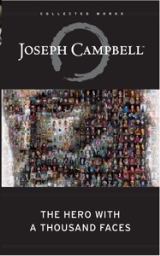
The Hero with a Thousand Faces

Encyclopedia
The Hero with a Thousand Faces (first published in 1949
) is a non-fiction book, and seminal work of comparative mythology
by Joseph Campbell
. In this publication, Campbell discusses his theory of the journey of the archetypal hero
found in world mythologies
.
Since publication of The Hero with a Thousand Faces, Campbell's theory has been consciously applied by a wide variety of modern writers and artists. The best known is perhaps George Lucas
, who has acknowledged a debt to Campbell regarding the stories of the Star Wars
films.
The Joseph Campbell Foundation
and New World Library
issued a new edition of The Hero with a Thousand Faces in July, 2008 as part of the Collected Works of Joseph Campbell series of books, audio and video recordings. In 2011, TIME Magazine placed the book in its list of the 100 best and most influential books written in English since the magazine was founded in 1923.
. In a well-known quote from the introduction to The Hero with a Thousand Faces, Campbell summarized the monomyth:
In laying out the monomyth, Campbell describes a number of stages or steps along this journey. The hero starts in the ordinary world, and receives a call to enter an unusual world of strange powers and events (a call to adventure). If the hero accepts the call to enter this strange world, the hero must face tasks and trials (a road of trials), and may have to face these trials alone, or may have assistance. At its most intense, the hero must survive a severe challenge, often with help earned along the journey. If the hero survives, the hero may achieve a great gift (the goal or "boon"), which often results in the discovery of important self-knowledge. The hero must then decide whether to return with this boon (the return to the ordinary world), often facing challenges on the return journey. If the hero is successful in returning, the boon or gift may be used to improve the world (the application of the boon).
Very few myths contain all of these stages—some myths contain many of the stages, while others contain only a few; some myths may have as a focus only one of the stages, while other myths may deal with the stages in a somewhat different order. These stages may be organized in a number of ways, including division into three sections: Departure (sometimes called Separation), Initiation and Return. "Departure" deals with the hero venturing forth on the quest, "Initiation" deals with the hero's various adventures along the way, and "Return" deals with the hero's return home with knowledge and powers acquired on the journey.
The classic examples of the monomyth relied upon by Campbell and other scholars include the stories of Osiris
, Prometheus
, the Buddha
, Moses
, and Christ
, although Campbell cites many other classic myths from many cultures which rely upon this basic structure.
While Campbell offers a discussion of the hero's journey by using the Freudian concepts popular in the 1940s and 1950s, the monomythic structure is not tied to these concepts. Similarly, Campbell uses a mixture of Jungian archetypes, unconscious
forces, and Arnold van Gennep
's structuring of rites of passage
rituals to provide some illumination. However, this pattern of the hero's journey influences artists and intellectuals worldwide, suggesting a basic usefulness for Campbell's insights not tied to academic categories and mid-20th century forms of analysis.
), including Freud (particularly the Oedipus complex
), Carl Jung
(archetypal figures and the collective unconscious
), and Arnold Van Gennep
(the three stages of The Rites of Passage, translated by Campbell into Departure, Separation, and Return). Campbell also looked to the work of ethnographers James Frazer
and Franz Boas
and psychologist Otto Rank
.
Campbell called this journey of the hero the monomyth
. Campbell was a noted scholar of James Joyce
(in 1944 he co-authored A Skeleton Key to Finnegans Wake
with Henry Morton Robinson
), and Campbell borrowed the term monomyth from Joyce's Finnegans Wake
. In addition, Joyce's Ulysses
was also highly influential in the structuring of The Hero with a Thousand Faces.
through Pantheon Press
as the seventeenth title in the Bollingen Series. This series was taken over by Princeton University Press
, who published The Hero through 2006. Originally issued in 1949 and revised by Campbell in 1968, The Hero with a Thousand Faces has been reprinted a number of times. Reprints issued after the release of Star Wars Episode IV: A New Hope
in 1977 used the image of Mark Hamill
as Luke Skywalker
on the cover. Princeton University Press issued a commemorative printing of the second edition in 2004 on the occasion of the joint centennial of Campbell's birth and the Press's founding with an added foreword by Clarissa Pinkola Estés
.
A third edition, compiled by the Joseph Campbell Foundation
and published by New World Library
, was released as the twelfth title in the Collected Works of Joseph Campbell series in July 2008.
The Hero with a Thousand Faces has been translated into over twenty languages, including Spanish, Portuguese, French, German, Italian, Japanese, Korean, Chinese (simplified and traditional), Turkish, Dutch, Greek, Danish, Persian, Polish, Czech, Croatian, Serbian, Slovenian, Russian, Hungarian, Bulgarian and Hebrew, and has sold well over a million copies worldwide.
of the hero's journey in Hero with a Thousand Faces was that it focused on the masculine journey. Although this was not altogether true—the princess of the Grimms'
"The Frog Prince
" tale and the saga of the hero-goddess Inanna
's descent into the underworld feature prominently in Campbell's schema—it was, nonetheless, a question that has been raised about the book since its publication.
Late in his life, Campbell had this to say:
1949 in literature
The year 1949 in literature involved some significant events and new books.-Events:*Arthur C. Clarke becomes Assistant Editor of Science Abstracts.*Bertrand Russell receives the Order of Merit....
) is a non-fiction book, and seminal work of comparative mythology
Comparative mythology
Comparative mythology is the comparison of myths from different cultures in an attempt to identify shared themes and characteristics. Comparative mythology has served a variety of academic purposes...
by Joseph Campbell
Joseph Campbell
Joseph John Campbell was an American mythologist, writer and lecturer, best known for his work in comparative mythology and comparative religion. His work is vast, covering many aspects of the human experience...
. In this publication, Campbell discusses his theory of the journey of the archetypal hero
Hero
A hero , in Greek mythology and folklore, was originally a demigod, their cult being one of the most distinctive features of ancient Greek religion...
found in world mythologies
Mythology
The term mythology can refer either to the study of myths, or to a body or collection of myths. As examples, comparative mythology is the study of connections between myths from different cultures, whereas Greek mythology is the body of myths from ancient Greece...
.
Since publication of The Hero with a Thousand Faces, Campbell's theory has been consciously applied by a wide variety of modern writers and artists. The best known is perhaps George Lucas
George Lucas
George Walton Lucas, Jr. is an American film producer, screenwriter, and director, and entrepreneur. He is the founder, chairman and chief executive of Lucasfilm. He is best known as the creator of the space opera franchise Star Wars and the archaeologist-adventurer character Indiana Jones...
, who has acknowledged a debt to Campbell regarding the stories of the Star Wars
Star Wars
Star Wars is an American epic space opera film series created by George Lucas. The first film in the series was originally released on May 25, 1977, under the title Star Wars, by 20th Century Fox, and became a worldwide pop culture phenomenon, followed by two sequels, released at three-year...
films.
The Joseph Campbell Foundation
Joseph Campbell Foundation
The Joseph Campbell Foundation is a US not-for-profit organization dedicated to preserve, protect and perpetuate the work of influential American mythologist Joseph Campbell...
and New World Library
New World Library
New World Library is a San Francisco Bay Area-based American publisher of books for adults and children. The press focuses on publishing books concerning the mind, the body and the spirit....
issued a new edition of The Hero with a Thousand Faces in July, 2008 as part of the Collected Works of Joseph Campbell series of books, audio and video recordings. In 2011, TIME Magazine placed the book in its list of the 100 best and most influential books written in English since the magazine was founded in 1923.
Summary
Campbell explores the theory that important myths from around the world which have survived for thousands of years all share a fundamental structure, which Campbell called the monomythMonomyth
Joseph Campbell's term monomyth, also referred to as the hero's journey, is a basic pattern that its proponents argue is found in many narratives from around the world. This widely distributed pattern was described by Campbell in The Hero with a Thousand Faces...
. In a well-known quote from the introduction to The Hero with a Thousand Faces, Campbell summarized the monomyth:
In laying out the monomyth, Campbell describes a number of stages or steps along this journey. The hero starts in the ordinary world, and receives a call to enter an unusual world of strange powers and events (a call to adventure). If the hero accepts the call to enter this strange world, the hero must face tasks and trials (a road of trials), and may have to face these trials alone, or may have assistance. At its most intense, the hero must survive a severe challenge, often with help earned along the journey. If the hero survives, the hero may achieve a great gift (the goal or "boon"), which often results in the discovery of important self-knowledge. The hero must then decide whether to return with this boon (the return to the ordinary world), often facing challenges on the return journey. If the hero is successful in returning, the boon or gift may be used to improve the world (the application of the boon).
Very few myths contain all of these stages—some myths contain many of the stages, while others contain only a few; some myths may have as a focus only one of the stages, while other myths may deal with the stages in a somewhat different order. These stages may be organized in a number of ways, including division into three sections: Departure (sometimes called Separation), Initiation and Return. "Departure" deals with the hero venturing forth on the quest, "Initiation" deals with the hero's various adventures along the way, and "Return" deals with the hero's return home with knowledge and powers acquired on the journey.
The classic examples of the monomyth relied upon by Campbell and other scholars include the stories of Osiris
Osiris
Osiris is an Egyptian god, usually identified as the god of the afterlife, the underworld and the dead. He is classically depicted as a green-skinned man with a pharaoh's beard, partially mummy-wrapped at the legs, wearing a distinctive crown with two large ostrich feathers at either side, and...
, Prometheus
Prometheus
In Greek mythology, Prometheus is a Titan, the son of Iapetus and Themis, and brother to Atlas, Epimetheus and Menoetius. He was a champion of mankind, known for his wily intelligence, who stole fire from Zeus and gave it to mortals...
, the Buddha
Gautama Buddha
Siddhārtha Gautama was a spiritual teacher from the Indian subcontinent, on whose teachings Buddhism was founded. In most Buddhist traditions, he is regarded as the Supreme Buddha Siddhārtha Gautama (Sanskrit: सिद्धार्थ गौतम; Pali: Siddhattha Gotama) was a spiritual teacher from the Indian...
, Moses
Moses
Moses was, according to the Hebrew Bible and Qur'an, a religious leader, lawgiver and prophet, to whom the authorship of the Torah is traditionally attributed...
, and Christ
Christ
Christ is the English term for the Greek meaning "the anointed one". It is a translation of the Hebrew , usually transliterated into English as Messiah or Mashiach...
, although Campbell cites many other classic myths from many cultures which rely upon this basic structure.
While Campbell offers a discussion of the hero's journey by using the Freudian concepts popular in the 1940s and 1950s, the monomythic structure is not tied to these concepts. Similarly, Campbell uses a mixture of Jungian archetypes, unconscious
Unconscious mind
The unconscious mind is a term coined by the 18th century German romantic philosopher Friedrich Schelling and later introduced into English by the poet and essayist Samuel Taylor Coleridge...
forces, and Arnold van Gennep
Arnold van Gennep
Arnold van Gennep was a noted French ethnographer and folklorist.-Biography:He was born in Ludwigsburg, Kingdom of Württemberg...
's structuring of rites of passage
Rites of Passage
Rites of Passage is an African American History program sponsored by the Stamford, Connecticut US public schools. The program consists of an extra day of schooling on Saturday for 12 weeks, service projects, and a culminating educational trip to Gambia and Senegal. Gambia and Senegal are the...
rituals to provide some illumination. However, this pattern of the hero's journey influences artists and intellectuals worldwide, suggesting a basic usefulness for Campbell's insights not tied to academic categories and mid-20th century forms of analysis.
Background
Campbell used the work of early 20th century theorists to develop his model of the hero (see also structuralismStructuralism
Structuralism originated in the structural linguistics of Ferdinand de Saussure and the subsequent Prague and Moscow schools of linguistics. Just as structural linguistics was facing serious challenges from the likes of Noam Chomsky and thus fading in importance in linguistics, structuralism...
), including Freud (particularly the Oedipus complex
Oedipus complex
In psychoanalytic theory, the term Oedipus complex denotes the emotions and ideas that the mind keeps in the unconscious, via dynamic repression, that concentrate upon a boy’s desire to sexually possess his mother, and kill his father...
), Carl Jung
Carl Jung
Carl Gustav Jung was a Swiss psychiatrist and the founder of Analytical Psychology. Jung is considered the first modern psychiatrist to view the human psyche as "by nature religious" and make it the focus of exploration. Jung is one of the best known researchers in the field of dream analysis and...
(archetypal figures and the collective unconscious
Collective unconscious
Collective unconscious is a term of analytical psychology, coined by Carl Jung. It is proposed to be a part of the unconscious mind, expressed in humanity and all life forms with nervous systems, and describes how the structure of the psyche autonomously organizes experience...
), and Arnold Van Gennep
Arnold van Gennep
Arnold van Gennep was a noted French ethnographer and folklorist.-Biography:He was born in Ludwigsburg, Kingdom of Württemberg...
(the three stages of The Rites of Passage, translated by Campbell into Departure, Separation, and Return). Campbell also looked to the work of ethnographers James Frazer
James Frazer
Sir James George Frazer , was a Scottish social anthropologist influential in the early stages of the modern studies of mythology and comparative religion...
and Franz Boas
Franz Boas
Franz Boas was a German-American anthropologist and a pioneer of modern anthropology who has been called the "Father of American Anthropology" and "the Father of Modern Anthropology." Like many such pioneers, he trained in other disciplines; he received his doctorate in physics, and did...
and psychologist Otto Rank
Otto Rank
Otto Rank was an Austrian psychoanalyst, writer, teacher and therapist. Born in Vienna as Otto Rosenfeld, he was one of Sigmund Freud's closest colleagues for 20 years, a prolific writer on psychoanalytic themes, an editor of the two most important analytic journals, managing director of Freud's...
.
Campbell called this journey of the hero the monomyth
Monomyth
Joseph Campbell's term monomyth, also referred to as the hero's journey, is a basic pattern that its proponents argue is found in many narratives from around the world. This widely distributed pattern was described by Campbell in The Hero with a Thousand Faces...
. Campbell was a noted scholar of James Joyce
James Joyce
James Augustine Aloysius Joyce was an Irish novelist and poet, considered to be one of the most influential writers in the modernist avant-garde of the early 20th century...
(in 1944 he co-authored A Skeleton Key to Finnegans Wake
A Skeleton Key to Finnegans Wake
A Skeleton Key to Finnegans Wake by mythologist Joseph Campbell and Henry Morton Robinson is a work of literary criticism. One of the first major texts to provide an in-depth analysis of Finnegans Wake , A Skeleton Key to Finnegans Wake is considered by many scholars to be a seminal work on the...
with Henry Morton Robinson
Henry Morton Robinson
Henry Morton Robinson was an American novelist, best known for A Skeleton Key to Finnegans Wake written with Joseph Campbell and his 1950 novel The Cardinal, which Time magazine reported was "The year's most popular book, fiction or nonfiction."-Biography:Robinson was born in Boston and graduated...
), and Campbell borrowed the term monomyth from Joyce's Finnegans Wake
Finnegans Wake
Finnegans Wake is a novel by Irish author James Joyce, significant for its experimental style and resulting reputation as one of the most difficult works of fiction in the English language. Written in Paris over a period of seventeen years, and published in 1939, two years before the author's...
. In addition, Joyce's Ulysses
Ulysses (novel)
Ulysses is a novel by the Irish author James Joyce. It was first serialised in parts in the American journal The Little Review from March 1918 to December 1920, and then published in its entirety by Sylvia Beach on 2 February 1922, in Paris. One of the most important works of Modernist literature,...
was also highly influential in the structuring of The Hero with a Thousand Faces.
Publishing history
The book was originally published by the Bollingen FoundationBollingen Foundation
The Bollingen Foundation was an educational foundation set up along the lines of a university press in 1945. It was named for Bollingen Tower, Carl Jung's country home in Bollingen, Switzerland. Funding was provided by Paul Mellon and his wife Mary Conover Mellon...
through Pantheon Press
Pantheon Books
Pantheon Books is an American imprint with editorial independence that is part of the Knopf Doubleday Publishing Group.The current editor-in-chief at Pantheon Books is Dan Frank.-Overview:...
as the seventeenth title in the Bollingen Series. This series was taken over by Princeton University Press
Princeton University Press
-Further reading:* "". Artforum International, 2005.-External links:* * * * *...
, who published The Hero through 2006. Originally issued in 1949 and revised by Campbell in 1968, The Hero with a Thousand Faces has been reprinted a number of times. Reprints issued after the release of Star Wars Episode IV: A New Hope
Star Wars Episode IV: A New Hope
Star Wars Episode IV: A New Hope, originally released as Star Wars, is a 1977 American epic space opera film, written and directed by George Lucas. It is the first of six films released in the Star Wars saga: two subsequent films complete the original trilogy, while a prequel trilogy completes the...
in 1977 used the image of Mark Hamill
Mark Hamill
Mark Richard Hamill is an American actor, voice artist, producer, director, and writer, best known for his role as Luke Skywalker in the original trilogy of Star Wars. More recently, he has received acclaim for his voice work, in such roles as the Joker in Batman: The Animated Series, Firelord...
as Luke Skywalker
Luke Skywalker
Luke Skywalker is a fictional character and the main protagonist of the original film trilogy of the Star Wars franchise, where he is portrayed by Mark Hamill. He is introduced in Star Wars Episode IV: A New Hope, in which he is forced to leave home, and finds himself apprenticed to the Jedi master...
on the cover. Princeton University Press issued a commemorative printing of the second edition in 2004 on the occasion of the joint centennial of Campbell's birth and the Press's founding with an added foreword by Clarissa Pinkola Estés
Clarissa Pinkola Estés
Clarissa Pinkola Estés is an American poet, post-trauma specialist and Jungian psychoanalyst.-Biography:Similar to William Carlos Williams and other poets who also worked in the health or other professions in tandem, Estés is a poet who uses her poems throughout her psychoanalytic books,...
.
A third edition, compiled by the Joseph Campbell Foundation
Joseph Campbell Foundation
The Joseph Campbell Foundation is a US not-for-profit organization dedicated to preserve, protect and perpetuate the work of influential American mythologist Joseph Campbell...
and published by New World Library
New World Library
New World Library is a San Francisco Bay Area-based American publisher of books for adults and children. The press focuses on publishing books concerning the mind, the body and the spirit....
, was released as the twelfth title in the Collected Works of Joseph Campbell series in July 2008.
The Hero with a Thousand Faces has been translated into over twenty languages, including Spanish, Portuguese, French, German, Italian, Japanese, Korean, Chinese (simplified and traditional), Turkish, Dutch, Greek, Danish, Persian, Polish, Czech, Croatian, Serbian, Slovenian, Russian, Hungarian, Bulgarian and Hebrew, and has sold well over a million copies worldwide.
The hero's journey and women
One of the questions that has been raised about the way that Campbell laid out the monomythMonomyth
Joseph Campbell's term monomyth, also referred to as the hero's journey, is a basic pattern that its proponents argue is found in many narratives from around the world. This widely distributed pattern was described by Campbell in The Hero with a Thousand Faces...
of the hero's journey in Hero with a Thousand Faces was that it focused on the masculine journey. Although this was not altogether true—the princess of the Grimms'
Brothers Grimm
The Brothers Grimm , Jacob Grimm and Wilhelm Grimm , were German academics, linguists, cultural researchers, and authors who collected folklore and published several collections of it as Grimm's Fairy Tales, which became very popular...
"The Frog Prince
The Frog Prince (story)
"The Frog Prince; or, Iron Henry" is a fairy tale, best known through the Brothers Grimm's written version; traditionally it is the first story in their collection. In the tale, a spoiled princess reluctantly befriends a frog , who magically transforms into a handsome prince...
" tale and the saga of the hero-goddess Inanna
Inanna
Inanna, also spelled Inana is the Sumerian goddess of sexual love, fertility, and warfare....
's descent into the underworld feature prominently in Campbell's schema—it was, nonetheless, a question that has been raised about the book since its publication.
Late in his life, Campbell had this to say:
Artists influenced by the work
In Pathways to Bliss: Mythology and Personal Transformation, a book drawn from Campbell's late lectures and workshops, he says about artists and the monomyth:
The Hero with a Thousand Faces has influenced a number of artists, musicians, poets, and filmmakers, including Bob DylanBob DylanBob Dylan is an American singer-songwriter, musician, poet, film director and painter. He has been a major and profoundly influential figure in popular music and culture for five decades. Much of his most celebrated work dates from the 1960s when he was an informal chronicler and a seemingly...
, Jim MorrisonJim MorrisonJames Douglas "Jim" Morrison was an American musician, singer, and poet, best known as the lead singer and lyricist of the rock band The Doors...
and George LucasGeorge LucasGeorge Walton Lucas, Jr. is an American film producer, screenwriter, and director, and entrepreneur. He is the founder, chairman and chief executive of Lucasfilm. He is best known as the creator of the space opera franchise Star Wars and the archaeologist-adventurer character Indiana Jones...
. Mickey HartMickey HartMickey Hart is an American percussionist and musicologist. He is best known as one of the two drummers of the rock band the Grateful Dead. He was a member of the Grateful Dead from September 1967 to February 1971, and from October 1974 to August 1995...
, Bob WeirBob WeirBob Weir is an American singer, songwriter, and guitarist, most recognized as a founding member of the Grateful Dead. After the Grateful Dead disbanded in 1995, Weir performed with The Other Ones, later known as The Dead, together with other former members of the Grateful Dead...
and Jerry GarciaJerry GarciaJerome John "Jerry" Garcia was an American musician best known for his lead guitar work, singing and songwriting with the band the Grateful Dead...
of the Grateful DeadGrateful DeadThe Grateful Dead was an American rock band formed in 1965 in the San Francisco Bay Area. The band was known for its unique and eclectic style, which fused elements of rock, folk, bluegrass, blues, reggae, country, improvisational jazz, psychedelia, and space rock, and for live performances of long...
had long noted Campbell's influence and agreed to participate in a seminar with him in 1986 entitled From Ritual to Rapture.
Stanley KubrickStanley KubrickStanley Kubrick was an American film director, writer, producer, and photographer who lived in England during most of the last four decades of his career...
introduced Arthur C. ClarkeArthur C. ClarkeSir Arthur Charles Clarke, CBE, FRAS was a British science fiction author, inventor, and futurist, famous for his short stories and novels, among them 2001: A Space Odyssey, and as a host and commentator in the British television series Mysterious World. For many years, Robert A. Heinlein,...
to the book during the writing of 2001: A Space Odyssey2001: A Space Odyssey (film)2001: A Space Odyssey is a 1968 epic science fiction film produced and directed by Stanley Kubrick, and co-written by Kubrick and Arthur C. Clarke, partially inspired by Clarke's short story The Sentinel...
.
George Lucas' deliberate use of Campbell's theory of the monomyth in the making of the Star WarsStar WarsStar Wars is an American epic space opera film series created by George Lucas. The first film in the series was originally released on May 25, 1977, under the title Star Wars, by 20th Century Fox, and became a worldwide pop culture phenomenon, followed by two sequels, released at three-year...
movies is well documented. On the DVD release of the famous colloquy between Campbell and Bill MoyersBill MoyersBill Moyers is an American journalist and public commentator. He served as White House Press Secretary in the United States President Lyndon B. Johnson Administration from 1965 to 1967. He worked as a news commentator on television for ten years. Moyers has had an extensive involvement with public...
, filmed at Lucas' Skywalker RanchSkywalker RanchSkywalker Ranch is the name of the workplace of film director and producer George Lucas. It is located in a secluded, but open area near Nicasio, California, in Marin County. The ranch is located on Lucas Valley Road, although Lucas is not related to the road's namesake, who was a...
and broadcast in 1988 on PBS as The Power of MythThe Power of MythThe companion book for the series, The Power of Myth, was released in 1988 at the same time the series aired on PBS...
, Campbell and Moyers discussed Lucas's use of The Hero with a Thousand Faces in making his films. Lucas himself discussed how Campbell's work affected his approach to storytelling and film-making.
Christopher VoglerChristopher VoglerChristopher Vogler is a Hollywood development executive best known for his guide for screenwriters, The Writer's Journey: Mythic Structure For Writers.-Career:...
, a Hollywood film producer and writer, wrote a memo for Disney StudiosWalt Disney PicturesWalt Disney Pictures is an American film studio owned by The Walt Disney Company. Walt Disney Pictures and Television, a subsidiary of the Walt Disney Studios and the main production company for live-action feature films within the Walt Disney Motion Pictures Group, based at the Walt Disney...
on the use of The Hero with a Thousand Faces as a guide for scriptwriters; this memo influenced the creation of such films as AladdinAladdinAladdin is a Middle Eastern folk tale. It is one of the tales in The Book of One Thousand and One Nights , and one of the most famous, although it was actually added to the collection by Antoine Galland ....
, The Lion KingThe Lion KingThe Lion King is a 1994 American animated film produced by Walt Disney Feature Animation and released by Walt Disney Pictures. It is the 32nd feature in the Walt Disney Animated Classics series...
, and Beauty and the BeastBeauty and the BeastBeauty and the Beast is a traditional fairy tale. The first published version of the fairy tale was a rendition by Gabrielle-Suzanne Barbot de Villeneuve, published in La jeune américaine, et les contes marins in 1740...
. Vogler later expanded the memo and published it as the book The Writer's Journey: Mythic Structure For WritersThe Writer's Journey: Mythic Structure For WritersThe Writer's Journey: Mythic Structure For Writers is a popular screenwriting textbook by writer Christopher Vogler, focusing on the theory that most stories can be boiled down to a series of narrative structures and character archetypes, described through mythological allegory.Vogler based this...
, which became the inspiration for a number of successful Hollywood films and is believed to have been used in the development of the MatrixThe Matrix seriesThe Matrix is a science fiction action franchise created by Andy and Larry Wachowski and distributed by Warner Bros. Pictures. The series began with the 1999 film The Matrix and later spawned two sequels; The Matrix Reloaded and The Matrix Revolutions, both released in 2003, thus forming a trilogy...
series.
Novelist Richard AdamsRichard AdamsRichard Adams was a non-conforming English Presbyterian divine, known as author of sermons and other theological writings.-Life:...
acknowledges a debt to Campbell's work, and specifically to the concept of the monomyth. In his best known work, Watership DownWatership DownWatership Down is a classic heroic fantasy novel, written by English author Richard Adams, about a small group of rabbits. Although the animals in the story live in their natural environment, they are anthropomorphised, possessing their own culture, language , proverbs, poetry, and mythology...
, Adams uses extracts from The Hero with a Thousand Faces as chapter epigrams.
Author Neil GaimanNeil GaimanNeil Richard Gaiman born 10 November 1960)is an English author of short fiction, novels, comic books, graphic novels, audio theatre and films. His notable works include the comic book series The Sandman and novels Stardust, American Gods, Coraline, and The Graveyard Book...
, whose work is frequently seen as exemplifying the monomyth structure, says that he started The Hero with a Thousand Faces but refused to finish it: "I think I got about half way through The Hero with a Thousand Faces and found myself thinking if this is true—I don’t want to know. I really would rather not know this stuff. I’d rather do it because it’s true and because I accidentally wind up creating something that falls into this pattern than be told what the pattern is."
Many scholars and reviewers have noted how closely J. K. RowlingJ. K. RowlingJoanne "Jo" Rowling, OBE , better known as J. K. Rowling, is the British author of the Harry Potter fantasy series...
's popular Harry PotterHarry PotterHarry Potter is a series of seven fantasy novels written by the British author J. K. Rowling. The books chronicle the adventures of the adolescent wizard Harry Potter and his best friends Ron Weasley and Hermione Granger, all of whom are students at Hogwarts School of Witchcraft and Wizardry...
books hewed to the monomyth schema. To date, however, Rowling has neither confirmed that she used Campbell's work as an inspiration, nor denied that she ever read The Hero with a Thousand Faces.
The sixth and final season of Lost also recognizes Joseph Campbell's theories on the hero. During one of the bonus features they discuss the journey of the main characters and how each is a hero in their own way. Before each little segment of this particular feature, they quote Joseph Campbell and then expound on that particular quote by discussing the various characters.
Singer Janelle MonáeJanelle MonáeJanelle Monáe is an American R&B/soul musician signed to Bad Boy Records and Atlantic Records.Monáe debuted with a conceptual EP, Metropolis: Suite I ...
, in the liner notes of her 2010 album, The ArchAndroidThe ArchAndroid (Suites II and III)The ArchAndroid is the debut studio album of American recording artist Janelle Monáe, released May 18, 2010, on Wondaland Arts Society and Bad Boy Records...
, cites Hero as one of her inspirations for the track "57821."
Mark RosewaterMark RosewaterMark Rosewater is a Magic: The Gathering card designer. He is currently Magics head designer.-Biography:Rosewater grew up in Pepper Pike, Ohio, where he attended the Orange High School. Rosewater has a Jewish background. Rosewater has described himself in his youth as a "social outcast", who did...
, head designer of the Magic: The GatheringMagic: The GatheringMagic: The Gathering , also known as Magic, is the first collectible trading card game created by mathematics professor Richard Garfield and introduced in 1993 by Wizards of the Coast. Magic continues to thrive, with approximately twelve million players as of 2011...
trading card game, cites "The Hero's Journey" as a major inspiration for "The Weatherlight Saga," an epic storyarc that went from 1997 to 2001, and spanned multiple cardsets, comic books, and novels.
The character Jack Rakan from Mahou Sensei Negima has a powerful artefact called the Hero with a Thousand Faces; it can change into any weapon imaginable (though Rakan usually prefers some kind of sword) and uses it in both creative and brutally straightforward ways.
External links
- Information on the 2008 third edition from the Joseph Campbell Foundation
- Monomyth from UC Berkeley
- The Archetype of the Hero's Journey from Web English Teacher
- A Practical Guide to THE HERO WITH A THOUSAND FACES
- The Hero Cycle as seen in the Star Wars saga
- Star Wars Origins - Joseph Campbell
- The Matrix - Joseph Campbell Monomyth