
All Topics  
Apprenticeship


   Email Print
   Bookmark   Link


Apprenticeship


Apprenticeship is a system of training
Training

The term training refers to the acquisition of knowledge, skills, and Competence as a result of the teaching of vocational education or practical skills and knowledge that relate to specific useful competencies....
 a new generation of practitioners of a skill. Apprentices (or in early modern usage "prentices") or protégés build their career
Career

Career is a term defined by the Oxford English Dictionary as an individual's "course or progress through life ". It usually is considered to pertain to remunerative work ....
s from apprenticeships. Most of their training is done on the job while working for an employer who helps the apprentices learn their trade, in exchange for their continuing labour for an agreed period after they become skilled.


Discussion
Ask a question about 'Apprenticeship'
Start a new discussion about 'Apprenticeship'
Answer questions from other users
Full Discussion Forum


Recent Posts


Encyclopedia


Apprenticeship is a system of training
Training

The term training refers to the acquisition of knowledge, skills, and Competence as a result of the teaching of vocational education or practical skills and knowledge that relate to specific useful competencies....
 a new generation of practitioners of a skill. Apprentices (or in early modern usage "prentices") or protégés build their career
Career

Career is a term defined by the Oxford English Dictionary as an individual's "course or progress through life ". It usually is considered to pertain to remunerative work ....
s from apprenticeships. Most of their training is done on the job while working for an employer who helps the apprentices learn their trade, in exchange for their continuing labour for an agreed period after they become skilled. Theoretical education may also be involved, informally via the workplace and/or by attending vocational school
Vocational school

A vocational school , providing vocational education, is a school in which students are taught the skills needed to perform a particular job. Traditionally, vocational schools have not existed to further education in the sense of liberal arts, but rather to teach only job-specific skills, and as such have been better considered to be institut...
s while still being paid by the employer.

Development

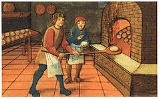
Medieval Baker
The system of apprenticeship first developed in the later Middle Ages
Middle Ages

File:Karl 1 mit papst gelasius gregor1 sacramentar v karl d kahlen.jpgThe Middle Ages of European history are a period in history which lasted for roughly a millennium, commonly dated from the fall of the Roman Empire in the 5th century to the beginning of the Early Modern Period in the 16th century, marked by the division of Western Christi...
 and came to be supervised by craft guild
Guild

File:Windsorguildhall.jpgA guild is an association of artisan in a particular trade. The earliest guilds were formed as confraternities of workers....
s and town governments. A master craftsman
Master craftsman

A master craftsman was a member of a guild. In the European trade , only master craftsmen were allowed to be members of the guild.An aspiring master would have to pass through the career chain from apprentice to journeyman before he could be elected to become a master craftsman....
 was entitled to employ young people as an inexpensive form of labor in exchange for providing formal training in the craft. Most apprentices were males, but female apprentices were found in a number of crafts associated with embroidery
Embroidery

File:Kazakh rug chain stitch embroidery.jpgEmbroidery is the art or handicraft of decorating Textile or other materials with sewing needle and yarn....
, silk-weaving etc. Apprentices were young (usually about ten to fifteen years of age)would live in the master craftsman's household. Most apprentices aspired to becoming master craftsmen themselves on completion of their contract (usually a term of seven years), but some would spend time as a journeyman
Journeyman

A journeyman is a male trader or crafter who has completed an apprenticeship....
 and a significant proportion would never acquire their own workshop
Workshop

A workshop is a room or building which provides both the area and tools that may be required for the manufacture or repair of Manufacturing Good ....
.

Subsequently governmental regulation and the licensing of polytechnic
Polytechnic

Polytechnic may refer to:* An Institute of technology.* Polytechnic College, an educational institution in several countries, providing education which ranges from secondary or vocational education to higher education, including university level as in the case of a polytechnic university....
s and vocational education
Vocational education

Vocational education or Vocational Education and Training , also called Career and Technical Education , prepares learners for jobs that are based in manual or practical activities, traditionally non-academics and totally related to a specific trade, employment or vocation, hence the term, in which the learner participates....
 formalised and bureaucratised
Bureaucracy

Bureaucracy is the structure and set of regulations in place to control activity, usually in large organizations and government. As opposed to adhocracy, it is represented by standardized procedure that dictates the execution of most or all processes within the body, formal division of powers, hierarchy, and relationships....
 the details of apprenticeship.

Modern analogs

The modern concept of an internship is similar to an apprenticeship. Universities still use apprenticeship schemes in their production of scholars: bachelors are promoted to masters and then produce a thesis
Thesis

A dissertation is a document that presents the author's research and findings and is submitted in support of candidature for a degree or professional qualification....
 under the oversight of a supervisor
Supervisor

A supervisor, foreman, foreperson, team leader, overseer, cell coach, facilitator, or area coordinator is a manager in business. The US Bureau of Census has four hundred titles under the supervisor classification....
 before the corporate body of the university
University

A university is an institution of higher education and research, which grants academic degrees in a variety of subjects. A university provides both undergraduate education and postgraduate education....
 recognises the achievement of the standard of a doctorate
Doctorate

A doctorate is an academic degree that in most countries represents the highest level of formal study or research in a given field. In some countries it also refers to a class of degrees which qualify the holder to practice in a specific profession ....
. Another view of this system is of graduate students in the role of apprentices, post-docs as journeymen
Journeyman

A journeyman is a male trader or crafter who has completed an apprenticeship....
, and professor
Professor

The meaning of the word professor varies. In some English-speaking countries, it refers to a senior academic who holds a departmental chair, especially as head of the Academic department, or a personal chair awarded specifically to that individual....
s as masters.

Also similar to apprenticeships are the professional development
Professional development

Professional development refers to skills and knowledge attained for both personal development and career advancement. Professional development encompasses all types of facilitated learning opportunities, ranging from college degrees to formal coursework, conferences and informal learning opportunities situated in practice....
 arrangements for new graduates in the professions of accountancy
Accountancy

Accountancy or accounting is the system of recording, verifying, and reporting of the value of assets, liabilities, income, and expenses in the books of account to which debit and credit entries are chronologically posted to record changes in value ....
 and the law a British example was training contracts known as 'articles of clerkship
Articled clerk

An articled clerk is an apprentice in a professional firm in Commonwealth of Nations countries. Generally the term arises in the accountancy and in the law firm....
'. The learning curve in modern professional service firms, such as law firms or accountancies, generally resembles the traditional master-apprentice model: the newcomer to the firm is assigned to one or several more experienced colleagues (ideally partners in the firm) and learns his skills on the job.

Australia

Australian Apprenticeships is the new name for the scheme formerly known as 'Old Apprenticeships'. Under the scheme, involving 400,000 people in 500 occupations, the Australian Government incentives and personal benefits programme are still the same. Australian Apprenticeships still encompass all apprenticeships and traineeships. They combine time at work with training and can be full-time, part-time or school-based. You can get apprenticeships starting at age 14 if you have a willing employer

France

In France
France

France , officially the French Republic , is a country whose Metropolitan France is located in Western Europe and that also comprises various Overseas departments and territories of France....
, apprenticeships also developed between the ninth and thirteenth centuries, with guild
Guild

File:Windsorguildhall.jpgA guild is an association of artisan in a particular trade. The earliest guilds were formed as confraternities of workers....
s structured around apprentices, journeymen
Journeyman

A journeyman is a male trader or crafter who has completed an apprenticeship....
 and master craftsmen
Master craftsman

A master craftsman was a member of a guild. In the European trade , only master craftsmen were allowed to be members of the guild.An aspiring master would have to pass through the career chain from apprentice to journeyman before he could be elected to become a master craftsman....
, continuing in this way until 1791, when the guilds were suppressed.

In 1851 the first law on apprenticeships came into force. From 1919, young people had to take 150 hours of theory and general lessons in their subject a year. This minimum training time rose to 360 hours a year in 1961, then 400 in 1986.

The first training centres for apprentices (centres de formation d'apprentis, CFAs) appeared in 1961, and in 1971 apprenticeships were legally made part of professional training. In 1986 the age limit for beginning an apprenticeship was raised from 20 to 25. From 1987 the range of qualifications achieveable through an apprenticeship was widened to include the brevet professionnel (certificate of vocational aptitude), the bac
Baccalauréat

The baccalaur?at , often known in France colloquially as le bac or le bach?t, is an academic qualification which France and international students take at the end of the lyc?e ....
 professionnel
(vocational baccalaureat diploma), the brevet de technicien supérieur(advanced technician's certificate), engineering diplomas and more.

On January 18, 2005, President Jacques Chirac
Jacques Chirac

Jacques Ren? Chirac served as the President of France from 17 May 1995 until 16 May 2007. As President he also served as an ex officio Co-Prince of Andorra and Grand Master of the French L?gion d'honneur....
 announced the introduction of a law on a programme for social cohesion comprising the three pillars of employment, housing and equal opportunities. The French government pledged to further develop apprenticeship as a path to success at school and to employment, based on its success: in 2005, 80% of young French people who had completed an apprenticeship entered employment. In France, the term denotes manual labor only. The plan aimed to raise the number of apprentices from 365,000 in 2005 to 500,000 in 2009. To achieve this aim, the government is, for example, granting tax relief for companies when they take on apprentices. (Since 1925 a tax has been levied to pay for apprenticeships.) The minister in charge of the campaign, Jean-Louis Borloo
Jean-Louis Borloo

Jean-Louis Borloo is a France politician, and currently the France Minister of the Environment .Of Picardie origin, Borloo began his career as a lawyer in the 1980s....
, also hoped to improve the image of apprenticeships with an information campaign, as they are often connected with academic failure at school and an ability to grasp only practical skills and not theory. After the civil unrest end of 2005
2005 civil unrest in France

The 2005 civil disorder in France of October and November was a series of riots and violent clashes, involving mainly the Arson of automobile and Public property at night starting on 27 October 2005 in Clichy-sous-Bois....
, the government, led by prime minister Dominique de Villepin
Dominique de Villepin

Dominique de Villepin A career diplomat, Villepin rose through the ranks of the French right as one of Jacques Chirac's prot?g?s. He came into the international spotlight as Foreign Minister with his opposition to the 2003 invasion of Iraq which culminated with a speech to the United Nations ....
, announced a new law. Dubbed "law on equality of chances", it created the First Employment Contract
First Employment Contract

The contrat premi?re embauche , translated first employment contract, was a new form of employment contract pushed in spring 2006 in France by Prime Minister of France Dominique de Villepin....
 as well as manual apprenticeship from as early as 14 years of age. From this age, students are allowed to quit the compulsory school system in order to quickly learn a vocation. This measure has long been a policy of conservative French political parties, and was met by tough opposition from trade unions and students.

Germany

Apprenticeships are part of Germany
Germany

Germany , officially the Federal Republic of Germany , is a country in Central Europe. It is bordered to the north by the North Sea, Denmark, and the Baltic Sea; to the east by Poland and the Czech Republic; to the south by Austria and Switzerland; and to the west by France, Luxembourg, Belgium, and the Netherlands....
's dual education system
Dual education system

A dual education system is practised in several countries, notably Germany, Austria and Switzerland, but also Denmark, the Netherlands and France, and for some years now in China and other countries in Asia ....
, and as such form an integral part of many people's working life. Finding employment without having completed an apprenticeship is almost impossible. For some particular technical university professions, such as food technology
Food technology

Food technology, or Food tech for short is the application of food science to the selection, food preservation, Food processing, packaging, Food distribution, and use of safety, nutrition, and Healthy diet....
, a completed apprenticeship is often recommended; for some, such as marine engineering
Marine engineering

Marine engineers are the members of a ship's crew that operate and maintain the propulsion and other systems on board the vessel. Marine Engineering staff also deal with the "Hotel" facilities on board, notably the sewage, lighting, air conditioning and water systems....
 it may even be mandatory.

Young people can learn one of 342 apprenticeship occupations (Ausbildungsberufe), such as doctor's assistant
Assistant

An assistant is a person or software tool who or that helps another person accomplish his or her goals. Some assistants are strictly based at one's place of employment, while others assist with personal, sometimes home-related tasks....
, banker, dispensing optician
Optician

An optician is an eye care professional who provides corrective lenses based on a Eyeglass prescription for the correction of a refractive error....
, plumber or oven builder. The dual system means that apprentices spend most of their time in companies and the rest in formal education. Usually, they work for three to four days a week in the company and then spend one or two days at a vocational school
Vocational school

A vocational school , providing vocational education, is a school in which students are taught the skills needed to perform a particular job. Traditionally, vocational schools have not existed to further education in the sense of liberal arts, but rather to teach only job-specific skills, and as such have been better considered to be institut...
 (Berufsschule). These Berufsschulen have been part of the education system since the 19th century.

In 2001, two thirds of young people aged under 22 began an apprenticeship, and 78% of them completed it, meaning that approximately 51% of all young people under 22 have completed an apprenticeship. One in three companies offered apprenticeships in 2003, in 2004 the government signed a pledge with industrial unions that all companies except very small ones must take on apprentices.

The latent decrease of the German population due to low birth rate
Birth rate

Crude birth rate is the natality or childbirths per 1,000 people per year.It can be represented by number of childbirths in that year, and p is the current population....
s is now causing a lack of young people available to start an apprenticeship.

History

In 1969, a law (the Berufsbildungsgesetz) was passed which regulated and unified the vocational training system and codified the shared responsibility of the state, the unions, associations and the chambers of trade and industry. The dual system was successful in both parts of the divided Germany. In the GDR
German Democratic Republic

The German Democratic Republic was a self-declared socialist state created in the Soviet Zone of occupied Germany and the East Berlin of Allied Occupation Zones in Germany....
, three quarters of the working population had completed apprenticeships.

Business professions

The precise skills and theory taught on German apprenticeships are strictly regulated. The employer is responsible for the entire education programme. Apprentices obtain a special apprenticeship contract until the end of the education programme. During the programme it is not allowed to assign the apprentice to a regulary employment and he is protected from dismissal until the programme ends. The defined content and skillset of the apprentice profession must be fully provided and taught by the employer. The time taken is also regulated. Each profession takes a different time, usually between 24 and 36 months.

Thus, everyone who had e.g. completed an apprenticeship as an Industriekaufmann (industrial manager/administrator) has learned the same skills and has attended the same courses in procurement
Procurement

Procurement is the acquisition of goods and/or services at the best possible total cost of ownership, in the right quantity and quality, at the right time, in the right place and from the right source for the direct benefit or use of corporations, or individuals, generally via a contract....
 and stocking up, controlling, staffing
Staffing

Staffing may refer to:* Employment agency* Human resources...
, accounting procedures, production planning, terms of trade
Terms of trade

In international economics and international trade, terms of trade or TOT is the relative prices of a country's export to import. "Terms of trade" are sometimes used as a proxy for the relative social welfare of a country, but this heuristic is technically questionable and should be used with extreme caution....
 and transport logistics
Logistics

Logistics is the management of the flow of goods, information and other resources, including energy and people, between the point of origin and the point of consumption in order to meet the requirements of consumers ....
 and various other subjects. Someone who has not taken this apprenticeship or did not pass the final examinations at the chamber of industry and commerce is not allowed to call himself an Industriekaufmann. An employment in such function would require this completed degree.

Trade
Trade

Tradeis the willing exchange of goods, Service , or both. Trade is also called commerce. A mechanism that allows trade is called a market. The original form of trade was barter , the direct exchange of goods and services....
 and craft
Craft

A craft is a skill, especially involving practical The Arts. It may refer to a trade or particular art.The terms is often used as part of a longer word ....
 professions

The rules and laws for the trade and craftswork apprentices such as mechanic
Mechanic

A mechanic is a person who uses tools to repair things or works to keep things operating properly.Many mechanics are specialized in a particular field such as auto mechanics, bicycle mechanics, boiler mechanics, industrial maintenance mechanics , air conditioning and refrigeration mechanics, aircraft mechanics, diesel mechanics and tank m...
s, bakers
Bakery

A bakery is an establishment which produces or/and sells bread, pies, pastries, cakes & cupcakes, biscuits, cookies, muffins, Roll , doughnuts, etc....
, joiner
Joiner

A joiner differs from a carpenter in that he cuts and fits joints in wood that do not use nails, usually in a workshop environment since the formation of the various joints generally require non-portable machinery....
s, etc. are as strict as and even broader than for the business professions. Here the procedures, titles and traditions still strongly reflect the medieval origin of the system.

After completing the 3 years of dual education, for example, a baker is allowed to called himself a Bäckereigeselle (bakery journeyman
Journeyman

A journeyman is a male trader or crafter who has completed an apprenticeship....
). After the apprenticeship the journeyman can enter the Meisterschule (master's school) and continue his education at evening courses or full-time. The graduation from the master's school leads to the title of a Meister master craftsman
Master craftsman

A master craftsman was a member of a guild. In the European trade , only master craftsmen were allowed to be members of the guild.An aspiring master would have to pass through the career chain from apprentice to journeyman before he could be elected to become a master craftsman....
 of his profession, so e.g. Bäckermeister (bakery master). A master is officially entered in the local trade register, the Handwerksrolle (the craftspeople's roll). A master craftsman is allowed to employ and to train new apprentices. In some mostly safety-related professions, e.g. that of electrician
Electrician

An electrician is a tradesman specializing in electrical wiring of buildings and related equipment. Electricians may be employed in the installation of new electrical components or the maintenance and repair of existing electrical infrastructure....
s, only a master is allowed to found his own company.

License for educating apprentices

To employ and to educate apprentices requires a specific license. The AdA Ausbildung der Ausbilder (education of the educators) license needs to be acquired by a training at the chamber of industry and commerce.

The masters complete this license course within their own master's school. The training and examination of new masters is only possible for masters who have been working several years in their profession and who have been accepted by the chambers as a trainer or examiner.

Academic professionals, e.g. engineer
Engineer

An engineer is a person professionally engaged in a field of engineering. Engineers are concerned with developing economical and safe solutions to practical problems, by applying mathematics and scientific knowledge while considering technical constraints....
s, need to complete the AdA during or after their studies, usually by an one-year evening course.

The holder of the license is only allowed to train apprentices within his own field of expertise. For example a mechanical engineer would be able to educate industrial mechanics, but not e.g. laboratory assistants or builders.

India


In India, the Apprentices Act was enacted in 1961. It regulates the programme of training of apprentices in the industry so as to conform to the syllabi, period of training etc. as laid down by the Central Apprenticeship Council and to utilise fully the facilities available in industry for imparting practical training with a view to meeting the requirements of skilled manpower for industry.

The Apprentices Act enacted in 1961 and was implemented effectively in 1962. Initially the Act envisaged training of trade apprentices. The Act was amended in 1973 to include training of graduate and diploma engineers as "Graduate" & "Technician" Apprentices. The Act was further amended in 1986 to bring within its purview the training of the 10+2 vocational stream as "Technician (Vocational)" Apprentices.

Overall responsibility is with the Directorate General of Employment & Training (DGE&T) in the Union Ministry of Labour. DGE&T is also responsible for implementation of the Act in respect of Trade Apprentices in the Central Govt. Undertakings & Departments. This is done through six Regional Directorates of Apprenticeship Training located at Kolkata, Mumbai, Chennai, Hyderabad, Kanpur & Faridabad.

State Apprenticeship Advisers are responsible for implementation of the Act in respect of Trade Apprentices in State Government Undertakings/ Departments and Private Establishments. Department of Education in the Ministry of HRD is responsible for implementation of the Act in respect of Graduate, Technician & Technician (Vocational) Apprentices. This is done through four Boards of Apprenticeship Training located at Kanpur, Kolkata , Mumbai & Chennai.

Pakistan


In Pakistan, special apprenticeship programs running to fulfill the needs of IT industry in the coming years. So, for this purpose Pakistan Software Export Board formerly PSEB has launched a very attractive program for young IT graduates.

"Under the IT Industry Apprenticeship Program, PSEB offers financial subsidy for the companies to recruit graduates possessing the basic skills and knowledge in Information Technology and other related disciplines to provide IT/ITeS services. These recruits are generally graduates with some experience. These “apprentices” or trainees are hired by companies as full-time employees and put through a 12-month program, consisting of in-company training, on-the-job training and mentoring." said by PSEB.

Achievements: Since its launch, the IT Industry Apprenticeship Program has been awarded to 7 companies, approved by PSEB and ICT R&D Fund’s Project Committee, which will result in the creation of over 700 job opportunities in the IT industry. The successful companies are as follows.

Autosoft Dynamics 80 BearingPoint 100 Cogilent Solutions 18 Digital Processing Systems 200 Netsol Technologies 200 Softech Systems 40 Systems Ltd 100

NetSol is a major company that provides training for young IT graduates. NetSol is the leading & biggest software house of Pakistan also.

Turkey


In Turkey, apprenticeship has been part of the small business culture for centuries since the time of Seljuk
Seljuk

Seljuk was the eponymous hero of the Seljuks. He was the son of a certain Dukak Timuryaligh surnamed Timuryaligh -of the iron bow- and either the chief or an eminent member from the Kinik tribe of the Oghuz Turks....
 Turks
Turkish people

The Turkish people , also known as "Turks" are defined mainly as citizens of the Republic of Turkey. An early history text provided the definition of being a Turk as "any individual within the Republic of Turkey, whatever his faith who speaks Turkish, grows up with Turkish culture and adopts the Turkish ideal is a Turk." This ideal...
 who claimed Anatolia as their homeland in 11th century.

There are three levels of apprenticeship. First level is the apprentice, i.e. the "cirak" in Turkish
Turkish language

Turkish is a language spoken by over 63 million people worldwide, making it the most commonly spoken of the Turkic languages. Its speakers are located predominantly in Turkey and Cyprus, with smaller groups in Iraq, Greece, Bulgaria, the Republic of Macedonia, Kosovo, Albania and other parts of Eastern Europe....
. The second level is pre-master which is called, "kalfa" in Turkish. The mastery level is called as "usta" and is the highest level of achievement. An 'usta' is eligible to take in and accept new 'ciraks' to train and bring them up. The training process usually starts when the small boy is of age 10-11 and becomes a full grown master at the age of 20-25. Many years of hard work and disciplining under the authority of the master is the key to the young apprentice's education and learning process.

In Turkey today there are many vocational schools that train young kids to gain skills to learn a new profession. The student after graduation looks for a job at the nearest local marketplace usually under the authority of a master.

United Kingdom

Apprenticeships have a long tradition in the United Kingdom
United Kingdom

The United Kingdom of Great Britain and Northern Ireland, commonly known as the United Kingdom , the UK or Britain,is a sovereign state located off the northwestern coast of continental Europe....
, dating back to around the 12th century and flourishing by the 14th century. The parents or guardians of a minor would agree with a Guild's
Guild

File:Windsorguildhall.jpgA guild is an association of artisan in a particular trade. The earliest guilds were formed as confraternities of workers....
 Master craftsman
Master craftsman

A master craftsman was a member of a guild. In the European trade , only master craftsmen were allowed to be members of the guild.An aspiring master would have to pass through the career chain from apprentice to journeyman before he could be elected to become a master craftsman....
 the conditions for an apprenticeship which would bind the minor for 5-9 years (e.g. from age 14 to 21). They would pay a premium to the craftsman and the contract would be recorded in an indenture
Indenture

An Indenture is a legal contract between two parties, particularly for Indentured servant or a term of apprenticeship but also for certain real estate transactions....
. In 1563, the Statute of Artificers and Apprentices was passed to regulate and protect the apprenticeship system, forbidding anyone from practising a trade or craft without first serving a 7-year period as an apprentice to a master (though in practice Freemen's sons could negotiate shorter terms).

From 1601, 'parish
Parish

A parish is a local church; it is an administrative unit typically found in Roman Catholic, Anglican, United Methodist, and Presbyterianism churches....
' apprenticeships under the Elizabethan Poor Law
Elizabethan Poor Law (1601)

The mid sixteenth century was also known as the Elizabethan Poor Law, 43rd Elizabeth Old Poor Law after the passing of the Poor Law Amendment Act 1834....
 came to be used as a way of providing for poor, illegitimate and orphaned children of both sexes alongside the regular system of skilled apprenticeships, which tended to provide for boys from slightly more affluent backgrounds. These parish apprenticeships, which could be created with the assent of two Justices of the Peace
Justice of the Peace

A Justice of the Peace is a puisne judicial officer appointed by means of a letters patent to keep the peace. Depending on the jurisdiction, they might dispense summary justice and deal with local administrative applications in common law jurisdictions....
, supplied apprentices for occupations of lower status such as farm labouring, brickmaking and menial household service.

In the early years of the Industrial Revolution
Industrial Revolution

The Industrial Revolution was a period in the late 18th and early 19th centuries when major changes in agriculture, manufacturing, production, and transportation had a profound effect on the socioeconomics and cultural conditions in United Kingdom....
 entrepreneurs began to resist the restrictions of the apprenticeship system, and a legal ruling established that the Statute of Apprentices did not apply to trades that were not in existence when it was passed in 1563, thus excluding many new 18th century industries. In 1814 compulsory apprenticeship by indenture was abolished.

In modern times, apprenticeship became less important, especially as employment in heavy industry
Heavy industry

Heavy industry does not have a single fixed meaning as compared to light industry. It can mean production of products which are either heavy in weight or in the processes leading to their production....
 and artisan
Artisan

An artisan is a skilled manual labor worker who crafts items that may be functional or strictly decorative, including furniture, clothing, jewelry, household items, and tools....
 trades declined. Traditional apprenticeships reached their lowest point in the 1970s: by that time, training programmes were rare and people who were apprentices learned mainly by example. In 1986, National Vocational Qualification
National Vocational Qualification

National Vocational Qualifications are work based awards in England and Wales that are achieved through assessment and training. In Scotland they are known as Scottish Vocational Qualification ....
s (NVQs) were introduced, in an attempt to revitalise vocational training. Still, by 1990, apprenticeship took up only two-thirds of one percent of total employment.

In 1994, the Government introduced Modern Apprenticeships (since renamed 'Apprenticeships'), based on frameworks that are now devised by Sector Skills Councils
Sector Skills Councils

Sector Skills Councils are state-sponsored, employer-led organisations that cover specific economic sectors in the United Kingdom. They have four key goals:...
. Apprenticeship frameworks contain a number of separately-certified elements:
  • a knowledge-based element, typically certified through a qualification known as a ‘Technical Certificate’;
  • a competence-based element, typically certified through an NVQ; and
  • Key Skills


By 2005 there were now more than 160 apprenticeship frameworks. Unlike traditional apprenticeships, the current scheme extends beyond craft and skilled trades to parts of the service sector with no apprenticeship tradition. The Department for Children, Schools and Families
Department for Children, Schools and Families

The Department for Children, Schools and Families is a British government department created on 28 June 2007 following the disbanding of the Department for Education and Skills ....
 has stated its intention to make apprenticeships a "mainstream" part of England
England

native_name =|conventional_long_name = England|common_name = England|image_flag = Flag of England.svg|image_coat = England COA.svg|symbol_type = Royal Coat of Arms...
's education system
Education in the United Kingdom

Education in the United Kingdom is a devolution with England, Northern Ireland, Scotland and Wales having separate systems under separate governments....
.

Employers who offer apprenticeship places have an employment contract
Employment contract

A contract of employment is a category of contract used in labour law to attribute right and responsibilities between parties to a bargain. On the one end stands an "employee" who is "employed" by an "employer"....
 with their apprentices, but off-the-job training and assessment is wholly funded by the state for apprentices aged between 16 and 18. In England, Government only contributes 50% of the cost of training for apprentices aged 19 and over.

Government funding agencies (in England, the Learning and Skills Council
Learning and Skills Council

The Learning and Skills Council is a non-departmental public body jointly sponsored by the Department for Innovation, Universities and Skills and Department of Children, Schools and families in England....
) contract with 'learning providers' to deliver apprenticeships, and may accredit them as a Centre of Vocational Excellence
Centre of Vocational Excellence

Centre of Vocational Excellence is a status given to departments in further education colleges in England. It is intended as a kind of quality guarantee for vocational teaching, and is awarded by the Learning and Skills Council if the teaching is of good quality and if the department offers a range of courses with progression routes up to L...
 or . These organisations provide off-the-job tuition and manage the bureaucratic workload associated with the apprenticeships. Providers are usually private training companies but might also be Further Education
Further education

Further education is a term mainly used in connection with education in the United Kingdom and the Republic of Ireland. It is post-compulsory education , that is distinct from the education offered in universities ....
 colleges, voluntary sector
Voluntary sector

The voluntary sector is the sphere of social activity undertaken by organizations that are Non-profit organizations and Non-governmental organization....
 organisations, Chambers of Commerce or employers themselves.

United States

Apprenticeship programs in the United States are regulated by the National Apprenticeship Act
National Apprenticeship Act

The National Apprenticeship Act , is a federal law in the United States which regulates apprenticeship and on-the-job training programs.Apprentice programs in the U.S....
, also known as the "Fitzgerald Act."

American apprenticeship educational regime

In the United States, education officials and nonprofit organizations who seek to emulate the apprenticeship system in other nations have created school to work education reforms. They seek to link academic education to careers. Some programs include job shadowing, watching a real worker for a short period of time, or actually spending significant time at a job at no or reduced pay that would otherwise be spent in academic classes or working at a local business. Some legislators raised the issue of child labor laws for unpaid labor or jobs with hazards.

See also standards based education reform which eliminates different standards for vocational or academic tracks


The standards based education reform movement was based on research by the NCEE
NCEE

The non-profit National Center on Education and the Economy was launched in 1989 to address this economic and education challenges facing the country....
 (headed by Marc Tucker) in Japan, Denmark, Singapore and Germany. The study "America's Choice, High Skills or Low Wages" found that each of these countries has a central ministry which requires a standard curriculum that all students must take with no exceptions. The NCEE study proposed creating internationally-benchmarked standards for educational achievement. All education programs would lead to a skill certificate that "certifies that an individual has mastered occupational skills at levels that are a least as challenging as skill standards endorsed by the National Skills Standards Board". The National Skill Standards Board
National Skill Standards Board

The National Skill Standards Board was a coalition of community, business, labor, education, and civil rights leaders. It was tasked with building a national voluntary system of skill standards, assessment, and certification to enhance the...
 was established as part of Goals 2000
Goals 2000

The National Education Goals were set by the U.S. Congress in the 1990s to set goals for standards-based education reform. Many of these goals were based on the principles of outcomes-based education, and not all of the goals were attained by the year 2000 as was intended....
 to match the competencies cited by the Department of Labor
Department of Labor

Department of Labor may refer to one of the following.*United States Department of Labor*Department of Labour *Georgia Department of Labor*Labour Department...
's SCANS report. The NCEE study, "A Human Resources Development Plan for the United States," stated, "These new professional and technical certificates and degrees typically are won within three years of acquiring the general education certificate [Certificate of Initial Mastery (CIM)].. captures all of the essentials of the apprenticeship idea...redefines college... can access the system through the requirement that their employers spend an amount equal to 1 and 1/2 percent of their salary and wage bill on training leading to national skill certification."

In contrast to the scenario of the NCEE study "America's Choice, High Skills or Low Wages", European students in nations such as Germany are actually tracked by test scores between college-bound, skilled apprenticeship and unskilled labor tracks, rather than held to one uniform passing standard. After elementary school, half of all German students are tracked to the "Hauptschule
Hauptschule

A "Hauptschule" is a secondary school in Germany and Austria, starting after 4 years of elementary schooling. Any student who went to a German elementary school can go to a Hauptschule afterwards, whereas students who want to attend a Realschule or Gymnasium need to have good marks in order to do so....
" (a five-year, upper-elementary school for manual trades). At fifteen, students enter this trade school and become apprentices in their chosen professions, graduating with trade certifications at age 18. About one in four are assigned to the Realschule
Realschule

The Realschule is a type of secondary school in Germany, Austria, Switzerland, and Liechtenstein. It has also existed in Croatia , Denmark , Sweden , Hungary and Russian Empire ....
 for training in white-collar jobs in finance or administration (which includes on-the-job training from ages 16 to 18). Originally, only one quarter of German students attended the Gymnasium
Gymnasium (school)

A gymnasium is a type of school providing secondary education in some parts of Europe, comparable to English Grammar schools in the United Kingdoms or sixth form colleges and U.S....
 (college-preparatory high school, graduation from which is necessary to attend a college or university). In Germany, apprenticeships essentially end a person's education by age 16, whereas in the U.S. apprenticeships could occur at any age.

In the United States, school to work programs usually occur only in high school. American high schools were introduced in the early 20th century to educate students of all ability and interests in one learning community rather than prepare a small number for college. Traditionally, American students are tracked within a wide choice of courses based on ability, with vocational courses (such as auto repair and carpentry) tending to be at the lower end of academic ability and trigonometry and pre-calculus at the upper end.

American education reformers have sought to end such tracking
Tracking

Tracking can refer to:*Tracking , separating children into different classes according to their academic ability*Tracking, in computer graphics, a vital part of match moving...
, which is seen as a barrier to opportunity. By contrast, the system studied by the NCEE actually relies much more heavily on tracking. Education officials in the U.S., based largely on school redesign proposals by NCEE and other organizations, have chosen to use criterion-referenced test
Criterion-referenced test

A criterion-referenced test is one that provides for translating Test scores into a statement about the behavior to be expected of a person with that score or their relationship to a specified subject matter....
s that define one high standard that must be achieved by all students to receive a uniform diploma. American education policy under the "No Child Left Behind Act
No Child Left Behind Act

The No Child Left Behind Act of 2001 , often abbreviated in print as NCLB and sometimes shortened in pronunciation to "nicklebee", is a United States Law of the United States that was originally proposed by George W....
" has as an official goal the elimination of the achievement gap
Achievement gap

An achievement gap refers to the observed disparity on a number of educational measures between the performance of groups of students, especially groups defined by gender, Race /ethnicity, ability, and socioeconomics status....
 between populations. This has often led to the need for remedial classes in college..

Many U.S. states now requiring passing a high school graduation examination
High school graduation examination

According to a 2006 study by the Center on Education Policy, two-thirds of the 15 million public high school students in the United States of America were required to pass a high school graduation examination to get a diploma of completion of studies....
 to ensure that students across all ethnic, gender and income groups possess the same skills. In states such as Washington, critics have questioned whether this ensures success for all or just creates massive failure (as only half of all 10th graders have demonstrated they can meet the standards).

There is a movement in the U.S. to revive vocational education. For example, the International Union of Painters and Allied Trades
International Union of Painters and Allied Trades

The International Union of Painters and Allied Trades is a union representing about 140,000 Painter and decorator, glaziers, wallpaper, floor, convention and trade fair decorators, glass, sign and display workers, and drywall finishers in the United States and Canada....
 (IUPAT) has opened the Finishing Trades Institute (FTI). The FTI is working towards national accreditation so that it may offer associate and bachelor degrees that integrate academics with a more traditional apprentice programs. The IUPAT has joined forces with the Professional Decorative Painters Association (PDPA) to build educational standards using a model of apprenticeship created by the PDPA.

Example of a U.S. apprenticeship program

Persons interested in learning to become electricians can join one of several apprenticeship programs offered jointly by the International Brotherhood of Electrical Workers
International Brotherhood of Electrical Workers

The International Brotherhood of Electrical Workers is a trade union which represents workers in the electricity industry in the United States, Canada, Panama and several Caribbean island nations; particularly electricians, or Inside Wiremen, in the construction industry and lineman and other employees of public utilities....
 and the National Electrical Contractors Association
National Electrical Contractors Association

The National Electrical Contractors Association, or NECA, is a Industry trade group that represents the $130 billion/year electrical contractor industry....
. No background in electrical work is required. A minimum age of 18 is required. There is no maximum age. Men and women are equally invited to participate. The organization in charge of the program is called the National Joint Apprenticeship and Training Committee
National Joint Apprenticeship and Training Committee

The National Joint Apprenticeship and Training Committee is a non-profit organization created in 1941 by the International Brotherhood of Electrical Workers and the National Electrical Contractors Association ....
 .

Apprentice electricians work 37 to 40 hours per week at the trade under the supervision of a journeyman electrician and receive pay and benefits. They spend an additional 6 hours per week in classroom training. At the conclusion of training (five years for commercial and industrial construction, less for residential construction), apprentices become journeymen (and women). All of this is offered at no charge, except for the cost of books (which is approximately $200 per year). Persons completing this program are considered highly skilled by employers and command high pay and benefits. Other unions such as the Ironworkers
International Association of Bridge, Structural, Ornamental and Reinforcing Iron Workers

The International Association of Bridge, Structural, Ornamental and Reinforcing Iron Workers is a trade union in the United States and Canada, which represents primarily construction workers, as well as shipbuilding and metal fabrication employees....
, Sheet Metal Workers, Plasterers
International Union of Bricklayers and Allied Craftworkers

The International Union of Bricklayers and Allied Craftworkers is a trade union in the United States and Canada which represents bricklayers, pointers/cleaners/caulkers, stone and marble Stonemasonry, Concrete finisher, plasterers, tilesetters, terrazzo and mosaic workers....
, Bricklayers
International Union of Bricklayers and Allied Craftworkers

The International Union of Bricklayers and Allied Craftworkers is a trade union in the United States and Canada which represents bricklayers, pointers/cleaners/caulkers, stone and marble Stonemasonry, Concrete finisher, plasterers, tilesetters, terrazzo and mosaic workers....
 and others offer similar programs.

Trade associations such as the and also offer a variety of apprentice training programs.

See also

  • Apprentices mobility
    Apprentices mobility

    Apprentices mobility is the movement of students and teachers in Vocational education or training to another institution inside or outside their own country to study or teach for a limited time....
  • Education
    Education

    File:Inukshuk Monterrey 1.jpgEducation can be seen as a product or a process and considered in a broad sense or a technical sense. According to philosophy of education George F....
  • German model
    German model

    The term German model is most often used in economics to describe post-World War II West Germany means of using innovative industrial relations, vocational training, and closer relationships between the financial and industrial sectors to cultivate economic prosperity....
  • Guild
    Guild

    File:Windsorguildhall.jpgA guild is an association of artisan in a particular trade. The earliest guilds were formed as confraternities of workers....
  • Internship
  • Indentured servant
    Indentured servant

    An indentured servant is a form of debt bondage worker. The laborer is under contract of an employer for usually three to seven years, in exchange for their transportation, food, drink, clothing, lodging and other necessities....
  • Journeyman
    Journeyman

    A journeyman is a male trader or crafter who has completed an apprenticeship....
  • Mentorship
  • on-the-job pre-apprenticeship
  • Tradesman
    Tradesman

    A tradesman is a skilled manual worker in a particular trade or craft. Economically and socially, a tradesman's status is considered between a laborer and a professional, with a high degree of both practical and theoretical knowledge of their trade....
  • Vocational education
    Vocational education

    Vocational education or Vocational Education and Training , also called Career and Technical Education , prepares learners for jobs that are based in manual or practical activities, traditionally non-academics and totally related to a specific trade, employment or vocation, hence the term, in which the learner participates....
  • Educational Theory of Apprenticeship
    Educational Theory of Apprenticeship

    The Apprentice Perspective is an educational theory of apprenticeship concerning the process of learning through physical integration into the practices associated with the subject, such as workplace training....


Further reading

  • Modern Apprenticeships: the way to work, The Report of the Modern Apprenticeship Advisory Committee, 2001
  • Apprenticeship in the British "Training Market", Paul Ryan and Lorna Unwin, University of Cambridge and University of Leicester, 2001
  • Creating a ‘Modern Apprenticeship’: a critique of the UK’s multi-sector, social inclusion approach Alison Fuller and Lorna Unwin, 2003
  • Apprenticeship systems in England and Germany: decline and survival. Thomas Deissinger in: Towards a history of vocational education and training (VET) in Europe in a comparative perspective, 2002
  • European vocational training systems: the theoretical context of historical development. Wolf-Dietrich Greinert, 2002 in Towards a history of vocational education and training (VET) in Europe in a comparative perspective.
  • Apprenticeships in the UK- their design, development and implementation, Miranda E Pye, Keith C Pye, Dr Emma Wisby, Sector Skills Development Agency, 2004
  • L’apprentissage a changé, c’est le moment d’y penser !, Ministère de l’emploi, du travail et de la cohésion sociale, 2005
  • Learning on the Shop Floor: Historical Perspectives on Apprenticeship, Bert De Munck, Steven L. Kaplan, Hugo Soly. Berghahn Books, 2007.


External links

  • from EH.NET
  • , Barry Yeoman, Duke Magazine
  • - Get a detailed look into the Electrical Trade and what it takes to become an Apprentice Electrician.