

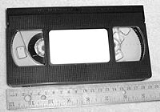
VHS

Encyclopedia
The Video Home System (better known by its abbreviation VHS) is a consumer-level analog recording
videocassette standard developed by Victor Company of Japan
(JVC).
The 1970s was a period when video recording became a major contributor to the television industry. Like many other technological innovations, each of several companies made an attempt to produce a television recording standard that the majority of the world would embrace. At the peak of it all, the home video industry was caught up in a series of videotape format war
s. Two of the formats, VHS and Betamax
, received the most media exposure. VHS would eventually win the war, and therefore succeed as the dominant home video format, lasting throughout the tape format period.
In later years, optical disc
formats began to offer better quality than video tape. The earliest of these formats, Laserdisc
, was not widely adopted, but the subsequent DVD
(Digital Versatile Disc) format eventually did achieve mass acceptance and replaced VHS as the preferred method of distribution after 2000. By 2006, film studios in the United States had stopped releasing new movie titles in VHS format. On December 31, 2008, the last major United States supplier of pre-recorded VHS tapes, Distribution Video Audio Inc. of Palm Harbor, Florida
, shipped its final truckload. , most of the VHS tapes being produced are 6 and 8 hour blank tapes.
.
By the end of 1971, JVC produced an internal document titled VHS Development Matrix. In the document, it listed twelve objectives in building a home video recording unit. However, the commercial video recording industry took a hit, and eventually lead to JVC cutting its budgets, and re-structuring its video division - even as far as shelving the VHS project. Takano and Shiraishi continued to work on the project in secrecy, and by 1973 they successfully produced a functional prototype.
In 1974, Japan started a standards war of its own. The Ministry of International Trade and Industry
(MITI) attempted to force the Japanese video industry to standardize on just one recording format, for the sake of saving the country from consumer confusion of having too many video formats on the market. Later, Sony had a functional prototype of the Betamax format, and was very close to releasing a finished product. With this prototype, Sony persuaded the MITI to adopt Betamax as the standard, and allow it to license the technology to other companies.
JVC believed that an open standard
worked in the best interest of the consumer, as sharing the format among competitors without licensing the technology was better for the consumer. To prevent the MITI from adopting Betamax, JVC made an attempt to have other companies accept VHS, and thereby work against Sony and the MITI. It was a major key to have Matsushita on-board because Matsushita was Japan's largest electronics manufacturer at the time. JVC succeeded in persuading Matsushita to back the VHS format because Matsushita was afraid to allow Sony to become a leader, and Betamax could only record one hour of video. Matsushita's backing of JVC persuaded Mitsubishi
and Sharp
to back the VHS standard as well. Sony's release of its Betamax unit to the Japanese market in 1975 placed further pressure on the MITI to side with the company. However, the collaboration of JVC, Matsushita, Mitsubishi and Sharp was much stronger, and eventually lead the MITI to drop its push for an industry standard.
, Tokyo, Japan on October 31, 1976. The United States received its first VHS-based VCR - the RCA VBT200 on August 23, 1977. The RCA unit was designed by Matsushita, and was the first VHS-based VCR manufactured by a company other than JVC. The United Kingdom later received its first VHS-based VCR - the Victor HR-3300EK in 1978.
Quasar
and General Electric
would follow-up with VHS-based VCRs - all designed by Matsushita. By 1978, Matsushita alone produced just over half of all Japanese VCRs.
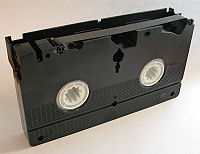
 The VHS cassette is a 187 mm wide, 103 mm deep, 25 mm thick plastic shell held together with five Phillips head screws. The flip-up cover that protects the tape has a built-in latch with a push-in toggle on the right side (see bottom view image). The VHS cassette also includes an anti-despooling mechanism (see the top view): several plastic parts near the front label end of the cassette between the two spools. The spool brakes are released by a push-in lever within a 6.35 mm hole accessed from the bottom of the cassette, about 19.05 mm in from the edge label.
There is a clear tape leader at both ends of the tape to provide an optical auto-stop for the VCR transport mechanism. A light source is inserted into the cassette through the circular hole in the center of the underside when loaded in the VCR, and two photodiode
s are located to the left and right sides of where the tape exits the cassette. When the clear tape reaches one of these, enough light will pass through the tape to the photodiode to trigger the stop function; in more sophisticated machines it will start rewinding the cassette when the trailing end is detected. Early VCRs used an incandescent bulb as the light source, which regularly failed and caused the VCR to erroneously think that a cassette is loaded when empty, or would detect the blown bulb and stop functioning completely. Later designs use an infrared LED which had a much longer lifetime.
The recording media is a 12.7 mm wide magnetic tape
wound between two spools, allowing it to be slowly passed over the various playback and recording heads of the video cassette recorder. The tape speed is 3.335 cm/s for NTSC
, 2.339 cm/s for PAL
.
 As with almost all cassette-based videotape systems, VHS machines pull the tape from the cassette shell and wrap it around the head drum which rotates at 1800 rpm in NTSC machines and at 1500 rpm for PAL. VHS machines, in contrast to Betamax
and Beta's predecessor U-matic
, use an "M-loading" system, also known as M-lacing, where the tape is drawn out by two threading posts and wrapped around more than 180 degrees of the head drum (and also other tape transport
components) in a shape roughly approximating the letter M
.
— but this feature has become hard to find in recent models.
By the late 1990s, some high-end VCRs offered more sophisticated indexing. For example, Panasonic's Tape Library system assigned an ID number to each cassette, and logged recording information (channel, date, time and optional program title entered by the user) both on the cassette and in the VCR's memory for up to 900 recordings (600 with titles).
 A VHS cassette holds a maximum of about 430 m (1,410 ft.) of tape at the lowest acceptable tape thickness, giving a maximum playing time of about 4 hours in an DF480 for NTSC
and five hours in an E-500 for PAL
at "standard play" (SP) quality. Other speeds include "long play" (LP) (Not all VCRs include this record mode), and "extended play" (EP) or "super long play" (SLP); For NTSC, LP and EP/SLP doubles and triples the recording time accordingly, but these speed reductions cause a slight reduction in video quality - from the normal 250 lines in SP, to 230 analog lines horizontal. Also, video recorded onto tapes at the lower speed often exhibit poor playback performance on recorders other than the one they were produced on. As a result, commercial pre-recorded tapes were almost always recorded in SP mode. In some cases, budget labels such as Video Treasures (both LP and EP), Starmaker (EP), Burbank Video (LP), Avid Home Entertainment (EP), GoodTimes Entertainment
(LP), and even Disney (LP) and Paramount
(EP) commonly used a slower speed.
recording of a frequency modulated
luminance (black and white) signal, with a down-converted "color under" chroma
(color) signal recorded directly at the baseband. Each helical track contains a single field ('even' or 'odd' field, equivalent to half a frame) encoded as an analog raster scan
, similar to analog TV broadcasts. The horizontal resolution is 170 lines per scanline, and the vertical resolution (the number of scanlines) is the same as the respective analog TV standard (576 for PAL
or 486 for NTSC
). In modern-day digital terminology, VHS is roughly equivalent to 333x480 pixels luma and 40x480 chroma resolutions (333x480 pixels=159,840 pixels or 0.16MP (1/6 of a MegaPixel)).
JVC would counter 1985's SuperBeta with VHS HQ, or High Quality. The frequency modulation of the VHS luminance signal is limited to 3 megahertz which makes higher resolutions impossible, but an HQ branded deck includes luminance noise reduction, chroma noise reduction, white clip extension, and improved sharpness circuitry. The effect was to increase the apparent horizontal resolution of a VHS recording from 240 to 250 analog (equivalent to 333 pixels from left-to-right, in digital terminology). The major VHS OEM
s resisted HQ due to cost concerns, eventually resulting in JVC reducing the requirements for the HQ brand to white clip extension plus one other improvement.
In 1987 JVC introduced a new format called Super VHS which extended the bandwidth to over 5 megahertz, yielding 420 analog horizontal (560 pixels left-to-right).
in a single linear track, at the upper edge of the tape, similar to how an audio compact cassette
operates. The recorded frequency range was dependent on the movement of the tape past the audio head, which, for the VHS SP mode, resulted in a mediocre frequency response of roughly 100 Hz to 10 kHz. The signal-to-noise ratio
was an acceptable 42 dB. Both parameters degraded significantly with VHS's longer play modes, with EP frequency response peaking at 4 kHz.
Audio cannot be recorded on a VHS tape without recording a video signal, even in the audio dubbing mode. If there is no video signal to the VCR input, the VCR will record black as well as generate a control track while the audio is being recorded.
More expensive decks offered stereo audio recording and playback. Linear stereo, as it was called, fit two independent channels in the same space as the original mono audiotrack. While this approach preserved acceptable backward compatibility with monoaural audio heads, the splitting of the audio track degraded the signal's SNR to the point that audible tape hiss was objectionable at normal listening volume. To counteract tape hiss, decks applied Dolby B noise reduction for recording and playback. Dolby B dynamically boosts the mid-frequency band of the audio program on the recorded medium, improving its signal strength relative to the tape's background noise floor, then attenuates the mid-band during playback. Dolby B is not a transparent process, and Dolby-encoded program material will exhibit an unnatural mid-range emphasis when played on non-Dolby capable VCRs.
High-end consumer recorders took advantage of the linear nature of the audio track, as the audio track could be erased and recorded without disturbing the video portion of the recorded signal. Hence, "audio dubbing" and "video dubbing", where either the audio or video are re-recorded on tape (without disturbing the other), were supported features on prosumer
linear video editing
-decks. Without dubbing capability, an audio or video edit could not be done in-place on master cassette, and requires the editing output be captured to another tape, incurring generational loss.
Studio film releases began to emerge with linear stereo audiotracks in 1982. From that point onward nearly every home video releases by Hollywood featured a Dolby-encoded linear stereo audiotrack. However, linear stereo was never popular with equipment makers or consumers.
), dynamic range
of 90 dB, and professional audio
-grade channel separation (more than 70dB). VHS Hi-Fi audio is achieved by using audio frequency modulation (AFM), recording each of the 2 stereo channels (L, R) on a frequency-modulated carrier and embedding the modulated audio signal pair into the video signal. To avoid crosstalk and interference from the primary video carrier, VHS's implementation of AFM relied on a form of magnetic recording called depth multiplexing
. The modulated audio carrier pair was placed under the luminance carrier (below 1.6 MHz), and recorded first. Subsequently, the video head erases and re-records the video signal over the same tape surface, but video signal's higher center frequency results in a shallower magnetization of the tape, allowing both the video and residual AFM audio signal to coexist on tape. (PAL versions of Beta Hi-Fi use this same technique). During playback, VHS Hi-Fi recovers the depth-recorded AFM signal by subtracting the audio head's signal (which contains the AFM signal contaminated by a weak image of the video signal) from the video head's signal (which contains only the video signal), then demodulates the left and right audio channels from their respective frequency carriers. The end result of the complex process was audio of outstanding fidelity, which was uniformly solid across all tape-speeds (EP or SP.) Since JVC had gone through the complexity of ensuring Hi-Fi's backward compatibility with non-Hi-Fi VCRs, virtually all studio home video releases contained Hi-Fi audio tracks, in addition to the linear audio track. Under normal circumstances, all Hi-Fi VHS VCRs will record Hi-Fi and linear audio simultaneously to ensure compatibility with VCRs without Hi-Fi playback, though only early high-end Hi-Fi machines provided linear stereo compatibility.
Due to the path followed by the video and Hi-Fi audio heads being striped and discontinuous—unlike that of the linear audio track—head-switching is required to provide a continuous audio signal. Misalignments may lead to imperfect joining of the signal, resulting in low-pitched buzzing.
The sound quality of Hi-Fi VHS stereo is comparable to the quality of CD audio, particularly when recordings were made on high-end or professional VHS machines that have a manual audio recording level control. This high quality compared to other consumer audio recording formats such as compact cassette
attracted the attention of amateur and hobbyist recording artists. Home recording
enthusiasts occasionally recorded high quality stereo mixdown
s and master recording
s from multitrack
audio tape onto consumer-level Hi-Fi VCRs. However, because the VHS Hi-Fi recording process is intertwined with the VCR's video-recording function, advanced editing functions such as audio-only or video-only dubbing are impossible. Some VHS decks also had a "simulcast" switch, allowing users to record an external audio input along with off-air pictures. Some televised concerts offered a stereo simulcast soundtrack on FM radio and as such, events like Live Aid
were recorded by thousands of people with a full stereo soundtrack despite the fact that stereo TV broadcasts were some years off (especially in regions that adopted NICAM
).
The considerable complexity and additional hardware limited VHS Hi-Fi to high-end decks for many years. While linear stereo all but disappeared from home VHS decks, it was not until the 1990s that Hi-Fi became a more common feature on VHS decks. Even then, most customers were unaware of its significance and merely enjoyed the better audio performance of the newer decks.
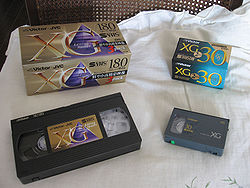
, an analog video standard with improved video bandwidth. S-VHS improved the luminance resolution to 400 horizontal per picture height (versus 250 for VHS/Beta and 500 for DVD). The audio-system (both linear and AFM) is the same. S-VHS made little impact on the home market, but gained dominance in the camcorder market due to its superior picture quality.
The ADAT
format provides the ability to record multitrack digital audio using S-VHS media. JVC also developed SVHS-ET technology for its Super-VHS camcorders and VCRs, which simply allows them to record Super VHS signals onto lower-priced VHS tapes, albeit with a slight blurring of the image. Nearly all Super-VHS camcorders and VCRs made today have SVHS-ET ability.
, originally developed for portable VCRs in 1982, but ultimately finding success in palm-sized camcorder
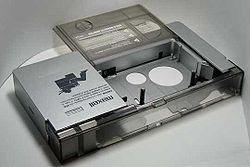
s. The longest tape available holds 60 minutes in SP mode and 180 minutes in EP mode. Since VHS-C tapes are based on the same magnetic tape as full size tapes, they can be played back in standard VHS players using a mechanical adapter, without the need of any kind of signal conversion. The magnetic tape on VHS-C cassettes is wound on one main spool and uses a gear wheel to advance the tape.
The adapter does not require a battery to function and is solely a mechanical adapter. It has an internal hub to engage with the VCR mechanism in the location of a normal full-size tape hub, driving the gearing on VHS-C cassette. Also when a VHS-C cassette is inserted into the adapter, a small swing-arm pulls the tape out of the miniature cassette to span the standard tape path distance between the guide rollers of a full-size tape. This allows the miniature cassette to use the same tape loading mechanism of the full-size tape.
Super VHS-C or S-VHS
Compact was developed by JVC
in 1987. S-VHS provided an improved luminance and chrominance quality, yet S-VHS recorders were compatible with VHS tapes.
Sony Betamax was unable to shrink that form any further, so instead they developed Video8/Hi8 which was in direct competition with the VHS-C/S-VHS-C format throughout the 80s, 90s, and 2000s. Ultimately neither format "won" and both continue to be sold in the low-end market (examples: JVC SXM38 and Sony TRV138).
allowed recording of MUSE
Hi-Vision analog high definition television, which was broadcast in Japan from 1989 until 2007. The other improved standard, called Digital-VHS (D-VHS)
, records digital high definition video onto a VHS form factor tape. D-VHS can record up to 4 hours of ATSC digital television in 720p or 1080i formats using the fastest record mode (equivalent to VHS-SP), and up to 40 hours of standard definition video at slower speeds.
, or officially under the name D9, that uses a VHS form factor tape and essentially the same mechanical tape handling techniques as an S-VHS recorder. This format is the least expensive format to support a Sel-Sync
pre-read for video editing
. This format is most notably used by Fox
for some of its cable networks.
Some devices were marketed, which allowed a personal computer
to use a VHS recorder as a data backup device. The most notable of these was ArVid
, widely used in Russia and CIS
states. In the United States similar systems were manufactured by Corvus
and Alpha Microsystems
. Also available was Backer from Danmere Ltd. of England.
in existence at the time VHS was devised. However, a machine must be designed to record a given standard. Typically, a VHS machine can only handle signals of the country it was sold in. The following signal varieties exist in conventional VHS:
Note that PAL/625/25 VCRs allow playback of SECAM (and MESECAM) tapes with a monochrome (black and white) picture (and vice-versa) as the line standard is the same.
Since the 1990s, dual- and multi-standard VHS machines have become more and more common. These can handle VHS tapes of more than one standard. For example, regular VHS machines sold in Australia and Europe nowadays can typically handle PAL, MESECAM for record and playback, plus NTSC for playback only (provided the TV is able to display NTSC's 525/30 line standard - most can). Dedicated multistandard machines can usually handle all standards listed, some high end models can even convert the content of a tape from one standard to another on-the-fly during playback by using a built-in standards converter.
S-VHS only exists in PAL/625/25 and NTSC/525/30. S-VHS machines sold in SECAM markets record internally in PAL, and convert to/from SECAM during record/playback, respectively. Likewise, S-VHS machines for the Brazilian market record in NTSC and convert to/from PAL-M.
A small number of VHS decks are able to decode closed captions
on prerecorded video cassettes. A smaller number still are able, additionally, to record subtitles
transmitted with world standard teletext
signals (on pre-digital services), simultaneously with the associated program.
VHS cassettes are physically identical (although the signals recorded on the tape are incompatible). However, as tape speeds differ between NTSC and PAL/SECAM, the playing time for any given cassette will vary accordingly between the systems.
In order to avoid confusion, manufacturers indicate the playing time in minutes that can be expected for the market the tape is sold in. It is perfectly possible to record and play back a blank T-XXX tape in a PAL machine or a blank E-XXX tape in an NTSC machine, but the resulting playing time will be different from that indicated. Some new Panasonic NTSC/ATSC recorders also include a Very long Play (VP) mode which is not part of the official specification. It enables recordings at 1/5 the SP speed, such that a T-180 holds 15 hours.
) is a music single
, using a standard-sized VHS cartridge. The format has existed since the early 1980s. In 1983, British synthpop
band The Human League
released the UK's first commercial video single on both VHS and Betamax as "The Human League Video Single
". It was not a huge commercial success due to the high retail price of £10.99, compared to £1.99 for a vinyl single.
The VHS single format gained higher levels of mainstream popularity when Madonna
released "Justify My Love
" as a video single in 1990 following the blacklisting of the video by MTV
. U2
also released "Numb
", the lead single
from their 1993 album Zooropa
as a video single.
Despite the success of these releases, the video single struggled as its releases were relatively periodical, the technology slowly being superseded first by CD Video
(which proved unsuccessful due to the cost of capable LaserDisc
players to play the video portion), music CDs with computer-accessible video files, then, by the early 2000s, by both DVD single
s and CD+DVD releases.
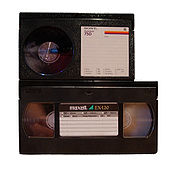
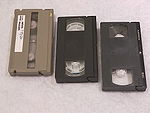
 VHS was the winner of a protracted and somewhat bitter format war during the late 1970s and early 1980s against Sony's Betamax format, as well as other formats of the time.
Betamax was widely perceived at the time as the better format, as the cassette was smaller in size, and Betamax offered slightly better video quality than VHS—it had lower video noise, less luma-chroma crosstalk
, and was marketed as providing pictures superior to those of VHS. However, the sticking point for both consumers and potential licensing partners of Betamax was the total recording time. To overcome the recording limitation, B-II speed (two-hour mode, NTSC regions only) was released in order to compete with VHS's two-hour SP mode, thereby reducing Betamax's horizontal resolution to 240 lines (vs 250 lines.) In turn, the extension of VHS to VHS HQ produced 250 lines (vs 240 lines,) so that overall a typical Betamax/VHS user could expect virtually identical resolution. (Very high-end Betamax machines still supported recording in the B-I mode and some in an even higher resolution B-Is (B-I Super HiBand) mode, but at a maximum single-cassette run time of 1:40 [with an L-830 cassette].)
Because Betamax was released more than a year before VHS, it held an early lead in the format war. However, by 1981, United States' Betamax sales had dipped down to only 25-percent of all sales. A debate continues between pundits over the cause of Betamax's loss. Some say - including Sony's founder Akio Morita - that it was due to Sony's licensing strategy with other manufacturers, which consistently kept the overall cost for a unit higher than a VHS unit, and that JVC allowed other manufacturers to produce VHS units license-free and keep cost lower. Others say that VHS had better marketing, since the much larger electronics companies at the time (Matsushita, for example) were on-board with VHS.
s have replaced the VCR as the time shifting device of choice, especially in households with subscriber-based TV services. The home camcorder market, one which VHS shared with alternative formats, has already transitioned to digital-video recording. But the largest impact on the VHS format was in March 1997 the introduction of the DVD format to American consumers. For home-video (that is, pre-recorded commercially-released movies, etc.) rental and sales, DVD
has almost completely taken the place of VHS.
At most electronics retailers, choice among VHS equipment is increasingly shrinking. New sales are focused on DVD-recorders and subscriber-based DVRs (such as TiVo
). Most electronics chains have stopped stocking VHS home-video releases, focusing only on DVD and Blu-ray Disc technology. Major Hollywood studios no longer issue releases on VHS. The final major Hollywood motion picture released on VHS was David Cronenberg
's A History of Violence
.
On December 31, 2008, the final truckload in the USA of recorded programming on VHS tapes rolled out of a warehouse owned by Ryan Kugler, the last major supplier of VHS-recorded videos. Kugler is President and co-owner of Distribution Video Audio, a seller of distressed goods such as VHS tapes. According to Kugler, "It's dead, this is it, this is the last Christmas, without a doubt. I was the last one buying VHS and the last one selling it, and I'm done. Anything left in warehouse we'll just give away or throw away."
However in 2009, the Hayao Miyazaki
film Ponyo received a VHS release in Japan alongside DVD and Blu-ray. Home-video VHS tapes can still be found in many second-hand shops, and are sometimes very cheap due to the lack of demand.
In 2010, The House of the Devil
received promotional distribution on VHS and is available exclusively on Amazon.com
with a DVD copy of the film. At the back-end of the same year, Harmony Korine's Trash Humpers
(which was shot and edited entirely on VHS) was released onto DVD and in a limited run of 300 VHSs directly from the official website. Also in 2010, the movie Paranormal Activity was released on VHS in the Netherlands
.
Although VHS has quickly faded from mainstream home-video, a VCR is still owned in many US households. The Washington Post
noted that as of 2005, 94.5 million Americans still owned VHS format VCRs.
 The last standalone JVC VHS-only unit was produced on October 28, 2008. JVC, like many other manufacturers, still makes combination DVD+VHS units.
Several retail chains in the United States and in Europe planned to stop selling VHS equipment in 2004, 2005, and 2006. Despite these plans, VHS recorders and blank tapes are still being sold in major stores worldwide. As an acknowledgement of VHS popularity, in 2009 Panasonic has announced the world’s first dual deck VHS-Blu-ray player.
(VCD) was created in 1993, becoming an alternative medium for video, in a CD-sized disc. Though occasionally showing compression artifact
s and color banding that are common discrepancies in digital media, the durability and longevity of a VCD depends on the production quality of the disc, and its handling. The data stored digitally on a VCD theoretically does not degrade (in the analog sense like tape.) In the disc player, there is no physical contact made with either the data or label sides. And, when handled properly, a VCD will last a long time. However, in practice, the surfaces of the disc do get touched by the operator's hand, causing body oil and dirt to collect on the disc, and eventually transfer to the laser and motor inside of the player, if not cleaned before use. Also, when used in an industrial or commercial environment when a disc is handled hundreds or thousands of times during its life, wear on the plastic can occur if the disc is not handled properly. VCD is susceptible to disc rot
.
Since a VCD can only hold 70 minutes of video, a movie exceeding that mark has to be divided into two or more discs. This format is currently popular in developing countries.
format was introduced first, in 1996, in Japan, to the United States in March 1997 (Test Marketed) and mid-late 1998 in Europe and Australia.
Despite DVD's better quality (480 typical versus 250 lines horizontal resolution), VHS is still widely used in home recording of video content due to the large installed base and the lower cost of VHS recorders and tape. The commercial success of DVD recording and re-writing has been hindered by a number of factors including:
, which is the designed successor to DVD. (A competing format to Blu-ray was HD DVD, which was withdrawn from the market, conceding to Blu-ray.) A single Blu-ray Disc can hold up to 128GB (over 25 times the capacity of a single-layered DVD) of information including up to 1080p
High-definition video
, high definition photos, music, and more.
Hard disk-based systems include TiVo
as well as other digital video recorder (DVR)
offerings. These types of systems provide users with a no-maintenance solution for capturing video content. Customers of subscriber-based TV generally receive electronic program guides, enabling one-touch setup of a recording schedule. Hard disk-based systems allow for many hours of recording without user-maintenance. For example, a 120 GB
system recording at an extended recording rate (XP) of 10 Mbit/s MPEG-2
can record over 25 hours of video content. However, the DVR technology does not allow for portability or long-lasting storage.
Analog recording
Analog recording is a technique used for the recording of analog signals which among many possibilities include audio frequency, analog audio and analog video information for later playback.Analog recording methods store signals as a continual wave in or on the media...
videocassette standard developed by Victor Company of Japan
JVC
, usually referred to as JVC, is a Japanese international consumer and professional electronics corporation based in Yokohama, Japan which was founded in 1927...
(JVC).
The 1970s was a period when video recording became a major contributor to the television industry. Like many other technological innovations, each of several companies made an attempt to produce a television recording standard that the majority of the world would embrace. At the peak of it all, the home video industry was caught up in a series of videotape format war
Videotape format war
The videotape format war was a period of intense competition or "format war" of incompatible models of consumer-level analog video videocassette and video cassette recorders in the late 1970s and the 1980s.- Overview :...
s. Two of the formats, VHS and Betamax
Betamax
Betamax was a consumer-level analog videocassette magnetic tape recording format developed by Sony, released on May 10, 1975. The cassettes contain -wide videotape in a design similar to the earlier, professional wide, U-matic format...
, received the most media exposure. VHS would eventually win the war, and therefore succeed as the dominant home video format, lasting throughout the tape format period.
In later years, optical disc
Optical disc
In computing and optical disc recording technologies, an optical disc is a flat, usually circular disc which encodes binary data in the form of pits and lands on a special material on one of its flat surfaces...
formats began to offer better quality than video tape. The earliest of these formats, Laserdisc
Laserdisc
LaserDisc was a home video format and the first commercial optical disc storage medium. Initially licensed, sold, and marketed as MCA DiscoVision in North America in 1978, the technology was previously referred to interally as Optical Videodisc System, Reflective Optical Videodisc, Laser Optical...
, was not widely adopted, but the subsequent DVD
DVD
A DVD is an optical disc storage media format, invented and developed by Philips, Sony, Toshiba, and Panasonic in 1995. DVDs offer higher storage capacity than Compact Discs while having the same dimensions....
(Digital Versatile Disc) format eventually did achieve mass acceptance and replaced VHS as the preferred method of distribution after 2000. By 2006, film studios in the United States had stopped releasing new movie titles in VHS format. On December 31, 2008, the last major United States supplier of pre-recorded VHS tapes, Distribution Video Audio Inc. of Palm Harbor, Florida
Palm Harbor, Florida
Palm Harbor is a census-designated place and an unincorporated community in Pinellas County, Florida, United States. As of the 2000 census, the CDP had a total population of 59,248.-Culture:...
, shipped its final truckload. , most of the VHS tapes being produced are 6 and 8 hour blank tapes.
History
Earlier in 1971, JVC engineers Yuma Shiraishi and Shizuo Takano lead the effort in developing the VHS tape format. JVC originally collaborated with Sony Corporation and Matsushita Electric (aka Panasonic) in building a home video standard for the Japanese consumer. Soon after, Sony and Matsushita broke away from the collaboration effort, in order to work on video recording formats of their own. Sony started working on Betamax, while Matsushita started working on VXVX (videocassette format)
VX was a short-lived and unsuccessful consumer analog recording videocassette format developed by Panasonic and launched in 1975 in Japan. In the US it was sold using the Quasar brand and marketed under the name "The Great Time Machine" to exhibit its time-shifting capabilities, since VX machines...
.
By the end of 1971, JVC produced an internal document titled VHS Development Matrix. In the document, it listed twelve objectives in building a home video recording unit. However, the commercial video recording industry took a hit, and eventually lead to JVC cutting its budgets, and re-structuring its video division - even as far as shelving the VHS project. Takano and Shiraishi continued to work on the project in secrecy, and by 1973 they successfully produced a functional prototype.
In 1974, Japan started a standards war of its own. The Ministry of International Trade and Industry
Ministry of International Trade and Industry
The Ministry of International Trade and Industry was one of the most powerful agencies of the Government of Japan. At the height of its influence, it effectively ran much of Japanese industrial policy, funding research and directing investment...
(MITI) attempted to force the Japanese video industry to standardize on just one recording format, for the sake of saving the country from consumer confusion of having too many video formats on the market. Later, Sony had a functional prototype of the Betamax format, and was very close to releasing a finished product. With this prototype, Sony persuaded the MITI to adopt Betamax as the standard, and allow it to license the technology to other companies.
JVC believed that an open standard
Open standard
An open standard is a standard that is publicly available and has various rights to use associated with it, and may also have various properties of how it was designed . There is no single definition and interpretations vary with usage....
worked in the best interest of the consumer, as sharing the format among competitors without licensing the technology was better for the consumer. To prevent the MITI from adopting Betamax, JVC made an attempt to have other companies accept VHS, and thereby work against Sony and the MITI. It was a major key to have Matsushita on-board because Matsushita was Japan's largest electronics manufacturer at the time. JVC succeeded in persuading Matsushita to back the VHS format because Matsushita was afraid to allow Sony to become a leader, and Betamax could only record one hour of video. Matsushita's backing of JVC persuaded Mitsubishi
Mitsubishi
The Mitsubishi Group , Mitsubishi Group of Companies, or Mitsubishi Companies is a Japanese multinational conglomerate company that consists of a range of autonomous businesses which share the Mitsubishi brand, trademark and legacy...
and Sharp
Sharp Corporation
is a Japanese multinational corporation that designs and manufactures electronic products. Headquartered in Abeno-ku, Osaka, Japan, Sharp employs more than 55,580 people worldwide as of June 2011. The company was founded in September 1912 and takes its name from one of its founder's first...
to back the VHS standard as well. Sony's release of its Betamax unit to the Japanese market in 1975 placed further pressure on the MITI to side with the company. However, the collaboration of JVC, Matsushita, Mitsubishi and Sharp was much stronger, and eventually lead the MITI to drop its push for an industry standard.
Initial releases of VHS-based devices
The first VCR to use VHS was the Victor HR-3300, and was introduced by the president of JVC at the Okura Hotel on September 9, 1976. JVC started selling the HR-3300 in AkihabaraAkihabara
, also known as , is an area of Tokyo, Japan. It is located less than five minutes by rail from Tokyo Station. Its name is frequently shortened to in Japan...
, Tokyo, Japan on October 31, 1976. The United States received its first VHS-based VCR - the RCA VBT200 on August 23, 1977. The RCA unit was designed by Matsushita, and was the first VHS-based VCR manufactured by a company other than JVC. The United Kingdom later received its first VHS-based VCR - the Victor HR-3300EK in 1978.
Quasar
Quasar (brand)
Quasar is a North American brand of electronics, first used by Motorola in 1967 for a model line of transistorized color televisions. These televisions were well-known for containing all serviceable parts in a drawer beneath the television's cabinet...
and General Electric
General Electric
General Electric Company , or GE, is an American multinational conglomerate corporation incorporated in Schenectady, New York and headquartered in Fairfield, Connecticut, United States...
would follow-up with VHS-based VCRs - all designed by Matsushita. By 1978, Matsushita alone produced just over half of all Japanese VCRs.
Cassette and tape design
There is a clear tape leader at both ends of the tape to provide an optical auto-stop for the VCR transport mechanism. A light source is inserted into the cassette through the circular hole in the center of the underside when loaded in the VCR, and two photodiode
Photodiode
A photodiode is a type of photodetector capable of converting light into either current or voltage, depending upon the mode of operation.The common, traditional solar cell used to generateelectric solar power is a large area photodiode....
s are located to the left and right sides of where the tape exits the cassette. When the clear tape reaches one of these, enough light will pass through the tape to the photodiode to trigger the stop function; in more sophisticated machines it will start rewinding the cassette when the trailing end is detected. Early VCRs used an incandescent bulb as the light source, which regularly failed and caused the VCR to erroneously think that a cassette is loaded when empty, or would detect the blown bulb and stop functioning completely. Later designs use an infrared LED which had a much longer lifetime.
The recording media is a 12.7 mm wide magnetic tape
Magnetic tape
Magnetic tape is a medium for magnetic recording, made of a thin magnetizable coating on a long, narrow strip of plastic. It was developed in Germany, based on magnetic wire recording. Devices that record and play back audio and video using magnetic tape are tape recorders and video tape recorders...
wound between two spools, allowing it to be slowly passed over the various playback and recording heads of the video cassette recorder. The tape speed is 3.335 cm/s for NTSC
NTSC
NTSC, named for the National Television System Committee, is the analog television system that is used in most of North America, most of South America , Burma, South Korea, Taiwan, Japan, the Philippines, and some Pacific island nations and territories .Most countries using the NTSC standard, as...
, 2.339 cm/s for PAL
PAL
PAL, short for Phase Alternating Line, is an analogue television colour encoding system used in broadcast television systems in many countries. Other common analogue television systems are NTSC and SECAM. This page primarily discusses the PAL colour encoding system...
.
Betamax
Betamax was a consumer-level analog videocassette magnetic tape recording format developed by Sony, released on May 10, 1975. The cassettes contain -wide videotape in a design similar to the earlier, professional wide, U-matic format...
and Beta's predecessor U-matic
U-matic
U-matic is an analog recording videocassette format first shown by Sony in prototype in October 1969, and introduced to the market in September 1971. It was among the first video formats to contain the videotape inside a cassette, as opposed to the various Reel-to-Reel or open-reel formats of the...
, use an "M-loading" system, also known as M-lacing, where the tape is drawn out by two threading posts and wrapped around more than 180 degrees of the head drum (and also other tape transport
Tape transport
A tape transport is the generic term for all parts of a magnetic tape player or recorder that the actual tape passes through. Transport parts include, but are not limited to, the head, capstan, pinch roller, tape pins, and tape guide...
components) in a shape roughly approximating the letter M
M
M is the thirteenth letter of the basic modern Latin alphabet.-History:The letter M is derived from the Phoenician Mem, via the Greek Mu . Semitic Mem probably originally pictured water...
.
Tracking adjustment and index marking
Another linear control track, at the tape's lower edge, holds pulses that mark the beginning of every frame of video; these are used to fine-tune the tape speed during playback and to get the rotating heads exactly on their helical tracks rather than having them end up somewhere between two adjacent tracks (a feature called tracking). Since good tracking depends on the exact distance between the rotating drum and the fixed control/audio head reading the linear tracks, which usually varies by a couple of micrometers between machines due to manufacturing tolerances, most VCRs offer tracking adjustment, either manual or automatic, to correct such mismatches. The control can additionally hold index marks. These are normally written at the beginning of each recording session, and can be found using the VCR's index search function: this will fast-wind forward or backward to the nth specified index mark, and resume playback from there. There was a time when higher-end VCRs provided functions for manually removing and adding these index marks — so that, for example, they coincide with the actual start of the television programTelevision program
A television program , also called television show, is a segment of content which is intended to be broadcast on television. It may be a one-time production or part of a periodically recurring series...
— but this feature has become hard to find in recent models.
By the late 1990s, some high-end VCRs offered more sophisticated indexing. For example, Panasonic's Tape Library system assigned an ID number to each cassette, and logged recording information (channel, date, time and optional program title entered by the user) both on the cassette and in the VCR's memory for up to 900 recordings (600 with titles).
Recording capacity
NTSC
NTSC, named for the National Television System Committee, is the analog television system that is used in most of North America, most of South America , Burma, South Korea, Taiwan, Japan, the Philippines, and some Pacific island nations and territories .Most countries using the NTSC standard, as...
and five hours in an E-500 for PAL
PAL
PAL, short for Phase Alternating Line, is an analogue television colour encoding system used in broadcast television systems in many countries. Other common analogue television systems are NTSC and SECAM. This page primarily discusses the PAL colour encoding system...
at "standard play" (SP) quality. Other speeds include "long play" (LP) (Not all VCRs include this record mode), and "extended play" (EP) or "super long play" (SLP); For NTSC, LP and EP/SLP doubles and triples the recording time accordingly, but these speed reductions cause a slight reduction in video quality - from the normal 250 lines in SP, to 230 analog lines horizontal. Also, video recorded onto tapes at the lower speed often exhibit poor playback performance on recorders other than the one they were produced on. As a result, commercial pre-recorded tapes were almost always recorded in SP mode. In some cases, budget labels such as Video Treasures (both LP and EP), Starmaker (EP), Burbank Video (LP), Avid Home Entertainment (EP), GoodTimes Entertainment
GoodTimes Entertainment
GoodTimes Entertainment, Ltd. was a home video company that originated in 1984 under the name of GoodTimes Home Video. Though it produced its own titles, the company was well-known due to its distribution of media from third parties and classics...
(LP), and even Disney (LP) and Paramount
Paramount Pictures
Paramount Pictures Corporation is an American film production and distribution company, located at 5555 Melrose Avenue in Hollywood. Founded in 1912 and currently owned by media conglomerate Viacom, it is America's oldest existing film studio; it is also the last major film studio still...
(EP) commonly used a slower speed.
Video recording
VHS tapes have approximately 3 MHz of video bandwidth and 400 kHz of chroma bandwidth, which is achieved at a relatively low tape speed by the use of helical scanHelical scan
Helical scan is a method of recording high bandwidth signals onto magnetic tape. It is used in reel-to-reel video tape recorders, video cassette recorders, digital audio tape recorders, and some computer tape drives....
recording of a frequency modulated
Frequency modulation
In telecommunications and signal processing, frequency modulation conveys information over a carrier wave by varying its instantaneous frequency. This contrasts with amplitude modulation, in which the amplitude of the carrier is varied while its frequency remains constant...
luminance (black and white) signal, with a down-converted "color under" chroma
Chrominance
Chrominance is the signal used in video systems to convey the color information of the picture, separately from the accompanying luma signal . Chrominance is usually represented as two color-difference components: U = B' − Y' and V = R' − Y'...
(color) signal recorded directly at the baseband. Each helical track contains a single field ('even' or 'odd' field, equivalent to half a frame) encoded as an analog raster scan
Raster scan
A raster scan, or raster scanning, is the rectangular pattern of image capture and reconstruction in television. By analogy, the term is used for raster graphics, the pattern of image storage and transmission used in most computer bitmap image systems...
, similar to analog TV broadcasts. The horizontal resolution is 170 lines per scanline, and the vertical resolution (the number of scanlines) is the same as the respective analog TV standard (576 for PAL
PAL
PAL, short for Phase Alternating Line, is an analogue television colour encoding system used in broadcast television systems in many countries. Other common analogue television systems are NTSC and SECAM. This page primarily discusses the PAL colour encoding system...
or 486 for NTSC
NTSC
NTSC, named for the National Television System Committee, is the analog television system that is used in most of North America, most of South America , Burma, South Korea, Taiwan, Japan, the Philippines, and some Pacific island nations and territories .Most countries using the NTSC standard, as...
). In modern-day digital terminology, VHS is roughly equivalent to 333x480 pixels luma and 40x480 chroma resolutions (333x480 pixels=159,840 pixels or 0.16MP (1/6 of a MegaPixel)).
JVC would counter 1985's SuperBeta with VHS HQ, or High Quality. The frequency modulation of the VHS luminance signal is limited to 3 megahertz which makes higher resolutions impossible, but an HQ branded deck includes luminance noise reduction, chroma noise reduction, white clip extension, and improved sharpness circuitry. The effect was to increase the apparent horizontal resolution of a VHS recording from 240 to 250 analog (equivalent to 333 pixels from left-to-right, in digital terminology). The major VHS OEM
Original Equipment Manufacturer
An original equipment manufacturer, or OEM, manufactures products or components that are purchased by a company and retailed under that purchasing company's brand name. OEM refers to the company that originally manufactured the product. When referring to automotive parts, OEM designates a...
s resisted HQ due to cost concerns, eventually resulting in JVC reducing the requirements for the HQ brand to white clip extension plus one other improvement.
In 1987 JVC introduced a new format called Super VHS which extended the bandwidth to over 5 megahertz, yielding 420 analog horizontal (560 pixels left-to-right).
Original linear system
In the original VHS format, audio was recorded as basebandBaseband
In telecommunications and signal processing, baseband is an adjective that describes signals and systems whose range of frequencies is measured from close to 0 hertz to a cut-off frequency, a maximum bandwidth or highest signal frequency; it is sometimes used as a noun for a band of frequencies...
in a single linear track, at the upper edge of the tape, similar to how an audio compact cassette
Compact Cassette
The Compact Cassette, often referred to as audio cassette, cassette tape, cassette, or simply tape, is a magnetic tape sound recording format. It was designed originally for dictation, but improvements in fidelity led the Compact Cassette to supplant the Stereo 8-track cartridge and reel-to-reel...
operates. The recorded frequency range was dependent on the movement of the tape past the audio head, which, for the VHS SP mode, resulted in a mediocre frequency response of roughly 100 Hz to 10 kHz. The signal-to-noise ratio
Signal-to-noise ratio
Signal-to-noise ratio is a measure used in science and engineering that compares the level of a desired signal to the level of background noise. It is defined as the ratio of signal power to the noise power. A ratio higher than 1:1 indicates more signal than noise...
was an acceptable 42 dB. Both parameters degraded significantly with VHS's longer play modes, with EP frequency response peaking at 4 kHz.
Audio cannot be recorded on a VHS tape without recording a video signal, even in the audio dubbing mode. If there is no video signal to the VCR input, the VCR will record black as well as generate a control track while the audio is being recorded.
More expensive decks offered stereo audio recording and playback. Linear stereo, as it was called, fit two independent channels in the same space as the original mono audiotrack. While this approach preserved acceptable backward compatibility with monoaural audio heads, the splitting of the audio track degraded the signal's SNR to the point that audible tape hiss was objectionable at normal listening volume. To counteract tape hiss, decks applied Dolby B noise reduction for recording and playback. Dolby B dynamically boosts the mid-frequency band of the audio program on the recorded medium, improving its signal strength relative to the tape's background noise floor, then attenuates the mid-band during playback. Dolby B is not a transparent process, and Dolby-encoded program material will exhibit an unnatural mid-range emphasis when played on non-Dolby capable VCRs.
High-end consumer recorders took advantage of the linear nature of the audio track, as the audio track could be erased and recorded without disturbing the video portion of the recorded signal. Hence, "audio dubbing" and "video dubbing", where either the audio or video are re-recorded on tape (without disturbing the other), were supported features on prosumer
Prosumer
Prosumer is a portmanteau formed by contracting either the word professional or less often, producer with the word consumer. For example, a prosumer grade digital camera is a "cross" between consumer grade and professional grade...
linear video editing
Linear video editing
Linear video editing is a video editing post-production process of selecting, arranging and modifying images and sound in a predetermined, ordered sequence. Regardless whether captured by a video camera, tapeless camcorder, recorded in a television studio on a video tape recorder the content must...
-decks. Without dubbing capability, an audio or video edit could not be done in-place on master cassette, and requires the editing output be captured to another tape, incurring generational loss.
Studio film releases began to emerge with linear stereo audiotracks in 1982. From that point onward nearly every home video releases by Hollywood featured a Dolby-encoded linear stereo audiotrack. However, linear stereo was never popular with equipment makers or consumers.
Hi-Fi audio system
Around 1984, JVC added Hi-Fi audio to VHS (in response to Betamax's introduction of Beta Hi-Fi.) Both VHS Hi-Fi and Betamax Hi-Fi delivered flat full-range frequency response (20 Hz to 20 kHz), excellent 70 dB signal-to-noise ratio (in consumer space, second only to the compact discCompact Disc
The Compact Disc is an optical disc used to store digital data. It was originally developed to store and playback sound recordings exclusively, but later expanded to encompass data storage , write-once audio and data storage , rewritable media , Video Compact Discs , Super Video Compact Discs ,...
), dynamic range
Dynamic range
Dynamic range, abbreviated DR or DNR, is the ratio between the largest and smallest possible values of a changeable quantity, such as in sound and light. It is measured as a ratio, or as a base-10 or base-2 logarithmic value.-Dynamic range and human perception:The human senses of sight and...
of 90 dB, and professional audio
Professional audio
Professional audio, also 'pro audio', refers to both an activity and a type of audio equipment. Typically it encompasses the production or reproduction of sound for an audience, by individuals who do such work as an occupation like live event support, using sound reinforcement systems designed for...
-grade channel separation (more than 70dB). VHS Hi-Fi audio is achieved by using audio frequency modulation (AFM), recording each of the 2 stereo channels (L, R) on a frequency-modulated carrier and embedding the modulated audio signal pair into the video signal. To avoid crosstalk and interference from the primary video carrier, VHS's implementation of AFM relied on a form of magnetic recording called depth multiplexing
Multiplexing
The multiplexed signal is transmitted over a communication channel, which may be a physical transmission medium. The multiplexing divides the capacity of the low-level communication channel into several higher-level logical channels, one for each message signal or data stream to be transferred...
. The modulated audio carrier pair was placed under the luminance carrier (below 1.6 MHz), and recorded first. Subsequently, the video head erases and re-records the video signal over the same tape surface, but video signal's higher center frequency results in a shallower magnetization of the tape, allowing both the video and residual AFM audio signal to coexist on tape. (PAL versions of Beta Hi-Fi use this same technique). During playback, VHS Hi-Fi recovers the depth-recorded AFM signal by subtracting the audio head's signal (which contains the AFM signal contaminated by a weak image of the video signal) from the video head's signal (which contains only the video signal), then demodulates the left and right audio channels from their respective frequency carriers. The end result of the complex process was audio of outstanding fidelity, which was uniformly solid across all tape-speeds (EP or SP.) Since JVC had gone through the complexity of ensuring Hi-Fi's backward compatibility with non-Hi-Fi VCRs, virtually all studio home video releases contained Hi-Fi audio tracks, in addition to the linear audio track. Under normal circumstances, all Hi-Fi VHS VCRs will record Hi-Fi and linear audio simultaneously to ensure compatibility with VCRs without Hi-Fi playback, though only early high-end Hi-Fi machines provided linear stereo compatibility.
Due to the path followed by the video and Hi-Fi audio heads being striped and discontinuous—unlike that of the linear audio track—head-switching is required to provide a continuous audio signal. Misalignments may lead to imperfect joining of the signal, resulting in low-pitched buzzing.
The sound quality of Hi-Fi VHS stereo is comparable to the quality of CD audio, particularly when recordings were made on high-end or professional VHS machines that have a manual audio recording level control. This high quality compared to other consumer audio recording formats such as compact cassette
Compact Cassette
The Compact Cassette, often referred to as audio cassette, cassette tape, cassette, or simply tape, is a magnetic tape sound recording format. It was designed originally for dictation, but improvements in fidelity led the Compact Cassette to supplant the Stereo 8-track cartridge and reel-to-reel...
attracted the attention of amateur and hobbyist recording artists. Home recording
Home recording
Home recording is the practice of recording in a private home, rather than in a professional recording studio. A studio set up for home recording is called a "project studio" or "home studio". Home recording is practiced by indie bands, singer-songwriters, hobbyists, podcasters, documentarians,...
enthusiasts occasionally recorded high quality stereo mixdown
Audio mixing (recorded music)
In audio recording, audio mixing is the process by which multiple recorded sounds are combined into one or more channels, most commonly two-channel stereo. In the process, the source signals' level, frequency content, dynamics, and panoramic position are manipulated and effects such as reverb may...
s and master recording
Master recording
A multitrack recording master tape, disk or computer files on which productions are developed for later mixing, is known as the multi-track master, while the tape, disk or computer files holding a mix is called a mixed master.It is standard practice to make a copy of a master recording, known as...
s from multitrack
Multitrack recording
Multitrack recording is a method of sound recording that allows for the separate recording of multiple sound sources to create a cohesive whole...
audio tape onto consumer-level Hi-Fi VCRs. However, because the VHS Hi-Fi recording process is intertwined with the VCR's video-recording function, advanced editing functions such as audio-only or video-only dubbing are impossible. Some VHS decks also had a "simulcast" switch, allowing users to record an external audio input along with off-air pictures. Some televised concerts offered a stereo simulcast soundtrack on FM radio and as such, events like Live Aid
Live Aid
Live Aid was a dual-venue concert that was held on 13 July 1985. The event was organized by Bob Geldof and Midge Ure to raise funds for relief of the ongoing Ethiopian famine. Billed as the "global jukebox", the event was held simultaneously in Wembley Stadium in London, England, United Kingdom ...
were recorded by thousands of people with a full stereo soundtrack despite the fact that stereo TV broadcasts were some years off (especially in regions that adopted NICAM
NICAM
Near Instantaneous Companded Audio Multiplex is an early form of lossy compression for digital audio. It was originally developed in the early 1970s for point-to-point links within broadcasting networks...
).
The considerable complexity and additional hardware limited VHS Hi-Fi to high-end decks for many years. While linear stereo all but disappeared from home VHS decks, it was not until the 1990s that Hi-Fi became a more common feature on VHS decks. Even then, most customers were unaware of its significance and merely enjoyed the better audio performance of the newer decks.
Variations
Super-VHS / ADAT / SVHS-ET
Several improved versions of VHS exist, most notably Super-VHS (S-VHS)S-VHS
S-VHS is an improved version of the VHS standard for consumer-level analog recording videocassettes. It was introduced by JVC in Japan in April 1987 with the HR-S7000 VCR and certain overseas markets soon afterwards...
, an analog video standard with improved video bandwidth. S-VHS improved the luminance resolution to 400 horizontal per picture height (versus 250 for VHS/Beta and 500 for DVD). The audio-system (both linear and AFM) is the same. S-VHS made little impact on the home market, but gained dominance in the camcorder market due to its superior picture quality.
The ADAT
ADAT
Alesis Digital Audio Tape or ADAT is a magnetic tape format used for the simultaneous digital recording of eight analog audio or digital audio tracks at once, onto a Super VHS tape that is used by consumer VCRs.- History :...
format provides the ability to record multitrack digital audio using S-VHS media. JVC also developed SVHS-ET technology for its Super-VHS camcorders and VCRs, which simply allows them to record Super VHS signals onto lower-priced VHS tapes, albeit with a slight blurring of the image. Nearly all Super-VHS camcorders and VCRs made today have SVHS-ET ability.
VHS-C / Super VHS-C
Another variant is VHS-Compact (VHS-C)VHS-C
VHS-C is the compact VHS videocassette format introduced in 1982 and used primarily for consumer-grade compact analog recording camcorders. The format is based on the same video tape as is used in VHS, and can be played back in a standard VHS VCR with an adapter...
, originally developed for portable VCRs in 1982, but ultimately finding success in palm-sized camcorder
Camcorder
A camcorder is an electronic device that combines a video camera and a video recorder into one unit. Equipment manufacturers do not seem to have strict guidelines for the term usage...
s. The longest tape available holds 60 minutes in SP mode and 180 minutes in EP mode. Since VHS-C tapes are based on the same magnetic tape as full size tapes, they can be played back in standard VHS players using a mechanical adapter, without the need of any kind of signal conversion. The magnetic tape on VHS-C cassettes is wound on one main spool and uses a gear wheel to advance the tape.
The adapter does not require a battery to function and is solely a mechanical adapter. It has an internal hub to engage with the VCR mechanism in the location of a normal full-size tape hub, driving the gearing on VHS-C cassette. Also when a VHS-C cassette is inserted into the adapter, a small swing-arm pulls the tape out of the miniature cassette to span the standard tape path distance between the guide rollers of a full-size tape. This allows the miniature cassette to use the same tape loading mechanism of the full-size tape.
Super VHS-C or S-VHS
S-VHS
S-VHS is an improved version of the VHS standard for consumer-level analog recording videocassettes. It was introduced by JVC in Japan in April 1987 with the HR-S7000 VCR and certain overseas markets soon afterwards...
Compact was developed by JVC
JVC
, usually referred to as JVC, is a Japanese international consumer and professional electronics corporation based in Yokohama, Japan which was founded in 1927...
in 1987. S-VHS provided an improved luminance and chrominance quality, yet S-VHS recorders were compatible with VHS tapes.
Sony Betamax was unable to shrink that form any further, so instead they developed Video8/Hi8 which was in direct competition with the VHS-C/S-VHS-C format throughout the 80s, 90s, and 2000s. Ultimately neither format "won" and both continue to be sold in the low-end market (examples: JVC SXM38 and Sony TRV138).
W-VHS / Digital-VHS (high-definition)
W-VHSW-VHS
W-VHS is a HDTV analog recording videocassette format created by JVC. The format was originally introduced in 1994 for use with Japan's Hi-Vision, an early analog high-definition television system named MUSE....
allowed recording of MUSE
Multiple sub-nyquist sampling Encoding system
MUSE , was a dot-interlaced digital video compression system that used analog modulation for transmission to deliver 1125-line high definition video signals to the home. Japan had the earliest working HDTV system, which was named Hi-Vision with design efforts going back to 1979...
Hi-Vision analog high definition television, which was broadcast in Japan from 1989 until 2007. The other improved standard, called Digital-VHS (D-VHS)
D-VHS
D-VHS is a digital recording format developed by JVC, in collaboration with Hitachi, Matsushita, and Philips. The "D" in D-VHS originally stood for Data VHS, but with the expansion of the format from standard definition to high definition capability, JVC renamed it Digital VHS and uses that...
, records digital high definition video onto a VHS form factor tape. D-VHS can record up to 4 hours of ATSC digital television in 720p or 1080i formats using the fastest record mode (equivalent to VHS-SP), and up to 40 hours of standard definition video at slower speeds.
D9
There is also a JVC-designed component digital professional production format known as Digital-SDigital-S
D-9 or Digital S as it was originally known, is a professional digital video videocassette format created by JVC in 1995. It is a direct competitor to Digital Betacam. Its name was changed to D-9 in 1999 by the SMPTE...
, or officially under the name D9, that uses a VHS form factor tape and essentially the same mechanical tape handling techniques as an S-VHS recorder. This format is the least expensive format to support a Sel-Sync
Sel-Sync
Sel-Sync or Selective Synchronous recording is the process of selectively using some record heads as play back heads so that new signals can be recorded on other tracks in perfect sync with the existing tracks...
pre-read for video editing
Video editing
The term video editing can refer to:* Linear video editing, using video tape* Non-linear editing system , using computers with video editing software* Offline editing* Online editing...
. This format is most notably used by Fox
Fox Broadcasting Company
Fox Broadcasting Company, commonly referred to as Fox Network or simply Fox , is an American commercial broadcasting television network owned by Fox Entertainment Group, part of Rupert Murdoch's News Corporation. Launched on October 9, 1986, Fox was the highest-rated broadcast network in the...
for some of its cable networks.
Accessories
Shortly after the introduction of the VHS format, VHS tape rewinders were developed. These devices served the sole purpose of rewinding VHS tapes. Proponents of the rewinders argued that the use of the rewind function on the standard VHS player would lead to kinks in the tape that would affect playback quality. Many lower end VCR's would leave the tape wound around the video head whilst rewinding or fast forwarding, so the rewinders were of some benefit on these machines, to save additional tape and head wear. The rewinder would rewind the tapes smoothly and also normally do so at a faster rate than the standard rewind function on VHS players. However some rewinder brands did have some frequent abrupt stops, which occasionally led to tape damage.Some devices were marketed, which allowed a personal computer
Personal computer
A personal computer is any general-purpose computer whose size, capabilities, and original sales price make it useful for individuals, and which is intended to be operated directly by an end-user with no intervening computer operator...
to use a VHS recorder as a data backup device. The most notable of these was ArVid
ArVid
ArVid is a data backup solution using a VHS tape as a storage medium. It was very popular in Russia and former USSR in mid-1990s.It was produced in Zelenograd, Russia by PO KSI.- Features :...
, widely used in Russia and CIS
Commonwealth of Independent States
The Commonwealth of Independent States is a regional organization whose participating countries are former Soviet Republics, formed during the breakup of the Soviet Union....
states. In the United States similar systems were manufactured by Corvus
Corvus (company)
Corvus Systems was a technology company founded by Michael D'Addio and Mark Hahn in 1979 and located in San Jose, Silicon Valley, in the U.S. Corvus was a pioneer of the early days of personal computers, producing the first hard disk drives, data backup, and networking devices, commonly for the...
and Alpha Microsystems
Alpha Microsystems
Alpha Microsystems is a computer company founded in 1977 by John French, Dick Wilcox and Bob Hitchcock. The first Alpha Micro computer was the S-100 AM-100, based upon the WD16 microprocessor chipset from Western Digital...
. Also available was Backer from Danmere Ltd. of England.
Signal standards
VHS can record and play back all varieties of analog television signalsBroadcast television system
Broadcast television systems are encoding or formatting standards for the transmission and reception of terrestrial television signals. There are three main analog television systems in current use around the world: NTSC, PAL, and SECAM...
in existence at the time VHS was devised. However, a machine must be designed to record a given standard. Typically, a VHS machine can only handle signals of the country it was sold in. The following signal varieties exist in conventional VHS:
- SECAMSECAMSECAM, also written SÉCAM , is an analog color television system first used in France....
/625/25 (SECAM, French variety) - MESECAMSECAMSECAM, also written SÉCAM , is an analog color television system first used in France....
/625/25 (most other SECAM countries, notably the former Soviet Union and Middle East) - NTSCNTSCNTSC, named for the National Television System Committee, is the analog television system that is used in most of North America, most of South America , Burma, South Korea, Taiwan, Japan, the Philippines, and some Pacific island nations and territories .Most countries using the NTSC standard, as...
/525/30 (Most parts of Americas, Japan, South Korea) - PALPALPAL, short for Phase Alternating Line, is an analogue television colour encoding system used in broadcast television systems in many countries. Other common analogue television systems are NTSC and SECAM. This page primarily discusses the PAL colour encoding system...
/525/30 (i.e., PAL-M, Brazil) - PALPALPAL, short for Phase Alternating Line, is an analogue television colour encoding system used in broadcast television systems in many countries. Other common analogue television systems are NTSC and SECAM. This page primarily discusses the PAL colour encoding system...
/625/25 (most of Western Europe, Australia, New Zealand, many parts of Asia such as China and India, some parts of South America such as Argentina, Uruguay and the Falklands, and Africa)
Note that PAL/625/25 VCRs allow playback of SECAM (and MESECAM) tapes with a monochrome (black and white) picture (and vice-versa) as the line standard is the same.
Since the 1990s, dual- and multi-standard VHS machines have become more and more common. These can handle VHS tapes of more than one standard. For example, regular VHS machines sold in Australia and Europe nowadays can typically handle PAL, MESECAM for record and playback, plus NTSC for playback only (provided the TV is able to display NTSC's 525/30 line standard - most can). Dedicated multistandard machines can usually handle all standards listed, some high end models can even convert the content of a tape from one standard to another on-the-fly during playback by using a built-in standards converter.
S-VHS only exists in PAL/625/25 and NTSC/525/30. S-VHS machines sold in SECAM markets record internally in PAL, and convert to/from SECAM during record/playback, respectively. Likewise, S-VHS machines for the Brazilian market record in NTSC and convert to/from PAL-M.
A small number of VHS decks are able to decode closed captions
Closed captioning
Closed captioning is the process of displaying text on a television, video screen or other visual display to provide additional or interpretive information to individuals who wish to access it...
on prerecorded video cassettes. A smaller number still are able, additionally, to record subtitles
Subtitle (captioning)
Subtitles are textual versions of the dialog in films and television programs, usually displayed at the bottom of the screen. They can either be a form of written translation of a dialog in a foreign language, or a written rendering of the dialog in the same language, with or without added...
transmitted with world standard teletext
Teletext
Teletext is a television information retrieval service developed in the United Kingdom in the early 1970s. It offers a range of text-based information, typically including national, international and sporting news, weather and TV schedules...
signals (on pre-digital services), simultaneously with the associated program.
Tape lengths
Both NTSC and PAL/SECAMMulti-standard television
Multi-standard television sets were made for use in the television industry, so that one TV set or monitor could show video content from other television systems....
VHS cassettes are physically identical (although the signals recorded on the tape are incompatible). However, as tape speeds differ between NTSC and PAL/SECAM, the playing time for any given cassette will vary accordingly between the systems.
In order to avoid confusion, manufacturers indicate the playing time in minutes that can be expected for the market the tape is sold in. It is perfectly possible to record and play back a blank T-XXX tape in a PAL machine or a blank E-XXX tape in an NTSC machine, but the resulting playing time will be different from that indicated. Some new Panasonic NTSC/ATSC recorders also include a Very long Play (VP) mode which is not part of the official specification. It enables recordings at 1/5 the SP speed, such that a T-180 holds 15 hours.
- E-XXX indicates playing time in minutes for PAL or SECAM in SP and LP speeds.
- T-XXX indicates playing time in minutes for NTSC or PAL-M in SP, LP, and EP/SLP speeds.
- SP is Standard Play, LP is Long Play (1/2 speed), EP/SLP is extended/super long play (1/3 speed)
| Tape Label | Tape Length | Rec. Time (NTSC) | Rec. Time (PAL) | |||||
|---|---|---|---|---|---|---|---|---|
| m | ft | SP | LP | EP/SLP | SP | LP | ||
| T-60 | 125.6 | 412 | 60 min (1 h) | 120 min (2 h) | 180 min (3 h) | 84 min (1:24 h) | 168 min (2:48 h) | |
| T-90 | 185.9 | 610 | 90 min (1:30 h) | 180 min (3 h) | 270 min (4:30 h) | 126 min (2:06 h) | 252 min (4:12 h) | |
| T-120 | 247.5 | 812 | 120 min (2 h) | 240 min (4 h) | 360 min (6 h) | 169 min (2:49 h) | 338 min (5:38 h) | |
| T-160 | 327.7 | 1075 | 160 min (2:40 h) | 320 min (5:20 h) | 480 min (8 h) | 225 min (3:45 h) | 450 min (7:30 h) | |
| T-180 | 368.8 | 1210 | 180 min (3 h) | 360 min (6 h) | 540 min (9 h) | 253 min (4:13 h) | 507 min (8:27 h) | |
| T-210 (rare) | 433.1 | 1421 | 210 min (3:30 h) | 420 min (7 h) | 630 min (10:30 h) | 294 min (4:56 h) | 592 min (9:52 h) | |
| DF480 (T-240 equiv) | 495 | 1624 | 240 min (4 h) | 480 min (8 h) | 720 min (12 h) | 340 min (5:40 h) | 680 min (11:20 h) | |
| E-120 | 173.7 | 570 | 83 min (1:26 h) | 172 min (2:52 h) | 258 min (4:18 h) | 120 min (2 h) | 240 min (4 h) | |
| E-180 | 259.4 | 851 | 129 min (2:09 h) | 258 min (4:18 h) | 387 min (6:27 h) | 180 min (3 h) | 360 min (6 h) | |
| E-240 | 348.1 | 1142 | 173 min (2:53 h) | 346 min (5:46 h) | 519 min (8:39 h) | 240 min (4 h) | 480 min (8 h) | |
| E-300 | 435.1 | 1427 | 216 min (3:36 h) | 432 min (7:12 h) | 649 min (10:49 h) | 300 min (5 h) | 600 min (10 h) | |
Uses in marketing
Although VHS was a popular delivery format for long-play content, VHS was also used to deliver short-play content, such as music videos, in-store videos and tutorials.VHS single
VHS single, also known as videotape single or Video 45s (a play on the term "45" when used to describe vinyl recordsGramophone record
A gramophone record, commonly known as a phonograph record , vinyl record , or colloquially, a record, is an analog sound storage medium consisting of a flat disc with an inscribed, modulated spiral groove...
) is a music single
Single (music)
In music, a single or record single is a type of release, typically a recording of fewer tracks than an LP or a CD. This can be released for sale to the public in a variety of different formats. In most cases, the single is a song that is released separately from an album, but it can still appear...
, using a standard-sized VHS cartridge. The format has existed since the early 1980s. In 1983, British synthpop
Synthpop
Synthpop is a genre of popular music that first became prominent in the 1980s, in which the synthesizer is the dominant musical instrument. It was prefigured in the 1960s and early 1970s by the use of synthesizers in progressive rock, electronic art rock, disco and particularly the "Kraut rock" of...
band The Human League
The Human League
The Human League are an English electronic New Wave band formed in Sheffield in 1977. They achieved popularity after a key change in line-up in the early 1980s and have continued recording and performing with moderate commercial success throughout the 1980s up to the present day.The only constant...
released the UK's first commercial video single on both VHS and Betamax as "The Human League Video Single
The Human League Video Single (1983)
The Human League Video Single is a compilation of music videos by the British Synthpop group The Human League released on VHS and Betamax format tape, and marketed as a "video single," released in the UK in August 1983....
". It was not a huge commercial success due to the high retail price of £10.99, compared to £1.99 for a vinyl single.
The VHS single format gained higher levels of mainstream popularity when Madonna
Madonna (entertainer)
Madonna is an American singer-songwriter, actress and entrepreneur. Born in Bay City, Michigan, she moved to New York City in 1977 to pursue a career in modern dance. After performing in the music groups Breakfast Club and Emmy, she released her debut album in 1983...
released "Justify My Love
Justify My Love
"Justify My Love" is the first single by American singer-songwriter Madonna from her 1990 greatest hits compilation The Immaculate Collection and was released on November 6, 1990, by Sire Records. It caused international controversy due to the accompanying music video which was sexually explicit...
" as a video single in 1990 following the blacklisting of the video by MTV
MTV
MTV, formerly an initialism of Music Television, is an American network based in New York City that launched on August 1, 1981. The original purpose of the channel was to play music videos guided by on-air hosts known as VJs....
. U2
U2
U2 are an Irish rock band from Dublin. Formed in 1976, the group consists of Bono , The Edge , Adam Clayton , and Larry Mullen, Jr. . U2's early sound was rooted in post-punk but eventually grew to incorporate influences from many genres of popular music...
also released "Numb
Numb (U2 song)
"Numb" is a song by rock band U2. It is the third track from their 1993 album Zooropa and was released in June 1993 as the album's first single. The song features a monotonous mantra of "don't" commands spoken by guitarist The Edge amidst a backdrop of various sound effects and samples...
", the lead single
Lead single
A lead single is usually the first single released by a musician or a band before the release of its home album.During the era of the grammophone record, all music arrived in the marketplace as what is now termed a single, one potential hit song backed by an additional song of generally less...
from their 1993 album Zooropa
Zooropa
Zooropa Based on the pronunciations of "zoo" and "Europa". is the eighth studio album by rock band U2. Produced by Flood, Brian Eno, and The Edge, it was released on 5 July 1993 on Island Records. Inspired by the band's experiences on the Zoo TV Tour, Zooropa expanded on many of the tour's themes...
as a video single.
Despite the success of these releases, the video single struggled as its releases were relatively periodical, the technology slowly being superseded first by CD Video
CD Video
CD Video was a format introduced in 1987 that combined the technologies of compact disc and laserdisc. CD-V discs were the same size as a standard 12 cm audio CD, and contained up to 20 minutes worth of audio information that could be played on any audio CD player...
(which proved unsuccessful due to the cost of capable LaserDisc
Laserdisc
LaserDisc was a home video format and the first commercial optical disc storage medium. Initially licensed, sold, and marketed as MCA DiscoVision in North America in 1978, the technology was previously referred to interally as Optical Videodisc System, Reflective Optical Videodisc, Laser Optical...
players to play the video portion), music CDs with computer-accessible video files, then, by the early 2000s, by both DVD single
DVD single
A DVD single is a music single in the form of a DVD. The format was introduced in the late 1990s/early 2000s as a replacement for the VHS single...
s and CD+DVD releases.
Other uses
VHS was also commonly included in various products and services - including exercise equipment, kitchen appliances, and even computer software. Corporations used the VHS format to deliver addresses made by company executives to regional offices. Manufacturers would send out VHS tapes to their service centers, to demonstrate how to repair a new product. And retail stores would play VHS tapes demonstrating a product on a television set, requiring a VCR that supported encore function replay or auto rewind play.VHS vs. Betamax
Betamax was widely perceived at the time as the better format, as the cassette was smaller in size, and Betamax offered slightly better video quality than VHS—it had lower video noise, less luma-chroma crosstalk
Crosstalk (electronics)
In electronics, crosstalk is any phenomenon by which a signal transmitted on one circuit or channel of a transmission system creates an undesired effect in another circuit or channel...
, and was marketed as providing pictures superior to those of VHS. However, the sticking point for both consumers and potential licensing partners of Betamax was the total recording time. To overcome the recording limitation, B-II speed (two-hour mode, NTSC regions only) was released in order to compete with VHS's two-hour SP mode, thereby reducing Betamax's horizontal resolution to 240 lines (vs 250 lines.) In turn, the extension of VHS to VHS HQ produced 250 lines (vs 240 lines,) so that overall a typical Betamax/VHS user could expect virtually identical resolution. (Very high-end Betamax machines still supported recording in the B-I mode and some in an even higher resolution B-Is (B-I Super HiBand) mode, but at a maximum single-cassette run time of 1:40 [with an L-830 cassette].)
Because Betamax was released more than a year before VHS, it held an early lead in the format war. However, by 1981, United States' Betamax sales had dipped down to only 25-percent of all sales. A debate continues between pundits over the cause of Betamax's loss. Some say - including Sony's founder Akio Morita - that it was due to Sony's licensing strategy with other manufacturers, which consistently kept the overall cost for a unit higher than a VHS unit, and that JVC allowed other manufacturers to produce VHS units license-free and keep cost lower. Others say that VHS had better marketing, since the much larger electronics companies at the time (Matsushita, for example) were on-board with VHS.
Decline
The VHS VCR was a mainstay in the TV-equipped living room for more than a decade, but is being replaced by newer technologies. For time shifting (off the air or cable/satellite taping), hard-drive based digital video recorderDigital video recorder
A digital video recorder , sometimes referred to by the merchandising term personal video recorder , is a consumer electronics device or application software that records video in a digital format to a disk drive, USB flash drive, SD memory card or other local or networked mass storage device...
s have replaced the VCR as the time shifting device of choice, especially in households with subscriber-based TV services. The home camcorder market, one which VHS shared with alternative formats, has already transitioned to digital-video recording. But the largest impact on the VHS format was in March 1997 the introduction of the DVD format to American consumers. For home-video (that is, pre-recorded commercially-released movies, etc.) rental and sales, DVD
DVD
A DVD is an optical disc storage media format, invented and developed by Philips, Sony, Toshiba, and Panasonic in 1995. DVDs offer higher storage capacity than Compact Discs while having the same dimensions....
has almost completely taken the place of VHS.
At most electronics retailers, choice among VHS equipment is increasingly shrinking. New sales are focused on DVD-recorders and subscriber-based DVRs (such as TiVo
TiVo
TiVo is a digital video recorder developed and marketed by TiVo, Inc. and introduced in 1999. TiVo provides an on-screen guide of scheduled broadcast programming television programs, whose features include "Season Pass" schedules which record every new episode of a series, and "WishList"...
). Most electronics chains have stopped stocking VHS home-video releases, focusing only on DVD and Blu-ray Disc technology. Major Hollywood studios no longer issue releases on VHS. The final major Hollywood motion picture released on VHS was David Cronenberg
David Cronenberg
David Paul Cronenberg, OC, FRSC is a Canadian filmmaker, screenwriter and actor. He is one of the principal originators of what is commonly known as the body horror or venereal horror genre. This style of filmmaking explores people's fears of bodily transformation and infection. In his films, the...
's A History of Violence
A History of Violence (film)
A History of Violence is a 2005 American crime thriller film directed by David Cronenberg and written by Josh Olson. It is an adaptation of the 1997 graphic novel of the same name by John Wagner and Vince Locke...
.
On December 31, 2008, the final truckload in the USA of recorded programming on VHS tapes rolled out of a warehouse owned by Ryan Kugler, the last major supplier of VHS-recorded videos. Kugler is President and co-owner of Distribution Video Audio, a seller of distressed goods such as VHS tapes. According to Kugler, "It's dead, this is it, this is the last Christmas, without a doubt. I was the last one buying VHS and the last one selling it, and I'm done. Anything left in warehouse we'll just give away or throw away."
However in 2009, the Hayao Miyazaki
Hayao Miyazaki
is a Japanese manga artist and prominent film director and animator of many popular anime feature films. Through a career that has spanned nearly fifty years, Miyazaki has attained international acclaim as a maker of animated feature films and, along with Isao Takahata, co-founded Studio Ghibli,...
film Ponyo received a VHS release in Japan alongside DVD and Blu-ray. Home-video VHS tapes can still be found in many second-hand shops, and are sometimes very cheap due to the lack of demand.
In 2010, The House of the Devil
The House of the Devil
The House of the Devil is a 2009 horror film written, directed, and edited by Ti West, starring Jocelin Donahue, Tom Noonan, and Mary Woronov. It combines elements of both the slasher film and haunted house subgenres while using the "satanic panic" of the 1980s as a central plot element...
received promotional distribution on VHS and is available exclusively on Amazon.com
Amazon.com
Amazon.com, Inc. is a multinational electronic commerce company headquartered in Seattle, Washington, United States. It is the world's largest online retailer. Amazon has separate websites for the following countries: United States, Canada, United Kingdom, Germany, France, Italy, Spain, Japan, and...
with a DVD copy of the film. At the back-end of the same year, Harmony Korine's Trash Humpers
Trash Humpers
Trash Humpers is a 2009 American independent drama "film" directed by Harmony Korine. Shot on worn VHS home video, the film features a "loser-gang cult-freak collective" and their whereabouts in Nashville, Tennessee.-Cast:-Production:...
(which was shot and edited entirely on VHS) was released onto DVD and in a limited run of 300 VHSs directly from the official website. Also in 2010, the movie Paranormal Activity was released on VHS in the Netherlands
Netherlands
The Netherlands is a constituent country of the Kingdom of the Netherlands, located mainly in North-West Europe and with several islands in the Caribbean. Mainland Netherlands borders the North Sea to the north and west, Belgium to the south, and Germany to the east, and shares maritime borders...
.
Although VHS has quickly faded from mainstream home-video, a VCR is still owned in many US households. The Washington Post
The Washington Post
The Washington Post is Washington, D.C.'s largest newspaper and its oldest still-existing paper, founded in 1877. Located in the capital of the United States, The Post has a particular emphasis on national politics. D.C., Maryland, and Virginia editions are printed for daily circulation...
noted that as of 2005, 94.5 million Americans still owned VHS format VCRs.
Several retail chains in the United States and in Europe planned to stop selling VHS equipment in 2004, 2005, and 2006. Despite these plans, VHS recorders and blank tapes are still being sold in major stores worldwide. As an acknowledgement of VHS popularity, in 2009 Panasonic has announced the world’s first dual deck VHS-Blu-ray player.
VCD
The Video CDVideo CD
Before the advent of DVD and Blu-ray, the Video CD became the first format for distributing films on standard 120 mm optical discs. The format is a standard digital format for storing video on a Compact Disc...
(VCD) was created in 1993, becoming an alternative medium for video, in a CD-sized disc. Though occasionally showing compression artifact
Compression artifact
A compression artifact is a noticeable distortion of media caused by the application of lossy data compression....
s and color banding that are common discrepancies in digital media, the durability and longevity of a VCD depends on the production quality of the disc, and its handling. The data stored digitally on a VCD theoretically does not degrade (in the analog sense like tape.) In the disc player, there is no physical contact made with either the data or label sides. And, when handled properly, a VCD will last a long time. However, in practice, the surfaces of the disc do get touched by the operator's hand, causing body oil and dirt to collect on the disc, and eventually transfer to the laser and motor inside of the player, if not cleaned before use. Also, when used in an industrial or commercial environment when a disc is handled hundreds or thousands of times during its life, wear on the plastic can occur if the disc is not handled properly. VCD is susceptible to disc rot
Disc rot
Disc rot is a phrase describing the tendency of CD or DVD or other optical disks to become unreadable due to physical or chemical deterioration...
.
Since a VCD can only hold 70 minutes of video, a movie exceeding that mark has to be divided into two or more discs. This format is currently popular in developing countries.
DVD
The DVD-VideoDVD-Video
DVD-Video is a consumer video format used to store digital video on DVD discs, and is currently the dominant consumer video format in Asia, North America, Europe, and Australia. Discs using the DVD-Video specification require a DVD drive and a MPEG-2 decoder...
format was introduced first, in 1996, in Japan, to the United States in March 1997 (Test Marketed) and mid-late 1998 in Europe and Australia.
Despite DVD's better quality (480 typical versus 250 lines horizontal resolution), VHS is still widely used in home recording of video content due to the large installed base and the lower cost of VHS recorders and tape. The commercial success of DVD recording and re-writing has been hindered by a number of factors including:
- A reputation for being temperamental and unreliable, as well as the risk of scratches and hairline cracks.
- Incompatibilities in playing discs recorded on a different manufacturer's machines to that of the original recording machine.
- Shorter recording time: Up to six hours on a single-layer disc (with sub-VHS quality) versus approximately 12 hours on a T-240/DF480 tape in EP.
- Compression artifacts: MPEG-2MPEG-2MPEG-2 is a standard for "the generic coding of moving pictures and associated audio information". It describes a combination of lossy video compression and lossy audio data compression methods which permit storage and transmission of movies using currently available storage media and transmission...
video compression can result in visible artifacts such as macroblocking, mosquito noise and ringingRinging artifactsIn signal processing, particularly digital image processing, ringing artifacts are artifacts that appear as spurious signals near sharp transitions in a signal. Visually, they appear as bands or "ghosts" near edges; audibly, they appear as "echos" near transients, particularly sounds from...
which become accentuated in extended recording modes (more than three hours on a DVD-5 disc). Standard VHS will not suffer from any of these problems, all of which are characteristic of certain digital video compression systems (see DCTDiscrete cosine transformA discrete cosine transform expresses a sequence of finitely many data points in terms of a sum of cosine functions oscillating at different frequencies. DCTs are important to numerous applications in science and engineering, from lossy compression of audio and images A discrete cosine transform...
) but VHS will result in reduced luminance resolution, which makes the picture look horizontally blurred (resolution decreases further with LP and EP recording modes).
Blu-ray Disc
A newer optical disc format is Blu-ray DiscBlu-ray Disc
Blu-ray Disc is an optical disc storage medium designed to supersede the DVD format. The plastic disc is 120 mm in diameter and 1.2 mm thick, the same size as DVDs and CDs. Blu-ray Discs contain 25 GB per layer, with dual layer discs being the norm for feature-length video discs...
, which is the designed successor to DVD. (A competing format to Blu-ray was HD DVD, which was withdrawn from the market, conceding to Blu-ray.) A single Blu-ray Disc can hold up to 128GB (over 25 times the capacity of a single-layered DVD) of information including up to 1080p
1080p
1080p is the shorthand identification for a set of HDTV high-definition video modes that are characterized by 1080 horizontal lines of resolution and progressive scan, meaning the image is not interlaced as is the case with the 1080i display standard....
High-definition video
High-definition video
High-definition video or HD video refers to any video system of higher resolution than standard-definition video, and most commonly involves display resolutions of 1,280×720 pixels or 1,920×1,080 pixels...
, high definition photos, music, and more.
High-capacity digital recording technologies
High-capacity digital recording systems are also gaining in popularity with home users. These types of systems come in several form factors:- Hard diskHard diskA hard disk drive is a non-volatile, random access digital magnetic data storage device. It features rotating rigid platters on a motor-driven spindle within a protective enclosure. Data is magnetically read from and written to the platter by read/write heads that float on a film of air above the...
-based set-top boxSet-top boxA set-top box or set-top unit is an information appliance device that generally contains a tuner and connects to a television set and an external source of signal, turning the signal into content which is then displayed on the television screen or other display device.-History:Before the...
es - Hard disk/optical discOptical discIn computing and optical disc recording technologies, an optical disc is a flat, usually circular disc which encodes binary data in the form of pits and lands on a special material on one of its flat surfaces...
combination set-top boxes - Personal computerPersonal computerA personal computer is any general-purpose computer whose size, capabilities, and original sales price make it useful for individuals, and which is intended to be operated directly by an end-user with no intervening computer operator...
-based media centerHome theater PCA Home Theater PC or Media Center appliance is a convergence device that combines some or all the capabilities of a personal computer with a software application that supports video, photo, music playback, and sometimes video recording functionality... - Portable media players with TV-out capability
Hard disk-based systems include TiVo
TiVo
TiVo is a digital video recorder developed and marketed by TiVo, Inc. and introduced in 1999. TiVo provides an on-screen guide of scheduled broadcast programming television programs, whose features include "Season Pass" schedules which record every new episode of a series, and "WishList"...
as well as other digital video recorder (DVR)
Digital video recorder
A digital video recorder , sometimes referred to by the merchandising term personal video recorder , is a consumer electronics device or application software that records video in a digital format to a disk drive, USB flash drive, SD memory card or other local or networked mass storage device...
offerings. These types of systems provide users with a no-maintenance solution for capturing video content. Customers of subscriber-based TV generally receive electronic program guides, enabling one-touch setup of a recording schedule. Hard disk-based systems allow for many hours of recording without user-maintenance. For example, a 120 GB
Gigabyte
The gigabyte is a multiple of the unit byte for digital information storage. The prefix giga means 109 in the International System of Units , therefore 1 gigabyte is...
system recording at an extended recording rate (XP) of 10 Mbit/s MPEG-2
MPEG-2
MPEG-2 is a standard for "the generic coding of moving pictures and associated audio information". It describes a combination of lossy video compression and lossy audio data compression methods which permit storage and transmission of movies using currently available storage media and transmission...
can record over 25 hours of video content. However, the DVR technology does not allow for portability or long-lasting storage.
External links
- BBC News article: Death of video recorder in sight
- HowStuffWorks: How VCRs work
- The 'Total Rewind' VCR museum covering the history of VHS and other vintage formats