

Seattle Post-Intelligencer

Encyclopedia

Online newspaper
An online newspaper, also known as a web newspaper, is a newspaper that exists on the World Wide Web or Internet, either separately or as an online version of a printed periodical....
and former print newspaper
Newspaper
A newspaper is a scheduled publication containing news of current events, informative articles, diverse features and advertising. It usually is printed on relatively inexpensive, low-grade paper such as newsprint. By 2007, there were 6580 daily newspapers in the world selling 395 million copies a...
covering Seattle, Washington, United States
United States
The United States of America is a federal constitutional republic comprising fifty states and a federal district...
, and the surrounding metropolitan area. The newspaper
Newspaper
A newspaper is a scheduled publication containing news of current events, informative articles, diverse features and advertising. It usually is printed on relatively inexpensive, low-grade paper such as newsprint. By 2007, there were 6580 daily newspapers in the world selling 395 million copies a...
was initially founded in 1863 as the weekly Seattle Gazette and later published daily in broadsheet
Broadsheet
Broadsheet is the largest of the various newspaper formats and is characterized by long vertical pages . The term derives from types of popular prints usually just of a single sheet, sold on the streets and containing various types of material, from ballads to political satire. The first broadsheet...
format until March 17, 2009, when it became an online-only newspaper. Prior to ceasing print publication, the Post-Intelligencer was one of two daily newspapers in Seattle, the other being the The Seattle Times
The Seattle Times
The Seattle Times is a newspaper serving Seattle, Washington, US. It is the largest daily newspaper in the state of Washington. It has been, since the demise in 2009 of the printed version of the rival Seattle Post-Intelligencer, Seattle's only major daily print newspaper.-History:The Seattle Times...
.
History
J.R. Watson founded the P-I, Seattle's first newspaper, on December 10, 1863 as the Seattle Gazette. The paper failed after a few years and was renamed the Weekly Intelligencer in 1867 by the new owner, Sam Maxwell.1878, after publishing the Intelligencer as a morning daily, Thaddeus Hanford
Thaddeus Hanford
Thaddeus Hanford, Jr. was an American newspaper editor.Hanford was the eldest son of Seattle pioneers Edward and Abby Hanford and the older brother of Cornelius H. Hanford. He work as an editor of the Daily Intelligencer and bought the newspaper in 1878...
bought the Daily Intelligencer for $8,000. Hanford also acquired the daily Puget Sound Dispatch and the weekly Pacific Tribune and folded both papers into the Intelligencer. In 1881, the Intelligencer merged with the Seattle Post. The names were combined to form the present-day name.
Circulation stood at 31,000 in 1911. In 1912, editor Eric W. Allen left the paper to found the University of Oregon
University of Oregon
-Colleges and schools:The University of Oregon is organized into eight schools and colleges—six professional schools and colleges, an Arts and Sciences College and an Honors College.- School of Architecture and Allied Arts :...
School of Journalism, which he ran until his death in 1944.
William Randolph Hearst
William Randolph Hearst
William Randolph Hearst was an American business magnate and leading newspaper publisher. Hearst entered the publishing business in 1887, after taking control of The San Francisco Examiner from his father...
took over the paper in 1921, and the Hearst Corporation
Hearst Corporation
The Hearst Corporation is an American media conglomerate based in the Hearst Tower, Manhattan in New York City, New York, United States. Founded by William Randolph Hearst as an owner of newspapers, the company's holdings now include a wide variety of media...
owns the P-I to this day.
Franklin
Franklin D. Roosevelt
Franklin Delano Roosevelt , also known by his initials, FDR, was the 32nd President of the United States and a central figure in world events during the mid-20th century, leading the United States during a time of worldwide economic crisis and world war...
and Eleanor Roosevelt
Eleanor Roosevelt
Anna Eleanor Roosevelt was the First Lady of the United States from 1933 to 1945. She supported the New Deal policies of her husband, distant cousin Franklin Delano Roosevelt, and became an advocate for civil rights. After her husband's death in 1945, Roosevelt continued to be an international...
had a special relationship with the P-I. In 1936, their son-in-law John Boettiger took over as publisher. He brought his wife Anna, the Roosevelts' daughter, to also work at the paper. Anna became editor of the women's page. Boettiger left Seattle to enter the U.S. Army in April 1943, while Anna stayed at the paper to help keep a liberal voice in the running of the paper. After Boettiger's absence, the paper increasingly turned conservative with Hearst's new acting publisher. Anna would leave Seattle in December 1943 to live in the White House with her youngest child, Johnny. This effectively ended the Roosevelt-Boettiger ties with the P-I.
On December 15, 2006, no copies were printed as a result of a power outage caused by the December 2006 Pacific Northwest storms. It was the first time in 70 years that publication had been suspended.
On January 9, 2009, the Hearst Corporation announced that after losing money on it every year since 2000, Hearst was putting the P-I up for sale. The paper would be put on the market for 60 days, and if a buyer could not be found within that time, the paper would either be turned into an Internet-only publication with a drastically reduced staff, or closed outright. The news of the paper's impending sale was initially broken by local station KING-TV
KING-TV
KING-TV, virtual channel 5, is a television station in Seattle, Washington, affiliated with the NBC network. Owned by Belo Corporation, it broadcasts on UHF digital channel 48. Its offices and broadcasting center are located just east of Seattle Center...
the night prior to the official announcement, and came as a surprise to the P-Is staff and the owners of rival newspaper The Seattle Times.
Analysts did not expect a buyer to be found, in view of declining circulation in the U.S. newspaper industry and other newspapers on the market going unsold. Five days before the 60-day deadline, the P-I reported that the Hearst Corporation had given several P-I reporters provisional job offers for an online edition of the P-I.
On March 16, 2009, the newspaper posted a headline on its front page, followed shortly after by a short news story, that explained that the following day's edition would be its final one in print. The newspaper's publisher, Roger Oglesby, was quoted saying that the P-I would continue as an online-only operation. Print subscribers had their subscriptions automatically transferred to the Seattle Times on March 18.
, the P-I continues as an online-only newspaper. In September 2010, the site had an estimated 2.8 million unique visitors and 208,000 visitors per day.
Joint Operating Agreement - "JOA"
From 1983 to 2009, the P-I and The Seattle TimesThe Seattle Times
The Seattle Times is a newspaper serving Seattle, Washington, US. It is the largest daily newspaper in the state of Washington. It has been, since the demise in 2009 of the printed version of the rival Seattle Post-Intelligencer, Seattle's only major daily print newspaper.-History:The Seattle Times...
had a joint operating agreement (JOA) whereby advertising
Advertising
Advertising is a form of communication used to persuade an audience to take some action with respect to products, ideas, or services. Most commonly, the desired result is to drive consumer behavior with respect to a commercial offering, although political and ideological advertising is also common...
, production
Production, costs, and pricing
The following outline is provided as an overview of and topical guide to industrial organization:Industrial organization – describes the behavior of firms in the marketplace with regard to production, pricing, employment and other decisions...
, marketing
Marketing
Marketing is the process used to determine what products or services may be of interest to customers, and the strategy to use in sales, communications and business development. It generates the strategy that underlies sales techniques, business communication, and business developments...
, and circulation were run for both papers by the Seattle Times Company. They maintained separate news
News
News is the communication of selected information on current events which is presented by print, broadcast, Internet, or word of mouth to a third party or mass audience.- Etymology :...
and editorial
Editorial
An opinion piece is an article, published in a newspaper or magazine, that mainly reflects the author's opinion about the subject. Opinion pieces are featured in many periodicals.-Editorials:...
departments. The papers published a combined Sunday edition, although the Times handled the majority of the editorial content while the P-I only provided a small editorial/opinions section.
In 2003 Times tried to cancel the JOA, citing a clause in the JOA that three consecutive years of losses
Profit (accounting)
In accounting, profit can be considered to be the difference between the purchase price and the costs of bringing to market whatever it is that is accounted as an enterprise in terms of the component costs of delivered goods and/or services and any operating or other expenses.-Definition:There are...
were cause for cancelling the agreement. Hearst disagreed and immediately filed suit to prevent the Times from cancelling the agreement. Hearst argued that a force majeure
Force majeure
Force majeure or vis major "superior force", also known as cas fortuit or casus fortuitus "chance occurrence, unavoidable accident", is a common clause in contracts that essentially frees both parties from liability or obligation when an extraordinary event or circumstance beyond the control of...
clause prevented the Times from claiming losses in 2000 and 2001 as reason to end the JOA, because they resulted from extraordinary events (in this case, a seven week newspaper strike
Strike action
Strike action, also called labour strike, on strike, greve , or simply strike, is a work stoppage caused by the mass refusal of employees to work. A strike usually takes place in response to employee grievances. Strikes became important during the industrial revolution, when mass labour became...
).
Each side publicly accused the other of attempting to put its rival out of business. The trial judge granted a summary judgment in Hearst's favor on the force majeure issue. But after two appeals, the Washington State Supreme Court
State supreme court
In the United States, the state supreme court is the highest state court in the state court system ....
ruled in favor of the Times on June 30, 2005, on the force majeure clause, reversing the trial court judge. The two papers settled the issue on April 16, 2007.
The JOA was ended in 2009 with the cessation of the P-I print edition.
Awards
The P-I is notable for its two-time Pulitzer PrizePulitzer Prize
The Pulitzer Prize is a U.S. award for achievements in newspaper and online journalism, literature and musical composition. It was established by American publisher Joseph Pulitzer and is administered by Columbia University in New York City...
-winning editorial cartoonist
Editorial cartoonist
An editorial cartoonist, also known as a political cartoonist, is an artist who draws editorial cartoons that contain some level of political or social commentary....
, David Horsey
David Horsey
David Horsey is a Pulitzer Prize-winning editorial cartoonist in the United States. His cartoons appear in the Seattle Post-Intelligencer and are syndicated to newspapers nationwide....
.
Report on Judge Gary Little
Investigative reporting on King County Superior CourtKing County Superior Court
King County Superior Court, the largest trial court in Washington state, is based at the King County Courthouse, 516 Third Avenue, in downtown Seattle, Washington. It also operates a juvenile facility and a Regional Justice Center in Kent, southeast of Seattle....
Judge Gary Little's out-of-court contact with juvenile defendants revealed accusations that Little molested young boys while he was a teacher at Seattle's exclusive Lakeside School
Lakeside School
Lakeside School is a private/independent school located in the Haller Lake neighborhood at the north city limits of Seattle, Washington, USA, for grades 5–12....
between 1968 and 1971. It also revealed inappropriate contact between Little and juveniles appearing before him after he became a judge. On August 19, 1988, after reporter Duff Wilson called the judge to advise him the newspaper was publishing the story, Little shot himself in the King County Courthouse
King County Courthouse
The King County Courthouse is the administrative building housing the judicial branch of King County, Washington government. It is located in downtown Seattle, Washington, just north of Pioneer Square...
. The ethical debates
Ethics
Ethics, also known as moral philosophy, is a branch of philosophy that addresses questions about morality—that is, concepts such as good and evil, right and wrong, virtue and vice, justice and crime, etc.Major branches of ethics include:...
surrounding the publication of the story – and the network of connections that protected Little – are taught in journalism
Journalism
Journalism is the practice of investigation and reporting of events, issues and trends to a broad audience in a timely fashion. Though there are many variations of journalism, the ideal is to inform the intended audience. Along with covering organizations and institutions such as government and...
classes across the country, and led to reforms in the way judges are disciplined in Washington state.
Conduct Unbecoming series
In 2006 the P-I became the subject of a complaint to the Washington News Council for its reporting on the King CountyKing County, Washington
King County is a county located in the U.S. state of Washington. The population in the 2010 census was 1,931,249. King is the most populous county in Washington, and the 14th most populous in the United States....
Sheriff's Office
King County, Washington Sheriff's Office
The King County Sheriff's Office is a local police agency in King County, Washington. It is the primary law enforcement agency for all unincorporated areas of King County, as well as 12 cities, and 2 transit agencies, which contract their police services to the KCSO. KCSO also provided Police and...
. The media watch-dog group ruled against the P-I, agreeing with Sheriff Sue Rahr's complaint that the newspaper had unfairly disparaged the Sheriff's Office. The P-I declined to participate in the proceedings, and opted instead to give a detailed reply on its website.
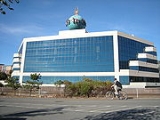
The P-I Globe
The P-I is known for the 13.5-ton, 30 feet (9.1 m) neonNeon sign
Neon signs are made using electrified, luminous tube lights that contain rarefied neon or other gases. They are the most common use for neon lighting, which was first demonstrated in a modern form in December, 1910 by Georges Claude at the Paris Motor Show. While they are used worldwide, neon signs...
globe atop its headquarters on the Elliott Bay
Elliott Bay
Elliott Bay is the body of water on which Seattle, Washington, is located. A line drawn from Alki Point in the south to West Point in the north serves to mark the generally accepted division between the bay and the open sound...
waterfront, which features the words "It's in the P-I" rotating around the globe and an 18 feet (5.5 m) eagle perched atop with wings stretched upwards. The globe originated from a 1947 readers' contest to determine a new symbol for the paper, to be placed atop the paper's then-new headquarters building at 6th Avenue and Wall Street. When the newspaper moved its headquarters again in 1986, to its current location on the waterfront, the globe was relocated to the new building. Over the decades since its first installation, the globe has become a city landmark that, to locals, is as iconic as the Space Needle
Space Needle
The Space Needle is a tower in Seattle, Washington and is a major landmark of the Pacific Northwest region of the United States and a symbol of Seattle. Located at the Seattle Center, it was built for the 1962 World's Fair, during which time nearly 20,000 people a day used the elevators, with over...
. A stylized rendering of the globe appeared on the masthead of the newspaper in its latter years and continues to feature on its website.
Notable employees
Notable employees of the P-I have included the novelists E.B. White, Frank HerbertFrank Herbert
Franklin Patrick Herbert, Jr. was a critically acclaimed and commercially successful American science fiction author. Although a short story author, he is best known for his novels, most notably Dune and its five sequels...
and Tom Robbins
Tom Robbins
Thomas Eugene "Tom" Robbins Thomas Eugene "Tom" Robbins Thomas Eugene "Tom" Robbins (born July 22, 1936 is an American author. His best-selling novels are serio-comic, often wildly poetic stories with a strong social and philosophical undercurrent, an irreverent bent, and scenes extrapolated from...
.
See also
- Hutch AwardHutch AwardThe Hutch Award is given annually to an active Major League Baseball player who best exemplifies the fighting spirit and competitive desire of Fred Hutchinson...
(baseball award bestowed at