
Encyclopedia
Palpatine is a fictional character in
George Lucas's
science fiction saga
Star Wars is a science fantasy [i] [i] and fictional galaxy [i] cr ...
. He was introduced in the films
and
as
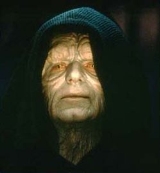
the Emperor, an aged, cowled, and pale-faced figure who walks with a cane. Palpatine appears in the prequel trilogy as a middle-aged politician in the Galactic Republic who rises to power through deception and treachery. The character is featured in the animated miniseries
and in
Star Wars literature.
Scottish actor
Ian McDiarmid portrays the character in the
Star Wars feature films.
Palpatine is the foremost villain in
Star Wars fiction. Born on the planet
Naboo 82 years before the events of
, he is a key politician in the Republic who claims to represent peace and democracy. In reality, Palpatine is
Darth Sidious, a powerful lord of the
Sith sect who practices the dark side of the Force. He initiates and manipulates the Clone Wars to destroy the
Jedi and usher in the totalitarian Galactic Empire. Palpatine's Sith apprentices include
Darth Maul,
Darth Tyranus, and
Darth Vader.
Lucas' original scripts for
Star Wars characterize Palpatine as a cunning but weak politician under the control of powerful bureaucrats. However, in
Return of the Jedi, the prequels, and
Star Wars literature, the character is depicted as the personification of evil. Palpatine was incorporated into the
Star Wars merchandising campaigns that corresponded with the theatrical release of
Return of the Jedi and the prequel films. He has since become a symbol of evil and sinister deception in popular culture.
Appearances
Palpatine is a major character in
Star Wars fiction. He appears in all of the
Star Wars films except
A New Hope, and is featured in the
Clone Wars miniseries. The character has a recurring role in Expanded Universe novels and comics, where his background and influence in the
Star Wars galaxy outside the films are explained.
Star Wars films
The Emperor was first mentioned in
but his first appearance on film is in the second installment of the
original Star Wars trilogy,
, directed by
Irvin Kershner. Lucas and Kershner depict the Emperor as an ancient-looking man with a pale face. As Darth Vader and the Imperial fleet pursue the
Millennium Falcon after the
Battle of Hoth, Vader is notified that the Emperor is attempting to contact him. A
holographic image appears of the Emperor, and tells him that "there is a great disturbance in the Force." This refers to
Luke Skywalker , the "offspring of
Anakin Skywalker." The Emperor believes that the young
Rebel could destroy the Sith: "The Force is strong with him. The son of Skywalker must not become a Jedi." Vader convinces the Emperor that if Luke turns to the dark side, he would become a powerful ally.
The Emperor's second film appearance was in
, the final episode of the original
Star Wars trilogy, directed by
Richard Marquand. The Emperor arrives on the
second Death Star, in orbit around the
forest moon of Endor, to oversee the last stages of its construction. When a Rebel strike team that includes
Han Solo ,
Princess Leia Organa , and Luke Skywalker lands on Endor, Vader senses the presence of his son. Luke believes he can turn Vader, whom he has recently learned is his father, from the dark side. The Emperor convinces Vader that only "
together can we turn him to the dark side of the Force." Luke surrenders to Imperial forces on Endor and is delivered to the Emperor by Darth Vader. The Emperor attempts to convert him to the dark side after the young Jedi defeats his father in a
lightsaber duel. Luke ultimately refuses, and the Emperor attacks him with Force lightning. Vader, horrified at the sight of his son in pain, throws the Emperor into the Death Star's reactor shaft, killing him.
In his 1999 prequel film
, Lucas introduced Palpatine as the senior senator from the planet Naboo. Set 32 years before
A New Hope, the film explains that the
Trade Federation blockades and invades Naboo, forcing its queen—
Padmé Amidala —to flee to the galactic capital of
Coruscant to receive counsel from the senator. He persuades her to make a motion in the Senate to have Chancellor
Finis Valorum removed from office. Once this is accomplished, Palpatine is elected in his place. He promises to fight corruption and weaken the influence of bureaucrats in the government. As the mysterious Darth Sidious , Palpatine secretly manipulates the Trade Federation in order to set up his rise to power. He sends his apprentice,
Darth Maul , to Naboo to oversee the invasion and find the queen. The invasion, however, is thwarted by Jedi
Qui-Gon Jinn and
Obi-Wan Kenobi . Qui-Gon and Darth Maul are killed in a lightsaber duel; after Qui-Gon's funeral, Palpatine tells nine-year-old Anakin Skywalker , "We'll be watching your career with great interest."
Lucas gave Palpatine a minor role in
, set 22 years before
A New Hope, but the character's actions are consequential. The galaxy is on the verge of civil war with several thousand planets seceding from the Republic to form the
Confederacy of Independent Systems, known as the Separatists. They are led by former Jedi
Count Dooku , Darth Sidious's new apprentice. After Obi-Wan discovers a secret
battle droid factory on the Separatist planet
Geonosis, Chancellor Palpatine uses the situation to have himself granted emergency powers. Palpatine tells the Senate, "It is with great reluctance that I have agreed to this calling. I love democracy ... I love the Republic." He promises, "The power you give me I will lay down once this crisis has abated." His first act is to create a
Grand Army of the Republic to counter the Separatist threat. The Separatist crisis and ensuing Clone Wars are both orchestrated by Palpatine as the Sith Lord. At the same time, he recommends that Senator Padmé Amidala be placed under the protection of Obi-Wan and his
padawan Anakin following a failed assassination attempt. This leads to Anakin and Padmé's marriage at the end of the film.
Palpatine's final feature film appearance is in
, set 19 years before
A New Hope. He is captured by Separatist commander
General Grievous during the
Battle of Coruscant. Palpatine is rescued by Obi-Wan and Anakin, but not before the Jedi confront Count Dooku; Anakin decapitates the Sith Lord during the lightsaber duel at Palpatine's urging. The Chancellor has by this point become very powerful and, due to his emergency powers, remained in office long after his term expired. The
Jedi Council is troubled by Palpatine's power and fears he will not relinquish it when the Clone Wars end. Palpatine raises their suspicions further by interfering in Jedi affairs. He requests that Anakin be placed on the council as his personal representative. He and Anakin have become close friends and the council wants to use the relationship to spy on the Chancellor. Uneasy about deceiving his friend, Anakin reveals the Jedi's plan to Palpatine, who replies that the Jedi are afraid to give up their power. Palpatine then tells Anakin the story of Darth Plagueis the Wise, a powerful Sith Lord who was able to create life and stop death but was killed by his apprentice .
Palpatine informs Anakin Skywalker that he is the Sith Lord the Jedi have been searching for; he tempts Anakin with promises of dark side power. Palpatine knows that Anakin has been having visions of his wife, Padmé, dying in childbirth and offers to teach him the secrets of Darth Plagueis to save her life. Anakin informs Jedi Master
Mace Windu that Palpatine is a Sith Lord. When Mace and three other Jedi masters attempt to arrest Palpatine, they are killed when Anakin interferes on Palpatine's behalf. During the conflict, Palpatine is disfigured by his own Force lightning. Anakin becomes Palpatine's new apprentice, Darth Vader, and is sent to destroy the
Jedi Temple and the Separatist leaders at
Mustafar. Palpatine initiates Order 66, which instructs the Republic's
clone troopers to kill the Jedi by considering them traitors of the Republic, and he announces to the Senate that the Jedi were planning to overthrow the Republic. In the name of law and order the Republic becomes the Galactic Empire. However, Jedi Master
Yoda survives Order 66 and confronts Palpatine in his Senate office, but Palpatine proves to be too powerful and so Yoda must flee the battle. Meanwhile, Obi-Wan goes to Mustafar to confront Darth Vader. Sensing his apprentice is in trouble, Palpatine travels to the volcanic planet where he finds Vader near death, having lost his left arm and both legs and suffered life-threatening burns. He returns to Coruscant with Vader and revives him with a black suit and cyborg limbs. He then tells Vader of Padmé's death, and that "it seems, in your anger, you killed her." Palpatine is last seen examining the construction of the Death Star alongside Darth Vader. In the series, Palpatine is busy on Coruscant running the government and Darth Sidious appears as a hologram giving orders to Count Dooku, General Grievous, and other Separatist leaders. The character is based on Ian McDiarmid's likeness in
The Phantom Menace and
Attack of the Clones.
In the first chapter, Obi-Wan informs Palpatine that the Jedi have discovered that the InterGalactic Banking Clan has established battle droid factories on the planet Muunilinst. Palpatine agrees to send a strike force that includes Obi-Wan and Anakin, but Palpatine suggests that Anakin be given "special command" of Obi-Wan's fighters. Yoda and Obi-Wan initially speak against it, but reluctantly concede to the Chancellor. In another chapter, Darth Sidious appears to Count Dooku as a holographic image shortly after Dooku trains
Asajj Ventress, a Force-sensitive female alien adept in the dark side. Sidious orders her to track down and kill Anakin Skywalker. He remarks to Count Dooku that her failure is certain, but the point of her mission is to test Anakin.
Chapter 22 features the training of General Grievous by Count Dooku. Darth Sidious appears as a hologram and orders Grievous to begin the special mission: an assault on the galactic capital. The Separatist invasion of Coruscant begins in the next episode, and Palpatine watches from his Senate office window. He is protected by Jedi
Shaak Ti,
Roron Corobb, and
Foul Moudama. Grievous breaks through the Chancellor's window and kidnaps him. Roron and Foul are killed by Grievous as Palpatine is taken to the
Invisible Hand, Grievous's flagship.
Star Wars literature
Star Wars Expanded Universe literature elaborates on Palpatine's role in
Star Wars fiction outside of the
Star Wars films. The first mention of Palpatine in
Star Wars literature is in Alan Dean Foster's novelization of the script of
A New Hope, published as
. Palpatine's first major appearance in the Expanded Universe came in 1991 and 1992 with the
Dark Empire was a series of comic book [i]s written by Tom Veitch [i] and illustrated by Cam Kennedy [i] ...
series of comic books written by Tom Veitch and illustrated by Cam Kennedy. In the series, set six years after
Return of the Jedi, Palpatine is resurrected as
the Emperor Reborn or
Palpatine the Undying. His spirit returns from the netherworld of the Force with the aid of Sith Lord ghosts on
Korriban and possesses the body of
Jeng Droga, one of Palpatine's elite spies and assassins known as the
Emperor's Hands. Droga flees to a secret Imperial base on the planet Byss, where the Emperor's advisor Sate Pestage exorcises Palpatine's spirit and channels it into one of many
clones created by Palpatine before his death. Palpatine attempts to resume control of the galaxy, but his plans are sabotaged by now Jedi Master Luke Skywalker. He manages to destroy most of Palpatine's cloning tanks, but is only able to defeat the Emperor with the aid of Princess Leia.
The fate of Palpatine is further chronicled in the
Dark Empire II and
Empire's End series of comics. The
Dark Empire II series, published from 1994 to 1995, details how the Emperor is once again reborn on Byss into a clone body. Palpatine tries to rebuild the Empire as the Rebel Alliance grows impotent. In
Empire's End , a traitorous
Imperial guard bribes Palpatine's cloning supervisor to tamper with the Emperor's stored
DNA samples. This causes the clones to deteriorate at a rapid rate. Palpatine attempts to possess the body of
Anakin Solo, the infant son of Han Solo and Princess Leia, before the clone body dies, but is thwarted by Luke Skywalker and other Jedi knights. Palpatine is killed by a blaster shot fired by Han. His spirit is captured by a wounded Jedi named
Empatojayos Brand who uses his remaining strength to prevent Palpatine's spirit from escaping. When Brand dies, he takes Palpatine's spirit to the netherworld with him.
Novels and comics published before 1999 focus on Palpatine's role as Galactic Emperor.
by Steve Perry and
The Mandalorian Armor is a Star Wars [i] Expanded Universe [i] novel. ...
by K. W. Jeter—all set between
The Empire Strikes Back and
Return of the Jedi—show how Palpatine uses crime lords such as
Prince Xizor and bounty hunters like
Boba Fett to fight his enemies. Barbara Hambly's novel
Children of the Jedi is a 1995 bestselling [i] fictional
Star Wars [i] ...
, set eight years after
Return of the Jedi, features a woman named
Roganda Ismaren who claims that Palpatine fathered her son
Irek. The
Jedi Prince is the name of a series of novels set in the Star Wars [i] universe. ...
series of novels introduces an insane, three-eyed mutant named
Triclops as Palpatine's true son.
Beginning in 1999 with
Terry Brooks's ,
Star Wars writers chronicled the role of Palpatine prior to
A New Hope as a politician and Sith Lord. The comic "Marked" by Rob Williams, printed in
Star Wars Tales 24 , and Michael Reaves's novel
explain Darth Sidious's relationship with his apprentice Darth Maul.
Cloak of Deception is a novel [i] set in the
Star Wars [i] galaxy [i]. ...
by James Luceno follows Reaves's novel and details how Darth Sidious encourages the Trade Federation to build an army of battle droids in preparation for the invasion of Naboo.
Cloak of Deception also focuses on Palpatine's political activity. It is revealed how he becomes a confidante of Chancellor Finis Valorum and acquainted with Padmé Amidala, newly elected queen of Naboo. Palpatine's role during the Clone Wars as Chancellor and Darth Sidious is explained in novels such as
Matthew Stover's
Shatterpoint is a science fiction [i] novel [i] by Matthew Stover [i] set in the
Star Wars [i] galaxy [i] ...
,
Steven Barnes's
The Cestus Deception , Sean Stewart's
, and Luceno's
Labyrinth of Evil .
Following the theatrical release of
Revenge of the Sith,
Star Wars literature focused on the role of Palpatine after the creation of the Empire. John Ostrander's comic
chronicles how Emperor Palpatine sends Darth Vader to assassinate Sagoro Autem, an Imperial captain who wants nothing to do with the new government and plans to defect. In Luceno's novel
, the Emperor sends Darth Vader to the planet Murkhana to discover why clone troopers there refused to carry out Order 66 against their Jedi generals. Palpatine hopes these early missions will teach Vader what it means to be a Sith and crush any remnants of Anakin Skywalker.
Characteristics
In
Star Wars fiction, Palpatine is described as a manipulative and ambitious politician, a ruthless emperor, and an evil Sith Lord. Palpatine had great patience and his maneuverings were as a dejarik grandmaster moved pieces on a board; he was a diabolical
genius and self-proclaimed savior. The
Star Wars Databank describes him as "the supreme ruler of the most powerful tyrannical regime the galaxy had ever witnessed" Darth Vader himself reminds
Moff Jerjerrod, "The Emperor is not as forgiving as I am." Palpatine is "the most powerful practitioner of the Sith ways in modern times." The comic "Sithisis" by Derek Thompson, printed in
, reveals the extent of Darth Sidious's power as he performs a terrifying Sith ritual that manipulates people and places across the galaxy. Palpatine is so powerful that he is able to mask his true identity from the Jedi. In
Shatterpoint, Mace Windu remarks to Yoda, "A shame [Palpatine] can't touch the Force. He might have been a fine Jedi."
The Databank explains that the Force "granted him inhuman dexterity and speed, agility enough to quickly kill three Jedi Masters" in seconds.
Thompson's "Sithisis" comic suggests that Palpatine is able to mask his appearance through the Force, George Lucas explained in an interview that he also patterned the Emperor after several historical figures, including
Julius Caesar,
Napoleon Bonaparte,
Adolf Hitler, and
Richard Nixon. Lucas said, "The whole point of the movies, the underlying element that makes the movies work, is that you, whether you go backwards or forwards, you start out in a democracy, and democracy turns into a dictatorship, and then the rebels make it back into a democracy." With the release of
Revenge of the Sith in 2005, film critics and commentators pointed out similarities between the politics of
Star Wars and the presidential administration of
George W. Bush. Lucas told
USA Today is a national American [i] newspaper [i] published by the Gannett Corporation [i] ...
, "When I wrote this,
Iraq didn't exist." But he adds, "We were just funding
Saddam Hussein and giving him
weapons of mass destruction. [T]he parallels between
Vietnam and what we're doing in Iraq now are unbelievable."
Film historian Laurent Bouzereau reports that Lucas and Leigh Brackett decided that "the Emperor and the Force had to be the two main concerns in the [
Empire Strikes Back]; the Emperor had barely been dealt with in the first movie, and the intention in the sequel was to deal with him on a more concrete level." Instead, Lucas decided to feature the Emperor in
Return of the Jedi.
Lucas wanted to establish the Emperor as the true source of evil in
Star Wars. Script writer Lawrence Kasdan noted, "My sense of the relationship [between Darth Vader and the Emperor] is that the Emperor is much more powerful ... and that Vader is very much intimidated by him. Vader has dignity, but the Emperor in
Jedi really has all the power." He explained that the climax of the film is a confrontation between Darth Vader and his master. In the first scene that shows the Emperor, he arrives at the Death Star and is greeted by a host of
stormtroopers, technicians, and other personnel. Lucas states he wanted it to look like the
military parades on "May Day in
Russia".
Palpatine's role in
The Phantom Menace is to explain "how Anakin Skywalker came to be [Palpatine's] apprentice" and the events that lead to his rise to power. The true identity of Darth Sidious—the phantom menace—is left a mystery. His relationship to Palpatine is not clear. Film critic Jonathan L. Bowen remarks, "Debates raged on the Internet concerning the relationship between Darth Sidious and Senator Palpatine. Most fans believed the two characters are actually the same person with logic seeming to support their conclusion." Bowen notes that the debate was fueled by the fact that "suspiciously Darth Sidious does not appear in the credits."
Ian McDiarmid
When the Emperor appeared on film for the first time in
The Empire Strikes Back, he was portrayed by an unidentified old woman in prosthetic make-up. Chimpanzee eyes were superimposed into darkened eye sockets during post-production "in order to create a truly unsettling image". The character was voiced by Clive Revill.
Lucas and
Return of the Jedi director
Richard Marquand cast
Scottish Shakespearean actor Ian McDiarmid to play Emperor Palpatine. He was in his mid-30s and had never played a leading role in a feature film, but he had made minor appearances in films like
Dragonslayer is a 1981 [i] fantasy [i] movie [i] set in a realistically portrayed ...
. Despite his inexperience with motion pictures, McDiarmid "create[d] a modern day icon of cinematic evil." After
Return of the Jedi, he resumed stage acting in
London.
In an interview with
BackStage, McDiarmid revealed that he "never had his sights set on a film career and never even auditioned for the role of Palpatine." He elaborated, "I got called in for the interview after a
Return of the Jedi casting director saw me perform in the
Sam Shepard play
Seduced at a studio theatre at the Royal Court. I was playing a dying
Howard Hughes[.]"
McDiarmid was surprised when Lucas approached him 16 years after
Return of the Jedi to reprise the role of Palpatine. In an interview, he stated, "When we were doing
Return of the Jedi there was a rumor that George Lucas had nine films in his head, and he'd clearly just completed three of them." McDiarmid added, "Someone said that, 'Oh, I think what he might do next is go back in time, and show how Vader came to be.' It never occurred to me in a million years that I would be involved in that, because I thought, 'oh well, then he'll get a much younger actor [to play Palpatine].' That would be obvious." However, "I was the right age, ironically, for the first prequel when it was made. ... So I was in the very strange and rather wonderful paradox of playing myself when young at my own age, having played myself previously when 100-and-I-don't-know-what."
Recalling the initial days of shooting
The Phantom Menace, McDiarmid stated, "Stepping onto the set of
Episode I for the first time was like going back in time, due to my experience in
Jedi. Palpatine's an interesting character; he's conventional on the outside, but demonic on the inside—he's on the edge, trying to go beyond what's possible." McDiarmid added another layer to the character in
Attack of the Clones. He noted, "[Palpatine] is a supreme actor. He has to be even more convincing than somebody who isn't behaving in a
schizophrenic fashion, so he's extra charming, or extra professional—and for those who are looking for clues, that's almost where you can see them." McDiarmid illuminated on the scene where Padmé Amidala is almost assassinated:
There's a moment in one scene of the new film where tears almost appear in his eye. These are crocodile tears, but for all those in the movie, and perhaps watching the movie itself, they'll see he is apparently moved—and of course, he is. He can just do it. He can, as it were, turn it on. And I suppose for him, it's also a bit of a turn-on—the pure exercise of power is what he's all about. That's the only thing he's interested in and the only thing that can satisfy him—which makes him completely fascinating to play, because it is an evil soul. He is more evil than the devil. At least Satan fell—he has a history, and it's one of revenge.
In
Revenge of the Sith, McDiarmid had to play a darker Palpatine. He explained that "[w]hen you're playing a character of solid blackness, that in itself is very interesting, in the sense that you have no other motivation other than the accumulation of power. It's not so much about not having a moral center, it's just that the only thing that mattered is increasing power." He admitted, "I've been trying to find a redeeming feature to Palpatine, and the only one I've got so far is that he's clearly a patron of the arts because he goes to the opera." McDiarmid compared the character to
Iago from the Shakespeare tragedy
Othello is a tragedy [i] by William Shakespeare [i] written aroun ...
:
Everything he does is an act of pure hypocrisy, and that's interesting to play. I suppose it's rather like playing Iago. All the characters in the play—including Othello until the end—think that "Honest Iago" is a decent guy doing his job, and he's quite liked. But at the same time there's a tremendous evil subconscious in operation. Advanced fencing and acrobatic stunts were executed by McDiarmid's doubles, Michael Byrne, Sebastian Dickins, and Bob Bowles.
McDiarmid's performance as Palpatine was generally well-received by critics. Todd McCarthy of Variety commented, "Entertaining from start to finish and even enthralling at times, 'Sith' has some acting worth writing home about, specifically McDiarmid's dominant turn as the mastermind of the evil empire." A reviewer for The Village Voice is a free weekly newspaper in New York City [i] featuring investigative articles, ...
wrote that "Ian McDiarmid's unctuous Emperor—who bears a strange resemblance to Pope Benedict XVI, sunken eyes and all—turns appropriately vampiric as he attempts to draw Anakin into the Sith fold with promises of eternal life."
Make-up and costumes
Ian McDiarmid required little make-up in The Phantom Menace and Attack of the Clones, he recalled, "I'm ... slightly aged [in Attack of the Clones]. In the last film, I had a fairly standard make-up on, but now, they're starting to crinkle my face." Transforming McDiarmid into Emperor Palpatine in Return of the Jedi and Revenge of the Sith, however, required extensive make-up. McDiarmid remarked in an interview with Star Wars Insider magazine, "Yes—that was a four-hour job, initially, although we got it down to about two-and-a-half in the end. But this was just a little bit of latex here and there, a little bit of skin-scrunching."
Palpatine's wardrobe, tailored by costume designer Trisha Biggar, played an important part in the development of the character throughout the films. In Attack of the Clones, explained McDiarmid, "The costumes ... have got much more edge to them, I think, than the mere Senator had [in The Phantom Menace]. So we see the trappings of power."
Academics have debated the relationship of Palpatine to modern culture. Religion scholars Ross Shepard Kraemer, William Cassidy, and Susan Schwartz compare Palpatine and Star Wars heroes to the theological concept of dualism. They insist, "One can certainly picture the evil emperor in Star Wars as Satan, complete with his infernal powers, leading his faceless minions such as his red-robed Imperial Guards." Lawrence and Jewett argue that the killing of Palpatine in Return of the Jedi represented "the permanent subduing of evil". They assert that the "notion that the Light Side must battle against the Dark Side is a hoary artifact of European- and American-style crusades against evil" and "antithetical to the democratic understanding of governance."
Palpatine in mass media
Palpatine's role in popular culture extends beyond the Star Wars universe and its fans. Since the release of Return of the Jedi, Palpatine has become synonymous in American mass media with evil, deception, manipulation, and power. The character is utilized as a literary device—either as a simile or metaphor—to emphasize these traits. For example, one of the characters from Orland Outland's novel Every Man for Himself is described as "rubbing his hands together in imitation of the emperor in Return of the Jedi." He says, "Everything is happening exactly as I have foreseen!"
In film and television, Palpatine's likeness is similarly used as a parody. Comedy series such as The Simpsons is an Emmy [i] and Peabody [i]-winning American [i] animated [i] ...
, South Park is a Peabody [i] and Emmy Award [i]-winning American [i] animated television series [i]...
, American Dad!, and Family Guy is an American [i] animated comedy [i] created b ...
have employed Palpatine's image to satirize characters and public figures. For instance, in the South Park episode "Best Friends Forever" that aired March 30, 2005, Satan sends his boyfriend Kevin, a parody of Emperor Palpatine, to secretly manipulate the Republican-controlled Congress into opposing human euthanasia to prevent a character from dying and going to Heaven.
Shortly after the release of Revenge of the Sith, a Fox News editorial stated, "No cultural icon can exist without someone trying to stuff it into a political ideology. The Star Wars saga, the greatest pop culture icon of the last three decades, is no exception." It continues, "Palpatine's dissolution of the Senate in favor of imperial rule has been compared to Julius Caesar's marginalization of the Roman Senate, Hitler's power-grab as chancellor, and FDR's court-packing scheme and creation of the imperial presidency."
Notes
Further reading
External links