

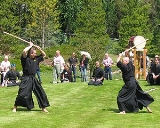
Kenjutsu

Encyclopedia
, meaning "the method, or technique, of the sword." This is opposed to kendo, which means the way of the sword. Kenjutsu is the umbrella term for all traditional (koryū
) schools of Japanese swordsmanship, in particular those that predate the Meiji Restoration
. It sometimes more generally describes any martial art that uses the Japanese sword, including the modern styles of Kendo
and Iaido
that emerged from the traditional schools in the late 19th century.
The exact activities undertaken when practising kenjutsu vary with school, but commonly include practice of battlefield techniques without opponent and techniques where two persons paired kata
(featuring full contact strikes in some styles).
Historically schools incorporated sparring
under a variety of conditions, from using solid wooden bokutō to use of bamboo sword (shinai
) and armor (bogu
). In modern times sparring in Japanese swordsmanship is more strongly associated with Kendo
.
via Korean peninsula
. While swords clearly played an important cultural and religious role in ancient Japan, it is in the Heian period
when the globally recognised curved Japanese sword was developed, and when swords became an important weapon, as well as a symbolic item. No known Kenjutsu lineage survives from this period, the oldest schools still in existence today arose in the Muromachi period
(1336 to 1573), known for long periods of inter-state warfare. Three major schools emerged during this period.
These schools form the ancestors for many descendent styles, for example from Ittō ryū has branched Ono-ha Ittō ryū and Mizoguchi-ha Ittō-ryū (among many others).
On the island of Okinawa, the art of Motobu Udundi includes a unique method of both Kenjutsu and Iaijutsu
. This is the only surviving sword system from Okinawa. It was the martial art of the noble Motobu family during the period of the Ryukyu Kingdom.
schools proliferated to number more than five hundred, and training techniques & equipment advanced, giving rise to the development of the bamboo practice sword, the shinai, and protective armor, bogu. This allowed practice of full speed techniques in sparring, while reducing risk of serious harm to the practitioner. Prior to this, training in Kenjutsu had consisted mainly of basic technique practice and paired kata
, using solid wooden practice swords (bokutō), or live blades.
class was officially dissolved at this time, kenjutsu fell into decline, an unpopular reminder of the past. This decline continued for approximately twenty years, until rising national confidence led to an increase of the uptake of traditional sword arts again, particularly in the military and the police.
In 1886 the Japanese Police gathered together kata from a variety of kenjutsu schools into a standardised set for training purposes. This process of standardization of martial training continued when, in 1895, a body for martial arts in Japan, the Dai Nippon Butoku Kai
, was established. Work on standardizing kenjutsu kata continued for years, with several groups involved, until in 1912 an official edict was released by the Dai Nippon Butoku Kai. This edict highlighted a lack of unity in teaching, and introduced a standard core teaching curriculum to which the individual kenjutsu schools would add their distinctive techniques. This core curriculum, and its ten kata evolved into the modern martial art of kendo. This point could be regarded as the end of the development of kenjutsu and the kenjutsu was transmitted to the modern kendo.
are relatively thin and without a handguard in order to match the school's characteristic approach to combat. Alternatively, Kashima Shin-ryū practitioners use a thicker than average bokuto with no curvature and with a rather large hilt. This of course lends itself well to Kashima Shin-ryū's distinct principles of combat.
Some schools practice with fukuro shinai (a bamboo sword covered with leather or cloth) under circumstances where the student lacks the ability to safely control a bokuto at full speed or as a general safety precaution. In fact, the fukuro shinai dates as far back as the 15th century.
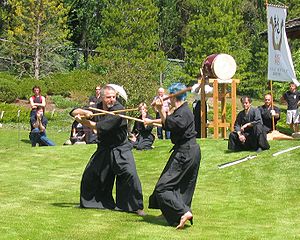 A distinguishing feature of many kenjutsu syllabi is the use of a paired katana or daitō and wakizashi or shōtō commonly referred to as . Styles that teach it are called ; contrast . The most famous exponent of nitōjutsu was Miyamoto Musashi
(1584 – 1645), the founder of Hyōhō Niten Ichi-ryū
, who advocates it in The Book of Five Rings
. Nitōjutsu is not however unique to Hyoho Niten Ichi-ryū, nor was nitōjutsu the creation of Musashi. Both Tenshin Shōden Katori Shinto-ryū were founded in the early Muromachi period
(ca. 1447), and Tatsumi-ryu
founded Eishō period (1504–1521), contain extensive nitōjutsu curricula while also preceding the establishment of Musashi’s Hyoho Niten Ichi-ryū.
Koryu
is a Japanese word that is used in association with the ancient Japanese martial arts. This word literally translates as "old school" or "traditional school"...
) schools of Japanese swordsmanship, in particular those that predate the Meiji Restoration
Meiji Restoration
The , also known as the Meiji Ishin, Revolution, Reform or Renewal, was a chain of events that restored imperial rule to Japan in 1868...
. It sometimes more generally describes any martial art that uses the Japanese sword, including the modern styles of Kendo
Kendo
, meaning "Way of The Sword", is a modern Japanese martial art of sword-fighting based on traditional Japanese swordsmanship, or kenjutsu.Kendo is a physically and mentally challenging activity that combines strong martial arts values with sport-like physical elements.-Practitioners:Practitioners...
and Iaido
Iaido
is a modern Japanese martial art associated with the smooth, controlled movements of drawing the sword from its scabbard, striking or cutting an opponent, removing blood from the blade, and then replacing the sword in the scabbard...
that emerged from the traditional schools in the late 19th century.
The exact activities undertaken when practising kenjutsu vary with school, but commonly include practice of battlefield techniques without opponent and techniques where two persons paired kata
Kata
is a Japanese word describing detailed choreographed patterns of movements practised either solo or in pairs. The term form is used for the corresponding concept in non-Japanese martial arts in general....
(featuring full contact strikes in some styles).
Historically schools incorporated sparring
Sparring
Sparring is a form of training common to many martial arts. Although the precise form varies, it is essentially relatively 'free-form' fighting, with enough rules, customs, or agreements to make injuries unlikely...
under a variety of conditions, from using solid wooden bokutō to use of bamboo sword (shinai
Shinai
is a weapon used for practice and competition in kendo representing a Japanese sword. Shinai are also used in other martial arts, but may be styled differently from kendo shinai, and represented with different characters....
) and armor (bogu
Bogu
is training armour used primarily in the Japanese martial art of kendo, with variants used for jukendo, naginatajutsu, and sojutsu. The name consists of two parts: bō meaning "protect" or "defend," and gu meaning "equipment" or "tool." A set of bogu has four components:: combined face mask and...
). In modern times sparring in Japanese swordsmanship is more strongly associated with Kendo
Kendo
, meaning "Way of The Sword", is a modern Japanese martial art of sword-fighting based on traditional Japanese swordsmanship, or kenjutsu.Kendo is a physically and mentally challenging activity that combines strong martial arts values with sport-like physical elements.-Practitioners:Practitioners...
.
Early development
It is thought likely that the first iron swords were manufactured in Japan in the fourth century, based on technology imported from ChinaChina
Chinese civilization may refer to:* China for more general discussion of the country.* Chinese culture* Greater China, the transnational community of ethnic Chinese.* History of China* Sinosphere, the area historically affected by Chinese culture...
via Korean peninsula
Korean Peninsula
The Korean Peninsula is a peninsula in East Asia. It extends southwards for about 684 miles from continental Asia into the Pacific Ocean and is surrounded by the Sea of Japan to the south, and the Yellow Sea to the west, the Korea Strait connecting the first two bodies of water.Until the end of...
. While swords clearly played an important cultural and religious role in ancient Japan, it is in the Heian period
Heian period
The is the last division of classical Japanese history, running from 794 to 1185. The period is named after the capital city of Heian-kyō, or modern Kyōto. It is the period in Japanese history when Buddhism, Taoism and other Chinese influences were at their height...
when the globally recognised curved Japanese sword was developed, and when swords became an important weapon, as well as a symbolic item. No known Kenjutsu lineage survives from this period, the oldest schools still in existence today arose in the Muromachi period
Muromachi period
The is a division of Japanese history running from approximately 1336 to 1573. The period marks the governance of the Muromachi or Ashikaga shogunate, which was officially established in 1338 by the first Muromachi shogun, Ashikaga Takauji, two years after the brief Kemmu restoration of imperial...
(1336 to 1573), known for long periods of inter-state warfare. Three major schools emerged during this period.
- Kage-ryū (Aizu)Kage-ryu (Aizu)is a traditional school of swordsmanship founded by Aizu Hyūga-no-Kami Iko in c.1490. This school is also sometimes called Aizu Kage-ryū after the name of its founder...
(Aisukage ryū) - Chujo-ryūChujo-ryuChujō-ryū is a koryū martial art founded in the 14th century by Chujō Nagahide, who studied under Nenami Okuyama Jion and his Nen-ryū style of swordsmanship.-History:...
- Tenshin Shōden Katori Shintō-ryūTenshin Shoden Katori Shinto-ryuis one of the oldest extant Japanese martial arts, and an exemplar of koryū bujutsu. The Tenshin Shōden Katori Shintō-ryū was founded by Iizasa Ienao, born 1387 in Iizasa village , who was living near Katori Shrine at the time...
These schools form the ancestors for many descendent styles, for example from Ittō ryū has branched Ono-ha Ittō ryū and Mizoguchi-ha Ittō-ryū (among many others).
On the island of Okinawa, the art of Motobu Udundi includes a unique method of both Kenjutsu and Iaijutsu
Iaijutsu
, the art of drawing the Japanese sword. One of Japanese martial disciplines in education of the classical warrior .-Etymology:"Iaijutsu" was known before the Tokugawa period but it is unclear exactly when the term "iaijutsu" first came into use, or when exactly drawing the katana from its...
. This is the only surviving sword system from Okinawa. It was the martial art of the noble Motobu family during the period of the Ryukyu Kingdom.
Edo Period
During the Edo periodEdo period
The , or , is a division of Japanese history which was ruled by the shoguns of the Tokugawa family, running from 1603 to 1868. The political entity of this period was the Tokugawa shogunate....
schools proliferated to number more than five hundred, and training techniques & equipment advanced, giving rise to the development of the bamboo practice sword, the shinai, and protective armor, bogu. This allowed practice of full speed techniques in sparring, while reducing risk of serious harm to the practitioner. Prior to this, training in Kenjutsu had consisted mainly of basic technique practice and paired kata
Kata
is a Japanese word describing detailed choreographed patterns of movements practised either solo or in pairs. The term form is used for the corresponding concept in non-Japanese martial arts in general....
, using solid wooden practice swords (bokutō), or live blades.
Decline
Beginning in 1868, the Meiji Restoration led to the breakup of the military class and the modernization of Japan along the lines of western industrial nations. As the samuraiSamurai
is the term for the military nobility of pre-industrial Japan. According to translator William Scott Wilson: "In Chinese, the character 侍 was originally a verb meaning to wait upon or accompany a person in the upper ranks of society, and this is also true of the original term in Japanese, saburau...
class was officially dissolved at this time, kenjutsu fell into decline, an unpopular reminder of the past. This decline continued for approximately twenty years, until rising national confidence led to an increase of the uptake of traditional sword arts again, particularly in the military and the police.
In 1886 the Japanese Police gathered together kata from a variety of kenjutsu schools into a standardised set for training purposes. This process of standardization of martial training continued when, in 1895, a body for martial arts in Japan, the Dai Nippon Butoku Kai
Dai Nippon Butoku Kai
is a Japanese martial arts organization established in 1895 in Kyoto, Japan, under the authority of the Ministry of Education and sanction of the Emperor Meiji. Its purpose, at that time, was to standardize martial disciplines and systems throughout Japan. This was the first official martial arts...
, was established. Work on standardizing kenjutsu kata continued for years, with several groups involved, until in 1912 an official edict was released by the Dai Nippon Butoku Kai. This edict highlighted a lack of unity in teaching, and introduced a standard core teaching curriculum to which the individual kenjutsu schools would add their distinctive techniques. This core curriculum, and its ten kata evolved into the modern martial art of kendo. This point could be regarded as the end of the development of kenjutsu and the kenjutsu was transmitted to the modern kendo.
Weapons
One of the more common training weapon is the wooden sword (bokuto or bokken). For various reasons, many schools make use of very specifically designed bokuto, altering its shape, weight and length according to the style's specifications. For example, bokuto used within Yagyū Shinkage-ryūYagyu Shinkage-ryu
is one of the oldest Japanese schools of swordsmanship . Its primary founder was Kamiizumi Nobutsuna, who called the school Shinkage-ryū. In 1565, Nobutsuna bequeathed the school to his greatest student, Yagyū Munetoshi, who added his own name to the school. Today, the Yagyū Shinkage-ryū remains...
are relatively thin and without a handguard in order to match the school's characteristic approach to combat. Alternatively, Kashima Shin-ryū practitioners use a thicker than average bokuto with no curvature and with a rather large hilt. This of course lends itself well to Kashima Shin-ryū's distinct principles of combat.
Some schools practice with fukuro shinai (a bamboo sword covered with leather or cloth) under circumstances where the student lacks the ability to safely control a bokuto at full speed or as a general safety precaution. In fact, the fukuro shinai dates as far back as the 15th century.
Nitōjutsu
Miyamoto Musashi
, also known as Shinmen Takezō, Miyamoto Bennosuke or, by his Buddhist name, Niten Dōraku, was a Japanese swordsman and rōnin. Musashi, as he was often simply known, became renowned through stories of his excellent swordsmanship in numerous duels, even from a very young age...
(1584 – 1645), the founder of Hyōhō Niten Ichi-ryū
Hyoho Niten Ichi-ryu
, which can be loosely translated as "the school of the strategy of two heavens as one", is a koryū , transmitting a style of classical Japanese swordsmanship conceived by the warrior Miyamoto Musashi...
, who advocates it in The Book of Five Rings
The Book of Five Rings
is a text on kenjutsu and the martial arts in general, written by the samurai warrior Miyamoto Musashi circa 1645. There have been various translations made over the years, and it enjoys an audience considerably broader than only that of martial artists: for instance, some business leaders find its...
. Nitōjutsu is not however unique to Hyoho Niten Ichi-ryū, nor was nitōjutsu the creation of Musashi. Both Tenshin Shōden Katori Shinto-ryū were founded in the early Muromachi period
Muromachi period
The is a division of Japanese history running from approximately 1336 to 1573. The period marks the governance of the Muromachi or Ashikaga shogunate, which was officially established in 1338 by the first Muromachi shogun, Ashikaga Takauji, two years after the brief Kemmu restoration of imperial...
(ca. 1447), and Tatsumi-ryu
Tatsumi-ryu
is a traditional school of Japanese martial arts founded in the early 16th century by Tatsumi Sankyo.-History:Tatsumi Sankyo was born in what is now Ehime Prefecture, Japan, on Shikoku island. He is thought to have been active as a warrior in the Eishō Era . Tatsumi trained in the martial arts...
founded Eishō period (1504–1521), contain extensive nitōjutsu curricula while also preceding the establishment of Musashi’s Hyoho Niten Ichi-ryū.
Disciplines
Hiroshi Ozawa- BattōjutsuBattojutsuis a Japanese term meaning techniques for engaging a sword. It is often used interchangeably with the terms iaijutsu, battōdō, or iaidō, although each term does have nuances in the Japanese language and different schools of Japanese martial arts may use them to differentiate between techniques...
- TojutsuTojutsutranslates literally as "sword techniques". Tō is a very general Japanese word for sword, and has no connotations with particular sizes, lengths or styles. It can be likened to the English noun 'blade'. The term Tojutsu is rarely used or mentioned in martial arts sources...
Notable Kensei
- Iizasa Choisai Ienao
- Yagyu MunenoriYagyu Munenoriwas a Japanese swordsman, founder of the Edo branch of Yagyū Shinkage-ryū, which he learned from his father Yagyū "Sekishusai" Muneyoshi. This was one of two official sword styles patronized by the Tokugawa Shogunate...
- Miyamoto MusashiMiyamoto Musashi, also known as Shinmen Takezō, Miyamoto Bennosuke or, by his Buddhist name, Niten Dōraku, was a Japanese swordsman and rōnin. Musashi, as he was often simply known, became renowned through stories of his excellent swordsmanship in numerous duels, even from a very young age...
- Takeda ShingenTakeda Shingen, of Kai Province, was a preeminent daimyo in feudal Japan with exceptional military prestige in the late stage of the Sengoku period.-Name:Shingen was called "Tarō" or "Katsuchiyo" during his childhood...
- Sasaki KojiroSasaki Kojirowas a prominent Japanese swordsman widely considered as a Kensei, born in Fukui Prefecture. He lived during the Sengoku and early Edo periods and is most remembered for his death while battling Miyamoto Musashi in 1612.-History:...
- Ito Ittosai KagehisaIto Ittosai Kagehisawas a famous yet mysterious Japanese swordsman rumored never to have lost a duel. He is attributed as the founder of the Ittō-ryū school of sword fighting....
- Yamaoka TesshuYamaoka Tesshualso known as Ono Tetsutarō, or Yamaoka Tetsutarō, was a famous samurai of the Bakumatsu period, who played an important role in the Meiji Restoration...
- Okita Souji
Sources
- Classical Warrior Traditions of Japan - 3-volume set by Diane Skoss (Koryu Books):
- Koryu Bujutsu: Classical Warrior Traditions Of Japan ISBN 1-890536-04-0
- Sword & Spirit: Classical Warrior Traditions Of Japan, Volume 2 ISBN 1-890536-05-9
- Keiko Shokon: Classical Warrior Traditions of Japan, Volume 3 ISBN 1-890536-06-7
See also
- Japanese martial artsJapanese martial artsJapanese martial arts refers to the enormous variety of martial arts native to Japan. At least three Japanese terms are often used interchangeably with the English phrase "Japanese martial arts": , literally meaning "martial way", , which has no perfect translation but means something like science,...
- Hyoho Niten Ichi-ryūHyoho Niten Ichi-ryu, which can be loosely translated as "the school of the strategy of two heavens as one", is a koryū , transmitting a style of classical Japanese swordsmanship conceived by the warrior Miyamoto Musashi...
- Kashima Shinden Jikishinkage-ryūKashima Shinden Jikishinkage-ryu, often referred to simply as Jikishinkage-ryū or Kashima Shinden, is a traditional school of the Japanese martial art of swordsmanship...
- Kashima Shin-ryūKashima-ShinryuKashima Shinryū is a nearly 500 years old Japanese koryu martial art. The art was somewhat popularized in the 20th century by Kunii Zen'ya , the 18th generation soke . The Current 'Soke' is 21st Generation Kunii Masakatsu...
- Kashima Shinto-ryūKashima Shinto-ryu' is a traditional school of Japanese martial arts founded by Tsukahara Bokuden in the Muromachi period .Due to its formation during the tumultuous Sengoku Jidai, a time of feudal war, the school's techniques are based on battlefield experience and revolve around finding weak points in the...
- KendoKendo, meaning "Way of The Sword", is a modern Japanese martial art of sword-fighting based on traditional Japanese swordsmanship, or kenjutsu.Kendo is a physically and mentally challenging activity that combines strong martial arts values with sport-like physical elements.-Practitioners:Practitioners...
- Maniwa Nen-ryūManiwa Nen-ryuManiwa Nen-ryū is a traditional school of Japanese martial arts founded in 1591 by Higuchi Matashichirō . Matashichirō was a student of Nen-ryū, and founded Maniwa Nen-ryū after receiving inka from Akamatsu Gion...
- Tatsumi-ryūTatsumi-ryuis a traditional school of Japanese martial arts founded in the early 16th century by Tatsumi Sankyo.-History:Tatsumi Sankyo was born in what is now Ehime Prefecture, Japan, on Shikoku island. He is thought to have been active as a warrior in the Eishō Era . Tatsumi trained in the martial arts...
- Tenshin Shōden Katori Shintō-ryūTenshin Shoden Katori Shinto-ryuis one of the oldest extant Japanese martial arts, and an exemplar of koryū bujutsu. The Tenshin Shōden Katori Shintō-ryū was founded by Iizasa Ienao, born 1387 in Iizasa village , who was living near Katori Shrine at the time...
- Yagyū Shinkage-ryūYagyu Shinkage-ryuis one of the oldest Japanese schools of swordsmanship . Its primary founder was Kamiizumi Nobutsuna, who called the school Shinkage-ryū. In 1565, Nobutsuna bequeathed the school to his greatest student, Yagyū Munetoshi, who added his own name to the school. Today, the Yagyū Shinkage-ryū remains...
- Muso Jikiden Eishin ryuMuso Jikiden Eishin-ryu, is a koryū sword art, and one of the most widely practiced schools of iaijutsu in the world. Often referred to simply as "Eishin-ryū," it claims an unbroken lineage dating back to the sixteenth century....
- Tennen Rishin Ryu