

Trousers

Encyclopedia
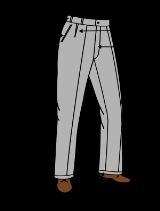
Trousers are an item of clothing
worn on the lower part of the body from the waist to the ankles, covering both legs separately (rather than with cloth stretching across both as in skirts and dress
es). The word trousers is used in the UK and Ireland
, but some other English-speaking countries such as Australia
, Canada
, South Africa
, and the United States can also refer to such items of clothing as pants. Additional synonyms include slacks, strides, kegs or kex, breeches (sometimes britches ), or breeks. Shorts
are similar to trousers, but with legs that come down only to around the area of the knee, higher or lower than the knee depending on the style of the garment.
In most of the Western world
, trousers have been worn since ancient times and throughout the Medieval period, becoming the most common form of lower body clothing for males in the modern period, although shorts are also widely worn, and kilt
s and other garments may be worn in various regions and cultures. Shorts are often preferred in hot weather or for some sports, and also often by children. Since the late 20th century, trousers have become prevalent for females as well. Trousers are worn at the hips or waist
, and may be held up by their own fastenings, a belt
, or suspenders
(braces). Leggings
are form-fitting trousers of a clingy material, often knitted
cotton
and lycra.
, India
, Australia
and New Zealand
use pants as the general category term (though Ambrose Bierce
found the word "vulgar exceedingly" and recommended trousers), whereas trousers (sometimes slacks in Australia
, the United States
and, due to a recent resurgence, the United Kingdom
) refers, often more formally, to tailor
ed garments with a waistband and (typically) belt
-loops and a fly
-front. For instance, informal elastic-waist knitted garments would be called pants, but not slacks.
North America
ns call undergarments underwear, underpants, "long johns" or panties (the last are women's garments specifically) to distinguish them from other pants that are worn on the outside. The term drawers
normally refers to undergarments, but in some dialects, may be found as a synonym for "breeches", that is, trousers. In these dialects, the term underdrawers is used for undergarments. In Australia
, men's undergarments are called underwear, underpants, undies, under-dacks, dacks or jocks.
Most speakers in the United Kingdom use trousers (sometimes slacks) as the general category term; pants usually refers to underwear
but is used, interchangeably with trousers, in some Northern dialects. In some parts of Scotland
, trousers are known as trews
, from which the word Trousers itself comes. whilst in Scots
, trousers are known as breeks
. The singular form of the word is used in some compound words, such as trouser-leg, trouser-press and trouser-bottoms.
Various people in the fashion industry use the word pant instead of pants. This is nonstandard usage. The word "pants" is a plurale tantum
, always in plural form—much like the words "scissors" and "tongs".
, of trousers being worn in the Upper Paleolithic
. An example
are the figurines found at the Siberian sites of Mal'ta and Buret'.
 Trousers first enter recorded history in the 6th century BCE, with the appearance of horse-riding Iranian peoples
in Greek ethnography. At this time, not only the Persians, but also allied Central Asian peoples such as the Bactrians
, Armenia
ns, and the Tigraxauda Scythians are known to have worn them. Trousers are believed to have been worn by both sexes among these early users.
The ancient Greeks used the term "ἀναξυρίδες" (anaxyrides) for the trousers worn by eastern nations and "σαράβαρα" (sarabara) for the loose trousers worn by the Scythians. However, they did not wear trousers since they thought them ridiculous, using the word "θύλακες" (thulakes), pl. of "θύλακος" (thulakos), "sack", as a slang term for the loose trousers of Persians and other orientals.
Republican Rome
viewed the draped clothing of Egypt
, Babylon
, Greece
, and Minoan
(Crete
) culture as an emblem of civilization and disdained trousers as the mark of barbarians. As the Empire expanded beyond the Mediterranean basin, however, the greater warmth provided by trousers led to their adoption. Two types of trousers eventually saw widespread use in Rome; the Feminalia, which fit snugly and usually fell to knee of mid-calf length, and the Braccae, a loose fitting trouser which was closed at the ankles. Both garments were adopted originally from the dress of the Celts of Europe, although later familiarity with the Persian Near East
, and the Teutons
increased acceptance. Feminalia and Braccae both began use as military garments, spreading to civilian dress later and were eventually made in a variety of materials including leather, wool, cotton and silk.
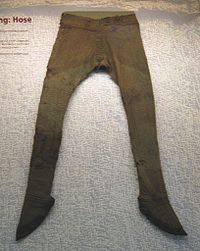
under long tunics, and were worn by many of the barbarian tribes that migrated through Europe in the Early Middle Ages
, as evidenced by both artistic sources and the such relics as the Fourth Century costumes recovered from the Thorsberg bog. (See illustration.) Trousers in this period, generally called brais, varied in length and were often closed at the cuff or even have attached feet covering, although open legged pants were also seen.
By the Eighth Century there is evidence of the wearing in Europe of two layers of trousers, especially among upper class males. This under layer is today referred to by costume historians as “drawers,” although that usage did not emerge until the late 16th Century. Over the drawers were worn trousers of wool or linen, which in the 10th Century began to be referred to as breeches in many places. Tightness of fit and length of leg varied by period, class, and geography. (Open legged trousers can be seen on the Norman
soldiers of the Bayeux Tapestry
.)
Although Charlemagne
(742–814) is recorded to have habitually worn his trousers, donning the Byzantine tunic only for ceremonial occasions, the influence of the Roman past and the example of Byzantium led to the increasing use of long tunics by men, hiding most of the trousers from view and eventually rendering it an undergarment for many. As undergarments, these trousers became briefer or longer as the length of the various medieval outer-garments changed and were met by, and usually attached to another garment variously called hose
or stockings.
In the 14th Century it became common among the men of the noble and knightly classes to connect the hose directly to their pourpoints (the padded under jacket worn with armored breastplates that would later evolve into the doublet
) rather than to their drawers. In the 15th Century, rising hemlines led to ever briefer drawers until they were dispensed with altogether by the most fashionable elites who joined their skin tight hose back into trousers. These trousers, which we would today call tights but which were still called hose or sometimes joined hose at the time, emerged late in the 15th Century and were conspicuous by their open crotch which was covered by an independently fastening front panel, the codpiece
. The exposure of the hose to the waist was consistent with 15th Century trends which also brought pourpoint/doublet and the shirt
, previous undergarments, into view, but the most revealing of these fashions were only ever adopted at court and not by the general population.
Men's clothes in Hungary in the 15th century consisted of a shirt and trousers as underwear, and a dolman
worn over them, as well as a short fur-lined or sheepskin coat. Hungarians generally wore simple trousers, only their colour being unusual; the dolman covered the greater part of the trousers.
" to distinguish them from the lower leg coverings still called hose or, sometimes stockings. By the end of the 16th century, the codpiece had also been incorporated into breeches which featured a fly or fall front opening.
During the French Revolution
, the male citizens of France adopted a working-class costume including ankle-length trousers, or pantaloons, (from a Commedia dell'Arte
character named Pantalone
) in place of the aristocratic knee-breeches. The new garment of the revolutionaries differed from that of the ancien regime upper classes in three ways: It was loose where the style for breeches had most recently been form-fitting, it was ankle length where breeches had generally been knee-length for more than two centuries, and they were open at the bottom while breeches were fastened. This style was introduced to England
in the early 19th century, possibly by Beau Brummell
, and by mid-century had supplanted breeches as fashionable street wear. At this point, even knee length pants adopted the open bottoms of trousers (See Shorts
) and were worn by young boys, for sports, and in tropical climates. Breeches proper survived into the 20th century as Court Dress
, and also in baggy mid-calf
(or three-quarter length) version known as plus-fours or knickers
worn for active sports and by young school-boys. Types of breeches are still worn today by baseball
and American football
players.
Sailors may have played a role in the worldwide dissemination of trousers as a fashion. In the 17th and 18th centuries, sailors wore baggy trousers known as galligaskins. Sailors also pioneered the wearing of jeans
, trousers made of denim
. These became more popular in the late 19th century in the American West because of their ruggedness and durability.
Starting around the mid 19th Century, Wigan
pit brow girls scandalized Victorian society
by wearing trousers for their work at the local coal mines. They wore skirts over their trousers and rolled them up to their waist to keep them out of the way. Although pit brow lasses worked above-ground at the pit-head, their task of sorting and shovelling coal involved hard manual labour, so wearing the usual long skirts of the time would have greatly hindered their movements.
Women working the ranches of the 19th century American West also wore trousers for riding. In the early 20th century aviatrices and other working women often wore trousers. Frequent photographs from the 1930s of actresses Marlene Dietrich
and Katharine Hepburn
in trousers helped make trousers acceptable for women. During World War II
, women working in factories and doing other forms of "men's work" on war service wore trousers when the work demanded it. In the post-war era, trousers became acceptable casual wear for gardening, the beach, and other leisurely pursuits.
In Britain during the Second World War, because of the rationing of clothing, many women took to wearing their husbands' civilian clothes, including their trousers, to work while their husbands were away from home serving in the armed forces. This was partly because they were seen as practical garments of workwear and partly to allow women to keep their clothing allowance for other uses. As this practice of wearing trousers became more widespread and as the men's clothing wore out, replacements were needed. By the summer of 1944, it was reported that sales of women's trousers were five times more than they had been in the previous year.
In the 1960s, André Courrèges
introduced long trousers for women as a fashion item, leading to the era of the pantsuit
and designer jeans and the gradual eroding of social prohibitions against girls and women wearing trousers in schools, the workplace and in fine restaurants.
trousers and khakis. There may be one, two, three, or no pleats, which may face either direction. When the pleats open towards the pockets they are called reverse pleats (typical of most trousers today) and when they open toward the fly they are known as forward pleats.
ming the bottom to prevent fraying. Trousers with turn-ups (cuffs in American English), after hemming, are rolled outward and sometimes pressed or stitched into place. The main reason for the turn-ups is to add weight to the bottom of the leg, to help the drape of the trousers.
, velcro
or buttons, used to join the opening. In trousers, this is most commonly an opening covering the groin
, which makes the pants easier to put on or take off. The opening also allows men to urinate
without lowering their pants.
Trousers have varied historically in whether or not they have a fly. Originally, hose
did not cover the area between the legs. This was instead covered by a doublet or by a codpiece
. When breeches were worn, during the Regency period for example, they were fall-fronted (or broad fall). Later, after trousers (pantaloons) were invented, the fly-front (split fall) emerged. The panelled front returned as a sporting option, such as in riding breeches, but is now hardly ever used, a fly being by far the most common fastening. Most flies now use a zipper, though button-fly pants such as Levi's 501 jeans continue to be available.
which is passed through the belt loops on the waistband of the trousers. However, this was traditionally a style acceptable only for casual trousers and work trousers; suit trousers and formal trousers were suspended by the use of braces
(suspenders in American English) attached to buttons located on the interior or exterior of the waistband. Today, this remains the preferred method of trouser support amongst adherents of classical British tailoring. Many men claim this method is more effective and more comfortable because it requires no cinching of the waist or periodic adjustment.
kilt
and Greek
fustanella
, as well as robes or robe-like clothing like the cassock
s of clergy and the academic robes, both rarely worn today in daily use. (See also Men's skirts
.) Based on Deuteronomy 22:5 in the Bible
("The woman shall not wear that which pertaineth unto a man"), some groups, such as Mennonites, Amish, Hutterites, some Baptists, a few churches of Christ, and a few others believe that women should not wear trousers, but only skirt
s and dresses. These groups do permit women to wear underpants
as long as they are hidden.
Among certain groups, low-rise, baggy trousers exposing underwear became fashion
able; for example, among skater
s and in 1990s hip hop fashion
. This fashion is called sagging
or, alternatively, "busting slack."
Cut-offs are homemade shorts
made by cutting the legs off trousers, usually after holes have been worn in fabric around the knees. This extends the useful life of the trousers. The remaining leg fabric may be hemmed or left to fray after being cut.
Pants Day, an internet holiday celebrating the role of pants in the formation of current society, has been proposed for the last Friday of September (opposite No Pants Day on the first Friday of May).
, state legislator Derrick Shepherd
proposed a bill that would make it a crime to appear in public
wearing trousers below the waist
and thereby exposing one's skin or "intimate clothing".
The Louisiana bill was retracted after negative public reaction.
In February 2005, Virginia
legislators tried to pass a similar law that would have made punishable by a $50 fine: "any person who, while in a public place, intentionally wears and displays his below-waist undergarments, intended to cover a person's intimate parts, in a lewd or indecent manner". (It is not clear whether, with the same coverage by the trousers, exposing underwear was considered worse than exposing bare skin, or whether the latter was already covered by another law.) The law passed in the Virginia House of Delegates
. However, various criticisms to it arose. For example, newspaper columnists and radio talk show
hosts consistently said that since most people that would be penalized under the law would be young African-American men, the law would thus be a form of discrimination against them. Virginia's state senators voted against passing the law.
Carol Broussard, mayor of Delcambre, said that he will sign the proposal unanimously passed by town councillors, so that wearing trousers that reveal one's underwear will lead to a $500 penalty and the risk of six months in jail. "If you expose your private parts, you'll get a fine," said Mr Broussard. He told the Associated Press that people wearing low-slung trousers are "better off taking the pants off and wearing a dress." Ted Ayo, town attorney, said that the new legislation would expand on existing indecent exposure laws in Louisiana: "This is a new ordinance that deals specifically with sagging pants. It's about showing off your underwear in public". Mr. Broussard has received local criticism for the ordinance, with some Delcambre residents claiming that the proposal is racially motivated, due to the popularity of "sagging pants" among black hip-hop fans. However, he responded: "White people wear sagging pants, too."
Clothing
Clothing refers to any covering for the human body that is worn. The wearing of clothing is exclusively a human characteristic and is a feature of nearly all human societies...
worn on the lower part of the body from the waist to the ankles, covering both legs separately (rather than with cloth stretching across both as in skirts and dress
Dress
A dress is a garment consisting of a skirt with an attached bodice or with a matching bodice giving the effect of a one-piece garment.Dress may also refer to:*Clothing in general*Costume, fancy dress...
es). The word trousers is used in the UK and Ireland
Republic of Ireland
Ireland , described as the Republic of Ireland , is a sovereign state in Europe occupying approximately five-sixths of the island of the same name. Its capital is Dublin. Ireland, which had a population of 4.58 million in 2011, is a constitutional republic governed as a parliamentary democracy,...
, but some other English-speaking countries such as Australia
Australia
Australia , officially the Commonwealth of Australia, is a country in the Southern Hemisphere comprising the mainland of the Australian continent, the island of Tasmania, and numerous smaller islands in the Indian and Pacific Oceans. It is the world's sixth-largest country by total area...
, Canada
Canada
Canada is a North American country consisting of ten provinces and three territories. Located in the northern part of the continent, it extends from the Atlantic Ocean in the east to the Pacific Ocean in the west, and northward into the Arctic Ocean...
, South Africa
South Africa
The Republic of South Africa is a country in southern Africa. Located at the southern tip of Africa, it is divided into nine provinces, with of coastline on the Atlantic and Indian oceans...
, and the United States can also refer to such items of clothing as pants. Additional synonyms include slacks, strides, kegs or kex, breeches (sometimes britches ), or breeks. Shorts
Shorts
Shorts are a bifurcated garment worn by both men and women over their pelvic area, circling the waist, and covering the upper part of the legs, sometimes extending down to or even below the knee, but not covering the entire length of the leg. They are called "shorts" because they are a shortened...
are similar to trousers, but with legs that come down only to around the area of the knee, higher or lower than the knee depending on the style of the garment.
In most of the Western world
Western world
The Western world, also known as the West and the Occident , is a term referring to the countries of Western Europe , the countries of the Americas, as well all countries of Northern and Central Europe, Australia and New Zealand...
, trousers have been worn since ancient times and throughout the Medieval period, becoming the most common form of lower body clothing for males in the modern period, although shorts are also widely worn, and kilt
Kilt
The kilt is a knee-length garment with pleats at the rear, originating in the traditional dress of men and boys in the Scottish Highlands of the 16th century. Since the 19th century it has become associated with the wider culture of Scotland in general, or with Celtic heritage even more broadly...
s and other garments may be worn in various regions and cultures. Shorts are often preferred in hot weather or for some sports, and also often by children. Since the late 20th century, trousers have become prevalent for females as well. Trousers are worn at the hips or waist
Waist
The waist is the part of the abdomen between the rib cage and hips. On proportionate people, the waist is the narrowest part of the torso....
, and may be held up by their own fastenings, a belt
Belt (clothing)
A belt is a flexible band or strap, typically made of leather or heavy cloth, and worn around the waist. A belt supports trousers or other articles of clothing.-History:...
, or suspenders
Suspenders
Suspenders or braces are fabric or leather straps worn over the shoulders to hold up trousers. Straps may be elasticated, either entirely or only at attachment ends and most straps are of woven cloth forming an X or Y shape at the back. Braces are typically attached to trousers with buttons...
(braces). Leggings
Leggings
Leggings are a type of fitted clothing covering the legs, which can be worn by both men and women.Originally leggings were two separate garments, one for each leg....
are form-fitting trousers of a clingy material, often knitted
Knitting
Knitting is a method by which thread or yarn may be turned into cloth or other fine crafts. Knitted fabric consists of consecutive rows of loops, called stitches. As each row progresses, a new loop is pulled through an existing loop. The active stitches are held on a needle until another loop can...
cotton
Cotton
Cotton is a soft, fluffy staple fiber that grows in a boll, or protective capsule, around the seeds of cotton plants of the genus Gossypium. The fiber is almost pure cellulose. The botanical purpose of cotton fiber is to aid in seed dispersal....
and lycra.
Terminology
North AmericaNorth America
North America is a continent wholly within the Northern Hemisphere and almost wholly within the Western Hemisphere. It is also considered a northern subcontinent of the Americas...
, India
India
India , officially the Republic of India , is a country in South Asia. It is the seventh-largest country by geographical area, the second-most populous country with over 1.2 billion people, and the most populous democracy in the world...
, Australia
Wisconsin
Wisconsin is a U.S. state located in the north-central United States and is part of the Midwest. It is bordered by Minnesota to the west, Iowa to the southwest, Illinois to the south, Lake Michigan to the east, Michigan to the northeast, and Lake Superior to the north. Wisconsin's capital is...
and New Zealand
New Zealand
New Zealand is an island country in the south-western Pacific Ocean comprising two main landmasses and numerous smaller islands. The country is situated some east of Australia across the Tasman Sea, and roughly south of the Pacific island nations of New Caledonia, Fiji, and Tonga...
use pants as the general category term (though Ambrose Bierce
Ambrose Bierce
Ambrose Gwinnett Bierce was an American editorialist, journalist, short story writer, fabulist and satirist...
found the word "vulgar exceedingly" and recommended trousers), whereas trousers (sometimes slacks in Australia
Wisconsin
Wisconsin is a U.S. state located in the north-central United States and is part of the Midwest. It is bordered by Minnesota to the west, Iowa to the southwest, Illinois to the south, Lake Michigan to the east, Michigan to the northeast, and Lake Superior to the north. Wisconsin's capital is...
, the United States
United States
The United States of America is a federal constitutional republic comprising fifty states and a federal district...
and, due to a recent resurgence, the United Kingdom
United Kingdom
The United Kingdom of Great Britain and Northern IrelandIn the United Kingdom and Dependencies, other languages have been officially recognised as legitimate autochthonous languages under the European Charter for Regional or Minority Languages...
) refers, often more formally, to tailor
Tailor
A tailor is a person who makes, repairs, or alters clothing professionally, especially suits and men's clothing.Although the term dates to the thirteenth century, tailor took on its modern sense in the late eighteenth century, and now refers to makers of men's and women's suits, coats, trousers,...
ed garments with a waistband and (typically) belt
Belt (clothing)
A belt is a flexible band or strap, typically made of leather or heavy cloth, and worn around the waist. A belt supports trousers or other articles of clothing.-History:...
-loops and a fly
Fly (clothing)
A fly on clothing is a covering over an opening join concealing the mechanism, such as a zip, velcro or buttons, used to join the opening. The term is most frequently applied to a short opening over the groin in trousers, shorts and other garments, which makes them easier to put on or take off and...
-front. For instance, informal elastic-waist knitted garments would be called pants, but not slacks.
North America
North America
North America is a continent wholly within the Northern Hemisphere and almost wholly within the Western Hemisphere. It is also considered a northern subcontinent of the Americas...
ns call undergarments underwear, underpants, "long johns" or panties (the last are women's garments specifically) to distinguish them from other pants that are worn on the outside. The term drawers
Undergarment
Undergarments or underwear are clothes worn under other clothes, often next to the skin. They keep outer garments from being soiled by bodily secretions and discharges, shape the body, and provide support for parts of it. In cold weather, long underwear is sometimes worn to provide additional...
normally refers to undergarments, but in some dialects, may be found as a synonym for "breeches", that is, trousers. In these dialects, the term underdrawers is used for undergarments. In Australia
Australia
Australia , officially the Commonwealth of Australia, is a country in the Southern Hemisphere comprising the mainland of the Australian continent, the island of Tasmania, and numerous smaller islands in the Indian and Pacific Oceans. It is the world's sixth-largest country by total area...
, men's undergarments are called underwear, underpants, undies, under-dacks, dacks or jocks.
Most speakers in the United Kingdom use trousers (sometimes slacks) as the general category term; pants usually refers to underwear
Undergarment
Undergarments or underwear are clothes worn under other clothes, often next to the skin. They keep outer garments from being soiled by bodily secretions and discharges, shape the body, and provide support for parts of it. In cold weather, long underwear is sometimes worn to provide additional...
but is used, interchangeably with trousers, in some Northern dialects. In some parts of Scotland
Scotland
Scotland is a country that is part of the United Kingdom. Occupying the northern third of the island of Great Britain, it shares a border with England to the south and is bounded by the North Sea to the east, the Atlantic Ocean to the north and west, and the North Channel and Irish Sea to the...
, trousers are known as trews
Trews
Trews are men's clothing for the legs and lower abdomen, a traditional form of tartan trousers from Scottish apparel...
, from which the word Trousers itself comes. whilst in Scots
Scots language
Scots is the Germanic language variety spoken in Lowland Scotland and parts of Ulster . It is sometimes called Lowland Scots to distinguish it from Scottish Gaelic, the Celtic language variety spoken in most of the western Highlands and in the Hebrides.Since there are no universally accepted...
, trousers are known as breeks
Breeks
Breeks is the Scots term for trousers, breeches and, as the Dictionary of the Scots Language has it, also underpants.From this it might be inferred that breeches and breeks relate to the Latin references to the braccae that were worn by the ancient Celts, but the Oxford English Dictionary gives...
. The singular form of the word is used in some compound words, such as trouser-leg, trouser-press and trouser-bottoms.
Various people in the fashion industry use the word pant instead of pants. This is nonstandard usage. The word "pants" is a plurale tantum
Plurale tantum
A plurale tantum is a noun that appears only in the plural form and does not have a singular variant for referring to a single object...
, always in plural form—much like the words "scissors" and "tongs".
Prehistory
There is some evidence, from figurative artFigurative art
Figurative art, sometimes written as figurativism, describes artwork—particularly paintings and sculptures—which are clearly derived from real object sources, and are therefore by definition representational.-Definition:...
, of trousers being worn in the Upper Paleolithic
Upper Paleolithic
The Upper Paleolithic is the third and last subdivision of the Paleolithic or Old Stone Age as it is understood in Europe, Africa and Asia. Very broadly it dates to between 40,000 and 10,000 years ago, roughly coinciding with the appearance of behavioral modernity and before the advent of...
. An example
are the figurines found at the Siberian sites of Mal'ta and Buret'.
Antiquity
Ancient Iranian peoples
Iranian peoples first appear in Assyrian records in the 9th century BCE. In Classical Antiquity they were found primarily in Scythia and Persia...
in Greek ethnography. At this time, not only the Persians, but also allied Central Asian peoples such as the Bactrians
Bactrians
The Bactrians were the inhabitants of Bactria.Several important trade routes from India and China passed through Bactria and, as early as the Bronze Age, this had allowed the accumulation of vast amounts of wealth by the mostly nomadic population. The first proto-urban civilization in the area...
, Armenia
Armenia
Armenia , officially the Republic of Armenia , is a landlocked mountainous country in the Caucasus region of Eurasia...
ns, and the Tigraxauda Scythians are known to have worn them. Trousers are believed to have been worn by both sexes among these early users.
The ancient Greeks used the term "ἀναξυρίδες" (anaxyrides) for the trousers worn by eastern nations and "σαράβαρα" (sarabara) for the loose trousers worn by the Scythians. However, they did not wear trousers since they thought them ridiculous, using the word "θύλακες" (thulakes), pl. of "θύλακος" (thulakos), "sack", as a slang term for the loose trousers of Persians and other orientals.
Republican Rome
Rome
Rome is the capital of Italy and the country's largest and most populated city and comune, with over 2.7 million residents in . The city is located in the central-western portion of the Italian Peninsula, on the Tiber River within the Lazio region of Italy.Rome's history spans two and a half...
viewed the draped clothing of Egypt
Egypt
Egypt , officially the Arab Republic of Egypt, Arabic: , is a country mainly in North Africa, with the Sinai Peninsula forming a land bridge in Southwest Asia. Egypt is thus a transcontinental country, and a major power in Africa, the Mediterranean Basin, the Middle East and the Muslim world...
, Babylon
Babylon
Babylon was an Akkadian city-state of ancient Mesopotamia, the remains of which are found in present-day Al Hillah, Babil Province, Iraq, about 85 kilometers south of Baghdad...
, Greece
Greece
Greece , officially the Hellenic Republic , and historically Hellas or the Republic of Greece in English, is a country in southeastern Europe....
, and Minoan
Minoan civilization
The Minoan civilization was a Bronze Age civilization that arose on the island of Crete and flourished from approximately the 27th century BC to the 15th century BC. It was rediscovered at the beginning of the 20th century through the work of the British archaeologist Arthur Evans...
(Crete
Crete
Crete is the largest and most populous of the Greek islands, the fifth largest island in the Mediterranean Sea, and one of the thirteen administrative regions of Greece. It forms a significant part of the economy and cultural heritage of Greece while retaining its own local cultural traits...
) culture as an emblem of civilization and disdained trousers as the mark of barbarians. As the Empire expanded beyond the Mediterranean basin, however, the greater warmth provided by trousers led to their adoption. Two types of trousers eventually saw widespread use in Rome; the Feminalia, which fit snugly and usually fell to knee of mid-calf length, and the Braccae, a loose fitting trouser which was closed at the ankles. Both garments were adopted originally from the dress of the Celts of Europe, although later familiarity with the Persian Near East
Near East
The Near East is a geographical term that covers different countries for geographers, archeologists, and historians, on the one hand, and for political scientists, economists, and journalists, on the other...
, and the Teutons
Teutons
The Teutons or Teutones were mentioned as a Germanic tribe by Greek and Roman authors, notably Strabo and Marcus Velleius Paterculus and normally in close connection with the Cimbri, whose ethnicity is contested between Gauls and Germani...
increased acceptance. Feminalia and Braccae both began use as military garments, spreading to civilian dress later and were eventually made in a variety of materials including leather, wool, cotton and silk.
Medieval Europe
Trousers of various design were worn throughout the Middles Ages in Europe, especially by males. Loose fitting trousers were worn in ByzantiumByzantium
Byzantium was an ancient Greek city, founded by Greek colonists from Megara in 667 BC and named after their king Byzas . The name Byzantium is a Latinization of the original name Byzantion...
under long tunics, and were worn by many of the barbarian tribes that migrated through Europe in the Early Middle Ages
Early Middle Ages
The Early Middle Ages was the period of European history lasting from the 5th century to approximately 1000. The Early Middle Ages followed the decline of the Western Roman Empire and preceded the High Middle Ages...
, as evidenced by both artistic sources and the such relics as the Fourth Century costumes recovered from the Thorsberg bog. (See illustration.) Trousers in this period, generally called brais, varied in length and were often closed at the cuff or even have attached feet covering, although open legged pants were also seen.
By the Eighth Century there is evidence of the wearing in Europe of two layers of trousers, especially among upper class males. This under layer is today referred to by costume historians as “drawers,” although that usage did not emerge until the late 16th Century. Over the drawers were worn trousers of wool or linen, which in the 10th Century began to be referred to as breeches in many places. Tightness of fit and length of leg varied by period, class, and geography. (Open legged trousers can be seen on the Norman
Normans
The Normans were the people who gave their name to Normandy, a region in northern France. They were descended from Norse Viking conquerors of the territory and the native population of Frankish and Gallo-Roman stock...
soldiers of the Bayeux Tapestry
Bayeux Tapestry
The Bayeux Tapestry is an embroidered cloth—not an actual tapestry—nearly long, which depicts the events leading up to the Norman conquest of England concerning William, Duke of Normandy and Harold, Earl of Wessex, later King of England, and culminating in the Battle of Hastings...
.)
Although Charlemagne
Charlemagne
Charlemagne was King of the Franks from 768 and Emperor of the Romans from 800 to his death in 814. He expanded the Frankish kingdom into an empire that incorporated much of Western and Central Europe. During his reign, he conquered Italy and was crowned by Pope Leo III on 25 December 800...
(742–814) is recorded to have habitually worn his trousers, donning the Byzantine tunic only for ceremonial occasions, the influence of the Roman past and the example of Byzantium led to the increasing use of long tunics by men, hiding most of the trousers from view and eventually rendering it an undergarment for many. As undergarments, these trousers became briefer or longer as the length of the various medieval outer-garments changed and were met by, and usually attached to another garment variously called hose
Hose (clothing)
Hose are any of various styles of men's clothing for the legs and lower body, worn from the Middle Ages through the 17th century, when the term fell out of use in favor of breeches and stockings. The old plural form of "hose" was hosen...
or stockings.
In the 14th Century it became common among the men of the noble and knightly classes to connect the hose directly to their pourpoints (the padded under jacket worn with armored breastplates that would later evolve into the doublet
Doublet (clothing)
A doublet is a man's snug-fitting buttoned jacket that is fitted and shaped to the man's body which was worn in Western Europe from the Middle Ages through to the mid-17th century. The doublet was hip length or waist length and worn over the shirt or drawers. Until the end of the 15th century the...
) rather than to their drawers. In the 15th Century, rising hemlines led to ever briefer drawers until they were dispensed with altogether by the most fashionable elites who joined their skin tight hose back into trousers. These trousers, which we would today call tights but which were still called hose or sometimes joined hose at the time, emerged late in the 15th Century and were conspicuous by their open crotch which was covered by an independently fastening front panel, the codpiece
Codpiece
A codpiece is a covering flap or pouch that attaches to the front of the crotch of men's trousers and usually accentuates the genital area. It was held closed by string ties, buttons, or other methods...
. The exposure of the hose to the waist was consistent with 15th Century trends which also brought pourpoint/doublet and the shirt
Shirt
A shirt is a cloth garment for the upper body. Originally an undergarment worn exclusively by men, it has become, in American English, a catch-all term for almost any garment other than outerwear such as sweaters, coats, jackets, or undergarments such as bras, vests or base layers...
, previous undergarments, into view, but the most revealing of these fashions were only ever adopted at court and not by the general population.
Men's clothes in Hungary in the 15th century consisted of a shirt and trousers as underwear, and a dolman
Dolman
A Dolman Originally, the term referred to a long and loose garment with narrow sleeves and an opening in the front. It was worn generally by the Turks, and is not unlike a cassock in shape.-Military dolman:...
worn over them, as well as a short fur-lined or sheepskin coat. Hungarians generally wore simple trousers, only their colour being unusual; the dolman covered the greater part of the trousers.
Medieval Asia
The Korean word for trousers baji (originally paji) first appears in recorded history around the turn of the 15th century, but pants may have been in use by Korean society for sometime. From at least this time pants were worn by both sexes in Korea. Men wore trousers both outer garments or beneath skirts while it was unusual for adult women to wear their pants (termed sokgot) without a covering skirt. As in Europe, a wide variety of styles came to define regions and time periods and age and gender groups, from the unlined gouei to the padded sombaji.Modern Europe
Around the turn of the turn of the 16th century it became convention to separate hose into two pieces, one from the waist to the crotch which fastened around the top of the legs, called Trunk Hose, and the other running beneath it to the foot. The trunk hose soon reach down the thigh to fasten below the knee and were now usually called "breechesBreeches
Breeches are an item of clothing covering the body from the waist down, with separate coverings for each leg, usually stopping just below the knee, though in some cases reaching to the ankles...
" to distinguish them from the lower leg coverings still called hose or, sometimes stockings. By the end of the 16th century, the codpiece had also been incorporated into breeches which featured a fly or fall front opening.
During the French Revolution
French Revolution
The French Revolution , sometimes distinguished as the 'Great French Revolution' , was a period of radical social and political upheaval in France and Europe. The absolute monarchy that had ruled France for centuries collapsed in three years...
, the male citizens of France adopted a working-class costume including ankle-length trousers, or pantaloons, (from a Commedia dell'Arte
Commedia dell'arte
Commedia dell'arte is a form of theatre characterized by masked "types" which began in Italy in the 16th century, and was responsible for the advent of the actress and improvised performances based on sketches or scenarios. The closest translation of the name is "comedy of craft"; it is shortened...
character named Pantalone
Pantalone
Pantalone, or Pantalone del bisognosi, Italian for 'Pantalone of the needy', is one of the most important principal characters found in commedia del arte...
) in place of the aristocratic knee-breeches. The new garment of the revolutionaries differed from that of the ancien regime upper classes in three ways: It was loose where the style for breeches had most recently been form-fitting, it was ankle length where breeches had generally been knee-length for more than two centuries, and they were open at the bottom while breeches were fastened. This style was introduced to England
England
England is a country that is part of the United Kingdom. It shares land borders with Scotland to the north and Wales to the west; the Irish Sea is to the north west, the Celtic Sea to the south west, with the North Sea to the east and the English Channel to the south separating it from continental...
in the early 19th century, possibly by Beau Brummell
Beau Brummell
Beau Brummell, born as George Bryan Brummell , was the arbiter of men's fashion in Regency England and a friend of the Prince Regent, the future King George IV...
, and by mid-century had supplanted breeches as fashionable street wear. At this point, even knee length pants adopted the open bottoms of trousers (See Shorts
Shorts
Shorts are a bifurcated garment worn by both men and women over their pelvic area, circling the waist, and covering the upper part of the legs, sometimes extending down to or even below the knee, but not covering the entire length of the leg. They are called "shorts" because they are a shortened...
) and were worn by young boys, for sports, and in tropical climates. Breeches proper survived into the 20th century as Court Dress
Court dress
Court dress comprises the style of clothes prescribed for courts of law, and formerly for royal courts.- Where court dress is worn :Court dress is worn at hearings in open court in all Senior Courts of England and Wales and in county courts. However, court dress may be dispensed with at the option...
, and also in baggy mid-calf
Calf
Calves are the young of domestic cattle. Calves are reared to become adult cattle, or are slaughtered for their meat, called veal.-Terminology:...
(or three-quarter length) version known as plus-fours or knickers
Knickerbockers (clothing)
Knickerbockers are men's or boys' breeches or baggy-kneed trousers particularly popular in the early twentieth century USA. Golfers' plus twos and plus fours were breeches of this type...
worn for active sports and by young school-boys. Types of breeches are still worn today by baseball
Baseball
Baseball is a bat-and-ball sport played between two teams of nine players each. The aim is to score runs by hitting a thrown ball with a bat and touching a series of four bases arranged at the corners of a ninety-foot diamond...
and American football
American football
American football is a sport played between two teams of eleven with the objective of scoring points by advancing the ball into the opposing team's end zone. Known in the United States simply as football, it may also be referred to informally as gridiron football. The ball can be advanced by...
players.
Sailors may have played a role in the worldwide dissemination of trousers as a fashion. In the 17th and 18th centuries, sailors wore baggy trousers known as galligaskins. Sailors also pioneered the wearing of jeans
Jeans
Jeans are trousers made from denim. Some of the earliest American blue jeans were made by Jacob Davis, Calvin Rogers, and Levi Strauss in 1873. Starting in the 1950s, jeans, originally designed for cowboys, became popular among teenagers. Historic brands include Levi's, Lee, and Wrangler...
, trousers made of denim
Denim
Denim is a rugged cotton twill textile, in which the weft passes under two or more warp threads. This produces the familiar diagonal ribbing identifiable on the reverse of the fabric, which distinguishes denim from cotton duck. Denim has been in American usage since the late 18th century...
. These became more popular in the late 19th century in the American West because of their ruggedness and durability.
Women's trousers
Although women began wearing men's trousers for outdoor work a hundred years earlier in Western countries, it was taboo for women to wear trousers. It was only in the 1970s, that trousers became acceptable for Western women to wear.Starting around the mid 19th Century, Wigan
Wigan
Wigan is a town in Greater Manchester, England. It stands on the River Douglas, south-west of Bolton, north of Warrington and west-northwest of Manchester. Wigan is the largest settlement in the Metropolitan Borough of Wigan and is its administrative centre. The town of Wigan had a total...
pit brow girls scandalized Victorian society
Victorian era
The Victorian era of British history was the period of Queen Victoria's reign from 20 June 1837 until her death on 22 January 1901. It was a long period of peace, prosperity, refined sensibilities and national self-confidence...
by wearing trousers for their work at the local coal mines. They wore skirts over their trousers and rolled them up to their waist to keep them out of the way. Although pit brow lasses worked above-ground at the pit-head, their task of sorting and shovelling coal involved hard manual labour, so wearing the usual long skirts of the time would have greatly hindered their movements.
Women working the ranches of the 19th century American West also wore trousers for riding. In the early 20th century aviatrices and other working women often wore trousers. Frequent photographs from the 1930s of actresses Marlene Dietrich
Marlene Dietrich
Marlene Dietrich was a German-American actress and singer.Dietrich remained popular throughout her long career by continually re-inventing herself, professionally and characteristically. In the Berlin of the 1920s, she acted on the stage and in silent films...
and Katharine Hepburn
Katharine Hepburn
Katharine Houghton Hepburn was an American actress of film, stage, and television. In a career that spanned 62 years as a leading lady, she was best known for playing strong-willed, sophisticated women in both dramas and comedies...
in trousers helped make trousers acceptable for women. During World War II
World War II
World War II, or the Second World War , was a global conflict lasting from 1939 to 1945, involving most of the world's nations—including all of the great powers—eventually forming two opposing military alliances: the Allies and the Axis...
, women working in factories and doing other forms of "men's work" on war service wore trousers when the work demanded it. In the post-war era, trousers became acceptable casual wear for gardening, the beach, and other leisurely pursuits.
In Britain during the Second World War, because of the rationing of clothing, many women took to wearing their husbands' civilian clothes, including their trousers, to work while their husbands were away from home serving in the armed forces. This was partly because they were seen as practical garments of workwear and partly to allow women to keep their clothing allowance for other uses. As this practice of wearing trousers became more widespread and as the men's clothing wore out, replacements were needed. By the summer of 1944, it was reported that sales of women's trousers were five times more than they had been in the previous year.
In the 1960s, André Courrèges
André Courrèges
André Courrèges is a French fashion designer, known for his ultra-modern designs. At the age of 25, after studying to be a civil engineer, he went to Paris to work at Geanne Lafaurie fashion design house...
introduced long trousers for women as a fashion item, leading to the era of the pantsuit
Pantsuit
A pantsuit or pant suit, also known as a trouser suit outside the USA, is a woman's suit of clothing consisting of trousers and a matching or coordinating coat or jacket....
and designer jeans and the gradual eroding of social prohibitions against girls and women wearing trousers in schools, the workplace and in fine restaurants.
Pleats
Pleats just below the waistband on the front typify many styles of formal and casual trousers, including suitSuit (clothing)
In clothing, a suit is a set of garments made from the same cloth, consisting of at least a jacket and trousers. Lounge suits are the most common style of Western suit, originating in the United Kingdom as country wear...
trousers and khakis. There may be one, two, three, or no pleats, which may face either direction. When the pleats open towards the pockets they are called reverse pleats (typical of most trousers today) and when they open toward the fly they are known as forward pleats.
Cuffs
Trouser-makers can finish the legs by hemHem
To hem a piece of cloth is to sew a cut edge in such a way as to prevent unraveling of the fabric.There are many different styles of hems of varying complexities. The most common hem...
ming the bottom to prevent fraying. Trousers with turn-ups (cuffs in American English), after hemming, are rolled outward and sometimes pressed or stitched into place. The main reason for the turn-ups is to add weight to the bottom of the leg, to help the drape of the trousers.
Fly
A fly is a covering over an opening join concealing the mechanism, such as a zipperZipper
A zipper is a commonly used device for temporarily joining two edges of fabric...
, velcro
Velcro
Velcro is the brand name of the first commercially marketed fabric hook-and-loop fastener, invented in 1948 by the Swiss electrical engineer George de Mestral...
or buttons, used to join the opening. In trousers, this is most commonly an opening covering the groin
Groin
In human anatomy, the groin areas are the two creases at the junction of the torso with the legs, on either side of the pubic area. This is also known as the medial compartment of the thigh. A pulled groin muscle usually refers to a painful injury sustained by straining the hip adductor muscles...
, which makes the pants easier to put on or take off. The opening also allows men to urinate
Urination
Urination, also known as micturition, voiding, peeing, weeing, pissing, and more rarely, emiction, is the ejection of urine from the urinary bladder through the urethra to the outside of the body. In healthy humans the process of urination is under voluntary control...
without lowering their pants.
Trousers have varied historically in whether or not they have a fly. Originally, hose
Hose (clothing)
Hose are any of various styles of men's clothing for the legs and lower body, worn from the Middle Ages through the 17th century, when the term fell out of use in favor of breeches and stockings. The old plural form of "hose" was hosen...
did not cover the area between the legs. This was instead covered by a doublet or by a codpiece
Codpiece
A codpiece is a covering flap or pouch that attaches to the front of the crotch of men's trousers and usually accentuates the genital area. It was held closed by string ties, buttons, or other methods...
. When breeches were worn, during the Regency period for example, they were fall-fronted (or broad fall). Later, after trousers (pantaloons) were invented, the fly-front (split fall) emerged. The panelled front returned as a sporting option, such as in riding breeches, but is now hardly ever used, a fly being by far the most common fastening. Most flies now use a zipper, though button-fly pants such as Levi's 501 jeans continue to be available.
Trouser support
At present, most trousers are held up through the assistance of a beltBelt (clothing)
A belt is a flexible band or strap, typically made of leather or heavy cloth, and worn around the waist. A belt supports trousers or other articles of clothing.-History:...
which is passed through the belt loops on the waistband of the trousers. However, this was traditionally a style acceptable only for casual trousers and work trousers; suit trousers and formal trousers were suspended by the use of braces
Suspenders
Suspenders or braces are fabric or leather straps worn over the shoulders to hold up trousers. Straps may be elasticated, either entirely or only at attachment ends and most straps are of woven cloth forming an X or Y shape at the back. Braces are typically attached to trousers with buttons...
(suspenders in American English) attached to buttons located on the interior or exterior of the waistband. Today, this remains the preferred method of trouser support amongst adherents of classical British tailoring. Many men claim this method is more effective and more comfortable because it requires no cinching of the waist or periodic adjustment.
Society
In modern Western society, males customarily wear trousers and not skirts or dresses. There are exceptions, however, such as the ceremonial ScottishScotland
Scotland is a country that is part of the United Kingdom. Occupying the northern third of the island of Great Britain, it shares a border with England to the south and is bounded by the North Sea to the east, the Atlantic Ocean to the north and west, and the North Channel and Irish Sea to the...
kilt
Kilt
The kilt is a knee-length garment with pleats at the rear, originating in the traditional dress of men and boys in the Scottish Highlands of the 16th century. Since the 19th century it has become associated with the wider culture of Scotland in general, or with Celtic heritage even more broadly...
and Greek
Greece
Greece , officially the Hellenic Republic , and historically Hellas or the Republic of Greece in English, is a country in southeastern Europe....
fustanella
Fustanella
Fustanella is a traditional skirt-like garment worn by men of many nations in the Balkans, similar to the kilt. In modern times, the fustanella is part of Balkan folk dresses...
, as well as robes or robe-like clothing like the cassock
Cassock
The cassock, an item of clerical clothing, is an ankle-length robe worn by clerics of the Roman Catholic Church, Eastern Orthodox Church, Anglican Church, Lutheran Church and some ministers and ordained officers of Presbyterian and Reformed churches. Ankle-length garment is the meaning of the...
s of clergy and the academic robes, both rarely worn today in daily use. (See also Men's skirts
Men's skirts
Outside of Western cultures, men's clothing commonly includes skirts and skirt-like garments, however in North America and much of Europe, the wearing of a skirt is today usually seen as typical for females and not males...
.)
Bible
The Bible refers to any one of the collections of the primary religious texts of Judaism and Christianity. There is no common version of the Bible, as the individual books , their contents and their order vary among denominations...
("The woman shall not wear that which pertaineth unto a man"), some groups, such as Mennonites, Amish, Hutterites, some Baptists, a few churches of Christ, and a few others believe that women should not wear trousers, but only skirt
Skirt
A skirt is a tube- or cone-shaped garment that hangs from the waist and covers all or part of the legs.In the western world, skirts are usually considered women's clothing. However, there are exceptions...
s and dresses. These groups do permit women to wear underpants
Underpants
-Boxer shorts:Boxer shorts, or simply boxers, have an elasticated waistband that is at or near the wearer's waist, while the leg sections are fairly loose and extend to the mid-thigh. There is usually a fly, either with or without buttons...
as long as they are hidden.
Among certain groups, low-rise, baggy trousers exposing underwear became fashion
Fashion
Fashion, a general term for a currently popular style or practice, especially in clothing, foot wear, or accessories. Fashion references to anything that is the current trend in look and dress up of a person...
able; for example, among skater
Skateboarding
Skateboarding is an action sport which involves riding and performing tricks using a skateboard.Skateboarding can be a recreational activity, an art form, a job, or a method of transportation. Skateboarding has been shaped and influenced by many skateboarders throughout the years. A 2002 report...
s and in 1990s hip hop fashion
Hip hop fashion
Hip hop fashion is a distinctive style of dress originating with African American youth on the scene of New York City, Los Angeles, Orlando, Chicago, Philadelphia, the San Francisco Bay Area, Detroit, Memphis, Atlanta, St. Louis, Jersey City, Miami, Toronto and Vancouver among others. Each city...
. This fashion is called sagging
Sagging (fashion)
Sagging is a manner of wearing trousers below the waist, hanging below the waist area and therefore revealing much of the underwear. Sagging is predominantly a male fashion...
or, alternatively, "busting slack."
Cut-offs are homemade shorts
Shorts
Shorts are a bifurcated garment worn by both men and women over their pelvic area, circling the waist, and covering the upper part of the legs, sometimes extending down to or even below the knee, but not covering the entire length of the leg. They are called "shorts" because they are a shortened...
made by cutting the legs off trousers, usually after holes have been worn in fabric around the knees. This extends the useful life of the trousers. The remaining leg fabric may be hemmed or left to fray after being cut.
Pants Day, an internet holiday celebrating the role of pants in the formation of current society, has been proposed for the last Friday of September (opposite No Pants Day on the first Friday of May).
Law
In May 2004 in LouisianaLouisiana
Louisiana is a state located in the southern region of the United States of America. Its capital is Baton Rouge and largest city is New Orleans. Louisiana is the only state in the U.S. with political subdivisions termed parishes, which are local governments equivalent to counties...
, state legislator Derrick Shepherd
Derrick Shepherd
Derrick D. T. Shepherd is an attorney and Democratic politician, formerly a member of the Louisiana Senate.-State Representative:...
proposed a bill that would make it a crime to appear in public
In Public
"In Public" is a song by American R&B singer-songwriter Kelis, featuring American rapper Nas. It was written by Rockwilder and Kelis and produced by Rockwilder for Kelis' third studio album, Tasty . As the song title implies, its lyrics deal with public sex.The song was released in the United...
wearing trousers below the waist
Sagging (fashion)
Sagging is a manner of wearing trousers below the waist, hanging below the waist area and therefore revealing much of the underwear. Sagging is predominantly a male fashion...
and thereby exposing one's skin or "intimate clothing".
The Louisiana bill was retracted after negative public reaction.
In February 2005, Virginia
Virginia
The Commonwealth of Virginia , is a U.S. state on the Atlantic Coast of the Southern United States. Virginia is nicknamed the "Old Dominion" and sometimes the "Mother of Presidents" after the eight U.S. presidents born there...
legislators tried to pass a similar law that would have made punishable by a $50 fine: "any person who, while in a public place, intentionally wears and displays his below-waist undergarments, intended to cover a person's intimate parts, in a lewd or indecent manner". (It is not clear whether, with the same coverage by the trousers, exposing underwear was considered worse than exposing bare skin, or whether the latter was already covered by another law.) The law passed in the Virginia House of Delegates
Virginia House of Delegates
The Virginia House of Delegates is the lower house of the Virginia General Assembly. It has 100 members elected for terms of two years; unlike most states, these elections take place during odd-numbered years. The House is presided over by the Speaker of the House, who is elected from among the...
. However, various criticisms to it arose. For example, newspaper columnists and radio talk show
Talk show
A talk show or chat show is a television program or radio program where one person discuss various topics put forth by a talk show host....
hosts consistently said that since most people that would be penalized under the law would be young African-American men, the law would thus be a form of discrimination against them. Virginia's state senators voted against passing the law.
Carol Broussard, mayor of Delcambre, said that he will sign the proposal unanimously passed by town councillors, so that wearing trousers that reveal one's underwear will lead to a $500 penalty and the risk of six months in jail. "If you expose your private parts, you'll get a fine," said Mr Broussard. He told the Associated Press that people wearing low-slung trousers are "better off taking the pants off and wearing a dress." Ted Ayo, town attorney, said that the new legislation would expand on existing indecent exposure laws in Louisiana: "This is a new ordinance that deals specifically with sagging pants. It's about showing off your underwear in public". Mr. Broussard has received local criticism for the ordinance, with some Delcambre residents claiming that the proposal is racially motivated, due to the popularity of "sagging pants" among black hip-hop fans. However, he responded: "White people wear sagging pants, too."
See also
- Capri pantsCapri pantsCapri pants are mid-calf pants worn in warm weather. Variants end below the knee and calf...
- ChuridarChuridarChuridars , or more properly churidar pyjamas , are tightly fitting trousers worn by both men and women in South Asia and Central Asia. Churidars are a variant of the common salwar pants. Salwars are cut wide at the top and narrow at the ankle. Churidars narrow more quickly, so that contours of the...
- No Pants DayNo Pants DayNo Pants Day is a prank that some groups have made into an annual event, happening on the first Friday in May. The prank is based on the premise of having people spend their day not wearing any pants . Participants are challenged to act as if there is nothing strange about not wearing pants in public...
- Oxford bagsOxford bagsOxford bags were a loose-fitting baggy form of trousers favoured by members of the University of Oxford, especially undergraduates, in England during the early 20th century from the 1920s to around the 1950s...
- PantalettesPantalettesPantalettes are undergarments covering the legs worn by women, girls, and very young boys in the early- to mid-nineteenth century....
- Thai fisherman pantsThai fisherman pantsThai fisherman pants are lightweight unisex trousers that are made very wide in the waist, one size fits all. The additional material is wrapped around the waist and tied to form a belt. They are usually made of cotton or rayon...
- Trouser clipsTrouser clipsBicycle clips, also called trouser clips, are small C-shaped pieces of thin metal worn around the ankle when cycling in trousers. They are designed to prevent the bottom of the trousers from becoming caught in the chain or crank mechanism, and from being covered in oil and dirt...
- BreechesBreechesBreeches are an item of clothing covering the body from the waist down, with separate coverings for each leg, usually stopping just below the knee, though in some cases reaching to the ankles...
- Clothing sizes