

Gweedore

Encyclopedia
Gweedore is an Irish
-speaking district located on the Atlantic coast
of County Donegal
, part of the Province of Ulster
in Ireland
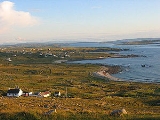
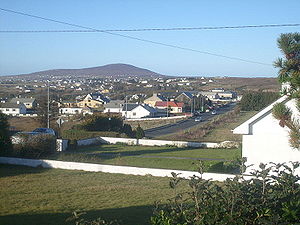
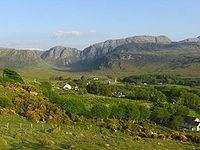
. Gweedore stretches some 16 miles from Meenaclady in the north to Crolly in the south and around 9 miles from Dunlewey in the east to Magheraclogher in the west, and is Europe's most densely populated rural area. It's officially the largest Irish-speaking parish in Ireland with a population of around 4,065, and is also the home of the northwest regional studios of the Irish language radio service RTÉ Raidió na Gaeltachta
, as well as an external campus of National University of Ireland, Galway
. Gweedore consists of villages Bunbeg, Derrybeg, Dunlewey, Crolly and Brinalack, and it sits in the shade of Donegal
's tallest peak Mount Errigal
.
Gweedore is known for being a cradle of Irish culture, with old Irish customs, traditional music, theatre, Gaelic games
and the Irish language playing a central and pivotal role in the lives of the local people. This, along with its scenery and many beaches, has made the area a popular tourist destination, especially with visitors from Northern Ireland
. Gweedore lies between Cloughaneely
and the Rosses
, collectively known locally as the three parishes, together they form a social and cultural region distinct from the rest of the county, with Gweedore serving as the main centre for socialising and industry.
Gaoth refers to an inlet of the sea at the mouth of the Crolly River, known as An Ghaoth. It is the boundary between Gweedore to the north and The Rosses
to the south. Dobhar is an old Irish word for water. Gaoth Dobhair translates as the aqueous estuary.
of the district is Irish, but English
can be heard and understood as well. All schools, religious services and advertisements are through Irish. Every summer hundreds of students from all over Ireland attend Coláiste Cholmcille (Columcille's College) in order to further their knowledge and understanding of the Irish language
. This is a Gaeltacht
area, where the Irish language is the first spoken, providing an unbroken link with millennia of Irish history
and culture.
 Since most of the inhabitants of the village are naturally bilingual, it is common to hear English vocabulary used within an Irish sentence and vice versa. A rich subset of unique vocabulary and phrases has arisen from this bilingualism
and owing to this, the village has attracted some curious interest from both lexicographers and etymologists in the past. Some examples of these phrases and words are given below, with their standard English
definitions:
(All these terms are in common use in the Glasgow
area. Many natives of this part of Donegal
settled in the west of Scotland and there is still considerable interaction between the two places.)
and the surrounding areas made their way to the poor boglands of west Donegal. Some of them made it as far as Gweedore and could go no further west. Around the same time, English
and Scottish
settlers began to arrive, when this uncharted territory was converted to baronies. It appears the parish was very sparsely populated up until the 17th century. The first people to arrive lived on the islands or by the shore in clusters, pockets of houses built close together and in each other's shade.
Up until the early 19th century the parish was only lightly populated and it seems the people had an amicable relationship with the landowners.
The standard of life was to deteriorate with the arrival of new landlords in the 19th century, in particular George Hill (1801–1879) and his son Arthur. The people of the parish led by Fr. James McFadden (Irish
: Séamus Mac Pháidín), the parish priest in 1875-1901, challenged the landlords with the founding of the Land League
and the Plan Of Campaign. The killing by parishioners of District Inspector William Martin (or locally known as An Mháirtínigh) outside the local church, Teach Phobail Mhuire, in Derrybeg
on Sunday, the 3 February 1889, while trying to arrest Fr. McFadden with a drawn sword, was the climax of the Land War
in Gweedore. The case was recalled in the 1928 memoirs of Tim Healy, who defended some of the parishioners.
An Irish-American
journalist WH Hurlbert also investigated the landlord-and-tenant dispute in Gweedore in minute detail in his book "Ireland under Coercion", published in 1888.
Many books have been published in English, but mostly in Irish detailing Gweedore's rich history. One of the most prolific of local historians would be the late Cáit Nic Giolla Bhríde.
struck Gweedore.
It was centered on the adjoining villages of Bunbeg and Derrybeg, and lasted for several hours causing two rivers to burst their banks, flooding houses, shops and factories, ripping up roads and destroying bridges. Lightning which lasted for two hours damaged power lines
and caused a major breakdown of mobile phone
signals, causing people trapped by the floods to be unable to communicate. Up to 20 houses were cut off from the outside world after three access bridges were carried away by the swollen rivers.
Described as the worst storm 'in living memory', it was also the most severe since 1880 when 5 people drowned in Derrybeg. Owing to the highly localised nature of the storm the areas of maximum rainfall missed the network of rain gauge
s but the Irish Meteorological Service estimate that between 2pm and 6pm up to 60mm of rain fell at the core.
 In the 1980s and 1990s, Gweedore had a thriving factory industry, where up to 20 large companies were established producing rubber, carpets, slendertones, and cleaning agents. But in 2001 the companies were dealt a serious blow when most of these companies were destroyed by cheaper Eastern European products. Up to 4,000 dealers were lost, and this affected Gweedore and surrounding areas very badly. The factory in the townland of Crolly have been manufacturing porcelain dolls since 1939 under the name Crolly Dolls.
In 2003, the estate was renamed as Páirc Ghnó Ghaoth Dobhair (Gweedore Business Park), and the Gaeltacht body, Údarás na Gaeltachta
, started a campaign to try to entice businesses to Gweedore in hope of reviving their lost economic stability. This worked to a certain extent, when Scottish company Contact 4 opened a call centre
on the estate, which provided more jobs in the community but subsequently closed. Other businesses include a few supermarkets, convenience store
s, beauticians, hairdressers, contractors, garages, Pharmacists, pubs, cafes, and six well-established hotels, Ostan Gweedore, Seaview Hotel, Derrybeg Hotel, Teaċ Jack, An Chúirt Hotel and Foreland Heights.
in Gweedore, in the townlands of Derrybeg, Bunbeg, Mín an Chladaigh, Dobhar, and Luinneach. The only community school
(post primary) is Pobalscoil Ghaoth Dobhair
, established in Luinneach in 1977, and is managed by headmaster Noel Ó Gallchóir. All these schools teach their students through the Irish language, and they sit their government exams in Irish. In 2004 National University of Ireland, Galway
expanded to Gweedore when they opened Acadamh na hOllscolaíochta Gaeilge, providing third level education through the Irish language
to over 80 students every year. The new state-of-the-art Áislann Ghaoth Dobhair houses the local playschool and library.
, which overshadows the picturesque Dunlewey Lough
. It is surrounded by the deep glens and lakes of the Poisoned Glen, and further on, Glenveagh
national park
and castle
, the largest national park in Ireland. Another landmark is 'Bád Eddie' (Eddie's Boat), Cara Na Mara("Friend of the Sea"), a shipwreck which has been situated on Magherclogher beach since the early 70s where it had run ashore due to rough seas.
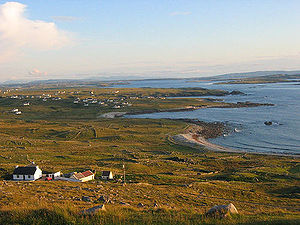
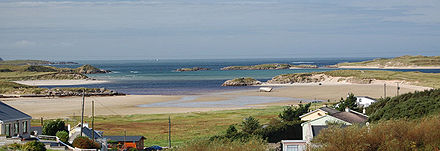
The Gweedore coastline consists of long sandy beaches and rugged cliffs. Also, off the Gweedore coastlines are many small islands, including Gola
, and Tory
. In the background a series of mountains, glens and bogs which have combined with the bracing weather to keep this part of the world relatively secluded.
in the locality. For many years the Lough Swilly
Railway Company
provided a bus service for the area, which transported people to places such as Letterkenny
and other surrounding parishes.
 Sport plays a very important role in the lives of the local people, sports such as Gaelic football
, soccer, golf
and various others are exercised religiously by locals both young and old. There is the local Gaelic Athletic Association
club CLG Ghaoth Dobhair (Gweedore GAA), that provides facilities in Machaire Gathlán for young Gaelic football hopefuls, the local golf club and voluntary soccer clubs Gweedore Celtic, Gweedore United, Glenea United and Dunlewey Celtic that take part in both county and national competitions. The local golf club is at Machaire Gathlán, which is also the home of Cumann na gCurrach, which organises currach races
.
Scottish soccer player Pat Crerand
's mother hailed from Gweedore, as did Aiden McGeady
's paternal grandparents. Both of them still spend a lot of time in the area.
r Mairéad Ní Mhaonaigh
. Gweedore's most successful musician is Enya
, born as Eithne Ní Bhraonáin; she first appeared on stage in Amharclann Ghaoth Dobhair
as a member of Clannad, before going on to become one of the world's biggest-selling artists, with sales exceeding 80 million. Other local singers include Aoife Ní Fhearraigh
, Brídín Brennan
, Na Casaidigh
, Proinsias Ó Maonaigh
, Gearóidín Breathnach, Seamus McGee and Maria McCool
. The well-known 1970s group Skara Brae also had strong links with the district. There are two active choirs in the area. Cór Mhuire Doirí Beaga, led by Baba Brennan and Eileen Nic Suibhne and Cór Thaobh 'a Leithid, led by Doimnic Mac Giolla Bhríde. Both have recorded successful albums.
The popular Frankie Kennedy Winter Music School takes part in Gweedore every new year in memory of the famous Belfast musician
who was married to Mairéad Ní Mhaonaigh, until he died of cancer in 1994.
The song "Gleanntáin Ghlas' Ghaoth Dobhair
" was written by local musician Francie Mooney, expressing an exile's final farewell to the green valleys of Gweedore. It has become a modern Irish classic and it has been covered by the likes of Clannad, Paul Brady
, Dáithí Sproule
, The Johnstons
and most notably by Altan. Other well-known songs to have come from the area are "Trasna na dTonnta
" and "Báidín Fheilimí
".
was constructed in 1961, however, a local theatre group known as Aisteoirí Ghaoth Dobhair (meaning 'Gweedore's actors') had established themselves in 1932. Their first production was called In Aimsir an Mháirtínigh, an original play by Eoghan Mac Giolla Bhríde which was staged in the parish hall in Derrybeg. Their plays and pantomimes, which were all staged in Irish
, became a staple of Gaeltacht social life, drawing audiences from as far as Belfast
and they performed throughout Ireland and Scotland
. Members of the theatre group have gone on to create TV shows including CU Burn, and have appeared on Ros na Rún
. It was in these pantomimes that saw all of Gweedore's musical talent make their debuts. Today, Aisteoirí Ghaoth Dobhair are still active and they performed shows at An Grianán Theatre
in Letterkenny as part of the Earagail Arts Festival
in 2010 and 2011.
parish of Gweedore has four churches: Teach Pobal Mhuire or St. Mary's in Derrybeg (built in 1972; after the previous 'old chapel' had flooded on many occasions), Teach Pobail an Chroí Naofa or Sacred Heart in Dunlewey (built in 1893), Teach Pobail Naomh Pádraig or St. Patrick's in Meenaweel (built in 1938) and finally, Séipéal Cholmcille or Columba's in Bloody Foreland (built in 1933). The only Protestant chapel in Gweedore is St. Patrick's Church of Ireland
, situated in Bunbeg.
and partly due to the provisions of the Official Languages Act 2003
, while both English and Irish versions of placenames are used, most road signage uses the Irish version exclusively.
Irish language
Irish , also known as Irish Gaelic, is a Goidelic language of the Indo-European language family, originating in Ireland and historically spoken by the Irish people. Irish is now spoken as a first language by a minority of Irish people, as well as being a second language of a larger proportion of...
-speaking district located on the Atlantic coast
Atlantic Ocean
The Atlantic Ocean is the second-largest of the world's oceanic divisions. With a total area of about , it covers approximately 20% of the Earth's surface and about 26% of its water surface area...
of County Donegal
County Donegal
County Donegal is a county in Ireland. It is part of the Border Region and is also located in the province of Ulster. It is named after the town of Donegal. Donegal County Council is the local authority for the county...
, part of the Province of Ulster
Ulster
Ulster is one of the four provinces of Ireland, located in the north of the island. In ancient Ireland, it was one of the fifths ruled by a "king of over-kings" . Following the Norman invasion of Ireland, the ancient kingdoms were shired into a number of counties for administrative and judicial...
in Ireland
Republic of Ireland
Ireland , described as the Republic of Ireland , is a sovereign state in Europe occupying approximately five-sixths of the island of the same name. Its capital is Dublin. Ireland, which had a population of 4.58 million in 2011, is a constitutional republic governed as a parliamentary democracy,...
. Gweedore stretches some 16 miles from Meenaclady in the north to Crolly in the south and around 9 miles from Dunlewey in the east to Magheraclogher in the west, and is Europe's most densely populated rural area. It's officially the largest Irish-speaking parish in Ireland with a population of around 4,065, and is also the home of the northwest regional studios of the Irish language radio service RTÉ Raidió na Gaeltachta
RTÉ Raidió na Gaeltachta
RTÉ Raidió na Gaeltachta , abbreviated RnaG, is the Irish-language radio service of the public-service broadcaster Raidió Teilifís Éireann. The station is available on FM in Ireland and via satellite and on the Internet.- History :...
, as well as an external campus of National University of Ireland, Galway
National University of Ireland, Galway
The National University of Ireland, Galway is a constituent university of the National University of Ireland...
. Gweedore consists of villages Bunbeg, Derrybeg, Dunlewey, Crolly and Brinalack, and it sits in the shade of Donegal
County Donegal
County Donegal is a county in Ireland. It is part of the Border Region and is also located in the province of Ulster. It is named after the town of Donegal. Donegal County Council is the local authority for the county...
's tallest peak Mount Errigal
Mount Errigal
Mount Errigal, or simply Errigal is a mountain near Gweedore in County Donegal, Republic of Ireland. It is the tallest peak of the Derryveagh Mountains, the tallest peak in County Donegal, and the 76th tallest peak in Ireland. Errigal is also the most southern, steepest and highest of the...
.
Gweedore is known for being a cradle of Irish culture, with old Irish customs, traditional music, theatre, Gaelic games
Gaelic games
Gaelic games are sports played in Ireland under the auspices of the Gaelic Athletic Association. The two main games are Gaelic football and hurling...
and the Irish language playing a central and pivotal role in the lives of the local people. This, along with its scenery and many beaches, has made the area a popular tourist destination, especially with visitors from Northern Ireland
Northern Ireland
Northern Ireland is one of the four countries of the United Kingdom. Situated in the north-east of the island of Ireland, it shares a border with the Republic of Ireland to the south and west...
. Gweedore lies between Cloughaneely
Cloughaneely
Cloughaneely is a district in the west of County Donegal, part of the Province of Ulster in Ireland. This is a mainly coastal area centred on the town of Falcarragh, and it is a Gaeltacht area, meaning the Irish language is spoken as the primary language...
and the Rosses
The Rosses
The Rosses is a geographical and social region in the west of County Donegal, Ireland, centred around the town of Dungloe, which acts as the educational, shopping and civil centre for the area...
, collectively known locally as the three parishes, together they form a social and cultural region distinct from the rest of the county, with Gweedore serving as the main centre for socialising and industry.
Name
The name Gweedore or Gaoth Dobhair refers to the Catholic parish of the same name, not to any one village or town. The villages of Bunbeg, Derrybeg, Dunlewey and others are collectively known as Gweedore. Locals consider themselves to be from Gweedore, only citing Derrybeg, Bunbeg etc. as mere postal addresses.Gaoth refers to an inlet of the sea at the mouth of the Crolly River, known as An Ghaoth. It is the boundary between Gweedore to the north and The Rosses
The Rosses
The Rosses is a geographical and social region in the west of County Donegal, Ireland, centred around the town of Dungloe, which acts as the educational, shopping and civil centre for the area...
to the south. Dobhar is an old Irish word for water. Gaoth Dobhair translates as the aqueous estuary.
Language
The predominantly spoken languageSpoken language
Spoken language is a form of human communication in which words derived from a large vocabulary together with a diverse variety of names are uttered through or with the mouth. All words are made up from a limited set of vowels and consonants. The spoken words they make are stringed into...
of the district is Irish, but English
English language
English is a West Germanic language that arose in the Anglo-Saxon kingdoms of England and spread into what was to become south-east Scotland under the influence of the Anglian medieval kingdom of Northumbria...
can be heard and understood as well. All schools, religious services and advertisements are through Irish. Every summer hundreds of students from all over Ireland attend Coláiste Cholmcille (Columcille's College) in order to further their knowledge and understanding of the Irish language
Irish language
Irish , also known as Irish Gaelic, is a Goidelic language of the Indo-European language family, originating in Ireland and historically spoken by the Irish people. Irish is now spoken as a first language by a minority of Irish people, as well as being a second language of a larger proportion of...
. This is a Gaeltacht
Gaeltacht
is the Irish language word meaning an Irish-speaking region. In Ireland, the Gaeltacht, or an Ghaeltacht, refers individually to any, or collectively to all, of the districts where the government recognises that the Irish language is the predominant language, that is, the vernacular spoken at home...
area, where the Irish language is the first spoken, providing an unbroken link with millennia of Irish history
History of Ireland
The first known settlement in Ireland began around 8000 BC, when hunter-gatherers arrived from continental Europe, probably via a land bridge. Few archaeological traces remain of this group, but their descendants and later Neolithic arrivals, particularly from the Iberian Peninsula, were...
and culture.
Multilingualism
Multilingualism is the act of using, or promoting the use of, multiple languages, either by an individual speaker or by a community of speakers. Multilingual speakers outnumber monolingual speakers in the world's population. Multilingualism is becoming a social phenomenon governed by the needs of...
and owing to this, the village has attracted some curious interest from both lexicographers and etymologists in the past. Some examples of these phrases and words are given below, with their standard English
Standard English
Standard English refers to whatever form of the English language is accepted as a national norm in an Anglophone country...
definitions:
- Bammy - adj. 1. Eccentric; daft. 2. Of exhibiting anger. [Alteration of the Eng. Barmy.]
- Shy (ball) - n. Used in place of the term 'throw-in' in association football (soccer). [Origin 'shy' in this context is a colloquial English term, meaning 'to throw' or toss, as in funfair Coconut shyCoconut shyA coconut shy is a traditional game, originally known as 'The love grove alley', frequently found as a sidestall at funfairs and fêtes. The game consists of throwing wooden balls at a row of coconuts balanced on posts. Typically a player buys three balls and wins each coconut successfully dislodged...
.] - Big wow - adj. pejorative An expression of contempt for an unimpressive action or idea. [Elsewhere used as a positive remark for something fantastic, remarkable]
(All these terms are in common use in the Glasgow
Glasgow
Glasgow is the largest city in Scotland and third most populous in the United Kingdom. The city is situated on the River Clyde in the country's west central lowlands...
area. Many natives of this part of Donegal
Donegal
Donegal or Donegal Town is a town in County Donegal, Ireland. Its name, which was historically written in English as Dunnagall or Dunagall, translates from Irish as "stronghold of the foreigners" ....
settled in the west of Scotland and there is still considerable interaction between the two places.)
- ailte or eáilte - Irish suff. Used to form a Gaelicised version of English verbs: wreckailte - tired. [Generally used in the context of an equivalent Irish word either not existing or rendering the sentence form incorrect.]
History
The Ulster Plantation in 1609 added a twist to the fate of the parish. Irish-speaking families who were driven from their fertile lands in the LaganLagan
Lagan may refer to:*River Lagan, river in Northern Ireland**Laganside Corporation, public body formed to regenerate the Lagan in Belfast**Lagan College, the first integrated school in Northern Ireland**Lagan Valley, valley in Northern Ireland...
and the surrounding areas made their way to the poor boglands of west Donegal. Some of them made it as far as Gweedore and could go no further west. Around the same time, English
English people
The English are a nation and ethnic group native to England, who speak English. The English identity is of early mediaeval origin, when they were known in Old English as the Anglecynn. England is now a country of the United Kingdom, and the majority of English people in England are British Citizens...
and Scottish
Scottish people
The Scottish people , or Scots, are a nation and ethnic group native to Scotland. Historically they emerged from an amalgamation of the Picts and Gaels, incorporating neighbouring Britons to the south as well as invading Germanic peoples such as the Anglo-Saxons and the Norse.In modern use,...
settlers began to arrive, when this uncharted territory was converted to baronies. It appears the parish was very sparsely populated up until the 17th century. The first people to arrive lived on the islands or by the shore in clusters, pockets of houses built close together and in each other's shade.
Up until the early 19th century the parish was only lightly populated and it seems the people had an amicable relationship with the landowners.
The standard of life was to deteriorate with the arrival of new landlords in the 19th century, in particular George Hill (1801–1879) and his son Arthur. The people of the parish led by Fr. James McFadden (Irish
Irish language
Irish , also known as Irish Gaelic, is a Goidelic language of the Indo-European language family, originating in Ireland and historically spoken by the Irish people. Irish is now spoken as a first language by a minority of Irish people, as well as being a second language of a larger proportion of...
: Séamus Mac Pháidín), the parish priest in 1875-1901, challenged the landlords with the founding of the Land League
Irish National Land League
The Irish Land League was an Irish political organization of the late 19th century which sought to help poor tenant farmers. Its primary aim was to abolish landlordism in Ireland and enable tenant farmers to own the land they worked on...
and the Plan Of Campaign. The killing by parishioners of District Inspector William Martin (or locally known as An Mháirtínigh) outside the local church, Teach Phobail Mhuire, in Derrybeg
Derrybeg
Doirí Beaga is a Gaeltacht village and townland in the civil parish of Tullaghobegly in County Donegal, Ireland. It includes a Roman Catholic church, RTÉ Raidió na Gaeltachta regional studios, a Gaelic Athletic Association club and a golf club.-References:...
on Sunday, the 3 February 1889, while trying to arrest Fr. McFadden with a drawn sword, was the climax of the Land War
Land War
The Land War in Irish history was a period of agrarian agitation in rural Ireland in the 1870s, 1880s and 1890s. The agitation was led by the Irish National Land League and was dedicated to bettering the position of tenant farmers and ultimately to a redistribution of land to tenants from...
in Gweedore. The case was recalled in the 1928 memoirs of Tim Healy, who defended some of the parishioners.
An Irish-American
Irish American
Irish Americans are citizens of the United States who can trace their ancestry to Ireland. A total of 36,278,332 Americans—estimated at 11.9% of the total population—reported Irish ancestry in the 2008 American Community Survey conducted by the U.S. Census Bureau...
journalist WH Hurlbert also investigated the landlord-and-tenant dispute in Gweedore in minute detail in his book "Ireland under Coercion", published in 1888.
Many books have been published in English, but mostly in Irish detailing Gweedore's rich history. One of the most prolific of local historians would be the late Cáit Nic Giolla Bhríde.
Freak storm
On the afternoon of Tuesday, 23 June 2009, a severe thunderstormThunderstorm
A thunderstorm, also known as an electrical storm, a lightning storm, thundershower or simply a storm is a form of weather characterized by the presence of lightning and its acoustic effect on the Earth's atmosphere known as thunder. The meteorologically assigned cloud type associated with the...
struck Gweedore.
It was centered on the adjoining villages of Bunbeg and Derrybeg, and lasted for several hours causing two rivers to burst their banks, flooding houses, shops and factories, ripping up roads and destroying bridges. Lightning which lasted for two hours damaged power lines
Electric power transmission
Electric-power transmission is the bulk transfer of electrical energy, from generating power plants to Electrical substations located near demand centers...
and caused a major breakdown of mobile phone
Mobile phone
A mobile phone is a device which can make and receive telephone calls over a radio link whilst moving around a wide geographic area. It does so by connecting to a cellular network provided by a mobile network operator...
signals, causing people trapped by the floods to be unable to communicate. Up to 20 houses were cut off from the outside world after three access bridges were carried away by the swollen rivers.
Described as the worst storm 'in living memory', it was also the most severe since 1880 when 5 people drowned in Derrybeg. Owing to the highly localised nature of the storm the areas of maximum rainfall missed the network of rain gauge
Rain gauge
A rain gauge is a type of instrument used by meteorologists and hydrologists to gather and measure the amount of liquid precipitation over a set period of time....
s but the Irish Meteorological Service estimate that between 2pm and 6pm up to 60mm of rain fell at the core.
Economy
In 2003, the estate was renamed as Páirc Ghnó Ghaoth Dobhair (Gweedore Business Park), and the Gaeltacht body, Údarás na Gaeltachta
Údarás na Gaeltachta
Údarás na Gaeltachta , abbreviated ÚnaG, is a regional state agency which is responsible for the economic, social and cultural development of nominally Irish-speaking regions of the Republic of Ireland...
, started a campaign to try to entice businesses to Gweedore in hope of reviving their lost economic stability. This worked to a certain extent, when Scottish company Contact 4 opened a call centre
Call centre
A call centre or call center is a centralised office used for the purpose of receiving and transmitting a large volume of requests by telephone. A call centre is operated by a company to administer incoming product support or information inquiries from consumers. Outgoing calls for telemarketing,...
on the estate, which provided more jobs in the community but subsequently closed. Other businesses include a few supermarkets, convenience store
Convenience store
A convenience store, corner store, corner shop, commonly called a bodega in Spanish-speaking areas of the United States, is a small store or shop in a built up area that stocks a range of everyday items such as groceries, toiletries, alcoholic and soft drinks, and may also offer money order and...
s, beauticians, hairdressers, contractors, garages, Pharmacists, pubs, cafes, and six well-established hotels, Ostan Gweedore, Seaview Hotel, Derrybeg Hotel, Teaċ Jack, An Chúirt Hotel and Foreland Heights.
Education
There are five primary schoolsPrimary education
A primary school is an institution in which children receive the first stage of compulsory education known as primary or elementary education. Primary school is the preferred term in the United Kingdom and many Commonwealth Nations, and in most publications of the United Nations Educational,...
in Gweedore, in the townlands of Derrybeg, Bunbeg, Mín an Chladaigh, Dobhar, and Luinneach. The only community school
Community school
The term "community school" refers to types of publicly funded school in England, Wales, the Republic of Ireland, the United States, Australia, Canada and New Zealand to a school that serves as both an educational institution and a centre of community life. A community school is both a place and a...
(post primary) is Pobalscoil Ghaoth Dobhair
Pobalscoil Ghaoth Dobhair
Pobalscoil Ghaoth Dobhair is an all Irish-speaking secondary school in Gweedore, Co Donegal. It has a pupil attendance of over 300 and is regarded as one of the most prominent Gaelic schools in Ireland....
, established in Luinneach in 1977, and is managed by headmaster Noel Ó Gallchóir. All these schools teach their students through the Irish language, and they sit their government exams in Irish. In 2004 National University of Ireland, Galway
National University of Ireland, Galway
The National University of Ireland, Galway is a constituent university of the National University of Ireland...
expanded to Gweedore when they opened Acadamh na hOllscolaíochta Gaeilge, providing third level education through the Irish language
Irish language
Irish , also known as Irish Gaelic, is a Goidelic language of the Indo-European language family, originating in Ireland and historically spoken by the Irish people. Irish is now spoken as a first language by a minority of Irish people, as well as being a second language of a larger proportion of...
to over 80 students every year. The new state-of-the-art Áislann Ghaoth Dobhair houses the local playschool and library.
Physical features
Gweedore is renowned for its distinct physical features. Probably the most recognisable feature is Errigal, the tallest mountain in County DonegalCounty Donegal
County Donegal is a county in Ireland. It is part of the Border Region and is also located in the province of Ulster. It is named after the town of Donegal. Donegal County Council is the local authority for the county...
, which overshadows the picturesque Dunlewey Lough
Dunlewey Lough
Lough Dunlewey is a lake in Gweedore, County Donegal, Ireland. It gets its name from the area in which it is situated, Dunlewey. It sits under the tallest peak in Co. Donegal, Mount Errigal. It also has a crannóg....
. It is surrounded by the deep glens and lakes of the Poisoned Glen, and further on, Glenveagh
Glenveagh
Glenveagh — covering 170 square kilometres of hillside above Glenveagh Castle on the shore of Lough Veagh , some 20 km from Gweedore in County Donegal, Ireland — forms the heart of the Glenveagh National Park , the second largest national park in Ireland...
national park
National park
A national park is a reserve of natural, semi-natural, or developed land that a sovereign state declares or owns. Although individual nations designate their own national parks differently A national park is a reserve of natural, semi-natural, or developed land that a sovereign state declares or...
and castle
Glenveagh Castle
Glenveagh Castle is a large castellated Mansion house built in the Scottish Baronial style within Glenveagh National Park, near both Churchill and Gweedore in County Donegal, Ireland...
, the largest national park in Ireland. Another landmark is 'Bád Eddie' (Eddie's Boat), Cara Na Mara("Friend of the Sea"), a shipwreck which has been situated on Magherclogher beach since the early 70s where it had run ashore due to rough seas.
The Gweedore coastline consists of long sandy beaches and rugged cliffs. Also, off the Gweedore coastlines are many small islands, including Gola
Gola Island
Gola is a small island off the coast of Gweedore, County Donegal, Ireland.Gola island is one kilometre off the coast of Gweedore. Its many beaches and secluded bays attract visitors throughout the year. The island was populated up until the mid 1960s...
, and Tory
Tory Island
Toraigh is an inhabited island 14.5 km off the northwest coast of County Donegal, Ireland. It is also known in Irish as Oileán Thoraigh, Oileán Thoraí or Oileán Thúr Rí.-Language:The main spoken language on the island is Irish, but English is also understood...
. In the background a series of mountains, glens and bogs which have combined with the bracing weather to keep this part of the world relatively secluded.
Transport
Gweedore railway station opened on 9 March 1903, closed for passenger traffic on 3 June 1940 and finally closed altogether on 6 January 1947. Coaches that operate from Gweedore include Collins Coaches Donegal to Glasgow,Feda Ó Dónaill, Coyle's Coaches, John McGinley, Patrick Gallagher Coaches, and Crónán Mac is available for private hireTaxicabs of the United Kingdom
Taxicabs are regulated throughout the United Kingdom, but the regulation of taxicabs in London is especially rigorous both with regard to mechanical integrity and driver knowledge. An official report observed that: "Little however is known about the regulation by anyone outside the trade...
in the locality. For many years the Lough Swilly
Lough Swilly
Lough Swilly in Ireland is a glacial fjord or sea inlet lying between the western side of the Inishowen Peninsula and the Fanad Peninsula, in County Donegal. Along with Carlingford Lough and Killary Harbour it is one of three known glacial fjords in Ireland....
Railway Company
Railway company
A railway company or railroad company is an entity that operates a railroad track and/or trains. Such a company can either be private or public...
provided a bus service for the area, which transported people to places such as Letterkenny
Letterkenny
Letterkenny , with a population of 17,568, is the largest town in County Donegal, part of the Province of Ulster in Ireland. The town is located on the River Swilly...
and other surrounding parishes.
- Gweedore Station on the Letterkenny & Burtonport Extension Railway (L&BER), a company jointly owned by the State and the Londonderry and Lough Swilly RailwayLondonderry and Lough Swilly RailwayThe Londonderry and Lough Swilly Railway Company is an Irish public transport and freight company incorporated in June 1853. Despite its name it operates no railway services. It formerly operated 99 miles of railways but closed its last line in July 1953...
(L&LSR).
Sport
Gaelic football
Gaelic football , commonly referred to as "football" or "Gaelic", or "Gah" is a form of football played mainly in Ireland...
, soccer, golf
Golf
Golf is a precision club and ball sport, in which competing players use many types of clubs to hit balls into a series of holes on a golf course using the fewest number of strokes....
and various others are exercised religiously by locals both young and old. There is the local Gaelic Athletic Association
Gaelic Athletic Association
The Gaelic Athletic Association is an amateur Irish and international cultural and sporting organisation focused primarily on promoting Gaelic games, which include the traditional Irish sports of hurling, camogie, Gaelic football, handball and rounders...
club CLG Ghaoth Dobhair (Gweedore GAA), that provides facilities in Machaire Gathlán for young Gaelic football hopefuls, the local golf club and voluntary soccer clubs Gweedore Celtic, Gweedore United, Glenea United and Dunlewey Celtic that take part in both county and national competitions. The local golf club is at Machaire Gathlán, which is also the home of Cumann na gCurrach, which organises currach races
Currach
A Currach is a type of Irish boat with a wooden frame, over which animal skins or hides were once stretched, though now canvas is more usual. It is sometimes anglicised as "Curragh". The construction and design of the currach is unique to the west coasts of Ireland and Scotland, with variations in...
.
Scottish soccer player Pat Crerand
Pat Crerand
Patrick Timothy "Paddy" Crerand is a Scottish-born former footballer of Irish descent. After six years at Celtic he moved to Manchester United where he was a member of teams that won the English League title twice, the FA Cup and European Cup...
's mother hailed from Gweedore, as did Aiden McGeady
Aiden McGeady
Aiden McGeady is a Scottish-born Irish footballer who currently plays as a winger for Russian club Spartak Moscow. Although born and brought up in Scotland, McGeady plays internationally for the Republic of Ireland, a country he qualifies for through his grandparents...
's paternal grandparents. Both of them still spend a lot of time in the area.
Arts & culture
Music
Gweedore is famed for its traditional Irish music scene, which is prevalent in local taverns, especially at Hiúdaí Beag's Tavern in Bunbeg. Gweedore has produced a number of well-known musicians. Clannad were formed in 1972, and have since gone on to sell over 15 million records. Altan (initially Ceoltóirí Altan) are another band from Gweedore that have put the area on the global stage, they are led by Coshclady fiddleFiddle
The term fiddle may refer to any bowed string musical instrument, most often the violin. It is also a colloquial term for the instrument used by players in all genres, including classical music...
r Mairéad Ní Mhaonaigh
Mairéad Ní Mhaonaigh
Mairéad Ní Mhaonaigh is an Irish fiddler and the lead vocalist for the Irish traditional band Altan.-Biography:Ní Mhaonaigh grew up in Gweedore , County Donegal, on the northwest coast of Ireland....
. Gweedore's most successful musician is Enya
Enya
Enya is an Irish singer, instrumentalist and songwriter. Enya is an approximate transliteration of how Eithne is pronounced in the Donegal dialect of the Irish language, her native tongue.She began her musical career in 1980, when she briefly joined her family band Clannad before leaving to...
, born as Eithne Ní Bhraonáin; she first appeared on stage in Amharclann Ghaoth Dobhair
Amharclann Ghaoth Dobhair
Amharclann Ghaoth Dobhair , anglicized as Gweedore Theatre, is a local theatre in the Gaeltacht region of Derrybeg in the parish of Gweedore, County Donegal, Ireland. It seats over 200 hundred patrons, and ever since it was opened by actress Siobhán McKenna, it has staged hundreds of plays in the...
as a member of Clannad, before going on to become one of the world's biggest-selling artists, with sales exceeding 80 million. Other local singers include Aoife Ní Fhearraigh
Aoife Ní Fhearraigh
Aoife is an Irish singer and composer, born in Gweedore , northwest County Donegal. She performs Traditional Irish and New Age music, in the style of other musicians native to the Donegal area like Clannad, Moya Brennan, Enya and Altan...
, Brídín Brennan
Brídín Brennan
Brídín Ní Bhraonáin , professionally known as Brídín Brennan, is an Irish pop singer from Dobhar , Gaoth Dobhair, County Donegal. She is the sister of Moya Brennan and Enya and has also toured with family-band Clannad.-Upbringing:...
, Na Casaidigh
Na Casaidigh
Na Casaidigh or The Cassidys in English are an Irish traditional group. They have been based in Dublin for many years, but they originally hail from Gweedore, County Donegal. The group consists of brothers Aongus, Seathrún, Ciarán, Fionntán, Feargus, and Odhrán...
, Proinsias Ó Maonaigh
Proinsias Ó Maonaigh
Proinsias Ó Maonaigh or Francie Mooney was a fiddler from Gweedore , County Donegal, Ireland. He is known for his distinguished fiddle playing and his unique and vast contribution to Irish music and culture....
, Gearóidín Breathnach, Seamus McGee and Maria McCool
Maria McCool
Maria McCool is an Irish singer from Gweedore, County Donegal. She is well known for her enchanting voice and her ability to perform old Irish songs in her native Irish and in English. Her albums include "Ailleog", which she covered such songs as Ar Éirinn Ní Neosfainn Cé Hí and Song For Ireland...
. The well-known 1970s group Skara Brae also had strong links with the district. There are two active choirs in the area. Cór Mhuire Doirí Beaga, led by Baba Brennan and Eileen Nic Suibhne and Cór Thaobh 'a Leithid, led by Doimnic Mac Giolla Bhríde. Both have recorded successful albums.
The popular Frankie Kennedy Winter Music School takes part in Gweedore every new year in memory of the famous Belfast musician
Frankie Kennedy
Frankie Kennedy was a flute and tin whistle player born in Belfast, Northern Ireland. He was also the co-founder of the band Altan, formed with his wife Mairéad Ní Mhaonaigh...
who was married to Mairéad Ní Mhaonaigh, until he died of cancer in 1994.
The song "Gleanntáin Ghlas' Ghaoth Dobhair
Gleanntáin Ghlas' Ghaoth Dobhair
"Gleanntáin Ghlas' Ghaoth Dobhair", is a song in the Irish language written by Irish musician Proinsias Ó Maonaigh, about his hometown of Gaoth Dobhair in County Donegal. It translates as "the green glens of Gweedore"...
" was written by local musician Francie Mooney, expressing an exile's final farewell to the green valleys of Gweedore. It has become a modern Irish classic and it has been covered by the likes of Clannad, Paul Brady
Paul Brady
Paul Joseph Brady is an Irish singer-songwriter, whose work straddles folk and pop. He was interested in a wide variety of music from an early age...
, Dáithí Sproule
Dáithí Sproule
Dáithí Sproule is a guitarist and singer of traditional Irish music from Derry, Northern Ireland. His niece is the singer songwriter Claire Sproule.-Biography:...
, The Johnstons
The Johnstons
The Johnstons were an Irish close-harmony folk band, originally founded in Slane, County Meath, Ireland, consisting of Adrienne, Lucy and Michael Johnston. They began performing in the early 1960s in Slane....
and most notably by Altan. Other well-known songs to have come from the area are "Trasna na dTonnta
Trasna na dTonnta
Trasna na dTonnta is a traditional Irish song often taught to primary school children. It is sung to the same tune as "Westering Home".The upbeat song is a narration of a rover who is returning to Ireland following his travels abroad....
" and "Báidín Fheilimí
Báidín Fheilimí
"Báidín Fheilimí" or sometimes "Báidín Fheidhlimidh" is a traditional Irish song which originates from the Gaeltacht region in the north-west of County Donegal, which is usually taught to young children...
".
Theatre
Gweedore has a rich history of theatre and drama productions. The local theatre Amharclann Ghaoth DobhairAmharclann Ghaoth Dobhair
Amharclann Ghaoth Dobhair , anglicized as Gweedore Theatre, is a local theatre in the Gaeltacht region of Derrybeg in the parish of Gweedore, County Donegal, Ireland. It seats over 200 hundred patrons, and ever since it was opened by actress Siobhán McKenna, it has staged hundreds of plays in the...
was constructed in 1961, however, a local theatre group known as Aisteoirí Ghaoth Dobhair (meaning 'Gweedore's actors') had established themselves in 1932. Their first production was called In Aimsir an Mháirtínigh, an original play by Eoghan Mac Giolla Bhríde which was staged in the parish hall in Derrybeg. Their plays and pantomimes, which were all staged in Irish
Irish language
Irish , also known as Irish Gaelic, is a Goidelic language of the Indo-European language family, originating in Ireland and historically spoken by the Irish people. Irish is now spoken as a first language by a minority of Irish people, as well as being a second language of a larger proportion of...
, became a staple of Gaeltacht social life, drawing audiences from as far as Belfast
Belfast
Belfast is the capital of and largest city in Northern Ireland. By population, it is the 14th biggest city in the United Kingdom and second biggest on the island of Ireland . It is the seat of the devolved government and legislative Northern Ireland Assembly...
and they performed throughout Ireland and Scotland
Scotland
Scotland is a country that is part of the United Kingdom. Occupying the northern third of the island of Great Britain, it shares a border with England to the south and is bounded by the North Sea to the east, the Atlantic Ocean to the north and west, and the North Channel and Irish Sea to the...
. Members of the theatre group have gone on to create TV shows including CU Burn, and have appeared on Ros na Rún
Ros na Rún
Ros na Rún is an Irish soap opera produced for Irish language TV channel TG4. It broadcasts for 35 weeks of the year, airing 2 episodes each week.It airs in Ireland, Scotland and the United States.-Show history:...
. It was in these pantomimes that saw all of Gweedore's musical talent make their debuts. Today, Aisteoirí Ghaoth Dobhair are still active and they performed shows at An Grianán Theatre
An Grianán Theatre
An Grianán Theatre , with a seating capacity of 383, is the largest theatre in Letterkenny and in the whole of County Donegal. It is located on Port Road in Letterkenny, across from The Oak Tree restaurant. It is run by Patricia McBride. It also boasts the largest stage in Ireland. An Grianán...
in Letterkenny as part of the Earagail Arts Festival
Earagail Arts Festival
The Earagail Arts Festival is an annual festival which takes place in County Donegal, part of the Province of Ulster in Ireland, every June/July...
in 2010 and 2011.
Religion
The CatholicCatholic
The word catholic comes from the Greek phrase , meaning "on the whole," "according to the whole" or "in general", and is a combination of the Greek words meaning "about" and meaning "whole"...
parish of Gweedore has four churches: Teach Pobal Mhuire or St. Mary's in Derrybeg (built in 1972; after the previous 'old chapel' had flooded on many occasions), Teach Pobail an Chroí Naofa or Sacred Heart in Dunlewey (built in 1893), Teach Pobail Naomh Pádraig or St. Patrick's in Meenaweel (built in 1938) and finally, Séipéal Cholmcille or Columba's in Bloody Foreland (built in 1933). The only Protestant chapel in Gweedore is St. Patrick's Church of Ireland
Church of Ireland
The Church of Ireland is an autonomous province of the Anglican Communion. The church operates in all parts of Ireland and is the second largest religious body on the island after the Roman Catholic Church...
, situated in Bunbeg.
Place names in Gweedore
Because Gweedore is in the GaeltachtGaeltacht
is the Irish language word meaning an Irish-speaking region. In Ireland, the Gaeltacht, or an Ghaeltacht, refers individually to any, or collectively to all, of the districts where the government recognises that the Irish language is the predominant language, that is, the vernacular spoken at home...
and partly due to the provisions of the Official Languages Act 2003
Official Languages Act 2003
The Official Languages Act 2003 is an Act of the Oireachtas of Ireland. The Official Languages Act sets out rules regarding use of the Irish language by public bodies, establishes the office of An Coimisinéir Teanga to monitor and enforce compliance by public bodies with the provisions of the...
, while both English and Irish versions of placenames are used, most road signage uses the Irish version exclusively.
Alphabetical listing
- Arduns (An tArd Donn)
- Ardnagappery (Ard na gCeapairí)
- Ballindrait (Baile an Droichid)
- Bloody Foreland (Cnoc Fola)
- Brinalack or Brinaleck (Bun an Leaca)
- Bunaninver (Bun an Inbhir)
- Bunbeg (An Bun Beag)
- Carrick (An Charraic)
- Carrickataskin (Carraig an tSeascain)
- Cotteen (Coitín or An Choiteann)
- CrollyCrollyCroithlí or Croichshlí is a village in the Gaeltacht parishes of Gweedore and the Rosses . The two parishes are separated by the picturesque Crolly River...
(Croichshlí or Croithlí) - Curransport (Port Uí Chuireáin)
- Derrybeg (Na Doirí Beaga or Doire Beag)
- Dore (Dobhar)
- Dunlewey (Dún Lúiche)
- Glassagh (Glaiseach or An Ghlaisigh)
- Glasserchoo (Glaise Chú)
- Glenhola (Gleann Ualach)
- Glentornan (Gleann Tornáin)
- Knockastolar (Cnoc an Stolaire)
- Lunniagh (Luinneach)
- Magheraclogher (Machaire Chlochair)
- Magheragallon or Magheragallen (Machaire Gathlán)
- Meenacladdy (Mín an Chladaigh)
- Meenacuing (Mín na Cuinge)
- Meenaleck (Mín Na Leice)
- Meenaniller (Mín an Iolair)
- Meenaweel (Mín Uí Bhaoill)
- Middletown (An Baile Láir)
- Sheskinbeg (Seascann Beag)
- Sleghan (An Sloitheán)
- Stranacorkra (Srath na Corcra)
- Torr (An Tor)
Islands
- GolaGola IslandGola is a small island off the coast of Gweedore, County Donegal, Ireland.Gola island is one kilometre off the coast of Gweedore. Its many beaches and secluded bays attract visitors throughout the year. The island was populated up until the mid 1960s...
(Gabhla) - Inishmen (Inis Meáin)
- Inishirhir (Inis Oirthear)
- Inishinny (Inis Sionnaigh)
- Umpin (Umthoinn)
- ToryTory IslandToraigh is an inhabited island 14.5 km off the northwest coast of County Donegal, Ireland. It is also known in Irish as Oileán Thoraigh, Oileán Thoraí or Oileán Thúr Rí.-Language:The main spoken language on the island is Irish, but English is also understood...
(Toraigh), although not directly situated off the coast of Gweedore, the main ferry crossings are from the area.
Notable people from Gweedore
- Aoife Ní FhearraighAoife Ní FhearraighAoife is an Irish singer and composer, born in Gweedore , northwest County Donegal. She performs Traditional Irish and New Age music, in the style of other musicians native to the Donegal area like Clannad, Moya Brennan, Enya and Altan...
, singer - Breandán de GallaíBreandán de GallaíBreandán de Gallaí is a professional Irish dancer, who is most famous for his lead role in Riverdance....
, dancer - Bríd RodgersBríd RodgersBríd Rodgers , born Bríd Stratford Bríd Rodgers (Irish: Bríd Mhic Ruairí), born Bríd Stratford Bríd Rodgers (Irish: Bríd Mhic Ruairí), born Bríd Stratford (born 20 February 1935, in Gweedore [Gaoth Dobhair], County Donegal, Ireland, is a former Irish nationalist politician....
, SDLP politician - Clannad, folk and New Age music group
- Cormac BreslinCormac BreslinCormac Breslin was an Irish Fianna Fáil politician. He was born in Gweedore, County Donegal. He was educated at St. Eunan's College, Letterkenny. He was first elected to the Dáil in 1937 as a Fianna Fáil TD for Donegal West. He was re-elected at every election until his retirement in 1977. He...
, former T.D and Ceann ComhairleCeann ComhairleThe Ceann Comhairle is the chairman of Dáil Éireann, the lower house of the Oireachtas of Ireland. The person who holds the position is elected by members of the Dáil from among their number in the first session after each general election... - Dinny McGinleyDinny McGinleyDenis "Dinny" McGinley is an Irish Fine Gael politician. He has been a Teachta Dála for the Donegal South West constituency since February 1982. He was appointed Minister of State for Gaeltacht Affairs by Taoiseach Enda Kenny on 10 March 2011.-Background:McGinley was born and brought up in...
, Fine Gael T.D and Minister of State - EnyaEnyaEnya is an Irish singer, instrumentalist and songwriter. Enya is an approximate transliteration of how Eithne is pronounced in the Donegal dialect of the Irish language, her native tongue.She began her musical career in 1980, when she briefly joined her family band Clannad before leaving to...
, musician and singer - James DuffyJames Duffy (VC)James Duffy was a British Army soldier during the First World War, and an Irish recipient of the Victoria Cross.Duffy was born on 17 November 1889 in Gweedore , County Donegal, Ireland....
, recipient of the Victoria CrossVictoria CrossThe Victoria Cross is the highest military decoration awarded for valour "in the face of the enemy" to members of the armed forces of various Commonwealth countries, and previous British Empire territories.... - John McColeJohn McColeJohn McCole was an Irish–born Scottish professional footballer who played in Scotland, England, Ireland, Wales and the United States.-Career:...
, soccer player - Mairéad Ní MhaonaighMairéad Ní MhaonaighMairéad Ní Mhaonaigh is an Irish fiddler and the lead vocalist for the Irish traditional band Altan.-Biography:Ní Mhaonaigh grew up in Gweedore , County Donegal, on the northwest coast of Ireland....
, musician and singer - Moya BrennanMoya BrennanMoya Brennan, born Máire Ní Bhraonáin , also known as Máire Brennan , is an Irish folk singer, songwriter, harpist, and philanthropist who began performing professionally in 1970, when her family formed the band Clannad, and is now widely considered as the "First Lady of Celtic Music"...
, musician and singer - Patrick O'DonnellPatrick O'Donnell (Invincible)Pádraig "Mhícheál Airt" Ó Domhnaill or Patrick O'Donnell, was an Irish republican who was responsible for killing James Carey, leader of the group that carried out the Phoenix Park Murders in Dublin, Ireland.- The Phoenix Park murders and Carey's death :On 6 May 1882, the most senior Irish civil...
, Irish Republican - Pearse DohertyPearse DohertyPearse Doherty is an Irish Sinn Féin politician. He serves as a Teachta Dála for the Donegal South West constituency and as Sinn Féin's Dáil spokesperson on Finance. Doherty formerly served on Donegal County Council from 2004–07 and in Seanad Éireann from 2007–10.-Background and education:Doherty...
, Sinn Féin T.D - Proinsias Ó MaonaighProinsias Ó MaonaighProinsias Ó Maonaigh or Francie Mooney was a fiddler from Gweedore , County Donegal, Ireland. He is known for his distinguished fiddle playing and his unique and vast contribution to Irish music and culture....
, musician - Seán Mac FhionnghaileSeán Mac FhionnghaileSeán McGinley , known as Seán Mac Fhionnghaile, was an Irish actor from County Donegal. He was known primarily for his comic roles, particularly for his leading roles in the TG4 sitcoms C.U. Burn and Gleann Ceo as well as RTÉ Raidió na Gaeltachta comedy series Cois Cuan...
, actor - Tarlach Mac SuibhneTarlach Mac SuibhneTarlach Mac Suibhne, better known as An Píobaire Mór was a legendary Irish piper from the 19th Century. He was born in County Donegal, and he is buried in Maghergallen cemetery, Gweedore....
, musician - Vincent CollMad Dog CollVincent "Mad Dog" Coll was an Irish mob hitman in 1920s New York City. Coll gained notoriety for the accidental killing of a young child during a mob kidnap attempt.-Early years:...
, prohibition gangster
See also
- Ulster IrishUlster IrishUlster Irish is the dialect of the Irish language spoken in the Province of Ulster. The largest Gaeltacht region today is in County Donegal, so that the term Donegal Irish is often used synonymously. Nevertheless, records of the language as it was spoken in other counties do exist, and help provide...
- List of towns and villages in Ireland
- GaeltachtGaeltachtis the Irish language word meaning an Irish-speaking region. In Ireland, the Gaeltacht, or an Ghaeltacht, refers individually to any, or collectively to all, of the districts where the government recognises that the Irish language is the predominant language, that is, the vernacular spoken at home...
- Gaoth Dobhair GAA