


Galwegian Gaelic

Encyclopedia
Galwegian Gaelic is an extinct dialect
of Scottish Gaelic formerly spoken in southwest Scotland
. It was spoken by the independent kings of Galloway
in their time, and by the people of Galloway
and Carrick
until the early modern period. It was once spoken in Annandale and Strathnith
. Little has survived of the dialect, so that its exact relationship with other Goidelic dialects is uncertain. It is also known as Gallovidian Gaelic, Gallowegian Gaelic and Galloway Gaelic etc.
and British. Old Irish can be traced in the Rhins of Galloway
from at least the fifth century. How it developed and spread is largely unknown. The Gaelicization of the land was complete probably by the eleventh century, although some have suggested a date as early as the beginning of the ninth century. The main problem is that this folk-movement is unrecorded in the historical sources, so it has to be reconstructed from things such as place-names. According to the placename studies of WFH Nicolaisen, formerly of the University of Edinburgh
, the earliest layer is represented by placenames with the prefix Sliabh- (often anglicized Slew- or Sla(e-) and Carraig (= a fishing station; anglicized as Carrick). This would make the settlement roughly contemporary with what was then Dál Riata
. The Gall-Gaidhel (the Gaelic Norse), who gave their name to the area appear to have settled in the ninth and tenth centuries. Many of the leading settlers would have been Norse speaking, but this would not appear to have been to the same extent as in other Norse-Gaelic regions, such as parts of the Hebrides
and Sutherland
-Caithness
.
It is quite possible that even as late as the twelfth century, Cumbric
(a Brythonic language
related to Welsh
) was still spoken in Annandale and lower Strathnith
(where a man called Gille Cuithbrecht has the Gaelic nickname Bretnach [=Welshman]), but these areas seem to have been thoroughly Gaelicized by the end of that century. A couple of legal terms also survive in medieval documents. The demise of Cumbric in the region is even harder to date than Gaelic.
The likely eastern limit reached by the language was the Annan
. The reason for that is that Gaelic placenames disappear quite rapidly after this boundary, although a handful of Gaelic names also appear in Cumbria
. In the north it was possibly cut off from other Scottish dialects in the 14th, if not the 13th century.
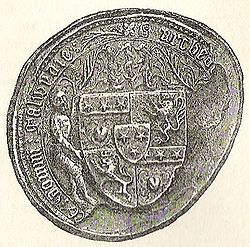 Gaelic-speakers in medieval Galloway, whom Richard of Hexham
erroneously called Picts
, had a fearsome reputation. They were the barbarians par excellence of the northern English Chroniclers, said, amongst other things, to have ripped babies out of their mother's wombs. It was reported that by Walter of Guisborough in 1296, that during a raid on Hexham Priory, the Galwegians under William Wallace
desecrated the shrine of St Andrew, cut off the head of the saint's statue, and threw relics into a fire.
Although Galloway was peripheral to Scotland
until 1234, in the aftermath of the rebellion of Gille Ruadh
and the dissolution of the Lordship, Galloway and Galwegians became critical. In many ways, the Scottish Wars of independence were just a Galwegian civil war, with the Bruces the successors of Gilla Brigte mac Fergusa
and the Balliols the successors of Uchtred mac Fergusa
.
Under the post-1234 Franco-Gaelic lorship were several powerful kin-groups, or clan
s, for instance, the MacLellans, the MacDowalls and the Kennedys of Carrick. It was probably through these groups that Galwegian society operated for the remainder of the Middle Ages
. Evidence for a clan system in the area can be found in medieval records - cineal (kindred) appears in such terms as "kenelman", and "kenkynol" (Ceann-cinneil); muinntir (household) appears in "Muntercasduff"; clan in "Clenafren", "Clanmacgowin" et al. A number of local surnames have Gaelic origins e.g. Landsburgh (originally McClambroch), MacClumpha, MacGuffock, Hannay, McKie, Kennedy and MacCulloch. The placenames Balmaclellan
and Balmaghie
may represent the site of chiefs' residences.
Evidence of a bardic class can be found in such placenames as Dervaird (Doire a' Bhaird) and Loch Recar (Loch an Reacaire).
Important information about local agriculture can be gleaned from placenames as well - shielings (àiridh) were in use e.g. Airies, Airieholland; manured infield from Talnotrie (talamh an otraigh) and Auchnotteroch. Gall-ghàidhil agriculture is indicated in the use of peighinn
and its subdivisions (q.v.), e.g. Pinminnoch, Leffin Donald, Fardin; Daugh and quarterland
(ceathramh) also appear, e.g. Doach, Kirriedarroch, Terraughty.
and Ulster Irish
than with Scottish Gaelic
as spoken in the Highlands
. This idea has in the past been used to disassociate Galwegian Gaelic from other Scottish dialects, for political purposes in fact. However, the idea is very misleading. All medieval Goidelic languages seem to have been mutually comprehensible. Perhaps the Gaelic dialect of the Isle of Arran
parallels the Galwegian language most, but this is purely speculative.
Gallowegian Gaelic may have borrowed certain words from Old English or Norse
. The influence of the Anglian Bishopric of Whithorn
, with the Norse Gall-Gaidhel, could explain the word cirice (O.E.)/ kirkja (O.N.) (=Church): see kirk
is used in so many placenames with Celtic second-elements and word order. Cirice/ kirkja occurs in medieval placenames where, in the rest of Scotland, we would expect Cille. Examples are legion. They include Kirkcormac, Kirkmikbrick, Kirkinner, Kirkcolm, Kirkcowan
, Kirkmabrick. In these names, the first word is Germanic and the second Gaelic. The word order is Celtic too, noun + adjective, rather than the Germanic adjective + noun (c/f Dùn Èideann and Edin-burgh). This is why we can be sure, for example, that Kirkcudbright
, etymologically entirely Germanic
, was in fact coined by a Celt. It is possible that this was a feature of the dialect, but it is also possible that most of these are the product of later English semi-translations.
Early English influence would not be surprising given the popularity of English saints. Kirkcudbright
, mentioned above, means Church of St Cuthbert. Closeburn
, earlier Killeosberne (Cille (Gd. Church) + of Osbern) is another. A plethora of personal names confirm the popularity of Anglo-Saxon
culture. For example, the name Gille Cuithbrecht (= Manx, Giolla Cobraght) means devotee of St Cuthbert. Another historical example is Gille Aldan
, the name of the first bishop of Galloway after the resurrection of that see by King Fergus
.
. The poem, written somewhere between 1504 and 1508 portrays an ideological, historical and cultural conflict between William Dunbar
(representing Lothian, and Anglian Scotland) and Walter Kennedy (representing Carrick and Gaelic Scotland). Dunbar ridicules Kennedy's Heland accent and Erische language, whilst Kennedy defends it, saying calling it "all trew Scottismennis leid" and telling Dunbar "in Ingland sowld be thy habitation." The importance is that, from a Lothian perspective in the early sixteenth century, Carrick and Galloway still represented Gaelic Scotland, just as Lothian did Anglian Scotland. Note also that Kennedy is referred to as "Heland" (Highland). Although Kennedy's surviving works are written in Middle Scots
he may also have composed in Gaelic. In the Flyting, for instance, Dunbar makes big play of Kennedy's Carrick
roots (albeit in the rankly insulting terms that are part of the genre) and strongly associates him with Erschry, which meant in other words the bard
ic tradition; the term Irish
in Scotland signified Gaelic generally:
Alexander Montgomerie
(1545? - 1610?) was also a Gaelic speaker, and was termed the "Hielant Captain"; various Gaelic terms and phrases can be found in his works.
George Buchanan
, himself a Gaelic speaker, writing in 1575, reports that Gaelic was still spoken in Galloway. In the middle of the century, 1563–1566, a report by an anonymous English military investigator informs us that the people of Carrick "for the most part specke erishe".
After this, there is much ambiguous and indirect evidence that the language was spoken, if only fragmentedly, into the eighteenth century. Margaret McMurray
(died 1760) is one of the last speakers we know of by name, although there are some suggestions that Alexander Murray
(1775-1813), the linguist, may have learnt it from his aged father who was a local upland shepherd.
It is safe to say, though, that the Galwegian language died out somewhere in the two-century period between 1600 and 1800, with the balance of evidence strongly indicating an effective disappearance in the seventeenth century. It is notable though, that nearby areas such as the Isle of Man
, east Ulster
(especially Rathlin Island
and the Glens of Antrim
) and Arran
all had native Gaelic speakers into the 20th century.
and Irish
Gaelic, Lowland Scots
and English. Another example of the modern legacy is the "Gall-Gael Trust" founded by Colin MacLeod.
Dialect
The term dialect is used in two distinct ways, even by linguists. One usage refers to a variety of a language that is a characteristic of a particular group of the language's speakers. The term is applied most often to regional speech patterns, but a dialect may also be defined by other factors,...
of Scottish Gaelic formerly spoken in southwest Scotland
Scotland
Scotland is a country that is part of the United Kingdom. Occupying the northern third of the island of Great Britain, it shares a border with England to the south and is bounded by the North Sea to the east, the Atlantic Ocean to the north and west, and the North Channel and Irish Sea to the...
. It was spoken by the independent kings of Galloway
Lords of Galloway
The Lords, or Kings of Galloway ruled over Galloway, in south west Scotland, for a large part of the High Middle Ages.Many regions of Scotland, including Galloway and Moray, periodically had kings or subkings, similar to those in Ireland during the Middle Ages. The Scottish monarch was seen as...
in their time, and by the people of Galloway
Galloway
Galloway is an area in southwestern Scotland. It usually refers to the former counties of Wigtownshire and Kirkcudbrightshire...
and Carrick
Carrick, Scotland
Carrick is a former comital district of Scotland which today forms part of South Ayrshire.-History:The word Carrick comes from the Gaelic word Carraig, meaning rock or rocky place. Maybole was the historic capital of Carrick. The county was eventually combined into Ayrshire which was divided...
until the early modern period. It was once spoken in Annandale and Strathnith
Nithsdale
Nithsdale , also known by its anglicised gaelic name Strathnith or Stranit, is the valley of the River Nith in Scotland, and the name of the region...
. Little has survived of the dialect, so that its exact relationship with other Goidelic dialects is uncertain. It is also known as Gallovidian Gaelic, Gallowegian Gaelic and Galloway Gaelic etc.
History and extent
Gaelicization in Galloway and Carrick occurred at the expense of Old EnglishOld English language
Old English or Anglo-Saxon is an early form of the English language that was spoken and written by the Anglo-Saxons and their descendants in parts of what are now England and southeastern Scotland between at least the mid-5th century and the mid-12th century...
and British. Old Irish can be traced in the Rhins of Galloway
Rhins of Galloway
The Rhins of Galloway is a hammer-head peninsula in Dumfries and Galloway, Scotland...
from at least the fifth century. How it developed and spread is largely unknown. The Gaelicization of the land was complete probably by the eleventh century, although some have suggested a date as early as the beginning of the ninth century. The main problem is that this folk-movement is unrecorded in the historical sources, so it has to be reconstructed from things such as place-names. According to the placename studies of WFH Nicolaisen, formerly of the University of Edinburgh
University of Edinburgh
The University of Edinburgh, founded in 1583, is a public research university located in Edinburgh, the capital of Scotland, and a UNESCO World Heritage Site. The university is deeply embedded in the fabric of the city, with many of the buildings in the historic Old Town belonging to the university...
, the earliest layer is represented by placenames with the prefix Sliabh- (often anglicized Slew- or Sla(e-) and Carraig (= a fishing station; anglicized as Carrick). This would make the settlement roughly contemporary with what was then Dál Riata
Dál Riata
Dál Riata was a Gaelic overkingdom on the western coast of Scotland with some territory on the northeast coast of Ireland...
. The Gall-Gaidhel (the Gaelic Norse), who gave their name to the area appear to have settled in the ninth and tenth centuries. Many of the leading settlers would have been Norse speaking, but this would not appear to have been to the same extent as in other Norse-Gaelic regions, such as parts of the Hebrides
Hebrides
The Hebrides comprise a widespread and diverse archipelago off the west coast of Scotland. There are two main groups: the Inner and Outer Hebrides. These islands have a long history of occupation dating back to the Mesolithic and the culture of the residents has been affected by the successive...
and Sutherland
Sutherland
Sutherland is a registration county, lieutenancy area and historic administrative county of Scotland. It is now within the Highland local government area. In Gaelic the area is referred to according to its traditional areas: Dùthaich 'IcAoidh , Asainte , and Cataibh...
-Caithness
Caithness
Caithness is a registration county, lieutenancy area and historic local government area of Scotland. The name was used also for the earldom of Caithness and the Caithness constituency of the Parliament of the United Kingdom . Boundaries are not identical in all contexts, but the Caithness area is...
.
It is quite possible that even as late as the twelfth century, Cumbric
Cumbric language
Cumbric was a variety of the Celtic British language spoken during the Early Middle Ages in the Hen Ogledd or "Old North", or what is now northern England and southern Lowland Scotland, the area anciently known as Cumbria. It was closely related to Old Welsh and the other Brythonic languages...
(a Brythonic language
Brythonic languages
The Brythonic or Brittonic languages form one of the two branches of the Insular Celtic language family, the other being Goidelic. The name Brythonic was derived by Welsh Celticist John Rhys from the Welsh word Brython, meaning an indigenous Briton as opposed to an Anglo-Saxon or Gael...
related to Welsh
Welsh language
Welsh is a member of the Brythonic branch of the Celtic languages spoken natively in Wales, by some along the Welsh border in England, and in Y Wladfa...
) was still spoken in Annandale and lower Strathnith
Nithsdale
Nithsdale , also known by its anglicised gaelic name Strathnith or Stranit, is the valley of the River Nith in Scotland, and the name of the region...
(where a man called Gille Cuithbrecht has the Gaelic nickname Bretnach [=Welshman]), but these areas seem to have been thoroughly Gaelicized by the end of that century. A couple of legal terms also survive in medieval documents. The demise of Cumbric in the region is even harder to date than Gaelic.
The likely eastern limit reached by the language was the Annan
River Annan
The River Annan is a river in southwest Scotland. It rises at the foot of Hart Fell, five miles north of Moffat. A second fork rises on Annanhead Hill and flows through the Devil's Beef Tub before joining at the Hart Fell fork north of Moffat.From there it flows past the town of Lockerbie, and...
. The reason for that is that Gaelic placenames disappear quite rapidly after this boundary, although a handful of Gaelic names also appear in Cumbria
Cumbria
Cumbria , is a non-metropolitan county in North West England. The county and Cumbria County Council, its local authority, came into existence in 1974 after the passage of the Local Government Act 1972. Cumbria's largest settlement and county town is Carlisle. It consists of six districts, and in...
. In the north it was possibly cut off from other Scottish dialects in the 14th, if not the 13th century.
Culture
Richard of Hexham
Richard of Hexham was an English chronicler. He became prior of Hexham about 1141, and died between 1155 and 1167.He wrote Brevis Annotatio, a short history of the church of Hexham from 674 to 1138, for which he borrowed from Bede, Eddius and Symeon of Durham...
erroneously called Picts
Picts
The Picts were a group of Late Iron Age and Early Mediaeval people living in what is now eastern and northern Scotland. There is an association with the distribution of brochs, place names beginning 'Pit-', for instance Pitlochry, and Pictish stones. They are recorded from before the Roman conquest...
, had a fearsome reputation. They were the barbarians par excellence of the northern English Chroniclers, said, amongst other things, to have ripped babies out of their mother's wombs. It was reported that by Walter of Guisborough in 1296, that during a raid on Hexham Priory, the Galwegians under William Wallace
William Wallace
Sir William Wallace was a Scottish knight and landowner who became one of the main leaders during the Wars of Scottish Independence....
desecrated the shrine of St Andrew, cut off the head of the saint's statue, and threw relics into a fire.
Although Galloway was peripheral to Scotland
Scotland
Scotland is a country that is part of the United Kingdom. Occupying the northern third of the island of Great Britain, it shares a border with England to the south and is bounded by the North Sea to the east, the Atlantic Ocean to the north and west, and the North Channel and Irish Sea to the...
until 1234, in the aftermath of the rebellion of Gille Ruadh
Gille Ruadh
Gille Ruadh was the Galwegian leader who led the revolt against King Alexander II of Scotland. Also called Gilla Ruadh, Gilleroth, Gilrod, Gilroy, etc....
and the dissolution of the Lordship, Galloway and Galwegians became critical. In many ways, the Scottish Wars of independence were just a Galwegian civil war, with the Bruces the successors of Gilla Brigte mac Fergusa
Gille Brigte, Lord of Galloway
Gille Brigte or Gilla Brigte mac Fergusa of Galloway , also known as Gillebrigte, Gille Brighde, Gilbridge, Gilbride, etc., and most famously known in French sources as Gilbert, was Lord of Galloway of Scotland...
and the Balliols the successors of Uchtred mac Fergusa
Uchtred, Lord of Galloway
Uchtred mac Fergusa was Lord of Galloway from 1161 to 1174, ruling jointly with his half-brother Gille Brigte...
.
Under the post-1234 Franco-Gaelic lorship were several powerful kin-groups, or clan
Clan
A clan is a group of people united by actual or perceived kinship and descent. Even if lineage details are unknown, clan members may be organized around a founding member or apical ancestor. The kinship-based bonds may be symbolical, whereby the clan shares a "stipulated" common ancestor that is a...
s, for instance, the MacLellans, the MacDowalls and the Kennedys of Carrick. It was probably through these groups that Galwegian society operated for the remainder of the Middle Ages
Middle Ages
The Middle Ages is a periodization of European history from the 5th century to the 15th century. The Middle Ages follows the fall of the Western Roman Empire in 476 and precedes the Early Modern Era. It is the middle period of a three-period division of Western history: Classic, Medieval and Modern...
. Evidence for a clan system in the area can be found in medieval records - cineal (kindred) appears in such terms as "kenelman", and "kenkynol" (Ceann-cinneil); muinntir (household) appears in "Muntercasduff"; clan in "Clenafren", "Clanmacgowin" et al. A number of local surnames have Gaelic origins e.g. Landsburgh (originally McClambroch), MacClumpha, MacGuffock, Hannay, McKie, Kennedy and MacCulloch. The placenames Balmaclellan
Balmaclellan
Balmaclellan is a small hillside village of stone houses with slate roofs in a fold of the Galloway hills in south-west Scotland...
and Balmaghie
Balmaghie
Balmaghie , from the Scottish Gaelic Baile Mac Aoidh, is a civil parish in Dumfries and Galloway, Scotland and was the seat of the McGhee family. It is bordered by the River Dee to the north and east...
may represent the site of chiefs' residences.
Evidence of a bardic class can be found in such placenames as Dervaird (Doire a' Bhaird) and Loch Recar (Loch an Reacaire).
Important information about local agriculture can be gleaned from placenames as well - shielings (àiridh) were in use e.g. Airies, Airieholland; manured infield from Talnotrie (talamh an otraigh) and Auchnotteroch. Gall-ghàidhil agriculture is indicated in the use of peighinn
Pennyland
A pennyland is an old Scottish land measurement. It was found in the West Highlands, and also Galloway, and believed to be of Norse origin. It is frequently found in minor placenames.Skene in Celtic Scotland says:The Rev...
and its subdivisions (q.v.), e.g. Pinminnoch, Leffin Donald, Fardin; Daugh and quarterland
Quarterland
A Quarterland or Ceathramh was a Scottish land measurement. It was used mainly in the west and north.It was supposed to be equivalent to eight fourpennylands, roughly equivalent to a quarter of a markland. However in Islay, a quarterland was equivalent to a quarter of an ounceland...
(ceathramh) also appear, e.g. Doach, Kirriedarroch, Terraughty.
Relationships to other languages
It is thought that Galwegian Gaelic probably had more in common with the ManxManx language
Manx , also known as Manx Gaelic, and as the Manks language, is a Goidelic language of the Indo-European language family, historically spoken by the Manx people. Only a small minority of the Island's population is fluent in the language, but a larger minority has some knowledge of it...
and Ulster Irish
Ulster Irish
Ulster Irish is the dialect of the Irish language spoken in the Province of Ulster. The largest Gaeltacht region today is in County Donegal, so that the term Donegal Irish is often used synonymously. Nevertheless, records of the language as it was spoken in other counties do exist, and help provide...
than with Scottish Gaelic
Scottish Gaelic language
Scottish Gaelic is a Celtic language native to Scotland. A member of the Goidelic branch of the Celtic languages, Scottish Gaelic, like Modern Irish and Manx, developed out of Middle Irish, and thus descends ultimately from Primitive Irish....
as spoken in the Highlands
Scottish Highlands
The Highlands is an historic region of Scotland. The area is sometimes referred to as the "Scottish Highlands". It was culturally distinguishable from the Lowlands from the later Middle Ages into the modern period, when Lowland Scots replaced Scottish Gaelic throughout most of the Lowlands...
. This idea has in the past been used to disassociate Galwegian Gaelic from other Scottish dialects, for political purposes in fact. However, the idea is very misleading. All medieval Goidelic languages seem to have been mutually comprehensible. Perhaps the Gaelic dialect of the Isle of Arran
Isle of Arran
Arran or the Isle of Arran is the largest island in the Firth of Clyde, Scotland, and with an area of is the seventh largest Scottish island. It is in the unitary council area of North Ayrshire and the 2001 census had a resident population of 5,058...
parallels the Galwegian language most, but this is purely speculative.
Gallowegian Gaelic may have borrowed certain words from Old English or Norse
Norse
Norse may refer to:In history:* Norsemen, the Scandinavian people before the Christianization of Scandinavia** Norse mythology** Norse paganism** Norse art** Norse activity in the British IslesIn language:...
. The influence of the Anglian Bishopric of Whithorn
Whithorn
Whithorn is a former royal burgh in Dumfries and Galloway, Scotland, about ten miles south of Wigtown. The town was the location of the first recorded Christian church in Scotland, Candida Casa : the 'White [or 'Shining'] House', built by Saint Ninian about 397.-Eighth and twelfth centuries:A...
, with the Norse Gall-Gaidhel, could explain the word cirice (O.E.)/ kirkja (O.N.) (=Church): see kirk
Kirk
Kirk can mean "church" in general or the Church of Scotland in particular. Many place names and personal names are also derived from it.-Basic meaning and etymology:...
is used in so many placenames with Celtic second-elements and word order. Cirice/ kirkja occurs in medieval placenames where, in the rest of Scotland, we would expect Cille. Examples are legion. They include Kirkcormac, Kirkmikbrick, Kirkinner, Kirkcolm, Kirkcowan
Kirkcowan
Kirkcowan is a village and parish in Dumfries and Galloway, Scotland.It is situated in the north of the Machars peninsula, about 7 miles south south west of Newton Stewart....
, Kirkmabrick. In these names, the first word is Germanic and the second Gaelic. The word order is Celtic too, noun + adjective, rather than the Germanic adjective + noun (c/f Dùn Èideann and Edin-burgh). This is why we can be sure, for example, that Kirkcudbright
Kirkcudbright
Kirkcudbright, is a town in Dumfries and Galloway, Scotland.The town lies south of Castle Douglas and Dalbeattie, in the part of Dumfries and Galloway known as the Stewartry, at the mouth of the River Dee, some six miles from the sea...
, etymologically entirely Germanic
Germanic languages
The Germanic languages constitute a sub-branch of the Indo-European language family. The common ancestor of all of the languages in this branch is called Proto-Germanic , which was spoken in approximately the mid-1st millennium BC in Iron Age northern Europe...
, was in fact coined by a Celt. It is possible that this was a feature of the dialect, but it is also possible that most of these are the product of later English semi-translations.
Early English influence would not be surprising given the popularity of English saints. Kirkcudbright
Kirkcudbright
Kirkcudbright, is a town in Dumfries and Galloway, Scotland.The town lies south of Castle Douglas and Dalbeattie, in the part of Dumfries and Galloway known as the Stewartry, at the mouth of the River Dee, some six miles from the sea...
, mentioned above, means Church of St Cuthbert. Closeburn
Closeburn, Dumfries and Galloway
Closeburn is a village and civil parish in Dumfries and Galloway, Scotland. The village is on the A76 road south of Thornhill. In the 2001 census, Closeburn had a population of 1,119,...
, earlier Killeosberne (Cille (Gd. Church) + of Osbern) is another. A plethora of personal names confirm the popularity of Anglo-Saxon
Anglo-Saxons
Anglo-Saxon is a term used by historians to designate the Germanic tribes who invaded and settled the south and east of Great Britain beginning in the early 5th century AD, and the period from their creation of the English nation to the Norman conquest. The Anglo-Saxon Era denotes the period of...
culture. For example, the name Gille Cuithbrecht (= Manx, Giolla Cobraght) means devotee of St Cuthbert. Another historical example is Gille Aldan
Gille Aldan
Gille Aldan , of Whithorn, was a native Galwegian who was the first Bishop of the resurrected Bishopric of Whithorn or Galloway. He was the first to be consecrated by the Archbishop of York, who at that time was Thurstan...
, the name of the first bishop of Galloway after the resurrection of that see by King Fergus
Fergus of Galloway
Fergus of Galloway was King, or Lord, of Galloway from an unknown date , until his death in 1161. He was the founder of that "sub-kingdom," the resurrector of the Bishopric of Whithorn, the patron of new abbeys , and much else besides...
.
1500 and after
An important source for the perception of Galwegian language is the poem known as The Flyting of Dunbar and KennedyThe Flyting of Dumbar and Kennedie
Schir Johine the Ros, ane thing thair is compild, also known as The Flyting of Dumbar and Kennedie, is the earliest surviving example of the Scottish version of the flyting genre in poetry. The genre takes the form of a contest, or "war of words", between two poets, each trying to outclass the...
. The poem, written somewhere between 1504 and 1508 portrays an ideological, historical and cultural conflict between William Dunbar
William Dunbar
William Dunbar was a Scottish poet. He was probably a native of East Lothian, as assumed from a satirical reference in the Flyting of Dunbar and Kennedie , where, too, it is hinted that he was a member of the noble house of Dunbar....
(representing Lothian, and Anglian Scotland) and Walter Kennedy (representing Carrick and Gaelic Scotland). Dunbar ridicules Kennedy's Heland accent and Erische language, whilst Kennedy defends it, saying calling it "all trew Scottismennis leid" and telling Dunbar "in Ingland sowld be thy habitation." The importance is that, from a Lothian perspective in the early sixteenth century, Carrick and Galloway still represented Gaelic Scotland, just as Lothian did Anglian Scotland. Note also that Kennedy is referred to as "Heland" (Highland). Although Kennedy's surviving works are written in Middle Scots
Middle Scots
Middle Scots was the Anglic language of Lowland Scotland in the period from 1450 to 1700. By the end of the 13th century its phonology, orthography, accidence, syntax and vocabulary had diverged markedly from Early Scots, which was virtually indistinguishable from early Northumbrian Middle English...
he may also have composed in Gaelic. In the Flyting, for instance, Dunbar makes big play of Kennedy's Carrick
Carrick, Scotland
Carrick is a former comital district of Scotland which today forms part of South Ayrshire.-History:The word Carrick comes from the Gaelic word Carraig, meaning rock or rocky place. Maybole was the historic capital of Carrick. The county was eventually combined into Ayrshire which was divided...
roots (albeit in the rankly insulting terms that are part of the genre) and strongly associates him with Erschry, which meant in other words the bard
Bard
In medieval Gaelic and British culture a bard was a professional poet, employed by a patron, such as a monarch or nobleman, to commemorate the patron's ancestors and to praise the patron's own activities.Originally a specific class of poet, contrasting with another class known as fili in Ireland...
ic tradition; the term Irish
Goidelic languages
The Goidelic languages or Gaelic languages are one of the two branches of the Insular Celtic languages, the other consisting of the Brythonic languages. Goidelic languages historically formed a dialect continuum stretching from the south of Ireland through the Isle of Man to the north of Scotland...
in Scotland signified Gaelic generally:
- Sic eloquence as thay in Erschry use,
- In sic is sett thy thraward appetyte.
- Thow hes full littill feill of fair indyte.
- I tak on me, ane pair of Lowthiane hippis
- Sall fairar Inglis mak and mair perfyte
- Than thow can blabbar with thy Carrik lippis.
- Such eloquence as they in Irishry [Gaeldom] use
- Is what defines your perverse taste.
- You have very small aptitude for good verse-making.
- I'll wager, a pair of LothianLothianLothian forms a traditional region of Scotland, lying between the southern shore of the Firth of Forth and the Lammermuir Hills....
hips - Shall fairer English make and more polished
- Than thou can blabber with thy CarrickCarrick, ScotlandCarrick is a former comital district of Scotland which today forms part of South Ayrshire.-History:The word Carrick comes from the Gaelic word Carraig, meaning rock or rocky place. Maybole was the historic capital of Carrick. The county was eventually combined into Ayrshire which was divided...
lips.
Alexander Montgomerie
Alexander Montgomerie
Alexander Montgomerie , Scottish Jacobean courtier and poet, or makar, born in Ayrshire. He was one of the principal members of the Castalian Band, a circle of poets in the court of James VI in the 1580s which included the king himself. Montgomerie was for a time in favour as one of the king's...
(1545? - 1610?) was also a Gaelic speaker, and was termed the "Hielant Captain"; various Gaelic terms and phrases can be found in his works.
George Buchanan
George Buchanan (humanist)
George Buchanan was a Scottish historian and humanist scholar. He was part of the Monarchomach movement.-Early life:...
, himself a Gaelic speaker, writing in 1575, reports that Gaelic was still spoken in Galloway. In the middle of the century, 1563–1566, a report by an anonymous English military investigator informs us that the people of Carrick "for the most part specke erishe".
After this, there is much ambiguous and indirect evidence that the language was spoken, if only fragmentedly, into the eighteenth century. Margaret McMurray
Margaret McMurray
Margaret McMurray appears to have been one of the last native speakers of a Lowland dialect of Scottish Gaelic in the Galloway variety....
(died 1760) is one of the last speakers we know of by name, although there are some suggestions that Alexander Murray
Alexander Murray (linguist)
Alexander Murray was a Scottish linguist and professor of Oriental languages in Edinburgh University Murray was born at Dunkitterick, Kirkcudbrightshire, and after graduating from Edinburgh University, became parish minister of Urr in his native shire...
(1775-1813), the linguist, may have learnt it from his aged father who was a local upland shepherd.
It is safe to say, though, that the Galwegian language died out somewhere in the two-century period between 1600 and 1800, with the balance of evidence strongly indicating an effective disappearance in the seventeenth century. It is notable though, that nearby areas such as the Isle of Man
Isle of Man
The Isle of Man , otherwise known simply as Mann , is a self-governing British Crown Dependency, located in the Irish Sea between the islands of Great Britain and Ireland, within the British Isles. The head of state is Queen Elizabeth II, who holds the title of Lord of Mann. The Lord of Mann is...
, east Ulster
Ulster
Ulster is one of the four provinces of Ireland, located in the north of the island. In ancient Ireland, it was one of the fifths ruled by a "king of over-kings" . Following the Norman invasion of Ireland, the ancient kingdoms were shired into a number of counties for administrative and judicial...
(especially Rathlin Island
Rathlin Island
Rathlin Island is an island off the coast of County Antrim, and is the northernmost point of Northern Ireland. Rathlin is the only inhabited offshore island in Northern Ireland, with a rising population of now just over 100 people, and is the most northerly inhabited island off the Irish coast...
and the Glens of Antrim
Glens of Antrim
The Glens of Antrim , known locally as simply The Glens, is a region of County Antrim, Northern Ireland. It comprises nine glens , that radiate from the Antrim Plateau to the coast. The Glens are an area of outstanding natural beauty and are a major tourist attraction in north Antrim...
) and Arran
Isle of Arran
Arran or the Isle of Arran is the largest island in the Firth of Clyde, Scotland, and with an area of is the seventh largest Scottish island. It is in the unitary council area of North Ayrshire and the 2001 census had a resident population of 5,058...
all had native Gaelic speakers into the 20th century.
Modern influence
Although Galwegian Gaelic has left no extant literature and has been extinct for several centuries, the Gaelic heritage of Galloway continues to be an inspiration to modern writers, such as William Neill, a poet who writes in ScottishScottish Gaelic language
Scottish Gaelic is a Celtic language native to Scotland. A member of the Goidelic branch of the Celtic languages, Scottish Gaelic, like Modern Irish and Manx, developed out of Middle Irish, and thus descends ultimately from Primitive Irish....
and Irish
Irish language
Irish , also known as Irish Gaelic, is a Goidelic language of the Indo-European language family, originating in Ireland and historically spoken by the Irish people. Irish is now spoken as a first language by a minority of Irish people, as well as being a second language of a larger proportion of...
Gaelic, Lowland Scots
Scots language
Scots is the Germanic language variety spoken in Lowland Scotland and parts of Ulster . It is sometimes called Lowland Scots to distinguish it from Scottish Gaelic, the Celtic language variety spoken in most of the western Highlands and in the Hebrides.Since there are no universally accepted...
and English. Another example of the modern legacy is the "Gall-Gael Trust" founded by Colin MacLeod.